R E S E A R C H A R T I C L E
Open Access
The association between attention deficit/
hyperactivity disorder and internet
addiction: a systematic review and
meta-analysis
Bing-qian Wang
1, Nan-qi Yao
2, Xiang Zhou
3, Jian Liu
4*and Zheng-tao Lv
5*Abstract
Background:This study aimed to analyze the association between Attention Deficit/Hyperactivity Disorder (ADHD)
and Internet addiction (IA).
Methods:A systematic literature search was performed in four online databases in total including CENTRAL,
EMBASE, PubMed and PsychINFO. Observational studies (case-control, cross-sectional and cohort studies) measuring the correlation between IA and ADHD were screened for eligibility. Two independent reviewers screened each article according to the predetermined inclusion criteria. A total of 15 studies (2 cohort studies and 13 cross-sectional studies) met our inclusion criteria and were included in the quantitative synthesis. Meta-analysis was conducted using RevMan 5.3 software.
Results:A moderate association between IA and ADHD was found. Individuals with IA were associated with more
severe symptoms of ADHD, including the combined total symptom score, inattention score and hyperactivity/ impulsivity score. Males were associated with IA, whereas there was no significant correlation between age and IA.
Conclusions:IA was positively associated with ADHD among adolescents and young adults. Clinicians and parents
should pay more attention to the symptoms of ADHD in individuals with IA, and the monitoring of Internet use of patients suffering from ADHD is also necessary. Longitudinal studies controlling for baseline mental health are needed.
Keywords:Internet addiction, Attention-deficit/hyperactivity disorder, Meta-analysis, Systematic review
Background
Internet addiction (IA), initially reported by Young [1], is considered as a new psychiatric disorder, but IA was still not listed as a clinical entity in the fifth edition of Diagnostic and Statistical Manual of Mental Disorders (DSM-5). People using Internet excessively and pathologically might suffer from adverse conse-quences, including arguments, fatigue, lying, poor
grading in school or vocational achievement during working, social isolation and even functional problems such as school failure, job loss and marriage failure [2]. The pathway from adaptive Internet use to IA is very complicate and ambiguous, which could be affected by many different factors including both indi-vidual and environment. It’s reported that IA was prevalent in both eastern and western countries. Be-cause of the different questionnaires, diagnostic cri-teria used, the prevalence of IA in different areas with different culture is different. It’s reported that the prevalence of IA ranges from 1% to 36.7% in a lit-erature review [3]. Given the large scale of Internet usage and so many negative consequences, it is important to un-tangle the potential risks associated with IA.
* Correspondence:[email protected];[email protected]; [email protected]
4Biological Engineering and Regenerative Medicine Center, Department of
Orthopedics, Tongji Hospital, Tongji Medical College, Huazhong University of Science and Technology, 1095#, Jiefang Avenue, Qiaokou District, Wuhan, Hubei 430030, China
5Department of Orthopedics, Tongji Hospital, Tongji Medical College,
Huazhong University of Science and Technology, 1095#, Jiefang Avenue, Qiaokou District, Wuhan, Hubei 430030, China
Full list of author information is available at the end of the article
© The Author(s). 2017Open AccessThis article is distributed under the terms of the Creative Commons Attribution 4.0
In a previously published systematic review about the association between IA and Attention Deficit/Hyper-activity Disorder (ADHD), positive correlations were confirmed after controlling covariates [4]. A 2-year pro-spective study found that adolescents diagnosed as ADHD were the most likely to be addicted to the Inter-net than other psychiatric symptoms such as hostility and social phobia [5]. However, it remains a matter of debate that if there were indeed any causalities between IA and ADHD., and the association could be explained from different aspects. For instance, in the biopsychoso-cial model, “being easily bored”and “having an aversion for delayed rewards” are two main ADHD symptoms [6, 7]. Internet use provides multiple windows with a variety of activities at the same time and immediate reward may decrease the boredom feeling and reward quickly, which makes people with ADHD addicted to Internet more easily. Furthermore, some researchers also found that subjects with ADHD have abnormal brain activities that would lead to impaired inhibition, which results in lack of self-control ability, so that Internet users would be-come more unable to restrain themselves and vulnerable to IA. Thus, ADHD could be a possible risk factor that may lead to IA.
Two well-established systematic reviews have sum-marized relevant articles on the relation of IA and psychiatric comorbidities, but their conclusions re-garding the association between IA and ADHD were hampered by the some methodological deficiencies and paucity of included studies, only five and four observational studies that reported odds ratio (OR) were included in two aforementioned studies respect-ively [4, 8]. The drawn conclusions were based upon ORs of unadjusted results, which could weaken the reliability of pooled results. As new evidence is emer-ging in recent years, it is necessary to perform an up-dated meta-analysis to reevaluate the association between IA and ADHD. Furthermore, our present study aims to assess the influence of IA on symptoms of ADHD, and to clarify the relationships between IA and demographic characteristics of enrolled participants.
Methods
This systematic review was conducted in accordance to the Meta-analysis Of Observational Studies in Epidemiology (MOOSE) guidelines [9].
Literature search
A comprehensive electronic literature search was con-ducted by using following databases: CENTRAL, EMBASE, PubMed and PsychINFO. Relevant articles published from inception to June 2016 were searched in databases above by two reviewers (B.Q. Wang and N.Q. Yao) independently and no language restriction
was imposed. Free text words and Medical Subject Headings (MeSH) were employed as search terms independently or in combination of according to specifications of each database.
The following searching strategy was utilized: (Internet addiction or problematic Internet use or Internet addic-tion disorder or pathological Internet use or Internet game addiction or excessive Internet use or compulsive Internet use or Internet dependency or computer
addiction) and (“Attention Deficit Disorder with
Hyperactivity”[Mesh] or ADHD or ADDH or Attention Deficit Disorder with Hyperactivity or Attention Deficit-Hyperactivity Disorder or Hyperkinetic Syndrome or Attention Deficit Hyperactivity Disorder or Attention Deficit Disorder). The bibliographies of relevant system-atic reviews and clinical guidelines were manually searched. References from each retrieved papers were also manually searched.
Types of participants
Patients diagnosed with IA by a standard criterion were recruited in IA group. The tools employed for the as-sessment of IA included CIAS [10], IAT [11], IAS [12], along with other well-established tools. No restriction on age, race and gender was imposed.
Types of control
Subjects without IA were included without other restrictions.
Outcome measures
The primary outcome was adjusted odds ratio (AOR), secondary outcome measures included crude odds ratio (COR) and parameters assessing the severity of symp-toms of ADHD. COR should be reported by included studies or could be calculated based upon raw data.
Types of included studies
Observational studies including cohort studies, case-control studies and cross-sectional studies without re-strictions on geographic area or sample size were included.
Exclusion criteria
Case series, case repots, book chapters, editorials and papers of conferences were excluded. Studies failed to report the diagnostic criteria of IA were excluded. Studies on pathologic internet use such as spending time and time to sleep but without a specific defin-ition of IA were also excluded. We also excluded case series, case reports and articles only studied the brain
imaging, electroencephalogram (EEG), treatments,
the relationship with ADHD. Studies with abstracts written in English language but with full-text in other languages were excluded. In addition, articles with only abstracts were also removed because detailed data could not be obtained so the methodologic qual-ity of them could not be assessed.
Data extraction
Two investigators (B.Q. Wang and N.Q. Yao) individu-ally reviewed each article and were blinded to the process and outcomes of each other. According to the inclusion criteria defined above, we implemented a strict screening to include articles with the eligibility. Data was also collected independently from these selected articles using the same collection form including first author, country, year of the publication, study design, source of cases, sample size in each group, mean age of all the en-rolled subjects, definition of IA and definition of ADHD, prevalence of ADHD in each group and scales used to assess the symptoms of ADHD. Any disagreement between the two reviewers was resolved through discus-sion until a consensus was reached. The third review author (Z.T. Lv) was consulted if an agreement could not be achieved.
Methodological quality assessment
The Newcastle-Ottawa Scale (NOS) [13] and an adapted form of NOS [14] were utilized to assess the methodo-logical quality of non-randomized studies in this
systematic review. Two reviewers assessed the methodo-logical qualities of each study independently, the results were compared afterwards.
Data synthesis and analysis
OR and the associated 95% confidence interval (CI) in each included studies were combined in order to
assess the possible association between IA and
ADHD. The standardized mean difference (SMD) as well as the associated 95% CI was both calculated for severity of ADHD and combined using the same method. Prevalence of ADHD in IA groups was also combined, and stratified analysis was made by two age groups. As included studies measured the out-comes using different scales, the random-effect model was used to conduct the statistical analysis. Hetero-geneity between studies was assessed by the Higgins I2 test (P > 0.1 and I2 < 50% indicate acceptable het-erogeneity) and a standard chi-square test. And the
heterogeneity outcomes showing P > 0.1 and
I2 < 50% could be acceptable.
Meta-regression analyses on age (≥18 years and
<18 years), ethnicity (Asian and European) and risk of bias (high, medium or low risk of bias) was imple-mented using Stata version 12.0 (Stata Corp LP, USA) to identify the probable cause of heterogeneity. Sensi-tivity analysis by removing each related study at a time was also made to evaluate the impact of each study on the pooled OR and the severity of ADHD
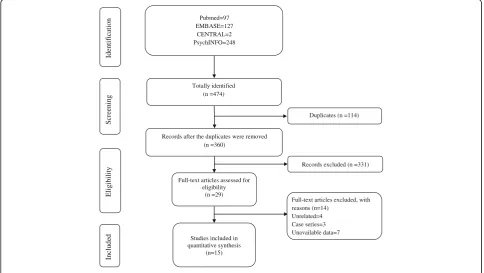
Totally identified (n =474) Pubmed=97 EMBASE=127
CENTRAL=2 PsychINFO=248
Records after the duplicates were removed (n =360)
Full-text articles assessed for eligibility
(n =29)
Studies included in quantitative synthesis
(n=15)
Duplicates (n =114)
Records excluded (n =331)
Full-text articles excluded, with reasons (n=14)
Unrelated=4 Case series=3 Unavailable data=7
n
oit
ac
ifi
t
ne
dI
Inc
luded
Eligibility
S
cre
ening
[image:3.595.56.541.446.719.2]symptoms. Begg’s rank correlation test and Egger’s linear regression test were used to evaluating the pub-lication bias. The forest plot was made by RevMan 5.3 (Copenhagen: The Nordic Cochrane Centre, The Cochrane Collaboration, 2014).
The effect size of association was expressed as small, moderate and large according to Cohen. OR was con-verted into these groups according to Chinn [15]. Cohen’s d was calculated based on original data from studies that did not provide OR. Thus, the effect sizes were explained as follow: small (Cohen’s d = 0.2, OR = 1.44), moderate (Cohen’s d = 0.5, OR = 2.48) and large (Cohen’s d = 0.8, OR = 4.27).
Results
Literature search
Three hundred sixty studies were identified using the search strategy, including 2 from CENTRAL, 127 from EMBASE, 97 records from PubMed and 248 from PsychINFO (Fig. 1). After excluding 114 duplicated stud-ies, a total of 360 articles were identified according to the present inclusion criteria. 29 potentially relevant studies were included in the systematic review and assessed by full-text. Among the remaining 29 articles, 3 case series were excluded, 4 studies were excluded cause they were not associated with the relationship be-tween IA and ADHD, 7 studies were removed because the outcome measures were unavailable. No additional studies were included through reference and biblio-graphic review. Finally, 15 studies were deemed eligible for the meta-analysis.
Main characteristics of included studies
Two cohort studies [16] and thirteen cross-sectional studies published from 2004 to 2016 were identified and included in our current study. The majority of studies
were conducted in Taiwan [16–21] and South Korea
[22–24], the remaining studies were performed in
Turkey [25–27], Sweden [28] and in the US [29]. Tar-geted population were either adolescents or young adults, both genders were evaluated in all studies. The
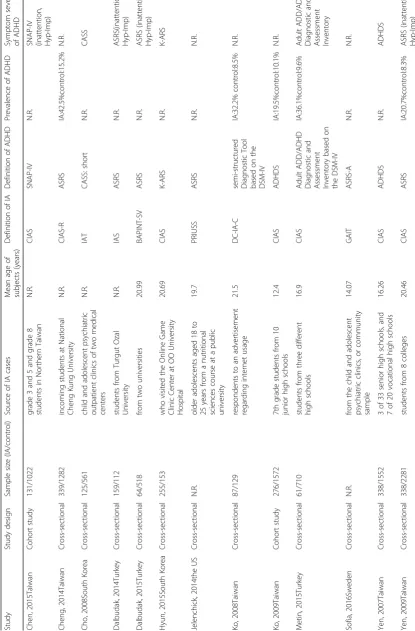
prevalence of ADHD in IA groups ranged from 19.5% to 42.5%, while the prevalence of ADHD in control groups ranged from 4.6% to 15.2%. Various scales or question-naires were employed for the assessment of IA: CIAS [10], CIAS-R [30], IAT [11], IAS [12], BAPINT-SV [31], PRIUSS [32], DC-IA-C [33], GAIT [34] and DSM-5; and ADHD: SNAP-IV [35], ASRS [36], CASS: short [37], CASS [37], K-ARS [38], ADHDS [39] and DSM-IV-TR. Main characteristics of included studies were summa-rized in Table 1.
Methodological quality
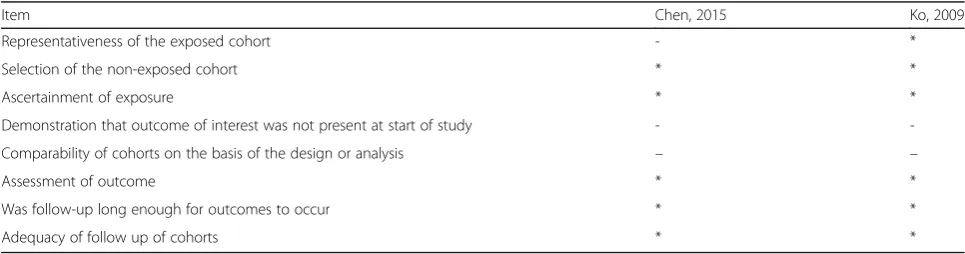
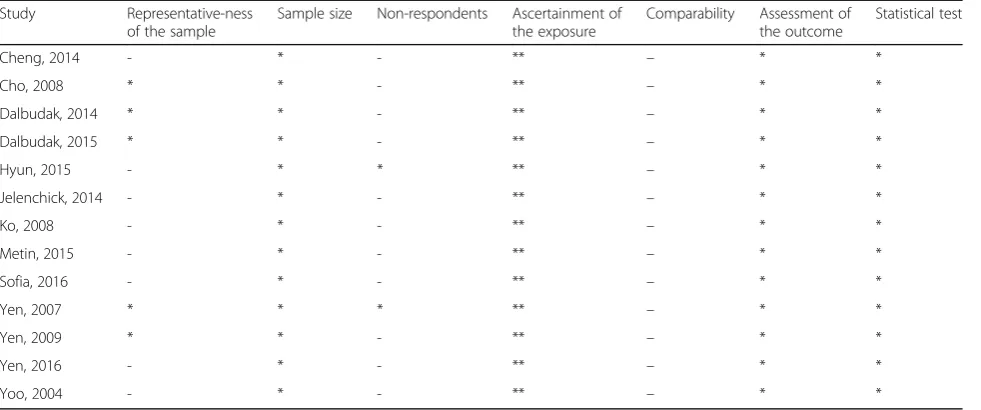
The NOS scale was used to assess the methodological quality in cohort studies, the adapted form of the NOS was utilized for the assessment of cross-sectional studies. Studies were categorized into low (scored 8–9), medium (scored 6–7), and high risk of bias groups (scored≤5). 8 studies [16–18, 21, 23, 27–29] were judged to high risk of bias, the remaining 7 studies [19, 20, 22, 24–26] were medium risk of bias. The detailed information about methodological quality assessment was presented in Ta-bles 2 and 3.
Evidence of association between IA and ADHD
Seven studies [17, 18, 20, 21, 23, 27] reported COR as outcome, 7 studies [17, 18, 20, 21, 28, 29] calcu-lated AOR after adjusting for potential confounders (gender, age, school bullying, family maltreatment, race, educational level, lifestyle factors, physical fac-tors, mental factors and social factors). All these stud-ies showed a consistency regarding the presence and direction of association, the prevalence of ADHD was found to be higher in IA subjects than in non-IA subjects amidst the selected study. The combination of COR showed a statistically significant correlation between IA and ADHD (OR 3.76, 95%CI 2.75, 5.15;
Tau2 = 0.11, Chi2 = 18.96; df = 6 (P = 0.004),
I2 = 68%), obvious heterogeneity between studies
[image:6.595.56.539.597.724.2]existed (Fig. 2). After controlling potential confound-ing factors, the pooled AOR indicated that patients with IA were 2.51 times more likely to be diagnosed
Table 2Methodological quality of cohort studies
Item Chen, 2015 Ko, 2009
Representativeness of the exposed cohort - *
Selection of the non-exposed cohort * *
Ascertainment of exposure * *
Demonstration that outcome of interest was not present at start of study -
-Comparability of cohorts on the basis of the design or analysis – –
Assessment of outcome * *
Was follow-up long enough for outcomes to occur * *
Adequacy of follow up of cohorts * *
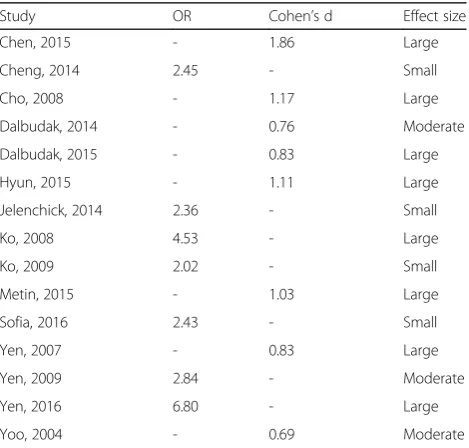
with ADHD when compared with non-IA subjects (OR 2.51, 95%CI 2.09, 3.02; Tau2 = 0.01, Chi2 = 6.55; df = 6 (P = 0.36), I2 = 8%), the heterogeneity across related studies was low (Fig. 3). The effect sizes were shown in Table 4, the association between IA and ADHD were small [17, 28, 29], moderate [20, 23, 25] or large [16, 18, 19, 21, 22, 24, 26, 27].
Age and IA
Seven studies [17, 18, 20, 21, 23, 27] reported prevalence of ADHD in IA groups. The combined prevalence showed that prevalence of ADHD in different age groups were similar: <18 years (prevalence 0.25, 95%CI 0.16, 0.33; Tau2= 0, Chi2= 6.24, df = 2 (P= 0.04), I2= 68%),
≥18 years (prevalence 0.23, 95%CI 0.08, 0.39; Tau2= 0.02, Chi2= 116.15, df = 2 (P< 0.00001), I2= 97%).
Among our selected studies, 7 [16, 19, 22, 23, 27, 28] targeted adolescents and the remaining 8 studies [17, 18, 20, 21, 24–26, 29] targeted young adults. The effect size of these studies were also similar, adolescents: 4 large, 1
moderate and 2 small; young adults: 4 large, 2 moderate and 2 small. In addition, 6 of our included studies deter-mined the association between age and IA, no study re-ported a statistically significant association between age and IA after controlling confounding factors.
Gender and IA
6 studies [16, 18, 19, 21, 28] reported significant gender difference, the prevalence of IA was significantly higher in male subjects than female. No study found higher rate of IA in females.
IA and symptoms of ADHD
[image:7.595.57.548.99.304.2]Nine studies [16, 19, 21–27] evaluated severity of symptoms in ADHD using series of scales. The com-bination of total score showed that the overall sever-ity of symptoms of ADHD in IA groups were significantly worse than healthy control (SMD 1.15, 95%CI 0.84, 1.46; Tau2 = 0.21; Chi2 = 187.81, df = 8 (P < 0.00001); I2 = 96%) (Fig. 4). The symptoms of Table 3Methodological quality of cross-sectional studies
Study Representative-ness
of the sample
Sample size Non-respondents Ascertainment of the exposure
Comparability Assessment of the outcome
Statistical test
Cheng, 2014 - * - ** – * *
Cho, 2008 * * - ** – * *
Dalbudak, 2014 * * - ** – * *
Dalbudak, 2015 * * - ** – * *
Hyun, 2015 - * * ** – * *
Jelenchick, 2014 - * - ** – * *
Ko, 2008 - * - ** – * *
Metin, 2015 - * - ** – * *
Sofia, 2016 - * - ** – * *
Yen, 2007 * * * ** – * *
Yen, 2009 * * - ** – * *
Yen, 2016 - * - ** – * *
Yoo, 2004 - * - ** – * *
A study could be awarded a maximum of one star for each item except for the item Comparability
[image:7.595.60.539.609.720.2]inattention (SMD 0.84, 95%CI 0.65, 1.02; Tau2 = 0.03;
Chi2 = 16.73, df = 4 (P = 0.002); I2 = 76%) and
hyperactivity/impulsivity (SMD 0.85, 95%CI 0.65, 1.04; Tau2= 0.04; Chi2= 19.30, df = 4 (P= 0.0007); I2= 79%) in IA groups were also significantly more serious than that in health control groups (Figs. 5 and 6).
Meta-regression and sensitivity analysis
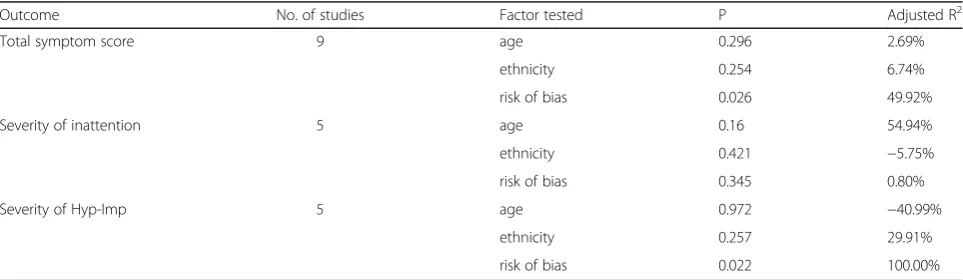
Meta-regression was conducted by residual (restricted) maximum likelihood (REML) with Knapp-Hartung modification to find the potentially possible source of heterogeneity in severity of symptoms of ADHD, the re-sults of meta-regression by age, ethnicity and risk of bias were presented in Table 5. However, neither age pattern nor ethnicity was not significantly associated with the heterogeneity between studies. Risk of bias of included studies could be a potential source of heterogeneity in the total symptom score and severity of hyperactivity-impulsivity (Table 5).
In the severity of symptoms ADHD, studies with high risk of bias (SMD 1.60, 95%CI 1.07, 2.13; Tau2 = 0.21; Chi2= 46.11, df = 2 (P< 0.00001); I2= 96%) had signifi-cantly higher total score when compared with studies with medium risk of bias (SMD 0.93, 95%CI 0.77, 1.09; Tau2= 0.03; Chi2= 18.84, df = 5 (P= 0.002); I2= 73%). In the severity of hyperactivity/impulsivity, studies with high risk of bias (SMD 1.06, 95%CI 0.96, 1.16; Tau2= 0.00; Chi2= 0.20, df = 1 (P = 0.66); I2= 0%) had significantly higher score than studies with medium risk
of bias (SMD 0.67, 95%CI 0.53, 0.82; Tau2 = 0.00;
Chi2= 0.13, df = 2 (P = 0.94); I2 = 0%). When studies with high risk of bias were removed from meta-analyses, the overall symptom and hyperactivity/impulsivity in IA groups were still significantly more serious than that in health control groups. Sensitivity analysis contrib-uted to the stability of resulting effects (detailed data not shown).
Publication bias
Publication bias was detected using Begg’s rank correl-ation test and Egger’s linear regression test, the results were shown in Table 6. A publication bias in the severity of hyperactivity/impulsivity was found.
Discussion
In summary, the finding of our present study suggested a positive association between IA and ADHD even after controlling confounding factors, symptoms of ADHD in IA groups were more severe than control groups. Male adolescents and young adults were more likely to be di-agnosed with IA, but age pattern was not positively asso-ciated with IA in our included studies. Evidence support a causal relation between IA and ADHD is still lacking.
[image:8.595.60.540.88.206.2]To the best of our knowledge, this is the first meta-analysis to individually investigate the association be-tween IA and ADHD with consideration of hetero-geneity while the previously published articles were systematic reviews about IA and several psychiatric co-morbidities [4, 8] or narrative literature review about the association between Internet gaming dis-order and ADHD [40]. In two previously published Fig. 3Forest plot of adjusted OR
Table 4Estimated effect sizes of included studies
Study OR Cohen’s d Effect size
Chen, 2015 - 1.86 Large
Cheng, 2014 2.45 - Small
Cho, 2008 - 1.17 Large
Dalbudak, 2014 - 0.76 Moderate
Dalbudak, 2015 - 0.83 Large
Hyun, 2015 - 1.11 Large
Jelenchick, 2014 2.36 - Small
Ko, 2008 4.53 - Large
Ko, 2009 2.02 - Small
Metin, 2015 - 1.03 Large
Sofia, 2016 2.43 - Small
Yen, 2007 - 0.83 Large
Yen, 2009 2.84 - Moderate
Yen, 2016 6.80 - Large
Yoo, 2004 - 0.69 Moderate
[image:8.595.57.292.490.714.2]systematic reviews, only few studies reporting OR as outcome were included for meta-analysis. The ex-tracted ORs were pooled without differentiating COR and AOR, which might lead to an exaggeration or underestimation of the correlations between IA and ADHD. Thus, the conclusions drawn by aforemen-tioned studies should be interpreted with caution. The results of our current work were powered by sufficient number of included studies and rigorous methodological quality assessment by independent re-viewers. Both dichotomous variables and continuous variables were taken into consideration by our study, which greatly fill the blank of now-existing literature. In addition, the magnitude of effect size across stud-ies was compared according to Cohen.
ADHD patients have poor self-control ability, so they’re more easily to sustain an addiction to substances as well as Internet. But studies have reported that striatal dopamine could help game users focus and gain better performance while playing Internet games [41], which let ADHD patients compensate for the failure in real-life and prefer into the virtual world. Compared with real life, Internet users would get response, reward and es-tablish interpersonal relationships more easily online. Our results demonstrated that patients with IA were present with more severe symptoms of ADHD than healthy control, so that IA may also have influence on ADHD. Ko and colleagues reported that ADHD could predict the occurrence of IA in the 2-year follow-up. Chen et al. [16] also reported that high ADHD symp-toms were significantly associated with the occurrence of IA. In summary, IA and ADHD may interact with
each other. However, evidence supporting a causality be-tween IA and ADHD is still lacking, only two included studies were based on a prospective design. The causal-ity between both entities is still a matter of debate.
The majority of our included studies suggested moder-ate and strong associations between IA and ADHD. The obviously observed heterogeneity (I2= 68%) in combin-ation of COR suggested that demographic factors and other social or family factors could possibly affect the as-sociation, this hypothesis was partially verified by the low heterogeneity in pooled AOR (I2= 8%). We further undertook meta-regression by age, ethnicity and meth-odological quality to determine whether they
contrib-uted to the heterogeneity in symptoms score,
methodological quality of included studies was found to be associated with heterogeneity across studies. Thus, prospective cohort studies with high methodological quality are required.
The risk of addiction to Internet was higher among males than females, which might be explained by two reasons. Firstly, more males than females tend to seek self-esteem feelings and make social contacts online. Secondly, girls may receive more close supervision re-garding internet use than boys in a family. Studies found that inattention was the most associated symptoms of ADHD among young adults and more significant in fe-male adults.
Except for gender difference, other factors for IA such as low family support, protective parenting style, poor grading in school, bad interpersonal ability [42] might predict IA. These predicting factors found could be spe-cifically targeted when designing the prevention program Fig. 4Forest plot of total symptom score
[image:9.595.59.540.87.205.2] [image:9.595.57.540.634.725.2]for IA among the children and adolescent population. On the other hand, these factors might be confounders that could affect the association between IA and ADHD, which should be controlled in more prospective cohort studies in the future. Studies showed that 65% children having ADHD during childhood had persistent ADHD symptoms till their adulthood [43]. Adult ADHD brings many negative effects but is seldom known by public [44]. Thus, ADHD patients should be very significant target group for the prevention for IA.
An interesting phenomenon observed in our study is that most included studies were performed in Asian countries. It was reported in a study of Zhang et al. [45] that IA was more prevalent in some Asian countries than in the United States. A possible reason might be the differences in socio-cultural background [46]. Unlike in Asia, where Internet cafés are easily accessible and frequently used, in the US games and virtual sex are accessed from the home. Further-more, attempts to evaluate the phenomenon are impeded by shame, denial, and minimization [47]. However, this ex-planation should be confirmed in further studies.
Given the results found in the current study, problems of IA, ADHD as well as the comorbidity conditions are required to get more concern of public health. Govern-ment should look for effective prevention policies and strategies to reduce the related health risks and negative outcomes. First, IA was identified as an emerging public health issue in both South Korea and China, as well as Taiwan. But until now, the scope of a universal definition of
IA is still absent. A standard terminology as well as diag-nostic criterion should be established and the cross-cultural validity should be examined to enable international com-parisons. Secondly, according to the results of our current study, age was not associated with IA, which suggested that both adolescents and young adults should be targeted for the IA prevention. Last but not least, until now, although the significant relationship between IA and ADHD was proved, whether the ADHD is the risk factor of IA or a co-morbidity is still unknown. It’s suggested that the comor-bidity disease should be cautiously screened if diagnosed one of them. ADHD symptoms should be carefully pre-vented and early identified among at-risk subjects and their families by effective strategies.
There were several limitations in our study. Firstly, only two prospective cohort studies conducted in Taiwan were included in our study [16], definite conclu-sion about the causal relationship between ADHD and IA could not be drawn. Secondly, homogeneous geo-graphic distribution and lack of a universal diagnostic
criterion for IA are two primary problems still
[image:10.595.63.538.87.181.2]remaining. The prevalence of IA is inconsistent across included studies, except for cultural reasons and sample selection, the varying questionnaires and thresholds employed may contribute to the variations in these re-sults. Seven of our included studies used CIAS criteria to diagnose IA with the cut-off point of 64 (accuracy 87.6%, specificity 92.6%). But to what extend could dif-ferent questionnaires and thresholds employed influence Fig. 6Forest plot of hyperactivity/impulsivity score
Table 5Metaregression of basic characteristics of trials and severity of symptoms in ADHD
Outcome No. of studies Factor tested P Adjusted R2
Total symptom score 9 age 0.296 2.69%
ethnicity 0.254 6.74%
risk of bias 0.026 49.92%
Severity of inattention 5 age 0.16 54.94%
ethnicity 0.421 −5.75%
risk of bias 0.345 0.80%
Severity of Hyp-Imp 5 age 0.972 −40.99%
ethnicity 0.257 29.91%
risk of bias 0.022 100.00%
[image:10.595.57.539.583.723.2]the prevalence of IA could not be addressed by our current study. More studies need to be carried out in other geographic areas of the world for comparisons among different cultures, when using unified diagnostic criteria. Lastly, many of our included studies had recruit-ment bias because the method of sampling was highly selective, the conclusions could not be generalized to community population. Within the fifteen included stud-ies, eight were evaluated with high risk of bias and seven had medium risk of bias. Thus the results should be interpreted cautiously.
Conclusion
Taken together, our results demonstrated a moderate as-sociation between IA and ADHD in adolescents and young adults, patients with IA were present with more severe symptoms of ADHD than healthy control. More attention should be paid by parents and clinicians to pa-tients with Internet addiction, and the symptoms of ADHD should be carefully evaluated. To address the causality between IA and ADHD, topic about whether treating ADHD could affect the Internet use behaviors should be systematically evaluated. On the other hand, future prospective cohort studies are encouraged to in-vestigate whether treating IA would benefit or deterior-ate the severity of ADHD.
Abbreviations
ADDH:Attention Deficit Disorder with Hyperactivity; ADHD: Attention Deficit/ Hyperactivity Disorder; AOR: Adjusted odds ratio; CI: Confidence interval; COR: Crude odds ratio; DSM-5: the fifth edition of Diagnostic and Statistical Manual of Mental Disorders; EEG: Electroencephalogram; IA: Internet addiction; MeSH: Medical Subject Heading; MOOSE: Meta-Analysis of Observational Studies in Epidemiology; NOS: Newcastle-Ottawa Scale; OR: Odds ratio; REML: Residual (restricted) maximum likelihood; SMD: Standardized mean difference
Acknowledgements
We wish to thank Michael Ni for his assistance in drafting and revising the manuscript.
Funding
None.
Availability of data and materials
CENTRAL, EMBASE, PubMed and PsychINFO.
Authors’contributions
B-qW and Z-tL produced the idea to this analysis and made the final version of this paper. B-qW and N-q Y did the literature search and evaluated the data. XZ and Z-tL critically revised this manuscript. JL was involved in revising the manuscript, including some important intellectual contents and the grammatical mistakes in our original study, he was also responsible for the accuracy of data. All authors read and approved the final manuscript.
Ethics approval and consent to participate
Not applicable.
Consent for publication
Not applicable.
Competing interests
The authors declare that they have no competing interests.
Publisher’s Note
Springer Nature remains neutral with regard to jurisdictional claims in published maps and institutional affiliations.
Author details 1
First Clinical College, Union Hospital, Tongji Medical College, Huazhong University of Science and Technology, Wuhan, Hubei, China.2School of Public Health, Faculty of Medicine, University of Hong Kong, Hong Kong, China.3University of Heidelberg, Heidelberg, Germany.4Biological Engineering and Regenerative Medicine Center, Department of Orthopedics, Tongji Hospital, Tongji Medical College, Huazhong University of Science and Technology, 1095#, Jiefang Avenue, Qiaokou District, Wuhan, Hubei 430030, China.5Department of Orthopedics, Tongji Hospital, Tongji Medical College, Huazhong University of Science and Technology, 1095#, Jiefang Avenue, Qiaokou District, Wuhan, Hubei 430030, China.
Received: 10 March 2017 Accepted: 29 June 2017
References
1. Young KS. Psychology of computer use: XL. Addictive use of the internet: a case that breaks the stereotype. Psychol Rep. 1996;79(3 Pt 1): 899–902.
2. Weinstein A, Lejoyeux M. Internet addiction or excessive internet use. Am J Drug Alcohol Abuse. 2010;36(5):277–83.
3. Ko CH, Yen JY, Yen CF, Chen CS, Chen CC. The association between internet addiction and psychiatric disorder: a review of the literature. Eur Psychiatry. 2012;27(1):1–8.
4. Carli V, Durkee T, Wasserman D, Hadlaczky G, Despalins R, Kramarz E, Wasserman C, Sarchiapone M, Hoven CW, Brunner R, et al. The association between pathological internet use and comorbid psychopathology: a systematic review. Psychopathology. 2013;46(1):1–13.
5. Ko CH, Yen JY, Chen CS, Yeh YC, Yen CF. Predictive values of psychiatric symptoms for internet addiction in adolescents: a 2-year prospective study. Arch Pediatr Adolesc Med. 2009;163(10):937–43.
6. Castellanos FX, Tannock R. Neuroscience of attention-deficit/hyperactivity disorder: the search for endophenotypes. Nat Rev Neurosci. 2002;3(8):617–28. 7. Diamond A. Attention-deficit disorder (attention-deficit/ hyperactivity
disorder without hyperactivity): a neurobiologically and behaviorally distinct disorder from attention-deficit/hyperactivity disorder (with hyperactivity). Dev Psychopathol. 2005;17(3):807–25.
8. Ho RC, Zhang MW, Tsang TY, Toh AH, Pan F, Lu Y, Cheng C, Yip PS, Lam LT, Lai CM, et al. The association between internet addiction and psychiatric co-morbidity: a meta-analysis. BMC Psychiatry. 2014;14:183.
9. Stroup DF, Berlin JA, Morton SC, Olkin I, Williamson GD, Rennie D, Moher D, Becker BJ, Sipe TA, Thacker SB. Meta-analysis of observational studies in epidemiology: a proposal for reporting. Meta-analysis of observational studies in epidemiology (MOOSE) group. JAMA. 2000;283(15):2008–12. 10. Ko CH, Yen JY, Yen CF, Chen CC, Yen CN, Chen SH. Screening for internet
addiction: an empirical study on cut-off points for the Chen internet addiction scale. Kaohsiung J Med Sci. 2005;21(12):545–51.
[image:11.595.57.291.99.196.2]11. Lai CM, Mak KK, Cheng C, Watanabe H, Nomachi S, Bahar N, Young KS, Ko HC, Kim D, Griffiths MD. Measurement invariance of the internet addiction Table 6Publication bias of outcomes
Outcome Begg’s test Egger’s test
z P t P
COR 0.9 0.368 1.98 0.116
AOR 1.5 0.133 2.24 0.075
Total symptom score 0.31 0.754 −0.46 0.66
Severity of inattention −0.24 1 0.18 0.868
Severity of Hyp-Imp 0.73 0.462 −4.22 0.024
CORcrude odds ratio;AORadjusted odds ratio;
test among Hong Kong, Japanese, and Malaysian adolescents. Cyberpsychol Behav Soc Netw. 2015;18(10):609–17.
12. Nichols LA, Nicki R. Development of a psychometrically sound internet addiction scale: a preliminary step. Psychol Addict Behav. 2004;18(4):381–4. 13. Wells GA, Shea B, O'Connell D, Peterson J, Welch V, Losos M, Tugwell P. The
Newcastle-Ottawa Scale (NOS) for assessing the quality of nonrandomised studies in meta-analyses. Available: http://www.ohri.ca/programs/clinical_ epidemiology/oxford.asp. Accessed 1 June 2015.
14. Herzog R, Alvarez-Pasquin MJ, Diaz C, Del Barrio JL, Estrada JM, Gil A. Are healthcare workers' intentions to vaccinate related to their knowledge, beliefs and attitudes? A systematic review BMC public health. 2013;13:154. 15. Chinn S. A simple method for converting an odds ratio to effect size for use
in meta-analysis. Stat Med. 2000;19(22):3127–31.
16. Chen YL, Chen SH, Gau SSF. ADHD and autistic traits, family function, parenting style, and social adjustment for internet addiction among children and adolescents in Taiwan: a longitudinal study. Res Dev Disabil. 2015;39:20–31.
17. Cheng SH, Lee CT, Chi MH, Sun ZJ, Chen PS, Chang YF, Yeh CB, Yang YK, Yang YC. Factors Related to Self-Reported Attention Deficit Among Incoming University Students. J Atten Disord. 2016;20(9):754–62.
18. Ko CH, Yen JY, Chen CS, Chen CC, Yen CF. Psychiatric comorbidity of internet addiction in college students: an interview study. CNS Spectrums. 2008;13(2):147–53.
19. Yen JY, Ko CH, Yen CF, Wu HY, Yang MJ. The comorbid psychiatric symptoms of internet addiction: attention deficit and hyperactivity disorder (ADHD), depression, social phobia, and hostility. J Adolesc Health. 2007;41(1):93–8.
20. Yen JY, Liu TL, Wang PW, Chen CS, Yen CF, Ko CH. Association between Internet gaming disorder and adult attention deficit and hyperactivity disorder and their correlates: Impulsivity and hostility. Addict Behav. 2017;64:308–13. 21. Yen JY, Yen CF, Chen CS, Tang TC, Ko CH. The association between adult
ADHD symptoms and internet addiction among college students: the gender difference. Cyberpsychol Behav. 2009;12(2):187–91.
22. Cho SC, Kim JW, Kim BN, Lee JH, Kim EH. Biogenetic temperament and character profiles and attention deficit hyperactivity disorder symptoms in Korean adolescents with problematic internet use. Cyberpsychol Behav. 2008;11(6):735–7.
23. Yoo HJ, Cho SC, Ha J, Yune SK, Kim SJ, Hwang J, Chung A, Sung YH, Lyoo IK. Attention deficit hyperactivity symptoms and internet addiction. Psychiatry Clin Neurosci. 2004;58(5):487–94.
24. Hyun GJ, Han DH, Lee YS, Kang KD, Yoo SK, Chung U-S, Renshaw PF. Risk factors associated with online game addiction: a hierarchical model. Comput Hum Behav. 2015;48:706–13.
25. Dalbudak E, Evren C. The relationship of internet addiction severity with attention deficit hyperactivity disorder symptoms in Turkish university students; impact of personality traits, depression and anxiety. Compr Psychiatry. 2014;55(3):497–503.
26. Dalbudak E, Evren C, Aldemir S, Taymur I, Evren B, Topcu M. The impact of sensation seeking on the relationship between attention deficit/ hyperactivity symptoms and severity of internet addiction risk. Psychiatry Res. 2015;228(1):156–61.
27. Metin O, Saracli O, Atasoy N, Senormanci O, Kardes VC, Acikgoz HO, Demirci E, Ayan UB, Atik L, Tahiroglu AY. Association of internet addiction in high school students with ADHD and tobacco/alcohol use. [Turkish]. Dusunen Adam. 2015;28(3):204–12.
28. Sofia V, Cecilia A, Charlotta H, Kent WN. Associations between problematic gaming and psychiatric symptoms among adolescents in two samples. Addict Behav. 2016;61:8–15.
29. Jelenchick LA, Eickhoff J, Zhang C, Kraninger K, Christakis DA, Moreno MA. Screening for adolescent problematic internet use: validation of the problematic and risky internet use screening scale (PRIUSS). Acad Pediatr. 2015;15(6):658–65.
30. Mak KK, Lai CM, Ko CH, Chou C, Kim DI, Watanabe H, Ho RC. Psychometric properties of the revised Chen internet addiction scale (CIAS-R) in Chinese adolescents. J Abnorm Child Psychol. 2014;42(7):1237–45.
31. Ogel K, Karadag F, Satgan D. Psychometric properties of the addiction profile index internet addiction form (BAPINT). Bull Clin Psychopharmacol. 2012;22(Suppl. 1):S110.
32. Jelenchick LA, Eickhoff J, Christakis DA, Brown RL, Zhang C, Benson M, Moreno MA. The Problematic and Risky Internet Use Screening Scale
(PRIUSS) for adolescents and young adults: Scale development and refinement. Comput Hum Behav. 2014;35:171–8.
33. Ko CH, Yen JY, Chen SH, Yang MJ, Lin HC, Yen CF. Proposed diagnostic criteria and the screening and diagnosing tool of internet addiction in college students. Compr Psychiatry. 2009;50(4):378–84.
34. Vadlin S, Aslund C, Rehn M, Nilsson KW. Psychometric evaluation of the adolescent and parent versions of the gaming addiction identification test (GAIT). Scand J Psychol. 2015;56(6):726–35.
35. Swanson JM, Kraemer HC, Hinshaw SP, Arnold LE, Conners CK, Abikoff HB, Clevenger W, Davies M, Elliott GR, Greenhill LL, et al. Clinical relevance of the primary findings of the MTA: success rates based on severity of ADHD and ODD symptoms at the end of treatment. J Am Acad Child Adolesc Psychiatry. 2001;40(2):168–79.
36. Kessler RC, Adler L, Ames M, Demler O, Faraone S, Hiripi E, Howes MJ, Jin R, Secnik K, Spencer T, et al. The World Health Organization adult ADHD self-report scale (ASRS): a short screening scale for use in the general population. Psychol Med. 2005;35(2):245–56.
37. Conners CK, Wells KC, Parker JD, Sitarenios G, Diamond JM, Powell JW. A new self-report scale for assessment of adolescent psychopathology: factor structure, reliability, validity, and diagnostic sensitivity. J Abnorm Child Psychol. 1997;25(6):487–97.
38. So YK, Noh JS, Kim YS, Ko SG, Koh YJ. The reliability and validity of Korean parent and teacher ADHD rating scale. J Korean Neuropsychiatr Assoc. 2002;41(2):283–9.
39. Wolraich ML, Lambert W, Doffing MA, Bickman L, Simmons T, Worley K. Psychometric properties of the Vanderbilt ADHD diagnostic parent rating scale in a referred population. J Pediatr Psychol. 2003;28(8):559–67. 40. Weinstein A, Weizman A. Emerging association between addictive gaming
and attention-deficit/hyperactivity disorder. Curr Psychiatry Rep. 2012;14(5):590–7.
41. Koepp MJ, Gunn RN, Lawrence AD, Cunningham VJ, Dagher A, Jones T, Brooks DJ, Bench CJ, Grasby PM. Evidence for striatal dopamine release during a video game. Nature. 1998;393(6682):266–8.
42. Chen YL, Chen SH, Gau SS. ADHD and autistic traits, family function, parenting style, and social adjustment for internet addiction among children and adolescents in Taiwan: a longitudinal study. Res Dev Disabil. 2015;39:20–31.
43. Biederman J, Petty CR, Evans M, Small J, Faraone SV. How persistent is ADHD? A controlled 10-year follow-up study of boys with ADHD. Psychiatry Res. 2010;177(3):299–304.
44. Kessler RC, Adler L, Barkley R, Biederman J, Conners CK, Demler O, Faraone SV, Greenhill LL, Howes MJ, Secnik K, et al. The prevalence and correlates of adult ADHD in the United States: results from the National Comorbidity Survey Replication. Am J Psychiatry. 2006;163(4):716–23.
45. Zhang L, Amos C, McDowell WC. A comparative study of internet addiction between the United States and China. Cyberpsychol Behav. 2008;11(6):727–9. 46. Yen CF, Yen JY, Ko CH. Internet addiction: ongoing research in Asia. World
Psychiatry. 2010;9(2):97.
47. Block JJ. Issues for DSM-V: internet addiction. Am J Psychiatry. 2008;165(3): 306–7.
• We accept pre-submission inquiries
• Our selector tool helps you to find the most relevant journal
• We provide round the clock customer support
• Convenient online submission
• Thorough peer review
• Inclusion in PubMed and all major indexing services • Maximum visibility for your research
Submit your manuscript at www.biomedcentral.com/submit