S T U D Y P R O T O C O L
Open Access
Evaluating the efficacy and cost-effectiveness of
web-based indicated prevention of major
depression: design of a randomised controlled trial
Claudia Buntrock
1,4*†, David D Ebert
1,2†, Dirk Lehr
1, Pim Cuijpers
1,4, Heleen Riper
1,3,4, Filip Smit
4,5,6and Matthias Berking
1,2Abstract
Background:Major depressive disorder (MDD) imposes a considerable disease burden on individuals and societies. Web-based interventions have shown to be effective in reducing depressive symptom severity. However, it is not known whether web-based interventions may also be effective in preventing the onset of MDD. The aim of this study is to evaluate the (cost-) effectiveness of an indicated web-based guided self-help intervention (GET.ON Mood Enhancer Prevention) on the onset of MDD.
Methods/Design:A randomised controlled trial (RCT) will be conducted to compare the (cost-) effectiveness of the GET.ON Mood Enhancer Prevention training with a control condition exclusively receiving online-based psychoeducation on depression. Adults with subthreshold depression (N = 406) will be recruited from the general population and randomised to one of the two conditions. The primary outcome is time to onset of MDD within a 12-months follow-up period. MDD will be assessed according to DSM-IV criteria as assessed by the telephone-administered Structured Clinical Interview for DSM-IV (SCID). Time to onset of MDD will be assessed using life charts. Secondary outcomes include changes on various indicators of depressive symptom severity, anxiety and quality of life from baseline to post-treatment, to a 6-month and a 12-month follow up. Additionally, an economic evaluation using a societal perspective will be conducted to examine the intervention’s cost-effectiveness.
Discussion:This is one of the first randomised controlled trials that examines the effect of an indicated guided self-help web-based intervention on the incidence of major depression. If shown to be effective, the intervention will contribute to reducing the disease burden due to MDD in the general population.
Trial registration:German Clinical Trial Registration DRKS00004709.
Keywords:Prevention, Indicated, Web-based, Subthreshold depression, Randomised controlled trial, Major depression, Cost-effectiveness
Background
Major depressive disorder (MDD) is highly prevalent [1,2] and has an incidence rate that is high relative to the number of prevalent cases [3]. The global point prevalence is estimated at 4.7% with an annual incidence rate of 3% [4]. Moreover, MDD is related to poorer quality
of life [5,6], increased mortality [7], and substantial eco-nomic costs [8-10]. Currently, MDD ranks as the fourth disorder with the highest disease burden and is projected to be the leading cause of premature mortality and disabil-ity in high-income countries by 2030 [11].
The disease burden attributable to MDD might be re-duced in two ways. The first approach is to treat existing cases. But despite the availability of effective MDD treat-ments, such as face-to-face cognitive-behaviour therapy, behavioural activation therapy or problem-solving ther-apy [12-14] less than half of depressed patients are recognised and treated [15]. Furthermore, it is estimated * Correspondence:[email protected]
†Equal contributors
1Innovation Incubator, Division Health Training Online, Leuphana University,
Lueneburg, Germany
4Department of Clinical Psychology and EMGO Institute for Health and Care
Research, VU University, Amsterdam, The Netherlands
Full list of author information is available at the end of the article
that approximately only one third of the disease burden caused by MDD could be averted assuming the hypo-thetical scenario of 100% coverage and full compliance to evidence-based treatments [16,17].
The second approach is reducing the development of new cases, which requires prevention. Preventive inter-ventions might be capable of contributing to a further reduction in disease burden. A recent meta-analysis of 19 randomised controlled trials demonstrated that pre-ventive interventions based on cognitive behaviour or interpersonal therapy were able to reduce the incidence of MDD by 22% [18]. One of these studies also showed the effectiveness of minimal contact cognitive-behavioural therapy for depression, based on the‘Coping with Depres-sion’course [19].
Selective prevention aimed at high-risk groups and in-dicated preventive efforts that target individuals who show already detectable signs of MDD but who do not yet meet the diagnostic criteria for the disorder were particularly effective. Universal prevention aimed at the general population regardless of any risk profile showed only small effects.
Indicated prevention has been suggested to be more “efficient” than selective prevention [20]. “Efficiency” is here defined in terms of“impact”, that is the number of cases that would be prevented if the targeted risk indica-tor were fully blocked in the population and “effort” reflecting the number needed to be treated to prevent one new case of MDD. From a clinical point of view, in-dicated prevention is worthwhile for two reasons. First, subthreshold depression is a highly prevalent condition [21] and the burden posed on people affected and the community is considerable [22,23]. Second, subthreshold depression is a risk indicator for MDD, as the incidence rate of MDD is significantly increased in subjects with subthreshold depression compared to those without ran-ging from .15 in a general population up to .58 in gen-eral medical populations and high risk groups [24].
Despite their effectiveness, currently available indi-cated preventive face-to-face interventions face some serious limitations. These include (a) difficulties deliver-ing interventions to the community en masse due to constraints in the workforce and health care resources [25,26], (b) limited availability of evidence-based inter-ventions and clinicians in routine practice, especially in rural areas, and (c) low participation rates even if access to those interventions is at little or no costs [27]. There-fore, new approaches are needed to enhance the impact of indicated preventive interventions.
Using the Internet to provide (guided) self-help inter-ventions may help to overcome some of the limitations of traditional preventive services. Web-based guided self-help strategies have several advantages over face-to-face approaches. These include: (a) interventions are more
easily accessible at any time and place, (b) anonymity is assured when patients want to avoid stigmatisation, (c) a greater potential for the integration of acquired skills in daily life due to an emphasis on the participants’active role in (guided) self-help interventions [28] (d) partici-pants can work at their own pace and go through mate-rials as often as they want, and (e) elimination of travel time and costs for both participants and clinicians. Finally (f), web-based interventions are easily scalable implying that only a small increase in therapeutic resources is re-quired for reaching a greater proportion of the eligible population using these interventions. Thus, marginal costs per additional user are low due to an economies of scale effect.
Web-based interventions have shown to be well ac-cepted by participants [29,30] and to be effective in the acute treatment of MDD [12] as well as in reducing de-pressive symptoms both in adults and adolescents [31,32]. However, although several web-based interven-tions are labelled as preventive interveninterven-tions, i.e.‘Colour your life’[33,34], to the best of our knowledge, no study has yet investigated the (cost-) effectiveness of an indi-cated guided self-help web-based preventive intervention on the onset of diagnosed major depressive disorders.
Objective and research questions
The aim of this study is to evaluate whether a newly de-veloped indicated guided self-help web-based interven-tion (GET.ON Mood Enhancer Preveninterven-tion) is effective in preventing the onset of major depressive disorder when compared to an online psychoeducation-only con-trol over a 12-months follow-up period. It is expected that depressive symptomatology will be reduced to a greater extend in the intervention group than in the control condition. It is hypothesised that GET.ON Mood Enhancer Prevention is superior in terms of cost-effectiveness, and QALY health gains compared to the psychoeducation-only control.
Methods/Design
Design
Inclusion and exclusion criteria
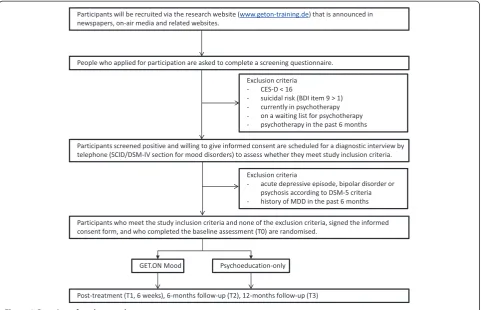
We will include adults (a) age 18 and above who (b) suf-fer from subthreshold depression (Centre for Epidemio-logical Studies Depression Scale (CES-D)≥16) but do not meet DSM-IV criteria for a major depressive epi-sode, (c) have Internet access, and (d) are willing to give informed consent. We will exclude subjects who (a) meet DSM-IV criteria for (a) current major depressive episode, (b) a bipolar disorder, or (c) a psychotic dis-order. Additional exclusion criteria are: (d) a history of a major depressive disorder in the past six months (based on Kupfer [35]), (e) currently receiving psychotherapy for any kind of mental health problems, (f ) being on a waiting list for psychotherapy, (g) receiving psychother-apy in the past six months, and (h) showing a notable suicidal risk, as indicated through a score greater 1 in the Beck Depression Inventory (BDI) Item 9 (“I feel I would be better off dead”).
Recruitment
Participants will be recruited from March 2013 to February 2014 via the GET.ON research website [36] that is announced in newspapers, on-air media and related websites. The research website provides information about the GET.ON Mood Enhancer Prevention training and details about the study. Additionally, a major health
insurance company will support the recruitment by pla-cing the information leaflet on its website. Individuals in-terested in participating in the study can apply online on the GET.ON research website by providing the research team with their mail address or by sending directly an e-mail to the research team. They do not need to be referred by their GP or other mental health care specialist.
Assessment of eligibility and randomisation
[image:3.595.58.540.89.399.2]the inclusion and none of the exclusion criteria who have completed the baseline assessment and returned the informed consent form via post or e-mail will enter the study and will be randomly allocated to study condi-tions. Randomisation will take place at an individual level. Block randomisation will be used to ensure equity of ample sizes across study conditions. Random blocks will consist of two allocations each. The allocation will be done by an independent researcher not otherwise in-volved in the study using an automated computer-generated random numbers table.
Blinding
The research staff conducting the semi-structured clin-ical interviews at 6- and 12-months follow-up will be blinded to the condition the participants are assigned to. These include: (a) an explanation to the participants why it is important not to inform the interviewer about the condition they were assigned to; (b) a written reminder for the interviewer in the interview manual to ask the participant not to inform him/her about the randomisa-tion status; (c) written and verbal reminders to the pa-tient before each interview; and (d) a documentation after each assessment of whether or not the interviewer is still blind to treatment condition. With regard to the latter, the interviewer will be asked to guess each partici-pant’s randomisation status and these guesses will be compared with the actual status. Cohen’s kappa will be computed to clarify whether hit rates differ from what can be expected from chance. In case of evidence for blinding break down, the interviewer will be changed to the second outcome interview.
Intervention
Get.ON mood enhancer prevention
The GET.ON Mood Enhancer Prevention training con-sists of six lessons. Participants are advised to do two lessons a week but at least one. Consequently, the train-ing lasts 3 to 6 weeks. However, participants are not ex-cluded from the intervention if they do not manage to complete one lesson a week. Lessons consist of text, ex-ercises, and testimonials. Each lesson includes interactive elements such as audio and video clips. Audio sequences introduce relaxation exercises, whereas video clips are used to explain theoretical frameworks, such as the con-cept of behavioural activation, in a user-friendly way. A strong focus lies on transfer tasks (homework assign-ments) to integrate newly acquired strategies and techniques into daily life. As an optional component, participants can choose to receive a set of about 42 stan-dardised text-messages supporting them to integrate the learned techniques into their everyday life. An example of such a text-message would be “Everyone has his own strategies to vanquish the inner temptation. What helps
you?”In the beginning of each subsequent lesson, partic-ipants are invited to reflect on their experiences with the newly acquired skills. The contents are adaptively tai-lored to the specific needs of the individual participant by continuously asking participants to respond by choosing among various response options. Subsequent content is then tailored to the participant’s response. For example, participants are asked whether to work on an elective module or not and if so they can choose which module they want to work on.
GET.ON Mood Enhancer Prevention is based on ele-ments from behaviour therapy (BT) [39] and problem-solving therapy (PST) [40]. These therapeutic elements are often found in psychological treatments for sub-threshold depression [41]. Interventions using BT and the combination of BT and PST have been shown to ef-fectively prevent the onset of major depressive disorder (i.e. [42,43]). In BT, a strong focus rests on daily pleasur-able activity scheduling that is integrated in each lesson (Additional file 1: Screenshots of the GET.ON Mood Enhancer Prevention intervention page 3). The PST ele-ments implemented in GET.ON Mood Enhancer Preven-tion have been used in various web-based intervenPreven-tions, such as the Dutch web-based “Alles onder Controle” course, which has been shown to be effective in reducing depressive symptomatology across several randomised controlled trials [44,45]. In the current study, PST consists of three steps. First, participants make a list of things that matter most to them in their lives. Second, participants list all their problems and worries and divide them into‘ man-ageable’ and ‘unmanageable’. Finally, they are invited to think about activities on how to solve the manageable problems. The main focus in problem-solving therapy is to tackle those problems that are manageable by means of a six-step procedure: (1) defining the problem, (2) defining the target state, (3) brainstorming about possible solutions and choosing the best one, (4) making a plan how to im-plement this solution, (5) actually putting the solution into practice, and (6) evaluating the outcome. Finally, partici-pants make a plan for the future on how they are going to accomplish their goals and those things that are most im-portant to them in their lives (Additional file 1 page 2). In addition to the BT and PST elements, in the last three les-sons participants are offered three elective modules target-ing sleep hygiene, relaxation techniques, and dealtarget-ing with worrying thoughts, respectively.
trainers focus on supporting participants to work through the exercises.
Psychoeducational-only condition
The psychoeducational intervention is also web-based and it is implemented on the same platform as GET.ON Mood Enhancer Prevention. Psychoeducational inter-ventions have been shown to be effective in reducing depressive symptoms [46]. In the current study, the psychoeducational intervention is based on the German S3-Guideline/National Disease Management Guideline Unipolar Depression [47]. It informs participants about the nature and evidence-based treatments of depression including information about symptoms and sources of help. They can go through the material as often as they want to. In this study, the psychoeducational intervention does neither require participants to do explicit homework assignments nor is any support by a trainer or other men-tal health care specialist offered to participants.
Sample size calculation
We assume an absolute risk reduction of at least 10% for the incidence of major depressive disorder (MDD) be-tween intervention and control group as clinically rele-vant. Based on previous studies evaluating interventions directed at the prevention of MDD, we expect a mean incidence of MDD in the control group of 25% within the 12-months follow-up period [48-50]. Based on a
power of 80%, an alpha of 0.05, a relative risk reduction of 40%, and an attrition rate of 20%, we will need 406 participants to demonstrate an absolute risk reduction of 10% between the groups using log rank survival analyses (calculated using PASS 12).
Outcome measurements
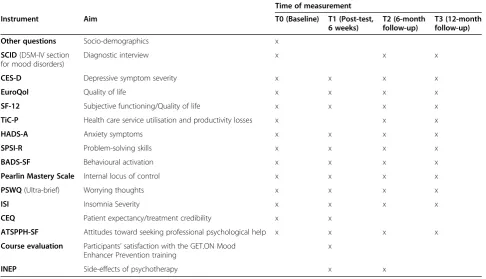
For an overview of assessment at baseline, post-treatment, 6-and 12-month follow-up see Table 1.
Primary outcome
[image:5.595.56.543.456.735.2]The primary outcome is time to onset of MDD within a 12-months follow-up period. Major depressive disorder will be assessed according to DSM-IV criteria as assessed by the telephone-administered Structured Clinical Inter-view for DSM-IV (SCID) at 6 and 12 months [37,38]. The inter-rater agreement of the Axis I disorders is moderate to excellent [51]. The agreement between face-to-face and telephone SCID interviews as indicated by the kappa coefficient is considered to be excellent [52]. Time to onset of MDD will be assessed using life charts. Life events are recalled by using a calendar method after which the presence of depressive symptoms at each month during the follow-up period is determined. SCIDs will be conducted by trained psychologists who are blind to treatment condition. The interviews will be recorded to examine inter-rater reliability. Disagreement shall be solved by discussion and the agreed rating will be used for
Table 1 Overview of outcome measurements
Time of measurement
Instrument Aim T0 (Baseline) T1 (Post-test,
6 weeks)
T2 (6-month follow-up)
T3 (12-month follow-up) Other questions Socio-demographics x
SCID(DSM-IV section for mood disorders)
Diagnostic interview x x x
CES-D Depressive symptom severity x x x x
EuroQol Quality of life x x x x
SF-12 Subjective functioning/Quality of life x x x x
TiC-P Health care service utilisation and productivity losses x x x
HADS-A Anxiety symptoms x x x x
SPSI-R Problem-solving skills x x x x
BADS-SF Behavioural activation x x x x
Pearlin Mastery Scale Internal locus of control x x x x
PSWQ(Ultra-brief) Worrying thoughts x x x x
ISI Insomnia Severity x x x x
CEQ Patient expectancy/treatment credibility x x
ATSPPH-SF Attitudes toward seeking professional psychological help x x x x
Course evaluation Participants’satisfaction with the GET.ON Mood Enhancer Prevention training
x
analysis. If this is not possible, the assessment will be rated by an experienced psychotherapist (gold standard) and this rating will be used for analysis.
Secondary outcomes
Self-report data will be collected using a secured online-based assessment system (AES, 256-bit encrypted).
Depressive symptomatology
The depressive symptom level will be assessed with the German version of the Center for Epidemiological Stud-ies Depression Scale (CES-D) [53]. The CES-D is a self-report scale and consists of 20 items, each scored 0–3, covering four domains: depressive affect, somatic com-plaints/activity inhibition, positive affect, and interper-sonal difficulties. The total score ranges from 0–60, with a higher score indicating more severe depressive symp-toms. A cut-off of 16 is usually regarded as indicating clinically relevant depressive symptom severity. The reli-ability of the CES-D has been shown to be excellent (in-ternal consistency of Cronbach’sα= .89) [53].
Quality of life
Health-related quality of life will be assessed with two multidimensional generic measures, i.e., the EuroQol [54] and the SF-12v1 Health Survey [55]. The EuroQol entails the 5D and a visual analogue scale. The EQ-5D consists of five items covering five dimensions (mo-bility, self-care, usual activities, pain/discomfort, and anxiety/depression), each of which is rated as causing ‘no problems’,‘some problems’, or ‘extreme problems’. The SF-12v1 has 12 items covering eight health domains (physical functioning, role functioning (physical and emotional), bodily pain, general health, vitality, social functioning, and mental health). The SF-12 generates two summary scores, the physical and mental health summary scores, respectively.
Anxiety
Anxiety will be measured with the German version of the anxiety subscale of the Hospital Anxiety and Depres-sion Scale (HADS-A) [56,57]. The anxiety subscale con-sists of seven questions and each is scored from 0-3 meaning that the total scores ranges from 0-21 where a score between 0-7 indicates no anxiety, between 8 and 10 possible anxiety, and above 11 or 12 a clinical anxiety disorder. Psychometric properties are well established (Cronbach’sαranging from .63-.93) [58].
Problem-solving skills
Problem-solving ability (i.e., generalised appraisal, be-liefs, expectancies, and emotional responses) will be measured with two subscales of the Social Problem-Solving Inventory-Revised (SPSI-R). The positive problem
orientation (PPO) subscale will represent a constructive dimension whereas the negative problem orientation (NPO) subscale is viewed as a dysfunctional dimension. Both subscales have displayed strong psychometric prop-erties in former studies (Cronbach’sα= .76; .83) [59].
Behavioural activation
Participants’activation towards goals/values and pleasant activities and avoidance behaviours will be measured with the Short Form (SF) [60]. The BADS-SF entails 9 items comprising two subscales (activation and avoidance). The items are rated on a 7-point Likert-type scale. Higher scores indicate that the individual scores high on the area of interest. The BADS-SF shows good psychometric properties (Cronbach’sα= .82) [60].
Mastery (internal locus of control)
Internal locus of control will be measured with the Pearlin Mastery Scale [61]. The Pearlin Mastery Scale consists of 7 items and each is rated on a 4-point Likert scale. The higher the score, the more the individual perceives having control over situations (internal mastery). A lower score points to external mastery meaning that the individual generally has the feeling that things are out of his or her control. The psychometric properties of this scale are well established [61].
Worrying
Worrying will be assessed with the ultra-brief version of the Penn State Worry Questionnaire (PSWQ) [62]. The ultra-brief version consists of 3 items stemming from the standard version, with each item being rated on a 7-point scale. The total score range from 0-18 with higher scores indicating more worry. The ultra-brief version shows similar psychometric properties compared to the standard version (Cronbach’sα= .85) [62].
Insomnia severity
Insomnia severity will be measured because evidence shows that treating sleep problems can ease depressive symptoms. Insomnia severity will be assessed with the Insomnia Severity Index (ISI) [63]. The ISI measures the nature, severity, and impact of insomnia. It consists of 7 items; each is rated on a 5-point Likert scale resulting in a total score ranging from 0 to 28. Higher scores indi-cate more severe insomnia. The ISI is a valid and reliable instrument to detect cases of insomnia in a population-based sample. The internal consistency is excellent (Cronbach’α= .90) [64].
Treatment credibility/patient expectancy
items, which are rated on a 9- or sometimes 10-point Likert scale. The psychometric properties of the instru-ment are well established (Cronbach’sα= .86) [65].
Attitudes toward seeking professional psychological help The influence of attitudes on mental health care service utilisation will be measured with the Attitudes Toward Seeking Professional Psychological Help Scale-SF (ATSPPH-SF) [66]. The ATSPPH-SF consists of 10 items that are rated on a 4-point Likert scale yielding a total score ran-ging from 0-30. High scores indicate positive treatment at-titudes. The instrument showed good psychometric properties in a previous study. The internal consistency ranges from .82 to .84 [67].
Course evaluation
User satisfaction will be measured with a self-designed questionnaire that is based on the“Satisfaction with Psy-chotherapy” Questionnaire (ZUF-8, [68]), the German version of the Client Satisfaction Questionnaire (CSQ-8, [69]). This self-report measure consists of 8 items meas-uring the global client satisfaction with the web-based training. Previous research indicated a high internal consistency (Cronbach’sα= .91) [70].
Side-effects of psychotherapy
Side-effects of psychotherapy will be measured with the side-effects of psychotherapy inventory (INEP) [71]. The INEP consists of 15 items assessing any changes partici-pants experienced after the completing of the web-based training in their social and/or work environment that they directly relate to their participation in the web-based training.
Key economic outcomes
Clinical endpoints In the cost-effectiveness analyses,
the main outcome will be depression-free years gained. Depression-free years will be assessed by calculating the difference in follow-up lengths and the duration of any major depressive episode (i.e. period of time in weeks that a person met DSM-IV criteria). In the cost-utility analysis, quality-adjusted life years (QALYs) will be the clinical endpoint. QALYs will be obtained from the EQ-5D (EuroQol) and SF-6D (SF-12v1). The EuroQol will be used because it is a widely applied quality of life in-strument and its reliability and validity is well estab-lished [54]. Theoretically, the EQ-5D generates 243 different health states. Index scores for each of these health states are available for various countries with “perfect health” and “death” being assigned values of 1 and 0, respectively. In this study, the index scores de-rived from a large general population sample in the UK will be used [72]. For the sensitivity analysis, the German index scores [73] will be applied. The EQ-5D, however,
might suffer from a ceiling effect meaning that a large number of respondents suffering from mild manifesta-tions of depressive symptoms report no problems. Hence, the SF-6D will also be used because it might be the more appropriate measure for milder conditions, i.e., subthreshold depression [74]. The SF-6D contains 6 di-mensions (each with between 2 and 5 levels) and includes 7 items of the SF-12. The SF-6D generates 7500 different health states. Utility values will be derived using Brazier’s algorithm [75,76].
Costs Direct medical (i.e. health care service utilisation) and direct non-medical costs (i.e. all costs not directly related to medical services such as transportation) are measured with the TiC-P, which is a self-report ques-tionnaire [77]. Indirect non-medical cost stemming from production losses due to absenteeism and presenteeism will be assessed with specific modules of the TiC-P. A catalogue of unit costs (i.e. inpatient, outpatient and re-habilitative services) and evaluation standards of the As-sociation of Statutory Health Insurance Physicians [78] will be used to calculate the total care costs on an indi-vidual basis [79].
Statistical analyses
Clinical efficacy
The study will be conducted in agreement with the CONSORT statement. Differences in the time to onset of MDD will be analysed in a proportional log rank sur-vival analysis over a follow-up period of 12 months after baseline. Time to onset will be the dependent variable in the survival analyses. Analyses will be done based on the intention-to-treat (ITT) principle. In addition, per-protocol analyses will be performed. For participants who are lost from the trial, available measurements will be used and then censored at the time of their last ob-servation. Participants who miss the assessment at 6-months follow-up, but are then assessed at 12-6-months follow-up, will be asked about their current and past symptoms according to SCID diagnostic criteria since the diagnostic interview at baseline. This will enable us to assess the time to onset of a depressive episode and thus to censoring. One-sided tests will be used for test-ing unidirectional and two-sided tests for testtest-ing bidirec-tional hypotheses. For all analyses statistical significance will be set at p < .05. We will calculate the number needed-to-be-treated (NNT) with GET.ON Mood En-hancer Prevention to prevent one case of MDD as com-pared to the control group to estimate the clinical effect size.
depressive episodes in the intervention and control group by follow-up. For all mixed-model analyses, Cohen’s d will be calculated by standardising the differ-ences between baseline and follow-up scores by the pooled standard deviation of baseline scores.
Economic analyses
It will be checked whether baseline differences exist be-tween the intervention and control group. If necessary, statistical techniques will be used to correct for baseline differences [80]. In the cost-effectiveness analyses, the incremental cost-effectiveness ratio (ICER) will be stated as costs per depression-free years gained, whereas the ICER in the cost-utility analyses will represent the costs per quality-adjusted life year (QALY) gained. Bootstrap-ping will be used to test the robustness of the ICERs and quantify the uncertainty around the ratios that will be graphically represented on a cost-effectiveness plane. The bootstrapped ICERs will also be shown in a cost-effective acceptability curve disclosing the probability that GET.ON Mood Enhancer Prevention is cost-effective for a wide range of willingness-to-pay ceilings [81]. To test the robustness of the base-case findings, a multi-way sensitivity analysis will be done. An incremen-tal net benefit regression analysis will be performed to ascertain which sub-groups benefit more from the inter-vention in terms of superior cost-effectiveness.
Discussion
Major depressive disorder is a highly prevalent disorder associated with a considerable loss of quality of life, in-creased mortality rates, and formidable economic costs. Due to limited accessibility and efficacy, treating existing cases only contributes to a partial reduction of disease burden. Thus, interventions preventing the onset of MDD should be used to complement treatment-focused interventions and further reduce the burden of this de-bilitating disorder. Available face-to-face preventive in-terventions face, however, limitations. Novel approaches are needed that go beyond the limits of traditional ser-vices. The Internet may attract people who do not partici-pate in face-to-face interventions. Moreover, it potentially provides the opportunity to offer preventive interventions to the community en masse. To our knowledge, this is one of the first randomised controlled trials that examines the (cost-) effectiveness of a web-based intervention on the onset of major depression in subjects with subthresh-old depression.
Limitations of this study include the following. Attri-tion is a common problem in web-based intervenAttri-tions [82]. However, providing guidance has been shown to re-duce attrition rates [12] and the intensity of support of-fered in this study is considered to keep drop-out to a minimum. In addition, the psychometric properties of
most of the secondary outcome measures used in this trial have not yet been tested in an online environment.
There are several strengths to this study. First, by con-ducting this trial a significant contribution to the litera-ture is made as to the best of our knowledge no other study has yet been undertaken that investigates the effect on an indicated guided self-help web-based intervention on the incidence of MDD. Second, Semi-Structured Diagnostic Interviews (SCID) will be conducted two times within the 12-month follow-up period to assess the time to onset of depressive episodes. This frequency of assess-ments allows for a reasonable temporal precision of onset of depressive episodes according to DSM-IV criteria. Third, an economic evaluation will be performed along-side the randomised controlled trial. If shown to be effect-ive, this web-based preventive intervention could be easily disseminated. As a low-threshold intervention, it would be better accepted among the target group. If shown to be cost-effective, GET.ON Mood Enhancer Prevention will be a valuable tool to efficiently reduce the disease burden attributable to MDD at population level.
Additional file
Additional file 1:Screenshots of the GET.ON Mood Enhancer Prevention intervention.
Competing interests
Professor Berking is minority shareholder of Minddistrict GmbH, which will provide the platform for the web-based intervention.
Authors’contributions
MB obtained funding for this study. MB, CB, JR, LB, DE, and DL contributed to the development of the GET.ON Mood Enhancer Prevention training. All authors contributed to the study design. FS contributed to the design of the economic evaluation study. CB drafted the manuscript. CB, DE, PC, FS, and MB contributed to the further writing of the manuscript. All authors read and approved the final manuscript.
Acknowledgements
The associated project of all authors is funded by the European Union (project number: EFRE: CCI 2007DE161PR001).
Author details
1Innovation Incubator, Division Health Training Online, Leuphana University,
Lueneburg, Germany.2Department of Psychology, Clinical Psychology and
Psychotherapy, Philipps University Marburg, Marburg, Germany.3GGZ
inGeest, Regional Mental Health Service Centre, VU University Medical Centre, Amsterdam, The Netherlands.4Department of Clinical Psychology
and EMGO Institute for Health and Care Research, VU University, Amsterdam, The Netherlands.5Department of Public Mental Health, Netherlands Institute
of Mental Health and Addiction, Trimbos Institute, Utrecht, The Netherlands.
6Department of Epidemiology and Biostatistics, EMGO Institute for Health
and Care Research, VU University Medical Center, Amsterdam, The Netherlands.
Received: 28 June 2013 Accepted: 27 January 2014 Published: 31 January 2014
References
Arbabzadeh-Bouchez S, Autonell J, Bernal M, Buist-Bouwman MA, Codony M, Domingo-Salvany A, Ferrer M, Joo SS, Martinez-Alonso M, Matschinger H,
et al:Prevalence of mental disorders in Europe: results from the European Study of the Epidemiology of Mental Disorders (ESEMeD) project.
Acta Psychiatr Scand Suppl2004,420:21–27.
2. Kessler RC, McGonagle KA, Zhao S, Nelson CB, Hughes M, Eshleman S, Wittchen HU, Kendler KS:Lifetime and 12-month prevalence of DSM-III-R psychiatric disorders in the United States: results from the national comorbidity survey.Arch Gen Psychiatry1994,51(1):8–19.
3. Waraich P, Goldner EM, Somers JM, Hsu L:Prevalence and incidence studies of mood disorders: a systematic review of the literature.Can J Psychiatry2004,49(2):124–138.
4. Ferrari AJ, Somerville AJ, Baxter AJ, Norman R, Patten SB, Vos T, Whiteford HA:Global variation in the prevalence and incidence of major depressive disorder: a systematic review of the epidemiological literature.Psychol Med2013,43(3):471–481.
5. Ustun TB, Ayuso-Mateos JL, Chatterji S, Mathers C, Murray CJ:Global burden of depressive disorders in the year 2000.Br J Psychiatry2004,
184:386–392.
6. Saarni SI, Suvisaari J, Sintonen H, Pirkola S, Koskinen S, Aromaa A, Lonnqvist J:Impact of psychiatric disorders on health-related quality of life: general population survey.Br J Psychiatry2007,190:326–332.
7. Cuijpers P, Smit F:Excess mortality in depression: a meta-analysis of community studies.J Affect Disord2002,72(3):227–236.
8. Berto P, D’Ilario D, Ruffo P, Di Virgilio R, Rizzo F:Depression: cost-of-illness studies in the international literature, a review.J Ment Health Policy Econ
2000,3(1):3–10.
9. Greenberg PE, Birnbaum HG:The economic burden of depression in the US: societal and patient perspectives.Expert Opin Pharmacother2005,
6(3):369–376.
10. Smit F, Cuijpers P, Oostenbrink J, Batelaan N, de Graaf R, Beekman A:Costs of nine common mental disorders: implications for curative and preventive psychiatry.J Ment Health Policy Econ2006,9(4):193–200. 11. Mathers CD, Loncar D:Projections of global mortality and burden of
disease from 2002 to 2030.PLoS Med2006,3(11):e442.
12. Richards D, Richardson T:Computer-based psychological treatments for depression: a systematic review and meta-analysis.Clin Psychol Rev2012,
32(4):329–342.
13. Cuijpers P, van Straten A, Andersson G, van Oppen P:Psychotherapy for depression in adults: a meta-analysis of comparative outcome studies.
J Consult Clin Psychol2008,76(6):909–922.
14. Cuijpers P, van Straten A, Warmerdam L, Andersson G:Psychological treatment of depression: a meta-analytic database of randomized studies.BMC Psychiatry2008,8:36.
15. Tylee A, Jones R:Managing depression in primary care.BMJ2005,
330(7495):800–801.
16. Andrews G, Issakidis C, Sanderson K, Corry J, Lapsley H:Utilising survey data to inform public policy: comparison of the cost-effectiveness of treatment of ten mental disorders.Br J Psychiatry2004,184:526–533. 17. Chisholm D, Sanderson K, Ayuso-Mateos JL, Saxena S:Reducing the global
burden of depression: population-level analysis of intervention cost-effectiveness in 14 world regions.Br J Psychiatry2004,184:393–403. 18. Cuijpers P, van Straten A, Smit F, Mihalopoulos C, Beekman A:Preventing
the onset of depressive disorders: a meta-analytic review of psychological interventions.Am J Psychiatry2008,165(10):1272–1280. 19. Willemse GR, Smit F, Cuijpers P, Tiemens BG:Minimal-contact
psychotherapy for sub-threshold depression in primary care: randomised trial.British J Psychiatry2004,185:416–421.
20. Schoevers RA, Smit F, Deeg DJ, Cuijpers P, Dekker J, van Tilburg W, Beekman AT:Prevention of late-life depression in primary care: do we know where to begin?Am J Psychiatry2006,163(9):1611–1621. 21. Cuijpers P:Minor depression: risk profiles, functional disability, health
care use and risk of developing major depression.J Affect Disord2004,
79(1–3):71–79.
22. Backenstrass M, Frank A, Joest K, Hingmann S, Mundt C, Kronmuller KT:A comparative study of nonspecific depressive symptoms and minor depression regarding functional impairment and associated characteristics in primary care.Compr Psychiatry2006,47(1):35–41. 23. Cuijpers P, Smit F, Oostenbrink J, de Graaf R, Ten Have M, Beekman A:
Economic costs of minor depression: a population-based study.
Acta Psychiatr Scand2007,115(3):229–236.
24. Cuijpers P, Smit F:Subthreshold depression as a risk indicator for major depressive disorder: a systematic review of prospective studies.
Acta Psychiatr Scand2004,109(5):325–331.
25. Morgan AJ, Jorm AF, Mackinnon AJ:Email-based promotion of self-help for subthreshold depression: mood memos randomised controlled trial.
Br J Psychiatry2012,200(5):412–418.
26. Christensen H, Griffiths KM:The prevention of depression using the Internet.Med J Aust2002,177(Suppl):S122–S125.
27. Cuijpers P, van Straten A, Warmerdam L, van Rooy MJ:Recruiting participants for interventions to prevent the onset of depressive disorders: possible ways to increase participation rates.BMC Health Serv Res2010,10:181.
28. Klaw E, Humphreys K:Facilitating client involvement in self-help groups. InPsychologists’desk reference.2nd edition. Edited by Koocher G, Norcross J, Hill S. New York: Oxford University Press; 2005:502–505.
29. Meyer B, Berger T, Caspar F, Beevers CG, Andersson G, Weiss M:
Effectiveness of a novel integrative online treatment for depression (Deprexis): randomized controlled trial.J Med Internet Res2009,11(2):e15. 30. Cavanagh K, Seccombe N, Lidbetter N:The implementation of
computerized cognitive behavioural therapies in a service user-led, third sector self help clinic.Behav Cogn Psychother2011,39(4):427–442. 31. Spek V, Nyklicek I, Smits N, Cuijpers P, Riper H, Keyzer J, Pop V:
Internet-based cognitive behavioural therapy for subthreshold depression in people over 50 years old: a randomized controlled clinical trial.
Psychol Med2007,37(12):1797–1806.
32. Calear AL, Christensen H, Mackinnon A, Griffiths KM, O’Kearney R:The YouthMood Project: a cluster randomized controlled trial of an online cognitive behavioral program with adolescents.J Consult Clin Psychol
2009,77(6):1021–1032.
33. Hoek W, Schuurmans J, Koot HM, Cuijpers P:Effects of Internet-based guided self-help problem-solving therapy for adolescents with depression and anxiety: a randomized controlled trial.PLoS One2012,7(8):e43485. 34. de Graaf LE, Gerhards SA, Arntz A, Riper H, Metsemakers JF, Evers SM,
Severens JL, Widdershoven G, Huibers MJ:Clinical effectiveness of online computerised cognitive-behavioural therapy without support for depression in primary care: randomised trial.Br J Psychiatry2009,195(1):73–80. 35. Kupfer DJ:Long-term treatment of depression.J Clin Psychiatry1991,
52(Suppl):28–34.
36. GesundheitsTraining.Online. www.geton-training.de.
37. Rohde P, Lewinsohn PM, Seeley JR:Comparability of telephone and face-to-face interviews in assessing axis I and II disorders.Am J Psychiatry
1997,154(11):1593–1598.
38. Allen K, Cull A, Sharpe M:Diagnosing major depression in medical outpatients: acceptability of telephone interviews.J Psychosom Res2003,
55(4):385–387.
39. Lewinsohn PM:The behaviroal study and treatment of depression. In
Progress in behavior modification.1st edition. Edited by Hersen M, Eisler RM, Miller PM. New York: Academic Press; 1974.
40. D’Zurilla TJ, Nezu AM:Social problem solving in adults. InAdvances in cognitive-behavioral research and therapy.1st edition. Edited by Kendall PC. New York: Academic Press; 1982:201–274.
41. Cuijpers P, Smit F, van Straten A:Psychological treatments of subthreshold depression: a meta-analytic review.Acta Psychiatr Scandinavica2007,115(6):434–441.
42. Garber J, Clarke GN, Weersing VR, Beardslee WR, Brent DA, Gladstone TR, DeBar LL, Lynch FL, D’Angelo E, Hollon SD, Shamseddeen W, Iyengar S:
Prevention of depression in at-risk adolescents: a randomized controlled trial.JAMA2009,301(21):2215–2224.
43. van’t Veer-Tazelaar PJ, van Marwijk HW, van Oppen P, van Hout HP, van der Horst HE, Cuijpers P, Smit F, Beekman AT:Stepped-care prevention of anxiety and depression in late life: a randomized controlled trial.
Arch Gen Psychiatry2009,66(3):297–304.
44. Warmerdam L, van Straten A, Twisk J, Riper H, Cuijpers P:Internet-based treatment for adults with depressive symptoms: randomized controlled trial.J Med Internet Res2008,10(4):e44.
45. van Straten A, Cuijpers P, Smits N:Effectiveness of a web-based self-help intervention for symptoms of depression, anxiety, and stress: randomized controlled trial.J Med Internet Res2008,10(1):e7.
46. Donker T, Griffiths KM, Cuijpers P, Christensen H:Psychoeducation for depression, anxiety and psychological distress: a meta-analysis.BMC Med
47. German S3-Guideline/National Disease Management Guideline Unipolar Depression.http://www.depression.versorgungsleitlinien.de/.
48. Allart-van Dam E, Hosman CM, Hoogduin CA, Schaap CP:Prevention of depression in subclinically depressed adults: follow-up effects on the
‘Coping with Depression’course.J Affect Dis2007,97(1–3):219–228. 49. Clarke GN, Hawkins W, Murphy M, Sheeber LB, Lewinsohn PM, Seeley JR:
Targeted prevention of unipolar depressive disorder in an at-risk sample of high school adolescents: a randomized trial of a group cognitive intervention.J Am Acad Child Adolesc Psychiatry1995,34(3):312–321. 50. Hagan R, Evans SF, Pope S:Preventing postnatal depression in mothers of
very preterm infants: a randomised controlled trial.BJOG2004,
111(7):641–647.
51. Lobbestael J, Leurgans M, Arntz A:Inter-rater reliability of the structured clinical interview for DSM-IV Axis I disorders (SCID I) and axis II disorders (SCID II).Clin Psychol Psychother2011,18(1):75–79.
52. Crippa JA, de Lima OF, Del-Ben CM, Filho AS, da Silva Freitas MC, Loureiro SR:Comparability between telephone and face-to-face structured clinical interview for DSM-IV in assessing social anxiety disorder.Perspect Psychiatr Care2008,44(4):241–247.
53. Hautzinger M, Bailer M, Hofmeister D, Keller F:Allgemeine Depressionsskala.
2nd edition. Göttingen: Hogrefe; 2012.
54. Brooks R:EuroQol: the current state of play.Health Policy1996,
37(1):53–72.
55. Gandek B, Ware JE, Aaronson NK, Apolone G, Bjorner JB, Brazier JE, Bullinger M, Kaasa S, Leplege A, Prieto L, Sullivan M:Cross-validation of item selection and scoring for the SF-12 health survey in nine countries: results from the IQOLA project: international quality of life assessment.
J Clin Epidemiol1998,51(11):1171–1178.
56. Zigmond AS, Snaith RP:The hospital anxiety and depression scale.
Acta Psychiatr Scand1983,67(6):361–370.
57. Hermann-Lingen C, Buss U, Snaith RP:Hospital Anxiety and Depression Scale - Deutsche Version (HADS-D).3rd edition. Bern: Verlag Hans Huber; 2011. 58. Bjelland I, Dahl AA, Haug TT, Neckelmann D:The validity of the hospital
anxiety and depression scale: an updated literature review.J Psychosom Res2002,52(2):69–77.
59. D’Zurilla TJ, Nezu AM, Maydeu-Olivares A:Social Problem-Solving Inventory-Revised (SPSI-R).New York: MHS; 2002.
60. Manos RC, Kanter JW, Luo W:The behavioral activation for depression scale-short form: development and validation.Behav Ther2011,
42(4):726–739.
61. Pearlin LI, Schooler C:The structure of coping.J Health Soc Behav1978,
19(1):2–21.
62. Berle D, Starcevic V, Moses K, Hannan A, Milicevic D, Sammut P:Preliminary validation of an ultra-brief version of the Penn State worry questionnaire.
Clin Psychol Psychother2011,18(4):339–346.
63. Bastien CH, Vallieres A, Morin CM:Validation of the insomnia severity index as an outcome measure for insomnia research.Sleep Med2001,
2(4):297–307.
64. Morin CM, Belleville G, Belanger L, Ivers H:The insomnia severity index: psychometric indicators to detect insomnia cases and evaluate treatment response.Sleep2011,34(5):601–608.
65. Devilly GJ, Borkovec TD:Psychometric properties of the credibility/ expectancy questionnaire.J Behav Ther Exp Psychiatry2000,31(2):73–86. 66. Fischer EH, Farina A:Attitudes toward seeking professional psychological
help: a shortened form and considerations for research.J Coll Stud Dev
1995,36:368–373.
67. Elhai JD, Schweinle W, Anderson SM:Reliability and validity of the attitudes toward seeking professional psychological help scale-short form.Psychiatry Res2008,159(3):320–329.
68. Schmidt J, Lamprecht F, Wittmann W:Satisfaction with inpatient management: development of a questionnaire and initial validity studies: [Article in German].Psychother, Psychosom Med Psychol1989,
39:248–255.
69. Nguyen TD, Attkisson CC, Stegner BL:Assessment of patient satisfaction: development and refinement of a service evaluation questionnaire.
Eval Program Plann1983,6(3–4):299–313.
70. Attkisson CC, Zwick R:The client satisfaction questionnaire: psychometric properties and correlations with service utilization and psychotherapy outcome.Eval Program Plann1982,5(3):233–237.
71. Nestoriuc Y, Rief W:Risiken und Nebenwirkungen von Psychotherapie [Risks and side-effects of psychotherapy]. InRisiken und Nebenwirkungen
von Verhaltenstherapie [Risks and side-effects of behavioural therapy].Edited by Linden M, Strauß B. Berlin: MWV; 2012:59–74.
72. Dolan P:Modeling valuations for EuroQol health states.Med Care1997,
35(11):1095–1108.
73. Greiner W, Claes C, Busschbach JJ, von der Schulenburg JM:Validating the EQ-5D with time trade off for the German population.Eur J Health Econ
2005,6(2):124–130.
74. Brazier J, Roberts J, Tsuchiya A, Busschbach J:A comparison of the EQ-5D and SF-6D across seven patient groups.Health Econ2004,13(9):873–884. 75. Brazier JE, Roberts J:The estimation of a preference-based measure of
health from the SF-12.Med Care2004,42(9):851–859.
76. Brazier J, Rowen D, Hanmer J:Revised SF-6D scoring programmes: a summary of improvements.PRO Newsletter2008,40:14–15.
77. Hakkaart-van Roijen L, van Straten A, Donker M, Tiemens B:Manual Trimbos/ iMTA questionnaire for Costs associated with Psychiatric illness (TiC-P).
Rotterdam: Erasmus University; 2002.
78. Association of Statutory Health Insurance Physicians. http://www.kvberlin. de/20praxis/30abrechnung_honorar/10ebm/index.html.
79. Krauth C, Hessel F, Hansmeier T, Wasem J, Seitz R, Schweikert B:Empirical standard costs for health economic evaluation in Germany–a proposal by the working group methods in health economic evaluation.
Gesundheitswesen2005,67(10):736–746.
80. Manca A, Hawkins N, Sculpher MJ:Estimating mean QALYs in trial-based cost-effectiveness analysis: the importance of controlling for baseline utility.Health Econ2005,14(5):487–496.
81. Fenwick E, O’Brien BJ, Briggs A:Cost-effectiveness acceptability curves– facts, fallacies and frequently asked questions.Health Econ2004,
13(5):405–415.
82. Christensen H, Griffiths KM, Farrer L:Adherence in internet interventions for anxiety and depression.J Med Internet Res2009,11(2):e13. doi:10.1186/1471-244X-14-25
Cite this article as:Buntrocket al.:Evaluating the efficacy and cost-effectiveness of web-based indicated prevention of major depression: design of a randomised controlled trial.BMC Psychiatry201414:25.
Submit your next manuscript to BioMed Central and take full advantage of:
• Convenient online submission
• Thorough peer review
• No space constraints or color figure charges
• Immediate publication on acceptance
• Inclusion in PubMed, CAS, Scopus and Google Scholar
• Research which is freely available for redistribution