2016 International Conference on Artificial Intelligence and Computer Science (AICS 2016) ISBN: 978-1-60595-411-0
Study on Modeling and Simulation of the Electronic Virtual Laboratory
Yan-ming YANG*, Rui-li ZHANG
and Lu-lu SUN
Naval Aeronautical and Astronautical University Qingdao Campus, Qingdao 266041, China *[email protected]
Keywords: Virtual laboratory, Modeling, Simulation, SPICE.
Abstract. This paper proposes a model structure based on “mathematical model and solid model” and a simulation algorithm based on SPICE for electronic virtual laboratory. In this model, the virtual experiment simulates real experiment via abstracting experiment scenes, instrument objects and component objects from actual experiment and constructing mathematical and solid model with object-oriented method. And familiar modeling methods and technologies are discussed in detail. In the simulation algorithm, SPICE is redeveloped and imbedded in the multimedia interface as simulating kernel, which succeeds in solving integration of simulation model and solid model. Finally, an application example “the virtual laboratory for electronic circuit experiment” is also given. The system provides the users with realistic environment, convenient operation and powerful simulation capability, and has been successfully applied in the experimental teaching.
Introduction
Experiment teaching has been playing an increasingly important role in higher education. It’s a key measure to improve the students’ ability. As an essential and beneficial supplement to the traditional laboratory, virtual laboratory not only saves a lot of educational funds, but also extends the experiments in time and space effectively. The goal of virtual laboratory is to simulate real experimental environment, experimental operation and results via virtual simulation technology. In the virtual laboratory, users can operate the virtual experiment equipment through mouse clicks or drags and keyboard strokes, as if they operate real ones, to accomplish the experiment. One could learn more from virtual experiments than real ones. The essential features and advantages of virtual laboratory are good interactive features and immersive feeling. The modern educational technology has entered a new era with the success in development of virtual laboratory. Users could operate the instruments, observe the phenomena and get result data, like they would do in real experiment, and this virtual way can impress them even more.
Model Structure of the Electronic Virtual Laboratory
In order to construct the electronic virtual laboratory, we should first model and simulate the objects used in the experiment, which include the experimental environment, the instrument model and the element model. To achieve the effect of real experiment, the solid model and the mathematical model are needed in the modeling of the environment, the instrument and the element. We can represent the modeling as follows:
Model (EVLab) = Model (solid) + Model (mathematical)
Laboratory (Virtual) = Interface + Rules
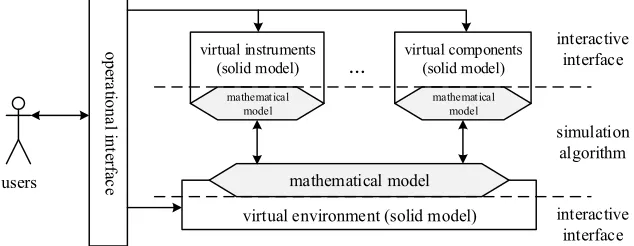
The electronic virtual laboratory comprises two parts, the solid model as the interactive interface and the mathematical model as the behavior rules. The two parts cooperate to achieve the same effect of operation and vision as that of the real laboratory. Figure 1 gives the model structure of the electronic virtual laboratory.
users op era tio na l in te rfa ce
virtual environment (solid model)
[image:2.612.146.463.149.272.2]... mathematical model virtual instruments (solid model) mathematical model virtual components (solid model) mathematical model interactive interface interactive interface simulation algorithm
Figure 1. The model structure of the electronic virtual laboratory.
Modeling Methods of the Electronic Virtual Laboratory
Mathematical Modeling
Mathematical modeling is the basis of system simulation. Different types of virtual laboratory have different mathematical models, but the processes of modeling are similar. The electronic virtual simulation adopted SPICE as the simulation kernel (mathematical model). SPICE (Simulation Program with Integrated Circuit Emphasis) has always been a frontier for evaluation of designed circuits and predicting their behavior. From its original development at the Electronics Research Lab of the University of California, Berkeley, it has upgraded and evolved into a widely used industry standard, competent to be termed as a powerhouse for general purpose analog circuit simulation [1].
Constructing Basic Models. The basic model can be obtained either from the theory computation equation and the relationship of the environment and instrument, derived from the principles of the experiment, or from the experience equation derived from system discrimination based experimental results. Take “the virtual laboratory for electronic circuit experiment” as an example. The basic model is a matrix equation of n dimension, where n is the number of circuit nodes: FX=b, where F is the coefficient matrix, b is an excitation vector [2]. In direct current analysis, it is a nonlinear algebraic equation group; in the small signal of alternating current analysis, it is a complex number algebraic equation group; in transient analysis, it is a nonlinear ordinary differential equation group. By solving the equation group via numerical analysis, we can obtain the stable solution of the circuit or the characteristic of frequency domain and time domain. Thus, the process of circuit simulation is the process to solve circuit equation group [3].
Choosing Parameters. In the basic model, there are often a number of parameters, some of which can be obtained from theory computation, some can be determined by experiment conditions, and some can be obtained by processing the experimental data, including system discrimination. For example, when iteratively solving the equation FX=b, we need to modify the values of cells in the coefficient matrix F and excitation vector b, because the values of the parameters of the nonlinear element model will change under different voltages [4].
Solid Modeling
The quality of solid model has a strong impact on the realism and interactivity of virtual laboratory. To simulate vividly the environment, the shapes of instruments and components and operation, three-dimensional modeling and rendering methods are used in solid modeling in virtual laboratory. The solid model consists of two parts: the static model and the dynamic model.
Static Modeling. Firstly, we need to construct all the three-dimensional geometric models of objects in the electronic virtual laboratory. Secondly, design required static pictures using three-dimensional modeling and rendering software. These pictures are used to simulate the environment, the appearances of instruments and components. Also, design vivid operations of different parts. Finally, we need to combine all these stuff together to accomplish the solid modeling of the environment, instruments and components. For example, the virtual instruments usually consist of panels, knobs, switches, dial plates etc. In Figure 2, there is a solid model of a virtual oscillograph, millivoltmeter and DC power supply.
[image:3.612.93.523.251.331.2]
Figure 2. The solid model of a virtual oscillograph, millivoltmeter and DC power supply.
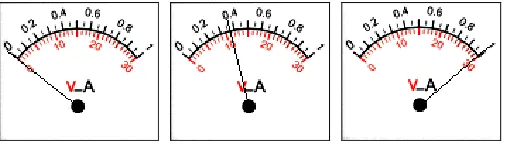
Dynamic Modeling. In general, we need to use dynamic drawing technique to make dynamic simulation. Object-oriented programming languages, such as VC++, C# and Delphi, provide a class for graphics drawing and display, called “Canvas class”. The Canvas class encapsulates basic shape drawing methods for basic shapes, such as point, line, arc, polygon, graphic filling etc. We can dynamically simulate user’s operations and instrument changes as long as we could choose the right events to respond to the user’s operations, invoke the right drawing method during the events, and implement real-time drawing of graphics. For example, the Dynamic display of the dial pointer of an instrument is shown in figure 3.
Figure 3. Dynamic display of the dial pointer of an instrument.
Mask transparent mapping technique. When the virtual parts move, it needs to be dynamically pasted on the background image. As the virtual parts are generally irregular geometric figure, using transparent mapping technology to realize the seamless connection between virtual components and virtual experiment environment. The mapping process can be expressed as follows:
Transparency (OP)=BPMPOP
[image:3.612.181.434.475.547.2]a) BP b) BPMP c) BPMPOP
Figure 4. Transparent mapping process of the instrument pointer.
Simulation Design of the Electronic Virtual Laboratory
The Simulation Process
The key problem of simulation design for the electronic virtual laboratory is how to combine the mathematical model with the solid model via appropriate methods to make a system in which all the parts cooperate in harmony with one another. In figure 5, the simulation process is shown. The electronic virtual laboratory consists of virtual experiment environment (solid model) and computation simulation module (mathematical model). The electronic virtual laboratory, which is the interface of computer-human interaction, is presented as a circuit image editor. Under this environment, virtual components and instruments of verisimilitude are provided. The users drag components to make circuit by mouse as convenient as in real experiments. The visualized mapping is a bidirectional system. On the one hand, the representation of the image on the screen is mapped to the data format required by system simulation. On the other hand, the digital information computed by system simulation is presented to users as visual physical phenomena or physical measures which change with time and space. The computation simulation module, which is the core module of the system, accomplishes the scientific computing of circuits.
users
virtual components
virtual instruments
computer simulation module
(system simulator)
virtual experiment environment
(circuit editor)
visualization mapping
simulation experiment platform
Figure 5. The simulation process in electronic virtual laboratory.
The Modification of SPICE and Simulation Design
In “the virtual laboratory for electronic circuit experiment”, SPICE, the advanced circuit simulation software, is used as simulation core. SPICE is a general-purpose circuit simulation program for nonlinear DC, nonlinear transient, and linear AC analyses. Based on the open source code of SPICE3f5, the system is transplanted to Windows platform from UNIX platform. That is to say, the SPICE source code is processed and compiled to DLL (dynamic link libraries) files that can be called by the program module of experiment environment. The DLLs provide a normal API interface as follows:
[image:4.612.129.493.437.546.2]CalStep: output parameter, step length of the computation CirString: input parameter, circuit string describing circuits ErrCode: output parameter, error code
The Application Example and Test Results
Single AC Amplifier Circuit Simulation
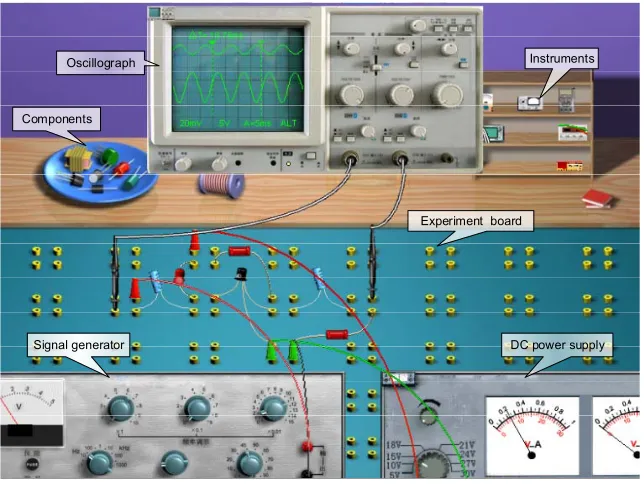
“The virtual laboratory for electronic circuit experiment” adopted the method mentioned above, and successfully solved the design problem of combining simulation approaches with multimedia techniques. Figure 6 shows the measurement of single AC amplifier circuit using the oscillograph. In the experiment platform shown in the figure, users can use a mouse to choose appropriate objects from the left element box, and build circuit on the general experiment board below according to the experiment requirement. The pins of the components (such as resistance, capacitance, triode, etc.) could be zoomed or dragged freely. After building a circuit and turning on the power, we can make measures by virtual instruments. The instruments required in the experiments are at the top right corner. We can drag them out and put them back freely with a mouse anytime according to the needs of the experiment. After measurement and recording experimental data, the system generates automatically an experiment report in word format. We could analyze and discuss the data in the report, and submit the experimental report online. Meanwhile, the teacher could supervise experimental process in real-time and read experimental reports at any time online.
Instruments
Components
Experiment board Oscillograph
[image:5.612.146.468.342.584.2]Signal generator DC power supply
Figure 6. The environment of single AC amplifier experiment.
The Test Results
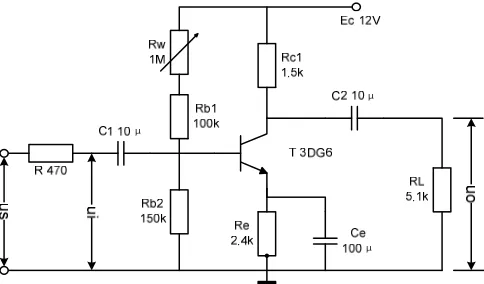
Figure 7. The schematic diagram of single AC amplifier circuit.
Table 1. The comparison between simulation and actual experiment results.
Experiment type DC parameters AC parameters
VB(V) VC(V) IC(mA) US(mV) Ui(mV) UO(mV) UL(mV) AV Ri(kΩ) RO(kΩ) Actual experiment 3.82 10.1 1.27 12.2 10.0 660 520 52.0 2.13 1.37 Simulation experiment 3.80 10.0 1.33 12.0 9.5 670 530 54.7 1.87 1.35
Computation equations: IC = (EC-VC)/RC, AV = UO/U, RO = (UO/UL-1)RL, Ri = (Ui/(US-Ui))R
Conclusions
At present, the project product is used in many universities. The system works well and has received positive comments. By the development and application of the virtual laboratory, we believe that virtual laboratory could relieve insufficient experiment equipment problem due to the lack of teaching funding in universities. The virtual laboratory is highly useful to strengthen the experiment teaching and advance the experiment training for the student abilities of creativity and practice. And it relieves the dependence of experiment teaching to objective substance conditions. As an essential and beneficial supplement to the traditional laboratory, virtual laboratory not only save a lot of education funds, but also extend the laboratory in time and space effectively.
References
[1] Karna D. Gajab, Ajay Kanth Chitturi. A Functional Analysis of SPICE Simulations and Parameters. Science and Engineering Investigations. vol. 2, issue 18, pp. 126-131, July 2013. [2] Joseph G. Tront, Joseph Tront. PSpice for Basic Circuit Analysis, New York: McGraw-Hill, 2004.
[3] Khalid M. Al-Ruwaihi, Isa S. Qamber. Novel behavioral macromodeling using SPICE and its applications to high-voltage engineering education. Computer Applications in Engineering Education, vol. 7, no. 3, pp. 155-161, March 1999.