2016 International Congress on Computation Algorithms in Engineering (ICCAE 2016) ISBN: 978-1-60595-386-1
1 INTRODUCTION
In recent years, the research on the key technology of space flexible manipulators has made a breakthrough. The space flexible manipulators have a huge demand market, especially a more urgent demand for high, precise and advanced space flexible manipulators. The huge demand market stimulates the enthusiasm of the researchers on the research of the space flexible ma-nipulators. This paper researches the method to pro-mote the quality of the space flexible manipulators and technical precision from the application of high-tech research means and innovation of the re-search concept, especially combines with the market demand to continuously upgrade the base, armed level, power consumption, operating space, weight ratio, flexibility and other technical indicators so that the degree of precision, energy consumption, production costs, structure, user-friendly operation and other in-tegrated indicators of the space flexible manipulators can achieve a maximum improvement. And compared with the traditional robots, it can be more suitable for high, precise and advanced scientific fields, especially the aerospace and manufacturing industry. Science and technology is the primary productive force. To keep a foothold in an intense competition environment, there is a must to constantly improve the process technology of the products and continuously increase the scientific and technological content of the products. Currently, the research on the key technology of au-tomatic control for the space flexible-joint robot fails
to make a breakthrough. In particular, there are diffi-cult problems in the key technology of control for the flexible manipulators which are required to be over-come. And it is also a task to be updated in the key technology.
2 CORE CONTENT OF KEY TECHNOLOGY OF
[image:1.516.269.450.460.562.2]AUTOMATIC CONTROL FOR THE SPACE FLEXIBLE MANIPULATOR
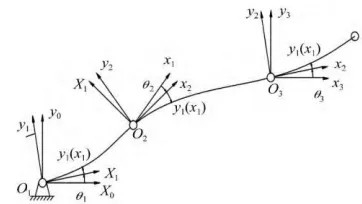
Figure 1. Simplified model of the flexible-bar robot.
The key and core technology of the space flexible manipulators is mainly manifested as two forms: rod piece and joint flexibility. The former one is achieved by twisting and bending vibration, while the latter one is brought to the attention through the impact on pre-cision of the robot arm; the joint flexibility is mainly caused by the reducer, rotation axis, transmission gear
Overview of Key Technology of Automatic Control
for Space Flexible Manipulators
Senlin Lu & Jun Chen
Jiangxi Science & Technology Normal University, Nanchang, Jiangxi, China
ABSTRACT: The research of the automatic control for the key technology of space flexible manipulators is a leading task in the current scientific research. According to the groundbreaking research results of the key tech-nology of dynamics modeling and automatic control for robots obtained by the researchers in recent years, this paper carries out a comprehensive analytic demonstration and summarization on the key technology of automatic control for flexible manipulators.
and synchronous belt in the drive system [1]. Its core part is the reducer, which mainly plays a role of buff-ering and vibration in collision. The flexible manipu-lator system is a nonlinear infinite-dimensional system with uncertain parameters and rigid-flexible coupling
[2]
. Taking the flexible-bar robot with three bars as an example, the flexible-bar can be simplified as an Eu-ler-Bernoulli beam when modeling [3], as shown in Figure 1.
As shown in the Figure 1, the coordinate system of O1X0Y0 is an inertial coordinate system. Oixiyi coor-dinate system represents a rigid coorcoor-dinate system which is connected with the i-th bar; Oi+1XiYi coor-dinate system represents a flexible coorcoor-dinate system which is connected with the i-th bar; θi represents the joint angle of the i-th bar in the rigid motion; yi(xi), yi(xi) and yi(xi) respectively represent the elastic de-formation of the i-th bar in the location of xi; li repre-sents the length of the i-th bar. The flexible defor-mation of the space flexible manipulator is inevitable in the specific practice, which often leads to a large error in the kinematic models. There is a need to pay attention to the dynamic integration with the matrix under the rigid and flexible coordinates in dynamics modeling, so as to display the system statics charac-teristics; the system has elastic potential energy due to the elastic deformation of the member itself. The ki-netic energy, potential energy and elastic potential energy of the kinetic equations and systems can be obtained by using Lagrange method. The dynamics modeling of the flexible manipulator is very difficult and complicated, which may result in the generation of elastic vibration due to the problems of the struc-tural flexibility and affect the overall system stability and positioning precision, thus causing difficulty in the system control. How to build a dynamics model with a strong stability is a core of the further research, which is also a difficult problem to be solved in the process of research. The dynamic characteristics of the system vibration, trajectory planning and precise posi-tioning of the terminal are the ways to solve the sys-tem stability, which divide the structure of the space flexible manipulator into three categories: the space flexible-bar robot, the space flexible-joint robot and the flexible robot mixed with flexible-bars and flexible joints. There is a need to pay attention to their differ-ences in the dynamics modeling and control research.
3 DYNAMICS MODELING
Two types of parameters concentrated and distributed in the mixed system of the space flexible manipulators are very important. The system structure generates the Coriolis force and centrifugal force in the process of motion. However, the motion control equation is a nonlinear-coupled partial differential equation which is difficult to solve. There is only a need to convert the modal analysis method into the ordinary differential
equation. The dynamics modeling should be divided into two steps: (1) Establish the partial differential equation; (2) convert into the ordinary differential equation. The model established by the finite element method is unable to analyze the system parameters, but it can do quantitative analysis. The model estab-lished in combination with the assumption modal method and Lagrange method lays the foundation for the active control of the system. The classic dynamic models which are established are continuous elasto-mer models, lumped parameter models, assumption modal models and finite element models.
3.1 Dynamics modeling
The space flexible manipulator is a special case of flexible manipulators. Its bar piece is relatively thin, the flexibility is prominent, the stiffness coefficient is relatively small, and its structure is similar to Eu-ler-Bernoulli beam, andits short and thick structure can adopt Timoshenko beam.
Lagrange method is used to establish the dynamics modeling method for the space manipulators. It is the result of the characteristic analysis and summary of the flexible-bar robot and the optimization of its con-figuration, thus achieving vibration abatement goals. The dynamics modeling achieves the flexible manipu-lator and piezoelectric plate coupling by using La-grange equation and assumption modal method. The modeling takes less account into the impact of the plate, so there are limitations. The practical modeling adopts the Euler-Bernoulli beam model and Lagrange equation, but takes less account into the uncertain parameters, so there is instability in the dynamics modeling. Some scientists adopt the assumption modal method and Lagrange equation and abandon small deformation assumptions to establish a single-bar rigid-flexible coupled dynamic model, and they also adopt the matrix recursion method to establish mul-ti-bar rigid-flexible coupled dynamic model. The above dynamics modeling method for the flexible-bar robot is not very precise, but the practical simulation verification result proves its good operational feasibil-ity.
re-search object is a multi-body system of the flexible member on the space robot, and the research focus is the impact of coupling between the dynamic condition and deformation of the rigid body motion for the flex-ible member in a wide range of system. By using FMD theory, the system is divided into a local colli-sion region and a region away from collicolli-sion. The global dynamic collision problem can be solved based on the rigid-flexible coupling and system differen-tial-algebraic collision dynamics equation derived from the collision-free environment. Given that the dynamics modeling for the space flexible-bar robot is too complicated, the scientists innovate to use varia-tion principle to directly carry out dynamic analysis, so as to eliminate the research process of the dynamics modeling, simplify the research process and optimize the research resources.
3.2 Dynamic modeling
An American scientist, Mark W. Spong proposed the dynamics modeling for the space flexible-joint robot. And the gears, sensors, reducers and other components reflect the flexible features. On this basis, he proposed two hypotheses: (1) Simplify the joint flexible feature to the linear twisting spring; (2) view the rotor of the motor and rotation axis as a whole. The joint flexibil-ity reflects that the nonlinearflexibil-ity has the problem of hysteresis, and the model is lack of the frictional in-fluence. In 1995, considering the kinematic error, flexible nonlinearity and frictional influences and other factors in the modeling for the space flexible manipulator, Dawson proposed a more accurate model. The new model also has its shortcomings; it is with no consideration about the impact of coefficient, electri-cal dynamics and other factors. In 1998, Ailon modi-fied the model, considered the impact of electrical dynamics and uncertain parameters and established a dynamic model of the space flexible-joint robot. In 2002, Melhem put forward a brand new kinematic model through improvement based on the dynamic model of the space flexible-joint robot.
In China, a great number of scientists are engaged in the research of the dynamics modeling for the space flexible-joint robot. In 2009, Zhang Wenhui also car-ried out derivation, analysis and demonstration by using Lagrange-Euler method, and eventually put forward a scientific dynamics model for the space flexible-joint robot. In 2013, Zhao Xinxiang estab-lished an effective simplified dynamics model by us-ing Euler-Lagrange method and linear torsional sprus-ing model. There are a series of achievements made in the field, but it needs to spend more time and efforts to truly establish the best model, especially further ex-plore and research how to effectively control prob-lems.
3.3 Dynamics modeling for the mixed space flexible
robot
The dynamics modeling for the mixed space flexible robot needs to simultaneously carry out the research of dynamics modeling of the flexible-bar and flexible joint. From 1994 to 2012, the researchers in this re-search field have conducted a systematic rere-search and formed a series of research results: The torsional spring model and the dynamics model of the flexible manipulator integrate the translational joint into the manipulator dynamics; the simulation and control technology integrates with the dynamics model of multi-flexible joint and connecting-bar robot; the joint flexibility and rod piece are comprehensively consid-ered in the dynamics model of the mixed flexible ro-bot by using the assumption modal method. Through a complex derivation of the basic beam element equa-tion and a conversion into the overall generalized kinetic equation, the control research is carried out by using the finite element method, neural network and Kalman filtering method, ignoring the flexible cou-pling of the rod piece and joint. The coucou-pling rela-tionship between the flexibility of the joint and rod piece is also analyzed by using the Lagrange equation and selecting the nonlinear torsional spring model of the rotor, with the following conclusion: The vibration under the coupling role of the joint and rod piece is less than independent superposition of both of them, and it also proves the importance of the dynamics modeling for the mixed flexible robot, and the dy-namic model for the mixed space flexible robot is established on this basis. Currently, the dynamics modeling for the mixed flexible robot draws more and more attention of the scientific community, because the dynamics modeling for the mixed flexible robot with common use and high precision is still the re-search goal in this field.
4 CONTROL RESEARCH OF THE SPACE
FLEXIBLE MANIPULATOR
4.1 Control research of the space flexible-bar robot
The control purpose of the space flexible-bar robot is to suppress the elastic deformation and vibration under the external influence, so as to ensure the precision of its motion trail and terminal pose. Currently, the con-trol research is still concentrated in the optimization, modeling and control range. To achieve a goal with high precision, high speed and low power consump-tion, its control objective is still trajectory control and vibration abatement. In 2010, Yu Ailan [4] put forward the optimal allocation scheme, which has achieved its passive control. The practice proves that the scheme can effectively suppress vibration, and it also proves that the passive control has obvious advantages, and its advantages could not be ignored, which are mainly reflected in the complex system and poor effect. Therefore, the researchers have to shift the research direction into active control. In 2010 and 2011, Wei Cheng, Kazemi, TINKIR, Yang Kanghua, GREEN, Hong, Zhang Wenhui and other researchers of MIT carried out research of the space robot in grasping target on orbit by using the sliding mode control method and the hard and soft grasping with a contact and collision type, and applied the linear quadratic optimal controller method and the trial method to determine its weighting matrix, variable speed integral PID control algorithm and linear quadratic optimal control to simulate and compare the vibration control effect, and applied the fuzzy logic control method for motion control based on the integral-type switch gain and the proportion switching and sliding mode control, and applied the advanced active control strategies, including the fuzzy control, neural network control and adaptive control into the robot trajectory tracking control. The intelligent control has obtained an initial development in the robot control. They further pro-posed to cooperate with the type-2 fuzzy logic control and the optimal principle adjusting weight value in the neural network range of the radial basis function (RBF); what’s more, it took into account the uncertain parameters so that the tracking error is reduced to a certain range, thus achieving a good effect of trajecto-ry control through simulation.
4.2 Control research of the space flexible-joint robot
To enhance the control performance of the flexi-ble-joint robot, there is a must to do finish machining for each member of the entity, upgrade the precision of the device, optimize the drive system, increase the degree of lubrication of the members and take measures to eliminate all influence factors that have impacts on the performance improvement. However, it is difficult to truly change and affect its utility only from above influence factors. Objectively speaking, there is a fact that the cost is too high, and it is diffi-cult to achieve high-precision control objective. The key joint control is the key to enhance the control
precision, and it must be optimized. The researchers presented some targeted methods such as the singular perturbation method [5], cascade system, feedback linearization method and integrator backstepping method and so on. Professor Spong explained the flexible joint control by using the singular perturbation theory, which has obtained recognition by the scien-tists and optimized repeatedly by a number of research experts. The singular perturbation method is limited to the control research of the space flexible-joint robot, the design of the joint flexibility compensator and the expansion of its range of applications. The slow vari-tron system applies the projection algorithm for the parameter adaptive controller achievements, which can effectively eliminate the impact of the uncertain parameters on the stability of the products. In 2012, Chen Zhiyong introduced a joint flexibility compen-sator and proposed a robust and effective scheme for the trajectory tracking of the space robot (which is confirmed by numerical simulation calculation) com-bined with the singular perturbation technology. Later, the researchers carried out the research of dynamic integration with the singular perturbation and com-pound control, and adopted mutually independent slow varitron and fast varitron system in the space flexible-joint robot system with uncertain parameters to compensate for the error generated by uncertain parameters through using the singular perturbation method and fuzzy sliding mode control law; the flexi-ble vibration of the fast varitron system must be con-trolled by the active suppression. Currently, the de-velopment and application of the singular perturbation theory has been full-fledged, and the control for the space flexible-joint robot is more effective. The re-searchers research the adaptive inverse control by using the approximation technique of the modern neural network, and they find that it can effectively reduce the vibration of each flexible joint. The re-search of the vibration abatement and motion control for the flexible-joint robot with external disturbance, uncertain parameters and limited torque of the flexible joint achieves the following result: The slow varitron and fast varitron systems achieve trajectory tracking and ensure the stability of the system. In 2013, Yao entered a joint control method for precise positioning of the flexible-joint robot. The intelligent control can improve the control precision but with an excessive calculation. Therefore, it needs to spend more man-power, financial resources and efforts to research a simple, reliable and efficient robust control scheme.
4.3 Control research of the mixed space flexible
robot
in the entity structure inevitably generate elasticity, distortion, deformation and other complex situations in the motion process, and affect the precise position-ing of the terminal and the high precision of the track running in the mixed flexible robot. Therefore, the vibration and trajectory control is still an important part. Using the classical control theory is unable to meet the actual needs, but there is a need to use the dynamic programming method, controllability, ob-servability, filtering theory and other modern control theories with the optimal control. Du Huiqiu proposed a fuzzy adaptive compensation control scheme, which can effectively suppress the vibration. Wang Wenyan, et al. put forward the double-mapping neural network, which can ensure the high tracking precision of the system state. In 2013, Xie Limin divided the system into three sub-systems by using the singular perturba-tion method. He researched a suitable control method and progressively tracked the motion trail by using the nonlinear sliding mode control method, and controlled over the elastic vibration by using the speed differen-tial feedback controller, and suppressed the elastic vibration by using the linear quadratic optimal con-troller. It is one of the best integrated control methods.
5 CONCLUSION
The space flexible manipulator system must establish a dynamic model to achieve high-performance control. Viewing from the research results of the key technol-ogy of the space flexible manipulator, the most im-portant thing for establishing a scientific dynamic model is to put the research of the basic theory in the first place and adopt the latest theory for scientific verification in addition to investing a lot of manpower, material resources and financial resources. No matter the research is conducted through hypothesis or for-mula calculating, it is based on the improvement of the space flexible manipulator system. The research results of the relevant aspects are insufficient, but the dynamic model can be established by using the as-sumption modal method, Lagrange method and cou-pling between the flexible-bar and flexible joint. Giv-en that the space flexible manipulator system is com-plicated, the variation principle can be used to carry out the dynamic analysis directly, so as to simplify the analysis methods and reduce the difficulty in modeling. There is a need to adopt the sliding mode control method and the singular perturbation method for the trajectory control and vibration abatement of the space flexible manipulator, but there are obvious limitations. Therefore, there is a must to carry out an in-depth analysis about the working mechanism of the space flexible manipulator and find ways to improve intelli-gent control of the system. The research must expand the knowledge field of the disciplinary research, in-novate the key technology of intelligent control for the space flexible manipulators and break through the
stage on the simulation analysis and practical verifica-tion, so as to effectively solve the primary models, low-efficiency algorithm, slow feedback, inadequate control structures and other problems. What’s more, the research should be aimed at the precision, speed, joint space, coordination control and other key tech-nologies of the flexible manipulators, so as to truly propose an innovative, forward-looking and world’s leading program to the flexible manipulators which is in line with the reality.
REFERENCES
[1] Wei Cheng. 2010. Dynamics and control of space flexi-ble robot in grasping and transferring target on orbit. Harbin: Harbin Institute of Technology.
[2] Yushu Bian, Zhihui Gao, & Yuchun Deng. 2013. Impact vibration reduction for flexible manipulators via con-trollable local degrees of freedom. Chinese Journal of
Aeronautics, 26(5): 1303-1309.
[3] Mao Lijun. 2002. Dynamic modeling and analysis of controlled flexible robot and its cooperation. Beijing: Beijing University of Technology.
[4] Yu Ailan. 2010. Research of vibration control and opti-mization of flexible manipulator. Jiangxi: East China Jiaotong University.
[5] Chen Zhiyong, & Chen Li. 2012. Augmented Variable Structure Control of Flexible-joint Space Robot by Us-ing SUs-ingular Perturbation Technology//Program and Ab-stract Book of the sixth Asian Conference on Multibody Dynamics (ACMD): 125-153.
[6] Wang Meng. 2014. System control of vehicle hydraulic flexible manipulator based on singular perturbation. Jilin University.
[7] Yang Kanghua. 2011. Vibration control and experi-mental research of flexible manipulator. Beijing Univer-sity of Posts and Telecommunications.
[8] Chen Xiaoyan, Zhang Qiuju, & Sun Yilin. 2015. Re-search progress of key technology of flexible-arm robot control. Machine Design and Research, (1): 22-30. [9] Liang Jie, Chen Li, & Liang Pin. 2015. Rigid-flexible
coupling dynamics simulation and wavelet-based fuzzy neural network control for space manipulator. Manned Spaceflight. (3): 286-294.
[10] Ma Tianbing. 2015. Research of vibration modal param-eter identification and delay compensation control for flexible manipulator. Hefei: Anhui University of Science and Technology.
[11] Pan Ai. 2015. Flexible manipulator modeling and intel-ligent control. Harbin: Harbin University of Science and Technology.
[12] Lou Junqiang, Wei Yanding, Yang Yiling, & Xie Fen-gran. 2014. Research of active control of bend-twist coupling vibration for flexible manipulator. Journal of
Vibration Engineering, (3): 400-407.
[13] Lou Junqiang, Wei Yanding, Yang Yiling, Xie Fengran, & Zhao Xiaowei. 2014. Research of modeling and active vibration control of an intelligent flexible manipulator system. Robot, (5): 552-575.
[15] Zirkohi M. M, & Fateh M. M. 2013. Type-2 Fuzzy Con-trol for a Flexible joint Robot Using Voltage ConCon-trol Strategy. International Journal of Automation and
Computing, 10(3): 242-255.
[16] Chen Zhiyong, & Chen Li. 2012. Augmented Variable Structure Control of Flexible-joint Space Robot by Us-ing SUs-ingular Perturbation Technology//Program and Ab-stract Book of the sixth Asian Conference on Multibody Dynamics (ACMD): 125-153.
[17] Xie Limin, & Chen Li. 2013. Fuzzy robust sliding mode control and flexible vibration active suppression of flex-ible-joint space robot based on flexibility compensation. Chin. J, Space Sci., 33(6): 683-689.
[18] Xie Limin, & Chen Li. 2013. Nonlinear sliding mode motion control and double elastic vibration active sup-pression of free-floating flexible-joint space robot. China
Mechanical Engineering, (19): 2657 - 2663.
[19] Wang Shuguo, Ding XiLun, & Cai Hegao. 1998. Simu-lation research on inverse dynamics of the space robot with flexible links. Journal of Astronautics, (19): 43-47. [20] Wang Congqing, & Zhang Chenglong. 2007. Dynamics
modeling and vibration abatement of a free-floating flexible dual-arm space robotic system. Mechanical
Sci-ence and Technology, (2): 192-196.
[21] Wang Shuyuan, Ding Xilun, & Cai Hegao. 1996. Re-search on dynamics modeling, analysis, control and sim-ulation of the space robot with flexible links. High-tech