2017 3rd International Conference on Electronic Information Technology and Intellectualization (ICEITI 2017) ISBN: 978-1-60595-512-4
The Numerical Simulation of Sector Cement
Missing Characteristic Wave in Vertical Well
Danyan Xie and Wei Yang
ABSTRACT
Numerical simulate the sound field of the Ⅱ interface sector cement missing in the vertical well. And study the influencing factors of the characteristic wave amplitude and travel time by the sector missing angle, the fluid ring thickness, and the formation media and so on. It is considered that the sector missing angle has a great influence on the amplitude of the characteristic wave, but has little influence on the first wave travel time. As the sector missing angle increases, the characteristic wave amplitude also increases. When the thickness of the fluid ring is greater than a certain value (5mm), the thickness of the fluid ring increases. The amplitude of the characteristic wave increases gradually when the sector missing angle is the same. From the influencing factors of characteristic wave amplitude change, we can see that the angle change of sector cement missing is equivalent to the fluid ring thickness change.
INTRODUCTION
In order to ensure the normal implementation of the oil production operations in the oilfield, it needs to pour the cement between the casing and the formation that is cementing. Due to cementing operations, in some locations there will be a lack of cement, and cracks between the casing and the formation that is the channel. The channel destroys the axisymmetric structure of the wellbore, and has a serious impact on the normal operation of the well. It studies the sound field of the casing _________________________
Danyan Xie, Taizhou University, Taizhou, China,225300.
well with channel, in order to detect the presence of channeling, the size and the location. In the process of the traditional channel problem research, it is not sure whether it is an analytic method or numerical calculation method. All assume that the cement layer is completely off (That is equivalent to the existence of a 360° channel). This is not consistent with the actual situation. In the vertical wellbore, due to the construction process, in the cement preparation process it will form a sector channel in parallel to the well axis.
At present, many scholars have studied the vertical well sector channel [1-6]. The SBT logging tool is very good to solve the problem of local lack in vertical wells. It is considered that the sector missing field is affected by the missing angle and other factors. This paper studies the factors such as the missing angle, the missing fluid ring thickness, and the well formation media and so on. Which influence on the characteristic wave of Ⅱ interface sector cement missing sound
field. In order to improve the cementing quality evaluation of the Ⅱ interface sector cement missing well, and perfect sector evaluation system of missing sound field.
It generally uses 3-D staggered grid finite difference method to simulate some complex non-axisymmetric wellbore [7-10]. This method has generally good performance, which is almost suitable for all the complex structure sound field. The sector cement missing wellbores is typical non-axisymmetric wellbores. And it is not suitable to simulate with traditional real axis integration method. As for this paper’s problem, such as simulating the different missing angles, the multiple missing fluid ring thicknesses, the well formation media changes and so on. There are all non-axisymmetric complex sound field. Therefore, this paper is suitable for using a 3-D finite difference method. Which is based on stress-velocity to simulate the sector cement missing sound field in vertical wells.
NUMERICAL SIMULATION METHOD OF THE SECTOR CEMENT MISSING SOUND FIELD
The Sector Cement Missing Model
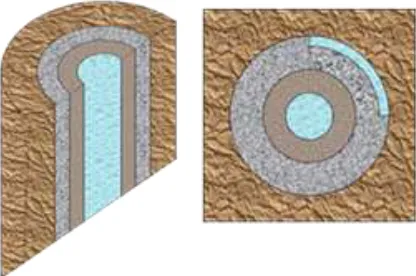
The vertical casing well model and the borehole cross section of the Ⅱ Interface sector cement missing model as shown in Fig. 1.
The medium from the inside to the outside in turn represents the borehole fluid, the steel casing, the cement ring, the formation in the well. H represents the channeling trough thickness. When H is less than the thickness of cement ring with 30.0mm, it indicates the existence Ⅱ Interface channel in well. It represents the
Figure 1. The vertical casing well model and the borehole cross section of the Ⅱ Interface sector cement missing model.
The High-Order Staggered 3-D Finite Difference Method
Use the 3-D finite difference method based on stress - velocity to solute the first-order partial differential equation of wellbore sound field. And use different scheme of staggered grid to improve operational efficiency. The 8-order staggered grid difference scheme, as shown in (1).
7 0 8 2 1 2 2 1 2 1 m m x m x f x m x f a x f (1)Use 2-order difference in time, and use 8-order difference in space. It obtains nine different formulas of velocity and stress, as shown in (2).
2 1 8 2 1 8 1 2 1 8 2 1 8 1 2 1 8 2 1 8 1 2 1 2 1 8 2 1 8 2 1 8 2 1 8 1 2 1 2 1 8 2 1 8 2 1 8 2 1 8 1 2 1 2 1 8 2 1 8 2 1 8 2 1 8 1 2 2 2 n y z n z y n yz n yz n x z n z x n xz n xz n x y n y x n xy n xy n zz n z z n z z n y y n x x n zz n zz n yy n y y n z z n y y n x x n yy n yy n xx n x x n z z n y y n x x n xx n xx t t t g t g t g t (2)
The finite difference simulation results need to meet the convergence and stability. And the time step of stability as shown in (3).
max 2 2 2
0 . 1 z y x t
(3)
And the convergence of the spatial interval as shown in (4).
max min 4 , , max f z yx
(4)
Heremax and min represent the maximum and the minimum sound velocity of
the medium. And represents the highest effective frequency of the sound source. In the 3-D finite difference simulation, there exists the false reflection of man-made boundary because of the limited computing space. This paper uses the non-cracked perfect matching method (NPML) to weaken this boundary reflection [11].
The Material Parameter
TABLE I. THE MATERIAL PARAMETERS.
media P - wave velocity (m/s)
s - wave velocity (m/s)
density (kg/m3)
well fluid 1580 0 1090
steel casing 6098 3354 7500
cement layer 2800 1700 1920
Fast
formation 3800 2200 2600 Slow formation 3000 1765 2261
STUDY ON THE CHARACTERISTIC WAVE OF SECTION CEMENT MISSING IN VERTICAL WELL
The Sector Cement Missing Characteristic Wave in Fast Formation
Study the relationship between the characteristic wave (the first wave amplitude and the travel time) and the Ⅱ interface sector missing angle in the fast formation.
First, simulate the case that the thickness of the Ⅱ interface channel fluid ring is
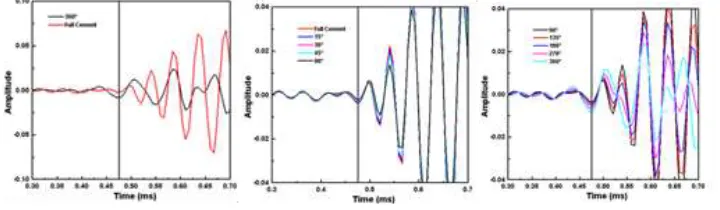
10.0mm, and the missing angles are 15 °, 30 °, 45 °, 90 °, 135 °, 180 °, 270 °, 360 ° (Consistent with the scale wells). The distribution of the characteristic wave amplitude changes with the missing angle when the thickness of the fluid ring is 10.0 mm as shown in Fig. 2.
Figure 2. The sound field of different missing angles. (P - wave velocity is 3800m/s,the fluid ring thickness is 10.0mm)
[image:5.612.126.486.456.561.2]stratigraphic wave. The Ⅱ interface characteristic wave amplitude which is portion missing is smaller than that of stratigraphic wave which is the fully cemented. While the characteristic waves travel time is less than the stratigraphic wave travel time.
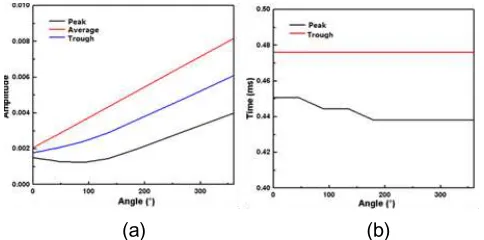
The relationship between the characteristic wave (the first wave amplitude and the ravel time) and the Ⅱ interface sector missing angle when the thickness of the fluid ring is 10.0 mm as shown in Fig.3.
Overall, the first wave amplitude of the characteristic wave increases with the increase of the missing angle. With the cementing quality deteriorated, the first wave amplitude of characteristic wave gradually increased. And the travel time of the characteristic wave is not related to the missing angle. From the peak the curve can also be found. The amplitude of the first wave is not obvious when the missing angle is less than 90°, and the amplitude of the first wave decreases with the increase of the missing angle when the missing angle is less than 45°.
[image:6.612.185.427.313.433.2](a) (b)
Figure 3. The relationship between the characteristic wave(the first wave amplitude and the travel
time) and the Ⅱ interface sector missing angle. (P - wave velocity is 3800m/s, the fluid ring thickness is 10.0mm) (a) the first wave amplitude (b) the ravel time.
This is because the position of the Ⅱ interface channel increases with the increase of the missing angle, and the characteristic wave energy is added. The amplitude of the characteristic wave increases with the increase of the missing angle. The arrival time of the first wave must be the Ⅱ interface characteristic wave when there is an angle missing. As long as the same missing thickness, the travel time of the first wave will not change a little.
The results of the fluid rings thickness are 1.0 mm, 5.0 mm and 15.0 mm as shown in Fig. 4.
15.0mm, while the trough values and the average are quite different. The distribution curves are almost linearly distributed when the fluid ring thickness is 1.0mm and 15.0mm. It only changes when the missing angle is less than 30°.
[image:7.612.125.487.144.267.2]
(a) (b) (c)
Figure 4. The distribution of the first wave amplitude of the characteristic wave changes with the
missing angle(P - wave velocity is 3800m/s) (a) The fluid ring thickness is 1.0mm (b) The fluid ring thickness is 5.0mm (c) The fluid ring thickness is 15.0mm.
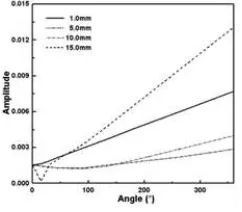
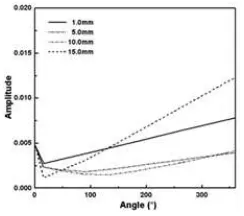
Figure 5. The distribution of the characteristic wave first wave amplitude changes with the missing angle in different fluid ring thickness. (Peak, P - wave velocity is 3800m/s).
Compared the four simulation results, the fluid rings missing thicknesses are 1.0 mm, 5.0 mm, 10.0 mm and 15.0 mm as shown in Fig.5.
It can be found that the first wave amplitude of the characteristic wave increases with the increase of the missing angle. The amplitude of the missing thickness is 1.0mm, which is greater than that of 5.0mm and 10.0mm. If the missing thickness is greater than 5.0mm, the characteristic wave amplitude increases with the increase of the missing thickness when the missing angle is the same. This change has some differences when the missing angle is less than 45°. The reason that the amplitude of the characteristic wave is interfered by other factors, such as the missing angle is too small , the missing thickness is quite small and so on.
[image:7.612.246.367.349.455.2]varies with the missing angle, which is equivalent to that of the channel fluid ring thickness.
The Sector Cement Missing Characteristic Wave in Slow Formation
[image:8.612.123.488.238.344.2]In the simulation of the fast formation, there exists a P-wave velocity which is 3800m/s. At this time, stratigraphic wave travel time is faster, which is close to the characteristic wave. Then, we simulate the case that the formation wave velocity is 3000 m/s (the slow formation), and other parameters are consistent with the previous. The sound field of different missing angles as shown in Fig. 6.
Figure 6. The sound field of different missing angles. (P - wave velocity is 3000m/s, the fluid ring thickness is 10.0mm)
Figure 7. The distribution of the characteristic wave first wave amplitude changes with the missing angle in different fluid ring thickness. (Peak,P - wave velocity is 3000m/s)
In the slow formation, the distribution of the characteristic wave first wave amplitude changes with the missing angles in different fluid ring thickness as shown in Fig. 7.
[image:8.612.245.367.399.507.2]cementing situation is much easier. The distribution in Fig.5 and Fig.7 are so similar. So it can be verified that the judgment obtained from Fig.5 is correct.
CONCLUSIONS
The paper uses different sector missing to simulate the Ⅱ interface local cement
channel in a vertical well. And it considers the first wave is the Ⅱ interface
characteristic wave when the Ⅱ interface local channeling.
First, the first wave amplitude of the characteristic wave increases with the increase of the missing angle. The amplitude change is smaller when the missing angle is less than 45°. The first wave travel time of the characteristic wave is not affected by the missing angle.
Second, if the missing thickness is greater than 5.0mm, the characteristic wave amplitude increases with the increase of the missing thickness when the missing angle is same.
Third, the fluid ring thickness and the sector missing angle both affect the amplitude of the characteristic wave, and their variation characteristics are equivalent.
Through studying the changes of the Ⅱ interface characteristic wave in sector cement missing sound field, we can gain three conclusions as shown above. Which can improve the cementing quality evaluation system of the missing sound field. And provides important theoretical basis for the possible occurrence of oilfield oil production operations and water injection operations.
REFERENCES
1. Jun Ma, Jisheng Liu, Xiumei Lu, Kehe Wang, Ronghua Xie. “Nonlinear Inversion of SBT Forward and Sector and Imaging of Local Defects in Well,” Chinese Journal of Geophysics, pp.64, 2001. In Chinese.
2. Weijun Lin, Chengyu Zhang, Hailan Zhang, Xiuming Wang. “Acoustic field in a cased well with a sectorial crossing channel,” Acta Acustica, vol.30(1), pp.10-14, 2005. In Chinese.
3. Peixiao Li, Weijun Lin, Xiupei Zhang. “Research on quantitative evaluation of cementing quality using the segmented bond logging technique,” Journal of Applied Acoustics, vol. 35(1), pp.27-35, 2016. In Chinese.
4. Xiumei Zhang, Jianmeng Sun, Xuelian Chen. “Numerical Simulation of the Logging Response of Segmented Bond Tool (SBT),” Well Logging Technology, vol.28(6), pp. 515-517, 2004.In Chinese.
5. Aimin Wang. “Sector Cement Bond Tool and Application in the Cased Holes,” Well Logging Technology, vol.27 (Suppl), pp.56- 58,2003. In Chinese.
7. Jun Ma , Kehe Wang , Gang Li. “Numerical simulation method of three - dimensional SV - FD with anisotropic media surrounding the sound field in wellbore,” The 18th Annual Meeting of the Chinese Society of Geophysics, 2002, Beihai China.In Chinese.
8. Ruolong Song, Jinxia Liu,Guijin Yao. “Parallel finite difference moderling of acoustic field in nonaxisymmetric cased hole,” Chinese Journal of Geophysics, vol.53(11), pp.2767-2775, 2010. In Chinese.
9. Xuelian Chen, Xiaoming Tang,Conghui Zhang. “Finite-difference numerical simulation and analysis on nonaxisymmetric acoustic field in cased borehole,”Chinese Journal of Geophysics, vol.58(1), pp.318-326, 2015. In Chinese.
10. Ruijia Wang, WenxiaoQiao. “Numerical modeling of three-dimensional acoustic reflection logging while drilling,” Chinese Journal of Geophysics, vol.58(6), pp.2201-2209, 2015. In Chinese.