© 2018, IRJET | Impact Factor value: 6.171 | ISO 9001:2008 Certified Journal | Page 3794
Productivity Improvement by Implementing Lean Manufacturing Tools
In Manufacturing Industry
Dhruv Shah
1, Mr. Pritesh Patel
21PG Student, Mechanical Engineering, BITS Edu Campus, Vadodara, India
2Assistant Professor, Mechanical Engineering, BITS Edu Campus, Vadodara, India
---***---Abstract -
The last two decades have witnessed anexplosion in the area of Quality and Productivity improvement initiatives in the Indian SMEs using various tools and techniques like Lean Manufacturing, TQM, TPM, Six Sigma, Lean Six Sigma, ISO implementation etc. Every manufacturing industry has put in continuous efforts for its survival in the current volatile economy. Industries are trying to implement new and efficient techniques in their manufacturing operations. Some of the established tools are applied, and its realization has been growing among the industries, particularly in manufacturing sector. Lean tools allow the organization to focus upon elimination of 7 wastes, reducing current lead time, stock levels and cycle times to find out the ratio of value added process to the total lead time of the product line being investigated. The initial step is to generate a current state map to analyze the existing procedure, evaluate and identify the wastes and steps to eliminate the same using suitable tools and techniques. The research work will help to illustrate the existing hidden potential in small scale industry as well as a selection of suitable methods for productivity improvements and its ultimate goal is to eliminate waste and non-value added activities at every stage in order to provide maximum satisfaction to the customer. It will also be useful for the researchers, professionals, academicians and other concerned to understand the significance of improvement methodology.
Key Words: Lean manufacturing tools, Indian SMEs, Waste reduction, Kaizen, TPM, OEE, Productivity improvement.
1. INTRODUCTION
The lean manufacturing (LM) or Toyota Production System (TPS), pioneered by a Japanese automotive company, Toyota, has been implemented by nearly all countries across the word due to its global superiority in cost, quality, flexibility and quick respond. Lean is a production practice that aims to minimize waste with entire value streams creating more value for customers. It is purely a customer based strategy which focuses on the value stream and its optimization. According to lean principles, use of resources that does not deliver consumer value is a target for change or elimination.
The main purpose of implementing lean manufacturing is to increase productivity, reduce lead time and cost and improve quality thus providing the up most value to customers. There are many descriptions regarding lean manufacturing.
1.1 Steps of lean manufacturing implementation 1. Identification of wastes in the system:-Many organizations need to know that they have many hidden and unhidden wastes in their systems.
2. Wastes present in the organization can be of different types:- There is a need to recognize the types of waste and their causes. Lean manufacturing believes in treating the causes and curing the problems permanently. There are various tools and techniques that are quite helpful in reducing or eliminating these types of waste.
3. The next step is to find the solution for the root causes:- One must stick to basic lean concepts and identify the root causes. Looking at causes might not help properly, so there is a need to identify the effects of the solution on the entire system.
4. The final step in the lean implementation process is to find the solutions and test the solutions first:- Once solutions are tested then they should be implemented. Training and following up are important in each and every step explained above. One needs to be patient because the implementation process might take a long time.
1.2 Types of Waste
There are seven types of waste describe as follow:-
(1) Overproduction:- It is unnecessary to produce more than the customer demands, or producing it too early before it is needed. This increases the risk of obsolescence and the risk of producing the wrong thing. It tends to lead to excessive lead and storage times.
(2) Defects:- In addition to physical defects which directly add to the costs of goods sold, this may include errors in paperwork, late delivery, production according to incorrect specifications, use of too much raw materials or generation of unnecessary scrap. When defect occurs, rework may be required; otherwise the product will be scrapped. Generation of defects will not only waste material and labour resources, but it will also create material shortages, hinder meeting schedules, create idle time at subsequent workstations and extend the manufacturing lead time.
© 2018, IRJET | Impact Factor value: 6.171 | ISO 9001:2008 Certified Journal | Page 3795 storage costs and higher defect rates. It tends to increase
lead time, prevents rapid identification of problems and increase space requirements. In order to conduct effective purchasing, it is especially necessary to eliminate inventory due to incorrect lead times.
(4) Transportation:- It includes any movement of materials that does not add any value to the product, such as moving materials between workstations. Transportation between processing stages results in prolonging production cycle times, the inefficient use of labour and space. Any movement in the firms could be viewed as waste. Double handling and excessive movements are likely to cause damage and deterioration with the distance of communication between processes.
(5) Waiting:- It is idle time for workers or machines due to bottlenecks or inefficient production flow on the factory floor. It includes small delays between processing of units. When time is being used ineffectively, then the waste of waiting occurs. This waste occurs whenever goods are not moving or being worked on. This waste affects both goods and workers, each spending time waiting. Waiting time for workers may be used for training or maintenance activities and should not result in overproduction.
(6) Motion:- It includes any unnecessary physical motions or walking by workers which divert them from actual processing work. This might include walking around the factory floor to look for a tool, or even unnecessary or difficult physical movements, due to poorly designed ergonomics, which slow down the workers. It involves poor ergonomics of production, where operators have to stretch, bend and pick up when such actions could be avoided.
(7) Over processing:- It is unintentionally doing more processing work than the customer requires in terms of product quality or features such as polishing or applying finishing in some areas of product that will not be seen by the customer. Over-processing occurs in situations where overly complex solutions are found to simple procedures.
1.3 Objectives of the Paper
To study existing scenario of the Plastic manufacturing industry and find the reasons for lean wastes.
Identification of the Lean tools that can help reducing the defects and wastage applying them in the industry.
Observing productivity improvement by implementation of tools.
Validation with past records.
1.4 Review of Lean Implementation
There are various type of lean tools are available and use this tools and principal, like cellular manufacturing, JIT, continuous improvement, standardization of work, total productive maintenance (TPM), SMED, etc.. We are understood about lean tool one by one in shortly.
1. Just in time (JIT): Just in time is a heart of the lean manufacturing. It’s associated with lean techniques. Just in time production gives right part at the right place at right time. It is also known as JIT- production OR Toyota Production System (TPS). IT is a methodology which aims primarily on reducing flow time within the production system & response time for suppliers & to the costumers. It was developed at BRITISH MOTOR CORPORATION (Australia) in SYDNEY in 1950s. Ten it was adopted in JAPAN, between 1960-1970s particularly at TOYOTA.
2.Kanban: Production smoothing, and setup time reduction are component of any JIT system. “Kanban” is a Japanese word which means card or signal. Which process is running and gives the basic information about manufacturing. It is system which prepare a schedule for lean manufacturing & Just in Time. It is a system which controls the inventory to control chain of supply. An industrial engineer namely Taijchi Ohno at Toyota developed kanban to improve manufacturing efficiency. It is method which is applied to achieve JIT.
3.Production Smoothing: Production smoothing is the process of the balance the work load over different time period. It provide flexibility to respond rush order. It is help to eliminate over production.
4. Total productive maintenance (TPM): Total productive maintenance is the techniques for reducing the machine down time and eliminates the defect and scrap. TPM is a fundamental pillar of lean. It is introducing awareness of self-maintenance and also introducing the preventive maintenance of machine. It is a system which maintains & improves the integrity of production & quality system through machines, processes, workers, equipment’s which adds business value to the organization. Its aim is to keep all the equipment’s in top working conditions which avoids delays & breakdowns in the manufacturing processes.
5. KPI (Key Performance Indicator): A method of regulating the flow of goods both within the factory and with outside suppliers and customers. Based on automatic replenishment through signal cards that indicate when more goods are needed. Eliminates waste from inventory and overproduction. Can eliminate the need for physical inventories (instead relying on signal cards to indicate when more goods need to be ordered).
© 2018, IRJET | Impact Factor value: 6.171 | ISO 9001:2008 Certified Journal | Page 3796 Availability (e.g. down time)
Performance (e.g. slow cycles) Quality (e.g. rejects)
Provides benchmark/baseline and a means to track progress in eliminating waste from a manufacturing process. 100% OEE means perfect production (manufacturing only good parts, as fast as possible, with no down time).
2. Literature Review
Indian manufacturing industry has witnessed irrepressible competition in the recent times in terms of low costs, improved quality and diverse products with superior performance. Indian entrepreneurs have now understood that to meet the challenges posed by the competitive environment, the manufacturing organizations must infuse quality and maintenance improvement initiatives in all aspects of their processes to improve their competitiveness.
Lean is a production philosophy, which considers that any activity which consumes resources but not create value for the end customer is wasteful, and therefore should be eliminated. Shah and Ward, 2007; Antony, 2011).[17][19]
lean production eliminates unnecessary processes, align processes in continuous flow and solve problems through continuous improvements. At operational level lean manufacturing is carried out through a set of lean practices. By implementing these tools and techniques lean manufacturing targets to identify and eliminate numerous wastes exist inside the factory or along the supply chain Sohal (1996).[19]
Apply the lean tool by method time measurement and line balance efficiency and reduce the cycle time in a truck body assembly line and improve efficiency in that product line. Also says that lean manufacturing is a business philosophy that continuously improves the process involve in manufacturing. Santosh kumar et, al.(2014)[4]
Companies recognize that consistent and disciplined application of lean manufacturing strategies with the emphasis on waste elimination and process streamlining can lead to business excellence (Mejabi, 2003; Taj, 2008; Rahman et.al.,2010).
Lean is a manufacturing paradigm based on the fundamental goals of Toyota Production System (TPS), which is aimed at continuously minimizing waste to maximize flow (Vinodh et al., 2010).[9]
Applied VSM in a biscuit manufacturing plant and found that application of lean manufacturing resulted in increase in quality, decrease in inventory,increase in timely deliveries ,better utilization of space and equipments and reduction in lead time. Upadhye et al. (2010)[24]
Study the application of lean manufacturing in a radial tyre manufacturing firm and found that organizational culture and human resource management play a vital role to manage the change. Authors also found that major causes of high manufacturing cost were over-processing and excessive defects. Gupta et al. (2013)[23]
Indian manufacturing industries regarding lean implementation issues but there is barely any exploratory research focussed upon process sector of India. Present empirical study will bridge this gap in research by addressing the prominent issues regarding lean implementation in Indian process industries and will furnish important outcomes for general application and upcoming research. (Singh et al., 2010; Garza-Reyes et al., 2012; Ghosh, 2013).[7] [21][22]
2.1 Summary of Literature Review
The literature review reveals that manufacturing sectors such as automobile, machinery and steel industries have made the most of lean manufacturing tools and techniques to improve their productivity and the manufacturing processes.
On the other hand, although substantial data has been generated on lean manufacturing tools and techniques, implementation of lean manufacturing tools and techniques in Plastic industries has not been extensive and popularized.
The findings of the literature review have clearly reflected the shortcomings of the Plastic industries. Hence, after considering the gaps identified, it was proposed to take up a research study with the main thrust to identify diverse opportunities from lean manufacturing tools and techniques that are applicable specifically to the Plastic industries, Subsequently, it was planned to come out with possible suggestions to implement the lean manufacturing tools and techniques for the benefit of the majority of the Plastic industries.
2.2 Scope of Work
To implement applicable lean manufacturing tools in plastic Manufacturing Industry.
Identification of the tools that can help in improvement to reduce the waste, reduce cycle time and improve productivity.
By implementing tools continuous improvement in every stage of process in Manufacturing Industry
Implementation of the tools and observing the outcome.
Standardize the procedure for waste reduction.
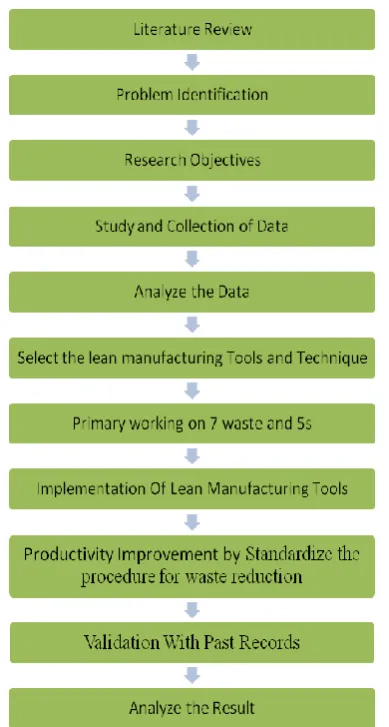
© 2018, IRJET | Impact Factor value: 6.171 | ISO 9001:2008 Certified Journal | Page 3797 Fig -1: Research Framework
3. CONCLUSION
Lean is applicable for all the type of the organization irrespective of their size, lot of work has been carried out in manufacturing sector that to in different functional areas, the level of implementation varies across the sectors and their size. It is evident from the research paper studied that kanban, continuous flow and TPS are the most commonly used lean tools in the organization.
One of the critical implementation factors of LM is simultaneous adoption of leanness in supply chain. One of the reasons for the slow adoption of LM under variable demand scenario is to link the production pull signal to the variable demand. . LM adoption led to more stress at managerial level rather than the shop floor level people.
From review of different papers, we concluded that successful implementation of Lean Manufacturing is used in small scale industries to improve man, machine, method and environment, a core of manufacturing industries We can also suggest some change in steps of processes why using VSM through layout which would may be efficient for workers to use it. By implementing Lean manufacturing techniques
excess inventory can be reduce, so we can manage to maintain inventory. We reviewed these all research papers to get details of lean manufacturing tools which can be used in to improve productivity of an industry.
REFERENCES
1.Morales Méndez JD, Rodriguez RS. “Total productive maintenance (TPM) as a tool for improving productivity: a case study of application in the bottleneck of an auto-parts machining line” Int J Adv Manuf Technol. 2017;92(1-4):1013-1026. doi:10.1007/s00170-017-0052-4.
2.Arunagiri P, Gnanavelbabu A. “Identification of high impact lean production tools in automobile industries using weighted average method. Procedia Eng. 2014;97:2072-2080. doi:10.1016/j.proeng.2014.12.450.
3.Panwar A, Jain R, Rathore APS. Journal of Manufacturing Technology Management Lean Implementation in Indian Process Industries – Some Empirical Evidence Lean Implementation in Indian Process Industries – Some Empirical Evidence. Vol 26.; 2015. http://dx.doi.org/10.1108/JMTM-05-2013
4.Kumar SS, Kumar MP. Cycle Time Reduction of a Truck Body Assembly in an Automobile Industry by Lean Principles. Procedia Mater Sci. 2014;5:1853-1862. doi:10.1016/j.mspro.2014.07.493.
5.Sundar R, Balaji AN, Satheesh Kumar RM. A review on lean manufacturing implementation techniques. Procedia
Eng. 2014;97:1875-1885.
doi:10.1016/j.proeng.2014.12.341.
6.Rahani AR, Al-Ashraf M. Production flow analysis through Value Stream Mapping: A lean manufacturing process case study. Procedia Eng. 2012;41(Iris):1727-1734. doi:10.1016/j.proeng.2012.07.375.
7.Singh R, Gohil AM, Shah DB, Desai S. Total productive maintenance (TPM) implementation in a machine shop: A case study. Procedia Eng. 2017;51(NUiCONE 2012):592-599. doi:10.1016/j.proeng.2013.01.084.
8. Chowdary B V., George D. Improvement of manufacturing operations at a pharmaceutical company. J Manuf Technol Manag.2011;23(1):56-75doi:10.1108/17410381211196285.
9.Vinodh S, Gautham SG, Ramiya A. Implementing lean sigma framework in an Indian automotive valves manufacturing organisation: A case study. Prod Plan
Control. 2017;22(7):708-722.
doi:10.1080/09537287.2010.546980.
© 2018, IRJET | Impact Factor value: 6.171 | ISO 9001:2008 Certified Journal | Page 3798 manufacturing organisation. J Manuf Technol Manag.
2017;21(7):888-900. doi:10.1108/17410381011077973.
11.Ahuja IPS, Khamba JS. Strategies and success factors for overcoming challenges in TPM implementation in Indian manufacturing industry. J Qual Maint Eng. 2008;14(2):123-147. doi:10.1108/13552510810877647.
12.Almanei M, Salonitis K, Xu Y. Lean Implementation Frameworks: The Challenges for SMEs. Procedia CIRP. 2017;63:750-755. doi:10.1016/j.procir.2017.03.170.
13.Venkataraman K, Ramnath BV, Kumar VM, Elanchezhian C. Application of Value Stream Mapping for Reduction of Cycle Time in a Machining Process. Procedia Mater Sci. 2014;6(Icmpc):1187-1196. doi: 10.1016/j.mspro.2014.07. 192.
14.Ramesh V, Sreenivasa Prasad K V, Srinivas TR. Implementation of a Lean Model for Carrying out Value Stream Mapping in a Manufacturing Industry. J Ind Syst Eng. 2017;2(3):180-196.
15.Rohani JM, Zahraee SM. Production Line Analysis via Value Stream Mapping: A Lean Manufacturing Process of Color Industry. Procedia Manuf. 2015;2(February):6-10. doi:10.1016/j.promfg.2015.07.002.
16.Krause DR, Ellram LM. Critical elements of supplier development The buying-firm perspective. Eur J Purch Supply Manag. 1997;3(1):21-31. doi:10.1016/S0969-7012(96)00003-2.
17.Shah R, Ward PT. Lean manufacturing: Context, practice bundles, and performance. J Oper Manag. 2003;21(2):129-149. doi:10.1016/S0272-6963(02)00108-0.
18.Sohal AS. Developing a lean production organization: an Australian case study. Int J Oper Prod Manag. 1996;16(2):91-102. doi:10.1108/01443579610109866.
19.Antony J. Six Sigma vs Lean. Int J Product Perform
Manag. 2011;60(2):185-190.
doi:10.1108/17410401111101494.
20.Belekoukias I, Garza-Reyes JA, Kumar V. The impact of lean methods and tools on the operational performance of manufacturing organisations. Int J Prod Res. 2014;52(18) :5346-5366. doi: 10.1080/00207543.2014. 903348.
21.Belekoukias I, Garza-Reyes JA, Kumar V. The impact of lean methods and tools on the operational performance of manufacturing organisations. Int J Prod Res. 2014;52(18):5346-5366. doi: 10.1080/00207543. 2014. 903348.
22.Ghosh M. Lean manufacturing performance in Indian manufacturing plants. J Manuf Technol Manag. 2012;24(1):113-122. doi:10.1108/17410381311287517.
23.Gupta S, Jain SK. A literature review of lean manufacturing. Int J Manag Sci Eng Manag. 2013;8(4):241-249. doi:10.1080/17509653.2013.825074.