© 2018, IRJET | Impact Factor value: 6.171 | ISO 9001:2008 Certified Journal | Page 1760
Enhancement of Highway Project Performance using
Lean Construction Method
Sarthak Singh Rajput
1, Prakash Kumar Sharma
21 Professor, Department of Civil Engineering, Integral University, Lucknow Uttar Pradesh,
2Student, Department of Civil Engineering, Integral University, Lucknow, Uttar Pradesh.
---***---Abstract -
Construction sector in Northern India (especially Lucknow) has been on a high growth path recently and maximizing potency and profit has been a key concern. Lean Construction offers a possible answer for system level potency improvement. Lean implementation is a challenge to deal with untrained staff, improper site management and safety aspects in construction. Construction sites must allow adopting the Lean principles and using numerous different Lean tools by imparting training to the staff. The paper presents several of the quality advantages of Lean implementation. However, the extent of gains are seen to be influenced by several soft aspects, like the culture and position of an organization, designing and engineering experience, commitment and support from prime management and site management.Key Words: Lean principles, Indian Construction, Toyota way, prospective solution
1. INTRODUCTION
The construction industry has very low productivity as compare to other industries since many years even after the use of new technologies and use in construction. Lean concept is very popular in manufacturing industries to improve productivity by smooth work flow and minimize the waste. A Lean construction is a “way to design production systems to minimize waste of materials, time, and effort in order to generate the maximum possible amount of value," here waste is different from pure construction waste. Designing a production system to achieve the stated ends is only possible through the collaboration of all project participants (Owner, Architect/Engineer, contractors, Facility Managers, End-user) at every stages of the project. Lean Construction is believed to be particularly useful on complex, uncertain and quick projects.
There are substantial researches that have been focused on Lean Construction theory. Some of the lean principles that are related to the construction industry are such improvements as the construction planning process, eliminating waste, construction supply chain, and downstream performance.
Lean construction draws upon the principles of project-level management and upon the principles that govern production-level management.
Primarily, lean construction aims to reduce the waste caused by unpredictable workflow. Here Waste is defined in following categories: defects, delays due to waiting for upstream activities to finish before another job can begin, maintaining excess inventory, and unnecessary transport of materials and unnecessary movement of people. Over allocated equipment and material on site, accident on site etc. Work is structured throughout the process to maximize value and to reduce waste at the project delivery level. Efforts to manage and improve performance are aimed at improving total project performance, because this is more important than reducing the cost or increasing the speed of any particular activity.
The Toyota Way Model is employed to solve some of the time overshot limitation. It is beneficial to analyze the attributes of Toyota Way Model in terms of their importance to optimize delaying situation.
1.1 Literature Review
© 2018, IRJET | Impact Factor value: 6.171 | ISO 9001:2008 Certified Journal | Page 1761
Authority of India (NHAI) don't give any points of interest to the authoritative specialists that have worked with them already. Since the portion needs economies of scale, littler players may have better cost structures in view of lower overhead costs.
1.2 Causes of Delay
Researchers have
studied
the many causes of delay in the construction industry. Lo et al. (2006) summarized some of the studies that took place from 1971 to 2000 (Table1).Table1. Summary of Previous Studies of the Causes of Delays in Construction Projects
Researcher Country Major causes of delay
Baldwin et. al. (1971) United States Inclement weather, shortages of labor supply, subcontracting system
Arditi et. al. (1985) Turkey Shortages of resources, delay in design work, financial difficulties faced by public agencies and contractors, organizational difficulties, frequent changes in orders Assaf et. al. (1995) Saudi Arabia Delay in payments to contractors, shortages of labor supply,
poor workmanship, changes in orders
Okpala and Aniekwu (1998) Nigeria Shortages of supply, failure to pay for completed works, Poor contract management
Dlakwa and Culpin (1990) Nigeria Fluctuations in materials, plant and labor costs, delays in payments by agencies to contractors
Semple et. al.(1994) Canada Increases in the scope of work, inclement weather, restricted access
2. METHODOLOGY
The methodology espoused is to analyze the lean performance of construction sites in transportation sector by awarding the lean score. The expected benefits which are predicted post application of lean principles are noted down. The application of Toyota Way attributes in construction sites will lead to their transformation into lean construction organization.
2.1 Need for Research
North Indian construction industries within realm of Lucknow (India) are shaped by four precarious performance facets, namely, quality, productivity, profitability and project management. In order to accomplish serviceably all the performance facets, ethics of Toyota way model can favorable. In actual enactment, it seems that no single real estate construction firm has fully demonstrated its ability, capacity, or readiness to implement all the principles of Toyota Way model which manifests gaps between two. A requisite is to shoot Toyota management postulates to real estate construction firms for exertions need to be utilized as anti-delay remedy to ameliorate the approach within each different principle: the contribution of employees and workers (manpower), the contribution of materials and machines and the contribution of workplace design.
2.2 Introduction to the Toyota way principles
In recent years, the state-owned and private companies have gradually initiated to undertake the lean approach so as to lessen probability of cost and time overrun of construction projects. So far, most companies have only focused on the application of lean tools and very few have fully started the whole lean enterprise transformation. Lucknow firms held three different attitudes towards lean principles. Firstly, many companies claimed that they are lean companies because they have already implemented 5-S activities, or etc., but they have failed to appreciate the interrelationships between many other tools. Secondly, many companies believed that occurrence of delays are due to an act of God and lean principles will not stop delay occurrence. Lastly, some companies thought that they completed their lean transformation years ago.
© 2018, IRJET | Impact Factor value: 6.171 | ISO 9001:2008 Certified Journal | Page 1762
“Based your management decision on the long-term philosophy, even at the expense of short-term financial goals”. Sometimes either contractor or third party causes delays in construction projects to make more profit. But it must not the driving purpose of contractor or owner and must adopt strategy of “constancy of purpose” for growth in sales of deliverables and hence profit (sense of purpose).To avoid delays during construction work/designing phase construction organization must not dismiss its employees because of a temporary downturn and it must sustain a long-term relationship with the suppliers (long term perspectives).Construction industry must have unique spirit of “let’s do it ourselves” and self reliance. Self reliance helps in developing core-competitiveness. At firm, the champion to self-reliance is responsibility for its own successes and failures (self reliance and responsibility). The management endeavors to ensure that all tram members and departments realize their dual roles, namely that they are not only the customers of the previous operation but also the suppliers to the next operation downstream. In order to avoid delays due to lack of communication, inadequate manual operation, loading and unloading parts from equipments construction resources like equipments, labors, machines must be arranged around the edge of a u-shape, allowing workers to walk the shortest distance from process to process and performing other manual operations .It will assist communication and allows the workers access to a number of machines and to be able to operate several machines. The project is not only delayed but the morale of workers plummet because of non-payment or irregular payment of wages. Subcontractors and suppliers of materials and components and their employees are likewise affected. The overburden of work on labors, staff and on equipment’s reduce their efficiency and further rate of performing work slows down due to sickness. In this case situation of staff getting sick is common and so it will act as barrier to construction process. Standardized tasks are the foundation for keeping project work as per defined schedule and imply that all work should be highly specified in terms of timing, content, sequence and outcome. Creating standardized work requires identifying the repeatable elements of a process, assessing the best way to perform those elements, developing a reliable method to ensure the performance of those elements and then performing the reliable method according to a required time. Visual management in construction is needed due to a number of factors such as physical environment involved, construction technology and contractual relations that result in difficulties visualizing the flow of work in progress on-site. Basically, visual management practices can be classified into different layers of visual workplace framework namely visual order, visual standards, visual measures and controls and visual guarantees. Real estate sector organization, which is still very labour intensive, aims to be on the cutting edge of technology. Thoroughly test new technology, technology must support people and company values and technology must improve people. Building professionals have attempted various new technologies, in the hope of improving performance, in an industry which is known for its slow rate of adopting new technology.
Table2. Statistics showing attributes relative importance
S. No. Attributes of the Toyota Way Philosophy Model
1. Sustain a constant purpose (vision, mission, values)
2. Have a mission which facilitates values towards employees and clients 3. Formulation of long-term vision plan
4. Short-term losses affect decision-making, but are less important than pursuing long-term goals 5. Have a clear view of the firm’s core competency
6. Be responsible for sustainable products, engineers, environment and society 7. Understanding the customer’s requirement is priority work
8. Be able to rapidly respond to meet the changing requirement of the customer’s 9. Treat employees/suppliers as internal customers
10. Employee is concerned with waste elimination
11. Material flow is adhered to consistently throughout the daily work activities
12. Material, equipment and other resources are provided in a “just-in-time” manner when needed 13. Site layout is organised to enhance material flow, employee movement, etc, to minimise wastes due to
movement , motion, travel, etc.
14. Strive to cut back to zero the amount of time any work is sitting idle or waiting for someone to work on it 15. Make flow evident through organisational culture
16. Materials are ordered as close as possible to exact needs
© 2018, IRJET | Impact Factor value: 6.171 | ISO 9001:2008 Certified Journal | Page 1763 18. Use simple signals-cards, empty bins, etc. To monitor the level of inventory and to order the needed
materials
19. Monitor the quantity of material/equipment that the teams actually take away
20. Clear job contents, work time, material requirements, among other information are prepared before releasing a work task to a crew
21. Project manager plans the work with input from other parties including subcontractors, suppliers etc. 22. Daily work activities are planned to balance material availability, manpower, machine availability and
workload between operations
23. Foreman make commitments on what the crews will do each week based on what is ready to be done 24. Weekly/daily work assignments are completed in accordance with the weekly/daily schedule 25. Levelling the daily work activities without overburdening workers and machinery
26. Employees are dedicated to provide “built-in” quality into every aspect of operations 27. Preventing defective or “no-inspection” assignments from entering the next process 28. Rejecting defective materials, components and equipment
29. Employees are encouraged to seek support from their supervisors when something goes wrong at work 30. Employees are empowered to be responsible for quality
31. Employees who work in the same team meet on a regular basis to discuss quality problems and lessons learned
32. Established standard operating procedures like work processes are practiced by employees for each major process
33. Employees play a key role in creating the SOPs
34. Employees are encouraged to improve the existing SOPs based on their own practical experience 35. Using standardised prefabricated components from off-site shops
36. Visual aids are adopted to make wastes, problems and abnormal conditions readily apparent to employees
37. The posted information in terms of job status, schedule, quality, safety, etc is in place that most workers can see it on a daily basis, and it is up-to-date
38. Appropriate signage are used to identify layouts, traffic, safety concerns, etc. 39. The work place follows the principles of 5-S
40. New technology must support the company’s values 41. New technology must be specific solution oriented
42. New technology must be thoroughly tested and proven to provide long-term benefits 43. New technology must demonstrate its potential to enhance processes
3.History of surveyed construction organization
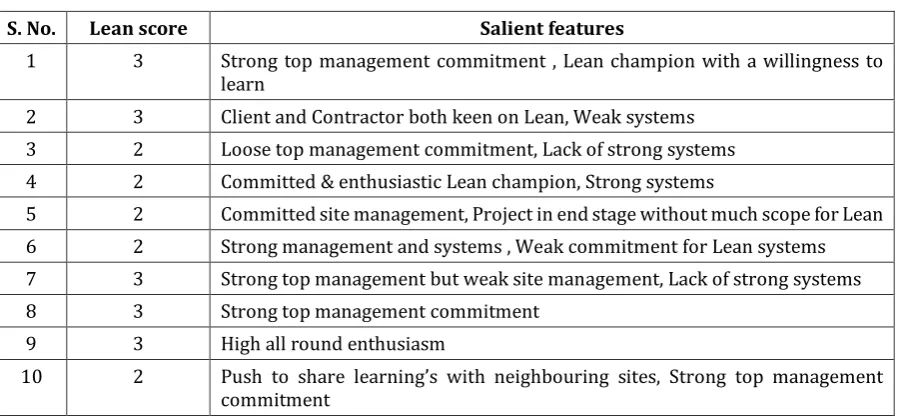
The performance of the various sites that participated in this programme has been rated on a 4-point scale and shown in table 1. On this scale:
• Level 1 indicates that there was no visible implementation of lean practices.
© 2018, IRJET | Impact Factor value: 6.171 | ISO 9001:2008 Certified Journal | Page 1764
• Level 3 represents ‘heavy lean’ status. In this stage, the site was expected to have implemented robust and integrated lean tools that visibly drove project planning on site. Further, at this point lean approach was expected to be an accepted mechanism, visible in all project meetings and reviews.
[image:5.595.75.527.182.391.2]• Level 4 represents ‘lean as culture’ status. In this stage, all personnel at site purposively think about lean as they carry out their tasks.
Table 3:Lean Performance of construction sites
S. No. Lean score Salient features
1 3 Strong top management commitment , Lean champion with a willingness to learn
2 3 Client and Contractor both keen on Lean, Weak systems 3 2 Loose top management commitment, Lack of strong systems 4 2 Committed & enthusiastic Lean champion, Strong systems
5 2 Committed site management, Project in end stage without much scope for Lean 6 2 Strong management and systems , Weak commitment for Lean systems 7 3 Strong top management but weak site management, Lack of strong systems 8 3 Strong top management commitment
9 3 High all round enthusiasm
10 2 Push to share learning’s with neighbouring sites, Strong top management commitment
3.1 EXPECTED BENEFITS AS PREVENTIVE MEASURES TO LESSEN DELAYS IN APPLYING TOYOTA WAY PRINCIPLES
A better implementation of the above-mentioned principles-oriented initiatives requires, collectively (1) in terms of manpower, that those working in the lower levels of the hierarchy in projects need to be aware of what they can do to contribute to a better process; (2) in terms of materials and machines, that an understanding is gained of how materials and machines should be treated in order to assist people to achieve better processes and (3) in terms of workplace design, that those aspects which affect the design of workplace design need to be considered, and improvements incorporated at the project site level (i.e. of layout) to result in better processes. Table 4 highlights the findings.
Table4. Preventive measures to lessen delay occurrence
Lean principles Principles Benefits to lessen delay causing factors
Long term
philosophy 1)2) Sustain a constant purpose Have a high purpose or mission to generate value towards employees, society and customers 3) Formulate a plan towards the realization of a
company’s long-term vision
4) Short-term losses affect decision-making, but are less important than pursing long-term goals 5) Have a clear view of core competencies and
endeavour to become an expert in this area 6) Be responsible for products, employees and
society
7) Understanding customer’s requirement is priority work
8) Be able to rapidly respond to meet the changing requirement of customers (e.g. design change) 9) Treat employees and suppliers as internal
customers Expected outcomes
1) Improved customer satisfaction 2) Contributing more values to
employees, firms, and society at large 3) Improved understanding of customers
values
4) Clients satisfaction in terms of quality and cost
5) Enhance safety of the working environment
6) Give rise to value engineering
© 2018, IRJET | Impact Factor value: 6.171 | ISO 9001:2008 Certified Journal | Page 1765 Toyota Way process model
One-piece flow 1) Employees are concerned with waste elimination 2) Material flow is adhered to consistently throughout
the daily work activities
3) Materials, equipment, and other resources are provided in a “just-in- time” manner when needed 4) Site layout is organized to enhance material flow,
employee movement and so on, in order to minimize waste due to movement
5) Strive to cut to zero the amount of time any work is sitting idle or waiting for someone to work on it 6) Make flow evident through organizational culture
1) Waste is eliminated as much as possible
2) Achieving uninterrupted workflow 3) Sufficient numbers of workers can be
maintained on site
4) Materials arrive in JIT manner 5) Project managers possess strong
technical know-how in creating uninterrupted workflow
Pull “kanban”
system 1) Materials are ordered as close as possible to exact needs 2) Strive for as low as possible levels of material
inventory (even stockless) on the construction site 3) Use simple signals—cards, empty bins, and so on, to
monitor the level of inventory and to order the needed materials or components
4) Monitor the quantities of materials, components and equipment that the teams actually take away
5) Clear job contents, work time, material requirements, and other information should be prepared before releasing a work task to a crew
1) Low level of inventory at project level 2) Good practice of material
management
3) Increased reliability of work plans 4) Enhanced ability in shielding the
downstream work
5) Cost control of building materials
Level out the
workload 1) The project manager plans the work with inputs from other parties, including subcontractors, clients and suppliers
2) Daily work activities are planned to balance material availability, manpower, machine availability and workload between operations
3) Foremen (the last planners) make commitments as to what their crews will do each week based on what is ready to be done
4) Weekly and daily work assignments are completed in accordance with the weekly and daily schedules 5) Levelling the daily work activities without
overburdening workers and machinery
1) Improved collaboration between project teams and other stakeholders in project planning
2) More empowerment can be seen on site
3) Enhancement of foremen’s skills in job planning
4) Less overtime resulting from uneven workload
Built-in quality 1) Employees are dedicated to providing quality “built-in” to every aspect of operations
2) Preventing defective or “no inspection” assignments from entering the next process
3) Rejecting defective materials, components, and equipment
4) Employees are encouraged to seek support from their supervisors when something goes wrong at work 5) Employees are empowered to be responsible for
quality
6) Employees who work in the same team meet on a regular basis to discuss quality problems and lessons learned
7) Feedback about quality is routinely given by employees
1) Improved quality: reduction in rework and less reoccurring quality problem 2) Improved skills in detecting problems 3) More empowerment in letting workers
stop the operation if a problem occurs 4) More teamwork and communication
© 2018, IRJET | Impact Factor value: 6.171 | ISO 9001:2008 Certified Journal | Page 1766 Standardizatio
n 1) Established standard operating procedures (SOPs) (e.g. for work processes) are practised by employees for each major operation and process
2) Employees play a key role in creating the SOPs 3) Employees are encouraged to improve the existing
SOPs based on their own practical experience
4) Incorporate employees’ creative improvements of the standard into new SOPs
5) Use standardized prefabricated components from offsite yards
1) Improved understanding of standardization
2) Improved productivity resulting from the implementation of standardization 3) Improved ownership of worker
operations
4) More standardized components or materials can be introduced and used
Visual
management 1) Adopt visual aids to make wastes, problems and abnormal conditions readily apparent to employees 2) The information posted on job status, schedule,
quality, safety, and others appears in a place that most workers can see on a daily basis and is kept up-to-date
3) Appropriate signage is used to identify layouts, traffic flow, safety concerns and so on
4) The construction site is kept clean at all times
5) Employees take pride in keeping the construction site organized and clean
1) Increased use of visual tools 2) Higher awareness of the 5-S
programme and fuller participation 3) More organized and tidier site 4) Employees are more disciplined to
keep the site clean
Use of reliable
technology 1)2) New technology must support the company’s values New technology must demonstrate its potential to enhance processes
3) New technology must be specific- solution-oriented 4) New technology must be thoroughly tested and
proven to provide long-term benefits
1) Establish a long-term philosophy and apply it to various aspects of the firm Requirements and actions
2) Improved understanding of customers and customers values
3) Improved customer satisfaction 4) Increased competitiveness
5) Contributing more value to employees, firms, and society at large
4 Conclusion
The framework implementation guidelines not only list the Toyota Way-styled practices and depict how these should be implemented in a holistic way, but these also offer strategies for implementing them effectively. This framework can also be used by the top management of the firm, especially as this is essential for effecting organizational culture changes, mindset changes, etc. All such changes require the commitment of top management who need to take the initiative to become champions for facilitating implementation. Overall, this frame- work can be used as a practical guideline covering a number of areas, including organizational philosophy, process, people and partners, and problem-solving.
References
1. Alkass, S., Mazerolle, M., and Harris, F. (1995). Computer Aided Construction Delay Analysis and Claims Preparation. Construction Management and Economics, 13, 335-352.
2. Alkass, S., Mazerolle, M., and Harris, F. (1996). Construction Delay Analysis Techniques. Construction Management and Economics, 14 (5), 375-394.
3. Al-Khal, M. I., and Al-Ghafly, M. (1999).Important Causes of Delay in Public Utility Projects in Saudi Arabia. Construction Management and Economics, 17(5), 647-655.
© 2018, IRJET | Impact Factor value: 6.171 | ISO 9001:2008 Certified Journal | Page 1767
5. Al-Momani, A. H. (2000).Construction Delay: A Quantitative Analysis. International Journal of Project Management, 18 (1), 51-59.
6. Arditi, D., Akan, G. T., and Gurdamar, S. (1985).Reasons for Delays in Public Projects in Turkey. Construction Management and Economics, 3,171-181.
7. Arditi, D., and Robinson, M. A. (1995). Concurrent Delays in Construction Litigation. Cost Engineering Journal, AACE International, 37(7), 20-31.
8. Assaf, S. A., Al-khalil, M., and Al-Hazmi, M. (1995).Causes of Delay in Large Building Construction Projects. Journal of Management in Engineering, ASCE, 11(2), 45-50.
9. Assaf, S. A., and Al-Hejji, S. (2006). Causes of Delay in Large Construction Projects. International Journal of Project Management, 24,349-357.
10. Baldwin, J. R., Mathei, J. M., Rothbart, H., and Harris, R. B. (1971).Causes of Delay in the Construction Industry. Journal of Construction Division, ASCE, 97(2), 177-187.
11. Bordoli, D. W., and Baldwin, A. N. (1998).A Methodology for Assessing Construction Project Delays. Construction Management and Economics, 16, 327-337.
12. Dlakwa, M. M., and Culpin, M. F. (1990). Reasons for Overrun in Public Sector Construction Projects in Nigeria. International Journal of Project Management, 8 (4), 237-241.
13. Lovejoy, V. A. (2004). Claims Schedule Development and Analysis: Collapsed As-built Schedule for Beginners. Cost Engineering Journal, AACE International, 46(1), 27-30.
14. Lowsley, S., and Linnett, C. (2006). About Time: Delay Analysis in Construction. RICS Business Services Limited.
15. Lyer, K. C., and Jha, K. N. (2006). Critical Factors Affecting Schedule Performance: Evidence from Indian Construction Projects. Journal of Construction Engineering and Management, ASCE, 132(8), 871-881.