2016, Volume 3, e3033 ISSN Online: 2333-9721 ISSN Print: 2333-9705
Tightly-Secure Authenticated Key Exchange
without NAXOS’ Approach Based on
Decision Linear Problem
Mojahed Mohamed1,2, Xiaofen Wang1, Xiaosong Zhang1
1School of Computer Science and Engineering, University of Electronic Science and Technology of China, Chengdu, China 2Department of Electronic Engineering, Karary University, Omdurman, Sudan
Abstract
Design Secure Authenticated Key Exchange (AKE) protocol without NAXOS ap-proach is remaining as an open problem. NAXOS apap-proach [4] is used to hide the ephemeral secret key from an adversary even if the adversary in somehow may ob-tain the ephemeral secret key. Using NAXOS approach will cause two main draw-backs: (i) leaking of the static secret key which will be utilized in computing the ex-ponent of the ephemeral public key; (ii) maximization of using random oracle when applying to the exponent of the ephemeral public key and session key derivation. In this paper, we present another AKE-secure without NAXOS approach based on deci-sion linear assumption in the random oracle model. We fasten our security using games sequences tool which gives tight security for our protocol.
Subject Areas
Information and Communication: Security, Privacy and Trust
Keywords
AKE, eCK Model, NAXOS’ Approach, Decision Linear Assumption
1. Introduction
An Authenticated Key Exchange protocol (AKE) allows two parties to end up with a shared secret key in secure and authenticated manner. The authentication problem deals with restraining adversary that actively controls the communication links used by legitimated parties. They may modify and delete messages in transit, and even inject false one or may control the delays of messages.
How to cite this paper: Mohamed, M., Wang, X.F. and Zhang, X.S. (2016) Tightly- Secure Authenticated Key Exchange without NAXOS’ Approach Based on Decision Linear Problem. Open Access Library Journal, 3: e3033.
http://dx.doi.org/10.4236/oalib.1103033
Received: September 4, 2016 Accepted: October 6, 2016 Published: October 11, 2016
Copyright © 2016 by authors and Open Access Library Inc.
This work is licensed under the Creative Commons Attribution International License (CC BY 4.0).
http://creativecommons.org/licenses/by/4.0/
In 1993, Bellare and Rogaway [1] provided the first formal treatment of entity authentication and authenticated key distribution appropriate to the distributed environment. In 1998, Bellare, Canetti, Mihir and Krawczyk [2] provided a model for studying session-oriented security protocols. They also introduce the “authenticator” techniques that allow for greatly simplifying the analysis of protocols. Also, they proposed a definition of security of KE protocols rooted in the simulatability approach used to define the security of multiparty computation. In 2002 Canetti and Krawczyk [3] presented their security model which had extended by LaMacchia, Lauter, and Mityagin [4] design and proposed NAXOS protocol which is secure under their model. That model capture attacks resulting from leakage of ephemeral and long-term secret keys, defined by an experiment in which the adversary is given many corruption power for various key exchange sessions and most solve a challenge on a test session. This model doesn’t give an adversary capability to trivially break an AKE protocol.
To acquire eCK security, NAXOS needs that the ephemeral public key X be computed from an exponent result from hashing an ephemeral private key x and the static private key a, more precisely H x a( ),
X =g instead of X =gx. In this paper
generating ephemeral public key as H x a( ),
X =g is called NAXOS’s approach. In
NAXOS’s approach no one is capable of querying the discrete logarithm of an ephemeral public key X without the pair (x a, ); thus, the discrete logarithm of X is
hidden via an additional random oracle. Using NAXOS' approach many protocols, [5]-[8] were claimed secure in the eCK model under the random oracle assumption. In the standard model, eCK-secure protocols were declared to be secured in the eCK model as Okamoto [9]; they use pseudo-random functions instead of hash functions.
Motivating Problem. (1) Design AKE-secure protocol without NAXOS trick to achieve two goals: (i) To reduce the risk of leaking the static private key, since the derivation of the ephemeral public key is independent of the static private key. This method is in contrast to protocols that use the NAXOS' approach. (ii) Minimize the utilization of the random oracle, by applying it only to the session key derivation. Kim, Minkyu, Atsushi Fujioka, and Berkant Ustaolu [10] proposed a two strongly secure authenticated key exchange protocols without NAXOS approach, one of their protocol supposed to be secure under the GDH assumption and the other under the CDH assumption in random oracle model. Mohamed et al. [19] designed a protocol without NAXOS approach but secure in RO model, they rely the security of their protocol upon security reduction, and we use in this paper the game sequences tools to fasten the security and give tightly secure security proof. (2) Design AKE-secure protocol secure under Decision Linear Assumption. Boneh, Boyen, and Shacham [11] introduced a decisional assumption, called Linear, intended to take the place of DDH in groups—in particular, bilinear groups [12]—where DDH is easy. For this setting, the Linear problem has desirable properties, as Boneh, Boyen and Shacham show: it is hard if DDH is hard, but, at least in general groups [13], remains hard even if DDH is easy.
not rely on any NAXOS trick that yields a more efficient solution when it is implement- ed with secure device. We give tight proof reducing eCK security of our protocol to break the used cryptographic primitives under random oracle. In our protocol, the ephemeral public key is containing each peers generator, which results in two different discrete logarithm problems with two different generators, which increase hardness for DL’s solver.
In the derivation of the session key, each party will compete shared secret from ephemeral keys and static keys. We fasten the security of this protocol using games sequences tool which gives tight security.
Organization. Section 2 reviews security definitions and states the hard problem. Section 3 gives brief for the eCK model. Section 4 proposes AKE-secure protocol with its security results. Section 5 compares our protocol with other related AKE protocols and shows its efficiency. And finally, we draw the conclusion in Section 6.
2. Preliminaries
In this section, we review security definitions we will use to construct our protocol.
2.1. The Decision Linear Diffie-Hellman Assumption
Let G be a cyclic group of prime order p and along with arbitrary generators u v, and
h where
*
, , , : ; ; ; ; , , p
g u v h∈G g =G u=gα v=gβ gλ =hα β λ∈ (1)
consider the following problem:
Decision Linear Problem in G [11] Given u v h u v h, , , a, b, c∈G as input, output yes
if a+ =b c and no otherwise.
One can easily show that an algorithm for solving Decision Linear in G gives an algorithm for solving DDH in G. The converse is believed to be false. That is, it is believed that Decision Linear is a hard problem even in bilinear groups where DDH is easy. More precisely, we define the advantage of an algorithm in deciding the Decision Linear problem in G as
(
)
(
)
def
$ $
$ $
Pr , , , , , : , , ; ,
Pr , , , , , : , , ; ,
a b a b
p p
a b
p p
AdvLinear u v h u v h yes u v h G a b
u v h u v γ yes u vγ G a b
+
= = ← ←
− = ← ←
(2)
The probability is over the uniform random choice of the parameters to , and over the coin tosses of . We say that an algorithm
( )
t, -decides Decision Linear in G if runs in time at most t, and AdvLinear is at least .Definition 2.1. We say that the
( )
t, -Decision Linear Assumption (DLIN) holds in G if no t-time algorithm has advantage at least in solving the Decision Linear problem in G.2.2. Linear Diffie-Hellman
, ,
X Y h∈G and returns x y, →p such that X =vx and y
Y =u . Define the Linear
Diffie-Hellman functions 2
:
ldh G →G as ldh A B
(
,)
= Adlv( )X Bdlu( )Y ,(
,)
dlv( )A dlu( )Bldh X Y =X Y , and Decisional Linear predicate DLINu v h, , :G3→ as a
function which takes an input
(
)
3, ,
A B Z ∈G and returns 1 if
( ) ( ) ( ) ( )
=
v u v u
dl X dl Y dl X dl Y
Z =A B h + (3)
or in input
(
)
3, ,
X Y Z ∈G and returns 1 if
( ) ( ) ( ) ( )
v u v u
dl A dl B dl X dl Y
Z =X Y =h + (4)
3. Security Model
In this section, eCK model is outlined [18]. An n different parties P=P1,,Pn
running the KE protocol Π in eCK model. Each party possesses long-term static (private/public) keys including the corresponding certificate issued by the certifying authority. The protocol Π is executed between two parties and whose static public key are A and B respectively. and will interchange their ephemeral public keys X and Y to obtain the same session key.
Sessions: A party is activated by an outside call or an incoming message to execute the protocol Π . Each program of executing Π is modeled as an interactive probabilistic polynomial-time machine. We call a session an invocation of an instance of Π within a party. We assume that is the session initiator and is the session responder. Then is activated by the outside call
(
,)
or the incoming message(
, ,Y)
. When activated by(
,)
, prepares an ephemeral public key X and stores a separate session state which includes all session-specific ephemeral information. The session identifier (denoted by sid) in is initialized with(
, ,X, ,− )
. After is activated by(
, ,Y)
(receiving an appropriatemessage from responder), the session identifier is updated to
(
, ,X Y, ,)
. Similarly, the responder is activated by the incoming message(
, ,X)
. When activated, also prepares an ephemeral public key Y and stores a separate session state, and the corresponding session identifier is(
, , ,Y X,)
. A(
, , ,Y X,)
(if it exists) is said to be matching to the session(
, ,X Y, ,)
or(
, ,X, ,− )
. For a session(
, ,*,*,role)
, is called the owner of the session while is called the peer of the session. We say sid is complete if there is no symbol “-” in sid.Adversaries: The adversary is also modeled as a probabilistic polynomial-time machine. controls the whole communications between parties by sending arbitrary messages to the intended party on behalf of another party and receiving the outgoing message from the communicating parties. In order to capture the possible attacks, is allowed to make the following queries as well as H queries of (hash) random oracles.
We require that when makes such query, the certifying authority should verify that the submitted static public key is in the appropriate group (to avoid small subgroup attack) and the proof that knows the corresponding static private key.
Send (, m): sends the message m to party . Upon invocation by m, the adversary obtains the outgoing message of .
Ephemeral Key Reveal (sid): obtains the ephemeral private key stored in the session state of session sid.
Static Key Reveal (Pi): learns the long-term static private key of an honest
party Pi. In this case, Pi no longer seems honest.
Session Key Reveal (sid): obtains the session key for the session sid if the session has accepted, otherwise obtains nothing.
Experiment is given the set P of honest parties and makes whichever queries he wants. The final aim of the adversary is to distinguish a session key from a random string of the same length. Thus selects a complete and fresh session sid, and makes a special query Test(sid). This query can be queried only once, and the session sid is called test session. On this query, a coin b is flipped, if b=1 is given the real
session key held by sid, otherwise is given a random key drawn from the key space at random. wins the experiment if he guesses the correct value of b. Of course,
can continue to make the above queries after the Test query; however the test session should remain fresh throughout the whole experiment.
Definition 3.1 (Fresh session). Let sid be a complete session, owned by honest
with honest peer . If the matching session of sid exists, we let sid denote the
session identifier of its matching session. sid is said to be fresh if none of the following events occurs:
1. makes a Session Key Reveal (sid) query or a Session Key Reveal (sid)
query if sid exists.
2. If sid exists, makes either of the following queries:
(a) Both Static Key Reveal () and Ephemeral Key Reveal (sid), or (b) Both Static Key Reveal () and Ephemeral Key Reveal (sid).
3. If sid does not exist, makes either of the following queries:
(a) Both Static Key Reveal () and Ephemeral Key Reveal (sid), or (b) Static Key Reveal ().
The eCK security notion can be described now.
Definition 3.2 (eCK security). The advantage of the adversary in the above experiment with respect to the protocol Π is defined as ( b is the guessed value of coin by ):
( )
2 1AKE
AdvΠ = b′= −b (5)
The protocol Π is said to be secure if the following conditions hold:
1) If two honest parties complete matching sessions, then they will both compute the same session key, except with a negligible probability.
2) The advantage AKE
( )
4. Protocol
Parameters. Let k be the security parameter and G be a cyclic group with generator g and order a k-bit prime p. Let user’s public key is a triple of generators u v h, , ∈G.
Parties ′s, ′s static private key is a a b b1, 2, ,1 2∈*p, respectvly. Where ′s public
key is 1 2
1 , 2
a a
A =u A =u , ′s public key is 1 2
1 , 2
b b
B =v B =v . Let H: 0,1
{ }
*→{ }
0,1kto be a cryptographic hash function modeled as a random oracle.
4.1. Protocol Description
As following description, will be the session initiator and the session responder.
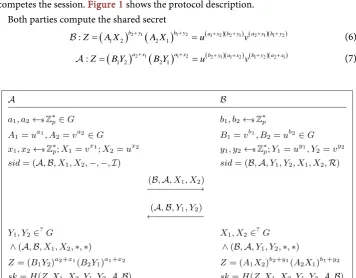
1) chooses randomly an ephemeral private key *
1, 2 R p
x x ∈ , computing the
ephemeral public key 1 2
1 ; 2
x x
X =v X =u and sends
(
, ,X X1, 2)
to .2) Upon receiving
(
, ,X X1, 2)
, verifies that X X1, 2∈G. if so, choosesrandomly an ephemeral private key *
1, 2 R p
y y ∈ , computing the ephemeral public key
1 2
1 , 2
y y
Y =u Y =v and sends
(
, , ,Y Y1 2)
to . Then computing the sharedsecret
(
)
2 1(
)
1 21 2 2 1
b y b y
Z = A X + A X + , the session SK=H Z X X Y Y
(
, 1, 2, ,1 2, ,)
andcompetes the session.
3) Upon receiving
(
, , ,Y Y1 2)
, checks if he owns a session with sid(
, ,X X1, 2,×)
. if so, verifies that Y Y1, 2∈G. if so, computing the sharedsecret
(
)
2 1(
)
1 21 2 2 1
a x a x
Z= B Y + B Y + , the session SK=H Z X X Y Y
(
, 1, 2, ,1 2, ,)
andcompetes the session. Figure 1 shows the protocol description. Both parties compute the shared secret
(
)
2 1(
)
1 2 (1 2)(2 1) (2 1)(1 2)1 2 2 1
:Z = A X b+y A X b+y =ua+x b+y va +x b+y
(6)
(
)
2 1(
)
1 2 (2 1)(1 2) (1 2)(2 1)1 2 2 1
:Z = B Y a +x B Y a+x =ub+y a+x vb+y a+x
[image:6.595.195.552.386.664.2] (7)
4.2. Protocol Security
Theorem 4.1. If the DLIN assumption holds in G and H is a random oracle, then the Protocol Π is eCK-secure.
Let be a polynomial bounded adversary against protocol Π, *
sid is the
target session chosen by adversary , is the owner of the session *
sid and
is the peer. Let *
sid be
(
* * * *)
1 2 1 2
, ,X ,X ,Y Y, ,
where
(
A A1, 2) (
, B B1, 2)
is publickeys for
(
,)
respectively, ( * * * * * 1* 2* 1* 2*1, 2, 1, 2 , 1 , 2 , 1 , 2
a a b b
a a b b ← A ←u A ←u B ←v B ←v ).
Assume also that ake
( )
,AdvΠ k is adversary advantage which we want to evaluate in
this proof. Let n k
( )
>1 is the number of parties chosen bt adversary and let s k( )
>1 is the number of sessions chosen by the adversary in challenge game. We will have this two events:-case 1: Existence of a matching session sid* for the target session * sid .
-case 2: No existence of a matching session for the target session * sid .
Case 1. To analyze this event, Adversary will play next games,
1 0 1 1 1 2
Game− , Game , Game− − and Game1 3− as follows:
-Game1 0− : This is eCK original game where adversary try to distinguish the real
session key from random string. For game state, see Appendix A.1. Claim. let G0 be the event that b=b′ in Game1 0− . we claim that
[ ]
ake,( )
0 Adv 1 Pr G 2 k Π +
= (8)
Proof. It’s easy to derive the proof from definition 3.2
-Game1 1− : This is reduced game from Game1 0− , In this game the adversary will
choose only two parties , and only two sessions, the target session and its matching session ( * *
,
sid sid ) with identifiers ( , ,X1*,X Y Y2*, 1*, 2*, ) and (
* * * *
1 2 1 2
, ,X ,X Y Y, , ,
)
respectively. For game state, see Appendix A.2.
Claim. let G1 be the event that success in guessing
* *
,
sid sid in Game1 1− . we
claim that
[ ]
[ ]
( ) ( )
0 1 2
2 Pr G Pr G
n k s k
− ≤ (9)
Proof. In this game, it obvious that this game is similar to game Game1 1− except it required adversary to guess target session and its matching session correctly to win this game. To select correct parties aad , adversary should choose between n k
( )
parties the couple ( , ), Let Pr
[
∩]
denotes that event, thus:[
]
( )( )
( )
(
)
( ) ( )
(
)
( )
2 2
1 1 2 2
Pr
! 1
2 !2!
n k n k
n k
n k n k
C n k ∩ = = = ≤ − −
, , , , , , Prsid ∪sid =Prsid +Prsid −Prsid ∩sid
( )
( )
( )
(
)
( ) ( )
(
)
, ,
2
1 1 1
Pr
! 1
2 !
s k
sid sid
s k s k s k
P s k ∩ = = = − − thus
( )
( )
( ) ( )
(
)
(
( )
( )
)
( )
, , 21 1 1 1
Pr
1 1
s k
sid sid
s k s k s k s k s s k s k
−
∪ = + − = ≤
− −
From these two probabilities, we can derive the whole probability that adversary success in guessing parties and with target session and its matching session with the form:
[ ]
[ ]
[
]
( ) ( )
0 1 , , 2
2
Pr G Pr G Pr Pr sid sid
n k s k
− ≤ ∩ ∪ =
-Game1 2− : We transform Game1 1− into Game1 2− , computing values
(
) (
* *)
* *(
* *)
( )(
* *)(
* *)
2 1 1 2 1 2 2 1 2 1 1 2* * * * *
1 2 2 1
a x a x a x b y a x b y
Z = B Y + B Y + =u + + v + + to random value * $
Z ← G
where
(
* * * *)
1 1 2 1DLIN B Y ,B Y =1. For game state, see Appendix A.3.
Claim. let G2 be the event that success in solving DLIN problem in Game1 2− .
we claim that
[ ]
[ ]
dlin( )
1 2
Pr G −Pr G ≤Adv k (10)
Proof. We transform game Game1 1− into Game1 2− computing values
(
) (
* *)
* *(
* *)
( )(
* *)(
* *)
2 1 1 2 1 2 2 1 2 1 1 2* * * * *
1 2 2 1
a x a x a x b y a x b y
Z = B Y + B Y + =u + + v + + to random value * $
Z ← G
where
(
* * * *)
1 1 2 1DLIN B Y ,B Y =1. If adversary success in distinguishing between Game1 1−
and Game1 2− with non-negligible probability, then he can solve the DLIN problem,
thus we construct adversary that solves DLIN problem. In this game, will choose same parameters in Game1 1− except values (
*
Z ) which will be chosen randomly. There for
we obtain:
[ ]
[ ]
dlin( )
1 2
Pr G −Pr G ≤Adv k
-Game1 3− : We transform Game1 2− into Game1 3− , computing h by choosing it at
random, rather than as a hash function. For game state, see Appendix A.4.
Claim. let G3 be the event that success in distinguishing value H from random
string in Game1 2− . we claim that
[ ]
2[ ]
3( )
Pr G −Pr G ≤es k (11)
which es is ES-advantage of some efficient algorithm( which is negligible assuming
is entropy smoothing).
Proof. We will prove here using the same idea in the previous game. In this game we transformed from Game1 2− by changing the hash value with a random value. The
ES-advantage.
Moreover, as h act as a one-time pad in game Game1 3− , it's evident that
[ ]
31 Pr G
2
= (12)
Combining (8), (9), (10), (11) and (12), we obtain
( )
( )
( ) ( )
( )
dlin ake
, 2
1 4
Adv Adv 2
2 es
k k k
n k s k
Π
≥ − −
(13)
Case 2. To analyze this event, Adversary will play next games,
2 0 2 1 2 2
Game − , Game−, Game− and Game2 3− as follows:
-Game2 0− : This is an eCK original game where adversary try to distinguish the
real session key from a random string. For the game state, see Appendix A.5. Claim. let G0 be the event that b=b′ in Game1 0− . we claim that
[ ]
ake,( )
0 Adv 1 Pr G 2 k Π +
= (14)
Proof. That proof can be derived from Game1 0− .
-Game2 1− : This is reduced game from Game2 0− , In this game the adversary will
choose only two parties , and only target session (sid sid*, *) with identifier
( * * * *
1 2 1 2
, ,X ,X Y Y, , ,
). For game state, see Appendix A.6. Claim. let G1 be the event that success in guessing
*
sid in Game2 1− . we claim
that
[ ]
[ ]
( ) ( )
0 1 2
2 Pr G Pr G
n k s k
− ≤ (15)
Proof. In this game, it is obvious that this game is similar to game Game2 1− except it's required the adversary to guess target session correctly to win this game. To select correct parties nad , adversary should choose between n k
( )
parties thecouple( , ), Let Pr
[
∩]
denotes that event, thus:[
]
( )( )
( )
(
)
( ) ( )
(
)
( )
2 2
1 1 2 2
Pr
! 1
2 !2!
n k n k
n k
n k n k
C n k ∩ = = = ≤ − −
In another hand, the adversary should success in guessing target session and its matching session. Let Pr[sidA;B], denote the probability that adversary successfully guess
the target session from s k
( )
sessions, thus:( )
, 1 Pr sid s k = [ ]
[ ]
[
]
( ) ( )
0 1 , , 2
2
Pr G Pr G Pr Pr sid sid
n k s k
− ≤ ∩ ∪ =
-Game2 2− : We transform Game2 1− into Game2 2− , computing values
* * * *
1, 2, 1, 2
X X Y Y
randomly as * * * * 1, 2, 1, 2 $
X X Y Y ← G which lead to computing value Z* from random
values which make it random value. For the game state, see Appendix A.7.
Claim. let G2 be the event that success in solving DLIN problem in Game2 2− . we claim that
[ ]
[ ]
DLIN2 dlin( )
1 2
Adv Pr G Pr G
2
q ⋅ k
− ≤ (16)
Proof. We transform game Game2 1− into Game2 2− computing values
* * * *
1, 2, 1, 2
X X Y Y
randomly as * * * * 4 1, 2, 1, 2 $
X X Y Y ← G which lead to compute value Z* from random
values which make it random value. If adversary success in distinguishing between
2 1
Game − and Game2 2− with non-negligible probability, then he can solve the DLIN
problem, thus we construct adversary that solve DLIN problem. In this game,
will choose same parameters in Game2 1− except values
* 2 * 1 * 2 *
1
,
X
,
Y
,
Y
X
which willbe chosen randomly. Then he will query oracle machine for tuple
(
* * * *)
1,i, 2,i, 1,i, 2,i, ,X X Y Y ,
if a tuple exists oracle will return corresponding Z′ to the adversary, else oracle will
return random value to an adversary. So we can make qDLIN queries oracle without
repeating the same query to oracle. In case repeating the same query we will get halt with probability of:
[ ]
DLIN(
)
(
)
2 DLIN DLIN DLIN DLIN 2 DLIN 1 ! Pr
2 !2! 2 2
q q q q q
C
q
−
⊥ = = = ≤
−
There for, we obtain:
( )
2 dlin
Adv 2
q ⋅ k
-Game2 3− : We transform Game2 2− into Game2 3− , based on transform hash
function H
( )
. with random oracle function . For game state, see Appendix A.8. Claim. let G3 be the event that success in distinguishing value H( )
. fromrandom oracle
( )
. in Game2 3− . we claim that[ ]
2[ ]
3 2( )
Pr G Pr G
2
H es
q k
− ≤ ⋅ (17)
which es is ES-advantage of some efficient algorithm( which is negligible assuming
is entropy smoothing).
Proof. We will prove here using the same idea in the previous game. In this game we transformed from Game2 2− by changing the hash value with a random value
generated by oracle. Without losing of generality, The adversary will make qH queries
[ ]
2(
)
(
)
21 !
Pr
2 !2! 2 2
H
q H H H H
H
q q
q q
C q
−
⊥ = = = ≤
−
The difference between Pr G
[ ]
2 and Pr G[ ]
3 can be parlayed into a correspondingES-advantage.
Moreover, as h act as a one-time pad in game Game2 3− , it’s evident that
[ ]
31 Pr G
2
= (18)
Combining (14), (15), (16), (17) and (18), we obtain
( )
( )
( ) ( )
( )
dlin ake 2
,
2 2
DLIN
1 4
Adv k Adv k qH es k
q Π n k s k
≥ − − ⋅
(19)
From the sequence of preceding claims, we can conclude that since the
( )
( )
dlin ake
,
Adv k ≥AdvΠ k , and since Advdlin
( )
k is negligible in k-from DLIN assump- tion-thus our protocol is secure based on decision linear assumption in random oracle model.5. Efficiency
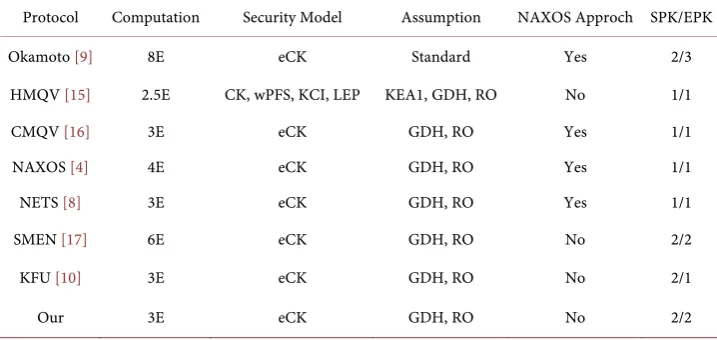
In this section, we compare our protocols with other related AKE protocols in terms of based assumption, computational efficiency and security model. In Table 1 number of exponentiation in G (E), a number of static public keys (SPK) and the number of ephemeral public key (EPK). Table 5 presents the naive group exponentiations count; Okamoto’s protocol is secure in the standard model, but the proof relies on an existence of πPRF family. In the security proof of HMQV and CMQV, the reduction argument is less tight since the Forking Lemma [14] is essential for the arguments. Our protocol in Table 1, has tighter security reductions and does not use the Forking Lemma and just uses one static public key in computation.
[image:11.595.192.551.535.705.2]It clear that our protocol has same security model with NETS, CMQV, and KFU-P1, but it differs from them in base assumption and computation.
Table 1. Protocols comparison.
Protocol Computation Security Model Assumption NAXOS Approch SPK/EPK
Okamoto [9] 8E eCK Standard Yes 2/3
HMQV [15] 2.5E CK, wPFS, KCI, LEP KEA1, GDH, RO No 1/1
CMQV [16] 3E eCK GDH, RO Yes 1/1
NAXOS [4] 4E eCK GDH, RO Yes 1/1
NETS [8] 3E eCK GDH, RO Yes 1/1
SMEN [17] 6E eCK GDH, RO No 2/2
KFU [10] 3E eCK GDH, RO No 2/1
We showed that it is possible to construct eCK-secure AKE protocols without using NAXOS’ approach, so our protocol is secure even when the discrete logarithm of the ephemeral public key is revealed and decrease the risk of leaking the static private key which makes our protocol more practical.
Moreover, One of the advantages of our protocols is the use of single random oracle as opposed to two for HMQV and CMQV. The random oracle is merely needed for the session key derivation, which is typical way to attain indistinguishability in random oracle model.
Also, our protocol uses decision linear assumption with a tight security proof.
6. Conclusion
In this paper, we present AKE protocol secure in the eCK model under Decision Linear assumption(DLIN) without using NAXOS trick with a fastened reduction, which reduces the risk of leaking the static private key, that because of the derivation of the ephemeral public key is independent of the static private key. This is in contrast to protocols that use the NAXOS’ approach, and minimize the use of the random oracle, by applying it only to the session key derivation. We gave tightly security proof for our protocol based on games. In this paper, how to preserve the security of to this protocol without using random oracle remains as an open problem.
References
[1] Bellare, M. and Rogaway, P. (1993) Entity Authentication and Key Distribution. Crypto 1993, LNCS 773, 110-125.
[2] Bellare, M., Canetti, R. and Krawczyk, H. (1998) A Modular Approach to the Design and Analysis of Authentication and Key Exchange Protocols. Proceedings of the 30th Annual ACM Symposium on Theory of Computing, ACM, Location, pp.
[3] Canetti, R. and Krawczyk, H. (2001) Analysis of Key-Exchange Protocols and Their Use for Building Secure Channels. Eurocrypt 2001, LNCS 2045, 453-474.
[4] LaMacchia, B., Lauter, K. and Mityagin, A. (2007) Stronger Security of Authenticated Key Exchange. ProvSec 2007, LNCS 4784, 1-16.
[5] Ustaoglu, B. (2008) Obtaining a Secure and Efficient Key Agreement Protocol for (H)MQV and NAXOS. Designs, Codes and Cryptography, 46, 329-342. Extended version available at
http://eprint.iacr.org/2007/123
[6] Huang, H. and Cao, Z. (2008) Strongly Secure Authenticated Key Exchange Protocol Based on Computational Diffie-Hellman Problem. Inscrypt.
[7] Lee, J. and Park, J. (2008) Authenticated Key Exchange Secure under the Computational Diffie-Hellman Assumption. http://eprint.iacr.org/2008/344
[8] Lee, J. and Park, C. (2008) An Efficient Key Exchange Protocol with a Tight Security Re-duction. http://eprint.iacr.org/2008/345
[9] Okamoto, T. (2007) Authenticated Key Exchange and Key Encapsulation in the Standard Model. Asiacrypt 2007, LNCS 4833, 474-484.
[11] Boneh, D., Boyen, X. and Shacham, H. (2004) Short Group Signatures. In: Franklin, M., Ed., Proceedings of Crypto 2004, Volume 3152 of LNCS, Springer-Verlag, , 41-55.
http://dx.doi.org/10.1007/978-3-540-28628-8_3
[12] Joux, A. and Nguyen, K. (2003) Separating Decision Diffie-Hellman from Computational Diffie-Hellman in Cryptographic Groups. Journal of Cryptology, 16, 239-247.
http://dx.doi.org/10.1007/s00145-003-0052-4
[13] Shoup, V. (1997) Lower Bounds for Discrete Logarithms and Related Problems. In: Fumy, W., Ed., Proceedings of Eurocrypt 1997, Volume 1233 of LNCS, Springer-Verlag, 256-266. [14] Pointcheval, D. and Stern, J. (2000) Security Arguments for Digital Signatures and Blind
Signatures. Journal of Cryptology, 13, 361-396. http://dx.doi.org/10.1007/s001450010003
[15] Krawczyk, H. (2005) HMQV: A High-Performance Secure Diffie-Hellman Protocol. Crypto 2005, LNCS 3621, 546-566.
[16] Ustaoglu, B. (2008) Obtaining a Secure and Efficient Key Agreement Protocol for (H)MQV and NAXOS. Designs, Codes and Cryptography, 46, 329-342.
http://dx.doi.org/10.1007/s10623-007-9159-1
[17] Wu, J. and Ustaoglu, B. (2009) Efficient Key Exchange with Tight Security Reduction. IACR Cryptology ePrint Archive, 2009, 288.
[18] Li, H. and Wu, C.K. (2012) CMQV+: An Authenticated Key Exchange Protocol from CMQV. Science China Information Sciences, 55, 1666-1674.
http://dx.doi.org/10.1007/s11432-011-4310-z
Appendix
A.1 Game1 0−A.2 Game1 1−
A.3 Game1 2−
A.5 Game2 0−
A.6 Game2 1−
A.8 Game2 3−
Submit or recommend next manuscript to OALib Journal and we will provide best service for you:
Publication frequency: Monthly
9 subject areas of science, technology and medicine Fair and rigorous peer-review system
Fast publication process
Article promotion in various social networking sites (LinkedIn, Facebook, Twitter, etc.) Maximum dissemination of your research work