Holding-Together Regionalism: 20 Years
of Post-Soviet Integration
Libman, Alexander and Vinokurov, Evgeny
18
Post-Soviet Space, Central Asia
and Eurasia
The nature of holding-together regionalism dictates the initial compo-sition of countries participating in a regional agreement and establishes borders which participants perceive as being, in some senses, natural and reasonable. This has probably been less applicable to former African colonies but is extremely pronounced in case of the FSU. The post-Soviet space inherited its borders from the Russian Empire: almost all nations of the FSU (with the exception of Western Ukraine, which has been part of the Hapsburg monarchy) have been part of a single state for at least one and a half centuries. However, as we have already described, these initially ‘natural’ spaces lose their coherence over time. This then erodes the foundation for the HTI. The situation is somewhat better in Africa, where post-colonial regionalism partially coincided with exist-ing geographical borders between parts of the continent (these borders did not necessarily reflect cultural and religious divisions, but that is also true for the borders between independent states). In the post-Soviet space, which comprises countries with very different cultures and which lean towards different extra-regional poles of influence (Turkey, the EU, China, Romania and so on) the problem of fragmentation will have a fundamental impact on HTI.
task. For the post-Soviet space, this transformation of the HTI into a new form of regionalism is influenced greatly by the increase in economic linkages throughout the Eurasian continent, connecting in particular the countries of East and South Asia, Europe, Turkey and the FSU. Ulti-mately, therefore, the development of post-Soviet regionalism could be described as a transformationfrom post-Soviet into Eurasian integra-tion.This transformation could include one or several of the following aspects:
1. In the narrowest sense, it implies participation of countries outside the FSU in regional integration projects comprising many, or all, post-Soviet countries.
2. A somewhat broader concept impliespost-Soviet regionalism is designed specially to allow its members to participate in extra-regional inte-gration groupings. In this context, regionalism in the FSU should be designed as a flexible and open structure reflecting the notion of New Regionalism rather than as a ‘Eurasian EU’ mimicking ‘Fortress Europe’. Post-Soviet regionalism would also allow its members to par-ticipate in other integration projects. Finally, in terms of its relations with more advanced regional groupings, such as the EU, post-Soviet regionalism could adjust itsaquis,where feasible, to European standards.
3. Eurasian integration can incorporate inter-regionalism, that is, interaction between post-Soviet regional integration groupings and extra-regional integration groupings. To date, the weakness of FSU regionalism has rendered this interaction superfluous, but as the CU advances this situation could change.
We investigate Eurasian trans-continental links in our book on Eurasian Integration, published concurrently by Palgrave Macmillan. In this chapter, however, we will briefly discuss the implications for post-Soviet integration of Eurasian regionalism.
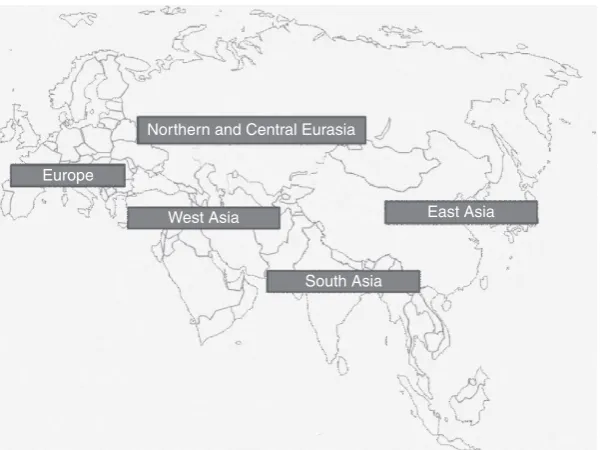
Northern and Central Eurasia
Post-Soviet Space, Central Asia and Eurasia 195
Europe
West Asia
South Asia
[image:4.595.148.449.168.393.2]East Asia Northern and Central Eurasia
Figure 18.1 Macroregions of Eurasia
to the region’s past, not its present or future. To find an approximate equivalent, it would be like calling Africa the ‘post-colonial region’ or Austria, Hungary, the Czech Republic, Slovakia, Slovenia, and their neighbouring states the ‘former Austro-Hungarian Empire’. We therefore strongly prefer to use the geographical connotation and choose ‘North-ern and Central Eurasia’ as a more correct, neutral and forward-looking term for this region (Figure 18.1).
Advantages of Eurasian integration
channel for better institutions and practices. Lastly, Eurasion integration is necessary if the economic potential of the post-Soviet space is to be fully realized.
As we have mentioned before, asymmetry (specifically weak asymme-try) is one of the greatest obstacles to the development of post-Soviet regionalism. If the number of participants decreases, but Russia remains among them, asymmetry increases (since there is no longer the option of smaller states forming a coalition against Russian dominance), and the future of regional integration becomes even more problematic. However,increasingthe number of participants reduces the problem of asymmetry. Smaller states can manoeuvre between larger participants, therefore political risks for them become smaller, and they are more likely to join the regional integration agreement. Since the market of the regional integration group also becomes larger, this creates additional incentives for smaller countries.
Furthermore, although economic interdependence in the FSU is extensive, it would be incorrect to state that the participation of post-Soviet states in regionalization processes in Eurasia stops at the borders of the former Soviet Union. On the contrary, for the most prominent country of the post-Soviet space – Russia – relativelythe most impor-tant trade and investment partner for the last two decades has been the European Union. The economic links between Russia and China are growing very fast in terms of trade and investment as well as for migration (in Siberian regions Chinese labour migration is as signifi-cant as migration from the FSU, and in the late 2000s the new trend of temporary labour migration from Russia to China emerged). For Central Asian countries (especially Kazakhstan and Kyrgyzstan), the importance of China as a trade and investment partner is even higher. Ukraine and Moldova, meanwhile, are economically linked to the EU and also consider European integration as an important goal. Therefore, open-ing up borders in the FSU may create incentives for economic growth, but if this coincides with closing borders to extra-regional partners, the negative effects of this could predominate. In terms of positive inte-gration, any attempt to govern economic relations in the FSU without extra-regional partners is likely to create a gap between jurisdictional boundaries and market boundaries, which, in an environment where rule of law is weak, is problematic.1
Post-Soviet Space, Central Asia and Eurasia 197
especially important if the format of Eurasian integration implies close links to the European Union. Taking the experience and the posi-tion of extra-regional players into account can be instrumental in the import of institutions and transmission of best practice (in fact, the European Union supports cross-border cooperation among its Eastern neighbours precisely for this purpose). This is particularly important because of the numerous ‘pseudo-integration’ effects generated by post-Soviet regionalism – especially the ‘protective integration’ logic, which has heavily influenced and perverted the idea of regionalism in the FSU, turning it into a mechanism which prevents rather than facilitates the diffusion of efficient institutional practices.
Finally, as we have discussed before, the economic potential of the post-Soviet space can be fully realized only if extra-regional players are involved. This is particularly the case for the FSU transport infras-tructure, which is much more valuable if it is linked to the transport infrastructure of China and Europe. In the same way, the post-Soviet electricity market could be more efficient as part of the Eurasian power utilities market. Furthermore, the Eurasian integration format is likely to be much more resilient to the risks of hold-up associated with interdependency in Eurasian energy supply networks: for example, dependencies between Russia and Europe, Central Asia and Russia, and (potentially) Russia and China.
The problems of transition to Eurasian integration
Eurasian integration, however, could precipitate some undesirable con-sequences for post-Soviet regional integration projects. To involve extra-regional partners destroys one of the main advantages of post-Soviet regionalism so far – the shared Soviet heritage of the participating countries. This leads firstly to much higher negotiating costs: while Russian is currently treated as the ‘natural’ language of communica-tion in the FSU,2any extra-regional partner would make it impossible
to use Russian as the official language. The political elites of extra-regional countries would be likely to have different traditions and habits, which would also make negotiations more difficult. Over time, the capital of a shared history disappears, and this problem becomes less significant – but for now at least it is substantial.
so than the post-Soviet states. In the Eurasian context, this gives rise to an additional problem: Eurasian integration is likely to be based on the interaction of large countries, which generally find it very difficult to maintain the required levels of commitment given the multiplicity of their economic goals and integration initiatives. China, for example, is currently involved in regional projects in Northeast Asia (the Great Tumen Initiative), East and Southeast Asia (ASEAN+3, the Great Mekong
Region) and Central Asia (SCO, the Great Altai Region). Russia has sys-tematically neglected the need to develop political and economic ties with China and has paid much more attention to Europe.
A possible solution to this problem involves conceptualizing Eurasian integration not as a single project but rather as a network of smaller and partly overlapping integration areas pursuing specific objectives. This approach could ultimately be implemented through sub-national integration, although, as mentioned above, political centralization in Russia and Kazakhstan prevents full utilization of the potential of this channel of cooperation. Moreover, this approach is clearly incompatible with the ‘Eurasian EU’ idea, which until recently has guided post-Soviet regionalism: the SES-4 attempt to distance itself from this notion has been unsuccessful, and it is not clear whether the CU will follow the same path (we consider this problem below). Asian integration initia-tives, with their more restricted scope and their focus on infrastructure rather than on norm-setting, are more compatible with this approach of overlapping integration areas; however, most of them are currently underdeveloped.
Another problem results from the overall weakness of post-Soviet regionalism. Up to now, post-Soviet integration structures have had a poor reputation among the post-Soviet countries themselves and their extra-regional partners. In other words, there are few, if any, incentives for China or the EU to give serious consideration to their relation-ships with very weak structures like the CIS or the old EurAsEC. The situation could change dramatically as the CU becomes more established, and acquires sufficient governance capabilities to become a serious partner in inter-regionalism.
Three spaces of post-Soviet regionalism
Post-Soviet Space, Central Asia and Eurasia 199
flows. But the ‘darker side’ of integration has also gained ground – trafficking in drugs, weapons and humans, and the spread of diseases. Today, Eurasian countries are also more likely to encounter cross-border problems which require their joint attention – for example, in the area of ecology – simply because of rapid economic growth and industrial-ization. Therefore, the development of regionalization in Eurasia – as in the post-Soviet space – outperforms the progress of regionalism.
Treating Eurasian integration as a system of overlapping functional integration spaces3raises other questions: how would individual spaces
be structured? How can the existing institutional structure of post-Soviet regionalism be reformed to be pertinent to spaces of actual regionalization without changing their structure and membership? In which cases might regional projects be constructed without being guided by the borders of the ex-USSR? There are no unambiguous answers to these questions, and certainly no answers that can be givenex ante: it is only through competition between various integration initia-tives and experimentation with different formats and membership that the optimal scope of regionalism can be determined (assuming, ideally, that the extent of regionalization and regionalism coincide). However, we are able make some tentative suggestions in this field based on our analysis of regionalization in the FSU.
It is possible to distinguish between three spaces of post-Soviet inte-gration, depending on their cross-border links. Designing regionalism based on FSU borders would certainly be suboptimal from the point of view of large-scale FDI and trade links pursued by developing Russian multinationals. Russian companies heavily invest in European countries (even more heavily in Central and Eastern Europe, which are now part of the EU), and the EU is Russia’s main trading partner. Therefore, this is an area where the broader participation of Eurasian countries could be advantageous. For small-scale informal trade networks, however, the FSU is suboptimal, but so is a broad coalition of Eurasian counties. Currently the Eurasian continent is witnessing the emergence of sev-eral integrated areas connected by informal trade: one links Central Asia with Western China and Russia’s border regions, another is being formed in the post-Soviet Caucasus and Turkey. The optimal scenario in such cases is to concentrate on sub-national cooperation in these smaller areas of ‘microregionalization’.4Finally, where migration is
be an efficient option; however, any such initiative should clearly take into account possible extra-regional factors (for example, the problem of illegal migration into the EU), possibly through the mechanism of inter-regionalism.
The transformation of post-Soviet into Eurasian integration, therefore, has both ‘horizontal’ and ‘vertical’ dimensions. Its horizontal progres-sion involves the establishment of free trade and investment flows at the Eurasian level by a broad coalition of countries (the energy trade is potentially a good example of this: in fact, the Energy Charter Treaty is attempting to implement this framework, but because of resistance from Russia – it has so far been unsuccessful). Framework agreements on migration within the FSU and inter-regional initiatives in the area of migration (especially with the EU) are also good potential exam-ples. With regard to the vertical progression of integration, several overlapping regional initiatives relating to infrastructure (for example, transport corridors), local trade problems, and environmental issues, partly established by sub-national governments, should emerge in dif-ferent sub-regions of the FSU with the involvement of extra-regional partners.
Until now, post-Soviet integration has not been very compatible with this mode of operating: there is no common framework for migration, since the CES agreement on labour migration does not cover the key emigration countries. More importantly, the CU’s efforts to liberalize trade have not been coordinated with extra-regional partners, which could become a source of conflict in this structure and limit its ability to embrace other FSU countries because of diverging interests.
Perspectives of Central Asia
Post-Soviet Space, Central Asia and Eurasia 201
of the FSU).5The Central Asian countries are uniquely landlocked, not
only in the FSU but in the world (given their position at the centre of the largest continental landmass on Earth); on the other hand, their exports are now concentrated in the commodities (metals, oil and gas, grain for Kazakhstan), which need to be sold on global markets; so maintaining closer economic integration in the FSU in order to gain access to markets elsewhere is particularly important for Central Asia.
However, Central Asian states have also been strongly influenced by emerging trans-continental links – both positive and negative. In the early 1990s, Turkey made a bid to become the dominant power among the Turkic republics of the FSU; although this attempt was unsuccessful, Turkey remains an important cultural and economic power in Central Asia. Turkey, Iran and the Central Asian states belong to the Economic Cooperation Organization (ECO), which is a loose alliance with no well-defined agenda. Furthermore, since the middle of the last decade, China has been penetrating markets in Central Asia through trade (formal and informal networks), investment (especially in oil and gas) and intergov-ernmental lending. The negative effects of Eurasian regionalization for Central Asia are linked to its proximity to Afghanistan making it one of the main drug trafficking routes in Eurasia.
Over the last few decades, Central Asia has witnessed the establish-ment of a number of successful international organizations, including post-Soviet states and extra-regional partners. One example we have already mentioned is the SCO, which, although it has been unable to pursue a successful economic integration agenda, was instrumental in solving border disputes in the region. Another example is CAREC, an initiative focusing on infrastructure and trade facilitation. Purely ‘Cen-tral Asian’ regionalism has so far been unsuccessful; the Cen‘Cen-tral Asian Cooperation Organization, an integration alliance between Kazakhstan, Uzbekistan, Tajikistan and Kyrgyzstan, did not survive as a stand-alone organization and merged with the EurAsEC.
Looked at from another perspective, Central Asia epitomizes the prob-lems and difficulties encountered by Eurasian integration. Firstly, the Central Asian autocracies are among the most repressive in the FSU, and therefore Central Asian regionalism has been more successful in its pursuit of protective integration6 than it has in establishing true
to regional cooperation; these countries have kept the Soviet central-ized planning system and predominantly state-owned assets (Russia and Belarus encountered similar problems – the Belarussian government has been extremely reluctant to yield control over state-owned enterprises to Russian investors).
Furthermore, successful economic cooperation in Central Asia requires the involvement of RussiaandChina – the two dominant eco-nomic partners in the region – one with its enduring historical influence and the other with its increasing economic involvement in Central Asia. However, there is not one regional cooperation agreement functioning in theeconomicarena that includes both Russia and China. The obsta-cles are numerous and include contradictions and misunderstandings between Russian and Chinese leaders. Indeed, it is our impression that the need to involve both Russia and China in Central Asia is often overlooked by international donors (which are heavily influencing the CAREC) and by Russia (in designing the CU and EurAsEC – the possi-ble negative effect of the CU on Kazakhstan–China trade is one of the greatest concerns of those who have analysed the new regional inte-gration project). Inteinte-gration attempts appear either to ignore the links with either one of these countries or threaten to disrupt them – with disastrous consequences for Central Asian economies.