http://www.scirp.org/journal/jmp ISSN Online: 2153-120X
ISSN Print: 2153-1196
Supersymmetric Resolvent-Based
Fourier Transform
Seiichi Kuwata
Graduate School of Information Sciences, Hiroshima City University, Hiroshima, Japan
Abstract
We calculate in a numerically friendly way the Fourier transform of a non- integrable function, such as ϕ
( )
x =1, by replacing with −1 , where represents the resolvent for harmonic oscillator Hamiltonian. As contrasted with the non-analyticity of(
)
1( )
2 2
x +a − ϕ x at x= ±ia in the case of a simple replacement
of by
(
) (
)
12 2 2 2
ˆ ˆ
p +a q +a − , where pˆ and qˆ represent the momentum and position operators, respectively, the
ϕ
turns out to be an entire function. In cal-culating the resolvent kernel, the sampling theorem is of great use. The resolvent based Fourier transform can be made supersymmetric (SUSY), which not only makes manifest the usefulness of the even-odd decomposition of ϕ in a more natural way, but also leads to a natural definition of SUSY Fourier transform through the com-mutativity with the SUSY resolvent.Keywords
Resolvent, Fourier Transform, Supersymmetry, Harmonic Oscillator Hamiltonian, Sampling Theorem
1. Introduction
Fourier transform (FT) 2
( )
2( )
:L →L by
( )( )
1 i( )
e d ,
2π
kx
x k k
ϕ =
∫
ϕ
which is a unitary operator, is a fundamental method in function analysis and is applied to many fields in physics. The corresponding self-adjoint operator is given by the harmonic oscillator Hamiltonian 2
( )
2( )
:L →L
by
(
)( )
1(
ˆ2 ˆ2)
( )
1 ,
2
x p q x
ϕ = + − ϕ
(1)
How to cite this paper: Kuwata, S. (2017) Supersymmetric Resolvent-Based Fourier Transform. Journal of Modern Physics, 8, 133-146.
http://dx.doi.org/10.4236/jmp.2017.81012
Received: December 28, 2016 Accepted: January 20, 2017 Published: January 23, 2017
Copyright © 2017 by author and Scientific Research Publishing Inc. This work is licensed under the Creative Commons Attribution International License (CC BY 4.0).
where
( )( )
ˆ 1 d( )
i dp x x
x
ϕ = ϕ and
( )( )
qˆϕ x =xϕ( )
x , through the relationi π
e , .
2
θ θ
= =
(2)
The validity of (2) is verified by noticing that the Hermite polynomial Hn
( )
x(multipled by 22
e−x ) is a simultaneous eigenfunction of and , with their eigen-
values given by in and
n
, respectively.If a function
ϕ
: → is integrable, its FT is well defined. However, if the function ϕ is not integrable, for example ϕ( )
x =1, its FT should be regarded as a generalized function. To calculate the FT of ϕ( )
x =1 in a numerically friendly way, one of the methods is to replace by −1 such that[
,]
=0, and to choose as the resolvent for , that is [1]
(
)
1(
)
spect .
a − a
= − ∉
Considering that includes the term proportional to ˆ2
q , we find that
( )( )
ϕ x behaves like 2x− for x → ∞. Thus
ϕ
can be Fourier transformed.To make ϕ
( )
x =1 square integrable, it is sufficient to reduce the order of ϕ( )
x (for x → ∞) by one, not necessarily by two. This implies that it is sufficient to choose1 2
−
, not necessarily −1 2, as given above. However, the square root of the operator , in general, is somewhat complicated to deal with, so we adopt an alter- native approach, supersymmetrization. The supersymmetry (SUSY) can be realized by adding in (1) to †
f f [2], where f†,f :2 →2, representing the fermionic creation and annihilation operators, respectively, satisfying 2
0
f = ,
( )
f† 2 =0, and{
†}
,
f f =I, with
{ }
A B, =AB+BA. The modified Hamiltonian ′ =I+ f†f can be decomposed into = 2, where is called a supercharge. Under the modifica- tion →′, it is natural to transform to ieθ ′
′ =
, as is analogous to (2). The aim of this paper is replace ′ by
(
) (
)
1,
I I
α α −
′= + ′ +
with α∈ chosen in an appropriate way, to finally find that the introduction of
SUSY clarifies the availability of the even-odd decomposition of ϕ in a more natural
way. In Section 2, we generalize the resolvent kernel for , where can be regarded as the specialization of the Hamiltonian (α β, )
whose eigenfunction is given by the Jacobi polynomial. In calculating the resolvent kernel, the sampling theorem [3]
is fully employed. In Section 3, we first reexamine the FT of ϕ
( )
x =1, based on the resolvent for . Then we compare the resolvent based method with other methods, to find that the former has some merits of being numerical calculation friendly and free of singularity for(
)
1a − ϕ
−
, even after analytic continuation. Analytic property is signi- ficant for calculating, for example, path integral in Minkowski space (Wick roration), and the Shannon entropy in the limit of the Rényi entropy (replica trick). We give conclusion in Section 4.
2. Methods
eigenfunction is given by the Jacobi polynomial. Then we calculate the resolvent kernel for as a specialization of the former.
2.1. Jacobi Polynomial
Let ( , ) 2
( )
2( )
:L L
α β Ω → Ω
(where Ω = −
[
1,1]
⊂) be the Hamiltonian( )
(
)
( )
( )
(
)
( )
( )
( ) (
) (
)
, 1 d 2 d 1
1 , 1 1 .
d d
x x w x x w x x x
x x x
w x
α β α βϕ = − ϕ = − +
The (normalized) eigenfunction for (α β, )
is given by
( )
( )
( )
( ) ( )
( )
(
)
, ,
, for , 1 ,
n n
n w x
x P x
N
α β α β
α β
φ = α β > −
where ( , )
( )
n
Pα β x and Nn( , )
α β represent the Jacobi polynomial and its normalization
constant as
( )
( )
(
)
(
) (
)
,
2 1
1 1
1, ; 1; ,
1 1 2
n
n x
P x F n n
n
α β α α β α
α
Γ + + −
= + + + − +
Γ + Γ + (3)
( )
( )
(
( )( )
)
(
) (
)
(
) (
)
1 2
, , 2 1 1
d ,
2 1 1 1
n n
n n
N w x P x x
n n n
α β
α β α β α β
α β α β
+ +
Ω
Γ + + Γ + +
= =
+ + + Γ + Γ + + +
∫
with Γ
( )
z and 2F a b c z1(
, ; ;)
the Gamma function and the hypergeometric function, respectively. The corresponding eigenvalue is given by( , )
(
)
( , )( )
1 n 0.
n n x
α β α β φα β
+ + + + =
(4)
The resolvent kernel for (α β, )
(denoted by ( , )
( )
,Kνα β x y ) can be expanded using
the eigenfunctions ( , )
( )
n x
α β
φ ’s (for n∈) as
( )
( )
(
)
( )(
)
( ) ( )(
) (
)
( )( )
( )( )
1
, ,
1 , ,
( , )
0
1 , ,
0
, 1
1
1 1 ,
n n
n
n n
n
K x y x y
x y
n n x y
α β α β
ν
α β α β α β
α β α β
ν ν α β
ν ν α β φ φ
ν ν α β α β φ φ
−
∞ −
=
∞ −
=
= + + + +
= + + + +
= + + + − + + +
∑
∑
(5)
where in the second and third equalities, use has been made of the completeness for
( )
( )
{
,}
n
n
x
α β
φ
∈ and (4), respectively.
There seems to be no such formula as the series sum of (5) for general parameters
α
andβ
. However, it will be found that the sum can be represented as the product of two hypergeometric functions as follows. The starting point would be the following formula, which corresponds to the particular case of(
α β,) ( )
= 0, 0 as [4] [5]( )0,0
(
)
( )0,0( )
( )0,0( )
(
(
)
)
sinπ 1
, for , ,
π Kν x y 2 1 ν x ν y x y D
ν φ φ
ν
− = ∈
+ (6)
where D:=
{
(
x y,)
∈2x+ >y 0; ,x y<1}
. Notice that ( )0,0( )
x ν
φ is given by the
Legendre function P xν
( )
as( )0,0
( )
2 1( )
, 2x P x
ν ν
ν
where ( , )
( )
Pνα β x is defined by replacing
n
in (3) withν
. Before proceeding further,we discuss the validity of (6). By applying ( )0,0
(
)
1ν ν
+ +
to (6) from the left, it is
found that both sides of (6) satisfy the same second order differential equation for 0
x+ ≠y , due to the completeness relation of n 0φn( )0,0
( )
x φn( )0,0( )
y δ(
x y)
∞= − = +
∑
. Thereason of restricting
( )
x y, to x+ >y 0 is as follows. To avoid the singularity of(
x y)
δ + at x+ =y 0,
( )
x y, should be restricted to either x+ >y 0 or x+ <y 0. Moreover, to avoid the singularity of ( )0,0( )
Pν x (for ν∉) at x= −1, the region of
0
x+ <y is not allowed.
Furthermore, it should be noted that the left-hand side of (6) turns out to be
(
)
(
)
( ) ( )
sinπ 1
2 n π n n
n
P x P y n
ν ν
∞ =−∞
− −
∑
, due to the relation( )
( ) ( ) ( )
(
)
1 1 for .
n
n n n
P− − x =P x = − P −x all n∈
Thus the relation of (6) can be rewritten as
(
) ( ) ( )
( ) ( )
(
( )
)
sinc n n for , ,
n
n P x P y P x P yν ν x y D
ν
∞ =−∞
− = ∈
∑
(7)where sinc
( )
: sinπ πz z
z
= , so that the sampling theorem [3] can be applied to
( ) ( )
P x P yν ν . The sampling theorem states that for f :→
[
]
(
supp π,π)
( )
sinc(
) ( )
,n
f f
ν
ν
n f n∞ =−∞
⊆ − ⇒ = −
∑
(8)
where supp
( )
⋅ represents the support. Hence the validity of (7) is guaranteed by showing that suppf ⊆ −[
π,π]
for f( )
ν =P x Pν( ) ( )
ν y (with(
x y,)
∈D). To show it, it is convenient to use the integral representation for Pν(
cosθ)
as [6](
)
(
)
1 2(
)
0
2 1
cos cos cos cos d for <π ,
2
Pν θ θ φ θ ν φ φ θ
π
−
= − +
∫
from which it is found that i
(
) (
)
et cos cos d
P P
ν
ν θ ν ψ ν
∫
is vanishing for t >π underthe conditions of θ ψ+ <π and θ ψ− <π. Here, we have used the integral representation for the Dirac delta as
(
)
i( )e t t d
t t ν
δ − ′ ∝ −′ ν
∫
. Noticing further that(
)
π
cos , cos ,
π D
θ ψ
θ ψ
θ ψ
+ <
⇔ ∈
− <
we can eventually prove the relation of (7) by employing the sampling theorem.
Before proceeding further, we try to rewrite the summation relation in the right- hand side of (8) in terms of the Dirac notation as
, n
f n n f
∈
=
∑
(9)
where v f = f
( )
ν and(
)
(
)
sinc for all ,
v n = ν−n ν∈
from which we obtain the orthonormality relation m n =δmn for all m n, ∈. The
n
as f and n , respectively, we can formally obtain from (9)
( )
(
)
i 1
e for , ,
2π
nx
x n = W x x∈n∈ (10)
where W:→ represents the window function as
( )
1(
(
π ,)
)
0 π .
x W x
x
<
=
>
The relation of (10) should be compared with
(
)
i 1
e for , .
2π
kx
x k = x k∈ (11)
[In the usual Dirac notation, k is reserved for a Fourier transformed variable, so
that k may be simply written as k . Actually, if we formally write f k as
(
d)
f k =
∫
f x x k x , it is found that 1 ei2π
kx
x k = , because
( )
1 1 1 i
= = = e d
2π
kx
f k − f k k − f ∗
∫
f∗ x x
where use has been made of the unitarity of as † =−1. In this sense, x k can be simply written as x k .] Notice that (10) cannot be derived from (11) by formally setting k∈ to n∈. This is because n in (10) can be applied only to f such that suppf ⊆ −
[
π, π]
. Notice further that the following relation can be derived from (10):(
) ( )
(
for ,)
,n
x n n y δ x y W x x y
∈
= − ∈
∑
(12)
where we have used i
(
)
enx 2π 2 π
n∈ = n∈
δ
x− n∑
∑
. The relation of (12) indicates thatthe completeness relation
∑
n∈ n n =1 holds, if it is applied to f such that[
]
suppf ⊆ −π,π , so that f x
( )
= f x W x( ) ( )
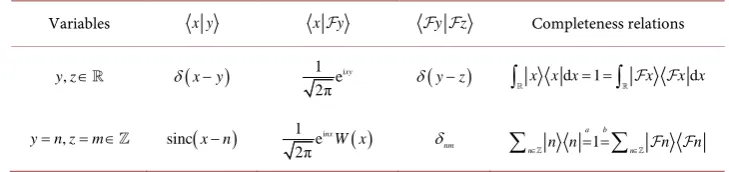
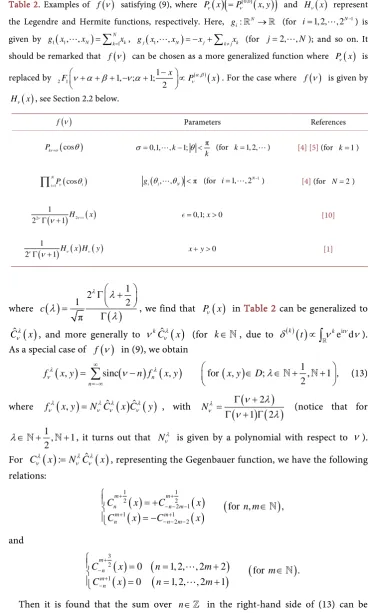
. These completeness relations, along with the orthogonal relations, are recapitulated in Table 1, while some examples of f( )
ν satisfying (9) are listed in Table 2.Now we go back to generalize the relation of (6). Using the integral representation
for
( )
2 11 1
ˆ : 2 , ; ;
2 2
x Cνλ x = Fν+ λ ν λ− + −
(notice that
( )
( )
1 2 ˆ
P xν =Cν x ) as [7]
(
)
( )
(
)
1(
)
(
)
2 1 0
ˆ cos cos cos cos d for 0 π ,
sin
c
Cνλ θ λλ θ φ θ λ ν λ φ φ θ
θ
− −
[image:5.595.190.555.616.702.2]=
∫
− + < <Table 1. Orthogonal relation and completeness relation, where x∈.
Variables x y xy y z Completeness relations
,
y z∈ δ
(
x−y)
1 ie 2π
xy
(
)
y z
δ −
∫
x x xd = =1∫
x x xd
,
y=n z= ∈m sinc
(
x−n)
1 i ( )e 2π
nx
W x δnm a1b
n∈ n n= = n∈ n n
∑
∑
a 1
n∈ n n =
∑
can be applied to f such that suppf ⊆ −[ π,π].b 1
n∈ n n=
∑
can be applied to fTable 2. Examples of f
( )
ν satisfying (9), where P xν( )
(
=Pν( )0,0( )
x y,)
and Hν( )
x representthe Legendre and Hermite functions, respectively. Here, : N i
g → (for 1, 2, , 2N1
i= − ) is
given by 1
(
1, ,)
1N
N k k
g x x =
∑
=x , gj(
x1,,xN)
= − +xj∑
k j≠xk (for j=2,,N); and so on. Itshould be remarked that f
( )
ν can be chosen as a more generalized function where P xν( )
isreplaced by ( , )
( )
2 1
1
1, ; 1;
2
x
Fν α β+ + + −ν α+ − ∝Pνα β x
. For the case where f
( )
ν is given by( )
Hν x , see Section 2.2 below.
( )
f ν Parameters References
(cos )
k
Pν σ+ θ
π 0,1, ,k 1;
k
σ= − θ < (for k=1, 2,) [4] [5] (for k=1)
( )
1 cos
N i i=Pν θ
∏
gi(θ1,,θN)<π (for1
1, , 2N
i= − ) [4] (for N=2)
( ) 2 ( ) 2
1
2νΓ +ν 1 Hν+ x =0,1;x>0 [10]
(1 ) ( ) ( )
2νΓν+1 Hν x Hν y x+ >y 0 [1]
where
( )
( )
1 2
1 2
π
c
λ λ
λ
λ
Γ +
=
Γ , we find that P xν
( )
in Table 2 can be generalized to( )
ˆ
Cνλ x , and more generally to k ˆ
( )
Cνλ xν
(for k∈, due to ( )( )
ie d
k k t
t ν
δ ∝
∫
ν ν). As a special case of f( )
ν in (9), we obtain( )
(
) ( )
( )
1, sinc , for , ; , 1 ,
2
n n
fνλ x y ν n fλ x y x y D λ
∞ =−∞
= − ∈ ∈ + +
∑
(13)where fλ
( )
x y, N Cλ ˆλ( ) ( )
x Cˆλ yν = ν ν ν , with
(
(
) ( )
)
2
1 2
Nνλ ν λ
ν λ
Γ + =
Γ + Γ (notice that for
1
, 1
2
λ∈ + + , it turns out that Nνλ is given by a polynomial with respect to
ν
).For Cλ
( )
x : N Cλ ˆλ( )
xν = ν ν , representing the Gegenbauer function, we have the following
relations:
( )
( )
( )
( )
(
)
1 1
2 2
2 1
1 1
2 2
for , ,
m m
n n m
m m
n n m
C x C x n m
C x C x
+ +
− − −
+ +
− − −
= + ∈
= −
and
( )
(
)
( )
(
)
(
)
3 2
1
0 1, 2, , 2 2 for .
0 1, 2, , 2 1
m n m n
C x n m m
C x n m
+ −
+ −
= = + ∈
= = +
Then it is found that the sum over n∈ in the right-hand side of (13) can be replaced by the sum over n∈ as
(
) ( )
( )
( )
0
sinπ 1 1
sinc , 1 , ,
π 2
n
n n
n n
n f x y f x y
n n
λ ν λ
ν
ν ν λ
∞ ∞
=−∞ =
− = − −
− + +
where use has been made of sinπ
(
ν−n) ( )
= −1 sinn πν for all n∈. Once we have replaced the right-hand side of (13) by that of (14), it is not necessary to restrict the parameter λ to either 12
+
or +1. This is because fνλ
( )
x y, and the right- hand side of (14) satisfy the same second order differential equation for x+ ≠y 0, de- spite the value of λ. By re-parameterizing λ in the right-hand side of (14) as 12
α+ , the relation of (6) is generalized to
( , )
(
)
( , )( )
( , )( )
(
(
)
)
sinπ 1
, = for , ,
π K x y 2 2 1 x y x y D
α α α α α α
ν ν ν
ν φ φ
ν α
− ∈
+ + (15)
where use has been made of Cnλ
( ) ( )
− = −x 1nCnλ( )
x for all n∈.The relation of (15) can be further generalized. Recall that P xν
( )
in Table 2 can begeneralized to ( , )
( )
2 1
1
ˆ : 1, ; 1;
2
x Pνα β x = Fν α β+ + + −ν α+ −
, which is proportional to
the Jacobi function. Following an analogous procedure for manipulating the Gegen- bauer function Cνλ
( )
x above, we finally obtain [1]( , )
(
)
( , )( )
( , )( )
(
( )
)
sinπ 1
, for , ,
π K x y 2 1 x y x y D
α β β α α β
ν ν ν
ν φ φ
ν α β
− = ∈
+ + +
where use has been made of the relation
( , )
( ) ( )
( , )( )
(
)
1n for all .
n x n x n
α β β α
φ − = − φ ∈
Notice the the superscripts
α β
, in the left-hand and right-hand sides are ex- changed.2.2. Hermite Polynomial
In this subsection, we obtain the resolvent kernel for , whose eigenfunction is given by the Hermite polynomial Hn
( )
x . Considering that Hn( )
x can be given by thespecialization of the Gegenbauer polynomial Cn
( )
xλ as [8]
( )
! 2 ,lim n
n n
x
H x n Cλ
λ λ λ
− →∞
=
(16)
then we obtain from (15), together with the asymptotic expansion as
(
)
( )
( )
2
2 2
ν
ν λ
λ λ
Γ +
→
Γ (for λ→ ∞), the following formula:
(
)
( ) ( )
( ) ( )
(
)
0
1 1
sinc n n for 0 ,
n n
n H x H y H x H y x y
N Nν ν ν
ν
∞ =
− = + >
∑
(17)where Nν = π 2νΓ +
(
ν
1)
(Nn amounts to the normalization constant as( ) ( )
2e x d
n m n nm
H x H x − x=N δ
∫
). Here, Hν( )
x , which is formally given byn
→
ν
in(16), is related to the parabolic cylinder function Dν
( )
x as( )
2 24= 2 e
2
x x
Dν x −ν − Hν
( )
2 24 π 1 2 2π 1 3 22 e , ; , ; ,
1 2 2 2 2 2 2
2 2
x x x
Dν x ν ν x ν
ν ν
−
−
= Φ − − Φ
−
Γ Γ −
with Φ
(
a c z, ;)
=1F a c z1(
; ;)
, the confluent hypergeometric function. Considering that1 0
n N−
= (forn=1, 2,) due to Γ −
( )
n = ∞, and that( )
( )
( )
( )
( ) (
)
2 1
1 π
e erfc , 2
1 d
for 1, 2, , 2 d
x
n n
H x x
H x H x n
n x −
− − +
=
= − =
where
( )
2 2erfc e d
π
t x
x =
∫
∞ − t, we find that the sum overn
in the left-hand side of (17)can be formally extended to all n∈. Thus, f
( )
1 H( ) ( )
x H yNν ν ν
ν = satisfies the
relation of (9) for x+ >y 0 (listed in the fourth row in Table 2).
For later convenience, we divide the left-hand side of (17) into even and odd parts as
( )
( )
( ) ( )
(
)
2
1 1
, : for = 0,1 .
2n ! n n
n
h x y H x H y
n n
ε ν
ε
ε ν
∈ +
=
−
∑
Recalling that Hn
( ) ( )
− = −x 1 nHn( )
x for all n∈, we obtain from (17)( )
( )
( )
2( )
(
)
1
1 1
, 2 , ; for ,
2 2 2
2
hνε x y = − ν+ Γε ν− xεΦε ν− +ε x Hν x y> x
(18)
where use has been made of the following formulae:
( ) (
)
( )
2 1( )
π 1 ,
sinπ
2 1
2 .
2 π
z
z z
z
z z z
−
= −Γ − Γ +
Γ = Γ Γ +
The condition of y> x comes from the intersection of x+ >y 0 and
( )
− + >x y 0. To obtain hν( )ε( )
x y, for( )
−y > x (complementary to y> x ), it may be conve- nient to rewrite Hν( )
y using another confluent hypergeometric function(
, ;)
(
(
1)
) (
, ,)
(
( )
1)
1(
1 , 2 ;)
1c
c c
a c z a c z z a c c z
a c a
−
Γ − Γ −
Ψ = Φ + Φ + − −
Γ + − Γ as
( )
1 2 1 3 2(
)
2 , ; , ; for 0 .
2 2 2 2
H y y y y y
ν
ν ν ν
− = Ψ− = Ψ − >
(19)
Substituting (19) into (18), and using Hn
( ) ( ) ( )
− = −y 1nH y again, we obtain therelation that is valid not only for y> x but also for
( )
−y > x in the form( )
( )
(
)
(
)
2 2
1 1 1
, 2 , ; , ;
2 2 2 2 2 2
for ,
h x y xy x y
y x
ε ε
ν
ε ν− ε ν− ε ε ν− ε
= − Γ Φ + Ψ +
>
(20)
In a practical application, it is convenient to choose the parameter
ν
so that the y-dependence of hν( )ε( )
x y, may be written as simply as possible. Considering that( )
nH y is given by a polynomial of y of order
n
, we can chooseν
as 0 for ε =1. In the case of ε =0, however,ν
cannot be chosen as 0, due to the divergence of( )
( )
,
hνε x y , but can be chosen as 1. To summarize, we have
( )
( )
( ) ( )
( )
( )
(
2( )
)
(
)
1 0
2 0
1
, erfi sgn
2
for > , d
, e erfi
2 d
x x
h x y x y
y x
h x y e x y
x
π
π −
= −
=
where
( )
20 2
erfi e d
π
x t
x =
∫
t. No such formula as (20) but h0( )1( )
x y, has been listed inRef. [9].
At the end of this subsection, we deal with the sampling-theorem based summation formula for a single Hermite function of the form
(
)
2( )
2( )
(
)
0
sinc n n for 0,1 ,
n
n H ε x νHν ε x
ν γ γ ε
∞
+ +
=
− = =
∑
where the coefficient γ ∈ν is to be determined in such a way that the sum over
n
in the left-hand side can be formally extended to all integers, namely, γ−n =0 (for 1, 2,
n= ). Bearing the specialization of (16) in mind, we find that the corresponding
summation formula for a single Gegenbauer function is given by
(
)
2( )
2( ) (
)
2 2
ˆ ˆ
sinc nm mn m m for 0 1; 1, 2, .
n
n N C ε x Nν Cν ε x x m
ν
∞
+ +
=−∞
− = < < =
∑
(21)Actually, the left-hand side of (21) can be rewritten as
(
)
( )
(
)
( ) ( )
(
)
( )
2 2
1 2
2 2
0
ˆ sinc
ˆ ˆ
sin 1 sin ,
m m
n n
n
m
m m
n n n
n
n N C x
N c n C x c n m C x
ε
ε ε
ν
ν ν
∞
+ =−∞
∞ −
+ −
=
−
= − + − + +
∑
∑
where use has been made of ˆ2 2
( )
ˆ2( )
m m
n m n
C− − +ε x =C −ε x , and
( )
(
1) ( )
1 1(
(
1)
)
mn n m
n m n
−
Γ − Γ +
= −
Γ − − + Γ + for m∈. Under the specialization of (16), we
finally obtain from (21)
(
) ( )
( ) (
)
0
sinc n for 0 ,
n
n f x fν x x
ν
∞ =
− = >
∑
(22)where
( )
2(
)
2( )
1
2 1
fν x ν Hν ε x
ν
+=
Γ + for
ε
=0,1. The condition of x>0 in (22)originates from the condition of 0< <x 1 in (21), which is equivalent to x=cosθ , with θ <π 2 (corresponding to the case of k=2 in the first row in Table 2). The relation of (22) is listed in Ref. [10], in which H2ν ε+
( )
x is given by using the paraboliccylinder function D2ν ε+
( )
2x . [ 2 2x Dν ε+
in [10] should be read as D2ν ε+
( )
2x .]3. Results and Discussion
representation of † 2 2
, :
f f → as
†
0 0 0 1
, ,
1 0 0 0
f = f =
the supercharge 2
( )
2 2( )
2:L × →L ×
can be written as
† †
† 0
, 0
b b f b f
b
= + =
(23)
where 1
(
ˆ iˆ)
2b= q+ p and † 1
(
ˆ iˆ)
2b = q− p . The corresponding SUSY Hamiltonian
′
is given by
2 1 0
, 0
+
′ = =
which amounts to I+ f†f , where
{
†}
,I= f f (I can be simply denoted by ,
because I commutes with all the elements generated by f f, †,ff†, and f f† ). Under the transformation →′, it is natural to transform FT as
π i 2 e ′.
′
→ =
(24)
In this case, ′ turns out to be unitary due to the self-adjointness of ′, and is related to through
πi( 1) 2
π i 2
e 0 i 0
. 0
0 e
+
′ = =
(25)
By the commutativity
[
′,]
=0, so is[
′,]
=0, it follows from (23) and (25) that† †
i ,
i ,
b b
b b
=
=
(26)
where the second relation can de derived from the conjugate of the first relation (recall that is unitary, so that † =−1).
The resolvent for can be written using
(
)
1a a
−
= −
as
(
)
2(
)
2
1 1
†
0
= for .
0 b I
b
α α
α
α α
α
− − −
+ ∈
−
(27)
The validity of (27) is verified by
(
)(
)
1(
) (
1)
I I I I I
α α − α − α
+ + = + + =
.
Recall that in Section 2, a convenient choice of the resolvent parameter
a
in a is given by 0 (or 1) for an odd (or even) function. This corresponds to the choice ofα
in (27) as 1, with 2( )
2L
φ
∈ × to which(
)
1I
α −
+
is applied being given by
( )
x( )
( )
x , xϕ φ
ϕ
− +
=
(28)
where
( )
1( )
( )
2
x x x
ϕ± = ϕ ±ϕ − . It should be noted that the
φ
in (28) is the2 ,
φ φ
′ =
(29)
where
(
=2)
represents the space inversion( )
( )
:ϕ x ϕ −x .
The relation 2= can be formally derived from 2 iπ e
=
and
( )
22( )
22e x e x
n n
H x − =nH x −
, together with Hn
( ) ( )
− = −x 1nHn( )
x for all n∈.As a simple application, let us reconsider the FT of ϕ
( )
x =1, in which( )
01
x
φ
= .
Although the φ
( )
x in this case does not belong to L2( )
× 2, we can formally apply(
)
1I −
+
to
φ
, with the result that(
)
1I − φ
+
can be Fourier transformed. A series of calculations yields
( )1
1 2 3,
I I
φ+ −→ → →φ ′ φ + φ
where the φk's (for k=1, 2, 3) are given by
( )
( )
( )
( )
( )
( )
2 2
2
1 2 3
2
0
πe sgn
2
, ( ) , .
2 1 2πe | | 2π
x
x x D x
x x x
x D x x x
φ φ φ
δ
− −
−
= = =
−
(30)
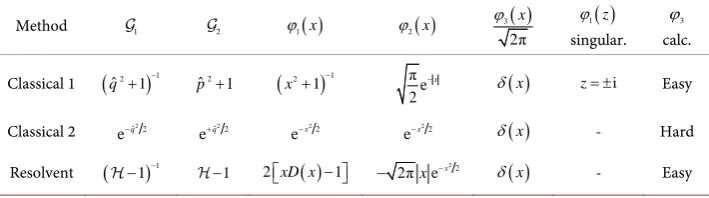
For D x
( )
, see Table 3.Notice that
( )
11 x x
φ − for →±∞
x , as is expected from the property that behaves like the multiplication by
x
in the limit of x→ ±∞. Bearing in mind that we have the relation(
) (
)
1I I −
′= + ′ +
by the commutativity
[
, ′ =]
0, so that φ3 =φ′, then we again obtain( )
:1 2π
δ
x . (31)
Recalling that D x
( )
is an odd function ofx
, we find that the first (second)element in φk (for k=1, 2, 3) in (30) is given by an odd (even) function. It should be
noticed that this property holds for a general φ
( )
x in (28), not necessarily for( )
01
x
φ
= . The reason is as follows. From
[
, ′ =]
0, together with (29), it is re-quired that
[image:11.595.197.552.633.732.2](
Γ ⊕ Γ− +)
φk =φk(
k=1, 2, 3 ,)
Table 3. Calculation of ϕ ϕ1, 2, and ϕ3 for ϕ
( )
x =1, where( )
2 2
2 2 0
ex xet d
D x = −
∫
t. In theclassical method 1, there is a singularity of ϕ1
( )
z at z= ±i. As compared with other methods,it is hard enough to calculate ϕ3 from ϕ2 in the classical method 2, due to an infinite number
of derivatives in ˆ2
2
ep .
Method 1 2 ϕ1
( )
x ϕ2( )
x( )
3
2π
x
ϕ ϕ1( )z
singular.
3
ϕ calc.
Classical 1
(
2)
1 ˆ 1q + − ˆ2
1
p +
(
2)
1 1x + − πe 2
x
− δ( )x z= ±i Easy
Classical 2 2 ˆ 2
e−q 2
ˆ 2
e+q 2
2
e−x 2
2
e−x δ( )x - Hard
Resolvent ( )1
1−
−
−1 2xD x( )−1 22
2π ex
x −
where 1
(
1)
2 ±Γ = ± , projection on the even or odd parity space. Thus, it is found that
the first (second) element in φk is parity odd (even).
In the latter half of this section, we discuss the FT of ϕ
( )
x =1 in another method. Some may point out that the result of (31) can be derived more efficiently from a method where is replaced by( )
2 1such that 1ϕ L ,
= ∈
(32)
which is schematically shown as
3
1 2
1 2
ϕ ϕ
ϕ ϕ
→
↓ ↑
→
Rewriting (26) as
ˆ ˆ ,
ˆ ˆ ,
q p
p q
= = −
(33)
we find that 1 can be chosen as such that depends on qˆ only (so that 2 depends on pˆ only), in order to calculate 1ϕ in quite a simple way (we call such a case a classical method). To further simplify the calculation by 2, the functional form of 2 is given by a polynomial of pˆ. Considering the condition of 1ϕ∈L
( )
, we find thatthe simplest form of 1 and 2 can be written as
(
2)
1(
)
12 2
ˆ 1
classical method 1 .
ˆ 1
q
p −
= +
= +
The calculation of ϕ1
(
=1ϕ ϕ)
, 2(
=ϕ1)
, and ϕ3(
=2ϕ2)
is summarized in Table 3, together with the corresponding calculation in another classical (named classical 2, discussed in the next-next paragraph) and the resolvent methods.Although all the methods give the same result as (31), there is an essential difference in ϕ1 between the classical 1 and resolvent methods from an analytical point of view. While zD z
( )
is an entire function,(
z2+1)
−1 has a pole at z=±i. The non-analyti- city of ϕ1 in the classical method is revealed when the ϕ1 is evaluated as ϕ1Λ in the limit of Λ → ∞:
( )
( )
11 x lim 1 x , 1 2,
ϕ ϕΛ ϕΛ −ϕΛ
Λ→∞
= =
where ϕ2
Λ is given by
( )
( ) ( )
( )
(
(
)
)
2 2
1 ,
, with
0 .
x
x x U x U x
x
ϕΛ ϕ
Λ Λ
≤ Λ
= =
> Λ
In calculating ϕ1 from the inverse FT of ϕ2, the limit operation Λ → ∞ is necessary, because (inverse) FT is given by an improper integral. After the analytic continuation of ϕ1
( )
x andϕ
1( )
xΛ from
x∈ to z∈, it is found that
z
∀ ∈
( )
( )
(
)
( )
( )
(
)
1 1
1 1
, lim classical method 1 ,
, lim resolvent method ,
B z z
z z z
ϕ ϕ
ϕ ϕ
Λ Λ→∞
Λ Λ→∞
≠
∀ ∈ =
where B=
{
z∈ − ≤ 1 Imz≤1}
. Actually, for z=i y(
y∈)
, for simplicity, we have( )
( )
(
)
(
)
2 2
2
1 1
2 1
e sinh cosh
1
classical method 1 ,
i i
2e cosh e erf erf
2 2 2
y v
y y y
y
y y
y y
y y
ϕ ϕ
π
−Λ
Λ
−Λ
Λ + Λ
−
− =
Λ + Λ −
Λ + −
(
)
resolvent method ,
where
( )
20 2
erf e d
π
z t
z =
∫
− t, so that it is confirmed that the relation of (34) holds for yz=i . Notice that
ϕ
1( )
zΛ is an entire function, because
( )
2 x
ϕ
Λ has a compactsupport so that its (inverse) FT turns out to be an entire function. Thus it is found that whether or not the relation of limΛ→∞ϕ1
( )
z =ϕ1( )
z holds for all z∈ depends onthe property that ϕ1
( )
z is an entire function (the identity theorem in complex analy-sis).
Some may further point out that in the classical method, ϕ1 for ϕ(x)=1 can be made an entire function by choosing 1 [hence 2 by (33)] as
(
)
2 2
ˆ 2 1
ˆ 2 2
e
classical method 2 , e
q
p − +
=
=
in which a series of calculations is summarized in Table 3. Although the ϕ1
( )
z isindeed an entire function, it is hard enough to calculate ϕ3 from ϕ2 (especially in a numerical way), compared to the resolvent method, because ˆ22
ep includes an infinite
number of derivatives. Even if we try to regard ˆ22
ep as an integral transform, it fails due to the divergence of the corresponding integral kernel K x
( )
. Actually, we obtain from ˆ22 ˆ22 1ep =eq −
( )
(
)
( )
(
) ( )
( )
2
2
ˆ 2
3 2
i 2
2 e
d , e e d ,
p
kx k
x x
K x y y y K x k
ϕ ϕ
ϕ =
=
∫
− =∫
which indicates that K x
( )
(for x∈) is divergent in a usual sense.Regarding the analyticity and numerical simplicity in calculating FT of ϕ
( )
x =1, it seems that, based on the above discussion, there is no way other than the resolvent based method.4. Conclusions
We have obtained, using the resolvent for the harmonic oscillator Hamiltonian , the FT of a non-integrable function ϕ, such as ϕ
( )
x =1. As compared with the classical methods in Table 3, the resolvent method has some merits of being numerical calcula- tion friendly and free of singularity for ϕ1( )
z . In calculating the resolvent kernel, thesampling theorem is of great use. The introduction of SUSY to not only makes transparent the usefulness of the even-odd decomposition of the ϕ in a more natural way, but also leads to a natural definition of SUSY FT.
is to deal with other unitary transforms, for example, the Hankel transform, whose eigenfunction is given by the Laguerre polynomials Using the resolvent for the corres- ponding Hamiltonian, we can obtain an analogous result. Another is to generalize
:
ϕ
→ to : C ,( )
m
p q
ϕ
→ , the Clifford algebra over p q+ [φ
in (28) cor-responds to C0,1
( )
⊕C0,1( )
]. Although the Clifford FT, in itself, is defined invarious ways [11] [12] [13] [14], mainly due to the non-commutativity of the algebra, the resolvent based calculation will still be of use, despite the non-commutativity.
Acknowledgements
The author is indebted to H. Fujisaka for useful discussions. This work was supported in part by HCU grant.
References
[1] Kuwata, S. (2016) AIP Conference Proceedings, 1705, 020012.
https://doi.org/10.1063/1.4940260
[2] Witten, E. (1981) Nuclear Physics, B188, 513-554.
https://doi.org/10.1016/0550-3213(81)90006-7
[3] Marks, R.J. (1991) Introduction to Shannon Sampling and Interpolation Theory. Springer, New York. https://doi.org/10.1007/978-1-4613-9708-3
[4] Magnus, W., Oberhettinger, F. and Soni, R.P. (1966) Formulas and Theorems for the Spe-cial Functions of Mathematical Physics. 3rd Edition, Springer, New York, 183.
https://doi.org/10.1007/978-3-662-11761-3
[5] Gradshteyn, I.S. and Ryzhik, I.M. (2007) Tables of Integrals, Series, and Products. 7th Edi-tion, Academic, Burlington, 972.
[6] Gradshteyn, I.S. and Ryzhik, I.M. (2007) Tables of Integrals, Series, and Products. 7th Edi-tion, Academic, Burlington, 977.
[7] Gradshteyn, I.S. and Ryzhik, I.M. (2007) Tables of Integrals, Series, and Products. 7th Edi-tion, Academic, Burlington, 406.
[8] Szego, G. (1975) Orthogonal Polynomials. American Mathematical Society, Providence, 107.
[9] Prudnikov, A.P., Brychkov, Yu.A. and Marichev, O.I. (1986) Integrals and Series, Vol. 2: Special Functions. Gordon and Breach, New York, 710.
[10] Prudnikov, A.P., Brychkov, Yu.A. and Marichev, O.I. (1986) Integrals and Series, Vol. 2: Special Functions. Gordon and Breach, New York, 708.
[11] Jancewicz, B. (1990) Journal of Mathematical Physics, 31, 1847-1852.
https://doi.org/10.1063/1.528681
[12] Brackx, F., De Schepper, N. and Sommen, F. (2005) Journal of Fourier Analysis and Appli-cations, 11, 669-681. https://doi.org/10.1007/s00041-005-4079-9
[13] Hitzer, E. and Mawardi, B. (2008) Advances in Applied Clifford Algebras, 18, 715-736.
https://doi.org/10.1007/s00006-008-0098-3
[14] De Bie, H. (2012) Mathematical Methods in the Applied Sciences, 35, 2198-2228.
Submit or recommend next manuscript to SCIRP and we will provide best service for you:
Accepting pre-submission inquiries through Email, Facebook, LinkedIn, Twitter, etc. A wide selection of journals (inclusive of 9 subjects, more than 200 journals)
Providing 24-hour high-quality service User-friendly online submission system Fair and swift peer-review system
Efficient typesetting and proofreading procedure
Display of the result of downloads and visits, as well as the number of cited articles Maximum dissemination of your research work
Submit your manuscript at: http://papersubmission.scirp.org/