Munich Personal RePEc Archive
A Dynamic Inflation Hedging Trading
Strategy Using a CPPI
Fulli-Lemaire, Nicolas
University of Paris II, Crédit Agricole SA
2 January 2012
Online at
https://mpra.ub.uni-muenchen.de/43620/
A Dynamic Inflation Hedging Trading Strategy using a CPPI
Nicolas Fulli-Lemaire1
Amundi
Paris II University
Fourth Version: 04/01/2013
Published in the Journal of Finance & Risk Perspective: December 2012, Volume 1 (Issue2).
Abstract
This article tries to solve the portfolio inflation hedging problem by introducing a new class of dynamic trading strategies derived from classic portfolio insurance techniques adapted to the real world. These strategies aim at yielding higher returns on a risk-adjusted basis than regular inflation hedging portfolio allocation while achieving a lower cost than comparable option–based guaranteed real value strategies.
Keywords: ALM, Inflation Hedging, Portfolio Insurance, CPPI.
JEL classification: C58, C63, E31, E43, E52 ,G12, G2, Q0.
1
This document presents the ideas and the views of the author only and does not reflect Amundi’s opinion in
Plan
Introduction ... 3
1. Inflation Hedging and Portfolio Insurance ... 4
1.1. Motivations for seeking alternative hedges, a review of the existing literature ... 4
1.2. Adapting Portfolio Insurance techniques to the real world ... 6
2. Theoretical construction of the DIHTS ... 9
2.1. The DIHTS as an alternative strategy ... 9
2.2. Optimal allocation of the diversified portfolio ... 13
3. Empirical estimations of the performance of the strategy ... 14
3.1. Methodology and data sources ... 14
3.2. Historical Backtesting results ... 16
4. Block Bootstrapping based evaluation of the DIHTS ... 17
4.1. Principle ... 17
4.2. Results ... 19
Conclusion ... 21
Appendix ... 23
A. Historical Simulation Results ... 23
B. Bootstrapped Simulation Results ... 31
References ... 37
List of Figures ... 39
List of Tables ... 39
Introduction
The demand for inflation hedges from pension funds has spurred the academic literature on optimal portfolio allocation and investment strategies for durations up to several decades. These types of long haul strategies are designed to match future liabilities that must be provisioned but that do not require specifically that the mark to market value of their investments matches that of their liabilities in the short run. In this paper, we set ourselves in the different context of commercial banks that need to hedge their inflation liabilities arousing from retail products such as guaranteed power purchasing saving accounts, term deposits, or even asset management structured products. All of these guarantees are immediately effective and their duration rarely exceeds a decade. Moreover, a constant access to liquidity is required for these open funds which can face partial or total redemption any time during their lifetime.
1.
Inflation Hedging and Portfolio Insurance
1.1.Motivations for seeking alternative hedges, a review of the existing
literature
Corporations which are structurally exposed to inflation would most naturally like to hedge their liabilities by the purchase of inflation linked financial assets, or by entering in derivative contracts which would outsource the risk. But these two natural solutions rely on an insufficiently deep and insufficiently liquid market for the first one and is excessively costly for the second one as a result of an unbalanced market:
On the demand side of the inflation financial market, the need for inflation protected investments is spurred by four main drivers which are pension funds because of their inflation liabilities arousing from explicit power purchasing guaranteed pensions, retail asset managers providing inflation protected funds, insurance companies hedging their residual inflation liabilities and, mostly in continental Europe, commercial banks exposed to state guaranteed inflation indexed saving accounts. The bulks of those liabilities have long to vey long durations and amount to the equivalent of hundreds of billions of Euros. On the supply side of the market for inflation-linked bonds, there is a very limited pool of issuers which is comprised mostly of sovereign or quasi-sovereign entities. There are very few corporate issuers of inflation linked bonds as there are very few corporations that have a structural long net exposure to inflation to the exception of maybe utilities engaging in Public-Private-Partnerships or real-estate leasers which tariffs are periodically adjusted on an inflation basis by law or contract. And even in those cases, it is not obvious that those companies have an interest in financing their operations on an inflation-linked basis which in nominal term is a floating rate. In fact, very few choose to. This limited pool of issuers is subject to changing budget policies, issuance strategies and current deficits which result in a fluctuating primary supply. Moreover, most of the buyers in the primary market acquire those assets on a hold to maturity basis or for immediate repo, rendering the secondary market relatively more illiquid than the one of their nominal counterparts, as is evidenced in the working paper(D'Amico, Kim et Wei 2009).
This gap between supply and demand in the inflation financial market has spurred the interest in alternative inflation hedging techniques that could solve the depth, cost and liquidity issues that have plagued the inflation financial market. Academic literature dating back from as far as the seventies has explored the use of a portfolio of real investments as an inflation hedge. Various asset classes such as equities (Z. Bodie 1976), commodities (Z. Bodie 1983), real estate (Rubens, Bond et Webb 2009), REITS (Park, Mullineaux et Chew 1990), and more recently dividend indices(Barclays Capital Research 2008) have been examined as potential real hedges to inflation. Even exotic assets such as forest assets (Washburn et Binkley 1993) and farmland (Newell et Lincoln 2009) just to mention two of them have also been explored but offer very limited interest with respect to the added complexity their investment requires.
The first emission of a long term CPI linked bond by a private US financial institution in the late eighties has led to a string of papers starting with (Z. Bodie 1990) which aimed at finding the optimal strategic asset mix these new assets enabled. Similarly, the first issuance by the United States treasury of inflation protected securities in 1997, following the first issuance by the British treasury of inflation linked gilts in 1981 have generated a renewal of interest in their role as inflation risk mitigation and diversification assets. The latest of which is the(Brière et Signori 2010) paper. These studies are of limited help for the purpose of this work as they still rely for a significant fraction of their investment strategies on inflation linked assets, which we are precisely trying to avoid doing. They nonetheless offer a first alternative to fully inflation protected investments, and therefore offer a potentially higher degree of returns, at the cost of a more hazardous hedging method.
Another stream of academic literature has focused on the optimal allocation for inflation hedging portfolios using only nominal assets and using various approaches to determine the optimal allocation like the recent (Amenc, Martellini et Ziemann 2009) paper which devised a global unconstrained nominal inflation hedging portfolio that would use a Vector Error Correcting Model to determine the optimal ex-ante allocation of the various potential inflation hedging asset classes mentioned before. This kind of strategy would solve the availability problem of the inflation linked assets, but would fail to bring any kind of guaranteed value to the portfolio, be it in real or nominal terms, and because of that, fails to meet our Asset Liability Management (ALM) constraints. In fact, the hedging potential of all the above-mentioned asset classes has proved to be horizon sensitive and dependent on the macroeconomic context. (Attié et Roache 2009) have studied the time sensitivity of the inflation hedging potential of various asset classes and have shown in particular that some asset classes like commodities react better to unexpected inflation shocks than others, like most obviously nominal bond. More generally, the inflation betas has also proved to be unstable over time and can exhibit strong local decorrelations, rendering the inflation hedging exercise risky considering for example that the volatility of most of these asset classes is far superior to that of the Consumer Price Index we are precisely trying to hedge.
VAR models, but these classes of models are tricky to calibrate and would most probably result in statistically insignificant estimations, and accordingly, wrong allocations. Moreover, they would also most probably fail to detect in a timely manner small macroeconomic regime changes that could have a lastingly impact on the structure of the inflation betas. This might in turn jeopardize the overall inflation hedging potential of the portfolio if for example one of the invested assets suffered a significant fall in value as none of them has a guaranteed value at maturity like a bond, credit risk apart. Overall, this type of strategies would still fall short of a totally guaranteed value for the portfolio as would be the case with a real zero coupon bond.
1.2.Adapting Portfolio Insurance techniques to the real world
The limitations in term of guaranteed terminal value for the classic Markowitz approach to optimal portfolio selection based on the benefit of diversification have motivated the quest for portfolio insurance strategies in the seventies (Leland, Who Should Buy Portfolio Insurance? 1980). In purely nominal terms, the optimal tradeoff between the enhanced returns on risky assets and the low returns on assumed risk-free nominal bonds is known as the “two fund theorem”. The optimization can also be further constrained by incorporating guaranteed nominal-value-at-maturity characteristics. Doing so yields the so called Dynamic Portfolio Insurance Strategies (Perold et Sharpe 1988) which includes: Buy and Hold, Constant Mix, Constant Proportion and Option Based Portfolio Insurance. But can such guaranteed-values-at-maturity strategies be transposed to the real world?
The simplest solution would be to mimic a two fund strategy in the real world: it would be implemented using a real risk free zero coupon bond and either a diversified portfolio of real assets or a call on the real performance of a basket of assets. The call option could also be either bought or replicated using an adaptation of the ideas exposed in(Leland et Rubinstein, Replicating Options with Positions in Stocks and Cash 1981). Such strategies would unfortunately be highly intensive in inflation indexed products use and would therefore not solve our availability problem, without even taking into account the low real returns these strategies would probably yield.
Using a call option on nominal assets, as opposed to real assets, would only partly solve the problem as the risk-free part is either made of zero coupon bonds which are available in limited supply or synthetic bonds made of nominal zero coupon bonds combined with a zero coupon inflation index swap which have greater supply but very low real returns. It could also be envisaged to combine a risk free zero coupon nominal bond and an out of the money call option on inflation. It would almost exactly be a replication of an inflation index bond as we will explain in the next subsection.
assets or derivatives if it were possible to generate a portfolio that could mimic the cash-flows of an inflation-linked-bond as we will try to prove in the next subsection.
To sum up, any real portfolio insurance strategy would involve a capital guaranteeing part and a real performance seeking investment made of a diversified portfolio or a derivative and without explicit capital guarantees at maturity. Depending on the strategy used, the guaranteed capital part would either have a real guarantee embedded, or simply a nominal guarantee which would have to be complemented by a real guarantee attained to the detriment of the performance seeking part.
Trying to do without the IL instruments, we want to replicate the cash flow of an ILB with a Fisher Hypothesis. This replication can be achieved using an adapted OBPI technique as mentioned in the previous subsection and the theoretical justification is provided below:
Replicating the cash flows of an ILB is equivalent to fully hedging a nominal portfolio on a real basis. To do so, we need to invest a fraction α of the notional of the portfolio N in a zero coupon nominal bond of rate τ , and buy a cap to hedge the residual risk. Out of simplicity, N is assumed hereunder to have a unit value. Using the Fisher framework (Fisher 1907), we can decompose the nominal bond’s rate into a real rate τ , , an inflation anticipation π ,
and an inflation premium p π , :
1 τ , 1 τ , 1 π , 1 p π ,
The nominal bond’s allocation α should then be defined such that its inflation components equalize the ILB’s one. We obtain the following equation by ignoring the cross product :
α 1 π , 1 p π , 1 π , ⇒ α 1 p π1
,
We are left with a residual amount 1 α out of which we can buy the option without shorting.
Let π , be the realized inflation between 0 and T, let S be the initial spot rate for inflation
equal to π , under the rational expectation hypothesis and let c , ; be the cap premia of strike K and maturity T at 0 be expressed as a percentage of the notional.
By a simple absence of arbitrage opportunity hypothesis, we can rule out ITM strikes:
∄K S such that c , ; 1 α
When short selling is also prohibited, we have strikes that are OTM or at best ATM. This would constitute a partial hedge in which we would remain at risk on the spread:
Residual Risk K S , if S ∈ S , K
If we can borrow at rate τ , , we can then fully hedge our portfolio. Ignoring the cross
products, we obtain under those assumptions the nominal return N :
N α τ , π , π , π , 1 α c , ; 1 τ ,
The real return R is thus:
R α τ , π , π , π , 1 α c , ; 1 τ , π ,
Applying the cap-floor parity, we have :
π , π , π , π , π , π ,
Which gives us the following result for the real rate:
R α τ , π , π , 1 α c , ; 1 τ ,
Nota bene: This return is not necessarily positive.
In fact, since call options on inflation are not liquid exchange-traded instruments but OTC products, there is a high probability that the call premium would be sufficiently high to render the real return of the strategy very low at best if not negative at worst. This is not inconsistent with empirical observations that have been made on real bonds: some TIPS issuances in 2010 have had negative real rates.
The replication of the ILB cash flows by a combination of a nominal bond and a call option on inflation still fails to fully satisfy our objective of getting rid of the dependency on the inflation financial market because of the call option. To relax this constraint, it might be possible to manage the option in a gamma trading strategy without having to outrightly buy the derivative. The obvious challenge to overcome is that the natural underlying of the call option is an inflation indexed security, which brings us back to our previous hurdle. To overcome this latest challenge, it could be possible to envisage a cross-hedging trading strategy to gamma hedge the call on purely nominal underlings as will be exposed in the next subsection. (Brennan et Xia 2002) proposed a purely nominal static strategy that would both replicate a zero coupon real bond and invest the residual fraction of the portfolio in equity while taking into account the horizon and the risk aversion of the investor in a finite horizon utility maximization framework. We would like to extend the scope of this work to dynamic allocation.
2.
Theoretical construction of the DIHTS
2.1.The DIHTS as an alternative strategy
To achieve this inflation hedging portfolio insurance, we would like to capitalize on the popular CPPI strategy to build a dynamic trading algorithm that would be virtually free of inflation linked products and derivatives, but still offer a nominal and a real value-at-maturity guarantee: we propose a strategy which we will call the Dynamic Inflation Hedging Trading Strategy (DIHTS).
The risk-free part of the DIHTS portfolio would be invested in nominal zero coupon bonds which maturity matches that of our target maturity. The ideal asset for our strategy would be a floating rate long duration bond but since too few corporate or sovereign issuers favor this type of product, we cannot base a credible strategy relying on them. We could swap the fixed rate of the bond for a floating rate with a Constant Maturity Swap (CMS) as this type of fixed income derivative does not suffer for the limited supply and its cost implications like inflation indexed ones as it boasts a much boarder base of possible underlings in the interest rate market. Also, contrary to the inflation financial market, there are players in the market which are naturally exposed to floating rate and who wish to hedge away this risk by entering in the opposite side of a CMS transaction, therefore enhancing liquidity and driving the cost down for such products. But, we have to accept bearing huge costs if the portfolio is readjusted as long rates move up or have to forfeit the capital guarantee at maturity by synthesizing the CMS by rolling positions on long duration bonds. Either which of these options are hardly sustainable.
If we add a martingale hypothesis for the price process of the other asset classes:
This “limited liability” assumption becomes equivalent to a value-at-maturity hypothesis for the diversified portfolio which we can write for being the guaranteed value at maturity:
∙
By further assuming that expected inflation can be obtained by the use of BEIs derived from ZCIIS, we can compute the initial fixed income fraction of the DIHTS which we will denote .
Let , be the realized inflation between t and t+ , and let , be the expected inflation
between t and t+ at time . We have:
, , ,
Let’s further assume that:
∀ , , 0
We then assume that:
, ,
This assumption simplifies the problem of the computation of the inflation expectation in a rational anticipation framework: since in the Fisher framework we have:
1 , 1 , 1 ,
The above assumption is equivalent to considering that the risk premiums are nil, which is a prudent hypothesis since they are non-negative: we therefore never underestimate the inflation risk. This hypothesis will have a further justification when we’ll discuss the definition of the DIHTS’ floor.
exploiting the same general principal as for the simpler strategy presented here. Henceforth, we will focus only on bullet repaying strategies since the marking-to-market allows us to theoretically adjust the notional of the fund at a current value, therefore without risking incurring a loss in case of partial or total redemption from the fund.
As previously defined, denotes the fraction of the fund invested in risk free nominal assets.
Let , 1 be the initial global allocation of the DIHTS and NPV denotes the net
present value of the two fractions. All rates from now on are given in annual rate. At inception:
1 α ∙ μ α 1 π ,
1 τ ,
We therefore have
α 1 π ,
1 τ , μ
1 1 μ
Let Α, represent the ZC zero coupon bonds fraction of equivalent tenor (T-t), invested at time t and maturing at time T (for a ZCNB, only the nominal at maturity counts):
Let NAV represent the NAV of the zero coupon part, we have:
NAV Α ,
1 τ,
Let be the weights of the ex-ante optimal allocation of the diversified portfolio, let Ω be the vector of the value of the assets of the portfolio and let be the price vector of the selected asset classes. From now on, the star will denote the post optimization value of the parameter. We have at inception:
∗ Ω∗
1
1 ∗ ∙
We then define as:
Ω∗ ′ ∙
And as:
1 , 1 ,
For any 0, we define the net asset value of the strategy :
Before any reallocation we have:
Let be the implicitly guaranteed net asset value of the strategy taking into account the loss resilience parameter :
∙
The strategy remains viable as long as 0. If the floor is breached, the fund is closed before the maturity or a zero coupon inflation hedging security would have to be bought at a loss.
A global reallocation is necessary if 0 and in which case, we have to add a new trench of ZCNB such that:
∗ argmin 0
In case we have:
0 0 we set 0
Since the expected returns on the diversified part of the portfolio are potentially higher than those on the fixed income part, we set at the lowest possible value that verifies 0. In order not to reallocate constantly the global parameter at the slightest market movement, we set a tolerance parameter under which no global reallocation is done:
∗ | | 0 0
Obviously, any global reallocation would trigger a reallocation of the diversified portfolio weights. It is a sufficient but not necessary condition as it may be more optimal to do so more frequently as we will expose in the next subsection.
The breaching of the DIHTS’ floor is obtained when it is not possible to reallocate the global parameter such that the guaranteed net asset value becomes positive:
∀ 0, 0
be curtailed by the fact that we had taken ZCIIS BEIs when computing the NAV and not directly the expected inflation which would have been lower.
2.2.Optimal allocation of the diversified portfolio
The diversification portfolio is allocated in order to hedge both the residual expected inflation and the unexpected inflation, while also yielding the real excess return that is targeted. Once the global allocation parameter is set, we can compute the residual expected inflation and eventually set a targeted real excess return. According to our hypothesis, we have no input regarding the value of the unexpected inflation which ex-ante conditional expectation is nil.
Out of all the possible portfolio optimization criteria, we will limit ourselves to envisaging allocating the diversified portfolio according to three criteria: a Constant Weight scheme (CW), a minimum-variance (MV) and an Information Ratio (IR). We introduce the following definitions: Let be the targeted real return scalar, be the realized return vector over the period k for the different asset classes and Σ be the variance-covariance matrix of the return vector at time t. Let be a portfolio allocation at time t and ∗ be the optimal one
according to the X criteria used. Let be the realized inflation over the k period, be the
expected inflation over the k period at time t and be the nominal return on the fixed-income investment.
The MV optimization criterion is defined by the following loss function at time t:
, , , , , Σ ∙ Σ ∙
We therefore obtain the optimal portfolio according to the MV criterion by minimizing L:
∗ argmin , , , Σ
The IR optimization criterion is defined such that:
, , , , , Σ ,
∙ , 1 1 , ∙
∙ Σ ∙
We therefore obtain the optimal portfolio according to the IR criterion by maximizing the IR:
∗ argmax , , , , , Σ ,
trickier to compute since they require for example a model to compute simulated trajectories and perform Monte-Carlo estimation. The CW method being blind, it is obviously the less demanding in term of input.
In the next section on empirical estimation, we will rely on historical estimations of the key optimization inputs out of simplicity considerations. Forecasting errors will be assumed to be nil (rational expectation hypothesis). A slightly more comprehensive approach to allocating our portfolio would involve the modeling of the joint distribution of inflation and investable assets from a macro or an econometric perspective in order to make forecasts (or simulations). Unfortunately, as we will expose thereafter, no such simulation tool is available today.
Had a more accurate model to forecast economic and financial variables over a horizon spanning from five to ten years been available, it could be envisaged to reuse previously published models like (Amenc, Martellini et Ziemann 2009) Vector Error Correction Model (VECM) or more simpler VAR based models to generate scenarios on which we could perform both our allocation optimization and the back-testing of our strategy on simulated scenarios. Using this scenario generator, we could perform an estimation of the expected values of the unknown parameters with a Monte Carlo procedure, using only data available at time t. The ℙ would for example be obtained in such a way if we remark that:
ℙ , ℙ , , , , Σ ℙ ℙ ∙ 0
ℙ ∙
Using such a procedure would also enable the allocation of pre-determined real return targeting portfolios which would in turn enable the construction of an efficient frontier ℙ ; which would sum up in graphic form the tradeoff between targeted real return, or achieved real return, and the empirical short fall probability.
3.
Empirical estimations of the performance of the strategy
3.1.Methodology and data sources
To empirically test the efficiency of the global allocation principle independently from the optimization method used to allocate the diversified portfolio, we adopted the same allocation technique for both the diversified fraction of the investment and for the standard benchmark portfolio. Portfolios were simulated over the longest available timeframe on US data spanning three decades from 1990 to the end of 2010.
is defined as the percentage of times a portfolios breaks the real par floor, the IR is the Sharpe ratio applied to a pure inflation benchmark and the ToR is the percentage of the initial value of the fund that is reallocated during the life of the strategy. To have a measure of the potential Profit and Loss (P&L) of the benchmark portfolio returns in case of failure of the DIHTS, we measure the P&L Given Failure (PLGF). Nota bene, this indicator is obviously measurable only if the DIHTS does fail.
For the three previously selected allocation methods, we then tested the impact on the overall strategy performance on the choice of a shorter investment horizon based on our central scenario of µ = 50% and η = 1%. We then computed the sensitivity analysis of the DIHTS to the choice of µ and η in our 10 year investment horizon base scenario (results presented in the working paper version). We also plotted the comparative real return profile of the DIHTS compared to the benchmark portfolio allocated with the same technique for various investment horizons in our baseline scenario. Eventually, we constructed an efficient frontier based on our real return compared to a risk measure (the volatility of the NAV).
The various portfolios values were computed on end-of-period values at a monthly frequency obtained from the Bloomberg data services: for the diversified and benchmark portfolios the S&P-GSCI-TR total return commodity index, the S&P500-TR total return broad US equity index, the FTSE-NAREIT-TR traded US real estate total return index and the Barclays Capital Long U.S. Treasury Index (the last being only for the benchmark portfolio). For our zero-coupon and mark-to-market computation, we used the US sovereign ZC-coupon curve computed also by Bloomberg. CPI inflation was measured using the standard official measure. The longest overlapping availability period for all of these data stretches from 1988 to 2011.
Forward inflation expectations used to compute the floors were obtained using market values derived from the Zero Coupon Inflation Indexed Swaps curve (ZCIIS) which is available from June 2004 to the 2011. Prior estimations of expected inflation were obtained using the Federal Reserve Bank of Philadelphia Survey of Professional Forecasters (SPF) for future US inflation at 1 and 10 year horizon available for the entire 1988 to 2010 period.
3.2.Historical Backtesting results
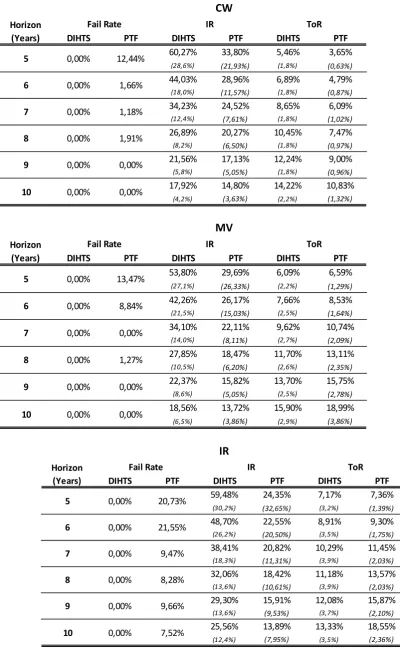
The first striking results of this study is that as we can see from the analysis of any of the horizon sensitivity analysis presented in tables 1 is that the efficiency of the DIHTS compared to the benchmark portfolio is stronger for medium investment horizon of 5 to 7 years, whereas for longer ones, the effect tends to diminish as the benchmark portfolio failure rate drops. Shorter horizons were not modeled as in some cases interest rate from inception to maturity being lower than the expected inflation, the strategy could not have been initiated. The less striking result is that a classical portfolio of our alternative asset classes does offer a relatively good inflation hedge over long horizons, whilst failing at shorter ones. Comparatively, in our baseline scenario, the DIHTS never fails over the same range of maturities and ensures through its life a positive real mark to market. Again, as could have been expected after the following analysis, the IR for the DIHTS is persistently higher over the entire range of investment horizons, but as the maturity lengthens, the difference diminishes.
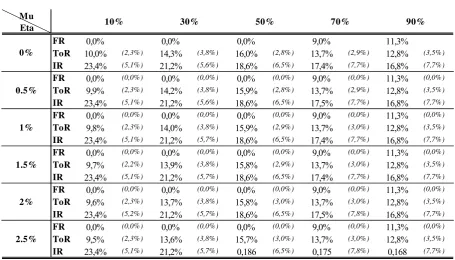
The main drawback of this study is that reallocations are done at no trading costs. The performance indicated here is in effect purely theoretical. This is why the ToR ratios are computed in order to have an idea of the potential trading cost implications. On this aspect, the DIHTS does underperform its benchmark portfolio by a relatively small measure, even if this conclusion has to be nuanced by the large and relatively higher volatility of the ToR for the DIHTS compared to its benchmark. The choice of our baseline scenario is comforted by the parameter sensitivity analysis which clearly indicates that a conservative estimate for µ = 50% reduces failure rates at the 10 year horizon tested. The tolerance parameter η = 1% impact seems to be of lesser importance but it is clear the ToR versus FR arbitrage could be of significance had trading costs been accounted for as can be seen in tables 4 to 6. The CW allocation is rather surprisingly less ToR intensive compared to the other allocation methods but achieves lower IR performance. This could be attributed to the volatility of the estimation of future expected returns and volatility which require important shifts in allocation.
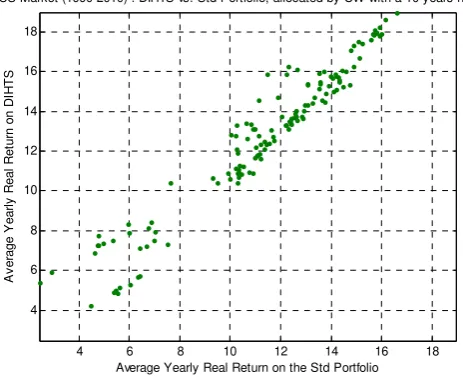
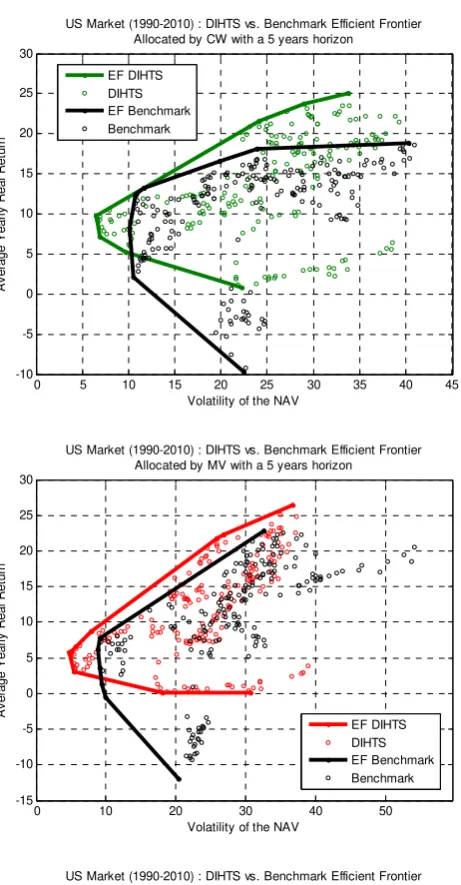
The graphical representation of the comparative real performance of the strategy at medium maturities as can be seen in figure 4 appears to show the classical CPPI “call-like” optional risk profile in which the strategies holds in tough times whilst potentially achieving higher returns in favorable ones. As fewer negative results are experienced for longer investment horizons, the risk profile is less clear to establish but is consistent with the previous analysis in the IR case. The analysis of our empirical determination of the real efficient frontier of our strategy reinforces the previous conclusions as to the relative efficacy of the DIHTS in medium term and its less clear performance gains for longer horizons as can be seen in figure 5: at the five years horizon, the DIHTS frontier is systematically shifted towards the upper left corner compared to its benchmark whist at the ten year horizon, it is shifted to the left in the IR case.
conditional allocation does offer better than expected results in the most favorable circumstances, which is very uncommon in the plain vanilla derivative instruments it is supposedly mimicking. To sum up, the DIHTS achieves inflation hedging and delivers real returns in all the backtest simulations for any targeted maturity whist consistently achieving higher returns that its benchmark, thus justifying the validity of our approach.
4.
Block Bootstrapping based evaluation of the DIHTS
4.1.Principle
The main shortfall of the previous empirical estimation of the performance of the DIHTS is that it relies on the historical time series which represent only one scenario in a backtesting approach. Moreover, the historical time span studied here corresponds to a very specific context of a downward trending inflation and its associated risk premium. We therefore have a context in which long horizon inflation hedging techniques were beaten by classic allocations since inflation tended to be systematically under its expected value ex-ante. In such a context, investing in long duration nominal assets accordingly yields strong real returns. Considering for example the vast amount of liquidity injected by central banks in the financial market by the various unconventional monetary policies of the last couple of years, the still untamed government spending generating large deficits and a looming sovereign crisis, it is very hard to imagine that inflation will keep following the same path it followed over the past twenty years. A backward looking approach is therefore clearly insufficient. Yet, it is probable that fundamental economic relations will still more or less link the various asset classes and we can hope that our approach can hold in such a context. Exploiting simulated stressed scenarios could therefore be informative if they are credible. But since we do not have a credible simulation tool, we choose to bootstrap the existing dataset using a block method to retain as much as we can of the existing correlation structure of our dependent vector time series.
backtesting, we presented the results of this exercise on graphic format and tables summarizing the comparative performances, and the average allocation of the portfolio.
Out of the universes of scenari we generated, some will be extraordinarily adverse. It is worth mentioning that since those scenari are obtained from real past returns, they do constitute credible “black swans” events worse evaluating, especially since recent turmoil have taught us that such improbable events do actually occur rather frequently. There are obvious intrinsic shortfalls to this methodology: we puts into question the rational expectation hypothesis as when the simulated path crosses over from one block of returns to the other, there is no reason to believe expectations will hold. It is an especially acute problem for the fixed income market where we should see forward rates converging towards spot rates. Even though from a purely numerical point of view, correlation structures should be mostly preserved. Though imperfect, this method is the only credible alternative to historical backtesting. It generates extreme scenarios with intrinsic structural breakpoints in term of correlations and rational expectation, but might be informative for stress testing.
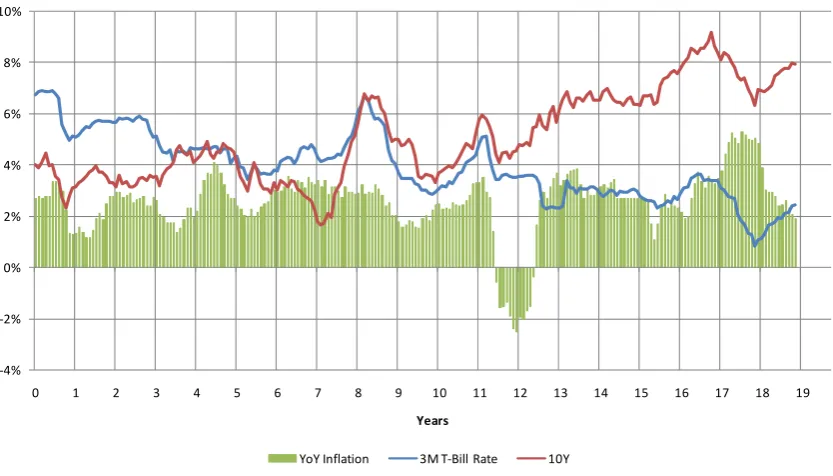
[image:19.595.89.506.440.678.2]If we analyze the example provided here under, we can observe during the first years of the simulated path an inverted rate curve, a short negative long real rates period, a monetary contraction driven by a short term rate spike followed by a fall in inflation, the inversion of the nominal curve, a prolonged deflation then a sustained inflationary period with a monetary loosening period and a spike in inflation with significant real rates and inflation risk premia.
Figure 1: Example of a joint simulation of nominal rates and inflation using block bootstrapping
All these events have been observed in the past, though possibly of lesser magnitude and duration, but are consistent and could be analyzed in term of stress testing of the strategy. There are obvious intrinsic shortfalls to this methodology: the quasi-random path simulated in our selected example shows that though short term interest rates did fall synchronously with
‐4%
‐2% 0% 2% 4% 6% 8% 10%
0 1 2 3 4 5 6 7 8 9 10 11 12 13 14 15 16 17 18 19
Years
the year on year inflation, they then remained at above 3% whilst inflation went into negative territory. There is hardly any credible monetary policy that springs to mind that would justify such a move. Yet, as adverse and improbable as it may seem, such an approach is clearly informative.
4.2.Results
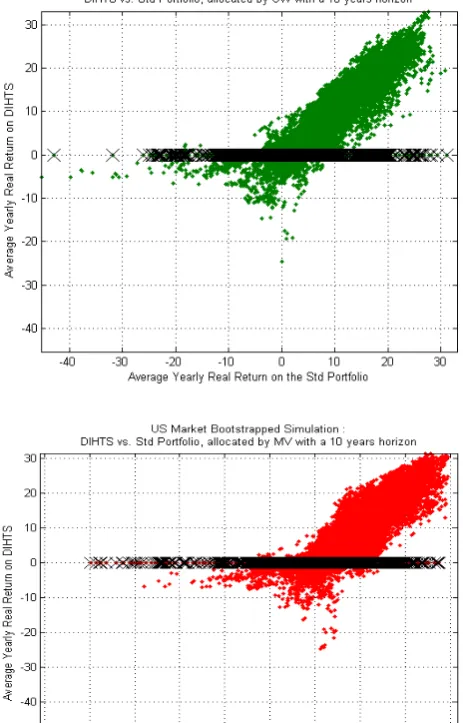
If we first look at both the five year and ten year DIHTS versus Benchmark plot, it is difficult to see any significantly different pattern at first glance. It is not as clear as in the previous case that we have a clear optional-like payoff profile with an asymmetrical distribution. In fact, the distribution shows remarkable similarity, except maybe for highly negative returns. We do observe large numbers of FR for the DIHTS but reassuringly, the PLGF is also negative, indicating that the benchmark would probably haven’t fared better in such adverse environments. We also observe a significant number of DIHTS simulations which end-up below the real floor at maturity whilst they never broke the real floor during their lifetime up to the before-last valuation of their mark-to-market. Since this represents the gap risk resulting from the mark-to-market at a low frequency (monthly here), we have included those cases in the computation of the failed rate. Moving to higher frequency estimation would probably eliminate much if not all of these below zero points as in the conventional CPPI.
Looking then at the efficient frontier empirical estimation, we have once again as in the previous case better results for the five year with frontiers pushed to the northwest for all the allocation methods. For the ten year cases, there seems to be no significant difference between the efficient frontiers of the benchmark portfolio and the DIHTS but for the very adverse cases as before. Nota bene: the efficient frontiers of the DIHTS passes through the (0,0) point because in case of a breach of the real par, the strategies are terminated and an arbitrary (0,0) return variance couple is entered.
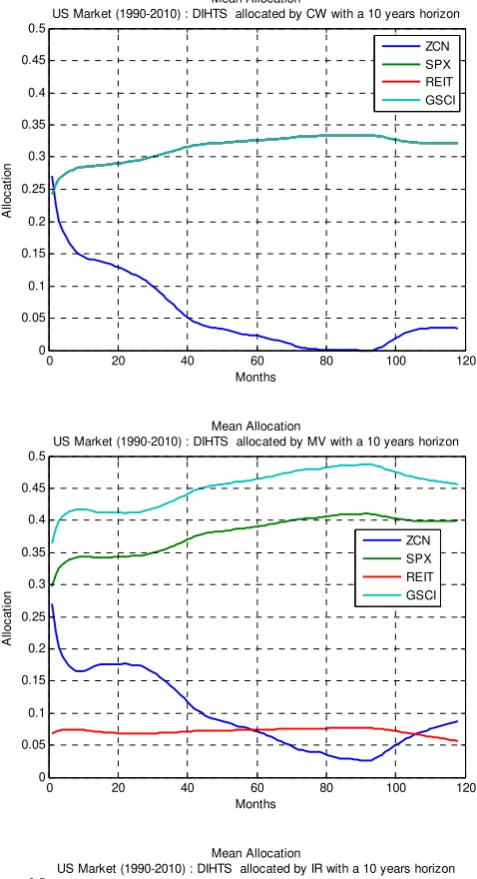
The average allocation of the portfolio shows a progressive substitution of the nominal bond to the benefit of the other asset classes which exhibit upward trending means for all classes in the five year computation. In the case of the ten year horizon, the REIT allocation exhibits a downward trend in the MV allocation and so does the GSCI in the IR allocation. There is no clear explanation for these phenomena.
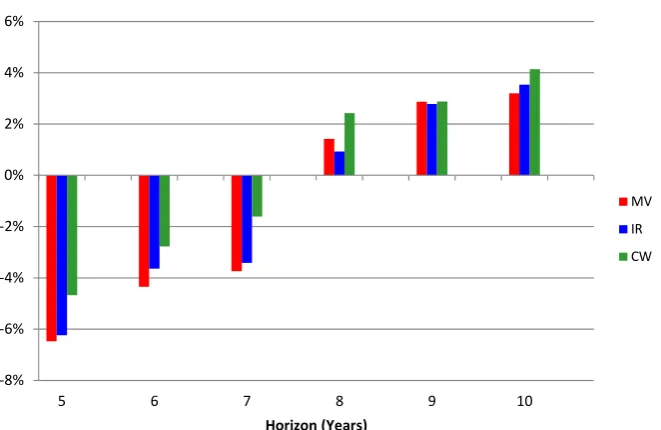
In term of comparative performance to the benchmark, we have computed the excess rate of failure of the DIHTS over its benchmark for the three allocation methods for horizons ranging from 5 to 10 years. The results are presented in the figure 2 above. We observe that in term of FR, the DIHTS achieves a significant reduction for maturities ranging from 5 to 7 years and then underperforms its benchmark significantly for maturities of 8 years and over.
The IR ratios yield little discriminative value as the differences between the ones of the DIHTS and those of its benchmark are negligible. The ToRs are also fairly close, but it is rather encouraging as it removes partly the trading cost caveat.
Figure 2 : DIHTS – Benchmark Fail Rate Enhancement Horizon Sensitivity
‐8%
‐6%
‐4%
‐2%
0% 2% 4% 6%
5 6 7 8 9 10
Horizon (Years)
Conclusion
Inflation hedging has been a broad cyclical concern in Asset Liability Management for almost every type of financial institution and states alike. Be it for hedging on the short or the long part of the curve depending on their type of liabilities, virtually every player has had to grapple with an unbalanced market and all the costs and liquidity problems associated with it. Three decades of development of the primary inflation linked market have failed to quench the demand for inflation linked securities as its growth has been largely outpaced by the one of the potential demand for such instruments, adding extra pressure on hedgers. Recent spikes in headline inflation in OECD countries have spurred once again the quest for alternative hedging techniques as many sovereign issuers, constituting the bulk of the emitters, might rethink their emission policies. Some have already done so in the face of growing servicing cost and mounting public debt, the enduring testimony of the 2008-2009 financial crises.
This paper presents a novel way of hedging inflation without having to use inflation linked securities or other kind of derivatives through the transposition of a classic portfolio insurance strategy called CPPI. The Dynamic Inflation Hedging Strategy offers the promise of an implicitly guaranteed real par value for the portfolio whilst also delivering real returns at a much lower cost than comparative inflation-linked strategies would offer. The first empirical backtesting results of the potential of the DIHTS obtained for a set of US data have showed encouraging results. With conservative parameter choice, the strategy delivers on its promises and never breaks the floor at any investment horizon and for any of the thousands of overlapping periods tested. The strategy is able to save the par value in rough markets conditions and delivers strong real performance in more auspicious ones.
In the light of the results obtained by running a simulation exercise using a bootstrapping method with all the caveats before mentioned, we can reasonably upheld the rather optimistic results obtained in the historical simulation back-testing as we are able to prove a significant outperformance of the DIHTS over its benchmark in term of rate of failure for horizons of five to seven years, whilst it unfortunately suffers greater losses for longer targeted maturities. Contrary to our first estimation, the bootstrapping simulation exercises shows that the DIHTS can fail in cases of extremely adverse scenari, the like of which we have never seen before though.
enhance the allocation by incorporating more advanced models into the framework or using predictive allocation variables to market-time the alternative asset classes. The breakdown of the general asset classes we are investing on into more subtle sub-indexes might also yield enhanced performance in term of tracking error of the CPI.
Appendix
[image:24.595.312.544.159.350.2]A. Historical Simulation Results
Figure 3: Graphic performance comparison DIHTS vs. Benchmark portfolio
-5 0 5 10 15 20 25
-5 0 5 10 15 20 25
Average Yearly Real Return on the Std Portfolio
A v er age Y e ar ly R e al R e tu rn on D IH T S
US Market (1990-2010) : DIHTS vs. Std Portfolio, allocated by CW with a 5 years horizon
4 6 8 10 12 14 16 18
4 6 8 10 12 14 16 18
Average Yearly Real Return on the Std Portfolio
A v er age Y ear ly R eal R et ur
n on D
IH
T
S
US Market (1990-2010) : DIHTS vs. Std Portfolio, allocated by CW with a 10 years horizon
-10 -5 0 5 10 15 20 25
-10 -5 0 5 10 15 20 25
Average Yearly Real Return on the Std Portfolio
A v er age Y ear ly R eal R et ur
n on D
IH
T
S
US Market (1990-2010) : DIHTS vs. Std Portfolio, allocated by MV with a 5 years horizon
2 4 6 8 10 12 14 16 18 20
2 4 6 8 10 12 14 16 18 20
Average Yearly Real Return on the Std Portfolio
A v er age Y ear ly R eal R et ur
n on D
IH
T
S
US Market (1990-2010) : DIHTS vs. Std Portfolio, allocated by MV with a 10 years horizon
-10 -5 0 5 10 15 20
-10 -5 0 5 10 15 20
Average Yearly Real Return on the Std Portfolio
A v er age Y e ar ly R eal R et ur n on D IH T S
US Market (1990-2010) : DIHTS vs. Std Portfolio, allocated by IR with a 5 years horizon
-2 0 2 4 6 8 10 12
-2 0 2 4 6 8 10 12
Average Yearly Real Return on the Std Portfolio
A v er age Y e ar ly R eal R et ur n on D IH T S
Figure 4: Efficient frontier estimation
0 5 10 15 20 25 30 35 40 45
-10 -5 0 5 10 15 20 25 30
Volatility of the NAV
A v er age Y ear ly R ea l R et u rn
US Market (1990-2010) : DIHTS vs. Benchmark Efficient Frontier Allocated by CW with a 5 years horizon
EF DIHTS DIHTS EF Benchmark Benchmark
0 20 40 60 80 100
2 4 6 8 10 12 14 16 18 20
Volatility of the NAV
A v er age Y ear ly R ea l R et ur n
US Market (1990-2010) : DIHTS vs. Benchmark Efficient Frontier Allocated by CW with a 10 years horizon
EF DIHTS DIHTS EF Benchmark Benchmark
0 10 20 30 40 50
-15 -10 -5 0 5 10 15 20 25 30
Volatility of the NAV
A v er age Y ear ly R eal R et ur n
US Market (1990-2010) : DIHTS vs. Benchmark Efficient Frontier Allocated by MV with a 5 years horizon
EF DIHTS DIHTS EF Benchmark Benchmark
0 20 40 60 80 100 120
0 5 10 15 20 25
Volatility of the NAV
A v er age Y ear ly R eal R et ur n
US Market (1990-2010) : DIHTS vs. Benchmark Efficient Frontier Allocated by MV with a 10 years horizon
EF DIHTS DIHTS EF Benchmark Benchmark
0 5 10 15 20 25 30 35 40 45
-15 -10 -5 0 5 10 15 20 25
Volatility of the NAV
A v er age Y ear ly R eal R et ur n
US Market (1990-2010) : DIHTS vs. Benchmark Efficient Frontier Allocated by IR with a 5 years horizon
EF DIHTS DIHTS EF Benchmark Benchmark
0 5 10 15 20 25 30 35 40 45 -4 -2 0 2 4 6 8 10 12 14
Volatility of the NAV
A v erage Y ear ly R eal R et urn
US Market (1990-2010) : DIHTS vs. Benchmark Efficient Frontier Allocated by IR with a 10 years horizon
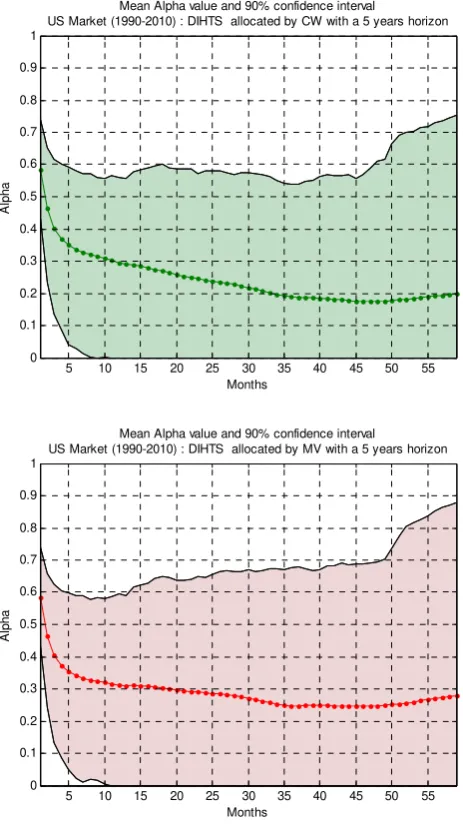
Figure 5 : Estimation of the mean Alpha values of the DIHTS and its 90% confidence interval
Months
A
lpha
Mean Alpha value and 90% confidence interval
US Market (1990-2010) : DIHTS allocated by CW with a 5 years horizon
5 10 15 20 25 30 35 40 45 50 55
0 0.1 0.2 0.3 0.4 0.5 0.6 0.7 0.8 0.9 1 Months A lpha
Mean Alpha value and 90% confidence interval
US Market (1990-2010) : DIHTS allocated by CW with a 10 years horizon
10 20 30 40 50 60 70 80 90 100 110
0 0.1 0.2 0.3 0.4 0.5 0.6 0.7 0.8 0.9 1 Months A lpha
Mean Alpha value and 90% confidence interval
US Market (1990-2010) : DIHTS allocated by MV with a 5 years horizon
5 10 15 20 25 30 35 40 45 50 55
0 0.1 0.2 0.3 0.4 0.5 0.6 0.7 0.8 0.9 1 Months A lpha
Mean Alpha value and 90% confidence interval
US Market (1990-2010) : DIHTS allocated by MV with a 10 years horizon
10 20 30 40 50 60 70 80 90 100 110
0 0.1 0.2 0.3 0.4 0.5 0.6 0.7 0.8 0.9 1 Months A lpha
Mean Alpha value and 90% confidence interval
US Market (1990-2010) : DIHTS allocated by IR with a 5 years horizon
5 10 15 20 25 30 35 40 45 50 55
0 0.1 0.2 0.3 0.4 0.5 0.6 0.7 0.8 0.9 1 Months A lpha
Mean Alpha value and 90% confidence interval
US Market (1990-2010) : DIHTS allocated by IR with a 10 years horizon
10 20 30 40 50 60 70 80 90 100 110
Figure 6: Mean Allocation Months A llo c a tio n Mean Allocation
US Market (1990-2010) : DIHTS allocated by CW with a 5 years horizon
0 10 20 30 40 50 60
0 0.05 0.1 0.15 0.2 0.25 0.3 0.35 0.4 0.45 0.5 ZCN SPX REIT GSCI Months A llo c a tio n Mean Allocation
US Market (1990-2010) : DIHTS allocated by CW with a 10 years horizon
0 20 40 60 80 100 120
0 0.05 0.1 0.15 0.2 0.25 0.3 0.35 0.4 0.45 0.5 ZCN SPX REIT GSCI Months A llo c a ti o n Mean Allocation
US Market (1990-2010) : DIHTS allocated by MV with a 5 years horizon
0 10 20 30 40 50 60
0 0.05 0.1 0.15 0.2 0.25 0.3 0.35 0.4 0.45 0.5 ZCN SPX REIT GSCI Months A llo c a ti o n Mean Allocation
US Market (1990-2010) : DIHTS allocated by MV with a 10 years horizon
0 20 40 60 80 100 120
0 0.05 0.1 0.15 0.2 0.25 0.3 0.35 0.4 0.45 0.5 ZCN SPX REIT GSCI Months A llo c a tio n Mean Allocation
US Market (1990-2010) : DIHTS allocated by IR with a 5 years horizon
0 10 20 30 40 50 60
0 0.05 0.1 0.15 0.2 0.25 0.3 0.35 0.4 0.45 0.5 ZCN SPX REIT GSCI Months A llo c a tio n Mean Allocation
US Market (1990-2010) : DIHTS allocated by IR with a 10 years horizon
0 20 40 60 80 100 120
Table 1: Horizon sensitivity of the DIHTS vs. the Benchmark Portfolio
CW
MV
IR
DIHTS PTF DIHTS PTF DIHTS PTF
60,27% 33,80% 5,46% 3,65%
(28,6%) (21,93%) (1,8%) (0,63%)
44,03% 28,96% 6,89% 4,79%
(18,0%) (11,57%) (1,8%) (0,87%)
34,23% 24,52% 8,65% 6,09%
(12,4%) (7,61%) (1,8%) (1,02%)
26,89% 20,27% 10,45% 7,47%
(8,2%) (6,50%) (1,8%) (0,97%)
21,56% 17,13% 12,24% 9,00%
(5,8%) (5,05%) (1,8%) (0,96%)
17,92% 14,80% 14,22% 10,83%
(4,2%) (3,63%) (2,2%) (1,32%)
Fail Rate IR ToR
0,00% 0,00% 0,00% 1,91% 1,18% 1,66% 12,44% Horizon (Years) 5 6 7 8 9 10 0,00% 0,00% 0,00% 0,00% 0,00%
DIHTS PTF DIHTS PTF DIHTS PTF
53,80% 29,69% 6,09% 6,59%
(27,1%) (26,33%) (2,2%) (1,29%)
42,26% 26,17% 7,66% 8,53%
(21,5%) (15,03%) (2,5%) (1,64%)
34,10% 22,11% 9,62% 10,74%
(14,0%) (8,11%) (2,7%) (2,09%)
27,85% 18,47% 11,70% 13,11%
(10,5%) (6,20%) (2,6%) (2,35%)
22,37% 15,82% 13,70% 15,75%
(8,6%) (5,05%) (2,5%) (2,78%)
18,56% 13,72% 15,90% 18,99%
(6,5%) (3,86%) (2,9%) (3,86%)
Horizon (Years)
Fail Rate IR ToR
5 0,00% 13,47%
6 0,00% 8,84%
7 0,00% 0,00%
10 0,00% 0,00%
8 0,00% 1,27%
9 0,00% 0,00%
DIHTS PTF DIHTS PTF DIHTS PTF
59,48% 24,35% 7,17% 7,36%
(30,2%) (32,65%) (3,2%) (1,39%)
48,70% 22,55% 8,91% 9,30%
(26,2%) (20,50%) (3,5%) (1,75%)
38,41% 20,82% 10,29% 11,45%
(18,3%) (11,31%) (3,9%) (2,03%)
32,06% 18,42% 11,18% 13,57%
(13,6%) (10,61%) (3,9%) (2,03%)
29,30% 15,91% 12,08% 15,87%
(13,6%) (9,53%) (3,7%) (2,10%)
25,56% 13,89% 13,33% 18,55%
(12,4%) (7,95%) (3,5%) (2,36%)
10 0,00% 7,52%
8 0,00% 8,28%
9 0,00% 9,66%
6 0,00% 21,55%
7 0,00% 9,47%
Horizon (Years)
Fail Rate IR ToR
Table 2: Allocation horizon sensitivity analysis
CW
MV
IR
Horizon
(Years) ZCN SPX REIT GSCI
23,5% 24,9% 24,9% 24,9%
(22,2%) (14,3%) (10,2%) (7,9%)
19,0% 26,6% 26,6% 26,6%
(19,7%) (12,2%) (8,3% ) (6,2%)
13,9% 28,3% 28,3% 28,3%
(16,4%) (9,2% ) (5,5% ) (3,4%)
9,9% 29,7% 29,7% 29,7%
(12,9%) (6,2% ) (2,6% ) (0,7%)
7,6% 30,5% 30,5% 30,5%
(9,8% ) (3,6% ) (0,3% ) (1,5%)
5,7% 31,2% 31,2% 31,2%
(6,9% ) (1,4% ) (1,6% ) (3,3%)
5
6
7
8
9
10
Horizon
(Years) ZCN SPX REIT GSCI
28,1% 29,9% 5,3% 35,0%
(22,2%) (17,3%) (14,9%) (13,9%)
24,1% 31,7% 5,7% 37,2%
(19,7%) (15,9%) (13,9%) (13,3%)
19,3% 33,7% 6,1% 39,7%
(16,4%) (14,2%) (13,1%) (12,9%)
14,9% 35,5% 6,6% 41,9%
(12,9%) (13,1%) (12,8%) (13,1%)
12,3% 36,5% 6,9% 43,3%
(9,8% ) (12,7%) (13,0%) (13,6%)
9,8% 37,6% 7,2% 44,6%
(6,9% ) (12,8%) (13,6%) (14,3%)
5
6
7
8
9
10
Horizon
(Years) ZCN SPX REIT GSCI
31,6% 32,2% 19,8% 14,7%
(22,2% ) (16,5% ) (12,9% ) (10,9%)
29,0% 33,6% 20,3% 15,7%
(19,7% ) (14,4% ) (10,9% ) (9,2%)
25,9% 35,2% 20,6% 17,2%
(16,4% ) (11,5% ) (8,3%) (7,3%)
22,7% 36,8% 21,2% 18,3%
(12,9% ) (8,7%) (6,9%) (6,8%)
20,3% 38,0% 22,4% 18,3%
(9,8% ) (6,9%) (7,1%) (7,8%)
17,8% 39,3% 23,8% 18,3%
(6,9% ) (7,1%) (8,3%) (9,4%)
5
6
7
8
9
Table 3: Parameter sensitivity analysis for the DIHTS
CW
MV
Mu Eta
FR 0,0% 0,0% 0,0% 5,3% 6,0%
ToR 9,1% (1,8%) 13,1% (2,8%) 14,3% (2,1%) 12,2% (1,8%) 11,5% (1,5%)
IR 22,9% (4,0%) 20,4% (4,1%) 17,9% (4,1%) 17,2% (6,2%) 17,4% (6,1%)
FR 0,0% (0,0%) 0,0% (0,0%) 0,0% (0,0%) 5,3% (0,0%) 6,0% (0,0%)
ToR 9,0% (1,8%) 13,1% (2,8%) 14,3% (2,1%) 12,2% (1,8%) 11,5% (1,5%)
IR 22,9% (4,1%) 20,4% (4,1%) 17,9% (4,2%) 17,2% (6,2%) 17,4% (6,1%)
FR 0,0% (0,0%) 0,0% (0,0%) 0,0% (0,0%) 5,3% (0,0%) 6,0% (0,0%)
ToR 8,8% (1,8%) 12,9% (2,8%) 14,2% (2,2%) 12,2% (1,8%) 11,5% (1,5%)
IR 22,8% (4,1%) 20,5% (4,1%) 17,9% (4,2%) 17,2% (6,2%) 17,4% (6,1%)
FR 0,0% (0,0%) 0,0% (0,0%) 0,0% (0,0%) 5,3% (0,0%) 6,0% (0,0%)
ToR 8,8% (1,8%) 12,8% (2,8%) 14,2% (2,2%) 12,2% (1,8%) 11,5% (1,5%)
IR 22,8% (4,1%) 20,5% (4,1%) 17,9% (4,2%) 17,2% (6,2%) 17,4% (6,1%)
FR 0,0% (0,0%) 0,0% (0,0%) 0,0% (0,0%) 5,3% (0,0%) 6,0% (0,0%)
ToR 8,7% (1,8%) 12,7% (2,8%) 14,1% (2,2%) 12,2% (1,8%) 11,5% (1,5%)
IR 22,8% (4,1%) 20,5% (4,1%) 17,9% (4,2%) 17,2% (6,2%) 17,4% (6,1%)
FR 0,0% (0,0%) 0,0% (0,0%) 0,0% (0,0%) 5,3% (0,0%) 6,0% (0,0%)
ToR 8,7% (1,8%) 12,5% (2,7%) 14,1% (2,2%) 12,1% (1,8%) 11,5% (1,5%)
IR 22,8% (4,1%) 20,5% (4,1%) 0,179 (4,2%) 0,172 (6,2%) 0,174 (6,1%)
0.5%
1%
1.5%
2%
2.5%
10% 30% 50% 70% 90%
0%
Mu Eta
FR 0,0% 0,0% 0,0% 9,0% 11,3%
ToR 10,0% (2,3%) 14,3% (3,8% ) 16,0% (2,8% ) 13,7% (2,9%) 12,8% (3,5% )
IR 23,4% (5,1%) 21,2% (5,6% ) 18,6% (6,5% ) 17,4% (7,7%) 16,8% (7,7% )
FR 0,0% (0,0%) 0,0% (0,0% ) 0,0% (0,0% ) 9,0% (0,0%) 11,3% (0,0% )
ToR 9,9% (2,3%) 14,2% (3,8% ) 15,9% (2,8% ) 13,7% (2,9%) 12,8% (3,5% )
IR 23,4% (5,1%) 21,2% (5,6% ) 18,6% (6,5% ) 17,5% (7,7%) 16,8% (7,7% )
FR 0,0% (0,0%) 0,0% (0,0% ) 0,0% (0,0% ) 9,0% (0,0%) 11,3% (0,0% )
ToR 9,8% (2,3%) 14,0% (3,8% ) 15,9% (2,9% ) 13,7% (3,0%) 12,8% (3,5% )
IR 23,4% (5,1%) 21,2% (5,7% ) 18,6% (6,5% ) 17,4% (7,7%) 16,8% (7,7% )
FR 0,0% (0,0%) 0,0% (0,0% ) 0,0% (0,0% ) 9,0% (0,0%) 11,3% (0,0% )
ToR 9,7% (2,2%) 13,9% (3,8% ) 15,8% (2,9% ) 13,7% (3,0%) 12,8% (3,5% )
IR 23,4% (5,1%) 21,2% (5,7% ) 18,6% (6,5% ) 17,4% (7,7%) 16,8% (7,7% )
FR 0,0% (0,0%) 0,0% (0,0% ) 0,0% (0,0% ) 9,0% (0,0%) 11,3% (0,0% )
ToR 9,6% (2,3%) 13,7% (3,8% ) 15,8% (3,0% ) 13,7% (3,0%) 12,8% (3,5% )
IR 23,4% (5,2%) 21,2% (5,7% ) 18,6% (6,5% ) 17,5% (7,8%) 16,8% (7,7% )
FR 0,0% (0,0%) 0,0% (0,0% ) 0,0% (0,0% ) 9,0% (0,0%) 11,3% (0,0% )
ToR 9,5% (2,3%) 13,6% (3,8% ) 15,7% (3,0% ) 13,7% (3,0%) 12,8% (3,5% )
IR 23,4% (5,1%) 21,2% (5,7% ) 0,186 (6,5% ) 0,175 (7,8%) 0,168 (7,7% )
0.5%
1%
1.5%
2%
2.5%
10% 30% 50% 70% 90%
IR
Mu Eta
FR 0,0% 0,0% 0,0% 25,6% 20,3%
ToR 9,6% (2,3% ) 12,1% (2,4%) 13,5% (3,6%) 11,3% (2,8% ) 11,1% (2,0% )
IR 26,7% (7,8% ) 29,1% (11,0%) 25,6% (12,4%) 19,8% (13,5% ) 20,6% (12,0% )
FR 0,0% (0,0% ) 0,0% (0,0%) 0,0% (0,0%) 25,6% (0,0% ) 20,3% (0,0% )
ToR 9,5% (2,3% ) 12,0% (2,4%) 13,5% (3,5%) 11,3% (2,8% ) 11,1% (2,0% )
IR 26,7% (7,8% ) 29,1% (11,0%) 25,6% (12,4%) 19,7% (13,4% ) 20,6% (12,0% )
FR 0,0% (0,0% ) 0,0% (0,0%) 0,0% (0,0%) 25,6% (0,0% ) 20,3% (0,0% )
ToR 9,4% (2,4% ) 11,7% (2,2%) 13,3% (3,5%) 11,3% (2,8% ) 11,1% (2,0% )
IR 26,7% (7,8% ) 29,2% (11,1%) 25,6% (12,4%) 19,7% (13,4% ) 20,6% (12,0% )
FR 0,0% (0,0% ) 0,0% (0,0%) 0,0% (0,0%) 25,6% (0,0% ) 19,5% (0,0% )
ToR 9,3% (2,3% ) 11,5% (2,0%) 13,2% (3,5%) 11,3% (2,8% ) 11,1% (1,9% )
IR 26,6% (7,8% ) 29,2% (11,1%) 25,5% (12,4%) 19,7% (13,4% ) 20,7% (11,8% )
FR 0,0% (0,0% ) 0,0% (0,0%) 0,0% (0,0%) 25,6% (0,0% ) 19,5% (0,0% )
ToR 9,2% (2,3% ) 11,3% (1,9%) 13,1% (3,6%) 11,2% (2,7% ) 11,1% (1,9% )
IR 26,6% (7,7% ) 29,3% (11,2%) 25,5% (12,4%) 19,8% (13,4% ) 20,7% (11,8% )
FR 0,0% (0,0% ) 0,0% (0,0%) 0,0% (0,0%) 25,6% (0,0% ) 19,5% (0,0% )
ToR 9,1% (2,2% ) 11,1% (1,9%) 12,9% (3,3%) 11,2% (2,7% ) 11,1% (1,9% )
IR 26,6% (7,7% ) 29,3% (11,2%) 0,255 (12,4%) 0,198 (13,5% ) 0,207 (11,8% )
0.5%
1%
1.5%
2%
2.5%
10% 30% 50% 70% 90%
B. Bootstrapped Simulation Results
Figure 8: Efficient frontier estimation
Figure 9: Estimation of the mean Alpha values of the DIHTS and its 90% confidence interval Months Al p h a
Mean Alpha value and 90% confidence interval
US Market Bootstrapped Simulation : DIHTS allocated by CW with a 5 years horizon
5 10 15 20 25 30 35 40 45 50 55
0 0.1 0.2 0.3 0.4 0.5 0.6 0.7 0.8 0.9 1 Months Al p h a
Mean Alpha value and 90% confidence interval
US Market Bootstrapped Simulation : DIHTS allocated by CW with a 10 years horizon
10 20 30 40 50 60 70 80 90 100 110
0 0.1 0.2 0.3 0.4 0.5 0.6 0.7 0.8 0.9 1 Months Al p h a
Mean Alpha value and 90% confidence interval
US Market Bootstrapped Simulation : DIHTS allocated by MV with a 5 years horizon
5 10 15 20 25 30 35 40 45 50 55
0 0.1 0.2 0.3 0.4 0.5 0.6 0.7 0.8 0.9 1 Months Al p h a
Mean Alpha value and 90% confidence interval
US Market Bootstrapped Simulation : DIHTS allocated by MV with a 10 years horizon
10 20 30 40 50 60 70 80 90 100 110
0 0.1 0.2 0.3 0.4 0.5 0.6 0.7 0.8 0.9 1 Months Al p h a
Mean Alpha value and 90% confidence interval
US Market Bootstrapped Simulation : DIHTS allocated by IR with a 5 years horizon
5 10 15 20 25 30 35 40 45 50 55
0 0.1 0.2 0.3 0.4 0.5 0.6 0.7 0.8 0.9 1 Months Al p h a
Mean Alpha value and 90% confidence interval
US Market Bootstrapped Simulation : DIHTS allocated by IR with a 10 years horizon
10 20 30 40 50 60 70 80 90 100 110
Figure 10: Mean allocation
Table 4: Horizon sensitivity of the DIHTS vs. the Benchmark Portfolio
CW Months A llo c a tio n Mean Allocation
US Market Bootstrapped Simulation : DIHTS allocated by CW with a 5 years horizon
0 10 20 30 40 50 60
0 0.05 0.1 0.15 0.2 0.25 0.3 0.35 0.4 0.45 0.5 ZCN SPX REIT GSCI Months A llo c a tio n Mean Allocation
US Market Bootstrapped Simulation : DIHTS allocated by CW with a 10 years horizon
0 20 40 60 80 100 120
0 0.05 0.1 0.15 0.2 0.25 0.3 0.35 0.4 0.45 0.5 ZCN SPX REIT GSCI Months A llo c a tio n Mean Allocation
US Market Bootstrapped Simulation : DIHTS allocated by MV with a 5 years horizon
0 10 20 30 40 50 60
0 0.05 0.1 0.15 0.2 0.25 0.3 0.35 0.4 0.45 0.5 ZCN SPX REIT GSCI Months A llo c a tio n Mean Allocation
US Market Bootstrapped Simulation : DIHTS allocated by MV with a 10 years horizon
0 20 40 60 80 100 120
0 0.05 0.1 0.15 0.2 0.25 0.3 0.35 0.4 0.45 0.5 ZCN SPX REIT GSCI Months A llo c a tio n Mean Allocation
US Market Bootstrapped Simulation : DIHTS allocated by IR with a 5 years horizon
0 10 20 30 40 50 60
0 0.05 0.1 0.15 0.2 0.25 0.3 0.35 0.4 0.45 0.5 ZCN SPX REIT GSCI Months A llo c a tio n Mean Allocation
US Market Bootstrapped Simulation : DIHTS allocated by IR with a 10 years horizon
0 20 40 60 80 100 120
MV
IR
[image:36.595.113.476.508.687.2]
Table 5: Allocation horizon sensitivity analysis for the DIHTS allocated by CW.
CW
Horizon (Years)
Fail Rate IR ToR PLGF
DIHTS PTF DIHTS PTF DIHTS PTF
5 7,92% 12,58% 59,01% 70,32% 6,57% 3,80% ‐5,47%
(30,2%) (33,59%) (3,5%) (0,91%) (13,27%)
6 8,33% 11,10% 46,28% 46,80% 7,40% 4,95% ‐2,90%
(22,6%) (22,92%) (3,4%) (1,23%) (11,42%)
7 7,78% 9,39% 39,24% 38,24% 8,76% 6,31% ‐1,49%
(10,6%) (10,16%) (3,7%) (1,73%) (10,13%)
8 7,42% 4,99% 20,53% 20,57% 9,90% 7,91% 0,85%
(3,2%) (3,09%) (4,0%) (2,28%) (9,56%)
9 10,31% 7,43% 12,85% 12,91% 11,09% 9,45% ‐1,18%
(1,0%) (0,81%) (4,7%) (3,11%) (11,20%)
10 10,42% 6,29% 8,94% 9,44% 12,51% 11,26% 0,52%
(0,7%) (0,66%) (5,4%) (3,75%) (10,42%)
Horizon (Years)
Fail Rate IR ToR PLGF
DIHTS PTF DIHTS PTF DIHTS PTF
5 10,10% 16,58% 122,92% 107,33% 7,60% 5,71% ‐6,54%
(80,4%) (73,70%) (4,2%) (1,82%) (13,00%)
6 10,23% 14,58% 30,46% 32,15% 8,53% 7,14% ‐4,75%
(8,6%) (9,03%) (4,2%) (2,59%) (11,31%)
7 9,81% 13,55% 31,91% 31,01% 10,05% 8,69% ‐3,87%
(13,2%) (12,77%) (4,7%) (3,36%) (8,96%)
8 10,44% 9,03% 24,90% 24,30% 11,86% 11,01% ‐0,30%
(1,8%) (2,90%) (5,8%) (4,39%) (9,52%)
9 13,63% 10,76% ‐22,30% ‐19,70% 12,85% 12,97% ‐1,47%
(31,5%) (27,87%) (6,5%) (5,69%) (11,59%)
10 13,45% 10,25% 15,60% 11,31% 14,04% 14,39% ‐0,26%
(5,2%) (4,49%) (7,3%) (5,97%) (9,95%)
Horizon (Years)
Fail Rate IR ToR PLGF
DIHTS PTF DIHTS PTF DIHTS PTF
5 9,93% 16,17% 56,05% 51,79% 8,10% 6,17% ‐7,03%
(21,4%) (19,95%) (4,9%) (2,38%) (13,31%)
6 10,55% 14,19% 45,52% 47,95% 9,13% 7,79% ‐5,82%
(18,8%) (21,36%) (4,9%) (3,02%) (12,81%)
7 8,83% 12,24% 25,64% 31,05% 10,66% 9,37% ‐5,92%
(15,2%) (21,26%) (5,3%) (3,77%) (14,60%)
8 9,63% 8,70% 29,69% 32,00% 11,68% 11,27% ‐1,01%
(9,0%) (9,78%) (6,1%) (4,69%) (12,55%)
9 13,33% 10,55% 22,52% 21,03% 13,26% 13,63% ‐4,56%
(6,2%) (4,92%) (6,6%) (5,61%) (12,93%)
10 12,14% 8,60% 4,94% 4,89% 15,44% 16,14% ‐2,09%
(7,0%) (6,91%) (8,2%) (7,61%) (13,75%)
MV
IR
Horizon \
Allocation ZCN SPX REIT GSCI
5 16,8% 26,9% 26,9% 26,9%
(10,9%) (1,8%) (1,4%) (2,7%)
6 16,2% 27,1% 27,1% 27,1%
(10,3%) (2,4%) (0,6%) (1,9%)
7 15,0% 27,7% 27,7% 27,7%
(8,6%) (1,7%) (1,1%) (2,4%)
8 14,5% 27,7% 27,7% 27,7%
(7,3%) (1,8%) (0,7%) (1,9%)
9 14,3% 27,5% 27,5% 27,5%
(5,9%) (1,2%) (1,0%) (2,1%)
10 14,5% 27,4% 27,4% 27,4%
(5,1%) (1,0%) (0,7%) (1,6%)
Horizon \
Allocation ZCN SPX REIT GSCI
5 17,9% 35,6% 16,9% 26,9%
(10,8%) (6,9%) (7,3%) (7,8%)
6 17,6% 36,1% 16,5% 27,0%
(10,1%) (7,3%) (7,4%) (7,8%)
7 16,6% 36,9% 16,7% 27,5%
(8,7%) (7,3%) (7,5%) (7,9%)
8 16,1% 35,2% 16,8% 29,4%
(7,4%) (6,6%) (6,8%) (7,2%)
9 16,3% 35,8% 16,3% 28,4%
(5,6%) (6,7%) (7,1%) (7,4%)
10 16,9% 35,8% 15,8% 27,8%
(5,1%) (7,2%) (7,4%) (7,7%)
Horizon \
Allocation ZCN SPX REIT GSCI
5 17,3% 22,5% 35,5% 21,6%
(10,7%) (5,7%) (6,1%) (6,6%)
6 17,1% 22,9% 35,7% 21,4%
(10,2%) (5,9%) (5,9%) (6,4%)
7 15,9% 21,9% 37,0% 22,7%
(8,7%) (6,3%) (6,5%) (6,9%)
8 15,8% 25,3% 35,9% 20,1%
(7,5%) (5,7%) (5,8%) (6,1%)
9 14,9% 24,8% 35,9% 20,4%
(5,8%) (5,5%) (5,7%) (6,1%)
10 14,5% 23,2% 36,3% 21,3%
(5,0%) (5,5%) (5,7%) (5,9%)