
http://dx.doi.org/10.4236/alamt.2013.34012
The Solution of the Eigenvector Problem in Synchrotron
Radiation Based Anomalous Small-Angle X-Ray Scattering
Guenter Johannes Goerigk
Institute of Soft Matter and Functional Materials, Helmholtz-Zentrum-Berlin, Berlin, Germany Email: [email protected]
Received October 22, 2013; revised November 22, 2013; accepted November 29, 2013
Copyright © 2013 Guenter Johannes Goerigk. This is an open access article distributed under the Creative Commons Attribution License, which permits unrestricted use, distribution, and reproduction in any medium, provided the original work is properly cited.
ABSTRACT
In the last three decades Synchrotron radiation became an indispensable experimental tool for chemical and structural analysis of nano-scaled properties in solid state physics, chemistry, materials science and life science thereby rendering the explanation of the macroscopic behavior of the materials and systems under investigation. Especially the techniques known as Anomalous Small-Angle X-ray Scattering provide deep insight into the materials structural architecture ac- cording to the different chemical components on lengths scales starting just above the atomic scale (≈1 nm) up to sev- eral 100 nm. The techniques sensitivity to the different chemical components makes use of the energy dependence of the atomic scattering factors, which are different for all chemical elements, thereby disentangling the nanostructure of the different chemical components by the signature of the elemental X-ray absorption edges i.e. by employing synchro- tron radiation. The paper wants to focus on the application of an algorithm from linear algebra in the field of synchro- tron radiation. It provides a closer look to the algebraic prerequisites, which govern the system of linear equations es- tablished by these experimental techniques and its solution by solving the eigenvector problem. The pair correlation functions of the so-called basic scattering functions are expressed as a linear combination of eigenvectors.
Keywords: Matrix Inversion; Eigenvalues; Eigenvectors; Pair Correlation Functions; Basic Scattering Functions
1. Introduction
Small-Angle X-ray Scattering (SAXS) experiments av- erage over a large sample volume and give structural and quantitative information of high statistical signifi- cance on a mesoscopic length scale between 1 and hun- dreds of nanometers, which can be correlated to the ma- croscopic physical and chemical properties of the ana- lysed condensed matter systems in solid state physics, chemistry, life science and materials science. Detailed descriptions of the experimental and theoretical aspects of Small-Angle Scattering can be found in [1-3]. By use of synchrotron radiation at suitable storage rings the so- called Anomalous Small-Angle X-ray Scattering (AS- AXS) can be employed, which is an excellent tool for the chemical selective structural analysis of multi-com- ponent systems.
This publication outlines in detail the basic mathe- matical aspects related to the scientific results of a series of former publications [4-16] obtained from quantitative ASAXS measurements applied to very different phys-
2. The Eigenvector Problem Established by
Anomalous Small-Angle X-Ray Scattering
2.1. Anomalous Small-Angle X-Ray Scattering The remarkable possibilities of the ASAXS technique are based on the energy dependence of the atomic scattering factors giving selective access to the specific SAXS con- tributions of nano-scaled phases, which are built up by different chemical constituents in composites like for instance alloys, chemical solutions or porous multicom- ponent systems. In general the atomic scattering factors are energy dependent complex quantities:
0,
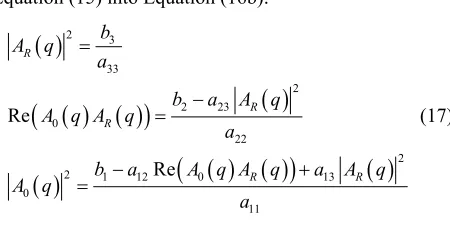
Z Z Z Z
f f f if
d
(1) where Z represents the atomic number. When performing ASAXS measurements on multi-component systems in the vicinity of the absorption edge of one of the sample constituents the scattering amplitude is:
3 0
3
, exp
exp d
p
p
V R V
A i r
i r
q r qr
r qr , (2)
where q is the magnitude of the scattering vector
4
sin 2
non-resonant and the resonant scattering atoms,
0 0 0 0
0, ,
m
R Z
Z m Z Z Z
f u f V u
f v
f V f if v
r r r
r r
r
(3)
calculated from the electron density, m, and the atomic (molecular) volumes V0 and VZ, respectively, where
m
is the electron density of the entire sample. The volume 0 represents the atomic (molecular) volume of the non-resonant scattering atoms or building groups.
V
Z
V corresponds to the atomic volumes of the resonant scattering atoms. The functions are the number densities of the non-resonant and the resonant scattering units, respectively and represent their spatial distribution in the sample. The atomic scattering factor,
, u r v r
t0
f cons , is nearly energy independent, while the atomic scattering factor, fZ
f0,Z fZ
ifZ
,shows strong variation with the energy in the vicinity of the absorption edge of the resonant scattering atoms due to the so-called anomalous dispersion corrections fZ
,
Z
f . Calculating the scattering intensity I
q,
, 2
, A*
A q A q q, by means of Equations (2) and (3) and averaging over all orientations yields the sum of three scattering contributions,
, 0
0R
, R
,
I q S q S q S q , with the convo-lution integrals [17,18]:
, is the scattering angle, λ the
X-ray wavelength and Vp is the irradiated sample volume. 0, R
are the differences of electron densities of the
2
2 3 3 2
0 0 0 0
3 3
0 0 0,
0 0, 0
2 3 3
2 2
sin
d d
sin
, 2 d d
2 Re
sin ,
p
p
p
V
R Z m Z Z
V
Z m Z Z R
R Z
V
Z R
q
S q f u u r r f A q
q
q
S q f f V f u v r r
q
f f V f A q A q
q
S q f v v d rd r
q
f A q
r r
r r
r r
r r
r r
r r
r r
r r
r r
(4)
Equation (4) gives the so-called non-resonant scatter- ing, , the cross-term or mixed-resonant scattering,
0R
0
S q
,S q , originating from the superposition of the scattering amplitudes of the non-resonant and the reso- nant scattering atoms and finally, S qR
,The measurement of scattering curves at three energies in the vicinity of the absorption edge of the atoms with atomic number Z constitutes the following vector equa- tion:
, which con- tains only the scattering contributions of the resonant scattering atom species. These basic scattering functions are based on the pair correlation functions 2
0 A q , 0
R
Re A q A q , 2
RA q and in the literature are sometimes referred to as Stuhrmann functions.
,ij i j q i qi
M A I
M A I , (5)
2 2
2
2
0 0 0, 1 0, 1 1
0 1
2 2
2
0 0 0, 2 0, 2 2 0
2
2 2
2
0 0 0, 3 0, 3 3
2
,
2 Re
2
Z Z Z Z Z
Z Z Z Z Z R
R
Z Z Z Z Z
f f f f f f f
A q I q
f f f f f f f A q A q I q
A q
f f f f f f f
23
, , I q
(5a)
with f0,Z f0,Zm ZV . The summation is running over the index ji.e. summing over the vector components Aj and the columns of the matrix Mij in the row with index i. The transformation of the vector Equation (5) by elemen- tary operations changes the matrix M into the triangular matrix M':
,
ij i j q i qi
M A B
2 0
11 12 13 1
22 23 0 2
2
33 3
0 Re
0 0
R
R
A q
a a a b
a a A q A q b
a A q b
(6)
where the meaning of a bij, i is [11]:
211 0
12 0 0, 1
2 2
13 0, 1 1
22 0 2 1
2 2 2 2
23 0, 2 1 2 1 2 1
2 2
1 2
33 1 3 2 3
1 2
2
2 2
Z Z
Z Z Z
Z Z
Z Z Z Z Z Z Z
Z Z
Z Z Z Z
Z Z
a f
a f f f
a f f f
a f f f
a f f f f f f f
f
f f
a f f f f
f f
2 2
1 3
1 3
1 1 1
2 1 2 2 1
3 1
3 1 2 3 3 1 2 1
2 1
, ,
, , , ,
, , , , , , ,
Z Z
Z Z
Z Z
Z Z
f
f f
b q I q
b q I q I q
f f
b q I q I q I q I q
f f
(7)
The vector Equation (6) with the triangular matrix re- presents the Gauss algorithm (elimination procedure) for the solution of a system of linear equations. Thus the eli- mination procedure is equivalent to the elementary ope- rations performed to the matrix of a vector equation. 2.2. The Eigenvector Problem in Anomalous
Small-Angle X-Ray Scattering
Up to this point the Equations (1)-(7) have been taken from [11,14] and represent nothing new. In what is to follow the underlying basics of linear algebra and the high degree of significance obtained by a suitable matrix in- version applied to experimental data (here scattering curves) will be outlined. In detail we demonstrate the cal- culation of the eigenvalues of the vector Equation (6) from the characteristic polynomial thereby providing the ei- genvectors. Furthermore the representation of the special solution as a linear combination of the eigenvectors is demonstrated. In the next step analytical expressions for
the pair correlation functions have been deduced from the eigenvector representation. Finally in the last step the ba- sic scattering functions (Stuhrmann functions) are pro- vided.
We start with the vector Equation (6):
,
ij i j q i qi
M A B . The characteristic polyno- mial for the determination of the eigenvalues writes:
det
n ij c McI
(8)
Inrepresents the identity matrix:
3
1 0 0 0 1 0 0 0 1
I (9)
11 12 13
22 23 11 22 33
33
0 0
0 0
a c a a
a c a a c a c a c
a c
3
i
(10) giving the three eigenvalues:
1 11, 2 22, 3 3
c a c a c a (11) From the eigenvalues the eigenvectors, Ei, can be con- structed via Equation (12):
i i
i ii
c a
M E E E , (12) giving:
12
22 11
1 2
23 12 13 33 22
33 11 33 22
3 23
33 22
1
0 1
0
0
1 a
a a
a a a a a
a a a a
a
a a
E E
E
(13)
Because these eigenvectors are linear independent they define a system of basic vectors in the solution space and
the vectors Aand B can be expressed via a linear combi- nation of the eigenvectors Ei:
2 0
1 2 3
0 1 2 3
2
23 12 13 33 22 12
33 11 33 22 22 11
23
1 2 3
33 22 Re
1
0 1
0
0 1
R
R A q
A q A q x x x
A q
a a a a a
a
a a a a
a a
a
x x x
a a
E E E
(14) Thus the vector composed from the pair correlation functions can be represented by a linear combination of the eigenvectors Ei with the linear coefficients x
i. From the vector Equation (14) the linear coefficients xican be calculated:
2 12 23 12 13 33 22
1 0 2 3
22 11 33 11 33 22
23
2 0 3
33 22
2 3
Re R
R
a a a a a
a
x A q x x
a a a a a a
a
x A q A q x
a a
x A q
(15)
In the next step Equation (14) is inserted into Equation (6):
23 12 13
33 22
122
33 11 33 22 22 11
0
1 23
0 1 2 3
33 22 2
3 1
Re 0 1
0
0 1
R
R
a a a a a
a
a a a a
a a
A q b
a
2
A q A q x x x b
a a
b A q
M M M M (16a)
or, because the Eiare eigenvectors of M':
23 12 13
33 22
1233 11 33 22 22 11
1 23
1 11 2 22 3 33 2
33 22
3 1
0 1
0
0 1
a a a a a
a
a a a a
a a
b a
x a x a x a b
a a
b
(16b)
Equation (15) into Equation (16b):
2 3
33
2 2 23
0
22
2
2 1 12 0 13
0
11 Re
Re R
R R
R R
b A q
a
b a A q A q A q
a
b a A q A q a A q
A q
a
[image:5.595.61.286.93.207.2] [image:5.595.58.284.354.543.2](17)
Figure 1 summarizes the results from Equations (1) to (17). The three pair correlation functions 2
0 A q , 0
Re A q A q , R
2
RA q are plotted along the three rectangular axis of the 3-dimensional coordinate system. The eigenvectors E1, E2(ε), E3(ε) build up an oblique- angled coordinate system where two of them depend on the photon energy. The blue and the red line show the eigenvectors E2(ε) and E3(ε) following curvatures de- pending on the energy via their vector components. Thus the pair correlation functions of Equation (14) depicted by the black vector are represented by the parallelepiped
1000
2000
3000
4000 0.0
0.2 0.4 0.6 0.8 1.0
1.2 0.9
0.6
0.0 0.3
E1 E2()
E2()
E3() E3()
[A0(q)2,Re(A0(q),AR(q)),AR(q)2]
=[x
1E
1
,x
2E
2
,
AR
(q
)
2
Re(A0 (q)AR
(q))
A
0(q)2
x
3E 3
]
Figure 1. The pair correlation functions (black vector) in eigenvector representation. The eigenvectors E1 (green) E2
(blue) and E3 (red) build up the oblique-angled coordinate
system (see text). The parallelepiped depicts the black vector in eigenvector representation at energy ε1. For energy ε2 the
dashed blue and red vectors together with the energy inde- pendent vector E1 (green) are the eigenvectors. The under-
lying data of the red and the blue curves have been taken as example from Cromer Liberman calculations [21,22] of the LIII-absorption edge of Thallium. Note the different length
scales of the 3 axis in the rectangular basic system. In order to depict the energy dependence of the eigenvectors with a better resolution the x-component of E2 and the y-compo-
nent of E3 have been stretched by a factor 100 and 10
re-spectively. For the same reason the x-component of E3 was
compressed by a factor of 10 and E1 is stretched by a factor
1500. Δf0= −3.5. The dashed red line represents the projec-
tion of E3(ε) onto the grey xy-plane.
which shows the vector of pair correlation functions in eigenvector representation with the coordinates xi/liin the oblique angled basic system. The li are the lengths of the basic vectors Ei.
From Equation (17) the so-called basic scattering func- tions (Stuhrmann functions) can be deduced (see Equation (4)):
2 2
0 0 0
0 1 0 0, 1 0
2 2
1 1
, 2 Re
,
R Z Z
R Z R
S q f A q
S q f f f A q A q
S q f A q
R (18)
or in explicit form:
0 1 0 1 1
0 1 1 2 1
0, 1
2
1 2
2
1 1
1 3
1 2
1 2 1 3
1 2 3
2 2
1 2
1 2 3 2 3
1
, , ,
, , , ,
, ,
, ,
, ,
1 , , , ,
R R
R R
Z Z R
Z Z
R Z
Z Z Z Z
Z Z
Z Z
Z
S q I q S q S q
S q I q I q S q
f f
S q
f f
S q f
I q I q I q I q
f f f f
F
f f
F f f
f
2
2 2
1 3
1 3
Z
Z Z
Z Z
f
f f
f f
(19) Equation (19) provides the analytical form for the cal- culation of the basic scattering functions from scattering curves measured at in minimum three energies. The ma- thematical theory behind this formula is the solution of the eigenvalue problem in six steps:
1) Calculation of the triangular matrix by elementary operations upon the vector equation established by an ASAXS measurement at in minimum three different energies.
2) Calculation of the eigenvalues from the characteristic polynomial of the new vector equation obtained from the elementary operations.
3) Calculation of the eigenvectors.
4) Representation of both, the special solution vector Ai and the vector Bi by linear combination of the eigen- vectors.
5) Calculation of the pair correlation functions, 2
0 A q ,
0
Re A q A qR ,
2 RA q from these representa- tions.
R
13 3
2 1
, 1 , 1
1 3
ij ij
i j i j
T
a a
mann functions) from the basic pair correlation func- tions.
With the definition of S0R in Equation (4) the three basic scattering functions fulfill the Cauchy-Schwarz inequality because the integrals in S0, S0R and SR of Equations (4) and (20) define a positive definite metric in the vector space of functions [5,14]:
2
M M M
M' M
, (21)
where M1 is the inverse matrix. A detailed description
of the impact of the Turing number for ASAXS measure- ments is given in [14,20].
2
0R , 4 0 ,
S q S q S q (20)
2.3. The Eigenvector Problem in Anomalous Small-Angle X-Ray Scattering with More than Three Energies at One X-Ray Absorption Edge
This criterion is essential but not sufficient for the re- liability of the basic scattering functions obtained from the matrix inversion. If it is not fulfilled, the basic scattering functions are meaningless. The significance of the special solution obtained by matrix inversion can be numerically quantified by the Turing number [19]:
In the following we will discuss the system of linear equa- tions with more than three (4…n) energies:
,
ij i j q i q i
M A I
2 2
2
0 0 0, 1 0, 1 1
2
2 2 0
2
0 0 0, 2 0, 2 2
0
2 2
2
0 0 0, 3 0, 3 3
2 2
2
0 0 0, 4 0, 4 4
2 2
Re 2
2
Z Z Z Z Z
Z Z Z Z Z
Z Z Z Z Z
Z Z Z Z Z
f f f f f f f
A q
f f f f f f f
A q
f f f f f f f
f f f f f f f
1 2 3 2
4 , , , , R
R
I q I q A q
I q
A q I q
(22)
Equation (22) represents an ASAXS sequence with scattering curves I(q,εi) measured at four different ener- gies εi. Once again the summation is running over the index j = 1, 2, 3 i.e. summing over the vector components Aj and the columns with index j of the rectangular i × j-matrix Mij in the row with index i. But now the resulting vector has four components on the right side. Equation (22) represents a linear map from a 3-dimensional space into a 4-dimensional space. The possible solutions are located in the 3-dimensional subspace, which is embedded in the 4- dimensional space. Because the rank of the matrix is three in minimum two of the four linear equations must be li- near dependent. The transformation of the vector Equation (22) by elementary operations changes the matrix M into the triangular matrix M' of the form:
2
11 12 13 1
0
22 23 2
0
33 2 3
0
Re
0 0
0 0 0 0
R
R
a a a A q b
a a b
A q A q
a b
A q
(24)
211 12 13 1
0
22 23 2
0
33 2 3
0
Re
0 0
0 0 0 0
R
R
a a a A q b
a a b
A q A q a
A q
b
(23)
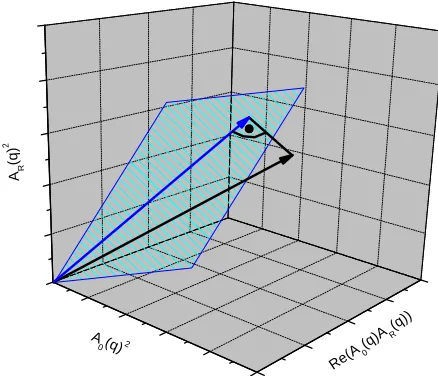
Because b4 is not exactly zero, the vector is located in the 4-dimensional space but outside the embedded 3- dimensional space of solution vectors. Thus no exact solution for the system of linear equations exists. Only an approximate solution exists. It is the vector in the 3-di- mensional hyper plane with the shortest distance to B in the 4-dimensional space or in other words: the foot of the perpendicular constructed between B and the hyper plane (Figure 2). The meaning of Equation (24) is: no im- provement can be obtained from additional measurements of scattering curves at more than three energies, because the rank of the matrix is three or in other words in case of more than three equations in the 3-dimensional vector space in minimum two of them are linear dependent. The same argumentation holds for n energies. The significance of the solution vector obtained by the matrix inversion of the system of linear equations can be calculated by the Turing number, which was outlined in a recent publication [14]. Note that the Turing number increases with the number n of equations (energies) by n i.e., ASAXS measurements at many (n > 3) energies cannot improve As a consequence the fourth component of the vector
Re(A
0(q
)AR(q ))
A
0(q)2
AR
(q
)
[image:7.595.60.279.86.274.2]2
Figure 2. In analogy the blue plane represents the 3-dimen- sional hyper plane which is embedded in the 4-dimensional vector space. The possible solution vectors of the matrix equ- ation are located in the plane. Due to measurement errors no solution vector of equation (24) exists, because the right hand vector is located outside of the plane (black vector). The approximate solution is the blue vector in the hyper plane with the shortest distance to the black vector.
the accuracy of the ASAXS sequence but require im- proved (!) accuracies [14,19].
2.4. The Eigenvector Problem in Anomalous Small-Angle X-Ray Scattering with More than Three Energies but at Different X-Ray Absorption Edges
In the following we will discuss the system of linear equations established by ASAXS measurements at dif- ferent X-ray absorption edges such as binary alloys
composed of components A and B, glasses or chemical solutions with different metal constituents.
,
ij i j q i qi
M A I
11 12 13 14 15 16
21 22 23 24 25 26
31 32 33 34 35 36
41 42 43 44 45 46
51 52 53 54 55 56
61 62 63 64 65 66
2 0
1 0
2 2
3 2
4 0
5 0
6 2
Re
Re
R
R
R
R
a a a a a a
a a a a a a
a a a a a a
a a a a a a
a a a a a a
a a a a a a
A q
I A q A q
I
A q I
I B q
I B q B q
I B q
(25)
The Ii represent six scattering curves measured at dif- ferent energies, three at energies of the 1st X-ray absorp- tion edge, the other three at energies of the 2nd X-ray ab- sorption edge. The aij again are functions of the density contrasts and the anomalous dispersion corrections of the different chemical constituents but this time from differ- ent X-ray absorption edges. The two X-ray absorption edges define two 3-dimensional vector spaces, which are orthogonal to each other i.e. the six linear equations are linear independent. Due to the different X-ray absorption edges the rank of the matrix is now six. Once again the triangular matrix can be found by elementary operation of the 6-dimensional vector equation, but for every subspace a triangular matrix can be established:
,
ij i j q i qi
M A B
2 011 12 13 1
0
22 23 2
2
33 3
2
44 45 46 4
0
55 56 5
0
66 2 6
0 0 0
Re
0 0 0 0
0 0 0 0 0
0 0 0
0 0 0 0 Re
0 0 0 0 0
R
R
R
R A q
a a a b
A q A q
a a b
A q
a b
a a a B q b
a a B q B q b
a b
B q
(26)
For the calculation of the eigenvalues, eigenvectors, pair correlation functions and the basic scattering func- tions the formula of the for-going chapter 2.2 can be used
23 12 13
33 22
1233 11 33 22 22 11
23
1 2 3 33 22
4 5
45 5 1
0
1 0
0
0 0 1
0 0 0
0 0 0
0 0
0
0 0
0 0
1 0 0
a a a a a
a
a a a a
a a
a
a a
a a
E E E
E E
56 45 46
66 55
666 44 66 55 5 44
56 66 55
0 0 0
1 0
1
a a a a a
a a a a
a
a
a a
E
(26a)
The physical meaning of the 3 × 3-submatrix in Equa- tion (26) filled with zero in the top right and bottom left is, that the atomic scattering factors of component B do not change, when tuning the energy at the X-ray absorption edge of component A and vice versa. The latter is a good approximation in the case, that the X-ray absorption edges lie far apart of each other. But of course there is a small change with energy and additionally, as in the forgoing chapter, there are measurement errors which enter the right hand vector. So a realistic formula of the vector equation is:
11 12 13
22 23
33
44 45 46
55 56
66 2
0
1 0
2 2
3 2
4 0
5 0
6 2
0 0 0
0 0 0
0 0 0 0 0
0 0 0 0 0 0 0 0 0 0 0 0
Re
Re
R
R
R
R
a a a
a a
a
a a a
a a
a
A q
b A q A q
b
A q b
b B q
b B q B q
b B q
0
(27)
If the matrix elements in the top right and bottom left matrix are small enough the eigenvector problem can be solved in good approximation separately for each ab- sorption edge as outlined in chapter 2.2. In the case of
contiguous X-ray absorption edges a more sophisticated equation must be employed for the solution of the eigen- vector problem as is shown in Equation (28) for the ex- ample of a binary system:
11 12 13 14 15 16
22 23 24 25 26
33 34 35 36
44 45 46
55 56
66 2
0
1 0
2 2
3 2
4 0
5 0
6 2
0 0 0 0 0 0 0 0 0 0 0 0 0 0 0
Re
Re
R
R
R
R
a a a a a a
a a a a a
a a a a
a a a
a a
a
A q
b A q A q
b
A q b
b B q
b B q B q
b B q
(28)
sional orthogonal subspaces and a 3M-dimensional sub- space. The scheme of the vector equation is shown in
Figure 3. Again the significance of the solution vectors obtained by these matrix inversions must be calculated via the Turing number [14].
As an example taken from a former publication Figure 4 depicts schematically the eigenvector representation in the 9-dimensional vector space of two ternary alloys (blue vectors) of different metallurgical states with the compo- sition Ni68Nb16Y16 [10,11,14]. The light blue lines con- struct the foot points of the projection of the 9-dimen- sional vectors onto the three 3-dimensional subspaces of the three alloy components Nickel, Niobium and Yttrium. Because the X-ray absorption edges of the three elements
0 0 0
3N
3M 3 3 3N
0 0
3 (N-M)
3
0
3M
0 3
0
=
Figure 3. The vector equation established by a multi com- ponent system composed of N chemical elements. The small squares with the number 3 represent N-M 3 × 3 matrices in 3-dimensional subspaces. The small rectangles in the special solution vector represent the special 3-dimensional solution vector of Equation (6). The large square with the number 3M represents a 3M × 3M matrix of M chemical components with contiguous X-ray absorption edges. In the case of M = 2 it is the matrix of Equation (28). The subspaces are ortho- gonal to each other.
Yttriu m A
0 2,Re(
A0AR
),AR 2
Niobium A
0 2
,Re(A
0A R),A
R 2
N
ic
k
e
l
A0
2 ,R
e
(A
0
AR
),
AR
2
Ni
[image:9.595.81.260.526.688.2]68Nb16Y16
Figure 4. The blue vectors show the schematic eigenvector representation in the 9-dimensional vector space of two ter- nary alloys of different metallurgical states with the compo- sition Ni68Nb16Y16 [10,11,14].
lie far apart of each other the three subspaces are ortho- gonal to each other in good approximation. Each subspace is spanned by the Cartesian orthogonal system of the pair correlation functions A02, Re(A0AR) and AR2(see Figure 1). Thus within these three subspaces the pair correlation functions can be expressed in eigenvector representation i.e. each subspace provides the solution of the eigenvector problem independently from the other subspaces via the equations of chapter 2.2.
3. Conclusion
The mathematical basics of the system of linear equa- tions established by Synchrotron radiation based Anoma- lous Small-Angle X-ray Scattering experiments have been analyzed. The linear algebraic theory provides the AS- AXS techniques with five major improvements: (1) Ana- lytical formula for the basic scattering functions, thereby omitting in-transparent fit or inversion procedures of un- known significance (2) a mathematical unambiguous so- lution of the system of linear equations by employment of the (linear) Gaussian elimination algorithm (3) an es- sential (but not sufficient) criterion (the Cauchy Schwarz inequality) allowing direct control, whether obtained ba- sic scattering functions can possess significance or not and (4) a sufficient criterion represented by the Turing number, which tells directly the errors of the special so- lution vector facilitated by the inversion algorithm, there- by revealing its degree of significance. (5) The latter can be verified directly by ab initio error calculations, which start with the experimental errors entering the scattering curves of the ASAXS experiment (for instance the statis- tical errors obtained via single photon count techniques). For the calculation of the error propagation, the analyti- cal formula is mandatory.
In summary, the eigenvector-based algorithm repre- sents a superior mathematical description, because the problem is treated in the context of a linear matrix theory thereby offering the calculation of the significance of the solution, which cannot be provided by non-linear proce- dures. In other words, Linear Algebra gives deep insight (first intended by [20]) into ill-conditioned mathematical problems in condensed matter research thereby giving clear hints on how to overcome these problems by ex- perimental and mathematical improvements. The subject underlines the crucial importance of Linear Algebra for search and understanding of mathematical algorithms in condensed matter research with Synchrotron radiation.
REFERENCES
[1] A. Guinier and G. Fournet, “Small-Angle Scattering of X-rays,” Wiley, New York, 1955.
[3] O. Kratky, “The World of Negligible Dimensions and Small Angle Diffraction of X-Rays and Neutrons on Bio- logical Macromolecules,” Acta Leopoldina, Vol. 55, No. 256, 1983, pp. 6-72.
[4] G. Goerigk, R. Schweins, K. Huber and M. Ballauff, “The Distribution of Sr2+ Counterions around Polyacry- late Chains Analyzed by Anomalous Small-Angle X-Ray Scattering,” Europhysics Letters, Vol. 66, No. 3, 2004, pp. 331-337. http://dx.doi.org/10.1209/epl/i2003-10215-y [5] G. Goerigk and D. L. Williamson, “Temperature Induced
Differences in the Nanostructure of Hot-Wire Deposited Silicon-Germanium Alloys Analyzed by Anomalous Small- Angle X-Ray Scattering,” Journal of Applied Physics, Vol. 99, No. 8, 2006, Article ID: 084309.
http://dx.doi.org/10.1063/1.2187088
[6] A. Bota, Z. Varga and G. Goerigk, “Biological Systems as Nanoreactors: Anomalous Small-Angle Scattering Stu- dy of the CdS Nanoparticle Formation in Multilamellar Vesicles,” The Journal of Physical Chemistry B, Vol. 111, No. 8, 2007, pp. 1911-1915.
http://dx.doi.org/10.1021/jp067772n
[7] Z. Varga, A. Bota and G. Goerigk, “Localization of Diha- logenated Phenols in Vesicle Systems Determined by Con- trast Variation X-ray Scattering,” Journal of Applied Cry- stallography, Vol. 40, No. 1, 2007, pp. 205-208.
http://dx.doi.org/10.1107/S0021889807001987
[8] G. Goerigk, K. Huber and R. Schweins, “Probing the Ex- tent of the Sr2+ Ion Condensation to Anionic Polyacrylate Coils: A Quantitative Anomalous Small-Angle X-Ray Scattering Study,” Journal of Chemical Physics, Vol. 127, No. 15, 2007, pp. 154908-1-154908-8.
http://dx.doi.org/10.1063/1.2787008
[9] A. Bota, Z. Varga and G. Goerigk, “Structural Descrip- tion of the Nickel Part of a Raney-Type Catalyst by Using Anomalous Small-Angle X-Ray Scattering,” The Journal of Physical Chemistry C, Vol. 112, No. 12, 2008, pp. 4427-4429. http://dx.doi.org/10.1021/jp800237b
[10] G. Goerigk and N. Mattern, “Critical Scattering of Ni– Nb–Y Metallic Glasses Probed by Quantitative Anoma- lous Small-Angle X-Ray Scattering,” Acta Materialia, Vol. 57, No. 12, 2009, pp. 3652-3661.
http://dx.doi.org/10.1016/j.actamat.2009.04.028
[11] G. Goerigk and N. Mattern, “Spinodal Decomposition in Ni-Nb-Y Metallic Glasses Analyzed by Quantitative Ano- malous Small-Angle X-Ray Scattering,” Journal of Phys- ics: Conference Series, Vol. 247, 2010, Article ID: 012022. http://iopscience.iop.org/1742-6596/247/1/012022 [12] G. Goerigk, K. Huber, N. Mattern and D. L. Williamson,
“Quantitative Anomalous Small-Angle X-Ray Scattering —The Determination of Chemical Concentrations in Na- no-Scaled Phases,” European Physical Journal—Special
Topics, Vol. 208, No. 1, 2012, pp. 259-274. http://dx.doi.org/10.1140/epjst/e2012-01623-2
[13] I. Akiba, A. Takechi, M. Sakou, M. Handa, Y. Shinohara, Y. Amemiya, N. Yagi and K. Sakurai, “Anomalous Small- Angle X-Ray Scattering Study of Structure of Polymer Micelles Having Bromines in Hydrophobic Core,” Mac- romolecules, Vol. 45, No. 15, 2012, pp. 6150-6157. http://dx.doi.org/10.1021/ma300461d
[14] G. Goerigk, “The Impact of the Turing Number on Quan- titative ASAXS Measurements of Ternary Alloys,” JOM, Vol. 65, No. 1, 2013, pp. 44-53.
http://dx.doi.org/10.1007/s11837-012-0451-9
[15] S. Lages, G. Goerigk and K. Huber, “SAXS and ASAXS on Dilute Sodium Polyacrylate Chains Decorated with Lead Ions,” Macromolecules, Vol. 46, No. 9, 2013, pp. 3570-3580. http://dx.doi.org/10.1021/ma400427d
[16] M. Sakou, A. Takechi, S. Murakami, K. Sakurai and I. Akiba, “Study of the Internal Structure of Polymer Mi- celles by Anomalous Small-Angle X-Ray Scattering at Two Edges,” Journal of Applied Crystallography, Vol. 46, No. 5, 2013, pp. 1407-1413.
http://dx.doi.org/10.1107/S0021889813022450
[17] H. B. Stuhrmann, “Resonance Scattering in Macromole- cular Structure Research,” Advances in Polymer Science, Vol. 67, 1985, pp. 123-163.
http://dx.doi.org/10.1007/BFb0016608
[18] H. B. Stuhrmann, “Anomale Röntgenstreuung zur Erfors- chung makromolekularer Strukturen,” Macromolecular Chemistry, Vol. 183, No. 10, 1982, pp. 2501-2514. http://dx.doi.org/10.1002/macp.1982.021831020
[19] J. Westlake, “A Handbook of Numerical Matrix Inversion and Solution of Linear Equations,” Wiley, New York, 1968.
[20] J. P. Simon, O. Lyon and D. de Fontaine, “A Comparison of the Merits of Isotopic-substitution in Neutron Small- Angle Scattering and Anomalous X-Ray Scattering for the Evaluation of Partial Structure Functions in a Ternary Alloy,” Journal of Applied Crystallography, Vol. 18, 1985, pp. 230-236.
http://dx.doi.org/10.1107/S0021889885010196
[21] D. T. Cromer and D. Liberman, Journal of Chemical Phy- sics, Vol. 53, No. 5, 1970, pp. 1891-1898.
http://dx.doi.org/10.1063/1.1674266
![Figure 4. The blue vectors show the schematic eigenvector representation in the 9-dimensional vector space of two ter- nary alloys of different metallurgical states with the compo- sition Ni68Nb16Y16 [10,11,14]](https://thumb-us.123doks.com/thumbv2/123dok_us/7947865.751667/9.595.81.260.526.688/figure-vectors-schematic-eigenvector-representation-dimensional-different-metallurgical.webp)
