Munich Personal RePEc Archive
India
Chairlone, Stefano and Ghosh, Saibal
January 2009
Online at
https://mpra.ub.uni-muenchen.de/17402/
INDIA
Stefano CHAIRLONE and Saibal GHOSH1
1. Introduction
After three post independence decades of insufficient progress, India grew at 6% per annum from 1980 to 2002 and at 7,6% from 2002 through 2007. Its rising path has been quite unique: rather than exporting labor intensive, low-priced manufactured goods, India relied on its domestic market more than on exports, consumption more than investment, services more than industry and high-tech more than low-skilled manufacturing. Moreover, 30-40% of GDP growth depends on rising productivity rather than to increases in the amount of capital or labor. Bosworth and Collins (2007) document that, over the period 1993-2004, 2.3% of the growth (out of a total of 6.5%) was accounted for by productivity changes. This suggests that India’s reforms processes has been able to obtain results in terms of better incentives and competition, inducing improvements in productivity.
As for Indian banking, it has lived three phases, so far. The first one (before 1969), was dominated by private ownership. The government nationalized most banks in 1969 and in 1980, and imposed quantitative targets and tight administrative constraints. Financial liberalization started in 1992, with reforms aimed at increasing stability and competitiveness. India is now on track to create a modern financial system. Skeptics, though, point to the still high weight of the public sector, the major remaining constraints relate to foreign ownership and statutory priority lending and the remaining indications of credit exclusion (the words ‘credit’ and ‘advances’ are used interchangeably).
2. From protectionism to liberalization
Indian growth averaged 3,5% from 1950 to 1980. In this so called ‘Hindu’ growth rate period, India adopted an import substitution and infant industry strategy. India pursued nationalization in many sectors (including banking), high public investment in infrastructure and implemented a centralized planning strategy. Such an approach yielded good growth rates during 1951-1964: about 4.3%. Nonetheless, from 1965 to 1980, growth slowed down significantly (annual GDP growth averaged 2.9%), in part due to the failure of the centralized planning strategy, other than to external factors such as drought and ‘oil shocks’. The economy had, in fact, become overtly controlled and rigid and largely closed to international trade and investment; such a development strategy implied that entrepreneurship was heavily constrained. That was no longer acceptable in a rapidly globalizing world.
In the early 1980s, India embarked on a path of economic reforms in the so-called
Bharatiya (meaning, Indian) growth period. Modest liberal reforms – especially
1 Senior Economist, Research and Strategy, UniCredit Group, Italy and Adjunct Professor, Catholic
lowering marginal tax rates and tariffs and providing some leeway to manufacturers – revived average growth to 5.6%. A pro-active attitude towards the private sector strongly contributed to an improvement in the scenario. Nonetheless, by the start of the 1990s, profligateness brought India to the brink of a balance of payments crisis with a realistic threat of sovereign default; fiscal deficits increased significantly, while inflation crept up to uncomfortable levels. These developments triggered wide-ranging pro-liberalization reforms and much more attention to fiscal health. All such reforms laid the groundwork for increasingly high growth rates, averaging 6,2% in 1993-2000 and over 7,5% since 2003.
Financial sector reform was central. Introduction of some operational autonomy in state-owned banks, entry of new private and of a greater number of foreign banks, and (limited) permission for foreign investment in banking were some of the major measures. Besides, prudential regulation was strengthened, in line with international best practices. The capital market has been revived with policy reforms, financial infrastructure innovation and an improved payment and settlement architecture. Among major interventions, we signal the 1992 abolition of the Controller of Capital Issues (CCI), which was in charge of both controlling the issuance of securities and administering their price; such reform liberalized the issuing of corporate bonds and the subsequent demutualization of the stock exchange.
3. The bank nationalization period
[image:3.612.91.511.482.667.2]After independence, national savings were low and supplied mainly by households. The banking sector was invested of a very important intermediation role. By 1951, there were 566 banks in India. Nonetheless, many rural and semi-urban areas were not well serviced. Also, the bulk of credit was directed towards large corporates, at the expense of the agricultural and SMEs. The All-India Rural Credit Survey Committee reported that out of the total borrowings of farmers of about INR 7.5bn, commercial banks provided less than 1%, while money lenders accounted for an overwhelming 70%.
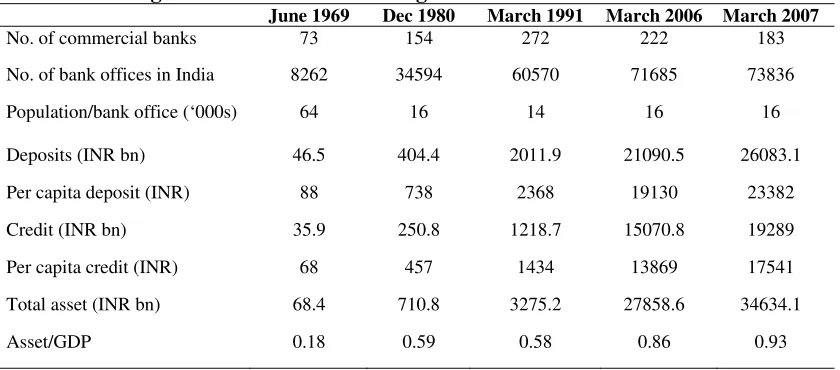
Table 1: Progress of commercial banking
June 1969 Dec 1980 March 1991 March 2006 March 2007
No. of commercial banks 73 154 272 222 183
No. of bank offices in India 8262 34594 60570 71685 73836
Population/bank office (‘000s) 64 16 14 16 16
Deposits (INR bn) 46.5 404.4 2011.9 21090.5 26083.1
Per capita deposit (INR) 88 738 2368 19130 23382
Credit (INR bn) 35.9 250.8 1218.7 15070.8 19289
Per capita credit (INR) 68 457 1434 13869 17541
Total asset (INR bn) 68.4 710.8 3275.2 27858.6 34634.1
Asset/GDP 0.18 0.59 0.58 0.86 0.93
3 Such features were not in sync with the national objective of achieving equitable allocation of credit. Therefore, the Reserve Bank of India (RBI) was envisaged to promote credit, with special attention to agriculture. Moreover, since 1967 a Bill imposed extensive social control over banks and banking policy. Banks were required to implement the government's objectives of improving banking access of rural areas and SMEs. These developments culminated in a two-stage bank nationalisation process, in 1969 and in 1980, aimed at ensuring that financial intermediaries fully met the credit demands according to national priorities. In fact, political economy considerations and borrowers’ needs gained primacy over the financial viability of the banking sector. Such choices were supported by an intensified public control over the financial system through various measures such as active mobilisation of savings through bank-dominated network, directed lending, interest rate regulation and the like.
Two important facets of banking during the post-nationalization period deserve mention. The first was ‘priority sector lending’: both the State Bank of India, and the nationalised banks and private banks were required to lend at least a fixed percentage of credit to agriculture and small-scale industry (RBI, 1983). Secondly, the branch licensing policy entailed banks to open four branches in unbanked locations for every branch opened elsewhere. Such policy increased the scope of banking in India to a scale unique to its level of development: by 2000, India had over 60,000 bank branches, spanning every district across the country (Table 1). Burgess and Pande (2005) showed that the re-distributive nature of branch expansion led to a substantial decline in rural poverty.
4. The Banking reforms
The unprecedented balance-of-payments crisis of the early 1990s, coupled with limited public resources for investment or provision of public services, rapidly brought forth the imperatives for financial sector strengthening. It was recognised that the success of the economy is contingent on a healthy financial system. India started a banking sector reform package in 1992. The thrust of the reforms was to promote a diversified, efficient and competitive financial system. Its first phase was guided by the recommendations of the Committee on the Financial System which proposed to bring about “operational flexibility” and “functional autonomy” so as to enhance “efficiency, productivity and profitability” (Government of India, 1991). The second stage of the reforms paid more attention towards strengthening the foundations of the banking system and make it internationally competitive (Government of India, 1998).
and its harmonization with other policies: recognising the inter-linkages, wide-ranging reforms were also undertaken in the real sector so that financial intermediation kept pace with underlying economic activity. Finally, the reforms were characterized by non-reversals, taking on board the views of all stakeholders.
At the same time, the weight of the public sector in banking has been reduced. Moreover, the ownership base in state-owned banks has been diversified. The regulations were amended to enable these banks to raise private capital, not exceeding 49% of their equity, in order for the government to retain majority shareholding. Equity sales in the market aggregating around INR.180bn (US $4.5bn) have been made by these banks, with several banks making subsequent follow-on offerings. Over the period 1993-2007, as many as 20 state-owned banks have accessed the capital market. At present, state-owned banks with 100% government ownership comprise only around 10% of commercial bank assets compared to around 90% at the beginning of reforms. A set of progressively tighter micro-prudential measures were instituted, with the objective of benchmarking against international best practices. Risk-based capital standards was hiked to 9%. Asset classification into doubtful, sub-standard and standard assets and related provisioning requirements were strengthened. Moreover, also rules on exposure limits for single and group borrowers, accounting rules, and investment valuation norms were improved. As part of such effort, the process of regulation and supervision has been strengthened with a strategy of on-site inspection and off-site surveillance, together with greater accountability of external auditors. In such a context, the RBI has been focusing on ensuring 'fit and proper' owners and directors of the bank (banks have been advised to ensure that a nomination committee screens the nominated and elected directors) and laying stress on diversified ownership.
As for Basel II, banks will initially adopt Standardized Approach for credit risk and Basic Indicator Approach for operational risk. From 2008, capital adequacy levels will be determined by a three-track approach. On the first track, commercial banks would be required to maintain capital for both credit and operational risks as per Basel II framework. The cooperative banks, on the second track, are required to maintain capital for credit risk as per Basel I framework and through surrogates for market risk; and the regional rural banks, on the third track, have a minimum capital requirement. The banking system has also witnessed greater levels of transparency and standards of disclosure in order to promote greater market discipline in line with the envisaged Basel II Accord.
Institutional arrangement to improve supervision and to ensure integrity of payment and settlement systems has been put in place. Key measures include the institution of a Board for Financial Supervision (1994) in order to ensure an integrated approach to supervision. In order to address the issue of regulatory gaps and overlaps across major regulatory authorities, a High Level Co-ordination Committee on Financial and Capital Markets has been operational since 1999.
5 (people’s court) for settling limited banking disputes. Visaria (2006) reports that the establishment of DRTs significantly lowered loan delinquency. More recently, the Securitisation and Reconstruction of Financial Assets and Enforcement of Security Interest Act (2002) has allowed secured creditors to enforce their interests and take possess of secured assets, in order to improve loan-recovery rates. The Credit Information Companies (Regulation) Act (2004) is expected to make available credit histories of both individuals and small businesses, lower transactions costs and enhance the quality of credit decision making.
[image:6.612.96.509.354.407.2]The net impact of these policy changes is getting reflected in the financial performance of banks (Table 2). Overall, efficiency and productivity has been improved by enhancing competition (Prasad and Ghosh, 2005). Moreover, Das and Ghosh (2006) report significant improvements in the performance of state-owned banks, post liberalization and a gradual convergence in their performance with foreign-owned and new private peers. The overall capital adequacy ratio (CAR) of commercial banks, which was 10,4% in 1996-97 has since trended upwards to reach 12,3% in 2006-07. Likewise, improved recovery management and better risk assessment, has resulted in a steady decline in the NPLs ratio of banks, from 15,7% in the mid-1990s to 2.7% in 2006-07. Such figures compare favorably with other emerging markets.
Table 2: Performance indicators of commercial banks (as % of total asset)
1980-91 1992-96 1997-01 2001-02 2002-03 2005-06 2006-07
Operating expense 2.53 2.74 2.64 2.19 2.24 2.11 1.97
Spread 1.90 2.94 2.87 2.57 2.77 2.78 2.78
Net Profit 0.15 -0.16 0.61 0.75 1.01 0.88 0.90
Source: Reserve Bank of India, Annual Report, Report on Trend and Progress of Banking in India and Statistical Tables Relating to Banks in India, Various Issues
5. The structure of the Indian banking system
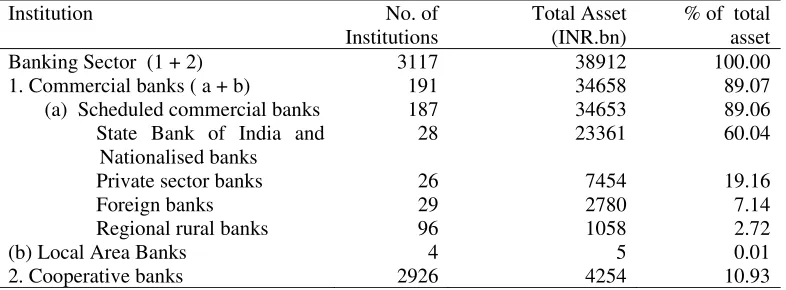
India's financial system is broadly serviced by two major groups of intermediaries: banks (commercial and co-operative, Table 3) and financial institutions, which includes development banks and the broadly defined non-bank financial institutions. The focus of this paragraph is on commercial banks which account for over 85% of banking assets. As of March 2006, there were 222 scheduled commercial banks, 133 of which were regional rural institutions. Indian law makes no distinction between universal and strictly commercial banks and most banks operate as universal banks.
Table 3: Structure of the Indian banking system
Institution No. of
Institutions
Total Asset (INR.bn)
% of total asset Banking Sector (1 + 2) 3117 38912 100.00 1. Commercial banks ( a + b) 191 34658 89.07 (a) Scheduled commercial banks 187 34653 89.06 State Bank of India and
Nationalised banks
28 23361 60.04 Private sector banks 26 7454 19.16 Foreign banks 29 2780 7.14 Regional rural banks 96 1058 2.72 (b) Local Area Banks 4 5 0.01 2. Cooperative banks 2926 4254 10.93
Figures as at end-March 2007
Source: Reserve Bank of India, Annual Report, Report on Trend and Progress of Banking in India and Statistical Tables Relating to Banks in India, Various Issues
Private banks account for 19,2% of total assets and over a fifth of total advances. Even before 1991, a few private banks have been operating in India: the 20 so-called 'old private banks’ escaped nationalization. The new private banks, on the other hand, benefited from the lack of burdensome administrative and branch networks, and have been able to establish a small but growing foothold in the market, leveraging on information technology and communications networking and focusing on few reliable high-net-worth companies and.
[image:7.612.102.514.543.690.2]Foreign banks play a small but innovative role in India. At end June 2007, 29 foreign banks with 268 branches from over 25 countries were operating in India (Table 4). They account for about 7% of total commercial banking sector asset. Another 30-odd foreign banks had representative offices. India has traditionally been quite open to foreign banks, even if less to foreign acquisition of Indian banks. There is no restriction on the licensing of new foreign banks in India, although licensing may be restricted if the foreign banks' market share exceeds 15% of the banking system. So far, foreign banks are allowed to either open up branches or set up wholly owned subsidiaries. Foreign banks are subject to the same prudential requirements as their domestic counterparts.
Table 4: Foreign banks in India
Country Number of banks Branches in India
Belgium 1 1
Canada 1 5
France 3 15
Germany 1 8
Hong Kong 1 48
Japan 2 5
Netherlands 1 28
Singapore 1 2
UK 2 84
USA 4 52
Others 12 20
7 The traditional contribution of foreign banks has been to meet the banking needs of foreign companies operating in the country and they are dominant in the forex market and in the derivatives market. In fact, traditionally, foreign banks focused on cross-border transactions involving trade finance with the larger Indian corporates. Recently, some of them have successfully tapped the middle-class and personal-banking markets. Their competitive advantage is based on their larger range of products and better standards of service. The new Indian private-sector banks, however, pose a threat for foreign banks. As the larger domestic commercial banks also become more aggressive, foreign banks will increasingly try to leverage their international networks to stay competitive. At the same time, several foreign banks have rationalized their Indian operations.
As for foreign ownership of Indian banks, the restriction is tighter: total foreign ownership in a private-sector bank cannot exceed 74% of the paid-up capital1, while in state-owned banks the FDI limit remains 20%. Moreover, mergers and acquisitions of Indian banks are subject to RBI approval and no individual foreign bank can own more than 5% of a domestic bank without RBI approval. Furthermore, a 10% cap on foreign investors voting rights exists at present.
Efforts have been initiated by the Government and the RBI to iron out various legal impediments inherent in the process of cross-border M&A.In particular, in the Union Budget Speech 2005-06, it was announced that RBI had prepared a two-phase roadmap for removing significant barriers to entry of new foreign players:
9 Since March 2005, foreign banks could either choose to operate through branches or set up a 100% wholly owned subsidiary (WOS) or convert their existing branches to WOS status. The WOS will be treated on par with the existing branches of foreign banks for branch expansion. To allow Indian banks sufficient time to prepare for global competition, foreign banks M&A will be permitted only in private-sector banks identified for restructuring by the RBI.
9 The second phase will start from April 2009. The removal of limitations on the operations of the WOSs and treating them on par with domestic banks will be designed and implemented after reviewing the experience with Phase I and consultations with all existing stakeholders. After a minimum period of operation, the WOSs of foreign banks will be allowed to list and dilute their stake so that at least 26% of the paid-up capital of the WOS is held by resident Indians. After a review is made, foreign banks may be permitted, subject to regulatory approvals and such conditions as may be prescribed, to enter into M&A transactions with any private-sector bank in India subject to the overall investment limit of 74% and the
one mode presence limit.
ING Vsysa Bank, ABN AMRO Bank was holding 1.4% of IndusInd Bank and foreign institutional investors hold just over 20% of the shares of Kotak Mahindra Bank.
Notwithstanding such evidence, several issues are still hampering a broader consensus over larger foreign presence in the banking sector: a) a concern about “cherry-picking” practices of foreign banks, which could leave domestic banks saddled with less creditworthy customers; b) the fact that the supervision of the more sophisticated activities of foreign banks entails a continuous challenge for regulators; c) doubts on whether depositors in foreign banks would be entitled to receive the same degree of protection as depositors in domestic banks; d) fears that the host country should extend the ‘lender of last resort’ umbrella to foreign banks; e) concerns about the still limited dimension and profitability of many Indian banks, which might make them exposed to hostile foreign takeovers.
6. Financial deepening and related issues
As the economy begins to grow rapidly and an increasing number of people migrate out of the poverty levels, the banking system will have to intermediate large amounts of funds than at present. The ratio of bank asset to GDP, loans and deposit to GDP and loans to deposits, although increasing in recent times, is still much lower than in other comparable bank-based economies, which suggests significant scope for financial deepening. In such a changed scenario, banks would need to harness modern delivery mechanisms that economize on transactions costs and provide better access to the presently under-served customers. This will call for devising innovative channels for credit delivery coupled with risk-related pricing of products and services. The role of prudent risk management, in such a situation, can hardly be over-emphasized.
It is also increasingly recognized that large segments of the rural population face ‘financial exclusion’ and continue their traditional dependence on the informal sector. Cross-country data for 99 countries in 2003-04 reported by Beck et al. (2007) indicates that, India ranked 24th in terms of geographic branch penetration (number of branches per 1000 sq. kms) with a figure of 22.6 and 59th in terms of demographic penetration (number of branches per 100000 people) with a figure of 6.3, whereas the highest for these indicators were 636.1 (for Singapore) and 95.9 (for Spain), respectively. The Government-appointed Committee on Financial Inclusion (Chairman: Dr.C.Rangarajan) in its Report in 2008 notes that, 45.9 million farmer households in the country out of a total of 89.3 million households do not access credit, either from institutional or non-institutional sources. The challenge remains for developing appropriate policies, procedures and products that can overcome this difficulty within the bounds of resource constraints. Some of the challenges which need to be effectively addressed include lack of adequate infrastructure in rural areas, relatively low volumes of transactions, comparatively higher transaction costs, and other factors such as the literacy levels of target customers.
9 operating efficiencies to corporates and government clients. Moreover, the increasing sophistication, flexibility and complexity of products and servicing offerings makes the effective use of technology critical for managing the risks associated with banking business. However, the ‘technological penetration’ in India has been quite modest: the percentage of ‘computer literate’ employees as ratio of total staff in 2000 was around 20% in public sector banks compared with 100 per cent in new private and around 90 per cent in foreign banks (RBI, 2002). The challenge, therefore, remains three fold: acquiring the ‘right’ technology, deploying it optimally and remaining cost-effective whilst delivering sustainable returns to shareholders. In effect, ‘managing’ technology to achieve and maintain high service and efficiency standards so as to reap the maximum benefits remains a key challenge.
7. Conclusion
To sum up, the Indian financial system has undertaken several important steps on the road towards a modern and efficient financial system, which can be a positive contributor to its economic development. This is in line with the philosophy itself of the gradualist Indian financial reforms process. Nonetheless, many steps are to be done, yet. Among the many issues, development of a domestic market for corporate debt is crucial. Developing a debt market can in turn provide corporates with alternative sources of financing and complete the scope of the financial market with positive spillover on its resilience from financial crises and ‘’sudden stops’ in financial flows from abroad. An easier access of foreign investors in Indian banks (already planned by the gradual phasing out of restrictions), and a further relaxation of preemption and priority lending could, finally, instill further competition in the market and be important tools for completing the modernization of India financial sector.
References
Ahluwalia, M.S., ’Economic reforms in India since 1991: has gradualism worked?’ Journal of Economic Perspectives 16 (2002), 67-88.
Beck, T., A. Demirguc Kunt and M.Soledad Martinez Peria , ’Reaching out: access to and use of banking services across countries’ Journal of Financial Economics 85 (2007)., 234-66.
Burgess, R., and R. Pande ’Do rural banks matter? evidence from the Indian social banking experiment’. American Economic Review 95 (2005), 780-95.
Das, A., and S. Ghosh, ’Financial deregulation and efficiency: an empirical analysis of Indian banks in the post-reform period’, Review of Financial Economics 15 (2006), 193-221. Government of India. Report of the Committee on the Financial System (Chairman: Shri
M.Narasimham), (New Delhi: Government of India:, 1991).
Government of India,. Report of the Committee on Banking Sector Reforms (Chairman: Shri M.Narasimham), (New Delhi: Government of India,1998)
Prasad, A., and S. Ghosh, ’Competition in Indian banking’, IMF Working Paper 141, (2005) Reserve Bank of India (RBI), The Reserve Bank of India : Functions and Working, (Mumbay:
RBI:,1983)
Reserve Bank of India (RBI), ’Expenditure Pattern and IT Initiatives of Banks’. RBI Bulletin, (2002).
Reserve Bank of India, Annual Report(Various Issues), Mumbai: RBI.
Reserve Bank of India, Report on Trend and Progress of Banking in India (Various Issues), Mumbai: RBI..
Reserve Bank of India, Statistical Tables Relating to Banks in India(Various Issues), Mumbai: RBI.
Visaria, S., ’Legal reform and loan repayment: the microeconomic impact of debt recovery tribunals in India’. Discussion Paper No.157 (2006)., University of Boston. Available at
www.bu.edu/econ
World Bank (2007). World Development Indicators database.