http://dx.doi.org/10.4236/gep.2014.23001
An Experimental Study of the Effect of
Rock/Fluid Interaction on Resistivity
Logs during CO
2
Sequestration in
Carbonate Rocks
Abdulrauf Adebayo, Mohammed Mahmoud
Petroleum Engineering Department, King Fahd University of Petroleum & Minerals, Dhahran, Saudi Arabia
Email: [email protected]
Received January 2014
Abstract
Accurate laboratory measurements and analysis of electrical properties of core samples are a prerequisite step to the evaluation of oil and gas reserves. In recent times, this evaluation tech-nique has been adopted in carbon dioxide sequestration projects for estimating and monitoring carbon dioxide (CO2) accumulation in saline aquifers. Several papers have reported laboratory success in the use of resistivity measurements to monitor the flow and also estimate the volume of CO2 plume in geological formations. Such laboratory experiments did not capture the effect of CO2 -brine-rock interaction (CBRI) on saturation estimation. The possibility of a change in value resis-tivity due to CO2/brine/rock interactions, and the possible effect on CO2 monitoring and estima-tion are of immediate interest here. Preliminary results of an ongoing research work showed that a much longer experiment time accommodates CO2-brine-rock interaction which ultimately lead to change in rock resistivity. We hereby present the electrical behavior of carbonates to CO2/ brine/rock interaction during prolonged CO2 sequestration and the effect on saturation estima-tion. This electrical behavior and its possible effect on CO2 monitoring and estimation are dis-cussed.
Keywords
Carbon Dioxide Sequestration and Monitoring, Resistivity Log, Rock Fluid Interaction, Archie Equation
1. Introduction
CO2 is normally injected into underground formation at high pressure and temperature such that the CO2 exists
in a supercritical state. The supercritical state will reduce the volume of rock space occupied by injected CO2 per
unit volume of CO2 existing at atmospheric condition. The pressure and temperature at which CO2 exist in this
cap-ture and sequestration (CCS) must be at this depth (Benson, 2008). While CO2 is injected into a subsurface
for-mation, four major trapping mechanisms ensue namely: 1) Physical/Structural trapping—a process whereby impermeable cap rock at the top of the formation prevent the CO2 from escaping out of the formation, keeping it
in place (Benson, 2008; Wang, 2010), 2) Solubility trapping—a process whereby injected CO2 dissolves in
for-mation pore water, 3) Mineral trapping—occurs when aqueous CO2 reacts with formation rock minerals
pro-ducing precipitates of carbonate minerals, and 4) Residual or Capillary trapping which occurs after CO2
injec-tion stops and water begins to imbibe into the aquifer displacing the CO2 already in the aquifer. Not all the CO2
is displaced but some are left behind as residual CO2 (residual trapping). Dissolved CO2 can acidify formation
water and subsequently mobilize and transport trace metals as it migrates in the formation (Gaus, 2010). A stor-age formation with strong cap rock is thus crucial to avoid leakstor-ages of trace metals and compounds into overly-ing portable aquifers. There is also the need for proper monitoroverly-ing of CO2 migration so as to observe its
behav-ior, distribution, and possible leakages. Hence, evaluation of the reliability of CO2 monitoring techniques should
be first step in risk assessment of any CCS project (Wang, 2004). Techniques required for monitoring CO2
mi-gration can be borrowed from a variety of other applications such as those used in the oil and gas industry, and those used in ground water monitoring (Benson, 2008). Examples of such techniques are seismic, gravity, and resistivity measurements. Seismic is the most extensively used technique. The use of resistivity measurements is also promising. Resistivity technique is applicable because rocks contain saline water and are thus conductive. The use of resistivity measurements to monitor and quantify CO2 in underground geological formation depends
on the fact that formation resistivity is higher at locations occupied by CO2 compared to locations un-invaded by
CO2, and the resistivity increases as CO2 saturation increases. The amount of resistivity changes depend on the
volume of CO2 present. With the use of Archie’s equation or modified Archie’s equation, CO2 saturation
distri-bution, migration, and volume can be estimated. Many experimental and field studies have successfully used re-sistivity measurements to monitor CO2 migration (Ramirez, 2003; Wang, 2010; Giese, 2009; Christensen, 2006;
Nakatsuka, 2010). Archie’s equation is given in Equation (1).
1n w w m t aR S R = ∅
(1)
where “a” is a constant determined as the intercept passing through 100% porosity on a formation fac-tor-porosity plot, while “m” and “n” are cementation factor and saturation exponent respectively and are ob-tained from laboratory resistivity measurements on core samples.
Kiessling et al. (2010) applied Archie’s equation to estimate CO2 saturation distribution in a CO2 SINK test
site close to Ketzin (Germany). Similarly, Nakatsuka et al. (2010) reported the use of Archie and modified Archie equation to estimate CO2 distribution in the Nagaoka pilot CO2 injection site. Time lapse resistivity
measurements in both cases were used to monitor movement of CO2 to and away from different zones of interest.
Changing resistivity values were interpreted as change in CO2 saturation. Figure 1 shows the time lapse
resis-tivity logs for both cases.
This study is new compared to previous works in the following sense: Many previous laboratory works have fo-cused on the applicability of electrical resistivity measurements to track CO2 migration by way of resistivity change
as a function of CO2 saturation changes during CO2 sequestration. Such experiments were also conducted only
within several hours or less. The fate of formation resistivity in the event that the CO2 remained trapped in the
pores for an extended period of time and the subsequent effect of the CO2/brine/rock reactions on resistivity and on
CO2 monitoring and estimation has not been addressed. This paper investigates the effect of CO2 brine rock
reac-tion on resistivity and CO2 saturation estimation.
2. Materials and Methods
(A)
[image:3.595.147.478.80.305.2](B)
Figure 1. Time lapse resistivity logs: (A) laboratory data taken with permission from Nakatsu- ka et al. (2010) (B) field data taken with permission from Kiessling et al. (2010).
Table 1. Sample properties.
L D Bulk Vol. He. Pore Vol. 500psi He Porosity (500psi) K
ID (cm) (cm) (cc) (cc) (%) (mD)
209 7.03 3.741 77.37 14.70 19.002 324
[image:3.595.87.550.437.580.2]206 7.06 3.736 77.43 13.78 17.790 423
Table 2. Synthetic formation brine.
Saline Aquifer
Composition Weight (g/l)
Sodium Chloride
44.5 (NaCl)
Calcium Chloride (CaCl2∙2H2O) 9.65
Magnesium Chloride (MgCl2∙6H2O) 3.41
Sodium Bicarbonate (NaHCO3) 0.15
Sodium phosphate (Na2SO4) 0.28
TDS (g/l) 57.99
Density, g/cc 1.02
Resistivity @ 22.5˚C, (ohm-m) 0.401
3. CO2 Injection Apparatus and Procedure
Figure 1 is the CO2 injection set up. The setup is designed to store supercritical CO2 in a brine saturated core
sample at a typical reservoir condition of 40˚C and 2000 psi overburden pressure. It consists of a CO2 source, a
core resistivity assembly, a test cell, pressure system, a heater, gauges, a LCR meter, and a data acquisition sys-tem to record resistivity measurement as a function of time as CO2 aging lasts. A 3.7 cm diameter by 7 cm long
carbonate core was placed in a Viton sleeve embedded with two electric current potential electrodes. A Teflon tape was wrapped along the circumference of the core (except the portion that would be in contact with the elec-tric potential electrodes) prior to placing it inside the Viton sleeve so as to delay the breakthrough of CO2
and then subjected to overburden pressure of 500 psi after which the core was circulated with brine to remove trapped air from the core’s pore space. An inlet valve and outlet valve attached tothe core assembly served as means of either closing up the core after CO2 injection or for fluid sampling at the end of storage. At the end of
brine circulation, cell temperature was raised to 45˚C, the overburden pressure too was raised to 2000 psi and the system left for over 24 hours for the core to equilibrate with the surrounding temperature and pressure. At this point, the outlet valve was closed and CO2 was applied at the inlet tubing at a pressure of 2000 psi making
the CO2 to exist in a supercritical state in the core. After few hours, the inlet valve was closed. CO2 inlet was
from the bottom of the core and the outlet tubing was at the top. The outlet tubing was also connected to a pres-sure gauge used to monitor CO2 pressure (Figure 2). The same procedure applied for the second core. Core
sample IL-206 was aged for 3 weeks (46 days) and IL-209 was aged for (90 days). During these aging times, the DAQ system recorded measurements of resistivity, pressure, and temperature of the core as a function of time.
3. Results and Discussions
Results after prolonged storage showed that rock electrical signature was constant prior to CO2 injection and
later increased in response to CO2 influx and remained constant again around this resistivity value until after
quite a number of days when constant resistivity pattern changed to a more turbulent pattern suggesting the on-set of chemical reactions between the three phases—CO2, brine, and carbonate grains. Considering the first 300
hours of CO2 storage (between 200th hour marking the beginning of CO2 storage till 500th hour) in sample
IL-206 (Figure 3(a)). It can be seen that although CO2 pressure is fairly the same during this period but the
for-mation resistivity dropped at about 150 hours after CO2 storage and later increased to the CO2 base line.
Esti-mating CO2 saturation within this period using Equation (1) would give different saturation profile whereas in
[image:4.595.93.535.376.703.2]the true sense the brine saturation is the same since no outflow was allowed. The same phenomenon can be seen
Figure 2. CO2 sequestration and online resistivity measurement system.
Flask
Temperature Control and Pressure Bath
Overburden Oil
Pressurized CO2 Cylinder
Syringe Pump
Analogue to Digital Converter
Computer
LCR Meter
P
Pressure Transducer
Pressure Gauge
Core Holder
P
Thermocouple
Overburden Pump
Air Supply for Overburden Oil
later at about 1000th hour to 1100th hour. The same phenomenon was observed in another experiment done on a different sample (IL-209) confirming repeatability (Figure 3(b)). The effect of such variation in resistivity measurements is best described in Table 3. This behavior showed that drop in formation resistivity does not necessarily mean migration of CO2 away from the location but can be due to CO2/brine/rock interaction. To be
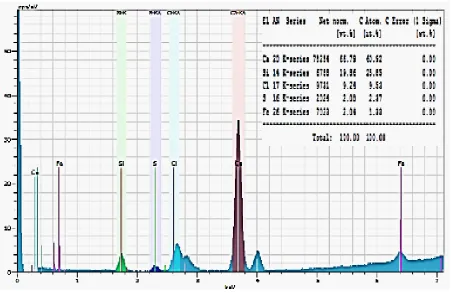
able to explain the reason for such electrical behavior in Figure 3, we carried out elemental analysis (XRFD) on precipitates seen at the bottom of brine effluents taken from samples at the end of storage (Figure 4). The pre-cipitates were identified to be carbonate grains which confirm carbonate grain dissolution (Figure 5). Samples’ permeability also reduced from 423mD to 201mD in IL-206 and from 324mD to 297mD in IL-209 (Figure 6). However, porosity remains either the same or a bit lower.
4. Conclusions
1) Resistivity logging in sequestration project can give information on fluid rock interaction.
[image:5.595.109.519.251.584.2](a) (b)
Figure 3. Resistivity versus time while CO2 reacts with brine saturated carbonate (A) IL-206 (B) IL-209.
Table 3. The effect of Archie’s parameters on saturation estimation (Bennion et al., 96).
Effect on Sx (If Under Estimated) Effect on Sw (If Over Estimated) Effect of Small Error
Satnration Exponent (n) Value too low Value too high Strong
Archie Constant (a) Value too low Value too high Moderate
Water Resistivity (Rw) Value too low Value too high Strong
Cementation Exponent (m) Value too low Value too high Moderate
[image:5.595.86.541.627.716.2]Figure 4. Brine effluent after CO2 storage. Sediments seen at the bottom.
Figure 5. XRFD analysis on precipitates.
2) Successful interpretation of this electrical signature can be a breakthrough in the understanding of miner-alization process in CO2 sequestration projects.
3) Results showed that drop in formation resistivity does not necessarily mean migration of CO2 away from
the location but can be due to CO2/brine/rock interaction
4) Collected brine effluents from storage showed carbon dioxide-rock fluid-rock interaction while XRFD analysis on precipitates showed that carbonate minerals and cementing materials dissolved in brine solution.
[image:6.595.89.541.306.599.2]Figure 6. Porosity and permeability for IL-206 and IL-209.
Acknowledgements
The authors are grateful to the King Fahd University of Petroleum & Minerals and the King Abdul-Aziz Center for Science and Technology-Technology Innovation Center on Carbon Capture and Sequestration (KACST- TIC-CCS) for their support under project number KACST-TIC-CCS-6.
References
Bennion, D. B., Thomas, F. B., & Bietz, R. F. (P0003-96). Determination of Initial Fluid Saturations—A Key Factor in By-passed Pay Determination.
Benson, S. M., & Cole, D. R. (2008). CO2 Sequestration in Deep Sedimentary Formations. Elements, 4, 325-331.
http://dx.doi.org/10.2113/gselements.4.5.325
Christensen, N. B., Sherlock, D., & Dodds, K. (2006). Monitoring CO2 Injection with Cross Hole Electrical Resistivity To-mography. Exploration Geophysics, 37, 44-49. http://dx.doi.org/10.1071/EG06044
Gaus, I. (2010). Role and Impact of CO2 Rock Interactions during CO2 Storage in Sedimentary Rocks. International Journal of Greenhouse Gas Control, 4, 73-89. http://dx.doi.org/10.1016/j.ijggc.2009.09.015
Giese, R., Henninges, J., Lüth, S., Morozova, D., Schmidt-Hattenberger, C., Würdemann, H., Zimmer, M., Cosma, C., Juhlin, C., & CO2 SINK Group (2009). Monitoring at the CO2 Sink Site: A Concept Integrating Geophysics, Geochemistry and Microbiology. Energy Procedia, 1, 2251-2259. http://dx.doi.org/10.1016/j.egypro.2009.01.293
Kiessling, D., Schmidt-hattenberger, C., Schuett, H., Schilling, F., Krueger, K., Schoebel, B., Danckwardt, & Kummerow, E. J. (2010). Geoelectrical Methods for Monitoring Geological CO2 Storage: First Results from Cross-Hole and Sur-face-Downhole Measurements from the CO2 SINK Tests It Eat Ketzin (Germany). International Journal of Greenhouse
Gas Control,4, 816-826. http://dx.doi.org/10.1016/j.ijggc.2010.05.001
Nakatsuka, Y., Xue, Z., Garcia, H., & Matsuoka, T (2010). Experimental Study on Monitoring and Quantification of Stored CO2 in Saline Formation Using Resistivity Measurements. International Journal of Greenhouse Gas Control, 4, 209-216.
http://dx.doi.org/10.1016/j.ijggc.2010.01.001
Wang, S., & Jaffe, P. R. (2004). Dissolution of a Mineral Phase in Potable Aquifers Due to CO2 Releases from Deep Forma-tions; Effect of Dissolution Kinetics. Energy Conversion and Management, 45, 2833-2848.
http://dx.doi.org/10.1016/j.enconman.2004.01.002