A Multiple Attribute Decision Making for Improving
Information Security Control Assessment
Nadher Al-Safwani
InterNetWorks ResearchLaboratory Universiti Utara Malaysia
Suhaidi Hassan
InterNetWorks ResearchLaboratory Universiti Utara Malaysia
Norliza Katuk
InterNetWorks ResearchLaboratory Universiti Utara Malaysia
ABSTRACT
Information security control assessment provides a comprehensive control analysis approach to assist an organization in measuring the effectiveness of its current and planned security controls. ISO/IEC 27005 is a risk management framework that can manage and treat risks in organizations. However, ISO/IEC 27005 does not define a clear guideline on how to select and prioritize information security control despite the need for an efficient security analysis method. The ISO 27005 framework mostly depends on subjective judgment and qualitative approaches for security control analysis. This paper aims to improve the ISC analysis method by proposing the concept of multiple attribute decision making to provide clear guidelines in solving these issues. Order performance by similarity to ideal solution (TOPSIS) method was utilized to determine the critical vulnerable controls on the basis of different evaluation criteria. We argue that evaluating ISC by using TOPSIS leads to a cost-effective analysis and an efficient assessment in terms of testing and selecting ISCs in organizations.
Keywords
Information security controls assessment, multiple attribute decision making, security controls analysis.
1.
INTRODUCTION
Information security is becoming increasingly important as the basis and premise for information system security [4, 11]. The principle goal of all business decision makers is to protect the organization and the ability to protect their IT assets, as well as to ensure the confidentiality, integrity, availability, and accountability features of the resources of the organization [16].
According to Singh [15], a risk assessment exercise involves several steps: identification of controls to be tested, testing of controls for their efficacy, analysis of test results, and recommendations for security enhancements on the basis of the analysis. The implementation of control risk management over the past few years has been ambiguous [9]. Numerous risk analysis methods and models have been developed to solve the issues and the challenges of these methods. Most security researchers attempt to enhance the framework to improve security decisions by applying quantitative or qualitative modeling techniques [10]. Quantitative techniques and methods that consider decision-making criteria and cost effective analysis remain lacking. Good references from standards organizations, such as ISO/IEC 27005, are available on the process aspects of risk management [7]. However, this framework typically and extensively focuses on the issue of defining a process around risk management. The framework may be excellent from a process perspective but does not define a clear guideline on how to accomplish control security
assessment and mostly depends on a qualitative analysis approach [15]. The remainder of the paper is organized as follows. Section 2 provides a summary of ISO/IEC 27005 related work on Information Security Control Assessment. Section 3 describes the multiple attribute decision making (MADM) concept and the TOPSIS method. Section 4 presents the experimental results of a case study. Section 5 discusses the results. Finally, Section 6 provides the summarized conclusions and the highlights of our future work.
2.
RELATED WORK
This section reviews the details of the ISO/IEC 27005 risk management framework and identifies the gaps in risk assessment standards and methods.
2.1
ISO/IEC 27005
ISO 27005 [7] provides the guidelines for information security risk management in an organization and the requirements of an Information Security Management System (ISMS), as shown in Figure 1. The common concepts in ISO/IEC 27001 are supported by the international standard and are designed to assist in the satisfactory implementation of information security according to the risk management approach. The process establishes the background and assesses the risks, which are mitigated by using a risk treatment plan to implement the recommended control and decisions. The standards attempt to determine the actual causes of the risks before deciding on what should be done and when to reduce the risk to an acceptable level.
Fig 1. ISO 27005 Risk Management Framework [7]. Step 3 is the identification of the existing controls that should be made to avoid unnecessary work or cost. An existing or planned control might be identified as ineffective, insufficient, or unjustified. However, Singh [15], [9] showed that ISO 27005 does not clearly define a proper analysis for the current controls despite having a generic guideline that describes the managed approach to risk. ISO 27005 fails to provide granular guidance on the key steps of critical control identification and tends to focus on qualitative data, thus reducing the value of the approach for decision makers [5]. The process of selecting an ISC from common practices is difficult, and choosing the best controls is based on the organization [13].
The standard provides a process framework and leaves the act of defining the risk management process and approach to the process guidelines of the organization, such as Information Security Management System (ISMS) or the context of risk management. According to some researchers [3], [1], the ISO standards family does not describe the practical aspects and shortens certain parts when evaluating the sufficiency of security mechanisms in a formal approach. The situation of the knowledge base has recently improved, but the standardization of the entire risk assessment process remains necessary.
Fig 2. ISO/IEC 27005 Risk Analysis Steps [7].
3.
MULTI-ATTRIBUTE DECISION
MAKING
[image:2.595.55.281.86.468.2]consider the trade-offs involved by normalization when obtaining the aggregating function. Nevertheless, TOPSIS is considered one of the major multi-attribute decision making (MDAM) techniques with an advantage over other MDAM techniques and group decision-making methods [2].
In any MDAM ranking, fundamental terms must be defined such as the decision matrix (DM), the evaluation matrix (EM), the alternatives, and the criteria.
The EM has m alternatives and must create n criteria. The intersection of each alternative and criteria is given as xij.
Therefore, we have a matrix (xij)m∗n
C1 C2 … Cn
D = A1
A2
⋮ Am
x11 x12
x21 x22
… x1n
… x2n
⋮ ⋮ xm1 xm2
⋮ ⋮ … xmn
,
where A1, A2 , … , Am are the possible alternatives among
which the decision makers have to choose (i.e., technical security controls), C1, C2 , … , Cn are criteria with which the
alternative performances are measured (i.e., vulnerabilities, threats, valid vulnerabilities, severity, and cost remediation effort), xij is the rating of the alternative Ai with respect to
criterionCj, and Wj is the weight of criterion Cj (i.e., threats
weight, severity weight, and cost remediation weight). Certain processes must be performed to rank the alternatives, such as normalization, maximization indicator, adding the weights, and other processes depending on the method.
3.1
Technique for Order Performance by
Similarity to Ideal Solution Method
3.1.1
Construct the normalized decision matrix
This process attempts to transform the various attribute dimensions into non-dimensional attributes, which allows a comparison across the attributes. The matrix (xij)m∗n is thennormalized from (xij)m∗n to the matrix R = (rij)m∗n by using
the normalization method:
rij = xij xij2 m
i=1
… … … . 1
This process results in a new Matrix R, where R is as follows:
R = r11 r12
r21 r22
… r1n
… r2n
⋮ ⋮ rm1 rm2
⋮ ⋮ … rmn
.
3.1.2
Construct the weighted normalized decision
matrix
In this process, a set of weights
w = w1, w2, w3 , ⋯ , wj, ⋯ , wn from the decision maker is
accommodated to the normalized DM. The resulting matrix can be calculated by multiplying each column from the normalized decision matrix (R) with its associated weight wj.
The set of the weights is equal to 1:
wj m
j=1
= 1 … … … . . … … … 2
This process results in a new Matrix V, where V is as follows:
V=
v11 v12
v21 v22
… v1n
… v2n
⋮ ⋮ vm1 vm2
⋮ ⋮ … vmn
=
w1r11 w2r12
w1r21 w2r22
… wnr1n
… wnr2n
⋮ ⋮ w1rm1 w2rm2
⋮ ⋮ … wnrmn
.
3.1.3
Determining the ideal and negative ideal
solutions
In this process, two artificial alternatives, A∗ (the ideal alternative) and A− (the negative ideal alternative), are defined as
A∗= max
i vij j ∈ J , mini vij j ∈ J
− i = 1,2, … , m
= v1∗, v2∗, … , vj∗, ⋯ vn∗ … … … . 3 .
A−= min
i vij j ∈ J , maxi vij j ∈ J
− i = 1,2, … , m
= v1−, v2−, … , vj−, ⋯ vn− … … … . 4 .
J is a subset of i = 1,2, … , m , which presents the benefit attribute (e.g., size, robustness, and complexity). By contrast,
J− is the complement set of J, which can be noted as Jc or the
set of cost attributes.
3.1.4
Separation measurement calculation on the
basis of the Euclidean distance
Separation measurement is conducted by calculating the distance between each alternative in V and the ideal vector A∗ by using the Euclidean distance, which is given by
Si∗= vij− vj∗ 2
n
j=1
, i = 1,2, ⋯ m … …. 5
The separation measurement for each alternative in V from the negative ideal A− is similarly given by
Si−= vij− vj− 2
n
j=1
, i = 1,2, ⋯ m ⋯ ⋯ 6
At the end of step 4, two values, namely, Si∗ and Si−, for each alternative are counted. These two values represent the distance between each and both alternatives (the ideal and the negative ideal).
3.1.5
Closeness to the ideal solution calculation.
The closeness of Ai to the ideal solution A∗ is defined asCi∗= 1 if and only if (Ai= A∗). Similarly, Ci∗= 0 if and only if (Ai= A−).
3.1.6
Step 6: Ranking the alternative according to
the closeness to the ideal solution.
The set of the alternative Ai can now be ranked according to the descending order of Ci∗. The highest value has the best performance.
3.2
Experimental Study
This section describes the experiments setup and the implementation of TOPSIS steps within ISO 27005 standard. The experiments were conducted in a small- and medium-size enterprise (SME) based in Kuala Lumpur, Malaysia that specializes cyber security consulting. The scope of study is to examine the information security controls of IT department. The organization assigned four people for the implementation who are expert in vulnerability assessment and penetration test.
3.3
Procedure and Materials
The study has determined the scope and infrastructure boundaries of security controls. Security controls are classified into two types: technical and nontechnical. In this paper, we evaluated the technical ISC. Technical controls are defined as the safeguards built into the hardware and the computer software, such as firewalls, routers, databases, and servers.
All tests were conducted in a real time network. First, we identified a total of 18 technical security controls (see Table 4). We conducted more than 50 experiments to identify the vulnerabilities among these controls by using different vulnerabilities assessment tools, such as Nessus, Nmap, Dumpsec, Kismet, and Acunetix Web Vulnerability Scanner. We then ran over 100 experiments by using different penetration testing tools, such as Metasploit, AirSnort, Nstealth, Paros Proxy, ISS Database Scanner, and Spike. The aim of this step is to validate the analyzed data obtained from the vulnerability assessment.
Finally, the severity of the attack classes and the cost remediation effort level were evaluated based on the severity and cost remediation level scores as described in Table 4, respectively. We had to validate the data and obtain an accurate result estimation prior to data analysis. Therefore, we conducted a group analysis panel with different experts to estimate the severity and cost of the remediation effort. Finally, we analyzed the obtained results by using the TOPSIS method to prioritize the feedback and data of the expert. The results of TOPSIS experiment illustrated in detail in Section 4.
4.
RESULTS
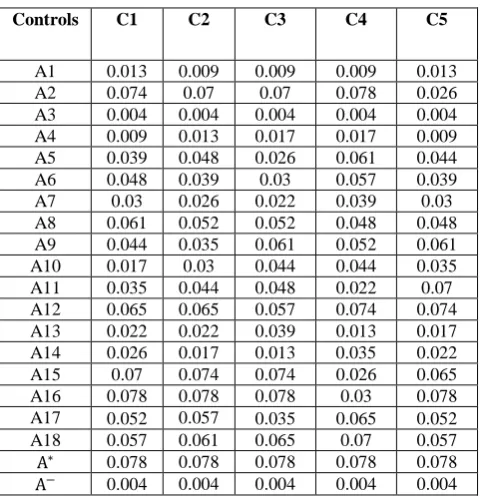
This section depicts the results obtained from the prior experiments conducted in a small-medium enterprise, wherein different technical security controls are implemented. We run the TOPSIS methods using java programming language. The developed program convert all mathematics equations into a programming code. The data of the five evaluation criteria such as know vulnerabilities, valid vulnerabilities, attack classes, severity of attacks, and remediation effort level were prioritized using TOPSIS methods. There are 18 security controls for evaluation and ranked based on the evaluation criteria. The weights of the evaluation criteria are defined by external cybersecurity team. The weight sum for each
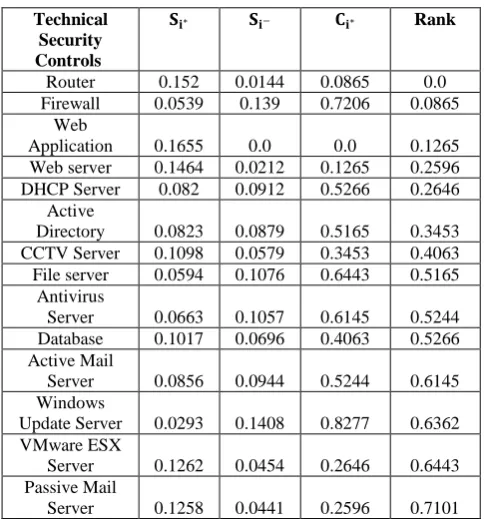
[image:4.595.309.550.201.452.2]evaluation criteria must be equal to 1. The first step and second step of TOPSIS have been conducted to extract the normalized data based on weight rating as depicted in Table 1. In addition, ideal and negative ideals solution were identified to calculate the separation and closeness as described in Table 1. Table 2 describes the separations, closeness, and the ranking of the security controls. The separation measures of these criteria conducted through all mathematic equations. These results are discussed in detail in Section 5.
Table 1. Weight of Normalized Decision Matrix
Controls C1 C2 C3 C4 C5
A1 0.013 0.009 0.009 0.009 0.013
A2 0.074 0.07 0.07 0.078 0.026
A3 0.004 0.004 0.004 0.004 0.004 A4 0.009 0.013 0.017 0.017 0.009 A5 0.039 0.048 0.026 0.061 0.044 A6 0.048 0.039 0.03 0.057 0.039 A7 0.03 0.026 0.022 0.039 0.03 A8 0.061 0.052 0.052 0.048 0.048 A9 0.044 0.035 0.061 0.052 0.061 A10 0.017 0.03 0.044 0.044 0.035 A11 0.035 0.044 0.048 0.022 0.07 A12 0.065 0.065 0.057 0.074 0.074 A13 0.022 0.022 0.039 0.013 0.017 A14 0.026 0.017 0.013 0.035 0.022 A15 0.07 0.074 0.074 0.026 0.065 A16 0.078 0.078 0.078 0.03 0.078 A17 0.052 0.057 0.035 0.065 0.052 A18 0.057 0.061 0.065 0.07 0.057
A∗ 0.078 0.078 0.078 0.078 0.078
A− 0.004 0.004 0.004 0.004 0.004
5.
DISCUSSION
Inaccurate ISC selection and evaluation can create an unclear view of the risk of an organization during risk assessment exercise. The ISC prioritization method allows decision makers to create accurate decisions on the critical and important controls and threats to consider. We used the TOPSIS method to improve the ISO/IEC 27005 control assessment and the security decision-making of the organization by providing a clear prioritization steps to select the most vulnerable and critical controls. Security controls were rated on a scale of 1 (critical risk) to 18 (low risk). We selected the top eight critical risks of the ISC to the organization. The list of critical security controls in Table 4 shows that web application is the most important critical control to address, followed by the router, web server, Passive Mail server, VMware ESX server, CCTV server, database, and Active Directory. These controls are evaluated based on not only the number of known vulnerabilities but also the different evaluation criteria, such as severity and cost remediation effort level.
Table 2. Summary Results of the TOPSIS Ranking Technical
Security Controls
𝐒𝐢∗ 𝐒𝐢− 𝐂𝐢∗ Rank
Router 0.152 0.0144 0.0865 0.0 Firewall 0.0539 0.139 0.7206 0.0865
Web
Application 0.1655 0.0 0.0 0.1265 Web server 0.1464 0.0212 0.1265 0.2596 DHCP Server 0.082 0.0912 0.5266 0.2646
Active
Directory 0.0823 0.0879 0.5165 0.3453 CCTV Server 0.1098 0.0579 0.3453 0.4063 File server 0.0594 0.1076 0.6443 0.5165
Antivirus
Server 0.0663 0.1057 0.6145 0.5244 Database 0.1017 0.0696 0.4063 0.5266 Active Mail
Server 0.0856 0.0944 0.5244 0.6145 Windows
Update Server 0.0293 0.1408 0.8277 0.6362 VMware ESX
Server 0.1262 0.0454 0.2646 0.6443 Passive Mail
Server 0.1258 0.0441 0.2596 0.7101
Wireless AP 0.055 0.1347 0.7101 0.7206 Email Gateway 0.0479 0.1503 0.7583 0.7583 DNS 0.0625 0.1093 0.6362 0.7691 Development
Server 0.0387 0.1289 0.7691 0.8277
6.
CONCLUSION
[image:5.595.50.550.391.673.2]Control assessment is a critical step in information security risk management. Control assessment and analysis methods have become increasingly more important to organizations that consider a continued defense technique against threats. The current ISO/IEC 27005 framework does not provide enough practical details on ISC selection and evaluation. The assessment process is niche and requires the use of more resources when conducted in organizations, particularly if the organization has a constant budget and limited resources to provide an entire risk picture. Few studies focus on improving the issues and challenges of information security systems. This paper proposes TOPSIS, to enhance ISC selection and prioritization. Our solution improves the risk assessment process by providing dynamic analysis methods to assist organizations in accurately evaluating the ISC by considering the weight of each attribute or evaluation criteria. This solution assists the organization in determining and selecting the effectiveness performance of security controls.
Table 3: Ranking Summary of the Results
Number Technical Security Controls
K
n
o
wn
Vul
n
er
a
b
il
iti
es
Va
li
d
Vul
n
er
a
b
il
iti
es
Atta
ck
Cla
ss
S
ev
er
ity
Re
m
ed
ia
tio
n
Effo
rt
lev
el
Ra
n
k
in
g
1 Router 3 2 2 2 3 2
2 Firewall 17 16 16 18 6 15
3 Web Application 1 1 1 1 1 1
4 Web server 2 3 4 4 2 3
5 DHCP Server 9 11 6 14 10 10
6 Active Directory 11 9 7 13 9 8
7 CCTV Server 7 6 5 9 7 6
8 File server 14 12 12 11 11 13
9 Antivirus Server 10 8 14 12 14 11
10 Database 4 7 10 10 8 7
11 Active Mail Server 8 10 11 5 16 9
12 Windows Update Server 15 15 13 17 17 18
13 VMware ESX Server 5 5 9 3 4 5
14 Passive Mail Server 6 4 3 8 5 4
15 Wireless AP 16 17 17 6 15 14
16 Email Gateway 18 18 18 7 18 16
17 DNS 12 13 8 15 12 12
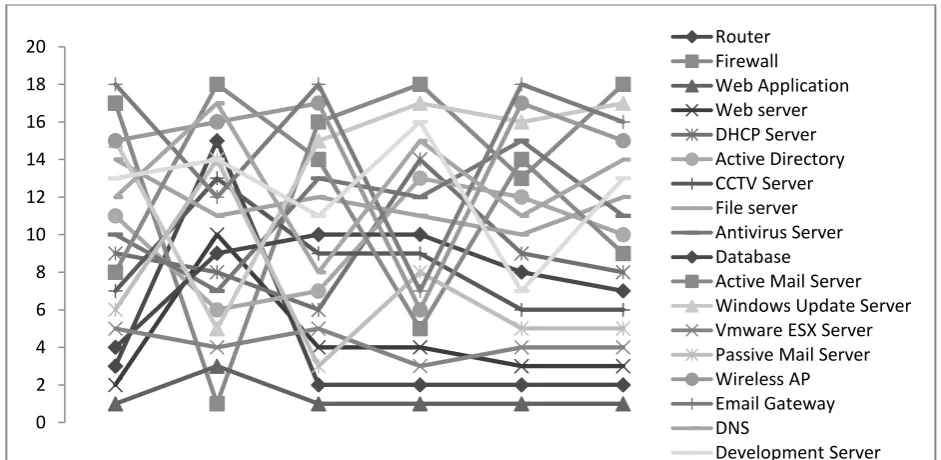
Figure 3. Technical Security Controls Ranking Using TOPSIS In the future, these data may be used for different MADM
methods. The results from this study can be examined to determine the most effective MADM method. Future research can also concentrate in evaluating this study by interviewing experts from organizations within similar industries.
7.
REFERENCES
[1] A. Asosheh, B. Dehmoubed, and A. Khani. A new quantitative approach for information security risk assessment. In Computer Science and Information Technology, 2009. ICCSIT 2009. 2nd IEEE International Conference on, pages 222–227, 2009.
[2] Shuo-Yan Chou, Yao-Hui Chang, and Chun-Ying Shen. A fuzzy simple additive weighting system under group decision-making for facility location selection with objective/subjective attributes. European Journal of Operational Research, 189(1):132 – 145, 2008.
[3] A. Ekelhart, S. Fenz, and T. Neubauer. Aurum: A framework for information security risk management. In System Sciences, 2009. HICSS ’09. 42nd Hawaii International Conference on, pages 1 –10, jan. 2009. [4] Nan Feng and Minqiang Li. An information systems
security risk assessment model under uncertain environment. Applied Soft Computing, 11(7):4332 – 4340, 2011.
[5] Douglas W. Hubbard. The Failure of Risk Management : Why It is Broken and How to Fix It. Willy, New Jeresy,USA, 2009.
[6] C.L. Hwang and K.P. Yoon. Multiple Attribute Decision Making Methods and Applications: A State-of-the Art Survey. Lecture Notes in Economics and Mathematical Systems Series. Springer London, Limited, 1981. [7] ISO/IEC. Iso 27005 information technology security
techniques information security risk management, 2008. [8] Cengiz Kahraman and Selçuk Çeb. A new multi-attribute
decision making method: Hierarchical fuzzy axiomatic design. Expert Syst Appl., 36(3):4848–4861, 2009. [9] E. Kiesling, C. Strausss, and C. Stummer. A
multi-objective decision support framework for simulation-based security control selection. In a, editor, Availability,
Reliability and Security (ARES), 2012 Seventh International Conference on, pages 454–462, 2012. [10]S. Lauesen and H. Younessi. Six styles for usability
requirements. In Proceedings of the Fourth International Workshop on Requirements Engineering: Foundation for Software Quality: REFSQ’98, pages 155–166, Pisa, Italy, 1998. Presses Universitaires de Namur.
[11]Jun-Jie Lv, Yong-Sheng Zhou, and Yuan-Zhuo Wang. A multi-criteria evaluation method of information security controls. In Computational Sciences and Optimization (CSO), 2011 Fourth International Joint Conference on, pages 190–194, 2011.
[12]Serafim Opricovic and Gwo-Hshiung Tzeng. Compromise solution by mcdm methods: A comparative analysis of vikor and topsis. European Journal of Operational Research, 156(2):445 – 455, 2004.
[13]Angel R. Otero, Carlos E. Otero, and Abrar Qureshi. A multi criteria evaluation of information security controls using boolean features. Network Security and Its Applications (IJNSA), 2(4):1–11, October 2010. [14]Hsu-Shih Shih, Huan-Jyh Shyur, and E. Stanley Lee. An
extension of topsis for group decision making. Mathematical and Computer Modelling, 45:801 – 813, 2007.
[15]Anand Singh and David Lilja. Improving risk assessment methodology: a statistical design of experiments approach. In 4th International Conference Security of Information and Networks (SIN 2011), pages 21–29, Sydney, Australia, October 2009. ACM.
[16]Evan Wheeler. Building an Information Security Risk Management Program from the Ground Up. Waltham, 2011.
[17]K . Paul Yoon and Ching-Lai Hwang. Multiple Attribute Decision Making: An Introduction (Quantitative Applications in the Social Sciences, volume 104:83. USA, SAGE Publications, Inc., 1995.
[18]Edmundas Kazimieras Zavadskas, Arturas Kaklauskas, Zenonas Turskis, and Jolanta Tamošaitien˙e. Multi-attribute decision-making model by applying grey numbers. Informatica, 20(2):305–320, April 2009. 0
2 4 6 8 10 12 14 16 18
20 Router
Firewall
Web Application Web server DHCP Server Active Directory CCTV Server File server Antivirus Server Database
Active Mail Server Windows Update Server Vmware ESX Server Passive Mail Server Wireless AP Email Gateway DNS
![Fig 2. ISO/IEC 27005 Risk Analysis Steps [7].](https://thumb-us.123doks.com/thumbv2/123dok_us/8051115.773951/2.595.55.281.86.468/fig-iso-iec-risk-analysis-steps.webp)