Munich Personal RePEc Archive
Estimating the Income Reporting
Function for the Self-Employed
Tedds, Lindsay
University of Victoria
July 2007
Online at
https://mpra.ub.uni-muenchen.de/39784/
Estimating the Income Reporting Function for the Self-Employed1
Lindsay M. Tedds
School of Public Administration, University of Victoria PO Box 1700 STN CSC, Victoria, BC, Canada, V8W 2Y2
Phone: 250-721-8068, Email: [email protected]
This version: July 2007
Abstract
There is considerable interest in measuring the underground economy using microeconomic data. One such method estimates income under-reporting by households by assuming a known, parametric form of the Engel curve and making the further parametric assumption that households under-report their income by a constant fraction, independent of income. This paper proposes a nonparametric approach which avoids functional form restrictions and enables the reporting function to vary across income levels and household characteristics. I illustrate by estimating the effect of the Canadian Goods and Services Tax on income under-reporting.
Keywords: Underground Economy, Income Under-reporting, Nonparametric Estimation, Engel Curve
JEL Classification: C14, D12, O17
1
1. INTRODUCTION
There has been a recent resurgence in interest in measuring the underground economy
and this interest has been stimulated predominantly by the perception that the underground
economy is sizeable and growing. In broad terms, the phrase “underground economy” refers to
output that is produced and income that is generated by agents who hide this fact from
authorities. Knowledge of the size and structure of the underground economy is important for a
number of reasons. First, because underground activities are unmeasured, they are not taken into
account in the information-set that is used to assist economic policy-makers. Second, the
underground economy effectively re-distributes both income and wealth in ways that are not
necessarily consistent with the re-distributional goals of the taxation system. Third, the shortfall
in income-reporting that is associated with underground activities leads to an erosion in the tax
base and tax revenue with subsequent implications for both public expenditure and taxation
policies. Finally, enforcement activities are unlikely to be successful (and may have counter
productive consequences) without detailed knowledge of the characteristics and types of
activities of underground economy participants.
To date, research that seeks to measure the underground economy has predominately
employed macro-methods.2 These macroeconomic measures, however, have been criticized for not being consistent with modern economic models of consumer behaviour, employing flawed
econometric techniques, producing unreliable estimates, and providing limited guidance to
policy makers (Thomas 1999). In particular, the macro-methods developed to date do not
provide any information regarding the characteristics of those participating in the underground
2
economy. In order to obtain this type of information, a method that utilizes microeconomic data
is required.
One such approach, popularized by Pissarides and Weber (1989) and modified by
Lyssiotou et al. (2004), utilizes household income and expenditure data to estimate the degree of
income under-reporting (i.e. the amount by which household income should be scaled upwards
to obtain true, or actual, income as opposed to reported income). The basic principle of this
Expenditure-Based Method is that true household income can be imputed from reported
household expenditures. The method is premised on variations of several key assumptions,
namely: the reporting of expenditures on some items by all households is accurate; those who
report zero self-employment income report income accurately while those who report non-zero
self-employment income may under-report; and the marginal propensity to consume out of
unreported income is equal to the marginal propensity to consume out of reported income.
Actual, or true, self-employment income is then imputed by comparing the expenditure levels of
households with positive self-employment income to the expenditure-income bundles of
households with zero self-employment income and similar characteristics. In practice, the
method is implemented by estimating reliable expenditure functions (i.e. Engel curves) for wage
earners that are then inverted to estimate true income for the self-employed.
Previous studies have implemented the Expenditure-Based Method using highly
parametric restrictions on: (1) an Engel curve (Pissarides and Weber 1989) or a system of Engel
curves (Lyssiotou et al. 2004); and (2) an income reporting function. These restrictions imply
that households under-report their income by a constant fraction, independent of income. There
is no empirical evidence that supports this restriction and little, if anything, is actually known
implementing the Expenditure-Based Method. In particular, the parametric restrictions are
relaxed and a nonparametric approach to the measurement of income under-reporting is
explored.
Specifically, a two-step approach to estimating a variable-with-income reporting function
is proposed, within the framework of the Expenditure-Based Method. The approach is
essentially as follows. First, a nonparametric inverse food Engel curve is estimated for the
sample of households that report zero self-employment income, to obtain an estimate of true
income given (accurately) reported expenditures for every household in the sample (including
those with employment income). Second, the nonparametric reporting function for
self-employment income for households that report positive self-self-employment income is estimated.
This approach improves on the implementation of the Expenditure-Based Method by minimizing
the number of assumptions required for estimation. More particularly, the proposed framework
avoids the usual functional form restrictions and enables the reporting parameter to vary across
income levels.
The approach is illustrated by estimating the effect of the Canadian Goods and Services
Tax (GST) on income under-reporting by married households with self-employment income. It
is often argued that the implementation of this broadly based consumption tax increased the
incentives and opportunities for tax evasion (e.g. Spiro 1993, and Hill and Kabir 1996) though
the Government of Canada maintained that it would reduce the scope the tax evasion. The
empirical analysis uses the Canadian Family Expenditure Survey (FAMEX), which contains
household level information about income and expenditures.
Overall, this refinement to the Expenditure-Based Method produces results that
particular, the gap between true and reported self-employment income is larger for households at
the lower end of the self-employment income distribution. This result supports the fundamental
results of Reinganum and Wilde (1985, 1986) that “…taxpayers with greater true income
under-report less than those with lower true income…” (Reinganum and Wilde 1986, p. 741). Possible
explanations of this finding are that households with more self-employment income may think
they are more likely to be audited by the authorities, face higher utility costs if they are caught,
and/or disproportionately benefit from legal tax avoidance (e.g. by exploiting various tax credits
or loopholes). It is also found that some self-employed households, notably those households at
the upper end of the self-employment income distribution, over-report their income. The
parametric restrictions imposed previously masked this possible behaviour. Overall, the
aggregate results neither support the hypothesis that the GST increased tax evasion nor the claim
by the Canadian federal government that the GST would reduce tax evasion, at least for the
self-employed.
The remainder of this paper is organized as follows. First, estimating income
under-reporting from micro data is discussed, including a brief overview of the literature and details
regarding the nonparametric approach proposed by this paper. The application of the approach is
then described, including a description of the data, implementation details of the nonparametric
approach (e.g. kernel and bandwidth selection), the results, and a discussion regarding the
2. ESTIMATING INCOME UNDER-REPORTING FROM MICRO DATA
2.1.Previous Approaches
In this section, attention is focused on two critical aspects of the empirical work in this
paper with the view of placing the empirical strategy in context. These aspects concern: (1)
functional form restrictions; and (2) the treatment of permanent income.
2.1.1. Functional Form Restrictions
A critical aspect of the empirical work in this area is the specification of the expenditure
and reporting functions. The pioneering work in the development of the Expenditure-Based
Method was conducted by Pissarides and Weber (1989).3 First, they categorize households as either being self-employed or wage earning. Second, they specify a log-log (in expenditures and
income) form for the expenditure equation (i.e. the constant elasticity Engel curve) that is used to
estimate the parameter θ in the linear reporting function for self-employed households, defined
as
SE SE y
y* (1)
where y*SE represents true self-employment income, ySE denotes reported self-employment
income, and θ is assumed to be > 1. This method of estimating income under-reporting consists
of two steps. First, an expenditure function is estimated for wage earners. Second, the
expenditure function is inverted to calculate θ, the amount by which reported self-employment
income must be scaled up by in order to obtain true self-employment income.
3
Figure 1 provides a graphical representation of the approach. Constant-elasticity Engel
curves for wage (or employee) and self-employed households are shown. A self-employed
household reports expenditures, E*, and income, Y, but the reported level of expenditures is
actually consistent with true income, Y*. The amount by which reported income must be scaled
up to obtain true income is calculated by taking the ratio of the distance 0Y*/0Y which is
equivalent to the parameter θ in equation (1) above. As the Engel curve for the self-employed is
assumed to be parallel to that of wage earners, the distance is the same for every household (i.e.
the reporting parameter is constant).
Lyssiotou et al. (2004) propose a systems approach to the Expenditure-Based Method.
They specify a system of Engel curves of quadratic-in-(log)income Working-Leser form. They
assume that durable and nondurable goods are separable and base their demand system on
nondurable goods only, namely: food, alcohol, fuel, clothing, personal goods/services, and
leisure goods/services. Lyssiotou et al. (2004) maintain the specification of the linear reporting
function given in equation (1) above but avoid classifying households as either wage earners or
self-employed.4
The functional form for the Engel curve that is specified by Lyssiotou et al. (2004) raises
two concerns. First, there is an implicit assumption of the Expenditure-Based Method that the
Engel curve(s) employed in the estimation must be monotonic in income. In reference to Figure
1, if this critical assumption is violated, then a unique value of true income associated with a
4
particular level of expenditures may not exist. The quadratic-in-(log)income Working-Leser
form of the Engel curve specified by Lyssiotou et al. (2004) is not necessarily consistent with the
monotonicity assumption, with particular goods, notably alcohol and clothing, known to violate
this assumption (Banks et al. 1997). Second, the quadratic-in-(log)income Working-Leser form
of the Engel curve is not invertible over all values due to the presence of asymptotes. While the
presence of asymptotes is not a concern under the structure imposed by Lyssiotou et al. (2004)
-the system of Engel curves is not (implicitly) inverted over all data points - it underscores -the
likelihood that the estimates are influenced, in whole or in part, by the parametric restrictions.
More generally, this approach still assumes a parametric Engel curve, albeit one that is
more widely accepted than that implied by earlier constant-elasticity assumption. Perhaps more
importantly, this approach continues to assume that households under-report their income by a
constant fraction, independent of income. In fact, little is known about the form of the reporting
function and it is plausible that under-reporting will differ with income and household
characteristics. This paper proposes a nonparametric approach which avoids functional form
restrictions. The proposed method also works directly with an inverse Engel curve, avoiding
problems associated with inversion, and continues with the tradition of the single equation
approach. The single equation approach also allows the analysis to be restricted to a good for
which the Engel curve is widely acknowledged to be monotonic in income.
2.1.2. Permanent Versus Transitory Income
There is a general belief that households base expenditures on permanent rather than
transitory income. This implies that households save when they have positive transitory income
implemented using transitory, or annual income, this may lead to biased estimates of income
under-reporting. Pissarides and Weber (1989) acknowledge that permanent income is the
measure of income that influences consumption decisions but stop short of requiring their
expenditure function to conform exactly to the permanent income hypothesis, perhaps because
the dataset used in their analysis (1982 British Family Expenditure Survey) did not contain
information regarding household savings behaviour. They indicate that “…for given permanent
income, the measured income of the self-employed may be more variable than the measured
income of employees in employment. If this is correct, our measure of income under-reporting
by the self-employed will have to be adjusted accordingly.” (Pissarides and Weber 1989, pp. 20)
Empirically, they implement this assumption by treating reported income as endogenous and
then using instrumental estimation, which “…enables an independent estimate of the residual
variance of reported income for each group which is exploited in the calculation of income
under-reporting.” (Pissarides and Weber 1989, pp. 22)
Whether Pissarides and Weber’s (1989) Two-Stage Least Square (2SLS) approach is
preferred to Ordinary Least Squares (OLS) depends on the quality of the instruments. Datasets
that contain information on household expenditures and income may not contain relevant and
suitable instrumental variables required for this analysis. Further, the approach requires the
researcher to make additional and somewhat arbitrary assumptions which restrict the analysis.
As a result, an alternative approach which addresses the issue of permanent income is desirable.
2.2. A Nonparametric Approach
As outlined above, to date, the Expenditure-Based Method has been implemented by
estimating Engel curves which are implicitly or explicitly inverted to obtain an average estimate
of income under-reporting. A more direct approach to estimating income under-reporting is to
utilize an inverse Engel curve (i.e. with income taking on the role of the dependent variable) and
nonparametric methods. Within the framework of the Expenditure-Based Method, a two-step
approach to estimating a variable-with-income reporting function is proposed that responds to
the concerns raised in the previous section.
The first step nonparametrically estimates an inverse Engel curve, which can be
consistently estimated for households that report zero self-employment income, to obtain true
income for all households. The second step nonparametrically estimates the reporting function
for households with positive self-employment income. The use of nonparametric methods has
three advantages. First, it enables the reporting function to vary across income levels and
household characteristics. Second, it avoids functional form restrictions on the Engel curve.
Third, within this framework it is also possible to test the null hypothesis that the reporting
function is linear, as has been assumed in the previous literature.
Estimating Engel curves using nonparametric techniques is quite common and
demographic household characteristics, used to account for observable heterogeneity, are often
included by specifying a partially linear additive semi-parametric specification using the
Yatchew (1997) or Robinson (1988) approach. However, “restrictions from consumer theory are
not innocuous both on the form of the Engel curve relationship and on the way in which
observable heterogeneity (demographics in our case) can enter.” (Blundell et al. 1998, pp. 436)
demographic composition and income that underlies the partially linear semiparametric model
implies strong and unreasonable restrictions on behaviour.” (Blundell et al. 1998, pp. 459)
Rather, to be consistent with consumer theory, the demographics that enter the Engel curve
specification must also scale the income term. The nonparametric estimation strategy proposed
here cannot be implemented if income and demographic terms enter non-additively, hence,
semiparametric estimation was not pursued. Instead, estimation is conducted separately on an
identified homogenous sub-population (i.e. married couples without dependent children present
in household).5
To achieve estimation, some initial assumptions are required. The three fundamental
assumptions of Pissarides and Weber (1989) are maintained and classifying households as either
self-employed or not is avoided, following Lyssiotou et al. (2004). First, food expenditures are
used in the analysis and it is assumed that the reporting of food expenditures by all households is
accurate.6 Second, only self-employment income can be under-reported.7 Third, the marginal
5
This is not to say that a semi-parametric approach cannot be pursued within the framework proposed but is beyond the scope of this paper.
6
The arguments for using food as opposed to any other commodity or group of commodities are that: there is no social stigma associated with food consumption which could cause expenditures to be reported inaccurately (counter examples would include tobacco and alcohol); food expenditures are more likely to be reported accurately by households participating in the underground economy since individual expenditures on food are small and are unlikely to rouse suspicion; tastes for food are more likely to be uniform across employment groups and over time; it is very difficult for a household to postpone food consumption; most food purchases cannot be included as a business expense; and, the food Engel curve is widely acknowledged to be monotonic. However it should be noted that the self-employed in many countries are able to write-off for tax purposes food that is consumed in restaurants much more easily than wage employees.
7
propensity to consume out of unreported income is constrained to be equal to the marginal
propensity to consume out of reported income.8
The estimation strategy is as follows. The object of interest is true household
self-employment income, y*SE h, , which is assumed to be a function of reported household
self-employment income, ySE h, , plus a white noise disturbance term:
*
, , ,
( SE h| SE h, 1] ( SE h) h
E y y d f y (2)
where h denotes an individual household and d is a dummy variable that takes a value of one if
the household reports any self-employment income.
The first stage of the procedure is to nonparametrically estimate an inverse Engel curve to
obtain true (permanent) income given (accurately) reported expenditures. The inverse Engel
curve expresses income, in this case permanent income, for reasons discussed above, as a
function of expenditures. For this exercise, the nonparametric representative of the inverse
Engel curve is given by:
, ( )
p
h h TOTAL h
y h x (3a)
where xh represents household reported (and assumed to be true) food expenditures, h is a
white noise disturbance term, and yTOTAL hp , represents true (reported plus unreported) total
permanent household income, defined as
taxes. The extent that this assumption is not valid will lead to the resulting estimate of the degree of under-reporting to be biased toward zero.
8
*
, ,
, .
p
SE h OTH h h TOTAL h
y y y A (3b)
,
OTH h
y refers to household reported (and assumed to be accurately reported) other income and
h A
indicates household net change in financial assets and liabilities (a household that has
positive (negative) transitory income will save (dissave) the additional money and Ah>0 (<0)).
By assumption, xh is accurately observed for all households but , p TOTAL h
y is only
accurately observed for those households that have zero self-employment income
(y*SE h, =ySE h, =0). This implies that h(xh) can be consistently estimated for households that
report zero self-employment income. The fitted values from the first stage regression, ˆ(h xh), for
households that report zero self-employment income are used to obtain an accurate estimate of
total permanent income for households with positive self-employment income based on food
expenditures. As a result, consistent estimates of total permanent household income, ˆ(h xh), are
obtained for every household.
As indicated in equation (3b) above, total permanent household income is comprised of
three elements, namely the household’s: true self-employment income, (y*SE h, ); reported other
income, (yOTH h, ); and net change in financial assets and liabilities, (Ah). If yOTH h, is
subtracted from and Ah is added to the estimate of total permanent household income obtained
in the first step, ˆ(h xh), one obtains an estimate of true self-employment income, y*SE h, , for those
households that report positive self-employment income. That is, y*SE h, can be calculated as
*
, ˆ( ) , .
SE h h OTH h h
y h x y A (3c)
This relationship is exploited in the second step of this approach.
The second step estimates the nonparametric form of the reporting function, the
parametric form of which is given by equation (1), for those households that report positive
self-employment income (ySE h, >0). The nonparametric form of the reporting function is given by:
*
, ( , ) .
SE h SE h h
y f y (4)
The amount of self-employment income that is unreported by each household is calculated as the
predicted value of true self-employment income, f yˆ ( SE h, ), minus reported self-employment
income, ySE h, . Total unreported income is found by summing over households with positive
reported self-employment income.
2.3. Testing Linearity of the Reporting Function
As indicated above, previous studies assumed that the reporting function took the form
denoted in equation (1), where θ is assumed to be > 1. The nonparametric approach outlined
above provides an opportunity to test the null hypothesis that the reporting function takes the
linear form specified by equation (1) versus the alternative that the reporting function takes the
nonparametric specification specified by equation (4).
To implement this test, a testing method described by Yatchew (1998, 2003) is utilized.
The test statistic is given by
2 * * 2
, , 1
2
1
( )
2
T
diff SE h SE h h
s y y
T
(7)
2 * 2
, ,
1
1 ˆ
( )
T
res SE h SE h h
s y y
T
(8)
and T is the total number of households.
The testing procedure is as follows. First, the data is reordered such that ySE,1≤…≤
T SE
y , . Second, sdiff2 is calculated. Third, the restricted regression given by equation (1) is
performed to obtain y*SE h, ˆySE h, . Fourth, sres2 is calculated. Finally, the test statistic, V, is
calculated and a one-sided test is conducted, comparing the value of the test statistic to a critical
value from a standard normal distribution.
2.4. Testing the Significance of the Change in Asset Term
It is also possible to test the significance of Ah, the change in financial assets term, in
equation (3) by employing the differencing method discussed in Yatchew (1998, 2003). To do
so, note that equation (3) can be rewritten as
h h h
a
h h x A
y ( ) (9)
where yha represents a household’s annual income (where a h
y =y*SE h, yOTH h, ). Equation (9) is
a partially linear model in Ah. In equation (3) above, β was assumed to be equal to 1.
In order to test if β=0 or, alternatively, if β=1, the data must first be sorted such that
1
x ≤…≤ xT. The variables a h
y and Ah are then differenced (which, in heuristic terms,
“removes” the direct effect, h(xh), of the nonparametric variables, xh, that occurs through Ah).
1 1 2 2 1 2 ( )( ) ˆ . ( ) T a a
h h h h
h diff T
h h h
y y A A
A A (11)
The process of differencing the data, however, creates autocorrelation in the error term.
Yatchew (2003) notes that the correction is simple if homoskedasticity is assumed: the standard
errors simply need to be multiplied by the square root of 1.5. Following this correction, standard
inference techniques can be employed.
3. APPLICATION
The nonparametric application of the Expenditure-Based Method outlined above is
illustrated here by estimating the effect of the Canadian Goods and Services Tax (GST) on
income under-reporting. The implementation of the GST in 1991 represents an interesting
opportunity to explore changes in income under-reporting by the self-employed in Canada. The
GST is a federal value-added tax that applies at a rate of 7% to the supply of most goods and
services, including services offered by the self-employed9, in Canada and replaced a less comprehensive manufacturers’ sales tax (MST).
Prior to introducing the GST, the federal government argued that the GST would reduce
the scope for tax evasion because it is applied successively at different stages of processing.
That is, businesses, including the self-employed, are required to pay the GST on all its inputs but
9
this is credited against the GST it collects from its own customers. In order to obtain the credit,
however, the business is required to produce receipts showing that it paid the GST on its inputs.
For this reason, the tax is said to apply only to the value added by a business. Another promoted
virtue of the GST was that, as a consumption tax, it is a tax that even the hard-to-tax (e.g. those
earning their full income in the underground economy) would have to pay since they must
purchase at least some of their goods and services in the observed economy. On the other hand,
it is often argued that the implementation of the GST increased the incentives and opportunities
for tax evasion. First, the business can choose not to report some fraction of their sales, avoiding
both their income and GST tax liability, while still claiming their whole input tax credit. Second,
the business and customer can collude and avoid collecting and paying the GST, respectively.
3.1. Data
The data used in this paper come from the public use Canadian Family Expenditure
Surveys (FAMEX), which were conducted at irregular intervals between 1969 and 1996.10 The FAMEX is a cross-sectional household recall survey that is intended to be representative of all
persons living in private households in the ten Canadian provinces.11
Two previous studies applied the Pissarides and Weber (1989) variant of the
Expenditure-Based Method to FAMEX data. Mirus and Smith (1997) find that the
self-employed in Canada under-report their income by 12.5% for the year 1990. Schuetze (2002)
pools FAMEX data for the period 1969 to 1992 and finds that the self-employed under-reported
10
In 1997, the Survey of Household spending (SHS) replaced the FAMEX and has been conducted annually since. The SHS, however, does not provide detailed information regarding the sources of household income so this data cannot be used for this analysis.
11
their income by between 11-23% and that the self-employed in the construction and service
occupations are more likely to be involved in tax non-compliance.
The sample for this analysis is limited to married couples (without children) and it is
assumed that the household unit acts as a single decision maker regarding expenditure and
income reporting. The sample is further restricted to households: where the head and spouse are
of working age (25-64 years of age); which constitute one economic family; that have positive
food expenditures; and for which the head’s occupation is known and is not working in the
primary occupation category. (This last restriction will exclude farm households, which are
likely to have much different expenditure patterns on food than those in other occupations.)
Households whose annual gross income was either in the top or bottom 1% of the income
distribution were excluded from the analysis. In addition, households whose permanent gross
income12 was either in the top or bottom 1% of the income distribution were also excluded from the analysis. These last two exclusions are intended to avoid households with negative income
and extreme positive income in both steps of the method described above. Finally, households
with negative self-employment income were also excluded from the analysis.
To conduct the analysis, results from using FAMEX data for the years 1982 and 1986
will be compared to those obtained using data for the years 1992 and 1996. Pooling the data in
this way attempts to ensure that there are sufficient observations included in each stage of the
analysis. Each pooled sample contains one year during which the economy was sluggish (1982
and 1992) and one year in which the economy was in a growth period (1986 and 1996). The
implicit restriction made by pooling the data in this way is that the marginal propensity to
consume food is the same for each of the two years contained in each of the pooled samples.
12
Two additional households in the pooled 1982/1986 sample were excluded from the analysis as
well as one additional household in the pooled 1992/1996 sample. These households had
self-employment income that exceeded average self-self-employment income by a factor of almost six.
As there were no other observations within their vicinity it was not possible to obtain
nonparametric estimates at these points by using any reasonable bandwidth. Pooling, along with
the restrictions noted here and above, left a total of 1,907 households in the 1982 and 1986
pooled sample, of which 303 are self-employed and a total of 1,840 households in the 1992 and
1996 pooled sample, of which 369 are self-employed. The increase in the ratio of self-employed
households to nonself-employed households between the two samples is not unexpected, given
that the Canadian self-employment rate rose from 13% in 1979 to 18% by 1997 (Picot et al.
1998).
Expenditures are converted to real 1996 dollars using the food price index developed by
Browning and Thomas (1999). Food expenditures, which includes expenditure on food
consumed at home and in restaurants, are used in estimating equation (3).13 Income terms and the change in asset term14 are converted to real 1996 dollars using a general price index. All income terms are inclusive of income taxes because net income by source is not available in the
FAMEX.15
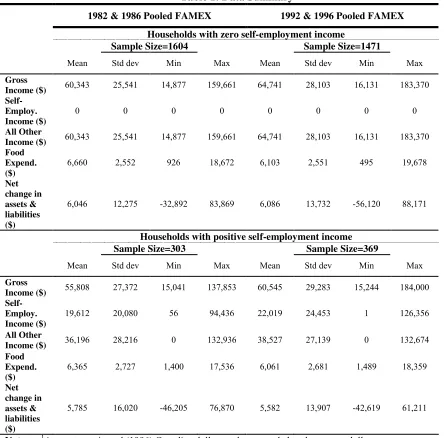
Table 1 provides some summary statistics of the data. The top half of the table presents
statistics for households with zero self-employment income, while the bottom half of the table
presents statistics for households with positive self-employment income. The left column shows
13
Similar estimates to those reported above were obtained when food expenditures were restricted to include only expenditures on food consumed at home.
14
Net change in assets and liabilities includes total net change in assets (including cash held in banks, money owed to households, money deposited against future purchases, net contributions less withdrawals to Registered Retirement Savings Plans, financial assets, sales of personal property, real estate, and investments in unincorporated business or farms) less net change in debts (including loans with regular payments and other money owed).
15
statistics for the 1982/1986 pooled sample and the right column for 1992/1996. The two
household groups report comparable average incomes, changes in assets, and expenditures on
food in each of the two samples, but self-employed households have greater variability in their
assets in the 1982/1986 sample.
3.2. Implementation Details of the Nonparametric Estimator
Nonparametric estimation of equations (3) and (4) is achieved by employing the
locally-weighted least-squares procedure, using the Gaussian kernel, and adaptive bandwidth where the
initializing bandwidth was selected by cross-validation (Härdle and Marron 1990). Equation (3),
the inverse Engel curve, is estimated at every point in the data but assigns a weight of zero to
households with positive self-employment income in the estimation process. The reporting
function given by equation (4) is estimated only for those households which report positive
self-employment income (ySE h, >0).
3.3. Results
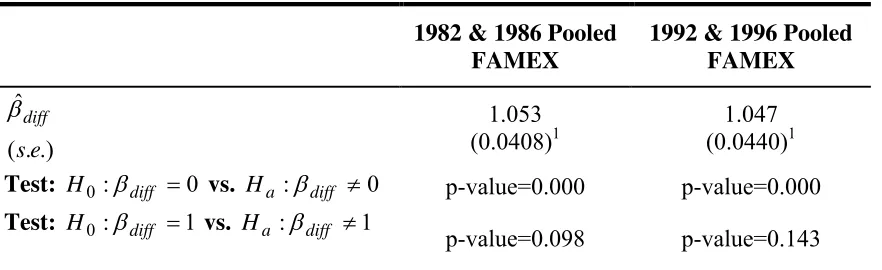
As outlined above, it is possible to test the significance of the Ah term in equation (3a).
The results of this test are outlined in Table 2. As before, the results for 1982/1986 are in the
column on the right and 1992/1996 are presented in the left-hand column. The parameter
estimates for diff , noted in the first row, are very close to unity in value. In both cases, the null
hypothesis that diff 0 is rejected with p-values of essentially zero, as is noted in the second
row of the table. The results for testing the null hypothesis that diff =1 are shown in the third
1% or 5% significance levels but would be rejected at a 10% significant level. For the
1992/1996 pooled dataset, the null hypothesis that diff 1 is not rejected at any conventional
significance level. Given the test results and the fact that the estimates for diff are
economically no different from unity, it is concluded that the A term should be included in the
analysis as outlined above and proceed accordingly.
Figure 2 presents graphs of the inverse food Engel curve, estimated from equation (3a).
Recall from above that equation (3a) can be consistently estimated on the sample of households
that report zero self-employment income and provides an estimate of true household income for
all households. The graph on the left is for the 1982/1986 pooled sample while the graph on the
right is for 1992/1996. Reported food expenditure is plotted on the horizontal axis and gross
household income, less changes in assets, is plotted on the vertical axis. For both samples, the
inverse food Engel curve appears linear over most food expenditures, but takes on some
curvature at higher levels of food expenditures, notably where the data becomes sparse.16 Figure 3 presents graphs of the nonparametrically estimated reporting function that were
obtained using equation (4). Again, the graph on the left is for the 1982/1986 pooled sample
while the graph on the right is for 1992/1996. Estimated true self-employment income is plotted
on the vertical axis and reported self-employment income is plotted on the horizontal axis. Both
axes use the log scale. Also shown are 90% bootstrapped confidence intervals obtained using the
“wild” bootstrap procedure (Wu 1986) which allows for heteroskedastic errors. The forty-five
degree line in the figures shows reported self-employment income. When the plot of estimated
16
true self-employment income is above the forty-five degree line, a household is under-reporting
their self-employment income. Each graph also presents three vertical lines, which represent the
tenth, fiftieth, and ninetieth percentiles of the data. This information is presented to provide the
reader with detail regarding the density of the data and its relation to the estimation of the
reporting function.
The graphs in Figure 3 show that the reporting function appears to be nonlinear. For the
1982/1986 pooled sample, estimated true employment income is above reported
self-employment income for households with less than almost $40,000 in reported self-self-employment
income, but under-reporting decreases as reported self-employment income approaches
approximately $40,000. For the 1992/1996 pooled sample, estimated true self-employment
income is above reported self-employment income for households with less than just over
$40,000 in reported employment income, but under-reporting decreases as reported
self-employment income increases beyond approximately $40,000. While this result may appear to
be counter-intuitive, it supports the primary result of the model of tax compliance proposed by
Reinganum and Wilde (1985, 1986).
Beyond the approximate $40,000 threshold amount in both samples, the results indicate
that households over-report self-employment income. It should be noted that the estimated
number of married households that over-report is small in percentage terms. There are two
possible explanations for the over-reporting finding. First, this particular result could be driven,
at least in part, by data sparsity and a breakdown in the nonparametric procedures. In both
pooled samples, the data are sparse beyond $40,000. In the 1982/1986 pooled sample, the
ninetieth percentile occurs at approximately $46,800 ($55,000 in the 1992/1996 pooled sample).
self-employment income falls below reported self-self-employment income. Second, some self-employed
households may over-report their income due to a misinterpretation of tax laws, to avoid a tax
audit, to secure financing, and/or to exploit various tax deductions, credits and loopholes in an
effort to reduce their tax bill. This is an issue that has not received a lot of attention in the tax
evasion literature to date and the parametric restriction imposed on the Expenditure-Based
Method previously masked this possible behaviour. It should be noted that Rice (1992), using
the U.S. Internal Revenue Service’s (IRS) Tax Compliance Measurement Program (TCMP) data,
found that about 6% of firms overstate their taxable income to some extent, providing some
support for this hypothesis.
As mentioned above, it is possible to test whether or not the reporting function, equation
(4), is linear, as assumed previously in the literature. Table 3 summarizes the results of the test
of null hypothesis, that the reporting function takes the form of equation (1), against the
alternative, that the reporting function takes the nonparametric specification of equation (4). The
results for the 1982/1986 pooled dataset are noted in the first column. The value of the test
statistic is noted in the first row and the associated p-value is reported in the second row. A
value for the test statistic of 1.306 is obtained with an associated p-value of 0.096; hence, the null
hypothesis,H0: ySE h* , ySE h, , is rejected in favour of the alternative, Ha:ySE h* , f y( SE h, ),
at the 10% significance level. For the 1992/1996 pooled dataset, the results of which are
reported in the column on the left of Table 3, a value for the test statistic of 2.863 is obtained,
noted in the first row, with an associated p-value of essentially zero, shown in the second row.
Therefore, the null hypothesis is rejected at all of the usual significance levels. However, some
caution should be exercised in interpreting these results since this test statistic is known to suffer
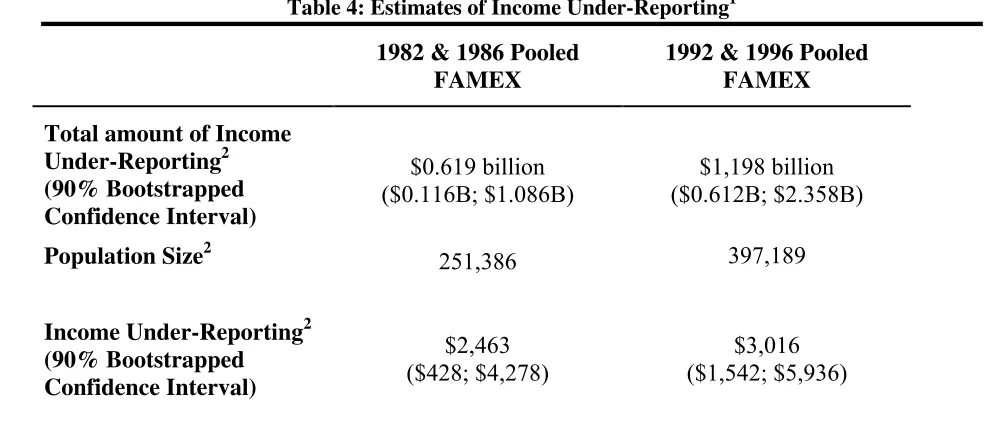
Table 4 reports household population estimates of income under-reporting by the
Canadian self-employed for 1982/1986, presented in the column on the left, and 1992/1996 in
the column on the right. The total amount of income under-reporting is found by subtracting
reported self-employment income from estimated household true self-employment income and
summing up over households. The first row of table 4 shows the population estimates for total
income reporting, obtained by using the FAMEX survey weights. Total income
under-reporting almost doubled between the 1980’s and the 1990’s, amounting to just over $0.619
billion in the 1982/1986 pooled sample and increasing to approximately $1.198 billion in the
1992/1986 pooled sample. The associated 90% bootstrapped confidence intervals are noted in
the parenthesis. There are two things to note with respect to the reported confidence intervals.
First, for both samples, the confidence intervals indicate that total income under-reporting was
statistically significantly greater than zero. Second, the overlapping of the confidence intervals
suggests that total income under-reporting in 1992/1996 was not statistically significantly
different from total income under-reporting in 1982/1986. Further statistical tests confirm that
the difference is not statistically significant.
As the number of self-employed households increased between the two pooled samples,
as shown in the second row of table 4, it could be that the increase in total income
under-reporting was simply due to the increase in self-employed households over the sample period,
rather than due to the implementation of the GST. In order to determine if there was a change in
the amount of income reporting per household, the average per household income
under-reporting is calculated.17 Despite the fact that the number of self-employed households increased
17
between these two pooled samples, there was an increase in the average amount of
self-employment income that went unreported. Income under-reporting per married household,
presented in the third row, amounted to $2,462.70 in the 1982/1986 pooled sample and
$3,015.71 in the 1992/1996 pooled sample. The 90% bootstrapped confidence intervals for these
per household amounts are presented in the final row of the table. Again, for both samples, the
confidence intervals indicate that average income under-reporting is statistically significant, but
the results are not statistically different from each other. That is, the results do not support the
notion that the GST increased income under-reporting by married households with
self-employment income. The results also do not support the claim that the GST would decrease tax
evasion.
3.4. Limitations
The results presented above call into question many of the assumptions made in the
parametric approach of the Expenditure-Based Method. That said, some caution needs to be
exercised in interpreting these specific results, as the reliability of the estimate depends on the
quality of the data. There are some notable features of the FAMEX that may bias the results
reported in this paper.
First, by using survey data, only those households that elected to take part in the survey
can be studied. Households that are heavily involved in underground activity, particularly those
households that are involved in illegal activity (for example, drug trafficking, human smuggling,
and prostitution), are unlikely to participate in the survey or may elect to modify their reported
Second, unlike household income and expenditure surveys conducted in other countries,
the FAMEX is a recall survey. That is, the data for the FAMEX is collected in March/April of a
given year, but covers expenditures for the previous year. It is possible that the expenditure data
used in the analysis may suffer from recall bias.18 In addition, data collectors make attempts to ensure that total expenditures are roughly equal to total income. In particular, income must
balance expenditures to within 10% and records where expenditures exceed all sources of
income by 20% or more are rejected. As a result, it is reasonable to assume that the estimates
obtained for the underground economy using this method will be a lower bound estimate. The
response rate for the FAMEX averages around 70%.
Third, income reported in the FAMEX may not be the same as income reported to the tax
authority by households. Households are not required to produce any proof of income and there
is no note in the FAMEX if the interviewer reviewed any such documents. To the extent that
income reported in the FAMEX differs from that reported to the tax authority, the results
outlined in this paper will be biased but it is unclear in which direction the results will be biased.
Finally, the unit of analysis, ideally, would be individuals, as it would avoid assuming
households act as single decision makers and because in Canada, taxes are assessed on the
individual rather than the household. In the FAMEX, however, expenditures are only surveyed
at the household level and there are insufficient observations to conduct the analysis on single
adult households. Additionally, as the FAMEX does not contain information regarding after-tax
income by income source19, the application was conducted using gross income. After-tax
18
Ahmed et al. (2005) compare income and food expenditure information collected in a diary based survey (FOODEX) to those collect in a recall based survey (FAMEX) and find little difference.
19
income is more desirable in this analysis as households are more likely to base their expenditures
on after-tax income. Further, as previously mentioned, income tax in Canada is assessed on the
individual rather than on the household. As a result, households with similar gross incomes, may
not have comparable net income and hence may not have comparable expenditures, which would
lead to a biased estimate of true gross income in the first step of the approach.
This analysis was also conducted on married households, living in both rural and urban
areas. Limiting the analysis to households living only in urban areas, resulted in insufficient
observations. It is extremely likely that households in urban and rural environments, have
different levels of food expenditures at similar income levels for reasons that are unassociated
with income under-reporting. For example, households in rural environments may be more
likely to: grow food for consumption in a household garden; face reduced food prices due to the
presence of local producers and suppliers; and engage in the trade of goods and services for food
products. To the extent that this is true, food expenditures for rural households with no
employment income will act as a poor counterfactual for urban households with positive
self-employment income and vice versa.
Caution must also be exercised in interpreting and comparing the results presented here
to those obtained by alternate methods. The results presented here, income under-reporting by
married households with self-employment income, should not be interpreted as representing a
measure of the total underground economy. Households with self-employment income but with
different demographic characteristics (e.g. households with children, single person households
etc.) may engage in income under-reporting at different rates than married households.
Additionally, income under-reporting by the self-employed, represents only a portion of
underground activity. Finally, the method presented in this paper, estimates income that is not
reported to tax authorities, which is quite distinct from measuring production or income that is
missed by the statistical offices when they calculate the value of the national product. Many
methods employed in estimating underground activity use the latter calculation. Giles and Tedds
(2002), updated by Tedds (2005), provide a summary of the available Canadian estimates of
underground activity, arranged according to methodology and calculation employed, should
additional, independent comparisons be desired.
4. CONCLUSION
This paper proposes a nonparametric approach for estimating income under-reporting by
households with self-employment income. The use of nonparametric methods is shown to have
several advantages over previous parametric approaches. First, it enables the reporting function
to vary across income levels and household characteristics. Second, it provided the ability to
test, and find evidence against, the previously held hypothesis that the reporting function takes
the linear form. Third, the framework allowed for an alternative approach to addressing the issue
of permanent income. A further advantage of this method is the ease in which population
estimates can be generated. In particular, the total amount of unreported income in the
population could be obtained directly, whereas previous studies could only extrapolate this
information by using national accounts data. Overall, the approach outlined in this paper calls
into question many of the assumptions made in the parametric applications of the
Expenditure-Based Method.
The approach outlined in this paper is illustrated by estimating the effect of the Canadian
self-employment income. The results indicate that income under-reporting by married households
with self-employment income neither increased nor decreased following the implementation of
the GST. The results indicate that income under-reporting increased, in real (1996) dollar terms,
from $2,462.70 per household in the 1980’s to $3,015.71 per household in the 1990’s, following
the implementation of the GST, but that this difference is not statistically significant. Caution
needs to be exercised in interpreting these specific results, as the reliability of the estimate
depends on the quality of the data and on the various assumptions made. Evidence is provided
that supports the notion that the obtained estimates of income under-reporting reported in this
paper are lower bound estimates.
The analysis presented in this paper indicates that further work is required in refining this
method to improve consistency with available data and knowledge concerning participation in
the underground economy. In particular, redefining the base group is warranted, as is exploring
a relaxation of the assumption that requires the marginal propensity to consume out of
unreported income to equal the marginal propensity to consume out of reported income. It may
also be worthwhile to consider alternative forms of the reporting function. Finally, several
shortcomings related to the use of the FAMEX were described in this paper, shortcomings that
are shared by comparable data sets for other countries. The most important of these is that
income reported in the FAMEX may not be the same as income reported to the tax authority by
households because households are not required to produce any proof of income. Tax filer data,
on the other hand, would have exact information regarding income and, hence, would provide
more accurate estimates of income under-reporting. Unfortunately, tax filer data does not
contain detailed information regarding expenditures. It does, however, contain information
may be possible to use this information and the method outlined in this paper to obtain more
REFERENCES
Ahmed, Naeem, Matthew Brzozowski and Thomas F. Crossley (2005), “Measurement Errors in Recall Food Expenditure Data,” Working Paper, Department of Economics, McMaster University, WP 2004-16.
Banks, J., Blundell, R., and Lewbel A. (1997), “Quadratic Engel Curves and Consumer Demand,”. Review of Economics and Statistics, 4, 527-538.
Blundell, R., Duncan A., and Pendakur K. (1998), “Semiparametric Estimation and Consumer Demand,”Journal of Applied Econometrics, 13, 435-461.
Browning, M. and Thomas, I. (1999), “Prices for the FAMEX: Methods and Sources,” Working Paper, Department of Economics, McMaster University.
Dilnot, A.W. and Morris, C.N. (1981), “What do We Know About the Black Economy?”Fiscal Studies, 2, 58-73.
Feige, E.L. (1979), “How Big is the Irregular Economy?”Challenge, 22, 5-13.
Frey, B.S. and Weck-Hanneman, H. (1984), “The Hidden Economy as an Unobserved Variable,”
European Economic Review, 26, 33-53.
Giles, D.E.A. and Tedds, L.M. (2002) Taxes and the Canadian Hidden Economy, Toronto: Canadian Tax Foundation.
Gutmann, P.M. (1977), “The Subterranean Economy,”Financial Analysts Journal, 34, 24-27.
Härdle, W. and Marron, J.S. (1990), “Semiparametric comparison of Regression Curves,”Annals of Statistics, 18, 63-89.
Hill, R. and Kabir, M.. (1996), “Tax Rates, the Tax Mix, and the Growth of the Underground Economy in Canada: What Can We Infer,”Canadian Tax Journal, 44, 1552-1583.
Lyssiotou, P., Pashardes, P. and Stengos, T. (2004), “Estimates of the Black Economy Based on Consumer Demand Approaches,”Economic Journal, 114, 622-639.
Mirus, R. and Smith, R.S. (1997), “Self-Employment, Tax Evasion, and the Underground Economy: Micro-Based Estimates for Canada,” Working Paper, International Tax Program, Harvard Law School.
Pissarides, C.A. and Weber, G. (1989), “An Expenditure-based Estimate of Britain’s Black Economy,”Journal of Public Economics, 39, 17-32.
Reinganum, Jennifer F. and Louis L. Wilde (1985), “Income Tax Compliance in a Principal-Agent Framework,” Journal of Public Economics, 26, 1-18.
______. (1986), “Equilibrium Verification and Reporting Policies in Model of Tax Compliance,” International Economic Review, 27, 739-760.
Rice, E.M. (1992), “The Corporate Tax Gap: Evidence on Tax Compliance by Small Corporations,” in Why People Pay Taxes: Tax Compliance and Enforcement, ed. Joel Slemrod, 125-166, Ann Arbor: The University of Michigan Press.
Schuetze, H.J. (2002), “Profiles of Tax Noncompliance Among the Self-Employed in Canada, 1969-1992,”Canadian Public Policy, XXVIII, 219-237.
Smith, S. with Pissarides, C.A. and Weber, G. (1986), “Evidence from Survey Discrepancies,” in
Britain’s Shadow Economy, ed. Stephen Smith, 137-153, Oxford: Clarendon Press.
Spiro, P.S. (1993), “Evidence of a Post-GST Increase in the Underground Economy,” Canadian Tax Journal, 41, 247-258.
Tanzi, V. (1980), “The Underground Economy in the United States: Estimates and Implications,”
Banco Nazionale del Lavoro, 135, 427-453.
Tedds, L.M. (2005), “The Underground Economy in Canada,” in Size, Causes and Consequences of the Underground Economy, ed. by Chris Bajada and Friedrich Schneider. Aldershot: Ashgate Publishing (forthcoming).
Thomas, J. (1999), “Quantifying the Black Economy: Measurement without Theory Yet Again,”
Economic Journal, 109, F381-F337.
Wu, C.F.J. (1986), “Jackknife, Bootstrap, and Other Resampling Methods in Regression Analysis,”Annals of Statistics, 14, 1261-1350.
Yatchew, A. (1998), “Nonparametric Regression Techniques in Economics,” Journal of Economic Literature, 36, 669-721.
TABLES
Table 1: Data Summary1
1982 & 1986 Pooled FAMEX 1992 & 1996 Pooled FAMEX
Households with zero self-employment income
Sample Size=1604 Sample Size=1471
Mean Std dev Min Max Mean Std dev Min Max
Gross
Income ($) 60,343 25,541 14,877 159,661 64,741 28,103 16,131 183,370
Self-Employ. Income ($)
0 0 0 0 0 0 0 0
All Other
Income ($) 60,343 25,541 14,877 159,661 64,741 28,103 16,131 183,370
Food Expend. ($)
6,660 2,552 926 18,672 6,103 2,551 495 19,678
Net change in assets & liabilities ($)
6,046 12,275 -32,892 83,869 6,086 13,732 -56,120 88,171
Households with positive self-employment income
Sample Size=303 Sample Size=369
Mean Std dev Min Max Mean Std dev Min Max
Gross
Income ($) 55,808 27,372 15,041 137,853 60,545 29,283 15,244 184,000
Self-Employ. Income ($)
19,612 20,080 56 94,436 22,019 24,453 1 126,356
All Other
Income ($) 36,196 28,216 0 132,936 38,527 27,139 0 132,674
Food Expend. ($)
6,365 2,727 1,400 17,536 6,061 2,681 1,489 18,359
Net change in assets & liabilities ($)
5,785 16,020 -46,205 76,870 5,582 13,907 -42,619 61,211
Table 2: Testing the Significance of Ah
1982 & 1986 Pooled FAMEX
1992 & 1996 Pooled FAMEX
.) . (
ˆ
e s
diff
1.053
(0.0408)1
1.047 (0.0440)1 Test: H0:diff 0 vs. Ha :diff 0 p-value=0.000 p-value=0.000 Test: H0:diff 1 vs. Ha :diff 1
p-value=0.098 p-value=0.143
[image:35.612.66.518.272.444.2]Notes: 1Standard errors corrected for autocorrelation as discussed in the text.
Table 3: Testing Linearity of the Reporting Function
Test: H0 : y*SE h, ySE h, vs. Ha:y*SE h, f y( SE h, )
1982 & 1986 Pooled FAMEX 1992 & 1996 Pooled FAMEX
V
p-value
1.306
0.096
2.863
Table 4: Estimates of Income Under-Reporting1 1982 & 1986 Pooled
FAMEX
1992 & 1996 Pooled FAMEX
Total amount of Income Under-Reporting2
(90% Bootstrapped Confidence Interval)
$0.619 billion ($0.116B; $1.086B)
$1,198 billion ($0.612B; $2.358B)
Population Size2 251,386 397,189
Income Under-Reporting2 (90% Bootstrapped Confidence Interval)
$2,463 ($428; $4,278)
$3,016 ($1,542; $5,936)
Notes 1Amounts are in real (1996) Canadian dollars and are rounded to the nearest dollar.
2
Calculated for married households without dependent children present in the hosuehold that report positive self-employment income using the survey
FIGURES
Figure 1: Income Under-reporting in the Single Equation Expenditure-Based Method
Log of
Expenditures Self-Employed
Households
Employee Households
Y Y*
E*
F
igu
re
2:
I
n
ve
rs
e F
ood
E
n
ge
l C
u
rve
[image:38.612.96.553.61.673.2]38