Minimize loss and Delay in VANETs using
Predicate Clustering with CRCN Environment
Aman Jyoti#,
#
Department of computer science, Punjabi University Regional Center of IT and Management, Mohali India
Abstract— Vehicular Ad Hoc Networks is a distributed network which does not rely on central administration for communication among vehicles, between vehicles and fixed road side unit. Some recent studies have demonstrated that other technology might not provide sufficient spectrum for reliable exchange of safety informations due to which problem of delay and loss occurred. In purposed work we focus on these issues and present new approach VANETs using Clustering with CRCN Environment. To overcome problem of delay, loss in safety message transmission, the cognitive radio can be utilized in transmission of safety messages and we use the new approach of Clustering that is the collection of mobile nodes in which cluster head is elected to get and forward the information of each and every node in cluster. The cognitive network uses primary and secondary users on the basis of CCH uses sensing approach that detects available channel and check the quality of channel. Spectrum sensing is used to detect which spectrum bands is free at that time and spectrum allocation is worked to allocate it to vehicle nodes. Road side units are established at 100-300m distant on sides of road to receive and forwarding the safety messages from near by nodes to another nodes that are not reachable to that vehicles node. Index Terms— CCH, Clustering, CRCN, DSR, DSDV, Spectrum Sensing, VANET.
I.
INTRODUCTION1.1 VANET : It is one of the most important protocols used to allocate spectrum for vehicular communication which are created by applying the principles of mobile ad-hoc networks by the spontaneous creation of a wireless network for data exchange to the domain of vehicles by the maximum utilization of bandwidth. A VANET turns participating car into a wireless router or node which allowing cars range between 100 to 300 meters to connect with each other and create a network with a wide range. when cars fall out of the signal range and drop out of the network and other cars can join in, connecting vehicles to one another to Frequent exchange of information so that a mobile network is created. It is estimated that this technology are used by police and fire vehicles to communicate with each other for the purpose of security [5]. It is a complex system equipped with advanced technologies such as the artificial intelligence, automatic control, computer and communication. In a V ANET, vehicles will rely on the integrity of received data for deciding when to present alerts to drivers. The communication between car to car, car to roadside unit done through wireless communication [6].
Aman Jyoti, Department of Computer Science, Punjabi University/
Regional centre of IT and Management, Mohali, Gurdaspur, India, Mobile No: 917696692273.
The VANET nodes have no issue of energy and computation resources. This allows VANET usage of demanding techniques such as RSA, ECDSA implementation and also provides unlimited transmission power. Better Physical [11].
1.2 Road side unit : The short transmission node is used
by vehicle node. RSU’s are spread sporadically or regularly depending on the deployment of the network in any particular region. In reality spread sporadically. They act as an intermediary node between the Central Authority (CA) and Vehicular Node (VN). Existing authentication protocols to secure vehicular ad hoc networks raise challenges like as certificate distribution and revocation, avoidance of computation and communication bottlenecks, and reduction of the strong reliance on tamper proof devices[10].
VANETs are a particular kind of Mobile Ad Hoc Network, (MANET) in which vehicles act as nodes and each vehicle is equipped with transmission capabilities which are interconnected to form a network. The topology created by vehicles is usually very dynamic and significantly non uniformly distributed. In order to transfer information about these kinds of networks, standard MANET routing algorithms are not appropriate [2].
Rollover warning is an vehicle node to RSU safety application. A RSU localized at critical curves can broadcast information about curve angle and road condition, so that, approaching vehicles can determine the maximum possible approaching speed before rollover and to avoid the collision [7].
1.3 Clustering and Cluster Parameters: Clustering is
the task of grouping a set of objects in such a way that objects in the same group are more similar to each other than to those in other groups (clusters). It is a main task of exploratory data mining, and a common technique for statistical data analysis, used in many fields, including machine learning, pattern recognition, image analysis, information retrieval, and bio-informatics. Some important parameters with regard to the whole clustering procedure are:
Number of clusters: It is depend upon the CH election and formation process lead to variable number of CHs are predetermined and preset. The number of clusters is usually a critical parameter with regard to the efficiency of the total routing protocol.
Nodes and CH mobility: The stationary sensor nodes and stationary CHs, which normally led to stable clusters with facilitated intracluster and intercluster network management forcing clusters to evolve over time and probably need to be continuously maintained.
Nodes types and roles: In heterogeneous environments, the CHs are assumed to be equipped with significantly more computation and communication resources than others. In homogeneous environments, all nodes have the same capabilities and just a subset of the deployed sensors is designated as CHs.
Cluster formation methodology: When CHs are just regular sensors nodes and time efficiency is a primary design criterion, clustering is being performed in a distributed manner without coordination. The coordinator nodes are used to partition the whole network off-line and control the cluster membership.
Cluster-head selection: The leader nodes of the clusters (CHs) in proposed algorithms can be preassigned. In most cases the CHs are picked from the deployed set of nodes either in a probabilistic or completely random way or based on other more specific criteria .
Algorithm complexity: The time complexity or convergence rate of most cluster formation procedures proposed nowadays is constant (just dependent on the number of CH). In some earlier protocols, however, the complexity time has been allowed to depend on the total number of sensors in the network.1.4 Cognitive Radio: It is an intelligent radio that can be
programmed and configured dynamically. Its transceiver is designed to use the best wireless channels in its vicinity. Such a radio automatically detects available channels in wireless spectrum, then accordingly changes its transmission or reception parameters to allow more concurrent wireless communications in a given spectrum band at one location [1].
This process is a form of dynamic spectrum management. In response to the operator's commands, the cognitive engine is capable of configuring radio-system parameters. These parameters include "waveform, protocol, operating frequency, and networking". This functions as an autonomous unit in the communications environment, exchanging information about the environment with the networks it accesses and other cognitive radios (CRs) [10].
A CR "monitors its own performance continuously", in addition to "reading the radio's outputs"; it then uses this information to "determine the RF environment, channel conditions, link performance, etc.", and adjusts the "radio's settings to deliver the required quality of service
Fig.1. Cognitive radio with working parameters[10]
subject to an appropriate combination of user requirements, operational limitations, and regulatory constraints" [12].
2. RELATED WORK
Signals with large bandwidth, thus smaller time duration, are needed to improve the precision of positioning, which is key for vehicle collision avoidance[8]. The high mobility of VANET increases the delay spread of waveforms, which can be alleviated by using larger frequency bandwidth. There is a significant requirement for large volume data flow in VANETs, e.g. traffic information message broadcast and communications to road side stations. Particularly, relay based Internet on the highway can substantially increase the traffic volume[7]. The Wireless Access in Vehicular Environments does not provide sufficient spectrum for reliable exchange of safety information, specifically in safety message delay is not acceptable and exceeds application requirements[2]. To overcome problem of delay in safety message transmission the cognitive radio can be utilized in transmission of safety messages. The cognitive network uses primary and secondary users on the basis of spectrum sensing is done to detect which spectrum is free at that time. CCH uses sensing approach that detects spectrum allowed for 5.8 GSM Hz band[10].
A new category of intelligent sensor network applications emerges where motion is a fundamental characteristic of the system under consideration. In such applications, sensors are attached to vehicles or people that move around large geographic areas. For instance, in mission critical applications of WSNs, sinks can be associated to first responders. In such scenarios, reliable data dissemination of events is very important, as well as the efficiency in handling the mobility of both sinks and event sources. For this kind of applications, reliability means real-time data delivery with a high data delivery ratio [11]. Broadcasting of safety messages requires an effective broadcast mechanism. Typically, selection of the probe node is the major problem in VANET broadcasting. The process of the probe node selection and broadcasting of safety messages must be achieved in a limited time. Meanwhile, the transmission reliability must also be preserved. Multi behavior and Reliable Broadcast (MRB) protocol is especially designed for an optimum performance of safety applications and addresses these constraints[6].
3. METHODOLOGY
The design of algorithm will be comprised of three phases:-
First Phase:- In this phase VANET scenario is
implemented on the basis of parameters. The number of nodes are initialized using clustering in different lanes and cluster-head is elected which is one of node in same cluster then energy provided to each and every node. Mac layer is used for error detection and transmission. The roting protocols DSR, DSDV are implemented for the routing of various nodes in the VANETs. The RSU is implemented in VANETs for sending of positions and speed of the nodes to other distant nodes in the network.
Second phase:- In this phase CRCN is implement in the
VANETs scenario to utilize free bandwidth. In this CCH and spectrum sensing worked to sensing of available bands which are in usable and ideal state in the cognitive radio that assigned to primary and secondary users of cognitive radio. The RSU utilize the band width available for system on the time of data transmission.
Third phase:- In this simulations parameters are
performed on demand of routing protocol for data transmission in the network. The process of transmission is done by utilize the free bandwidth of cognitive radio networks by that nodes have packets dropped. In this phase, performance of the proposed work is analyzed on the base of parameters like packet drop ratio, delay of message, delivery ratio, congestion, safety of messages to prove it is more secure.
NS2 is the network simulator tool which used for implementation of the proposed problem.[10]
4. TECHNIQUES USED
4.1 Dynamic Source Routing (DSR): The DSR network
is totally self organizing and self configuring. It is efficient routing protocol designed specifically for use in multi-hop wireless ad hoc networks of mobile nodes. It compose of two mechanisms i.e. route discovery and route maintenance. The DSR regularly updates its route cache for the sake of new available easy routes[3]. In route discovery, it has two messages first is route request (RREQ) and second route reply (RREP). If a node want to send a message to a any destination, it broadcast the RREQ message in the network. The nodes in the broadcast range receive RREQ message and add their own address then again broadcast it in the network. This RREQ message if reached to the destination, so that is the route to the specific destination. The first message reached to the destination has full information about the route then that node will send a RREP message to the sender having complete route information. This way route is considered the shortest path. Now the source node has complete information about the route in its cache and can starts routing of packets[13].
In route maintenance, two kind of messages route error (RERR) and acknowledgement (ACK). The messages successfully received by the destination nodes send an acknowledgement ACK to the sender. If there is some problem in the communication network a route error message denoted by RERR is transmitted to the sender, that there is some problem in the transmission[13].
4.2 Dynamic Destination Sequence-Vector Routing
This is designed for MANETS for each node of the network maintains a list of all destinations and number of hops to each destination and marked each entry with a sequence number. It use incremental update to reduce network traffic generated by route updates. To avoid the routing loops in network the broadcast of route updates is delayed by settling time. This routing information is always available[13]. In addition of sequence numbers, routes for the same destination are selected based on the following rules:
A route with a newer sequence number is preferred.
Two routes have a same sequence number, one with better cost metric is preferred.Each row of the update send is in the form <Dest. IP address, Dest. sequence number, Hop count>. The sequence number is used to distinguish stale routes from new ones and thus it avoids the formation of loops. The stations periodically transmit routing and updated tables to their immediate neighbors[13].
After receiving an update neighboring nodes utilizes it to compute the routing table entries
Fig. 2. Resolving route failure in DSDV[13]
4.3 CCH (Cognitive Channel Hopping): CCH divides
time into rounds, within each there are two phases. A round begins with a channel quality assessment (CQA) phase, during which a node scans the band to assess the quality of each channel. According to the results of this process, the node selects a set of channels to use, such that the combined channel quality is maximal. Based on the selected channels, it generates two channel hopping sequences utx and urx, for transmission and reception, respectively [10]. The ensuing communication phase consists of time slots, or simply slots. By default, node channel-hops over receiving channels specified by urx every slot, waiting for possible data frames arriving at
sequence (utx) each slot. When it has a frame to transmit, it then switches to its transmission channel and transmits the frame. After the transmission of the frame, it returns to the receiving channel. If a new slot begins when the node is involved in a transmission/reception, the channel switch is deferred until after the transmission/reception completes. Within a slot, nodes use carrier sense and rely on the conventional RTS/CTS mechanism, as done in 802.11 DCF [2].
4.4 Spectrum sensing: A cognitive radio can sense range
and distinguish “range openings” which are those recurrence groups not utilized by the authorized clients or having restricted impedance with them. Spectrum sensing is believed as the most crucial task to establish cognitive radio networks. The various spectrum sensing techniques includes primary transmitter detection, cooperative detection and interference detection [12].
Spectrum sensing is the ability to measure, sense and be aware of the parameters related to the radio channel characteristics, availability of spectrum and transmit power, interference and noise, radio’s operating environment, user requirements and applications, available networks and nodes, local policies and other operating restrictions. To allow reliable operation of cognitive radios, it must be able to detect precisely the spectrum holes at the link level (that is certain frequency bands are not used for transmission at certain times), which gives spectrum sensing a critical role [10].
5. SIMULATION ENVIRONMENT
Table.1. of simulation and configuration parameters
S No. Configuration parameters Value
1. 802.11p data rate 3-6 mbps
2. Packet generation rate 512 mbps
3. Packet size 32-1024
4. Transmission range 250 m
5. Communication method Broadcast
6. Radio model Two way ground
7. Number of lanes 2per direction
8. Number ofnodes 57
9. Area(mxn) 1500x2100
10. Routing protocols DSR and DSDV
11. Maximum packet 500 ifq
12. Channel type Wireless Channel
13. Antenna OmniAntenna
14. Radio propagation model TwoRayGround
15. Interface queue type CMUPriQueue
16. Network interface type Phy/WirelessPhy
17. Link Layer type LL
It provides substantial support for simulation of TCP, routing and multicast protocols over wired and wireless networks. It consists of two simulation tools. The network animator (NAM) is use to visualize thesimulations. Ns2 fully simulates a layered network from the physical radio transmission channel to high-level applications. The Distributed Coordination Function (DCF) of IEEE 802.11 for wireless LANs is used as the MAC layer. Simulation environment consists of 100 wireless mobile nodes which are placed uniformly and forming a Mobile Ad-hoc Network, moving about over a 1500 X 2100 meters area for 100 seconds of simulated time. Nodes move according to "random waypoint" model [3].
6. RESULT & DISCUSSION
In this section, the results of purposed work is discussed
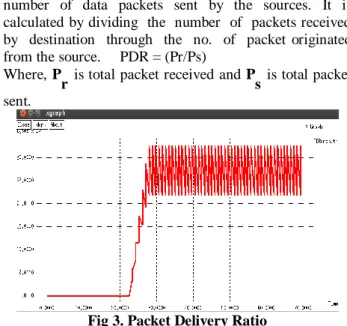
6.1 Packet delivery Ratio (PDR): It is the ratio of
all the received data packets at the destination to the number of data packets sent by the sources. It is calculated by dividing the number of packets received by destination through the no. of packet originated from the source. PDR = (Pr/Ps)
Where, P
r is total packet received and Ps is total packet
sent.
Fig 3. Packet Delivery Ratio
6.2 Throughput: It is the average at which data packet is
delivered successfully from one node to another over a communication network. It is measured in bits per second.
Throughput = (no of delivered packets * packet size)/ total duration of simulation
This graph represents throughput of the purposed system that communicate and transmit the message from vehicle to vehicles and road side units using bandwidth of the cognitive radio.
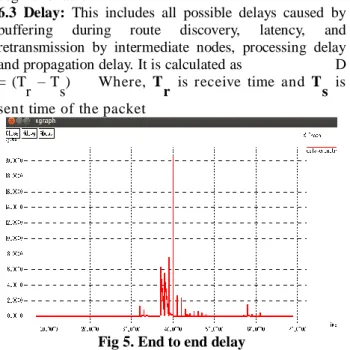
6.3 Delay: This includes all possible delays caused by
buffering during route discovery, latency, and retransmission by intermediate nodes, processing delay and propagation delay. It is calculated as D = (T
r – Ts) Where, Tr is receive time and Ts is
sent time of the packet
Fig 5. End to end delay
This figure represents the end to end delay of packets in the reliable communication of the VANET using cognitive radio scenario.
6.4 Packet loss: Packet loss is measured as a percentage
of packets lost with respect to packets sent. TCP detects packet loss and performs retransmissions to ensure reliable messaging.
Packet loss = Number of Packets send – Number of Packets received.
Fig 6. Packet Loss
This figure represents the packets loss in the reliable communication of the VANET using cognitive radio scenario.
7. CONCLUSION
The performance of the proposed work to utilize more bandwidth in VANETs using Cognitive radios and their techniques like CCH, Spectrum sensing, Spectrum allocation, Clustering and for routing DSR, DSDV is surely enhanced as proved in above results section. The results using routing protocol for various mobility, packet size and time interval metrics have been analyzed. The performance metrics to evaluate performance of the proposed work routing protocol includes load, average delay, packet delivery ratio, loss of packets on receiving side, throughput that means successfully delivered data. The message transmission utilizes bandwidth, so this
might creates problem of collision between the mobile vehicles which is the main problem in VANET. To overcome problem of delay, loss of safety message transmission, new approach Clustering and the cognitive radio is used to utilized bands in transmission of safety messages. Spectrum sensing is used to detect which spectrum is free at that time. CCH uses sensing approach that detects spectrum which has been assigned to primary and secondary users of cognitive radio. The RSU utilize the bandwidth available for system on the time of data transmission to the unreachable vehicle nodes.
REFRENCES
1.
Joanne Mun-Yee Lim “Cognitive VANET with Enhanced Priority Scheme” International Conf. on Telecommunications and Multimedia (TEMU), 2014, pp 116 – 121.2.
Kalkundri Ravi “AODV Routing in VANET for Message Authentication Using ECDSA” IEEE Conf. on Communications and Signal Processing (ICCSP), 2014, pp 1389 – 1393.3.
D Geetha, T Sarika 2, “Performance Analysis of TORA & DSR Routing Protocols inMobile Ad-hoc Networks”,ISSN- 2277-1956,IJECSE, 2011.4.
Hyun Yu “A VANET Routing based on the Real-time Road Vehicle Density in the City Environment” IEEE Conf. on Ubiquitous and Future Networks (ICUFN), 2013, pp 333 – 337.5.
Alwakeel, S “A virtual P-Persistent bandwidth partitioning manager for VANET's broadcast channel”, International conf. on Multimedia Computing and Systems (ICMCS), 2014, PP 1212 – 1215,.6.
Varshney “Security protocol for VANET by using digital certification to provide security with low bandwidth”, International Conf. on Communications and Signal Processing (ICCSP), 2014, PP 768 – 772.7.
Ghosh, T. “Congestion control by dynamic sharing of bandwidth among vehicles in VANET”, International Conf. on Intelligent Systems Design and Applications (ISDA), 2014, PP 291 – 296.8.
Gandhi, U.D “Request Response Detection Algorithm for detecting DoS attack in VANET”, International Conf. on Optimization, Reliability, and Information Technology (ICROIT), 2014, PP 192 – 194.9.
Meriam, E. “VANET adaptive and Reliable Broadcast protocol”, International Conf. on Wireless Communications and Mobile Computing Conference (IWCMC), 2014, PP 237 – 243.10.
Ali J. Ghandour a, Kassem Fawaz a, Hassan Artail a, Marco Di Felice b, Luciano Bononi “Improving vehicular safety message delivery through the implementation of a cognitive vehicular network” IEEE Conf. on Telecommunications (ICT), 2013, PP 123-765.11.
Srikanth Pagadarai “Characterization of Vacant UHF TV Channels for Vehicular Dynamic Spectrum Access”, IEEE Conf. on Vehicular Networking Conference (VNC), 2009, PP 1 – 8.12.
Marco Di Felice “Cooperative Spectrum Management in Cognitive”, IEEE Conf. on Vehicular Networking Conference (VNC), 2011, PP 47 – 54.13.
G. J. Moses, D. S. Kumar, “A Simulation Based Study of AODV, DSR, DSDV Routing Protocols in MANET using NS2”, ISSN: 2277 128X, IJARCSSE , 2012.Aman Jyoti received his Bachelor Degree in Computer Science and
Engineering in 2012 from Punjab Technical University, Jalandhar, India. She received his Master Degree in Computer Science in 2015, from Punjabi University, Patiala, India. I have select computer networking for my research Field in which I choosed VANETs and Cognitive Radios for research work. Participated in various Technical Events held in the Dept. Of CSE of the College. I have participated in various Technical Events held in the Dept. Of CSE of the College.
![Fig. 2. Resolving route failure in DSDV[13]](https://thumb-us.123doks.com/thumbv2/123dok_us/8218315.2178935/3.892.454.795.566.874/fig-resolving-route-failure-in-dsdv.webp)