Open Access
Research article
Extrapulmonary tuberculosis, human immunodeficiency virus, and
foreign birth in North Carolina, 1993 – 2006
Aaron M Kipp*
1, Jason E Stout
2, Carol Dukes Hamilton
2and Annelies Van
Rie
1Address: 1Department of Epidemiology, University of North Carolina, Chapel Hill, North Carolina, USA and 2Division of Infectious Diseases and International Health, Duke University Medical Center, Durham, North Carolina, USA
Email: Aaron M Kipp* - [email protected]; Jason E Stout - [email protected]; Carol Dukes Hamilton - [email protected]; Annelies Van Rie - [email protected]
* Corresponding author
Abstract
Background: The proportion of extrapulmonary tuberculosis (EPTB) reported in the United States has been gradually increasing. HIV infection and foreign birth are increasingly associated with tuberculosis and understanding their effect on the clinical presentation of tuberculosis is important. Methods: Case-control study of 6,124 persons with tuberculosis reported to the North Carolina Division of Public health from January 1, 1993 to December 31, 2006. Multivariate logistic regression was used to obtain adjusted odds ratios measuring the associations of foreign birth region and US born race/ethnicity, by HIV status, with EPTB.
Results: Among all patients with tuberculosis, 1,366 (22.3%) had EPTB, 563 (9.2%) were HIV co-infected, and 1,299 (21.2%) were foreign born. Among HIV negative patients, EPTB was associated with being foreign born (adjusted ORs 1.36 to 5.09, depending on region of birth) and with being US born, Black/African American (OR 1.84; 95% CI 1.42, 2.39). Among HIV infected patients, EPTB was associated with being US born, Black/African American (OR 2.60; 95% CI 1.83, 3.71) and with foreign birth in the Americas (OR 5.12; 95% CI 2.84, 9.23).
Conclusion: Foreign born tuberculosis cases were more likely to have EPTB than US born tuberculosis cases, even in the absence of HIV infection. Increasing proportions of foreign born and HIV-attributable tuberculosis cases in the United States will likely result in a sustained burden of EPTB. Further research is needed to explore why the occurrence and type of EPTB differs by region of birth and whether host genetic and/or bacterial variation can explain these differences in EPTB.
Background
The incidence of tuberculosis (TB) in the United States (US) has been declining over the past decades except for a resurgence from 1985 to 1992 (Figure 1) [1,2]. In 2006, the number of TB cases in the US reached an all-time low
with 13,779 new cases, corresponding to an incidence of 4.6 cases/100,000 persons [3]. The decline in extrapulmo-nary TB (EPTB) has not been as great as for pulmoextrapulmo-nary TB (PTB). Consequently, the proportion of EPTB cases has increased from 13.5% of all reported TB cases in 1975 to Published: 4 April 2008
BMC Public Health 2008, 8:107 doi:10.1186/1471-2458-8-107
Received: 27 August 2007 Accepted: 4 April 2008 This article is available from: http://www.biomedcentral.com/1471-2458/8/107
© 2008 Kipp et al; licensee BioMed Central Ltd.
This is an Open Access article distributed under the terms of the Creative Commons Attribution License (http://creativecommons.org/licenses/by/2.0), which permits unrestricted use, distribution, and reproduction in any medium, provided the original work is properly cited.
21.0% in 2006 (Figure 1) [3-6]. This relative increase may be an underestimate due to recent changes in case defini-tions, as cases with concomitant pulmonary disease or miliary disease are now counted as PTB cases [3-6]. Several studies have observed that the proportion of EPTB is higher among HIV co-infected individuals [7-11] and foreign born immigrants [8,9,12,13]. The latter popula-tion currently accounts for over half of all TB cases in the US [3].
Few studies have quantified the independent effect of HIV and foreign birth on EPTB and none have analyzed their joint association with EPTB. In this study, we investigated the association of HIV and foreign birth location, both individually and jointly, with the occurrence of EPTB among reported TB cases in North Carolina from 1993 to 2006.
Methods
We analyzed all verified TB cases in the North Carolina TB registry that were reported to the Division of Public
Health from January 1, 1993 through December 31, 2006. Cases were either laboratory, clinical, or provider verified using standard definitions from the Centers for Disease Control and Prevention (CDC) [3]. Demographic infor-mation, TB risk factors, disease presentation, and diagnos-tic and treatment information on each case were collected using the CDC's standardized Report of Verified Case of Tuberculosis form and entered into the North Carolina registry.
Variables used
The outcome of interest was EPTB, defined as any verified TB case whose site(s) of disease was not recorded as "Pul-monary". Individuals with concomitant PTB and EPTB were excluded due to insufficient numbers and because we aimed to analyze the effect of HIV and foreign birth region on exclusive EPTB.
Exposures of interest included HIV infection, foreign birth, region of birth, and US born race/ethnicity. HIV sta-tus was defined as positive, negative, or unknown. Foreign birth was defined as being born outside of the US or its
Reported tuberculosis cases and proportion by site of disease, United States, 1975–2006
Figure 1
Reported tuberculosis cases and proportion by site of disease, United States, 1975–2006. (Source: References [3–6]).
10000 15000 20000 25000 30000 35000 1975 1976 1977 1978 1979 1980 1981 1982 1983 1984 1985 1986 1987 1988 1989 1990 1991 1992 1993 1994 1995 1996 1997 1998 1999 2000 2001 2002 2003 2004 2005 2006 year T o tal T B case s r e p o rt e d 0% 10% 20% 30% 40% 50% 60% 70% 80% 90% 100% P e rc e n t E P TB or P T B
territories [3]. US and foreign born TB cases were catego-rized by race/ethnicity and region of birth, respectively, to account for differences in TB rates. US TB cases were cate-gorized as White/Caucasian, Black/African American, His-panic, or Other (Asian, American Indian, Native Alaskan, or Pacific Islander). Foreign born cases were classified as African, American (Central and South America and Carib-bean), European (including the Middle East and Russia), Indian (including Pakistan), Southeast Asian, and East Asian (further detail provided in the accompanying Appendix).
To allow for a detailed analysis of the association of EPTB with HIV and foreign birth, both individually and jointly, HIV status and race/ethnicity or birth region variables were combined into exclusive categories: HIV positive and foreign born by region, HIV positive and US born by race/ ethnicity, HIV negative and foreign born by region, and HIV negative and US born by race ethnicity. US born, White/Caucasian TB cases who were HIV negative served as the common referent group.
Statistical Analysis
Crude odds ratios (OR) and ORs from logistic regression were used to measure the association between each expo-sure category and EPTB. A final model was derived using backward elimination [14,15]. Further interactions beyond HIV infection by race/ethnicity or birth region were not considered. All covariates were assessed for con-founding. If the OR changed by more than 10% when a covariate was removed from the model, that covariate was considered a confounder and retained in the model [16]. Finally, a year variable was included in the model to account for increasing implementation of routine HIV testing during the study period.
All analyses were performed using SAS version 9.1.3. This study was approved by the Institutional Review Boards at the North Carolina Department of Public Health, Com-municable Disease Program and the University of North Carolina at Chapel Hill.
Results
Patient Characteristics
Between January 1, 1993 and December 31, 2006, a total of 6,416 verified cases of TB were reported and included in the North Carolina RVCT registry. Two hundred and ninety-two cases (4.6%) had both pulmonary and extrapulmonary disease and were excluded from analysis, resulting in a final study population of 6,124. Tables 1 and 2 show the distribution of socio-demographic and clinical variables by TB, HIV, and foreign birth status. Extrapulmonary TB occurred in 1,366 (22.3%) TB patients. These cases were more often provider verified,
HIV positive, foreign born, female, and 15 to 24 years old compared to PTB cases (Table 1). Among the foreign born, a larger proportion of EPTB cases had been in the US at least five years prior to TB diagnosis.
HIV co-infection was present in 563 (9.2%) of all TB cases, 35.5% had unknown HIV status due to testing not being performed. This decreased from 58.4% in 1993 to 8.1% in 2006. HIV co-infected TB cases were more often laboratory verified, diagnosed with EPTB, US born, male, 25 to 44 years old, with a recent history of being homeless and substance abuse in the past year (Table 2).
Foreign born cases accounted for 1,299 (21.2%) of all TB cases, increasing from 6.3% in 1993 to 37.2% in 2006. Over 60% came from 5 countries, including Mexico (38.0%), Vietnam (8.2%), India (6.9%), Philippines (4.4%), and Honduras (4.1%). Foreign born cases were more often diagnosed with EPTB, HIV negative, 15 to 44 years old, and lacked TB risk factors such as homelessness, illicit drug use, and excess alcohol use (Table 2). US born TB cases were primarily Black/African American (66.6%) or White/Caucasian (30.5%).
The location of EPTB varied by HIV and foreign birth sta-tus (Table 3). The most common sites of disease were the pleura (25.1%) and cervical lymph nodes (15.7%). HIV co-infected individuals were more likely to have non-cer-vical lymph node or miliary disease compared to HIV uninfected individuals, while foreign born EPTB cases were more likely to have cervical lymphadenitis than US born cases. The site of EPTB also varied by region of birth (Figure 2). Lymphatic TB accounted for 50% of EPTB in East Asia, 47% in India, 45% in Africa, 40% in Southeast Asia, and 35% in the Americas, but only 17% in Europe/ Middle East, and 21% in the US.
Univariate and Multivariate Analysis
In a crude analysis comparing all foreign born with all US TB cases, we found that foreign born cases without HIV infection had a slightly stronger association with EPTB (OR 1.84; 95%; CI 1.55, 2.18) than US born cases with HIV infection (OR 1.34; 95% CI 1.06, 1.69). Those who were both foreign born and had HIV infection had nearly three times the odds of EPTB compared with HIV unin-fected US born cases (OR 2.83; 95% CI 1.84, 4.34). Such generalizations, however, did not reflect the range of asso-ciations between EPTB and race/ethnicity, geographic regions, and HIV status.
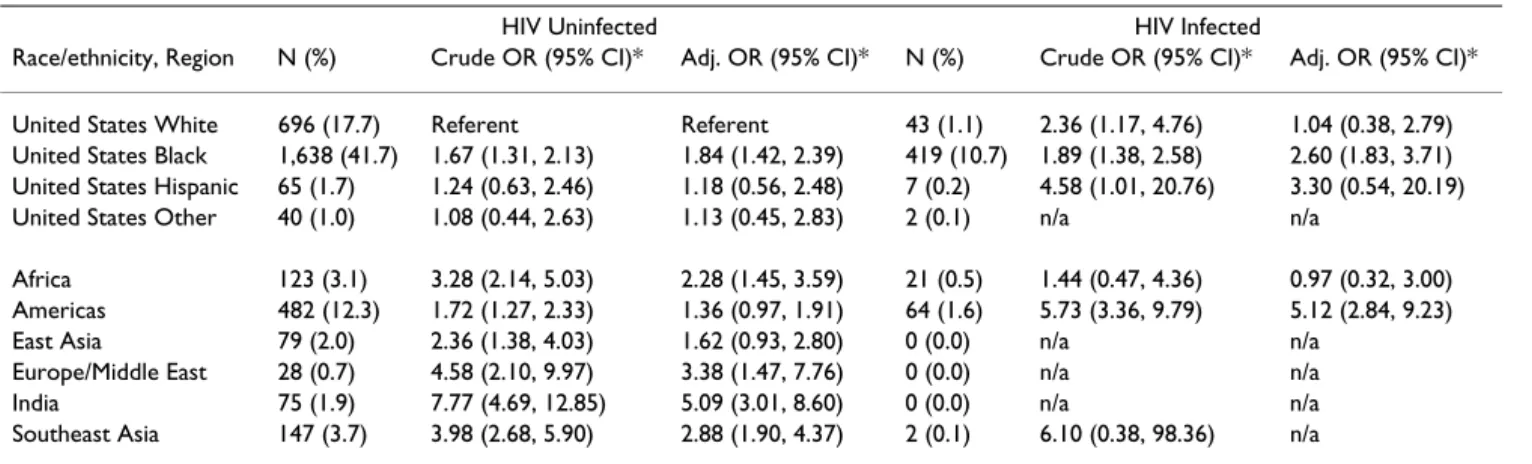
Results of the detailed analysis are given in Table 4. After adjusting for year, sex, age, injecting drug use, and alcohol use, HIV uninfected foreign born cases were more likely to have EPTB with adjusted ORs ranging from 1.36 to 5.09, depending on the region of origin. Among US born cases,
only Black/African American ethnicity was associated with EPTB in the absence of HIV infection (OR 1.84; 95% CI 1.42, 2.39).
HIV infection was also found to be associated with EPTB. Among US born cases, HIV infection was associated with EPTB in Black/African Americans (OR 2.60; 95% CI 1.83,
Table 1: Distribution of socio-demographic and clinical characteristics by disease site*.
Socio-demographic and clinical characteristics All TB cases (%) N = 6,124 EPTB (%) N = 1,366 PTB (%) N = 4,758 Verification† Laboratory 5,143 (84.0) 1.057 (77.4) 4,086 (85.9) Clinically 742 (12.1) 163 (11.9) 579 (12.2) Provider diagnosis 239 (3.9) 146 (10.7) 93 (2.0) HIV status Positive 563 (9.2) 151 (11.1) 412 (8.7) Negative 3,388 (55.3) 757 (55.4) 2,631 (55.3) Not tested 2,173 (35.5) 458 (33.5) 1,715 (36.0) Foreign-birth status Foreign 1,299 (21.2) 402 (29.4) 897 (18.9) United States 4,821 (78.7) 964 (70.6) 3,857 (81.1) Missing 4 (0.1) 0 (0.0) 4 (0.1) Sex Female 2,123 (34.7) 633 (46.3) 1,490 (31.3) Male 4,001 (65.3) 733 (53.7) 3,268 (68.7) Time in US‡ 0 – 1 years 384 (29.6) 84 (20.9) 300 (33.4) 2 – 5 years 446 (34.3) 136 (33.8) 310 (34.6) >5 years 443 (34.1) 174 (43.3) 269 (30.0) Missing 26 (2.0) 8 (2.0) 18 (2.0) Age (years) 0 – 4 150 (2.5) 29 (2.1) 121 (2.5) 5 – 14 136 (2.2) 33 (2.4) 103 (2.2) 15 – 24 422 (6.9) 112 (8.2) 310 (6.5) 25 – 44 1,872 (30.6) 459 (33.6) 1,413 (29.7) 45 – 64 1,753 (28.6) 334 (24.5) 1,419 (29.8) 65+ 1,790 (39.23) 399 (29,2) 1,391 (29.2) Missing 1 (0.0) 1 (0.0) Previous TB disease Yes 334 (5.5) 70 (5.1) 264 (5.6) No 5,783 (94.4) 1,293 (94.7) 4,490 (94.4) Missing 7 (0.1) 3 (0.2) 4 (0.1) Homeless Yes 410 (6.7) 35 (2.6) 375 (7.9) No 5,681 (92.8) 1,321 (96.7) 4,360 (91.6) Missing 33 (0.5) 10 (0.7) 23 (0.5)
Drug use (injecting)
Yes 98 (1.6) 16 (1.2) 82 (1.7)
No 5,255 (85.8) 1,205 (88.2) 4,050 (85.1)
Missing 771 (12.6) 145 (10.6) 626 (13.2)
Drug use (non-injecting)
Yes 580 (9.5) 71 (5.2) 509 (10.7)
No 4,785 (78.1) 1,150 (84.2) 3,635 (76.4)
Missing 759 (12.4) 145 (10.6) 614 (12.9)
Excess alcohol use
Yes 1,255 (20.5) 124 (9.1) 1,131 (23.8)
No 4,137 (67.6) 1,104 (80.8) 3,033 (63.8)
Missing 732 (12.0) 138 (10.1) 594 (12.5)
* Excluding 292 (4.6%) with concomitant pulmonary and extrapulmonary disease.
† Laboratory: positive M. tuberculosis culture or positive acid-fast stain; Clinical: positive tuberculin skin test, signs and symptoms consistent with TB, treatment with TB medication, and a completed diagnostic evaluation; Provider: cases that do not meet the laboratory or clinical case definition, but have a clinical picture consistent with TB.
Table 2: Socio-demographic and clinical characteristics by HIV and foreign birth status*. Socio-demographic and clinical
characteristics
HIV+ (%) N = 563 HIV – (%) N = 3,388 Foreign Born (%) N = 1,299 US Born (%) N = 4,821
Verification† Laboratory 516 (91.7) 2,873 (84.8) 1,070 (82.4) 4,070 (84.4) Clinical 16 (2.8) 383 (11.3) 163 (12.6) 579 (12.0) Provider 31 (5.5) 132 (3.9) 66 (5.1) 172 (3.6) Site of disease Extrapulmonary 151 (26.8) 757 (22.3) 402 (31.0) 964 (20.0) Pulmonary 412 (73.2) 2,631 (77.7) 897 (69.0) 3,857 (80.0) HIV status Positive 74 (7.8) 471 (9.8) Negative 943 (72.6) 2,444 (50.7) Not tested 264 (20.32) 1,906 (39.5) Foreign-birth status Foreign 92 (16.3) 943 (27.8) United States 471 (83.7) 2,444 (72.1) Missing 0 (0.0) 1 (0.0) Time in US‡ 0 – 1 years 22 (23.9) 271 (28.7) 2 – 5 years 31 (33.7) 351 (37.2) >5 years 34 (37.0) 305 (32.3) Missing 5 (5.4) 16 (1.7) Sex Female 122 (21.7) 1,101 (32.5) 474 (36.5) 1,649 (34.2) Male 441 (78.3) 2,287 (67.5) 825 (63.5) 3,172 (65.8) Age (years) 0 – 4 1 (0.2) 64 (1.9) 17 (1.3) 133 (2.8) 5 – 14 0 (0.0) 37 (1.1) 29 (2.2) 107 (2.2) 15 – 24 11 (2.0) 330 (9.7) 257 (19.8) 165 (3.4) 25 – 44 380 (67.5) 1,272 (37.5) 692 (53.3) 1,178 (24.4) 45 – 64 165 (29.3) 1,138 (33.6) 225 (17.3) 1,527 (31.7) 65+ 6 (1.1) 546 (16.1) 78 (6.0) 1,711 (35.5) Missing 1 (0.0) 0 (0.0) 1 (0.0) 0 (0.0) Previous TB disease Yes 33 (5.9) 187 (5.5) 6 (5.1) 268 (5.6) No 529 (94.0) 3,198 (94.4) 1,230 (94.7) 4,550 (94.4) Missing 1 (0.2) 3 (0.1) 3 (0.2) 3 (0.1) Homeless Yes 106 (18.8) 265 (7.8) 37 (2.9) 372 (7.7) No 445 (79.0) 3,115 (92.0) 1,250 (96.2) 4,428 (91.9) Missing 12 (2.1) 8 (0.2) 12 (0.9) 21 (0.4)
Drug use (injecting)
Yes 48 (8.5) 42 (1.2) 6 (0.5) 92 (1.9)
No 432 (76.7) 3,069 (90.6) 1,229 (94.6) 4,024 (83.5)
Missing 83 (14.7) 277 (8.2) 64 (4.9) 705 (14.6)
Drug use (non-injecting)
Yes 171 (30.4) 364 (10.7) 40 (3.1) 540 (11.2)
No 311 (55.2) 2,761 (81.5) 1,192 (91.8) 3,591 (74.5)
Missing 81 (14.4) 263 (7.8) 67 (5.2) 690 (14.3)
Excess alcohol use
Yes 210 (37.3) 864 (25.5) 89 (6.9) 1,165 (24.2)
No 278 (49.4) 2,289 (67.6) 1,143 (88.0) 2,993 (62.1)
Missing 75 (13.2) 235 (6.9) 67 (5.2) 663 (13.8)
* Excluding 292 (4.6%) with concomitant pulmonary and extrapulmonary disease; among remaining TB cases, 2,173 (33.5%) were not tested for HIV and 4 (0.1%) were missing foreign birth status.
† Laboratory: positive M. tuberculosis culture or positive acid-fast stain; Clinical: positive tuberculin skin test, signs and symptoms consistent with TB, treatment with TB medication, and a completed diagnostic evaluation; Provider: cases that do not meet the laboratory or clinical case definition, but have a clinical picture consistent with TB.
3.71). Among the foreign born, HIV infection was associ-ated with EPTB among those from the Americas region (OR 5.12; 95% CI 2.84, 9.23). The association could not be assessed for 4 regions because of small numbers of HIV co-infected patients.
Discussion
This study analyzed and quantified the individual and joint associations of HIV infection and foreign birth with
EPTB while controlling for important confounders. We observed that foreign born TB cases were more likely to have exclusive EPTB than US born TB cases, even in the absence of HIV infection. HIV infection was also associ-ated with exclusive EPTB above and beyond the effects of race/ethnicity or geographic region for Black/African Americans and foreign born cases from the Americas. We also found that the site of EPTB differed by region and HIV status. Lymphadenitis accounted for a disproportionate
Distribution of disease site by region of birth
Figure 2
Distribution of disease site by region of birth. * Includes Bone/Joint, Genitourinary, Meningeal, Miliary, Peritoneal, Pleural and other non-specified sites.
East Asia (n=119)
Southeast Asia (n=188) United States (n=4,821)
Europe/Middle East (n=44)
Africa (n=162) Americas (n=663)
India (n=103)
Lymphatic Other extrapulmonary* Pulmonary
Table 3: Distribution of extrapulmonary disease by HIV status and foreign birth*. Extrapulmonar
y site
All EPTB cases (%) n = 1,366
HIV + (%) n = 151
HIV- (%) n = 757
P value† Foreign born (%)
n = 402
US born (%) n = 964
P value†
Bone and/or joint 164 (12.0) 4 (2.7) 96 (12.7) .003 48 (11.9) 116 (12.0) .96
Genitourinary 78 (5.7) 5 (3.3) 40 (5.3) .31 24 (6.0) 54 (5.6) .79 Lymphatic: cervical 215 (15.7) 30 (19.9) 131 (17.3) .45 119 (29.6) 96 (10.0) <.001 Lymphatic: other 147 (10.8) 28 (18.5) 70 (9.3) .008 41 (10.2) 106 (11.0) .66 Meningeal 66 (4.8) 6 (4.0) 39 (5.2) .54 21 (5.2) 45 (4.7) .66 Miliary 158 (11.6) 38 (25.2) 87 (11.5) <.001 35 (8.7) 123 (12.8) .03 Other 135 (9.9) 15 (10.0) 73 (9.6) .91 40 (10.0) 95 (9.9) .96 Peritoneal 60 (4.4) 7 (4.6) 40 (5.3) .74 12 (3.0) 48 (5.0) .10 Pleural 343 (25.1) 18 (11.9) 181(23.9) .001 62 (15.4) 281 (29.2) <.001
* 458 (33.5%) of EPTB cases were missing HIV status. † Chi-square p-value for each category compared to all others
amount of EPTB among foreign born cases from East and Southeast Asian, Indian, and African regions. Miliary dis-ease and non-cervical lymphadenitis were more common among HIV co-infected cases.
Others have also documented an association between EPTB and foreign birth. Wilbershied et al. observed ORs, adjusted for HIV infection and other covariates, ranging from 0.9 to 3.9 for the association of exclusive EPTB with foreign born populations in New York City [9]. They did not account for race/ethnicity among the US born cases, which is an important limitation given we found that the occurrence of EPTB may differ by race/ethnicity.
A study of EPTB in Canada by Yang et al. found similar associations between foreign born status and EPTB, with crude ORs ranging from 1.72 to 2.53, when compared to non-Aboriginal Canadians [17]. HIV status was not adjusted for as only 1.8% of TB cases had HIV co-infec-tion. Patients with both pulmonary and extrapulmonary TB (8.3%) were included in the pulmonary TB group as opposed to being excluded as in our study.
Ong et al. reported an OR of 1.62 for the association of foreign birth with exclusive EPTB among TB cases in San Francisco [8], but the finding was not statistically signifi-cant. Their findings were adjusted for HIV status and race/ ethnicity, but did not account for region of birth among foreign born TB cases.
Similar to our findings, others have observed an associa-tion between EPTB and HIV. Ong et al. and Wilberschied et al. found small associations, with ORs of 1.3 to 1.45 while adjusting for foreign birth [8,9]. Onorato et al. reported that HIV infected persons were twice as likely to have EPTB as HIV uninfected persons [11], and Yang et al.
found that those with HIV infection had nearly 5 times the odds of EPTB than HIV uninfected TB cases [10]. These last two studies, however, included cases with concomi-tant PTB in the EPTB category. Concomiconcomi-tant pulmonary and extrapulmonary disease has been shown to be more common in HIV infected persons [7], which may explain the stronger association they observed.
While EPTB among HIV infected persons is related to immunosuppression, little is known about the factors associated with EPTB among foreign born populations. Some authors have speculated that this is an artifact of screening immigrants for PTB, which could inflate the proportion of EPTB by removing or treating those with PTB prior to immigration [18,19]. We feel this is unlikely, as such an affect would be seen mainly in the first year of immigration, while our and other data [9] suggest that EPTB occurs more often among immigrants who have been in the US more than 5 years. Other factors such as genetic variations in Mycobacterium tuberculosis and/or genetic variations in host immune response may account for the observations. Yang et al. found that TB patients infected with M. tuberculosis (MTB) containing a mutation in the phospholipase-C gene D had more than two times the odds of having extrathoracic TB (with or without tho-racic involvement) compared to those with the wild type strain (OR 2.19; 95% CI 1.27, 3.76), while controlling for HIV infection, sex and race [20]. Other studies have found genetic polymorphisms in host immune responses that are associated with EPTB, including Manose-Binding Pro-tein and TB meningitis [21], Interleuken (IL)-1β/IL-1R [22], IL-10 and IFN-γ [23], and NRAMP1 and pleural TB [24]. Fernando et al. found an association between a pol-ymorphism in the P2X7 gene and EPTB [25]. P2X7 is a receptor expressed on macrophages which facilitates induction and death of MTB. Polymorphisms that inhibit
Table 4: Odds ratios for each category of exposure and the association with EPTB.
HIV Uninfected HIV Infected
Race/ethnicity, Region N (%) Crude OR (95% CI)* Adj. OR (95% CI)* N (%) Crude OR (95% CI)* Adj. OR (95% CI)* United States White 696 (17.7) Referent Referent 43 (1.1) 2.36 (1.17, 4.76) 1.04 (0.38, 2.79) United States Black 1,638 (41.7) 1.67 (1.31, 2.13) 1.84 (1.42, 2.39) 419 (10.7) 1.89 (1.38, 2.58) 2.60 (1.83, 3.71) United States Hispanic 65 (1.7) 1.24 (0.63, 2.46) 1.18 (0.56, 2.48) 7 (0.2) 4.58 (1.01, 20.76) 3.30 (0.54, 20.19) United States Other 40 (1.0) 1.08 (0.44, 2.63) 1.13 (0.45, 2.83) 2 (0.1) n/a n/a
Africa 123 (3.1) 3.28 (2.14, 5.03) 2.28 (1.45, 3.59) 21 (0.5) 1.44 (0.47, 4.36) 0.97 (0.32, 3.00) Americas 482 (12.3) 1.72 (1.27, 2.33) 1.36 (0.97, 1.91) 64 (1.6) 5.73 (3.36, 9.79) 5.12 (2.84, 9.23)
East Asia 79 (2.0) 2.36 (1.38, 4.03) 1.62 (0.93, 2.80) 0 (0.0) n/a n/a
Europe/Middle East 28 (0.7) 4.58 (2.10, 9.97) 3.38 (1.47, 7.76) 0 (0.0) n/a n/a
India 75 (1.9) 7.77 (4.69, 12.85) 5.09 (3.01, 8.60) 0 (0.0) n/a n/a
Southeast Asia 147 (3.7) 3.98 (2.68, 5.90) 2.88 (1.90, 4.37) 2 (0.1) 6.10 (0.38, 98.36) n/a * OR, odds ratio; CI, confidence interval; Adj., adjusted for year, age, sex, injecting drug use, and alcohol use.
† Includes Asian, Pacific Islander, Alaskan Native, and American Indian. ‡ Cell counts too small to calculate association
receptor activity may facilitate the spread of MTB to extrapulmonary sites. Among Southeast Asian refugees in Australia, those with EPTB were more likely to have the polymorphism than healthy controls or patients with pul-monary TB (OR 3.8; 95% CI 1.6, 9.0).
Potential limitations of our study should be acknowl-edged. HIV testing was not done for 35.5% of the reported TB cases in our study. This has been noted in other studies analyzing surveillance data, with 30% to 50% of TB patients having unknown HIV status [9,10,26]. However, this is unlikely to affect validity and reliability of the data as noted in a recent analysis of California's TB registry [27]. While HIV testing and counseling is offered free of charge to TB patients at the health departments, incom-plete implementation of routine HIV testing likely accounts for why many patients were not tested. The patient may not have been offered an HIV test due to per-ceived low risk by the clinician, or the patient may have refused testing when offered. Either of these scenarios would result in missing HIV data. In our study, 54% of patients not tested for HIV were at low risk for HIV (>44 years old with no reported substance abuse or homeless-ness). Nevertheless, testing improved during the study
period with 92% of TB cases reported in 2006 receiving HIV testing (Figure 3).
Small numbers of HIV co-infected TB patients hindered our ability to analyze EPTB among foreign born persons with HIV infection, and the absence of CD4 count data precluded a more detailed analysis by level of immunosu-pression. This may be important as some studies have shown that EPTB, especially disseminated or meningeal disease, occurs more often in individuals with cell counts less than 200 cells/μl [28-30], even though other studies found no association between frequency of EPTB and decreasing CD4+ cell counts [31-33].
Conclusion
Extrapulmonary TB poses an important hurdle for the elimination of TB in the US. The proportion of EPTB will likely increase as foreign born and HIV attributable TB cases continue to rise in the US. Morbidity and mortality may be exacerbated in this group because of stigma, lan-guage, cultural, or immigration-related barriers to timely healthcare. Further research is needed to explore why the occurrence and type of EPTB differs by region of birth and whether host genetic and/or bacterial variation can explain these differences in EPTB.
Decline in percent of TB patients not tested for HIV infection, North Carolina, 1993–2006
Figure 3
Decline in percent of TB patients not tested for HIV infection, North Carolina, 1993–2006.
0 10 20 30 40 50 60 70 80 90 100 1993 1994 1995 1996 1997 1998 1999 2000 2001 2002 2003 2004 2005 2006 Year Pe rc e n t
Competing interests
The author(s) declare that they have no competing inter-ests.
Authors' contributions
AMK is responsible for data analysis and writing the man-uscript. CDH is responsible for acquisition of the data. All authors contributed to the design of the study and critical review of the manuscript.
Appendix: Countries of origin and the
corresponding region for all Tuberculosis cases
used in the analysis
African: Algeria, Benin, Burkina, Cameroon, Chad, Comoros, Congo, Democratic Republic of Congo, Dji-bouti, Egypt, Ethiopia, Europa Island, Gabon, Gambia, Ivory Coast, Kenya, Liberia, Mauritius, Mayotte, Morocco, Niger, Nigeria, Reunion, Senegal, Sierra Leone, Somalia, South Africa, Sudan, Togo, Uganda, Zambia.
American: Argentina, Barbados, Brazil, Cayman Islands, Colombia, Costa Rica, Cuba, Dominican Republic, Ecua-dor, El SalvaEcua-dor, Guadeloupe, Guatemala, Haiti, Hondu-ras, Mexico, Nicaragua, Panama, Peru, Trinidad and Tobago, Uruguay, Venezuela.
East Asian: China, Hong Kong, Japan, North and South Korea, Macau, Nauru, Philippines, Pitcairn Islands, Tai-wan.
European/Middle Eastern: Albania, Azerbaijan, Belarus, Bosnia and Hercegovina, France, Georgia, Germany, Greece, Iran, Ireland, Kazakhstan, Kuwait, Monaco, Oman, Romania, San Marino, Slovenia, Soviet Union, Spain, Syria, Turkey, Ukraine, United Arab Emirates. Indian: India, Pakistan.
Southeast Asian: Bangladesh, Burma, Cambodia, Indo-nesia, Laos, Malaysia, Nepal, Thailand, Vietnam.
United States: United States of America.
Acknowledgements
The authors would like to acknowledge the support and cooperation of Dr. Jeffrey Engel and the Communicable Diseases Branch of the North Carolina Division of Public Health. J.E.S is funded by NIH/NIAID K23 AI051409 and C.D.H is funded by NIH/NIAID K24 AI001833 and the North Carolina TB Control Program.
References
1. Frieden TR, Fujiwara PI, Washko RM, Hamburg MA: Tuberculosis
in New York City–turning the tide. N Engl J Med 1995, 333:229-233.
2. Cantwell MF, Snider DE Jr, Cauthen GM, Onorato IM:
Epidemiol-ogy of tuberculosis in the United States, 1985 through 1992.
Jama 1994, 272:535-539.
3. CDC: Reported Tuberculosis in the United States, 2006. Atlanta, GA: U.S. Department of Health and Human Services, Centers for Disease Control and Prevention; 2007.
4. CDC: Tuberculosis in the United States, 1981–1984. Atlanta, GA: U.S. Department of Health and Human Services, Centers for Dis-ease Control and Prevention; 1986.
5. CDC: Tuberulosis Statistics in the United States, 1992. Atlanta, GA: U.S. Department of Health and Human Services, Centers for Disease Control and Prevention; 1994.
6. CDC: Reported Tuberculosis in the United States (for years
1993–1996). Atlanta, GA: U.S. Department of Health and Human
Services, Centers for Disease Control and Prevention; 1997. 7. Chaisson RE, Schecter GF, Theuer CP, Rutherford GW, Echenberg
DF, Hopewell PC: Tuberculosis in patients with the acquired
immunodeficiency syndrome. Clinical features, response to therapy, and survival. Am Rev Respir Dis 1987, 136:570-574.
8. Ong A, Creasman J, Hopewell PC, Gonzalez LC, Wong M, Jasmer RM, Daley CL: A molecular epidemiological assessment of
extrapulmonary tuberculosis in San Francisco. Clin Infect Dis
2004, 38:25-31.
9. Wilberschied LA, Kaye K, Fujiwara PI, Frieden TR: Extrapulmonary
tuberculosis among foreign-born patients, New York City, 1995 to 1996. J Immigr Health 1999, 1:65-75.
10. Yang Z, Kong Y, Wilson F, Foxman B, Fowler AH, Marrs CF, Cave MD, Bates JH: Identification of risk factors for extrapulmonary
tuberculosis. Clin Infect Dis 2004, 38:199-205.
11. Onorato IM, McCray E: Prevalence of human
immunodefi-ciency virus infection among patients attending tuberculosis clinics in the United States. J Infect Dis 1992, 165:87-92.
12. Rieder HL, Snider DE Jr, Cauthen GM: Extrapulmonary
tubercu-losis in the United States. Am Rev Respir Dis 1990, 141:347-351.
13. Talbot EA, Moore M, McCray E, Binkin NJ: Tuberculosis among
foreign-born persons in the United States, 1993–1998. Jama
2000, 284:2894-2900.
14. Greenland S, Rothman KJ: Introduction to Stratified Analysis. In
Modern Epidemiology 2nd edition. Edited by: Rothman KJ, Greenland S.
Philadelphia, PA: Lippincott Williams and Wilkins; 1998:253-279. 15. Kleinbaum DG, Klein M: Logistic Regression: A Self-Learning Text 2nd
edition. New York: Springer; 2002.
16. Maldonado G, Greenland S: Simulation study of
confounder-selection strategies. Am J Epidemiol 1993, 138:923-936.
17. Yang H, Field SK, Fisher DA, Cowie RL: Tuberculosis in Calgary,
Canada, 1995–2002: site of disease and drug susceptibility.
Int J Tuberc Lung Dis 2005, 9:288-293.
18. Cowie RL, Sharpe JW: Extra-pulmonary tuberculosis: a high
frequency in the absence of HIV infection. Int J Tuberc Lung Dis
1997, 1:159-162.
19. Kempainen R, Nelson K, Williams DN, Hedemark L:
Mycobacte-rium tuberculosis disease in Somali immigrants in Minne-sota. Chest 2001, 119:176-180.
20. Yang Z, Yang D, Kong Y, Zhang L, Marrs CF, Foxman B, Bates JH, Wil-son F, Cave MD: Clinical relevance of Mycobacterium
tubercu-losis plcD gene mutations. Am J Respir Crit Care Med 2005, 171:1436-1442.
21. Hoal-Van Helden EG, Epstein J, Victor TC, Hon D, Lewis LA, Beyers N, Zurakowski D, Ezekowitz AB, Van Helden PD: Mannose-binding
protein B allele confers protection against tuberculous men-ingitis. Pediatr Res 1999, 45:459-464.
22. Wilkinson RJ, Patel P, Llewelyn M, Hirsch CS, Pasvol G, Snounou G, Davidson RN, Toossi Z: Influence of polymorphism in the genes
for the interleukin (IL)-1 receptor antagonist and IL-1beta on tuberculosis. J Exp Med 1999, 189:1863-1874.
23. Henao MI, Montes C, Paris SC, Garcia LF: Cytokine gene
poly-morphisms in Colombian patients with different clinical presentations of tuberculosis. Tuberculosis (Edinb) 2006, 86:11-19.
24. Kim JH, Lee SY, Lee SH, Sin C, Shim JJ, In KH, Yoo SH, Kang KH:
NRAMP1 genetic polymorphisms as a risk factor of tubercu-lous pleurisy. Int J Tuberc Lung Dis 2003, 7:370-375.
25. Fernando SL, Saunders BM, Sluyter R, Skarratt KK, Goldberg H, Marks GB, Wiley JS, Britton WJ: A polymorphism in the P2X7
gene increases susceptibility to extrapulmonary tuberculo-sis. Am J Respir Crit Care Med 2007, 175:360-366.
26. Kwara A, Roahen-Harrison S, Prystowsky E, Kissinger R, Adams R, Mathison J, Hyslop NE: Manifestations and outcome of
extra-Publish with BioMed Central and every scientist can read your work free of charge "BioMed Central will be the most significant development for disseminating the results of biomedical researc h in our lifetime."
Sir Paul Nurse, Cancer Research UK
Your research papers will be:
available free of charge to the entire biomedical community peer reviewed and published immediately upon acceptance cited in PubMed and archived on PubMed Central yours — you keep the copyright
Submit your manuscript here:
http://www.biomedcentral.com/info/publishing_adv.asp
BioMedcentral pulmonary tuberculosis: impact of human
immunodefi-ciency virus co-infection. Int J Tuberc Lung Dis 2005, 9:485-493.
27. Sprinson JE, Lawton ES, Porco TC, Flood JM, Westenhouse JL:
Assessing the validity of tuberculosis surveillance data in Cal-ifornia. BMC Public Health 2006, 6:217.
28. Shafer RW, Kim DS, Weiss JP, Quale JM: Extrapulmonary
tuber-culosis in patients with human immunodeficiency virus infec-tion. Medicine (Baltimore) 1991, 70:384-397.
29. Jones BE, Young SM, Antoniskis D, Davidson PT, Kramer F, Barnes PF:
Relationship of the manifestations of tuberculosis to CD4 cell counts in patients with human immunodeficiency virus infection. Am Rev Respir Dis 1993, 148:1292-1297.
30. De Cock KM, Soro B, Coulibaly IM, Lucas SB: Tuberculosis and
HIV infection in sub-Saharan Africa. Jama 1992, 268:1581-1587.
31. Dupon M, Ragnaud JM: Tuberculosis in patients infected with
human immunodeficiency virus 1. A retrospective multicen-tre study of 123 cases in France. The Groupe des Infectio-logues du Sud de la France. Q J Med 1992, 85:719-730.
32. Llibre JM, Tor J, Manterola JM, Carbonell C, Roset J: Risk
stratifica-tion for disseminastratifica-tion of tuberculosis in HIV-infected patients. Q J Med 1992, 82:149-157.
33. Perronne C, Ghoubontni A, Leport C, Salmon-Ceron D, Bricaire F, Vilde JL: Should pulmonary tuberculosis be an AIDS-defining
diagnosis in patients infected with HIV? Tuber Lung Dis 1992, 73:39-44.
Pre-publication history
The pre-publication history for this paper can be accessed here:
http://www.biomedcentral.com/1471-2458/8/107/pre pub