ACPL-P343 and ACPL-W343
4.0 Amp Output Current IGBT Gate Drive Optocoupler
with Rail-to-Rail Output Voltage in Stretched SO6
Data Sheet
Description
The ACPL-P343/W343 contains an AlGaAs LED, which is optically coupled to an integrated circuit with a power output stage. This optocoupler is ideally suited for driving power IGBTs and MOSFETs used in motor control inverter applications. The high operating voltage range of the output stage provides the drive voltages required by gate controlled devices. The voltage and high peak output current supplied by this optocoupler make it ideally suited for direct driving IGBT with ratings up to 1200 V / 200 A. For IGBTs with higher ratings, this optocoupler can be used to drive a discrete power stage which drives the IGBT gate. The ACPL-P343 and ACPL-W343 have the highest insulation voltage of VIORM = 891 Vpeak and VIORM
= 1140 Vpeak respectively in the IEC/EN/DIN EN 60747-5-2.
Functional Diagram
Note: A 1 F bypass capacitor must be connected between pins VCC and VEE.
Features
4.0 A maximum peak output current
3.0 A minimum peak output current
Rail-to-rail output voltage
200 ns maximum propagation delay
100 ns maximum propagation delay diff erence
LED current input with hysteresis
35 kV/s minimum Common Mode Rejection (CMR) at VCM = 1500 V
ICC = 3.0 mA maximum supply current
Under Voltage Lock-Out protection (UVLO) with hysteresis
Wide operating VCC Range: 15 to 30 V
Industrial temperature range: -40° C to 105° C
Safety Approval:
– UL Recognized 3750/5000 VRMS for 1 min.
– CSA
– IEC/EN/DIN EN 60747-5-2 VIORM = 891/1140 Vpeak
Applications
IGBT/MOSFET gate drive
AC and Brushless DC motor drives
Renewable energy inverters
Industrial inverters
Switching power supplies Truth Table LED VCC – VEE “POSITIVE GOING” (i.e., TURN-ON) VCC – VEE “NEGATIVE GOING” (i.e., TURN-OFF) VO OFF 0 – 30 V 0 – 30 V LOW ON 0 – 12.1 V 0 – 11.1 V LOW ON 12.1 – 13.5 V 11.1 – 12.4 V TRANSITION ON 13.5 – 30 V 12.4 – 30 V HIGH VCC VEE 1 2 3 6 5 4 CATHODE NC ANODE VOUT CATHODE NC ANODE
2
Ordering Information
ACPL-P343 is UL Recognized with 3750 VRMS for 1 minute per UL1577.
ACPL-W343 is UL Recognized with 5000 VRMS for 1 minute per UL1577.
Part number
Option
Package Surface Mount Tape & Reel
IEC/EN/DIN EN 60747-5-2 Quantity RoHS Compliant ACPL-P343 ACPL-W343 -000E Stretched SO-6 X 100 per tube
-500E X X 1000 per reel
-060E X X 100 per tube
-560E X X X 1000 per reel
To order, choose a part number from the part number column and combine with the desired option from the option column to form an order entry.
Example 1:
ACPL-P343-560E to order product of Stretched SO-6 Surface Mount package in Tape and Reel packaging with IEC/EN/ DIN EN 60747-5-2 Safety Approval in RoHS compliant.
Example 2:
ACPL-W343-000E to order product of Stretched SO-6 Surface Mount package in Tube packaging and RoHS compliant. Option datasheets are available. Contact your Avago sales representative or authorized distributor for information.
Package Outline Drawings
ACPL-P343 Stretched SO-6 Package (7 mm clearance)
ACPL-W343 Stretched SO-6 Package (8 mm clearance)
7° 7° 45° 5° NOM. 0.381 ±0.127 (0.015 ±0.005) 1.27 (0.050) BSG 4.580 + 0.254 – 0 7° 7° 3.180 ±0.127 (0.125 ±0.005) 1.590 ±0.127 (0.063 ±0.005) 0.254 ±0.050 (0.010 ±0.002) 9.7 ±0.250 (0.382 ±0.010)
Floating Lead Protusions max. 0.25 (0.01) Dimensions in Millimeters (Inches) Lead Coplanarity = 0.1 mm (0.004 Inches)
0.180+ 0.010– 0.000
(
)
1 ±0.250 (0.040 ±0.010) 0.20 ±0.10 (0.008 ±0.004) 7.62 (0.300) 6.81 (0.268) 0.45 (0.018) 10.7 (0.421) 1.27 (0.05) 0.76 (0.03) 2.16 (0.085)Land Pattern Recommendation
45° 7° 7° 2 1 3 4 5 6 7° 7° 0.381 ±0.127 (0.015 ±0.005) 0.20 ±0.10 (0.008 ±0.004)
Floating Lead Protusions max. 0.25 (0.01) Dimensions in Millimeters (Inches)
4.580+ 0.– 0254 0.180+ 0.010– 0.000
(
)
6.807+ 0.1– 0 27 0.268+ 0.00– 0.0005(
)
1.27 (0.050) BSG 35° NOM. 0.750 ±0.250 (0.0295 ±0.010) 0.254 ±0.050 (0.010 ±0.002) 1.590 ±0.127 (0.063 ±0.005) (0.13.180 ±0.125 ±0.00275) 0.45 (0.018) 7.62 (0.300) 12.65 (0.5) 1.27 (0.05) 0.76 (0.03) 1.905 (0.075)4
Recommended Pb-Free IR Profi le
Recommended refl ow condition as per JEDEC Standard, J-STD-020 (latest revision). Non- Halide Flux should be used.
Regulatory Information
The ACPL-P343/W343 is approved by the following organizations: UL
Recognized under UL 1577, component recognition program up to VISO = 3750 VRMS (ACPL-P343) and VISO = 5000 VRMS (ACPL-W343) expected prior to product release.
CSA
CSA Component Acceptance Notice #5, File CA 88324 IEC/EN/DIN EN 60747-5-2 (Option 060 Only)
Maximum Working Insulation Voltage VIORM = 891 Vpeak (ACPL-P343) and VIORM = 1140 Vpeak (ACPL-W343)
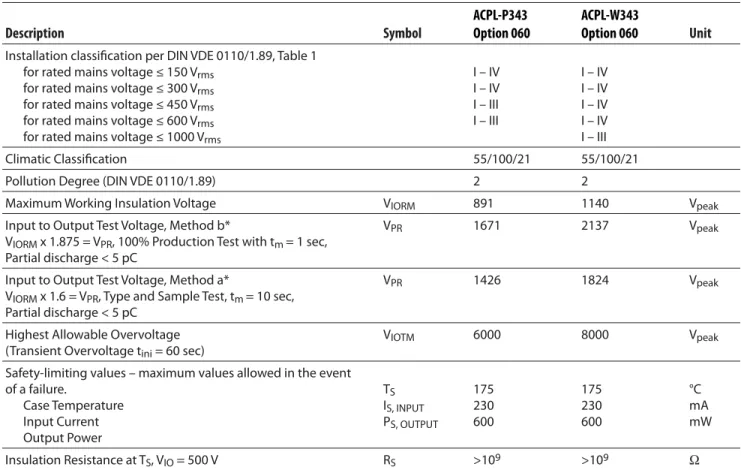
Table 1. IEC/EN/DIN EN 60747-5-2 Insulation Characteristics* (Option 060 – Under Evaluation)
Description Symbol
ACPL-P343 Option 060
ACPL-W343
Option 060 Unit
Installation classifi cation per DIN VDE 0110/1.89, Table 1 for rated mains voltage ≤ 150 Vrms
for rated mains voltage ≤ 300 Vrms for rated mains voltage ≤ 450 Vrms for rated mains voltage ≤ 600 Vrms for rated mains voltage ≤ 1000 Vrms
I – IV I – IV I – III I – III I – IV I – IV I – IV I – IV I – III
Climatic Classifi cation 55/100/21 55/100/21
Pollution Degree (DIN VDE 0110/1.89) 2 2
Maximum Working Insulation Voltage VIORM 891 1140 Vpeak
Input to Output Test Voltage, Method b*
VIORM x 1.875 = VPR, 100% Production Test with tm = 1 sec, Partial discharge < 5 pC
VPR 1671 2137 Vpeak
Input to Output Test Voltage, Method a*
VIORM x 1.6 = VPR, Type and Sample Test, tm = 10 sec, Partial discharge < 5 pC
VPR 1426 1824 Vpeak
Highest Allowable Overvoltage (Transient Overvoltage tini = 60 sec)
VIOTM 6000 8000 Vpeak
Safety-limiting values – maximum values allowed in the event of a failure. Case Temperature Input Current Output Power TS IS, INPUT PS, OUTPUT 175 230 600 175 230 600 °C mA mW Insulation Resistance at TS, VIO = 500 V RS >109 >109
* Refer to the optocoupler section of the Isolation and Control Components Designer’s Catalog, under Product Safety Regulations section, (IEC/EN/ DIN EN 60747-5-2) for a detailed description of Method a and Method b partial discharge test profi les.
Note:
These optocouplers are suitable for “safe electrical isolation” only within the safety limit data. Maintenance of the safety data shall be ensured by means of protective circuits. Surface mount classifi cation is Class A in accordance with CECC 00802.
Table 2. Insulation and Safety Related Specifi cations
Parameter Symbol ACPL-P343 ACPL-W343 Units Conditions
Minimum External Air Gap (External Clearance)
L(101) 7.0 8.0 mm Measured from input terminals to output
terminals, shortest distance through air. Minimum External Tracking
(External Creepage)
L(102) 8.0 8.0 mm Measured from input terminals to output
terminals, shortest distance path along body. Minimum Internal Plastic Gap
(Internal Clearance)
0.08 0.08 mm Through insulation distance conductor to
conductor, usually the straight line distance thickness between the emitter and detector. Tracking Resistance
(Comparative Tracking Index)
CTI >175 >175 V DIN IEC 112/VDE 0303 Part 1
Isolation Group IIIa IIIa Material Group (DIN VDE 0110, 1/89, Table 1)
Notes:
1. All Avago data sheets report the creepage and clearance inherent to the optocoupler component itself. These dimensions are needed as a starting point for the equipment designer when determining the circuit insulation requirements. However, once mounted on a printed circuit board, minimum creepage and clearance requirements must be met as specifi ed for individual equipment standards. For creepage, the shortest distance path along the surface of a printed circuit board between the solder fi llets of the input and output leads must be considered (the recommended Land Pattern does not necessarily meet the minimum creepage of the device). There are recommended techniques such as grooves and ribs which may be used on a printed circuit board to achieve desired creepage and clearances. Creepage and clearance distances will also change depending on factors such as pollution degree and insulation level.
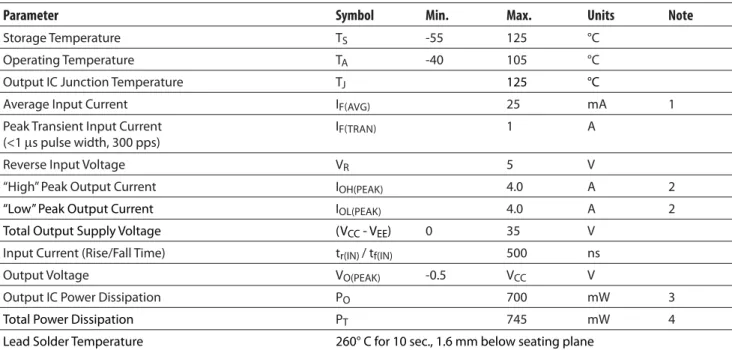
Table 3. Absolute Maximum Ratings
Parameter Symbol Min. Max. Units Note
Storage Temperature TS -55 125 °C
Operating Temperature TA -40 105 °C
Output IC Junction Temperature TJ 125 °C
Average Input Current IF(AVG) 25 mA 1
Peak Transient Input Current (<1 s pulse width, 300 pps)
IF(TRAN) 1 A
Reverse Input Voltage VR 5 V
“High” Peak Output Current IOH(PEAK) 4.0 A 2
“Low” Peak Output Current IOL(PEAK) 4.0 A 2
Total Output Supply Voltage (VCC - VEE) 0 35 V
Input Current (Rise/Fall Time) tr(IN) / tf(IN) 500 ns
Output Voltage VO(PEAK) -0.5 VCC V
Output IC Power Dissipation PO 700 mW 3
Total Power Dissipation PT 745 mW 4
Lead Solder Temperature 260° C for 10 sec., 1.6 mm below seating plane
Table 4. Recommended Operating Conditions
Parameter Symbol Min. Max. Units Note
Operating Temperature TA -40 105 °C
Output Supply Voltage (VCC - VEE) 15 30 V
Input Current (ON) IF(ON) 7 16 mA
6
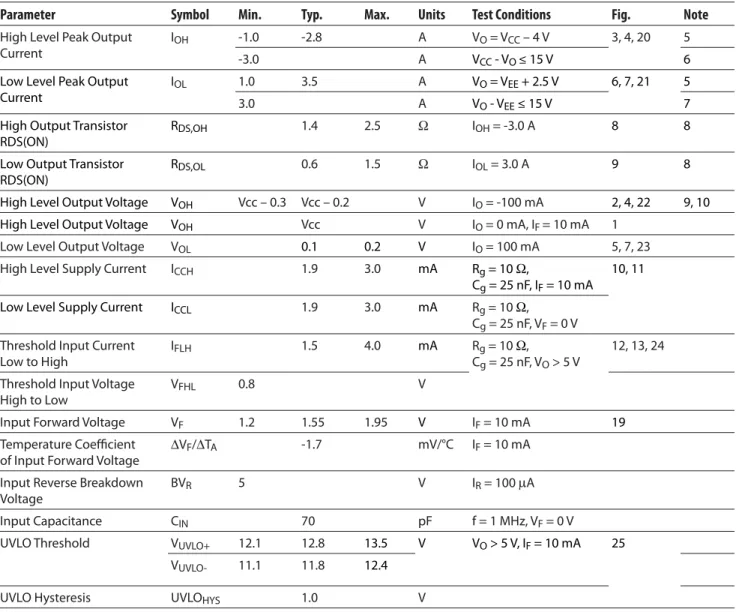
Table 5. Electrical Specifi cations (DC)
Unless otherwise noted, all typical values are at TA = 25° C, VCC - VEE = 30 V, VEE = Ground; all minimum and maximum
specifi cations are at recommended operating conditions (TA = -40 to 105° C, IF(ON) = 7 to 16 mA, VF(OFF) = -3.6 to 0.8 V,
VEE = Ground, VCC = 15 to 30 V).
Parameter Symbol Min. Typ. Max. Units Test Conditions Fig. Note
High Level Peak Output Current
IOH -1.0 -2.8 A VO = VCC – 4 V 3, 4, 20 5
-3.0 A VCC - VO ≤ 15 V 6
Low Level Peak Output Current
IOL 1.0 3.5 A VO = VEE + 2.5 V 6, 7, 21 5
3.0 A VO - VEE ≤ 15 V 7
High Output Transistor RDS(ON)
RDS,OH 1.4 2.5 IOH = -3.0 A 8 8
Low Output Transistor RDS(ON)
RDS,OL 0.6 1.5 IOL = 3.0 A 9 8
High Level Output Voltage VOH Vcc – 0.3 Vcc – 0.2 V IO = -100 mA 2, 4, 22 9, 10
High Level Output Voltage VOH Vcc V IO = 0 mA, IF = 10 mA 1
Low Level Output Voltage VOL 0.1 0.2 V IO = 100 mA 5, 7, 23
High Level Supply Current ICCH 1.9 3.0 mA Rg = 10 ,
Cg = 25 nF, IF = 10 mA
10, 11
Low Level Supply Current ICCL 1.9 3.0 mA Rg = 10 ,
Cg = 25 nF, VF = 0 V Threshold Input Current
Low to High
IFLH 1.5 4.0 mA Rg = 10 ,
Cg = 25 nF, VO > 5 V
12, 13, 24 Threshold Input Voltage
High to Low
VFHL 0.8 V
Input Forward Voltage VF 1.2 1.55 1.95 V IF = 10 mA 19
Temperature Coeffi cient of Input Forward Voltage
VF/TA -1.7 mV/°C IF = 10 mA
Input Reverse Breakdown Voltage
BVR 5 V IR = 100 A
Input Capacitance CIN 70 pF f = 1 MHz, VF = 0 V
UVLO Threshold VUVLO+ 12.1 12.8 13.5 V VO > 5 V, IF = 10 mA 25
VUVLO- 11.1 11.8 12.4
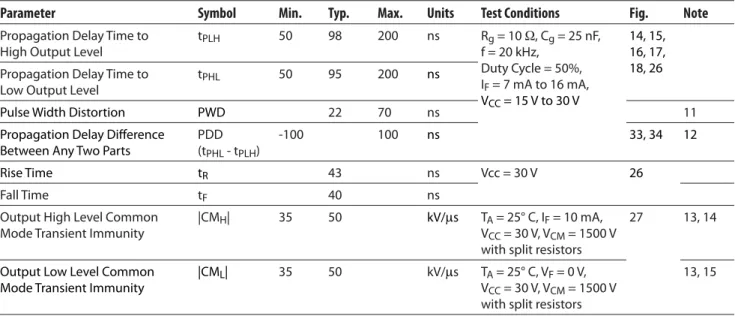
Table 6. Switching Specifi cations (AC)
Unless otherwise noted, all typical values are at TA = 25° C, VCC - VEE = 30 V, VEE = Ground; all minimum and maximum
specifi cations are at recommended operating conditions (TA = -40 to 105° C, IF(ON) = 7 to 16 mA, VF(OFF) = -3.6 to 0.8 V,
VEE = Ground, VCC = 15 to 30 V).
Parameter Symbol Min. Typ. Max. Units Test Conditions Fig. Note
Propagation Delay Time to High Output Level
tPLH 50 98 200 ns Rg = 10 , Cg = 25 nF, f = 20 kHz, Duty Cycle = 50%, IF = 7 mA to 16 mA, VCC = 15 V to 30 V 14, 15, 16, 17, 18, 26 Propagation Delay Time to
Low Output Level
tPHL 50 95 200 ns
Pulse Width Distortion PWD 22 70 ns 11
Propagation Delay Diff erence Between Any Two Parts
PDD (tPHL - tPLH)
-100 100 ns 33, 34 12
Rise Time tR 43 ns Vcc = 30 V 26
Fall Time tF 40 ns
Output High Level Common Mode Transient Immunity
|CMH| 35 50 kV/s TA = 25° C, IF = 10 mA,
VCC = 30 V, VCM = 1500 V with split resistors
27 13, 14
Output Low Level Common Mode Transient Immunity
|CML| 35 50 kV/s TA = 25° C, VF = 0 V,
VCC = 30 V, VCM = 1500 V with split resistors
13, 15
Table 7. Package Characteristics
Unless otherwise noted, all typical values are at TA = 25° C; all minimum/maximum specifi cations are at recommended
operating conditions.
Parameter Symbol Device Min. Typ. Max. Units Test Conditions Fig. Note
Input-Output Momentary Withstand Voltage*
VISO ACPL-P343 3750 VRMS RH < 50%, t = 1 min.,
TA = 25° C
16,18
ACPL-W343 5000 VRMS RH < 50%, t = 1 min.,
TA = 25° C
17,18
Input-Output Resistance RI-O >5012 VI-O = 500 VDC 18
Input-Output Capacitance CI-O 0.6 pF f =1 MHz
LED-to-Ambient Thermal Resistance R11 135 °C/W 19 LED-to-Detector Thermal Resistance R12 27 Detector-to-LED Thermal Resistance R21 39 Detector-to-Ambient Thermal Resistance R22 47
* The Input-Output Momentary Withstand Voltage is a dielectric voltage rating that should not be interpreted as an input-output continuous voltage rating. For the continuous voltage rating, refer to your equipment level safety specifi cation or Avago Technologies Application Note 1074 entitled “Optocoupler Input-Output Endurance Voltage.”
8
Notes:
1. Derate linearly above 70° C free-air temperature at a rate of 0.3 mA/°C.
2. Maximum pulse width = 10 s. This value is intended to allow for component tolerances for designs with IO peak minimum = 3.0 A. See applications
section for additional details on limiting IOH peak.
3. Derate linearly above 85° C free-air temperature at a rate of 16.9 mW/°C .
4. Derate linearly above 85° C free-air temperature at a rate of 15.3 mW/°C . The maximum LED junction temperature should not exceed 125° C. 5. Maximum pulse width = 50 s.
6. Output is sourced at -3.0 A with a maximum pulse width = 10 s. VCC-VO is measured to ensure 15 V or below.
7. Output is sourced at 3.0 A with a maximum pulse width = 10 s. VO-VEE is measured to ensure 15 V or below.
8. Output is sourced at -3.0 A/3.0 A with a maximum pulse width = 10 s.
9. In this test VOH is measured with a DC load current. When driving capacitive loads, VOH will approach VCC as IOH approaches zero amps.
10. Maximum pulse width = 1 ms.
11. Pulse Width Distortion (PWD) is defi ned as |tPHL-tPLH| for any given device.
12. The diff erence between tPHL and tPLH between any two ACPL-P343 parts under the same test condition.
13. Pin 2 needs to be connected to LED common.
14. Common mode transient immunity in the high state is the maximum tolerable dVCM/dt of the common mode pulse, VCM, to assure that the
output will remain in the high state (i.e., VO > 15.0 V).
15. Common mode transient immunity in a low state is the maximum tolerable dVCM/dt of the common mode pulse, VCM, to assure that the output
will remain in a low state (i.e., VO < 1.0 V).
16. In accordance with UL1577, each optocoupler is proof tested by applying an insulation test voltage ≤ 4500 VRMS for 1 second (leakage detection
current limit, II-O < 5 A).
17. In accordance with UL1577, each optocoupler is proof tested by applying an insulation test voltage ≤ 6000 VRMS for 1 second (leakage detection
current limit, II-O < 5 A).
18. Device considered a two-terminal device: pins 1, 2, and 3 shorted together and pins 4, 5 and 6 shorted together. 19. The device was mounted on a high conductivity test board as per JEDEC 51-7
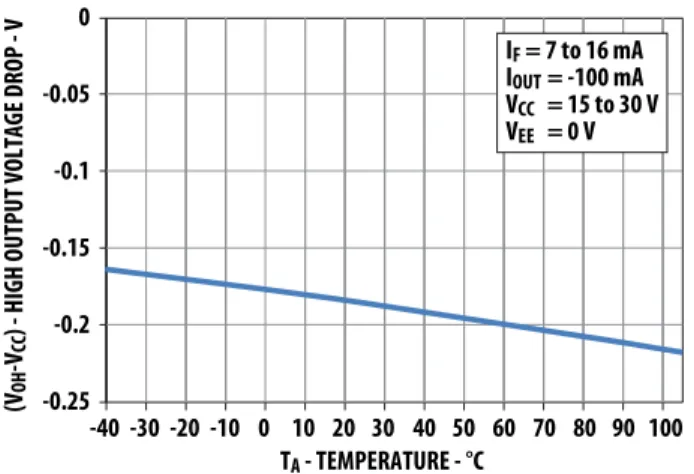
Figure 1. High output rail voltage vs. temperature Figure 2. VOH vs. temperature
Figure 3. IOH vs. temperature Figure 4. IOH vs. VOH
Figure 5.VOL vs. temperature Figure 6. IOL vs. temperature
IF = 10mA IOUT = 0mA VCC = 30 V VEE = 0 V IF = 7 to 16 mA IOUT = -100mA VCC = 15 to 30 V VEE = 0 V IF = 7 to 16 mA VOUT = VCC 4 V VCC = 15 to 30 V VEE = 0 V IF = 7 to 16 mA VCC = 15 to 30 V VEE = 0 V TA = 25° C VF (OFF) = 0 V IOUT = 100mA VCC = 15 to 30 V VEE = 0 V 29.84 29.81 29.82 29.83 29.77 29.78 29.79 29.8 -40-30-20-10 0 10 20 30 40 50 60 70 80 90 100 VOH - HI G H OUT P UT R AIL VOLTA G E - V TA - TEMPERATURE - °C -40-30-20 -10 0 10 20 30 40 50 60 70 80 90100 TA - TEMPERATURE - °C -40-30-20 -10 0 10 20 30 40 50 60 70 80 90100 TA - TEMPERATURE - °C -40-30-20 -10 0 10 20 30 40 50 60 70 80 90 100 TA - TEMPERATURE - °C -40-30-20-10 0 10 20 30 40 50 60 70 80 90 100 TA - TEMPERATURE - °C 0 -0.15 -0.1 -0.05 -0.25 -0.2 (VOH -VCC ) - HI G H OUT P UT VOLTA G E D R O P - V -0.5 0 -2 -1.5 -1 -4 -3.5 -3 -2.5 IOH - OUT P UT HI G H CU RR ENT - A -1 -0.5 0 0.5 -3 -2.5 -2 -1.5 -4.5 -4 -3.5 0 1 2 3 4 5 6 IOH - OUT P UT HI G H CU RR ENT - A (VOH-VCC) - HIGH OUTPUT VOLTAGE DROP - V 0.1 0.12 0.14 0.02 0.04 0.06 0.08 0 VOL - OUT P UT LOW VOLTA G E - V 3 3.5 4 4.5 0.5 1 1.5 2 2.5 0 IOL - OUT P UT LOW CU RR ENT - A VF (OFF) = 0 V VOUT = 2.5 V VCC = 15 to 30 V VEE = 0 V
10
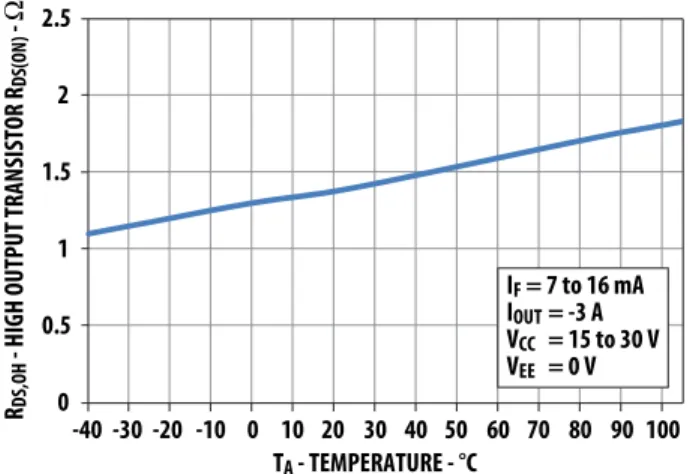
Figure 7. IOL vs. VOL Figure 8. RDS,OH vs. temperature
Figure 9. RDS,OL vs. temperature
Figure 11. ICC vs. VCC Figure 12. IFLH hysteresis
Figure 10. ICC vs. temperature IF = 7 to 16 mA IOUT = -3 A VCC = 15 to 30 V VEE = 0 V 3 3.5 4 4.5 5 0.5 1 1.5 2 2.5 3 0 0 0.5 1 1.5 2 2.5 3 IOL - OUT P UT LOW CU RR ENT - A
VOL - OUTPUT LOW VOLTAGE - V
VF (OFF) = 0 V VCC = 15 to 30 V VEE = 0 V TA = 25° C 2 2.5 0.5 1 1.5 0 RDS ,OH - HI G H OUT P UT T R AN S I S TO R RDS (ON) - 7 -40-30-20 -10 0 10 20 30 40 50 60 70 80 90100 TA - TEMPERATURE - °C 0.7 0.8 0.9 1 0.2 0.3 0.4 0.5 0.6 0 0.1 RDS ,OL - LOW OUT P UT T R AN S I S TO R RDS (ON) - 7 -40-30-20 -10 0 10 20 30 40 50 60 70 80 90 100 TA - TEMPERATURE - °C -40-30-20 -10 0 10 20 30 40 50 60 70 80 90100 TA - TEMPERATURE - °C VF (OFF) = 0 V IOUT = 3 A VCC = 15 to 30 V VEE = 0 V 2 2.5 0.5 1 1.5 ICC - S U PP LY CU RR ENT - m A 0 IF = 10mA for ICCH VF = 0 V for ICCL VCC = 30 V VEE = 0 V ICCH ICCL 2 2.5 0.5 1 1.5 ICC - S U PP LY CU RR ENT - m A 0 15 20 25 30 VCC - SUPPLY VOLTAGE - V ICCL ICCH IF = 10mA for ICCH VF = 0 V for ICCL TA = 25° C VEE = 0 V TA = 25° C VCC = 30 V VEE = 0 V IFLH ON IFLH OFF 24 29 34 4 9 14 19 VO - OUT P UT VOLTA G E - V -1 4
IFLH - LOW TO HIGH CURRENT THRESHOLD - mA
Figure 13. IFLH vs. temperature Figure 14. Propagation delays vs. VCC
Figure 15. Propagation delays vs. IF
Figure 17. Propagation delay vs. Rg Figure 18. Propagation delay vs. Cg
Figure 16. Propagation delays vs. temperature IF = 7mA VCC = 30 V, VEE = 0 V Rg = 107, Cg = 25 nF DUTY CYCLE = 50% f = 20 kHz IF = 7mA, TA = 25° C VCC = 30 V, VEE = 0 V Rg = 107 DUTY CYCLE = 50% f = 20 kHz IF = 7mA, TA = 25° C VCC = 30 V, VEE = 0 V Cg = 25 nF DUTY CYCLE = 50% f = 20 kHz 1.6 1.8 2 2.2 2.4 0.2 0.6 0.4 0.8 1 1.2 1.4 0 IFLH - LOW TO HI G H CU RR ENT TH R E S HOLD -m A -40-30-20 -10 0 10 20 30 40 50 60 70 80 90 100 TA - TEMPERATURE - °C VCC = 15 to 30 V VEE = 0 V IFLH ON IFLH OFF 100 110 120 70 80 90 60 TP - PR O P A G ATION DELAY - ns 15 20 25 30 VCC - SUPPLY VOLTAGE - V IF = 7mA TA = 25° C Rg = 107, Cg = 25 nF DUTY CYCLE = 50% f = 20 kHz TPLH TPHL TPLH TPHL TPLH TPHL TPLH TPHL 100 110 120 70 80 90 60 6 8 10 12 14 16 TP - PR O P A G ATION DELAY - ns IF - FORWARD LED CURRENT - mA 100 110 120 70 80 90 60 TP - PR O P A G ATION DELAY - ns 90 95 100 105 65 70 75 80 85 60 65 10 15 20 25 30 35 40 45 50 10 15 20 25 30 35 40 45 50 TP - PR O P A G ATION DELAY - ns Rg - SERIES LOAD RESISTANCE - 7 95 100 105 110 70 75 80 85 90 60 65 TP - PR O P A G ATION DELAY - ns Cg - SERIES LOAD CAPACITANCE - nF -40-30-20-10 0 10 20 30 40 50 60 70 80 90 100 TA - TEMPERATURE - °C VCC = 30 V, VEE = 0 V TA = 25° C Rg = 107, Cg = 25 nF DUTY CYCLE = 50% f = 20 kHz TPLH TPHL
12
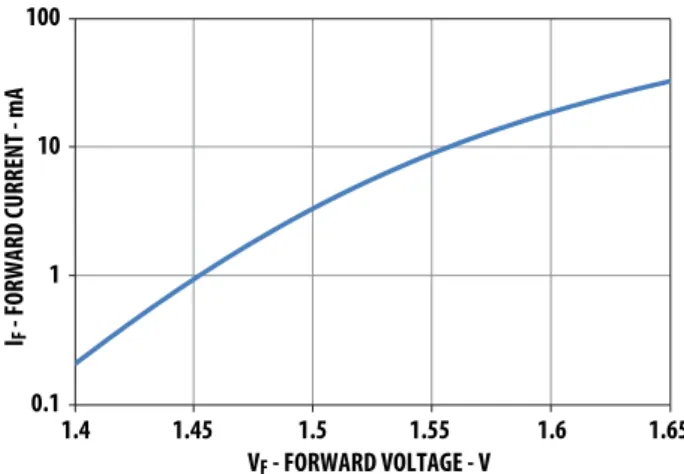
Figure 19. Input current vs. forward voltage
Figure 20. IOH test circuit
Figure 21. IOL test circuit
1 MF IF = 7 to 16 mA + _ + _ 2.5 V Pulsed VCC = 15 to 30 V 1 MF IOL 100 1 10 0.1 1.4 1.45 1.5 1.55 1.6 1.65 IF - FO R WA R D CU RR ENT - m A VF - FORWARD VOLTAGE - V 1 2 3 6 5 4 + _ + _ 4 V Pulsed VCC = 15 to 30 V IOH 1 2 3 6 5 4
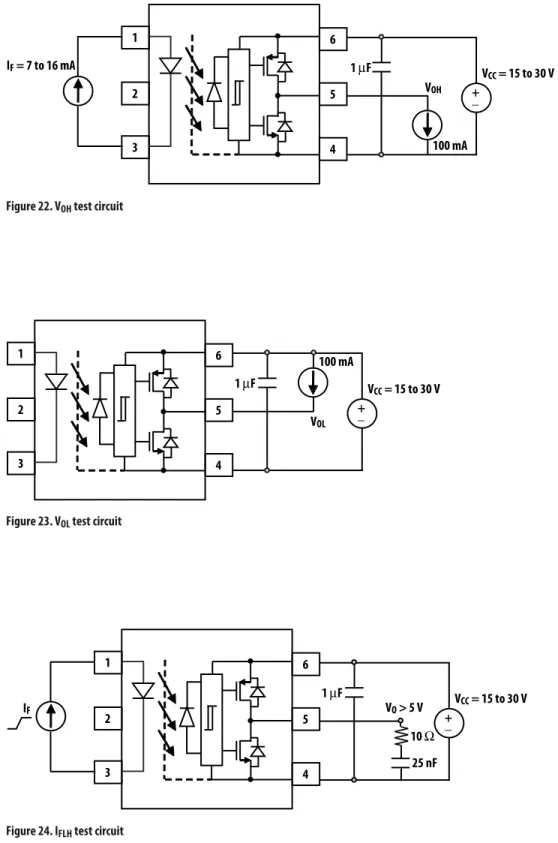
Figure 22. VOH test circuit
Figure 23. VOL test circuit
Figure 24. IFLH test circuit 1 2 3 6 5 4 + _ 100mA VCC = 15 to 30 V 1 MF VOH IF = 7 to 16 mA 100mA + _ VCC = 15 to 30 V VOL 1 MF IF VO > 5 V VCC = 15 to 30 V 1 MF 107 25 nF + _ 1 2 3 6 5 4 1 2 3 6 5 4
14
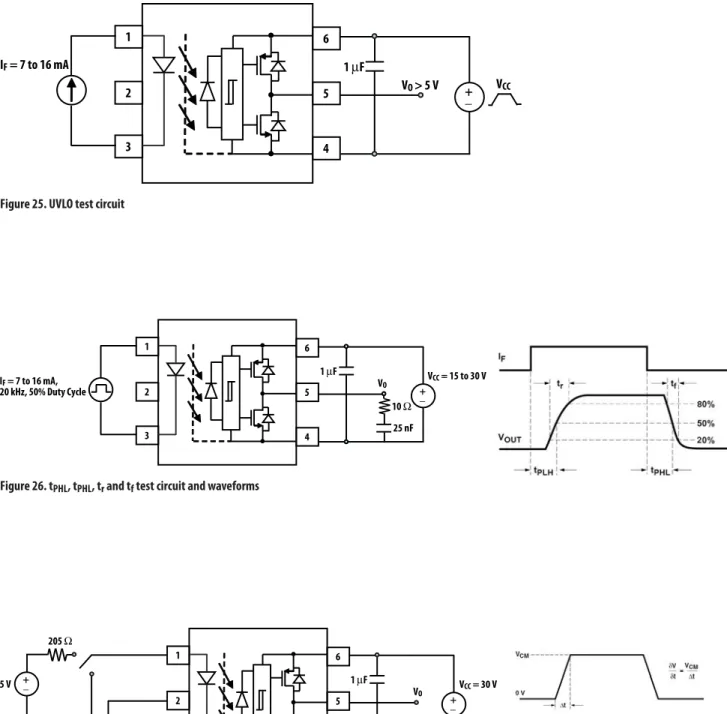
Figure 25. UVLO test circuit
Figure 26. tPHL, tPHL, tr and tf test circuit and waveforms
Figure 27. CMR test circuit with split resistors network and waveforms 1 2 3 6 5 4 + _ 1 MF VO > 5 V IF = 7 to 16 mA VCC VO VCC = 15 to 30 V 1 MF 107 25 nF + _ 1 2 3 6 5 4 IF = 7 to 16 mA, 20 kHz, 50% Duty Cycle 10 mA 10 mA 10mA VCC = 30 V VO + _ 1 MF + _ VCM = 1500 V 5 V 205 7 1377 + _ 1 2 3 6 5 4
Application Information
Product Overview DescriptionThe ACPL-P343/W343 is an optically isolated power output stage capable of driving IGBTs of up to 200 A and 1200 V. Based on BCDMOS technology, this gate drive optocou-pler delivers higher peak output current, better rail-to-rail output voltage performance and two times faster speed than the previous generation products.
The high peak output current and short propagation delay are needed for fast IGBT switching to reduce dead time and improve system overall effi ciency. Rail-to-rail output voltage ensures that the IGBT’s gate voltage is driven to the optimum intended level with no power loss across IGBT. This helps the designer lower the system power which is suitable for bootstrap power supply operation. It has very high CMR(common mode rejection) rating which allows the microcontroller and the IGBT to operate at very large common mode noise found in industrial motor drives and other power switching applications. The input is driven by direct LED current and has a hysteresis that prevents output oscillation if insuffi cient LED driving current is applied. This will eliminates the need of addi-tional Schmitt trigger circuit at the input LED.
The stretched SO6 package which is up to 50% smaller than conventional DIP package facilitates smaller more compact design. These stretched packages are compliant to many industrial safety standards such as IEC/EN/DIN EN 60747-5-2, UL 1577 and CSA.
Recommended Application Circuit
The recommended application circuit shown in Figure 28 illustrates a typical gate drive implementation using the ACPL-P343. The following describes about driving IGBT. However, it is also applicable to MOSFET. Designers will need to adjust the VCC supply voltage, depending on the MOSFET or IGBT gate threshold requirements (Recom-mended VCC = 15 V for IGBT and 12 V for MOSFET).
The supply bypass capacitors (1 F) provide the large transient currents necessary during a switching transition. Because of the transient nature of the charging currents, a low current (3.0 mA) power supply will be enough to power the device. The split resistors (in the ratio of 1.5:1) across the LED will provide a high CMR response by providing a balanced resistance network across the LED.
The gate resistor RG serves to limit gate charge current and controls the IGBT collector voltage rise and fall times. In PC board design, care should be taken to avoid routing the IGBT collector or emitter traces close to the ACPL-P343 input as this can result in unwanted coupling of transient signals into ACPL-P343 and degrade performance.
_ VEE CATHODE NC ANODE VOUT VCC _ R R + 1 2 3 6 5 4 Rg + VCE + HVDC -HVDC 3-HVDC AC 1 MF VCC = 15 V VEE = 5 V + _ Q1 Q2 _ + VCE _ + _
16
Rail-to-Rail Output
Figure 29 shows a typical gate driver’s high current output stage with 3 bipolar transistors in darlington confi guration. During the output high transition, the output voltage rises rapidly to within 3 diode drops of VCC. To ensure the VOUT
is at VCC in order to achieve IGBT rated VCE(ON) voltage. The
level of VCC will be need to be raised to beyond VCC+3(VBE)
to account for the diode drops. And to limit the output voltage to VCC, a pull-down resistor, RPULL-DOWN between
the output and VEE is recommended to sink a static current
while the output is high.
Figure 29. Typical gate driver with output stage in darlington confi guration
Figure 30. ACPL-P343/W343 with PMOS and NMOS output stage for rail-to-rail output voltage 1 2 3 4 8 7 6 5 VCC VOUT VEE CATHODE NC ANODE NC RG RPULL-DOWN
ACPL-P343 uses a power PMOS to deliver the large current and pull it to VCC to achieve rail-to-rail output voltage
as shown in Figure 30. This ensures that the IGBT’s gate voltage is driven to the optimum intended level with no power loss across IGBT even when an unstable power supply is used. VCC VEE 1 2 3 6 5 4 CATHODE NC ANODE VOUT
Selecting the Gate Resistor (Rg)
Step 1: Calculate Rg minimum from the IOL peak specifi cation. The IGBT and Rg in Figure 28 can be analyzed as a simple
RC circuit with a voltage supplied by ACPL-P343/W343. Rg ≥ VCC – VEE – VOL
IOLPEAK
= 15 V + 5 V – 2.9 V 4A = 4.3 5
The VOL value of 2.9 V in the previous equation is the VOL at the peak current of 4.0 A (see Figure 7).
Step 1: Check the ACPL-P343/W343 power dissipation and increase Rg if necessary. The ACPL-P343/W343 total power dissipation (PT) is equal to the sum of the emitter power (PE) and the output power (PO).
PT = PE + PO
PE = IF • VF • Duty Cycle PO = PO(BIAS) + PO(SWITCHING) = ICC • (VCC-VEE) + ESW(Rg;Cg) • f
Using IF(worst case) = 16 mA, Rg = 5 , Max Duty Cycle = 80%, Cg = 25 nF, f = 25 kHz and TA max = 85° C: PE = 16 mA • 1.95 V • 0.8 = 25 mW
PO = 3 mA • 20 V + 5 J • 25 kHz = 60 mW + 125 mW
= 185 mW < 700 mW (PO(MAX) @ 85° C)
The value of 3 mA for ICC in the previous equation is the maximum ICC over the entire operating temperature range. Since PO is less than PO(MAX), Rg = 5 is alright for the power dissipation.
Figure 31. Energy Dissipated in the ACPL-P343/W343 for each IGBT switching cycle 2.0E-05 2.5E-05 3.0E-05 1.0E-05 1.5E-05 0.0E+00 5.0E-06 ESW - ENE RG Y P E R S WITCHIN G CYCLE - J 0 2 4 6 8 10 Rg - GateResistance - 7 VCC = 30 V VCC = 20 V VCC = 15 V
18
LED Drive Circuit Considerations for High CMR Performance
Figure 32 shows the recommended drive circuit for the ACPL-P343/W343 that gives optimum common-mode rejection. The two current setting resistors balance the common mode impedances at the LED’s anode and cathode. Common-mode transients can be capacitive coupled from the LED anode, through CLA (or cathode through CLC) to the output-side ground causing current to be shunted away from the LED (which is not wanted when the LED should be on) or conversely cause current to be injected into the LED (which is not wanted when the LED should be off ).Table 8 shows the directions of ILP and ILN depend on the polarity of the common-mode transient. For transients occurring when the LED is on, common-mode rejection (CMH, since the output is at “high” state) depends on LED current (IF). For conditions where IF is close to the switching threshold (IFLH), CMH also depends on the extent to which ILP and ILN balance each other. In other words, any condition where a common-mode transient causes a momentary decrease in IF (i.e. when dVCM/dt > 0 and |ILP| > |ILN|, referring to Table 8) will cause a common-mode failure for transients which are fast enough.
Likewise for a common-mode transient that occurs when the LED is off (i.e. CML, since the output is at “low” state),
if an imbalance between ILP and ILN results in a transient IF equal to or greater than the switching threshold of the optocoupler, the transient “signal” may cause the output to spike above 1 V, which constitutes a CML failure. The balanced ILED-setting resistors help equalize the common mode voltage change at the anode and cathode. The shunt drive input circuit will also help to achieve high CML performance by shunting the LED in the off state.
+5 V R1 R2 VCC VEE 1 2 3 6 5 4 CATHODE ANODE VOUT ILP ILN CLA CLC VDD = 5.0 V: R1 = 205 7 ±1% R2 = 1377 ±1% R1/R2 ≈ 1.5
Figure 32. Recommended high-CMR drive circuit for the ACPL-P343/W343
Table 8. Common Mode Pulse Polarity and LED current Transients
dVCM/dt ILP Direction ILP Direction
If |ILP| < |ILN|,
IF is momentarily
If |ILP| > |ILN|,
IF is momentarily Positive (>0) Away from LED anode
through CLA
Away from LED cathode through CLC
Increase Decrease
Negative(<0) Toward LED anode through CLA
Toward LED cathode through CLC
Dead Time and Propagation Delay Specifi cations
The ACPL-P343/W343 includes a Propagation Delay Dif-ference (PDD) specifi cation intended to help designers minimize “dead time” in their power inverter designs. Dead time is the time period during which both the high and low side power transistors (Q1 and Q2 in Figure 28) are off . Any overlap in Q1 and Q2 conduction will result in large currents fl owing through the power devices between the high and low voltage motor rails.To minimize dead time in a given design, the turn on of LED2 should be delayed (relative to the turn off of LED1) so that under worst-case conditions, transistor Q1 has just turned off when transistor Q2 turns on, as shown in Figure 33. The amount of delay necessary to achieve this condition is equal to the maximum value of the propa-gation delay diff erence specifi cation, PDDMAX, which is
specifi ed to be 100 ns over the operating temperature range of 40° C to 105° C.
Delaying the LED signal by the maximum propagation delay diff erence ensures that the minimum dead time is zero, but it does not tell a designer what the maximum dead time will be. The maximum dead time is equivalent to the diff erence between the maximum and minimum propagation delay diff erence specifi cations as shown in Figure 34. The maximum dead time for the ACPL-P343/ W343 is 200 ns (= 100 ns – (-100 ns)) over an operating temperature range of -40° C to 105° C.
Note that the propagation delays used to calculate PDD and dead time are taken at equal temperatures and test conditions since the optocouplers under consideration are typically mounted in close proximity to each other and are switching identical IGBTs.
For product information and a complete list of distributors, please go to our web site: www.avagotech.com Avago, Avago Technologies, and the A logo are trademarks of Avago Technologies in the United States and other countries. Data subject to change. Copyright © 2005-2011 Avago Technologies. All rights reserved.
AV02-2928EN - November 14, 2011
LED Current Input with Hysteresis
The detector has optical receiver input stage with built in Schmitt trigger to provide logic compatible waveforms, eliminating the need for additional wave shaping. The hysteresis (Figure 12) provides diff erential mode noise immunity and minimizes the potential for output signal chatter.
Under Voltage Lockout
The ACPL-P343/W343 Under Voltage Lockout (UVLO) feature is designed to prevent the application of insuffi -cient gate voltage to the IGBT by forcing the ACPL-P343/ W343 output low during power-up. IGBTs typically require gate voltages of 15 V to achieve their rated VCE(ON) voltage. At gate voltages below 13 V typically, the VCE(ON) voltage increases dramatically, especially at higher currents. At very low gate voltages (below 10 V), the IGBT may operate in the linear region and quickly overheat. The UVLO function causes the output to be clamped whenever insuffi cient operating supply (VCC) is applied. Once VCC exceeds VUVLO+ (the positive-going UVLO threshold), the UVLO clamp is released to allow the device output to turn on in response to input signals.
Thermal Model for ACPL-P343/W343 Stretched SO6
Package Optocoupler
Defi nitions:
R11: Junction to Ambient Thermal Resistance of LED due
to heating of LED
R12: Junction to Ambient Thermal Resistance of LED due
to heating of Detector (Output IC)
R21: Junction to Ambient Thermal Resistance of Detector
(Output IC) due to heating of LED.
R22: Junction to Ambient Thermal Resistance of Detector
(Output IC) due to heating of Detector (Output IC).
P1: Power dissipation of LED (W).
P2: Power dissipation of Detector / Output IC (W).
T1: Junction temperature of LED (°C).
T2: Junction temperature of Detector (°C).
Ta: Ambient temperature.
Ambient Temperature: Junction to Ambient Thermal Re-sistances were measured approximately 1.25 cm above optocoupler at ~23° C in still air
Thermal Resistance °C/W
R11 135
R12 27
R21 39
R22 47
This thermal model assumes that an 6-pin single-channel plastic package optocoupler is soldered into a 7.62 cm x 7.62 cm printed circuit board (PCB) per JEDEC standards. The temperature at the LED and Detector junctions of the optocoupler can be calculated using the equations below.
T1= (R11* P1+ R12* P2) + Ta (1)
T2= (R21* P1+ R22* P2) + Ta (2) Using the given thermal resistances and thermal model formula in this datasheet, we can calculate the junction temperature for both LED and the output detector. Both junction temperature should be within the absolute maximum rating.
For example, given P1 = 25 mW, P2 = 185 mW, Ta = 85° C: LED junction temperature,
T1 = (R11* P1+ R12* P2) + Ta = (135 * 0.025 + 27 * 0.185) + 85 = 93.4° C
Output IC junction temperature, T2 = (R21* P1+ R22* P2) + Ta = (39 *0.025 + 47 * 0.185) + 85 = 94.7° C
T1 and T2 should be limited to 125° C based on the board layout and part placement.
Related Application Noted
AN5336 – Gate Drive Optocoupler Basic Design for IGBT/ MOSFET
AN1043 – Common-Mode Noise: Sources and Solutions AV02-0310EN – Plastics Optocouplers Product ESD and Moisture Sensitivity