2
SKILL 1
How to Compare Banking Services
SKILL 2
How to Open a Checking Account
SKILL 3
How to Keep Accurate Records
SKILL 4
How to Write a Check
SKILL 5
How to Deposit Money in a Checking Account
SKILL 6
How to Endorse a Check
SKILL 7
How to Interpret and Reconcile a Bank
Statement
OPENING A
CHECKING ACCOUNT
AG
ES
/
T OD
Mark and Kim took a day to check out financial institutions and the services offered to customers. “For the sake of convenience, it’s a good idea to look at financial institutions located near your apartment or workplace,” said Kim. Since Mark didn’t have a clue where he would (or could) get an apartment, he decided to look at banks close to his present employer, Antwan’s Auto Parts.
How to Compare Banking Services
Kim explained to Mark that the main types of financial institutions offering checking accounts are commercial banks, savings and loan associations, and credit unions. By far, commercial banks are the most popular banking institu-tions. Banks offer services such as checking accounts, savings accounts, small consumer loans, credit cards, safe-deposit boxes, and other consumer services. In the past, savings and loan associations specialized in handling savings deposits and loaning money for the purchase of a home. However, in 1981 Congress authorized savings and loan associations to offer services that were previously provided only by commercial banks.
The credit union is another type of financial institution offering a broad range of services. Kim explained that a credit union wasn’t available to Mark at this point in his life. A credit union is a nonprofit organization that offers member-ship only to the members of a particular group, such as teachers in a school system, workers in a factory, or store employees. A credit union offers services similar to those from a savings and loan association.
Kim made one point very clear. Mark should make sure to open a checking account in an institution that is insured. The federal government offers insurance to financial institutions through an agency called the Federal Deposit Insurance Corporation (FDIC). The FDIC insures accounts in most commercial banks and in many savings and loan associations. The agency was established in 1933 to protect the money consumers deposit in a financial institution. At the present time, the maximum amount of insurance coverage is $100,000 per depositor in any one institution.
The Savings Association Insurance Fund (SAIF),
an agency of the FDIC, insures deposits in savings and loan associations. SAIF is backed by the full faith and credit of
the U.S. government. SAIF insures all the funds of a single depositor up to $100,000, according to SAIF and FDIC rules. If a customer has three different individual accounts at one insured institution, all accounts are added together and the total amount is insured up to $100,000.
The National Credit Union Administration (NCUA) protects customer accounts up to $100,000 per depositor in federally chartered credit unions.
PHO
T
O
:
©
GETTY IMA
GES/PHO
T
“It’s important,” said Kim, “to look for the FDIC, SAIF, or NCUA symbols on the window, the entrance door, and the publications of the financial institution with which you’re interested in dealing. If you see the symbol, you know your money is insured.”
1. In the past, what was the main difference between commercial banks and savings and loan associations?__________________ _______________________________________________________ _______________________________________________________ _______________________________________________________ 2. At the present time, can Mark open an account at a credit
union? Give a reason for your answer. _____________________ _______________________________________________________ _______________________________________________________ _______________________________________________________ 3. Identify the following:
a. FDIC ______________________________________________ b. SAIF ______________________________________________ c. NCUA ____________________________________________
A
How to Open a Checking Account
Mark checked out several institutions around Antwan’s Auto Parts, where he works, before deciding to open an account at National Bank. Ms. Keisha Reed, a bank officer there, had been very helpful. She pointed out several services that appealed to Mark.
Initial Deposit
“If you agree, let’s open the account. You do have money with you?” Ms. Reed smiled.
Mark quickly got out his wallet and pulled out $100, which left about $50 in his pocket. “How much do I need?” he asked.
“That’s sufficient for an initial deposit,” said Ms. Reed. “Usually $50 to $100 is enough to open a checking account. You don’t want to put all your cash into the
account; yet you want enough in your account to cover the checks you plan to write. On the other hand, there are times when you’ll want to pay cash instead of writing a check.”
Mark explained that he gets his paycheck every Friday. He would deposit more on the following Friday.
Signature Card
Ms. Reed pulled out a signature card and filled it out for Mark. A signature card is verification of the ownership of an account. It is signed by those who have the privilege of using the bank account. Some banking institutions will not permit a minor to sign the signature card unless it is signed jointly by a parent or
guardian. Examine Mark’s signature card in Figure 2-1 as Ms. Reed explains the items on the card.
Figure 2-1
Mark’s Signature Card for a Checking Account
ACCOUNT NUMBER
SIGNATURE
SIGNATURE
HOME ADDRESS HOME PHONE BUSINESS PHONE
EMPLOYER OCCUPATION
EMPLOYER’S ADDRESS SOCIAL SEC. NO. DATE
ACCEPTED BY
TYPE OF ACCOUNT
JOINT NOW REGULAR
INDIVIDUAL SUPER
NOW
ECONOMY PLAN
We, the undersigned, hereby open an account with National Bank, and do authorize, empower, and direct the said bank to open an account with us in the name set forth below, and we hereby agree and notify said Bank that each or either of us, or the survivor of either of us, the undersigned, may, at any and all times, endorse and deposit to the credit of said account any check, draft or other voucher payable to the order of each or either of us and draw and receive from said Bank the whole or any part of said money now deposited, or which may hereafter be deposited to the credit of said account. Checks, drafts, and other items drawn on this office of this bank not paid for any reason as of close of business day on which they have been deposited may be charged back to the customer. This bank will act only as the agent of the customer from which it receives such items, and will assume no responsibility or liability except for its own negligence, nor will it assume any responsibility or liability for any items lost in the mail.
04452294
MÄëä L. Såàìá
KÑàíªÄ MÄÑ RÑÑÉ
1040 PÑÄÇáìëÑÑ AìãÄçìÄ GA 30319-1396 Açìñöçfií Aîìé PÄëìí
636-00-4854 11/29/--SÄãÑí√Ñëí÷ß
555-1254 555-8763
7890 MÄäÑíªàÖì Dëàïû AìãÄçìÄ GA30317-6247
Account Number
Ms. Reed asked Mark to notice the space for the account number. Mark’s account number identifies his specific bank account. His account number is 04452294. The same number will be printed on the bottom of all Mark’s checks. Ms. Reed said that Mark’s checks will be contained in a checkbook and will be mailed to him as soon as the checks are printed.
Mark’s account number will be printed after a bank number. The numbers at the bottom of his checks will look like this: 025000779:04452294. When he is asked for his account number, he’ll give only the second set of numbers: 04452294.
Individual and Joint Accounts
Ms. Reed pointed out that Mark’s signature card lists either an individual account or a joint account. She explained that an individual account has only one holder. If Mark opens an individual account, he is the only one who can make withdrawals from the account.
A joint account is held between two or more individuals and grants each person who signs the signature card all the rights and privileges attached to the account. Ms. Reed said she and her husband have a joint account, which means that each
Read the following paragraph that was copied from Mark’s signature card (Figure 2-1). Answer true or false to the statements below.
We, the undersigned, hereby open an account with National Bank, and do authorize, empower, and direct the said bank to open an account with us in the name set forth below, and we hereby agree and notify said Bank that each or either of us, or the survivor of either of us, the undersigned, may, at any and all times, endorse and deposit to the credit of said account any check, draft or other voucher payable to the order of each or either of us and draw and receive from said Bank the whole or any part of said money now deposited, or which may hereafter be deposited to the credit of said account. Checks, drafts, and other items drawn on this office of this bank not paid for any reason as of close of business day on which they have been deposited may be charged back to the customer. This bank will act only as the agent of the customer from which it receives such items, and will assume no responsibility or liability except for its own negligence, nor will it assume any responsibility or liability for any items lost in the mail.
__1. If Mark opens an account with someone else, his co-signer can write a check on the account by simply signing his or her name to the check.
__2. The bank can charge Mark for checks he writes that exceed the amount he has in the bank.
__3. The bank agrees to sue a customer who owes Mark money. __4. The bank assumes responsibility for checks Mark puts in the mail. __5. The bank accepts responsibility for any errors the bank makes
regarding Mark’s account.
of them can make withdrawals, without the other’s knowledge or permission, at any time.
Ms. Reed said the names on her joint account are recorded as follows: Keisha Mae Reed or
Dontae C. Reed
She said that she or her husband may withdraw money or make deposits to the account without the signature of the other. However, if the names on a joint account are connected by the word and, both signatures are required for any withdrawals. For example:
Keisha Mae Reed and Dontae C. Reed
Ms. Reed said that the signature card usually lists the types of accounts available: regular, and various types of interest-bearing accounts. Mark wanted a regular account. Most interest-bearing accounts require a large balance to be kept in the account at all times. Mark can’t afford to do this at the present time.
1. Explain the difference between an individual account and a joint account. ___________________________________________ _______________________________________________________ _______________________________________________________ _______________________________________________________ 2. Explain the significance of recording signatures on a joint
account as follows: Keisha Mae Reed orDontae C. Reed _______________________________________________________ Keisha Mae Reed and Dontae C. Reed
_______________________________________________________ 3. The numbers printed on the bottom of Mark’s checks are:
025000779:04452294. What is his account number?
_______________________________________________________ 4. Can anyone open a checking account if he or she has enough
money for an initial deposit?______________________________ _______________________________________________________ 5. Give a reason for your answer to Question 4. ______________ _______________________________________________________ _______________________________________________________
How to Keep Accurate Records
Ms. Reed explained that a checkbook contains checks that are used for making payments in place of cash. The National Bank will process each of Mark’s checks and subtract the amount from his checking account.
“You should keep an accurate record of how much money is in your account,” Ms. Reed said. “Accurate records are important because you are charged a fee if you have insufficient funds in your account to cover your withdrawal. Your checkbook can also be an effective way of keeping records of your expenditures for other reasons, such as budgeting.”
Ms. Reed showed Mark some samples of checkbooks. There was quite a variety. Some had illustrations or designs on the checks. “The more elaborate checks cost more,” Ms. Reed said.
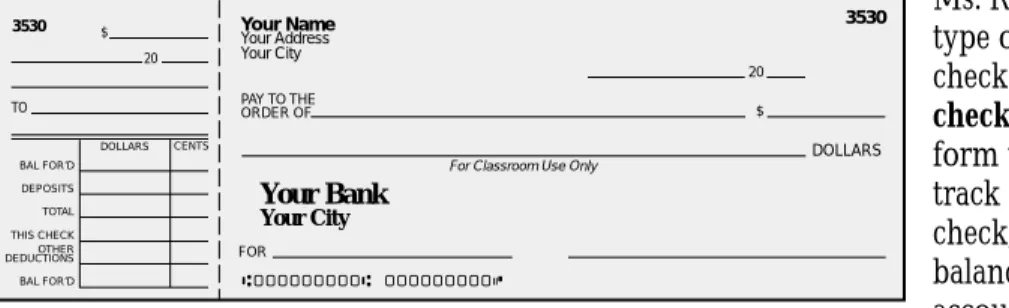
Mark noticed that some checkbooks have check stubs for keeping records. The check stub is attached to each check. It is used for recording the balance of the account, the amount of each check written, to whom the check is written, deposits made to the account, the date, and any charges made by the bank. Figure 2-2 is an example of a check and check stub.
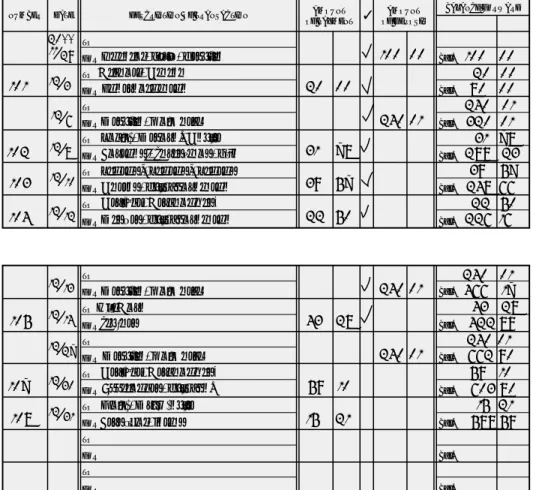
Ms. Reed showed Mark another type of checkbook that has a check register. She said the check register is a separate form that has space to keep track of the amount of each check, the check number, the balance, deposits to the account, date of the transac-tion, and description of the transaction. Mark chose to use the check register style. Figure 2-3 shows a blank page from Mark’s check register.
Check registers vary in format, but they usually contain the same basic columns. Use the Amount of Deposit column to record any money added to the account. Use the Amount of Payment column to record any money deducted from the
Figure 2-2
Check Stub and Check
3530 Your Name
Your Bank Your City Your Address Your City
For Classroom Use Only
PAY TO THE ORDER OF 20 20 FOR DOLLARS $ DOLLARS BAL FOR’D DEPOSITS TOTAL THIS CHECK OTHER DEDUCTIONS BAL FOR’D CENTS $ TO 3530 Figure 2-3
Mark’s Check Register
NUMBER DATE DESCRIPTION OF TRANSACTION AMOUNT OF PAYMENT AMOUNT OF DEPOSIT BALANCE FORWARD TO Bal. Bal. Bal. Bal. Bal. Bal. FOR TO FOR TO FOR TO FOR TO FOR TO FOR
account. You can use the ✓column when you balance your bank statement, which will be discussed later in this chapter.
Service Charges
Kim explained to Mark that there are service charges for having a checking account. A service charge is a fee charged by the financial institution for services provided to the customer. Kim told Mark to check out service charges when comparing financial institutions.
One common service charge is for returning canceled checks. Canceled checks are a customer’s checks that the bank has processed and deducted from the customer’s account. Ms. Reed said that National Bank, like many other banks, no longer returns canceled checks unless the customer asks for them. “This cuts down on the service charge,” she said. “However, National Bank does mail a copy of all canceled checks with the bank statement each month.”
Mark decided that he wanted a photocopy of his canceled checks so he could file the record in his Financial file in his new filing system. The filing system was beginning to make sense!
Personalized Checks
Mark chose personalized checks with his name and address printed on them. He used his parents’ home address since he didn’t have a permanent residence yet. Kim had cautioned him not to put his home phone number on his checks, although some people do this. Kim said she didn’t like to have that much personal information on her checks. “Never have your social security number printed on your checks,” she added.
Ms. Reed gave Mark a few bank checks to use until his personalized checks arrived in the mail. She said he would find it easier to cash his personalized checks, and they provided better records because they were numbered. But she realized he might need a check before he received his own.
When Mark’s personalized checks arrived in the mail, he noticed several identification numbers. One of Mark’s blank checks is shown in Figure 2-4.
Figure 2-4
Mark’s Check
Mark L. Smith 101
1040 Peachtree Drive
PAY TO THE ORDER OF
FOR
DOLLARS
N
ATIONALB
ANK Atlanta, GA20 $
For Classroom Use Only
15-77 250
On the right side of each check is a number that identifies the bank on which it is drawn. The American Bankers Association (ABA) assigns a number to each commercial bank in the country. On Figure 2-4 you can see this ABA number, 15-77/250, on the right side of the check. The numbers above the line indicate the city or state in which the bank is located and the bank’s individual number. The number below the line is a Federal Reserve number, used in routing checks through the system.
The numbers at the bottom of the check identify the bank and Mark’s account number. These numbers are printed with magnetic ink so the checks can be processed electronically. The check number (#101, #102, etc.) is located in the upper-right corner of the check.
Write the word(s) that correctly completes each definition given below.
1. In one style of checkbook, a ___________________ is attached to each check and is used for recording the balance of the account, the amount of each check written, deposits made to the account, and any charges made by the bank.
2. A ________ ___________ is a separate form for recording the same information as listed in Question 1.
3. A ______________ _______________ is a fee charged by the financial institution for services provided to the customer. 4. _________________ _________________ are checks that the
financial institution has processed and deducted from the customer’s account.
D
How to Write a Check
Mark wanted to write his first check to his father. Mark had borrowed $20 from his father last week. He was pleased to be able to repay his father with a check. It was a small thing, maybe, but Mark felt in control of his life. He knew he had only begun. There was more to financial management than opening a checking account. But it was a start. He felt like an adult.
Completing the Check Register
Mark remembered Ms. Reed cautioning him to fill out his check register either before or immediately after writing a check. The time taken to record the trans-action would prevent him from forgetting to whom and for what amount he had written the check.
Mark did just that. He was careful to record the date, the number of the check, the name of the person being paid, a description of the transaction, the amount of payment, and the balance after deducting the amount of the check. The balance is the amount of money on deposit in the account at that time. Every time Mark writes a check, he must deduct the check amount from the previous balance in order to calculate the new balance. Mark had $100 in his account before he wrote the $20 check to his father.
Writing the Check
Before writing his first check to his dad, Mark went over the following procedure with Kim:
1. Using a pen, write in the date. Include the month, day, and year.
2. After Pay to the Order of, write the name of the payee (the person or business being paid). There is no need to use titles, such as Ms., Mr., or Dr.
3. Write the amount of the check in numbers. Cents should be written as a fraction of 100. For example, write 33 cents as 33/100. If there are no cents, write 00/100. Begin the amount close to the dollar sign ($). That way, no one can change the amount by adding another number just after the dollar sign. 4. Write the amount in words, except for the cents. Again, write the cents as a
fraction. Start writing at the beginning of the amount line so there is no extra space before the written amount. Draw a wavy line after the written amount to the word Dollars. You do not want to leave room for someone to change the amount.
5. You can use the line marked For to make a note about the purpose of the check transaction. You don’t have to fill in the purpose, but it helps when recording expenditures in your budget.
6. Sign your name in the same way it appears on your signature card. Kim mentioned a few precautionary measures.
● Never write checks in pencil or with an erasable ink pen.
● If you make a mistake, write the word VOID across the check and the entry
in the check register. (The word VOID means “not valid.”) Begin a new check. Don’t try to correct your error on the original check.
● In general, do not write checks for Cash. If you lose the check, anyone can
Mark owes his father $20. Now that he has the money, he wants to pay it back.
1. Remove the checkbook from your simulation envelope. Record in the check register the initial $100.00 deposit Mark made to open his checking account on November 29, 20 - - .
2. Record the necessary information in the check register for Check 101 for $20.00 to Mark’s father, Michael Smith. The date is December 3, 20 - - . Write Entertainment as the descrip-tion, since Mark used the money to go out with his friends. Calculate the new balance in Mark’s checking account. 3. Write Check 101.
4. Tear out Check 101. Mark will be giving this check to his father, so file it in the Outgoing File envelope in your packet. Mark will receive this check with his bank statement at the end of the month.
Compare your check register and completed check with Mark’s check register and check shown in Figures 2-5 and 2-6.
E
Figure 2-5
Transactions Recorded in Mark’s Check Register
NUMBER DATE DESCRIPTION OF TRANSACTION AMOUNT OF PAYMENT
AMOUNT OF DEPOSIT
BALANCE FORWARD
TO
Bal.
Bal.
Bal.
Bal.
Bal.
Bal. FOR
TO FOR TO FOR TO FOR TO FOR TO FOR
20--11 29 12
101
100 00 100
20 80
00 00 00 20
IçàìàÄã c¥íª dÑèé¨àì MàÇáÄÑã Såàìá
EçìÑëìÄàçåÑçì 00
How to Deposit Money in a Checking Account
Mark plans to deposit $240.01 of his paycheck every week in his checking account and keep $85 in cash. When depositing money, you must fill out a deposit slip. A deposit slip is a form to be completed when you deposit money in your account. Personalized deposit slips are included in the back of check-books. They are preprinted with the customer’s name, address, and account number. Mark learned that the bank had extra deposit slips if he forgot his checkbook, but he preferred his personalized slips. A copy of Mark’s personal-ized deposit slip is shown in Figure 2-7.When you make a deposit, complete a deposit slip as follows: 1. Write the date, using the current month, day, and year.
2. Write the total value of any cash you’re depositing. Cash includes bills and coins.
Figure 2-6
Mark’s Completed Check
Mark L. Smith 101
1040 Peachtree Drive
PAY TO THE ORDER OF
FOR
DOLLARS
N
ATIONAL
B
ANK
Atlanta, GA
20
$
For Classroom Use Only
15-77 250
Atlanta, GA 30319-1396 DÑÇÑåÅûë 3
20.00 100
MàÇáÄÑã Såàìá
EçìÑëìÄàçåÑçì MÄëä L. Såàìá
Tñûçìò
––
00 100
Figure 2-7
Mark’s Deposit Slip
Mark L. Smith 1040 Peachtree Drive Atlanta, GA 30319-1396
N
ATIONAL
B
ANK
Atlanta, GA
20CASH C H E C K S
USE OTHER SIDE FOR ADDITIONAL LISTING
BE SURE EACH ITEM IS PROPERLY ENDORSED
DATE
DOLLARS
TOTAL FROM OTHER SIDE
LESS CASH RECEIVED TOTAL
NET DEPOSIT
CENTS
CHECKING ACCOUNT DEPOSIT SLIP 15-77
3. Write the bank’s number (the number above the line on the right side of the check) and the amount of each check you’re depositing. Use a separate line for each check. Usually, there are more lines on the back of the deposit slip if you need them.
4. Add the cash and check amounts to get the Total. If you are depositing only checks and want some cash back, write the amount you want in cash on the
Less Cash Received line.
5. Deduct the Cash Received amount from the Total to get the Net Deposit amount. This is the amount that the bank will add to your checking account balance.
6. Enter the amount of the deposit in your check register and calculate your new balance.
When you make a deposit, you should always get a receipt. At Mark’s bank, the bank teller stamps a duplicate copy of the deposit slip and returns it to the depositor. You should keep these receipts as proof of your deposits.
How to Endorse a Check
When you cash or deposit a check made out to you, you must endorse the check. To endorse a check, sign your name on the back. An endorsement con-sisting of just a signature is called a blank endorsement. When Mark endorsed his payroll check, he used a blank endorsement, as shown in Figure 2-8.
Always sign your name at the top left end of the back of the check. Never endorse a check until you are ready to cash or deposit it. Some banks require you to add your account number below your endorsement. A blank endorsement is the most common form of endorsement.
Payroll checks come in the form of a voucher check. A voucher check is a check divided into two parts by a perforation. One part is your payroll check, which
Figure 2-8
Mark’s Blank Endorsement of His Payroll Check
NO. 237
DOLLARS 20
$
For Classroom Use Only
15-101 320
DÑÇÑåÅûë 6
325.01 MàÇáÄÑã Såàìá
Açìñöç J¥Çäí÷ß
–– MÄëä L. Såàìá
you can cash or deposit just like a personal check. The other part is your vouch-er, or pay statement. The pay statement serves as a record of your pay and all deductions. (You will learn more about deductions from pay in Chapter 3.)
Mark deposited his payroll checks and wrote more checks in December.
1. Remove Mark’s payroll check (Form 2-1) from the Source Documents section of this Instructions and Source Documents Booklet. Cut along the dotted line to detach the pay statement from the check. Then file the pay statement in the Financial (green) file labeled Income Records. Endorse the check for Mark, using a blank endorsement.
2. On December 6, 20 - - , Mark wanted to deposit $240.01 of his $325.01 payroll check and receive $85.00 in cash. Remove a deposit slip from the back of the checkbook and fill out the deposit slip for Mark. Enter the deposit in the check register in the front of Mark’s checkbook and calculate the new balance for Mark’s checking account. File Mark’s paycheck and deposit slip in the Outgoing File.
3. On December 8, 20 - - , Mark bought a Christmas present for his parents. He found a toaster oven they wanted for $29.99 at Lacy’s Department Store. With tax, the bill came to $31.78. Enter the transaction in Mark’s check register and calculate the new balance. Write Check 102 to Lacy’s for $31.78. After
For, write Gift. File the check in the Outgoing File.
4. Record the following additional December transactions for Mark. Write the checks, complete the deposit slips, record the transactions in the check register, calculate the new balance, and file the documents as directed in Items 2 and 3 above.
a. On December 10, Mark wrote Check 103 to Linens, Linens, Linens for $39.57 for sheets for his new apartment. b. On December 12, he wrote Check 104 to Service
Merchandise for $22.50 for dishes. (Note: This transac-tion completes the first page of the check register.)
c. On December 13, Mark received his payroll check (Form 2-2 in the back of this Instructions and Source Documents
F
How to Interpret and
Reconcile a Bank Statement
Just as Ms. Reed promised, Mark received his bank statement at the end of December. The bank statement is a record of all deposits, withdrawals, and service charges for your checking account since the last statement. It is also a record of your balance (cash on deposit in your account) at the time the state-ment was prepared. Mark’s bank statestate-ment, dated December 26, is shown in Figure 2-9.
Booklet). As he did previously, he deposited $240.01 of his $325.01 payroll check and received $85.00 in cash. Detach the pay statement and file it in the Income Records
file. Endorse Mark’s paycheck and prepare the checking account deposit slip.
d. On December 14, he wrote Check 105 to HalMart for $43.28 for clothes.
e. On December 19, Mark wrote Check 106 to Lacy’s Department Store for $45.75 for Christmas gifts for his sisters.
f. On December 20, Mark received his payroll check (Form 2-3 in the back of this Instructions and Source Documents Booklet). He deposited $240.01 of the amount and received $85.00 in cash. Detach the pay statement and file it in the Income Records file. Endorse Mark’s paycheck and prepare the checking account deposit slip.
g. On December 27, Mark received his payroll check (Form 2-4 in the back of this Instructions and Source Documents Booklet). He deposited $240.01 of it and received $85.00 in cash.
h. On December 30, Mark wrote Check 107 to Service Merchandise for $59.10 for small appliances for his apartment.
i. On December 31, he wrote Check 108 to Fay’s Drugstore for $15.21 for personal items. This transaction completes the second page of the check register. Record the ending balance in the Balance Forward block on the next page.
Interpreting a Bank Statement
Notice that Mark’s bank statement lists the checks by number and amount. His bank statement also shows the deposits made and the service charge for the month. The date column on the bank statement indicates when the bank paid the checks, recorded the deposits, and added any service charges.
Mark examined his check register to see if his checkbook balance agreed with the bank statement balance. He also wanted to make sure that all his deposits had been added to his account and all the checks he had written had been processed. Checks written but not yet processed by the bank are called outstanding checks. Mark determined which checks were outstanding by comparing the canceled checks (returned with the bank statement) with his check register. He placed a
Figure 2-9
Mark’s Bank Statement
N
ATIONAL
B
ANK
Atlanta, GA
Mark L. Smith 1040 Peachtree Drive Atlanta, GA 30319-1396
STATEMENT OF ACCOUNT
ACCOUNT
NUMBER 04452294
0.00 202.88 6 4 820.03 4.00 613.15
11/29 12/05 12/06 12/10 12/12 12/13 12/16 12/17 12/20 100.00 240.01 240.01 240.01 12/23 12/26 20.00 31.78 39.57 22.50 43.28 45.75 4.00 SC 101 102 103 104 105 106 100.00 80.00 320.01 288.23 248.66 488.67 466.17 422.89 662.90 617.15 613.15 Dec. 26,
20--STATEMENT DATE
BALANCE LAST STATEMENT
CHECK
SC – SERVICE CHARGE CC – CHECK CHARGE
MC – MISCELLANEOUS CHARGE RT – RETURNED CHECK
ATD – AUTOMATED TELLER DEPOSIT ATW – AUTOMATED TELLER WITHDRAWAL AMOUNT DEPOSITS DATE BALANCE TOTAL AMOUNT WITHDRAWALS NO. OF WITHDRAWALS NO. OF DEPOSITS TOTAL AMOUNT DEPOSITS SERVICE CHARGE BALANCE THIS STATEMENT
checkmark in the ✓column of the check register next to each check that the bank had processed. Any checks not checked off were outstanding.
Mark also placed a checkmark in the ✓column of the check register next to each deposit that appeared on the bank statement. Any deposits not checked off were probably made after the date of the bank statement.
Figure 2-10 shows the check register completed by Mark. When he compared his check register with his bank statement (Figure 2-9), the two did not agree.
Figure 2-10
Check Register Completed by Mark
NUMBER DATE DESCRIPTION OF TRANSACTION AMOUNT OF PAYMENT AMOUNT OF DEPOSIT BALANCE FORWARD TO Bal. Bal. Bal. Bal. Bal. Bal. FOR TO FOR TO FOR TO FOR TO FOR TO FOR TO Bal. Bal. Bal. Bal. Bal. Bal. Bal. FOR TO FOR TO FOR TO FOR TO FOR TO FOR TO FOR
20--11 29 IçàìàÄã c¥íª dÑèé¨àì DÑèé¨àì pÄò∂áÑÇä
DÑèé¨àì pÄò∂áÑÇä DÑèé¨àì pÄò∂áÑÇä LÄÇòfi∆ DÑèÄëì. Sìé´Ñ PÄëÑçìí' Cáëàí«åÄí gºÖì LàçÑçí, LàçÑçí, LàçÑçí SáÑÑìí fé´ aèÄëìåÑçì
HöãMÄëì Cãé≠áÑí
SÑëï¢ÇÑ MÑëÇáÄçÉàí∏
SÑëï¢ÇÑ MÑëÇáÄçÉàí∏ AèèãàÄçÇÑí fé´ aèì. FÄòfi∆ DëîÜ∆ìé´Ñ PÑëí÷ßÄã iìÑåí DàíªÑí fé´ aèÄëìåÑçì MàÇáÄÑã Såàìá
EçìÑëìÄàçåÑçì 12
101 20 00
00 31 78 39 57 22 50 43 28 59 10 15 21 100 100 00 20 00 80 01 240 01 320 78 31 23 288 57 39 66 248 50 22 28 43 10 59 80 603 59 58815 21
89 422 01 240 90 662 16 226 00 240 01
240 01 240 01466 17
240 01 102 103 104 105 107 108 3 12 6 12 8 12 10 12 12 12 13 12 14 12 27 12 30 12 31
Reconciling a Bank Statement
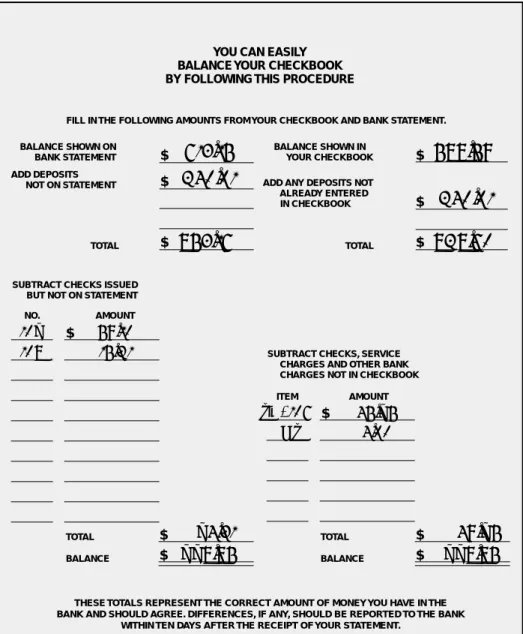
Once Mark discovered that his checkbook balance did not match the balance on the bank statement, he completed the reconciliation statement form on the back of his bank statement. Figure 2-11 is a copy of Mark’s completed reconciliation statement. (The word “reconcile” means “to settle.”)
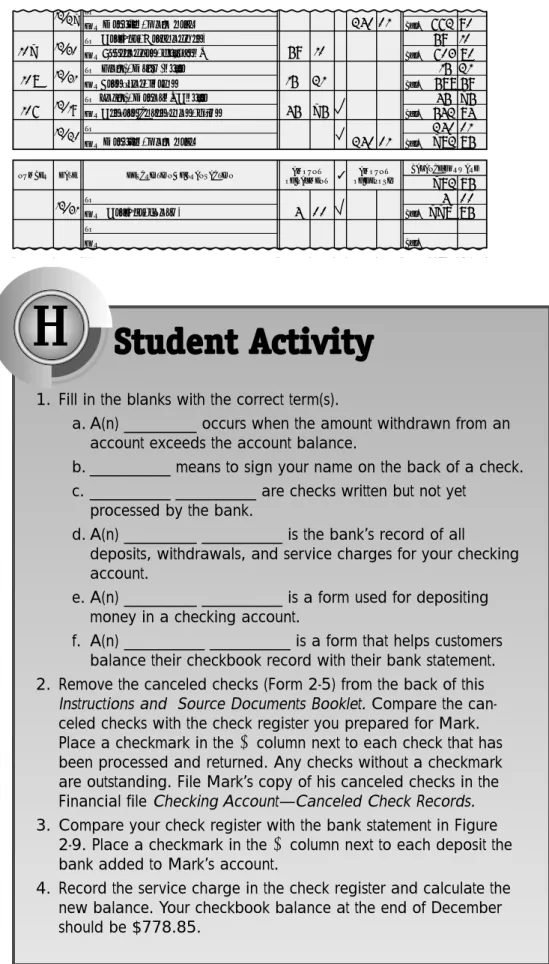
After Mark completed the reconciliation statement, he corrected his check register. He recorded the check and deposit he had forgotten to enter. Then he entered the service charge and calculated the new balance. He recorded these corrections as shown in Figure 2-12.
When Mark told Kim about his first errors in his check register, Kim said she had a story of her own. When she first opened a checking account, she felt so independent. She wrote several checks that same day.
“Somehow I got the strange notion that I had as much money in the bank as I had checks. It looked simple. Need money—write a check,” she laughed.
Determine why Mark’s check register balance does not agree with his bank statement balance. Answer the following questions. 1. Has Mark forgotten to record any checks in his check register?
If so, what check number and amount?_____________________ 2. What is the amount of the bank service charge that Mark has
not yet deducted? $ _____________________________________ 3. According to the records, are there any outstanding checks?
If so, what check numbers and amounts? ___________________ _______________________________________________________ 4. Has Mark forgotten to record any deposits in his check
register? _______________________________________________ If so, what date and amount? _____________________________ 5. Were there any deposits that do not appear on the bank
statement? _____________________________________________ If so, what date and amount? _____________________________ 6. What is the balance shown on the bank statement? __________ 7. What is the balance shown in Mark’s check register? ________
It wasn’t long before Kim received an overdraft notice from her bank. Writing checks for more money than you have on deposit is called overdrafting or overdrawing. She was $85 overdrawn on her account, which meant she had written checks for $85 more than she had in her account. The bank charged her $25 for every check that “bounced.”
If you do not keep an accurate record of each check, deposit, and service charge, you can easily overdraw your account. Both the financial institution and the business to which you write the check will probably charge you a large fee for a check not covered by sufficient funds. In fact, Insufficient Funds (ISF) is the bank’s name for a “rubber” check.
Figure 2-11
Mark’s Reconciliation
Statement YOU CAN EASILY
BALANCE YOUR CHECKBOOK BY FOLLOWING THIS PROCEDURE
FILL IN THE FOLLOWING AMOUNTS FROM YOUR CHECKBOOK AND BANK STATEMENT.
THESE TOTALS REPRESENT THE CORRECT AMOUNT OF MONEY YOU HAVE IN THE BANK AND SHOULD AGREE. DIFFERENCES, IF ANY, SHOULD BE REPORTED TO THE BANK
WITHIN TEN DAYS AFTER THE RECEIPT OF YOUR STATEMENT. BALANCE SHOWN ON
BANK STATEMENT
SUBTRACT CHECKS ISSUED BUT NOT ON STATEMENT
TOTAL
TOTAL BALANCE
TOTAL ITEM AMOUNT
BALANCE NO. AMOUNT
TOTAL
$ $
$
$
$
$
$
BALANCE SHOWN IN YOUR CHECKBOOK ADD ANY DEPOSITS NOT ALREADY ENTERED IN CHECKBOOK
SUBTRACT CHECKS, SERVICE CHARGES AND OTHER BANK CHARGES NOT IN CHECKBOOK ADD DEPOSITS
NOT ON STATEMENT
$
$ $
$ $
613.15
240.01
240.01
588.59
853.16
828.60
778.85 778.85
74.31 49.75
108 107
Ck 106 15.21
59.10
45.75 4.00 SC
Figure 2-12
Mark’s Corrected Check Register
NUMBER DATE DESCRIPTION OF TRANSACTION AMOUNT
OF PAYMENT AMOUNT OF DEPOSIT BALANCE FORWARD TO Bal. Bal. FOR TO FOR TO Bal. Bal. Bal. Bal. Bal. Bal. FOR TO FOR TO FOR TO FOR TO FOR TO
FORDÑèé¨àì pÄò∂áÑÇä
DÑèé¨àì pÄò∂áÑÇä
LÄÇòfi∆ DÑèÄëì. Sìé´Ñ Sàí«Ñëí'Cáëàí«åÄí gºÖìí SÑëï¢ÇÑ MÑëÇáÄçÉàí∏ AèèãàÄçÇÑí fé´ aèì. FÄòfi∆ DëîÜ∆ìé´Ñ PÑëí÷ßÄã iìÑåí
SÑëï¢ÇÑ cªÄëÜ∏ 85
59 10 15 21
45 75 45 75
778 01 240 10 59 80 603 59 588 84 542 85 782 85 782 00 4 00 4 01 240 21 15 90 662 240 01 240 01 107 108 12 27 12 30 12 31 12 31
106 12 19
12 20
1. Fill in the blanks with the correct term(s).
a. A(n) _________ occurs when the amount withdrawn from an account exceeds the account balance.
b. __________ means to sign your name on the back of a check. c. __________ __________ are checks written but not yet
processed by the bank.
d. A(n) _________ __________ is the bank’s record of all
deposits, withdrawals, and service charges for your checking account.
e. A(n) _________ __________ is a form used for depositing money in a checking account.
f. A(n) __________ __________ is a form that helps customers balance their checkbook record with their bank statement. 2. Remove the canceled checks (Form 2-5) from the back of this
Instructions and Source Documents Booklet. Compare the can-celed checks with the check register you prepared for Mark. Place a checkmark in the ✓ column next to each check that has been processed and returned. Any checks without a checkmark are outstanding. File Mark’s copy of his canceled checks in the Financial file Checking Account—Canceled Check Records.
3. Compare your check register with the bank statement in Figure 2-9. Place a checkmark in the ✓column next to each deposit the bank added to Mark’s account.
4. Record the service charge in the check register and calculate the new balance. Your checkbook balance at the end of December should be $778.85.
1. Contact (or visit) two financial institutions in your community to find out about the kinds of checking account services offered and the cost of these services. Prepare a comparative chart of the services offered by each financial institution.
2. As you gather information from financial institutions on checking accounts, file it in the Financial (green) file labeled Checking Account.
✔
Check Up
Having completed the Student Activities in this chapter, you should have mastered the skills listed below. Put a checkmark next to the skills you have mastered. If you aren’t sure of a skill, review that sec-tion of the chapter.
How to compare banking services
How to open a checking account
How to keep accurate checking account records
How to write a check
How to deposit money in a checking account
How to endorse a check
How to interpret and reconcile a bank statement
Now that you have mastered the skills listed above, move on to Chapter 3, Setting Up a Budget.