C H A P T E R
13
Session Border Controller
This chapter describes the level of support that Cisco ANA provides for Session Border Controller (SBC), as follows:
• Technology Description, page 13-1
• Information Model Objects (IMOs), page 13-2
• Vendor-Specific Inventory and IMOs
• Network Topology, page 13-20
• Service Alarms, page 13-20
Technology Description
SBC
Session Border Control (SBC) is an IP multimedia security and operational enhancement function for session-oriented IP services, based on SIP/H.323/H.248 signaling. It enables direct IP-to-IP interconnect between multiple administrative domains for session-based services, providing protocol
internetworking, security, admission control, and management. It enables direct IP-to-IP peering between service providers, and between service providers and their business and residential customers. The most common SBC deployment is Voice over IP (VoIP) peering between service providers. Up until now, this kind of peering was done by converting IP to public switched telephone network (PSTN) and using existing PSTN peering infrastructure, but the SBC approach has experienced phenomenal growth because it saves up to 75 percent in capital expenses.
SBC controls the signaling and media traffic generated during the setup, conduct, and teardown of interactive media communications. Each of its terms, in this context, has a special meaning:
• Session—In VoIP, a session is the same as a call. Each call consists of exchanges of control signals, and one or more media streams and associated data. This data can include audio, video, and other data, as well as call statistics, QoS data, and information needed for control signaling. It is this session that the SBC controls.
• Border—The demarcation point between one part of a network and another. One example is the firewall separating a corporate LAN from the rest of the Internet. Other example are the filtering routers, security servers, and other network elements that can separate one department within a large corporation from others in the same corporation. The SBC controls the flow of session data across these borders.
• Controller—The administrative functions that the SBC performs on the session data streams as they cross the borders between parts of the network. In addition to basic control functions, an SBC can provide metrics, access security, and data conversion services.
Note Cisco ANA currently provides SBC support on ASR 1000 routers only.
Information Model Objects (IMOs)
This section describes the following IMOs:• SBC Service (ISbcService)
• Service Border Element (ISBE)
• Data Border Element (IDBE)
• DBE Media Interface (IDbeMediaInterface)
• SBC Account (ISbcAccount)
• SBE AAA Interface (ISbeAaaInterface)
• SBE Billing Properties (ISbeBillingProperties)
• SBE Billing Instance Properties (ISbeBillingInstanceProperties)
• SBE RADIUS Client Properties (ISbeRadiusClientProperty)
• SBE RADIUS Server Properties (ISbeRadiusServerProperties)
• SBC Adjacency Endpoint (ISbcAdjacencyEnd)
• SBC Adjacency Group (ISbcAdjacencyGroup)
• SBC SIP Adjacency Endpoint (ISbcSipAdjacencyEnd)
• SBC SIP Adjacency Endpoint Authorization Realm (ISbcSipAdjacencyEndAuthRealm)
• SBE Configured BlackList (ISbeConfiguredBlackList)
• DBE Media Gateway Controller (IDbeMGC)
• SBC H248 Control Interface (ISbcH248ControlInterface)
• SBE Global Hunting Trigger List (ISbeGlobalHuntingTriggerList)
• SBE CAC Policy Set (ISbeCacPolicySet)
• SBE CAC Policy Table (ISbeCacPolicyTable)
• SBE CAC Rule Entry (ISbeCacRuleEntry)
• SBE Call Policy Set (ISbeCallPolicySet)
• SBE Call Policy Table (ISbeCallPolicyTable)
• SBE Call Policy Entry (ISbeCallRuleEntry)
• SBE Policy Set (ISbePolicySet)
• SBE Policy Table (ISbePolicyTable)
• SBE Rule Entry (ISbeRuleEntry)
• SBE SDP Match Table (ISbeSdpMatchTable)
• SBE SDP Policy Table (ISbeSdpPolicyTable)
• SBE QOS Profile (ISbeQosProfile)
• SBE SIP Header Profile (ISbeSipHeaderProfile)
• SBE SIP Header Profile Entry (ISbeSipHeaderProfileEntry)
• SBE SIP Header Profile Header (ISbeSipHeaderProfileHeader)
• SBE SIP Method Profile (ISbeSipMethodProfile)
• SBE SIP Method Profile Method (ISbeSipMethodProfileMethod)
• SBE SIP Option Profile (ISbeSipOptionProfile)
• SBE SIP Parameter Profile (ISbeSipParameterProfile)
• SBE SIP Profile (ISbeSipProfile)
• SBE SIP Timer Properties (ISbeSipTimerProperties)
SBC Service
The SBC Service object represents the SBC service function running on the physical network element (usually a router service card).
Service Border Element
The Service Border Element object represents the SBE (also known as the signaling proxy) that controls access to the network core by VoIP signaling messages. The SBE does this by acting as a Session Initiation Protocol (SIP) back-to-back user agent (B2BUA) or H.323 gateway, handling all call processing through one of these protocols. There can be only one signaling agent per service card, and the SBE will typically control one or more media gateways.
Data Border Element
The Data Border Element object represents the DBE (also known as a media control proxy) that controls access to media packets on the network by acting as an RTP proxy.
DBE Media Interface
The DBE Media Interface object represents either the pool of IPv4 network addresses that can be used by the DBE as local media addresses, or an interface defined on the DBE that is used for RTP packets.
Table 13-2 Service Border Element (ISBE)
Attribute Name Attribute Description Scheme Polling Interval
Call Redirect Limit Maximum number of redirections performed before the call fails (2 is default, range is 0-100)
IPCore Configuration Onhold Timeout Time the SBE will wait after receiving a media timeout notification from the
Data Border Element before tearing down an on-hold call.
IPCore Configuration
Table 13-3 Data Border Element (IDBE)
Attribute Name Attribute Description Scheme Polling Interval
DBE Location ID The unique location ID configured on each vDBE within a UM DBE service.
IPCore Configuration
DBE Type The type of DBE (DBE, vDBE) IPCore Configuration
Table 13-4 DBE Media Interface (IDbeMediaInterface)
Attribute Name Attribute Description Scheme Polling Interval
Address Range The defined range of addresses in the pool. IPCore Status VRF Name The VRF to which this interface is assigned. IPCore Status Managed By The unit managing this media interface, DBE or Media Gateway Controller. IPCore Status Port Range Upper The upper port range for the interface. IPCore Status Port Range Lower The lower port range for the interface. IPCore Status
SBC Account
The SBC Account object represents the service relationship with the remote organization on the SBE, with which the SBC interacts.
SBE AAA Interface
The SBE AAA Interface object represents the SBE interface used to supply authentication, authorization, and accounting (AAA) subscriber services to the SBC.
NAT Mode The configured traversal mode for network address and port translation (twice-napt,twice-nat).
IPCore Status Termination The ID of the interface termination point. IPCore Status
Table 13-4 DBE Media Interface (IDbeMediaInterface) (continued)
Attribute Name Attribute Description Scheme Polling Interval
Table 13-5 SBC Account (ISbcAccount)
Attribute Name Attribute Description Scheme Polling Interval
Name The SBC account name. IPCore Configuration
Adjacency List User-defined signaling adjacencies which connect the SBC to devices within the remote-side organization.
IPCore Configuration
Table 13-6 SBE AAA Interface (ISbeAaaInterface)
Attribute Name Attribute Description Scheme Polling Interval
Network ID The arbitrary SBE interface identifier (from 0-99999). IPCore Status
VRF The VRF to which this SBE interface is assigned. IPCore Status
AAA Address IP address of the AAA interface. IPCore Configuration
SBE Billing Properties
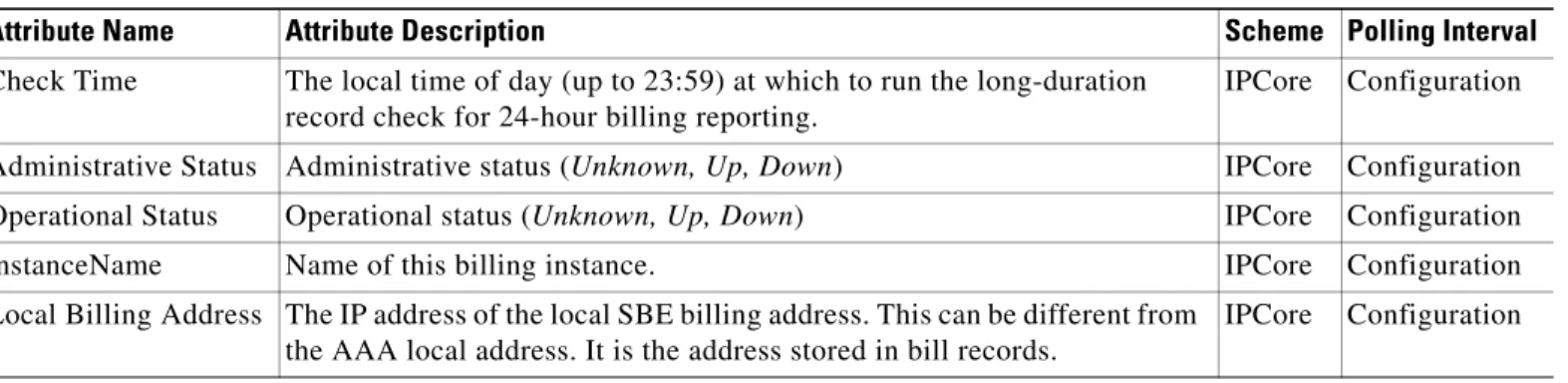
The SBE Billing Properties object represents all billing properties for an SBC Account.
SBE Billing Instance Properties
The SBE Billing Instance Properties object represents a single SBE billing record.
Table 13-7 SBE Billing Properties (ISbeBillingProperties)
Attribute Name Attribute Description Scheme Polling Interval
Check Time The local time of day (up to 23:59) at which to run the long-duration record check for 24-hour billing reporting.
IPCore Configuration Administrative Status Administrative status (Unknown, Up, Down) IPCore Configuration Operational Status Operational status (Unknown, Up, Down) IPCore Configuration
instanceName Name of this billing instance. IPCore Configuration
Local Billing Address The IP address of the local SBE billing address. This can be different from the AAA local address. It is the address stored in bill records.
IPCore Configuration
Table 13-8 SBE Billing Instance Properties (ISbeBillingInstanceProperties)
Attribute Name Attribute Description Scheme Polling Interval
Instance Number ID number of the billing instance. IPCore Configuration
Billing Method The billing method. IPCore Configuration
Local Billing Address The IP address of the local SBE billing address. This can be different from the AAA local address. It is the address stored in bill records.
IPCore Configuration Check Time The local time of day (up to 23:59) at which to run the long-duration
record check for 24-hour billing reporting.
IPCore Configuration
Batch Size Batch size. IPCore Configuration
Batch Time Batch time. IPCore Configuration
Deactivation Mode Description of how this billing instance is to be deactivated (for example,
normal).
IPCore Configuration RADIUS Client The name of the configured RADIUS accounting client for this billing
instance.
IPCore Configuration Active Calls The number of currently active calls logged against the billing instance.. IPCore Configuration Operational Status Operational status (Unknown, Up, Down) IPCore Configuration
Transport Status Transport status IPCore Configuration
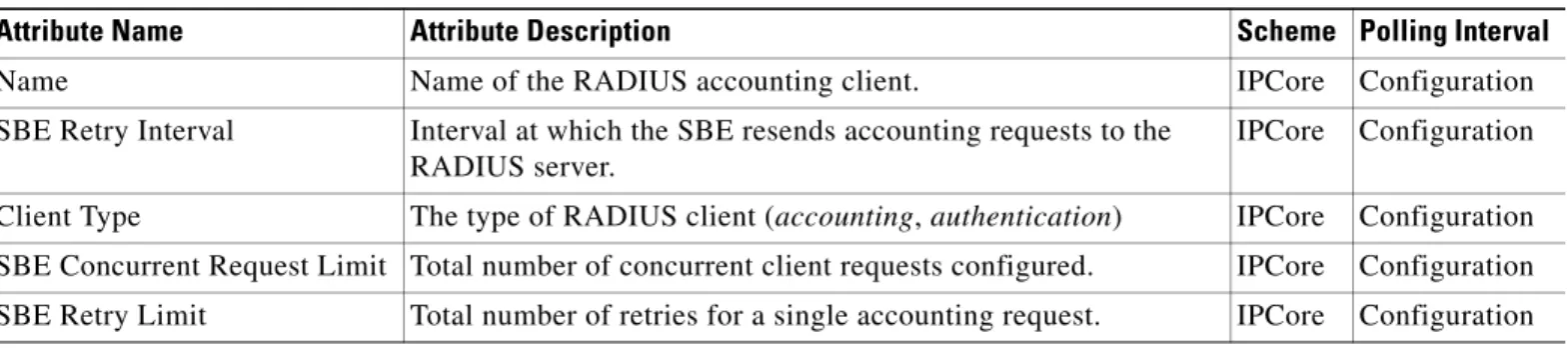
SBE RADIUS Client Properties
The SBE RADIUS Client Properties object stores the properties associated with the RADIUS client which the SBE uses to access AAA services.
SBE RADIUS Server Properties
The SBE RADIUS Server Properties object stores properties associated with the RADIUS server as viewed by the AAA client.
Table 13-9 SBE RADIUS Client Properties (ISbeRadiusClientProperty)
Attribute Name Attribute Description Scheme Polling Interval
Name Name of the RADIUS accounting client. IPCore Configuration
SBE Retry Interval Interval at which the SBE resends accounting requests to the RADIUS server.
IPCore Configuration Client Type The type of RADIUS client (accounting, authentication) IPCore Configuration SBE Concurrent Request Limit Total number of concurrent client requests configured. IPCore Configuration SBE Retry Limit Total number of retries for a single accounting request. IPCore Configuration
Table 13-10 SBE RADIUS Server Properties (ISbeRadiusServerProperties)
Attribute Name Attribute Description Scheme Polling Interval
Server Priority The priority of the accounting server. The priority determines which of the configured servers is selected as the default server and where all requests are sent. A RADIUS client contacts the RADIUS servers sequentially, in order of priority, to establish an active RADIUS session. Each RADIUS client sends call detail records to the currently active RADIUS server. The priority must be in the range 1-10 (highest to lowest priority).
IPCore Configuration
Server Key The RADIUS accounting server authentication key or shared secret. IPCore Configuration Port Number The port number on which the server connects to the RADIUS server. IPCore Configuration
RADIUS Mode The RADIUS mode (remote, local). IPCore Configuration
SBC Adjacency Endpoint
The SBC SIP Adjacency Endpoint object represents a signaling relationship between a local and a remote call agent. There is one adjacency defined per call agent. The adjacency defines protocol-specific parameters as well as admission control and routing policy. The SBC adjacency includes SIP and H.323 adjacencies (R4 supports SIP adjacencies only).
SBC Adjacency Group
The SBC Adjacency Group object represents a list of adjacencies. Adjacency groups permit operators to enable and disable features on a group basis instead of per adjacency.
Table 13-11 SBC Adjacency Endpoint (ISbcAdjacencyEnd)
Attribute Name Attribute Description Scheme Polling Interval
Description Description of this adjacency. IPCore Configuration
Subnet Restriction The configured IP address prefix restricting the set of remote signaling peers that can be contacted over this adjacency.
IPCore Configuration Media Passthrough Permit media traffic to bypass the DBE (true, false). IPCore Configuration Hunting Trigger Disabled Enables or disables the hunting trigger on this adjacency. IPCore Configuration Hunting Triggers The list of hunting triggers associated with this adjacency. IPCore Configuration VRF The VRF with which this adjacency is associated. IPCore Configuration Local Signaling Address The logical IP address of this adjacency. IPCore Configuration Remote Signaling
Address
The signaling peer. IPCore Configuration
Local Signaling Port The port used by this adjacency. IPCore Configuration Remote Signaling Port The port of the signaling peer. IPCore Configuration Operational Status Operational status of the adjacency (attach, detach). IPCore Configuration SBC Account The SBC Account associated with this adjacency. IPCore Configuration
Instance Name The name of this adjacency. IPCore Configuration
Transport Protocol The Layer 4 protocol this adjacency uses. IPCore Configuration
Table 13-12 SBC Adjacency Group (ISbcAdjacencyGroup)
Attribute Name Attribute Description Scheme Polling Interval
Name The name of the adjacency group. IPCore Configuration
SBC SIP Adjacency Endpoint
The SBC SIP Adjacency Endpoint object represents the same relationship as SBC Adjacency Endpoint but for a SIP adjacency only.
SBC SIP Adjacency Endpoint Authorization Realm
The SBC SIP Adjacency Endpoint Authorization Realm object represents a set of authentication credentials for a specified domain and adjacency.
SBE Configured BlackList
The SBE Configured BlackList object represents a source to which one or more instances of SBE Configured BlackList Entry applies. The source can be broad or narrow, depending on the defined combination of IP address, port, VPN, and port type.
Table 13-13 SBC SIP Adjacency Endpoint (ISbcSipAdjacencyEnd)
Attribute Name Attribute Description Scheme Polling Interval
Preferred Transport The preferred transport to use. If the preferred transport is not available, another supported transport will be used.
IPCore Configuration Registration Target Address The IP address of the SIP register server. IPCore Configuration Registration Target Port The port number of the SIP register server. IPCore Configuration
Table 13-14 SBC SIP Adjacency Endpoint Authorization Realm (ISbcSipAdjacencyEndAuthRealm)
Attribute Name Attribute Description Scheme Polling Interval
Domain The name of the domain for which the authentication credentials are valid. IPCore Status Username The username that identifies the SBC in the specified domain. IPCore Status Password The password used to authenticate the username in the specified domain. IPCore Status
Table 13-15 SBE Configured BlackList (ISbeConfiguredBlackList)
Attribute Name Attribute Description Scheme Polling Interval
Black List Type The type of source to which this blacklist applies. IPCore Configuration
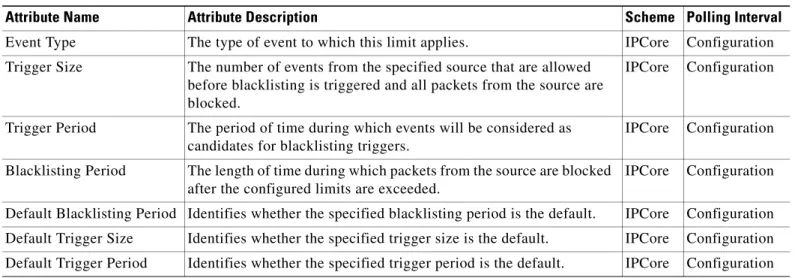
SBE Configured BlackList Entry
The SBE Configured BlackList Entry object represents a set of specific blacklisting actions that are taken when events of a specified type are received from sources defined in one or more instances of SBE Configured BlackList.
SBE Current BlackList Listing
The SBE Current BlackList Listing object represents a set of limits currently in effect against one or more blacklisted sources defined in one or more instances of SBE Configured BlackList.
Table 13-16 SBE Configured BlackList Entry (ISbeConfiguredBlackListEntry)
Attribute Name Attribute Description Scheme Polling Interval
Event Type The type of event to which this limit applies. IPCore Configuration Trigger Size The number of events from the specified source that are allowed
before blacklisting is triggered and all packets from the source are blocked.
IPCore Configuration
Trigger Period The period of time during which events will be considered as candidates for blacklisting triggers.
IPCore Configuration Blacklisting Period The length of time during which packets from the source are blocked
after the configured limits are exceeded.
IPCore Configuration Default Blacklisting Period Identifies whether the specified blacklisting period is the default. IPCore Configuration Default Trigger Size Identifies whether the specified trigger size is the default. IPCore Configuration Default Trigger Period Identifies whether the specified trigger period is the default. IPCore Configuration
Table 13-17 SBE Current BlackList Listing (ISbeCurrentBlacklisting)
Attribute Name Attribute Description Scheme Polling Interval
Source Address The IP address of a blacklisted source. IPCore Configuration All Source Addresses Indicates whether Source Address applies to only one or to all sources. If
true, ignore the value in Source Address.
IPCore Configuration Source Port Type The port type of the blacklisted sources. IPCore Configuration Source Port Number The port number of the blacklisted sources. IPCore Configuration Time Remaining The time remaining until the blacklist will be removed (hh:mm:ss). IPCore Configuration
Event Type The type of blacklisted event. IPCore Configuration
SBE Codec List
The SBE Codec List object defines a list of allowed codecs (a whitelist) that can be applied via a Call Admission Control (CAC) policy.
SBE Codec List Entry
The SBE Codec List Entry object represents an entry in the SBE Codec List.
SBE Media Gateway
The SBE Media Gateway object represents properties for the SBC/SBE side of the H.248 interface.
DBE Media Gateway Controller
The DBE Media Gateway Controller object represents properties for the DBE side of the H.248 interface.
Table 13-18 SBE Codec List (ISbeCodecList)
Attribute Name Attribute Description Scheme Polling Interval
Name The name of the list of allowed codecs. IPCore Configuration
Table 13-19 SBE Code List Entry (ISbeCodecListEntry)
Attribute Name Attribute Description Scheme Polling Interval
minPacketizationPeriod The minimum packetization period. IPCore Configuration codecName The name of the allowed codec to which the minimum packetization
period applies.
IPCore Configuration
Table 13-20 SBE Media Gateway (ISbeMediaGateway)
Attribute Name Attribute Description Scheme Polling Interval
codecList Comma-separated list of codecs supported on the H.248 link. IPCore Configuration
ipAddress IP address IPCore Configuration
SBC H248 Control Interface
The SBC H248 Control Interface object represents the H.248 interface used for signaling between the SBE and DBE in distributed mode, and between an SBE and a transcoding media gateway.
SBE Global Hunting Trigger List
The SBE Global Hunting Trigger List object represents a list of hunting triggers defined globally for SBCs. Hunting triggers enable SBCs to hunt for other route or destination adjacencies when normal routes fail.
SBE CAC Policy Set
The SBE CAC Policy Set object represents a set of SBE Call Admission Control (CAC) policy rules. These rules permit application-level policy control over how VoIP call admission requests are processed.
Table 13-22 SBC H248 Control Interface (ISbcH248ControlInterface)
Attribute Name Attribute Description Scheme Polling Interval
ipAddress IP address of the remote Media Gateway for an SBE, and the associated Media Gateway Controller for a DBE.
IPCore Configuration
transport The transport protocol used. IPCore Configuration
port The port number. IPCore Configuration
Association The media gateway associated with this H.248 control interface. IPCore Configuration
Table 13-23 SBE Global Hunting Trigger List (ISbeGlobalHuntingTriggerList)
Attribute Name Attribute Description Scheme Polling Interval
huntingMode SIP hunting triggers. IPCore Status
huntingTriggers The list of hunting triggers. IPCore Status
Table 13-24 SBE CAC Policy Set (ISbeCacPolicySet)
Attribute Name Attribute Description Scheme Polling Interval
firstScope First call table scope of this policy set. IPCore Configuration firstTable The first CAC table used by this policy set. IPCore Configuration
Description Description of the policy set. IPCore Configuration
SBE CAC Policy Table
The SBE CAC Policy Table object represents a table containing instances of SBE CAC Rule Entry.
SBE CAC Rule Entry
The SBE CAC Rule Entry object represents an entry in a SBE CAC Policy Table.
SBE Call Policy Set
The SBE Call Policy Set object represents a a set of SBE call policy rules. These rules permit application-level policy control over how in-call VoIP signaling and media are processed.
Table 13-25 SBE CAC Policy Table (ISbeCacPolicyTable)
Attribute Name Attribute Description Scheme Polling Interval
instanceName Name of the table IPCore Configuration
instanceDescription Description of the table IPCore Configuration
matchType List of event types to match on IPCore Configuration
Table 13-26 SBE CAC Rule Entry (ISbeCacRuleEntry)
Attribute Name Attribute Description Scheme Polling Interval
scope The scope of the entry. IPCore Configuration
nextPolicyTable The next CAC policy table to be evaluated in the chain. IPCore Configuration
Table 13-27 SBE Call Policy Set (ISbeCallPolicySet)
Attribute Name Attribute Description Scheme Polling Interval
isActive Indicates if the policy set is active or inactive. IPCore Configuration
policySetNumber The ID number of the policy set. IPCore Configuration
name The name of the policy set. IPCore Configuration
description The description of the policy set. IPCore Configuration
SBE Call Policy Table
The SBE Call Policy Table object represents a table containing instances of SBE Call Policy Entry.
SBE Call Policy Entry
The SBE Call Policy Entry object represents an entry in a SBE CAC Policy Table.
SBE Policy Set
The SBE Policy Set object represents a group of policies that can be active on the SBC at any one time.
Table 13-28 SBE Call Policy Table (ISbeCallPolicyTable)
Attribute Name Attribute Description Scheme Polling Interval
instanceName Name of the call policy table. IPCore Configuration
instanceDescription Description of the call policy table. IPCore Configuration
matchType The type of call events to match on. IPCore Configuration
Table 13-29 SBE Call Policy Entry (ISbeCallRuleEntry)
Attribute Name Attribute Description Scheme Polling Interval
entryNumber ID number of the Call policy entry. IPCore Configuration
action Action to be taken on a match. IPCore Configuration
matchValue The event to match on. IPCore Configuration
entryCategory The policy entry category. IPCore Configuration
Table 13-30 SBE Policy Set (ISbePolicySet)
Attribute Name Attribute Description Scheme Polling Interval
isActive Indicates whether the policy set is active or inactive. IPCore Configuration policySetNumber ID number of the SBE policy set. IPCore Configuration
name Name of the SBE policy set. IPCore Configuration
SBE Policy Table
The SBE Policy Table object represents a table of instances of SBE Rule Entry. It is an abstract class that contains attributes common to both call policy and CAC policy rules.
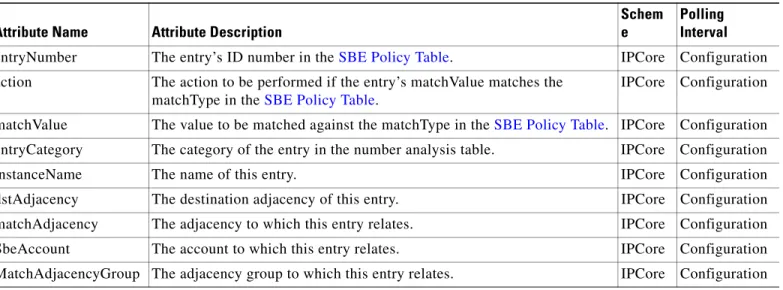
SBE Rule Entry
The SBE Rule Entry object represents an entry in SBE Policy Table. It is abstract class that contains attributes common to both Call and CAC policy rules.
SBE SDP Match Table
The SBE SDP Match Table object represents a table of strings used in event and policy matching.
Table 13-31 SBE Policy Table (ISbePolicyTable)
Attribute Name Attribute Description Scheme Polling Interval
matchType The criteria used to select an SBE Rule Entry from the table. IPCore Configuration
name The name of the SBE policy table. IPCore Configuration
description Description of the SBE policy table. IPCore Configuration
Table 13-32 SBE Rule Entry (ISbeRuleEntry)
Attribute Name Attribute Description
Schem e
Polling Interval entryNumber The entry’s ID number in the SBE Policy Table. IPCore Configuration action The action to be performed if the entry’s matchValue matches the
matchType in the SBE Policy Table.
IPCore Configuration matchValue The value to be matched against the matchType in the SBE Policy Table. IPCore Configuration entryCategory The category of the entry in the number analysis table. IPCore Configuration
instanceName The name of this entry. IPCore Configuration
dstAdjacency The destination adjacency of this entry. IPCore Configuration matchAdjacency The adjacency to which this entry relates. IPCore Configuration SbeAccount The account to which this entry relates. IPCore Configuration MatchAdjacencyGroup The adjacency group to which this entry relates. IPCore Configuration
SBE SDP Policy Table
The SBE SDP Policy Table object represents a table of the SBE/SBC policies.
SBE QOS Profile
The SBE QOS Profile object represents a defined quality-of-service profile used by CAC policies. These policies are used exclusively for marking packets.
SBE SIP Header Profile
The SBE SIP Header Profile object represents an instance of a SIP header profile, used to control which SIP message requests are accepted (whitelist) or rejected (blacklist) on the SBE.
Table 13-34 SBE SDP Policy Table (ISbeSdpPolicyTable)
Attribute Name Attribute Description Scheme Polling Interval
name Name of the policy table IPCore Status
Table 13-35 SBE QOS Profile (ISbeQosProfile)
Attribute Name Attribute Description Scheme Polling Interval
classOfService The type of call to which this QoS profile will be applied (for example, voice,
video, fax, signaling).
IPCore Configuration markingType The type of marking: DSCP or IP precedence. IPCore Configuration
dscp DSCP value. IPCore Configuration
ipPrecedence IP precedence value. IPCore Configuration
tos Terms of Service (ToS) value. IPCore Configuration
Table 13-36 SBE SIP Header Profile (ISbeSipHeaderProfile)
Attribute Name Attribute Description Scheme Polling Interval
instanceName Name of the SIP header profile. IPCore Configuration
isInUse Flag indicating wether the profile is in use. IPCore Configuration profileType The profile type (blacklist; profiles are whitelists by default). IPCore Configuration
SBE SIP Header Profile Entry
The SBE SIP Header Profile Entry object represents an entry in the SBE SIP Header Profile.
SBE SIP Header Profile Header
The SBE SIP Header Profile Header object is an abstract class representing a header on the SBE SIP Header Profile.
SBE SIP Method Profile
The SBE SIP Method Profile object specifies how methods for the corresponding SBE SIP Header Profile will be applied.
Table 13-37 SBE SIP Header Profile Entry (ISbeSipHeaderProfileEntry)
Attribute Name Attribute Description Scheme Polling Interval
entryNr ID number of the entry IPCore Configuration
action The action to be taken when there is a match on the value and conditions IPCore Configuration
value Value in the SIP message to be matched on IPCore Configuration
conditions Condition in the SIP message to be matched on IPCore Configuration
parameterProfile Parameter profile IPCore Configuration
Table 13-38 SBE SIP Header Profile Header (ISbeSipHeaderProfileHeader)
Attribute Name Attribute Description Scheme Polling Interval
name Name of the SBE SIP Header Profile IPCore Configuration
Table 13-39 SBE SIP Method Profile (ISbeSipMethodProfile)
Attribute Name Attribute Description Scheme Polling Interval
isPassthrough If true, permits message bodies to be passed through for non vital messages accepted by the profile. If false, strips the message body out of any non vital SIP messages matched by the profile.
SBE SIP Method Profile Method
The SBE SIP Method Profile object stores the method strings that form the whitelist or blacklist SBE SIP Header Profile.
SBE SIP Option Profile
The SBE SIP Option Profile object stores the option strings that form a SIP Option profile whitelist or blacklist.
SBE SIP Parameter Profile
The SBE SIP Parameter Profile object stores the parameters that form a SIP parameter profile whitelist or blacklist.
SBE SIP Profile
The SBE SIP Profile is an abstract class representing SIP Header, Option, and Method profiles.
Table 13-40 SBE SIP Method Profile Method (ISbeSipMethodProfileMethod)
Attribute Name Attribute Description Scheme Polling Interval
instanceName Name of the method. IPCore Configuration
action The action to be performed by the method strings. IPCore Configuration
mapStatusCode The map status code. IPCore Configuration
headerProfile The corresponding SBE SIP Header Profile for this method. IPCore Configuration parameterProfile The corresponding SBE SIP Parameter Profile for this method. IPCore Configuration
Table 13-41 SBE SIP Option Profile (ISbeSipOptionProfile)
Attribute Name Attribute Description Scheme Polling Interval
options The option strings that form the whitelist or blacklist. IPCore Configuration
Table 13-42 SBE SIP Parameter Profile (ISbeSipParameterProfile)
Attribute Name Attribute Description Scheme Polling Interval
parameters The parameter strings that form the whitelist or blacklist. IPCore Configuration
SBE SIP Timer Properties
The SBE SIP Timer Properties object represents a SIP Timer. Users can configure SIP timers to permit performance tuning of network elements participating in SBC traffic.
Table 13-44 SBE SIP Timer Properties (ISbeSipTimerProperties)
Attribute Name Attribute Description Scheme Polling Interval
tcpConnectTimeout Time (in milliseconds) the SBC waits for a SIP TCP connection to a remote peer to complete before failing the connection. The default is 1000.
IPCore Configuration
tcpIdleTimeout Minimum time (in milliseconds) a TCP socket must remain open while not processing traffic. If the socket remains idle after that time, it can be closed. The default is two seconds.
IPCore Configuration
tlsIdleTimeout Transport Layer Security (TLS) idle timeout. IPCore Configuration inviteTimeout Time (in milliseconds) the SBC waits for a final response to an
outbound SIP INVITE request. The default is 180 seconds. If no response is received during that time, an internal Request Timeout response is generated and returned to the caller.
IPCore Configuration
udpFirstRetransmitInterval Time (in milliseconds) the SBC waits for a UDP response or ACK before sending the first retransmission of the relevant signal. If the SBC keeps getting no responses, it doubles subsequent
retransmission intervals each time until it reaches the
udp-max-retransmit-interval duration. It will cease retransmitting the request and timeout the signal if 64 times this duration passes without the receipt of a response or ACK. The default first UDP retransmission interval is 500 milliseconds.
IPCore Configuration
udpMaxRetransmitInterval Maximum interval (in milliseconds) after which SBC will retransmit. The default interval is four seconds.
IPCore Configuration tcpConnectTimeout Time interval (in milliseconds) over which SBC will retain negative
UDP responses to INVITE requests. All subsequent retransmitted responses received within this interval will be answered with a negative ACK. Thereafter, any further retransmitted responses are ignored. The default UDP response linger period is 32 seconds.
Vendor-Specific Inventory and IMOs
There are no vendor-specific inventory or IMOs for this technology.
Network Topology
Cisco ANA does not support discovery of Network layer topology.
Service Alarms
There are no service alarms specific to this technology.
For detailed information about alarms and correlation, see the Cisco Active Network Abstraction 3.7 User Guide.