The Right “Change”
SQL-Based Middleware Mike McKee
CONNX Solutions
IMS Users Group
[email protected] http://www.connx.com
What was the most “overused”
word in 2008 Election?
Maverick
My Friends
Joe the Plumber
Historic
Did you select “Change”?
Gartner analyst says
“People resistant to change will not survive changes to the industry”
And Yet …
Legacy Systems still very much in existence today, and in most of Fortune 1000
companies
– DB2
– IMS
– VSAM
IMS Facts
90% of Fortune 1000 companies use IMS.
More than 3 trillion dollars of transactions go
through IMS in a single day.
Clients that run IMS have exceeded a
workload of 100 million transactions per day.
Taken from IBM Systems Magazine, “Standing the Test of Time”, April 2008
Is IMS too old, and do we need to
“change”
Steve Tockey, author of “Return on Software”
suggests that their comes a point in time when costs to maintain a system (or asset) becomes too costly, and analysis should be made on whether to “retire” the system.
Main reasons Tockey states are
– Deterioration
Deterioration and Obsolescence
Deterioration
– Software does not deteriorate (machines might)
Obsolescence
– Changes in environment or requirements that make it difficult or impossible to complete the task.
Replacement analysis
This is based on looking at viable options and see if they are “better” economic
solutions than the current solution. It is primarily based on costs/income.
Is a more modern database/”newer”
technology more viable than IMS or other legacy solutions?
Different opinions, but Middleware
provides a proven way to extend
life of legacy systems.
Middleware attempts to provide value to legacy databases by creating additional
components that bridge older technologies with new technologies.
SQL Based Middleware might be worth considering, as many standards/products support SQL.
SQL Based Middleware
Enables “legacy” data (e.g. IMS) to be
accessed through newer
standards/technologies through SQL Commands.
Attempts to make “IMS” or other legacy data
appear as a “relational” database.
May eliminate/postpone the need to migrate because there middleware provides tools to bridge legacy to newer technology.
Some Characteristics of SQL
Based Middleware (SBM)
Supports ANSI SQL
Has repository for meta data that makes up
the Data Sources that it supports
Supports interface standards such as:
– ODBC
– JDBC
– OLEDB
Review of Last Month’s
architecture
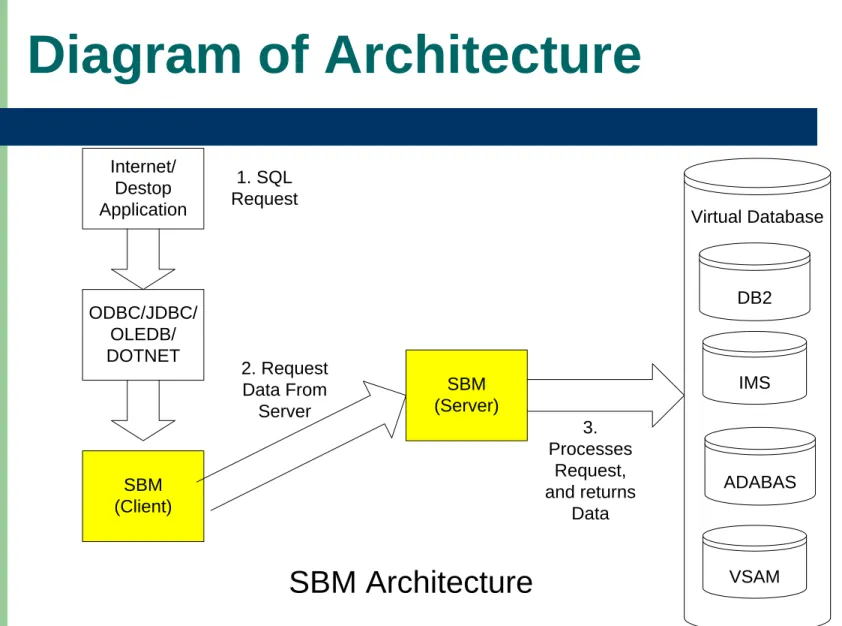
Architecture of a SBM
Normally most SBM’s have a Client/Server
Architecture.
The Client module (The SQL Engine) resides on a non-mainframe (PC, Linux Box, Web
Server).
The Server module resides on a mainframe, or an a machine in which the data resides.
Diagram of Architecture
Virtual Database SBM (Server) SBM (Client) ADABAS DB2 VSAM IMS Internet/ Destop Application 1. SQL Request 3. Processes Request, and returns Data 2. Request Data From Server ODBC/JDBC/ OLEDB/ DOTNET SBM ArchitectureFirst Step – SQL Request
Applications/Services/Beans issues SQL
Requests through function calls in interfaces such as:
– ODBC
– OLEDB
– JDBC
Examples of SQL Applications
SSIS (Microsoft) VB
Excel
SharePoint Netbeans Websphere
Examples of SQL Interfaces
ODBC ODBC is an acronym for Open Data Base Connectivity. One of the most widely used interfaces for Data Access. It is available on Window or Unix systems.
OLE DB Object Linking and Embedding Data Base interface. Usually invoked by “wrapper” API’s such
as ADO.NET/ADO.
JDBC Java Database Connectivity interface. Used for Java Development.
.NET Provider
Step 2 – Client Processing
Client evaluates SQL Request verifying it for accuracy.
Develops execution plan based on the common data dictionary (metadata) that contains information about the tables, columns, indexes.
Step 3 – Server gets control
Server analyzes the RPC call, and
determines if it is a select, insert, update, delete call.
Server makes a call in the native language
(in IMS it is DL/I) to carry out the correct operation.
Step 4 – Gives results back to
Client
If it is a query, it would give results in the form of data retrieved from the database.
If it was an update/delete/insert it would carry out the operation, and let the client know how many rows were processed.
While the processing seems simplistic, the middleware deals with many “plumbing”
details such as data translation, date/time issues, and threads/parallel processing.
A “Virtual” Database
Many SBM’s can be described as a “virtual”
database. This means that they “abstract” many of the data sources that might be contained in the data dictionary.
For instance, a SBM might contain VSAM files, IMS database, DB2 tables, Oracle
Tables, and a SQL Server database, and all the details would be encapsulated in “private” virtual database that clients would connect
Turning Heirarchial Relationships
to Relational
Many critics of a SQL approach suggest that it “impossible” to normalize Heirarchial
relationships.
Many legacy data in Cobol FD’s have arrays,
and sometimes arrays within arrays. In IMS this is often also referred to as Segments.
While Xquery (Another way to access data) allows for these types of data sources, these data sources can also be turned into
Cobol FD becoming two relational
tables
01 PAYMENT-RECORD. 05 ACCOUNTS. 10 MONTHLY-PAYMENT PICTURE IS 9(6)V99 USAGE IS COMP-3 OCCURS 12 TIMES
10 CUSTOMER-NAME PIC X(30). 10 CUSTOMER-ADDRESS PIC X(80)
Customer Table
CustomerName CHAR(30)
CustomerAddress CHAR(80)
Monthly Payment Table
CustomerName CHAR(30) MonthID INTEGER
PaymentAmount DOUBLE
COBOL FD Data Dictionary
Payment VSAM File
Why is SQL Data Access
important?
Standards, Standards, Standards
Widespread support by development
community.
Language is fairly simple to learn, yet
SQL Basics
SQL is consists of only 4 statements, sometimes referred to as CRUD :
– Create - INSERT - to store new data
– Read - SELECT - to retrieve data
– Update - UPDATE - to change or modify data.
Examples of SQL
Select order_id, customer_id, order_amt from orders where order_id=’111222’
Joining two tables
Select order_id, customer_id, order_amt, customers. customer_name from orders, customers where
order_id=’111222’ and customers.customer_id = orders.customer_id;
Criteria for selecting a SBM
Provider
Is the Data Source Supported?
Is the Hardware/OS Supported?
Performance – Is it close to the native speed
you get in your mainframe applications?
Data Type support – Some data types are
fairly complex (e.g. Date/Time). Are they supported. Can it handle nested arrays?
Correct results – Are the results consistently
More Criteria
Can Data Definition be easily imported into the Repository (Data Dictionary)?
Evaluation – Is their support to assist you
during the evaluation process?
Security – Are they security enhancements? Driver Interfaces – Is there support for
popular interfaces such as ODBC, OLEDB, JDBC, and .NET?
And Finally
Are there additional tools to complement the SBM?
Where can I find a SBM?
A “Google” search on “ODBC”, “JDBC”,
“OLEDB”, “VSAM”, “Data Access”, “and IMS” might provide a number of sites that link to a SBM Provider. The following Web link by
noted database expert Ken North offers a list of SBM Providers:
http://www.sqlsummit.com/ODBCVend.htm http://www.virtualims.com/tools.html
Conclusion
A SBM can enhance the life of your legacy system. By adding SQL Based Middleware legacy databases, many new technologies (Mashups, Web Services, Applets, Beans, .NET, Web Applications) can be used to provide value to your organization.
IMS Demonstration
Importing IMS into a Dictionary
Generating a IMS Query through a Query