Evaluation of DHS'
Information Security Program
for Fiscal Year 2015
January 5, 2016
OIG-16-08 (Revised)
DHS OIG H
IGHLIGHTS
Evaluation of DHS’ Information
Security Program for Fiscal Year 2015
January 5, 2016
Why We Did
This Evaluation
We reviewed the Department of Homeland Security’s (DHS) information security program in accordance with the Federal Information Security
Modernization Act of 2014. Our objective was to determine whether DHS’ information security program is adequate, effective, and complies with FISMA requirements.
What We
Recommend
We recommended that DHS further strengthen its oversight of the Department’s
information security program in the areas of continuous monitoring, plans of action and milestones, security
authorization, and
configuration management.
For Further Information:
Contact our Office of Public Affairs at (202) 254-4100, or email us at
What We Found
DHS has taken actions to strengthen its information security program. For example, DHS developed and implemented the Fiscal Year 2015 Information Security Performance Plan to define the performance requirements, priorities, and overall goals of the Department. DHS has also taken steps to address the President’s cybersecurity priorities, such as Information Security Continuous
Monitoring; Identity, Credential, and Access Management; and anti-phishing and malware defense.
Nonetheless, the Department must ensure compliance with information security requirements in other areas. For
example, DHS did not include classified systems
information in its monthly information security scorecard or its Federal Information Security Modernization Act of 2014 reporting submission to the Office of Management and Budget. Contrary to the Under Secretary’s guidance, the United States Coast Guard (USCG) did not report its personal identity verification card implementation data to the Department. We also identified inaccurate or
incomplete data in DHS’ enterprise management systems. Further, Components did not maintain their information security programs on a year-round, continuous basis or perform weakness remediation reviews as required. Components operated 220 “sensitive but unclassified,” “Secret,” and “Top Secret” systems with expired authorities to operate. We also identified deficiencies related to plans of action and milestones, configuration management, and continuous monitoring. Without addressing these
deficiencies, the Department cannot ensure that its systems are properly secured to protect sensitive information stored and processed in them.
DHS Response
We made six recommendations to the Chief Information Security Officer. The Department concurred with five recommendations.
OFFICE OF INSPECTOR GENERAL
Department of Homeland Security
Washington, DC 20528 / www.oig.dhs.gov
January 5, 2016 MEMORANDUM FOR: Jeffrey Eisensmith
Chief Information Security Officer FROM: Sondra F. McCauley
Assistant Inspector General
Office of Information Technology Audits
SUBJECT: Evaluation of DHS’ Information Security Program for Fiscal Year 2015 (OIG-16-08)
Attached for your information is our revised final report, Evaluation of DHS’ Information Security Program for Fiscal Year 2015. We reissued the report with a correction to the number of systems without authority to operate and current contingency plan tests. These revisions do not change the overall findings or recommendations in the report. Please see the attached errata sheet for details. Please call me with any questions, or your staff may contact Chiu-Tong Tsang, Director, Cybersecurity and Intelligence Division, at (202) 254-5472.
Errata page for OIG-16-08
Evaluation of DHS’ Information
Security Program for Fiscal Year 2015
Change made to the DHS OIG Highlights section, 3rd paragraph (see
below):
Changed from:
Components operated 136 “sensitive but unclassified,” “Secret,” and “Top Secret” systems with expired authorities to operate.
Changed to:
Components operated 220 “sensitive but unclassified,” “Secret,” and “Top Secret” systems with expired authorities to operate.
Change made to the Overall Issues To Be Addressed section, page 9, 2nd
bullet (see below):
Changed from:
Components continued to operate information systems without ATO. For example, the Department had 119 systems sensitive but unclassified (SBU) systems, as well as 17 systems classified as “Secret” and “Top Secret” operating with an expired ATO.
Changed to:
Components continued to operate information systems without ATO. For
example, the Department had 203 sensitive but unclassified (SBU) systems, as well as 17 systems classified as “Secret” and “Top Secret” operating with an expired ATO.
Change made to the Risk Management - Issues To Be Addressed section,
page 14, 1st bullet (see below):
Changed from:
As of June 2015, DHS had 119 systems classified as “SBU” operating without ATO. Changed to:
Change made to the Risk Management - Issues To Be Addressed section, page 14, Figure 4 (see below):
Changed from:
Figure 4: Number of Component Systems Operating without Valid ATOs
Component Number of Operational Systems Without ATO
CBP 14
DHS HQ 11
FEMA 25
FLETC 4
ICE 7
NPPD 10
S&T 7
TSA 10
USCG 26
USCIS 3
USSS 2
Changed to:
Figure 4: Number of Component Systems Operating without Valid ATOs
Component Number of Operational Systems Without ATO
CBP 8
DHS HQ 1
FEMA 111
FLETC 2
ICE 3
NPPD 15
S&T 12
TSA 0
USCG 35
USCIS 0
USSS 16
Change made to the Contingency Planning - Issues To Be Addressed
section, page 28, 1st bullet (see below):
Changed from:
For the previous 12 months, DHS and its Components had not tested contingency
plans for 203 operational systems with an overall FIPS security category of moderate or high.
Changed to:
For the previous 12 months, DHS and its Components had not tested contingency
plans for 106 operational systems with an overall FIPS security category of moderate or high.
Change made to the OIG Analysis section, page 32, 2nd paragraph (see
below):
Changed from:
As of June 2015, DHS had 119 SBU and 17 classified systems (“Secret” or “Top Secret”) operating without ATOs.
Changed to:
As of June 2015, DHS had 203 SBU and 17 classified systems (“Secret” or “Top Secret”) operating without ATOs.
Change made to the Appendix D, page 46, 2nd bullet (see below):
Changed from:
DHS had 119 systems classified as “SBU” and 17 systems classified as “Secret” or “Top Secret” operating without ATO
Changed to:
DHS had 203 systems classified as “SBU” and 17 systems classified as “Secret” or “Top Secret” operating without ATO
Change made to the Appendix L, page 57, 1st bullet (see below)
Changed from:
For the previous 12 months, DHS and its Components had not tested contingency
plans for 203 operational systems with an overall FIPS security category of moderate or high.
Changed to:
For the previous 12 months, DHS and its Components had not tested contingency
plans for 106 operational systems with an overall FIPS security category of moderate or high.
Background ...2
Results of Evaluation ...5
Details ...6
Recommendations...29
Management Comments and OIG Analysis ...30
Appendixes
Appendix A: Objective, Scope and Methodology...35Appendix B: Management Comments to the Draft Report...37
Appendix C: System Inventory ...41
Appendix D: Status of Risk Management Program ...45
Appendix E: Status of Configuration Management Program ...47
Appendix F: Status of Incident Response and Reporting Program ...49
Appendix G: Status of Security Training Program ...50
Appendix H: Status of Plan of Action and Milestones Program...51
Appendix I: Status of Remote Access Program...53
Appendix J: Status of Identity and Access Management Program ...54
Appendix K: Status of Continuous Monitoring Program...55
Appendix L: Status of Contingency Planning Program ...56
Appendix M: Status of Agency Program to Oversee Contractor Systems...58
Appendix N: Major Office of Information Technology Audit Contributors to This Report...59
Appendix O: Report Distribution...60
OFFICE OF INSPECTOR GENERAL
Department of Homeland Security
Table of Contents
OFFICE OF INSPECTOR GENERAL
Department of Homeland Security
Abbreviations
ATO authority to operate
CBP Customs and Border Protection CISO Chief Information Security Officer DHS Department of Homeland Security
FEMA Federal Emergency Management Agency FIPS Federal Information Processing Standards
FISMA Federal Information Security Modernization Act of 2014 FLETC Federal Law Enforcement Training Center
FY fiscal year HQ Headquarters
ICE Immigration and Customs Enforcement ISCM Information Security Continuous Monitoring ISO Information Security Office
IT information technology
NIST National Institute of Standards and Technology NPPD National Protection and Programs Directorate OA Ongoing Authorization
OCIO Office of Chief Information Officer OIG Office of Inspector General
OMB Office of Management and Budget PIV personal identity verification POA&M plans of action and milestones S&T Science and Technology
SA security authorization SBU sensitive but unclassified SOC Security Operations Center
TSA Transportation Security Administration USCG United States Coast Guard
USCIS United States Citizenship and Immigration Services USGCB United States Government Configuration Baseline USSS United States Secret Service
OFFICE OF INSPECTOR GENERAL
Department of Homeland Security
Background
Recognizing the importance of information security to the economic and national security interests of the United States, the Congress enacted the
Federal Information Security Modernization Act of 2014 (FISMA) to improve security within the Federal Government. Information security involves
protecting information and information systems from unauthorized access, use, disclosure, disruption, modification, or destruction. FISMA provides a
comprehensive framework to ensure the effectiveness of security controls over information resources that support Federal operations and assets.
FISMA focuses on program management, implementation, and evaluation of the security of unclassified and national security systems. As required by FISMA, each agency must develop, document, and implement an agency-wide security program. The security program should protect the information and the information systems that support the operations and assets of the agency, including those provided or managed by another agency, contractor, or other source. According to FISMA, agency heads are responsible for conducting annual evaluations of information programs and systems under their purview, as well as assessing related security policies and procedures. FISMA requires that agency Chief Information Officers, in coordination with other senior agency officials, to report annually to the agency head on the effectiveness of the information security program, including progress of remedial actions. The Office of Inspector General (OIG), or an independent external auditor
determined by the OIG, must independently evaluate the effectiveness of an agency’s information security program and practices each year.
The Office of Management and Budget (OMB) annually issues updated
instructions for agency and OIG reporting under FISMA. Our report this year summarizes the results of our evaluation of the Department’s information security program based on the FISMA reporting metrics issued in June 2015.1 As outlined in the Administration’s cybersecurity Cross-Agency Priority Goals, agencies are required to improve their Information Security Continuous
Monitoring (ISCM) programs. In addition, agencies must take steps to ensure only authorized users have access to resources and information and implement technologies and processes to reduce the risk of malware. To achieve the
Administration’s goals, Federal agencies must strengthen their information security operations by implementing the following capabilities:
1 FY 2015 Inspector General Federal Information Security Modernization Act Reporting Metrics,
Version 1.2, June 19, 2015.
OFFICE OF INSPECTOR GENERAL
Department of Homeland Security
• ongoing observation, assessment, analysis, and diagnosis of an organization’s cybersecurity;
• a set of authentication capabilities for users to access information technology (IT) resources and restrict users’ access to only those resources they need to perform their job functions; and
• technologies, processes, and training that reduce the risk of malware being introduced through email and malicious or compromised websites. As part of OMB’s Cybersecurity Sprint Initiative in June 2015, DHS was
required to:
• deploy indicators regarding priority threat-actor techniques, tactics, and procedures to scan systems and checklogs;
• apply security patches to mitigate critical vulnerabilities without delay;
• strengthen policies and practices for privileged users; and
• accelerate the implementation of multi-factor authentication, especially for privileged users.
On July 22, 2015, in response to recent cyber attacks on the Federal Government, the Under Secretary for Management issued a memorandum requiring DHS and its Components to strengthen their cyber defenses.2 DHS Components were to implement cybersecurity infrastructure measures, including the following, within 30 days:
• consolidate all of DHS’ internet traffic behind the Department’s trusted internet connections;
• implement strong authentication with the use of personal identity verification (PIV) cards for all privileged and unprivileged access accounts;
• achieve 100 percent compliance for security authorization (SA) of systems identified by the Component as high value assets and 95 percent compliance for the remaining systems; and
• retire all discontinued operating systems and servers (e.g., Windows XP and Windows Server 2000 and 2003).
According to the Under Secretary for Management’s memorandum, Component Heads were required to submit letters of risk acceptance if the Component could not comply with the required cybersecurity infrastructure measures. The
2 Under Secretary for Management Memorandum, Strengthening DHS Cyber Defense,
July 22, 2015.
OFFICE OF INSPECTOR GENERAL
Department of Homeland Security
letters were to contain detailed plans, including actions and milestones for achieving the measures that were not in compliance. As of
September 29, 2015, the Department had received letters of risk acceptance from Customs and Border Protection (CBP), DHS Headquarters (HQ), Federal Emergency Management Agency (FEMA), Federal Law Enforcement Training Center (FLETC), Immigration and Customs Enforcement (ICE), OIG, National Protection and Programs Directorate (NPPD), Science and Technology (S&T), Transportation Security Administration (TSA), and United States Secret Service (USSS).
The Chief Information Security Officer (CISO), who heads the Information Security Office (ISO), manages DHS’ information security program for the
Department’s unclassified systems, as well as the systems classified as “Secret” and “Top Secret.” To aid in managing the program, the CISO developed the
Fiscal Year 2015 DHS Information Security Performance Plan. The CISO also updated the Ongoing Authorization (OA) Methodology to enhance existing processes, such as risk management and continuous monitoring, and align DHS with the Administration’s cybersecurity priorities. DHS relies on two
enterprise management systems to create and maintain SA documentation and monitor plans of action and milestones (POA&M) activities for its unclassified systems, as well as those classified as “Secret.”3
In December 2014, we recommended the Department declare and report a material weakness, in accordance with the Federal Information Security
Management Act of 2002 requirements, on Components’ information security programs that were consistently lagging behind in key performance metrics (e.g., system inventory, SA, continuous monitoring, and weakness remediation) on the information scorecard, or when Components failed to provide the
required continuous monitoring data feeds.4
In March 2015, we disagreed with the Department's delay in making the decision on whether or not to declare and report a material weakness. As of August 2015, the CISO would not make a decision until the Department could evaluate the Components’ progress at the end of September 2015. However, we believe the decision on declaring a material weakness should be based on the
3 The National Institute of Standards and Technology (NIST) defines “security authorization” as
the official management decision given by a senior organizational official to authorize operation of an information system and to explicitly accept the risk to organizational operations and assets, individuals, other organizations, and the Nation based on the implementation of an agreed-upon set of security controls.
4 Evaluation of DHS' Information Security Program for Fiscal Year 2014, (OIG-15-16,
December 12, 2014).
OFFICE OF INSPECTOR GENERAL
Department of Homeland Security
performance of Components’ information security programs during fiscal year (FY) 2014 and not on whether Components have made progress in FY 2015.
Results of Evaluation
We conducted an independent evaluation of DHS’ information security program and practices to comply with FISMA requirements. To evaluate DHS’ progress in implementing its agency-wide information security program, we specifically assessed the Department’s configuration management, POA&M, SA processes, and continuous monitoring programs.
In FY 2015, DHS has taken steps to strengthen its information security program. For example, the DHS ISO developed and implemented the Fiscal Year 2015 Information Security Performance Plan to define the performance requirements, priorities, and overall goals for the Department throughout the year. In addition, DHS has taken actions to address the President’s
cybersecurity priorities to ensure secure access to information systems.
While improvements have been made, the Department must ensure compliance with information security requirements in other areas. For example, DHS does not include its classified system information as part of its monthly information security scorecard or its FISMA submission to OMB. In addition, USCG is not reporting its PIV data to the Department, which is a contradiction to the Under Secretary for Management’s guidance that requires Components to submit this information to the Department.5 In addition, we identified deficiencies with DHS’ enterprise management systems, including inaccurate or incomplete data.
Further, DHS Components are not maintaining their information security programs on a year-round, continuous basis. In addition, Components are continuing to operate information systems without an authority to operate (ATO). Our review also identified deficiencies related to POA&Ms, configuration management, continuous monitoring, and contingency planning. Without addressing these deficiencies, the Department cannot ensure that its systems are properly secured to protect sensitive information stored and processed in them.
5 Under Secretary for Management Memorandum, Immediate Implementation and Reporting of
Privileged Users Authentication, June 25, 2015.
OFFICE OF INSPECTOR GENERAL
Department of Homeland Security
Details
Based on the requirements outlined in FISMA and OMB’s annual reporting instructions, we focused on 10 key areas of DHS’ information security program. Specifically, we reviewed the Department’s:
• system inventory, • risk management, • POA&M,
• configuration management, • incident response and reporting, • security training,
• remote access,
• account and identity management, • continuous monitoring, and
• contingency planning.
We identified any significant progress made in these key areas since our FY 2014 evaluation, along with issues DHS still needs to address.
Overall Progress
DHS took steps to improve its information security program during FY 2015. For example, ISO updated the monthly information security scorecard to include additional or revised metrics aimed at better evaluating security processes and continuous monitoring capabilities. Specifically, ISO added anti-phishing and malware metrics while expanding the configuration
management metric to cover Linux, Macintosh, and Unix operating systems.
Overall Issues To Be Addressed
Despite the improvements made, the Department must take additional actions to ensure compliance with information security requirements in other
areas. For example, DHS did not include classified system information as part of its monthly information security scorecard or its FISMA submission to OMB. USCG reported its PIV implementation to the Defense Information Systems Agency, instead of to DHS as required. In addition, we identified inaccurate or incomplete data in DHS’ enterprise management systems.
ISO conducted critical control reviews, outreach and assist visits, and system authorization reviews to strengthen DHS’ information security program and ensure Components’ compliance with the Department’s information security
OFFICE OF INSPECTOR GENERAL
Department of Homeland Security
policies and procedures. However, the Components did not consistently follow DHS’ requirements to update systems’ SA and POA&M documentation in the Department’s enterprise management systems. In addition, Components
continued to operate systems without the proper authority and did not comply with all OMB and DHS continuous monitoring requirements. Specifically, we identified the following:
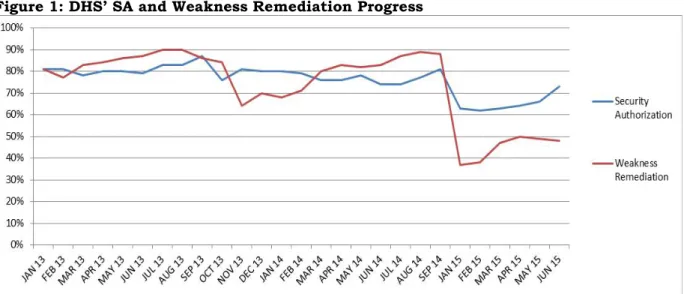
• Components did not maintain their information security programs on a year-round, continuous basis. For example, we evaluated the SA and POA&M (i.e., weakness remediation) performance metrics from the Department’s information security scorecards for January 2013 to June 2015. Figure 1 depicts that the overall scores for both metrics peaked during the months of Components’ annual FISMA reporting (around July–August) and dropped in the subsequent months. We identified a similar issue in 2009.6 This trend is an indication that Components are not complying with requirements to update and maintain systems’ SA and POA&M documentation on a continuous basis.
Figure 1: DHS’ SA and Weakness Remediation Progress
Source: OIG compiled based on DHS monthly information security scorecard from July 2013 to June 2015.7
• According to DHS Chief Information Officer officials, USCG reported to Defense Information Systems Agency on its PIV implementation.
Consequently, DHS does not have complete oversight or visibility
6 Evaluation of DHS’ Information Security Program for Fiscal Year 2009, (OIG-09-109, September
2009).
7 DHS did not produce information security scorecards for the periods of
October FY 2014 - December FY 2014.
OFFICE OF INSPECTOR GENERAL
Department of Homeland Security
regarding USCG’s information security program, including its
implementation of PIV. USCG reporting external to DHS is contrary to the Under Secretary for Management’s June 2015 memorandum requiring Components to report internally the status of PIV
implementation, including the counts of all privileged access accounts and the number of accounts enabled with PIV.8
• Some of the information in the Department’s enterprise management systems was inaccurate or incomplete. Specifically, DHS’ enterprise management systems lacked input validation controls to ensure accurate data were entered into the system. For example, some data
fields (e.g., contingency plan test dates, POA&M remediation funding, POA&M creation/completion dates, accreditation date, ATO approval date) lacked input validation controls, allowing Components to enter unrealistic, invalid, or null values. The data inaccuracy restricted the ability of the Department and Authorizing Officials to oversee and make credible, risk-based decisions regarding their information systems. Until input validation is implemented and data verification is complete, DHS cannot fully rely on information reported by the Components in the
enterprise management systems, which impacts overall security program management.
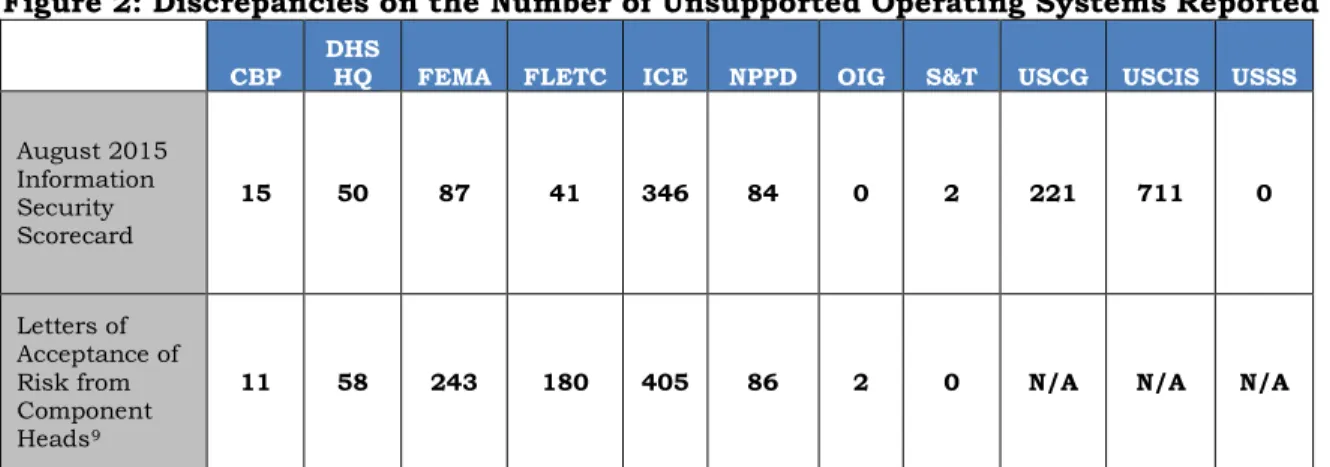
• Our review of the Department’s monthly information security scorecards identified discrepancies in the areas of PIV implementation and the continued use of unsupported operating systems. These were indicators that DHS’ senior officials may not be providing the most accurate data to make risk-based decisions about the Department’s information security program. For example:
We identified discrepancies between the Department’s monthly
scorecard and the data maintained by the Identity, Credential and Access Management Office regarding the status of PIV implementation.
We identified significant discrepancies between the Component
Heads’ letters of risk acceptance and the August 2015 information security scorecard regarding DHS’ use of
unsupported or obsolete operating systems (i.e., Windows XP, Windows Server 2003). Figure 2 shows the difference between the numbers of unsupported operating systems reported.
8 Under Secretary for Management Memorandum, Immediate Implementation and Reporting of
Privileged Users Authentication, June 25, 2015.
OFFICE OF INSPECTOR GENERAL
Department of Homeland Security
Figure 2: Discrepancies on the Number of Unsupported Operating Systems Reported
CBP DHS HQ FEMA FLETC ICE NPPD OIG S&T USCG USCIS USSS
August 2015 Information Security Scorecard
15 50 87 41 346 84 0 2 221 711 0
Letters of Acceptance of Risk from Component Heads9
11 58 243 180 405 86 2 0 N/A N/A N/A
Source: OIG compiled based on DHS’ monthly information security scorecard and letters of acceptance of risk from Component Heads.
• DHS did not include information related to its “Secret” or “Top Secret” systems in its FISMA submissions to OMB or in its monthly information security scorecard. Without this information, DHS’ senior officials and OMB cannot make accurate, risk-based decisions about the
Department’s information security program.
• Components continued to operate information systems without ATO. For example, the Department had 203 sensitive but unclassified (SBU)
systems, as well as 17 classified as “Secret” and “Top Secret” operating with an expired ATO. Without a valid ATO, DHS and its Components cannot ensure they have implemented effective controls to protect the sensitive information stored and processed by these systems.
• DHS had not implemented an ISCM program for its classified systems. As of July 2015, the ISO had not completed its National Security System ISCM strategy to outline the implementation requirements, metrics, and reporting that will be used to evaluate progress toward meeting DHS’ continuous monitoring goals.10
• Components were not consistently updating system SA and POA&M information in DHS’ unclassified and classified enterprise management systems despite the ISO’s efforts to perform critical control reviews,
9 According to ISO personnel, as of September 29, 2015, USCG and United States Citizenship
and Immigration Services (USCIS) did not submit a letter of risk acceptance to the Department. Additionally, USSS did not identify the number of unsupported operating systems in the component’s submission.
10 DHS National Security System Information Security Continuous Monitoring Implementation Plan
(Draft), Version 1.0, January 8, 2015.
OFFICE OF INSPECTOR GENERAL
Department of Homeland Security
component outreach and assist visits, and system authorization quality checks. Without complete or accurate information, DHS cannot
effectively manage or oversee the Department’s information system program or ensure that known information security weaknesses are remediated.
• As of June 2015, DHS reported that it had Windows Server 2003 operating systems installed on 3,044 servers. DHS also reported 787 machines that were running unsupported versions of Windows, including Windows XP. However, Microsoft ended its support for Windows Server 2003 on July 14, 2015, and Windows XP on April 8, 2014, respectively.11 On July 22, 2015, the Under Secretary for Management required
Components to retire all expired operating systems and servers, including Windows XP and Windows Server 2000/2003 operating systems.12
• DHS had not completed its information security scorecard to track FISMA and ISCM compliance for national security systems.
• Based on our FISMA testing activities and other audits conducted during FY 2015, Components had not implemented all the required United States Government Configuration Baseline (USGCB) and DHS baseline configuration settings on the information systems selected for review. We reported a similar finding in FY 2014.13
System Inventory
DHS maintained and updated its FISMA systems inventory, including agency and contractor systems, on an annual basis. In addition, DHS conducted site visits as part of its annual inventory refresh process to engage directly with Component personnel, identify new systems, and resolve any other inventory issues. DHS’ inventory comprised 743 information systems that the
Department reported as “operational,” including a mix of major applications and general support systems classified as “SBU” (673), “Secret” (62), and “Top Secret” (8). In addition, DHS had determined that 136 of its systems were mission essential systems.
11 DHS Chief Information Officer 2015 FISMA Quarter 3 Report, submitted June 26, 2015. 12 Under Secretary for Management Memorandum, Strengthening DHS Cyber Defense, July 22,
2015.
13 Evaluation of DHS’ Information Security Program for Fiscal Year 2014, (OIG-15-16,
December 2014)
OFFICE OF INSPECTOR GENERAL
Department of Homeland Security
Progress
• DHS updated its FISMA System Inventory Methodology guidance in May 2015 to reflect the Department's latest guidance regarding systems inventory management.14
• Components were required to identify and report their hardware assets to the Department on a monthly basis for DHS to develop and maintain an accurate inventory. As of July 2015, eight Components had met or exceeded the Department’s target of 95 percent for hardware asset reporting on DHS’ monthly information security scorecard.
• DHS maintained a change control process to ensure that the Department's inventory of systems remained accurate and up-to-date.
Issues To Be Addressed
• DHS required Components to report all software assets within their organizations as part of their ISCM program. However, as of
July 2015, CBP, FEMA, FLETC, ICE, USCG, and USSS had not met the Department’s target (95 percent) for software asset management, receiving scores of 69, 15, 82, 65, 65, and 72 percent, respectively.
See Appendix C, System Inventory, and Appendix M, Status of Agency Program to Oversee Contractor Systems, for additional information.
Risk Management Program
SA is the formal management decision by a senior organizational official to authorize operation of an information system and accept the risk to
organizational operations and assets, individuals, other organizations, and the Nation based on the implementation of an agreed-upon set of security
controls.15 The SA process provides an approach for assessing security controls (e.g., operational, technical, and management) to determine their overall
effectiveness. DHS requires Components to use enterprise management
systems for incorporating NIST security controls when performing SA on their systems. The enterprise-wide management systems enable Components to
14 DHS FISMA System Inventory Methodology, Version 13.5, May 1, 2015.
OFFICE OF INSPECTOR GENERAL
Department of Homeland Security
develop and maintain system security documentation as well as centralize the documents supporting the ATO for each system.
Components used DHS enterprise management tools to create SA artifacts for monitoring and authorizing their systems. These artifacts include:
• Federal Information Processing Standards (FIPS) Publication 199 Categorization;
• privacy threshold analysis and, if required, privacy impact assessment;
• E-Authentication;
• security plan;
• contingency plan;
• security assessment plan;
• contingency plan test results;
• security assessment report;
• authorization decision letter;
• POA&M; and
• annual self-assessment.
In October 2013, DHS began to allow Components to enroll in the OA program. Components are required to have a strong ISCM process, approved common controls, designated OA manager, and a chartered operational risk
management board for admission to the program. In addition, Components must maintain SA and weakness remediation metrics above 80 and 60 percent, respectively. Once a Component is accepted into the OA program, individual systems must meet the following requirements before each system can also be entered into the program:
• Component OA program acceptance letter;
• OA system admission letter;
• OA recommendation letter;
• system ATO expiration greater than 60 days of submission date;
• information system security officer with collateral responsibilities less than 51 percent;
• information system security officer trained on OA processes; and
• an approved control allocation table.
Progress
• As of July 2015, OIG, TSA, and USCIS had met the Department’s SA target of 100 percent for high-value assets and
15 DHS Security Authorization Process Guide, Version 11.1, March 16, 2015.
OFFICE OF INSPECTOR GENERAL
Department of Homeland Security
mission-essential systems. In addition, HQ, FLETC, NPPD, OIG, TSA, and USCIS had exceeded the Department’s SA target of 95 percent for all other FISMA systems.
Issues To Be Addressed
• DHS adopted enterprise management systems to manage and track the SA process for its “SBU” and “Secret” systems. During our evaluation, we identified the following inaccuracies associated with the enterprise management systems and a lack of input validation controls on some data fields:
Our analysis of data from the Department’s SBU enterprise
management system revealed that Component personnel had not entered appropriate data. For example, in key data fields, they input null values or invalid information, such as
accreditation date, contingency plan tests, POA&M
creation/completion dates, accreditation dates, etc. Without accurate POA&M information, authorizing officials lack the most up-to-date information about their systems and whether sufficient resources are provided to mitigate known security weaknesses.
Data from the Department’s classified enterprise system were
missing key information. For example, Component personnel provided inaccurate or null information for the SA and POA&M data fields for many of the systems identified in the enterprise management system. As a result, ISO must perform manual reviews to carry out its oversight and validation responsibilities for the Department’s “Secret” systems.
As of July 2015, FEMA, S&T, USCG, and USSS were failing the
Department’s SA metrics. The Under Secretary for Management requires Components to achieve 100 percent compliance for authorizing systems that Components identify as high-value assets and 95 percent compliance for the remaining systems. Figure 3 identifies the SA compliance for these Components, along with DHS’ targets.
OFFICE OF INSPECTOR GENERAL
Department of Homeland Security
Figure 3: SA Status for FEMA, S&T, USCG, and USSS as of July 2015
FEMA S&T USCG USSS Target DHS
High Value Assets and Mission Essential
Systems 70% 33% 56% 75% 100% All Other FISMA Systems 26% 45% 67% 58% 95%
Source: OIG compiled based on DHS’ monthly information security scorecard.
• As of June 2015, DHS had 203 systems classified as “SBU” operating without ATO. Figure 4 illustrates the number of operational “SBU” systems, by Component, operating without ATO.
Figure 4: Number of Component Systems Operating without Valid ATOs
Component Number of Operational Systems Without ATO
CBP 8
DHS HQ 1
FEMA 111
FLETC 2
ICE 3
NPPD 15
S&T 12
TSA 0
USCG 35
USCIS 0
USSS 16
Source: OIG compiled based on data from DHS’ enterprise management systems. • As of June 2015, DHS had 17 systems classified as “Secret” or
“Top Secret” operating without ATOs. Without ATOs, DHS cannot ensure that its systems are properly secured to protect sensitive information stored and processed in them.
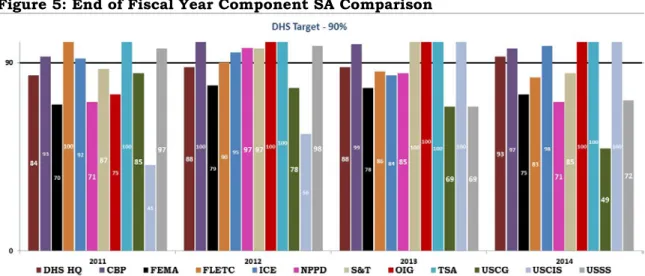
• We analyzed the Department’s September FY 2011 to FY 2014 information security scorecards to determine whether it was meeting its goal for SA. Based on our analysis, only CBP and TSA met or exceeded the target at any time during the entire period. The other Components either missed or did not sustain the
Department’s overall 90 percent SA target. In addition, FEMA and USCG did not meet the SA target for any of the years selected for review. Figure 5 compares Component SA scores to the target for the last four fiscal years.
OFFICE OF INSPECTOR GENERAL
Department of Homeland Security
Figure 5: End of Fiscal Year Component SA Comparison
Source: OIG compiled based on our analysis of DHS’ information security scorecards for September FY 2011 to FY 2014.
• Based on our quality review of 10 SA packages at selected
Components, we identified the following deficiencies:
Three systems had not completed their NIST 800-53 annual
self-assessments.
The system security plan for one “Secret” system was out of
date.
The system security plans for six systems did not contain the
required security controls.
The system security plan for three systems did not contain
incident handling procedures, and two systems did not describe the configuration management process.
The FIPS 199 artifacts for two systems were either improperly
categorized or had missing information.
The security assessment plans for two systems did not include
specific procedures for testing the required security controls.
POA&Ms were not developed for weaknesses identified in the
security assessment reports for four systems.
Appendix D, Status of Risk Management Program, provides summary information.
Plan of Action and Milestones Program
DHS requires the creation and maintenance of a POA&M for all known information security weaknesses. In April 2015, the DHS ISO conducted a
OFFICE OF INSPECTOR GENERAL
Department of Homeland Security
comprehensive POA&M review and developed a weakness analysis report on the Department’s SBU and classified POA&Ms.16 ISO used the review to identify systemic deficiencies in the POA&M management process, issues that
prohibited Components from resolving information security weaknesses, areas where additional training was required, and enterprise management system deficiencies. ISO also used the review to formulate recommendations for
improving the POA&M process. Despite these efforts, Components did not enter and track all information security weaknesses in DHS’ unclassified and
classified enterprise management systems as required.
Progress
• Based on our selected sample, Components had created a POA&M for the notices of findings and recommendations for the
weaknesses identified during our FY 2014 financial statement audit.17
Issues To Be Addressed
• Some of the key deficiencies identified by the ISO’s comprehensive POA&M review included:
Component personnel (i.e., CISO, information system security
managers) did not perform adequate POA&M reviews on systems, as basic quality issues were not identified prior to POA&M creation. DHS requires continuous monitoring of POA&M data and proper identification and prioritization of all weaknesses.18
POA&Ms were not updated on a monthly basis. DHS requires
that Component CISOs or information system security managers review milestone status monthly to determine whether plans of action to remediate security weaknesses are on schedule.
Enterprise management systems lacked input validation
measures to prevent Component personnel from creating POA&Ms until all DHS and OMB data elements were entered.
16 DHS Information Security Office Weakness Analysis Report, Version 1.0, April 5, 2015.
17 Information Technology Management Letter for the FY 2014 Department of Homeland Security
Financial Statement Audit, (OIG-15-93, May 2015).
18 DHS 4300A Sensitive Systems Handbook, Attachment H, Process Guide for Plan of Action and
Milestones (POA&M), Version 11.0, December 3, 2014.
OFFICE OF INSPECTOR GENERAL
Department of Homeland Security
Compliance reporting was inaccurate and could not accurately
track the number of classified POA&Ms within DHS, as Components had been reporting weaknesses using uploaded documents instead of populating automated fields/features within the enterprise management system.
Classified POA&Ms did not contain sufficient information
regarding weakness remediation. DHS requires that Components upload corrective action plans into the Department’s classified enterprise management system.
Security personnel needed better guidance to estimate
resources (i.e., funding) required for weakness remediation.
• Components had not created POA&Ms for systems that were operating without ATOs. For example, FEMA had not created any POA&Ms for 11 systems classified as “Secret” or “Top Secret” that were operating without ATOs. Without creating POA&Ms,
authorizing officials lacked the most accurate information to make credible risk-based decisions. They also could not ensure that all identified information security weaknesses were mitigated timely. When operating systems without ATOs, DHS and its Components cannot ensure they have implemented effective controls to protect the sensitive information stored and processed by these systems. We reported a similar finding in FY 2014.19
• As of June 2015, DHS had 22,294 open SBU POA&Ms, as
compared to the 3,206 POA&Ms we reported for the previous year. Given FEMA’s IT resiliency effort in 2014 and the addition of over 100 new systems, the component was responsible for 18,654 of the total 22,294 (84 percent) open SBU POA&Ms. According to ISO personnel, most of the milestone descriptions were severely
inadequate and did not contain the information needed to address identified weaknesses.
• Components did not maintain current or complete information on progress in remediating security weaknesses and did not resolve all POA&Ms in a timely manner. Without adequate POA&M information, authorizing officials lacked the most current information on their systems and could not determine whether known weaknesses were properly remediated. As of June 2015, we identified the following deficiencies in the Department’s
19 Evaluation of DHS’ Information Security Program for Fiscal Year 2014, (OIG-15-16,
December 2014)
OFFICE OF INSPECTOR GENERAL
Department of Homeland Security unclassified enterprise management system:
Of the 22,294 open SBU POA&Ms, 17,663 (79 percent) were
overdue. Moreover, 7,665 of the POA&Ms were at least 3
months late while 75 POA&Ms were more than a year past due. DHS requires Components to complete POA&M remediation within 6 months.
Of the 22,294 open SBU POA&Ms, 20,423 (92 percent) had
weakness remediation estimates less than $50. DHS requires that Components provide reasonable resource estimates of at least $50 to mitigate known weaknesses.
• The Department had not provided adequate oversight on POA&M remediation for its “Secret” and “Top Secret” systems. For example, Components did not maintain the required POA&M information for its classified systems (“Secret”) in the Department’s classified
enterprise management system. ISO personnel acknowledged they had not provided the oversight or enforcement mechanism needed to ensure Components correctly used the Department’s enterprise management system. In FY 2015, DHS migrated to a new
enterprise management system for its classified systems. However, many of the essential SA and POA&M data fields were not
transferred to the new system, restricting DHS’ ability to manage its security program.
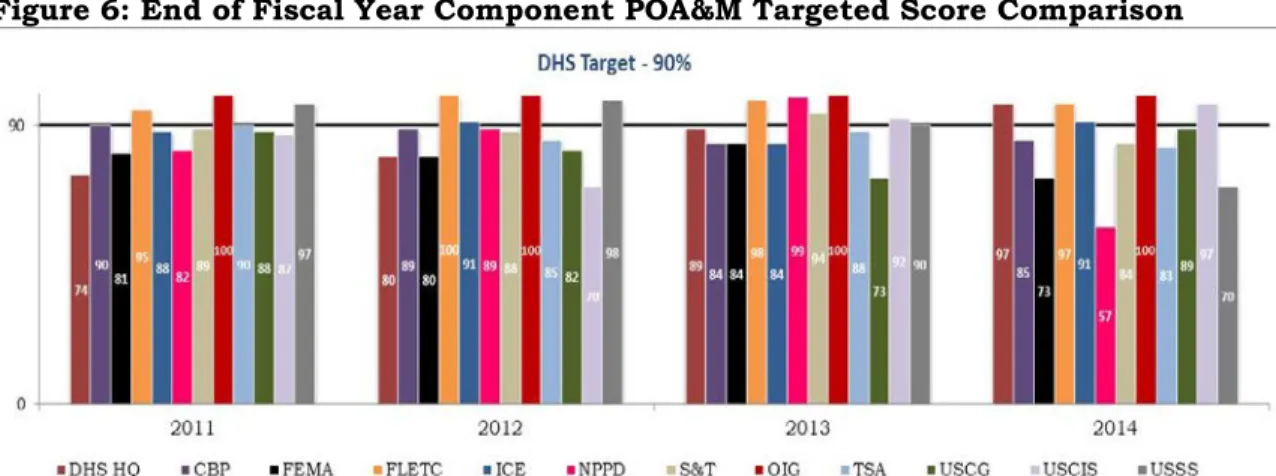
• We analyzed the Department’s September information security scorecards from FY 2011 to FY 2014 to determine the effectiveness of the Components’ POA&M remediation efforts and whether they met DHS’ POA&M target (90 percent). Based on our analysis, only OIG and FLETC met or exceeded the target during the entire
period. FEMA and USCG were consistently below the target for the entire period. Figure 6 depicts Component POA&M scores for FY 2011 to FY 2014. See appendix H for the status of DHS’ POA&M program.
OFFICE OF INSPECTOR GENERAL
Department of Homeland Security
Figure 6: End of Fiscal Year Component POA&M Targeted Score Comparison
Source: OIG compiled based on our analysis of DHS’ FISMA September information security scorecards from FY 2011 through FY 2014.
• CBP did not incorporate all known information security
weaknesses in a POA&M process for its Analytical Framework for Intelligence system, as required by applicable DHS, OMB, and NIST guidance. Specifically, CBP management officials did not create POA&M to address contingency planning deficiencies identified after its April 2014 testing exercise.20
• USSS did not properly maintain POA&M for its Criminal
Investigative Division Suite. Specifically, our review of Criminal Investigative Division Suite POA&Ms revealed that key information was missing from their POA&M, such as required resources,
status, scheduled completion dates, and milestone information.21
Configuration Management
We selected 18 systems from 10 Components (CBP, DHS HQ, FEMA, ICE, NPPD, OIG, TSA, USCG, USCIS, and USSS) to evaluate compliance with
USGCB and DHS baseline configuration settings. The systems tested include a mix of major applications and general support systems categorized as “SBU,” “Secret,” and “Top Secret.” We also performed vulnerability assessments on selected databases and websites to determine whether Components had implemented effective controls to protect DHS’ sensitive data.
20 Enhancements to Technical Controls Can Improve the Security of CBP's Analytical
Framework for Intelligence (OIG-15-137, September 2015).
21 DHS Can Strengthen Its Cyber Mission Coordination Efforts (OIG-15-140, September 2015).
OFFICE OF INSPECTOR GENERAL
Department of Homeland Security
Issues To Be Addressed
Our testing identified the following deficiencies:
USGCB Compliance for Windows 7 and Windows XP Workstations
• Two systems from FEMA and NPPD still used Windows XP at the time of testing. Microsoft had stopped providing security updates or technical support for Windows XP in April 2014, which could lead to unidentified and unpatched vulnerabilities for these older operating systems. We also determined the following:
The Windows XP workstations on one of FEMA’s Top Secret
systems had a USGCB compliance rate of 38 percent. FEMA had accepted the risk of operating the system with
non-compliant settings and an unsupported operating system. However, continued use of the unsupported Windows XP
workstations put FEMA’s “Top Secret” data at risk.
In May 2015, NPPD officials said they were in the process of
replacing 40 Windows XP workstations that were still
operational. After we completed our field work, NPPD provided evidence that all of the Windows XP workstations had been removed.22
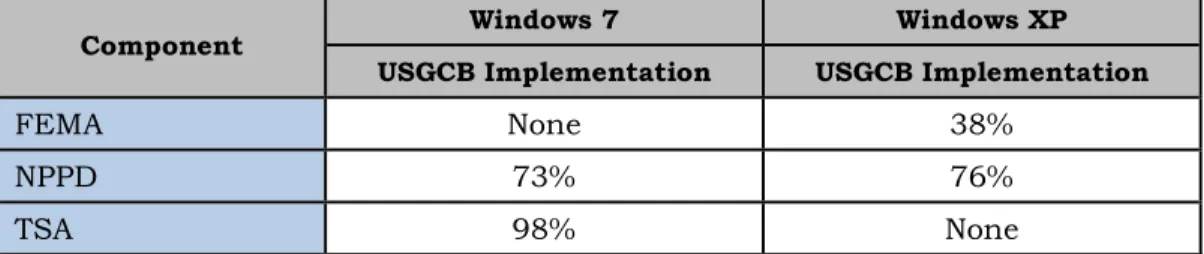
• Components we tested had not implemented all the required USGCB settings. Figure 7 summarizes deficiencies identified on the Components’ Windows 7 and Windows XP workstations.
Figure 7: USGCB Compliance for Windows 7 and Windows XP Operating Systems
Component Windows 7 Windows XP
USGCB Implementation USGCB Implementation
FEMA None 38%
NPPD 73% 76%
TSA 98% None
Source: OIG compiled based on testing results.
22 We did not conduct an independent assessment to verify that NPPD had removed all Windows
XP workstations.
OFFICE OF INSPECTOR GENERAL
Department of Homeland Security
Server Compliance with DHS Baseline Configuration Settings
• We evaluated approximately 200 configuration settings on four Windows 2008 servers. Overall, 76 percent of the configuration settings that we tested were compliant with the DHS baseline requirements. In addition, only 69 percent of the configuration settings tested on one server was compliant.
• We evaluated 91 configuration settings on a Red Hat Linux server. Our testing revealed that only 71 percent of the configuration settings tested met the DHS baseline requirements. Further, only 60 percent of the baseline configuration settings tested on one SE Linux server was compliant.
• We evaluated 130 configuration settings on three Windows 2003 servers. Our testing revealed that only 31, 47, and 60 percent of the baseline configuration settings tested on these servers met DHS requirements. In addition, only 71 percent of 120
configuration settings tested on one Windows XP system were compliant.
Vulnerability Assessments of Selected Systems
We performed vulnerability assessments on selected systems to determine whether Components had implemented adequate security controls on these systems. Our assessments revealed the following deficiencies.
• Windows 8.1 workstations were missing security patches for the Firefox Internet browser, Adobe software (e.g., AIR, Flash Player, Reader), and Microsoft Office products and services. Some of the missing patches were high-risk, dating back to February 2015.
• Windows 7 workstations were missing security patches for several Internet browsers (e.g., Chrome, Internet Explorer, Firefox), media players (e.g., Flash Player, Shockwave, QuickTime), and Microsoft Office products. Some of the missing high-risk patches dated back to April 2011, while critical patches dated back to October 2011. We found additional vulnerabilities regarding Adobe Acrobat, Adobe Reader, and Oracle Java software on the Windows 7 workstations. If exploited, these vulnerabilities could allow unauthorized access to DHS data.
OFFICE OF INSPECTOR GENERAL
Department of Homeland Security
• Workstations were missing security patches for the Windows XP operating system and the Microsoft Office suite. We also identified missing patches on software such as Adobe (e.g., Acrobat, Flash Player, Reader, and Shockwave) and Oracle Java. Some of the missing high-risk patches dated back to December 2011.
• Components had implemented weak passwords and had not applied security patches on databases timely, which could allow attackers to exploit the vulnerabilities to gain unauthorized access to DHS data. DHS requires Components to apply security patches timely.
• Two of the three internal websites tested were susceptible to cross-site and/or cross-frame vulnerabilities, which could allow attackers to impersonate legitimate users or execute clickjacking attacks.23 Further, these websites were vulnerable to Structured Query Language injection.24 Exploitation of these weaknesses could give unauthorized users access to sensitive government data.
• Prior OIG audits in FY 2015 revealed that Components had not fully implemented all of the required configuration settings on selected systems. For example, we reported these deficiencies:
Configuration vulnerabilities existed on CBP’s Analytical
Framework for Intelligence system.25
ICE had not implemented selected DHS baseline configuration settings on its Cyber Crimes Center workstations and servers as required, which could allow sensitive data to be compromised.26 See Appendix E, Status of Configuration Management Program, for more information in this regard.
23 Cross-site and cross-frame scripting vulnerabilities allow attackers to inject malicious code
into otherwise benign websites. A clickjacking attack deceives a victim into interacting with specific elements of a target website without user knowledge, executing privileged
functionality on the victim’s behalf.
24 Successful exploitation of a Structured Query Language injection vulnerability allows an
attacker to extract, modify, insert, or delete data from a supporting database. One Component assessed stated that it had resolved all identified website vulnerabilities; however, we did not conduct an independent assessment to verify the claim.
25Enhancements to Technical Controls Can Improve the Security of CBP's Analytical
Framework for Intelligence (OIG-15-137, September 2015).
26DHS Can Strengthen Its Cyber Mission Coordination Efforts (OIG-15-140, September 2015).
OFFICE OF INSPECTOR GENERAL
Department of Homeland Security
Incident Response and Reporting Program
The Department operates the DHS Security Operations Center (SOC) and the Homeland Secure Data Network SOC to ensure that SBU and Secret IT
resources are secure.27 The SOCs are also responsible for ensuring compliance with security policy and controls throughout the Department. The DHS SOC provides situational awareness, serves as a central data repository, and facilitates reporting and coordination regarding computer security incidents across the Department.
Issues To Be Addressed
• Components are required to submit weekly incident reports to the DHS SOC. However, only USCG and USCIS regularly submitted incident reports to the SOC in FY 2015. SOC personnel said they notify Component leadership when weekly incident reports are not submitted regularly as required.
Appendix F, Status of Incident Response and Reporting Program, provides additional information.
Security Training Program
DHS monitors security training completion through monthly status updates provided by the Components. Based on these updates, the ISO monitors and reports on all DHS employees who receive annual IT security awareness and privileged security training as required.
Progress
• DHS reported that, as of June 2015, CBP, DHS HQ, FEMA, ICE, NPPD, S&T, and USCIS had received 100 percent for the privileged training metric, which tracked the number of privileged users who had completed specialized training during the year.
Issues To Be Addressed
• In June 2015, DHS reported that privileged users in some Components had not received specialized training as required.
27 The Homeland Secure Data Network is a classified wide-area network for DHS and its
Components, with specific and controlled interconnections to the intelligence community and Federal law enforcement resources.
OFFICE OF INSPECTOR GENERAL
Department of Homeland Security
Specifically, the following Components received privileged training scores of 79 percent or less: OIG (60 percent); TSA (79 percent); USCG (59 percent); and USSS (0 percent). Without the required training, DHS cannot ensure Component personnel with
significant IT security responsibilities have the appropriate skills and knowledge to secure systems against potential attacks.
• Some Components did not report monthly the numbers of
employees who had received IT security awareness and privileged training as required. As of August 2015, NPPD and USSS had submitted no report on privileged user training completion during the year. As a result, ISO could not effectively monitor and report DHS-wide on whether employees and contractors with significant security responsibilities had completed the required specialized training.
• Based on our analysis, ICE, TSA, and USCIS collectively had nearly 600 privileged users that had not completed specialized training as of August 2015. In another report published in
September 2015, we similarly stated that ICE and USSS employees with significant security responsibilities had not received required specialized security training.28
See Appendix G, Status of Security Training Program, for additional information.
Remote Access Program
DHS has established policies and procedures to mitigate the risks associated with remote access and dial-in capabilities. Components are responsible for managing all remote access and dial-in connections to their systems by using two-factor authentication, enabling audit logs, and implementing encryption mechanisms to protect transmission of sensitive information. Our field work revealed that Components developed policies and procedures to protect remote connections and implemented various mitigating security controls (i.e.,
multi-factor authentication, firewalls, virtual private network concentrators, etc.) to protect DHS systems and data from external threats.
28 DHS Can Strengthen Its Cyber Mission Coordination Efforts (OIG-15-140, September 2015)
OFFICE OF INSPECTOR GENERAL
Department of Homeland Security
Issues To Be Addressed
• As of July 2015, CBP, FEMA, NPPD, and TSA had 40 connections that had yet to be consolidated behind a trusted Internet
connection as required. Figure 8 illustrates the number of connections by Component.
Figure 8: Number of Non-Trusted Internet Connections by Component
CBP FEMA NPPD TSA Total
Number of Non-Trusted
Internet Connections 9 12 11 8 40
Source: DHS’ July 2015 information security scorecard.
See Appendix I, Status of Remote Access Program, for more information.
Identity and Access Management Program
DHS’ identity and access management program was decentralized, with its Components individually responsible for issuing PIV cards to their employees and contractors. Each Component used account management software (e.g., Active Directory) to enforce access policies consistent with DHS procedures and guidance. To strengthen security, DHS has been implementing PIV cards
compliant with Homeland Security Presidential Directive-12 and the
Administration’s Identity, Credential, and Access Management priorities.
Progress
• As of July 2015, seven Components (DHS HQ, FEMA, FLETC, ICE, NPPD, OIG, and S&T) had met the target of 100 percent for
mandatory PIV use for privileged access accounts, which was part of the OMB and DHS Cybersecurity Sprint initiative.
• As of August 2015, the Department had issued 4,565 (69 percent) two-factor authentication tokens for all accounts on its classified Homeland Secure Data Network to reduce user anonymity and improve security. Additionally, the Department had issued
two-factor authentication tokens to all of its privileged users on the Homeland Secure Data Network.
OFFICE OF INSPECTOR GENERAL
Department of Homeland Security
Issues To Be Addressed
• According to the Office of Chief Information Officer (OCIO) officials, USCG no longer reported key information security metrics to DHS. Instead, USCG had begun reporting its PIV implementation for unprivileged and privileged access accounts to the Defense Information Systems Agency. This practice prohibited DHS from having complete oversight of USCG’s information security program, including its implementation of PIV. This practice also was
contrary to the Under Secretary for Management’s June 2015 memorandum requiring Components to report the status of PIV implementation, including the number of privileged access accounts and the number of accounts with PIV logical access.
• As of July 2015, NPPD had not implemented PIV for its
unprivileged access accounts. Further, USSS had received a score of 9 percent for implementation of PIV logical access for its
unprivileged access accounts, versus a target score of 100 percent mandatory PIV use.
See Appendix J, Status of Account and Identity Management Program, for summary information.
Continuous Monitoring Program
DHS had taken steps to strengthen its continuous monitoring program. For example, the ISO updated or developed additional ISCM metrics to better evaluate the Components’ compliance with applicable OMB and DHS
continuous monitoring requirements for 2015. In addition, the ISO expanded the OA program and took steps to develop an ISCM program for the
Department’s classified systems.
Progress
• DHS increased the number of systems participating in the OA program. As of August 2015, 82 systems from 7 Components (CBP, DHS HQ, ICE, FLETC, OIG, TSA, and USCIS) were enrolled. In FY 2014, we reported that DHS had 61 systems from 5 Components enrolled in the OA program.
• During FY 2015, DHS revised its information security scorecard to evaluate the Components’ alignment with OMB and DHS cyber
OFFICE OF INSPECTOR GENERAL
Department of Homeland Security security goals. For example, the ISO developed an
anti-phishing/malware metric to evaluate whether Components had installed anti-virus software updates on their workstations, laptops, notebooks, and servers.
Issues To Be Addressed
• In 2013, DHS instituted rigorous eligibility requirements for Components to enroll in the OA program. For example,
Components could only enter the OA program if they maintained a strong ISCM program by sustaining SA metrics above 80 and weakness remediation metrics above 60. However, as of August 2015, only 82 systems were enrolled in the program.
• DHS had not implemented an ISCM program for the Department’s classified systems. DHS was in the process of finalizing its National Security System Information Security Continuous Monitoring
Implementation Plan, which identified the requirements, metrics, and reporting that would be used to implement and evaluate the Department’s progress toward continuous monitoring goals for its classified systems.
• We interviewed selected CISOs and senior information security personnel at eight Components to discuss their continuous monitoring programs. We identified the following deficiencies, which may restrict Components from protecting their systems or preventing unauthorized software/hardware from being installed on their information technology assets:
Four Components did not perform network penetration testing. Five Component systems did not have the technical capability
to block unauthorized software from being introduced to any device on the network.
Three Components did not have the technical ability to block
unauthorized hardware (e.g., USB drives) from connecting to any devices on the network.
See Appendix K, Status of Continuous Monitoring Program.
OFFICE OF INSPECTOR GENERAL
Department of Homeland Security
Contingency Planning Program
DHS maintained an entity-wide business continuity and contingency planning program. However, the Department could take additional steps to strengthen its business continuity and disaster recovery programs.
Progress
• DHS had developed test and exercise approaches for its business continuity and disaster recovery programs. In FY 2015, DHS
participated in Eagle Horizon, a mandatory, national-level exercise to test its continuity and reconstitution plans. The exercise also helped participants to evaluate communications requirements and critical infrastructure support needed to execute mission-essential functions.
• The Department finalized DHS Directive Number 008-03, Continuity
Programs, on June 10, 2015 to establish and further clarify its continuity program policy, responsibilities, and requirements.
Issues To Be Addressed
• For the previous 12 months, DHS and its Components had not tested contingency plans for 106 operational systems with an overall FIPS security category of moderate or high. When
contingency plans are not tested, DHS and its Components cannot ensure operational restoration or recovery in the event of system failures or service disruptions.
• Our review of 10 SA packages disclosed the following deficiencies related to system contingency planning documentation:
One system with an overall security categorization of “high” and
another categorized as “moderate” did not contain procedures to restore operations for handling sensitive information at
alternate sites.
One system with an overall security categorization of “moderate”
did not identify alternate or off-site storage facilities. In
addition, the contingency plan did not identify vendor points of contact as required.