for Information Technology
Common Criteria
Security Evaluation
Part 1: Introduction and general model
August 1999
Version 2.1
Part 1: Introduction and general model
Foreword
This version of the Common Criteria for Information Technology Security Evaluation (CC 2.1) is a revision that aligns it with International Standard ISO/IEC 15408:1999. In addition, the document has been formatted to facilitate its use. Security specifications written using this document, and IT products/systems shown to be compliant with such specifications, are considered to be ISO/IEC 15408:1999 compliant.
CC 2.0 was issued in May, 1998. Subsequently, a Mutual Recognition Arrangement was established to use the CC as the basis of mutual recognition of evaluation results performed by the signatory organisations. ISO/IEC JTC 1 adopted CC 2.0 with minor, mostly editorial modifications in June, 1999.
CC version 2.1 consists of the following parts:
- Part 1: Introduction and general model
- Part 2: Security functional requirements
- Part 3: Security assurance requirements
This Legal NOTICE has been placed in all Parts of the CC by request:
The seven governmental organisations (collectively called “the Common Criteria Project Sponsoring Organisations”) listed just below and identified fully in Part 1 Annex A, as the joint holders of the copyright in the Common Criteria for
Information Technology Security Evaluations, version 2.1 Parts 1 through 3 (called “CC 2.1”), hereby grant non-exclusive license to ISO/IEC to use CC 2.1 in the continued development/maintenance of the ISO/IEC 15408 international standard. However, the Common Criteria Project Sponsoring Organisations retain the right to use, copy, distribute, translate or modify CC 2.1 as they see fit.
Canada: Communications Security Establishment
France: Service Central de la Sécurité des Systèmes d’Information
Germany: Bundesamt für Sicherheit in der Informationstechnik
Netherlands: Netherlands National Communications Security Agency
United Kingdom: Communications-Electronics Security Group
United States: National Institute of Standards and Technology
iv
Part 1: Introduction and general modelContents
1 Scope . . . 1
2 Definitions . . . 3
2.1 Common abbreviations . . . 3
2.2 Scope of glossary . . . 3
2.3 Glossary . . . 4
3 Overview . . . 8
3.1 Introduction . . . 8
3.2 Target audience of the CC . . . 8
3.2.1 Consumers . . . 8
3.2.2 Developers . . . 9
3.2.3 Evaluators . . . 9
3.2.4 Others . . . 9
3.3 Evaluation context . . . 10
3.4 Organisation of the Common Criteria . . . 11
4 General model . . . 13
4.1 Security context . . . 13
4.1.1 General security context . . . 13
4.1.2 Information technology security context . . . 16
4.2 Common Criteria approach . . . 16
4.2.1 Development . . . 16
4.2.2 TOE evaluation . . . 18
4.2.3 Operation . . . 19
4.3 Security concepts . . . 19
4.3.1 Security environment . . . 21
4.3.2 Security objectives . . . 22
4.3.3 IT security requirements . . . 23
4.3.4 TOE summary specification . . . 24
4.3.5 TOE implementation . . . 24
4.4 CC descriptive material . . . 24
4.4.1 Expression of security requirements . . . 24
4.4.2 Use of security requirements . . . 26
4.4.3 Sources of security requirements . . . 28
4.5 Types of evaluation . . . 29
4.5.1 PP evaluation . . . 29
4.5.2 ST evaluation . . . 29
4.5.3 TOE evaluation . . . 29
4.6 Assurance maintenance . . . 29
5 Common Criteria requirements and evaluation results . . . 30
5.1 Introduction . . . 30
5.2 Requirements in PPs and STs . . . 31
5.2.1 PP evaluation results . . . 31
Contents Part 1: Introduction and general model
5.4 Caveats on evaluation results . . . 32
5.5 Use of TOE evaluation results . . . 33
Annex A The Common Criteria project . . . 35
A.1 Background . . . 35
A.2 Development of the Common Criteria . . . 35
A.3 Sponsoring organisations . . . 36
Annex B Specification of Protection Profiles . . . 38
B.1 Overview . . . 38
B.2 Content of Protection Profile . . . 38
B.2.1 Content and presentation . . . 38
B.2.2 PP introduction . . . 38
B.2.3 TOE description . . . 39
B.2.4 TOE security environment . . . 40
B.2.5 Security objectives . . . 40
B.2.6 IT security requirements . . . 41
B.2.7 Application notes . . . 43
B.2.8 Rationale . . . 43
Annex C Specification of Security Targets . . . 44
C.1 Overview . . . 44
C.2 Content of Security Target . . . 44
C.2.1 Content and presentation . . . 44
C.2.2 ST introduction . . . 44
C.2.3 TOE description . . . 46
C.2.4 TOE security environment . . . 47
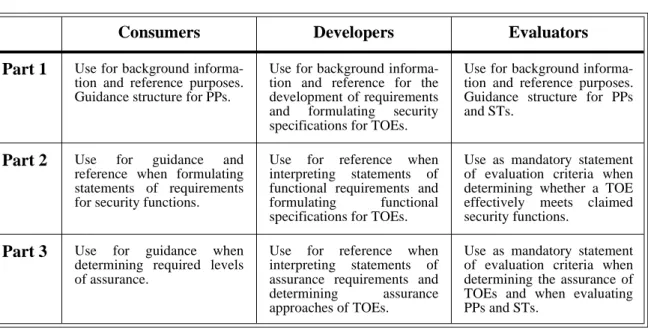
C.2.5 Security objectives . . . 48
C.2.6 IT security requirements . . . 48
C.2.7 TOE summary specification . . . 50
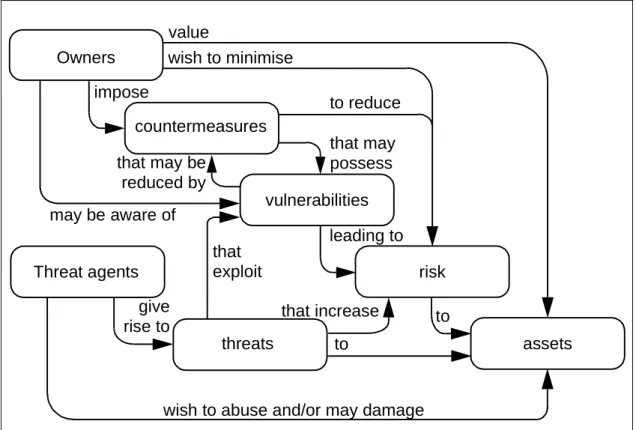
C.2.8 PP claims . . . 51
C.2.9 Rationale . . . 52
Part 1: Introduction and general model
List of figures
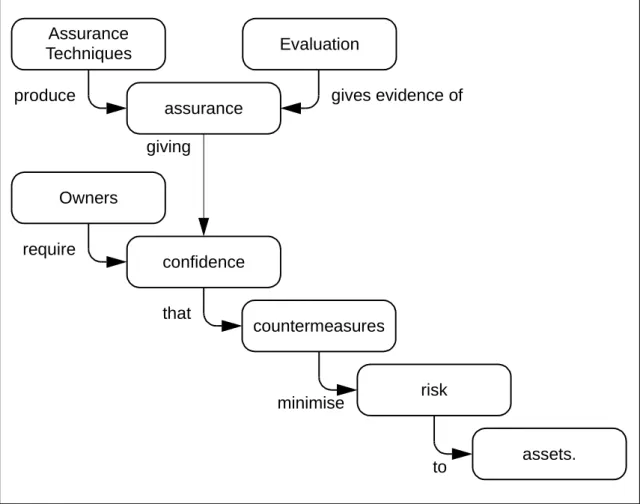
Figure 3.1 - Evaluation context . . . 11
Figure 4.1 - Security concepts and relationships . . . 14
Figure 4.2 - Evaluation concepts and relationships . . . 15
Figure 4.3 - TOE development model . . . 17
Figure 4.4 - TOE evaluation process . . . 18
Figure 4.5 - Derivation of requirements and specifications . . . 21
Figure 4.6 - Organisation and construction of requirements . . . 25
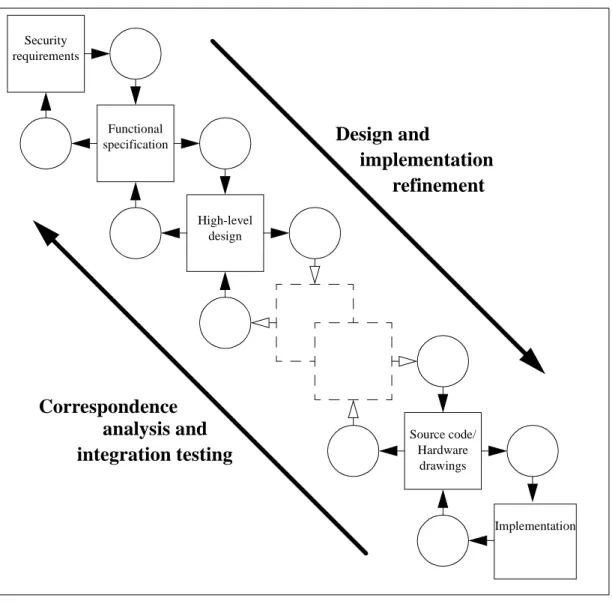
Figure 4.7 - Use of security requirements . . . 27
Figure 5.1 - Evaluation results . . . 30
Figure 5.2 - Use of TOE evaluation results . . . 33
Figure B.1 - Protection Profile content . . . 39
Part 1: Introduction and general model
List of tables
2
Part 1: Introduction and general model1
Scope
1 This multipart standard, the Common Criteria (CC), is meant to be used as the basis
for evaluation of security properties of IT products and systems. By establishing such a common criteria base, the results of an IT security evaluation will be meaningful to a wider audience.
2 The CC will permit comparability between the results of independent security
evaluations. It does so by providing a common set of requirements for the security functions of IT products and systems and for assurance measures applied to them during a security evaluation. The evaluation process establishes a level of confidence that the security functions of such products and systems and the assurance measures applied to them meet these requirements. The evaluation results may help consumers to determine whether the IT product or system is secure enough for their intended application and whether the security risks implicit in its use are tolerable.
3 The CC is useful as a guide for the development of products or systems with IT
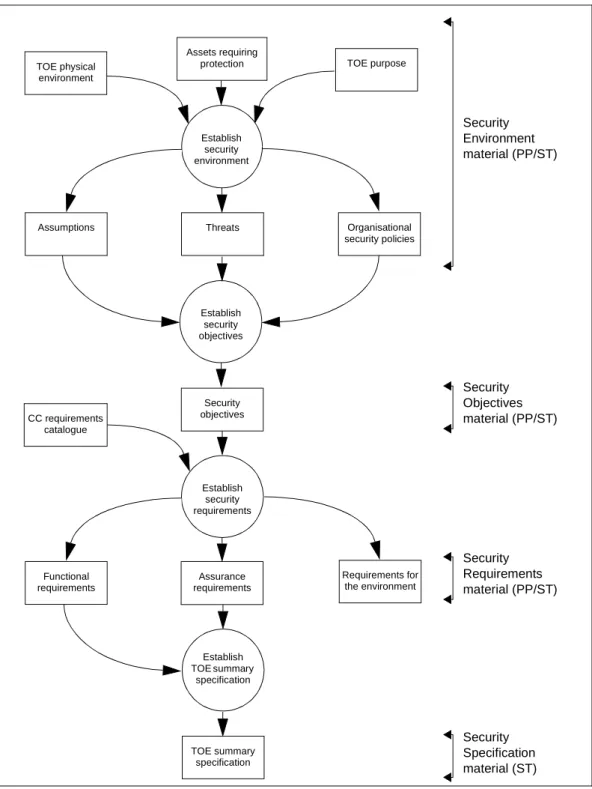
security functions and for the procurement of commercial products and systems with such functions. During evaluation, such an IT product or system is known as a Target of Evaluation (TOE). Such TOEs include, for example, operating systems, computer networks, distributed systems, and applications.
4 The CC addresses protection of information from unauthorised disclosure,
modification, or loss of use. The categories of protection relating to these three types of failure of security are commonly called confidentiality, integrity, and availability, respectively. The CC may also be applicable to aspects of IT security outside of these three. The CC concentrates on threats to that information arising from human activities, whether malicious or otherwise, but may be applicable to some non-human threats as well. In addition, the CC may be applied in other areas of IT, but makes no claim of competence outside the strict domain of IT security.
5 The CC is applicable to IT security measures implemented in hardware, firmware
or software. Where particular aspects of evaluation are intended only to apply to certain methods of implementation, this will be indicated within the relevant criteria statements.
6 Certain topics, because they involve specialised techniques or because they are
somewhat peripheral to IT security, are considered to be outside the scope of the CC. Some of these are identified below.
a) The CC does not contain security evaluation criteria pertaining to
administrative security measures not related directly to the IT security measures. However, it is recognised that a significant part of the security of a TOE can often be achieved through administrative measures such as organisational, personnel, physical, and procedural controls. Administrative security measures in the operating environment of the TOE are treated as
1 - Scope
secure usage assumptions where these have an impact on the ability of the IT security measures to counter the identified threats.
b) The evaluation of technical physical aspects of IT security such as
electromagnetic emanation control is not specifically covered, although many of the concepts addressed will be applicable to that area. In particular, the CC addresses some aspects of physical protection of the TOE.
c) The CC addresses neither the evaluation methodology nor the
administrative and legal framework under which the criteria may be applied by evaluation authorities. However, it is expected that the CC will be used for evaluation purposes in the context of such a framework and such a methodology.
d) The procedures for use of evaluation results in product or system
accreditation are outside the scope of the CC. Product or system accreditation is the administrative process whereby authority is granted for the operation of an IT product or system in its full operational environment. Evaluation focuses on the IT security parts of the product or system and those parts of the operational environment that may directly affect the secure use of IT elements. The results of the evaluation process are consequently a valuable input to the accreditation process. However, as other techniques are more appropriate for the assessments of non-IT related product or system security properties and their relationship to the IT security parts, accreditors should make separate provision for those aspects.
e) The subject of criteria for the assessment of the inherent qualities of
cryptographic algorithms is not covered in the CC. Should independent assessment of mathematical properties of cryptography embedded in a TOE be required, the evaluation scheme under which the CC is applied must make provision for such assessments.
7
Part 1: Introduction and general model Common abbreviations
2
Definitions
2.1
Common abbreviations
7 The following abbreviations are common to more than one part of the CC:
CC Common Criteria
EAL Evaluation Assurance Level
IT Information Technology
PP Protection Profile
SF Security Function
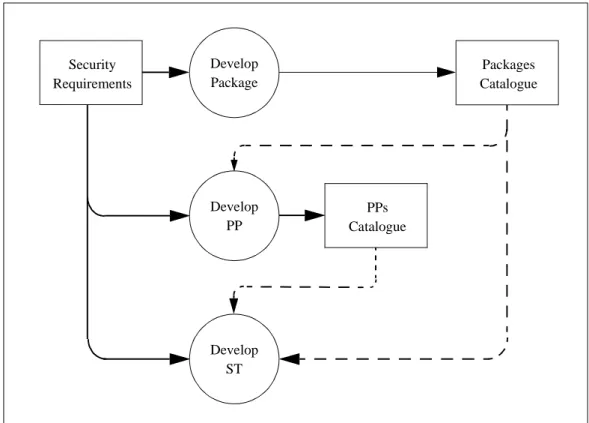
SFP Security Function Policy
SOF Strength of Function
ST Security Target
TOE Target of Evaluation
TSC TSF Scope of Control
TSF TOE Security Functions
TSFI TSF Interface
TSP TOE Security Policy
2.2
Scope of glossary
8 This subclause 2.2 contains only those terms which are used in a specialised way
throughout the CC. The majority of terms in the CC are used either according to their accepted dictionary definitions or according to commonly accepted definitions that may be found in ISO security glossaries or other well-known collections of security terms. Some combinations of common terms used in the CC, while not meriting glossary definition, are explained for clarity in the context where they are used. Explanations of the use of terms and concepts used in a specialised way in CC Part 2 and CC Part 3 can be found in their respective “paradigm” subclauses.
2 - Definitions Glossary
2.3
Glossary
9 Assets — Information or resources to be protected by the countermeasures of a
TOE.
10 Assignment — The specification of an identified parameter in a component. 11 Assurance — Grounds for confidence that an entity meets its security objectives. 12 Attack potential — The perceived potential for success of an attack, should an
attack be launched, expressed in terms of an attacker’s expertise, resources and motivation.
13 Augmentation — The addition of one or more assurance component(s) from Part 3
to an EAL or assurance package.
14 Authentication data — Information used to verify the claimed identity of a user. 15 Authorised user — A user who may, in accordance with the TSP, perform an
operation.
16 Class — A grouping of families that share a common focus.
17 Component — The smallest selectable set of elements that may be included in a
PP, an ST, or a package.
18 Connectivity — The property of the TOE which allows interaction with IT entities
external to the TOE. This includes exchange of data by wire or by wireless means, over any distance in any environment or configuration.
19 Dependency — A relationship between requirements such that the requirement that
is depended upon must normally be satisfied for the other requirements to be able to meet their objectives.
20 Element — An indivisible security requirement.
21 Evaluation — Assessment of a PP, an ST or a TOE, against defined criteria. 22 Evaluation Assurance Level (EAL) — A package consisting of assurance
components from Part 3 that represents a point on the CC predefined assurance scale.
23 Evaluation authority — A body that implements the CC for a specific community
by means of an evaluation scheme and thereby sets the standards and monitors the quality of evaluations conducted by bodies within that community.
24 Evaluation scheme — The administrative and regulatory framework under which
Glossary 2 - Definitions
25 Extension — The addition to an ST or PP of functional requirements not contained
in Part 2 and/or assurance requirements not contained in Part 3 of the CC.
26 External IT entity — Any IT product or system, untrusted or trusted, outside of
the TOE that interacts with the TOE.
27 Family — A grouping of components that share security objectives but may differ
in emphasis or rigour.
28 Formal — Expressed in a restricted syntax language with defined semantics based
on well-established mathematical concepts.
29 Human user — Any person who interacts with the TOE.
30 Identity — A representation (e.g. a string) uniquely identifying an authorised user,
which can either be the full or abbreviated name of that user or a pseudonym.
31 Informal — Expressed in natural language.
32 Internal communication channel — A communication channel between
separated parts of TOE.
33 Internal TOE transfer — Communicating data between separated parts of the
TOE.
34 Inter-TSF transfers — Communicating data between the TOE and the security
functions of other trusted IT products.
35 Iteration — The use of a component more than once with varying operations. 36 Object — An entity within the TSC that contains or receives information and upon
which subjects perform operations.
37 Organisational security policies — One or more security rules, procedures,
practices, or guidelines imposed by an organisation upon its operations.
38 Package — A reusable set of either functional or assurance components (e.g. an
EAL), combined together to satisfy a set of identified security objectives.
39 Product — A package of IT software, firmware and/or hardware, providing
functionality designed for use or incorporation within a multiplicity of systems.
40 Protection Profile (PP) — An implementation-independent set of security
requirements for a category of TOEs that meet specific consumer needs.
41 Reference monitor — The concept of an abstract machine that enforces TOE
2 - Definitions Glossary
42 Reference validation mechanism — An implementation of the reference monitor
concept that possesses the following properties: it is tamperproof, always invoked, and simple enough to be subjected to thorough analysis and testing.
43 Refinement — The addition of details to a component.
44 Role — A predefined set of rules establishing the allowed interactions between a
user and the TOE.
45 Secret — Information that must be known only to authorised users and/or the TSF
in order to enforce a specific SFP.
46 Security attribute — Information associated with subjects, users and/or objects
that is used for the enforcement of the TSP.
47 Security Function (SF) — A part or parts of the TOE that have to be relied upon
for enforcing a closely related subset of the rules from the TSP.
48 Security Function Policy (SFP) — The security policy enforced by an SF. 49 Security objective — A statement of intent to counter identified threats and/or
satisfy identified organisation security policies and assumptions.
50 Security Target (ST) — A set of security requirements and specifications to be
used as the basis for evaluation of an identified TOE.
51 Selection — The specification of one or more items from a list in a component. 52 Semiformal — Expressed in a restricted syntax language with defined semantics. 53 Strength of Function (SOF) — A qualification of a TOE security function
expressing the minimum efforts assumed necessary to defeat its expected security behaviour by directly attacking its underlying security mechanisms.
54 SOF-basic — A level of the TOE strength of function where analysis shows that
the function provides adequate protection against casual breach of TOE security by attackers possessing a low attack potential.
55 SOF-medium — A level of the TOE strength of function where analysis shows that
the function provides adequate protection against straightforward or intentional breach of TOE security by attackers possessing a moderate attack potential.
56 SOF-high — A level of the TOE strength of function where analysis shows that the
function provides adequate protection against deliberately planned or organised breach of TOE security by attackers possessing a high attack potential.
57 Subject — An entity within the TSC that causes operations to be performed. 58 System — A specific IT installation, with a particular purpose and operational
Glossary 2 - Definitions
59 Target of Evaluation (TOE) — An IT product or system and its associated
administrator and user guidance documentation that is the subject of an evaluation.
60 TOE resource — Anything useable or consumable in the TOE.
61 TOE Security Functions (TSF) — A set consisting of all hardware, software, and
firmware of the TOE that must be relied upon for the correct enforcement of the TSP.
62 TOE Security Functions Interface (TSFI) — A set of interfaces, whether
interactive (man-machine interface) or programmatic (application programming interface), through which TOE resources are accessed, mediated by the TSF, or information is obtained from the TSF.
63 TOE Security Policy (TSP) — A set of rules that regulate how assets are managed,
protected and distributed within a TOE.
64 TOE security policy model — A structured representation of the security policy
to be enforced by the TOE.
65 Transfers outside TSF control — Communicating data to entities not under
control of the TSF.
66 Trusted channel — A means by which a TSF and a remote trusted IT product can
communicate with necessary confidence to support the TSP.
67 Trusted path — A means by which a user and a TSF can communicate with
necessary confidence to support the TSP.
68 TSF data — Data created by and for the TOE, that might affect the operation of the
TOE.
69 TSF Scope of Control (TSC) — The set of interactions that can occur with or
within a TOE and are subject to the rules of the TSP.
70 User — Any entity (human user or external IT entity) outside the TOE that interacts
with the TOE.
71 User data — Data created by and for the user, that does not affect the operation of
12
Part 1: Introduction and general model Introduction
3
Overview
72 This clause introduces the main concepts of the CC. It identifies the target audience,
evaluation context, and the approach taken to present the material.
3.1
Introduction
73 Information held by IT products or systems is a critical resource that enables
organisations to succeed in their mission. Additionally, individuals have a reasonable expectation that their personal information contained in IT products or systems remain private, be available to them as needed, and not be subject to unauthorised modification. IT products or systems should perform their functions while exercising proper control of the information to ensure it is protected against hazards such as unwanted or unwarranted dissemination, alteration, or loss. The term IT security is used to cover prevention and mitigation of these and similar hazards.
74 Many consumers of IT lack the knowledge, expertise or resources necessary to
judge whether their confidence in the security of their IT products or systems is appropriate, and they may not wish to rely solely on the assertions of the developers. Consumers may therefore choose to increase their confidence in the security measures of an IT product or system by ordering an analysis of its security (i.e. a security evaluation).
75 The CC can be used to select the appropriate IT security measures and it contains
criteria for evaluation of security requirements.
3.2
Target audience of the CC
76 There are three groups with a general interest in evaluation of the security properties
of IT products and systems: TOE consumers, TOE developers, and TOE evaluators. The criteria presented in this document have been structured to support the needs of all three groups. They are all considered to be the principal users of this CC. The three groups can benefit from the criteria as explained in the following paragraphs.
3.2.1 Consumers
77 The CC plays an important role in supporting techniques for consumer selection of
IT security requirements to express their organisational needs. The CC is written to ensure that evaluation fulfils the needs of the consumers as this is the fundamental purpose and justification for the evaluation process.
78 Consumers can use the results of evaluations to help decide whether an evaluated
product or system fulfils their security needs. These security needs are typically identified as a result of both risk analysis and policy direction. Consumers can also
Target audience of the CC 3 - Overview
use the evaluation results to compare different products or systems. Presentation of the assurance requirements within a hierarchy supports this need.
79 The CC gives consumers — especially in consumer groups and communities of
interest — an implementation-independent structure termed the Protection Profile (PP) in which to express their special requirements for IT security measures in a TOE.
3.2.2 Developers
80 The CC is intended to support developers in preparing for and assisting in the
evaluation of their products or systems and in identifying security requirements to be satisfied by each of their products or systems. It is also quite possible that an associated evaluation methodology, potentially accompanied by a mutual recognition agreement for evaluation results, would further permit the CC to support someone, other than the TOE developer, in preparing for and assisting in the evaluation of a developer’s TOE.
81 The CC constructs can then be used to make claims that the TOE conforms to its
identified requirements by means of specified security functions and assurances to be evaluated. Each TOE’s requirements are contained in an implementation-dependent construct termed the Security Target (ST). One or more PPs may provide the requirements of a broad consumer base.
82 The CC describes security functions that a developer could include in the TOE. The
CC can be used to determine the responsibilities and actions to support evidence that is necessary to support the evaluation of the TOE. It also defines the content and presentation of that evidence.
3.2.3 Evaluators
83 The CC contains criteria to be used by evaluators when forming judgements about
the conformance of TOEs to their security requirements. The CC describes the set of general actions the evaluator is to carry out and the security functions on which to perform these actions. Note that the CC does not specify procedures to be followed in carrying out those actions.
3.2.4 Others
84 While the CC is oriented towards specification and evaluation of the IT security
properties of TOEs, it may also be useful as reference material to all parties with an interest in or responsibility for IT security. Some of the additional interest groups that can benefit from information contained in the CC are:
a) system custodians and system security officers responsible for determining
and meeting organisational IT security policies and requirements;
b) auditors, both internal and external, responsible for assessing the adequacy of the security of a system;
3 - Overview Evaluation context
c) security architects and designers responsible for the specification of the
security content of IT systems and products;
d) accreditors responsible for accepting an IT system for use within a particular environment;
e) sponsors of evaluation responsible for requesting and supporting an
evaluation; and
f) evaluation authorities responsible for the management and oversight of IT
security evaluation programmes.
3.3
Evaluation context
85 In order to achieve greater comparability between evaluation results, evaluations
should be performed within the framework of an authoritative evaluation scheme that sets the standards, monitors the quality of the evaluations and administers the regulations to which the evaluation facilities and evaluators must conform.
86 The CC does not state requirements for the regulatory framework. However,
consistency between the regulatory frameworks of different evaluation authorities will be necessary to achieve the goal of mutual recognition of the results of such evaluations. Figure 3.1 depicts the major elements that form the context for evaluations.
87 Use of a common evaluation methodology contributes to the repeatability and
objectivity of the results but is not by itself sufficient. Many of the evaluation criteria require the application of expert judgement and background knowledge for which consistency is more difficult to achieve. In order to enhance the consistency of the evaluation findings, the final evaluation results could be submitted to a certification process. The certification process is the independent inspection of the results of the evaluation leading to the production of the final certificate or approval. The certificate is normally publicly available. It is noted that the certification process is a means of gaining greater consistency in the application of IT security criteria.
88 The evaluation scheme, methodology, and certification processes are the
responsibility of the evaluation authorities that run evaluation schemes and are outside the scope of the CC.
Organisation of the Common Criteria 3 - Overview
Figure 3.1 - Evaluation context
3.4
Organisation of the Common Criteria
89 The CC is presented as a set of distinct but related parts as identified below. Terms
used in the description of the parts are explained in clause 4.
a) Part 1, Introduction and general model, is the introduction to the CC. It
defines general concepts and principles of IT security evaluation and presents a general model of evaluation. Part 1 also presents constructs for expressing IT security objectives, for selecting and defining IT security requirements, and for writing high-level specifications for products and systems. In addition, the usefulness of each part of the CC is described in terms of each of the target audiences.
b) Part 2, Security functional requirements, establishes a set of functional
components as a standard way of expressing the functional requirements for TOEs. Part 2 catalogues the set of functional components, families, and classes.
c) Part 3, Security assurance requirements, establishes a set of assurance
components as a standard way of expressing the assurance requirements for TOEs. Part 3 catalogues the set of assurance components, families and classes. Part 3 also defines evaluation criteria for PPs and STs and presents evaluation assurance levels that define the predefined CC scale for rating assurance for TOEs, which is called the Evaluation Assurance Levels (EALs).
Evaluation Criteria (the CC)
Evaluation Methodology
Evaluate Approve/
List of Certificates/ Evaluation
Scheme
Final Evaluation
3 - Overview Organisation of the Common Criteria
90 In support of the three parts of the CC listed above, it is anticipated that other types
of documents will be published, including technical rationale material and guidance documents.
91 The following table presents, for the three key target audience groupings, how the
parts of the CC will be of interest.
Table 3.1 - Roadmap to the Common Criteria
Consumers Developers Evaluators
Part 1 Use for background informa-tion and reference purposes. Guidance structure for PPs.
Use for background informa-tion and reference for the development of requirements and formulating security specifications for TOEs.
Use for background informa-tion and reference purposes. Guidance structure for PPs and STs.
Part 2 Use for guidance and reference when formulating statements of requirements for security functions.
Use for reference when interpreting statements of functional requirements and formulating functional specifications for TOEs.
Use as mandatory statement of evaluation criteria when determining whether a TOE effectively meets claimed security functions.
Part 3 Use for guidance when determining required levels of assurance.
Use for reference when interpreting statements of assurance requirements and determining assurance approaches of TOEs.
Use as mandatory statement of evaluation criteria when determining the assurance of TOEs and when evaluating PPs and STs.
29
Part 1: Introduction and general model Security context
4
General model
92 This clause presents the general concepts used throughout the CC, including the
context in which the concepts are to be used and the CC approach for applying the concepts. Part 2 and Part 3 expand on the use of these concepts and assume that the approach described is used. This clause assumes some knowledge of IT security and does not propose to act as a tutorial in this area.
93 The CC discusses security using a set of security concepts and terminology. An
understanding of these concepts and the terminology is a prerequisite to the effective use of the CC. However, the concepts themselves are quite general and are not intended to restrict the class of IT security problems to which the CC is applicable.
4.1
Security context
4.1.1 General security context
94 Security is concerned with the protection of assets from threats, where threats are
categorised as the potential for abuse of protected assets. All categories of threats should be considered; but in the domain of security greater attention is given to those threats that are related to malicious or other human activities. Figure 4.1 illustrates high level concepts and relationships.
4 - General model Security context
Figure 4.1 - Security concepts and relationships
95 Safeguarding assets of interest is the responsibility of owners who place value on
those assets. Actual or presumed threat agents may also place value on the assets and seek to abuse assets in a manner contrary to the interests of the owner. Owners will perceive such threats as potential for impairment of the assets such that the value of the assets to the owners would be reduced. Security specific impairment commonly includes, but is not limited to, damaging disclosure of the asset to unauthorised recipients (loss of confidentiality), damage to the asset through unauthorised modification (loss of integrity), or unauthorised deprivation of access to the asset (loss of availability).
96 The owners of the assets will analyse the possible threats to determine which ones
apply to their environment. The results are known as risks. This analysis can aid in the selection of countermeasures to counter the risks and reduce it to an acceptable level.
97 Countermeasures are imposed to reduce vulnerabilities and to meet security
policies of the owners of the assets (either directly or indirectly by providing direction to other parties). Residual vulnerabilities may remain after the imposition of countermeasures. Such vulnerabilities may be exploited by threat agents representing a residual level of risk to the assets. Owners will seek to minimise that risk given other constraints.
value
wish to abuse and/or may damage may be aware of
Owners
leading to risk
assets Threat agents
threats impose
that may possess wish to minimise
to that increase
countermeasures
vulnerabilities to reduce
that exploit give
rise to that may be
reduced by
Security context 4 - General model
Figure 4.2 - Evaluation concepts and relationships
98 Owners will need to be confident that the countermeasures are adequate to counter
the threats to assets before they will allow exposure of their assets to the specified threats. Owners may not themselves possess the capability to judge all aspects of the countermeasures, and may therefore seek evaluation of the countermeasures. The outcome of evaluation is a statement about the extent to which assurance is gained that the countermeasures can be trusted to reduce the risks to the protected assets. The statement assigns an assurance rating of the countermeasures, assurance being that property of the countermeasures that gives grounds for confidence in their proper operation. This statement can be used by the owner of the assets in deciding whether to accept the risk of exposing the assets to the threats. Figure 4.2 illustrates these relationships.
99 Owners of assets will normally be held responsible for those assets and should be
able to defend the decision to accept the risks of exposing the assets to the threats. This requires that the statements resulting from evaluation are defensible. Thus, evaluation should lead to objective and repeatable results that can be cited as evidence.
Owners
minimise confidence
countermeasures
risk
assets. require
that Assurance
Techniques
assurance produce
giving
to Evaluation
4 - General model Common Criteria approach
4.1.2 Information technology security context
100 Many assets are in the form of information that is stored, processed and transmitted
by IT products or systems to meet requirements laid down by owners of the information. Information owners may require that dissemination and modification of any such information representations (data) be strictly controlled. They may demand that the IT product or system implement IT specific security controls as part of the overall set of security countermeasures put in place to counteract the threats to the data.
101 IT systems are procured and constructed to meet specific requirements and may, for
economic reasons, make maximum use of existing commodity IT products such as operating systems, general purpose application components, and hardware platforms. IT security countermeasures implemented by a system may use functions of the underlying IT products and depend upon the correct operation of IT product security functions. The IT products may, therefore, be subject to evaluation as part of the IT system security evaluation.
102 Where an IT product is incorporated or being considered for incorporation in
multiple IT systems, there are cost advantages in evaluating the security aspects of such a product independently and building a catalogue of evaluated products. The results of such an evaluation should be expressed in a manner that supports incorporation of the product in multiple IT systems without unnecessary repetition of work required to examine the product’s security.
103 An IT system accreditor has the authority of the owner of the information to
determine whether the combination of IT and non-IT security countermeasures furnishes adequate protection for the data, and thus to decide whether to permit the operation of the system. The accreditor may call for evaluation of the IT countermeasures in order to determine whether the IT countermeasures provide adequate protection and whether the specified countermeasures are properly implemented by the IT system. This evaluation may take various forms and degrees of rigour, depending upon the rules imposed upon, or by, the accreditor.
4.2
Common Criteria approach
104 Confidence in IT security can be gained through actions that may be taken during
the processes of development, evaluation, and operation.
4.2.1 Development
105 The CC does not mandate any specific development methodology or life cycle
model. Figure 4.3 depicts underlying assumptions about the relationship between the security requirements and the TOE. The figure is used to provide a context for discussion and should not be construed as advocating a preference for one methodology (e.g. waterfall) over another (e.g. prototyping).
106 It is essential that the security requirements imposed on the IT development be
Common Criteria approach 4 - General model
requirements are established at the start of the development process, the resulting end product, however well engineered, may not meet the objectives of its anticipated consumers.
Figure 4.3 - TOE development model
107 The process is based on the refinement of the security requirements into a TOE
summary specification expressed in the security target. Each lower level of refinement represents a design decomposition with additional design detail. The least abstract representation is the TOE implementation itself.
108 The CC does not mandate a specific set of design representations. The CC
requirement is that there should be sufficient design representations presented at a sufficient level of granularity to demonstrate where required:
Security requirements
Functional specification
High-level design
Source code/ Hardware drawings
Implementation
Design and
implementation
refinement
Correspondence
analysis and
integration testing
4 - General model Common Criteria approach
a) that each refinement level is a complete instantiation of the higher levels (i.e. all TOE security functions, properties, and behaviour defined at the higher level of abstraction must be demonstrably present in the lower level); b) that each refinement level is an accurate instantiation of the higher levels (i.e. there should be no TOE security functions, properties, and behaviour defined at the lower level of abstraction that are not required by the higher level).
109 The CC assurance criteria identify the design abstraction levels of functional
specification, high-level design, low-level design, and implementation. Depending upon the assurance level specified, developers may be required to show how the development methodology meets the CC assurance requirements.
Figure 4.4 - TOE evaluation process
4.2.2 TOE evaluation
110 The TOE evaluation process as described in Figure 4.4 may be carried out in
parallel with development, or it may follow. The principal inputs to TOE evaluation are:
Feedback
Evaluation Results
Evaluate TOE Develop
TOE
Operate TOE
Security requirements
(PP and ST)
Evaluation criteria
Evaluation Methodology
Evaluation Scheme TOE and
Evaluation Evidence
Security concepts 4 - General model
a) the set of TOE evidence, which includes the evaluated ST as the basis for
TOE evaluation;
b) the TOE for which the evaluation is required;
c) the evaluation criteria, methodology and scheme.
111 In addition, informative material (such as application notes of the CC) and the IT
security expertise of the evaluator and the evaluation community are likely to be used as inputs to the evaluation.
112 The expected result of the evaluation process is a confirmation that the TOE
satisfies its security requirements as stated in the ST with one or more reports documenting the evaluator findings about the TOE as determined by the evaluation criteria. These reports will be useful to actual and potential consumers of the product or system represented by the TOE as well as to the developer.
113 The degree of confidence gained through an evaluation depends on the assurance
requirements (e.g. Evaluation Assurance Level) met.
114 Evaluation can lead to better IT security products in two ways. Evaluation is
intended to identify errors or vulnerabilities in the TOE that the developer may correct, thereby reducing the probability of security failures in future operation. Also in preparing for the rigours of evaluation, the developer may take more care in TOE design and development. Therefore, the evaluation process can exert a strong, though indirect, positive effect on the initial requirements, the development process, the end product, and the operational environment.
4.2.3 Operation
115 Consumers may elect to use evaluated TOEs in their environments. Once a TOE is
in operation, it is possible that previously unknown errors or vulnerabilities may surface or environmental assumptions may need to be revised. As a result of operation, feedback could be given that would require the developer to correct the TOE or redefine its security requirements or environmental assumptions. Such changes may require the TOE to be re-evaluated or the security of its operational environment to be strengthened. In some instances this may only require that the needed updates are evaluated in order to regain confidence in the TOE. Although the CC contains criteria to cover assurance maintenance, detailed procedures for re-evaluation, including reuse of evaluation results, are outside the scope of the CC.
4.3
Security concepts
116 Evaluation criteria are most useful in the context of the engineering processes and
regulatory frameworks that are supportive of secure TOE development and evaluation. This subclause is provided for illustration and guidance purposes only and is not intended to constrain the analysis processes, development approaches, or evaluation schemes within which the CC might be employed.
4 - General model Security concepts
117 The CC is applicable when IT is being used and there is concern about the ability
of the IT element to safeguard assets. In order to show that the assets are secure, the security concerns must be addressed at all levels from the most abstract to the final IT implementation in its operational environment. These levels of representation, as described in the following subclauses, permit security problems and issues to be characterised and discussed but do not, of themselves, demonstrate that the final IT implementation actually exhibits the required security behaviour and can, therefore, be trusted.
118 The CC requires that certain levels of representation contain a rationale for the
representation of the TOE at that level. That is, such a level must contain a reasoned and convincing argument that shows that it is in conformance with the higher level, and is itself complete, correct and internally consistent. Statements of rationale demonstrating conformance with the adjacent higher level representation contribute to the case for TOE correctness. Rationale directly demonstrating compliance with security objectives supports the case that the TOE is effective in countering the threats and enforcing the organisational security policy.
119 The CC layers the different levels of representation as described in Figure 4.5,
which illustrates the means by which the security requirements and specifications might be derived when developing a PP or ST. All TOE security requirements ultimately arise from consideration of the purpose and context of the TOE. This chart is not intended to constrain the means by which PPs and STs are developed, but illustrates how the results of some analytic approaches relate to the content of PPs and STs.
Security concepts 4 - General model
Figure 4.5 - Derivation of requirements and specifications
4.3.1 Security environment
120 The security environment includes all the laws, organisational security policies,
customs, expertise and knowledge that are determined to be relevant. It thus defines
Establish security requirements TOE physical
environment
Threats
TOE purpose
Organisational security policies
Security objectives CC requirements
catalogue
TOE summary specification
Requirements for the environment Establish
security environment
Establish security objectives
Security Specification material (ST) Security Requirements material (PP/ST) Security Objectives material (PP/ST) Security Environment material (PP/ST)
Establish TOE summary
specification Assets requiring
protection
Assumptions
Functional requirements
Assurance requirements
4 - General model Security concepts
the context in which the TOE is intended to be used. The security environment also includes the threats to security that are, or are held to be, present in the environment.
121 To establish the security environment, the PP or ST writer has to take into account:
a) the TOE physical environment which identifies all aspects of the TOE
operating environment relevant to TOE security, including known physical and personnel security arrangements;
b) the assets requiring protection by the element of the TOE to which security requirements or policies will apply; this may include assets that are directly referred to, such as files and databases, as well as assets that are indirectly subject to security requirements, such as authorisation credentials and the IT implementation itself;
c) the TOE purpose, which would address the product type and the intended
usage of the TOE.
122 Investigation of the security policies, threats and risks should permit the following
security specific statements to be made about the TOE:
a) A statement of assumptions which are to be met by the environment of the
TOE in order for the TOE to be considered secure. This statement can be accepted as axiomatic for the TOE evaluation.
b) A statement of threats to security of the assets would identify all the threats perceived by the security analysis as relevant to the TOE. The CC characterises a threat in terms of a threat agent, a presumed attack method, any vulnerabilities that are the foundation for the attack, and identification of the asset under attack. An assessment of risks to security would qualify each threat with an assessment of the likelihood of such a threat developing into an actual attack, the likelihood of such an attack proving successful, and the consequences of any damage that may result.
c) A statement of applicable organisational security policies would identify
relevant policies and rules. For an IT system, such policies may be explicitly referenced, whereas for a general purpose IT product or product class, working assumptions about organisational security policy may need to be made.
4.3.2 Security objectives
123 The results of the analysis of the security environment could then be used to state
the security objectives that counter the identified threats and address identified organisational security policies and assumptions. The security objectives should be consistent with the stated operational aim or product purpose of the TOE, and any knowledge about its physical environment.
124 The intent of determining security objectives is to address all of the security
Security concepts 4 - General model
TOE or by its environment. This categorisation is based on a process incorporating engineering judgement, security policy, economic factors and risk acceptance decisions.
125 The security objectives for the environment would be implemented within the IT
domain, and by non-technical or procedural means.
126 Only the security objectives for the TOE and its IT environment are addressed by
IT security requirements.
4.3.3 IT security requirements
127 The IT security requirements are the refinement of the security objectives into a set
of security requirements for the TOE and security requirements for the environment which, if met, will ensure that the TOE can meet its security objectives.
128 The CC presents security requirements under the distinct categories of functional
requirements and assurance requirements.
129 The functional requirements are levied on those functions of the TOE that are
specifically in support of IT security, and define the desired security behaviour. Part 2 defines the CC functional requirements. Examples of functional requirements include requirements for identification, authentication, security audit and non-repudiation of origin.
130 When the TOE contains security functions that are realised by a probabilistic or
permutational mechanism (e.g. a password or hash function), the assurance requirements may specify that a minimum strength level consistent with the security objectives is to be claimed. In this case, the level specified will be one of the following SOF-basic, SOF-medium, SOF-high. Each such function will be required to meet that minimum level or at least an optionally defined specific metric.
131 The degree of assurance can be varied for a given set of functional requirements;
therefore it is typically expressed in terms of increasing levels of rigour built with assurance components. Part 3 defines the CC assurance requirements and a scale of evaluation assurance levels (EALs) constructed using these components. The assurance requirements are levied on actions of the developer, on evidence produced and on the actions of the evaluator. Examples of assurance requirements include constraints on the rigour of the development process and requirements to search for and analyse the impact of potential security vulnerabilities.
132 Assurance that the security objectives are achieved by the selected security
functions is derived from the following two factors:
a) confidence in the correctness of the implementation of the security
functions, i.e., the assessment whether they are correctly implemented; and b) confidence in the effectiveness of the security functions, i.e., the assessment
4 - General model CC descriptive material
133 Security requirements generally include both requirements for the presence of
desired behaviour and requirements for the absence of undesired behaviour. It is normally possible to demonstrate, by use or testing, the presence of the desired behaviour. It is not always possible to perform a conclusive demonstration of absence of undesired behaviour. Testing, design review, and implementation review contribute significantly to reducing the risk that such undesired behaviour is present. The rationale statements provide further support to the claim that such undesired behaviour is absent.
4.3.4 TOE summary specification
134 The TOE summary specification provided in the ST defines the instantiation of the
security requirements for the TOE. It provides a high-level definition of the security functions claimed to meet the functional requirements, and assurance measures taken to meet the assurance requirements.
4.3.5 TOE implementation
135 The TOE implementation is the realisation of the TOE based on its security
functional requirements and the TOE summary specification contained in the ST. TOE implementation is accomplished using a process of applying security and IT engineering skills and knowledge. The TOE will meet the security objectives if it correctly and effectively implements all the security requirements contained in the ST.
4.4
CC descriptive material
136 The CC presents the framework in which an evaluation can take place. By
presenting the requirements for evidence and analysis, a more objective, and hence useful evaluation result can be achieved. The CC incorporates a common set of constructs and a language in which to express and communicate the relevant aspects of IT security, and permits those responsible for IT security to benefit from the prior experience and expertise of others.
4.4.1 Expression of security requirements
137 The CC defines a set of constructs that combine into meaningful assemblies of
security requirements of known validity, which can be used in establishing security requirements for prospective products and systems. The relationships among the various constructs for requirements expression are described below and illustrated in figure 4.6.
CC descriptive material 4 - General model
Figure 4.6 - Organisation and construction of requirements
138 The organisation of the CC security requirements into the hierarchy of class
-family - component is provided to help consumers to locate specific security requirements.
139 The CC presents requirements for functional and assurance aspects in the same
general style and uses the same organisation and terminology for each.
4.4.1.1 Class
140 The term class is used for the most general grouping of security requirements. All
the members of a class share a common focus, while differing in coverage of security objectives.
141 The members of a class are termed families.
4.4.1.2 Family
142 A family is a grouping of sets of security requirements that share security objectives
but may differ in emphasis or rigour.
143 The members of a family are termed components.
4.4.1.3 Component
144 A component describes a specific set of security requirements and is the smallest
selectable set of security requirements for inclusion in the structures defined in the CC. The set of components within a family may be ordered to represent increasing strength or capability of security requirements that share a common purpose. They
Optional extended (non-CC) Security Requirements Classa Familyj Component
Protection Profile
Security Target Packages
Reusable set of functional or assurance requirements. Optional input to PP or ST
CC Catalogues
Possible input sources for ST Possible input sources for PP
Component
Component Familyi Component
Component
Component
Familyk Component Component
Component Classb
...
...
4 - General model CC descriptive material
may also be partially ordered to represent related non-hierarchical sets. In some instances, there is only one component in a family so ordering is not applicable.
145 The components are constructed from individual elements. The element is the
lowest level expression of security requirements, and is the indivisible security requirement that can be verified by the evaluation.
Dependencies between components
146 Dependencies may exist between components. Dependencies arise when a
component is not self sufficient and relies upon the presence of another component. Dependencies may exist between functional components, between assurance components, and between functional and assurance components.
147 Component dependency descriptions are part of the CC component definitions. In
order to ensure completeness of the TOE requirements, dependencies should be satisfied when incorporating components into PPs and STs where appropriate.
Permitted operations on components
148 CC components may be used exactly as defined in the CC, or they may be tailored
through the use of permitted operations in order to meet a specific security policy or counter a specific threat. Each CC component identifies and defines any permitted operations of assignment and selection, the circumstances under which these operations may be applied to the component, and the results of the application of the operation. The operations of iteration and refinement can be performed for any component. These four operations are described as follows:
a) iteration, which permits the use of a component more than once with
varying operations;
b) assignment, which permits the specification of a parameter to be filled in
when the component is used;
c) selection, which permits the specification of items that are to be selected
from a list given in the component;
d) refinement, which permits the addition of extra detail when the component
is used.
149 Some required operations may be completed (in whole or part) in the PP or may be
left to be completed in the ST. Nevertheless, all operations must be completed in the ST.
4.4.2 Use of security requirements
150 The CC defines three types of requirement constructs: package, PP and ST. The CC
further defines a set of IT security criteria that can address the needs of many communities and thus serve as a major expert input to the production of these constructs. The CC has been developed around the central notion of using wherever
CC descriptive material 4 - General model
possible the security requirements components defined in the CC, which represent a well-known and understood domain. Figure 4.7 shows the relationship between these different constructs.
Figure 4.7 - Use of security requirements 4.4.2.1 Package
151 An intermediate combination of components is termed a package. The package
permits the expression of a set of functional or assurance requirements that meet an identifiable subset of security objectives. A package is intended to be reusable and to define requirements that are known to be useful and effective in meeting the identified objectives. A package may be used in the construction of larger packages, PPs, and STs.
152 The evaluation assurance levels (EALs) are predefined assurance packages
contained in Part 3. An EAL is a baseline set of assurance requirements for evaluation. EALs each define a consistent set of assurance requirements. Together, the EALs form an ordered set that is the predefined assurance scale of the CC.
4.4.2.2 Protection Profile
153 The PP contains a set of security requirements either from the CC, or stated
explicitly, which should include an EAL (possibly augmented by additional assurance components). The PP permits the implementation independent
Develop Package Security
Requirements
Develop PP
Develop ST
Packages Catalogue
PPs Catalogue
4 - General model CC descriptive material
expression of security requirements for a set of TOEs that will comply fully with a set of security objectives. A PP is intended to be reusable and to define TOE requirements that are known to be useful and effective in meeting the identified objectives, both for functions and assurance. A PP also contains the rationale for security objectives and security requirements.
154 A PP could be developed by user communities, IT product developers, or other
parties interested in defining such a common set of requirements. A PP gives consumers a means of referring to a specific set of security needs and facilitates future evaluation against those needs.
4.4.2.3 Security Target
155 An ST contains a set of security requirements that may be made by reference to a
PP, directly by reference to CC functional or assurance components, or stated explicitly. An ST permits the expression of security requirements for a specific TOE that are shown, by evaluation, to be useful and effective in meeting the identified objectives.
156 An ST contains the TOE summary specification, together with the security
requirements and objectives, and the rationale for each. An ST is the basis for agreement between all parties as to what security the TOE offers.
4.4.3 Sources of security requirements
157 TOE security requirements can be constructed by using the following inputs:
a) Existing PPs
The TOE security requirements in an ST may be adequately expressed by, or are intended to comply with, a pre-existing statement of requirements contained in an existing PP.
Existing PPs may be used as a basis for a new PP.
b) Existing packages
Part of the TOE security requirements in a PP or ST may have already been expressed in a package that may be used.
A set of predefined packages is the EALs defined in Part 3. The TOE assurance requirements in a PP or ST should include an EAL from Part 3.
c) Existing functional or assurance requirements components
The TOE functional or assurance requirements in a PP or ST may be expressed directly, using the components in Part 2 or 3.
Types of evaluation 4 - General model
Additional functional requirements not contained in Part 2 and/or additional assurance requirements not contained in Part 3 may be used in a PP or ST.
158 Existing requirements material from Parts 2 and 3 should be used where available.
The use of an existing PP will help to ensure that the TOE will meet a well known set of needs of known utility and thus be more widely recognised.
4.5
Types of evaluation
4.5.1 PP evaluation
159 The PP evaluation is carried out against the evaluation criteria for PPs contained in
Part 3. The goal of such an evaluation is to demonstrate that the PP is complete, consistent, and technically sound and suitable for use as a statement of requirements for an evaluatable TOE.
4.5.2 ST evaluation
160 The evaluation of the ST for the TOE is carried out against the evaluation criteria
for STs contained in Part 3. The goal of such an evaluation is twofold: first to demonstrate that the ST is complete, consistent, and technically sound and hence suitable for use as the basis for the corresponding TOE evaluation; second, in the case where an ST claims conformance to a PP, to demonstrate that the ST properly meets the requirements of the PP.
4.5.3 TOE evaluation
161 The TOE evaluation is carried out against the evaluation criteria contained in Part
3 using an evaluated ST as the basis. The goal of such an evaluation is to demonstrate that the TOE meets the security requirements contained in the ST.
4.6
Assurance maintenance
162 TOE assurance maintenance is carried out against the evaluation criteria contained
in Part 3 using a previously evaluated TOE as the basis. The goal is to derive confidence that assurance already established in a TOE is maintained and that the TOE will continue to meet its security requirements as changes are made to the TOE or its environment.
34
Part 1: Introduction and general model Introduction
5
Common Criteria requirements and evaluation
results
5.1
Introduction
163 This clause presents the expected results from PP and TOE evaluation. PP or TOE
evaluations lead respectively to catalogues of evaluated PPs or TOEs. ST evaluation leads to intermediate results that are used in the frame of a TOE evaluation.
Figure 5.1 - Evaluation results
164 Evaluation should lead to objective and repeatable results that can be cited as
evidence, even if there is no totally objective scale for representing the results of an IT security evaluation. The existence of a set of evaluation criteria is a necessary pre-condition for evaluation to lead to a meaningful result and provides a technical basis for mutual recognition of evaluation results between evaluation authorities. But the application of criteria contains both objective and subjective elements, that's why precise and universal ratings for IT security are not, therefore, feasible.
165 A rating made relative to the CC represents the findings of a specific type of
investigation of the security properties of a TOE. Such a rating does not guarantee fitness for use in any particular application environment. The decision to accept a TOE for use in a specific application environment is based on consideration of many security issues including the evaluation findings.
PP Evaluation Results Evaluate
PP
Catalogue PP
ST Evaluation Results Evaluate
ST
Evaluate TOE
TOE Evaluation Results
Catalogue Certificates Evaluated
PP
Evaluated TOE
Requirements in PPs and STs 5 - Common Criteria requirements and evaluation results
5.2
Requirements in PPs and STs
166 The CC defines a set of IT security criteria that can address the needs of many
communities. The CC has been developed around the central notion that the use of the security functional components contained in Part 2, and the EALs and assurance components contained in Part 3, represents the preferred course of action for expression of TOE requirements in PPs and STs, as they represent a well-known and understood domain.
167 The CC recognises the possibility that functional and assurance requirements not
included in the provided catalogues may be required in order to represent the complete set of IT security requirements. The following shall apply to the inclusion of these extended functional or assurance requirements:
a) Any extended functional or assurance requirements included in a PP or ST
shall be clearly and unambiguously expressed such that evaluation and demonstration of compliance is feasible. The level of detail and manner of expression of existing CC functional or assurance components shall be used as a model.
b) Evaluation results obtained using extended functional or assurance
requirements shall be caveated as such.
c) The incorporation of extended functional or assurance requirements into a
PP or ST shall conform to the APE or ASE classes of the Part 3, as appropriate.
5.2.1 PP evaluation results
168 The CC contains the evaluation criteria that permit an evaluator to state whether a
PP is complete, consistent, and technically sound and hence suitable for use as a statement of requirements for an evaluatable TOE.
169 Evaluation of the PP shall result in a pass/fail statement. A PP for which the
evaluation results in a pass statement shall be eligible for inclusion within a registry.
5.3
Requirements in TOE
170 The CC contains the evaluation criteria that permit an evaluator to determine
whether the TOE satisfies the security requirements expressed in the ST. By using the CC in evaluation of the TOE, the evaluator will be able to make statements about:
a) whether the specified security functions of the TOE meet the functional
requirements and are thereby effective in meeting the security objectives of the TOE;
b) whether the specified security functions of the TOE are correctly