White Paper
Maximizing Service Assurance for
Global Payment Systems
Predictive Analytics for IT in Action
Introduction
Financial services executives responsible for the performance of payments applications and services face a minefield of factors that impact their operational risk, including:
• Industry regulations such as PSD (the European Payments Services Directive) in Europe, or the Dodd-Frank Wall Street Reform and Consumer Protection Act in the U.S., which may dictate requirements for payments service performance assurance.
• Stiff penalties for failing to comply with regulatory requirements for timeliness of reporting on intraday liquidity and performance versus Service Level Agreements (SLAs).
• Multiple payments architectures resulting from mergers and acquisitions, requiring multiple performance monitoring architectures and dozens of tools.
• Lack of visibility into the holistic performance of applications and the underlying infrastructure, even as demands on that architecture increase with the growth of electronic and mobile payments worldwide.
This leads to increased operational risk of service outage and degradations to the critical payments services, despite millions spent on IT management tools to assure the performance of the applications and infrastructure services to support payments processes.
What You Will Learn in This Paper
One major Global Bank reengineered its global service assurance architecture to address these issues. The Bank attributed predictive IT analytics in helping them achieve their goal of “continuous availability” for their Global Payment applications and services.
In the white paper you will learn:
• What perceived operational risk led the Bank to review its payments systems monitoring architecture and why they considered predictive analytics software to address those risks.
• The types of payment systems and subsystems the institution deemed as viable monitoring targets for using predictive analytics.
• How the Bank achieved improved service assurance for payments systems with cross-silo correlation and predictive analytics capabilities.
• Early results that make the case for deployment of predictive analytics throughout their new performance monitoring architecture for payments applications.
When considering a new technology, it is also important to consider how it will be deployed. This White Paper can serve as a project “road map” for companies seeking to understand the operational and business benefits that are part of the Netuitive value proposition.
Payments Processing: Complex by Nature
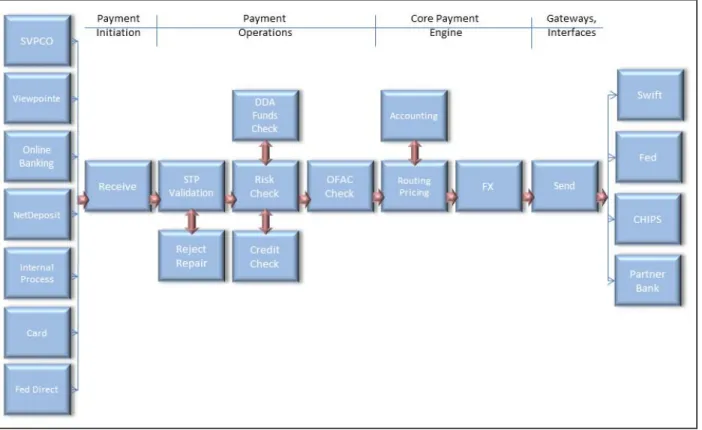
Payments is a common process among banks everywhere. Banks in every country have similar core payment processes with analogous processing steps (see Figure 1). The process is built upon IT infrastructure and applications that do the work of processing payment transactions. Every effort is made to streamline the payment process for efficiency and stability to reduce the operational risk of failed transactions or transactions with unacceptable latencies. Nevertheless, variations in payer/payee, expected transaction latencies, geographical regulatory and security requirements, payment sizes, SLAs, and evolving IT infrastructures (e.g. SOA, virtualization) make payments applications complex by nature.
Figure 1. A typical payment process
Payments Challenges for a Global Bank
The Global Bank portrayed in this white paper has experienced tremendous growth through aggressive market
expansion and the acquisition of regional banks across the globe over the course of several years. As a result, they are challenged by trying to efficiently operate and manage disparate systems while maintaining a high level of customer service – even as transaction volumes are increasing.
Multiple applications and diverse global geographies have created an environment that is difficult and costly to manage, resulting in significantly increased operational risk to payments systems and processes. This also creates greater exposure to compliance penalties and can impact service quality for customers.
Their payments infrastructure is a complex environment consisting of 40 payments applications with many hardware and infrastructure interdependencies. The systems serve five geographical regions, In two of these regions
To resolve the problem, the Bank decided to streamline common systems where possible. The Bank also saw a need to improve visibility into payments systems performance through a holistic monitoring approach that takes into account business activity, customer experience, and IT infrastructure performance metrics. The desire was for real-time correlation and analysis of performance data from a wide variety of data sources.
Requirements for a Holistic Analytics Approach to Improve Performance
Service availability and performance is critical to meeting payment delivery targets, internal SLAs and fixed cut-off times. The new service monitoring architecture has to address payment flows, applications, infrastructure, capacity, and business objectives.
The Bank hoped to implement holistic, real-time analysis of service performance and availability for the Global Payments Asset to achieve the goals listed on the right. The Bank investigated solutions to correlate alerts originating from across the business process flow, application and infrastructure domains. But this proved to be a tremendous challenge due to the different data collection intervals and unreliable threshold-based alerts from the existing tools. In essence, event correlation is useless if the events consist almost entirely of alert noise.
Instead, the Bank developed requirements for “holistic monitoring” that involved different perspectives on performance and availability, leveraging different types of monitoring tools and KPIs (see #1-4 below). The bank also liked the idea of understanding service health “at a glance” through a composite score for the payments system (see #5 below).
Application Monitoring Tools and KPIs
1. Application Monitoring: Used primarily to monitor the performance / availability of upstream payments systems. Leverages KPIs from APM tools like CA Wily.
2. Business Process / Transaction Monitoring: A measure of performance of upstream payments systems from a business process view. Leverages performance KPIs that track end-to-end as well as atomic (step by step) transaction times (e.g. HP BAC RUM).
3. Infrastructure Monitoring: A measure of performance and availability from traditional infrastructure monitoring tools that measure component availability and resource consumption (e.g. ITM6).
4. User Experience Monitoring: A measure of performance from a user experience perspective, using real time KPIs like payment queue levels, system response time, and transaction volume.
5. End-to-End Service Monitoring: A simplified business view of service performance that provides a composite health score derived from correlating and combining the performance and availability of systems across the business, application and infrastructure domains.
The Bank chose Netuitive software for its service modeling capabilities, and for its ability to automatically derive a composite, end-to-end service health score which was a “rollup” of the performance KPIs in views #1-4 above.
Global Payments Asset Goals
Efficiency Improve unit cost at >95% STP rate Functionality Provide the ability to make any
payment in any currency anywhere in the world
Transparency Deliver real time information on any payment across the group network
Implementing End-to-End Service Health Scores with Netuitive
Netuitive’s service modeling capability plays a key role in the service health monitoring solution for the Global Bank. The Netuitive “service” is a collection of monitored components and metrics which include:
• Systems and infrastructure components (e.g. servers, network devices, disk sub systems, virtual hosts, virtual machines, etc.)
• Payments applications (online banking applications, payment applications, gateways, validation software, OFAC, etc.).
• Business transaction activities (number of payments in a step, payment rejects, transaction volumes, items “stuck” in process, etc.)
• Customer experience (number of web transactions, response times, flow levels, site traffic volumes, failed web transactions, etc.)
When properly defined, the service will represent a payment process or a portion of a payment process. Netuitive captures and correlates metrics from a multitude of data sources that, together, form a comprehensive north/south, east/west view of the payment process.
Consider the following:
• The payment engine performs operations on payment transactions as they move through the process in the form of messages and files.
• Applications control and perform the operations on the payment transactions throughout the payment processing steps.
• The infrastructure provides a platform on which the applications run and do work.
• Customer experience is often a component of the payment process. Customer experience is more than the online banking experience. Any issue that may occur in a payment step that effects the normal processing of a customer payment can be classified as Customer Experience.
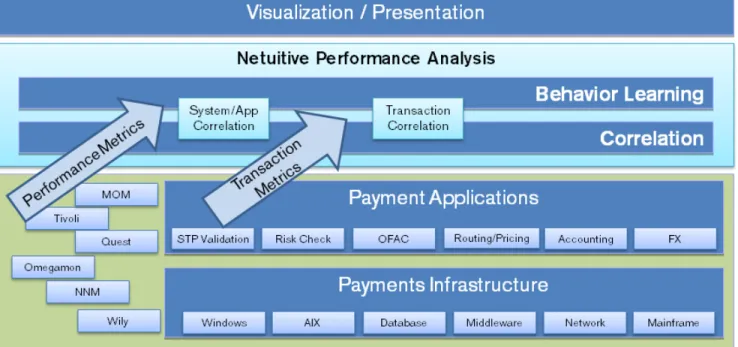
Although the activity and performance of each of these diverse components provide different sets of metrics, Netuitive has the unique capability of combining these metrics into a service defined by the business process being monitored. Netuitive’s self-learning and continuously adaptive Behavior Learning Engine™ correlates and analyzes these diverse metric sets into a unified service. When one or more KPIs deviate from “normal”, Trusted Alarms® provide actionable warning of impending performance problems on a real-time or forecasted basis across the service, whether the alarm relates to customer experience, business activity, application performance or IT infrastructure. In this way, Netuitive provides a comprehensive north/south solution for monitoring the health and performance of the payment process. Figure 2 below illustrates Netuitive’s role in this holistic performance monitoring architecture.
Figure 2. The role of Netuitive in leveraging different KPI sources for holistic performance monitoring.
Netuitive’s enterprise class analytics software is highly scalable. Deploying Netuitive across the entire payment process provides an east/west solution for monitoring the entire payment process, delivering a dashboard view and process monitoring of services from an end-to-end perspective. Netuitive also eliminates manually created
performance thresholds and correlation rules, replacing them with automated mathematics and analysis that forecast, identify, and help you resolve performance issues before they impact quality of service.
Existing data sources leveraged by Netuitive
Being a large financial institution with many tools at its disposal, the Bank is able to leverage earlier investments in legacy monitoring products that collect utilization and performance metrics from a variety of server operating systems, applications, transaction monitoring tools, databases, network components, middleware, and tools that monitor the online user experience. For this project, these data sources included TeamQuest, CA Wily, ITM6, NetQos, Microsoft SCOM, VMware, HP BAC, and Foglight. The performance metrics were integrated into Netuitive for analysis and real-time predictive alerting for 16 services defined within the overall Payments Systems architecture.
Importance of the Netuitive Behavior Learning Engine™
The Netuitive Behavior Learning Engine™ correlates and analyzes metrics from each of these data source types to measure and monitor payments service performance as it relates to Customer Experience, Business Process / Transaction Activity, Application Performance, and IT infrastructure.
Holistic Monitoring Requirement Netuitive Capability
Application Monitoring Netuitive improves the analytics capabilities of Application Support Groups when it leverages KPIs collected from application performance monitoring (APM) tools like CA Wily. Applications can be monitored as part of a defined service or as a single managed element where many attributes of the
application are correlated to provide a full system view of performance and availability.
Business Process / Transaction Monitoring
The ability to track the number of payment transactions in a payment step is a typical business metric within Netuitive. In this example, Netuitive uses this information in two ways:
a. As a composite part a defined service (see Composite Service Health Scores below)
b. As a separate monitored element. The number of payments may be traced through each process step beginning at payment initiation through to the outbound gateway. Netuitive’s Behavior Learning Engine™ is able to self-learn the normal transaction volumes by hour, day, week, and even seasonally, alerting on abnormal transaction volumes – e.g. if volumes are lower than expected for a given time. Infrastructure Monitoring Monitoring the IT infrastructure, physical or virtual, is another core capability of
Netuitive. Netuitive correlates metrics captured from existing infrastructure tools which provide performance metrics and managed element attributes.
Additionally, Netuitive can capture events within cloud environments (like VMware) and enables user-defined Service Level Objectives analysis and alerting for issues like VM cluster “workload imbalance.”
User Experience Monitoring Netuitive can also be applied to learn the “normal” behavior of metrics that measure service performance from a user experience perspective like response times, transaction queue levels, and transaction volumes. When one or more of these metrics trend outside of the expected norm – even if they are within SLA parameters – Netuitive alerts can provide advance warning and isolate the problem in the infrastructure, transaction, or application view.
End-to-End Service Monitoring The defined “service” monitors the payment process from and end-to-end perspective in real-time and provides a composite health score by correlating service performance and availability across business activity, application and infrastructure domains.
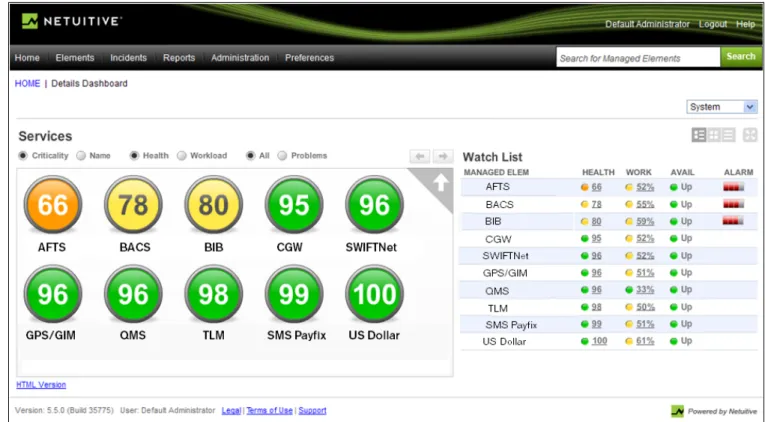
Figure 3 below shows an example of composite service “Health Scores” for payments services for a Global Bank. The score is based on how “normal” the Key Performance Indicators (KPIs) are. Users can decide which KPIs to include (as well as their relative weights) from across business, application, transaction, customer experience, and IT infrastructure metrics.
Results – Value Delivered
Today, the Bank is forwarding major and critical incidents from multiple payment processes in nine payment service categories across six business units. Payment processes include SWIFT inbound, BIPS outbound, CHAPS inbound and outbound, BACS Direct, clearing, currency transfers, direct debits, nostros, and call center to name a few. Netuitive plays a key role in the operational and business value that the Bank has derived from the new payments systems performance monitoring architecture:
Operational Value
• Better alerting leading to proactive performance management.
False alarms (false positives) are greatly reduced with Netuitive. For example, traditional OS monitoring generated 5,600 alarms in a given period – 2,400 of which “expired” (no one even looked at them). Netuitive generated 97% fewer OS alarms. Netuitive also performed better in finding actionable alerts (true positives) that no other
traditional monitoring tool detected. This allowed the Bank to proactively address performance issues.
• Better cross-silo visibility and collaboration
Services are now monitored from a holistic perspective, providing a unified view of performance and facilitating collaboration between Application Support and IT Operations staff.
• Faster problem diagnosis
Cross-silo diagnostics helped the Bank’s application support and IT operations teams isolate problems in the infrastructure in minutes versus hours when transaction latency trended from the norm.
Business Value
• Improved Service Assurance
The new service monitoring architecture provides the Bank with improved assurance to the availability and performance of Global Payment services across the Bank’s five geographical areas.
• Reduced Operational Risk (and associated costs)
Operational risk of failed transactions (and associated SLA and regulatory compliance penalties) is greatly reduced.
• Performance Transparency for Infrastructure Planning
The composite view of end-to-end and composite service health and workload can be analyzed historically and on a trended basis, serving as decision support for performance tuning and capacity planning.
Conclusion
Netuitive delivers a comprehensive performance management solution by collecting, correlating, and analyzing metrics representing four key areas: Customer Experience, Business Activity, Application Performance, and IT Infrastructure. Unified into a single performance dashboard, the software gives customers a solution that removes barriers that prevent them from achieving their business performance goals. The service modeling features of Netuitive give
customers a means of measuring the performance of business processes across the monitoring spectrum beginning at the hardware level, up through the application performance and resource utilization, into business and customer experience KPIs. Ultimately, Netuitive lets Payments Service Delivery Managers get ahead of crisis management, giving them time to proactively manage application health and reduce operational risk.
Netuitive | Predictive Analytics for IT
Netuitive, Inc.
12700 Sunrise Valley Drive Reston, VA USA 20191-5804 Toll Free: 877.492.9672 Main: +1.703.464.1500 Netuitive Europe Ltd 33 Throgmorton Street London
EC2N 2BR United Kingdom Main: +44 020.7156.5044
Web
Proactive. Predictive. Preventative.
Netuitive provides predictive analytics software for IT. Netuitive replaces human guesswork with automated mathematics and analysis to forecast, identify and resolve IT performance issues before they impact quality of service. Hundreds of customers, including eight of the 10 largest banks, rely on Netuitive to proactively manage the performance of their critical applications and underlying IT infrastructures - physical, virtual and cloud. Industry
recognition includes the 2011 “CTO Award for Innovation” from Morgan Stanley, the 2011 CODiE Award for “Best Systems Management Solution,” the 2010 EMA Award for “Best Analytics,” and “Best of VMworld” Awards in 2007, 2009 and 2011. For more information,
visit
Contact Netuitive to learn more about our solutions for proactive IT performance management, or to schedule an on-site demonstration.
© Netuitive Inc., 2011. No material in this document can be reproduced without the expressed written consent of Netuitive, Inc.