Vol. 8, No. 1, March 2019, pp. 1~6
ISSN: 2252-8938, DOI: 10.11591/ijai.v8.i1.pp1-6 r 1
Shrinkage of real power loss by enriched brain storm
optimization algorithm
K.Lenin
Department of EEE, Prasad V.Potluri Siddhartha Institute of Technology, Kanuru, Vijayawada, Andhra Pradesh -520007.
Article Info ABSTRACT
Article history: Received Nov 22, 2018 Revised Feb 5, 2019 Accepted Feb 21, 2019
This paper proposes Enriched Brain Storm Optimization (EBSO) algorithm is used for soving reactive power problem. Human being are the most intellectual creature in this world. Unsurprisingly, optimization algorithm stimulated by human being inspired problem solving procedure should be advanced than the optimization algorithms enthused by collective deeds of ants, bee, etc. In this paper, we commence a new Enriched brain storm optimization algorithm, which was enthused by the human brainstorming course of action. In the projected Enriched Brain Storm Optimization (EBSO) algorithm, the vibrant clustering strategy is used to perk up the k-means clustering process. The most important view of the vibrant clustering strategy is that; regularly execute the k-means clustering after a definite number of generations, so that the swapping of information wrap all ideas in the clusters to accomplish suitable searching capability. This new approach leads to wonderful results with little computational efforts. In order to evaluate the efficiency of the proposed Enriched Brain Storm Optimization (EBSO) algorithm, has been tested standard IEEE 118 & practical 191 bus test systems and compared to other standard reported algorithms. Simulation results show that Enriched Brain Storm Optimization (EBSO) algorithm is superior to other algorithms in reducing the real power loss
Keywords:
Enriched brain storm optimization
Optimal reactive power Transmission loss
Copyright © 2019 Institute of Advanced Engineering and Science. All rights reserved.
Corresponding Author: K.Lenin
Department of EEE,
Prasad V. Potluri Siddhartha Institute of Technology, Kanuru, Vijayawada, Andhra Pradesh -520007. Email: [email protected]
1. INTRODUCTION
Power system constancy is related through security, and it refers to steadiness of service, reliability in frequency and specified voltage restrictions. Main task is to sustain the voltage profiles within the limits by increase or decrease in reactive power. Choosing the ideal parameter of reactive power resources is one of the centre ways for the protected function of transmission structure. The scanty regulation of reactive power sources confines the active power transmission, which can be basis for uncontrolled declined in voltage and tension fall down in the load buses. Optimal reactive power dispatch is one among the main subject for the operation and control of power systems, and it should be carried out properly such that system dependability should not get affected.The gradient method [1, 2], Newton method [3] and linear programming [4-7] experience from the complexity of managing the inequality constraints. In recent times widespread Optimization techniques such as genetic algorithms have been proposed to solve the reactive power flow problem [8-9]. In this paper is Enriched Brain Storm Optimization (EBSO) Algorithm used to solve the reactive power problem. In the novel Brain Storm Optimization Algorithm (BSO) [10], a k-means clustering method was espoused to group similar data into numerous groups in the converging procedure. In the projected Enriched Brain Storm Optimization (EBSO) algorithm, the vibrant clustering strategy is used to
perk up the k-means clustering process. The most important view of the vibrant clustering strategy is that; regularly execute the k-means clustering after a definite number of generations, so that the swapping of information wrap all ideas in the clusters to accomplish suitable searching capability. Proposed algorithm has been evaluated in standard IEEE 118 & practical 191 bus test systems. Simulation results show that our proposed Enriched Brain Storm Optimization (EBSO) approach outperforms all the entitled reported algorithms in minimization of real power loss.
2. PROBLEM FORMULATION
The optimal power flow problem is treated as a general minimization problem with constraints, and can be mathematically written in the following form:
Minimize f(x, u) (1)
subject to g(x,u)=0 (2)
and
h(x, u) ≤ 0 (3)
Where f(x,u) is the objective function. g(x.u) and h(x,u) are respectively the set of equality and inequality constraints. x is the vector of state variables, and u is the vector of control variables.
The state variables are the load buses (PQ buses) voltages, angles, the generator reactive powers and the slack active generator power:
x = P+,, θ., . . , θ0, V2,, . , V202, Q+,, . . , Q+4+ 5
(4) The control variables are the generator bus voltages, the shunt capacitors/reactors and the transformers tap-settings:
u = V+, T, Q7 5
(5) Or
u = V+,, … , V+4+, T,, . . , T09, Q7,, . . , Q707 5
(6) Where ng, nt and nc are the number of generators, number of tap transformers and the number of shunt compensators respectively.
3. OBJECTIVE FUNCTION 3.1. Active Power Loss
The objective of the reactive power dispatch is to minimize the active power loss in the transmission network, which can be described as follows:
𝐹 = 𝑃𝐿 = >∈@AB𝑔> 𝑉D.+ 𝑉F.− 2𝑉D𝑉F𝑐𝑜𝑠𝜃DF (7)
Or
𝐹 = 𝑃𝐿 = D∈@M𝑃MD− 𝑃N= 𝑃MOPQR>+ @MDSOPQR>𝑃MD− 𝑃N (8)
Where gk: is the conductance of branch between nodes i and j, Nbr: is the total number of transmission lines in power systems. Pd: is the total active power demand, Pgi: is the generator active power of unit i, and Pgsalck: is the generator active power of slack bus.
3.2. Voltage Profile Improvement
𝐹 = 𝑃𝐿 + 𝜔U ×𝑉𝐷 (9) Where ωv: is a weighting factor of voltage deviation.
VD is the voltage deviation given by:
𝑉𝐷 = @Z[D\, 𝑉D− 1 (10)
3.3. Equality Constraint
The equality constraint g(x,u) of the ORPD problem is represented by the power balance equation, where the total power generation must cover the total power demand and the power losses:
𝑃]= 𝑃^+ 𝑃_ (11)
This equation is solved by running Newton Raphson load flow method, by calculating the active power of slack bus to determine active power loss.
3.4. Inequality Constraints
The inequality constraints h(x,u) reflect the limits on components in the power system as well as the limits created to ensure system security. Upper and lower bounds on the active power of slack bus, and reactive power of generators:
𝑃MOPQR>`Da ≤ 𝑃MOPQR>≤ 𝑃MOPQR>`Qb (12)
𝑄MD`Da≤ 𝑄MD≤ 𝑄MD`Qb , 𝑖 ∈ 𝑁M (13)
Upper and lower bounds on the bus voltage magnitudes:
𝑉D`Da≤ 𝑉
D≤ 𝑉D`Qb , 𝑖 ∈ 𝑁 (14)
Upper and lower bounds on the transformers tap ratios:
𝑇D`Da≤ 𝑇
D≤ 𝑇D`Qb , 𝑖 ∈ 𝑁g (15)
Upper and lower bounds on the compensator’s reactive powers:
𝑄R`Da≤ 𝑄R ≤ 𝑄h`Qb , 𝑖 ∈ 𝑁h (16)
Where N is the total number of buses, NT is the total number of Transformers; Nc is the total number of shunt reactive compensators.
4. ENRICHED BRAIN STORM OPTIMIZATION ALGORITHM
We all have experienced that, when we face a difficult problem which, single person can’t solve, a group of persons, particularly with dissimilar environment, get together to brain storm and the problem can frequently be solved with high possibility. Enormous and un-expectable intelligence can happen from interactive teamwork of human beings. One way to help human beings to interactively team up to generate great ideas is to acquire jointly a group of people to brainstorm. In the novel Brain Storm Optimization Algorithm (BSO), a k-means clustering method was espoused to group similar data into numerous groups in the converging procedure [10-11]. As we all known, the k-means clustering technique is time consuming and requires large time for the computation process. Throughout the evolutionary procedure, BSO carry out the k-means clustering in every generation to cluster ideas.
When facing a difficult problem, many people can deal with it cooperatively. This process is so called brainstorming process, and its main process can be given in Brain storming process. In brainstorming process, there are some rules to be obeyed. In a standard Brain Storm Optimization Algorithm, four rules are used that are given in Table 1.
Brainstorming Process Begin
Step 2: Generate many ideas by using the rules in Table 1.
Step 3: Have several, say 3 or 5, clients act as the owners of the problem to pick up several, say one from each owner, ideas as better ideas for solving the problem.
Step 4: Use the ideas picked up in the Step 3 with higher probability than other ideas as clues, and generate more ideas according to the rules in Table 1.
Step 5: Have the owners to pick up several better ideas generated as did in Step 3;
Step 6: Randomly pick an object and use the functions and appearance of the object as clues, generate more ideas according to the rules in Table 1.
Step 7: Have the owners to pick up several better ideas.
Step 8: Hopefully a good enough solution can be obtained by considering and/or merging the ideas generated.
End
Table 1. Osborn’s rules for idea generation in Brainstorming Process
Rule No Rule Rule No Rule
Rule 1 Suspend Judgment Rule 2 Anything goes Rule 3 Cross fertilize Rule 4 Go for quantity
Conversely, it is not essential to use k-means clustering technique to assemblage the ideas into dissimilar groups in every generation. In the projected Enriched Brain Storm Optimization (EBSO) algorithm, the vibrant clustering strategy is used to perk up the k-means clustering process. The most important view of the vibrant clustering strategy is that; regularly execute the k-means clustering after a definite number of generations, so that the swapping of information wrap all ideas in the clusters to accomplish suitable searching capability. Therefore, in our vibrant clustering stratagem, the important point is the size of re-clustering phase. If the re-clustering phase is lofty, the algorithm will get an elevated degree of exploitation and a soaring convergence rate, and the time difficulty of the algorithm will be respectively higher. Conversely, if the re-clustering period is inferior, the algorithm will attain more exploration and diversity, and the run time of the algorithm will be condensed in percentage. So, a suitable re-clustering phase helps to balance the exploitation and exploration of the algorithm, and will attain Enriched performance than the original BSO algorithm. In this paper, we use a probabilistic parameter p_vibrant to denote the re-clustering period. p_vibrant is a value between 0 to 1.
1 Initialization: generate the initial population randomly and evaluate them; 2 while stopping conditions do not hold do 3 Classification: classify all solutions into two categories according to their fitness values: the best 20% individuals are called “elites” and the others “normal’s”; 4 Disruption: select an individual from the population randomly, and change its value in a randomly selected dimension; 5 New individual generation: select one or two individuals from elitists or normal to generate a child; 6 Generate a new child by add a white noise to the child’s each dimension; 7 Record the new child if it is better than the current individual; 8 Update: update the whole population;
Vibrant Clustering Commence
If rand ( ) < 𝑃_vibrant
Implement k-means process End
End
To regulate the convergence speed as the evolution goes in idea generation, the original BSO algorithm defines a fine-tune factor used. Through numerical research, we find that at first the fine-tune factor keeps around 1, while when part the number of generations has been attained, it quickly turns to near 0. This technique to control the size of step can also balance exploration and exploitation at different penetrating generations. Conversely, it just takes effect only for very small interval. Therefore, we bring in a simple vibrant step size stratagem. The vibrant function is described as follows,
𝜉 = 𝑟𝑎𝑛𝑑𝑜𝑚∗𝑒𝑥𝑝 1 − `QbD`|`_D}~BQ}D•a
`QbD`|`€•‚ƒ„•€…†‡ R|BB~a}€•‚ƒ„•€…†ˆ, (17)
Step 1. Arbitrarily produce n potential solutions (individuals); Step 2. Huddle n individuals into m clusters;
Step 3. Calculate the n individuals;
Step 4. Grade the individuals in every cluster and document the best individual as cluster centre in each cluster;
Step 5. Arbitrarily generate a value between 0 and 1; Step 6. Create new individuals,
𝑋a~ŠN = 𝑋O~P~R}~N N + 𝜉 ∗ 𝑛 𝜇, 𝜎 (18)
𝜉 = 𝑙𝑜𝑔𝑠𝑖𝑔 0.5 ∗ 𝑚𝑎𝑥_𝑖𝑡𝑒𝑟𝑎𝑡𝑖𝑜𝑛 − 𝑐𝑢𝑟𝑟𝑒𝑛𝑡_𝑖𝑡𝑒𝑟𝑎𝑡𝑖𝑜𝑛 /𝑘 ∗ 𝑟𝑎𝑛𝑑 () (19)
Step 7. If n new individuals have been created, then go to step 8 or else go to step 6;
Step 8. Conclude if predestined maximum number of iterations has been reached or else go to step 2. 5. SIMULATION RESULTS
At first Enriched Brain Storm Optimization (EBSO) algorithm has been tested in standard IEEE 118-bus test system [12]. The system has 54 generator buses, 64 load buses, 186 branches and 9 of them are with the tap setting transformers. The limits of voltage on generator buses are 0.95 -1.1 per-unit., and on load buses are 0.95 -1.05 per-unit. The limit of transformer rate is 0.9 -1.1, with the changes step of 0.025. The limitations of reactive power source are listed in Table 2, with the change in step of 0.01.
Table 2. Limitation of reactive power sources
BUS 5 34 37 44 45 46 48
QCMAX 0 14 0 10 10 10 15
QCMIN -40 0 -25 0 0 0 0
BUS 74 79 82 83 105 107 110
QCMAX 12 20 20 10 20 6 6
QCMIN 0 0 0 0 0 0 0
The statistical comparison results of 50 trial runs have been list in Table 3 and the results clearly show the better performance of proposed Enriched Brain Storm Optimization (EBSO) algorithm.
Table 3. Comparison results
Active power loss (p.u) BBO [13] ILSBBO/ strategy1 [13] ILSBBO/strategy1 [13] Proposed EBSO
Min 128.77 126.98 124.78 116.84
Max 132.64 137.34 132.39 119.54
Average 130.21 130.37 129.22 117.12
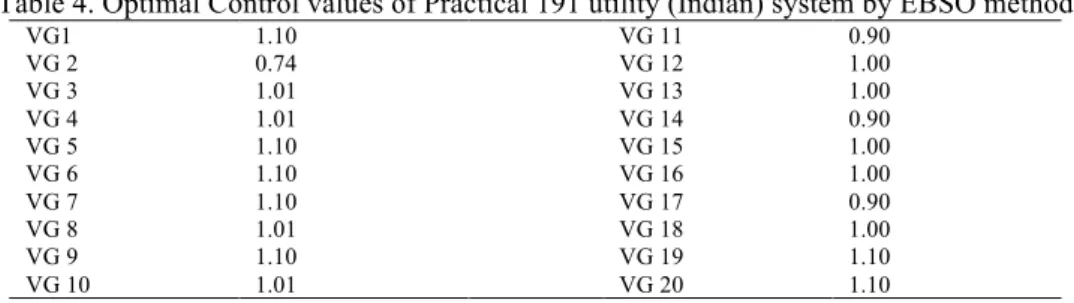
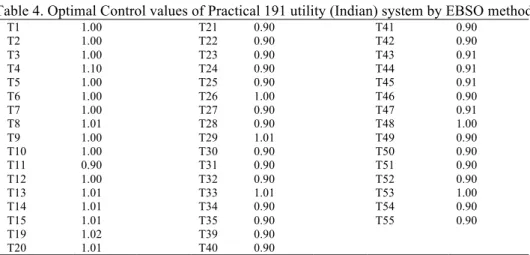
Then the Enriched Brain Storm Optimization (EBSO) algorithm has been tested in practical 191 test system and the following results have been obtained. In Practical 191 test bus system – Number of Generators = 20, Number of lines = 200, Number of buses = 191 Number of transmission lines = 55. Table 4 shows the optimal control values of practical 191 test system obtained by EBSO method. And Table 5 shows the results about the value of the real power loss by obtained by Enriched Brain Storm Optimization (EBSO) algorithm.
Table 4. Optimal Control values of Practical 191 utility (Indian) system by EBSO method
VG1 1.10 VG 11 0.90
VG 2 0.74 VG 12 1.00
VG 3 1.01 VG 13 1.00
VG 4 1.01 VG 14 0.90
VG 5 1.10 VG 15 1.00
VG 6 1.10 VG 16 1.00
VG 7 1.10 VG 17 0.90
VG 8 1.01 VG 18 1.00
VG 9 1.10 VG 19 1.10
Table 4. Optimal Control values of Practical 191 utility (Indian) system by EBSO method
T1 1.00 T21 0.90 T41 0.90
T2 1.00 T22 0.90 T42 0.90
T3 1.00 T23 0.90 T43 0.91
T4 1.10 T24 0.90 T44 0.91
T5 1.00 T25 0.90 T45 0.91
T6 1.00 T26 1.00 T46 0.90
T7 1.00 T27 0.90 T47 0.91
T8 1.01 T28 0.90 T48 1.00
T9 1.00 T29 1.01 T49 0.90
T10 1.00 T30 0.90 T50 0.90
T11 0.90 T31 0.90 T51 0.90
T12 1.00 T32 0.90 T52 0.90
T13 1.01 T33 1.01 T53 1.00
T14 1.01 T34 0.90 T54 0.90
T15 1.01 T35 0.90 T55 0.90
T19 1.02 T39 0.90
T20 1.01 T40 0.90
Table 5. Optimum real power loss values obtained for practical 191 utility (Indian) system by EBSO method
Real power Loss (MW) EBSO
Min 144.084
Max 147.012
Average 145.972
In this section, it is explained the results of research and at the same time is given the comprehensive discussion. Results can be presented in figures, graphs, tables and others that make the reader understand easily [2, 5]. The discussion can be made in several sub-chapters.
6. CONCLUSION
In this paper Enriched Brain Storm Optimization (EBSO) algorithm is used to solve the reactive power problem by including various generator constraints. In the projected Enriched Brain Storm Optimization (EBSO) algorithm, the vibrant clustering strategy is used to perk up the k-means clustering process. Efficiency of the proposed Enriched Brain Storm Optimization (EBSO) algorithm has been demonstrated on standard IEEE 118 & practical 191 bus test systems. Simulation results shows that Real power loss has been significantly reduced and voltage profile index within the particular limits.
REFERENCES
[1] O.Alsac,and B. Scott, “Optimal load flow with steady state security”, IEEE Transaction. PAS, pp. 745-751. 1973. [2] Lee K Y ,Paru Y M , Oritz J L –A united approach to optimal real and reactive power dispatch, IEEE Transactions
on power Apparatus and systems: PAS-104 : 1147-1153, 1985.
[3] A.Monticelli , M .V.F Pereira ,and S. Granville, “Security constrained optimal power flow with post contingency corrective rescheduling” , IEEE Transactions on Power Systems :PWRS-2, No. 1, pp.175-182, 1987.
[4] Deeb N ,Shahidehpur S.M ,Linear reactive power optimization in a large power network using the decomposition approach. IEEE Transactions on power system: 5(2) : 428-435, 1990.
[5] E. Hobson, “Network consrained reactive power control using linear programming”, IEEE Transactions on power systems PAS -99 (4) ,pp 868-877, 1980.
[6] K.Y Lee ,Y.M Park , and J.L Oritz, “Fuel –cost optimization for both real and reactive power dispatches”, IEE Proc; 131C,(3), pp.85-93.
[7] M.K. Mangoli, and K.Y. Lee, “Optimal real and reactive power control using linear programming”, Electr.Power Syst.Res, Vol.26, pp.1-10, 1993.
[8] K.Anburaja, “Optimal power flow using refined genetic algorithm”, Electr.Power Compon.Syst, Vol. 30, 1055-1063, 2002.
[9] D. Devaraj, and B. Yeganarayana, “Genetic algorithm based optimal power flow for security enhancement”, IEE proc-Generation.Transmission and. Distribution; 152, 6 November 2005.
[10] Yuhui Shi Xi’an Jiaotong, Brain Storm Optimization Algorithm, Y. Tan et al. (Eds.): ICSI 2011, Part I, LNCS 6728, pp. 303–309, 2011.
[11] Smith, R.: The 7 Levels of Change, 2nd edn. Tapeslry Press (2002).
[12] IEEE, “The IEEE 30-bus test system and the IEEE 118-test system”, http://www.ee.washington.edu/trsearch/pstca/. 1993.
[13] Jiangtao Cao, Fuli Wang and Ping Li, “An Improved Biogeography-based Optimization Algorithm for Optimal Reactive Power Flow”, International Journal of Control and Automation Vol.7, No.3 , pp.161-176. 2014.