A Case Study of the Development of Trust in a Business
Relation: Implications for a Dynamic Theory of Trust
Yimin Huang · Ian F. Wilkinson
Abstract: We examine and conceptualize the dynamics of trust in business relationships, including its dimensions, processes and determinants, based on an in-depth case history of a 10-year sponsorship relationship between Chinese and Western firms. A contribution of this research is the distinction between trusting attitudes and trusting actions that underlie the dynamics of trust. An analytical framework is developed to show how these two dimensions evolve through distinct but connected processes that are embedded in relationship evolution and affected by different contextual factors.
Keywords: Business relations and networks · Trust dynamics and evolution · China · Sponsorship relations
Published online: 31.03.2014 --- © jbm 2014
--- Y. Huang (C)
Department of Marketing and Management, Macquarie University, North Ryde, Australia e-mail: [email protected]
I. Wilkinson
University of Sydney, Sydney, Australia e-mail: [email protected]
Introduction
Virtually every commercial transaction includes an element of trust and, in particular, trust plays a central role in the formation, development and maintenance of business relationships. Trust involves a willingness to rely on the behaviour of others. It reduces the degree of uncertainty regarding the outcomes of actions and the potential for opportunistic behaviour. It has been defined as a belief, sentiment, or an expectation about an exchange partner that results from the partner's expertise, reliability, and intentionality (Moorman, Zaltman et al. 1992). Trust arises from a variety of sources and these have been used to classify types of trust, including contractual based trust, competence based trust, rational trust and benevolence based trust. Here we distinguish between two basic sources of trust that have been identified – cognitive and affective bases. Cognitive trust stems from a reliance on a partner firm’s expertise and its ability to perform and fulfill relationship obligations (Dwyer, Schurr et al. 1987; Anderson and Weitz 1989). Affective trust relies on the goodwill or benevolence intentions of another (Anderson and Narus 1990; Andaleeb, Lee et al. 1992).
Another dimension of trust that is given less attention in the literature is trusting actions, which does not focus on the sources of trust but the way it is used, i.e., the actions that flow from cognitive and affective trust (Lewis and Weigert 1985; Moorman, Deshpande et al. 1993; Huemer 2004). Five major types of trusting actions have been suggested by Smith and Barclay (1997), namely, relationship investment, influence acceptance, communication openness, control reduction and forbearance from opportunism.
It is not our purpose here to review the extensive literature on trust. Instead we want to examine the way different types of trust form and develop over time in business relations. For convenience we will refer to trust between firms but we recognize that ultimately trust resides in the perceptions and actions of management in a firm (Zaheer, McEvily et al. 1998). Interfirm trust reflects the collective orientation of top management towards another firm. Here, we draw from both the literature on interpersonal trust and inter-organizational trust.
There is no shortage of research in trust. Its sources and role have been examined (e.g., Child 1998; Chowdhury 2005; Young 2006), typologies have been proposed and measured (e.g., Young 1993; Doney and Cannon 1997) and precursors and outcomes have been subject to theory and empirical analysis (e.g., Morgan and Hunt 1994; Smith and Barclay 1997). These studies have made a significant contribution to our understanding of trust in business relationships.
Existing research has not yielded a coherent, consistent and integrated theory of trust (Lewicki and Bunker 1995; Geyskens, Steenkamp et al. 1998), especially regarding the causes and consequences of trust. Take commitment as an example. Some researchers argue that commitment helps to breed trust in business relationships (Miyamoto and Rexha 2004; Gao, Sirgy et al. 2005), while others contend that the existence of trust leads to higher levels of commitment (e.g., Kwon and Suh 2004; Gounaris 2005). In another example, Rodriguez and Wilson (1995)
reported that affect-based trust did not affect performance-based trust, but Johnson and Grayson (2005) found empirical evidence supporting a significant and positive association between performance-based trust and affect-based trust.
Such diverging views and results in part reflect the dynamic nature of relations and trust and the effects of feedback processes over time. For example, the trust and commitment that exists at one point in time affects the trusting behaviour of firms, which results in particular experiences and outcomes. These in turn affect the perceptions of the other firm, including the nature and degree of trust and commitment. Depending on where you enter this feedback cycle, commitment can be viewed as a source of trust and trusting actions or as an outcome. Trust is a dynamic context-based phenomenon built on both direct and indirect experiences (Arnott 2007), whose nature and extent are continually being shaped and restructured by the actions and interactions taking place within and between firms and the interpretations of the parties involved. This is a continuous development process with feedback effects in which trust affects and is affected by various factors at different times in relationships.
Despite the inherently dynamic nature of trust and business relations, the majority of research has been static, cross-sectional, survey based studies designed to develop and test variable-based correlational models in which time and process are absent. Limited attention has been given to the evolving nature of trust. Feedback effects and two-way interactions among trust and other dimensions of business relationships are largely ignored. Thus, despite the proliferation of literature in trust, its dynamics remains under-theorized, under-researched and, not well understood (Child 2001).
Some research on the dynamics of trust has been done (e.g., Moorman, Zaltman et al. 1992; Huemer 1994; Jones and George 1998; Wicks, Berman et al. 1999; Behnia 2008; Huang and Wilkinson 2013). Case studies of the development of business relations over time suggest some of the ways trust can change over time. Stage models of the development of business relations suggest the changing degree and nature of trust at different stages (Ford 1980; Dwyer, Schurr et al. 1987). For example, Wilson (1995) contends that trust could be active at early stages of business relationships when partners are being selected and relationship purposes are being defined, but trust could become latent later in the relationship during the process of setting relationship boundaries, creating relationship value and maintaining relationships. Doney and Cannon (1998) identify five distinct processes by which trust can develop in a business relationship. Adobor (2005) studies the dynamics of trust by examining the non-linear relationship between expectations and trust, while Behnia (2008) discusses trust development as the outcome of a complex process involving the interpretation of the situation in which the partners find themselves.
These studies have shed light on how trust is built, mobilized and redeveloped. But research has not resulted in a comprehensive model of the dynamics of trust, the way trust develops over time in relations and the factors affecting it at different stages of development. Therefore, a more systematic and integrative investigation of the
connections and distinction among the three dimensions of trust and the factors affecting these is needed to provide a holistic picture of the evolution of trust.
In this paper we develop a process model of the dynamics and development of trust based on the results of a systematic case history of the development of trust in a particular business relation. Our research is among the first efforts to formally conceptualize the dynamics of trust in business relationships using empirical data. Its research and management implications are discussed in the conclusion.
Research Method
The case study concerns a 10-year business relationship (1997 to 2006) between Xtar Sports Management Corp. (hereafter Xtar Sports), a state-owned firm in Shanghai, China, and HBB Beverage Corp. (China) (hereafter HBB China), the subsidiary to a European firm. Xtar Sports is a subsidiary of Shanghai Eagle Group (hereafter Eagle Group), one of the largest state-owned transportation companies in China. Xtar Sports was established in 1997 to operate and manage a major tennis event in Shanghai that was acquired by the Eagle Group. It was in the same year that HBB China became the title sponsor to the event and the first client to Xtar Sports.
We use an event-based narrative analysis (Abell 1987; Abbott 2001) of the case to develop explanations of changes in trust in terms of the nature, structure and sequences of events constituting the history. An event is the smallest meaningful unit in which changes can be detected (Poole, Van de Ven et al. 2000). Through events, the various forces that influence development and change come into play (Poole, Van de Ven et al. 2000). Event-based narrative analysis addresses the complexity of events by incorporating different types of effects, including contextual influences, feedback effects, critical events as well as tipping points. Such an approach makes it possible to go beyond a surface description to the logic behind observed temporal progressions, hence, providing a richer and more realistic understanding of actual processes.
Data collection
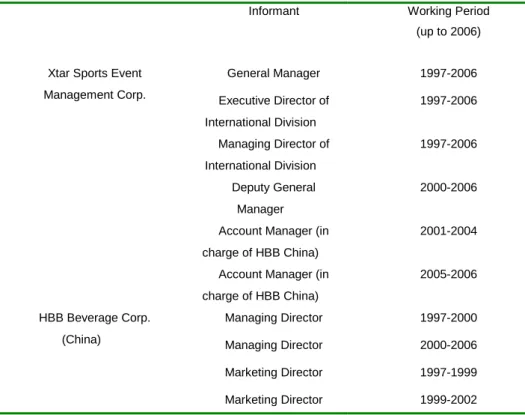
A retrospective research design has been advocated for studying relationship processes and evolution as it allows researchers to detect substantial changes along with the evolution and the emergence of clear temporal patterns (Ford and Redwood 2005; Provan, Fish et al. 2007). However, there have been concerns about the inaccuracy and potential biases resulting from managers’ lack of information and the cognitive limitations of people as information processors (Ericsson and Simon 1980; Nisbett and Ross 1980). To minimize these problems, we have followed the guidelines by Huber and Power (1985) in the process of data collection. Firstly, a snowball sampling strategy was used to identify and recruit appropriate informants from both organizations. This resulted in six senior managers from Xtar Sports and four from HBB China being interviewed (see Table 1 for the profiles of these interviewees). Furthermore, the narrative data was supplemented and triangulated with historical
documents, including company reports, internal newsletters, meeting minutes and media clippings. The tactic of recruiting multiple key informants through snowball strategies and integrating narrative data with archival data helped to control for hindsight bias (Fischhoff 1982) and attributional bias (Nisbett and Ross 1980), hence, producing more comprehensive and reliable data.
The key informants interviewed held senior positions in their organizations, ranging from Account Manager to Marketing Director and General Manager. They were the chief representatives of their firms in managing the relationship during the 10-year period and therefore had first-hand knowledge of what happened and more importantly, why it had happened. The selection of strategic-level managers as key informants helped to minimize the bias arising from informants’ lack of knowledge of specific facts (Huber and Power 1985). Thirdly, as unstructured questions are more likely to be misinterpreted (Huber and Power 1985), at least two rounds of semi-structured interviews were conducted in this research. The exploratory interviews in the first round were used to develop an overview of the way the relationship developed, while follow-up interviews included more in-depth questions to probe issues related to changes in trust as the relationship developed. Informants were encouraged and given time in interviews to allow for the emergence of additional relevant issues. Furthermore, being aware of the impact of framing on informants’ responses (Tversky and Kahneman 1971), and following suggestions in the literature (Cummings and Bromiley 1996; Blois 1999), careful attention was made not to lead informants by asking direct questions using the word “trust”. All interviews lasted between 90 minutes to two hours, and were taped and transcribed verbatim.
Tab. 1: Profiles of respondents interviewed for the case study of XtarSports-HBB relationship
Informant Working Period (up to 2006)
Xtar Sports Event Management Corp.
General Manager 1997-2006
Executive Director of International Division
1997-2006
Managing Director of International Division
1997-2006
Deputy General Manager
2000-2006
Account Manager (in charge of HBB China)
2001-2004
Account Manager (in charge of HBB China)
2005-2006
HBB Beverage Corp. (China)
Managing Director 1997-2000
Managing Director 2000-2006
Marketing Director 1997-1999
Data analysis
The primary unit of analysis in this research is an event. Events consist of individual or collective actors taking actions or responding to the actions of others in a certain context (Easton 1995). The role of context was examined at three levels in this study. First is the external environment which includes the social, competitive and industrial environments in which the focal firms operated. Second is the internal environment of the firms involved, including their history and the structural, cultural and strategic conditions. Third is the relational environment, where interactions between partner firms take place, including the power structure, commitment and existence of personal relationships.
To begin with, the main events taking place in the 10-year business relationship were identified, listed and chronologically ordered. A visual mapping strategy (Miles and Huberman 1994) was used to integrate the sequence of these events and their connections into a temporal map.
The second step was to conduct in-depth event-based narrative analysis to construct the causal sequence of events for each phase of the relation. Particular attention was given to significant events (Ford and Hakansson 2006; Schurr, Hedaa et al. 2008), i.e., extreme, critical and deviant events directly or indirectly affecting cognitive, affective and behavioural trust in the relationship. These critical events were coded based on whether they were related to changes in contexts or the perceptions and actions of firms.
ETHNO, a computer software programme for event-structure analysis (Heise 1992), was used to guide the interpretation of events and their connections. ETHNO forces the researcher to transform a chronology of events into a series of yes/no questions where the researcher is asked to decide if a temporal antecedent is required for the incidence of a subsequent event. The diagram generated in ETHNO was compared to the map manually developed in the early analysis to evaluate the logical interpretations of the temporal and structural connections among events. Whenever logical disagreement was detected, the data were revisited. Informants were involved in this process to provide more information and to confirm the appropriate understanding of events. An iterative process was followed until agreement and a degree of saturation were achieved (Glaser and Strauss 1967).
Findings
Case summary
The relationship between Xtar Sports and HBB China was forged in 1997, when HBB China became the title sponsor of an ATP event managed by Xtar Sports. At the
time, Xtar Sports was just established and new to the industry of event management, while HBB China had extensive experience in sports sponsorship. The two companies worked closely on the ATP event in the first few years of the relationship and HBB China helped its partner generously with event marketing and management. This was an important experience for Xtar Sports, which enhanced its competence and professionalism. As a result, Xtar Sports became more ambitious, seeking opportunities to cooperate with HBB China on more projects. In 2002, HBB China decided to include additional events in their brand promotion and discussed this with Xtar Sports.. This resulted in the two firms cooperating on new projects, including music events and HBB China’s annual convention for major distributors. This expansion of cooperation ended when organizational and personnel restructuring took place in 2004 and the changes in the internal power structure of Xtar Sports took place after a few personnel changes. These changes in internal environments led to a downgrading of the scope and scale of cooperation between the firms such that they only worked together on the tennis event from then on.
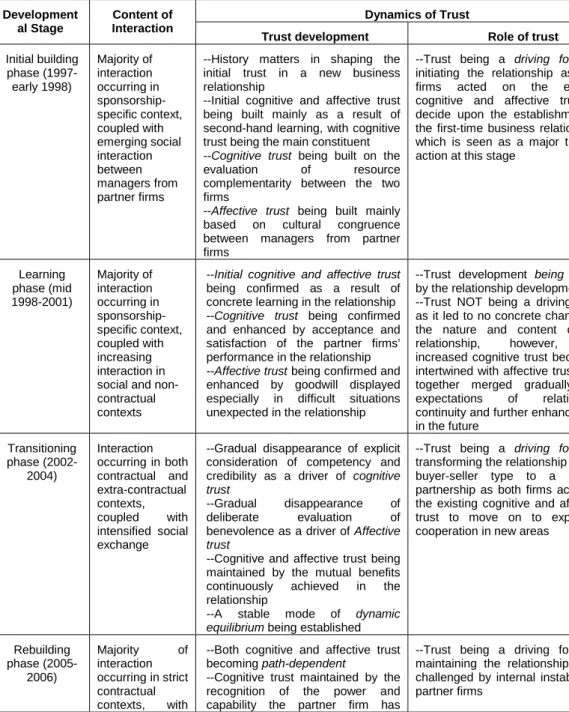
Based on the pattern of changes taking place, four developmental phases were identified: the initial building phase (1997-early 1998), the learning phase (mid 1998-2001), the transitioning phase (2002-2004) and the rebuilding phase (2005-2006). Each phase is characterized by a different relationship context that drives and is driven by changes in trust. In the following we describe and analyze the major events taking place in each phase and their impact on trust. The summary of major findings is presented in Table 2.
Initial building phase (1997-early 1998)
Relationship development
In 1997, Eagle Group, a state-owned public transportation company based in Shanghai, purchased an ATP franchise and established Xtar Sports as its subsidiary to manage the tennis event. Xtar Sports started as a small company with only 6 employees, including two experienced event managers from America, Mark and Cleve, as directors for event management. The first challenge for Xtar Sports was to sell the sponsorship of the event. They approached a number of potential clients, one of which was HBB China. Since establishing its business in China in the mid 1990s, HBB China had been seeking more marketing opportunities to strengthen its brand image and improve sales.. In particular, Shanghai was targeted as a key market for further penetration.
Negotiations between Xtar Sports and HBB China started in late 1997 and lasted for five months, which was an important learning experience for both parties. Business meetings and negotiations took place as well social interactions among senior managers, which helped them to get to know their counterparts better, both professionally and personally. The deal was closed in early 1998, with a 1+2 year
contract, which meant that HBB China had the right to terminate it in the end of the first year if it was not satisfied.
Dynamics of trust
The initial phase was an environment filled with unpredictability and risk for both parties. Though the ATP event was a unique business opportunity for investment, the tennis market in Shanghai in late 1990s was very underdeveloped with few people interested in the sport. HBB China had little experience of cooperating with Chinese companies, while Xtar Sports had limited knowledge and expertise in event management.
In these conditions both firms were strategic in selecting partners and trust was sought to reduce perceived risk. The fact that Xtar Sports was a newly-established company with no experience in the industry led to it seeking complimentary resources and a partner they could learn from. To do this Xtar Sports relied more on a competence and resource-based cognitive trust in HBB China. They recognised that HBB China’s corporate brand image was compatible with tennis and that they had substantial financial capabilities and rich experience of sports sponsorship.
On the other hand, HBB China’s initial trust in Xtar Sports was more complicated with both calculative and affective dimensions. Cognitive trust was grounded in the government relationship Xtar Sports had through its parent company, which was considered to be a critical resource for the successful operation of the tennis event. Secondly, the tennis event was the only ATP event in China in those years, presenting HBB with an exclusive marketing opportunity to improve its brand awareness and market performance in China. In this sense, HBB China needed the tennis event more than Xtar Sports. This is in line with the literature that some specific feature in the environment is what makes a certain partner firm so critical and trustworthy (Hakansson and Sharma 1996).
HBB China’s cognitive trust in Xtar Sports was complemented by the affective emotion of liking the counterparts in the partner firm, especially the two experienced American senior managers recruited by Xtar Sports. The cultural congruency between the Americans and Europeans, as seen in their mutual appreciation of straightforward communication, love of social life and a similar sense of humor, helped build affective trust (McAllister 1995). This in turn enhanced by HBB China’s confidence in having an effective and successful relationship with a Chinese company.
One major trusting action observed at this stage is relationship investment, i.e., the agreement to initiate a formal business relationship. This decision was based on the existing cognitive and affective trust, but was ultimately driven by both firms’ corporate strategies.. HBB China was looking for marketing opportunities for its branding when the chance of sponsoring the tennis event was presented to it. The following quote shows how the partner firms’ investment in the relation (trusting act) reflect their strategies and goals as well as the nature and degree of trust towards each other.
“Xtar Sports was the owner of the HBB Open. So when you look at your marketing plan, (you should ask if) you want to be linked to tennis or not…If the answer is yes, then you go and talk with some partners.”
Former Managing Director, HBB China
In summary, cognitive trust was the main type of trust initially developed between Xtar Sports and HBB China. It emerged from understanding the prior history of the partner firm and its resources, including reputation and networks. Both firms were goal-oriented in deciding whether the partner was trustworthy or not, but the nature of the initial trust and the influencing factors are different for each firm. This illustrates how history matters in shaping the initial conditions of trust in a business relationship. At this stage, trust was a major driving force in relationship development, with both firms acted on cognitive and affective trust to anticipate the otherfirm’s behaviour and so reduce potential risk.
Learning phase (mid 1998-2001)
Relationship development
With the 1+2 contract, the first year of cooperation was a potentially fragile stage in the relationship as HBB China could terminate the relationship relatively easily. Both firms were committed to the cooperation and worked closely to make the tennis event succeed. The first HBB Open was successfully staged, and HBB China renewed the sponsorship contract for another two years. This was an important event, which boosted the confidence of Xtar Sports in the relationship and led it to adjust its relational goals with a focus on developing a long-term relationship with HBB China and growing its own business by extending the scope of the event.
These revised goals led to more interactions taking place. In particular, communications were more open and thorough. For example, Xtar Sports took the initiative to discuss with HBB China its own corporate strategy and business development plan so as to steer the relationship towards a more sophisticated partnership. Personal relationships developed rapidly as well. A delegation of senior managers from Xtar Sports and Eagle Group was invited by HBB to its global headquarters in Europe in 1999, where they were introduced to senior management. These informal interactions helped to breed familiarity between the managers further developed their emotional ties to the relationship.
“What really happened between year 2 and year 3 is that we became very close friends, personally…I think if we learned anything, it certainly was that we always want to do better for these guys (from HBB).”
Executive Director of International Division, Xtar Sports
Another noticeable change at this stage was the emergence of interactions in extra-contractual contexts as evidenced in a few critical events. For example, in 2000,
HBB China offered additional financial support to enable Xtar Sports to do extra marketing for the event. In the same year HBB China agreed to be a sponsor to the first women’s tennis event staged in Shanghai, when Xtar Sports failed to sell the sponsorship deal to other companies. This happened despite the fact that women were not an appropriate target market for HBB product. Another key event occurred in2001, when HBB China was in trouble with its sales in China. To help, Xtar Sports persuaded its parent company to purchase HBB products as the Chinese New Year’s gift for its thousands of employees.
These events are important signals that the relationship had gradually evolved to be a mutually cooperative one, where both firms were able to make contributions to the benefits of each other. They marked the initial transition in the nature of the relationship from a simple buyer-seller relationship to a more sophisticated partnership in which firms go beyond their contractual obligations. The relationship was strengthened when both partners were able to offer support when needed.
Dynamics of trust
Trust without experience during the initial phase is more like an optimistic hope and hence is fragile (McKnight, Cummings, & Chervany, 1998). As the relationship moved beyond the initial stage, the intensified interactions provided a fruitful environment for trust to be further developed and transformed.
In general, both cognitive and affective trust was enhanced and strengthened in this phase. Cognitive trust was driven by the confirmation of and satisfaction with the partner’s competency and professionalism, as displayed in the daily cooperation. Affective trust grew based on the goodwill evidenced in the two key events described above, among others. For instance, goodwill was felt in because HBB China’s did not take unfair advantage of Xtar Sports’ vulnerable position due to the 1+2 contract. Instead, HBB China offered Xtar Sports constructive feedback and helped it with the event marketing. This was consistent to what HBB China promised during negotiations, which resulted in confirmation of the initial affective trust (McGregor 1967; Ouchi 1981). Further, the partner firms’ collaboration in extra-contractual contexts during difficult times, such as HBB China supporting Xtar Sports with the women’s tennis event and Xtar Sports helping HBB China with its declining sales, significantly enhanced affective trust. The crises provided a chance to demonstrate goodwill that may be otherwise hard to. This is in line with other research, which argues that the recognition of a partner firm’s benevolence is seen more easily through its behaviour in exceptional and
infrequently occurring circumstances (Mishra 1996; Narayandas and Rangan 2004). Another interesting finding in this phase relates to trusting actions. The main trusting action observed at this stage was communication openness driven by Xtar Sports, because the sponsorship contract was renewed. Xtar Sports shared with HBB China its operational and strategic ideas, including sensitive information such as its business development plan. This sharing behaviour signals Xtar Sports’ trust in HBB China as a reliable business partner. However, it is also an action consistent with the
revised relational objectives of Xtar Sports as well as its more general organizational goals. When the relationship was secured with a renewed contract, Xtar Sports became committed to developing a more substantial long-term relationship with HBB China, where they could work on more projects. Further, after years of experience and learning, Xtar Sports had developed into a capable event management firm with growing business ambitions. Given this, Xtar Sports became open in its communications with HBB China so as to get the partner firm more engaged in the relationship and to encourage collaboration on more projects.
The efforts of Xtar Sports to extend the scope of cooperation were not initially reciprocated by HBB China. There was no reciprocal open communication or other types of trusting actions such further relationship investment. This was not because of a lack of trust in Xtar Sports but largely due internal organizational factors. Firstly, unlike Xtar Sports, the relational goals of HBB China remained the same as the relationship moved on, which was to maximize the benefits of the event sponsorship for its branding and marketing purposes. This indicates a lack of motivation for HBB China to do more in the relationship. Secondly, as put by a former Marketing Director of HBB China, “I don’t think we had the money for that (doing more events). There were two big events every year. And that’s what we could do maximum.” HBB China lacked sufficient resources at that time to support any expansion of the cooperation.
These findings regarding trusting actions are consistent with those in the initial phase. Trusting actions are contingent, driven by environmental factors internal and external to the organization. In the learning phase, enhanced cognitive and affective trust increased the partner firms’ desire for a long-term relationship and changed their perception of the relationship to be more than simply a sponsorship program. But, due to the constraints of resources and environmental factors, cognitive and affective changes did not lead to concrete actions that transcended the nature of the relationship. The majority of activities and interactions still focused on the tennis event. In that sense, it is appropriate to conclude that trust did not play as constructive a role as it did in the initial building phase. Yet, the development and intertwining of cognitive and affective trust observed in this phase enabled both firms to take further initiatives in promoting the relationship in the future (Huemer 2004).
Transitioning phase (2002-2004)
Relationship development
The understanding and bonding between Xtar Sports and HBB China cultivated over the previous years of cooperation began to work in this phase to further develop the relationship. Xtar Sports continued its efforts to improve the tennis event by organizing more sub-events to cater to the marketing needs of HBB China. From time to time it would ask for a favour from HBB China to supply beverages for those events. Meanwhile, Xtar Sports would deliver extra benefits to its partner whenever possible. Out of these interactions grew a deeper and tighter connection between the firms. The
relationship became institutionalized in that routines and sentiments were developed that gave the partner firms a feeling of belonging together. As a result, the relationship acquired its own legitimacy and value, a resource with its own momentum (Hakansson and Sharma 1996).
A major change in this phase was the expansion of cooperation. In addition to working closely on the tennis event, Xtar Sports and HBB China started to cooperate on more events, such as music concerts and hospitality events. A higher level of interdependence resulted from these diversified contexts of business interactions. In addition, social exchanges continued to be intensified, with more senior managers getting involved in working together and developing personal relationships. As a result, it became difficult to disentangle the economic ties that reflect transactional efficiency from those that reflect emotional ties embedded in the same social networks (Cunningham and Turnbull 1983; Easton and Araujo 1994). This is described by the Executive Director of International Division in Xtar Sports, “we might be having a beer somewhere and it will be the marketing director (of HBB China) who would say ‘you know what, what do you think of this business proposal?’ The relationship certainly exists in that type of friendship. It’s always there.”
Naturally and smoothly, the relationship between Xtar Sports and HBB China transformed into a strategic partnership. But a tipping point in the relationship occurred when the HBB Open was replaced by a higher-level premium ATP event in Shanghai operated by Xtar Sports. Also Xtar Sports decided to rent out the ATP franchise (the former HBB Open) to an external agency after it won the hosting rights for the premium event for three years. This meant the termination of the HBB Open in Shanghai. HBB China was still the founding sponsor of the new ATP event but no longer the preeminent one. The expanded business network of Xtar Sports meant that HBB China was no longer the only priority for Xtar Sports. There was a shift to a more intentionally managed network of clients for Xtar Sports.
These events revealed Xtar Sports’ ambition to stage more prestigious events in order to expand its business. At the same time there were instabilities within HBB caused by an organizational restructuring. As a result, HBB China had not done much marketing since 2004 and relied more on the relationship with Xtar Sports to achieve its marketing goals. Even though Xtar Sports and HBB China knew each other well and kept treating each other favourably, they were gradually moving apart. These changes reflect how internal changes within partner firms impact on the development of the relationship. Partner firms could grow at different rates as a relationship develops, leading to changes in their business models and their perceptions and expectations of the relationship. This is not a Darwinian evolution but a quasi-Darwinian one (Eyuboglu and Buja 2007) in that the changes do not occur randomly but are also deliberately guided to the benefit of partner firms. As a result, the complementary objectives that bring the firms into the relationship at the beginning could vary and be replaced by other interests. Such changes may result in a partner firm’s efforts to identify new areas for cooperation and strategically expand the scope of the relationship; or an increasing mismatch between them that leads to the
downgrading of the relationship or even termination. The interactions between the processes of relationship development and the internal evolution of partner firms add to the complexity of the relationship, making its evolutionary path more unpredictable.
Dynamics of trust
This phase witnessed the building of broad trust (Zaheer, Lofstrom et al. 2002), i.e., trust developed between the partners was grounded on a more comprehensive basis. For example, unlike the early years in the relationship, when the trust of HBB China in Xtar Sports was driven dominantly by the partner firm’s exclusive resources of the ATP event, in this phase managers from HBB China had more to say about their partner. This included their capability to manage events in various fields and the reliability shown in extra-contractual domains and valuable business networks.
The level of trust between Xtar Sports and HBB China seem to reach its peak during this phase. Though both firms consistently displayed their professional expertise and benevolent commitment to the relationship, there was a gradual disappearance of the explicit consideration of credibility as a driver of cognitive trust (Young and Denize 1995) and the evaluation of goodwill as a driver of affective trust. No further changes in the nature and depth of trust were reported and observed in this phase. A stable equilibrium was established in the relationship with the patterns of actions and interactions reproducing and sustaining the firms’ perceptions and beliefs in each other. Each firm continued to bring opportunities to the other to achieve mutual benefits.
Such a dynamic equilibrium may be more or less stable in the sense of the extent to which is vulnerable to internal and external shocks. Events and problems that could have been damaging early on in a relationship are now less so because there is the weight of history to be contended with (Huang and Wilkinson 2013; Young 2006). For example, Xtar Sports did not doubt the goodwill of HBB China when it refused to sponsor the U.I.M Powerboat Grand Prix. The partner firms were more certain about their judgments of the other and how trustworthy they are. Hence, trust would not necessarily continue to increase in strength but instead is reaffirmed and becomes more certain. As the number of interactions increases, there is diminishing marginal impact of additional interactions and events on the nature and degree of trust between partner firms.
The transitioning phase is an exploration period in the history of the relationship. It involved experimentation with new alternatives with uncertain returns as each party learned to use the relationship as an additional resource that enabled them to do more, see more and think more (Wilkinson and Young 2005). Trusting actions took place and played a key role in driving relationship evolution. These include more open communication when HBB China began to share its strategic plans with Xtar Sports, as well as when both parties agreed to step into new areas for further collaboration. As cognitive and affective trust became a habitual and confident, the partner firms were less focused on calculative motivations on the capability and integrity of the other but,
instead, emphasized the desire to enhance the relationship (Selnes 1998). This helped to reduce perceived risk and stretched the partner firms’ acceptance of uncertainty when entering a brand new business. As described by the Managing Director of International Division in Xtar Sports, “If there were other projects that we could do together, we would do together, because there was enough trust there…We could just sit down at a meeting and say ‘ ok, this is the opportunity. What do you think?”
The drivers of trusting actions reveal again their contingent nature. HBB China was in a financial straightjacket in the learning phase, which restricted its readiness to respond to Xtar Sports’ call to work together on more events. Besides, the market performance of HBB China at that time was good enough to free them from investing more in marketing campaigns.. But the situation changed in this phase. The sales of HBB China declined dramatically and the Headquarters of HBB required its subsidiary in China to be more aggressive with marketing, increasing its marketing budget. This put HBB China in a position where it was much more motivated and ready to take trusting actions, such as sharing with Xtar Sports sensitive business information to seek more collaborative opportunities, and later, agreeing to work with Xtar Sports on more events in new areas. These key events revealed that the decision to take trusting actions is not determined solely by the status of cognitive and affective trust, but is affected also by various contextual factors, including corporate objectives and resource availability. As put by the former Managing Director of HBB China, “trust is always nice and helps you in certain times, but the underlying motto always is ‘does it make business sense for both parties?’”
Rebuilding phase (2005-2006)
Relationship development
This phase began with major organizational changes in HBB China. One major change was the takeover of the marketing and sales of HBB products in China by HBB Asia Pacific Ltd. (China) in 2006, followed by the arrival of a new marketing team to work with Xtar Sports on tennis sponsorship. This significant change broke the stability in the relationship environment. A new relationship environment was created, with weaker emotional bonds between managers and fewer interactions, the majority of which occurred in a narrow way as defined in the contract. The relationship was pulled back from a close partnership to a buyer-seller relation with its future uncertain. New rounds of learning and adaptation were triggered.
The long-term interdependence between the firms, especially the emotional ties Xtar Sports had towards HBB China, encouraged Xtar Sports to expect continuing exchange and future interactions. Driven by this, Xtar Sports took initiatives in communications, trying to learn and build rapport with the new HBB China team. However, the new HBB team was not responsive. The commitment of HBB China to the relationship disappeared after the assignment of the new team.
The relationship stepped further back when HBB China shifted its marketing focus and decided to decrease its investment in sponsorship of the tennis event in China. Though disappointed, Xtar Sports accepted it with understanding. It believed that opportunities still existed to deepen the cooperation with HBB China again, when it revived its market performance in China. As explained by a former Client Service Director in Xtar Sports, “We accepted their decision…We didn’t want to lose HBB China”. This reflected Xtar Sports’ perception of HBB China as a long-term partner and its objective to keep the relationship going by all means.
Dynamics of trust
The structural and personnel changes in HBB China disrupted the existing ties between Xtar Sports and HBB China, which resulted in a new environment where cognitive trust still existed and was the basis for trusting actions but affective trust had to be rebuilt. Despite the personnel changes in HBB China, the cognitive trust was well maintained between the partner firms, grounded in the confidence they had in the capability and credibility of each other, as demonstrated throughout the history of cooperation. “They (HBB China) know what they are doing. They have never let us down and we spent a lot of money with them and we have got fantastic results” (Executive Director of International Division in Xtar Sports). This indicates that the cognitive trust has been firmly attached to the organization and is less likely to be affected by personnel changes in the partner firm.
On the other hand, the extent of affective trust in the relation changed. Affective trust in HBB China was sustained based on Xtar Sports’ emotional attachment to HBB China as an organization. Being their first client that witnessed and helped with the growth of Xtar Sports, HBB China was considered as a “family member” (General Manager, Xtar Sports). As for the new marketing team in HBB China, their knowledge of the long history of cooperation with Xtar Sports and its reputation in the relationship helped in building their optimistic thinking about the partner. This became the initial condition for affective trust to be rebuilt without concrete experience of cooperation.
In this phase the trust Xtar Sports placed in HBB China was felt in the form of strong faith in them. Faith has been understood as an outcome of strong trust (McAllister 1995). In particular, Xtar Sports’ faith in its partner was seen in its high level of understanding and acceptance of HBB China’s changing performance in the relationship when personnel changes occurred. It also drove Xtar Sports’ desire to maintain the relationship by continuing its efforts to revitalize the cooperation, despite the reduced investment and commitment of HBB China to tennis sponsorship. In light of this, trust has been a key driving force in maintaining the relationship. This provides a counterargument to the view of Wilson (1995) that trust is latent in this stage of relationship maintenance. Our findings show that when conditions change dramatically, trust could become active in shaping responses, thus becoming a driving force in maintaining (or not) the relationship.
Xtar Sports’ continuing investment in the relationship with HBB China was also motivated by its calculative belief that HBB China would restore its market performance in China and become active again in sports sponsorship. The expectation of HBB China to return as a key client again in the future enhanced Xtar Sports’ motivation and justified its decision to act upon its existing trust in the relationship.
“It (HBB China decreasing its investment in sports sponsorship) certainly won’t change our relationship at all, because I think HBB China is certainly going to be profitable and aggressive in the marketplace to get the brand, where we can do other things with them, music or jazz, their choice.”
Executive Director, International Division, Xtar Sports
Tab. 2: Summary of Dynamics of Trust in Xtar-HBB Relationship
Development al Stage
Content of Interaction
Dynamics of Trust
Trust development Role of trust
Initial building phase (1997-early 1998) Majority of interaction occurring in sponsorship-specific context, coupled with emerging social interaction between managers from partner firms
--History matters in shaping the initial trust in a new business relationship
--Initial cognitive and affective trust being built mainly as a result of second-hand learning, with cognitive trust being the main constituent --Cognitive trust being built on the evaluation of resource complementarity between the two firms
--Affective trust being built mainly based on cultural congruence between managers from partner firms
--Trust being a driving force in initiating the relationship as both firms acted on the existing cognitive and affective trust to decide upon the establishment of the first-time business relationship, which is seen as a major trusting action at this stage
Learning phase (mid 1998-2001) Majority of interaction occurring in sponsorship-specific context, coupled with increasing interaction in social and non-contractual contexts
--Initial cognitive and affective trust being confirmed as a result of concrete learning in the relationship --Cognitive trust being confirmed and enhanced by acceptance and satisfaction of the partner firms’ performance in the relationship --Affective trust being confirmed and enhanced by goodwill displayed especially in difficult situations unexpected in the relationship
--Trust development being driven by the relationship development; --Trust NOT being a driving force as it led to no concrete changes in the nature and content of the relationship, however, the increased cognitive trust becoming intertwined with affective trust that together merged gradually into expectations of relationship continuity and further enhancement in the future
Transitioning phase
(2002-2004)
Interaction occurring in both contractual and extra-contractual contexts, coupled with intensified social exchange
--Gradual disappearance of explicit consideration of competency and credibility as a driver of cognitive trust
--Gradual disappearance of deliberate evaluation of benevolence as a driver of Affective trust
--Cognitive and affective trust being maintained by the mutual benefits continuously achieved in the relationship
--A stable mode of dynamic equilibrium being established
--Trust being a driving force in transforming the relationship from a buyer-seller type to a mutual partnership as both firms acted on the existing cognitive and affective trust to move on to expanded cooperation in new areas
Rebuilding phase
(2005-2006)
Majority of interaction
occurring in strict contractual
contexts, with
--Both cognitive and affective trust becoming path-dependent
--Cognitive trust maintained by the recognition of the power and capability the partner firm has
--Trust being a driving force in maintaining the relationship when challenged by internal instability in partner firms
minimal social exchange
displayed in the history of cooperation
--Affective trust either maintained by emotions towards the partner firm or rebuilt as an optimistic thinking with a lack of concrete experience of cooperation
Discussion
Based on the narrative event based analysis of the history of the focal relation, we propose a general process model of the dynamics of trust, as summarised in Figure 1. The model illustrates the co-existence of the two key components of trust dynamics, i.e., trusting attitudes (cognitive and affective trust) and trusting actions, the behavioural outcomes of trust. These two components involve distinct but connected processes embedded in relationship evolution. The model integrates contexts, processes and outcomes to provide a basis for the interaction between the dynamics of trust and relationship evolution that goes on continuously. Further, the model presents a nested system of interconnected cycles of acting, interacting, learning and adapting taking place in and between firms and their environments. Each is subject to its own rhythms and processes, out of which emerges revised trusting attitudes and trusting actions.
The dynamics of trust unfolds through the evolution of trusting attitudes, which can be a mix of cognitive and/or affective types at different phases of a relationship. The strength of each type may increase or decrease or be stabilized over time as the relationship develops. The overall condition of trust as a belief/attitude is constantly being tested, changing or not as a psychological response to the experience and outcomes of the actions and interactions occurring in the business relationship. Trusting attitudes are not forced but develop naturally out of the social and business interactions. They are affected by the experience and outcomes of actions and interactions taking place, such as a gain/loss of resources and changes in beliefs. As cognitive trust and affective trust evolve, they are affected by different factors. History matters (North 1990) particularly in creating the initial conditions for trusting attitudes. The shadow of the past is reflected in the existing resources of firms and their perceptions of each other regarding capability, benevolence and integrity, based on their track record in the industry. As a relationship continues, on-going events in have a greater effect on the development of both cognitive and affective trust. Partner firms learn about each other through ongoing actions and interactions, and adapt their beliefs about and attitudes to each other, including trust.
The case indicates that the cognitive and affective dimensions of trust are affected by different sets of factors in different phases of a relation. Take cognitive trust as an example. The initial building of cognitive trust is largely based on the calculative evaluation of the resources and skills of the partner firm, as well as their resource complementarity. As a relationship continues, the initial cognitive trust built without experiences needs to be confirmed by the partner firm’s actual performance in fulfilling its relational tasks. When the relationship moves on with more intensified interaction and higher degrees of familiarity between people in the partner firms, cognitive trust is more likely to be affected by satisfaction with the partner firms’ performance in both contractual and extra-contractual contexts. Cognitive trust reaches a point of dynamic equilibrium when it is maintained by partner firms’ performance consistency and continuous achievement of mutual benefits in the relationship. A different set of factors explains the changes in affective trust in different phases of the relation. A summary is presented in Table 3.
Tab.3: Evolution of Cognitive and Affective Trust in Business Relationships
Phase of Trust Evolution Relationship Development
Conditions
Major Influencing Factors
Cognitive Trust Affective Trust
Initial building phase Relationship being first built with no concrete
experience of cooperation between partner firms and little interaction occurring during initial communication and negotiation
Being built as wishful thinking based on the calculative evaluation of resource complementarity of the partner firm, according to the information acquired from second-hand learning
Being built as wishful thinking based on the
1) evaluation of the collaborative history of the partner firm, according to the information acquired from second-hand learning
2) cultural congruence felt in the initial interaction, such as meetings and negotiation Confirming/disconfirming phase Relationship being unfolded with increasing interactions mainly in business settings
Being
confirmed/disconfirmed by the acceptance (or not) of the partner firm’s performance in the relationship
Being confirmed/disconfirmed
by the consistency/inconsistency
between words and behaviours by the partner firm
Developing phase Relationship being developed with intensified interactions, possibly in both contractual and extra-contractual contexts, and in both business and social settings
Being developed by the satisfaction of the partner firm’s performance in both contractual and extra-contractual contexts
Being developed by the goodwill displayed especially in difficult situations unexpected in the relationship
Stabilising phase Relationship being matured with high level of familiarity between partner firms
Explicit consideration of competency and credibility disappearing but cognitive trust being stabilized by the continuous and consistent achievement of mutual benefits in the relationship
Deliberate evaluation of benevolence disappearing but affective trust being stabilized by the continuous and consistent achievement of mutual benefits in the relationship
Sustaining phase Relationship interrupted due to environmental factors, such as organizational and personnel changes in partner firms
Being sustained by the recognition of the power and capability the partner firm has displayed in the history of cooperation
Being sustained by the emotions built towards the partner firm throughout the history of cooperation; OR being rebuilt as a wishful thinking with a lack of concrete experience of cooperation, as in the initial building phase
Unlike trusting attitudes, which are psychological responses developing in a non-conscious and automatic way, trusting actions are a firm’ strategic responses to a given environment. These reflect decisions to rely on trust to deal with perceived risks. The existence of cognitive and affective trust is an essential prerequisite for the occurrence of trusting actions, yet not a guarantee. As observed by Lewis and Weigert (1985), one may trust cognitively without necessarily trusting behaviourally, and when one does trust behaviourally, one may trust only in some contexts but not others. This observation is echoed in the major findings in this study.
The case suggests a contingency model to explain trusting actions. The behavioural intention, which predicts the actual behaviours, is determined by the actor’s subjective perception and interpretation of the environment,and its attitude
towards the behaviour (Fishbein and Ajzen 1975). In the context of business relationships, a firm’s intention to take trusting actions is determined by its perceived importance of trusting and its behavioural readiness to act trustingly.
A firm’s perceived importance of acting on existing trusting attitudes reflects its perception and understanding of the environment in which it exists and cooperates with others (Jones and George 1998). This leads to various needs and motivations to rely on trust in order to proceed with cooperation. For example, trusting actions are always tied to a firm’s self-interest in the relationship (Behnia 2008). A particular environment presents those involved with incentives or pressures to act trustingly in relationships. The existence of uncertainty and unpredictability in a business relationship makes cooperating firms sensitive to their beliefs in the partner firm (Wilson 1988), thus, affecting their disposition to act on existing trusting attitudes. On the other hand, firms familiar with each other and cooperating in a stable market environment may see fewer risks and more predictability in the behaviour of the other (Mayer, Davis et al. 1995). Therefore, the perceived importance of trusting is low although trusting actions could be triggered by other factors, such as strategic needs, which is an example of firms’ behavioural readiness for trusting actions.
A firm’s behavioural readiness indicates the firm’s attitude towards acting trustingly, based on its evaluation of potential consequences of such an act. It is related to the compatibility between possible outcomes of trusting actions and the desired ones according to corporate needs. It can also be linked to the firm’s feasibility analysis, such as an examination of the availability of resources. A firm without sufficient support and capability is not likely to take trusting actions as desired by its partner, as seen in HBB China’s reluctance to proceed with Xtar Sports’ proposals due to its restricted marketing budgets. This point is endorsed by the concept of self-efficacy beliefs in social cognition theory, which argues that beliefs in one’s capability to execute actions required to produce given attainment, affect the actors’ level of motivation for the action, influencing the choices made and the actions pursued (Bandura 1997).
The level of perceived importance of trusting and a firm’s behavioural readiness for trusting actions varies according to external, internal and relational environments. Changes in the environment give firms stronger or weaker stimuli to take trusting actions. This explains why decisions made by firms of whether or not to act trustingly in the relationship vary over different stages of relationship development.
While trusting actions will not take place without the existence of trusting attitudes/beliefs, they also produce feedback effects on the development of cognitive and affective trust. Trusting actions affect the depth and scope of interactions in relations, in which firms learn and adapt. The outcomes of learning and adaptation are reflected in changes in the beliefs firms hold about themselves and their partners, which generate further changes in trusting attitude. This ongoing cyclical process is consistent with the picture described by Boersma, Buckely and Ghauri (2003) that the
dynamics of trust is a process involving a sequence of phases in which the outcome of one phase constitutes the input of the next.
Conclusion
The majority of studies on trust have treated trust as a static construct explained in terms of contemporaneous variables. Though static models are useful in providing “snapshots”, changes should be understood from a “moving picture” view (Buttriss 2009). The research reported here aims to address an important literature gap in understanding the dynamics of trust in business relationships. It focuses on the dynamic nature of trust in both attitudinal and behavioural dimensions. More significantly, this research explicitly describes the distinction and connectedness among cognitive, affective and behavioural trust, as well as their different yet interactive evolutionary paths. It contributes to the literature of business relationship dynamics by acknowledging a sense of “life” within trust which emerges, forms and reforms throughout relationship evolution (Capra 1996), together with a “contextualized explanation” (Welch, Piekkari et al. 2011).
Our research also illustrates the potential value of event-based narrative sequence analysis, which is in its early stages of development in marketing research, as a viable and effective methodology for research on the dynamics of marketing systems (Buttriss and Wilkinson 2006; Bairstow and Young 2011). More such research should be encouraged.
The findings are of value to managers in terms of how to design better strategies for developing, maintaining and using trust in business relationships. Though trust is a key factor for successful and sustainable business relationships, the distinction between trusting attitudes and trusting actions helps managers to realize that trust will not turn into a real competitive advantage until it is activated, i.e., when trusting actions take place. Therefore, managers should not only invest efforts in cultivating a trusting environment in the relationship but also pay attention to the contextual factors that breed partner firms’ intentions to engage in trusting actions to promote relationship development. Being aware that trusting attitudes do not necessarily lead to trusting actions, enable managers to better understand and interpret the behaviours of their partners.
References
Abbott, A. (2001). Time Matters. Chicago, The University of Chicago Press.
Abell, P. (1987). The Syntax of Social Life: Theory and Method of Comparative Narratives. Oxford, Oxford University Press.
Adobor, H. (2005). "Trust as Sensemaking: the Microdynamics of Trust in Interfirm Alliances." Journal of Business Research 58(3): 330-337.
Andaleeb, S. S., W. Lee, et al. (1992). Building Bridges: A Model of Partnership between Buyers and Sellers. AMA Summer Educators Conference.
Anderson, E. and B. Weitz (1989). "Determinants of Continuity in Conventional Industrial Channel Dyads." Marketing Science 8(4): 310-323.
Anderson, J. C. and J. A. Narus (1990). "A Model of Distributor Firm and Manufacturer Firm Working Partnerships." Journal of Marketing 54(January): 42-58.
Arnott, D. C. (2007). "Research on Trust: A Bibliography and Brief Bibliometric Analysis of the Special Issue Submissions." European Journal of Marketing 41(9/10): 1203-1240.
Bairstow, N. and L. Young (2011). "How Channels Evolve: A Historical Explanation." Industrial Marketing Management 41(3): 385-393.
Bandura, A. (1997). Self-Efficacy: The Exercise of Control, W.H. Freeman and Company.
Barber, B. (1983). The Logic and Limits of Trust. New Brunswick, NJ, Rutgers University Press.
Behnia, B. (2008). "Trust Development: A Discussion of Three Approaches and a Proposed Alternative." British Journal of Social Work 38: 1425-1441.
Blois, K. J. (1999). "Trust in Business to Business Relationships: An Evaluation of its Status." Journal of Management Studies 36(2 (March)): 197-215.
Boersma, M. F., P. J. Buckley, et al. (2003). "Trust in International Joint Venture Relationships." Journal of Business Research 56(12): 1031-1042.
Buttris, G. (2009). From Process to Explanatory Mechanisms, Australian National University.
Buttriss, G. and I. F. Wilkinson (2006). "Using Narrative Sequence Methods to Advance International Entrepreneurship Theory." Journal of International Entrepreneurship 4: 157-174.
Capra, F. (1996). The Web of Life-A New Synthesis of Mind and Matter, HarperCollins Publishers.
Child, J. (1998). Trust and International Strategic Alliances: The Case of Sino-Foreign Joint Ventures. Trust Within and Between Organizations. C. Lane and R. Bachman, Oxford University Press: 241-271.
Child, J. (2001). "Trust-The Fundamental Bond in Global Collaboration." Organization Dynamics 29(4): 274-288.
Chowdhury, S. (2005). "The Role of Affect- and Cognition-based Trust in Complex Knowledge Sharing." Journal of Managerial Issues XVII(3): 310-326.
Cummings, L. L. and P. Bromiley (1996). The Organizational Trust Inventory (OTI): Development and Validation. Trust in Organizations: Frontiers of Theory and Research. R. M. Kramer and T. R. Tyler. Thousand Oaks, Sage Publications. Cunningham, M. T. and P. W. Turnbull (1983). Interorganizational Personal Contacts
Patters. International Marketing and Purchasing of Industrial Goods. H. Hakansson. Chichester, John Wiley & Sons.
Doney, P. M. and J. P. Cannon (1997). "An Explanation of the Nature of Trust in Buyer-Seller Relationships." Journal of Marketing 61(April): 35-51.
Doney, P. M., J. P. Cannon, et al. (1998). "Understanding the Influence of National Culture on the Development of Trust." The Academy of Management Review 23(3 (July)): 601-620.
Dwyer, F. R., P. Schurr, et al. (1987). "Developing Buyer-Seller Relationships." Journal of Marketing 51: 11-27.
Dwyer, F. R., P. H. Schurr, et al. (1987). "Developing Buyer-Seller Relationships." Journal of Marketing 51(April): 11-27.
Easton, G. (1995). Methodology and Industrial Markets. Business Marketing: An Interaction and Network Perspective. K. Moller and D. Wilson. Norwell, Kluwer Academic Publishers: 411-492.
Easton, G. and L. Araujo (1994). "Market Exchange, Social Structures and Time." European Journal of Marketing 28(3): 72-84.
Ericsson, K. A. and H. A. Simon (1980). "Verbal Reports as Data." Psychological Review 87(3): 215-251.
Eyuboglu, N. and A. Buja (2007). "Quasi-Darwinian Selection in Marketing Relationships." Journal of Marketing 71(October): 48-62.
Fischhoff, B. (1982). For Those Condemned to Study the Past: Heuristics and Biases in Hindsight. Judging Under Uncertainty: Heuristics and Biases. D. Kahneman, P. Slovic and A. Tversky. Cambridge, Cambridge University Press.
Fishbein, M. and I. Ajzen (1975). Belief, Attitude, Intention and Behavior: An Introduction to Theory and Research. Reading, MA, Addison-Wesley.
Ford, D. (1980). "The Development of Buyer-Seller Relationships in Industrial Markets." European Journal of Marketing 15(5/6): 339-354.
Ford, D. and H. Hakansson (2006). "The Idea of Business Interaction." The IMP Journal 1(1): 4-27.
Ford, D. and M. Redwood (2005). "Making Sense of Network Dynamics through Network Pictures: A Longitudinal Case Study." Industrial Marketing Management 34(7): 648-657.
Gao, T., M. J. Sirgy, et al. (2005). "Reducing Buyer Decision-Making Uncertainty in Organizational Purchasing: Can Supplier Trust, Commitment, and Dependence Help?" Journal of Business Research 58: 397-405.
Geyskens, I., J.-B. E. M. Steenkamp, et al. (1998). "Generalizations about Trust in Marketing Channel Relationships Using Meta-Analysis." International Journal of Research in Marketing 15: 223-248.
Glaser, B. G. and A. L. Strauss (1967). The Discovery of Grounded Theory: Strategies for Qualitative Research. Chicago, Aldine.
Gounaris, S. P. (2005). "Trust and Commitment Influences on Customer Retention: Insights from Business-to-Business Services." Journal of Business Research 58(2): 126-140.
Hakansson, H. and D. D. Sharma (1996). Strategic Alliances in a Network Perspective. Networks in Marketing. D. Iacobucci, SAGE: 108-124.
Heise, D. (1992). "Computer Assistance in Qualitative Sociology." Social Science Computer Review 10(4): 531-543.
Huang, Y. and I. F. Wilkinson (2013). "The Dynamics and Evolution of Trust in Business Relationships." Industrial Marketing Management 42: 455-465.
Huber, G. P. and D. J. Power (1985). "Retrospective Reports of Strategic-Level Managers: Guidelines for Increasing their Accuracy." Strategic Management Journal 6: 171-180.
Huemer, L. (1994). Trust in Interorganizational Relationships: A Conceptual Model. The 10th IMP Conference, Groningen.
Huemer, L. (2004). "Activating Trust: The Redefinition of Roles and Relationships in an International Construction Project." International Marketing Review 21(2): 187-201. Huemer, L. (2004). "Balancing between stability and variety: Identity and trust
trade-offs in networks." industrial Marketing Management 33: 251-259.
Johnson, D. and K. Grayson (2005). "Cognitive and Affective Trust in Service Relationships." Journal of Business Research 58(4): 500-507.
Jones, G. R. and J. M. George (1998). "The Experience and Evolution of Trust: Implications for Cooperation and Teamwork." The Academy of Management Review 23(3): 531-546.
Kwon, I.-W. G. and T. Suh (2004). "Factors Affecting the Level of Trust and Commitment in Supply Chain Relationships." Journal of Supply Chain Management 40(2): 4-14.
Lewicki, R. J. and B. B. Bunker (1995). Trust in Relationships: A Model of Development and Decline. Conflict, Cooperation and Justice--Essays Inspired by the Work of Morton Deutch. B. B. Bunker and J. I. Rubin. San Francisco, Jossey-Bass Publishers.
Lewis, J. D. and A. Weigert (1985). "Trust as a Social Reality" Social Forces 63(4): 967-985.
Luhmann, N. (1979). Trust and Power. Wiley.
Mayer, R. C., J. H. Davis, et al. (1995). "An Integrative Model of Organizational Trust." The Academy of Management Review 20(3): 709-734.
McAllister, D. J. (1995). "Affect- and Cognition-based Trust as Foundations for Interpersonal Cooperation in Organizations" Academy of Management Journal 38(1): 24-59.
McGregor, D. (1967). The Professional Manager. New York, McGraw-Hill.
McKnight, D. H., L. L. Cummings, et al. (1998). "Initial Trust Formation in New Organizational Relationships." Academy of Management Review 23 (3): 473-490. Miles, M. B. and A. M. Huberman (1994). Qualitative Data Analysis: An Expanded
Source Book. Beverly Hills, Sage Publications.
Mishra, A. K. (1996). Organizational Responses to Crisis: The Centrality of Trust. Trust in Organizations. R. M. Kramer and T. Tyler. Newbury Park, CA, Sage: 261-287. Miyamoto, T. and N. Rexha (2004). "Determinants of Three Facets of Customer Trust:
A Marketing Model of Japanese Buyer-Supplier Relationship." Journal of Business Research 57(312-319).
Moorman, C., R. Deshpande, et al. (1993). "Factors Affecting Trust in Market Research Relationships" Journal of Marketing 57(January): 81-101.
Moorman, C., G. Zaltman, et al. (1992). "Relationships between Providers and Users of Market Research: The Dynamics of Trust within and between Organizations." Journal of Marketing Research 29(3 (August)): 314-328.
Morgan, R. M. and S. D. Hunt (1994). "The Commitment-Trust Theory of Relationship Marketing." Journal of Marketing 58(July): 20-38.
Narayandas, D. and V. K. Rangan (2004). "Building and Sustaining Buyer-Seller Relationships in Mature Industrial Markets." Journal of Marketing 68(July): 63-77.
Nisbett, R. and L. Ross (1980). Human Interference: Strategies and Shortcomings of Social Judgement. Englewood Cliffs, Prentice-Hall.
North, D. C. (1990). Institutions, Institutional Change and Economic Performance. Cambridge, UK, Cambridge University Press.
Ouchi, W. G. (1981). Theory Z: How American Business can Meet the Japanese Challenge. Reading, MA, Addison-Wesley.
Poole, M. S., A. H. Van de Ven, et al. (2000). Organizational Change and Innovation Processes: Theory and Methods for Research. New York, Oxford University Press. Provan, K. G., A. Fish, et al. (2007). "Interorganizational Networks at the Network
Level: A Review of the Empirical Literature on Whole Networks." Journal of Management 41: 224-234.
Rodriguez, C. M. and D. T. Wilson (1995). Trust Me!!!...But How? Pennsylvania State University Park, Institute for the Study of Business Markets.
Schurr, P. H., L. Hedaa, et al. (2008). "Interaction Episodes as Engines of Relationship Change" Journal of Business Research 61(8): 877-884.
Selnes, F. (1998). "Antecedents and Consequences of Trust and Satisfaction in Buyer-Seller Relationships." European Journal of Marketing 32(3/4): 305-322.
Smith, J. B. and D. W. Barclay (1997). "The Effects of Organizational Differences and Trust on the Effectiveness of Selling Partner Relationships." Journal of Marketing 61(1): 3-21.
Tversky, A. and D. Kahneman (1971). "Belief in the Law of Small Numbers." Psychological Bulletin 76(2): 105-110.
Welch, C., R. Piekkari, et al. (2011). "Theorising from Case Studies: Towards a Pluralist Future for International Business Research." Journal of International Business Studies 42: 740-762.
Wicks, A. C., S. L. Berman, et al. (1999). "The Structure of Optimal Trust: Moral and Strategic Implications." Academy of Management Review 24(1): 99-116.
Wilkinson, I. F. and L. Young (2013). "The Past and the Future of Business Marketing Theory." Industrial Marketing Management 42 (3) 394-404 (3): 394-404.
Wilkinson, I. F. and L. C. Young (2005). "Toward a Normative Theory of Normative Marketing Theory." Marketing Theory 5(4): 363-396.
Wilson, D. (1988). Effects of Task Uncertainty upon Link Multiplexity for High and Low Performance of Project Teams, University of California, Irvine.
Wilson, D. (1995). "An Integrated Model of Buyer-Seller Relationships." Journal of the Academy of Marketing Science 23(fall): 335-345.
Young, L. (1993). Towards a Typology of Trust. The 9th Annual conference of Industrial Marketing and Purchasing Group Conference, Bath.
Young, L. and S. Denize (1995). "A concept of commitment: alternative views of relational continuity in business service relationships." Journal of Business and Industrial Marketing 10(5): 22-37.
Young, L. (2006). "Trust: Looking Forward and Back." Journal of Business and Industrial Marketing 21(7): 439-445. Zaheer, A., S. Lofstrom, et al. (2002). Interpersonal and Interorganizational Trust in Alliances. Cooperative Strategies and Alliances. F. J. Contractor and P. Lorange. Oxford, UK, Elsevier Science Ltd.: 347-380.