A Note on Fuzzy Process Capability Indices
M.T. Moeti
1, A. Parchami
1and M. Mashinchi
The notion of fuzzy process capability indices is studied by Parchami et al. [1], where the specication limits are triangular fuzzy numbers. In this note, their results are revised for the general case, where the specication limits areL Rfuzzy intervals.
INTRODUCTION
Process Capability Indices (PCIs) are used to measure the capability of a process to reproduce items within the specied tolerance preset by the product designers or customers. There are several PCIs, such as Cp, Cpk, Cpm and Cpmk, which are used to estimate the
capability of a manufacturing process, where, in most cases, the normal distribution and a large sample size are assumed for population of data [2-6]. These indices essentially compare the specication tolerance range with the actual production tolerance one. In some cases, Specication Limits (SLs) are not precise numbers and they are expressed in fuzzy terms, so that the classical capability indices could not be applied. For such cases, Yongting [7] introduced a process capability index,Cp, as a real number, which was used
by Sadeghpour-Gildeh [8]. Lee investigated a process capability index, Cpk, as a fuzzy set [9]. Parchami et
al. introduced fuzzy PCIs as fuzzy numbers, where upper and lower SLs are triangular fuzzy numbers and discussed the relations operating between them when SLs are fuzzy rather than crisp [1,10]. Some researchers also obtained fuzzy condence intervals for these new process capability indices [11]. In this paper, the result of [1] is revised for cases where SLs are L R fuzzy intervals, which gives more exibility to the product designers.
The organization of this paper is as follows. In the following section, some preliminaries are discussed. Then, traditional process capability indices are re-viewed, the fuzzy process is considered and the fuzzy process capability indices introduced by Parchami et
1. Department of Mathematics and Computer Sciences, Shahid Bahonar University, Kerman, I.R. Iran.
*. Corresponding Author, Department of Mathematics and Computer Sciences, Shahid Bahonar University, Ker-man, I.R. Iran.
al. [1] are revised for the general case, where SLs are
L R fuzzy. After that, the relation between fuzzy process capabilities indices are studied. Finally, there is the conclusion.
PRELIMINARIES
In this section, some preliminaries are given, which will be needed throughout the paper. For more details, see [1,12]. LetRbe the set of real numbers. Let:
F(R)=fAjA:R![0;1]; Ais a continuous functiong:
Denition 1
LetA2F(R), then
a) A is called normal, if, and only if, there existsx2 R, such thatA(x) = 1;
b) A is called convex, if, and only if;
A(x+(1 )y)(A(x)^A(y)); 8x; y2R; 82[0;1]; where the symbol,^, denotes the minimum operator.
Denition 2
1. A fuzzy number is a normal and convex fuzzy set of the real line, R, whose membership function is piecewise continuous;
2. A fuzzy number, M, is called positive (negative), denoted by M > 0(M < 0), if its membership function satisesM(x) = 0,8x <0(8x >0).
Denition 3
A fuzzy number is a fuzzy interval if its membership function,M, satises the following conditions:
1. M is continuous mapping from R to the closed interval [0;1],
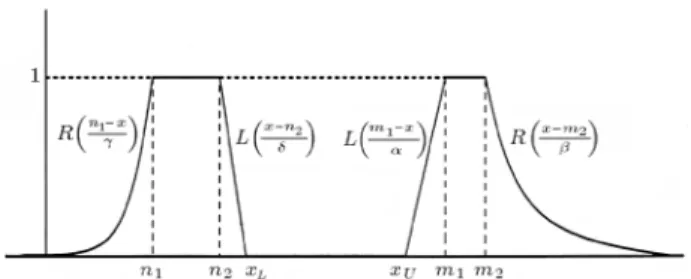
Figure1. Fuzzy interval.
2. M(x) = 0 for allx2( 1;c],
3. M is strictly increasing and continuous on [c;a], 4. M(x) = 1 for allx2[a;b],
5. M is strictly decreasing and continuous on [b;d], 6. M(x) = 0 for allx2(d;+1],
where a,b, c, dare real numbers and (a+b)=2 is the mean value ofM (see Figure 1).
Denition 4
A fuzzy interval, M, is said to be an L R fuzzy interval, if
M(x) = 8 > > < > > :
L m1 x
x < m1 >0;
1 m1
xm
2; R
x m2
x > m2 >0;
whereand are left and right spreads, respectively, and the function,L(:), is a left shape function satisfy-ing:
1. L(x) =L( x), 2. L(0) = 1,
3. L(x) is non-increasing on [0;1).
Naturally, a right shape function,R(:), is similarly dened asL(:). m1+m
2
2 is called the mean value ofM. Using its mean value, left and right spreads and shape function, such an L R fuzzy interval, M, is written as:
M= (m1;m2;;)LR:
By anL Rfuzzy number, one means a fuzzy interval,
M = (m1;m2;;)LR, where m1 =m2. It is written as: M = (m1;;)LR. Also, when = = 0 and m1 = m2, then, M reduces toM = (m1;m1;0;0)LR, which is the real number,m1.
Denition 5
LetM = (m1;m2;;)LR andN = (n1;n2;;)RLbe fuzzy intervals. Then:
1. One calls M = (m1;m2;;)LR lower bounded, if there exists xU = m1 L
1(0), such that L m1 xU
= 0 for allxxU;
Figure2. Upper and lower bounded fuzzy intervals. 2. One calls N = (n1;n2;;)RL upper bounded,
if there exists xL = n2 + L
1(0), such that L xL n2
= 0 for allxxL (see Figure 2); 3. Let:
FLR=fM= (m
1;m2;;)LR j M is a lower bounded fuzzy intervalg; and:
F+
RL=fN= (n
1;n2;;)RL j
N is an upper bounded fuzzy intervalg:
Denition 6
For an L Rfuzzy interval, M = (m1;m2;;)LR 2 FLR, and an L R fuzzy interval, N = (n1;n2;;)RL
2 F +
RL, the following formulas for the
extended opposite and subtraction hold, respectively: 1. Opposite:
M= ( m2; m1;;)RL; 2. Subtraction:
MN=(m1 n2;m2 n1;+;+)LR: (1) As a special case, observe that scalar multiplication for anL Rfuzzy interval,M= (m1;m2;;)LR, can be given by the following formula, depending on the sign of.
3. Scalar multiplication:
M=
(
(m1;m2;;)LR 0; (m2;m1; ; )RL <0:(2)
TRADITIONAL PROCESS CAPABILITY
INDICES
In this section, some notions of traditional PCIs will be reviewed. A process capability index is a real number, as a summary that compares the behavior of a product or process characteristic to engineering specications. This measure is also called the performance index. Sev-eral PCIs are introduced in the literature, such asCp,
Cpk, Cpmand so on [3-5]. For convenience, the upper
and lower specication limits will be denoted byU and
L, respectively, rather than the more customary USL and LSL notations. Where univariate measurements are concerned, the corresponding random variate will be denoted by X. The expected value and standard deviation ofXwill be denoted byand, respectively. The situation will be limited to where is in the specication interval, i.e. L U and it will be assumed that the measured characteristic should have a normal distribution (at least, approximately), although it is dicult to see why a good industrial process must result in a normal distribution for every measured characteristic.
The commonly recognized PCIs are:
Cp=U L6 = 6w; (3)
where w=U L. ThisCp is used when =M and
whereM= (U+L)=2.
Cpk= w 2j Mj
6 = minfU ; Lg
3 ; (4)
and:
Cpm= 6p w
2+ ( T)2 =
w
6p
E[(X T)2]
; (5) where T is target value andE[:] denotes the expected value.
There is also the hybrid index:
Cpmk= w 2j Mj 6p
2+ ( T)2 =
w 2j Mj 6p
E[(X T)2] : (6) Usually,T =M. IfT 6=M, the situation is sometimes described as \asymmetric tolerances" (see [13-15]). Introduction of Cp is ascribed to Juran [16]; that of Cpk to Kane [2]; that of Cpm, for the most part to
Hsiang and Taguchi [17], andCpmk to Pearn et al. [5].
Clearly Cp Cpk Cpmk and Cp Cpm Cpmk. Some more relations between PCIs could be
realized. From Equations 3 and 4, one has:
Cpk=Cp 13
M
; (7)
and from Equations 3 and 5, one has:
Cpm= r Cp 1 +
T 2
: (8)
From Equations 4 and 6, one has:
Cpmk= r Cpk 1 +
T 2
: (9)
A further interesting relation is:
Cpmk=CpmCCppk: (10)
An enlightening view of relations between the PCIs can be obtained from studies of the \superstructure PCIs", introduced by Vannman [18], as follows:
Cp(u;v) = w 2uj Mj 6p
2+v( T)2
(u;v0): (11) The four PCIs introduced in Equations 3 to 6 are special cases ofCp(u;v). Indeed;
Cp=Cp(0;0); Cpk =Cp(1;0); Cpm=Cp(0;1); Cpmk =Cp(1;1):
See more details concerning this section in Kotz [3].
FUZZY PROCESS CAPABILITY INDICES
In this section, the recent results on fuzzy process capability indices obtained by Parchami et al. [1] will be revised. The Cp index based on fuzzy SLs was
introduced as a real number by Yongting [7] and was also used by other authors [8]. But, it would be more realistic to have a Cp which is also fuzzy, since
a fuzzy process capability index would be much more appropriate than a precise number, if SLs are fuzzy.
Denition 7
A process with fuzzy specication limits, called a fuzzy process for short, is one which approximately satises the normal distribution condition and its specication limits are fuzzy [1].
In the following Denition 4.1, 4.2 of [1] is revisited, which gives a
Cp as having more exibility
for the product designers by the shape of its SLs.
Denition 8
Suppose one has a fuzzy process with xed , for which the specication limits are the fuzzy setsULR =
(m1;m2;;)LR
2FLR, LRL= (n
1;n2;;)RL 2F
+
RL
and xU xL, where xL = n 2+L
1(0) and x
U =
m1 L
1(0). Then:
a) The width between fuzzy process specication lim-its is a L Rfuzzy number,
wLR 2FLR, dened by;
wLR=ULRLRL
= (m1;m2;;)LR(n1;n2;;)RL
b) The fuzzy process capability index is aL Rfuzzy number,
Cp2F(R), dened by;
Cp= 16
wLR: (13)
By Equations 1 and 2, one can obtain
Cp, as follows:
Cp=
m1 n2
6 ;m2 n1
6 ;6+ ; 6+
LR: (14)
Note that
Cp is useful when=m, where: m=m1+m2+n1+n2
4 :
In the following, an example is given to clear the idea of
Cp.
Example 1
For a special product, suppose that the specication limits are considered to beULR= (5;5:5;0:5;0:5)LR2 FLR and LRL = (2:5;3;0:5;1)RL 2 F
+
RL, respectively,
whereL(x) = 1 x2 andR(x) =e x 2
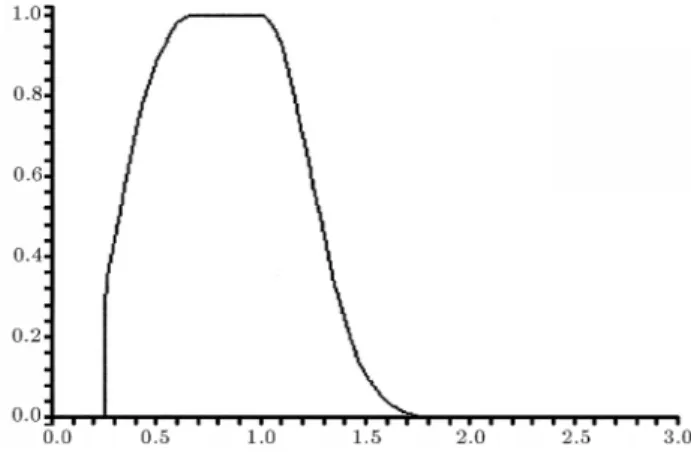
, as in Figure 3. Assume that the process meanis 6 and the estimated process standard deviation is 1/2. By Denition 8, one can compute the width between process SLs as
wLR=
(2;3;1:5;1)LR. Therefore, ^
Cp = (2=3;1;1=2;1=3)LR is
the estimate of
Cp, which is depicted in Figure 4.
Example 2
In a manufacturing process, 75 samples extracted from the vane-manufacturing process, which is under
Figure3. The membership function of fuzzy process
specication limits in Example 1.
Figure4. The membership function of fuzzy process
capability index in Example 1.
statistical control, are shown in Table 1 (as on page 781 of [19]).
From the data, s = 2:15 is estimated. As-sume ULR = (39:5;40:5;0:7;0:5)LR and LRL =
(19:5;20:5;0:4;0:9)RL are specication limits, where L(x) = R(x) = 1 x2. Then, by Equation 14,
^
Cp= (1:47;1:62;0:12;0:07)LR.
Remark 1
Let, in a fuzzy process, ULR = (5;5:5;0:5;0:5)LR, LRL = (2:5;3;2:5;1)RL, L(x) = 1 x2 and R(x) = e x2
. For several values of standard deviation, the pictorial representation of ^Cp is depicted in Figure 5
by Maple software. The bold curve is ^Cp fors = 1:4,
3.1 and 5.4, respectively. Note that, as s increases, the ^Cp tends to be a sharper and smallerL R fuzzy
interval.
Figure5. Three-dimensional representation of fuzzy PCI
related to standard deviation.
Table1. Data vane-manufacturing process for Example 2.
Observation
27 29 30 31 32 33 34 35 36 37 39Denition 9
Let ULR = (m1;m2;;)LR
2 FLR and LRL = (n1;n2;;)RL
2 F +
RL be the engineering fuzzy
spec-ication limits andxU xL, wherexL=n 2+L
1(0) andxU =m1 L
1(0). The following revised fuzzy PCIs are introduced:
Cpk= m1 n2 2 j mj
6 ; m2 n1 2 j mj
6 ;
+
6 ;6+ !
LR; (15)
Cpm= m1 n2 6p
2+ ( T)2
; m2 n1
6p
2+ ( T)2 ;
+
6p
2+( T)2;
+
6p
2+( T)2 !
LR;(16)
Cpmk= m1 n2 2 j mj 6p
2+ ( T)2
; m2 n1 2 j mj 6p
2+ ( T)2 ;
+
6p
2+( T)2;
+
6p
2+( T)2 !
LR;(17)
wherem= m1 +m 2 +n 1 +n 2
4 andT is target value. The revised \superstructure fuzzy PCI" is dened as follows:
Cp(u;v)= m1 n2 2u j mj 6p
2+v( T)2
; m2 n1 2u j mj 6p
2+v( T)2 ;
+
6p
2+v( T)2
;6p + 2+v( T)2
!
LR
foru;v0: (18)
Remark 2
i) The process capability indices dened by Equa-tions 3 to 6 could be expressed by the fuzzy process capability indices as follows:
Cp= Cp=
m1 n1 6 ;0;0
LR; Cpk =
Cpk =
m1 n1 2 j mj 6 ;0;0
LR; Cpm=
Cpm= m1 n1
6p
2+ ( T)2 ;0;0
!
LR;
Cpmk=
Cpmk= m1 n1 2 j mj 6p
2+ ( T)2 ;0;0 !
LR:
ii) When the process specication limits,
ULR = (m1;m2;;)LR
2 FLR and LRL = (n1;n2;;)RL
2 F
+
RL, are precise
numbers, i.e., m1 = m2, n1 = n2 and = = = = 0, then, all the introduced revised fuzzy PCIs are precise numbers and coincide with the traditional PCIs.
Remark 3
Fuzzy intervalsM = (m1;m2;;)LR
2FLR andN = (n1;n2;;)RL
2F +
RL are triangular fuzzy numbers if m1=m2,n1=n2andL(x) =R(x) = 1 x. Thus, as a special case, SLs, asULR= (bu;bu;bu au;cu bu)LR2 FLR and LRL = (bl;bl;bl al;cl bl)RL 2 F
+
RL, are
triangular fuzzy numbers,T(au;bu;cu) andT(al;bl;cl),
respectively, used by Parchami et al. [1], where:
T(a;b;c) = 8 > < > :
(x a)=(b a) if axb (c x)=(c b) if bxc 0 if elsewhere ; andL(x) =R(x) = 1 x.
RELATION BETWEEN FUZZY PROCESS
CAPABILITY INDICES
In this section, some relations governing the revised fuzzy process capability indices are given, as introduced in the previous section.
Theorem 1
In a fuzzy process, assumexU xL, wherexL =n 2+ L 1(0) andx
U =m1 L
1(0). Then;
Cpk(x) = Cp
x+j mj 3
;
where:
m= m1+m2+n1+n2
4 ; (19)
Cpm(x) = Cp 0 @x s 1 + T 2 1
A; (20)
Cpmk(x) = Cpk 0 @x s 1 + T 2 1
Proof Lety=j mj
3 . Then, by some calculations one has:
Cp(x+y)
= 8 > > > > < > > > > : L
m1 n2 6 x y
+ 6
ifx+y < m1 n2 6 1 if m1 n2
6
x+ym 2 n1
6 R
x+y m 2 n1
6
+ 6
ifx+y > m2 n1 6
;
Cpk(x)
= 8 > > > > < > > > > : L
m1 n2 6 y x
+ 6
ifx < m1 n2
6 y
1 if m1 n2 6 y
xm 2 n1
6 y R
x m2 n1 6
+y
+ 6
ifx > m2 n1
6 y
:
Therefore, Equation 19 is proved. Similarly, Equa-tions 20 and 21 can be proven.
Theorem 2
The four revised fuzzy PCIs introduced in Equations 14 to 17 are special cases of
Cp(u;v). Indeed:
Cp=
Cp(0;0); Cpk =
Cp(1;0); Cpm=
Cp(0;1);
Cpmk = Cp(1;1):
Proof
It is obvious by using Equations 14 to 18.
Further interesting relations are stated in the following theorem. First, an important denition is given.
Denition 10
ForL R fuzzy intervals,M = (m1;m2;;)LR and N = (n1;n2;;)LR, the following approximate for-mula for the extended multiplication holds, as follows: 1. Multiplication [20]:
IfM >0 andN >0, then,
MN
= (m1n1;m2n2;m1+n1;m2+n2)LR: 2. For positive L R fuzzy intervals, M;N;M0 and
N0, one can say M
N M
0
N
0, ifM
N
= (m;n;;)LR and M0
N
0
= (m;n;;)LR, for
some fuzzy interval, (m;n;;)LR.
Theorem 3
Let in a fuzzy process, xU > xL, where xL = n2+ L 1(0) and x
U =m1 L
1(0), and Cp;
Cpmk; Cpm
and
Cpk can be dened by Equations 14 to 17,
respectively. Then, Cp Cpmk Cpm Cpk.
Proof
According to Denitions 5 and 8 to 10, one has the following:
Cp
Cpmk= (m
1 n2)(m1 n2 2
j mj) 36p
2+ ( T)2 ; (m2 n1)(m2 n1 2
j mj) 36p
2+ ( T)2 ; (+)(2m1 2n2 2
j mj) 36p
2+ ( T)2 ; (+)(2m2 2n1 2
j mj) 36p
2+ ( T)2
!
LR;
Cpm
Cpk= (m
1 n2)(m1 n2 2
j mj) 36p
2+ ( T)2 ;
(m2 n1)(m2 n1 2
j mj) 36p
2+ ( T)2 ;
(+)(2m1 2n2 2
j mj) 36p
2+ ( T)2 ;
(+)(2m2 2n1 2
j mj) 36p
2+ ( T)2
!
LR::
Therefore, the theorem is proved when Cp;
Cpmk; Cpm
and
Cpk areL Rfuzzy intervals andxU > xL, where xL=n1+L
1(0) andx
U =m1 L 1(0).
CONCLUSION
In this paper, the revised fuzzy process capability indices have been introduced, when the engineering specication limits are L R fuzzy intervals. Also, several relations between them have been revealed.
ACKNOWLEDGMENT
The authors are partially supported by a gtant No. 853143-1385-8-15 from National Science Foundation of Iran as well as by Fuzzy Set and its Application Center of Excellence, Shahid Bahonar University of Kerman, Iran.
REFERENCES
1. Parchami, A., Mashinchi, M., Yavari, A.R. and Maleki, H.R. \Process capability indices as fuzzy numbers",
Austrian Journal of Statistics, 34(4), pp 391-402,
2. Kane, V.E. \Process capability indices", Journal of Quality Technology,18, pp 41-52 (1986).
3. Kotz, S. and Johnson, N. \Process capability indices-a review, 1992-2000", Journal of Quality Technology,
34, pp 2-19 (2002).
4. Kotz, S., Process Capability Indices, Chapman and Hall, New York, USA (1993).
5. Pearn, W.L., Kotz, S. and Johnson, N.L. \Distribu-tion and inferential properties of capability indices",
Journal of Quality Technology,24, pp 216-231 (1992).
6. Montgomery, D.C., Introduction to Statistical Quality Control, Fifth Ed., John Wiley & Sons, Inc. (2005). 7. Yongting, C. \Fuzzy quality and analysis on fuzzy
probability",Fuzzy Sets and Systems, 83, pp 283-290
(1996).
8. Sadeghpour-Gildeh, B. \Comparison of Cp, C pk and
Cp process capability indices in the case of
mea-surement error occurrence", IFSA World Congress, Istanbul, Turkey, pp 563-567 (2003).
9. Lee, H.T. \C
pkindex estimation using fuzzy numbers",
European Journal of Operational Research, 129, pp
683-688 (2001).
10. Mashinchi, M., Parchami, A. and Maleki, H.R. \Ap-plication of fuzzy capability indices in educational comparison",Proceeding of 3rd International Qualita-tive Research Convention, Sotel Palm Resort, Senai, Johor Malaysia, p 42 (2005).
11. Parchami, A., Mashinchi, M. and Maleki, M. \Fuzzy condence intervals for fuzzy process capability index",
Journal of Intelligent & Fuzzy Systems,17(3), pp
287-295 (2006).
12. Sakawa, M. \Fuzzy sets and interactive multiobjective optimization", Plenum Press, New York, USA (1993). 13. Boyles, R.A. \Process capability with asymmetric tolerances", Communication in Statistics-Simulation and Computation,23, pp 613-643 (1994).
14. Vannman, K. \A general class of capability indices in the case of tolerances",Communications in Statistics-Theory and Methods,26, pp 2049-2072 (1997).
15. Vannman, K. \Families of capability indices for one-side specication limits", Statistics, 31, pp 43-66
(1998).
16. Juran, J.M., Juran's Quality Control Handbook, 3rd Ed., McGraw-Hill, New York, USA (1974).
17. Hsiang, T.C. and Taguchi, G. \Tutorial on quality control and assurance- the Taguchi methods", Joint Meetings of the American Statistical Association, Las Vegas, Nevada, USA, p 188 (1985).
18. Vannman, K. \A unied approach to the capability indices",Statistical Sinica,5, pp 805-820 (1995).
19. Mongomery, D.C. and Runger, G.C.,Applied Statistics and Probability for Engineers, 2nd Ed., John Wiley & Sons, New York, USA (1999).
20. Dubois, D. and Prade, H., Fuzzy Sets And Systems: Theory and Applications, Academic (1980).