M
c
REL’
s
principal
A
boutM
cREL
Mid-continent Research for Education and Learning (McREL) is a nationally recognized, private, nonprofit organization dedicated to improving education for all students through applied research, product development, and service. Established in 1966, McREL now maintains a staff of 110 in its Denver, Colorado, office.
A
cknowLEdgEMEntsMany people contributed their time and expertise to this instrument. The authors express their gratitude to North Carolina Public Schools and the San Diego Unified School District for their support of the development efforts that led to the creation of the instrument and auxiliary materials.
Many McREL staff members graciously gave their time, support, and expertise in bringing this project to fruition. Their contributions are gratefully acknowledged.
A
uthoRsJean Williams Greg Cameron Tony Davis
McREL’s PRinciPAL EvALuAtion systEM
introduction ...1
Research on Leadership ...1
Purposes of the Evaluation ...3
Steps of the Process ...4
principal Evaluation rubric ...7
How the Rubric is Constructed ...7
Instructions for Completing the Rubric ...8
The Principal Evaluation Rubric ...9
recording Evaluation results ...18
Principal Summary Evaluation Worksheet ...18
Principal Summary Evaluation Rating Form ...19
Principal Summary Goal-Setting Form ...22
Mid-Year Evaluation: Progress toward Achieving Goals...23
appendices ...24
Appendix A: Glossary ...24
Appendix B: The Balanced Leadership Framework®: Connecting Vision With Action ....26
Appendix C: Principal Evaluation Process Documentation Form ...53
Appendix D: Principal Summary Evaluation Rating Form ...54
Appendix E: Scoring the Rubric and Sample Completed and Scored Forms ...58
Sample Completed Principal Evaluation Rubric ...59
Sample Completed Principal Summary Evaluation Worksheet ...65
Sample Completed Principal Summary Evaluation Rating Form ...68
IntroductIon
Effective leadership means more than simply knowing what to do—it’s knowing when, how, and why to do it. Effective leaders understand how to balance pushing for change while at the same time, protecting aspects of culture, values, and norms worth preserving. They know which policies, practices, resources, and incentives to align and how to align them with organizational priorities. They know how to gauge the magnitude of change they are calling for and how to tailor their leadership strategies accordingly. Finally, they understand and value the people in the organization. They know when, how, and why to create learning environments that support people, connect them with one another, and provide the knowledge, skills, and resources they need to succeed. This combination of knowledge and skills is the essence of
balanced leadership.1
This combination of knowledge and skills is also the focus of McREL’s Principal Evaluation System. By using the results of the evaluation to guide their own professional development, principals and central office administrators will be able to chart a course for professional growth and development from the novice principal who is developing into an effective school leader to a distinguished professional who leads the school to ever greater accomplishments and commands the respect of colleagues.
R
eseaRch onl
eadeRshipResearchers at Mid-continent Research for Education and Learning (McREL) and other organizations have analyzed key traits of educational leaders and those attributes which contribute to the success of schools. Portin et al. (2003) analyzed in-depth interviews with educators across 21 schools and identified seven types of leadership needs: instructional, cultural, managerial, human resources, strategic, external development,
and micropolitical.2 Cotton’s (2003) review of 81 research reports on principals and student achievement
showed that principals must take on a variety of roles (25 leadership practices) ranging from emotional and interpersonal support to community outreach and fundraising, in addition to academic leadership, in
order to effectively empower the school to improve student achievement.3 It is clear that the role of the
school principal has become one of instructional improvement, relationship building, delegation of key responsibilities, and leadership by example.
M
cREL’
sR
EsEaRch: B
aLancEdL
EadERship® ands
chooLL
EadERshipthatW
oRks®In 2003, McREL researchers examined more than 5,000 studies that purported to examine the effects of principal leadership on student achievement. Of these, 69 met rigorous criteria for inclusion in a meta-analytic research study. Three important findings emerged, which first were published in Balanced Leadership: What 30 Years of Research Tells Us about the Effects of Leadership on Student Achievement.4
The first finding is that leadership matters. The general effect of principal leadership on student achievement
has a correlation of 0.25. This means that in schools where teachers on average rated their principal at
the 84th percentile of leadership (one standard deviation above the mean), student achievement was 10
percentile points higher on norm-referenced tests. Expressed differently, the studies in the meta-analysis
suggest that improving principals’ leadership abilities by one standard deviation from the 50th to the 84th
percentile can lead to an increase in the average student achievement from the 50th to 60th percentile—a
substantial improvement.
1Waters, T. J., Marzano, R. J., & McNulty, B. (2003). Balanced leadership: What 30 years of research tells us about the effect of
leadership on student achievement. Retrieved from http://www.mcrel.org/products/144
2Portin, B., Schneider, P., DeArmond, M., & Gundlach, L. (2003, September). Making sense of leading schools: A study of the school
Second, the meta-analysis identified 21 leadership responsibilities associated with 66 leadership practices, which all have statistically significant relationships with student achievement. These responsibilities and practices
are strongly aligned with the seven standards of executive leadership identified by Portin and others.5
Third, McREL researchers discovered that principal leadership has a differential impact on student
achievement. In some of the studies included in the meta-analysis, the principals were perceived by
teachers as strong leaders, yet student achievement was low. This finding shows that not all leaders perceived as strong have a positive impact on student achievement. Two explanations underlie McREL’s theory of the differential impact of principal leadership on student achievement: (1) strong principals may not be focused on the right things, namely the use of research-based classroom or school practices known to have a positive effect on student achievement, and (2) strong principals may miscalculate the implications of a change initiative for the stakeholders in the school, causing inconsistent implementation of the initiative.
F
actora
nalysisBuilding on the results of the meta-analysis, McREL collected survey data from nearly 650 principals about
their leadership initiatives and use of the 21 responsibilities reported in School Leadership that Works.6 These
data were used in a factor analysis to identify the underlying structures and inter-correlations among the 21 leadership responsibilities. The factor analysis revealed three important findings:
1. There are two main factors associated with principal leadership: first-order change and second-order change. First-order change is incremental. It can be thought of as the next obvious step to take in a school or a district. Second-order change is anything but incremental. It involves dramatic departures from the expected, both in defining a given problem and in finding a solution.
2. All 21 leadership responsibilities are important and necessary for leading changes with first-order implications—that is, managing day-to-day functions of the school and leading routine changes. 3. Eleven of the 21 leadership responsibilities are associated with second-order change (see Table 1).
There are specific leadership responsibilities that principals can emphasize to effectively lead change with second-order implications. Specifically, 7 of the 11 were positively correlated with second-order change. Four were negatively correlated with second-order change. This means that when schools undertake changes with second-order implications, most staff members are likely to perceive these four responsibilities as not being carried out effectively. The ramification of this is that staff may feel frustration and even anger from changes that are perceived as deteriorating the organization. Effective leadership is perhaps most crucial when dealing with such perceptions.
PositivELy coRRELAtEd nEgAtivELy coRRELAtEd
Knowledge of curriculum, instruction, and assessment Culture
Optimize Communication
Intellectual stimulation Input
Change agent Order
M
cREL’
sB
aLancEdL
EadERshipF
RaMEWoRk®Please see Appendix B for the complete synthesis, titled The Balanced Leadership Framework: Connecting Vision with Action. The Framework connects McREL’s findings to existing research-based knowledge on change management, diffusion theory, collective efficacy, institutional theory, living systems theory, community development, asset utilization, and school improvement. The Framework puts the 21 leadership responsibilities into an organizing structure: 1) leadership, 2) focus of change, 3) magnitude of change, and 4) purposeful community (see Figure 1).
p
uRposes of the evaluationThe intended purpose of McREL’s Principal Evaluation System is to assess the principal’s performance in relation to the research-based strategies that have been proven to be effective. The evaluation should take place in a collegial and non-threatening manner. The principal will take the lead in conducting the evaluation through the use of self-assessment, reflection, and input gathered from the various stakeholders with an interest in the leadership in the school. The evidence and documentation gathered by the principal is not intended to become a portfolio. Rather, it should provide a basis for self-assessment, goal setting, professional development planning, and demonstration of performance on specific standards.
McREL’s Principal Evaluation System will:
n Serve as a guide for principals as they reflect upon and improve their effectiveness as school leaders;
n Measure and support professional practice consistently and fairly;
n Focus the goals and objectives of districts as they support, monitor, and evaluate their principals;
n Guide professional development for principals;
n Serve as a tool in developing coaching and mentoring programs for principals; and
n Inform higher education programs in developing the content and requirements of degree programs that
prepare future principals.
purposeful community
purposeful community
leadership
leadership
leadership
leadership
p
urposeful
c
ommunity
p
urposeful
c
ommunity
Focus
of
leadership
Magnitude
of
change
s
teps of the pRocesss
tEp1: o
RiEntationEach school year, evaluators will conduct a group orientation with all principals. At this orientation, each principal will receive a complete set of materials outlining the evaluation process and an explanation of the timeline and how performance will be measured. Each principal should become thoroughly familiar with McREL’s Principal Evaluation System and all of the materials associated with it, including definitions and forms. 1. orientation 2. a. Principal Self-Assessment b. Evaluator Assesment of Principal 3. Meeting Between Principal &
Evaluator 4. Mid-Year Evaluation discussion 5. consolidated Performance Assessment 6. End-of-Year Performance discussion 7. Final Evaluation & Goal-Setting Meeting
s
tEp3: M
EEtingBEtWEEnp
RincipaLandE
vaLuatoRPrincipals will meet individually with their evaluator to discuss the results of self assessment, the evaluator’s ratings of the principal, preliminary performance goals, and any artifacts or other evidence the principal and evaluator believe are critical to understanding the principal’s performance. The principal and evaluator will agree on the data, evidence, and documentation necessary to complete the evaluation process and confirm the principal’s level of performance.
s
tEp4: M
id-Y
EaRE
vaLuationd
iscussionPrincipals will meet individually with their evaluator to discuss their progress toward achieving annual goals. This mid-year discussion will focus on the status of goal attainment and necessary mid-year adjustments to action plans that must be made in order to achieve goals by the end of the school year.
s
tEp5: c
onsoLidatEdp
ERFoRMancEa
ssEssMEntThe principal will synthesize the information from Steps 3 and 4 in order to prepare a consolidated
assessment or comprehensive view of performance throughout the year. This brief summary of the data and artifacts used to judge performance should be provided to the evaluator well in advance of the end-of-year performance discussion.
s
tEp6: E
nd-
oF-Y
EaRp
ERFoRMancEd
iscussionThe principal and evaluator will meet at the school to discuss progress toward completing the evaluation process. They will discuss the self-assessment, consolidated assessment, and superintendent’s summary evaluation of the principal, which have been prepared in advance of the meeting. Should additional data or artifacts be needed for the discussion, the principal will have them available at that time.
s
tEp7: F
inaLE
vaLuationandg
oaL-s
EttingM
EEtingAt this meeting, the principal and evaluator will agree upon performance goals and recommendations for the Professional Development Plan. All forms needed to complete this process are included in this manual. While all of the forms are highly recommended, use of the following is required:
n Principal Evaluation Rubric (see pp. 9–17). The Rubric will be used for the following steps:
n Self-Assessment
n Evaluator Assessment
n Meeting Between Principal and Evaluator
n Final Evaluation and Goal-Setting Meeting
n Principal Summary Evaluation Worksheet (see p.18)
n Principal Summary Goal-Setting Form (see p. 19)
n Mid-year Evaluation: Progress toward Achieving Goals (see p. 20)
It will be helpful to understand the responsibilities of the principal and evaluator as they engage in this process (see Table 2, p. 6).
table 2: pRincipaland evaluatoR Responsibilities
PRinciPAL REsPonsibiLitiEs EvALuAtoR REsPonsibiLitiEs Understand McREL’s Principal Evaluation System.
Prepare for the Pre-Evaluation Conference, including a self-assessment, identification of performance goals, and identification of change initiatives underway at his or her school.
Gather data, artifacts, and evidence to support performance in relation to the three framework components and progress toward attaining goals.
Develop and implement strategies to improve
personal performance/attain goals in areas individually or collaboratively identified.
Participate in the Mid-year and Final Evaluation Conferences and End-of-Year meeting to set preliminary goals for subsequent year prior to receiving student achievement data.
Finalize goals and End-of-Year Evaluation with evaluator as soon as student achievement data is available.
Participate in professional development to understand and implement the system.
Supervise McREL’s Principal Evaluation System, and ensure that all steps are conducted according to the approved process.
Identify the principal’s strengths and areas for improvement and make recommendations for improving performance.
Ensure that the contents of the Principal Summary Evaluation Report contain accurate information and accurately reflect the principal’s performance.
Leverage skills and knowledge required to implement McREL’s Principal Evaluation System.
Participate in the Mid-year and Final Evaluation Discussions and End-of-Year Performance Discussion to set preliminary goals prior to receiving student achievement data.
PrIncIPAl EvAluAtIon ruBrIc
This instrument serves as the foundation for McREL’s Principal Evaluation System. It should be used throughout the process to monitor principals’ progress toward consistently using practices that leadership research has identified as necessary to improve the amount of learning that takes place in a school.
The Principal Evaluation Rubric beginning on page 10 should be completed by principals as a self-assessment of the performance during the year. Evaluators will use the rubric to complete their assessment of the principals’ performance for the same time period. Likewise, the principal and evaluator will use this rubric as a guide for performance discussions and as a tool to determine the final evaluation rating for the principal. Figure 3 provides a guide to the elements of the Rubric.
h
ow the RubRic is constRuctedfiguRe 3: exampleof howthe RubRicis constRucted
pRincipal leadeRship Responsibilities associatedwithManaging changE
Managing change involves understanding the implications of change efforts for stakeholders and adjusting leadership behaviors accordingly.
a. change agent: Is willing to and actively challenges the status quo.
developing pRoficient accomplished distinguished
(comment RequiRed)
not demonstRated
(comment RequiRed)
R Uses a variety of data to identify necessary change initiatives.
. . . and
R Builds on data analysis to define processes and protocols in order to create or adopt new and better ways to improve school and classroom practices.
. . . and
R Consistently attempts to operate at the edge instead of the center of the schools’ competence by leading the implementation of research-based initiatives even though outcomes may be uncertain.
. . . and
R Leverages the influence of opinion leaders to strategically target and frame change initiatives in order to increase the rate of adoption. R Is recognized in the
education community as an advocate for new and innovative ways of schooling.
F
RaMEWoRkc
oMponEntR
EsponsiBiLitYR
atingsi
nstRuctions foR completing the RubRicTo complete this form, begin in the first column, Developing. If the practice listed in the Developing column describes the principal’s performance throughout the year, mark the box beside the practice. Continue to work down the column of Developing practices. The evaluator should continue to the Proficient category and work down that column, marking all of the practices that describe the principal’s work throughout the year. The evaluator should continue to mark all practices that describe the principal’s performance under the Accomplished, and Distinguished categories. Each responsibility should be rated in a similar fashion. Figure 4 provides an example of what a completed responsibility might look like. Please note that, in the example, nothing is checked in the Not Demonstrated column, so the evaluator continued to the other columns to rate the principal. If practices are checked in either the Not Demonstrated or Distinguished category, the evaluator should provide an explanatory comment in the space provided at the end of the framework component.
pRincipal Responsibilities associatedwithpuRposEFuL coMMunitY
A purposeful community is one with the collective efficacy and capability to develop and use assets to accomplish goals that matter to all community members through agreed upon processes.
a. affirmation: Recognizes and celebrates school accomplishment and acknowledges failures.
developing pRoficient accomplished distinguished
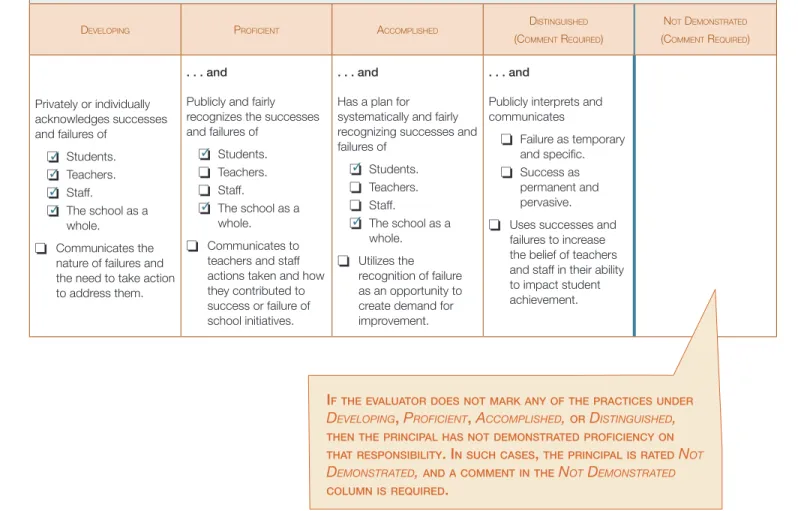
(comment RequiRed) not demonstRated (comment RequiRed) Privately or individually acknowledges successes and failures of R Students. R Teachers. R Staff. R The school as a whole. R Communicates the nature of failures and the need to take action to address them.
. . . and
Publicly and fairly recognizes the successes and failures of R Students. R Teachers. R Staff. R The school as a whole. R Communicates to teachers and staff actions taken and how they contributed to success or failure of school initiatives.
. . . and
Has a plan for systematically and fairly recognizing successes and failures of R Students. R Teachers. R Staff. R The school as a whole. R Utilizes the recognition of failure as an opportunity to create demand for improvement.
. . . and
Publicly interprets and communicates R Failure as temporary and specific. R Success as permanent and pervasive.
R Uses successes and failures to increase the belief of teachers and staff in their ability to impact student achievement. 3 3 3 3 3 3 3 3
iFthEEvaLuatoRdoEsnotMaRkanYoFthEpRacticEsundER
Developing, proficient, AccomplisheD,oRDistinguisheD,
thEnthEpRincipaLhasnotdEMonstRatEdpRoFiciEncYon thatREsponsiBiLitY. insuchcasEs, thEpRincipaLisRatEdnot
pRincipal leadeRship Responsibilities associatedwithManaging changE
Managing change involves understanding the implications of change efforts for stakeholders and adjusting leadership behaviors accordingly.
a. change agent: Is willing to and actively challenges the status quo.
developing pRoficient accomplished distinguished
(comment RequiRed)
not demonstRated
(comment RequiRed)
R Uses a variety of data to identify necessary change initiatives.
. . . and
R Builds on data analysis to define processes and protocols in order to create or adopt new and better ways to improve school and classroom practices.
. . . and
R Consistently attempts to operate at the edge instead of the center of the schools’ competence by leading the implementation of research-based initiatives even though outcomes may be uncertain.
. . . and
R Leverages the influence of opinion leaders to strategically target and frame change initiatives in order to increase the rate of adoption.
R Is recognized in the education community as an advocate for new and innovative ways of schooling.
b. Flexibility: Adapts his or her leadership behavior to the needs of the current situation and is comfortable with dissent.
R Understands the importance of how different change initiatives may be perceived differently by various stakeholders and how they may impact others.
. . . and
R Adapts leadership style to the needs of specific situations.
R Implements procedures that encourage teachers and staff to express opinions and perceptions even if they are contrary to those held by individuals in positions of authority.
. . . and
Creates and uses transitions teams during times of change to
R Assist individuals in transitioning into the new ways of doing things. R Adapt quickly to changing environments and contexts. . . . and Improves collective efficacy by R Effectively managing change. R Building on the collective ability of the school community to adapt to contextual conditions.
c. ideals and Beliefs: Communicates and operates from strong ideals and beliefs about school and schooling.
R Possesses well-defined ideals and beliefs about schools and schooling that align with district non-negotiable goals.
. . . and
R Creates demand for change through sharing beliefs about school, teaching, and learning with teachers and staff.
R Demonstrates behaviors that exemplify stated beliefs about school and schooling.
. . . and
R Creates demand for change by communicating ideals and beliefs throughout the community.
R Creates opportunities to implement change that exemplifies ideals and beliefs.
. . . and
R Shares leadership in a manner that extends and promotes the ideals and beliefs about schools and schooling throughout the community.
R Perseveres in the face of challenges to effectively sustain positive change.
t
hep
Rincipale
valuationR
ubRicd. intellectual Stimulation: Ensures that the faculty and staff are aware of the most current theories and practices and makes the discussion of these a regular aspect of the school culture.
developing pRoficient accomplished distinguished
(comment RequiRed)
not demonstRated
(comment RequiRed)
R Understands and articulates the current rigorous and relevant research and theory on effective schooling.
. . . and
R Uses rigorous and relevant research and theory on effective schooling to create demand for change by providing professional development opportunities.
. . . and
R Uses the outcomes of professional
development on rigorous and relevant research and theory on effective schooling to guide professional learning community discussions and activities.
. . . and
R Provides vicarious and mastery experiences for teachers that capitalize on staff development outcomes and discussions of effective schools practice.
e. Knowledge of curriculum, instruction, and assessment: Is knowledgeable about the current curriculum, instruction, and assessment practices.
R Articulates knowledge of curriculum, instruction, and assessment in a way that enables staff to understand and apply the knowledge. . . . and R Provides guidance regarding curriculum, instruction, and assessment in order to ensure effective practices in every classroom.
. . . and
R Provides mastery and vicarious experiences of research-based practices in curriculum design, instructional strategies, and assessment practices through professional development and action research.
. . . and
R Leverages mastery and vicarious experiences to increase the collective efficacy of teachers and staff.
f. Monitor and Evaluate: Monitors the effectiveness of school practices and their impact on student learning.
R Understands the impact of school practices on student learning and achievement.
R Understands the impact that change may have on individuals in the school.
. . . and
Uses a variety of data and processes to
R Drive decisions about initiating new and innovative research-based programs and interventions.
R Monitor the needs and performance of individuals, groups, and the school as a whole.
. . . and
R Routinely works collaboratively with teachers and staff to assess the impact of research-based programs and interventions on student learning and achievement.
. . . and
R Monitors the fidelity and consistency of the implementation of research-based practices and their impact on student learning and achievement.
g. Optimize: Inspires and leads new and challenging innovations.
R Portrays a positive attitude about the ability of teachers and staff to
. . . and
R Inspires teachers and staff to individually and collectively accomplish
. . . and
R Inspires and motivates teachers and staff to accomplish things they
. . . and
R Promotes perseverance and hope during challenging times.
coMMEnts:
REcoMMEndEd actions:
REsouRcEs nEEdEdto coMpLEtE thEsE actions:
EvidEncEoR docuMEntationthat MaY BE usEdto suppoRt Ratings:
R ELL Monitoring Notebook R Professional Development Plan
R Regular Feedback to Teachers and Staff Regarding Performance
R Planning and Leading Professional Development R Classroom Walkthrough Data
R Monitoring Plan
R Operating Principles and Working Agreements R ______________________________________________ R ______________________________________________
pRincipal Responsibilities associatedwithFocusoF LEadERship
Focus of leadership involves accurately and pro-actively targeting appropriate areas for school improvement efforts.
a. contingent rewards: Recognizes and rewards individual accomplishments.
developing pRoficient accomplished distinguished
(comment RequiRed)
not demonstRated
(comment RequiRed)
R Develops criteria and procedures for recognizing hard work and results from individuals and groups.
. . . and
Capitalizes on formal and informal opportunities to
R Recognize the accomplishments and hard work of all stakeholders.
R Maximize the intangible assets of a school.
. . . and
R Involves all stakeholder groups in the recognition and reward process.
. . . and
R Promotes the
accomplishments of the school.
R Inspires all stakeholders to make significant contributions.
R Improves perceptions of stakeholders that they have the ability to contribute to increases in student achievement.
b. Discipline: Protects teachers from issues and influences that would detract from their time or focus.
R Communicates to the entire school community the importance of an effective learning environment, and that instructional time and focus are the school’s top priority.
. . . and
Establishes systems that minimize or eliminate interruptions and distractions to classroom instruction, including
R A school schedule that maximizes instructional time.
R Policies and procedures that maximize the use of instructional time.
. . . and
R Enforces policies and procedures related to instruction time to assure that all staff members and all students benefit from periods of focused instruction.
. . . and
R Serves as a champion for protecting and maximizing instructional time and focus to assure an effective learning environment.
c. Focus: Establishes clear goals and keeps those goals in the forefront of the school’s attention.
R Understands the importance of setting high expectations for student learning and achievement.
. . . and
R Leads the school community in the establishment of rigorous and concrete goals to ensure student learning and achievement.
. . . and
Creates processes and procedures to
R Clearly communicate the goals and progress toward achieving them to all members of the school community.
R Maintain a consistent
. . . and
R Leverages high, concrete goals in order to continually create demand for innovation and improvement.
d. involvement in curriculum, instruction, and assessment: Is directly involved in helping teachers design curricular activities and address assessment and instructional issues.
developing pRoficient accomplished distinguished
(comment RequiRed) not demonstRated (comment RequiRed) R Demonstrates knowledge and understanding of curriculum, instruction, and assessment issues.
. . . and
R Actively initiates activities to address curriculum, instruction, and assessment issues. Provides and actively participates with teachers in meaningful professional development and opportunities to
R Reflect upon their practice.
R Engage in peer-to-peer learning.
R Design instructional and curricular activities.
R Address assessment issues.
. . . and
Models effective pedagogy that includes
R Communicating learning goals.
R Acquiring and integrating knowledge.
R Extending and refining knowledge.
R Applying knowledge.
. . . and
R Helps teachers adopt, adapt, or design rigorous research-based curriculum, instruction, and assessment practices, programs, and interventions.
e. Order: Establishes a set of standard operating procedures and routines.
R Is developing clear structures, rules, procedures, and routines for student and staff behavior.
. . . and
R Has established and consistently enforces policies, procedures, and routines that maximize opportunities for all students to learn.
. . . and
R Maximizes the established policies, procedures, and routines to build a culture that is safe, orderly, and enhances student and teacher abilities to engage in meaningful and productive work.
. . . and
R Uses an orderly environment to sustain confidence in the school’s ability to educate all children.
f. Outreach: Is an advocate and spokesperson of the school to all stakeholders.
R Communicates with stakeholder groups about school initiatives and activities.
. . . and
Advocates for the school with R The Community. R Parents. R Central Office. R Teachers. R Staff. R Students. . . . and R Collects perception data from the school community to inform advocacy activities.
Uses community
relationships as both tangible and intangible assets to engage all stakeholders in
R Family and community involvement initiatives. R School governance and improvement. R Contributing to improving student learning and achievement.
g. resources: Provides teachers with material and professional development necessary for the execution of their jobs.
developing pRoficient accomplished distinguished
(comment RequiRed)
not demonstRated
(comment RequiRed)
Assesses the resource needs of teachers and staff, including
R Professional development needs.
R Tools, materials, and equipment needs.
. . . and
Ensures that teachers and staff have
R Professional development that enhances their teaching.
R Tools, materials, and equipment necessary to perform their duties.
. . . and
R Seeks out additional resources to maximize outcomes for all students.
. . . and
R Implements processes and procedures that ensure the long-term viability of effective programs and practices.
coMMEnts:
REcoMMEndEd actions:
REsouRcEs nEEdEdto coMpLEtE thEsE actions:
EvidEncEoR docuMEntationthat MaY BE usEdto suppoRt Ratings:
R Principal Training
R University/School Associations R Formal Evaluations
R New Program Adoptions R Grade-Level Meeting Agendas R Progress Toward Achieving Goals R Student Handbook
R Safety Plan R Budget Notebook R Student Support Plan R Recognition Events R Staff Handbook R Site Calendar R Master Schedule
R Staff and Teacher Surveys R Community Activities
R Student Achievement Meetings, Protocols, and Schedules R ______________________________________________ R ______________________________________________ R ______________________________________________
pRincipal Responsibilities associatedwithpuRposEFuL coMMunitY
A purposeful community is one with the collective efficacy and capability to develop and use assets to accomplish goals that matter to all community members through agreed upon processes.
a. affirmation: Recognizes and celebrates school accomplishment and acknowledges failures.
developing pRoficient accomplished distinguished
(comment RequiRed) not demonstRated (comment RequiRed) Privately or individually acknowledges successes and failures of R Students. R Teachers. R Staff.
R The school as a whole.
R Communicates the nature of failures and the need to take action to address them.
. . . and
Publicly and fairly recognizes the successes and failures of
R Students.
R Teachers.
R Staff.
R The school as a whole.
R Communicates to teachers and staff actions taken and how they contributed to success or failure of school initiatives.
. . . and
Has a plan for systematically and fairly recognizing successes and failures of
R Students.
R Teachers.
R Staff.
R The school as a whole.
R Utilizes the recognition of failure as an opportunity to create demand for improvement.
. . . and
Publicly interprets and communicates
R Failure as temporary and specific.
R Success as permanent and pervasive.
R Uses successes and failures to increase the belief of teachers and staff in their ability to impact student achievement. b. communication: Establishes strong lines of communication with teachers and among students.
R Implements a variety of strategies to communicate with the teachers, staff, and the larger school community.
R Is accessible to some stakeholder groups.
. . . and
R Implements a variety of strategies to
encourage effective open communication between and among students, teachers, staff, and the larger school community.
R Is easily accessible to all stakeholder groups.
. . . and
R Systematically monitors and takes steps to improve communication structures within the school.
R Develops and monitors effective systems and protocols to enable stakeholder groups to communicate with each other and with the principal.
. . . and R Leverages
communications among and between stakeholder groups to increase the adoption of new and innovative change initiatives within the district or school.
c. culture: Fosters shared beliefs and a sense of community and cooperation.
R Demonstrates a belief through words and actions that teachers and staff can impact student learning and achievement.
R Demonstrates an understanding of how unity of purpose, teamwork, and commitment to the work are interrelated and support the work of the school.
. . . and
R Is the driving force behind a community-wide belief that teachers and staff can impact student learning and achievement.
R Leads the development of an understanding of a unified purpose and a shared vision for the school.
. . . and
R Routinely and systematically monitors the level of collective efficacy in the school.
R Assures that unity of purpose, teamwork, and commitment to the work are at the core of all decisions, activities, and initiatives.
. . . and
R Leverages vicarious and mastery experiences to build collective efficacy around teacher and staff ability to impact student learning and achievement.
R Monitors, evaluates, and annually updates the school’s purpose, shared vision, and the systems and procedures that support the schools purpose and vision.
d. input: Involves teachers in the design and implementation of important decisions.
developing pRoficient accomplished distinguished
(comment RequiRed) not demonstRated (comment RequiRed) R Demonstrates an understanding of the importance of providing opportunities for stakeholder input on important issues and decisions.
. . . and
R Seeks input from and provides opportunities for stakeholder groups to be involved in the school’s decision-making processes.
. . . and
R Creates opportunities and sets expectations for stakeholder groups to assume meaningful leadership and decision-making roles.
. . . and
R Leverages stakeholder group input in order to create systems and processes that support rigorous education and relevant outcomes that matter to all.
e. relationships: Demonstrates awareness of the personal aspects of teachers and staff.
R Knows teachers and staff on an appropriate personal level in order to keep informed about issues within their lives that may enhance or detract from their performance.
. . . and
R Creates opportunities for teachers and staff to share personal and professional aspirations, prior experiences and successes, interests, and outside activities.
R Acknowledges significant events in the lives of teachers and staff.
. . . and
R Identifies and uses the collection of skills, knowledge, and interests teachers and staff members bring to their jobs to provide opportunities for professional growth.
. . . and
R Strategically uses the strengths and interests of staff to significantly improve student performance.
f. Situational awareness: Is aware of the details and the undercurrents in the running of the school and uses this information to address current and potential problems.
R Understands the nature and impact on the school culture of informal groups and relationships among teachers and staff.
. . . and
R Recognizes and addresses potential conflicts and undercurrents among stakeholder groups, and/ or issues in the school that could create discord.
. . . and
R Implements strategies to ensure that relationships among formal and informal groups impact the school in a positive way.
.. . . and
R Leverages opportunities to build and strengthen trusting and productive relationships in order to strengthen the school’s capacity to meet future challenges.
g. Visibility: Has quality contacts and interactions with teachers and students.
Develops a systematic and strategic plan for visibility that includes
R Frequent visits to classrooms.
R Frequent interactions with all stakeholder groups.
. . . and
Implements the strategic plan for visibility that includes
R Frequent visits to classrooms.
R Frequent interactions with all stakeholder groups. . . . and R Uses classroom visitations and interactions with stakeholder groups to reinforce the outcomes that matter to all and the overall purpose of the school. . . . and R Has established a purposeful community and developed meaningful networks and strategic alliances to accomplish the school’s goals.
coMMEnts:
REcoMMEndEd actions:
REsouRcEs nEEdEdto coMpLEtE thEsE actions:
EvidEncEoR docuMEntationthat MaY BE usEdto suppoRt Ratings:
R School Vision and Mission Statements R Progress Toward Achievement of Smart Goals R Staff Conference Agendas and Minutes R Staff Bulletins and Newsletters
R Team Meeting Agendas R Teacher Survey Data R Community Survey Data
R Identification and Use of Human and Fiscal Resources R PTA/Principal’s Newsletter
R Master Schedule R PTA Calendar R School Calendar R ELL Support Schedule
R Faculty Meeting Agendas, Sign In Sheets, Minutes R Clear Vision and Mission about Improving Student
Achievement
R Student Achievement Data R Student Attendance Data R Teacher Attendance Data R Graduation and Promotion Rates
R ______________________________________________ R ______________________________________________
rEcordInG EvAluAtIon rESultS
p
Rincipals
ummaRye
valuationw
oRksheetThis form is used to summarize self-assessment and evaluate ratings in preparation for the mid-year and summary evaluation conferences. The principal and superintendent or designee independently complete the form by recording ratings of
individual responsibilities based on the ratings of practices collected on the rubric. During mid-year and summary evaluation conferences, the principal and superintendant or designee will jointly complete the final version of this form and agree on the final ratings.
Name of Principal: ________________________________________________ Date: _____________________________________ School: _______________________________________________________ District: _____________________________________ Name of Evaluator: ________________________________________________ Title: _____________________________________
distinguishEd accoMpLishEd pRoFiciEnt dEvELoping not dEMonstRatEd a ffi R ma tion c ommunica tion c ul tu R e i nput Rela tionships s itua tional a w a R eness v isibility ovER a LL : p u R pos EF u L c o MM unit Y c hange a gent f lexibility ideals and b eliefs i ntellectual s timula tion k nowledge of c u RR iculum , i nst R uction , and a ssessment m onito R and e valua te o ptimize o v ER a LL : M anaging c hang E c ontingent R ew a R ds d iscipline f ocus invol vement in c u RR iculum , i nst R uction , and a ssessment o R de R o ut R each R esou R ces o v ER a LL : F ocus o F L E ad ER ship
F
RaMEWoRkc
oMponEnt1: p
RincipaLL
EadERshipR
EsponsiBiLitiEsa
ssociatEdWithM
anagingc
hangEelements Developing Proficient Accomplished Distinguished Not Demonstrated
a. changE agEnt: iswillingtoandactivelychallengesthestatusquo.
b. FLExiBiLitY: adaptshisoRheRleadeRshipbehavioRtotheneedsofthecuRRent
situationandiscomfoRtablewithdissent.
c. idEaLsand BELiEFs: communicatesandopeRatesfRomstRongidealsandbeliefs
aboutschoolandschooling.
d. intELLEctuaL stiMuLation: ensuResthatthefacultyandstaffaReawaReofthemost
cuRRenttheoRiesandpRacticesandmakesthediscussionoftheseaRegulaRaspect
oftheschoolcultuRe.
e. knoWLEdgEoF cuRRicuLuM, instRuction, and assEssMEnt: isknowledgeableabout
thecuRRentcuRRiculum, instRuction, andassessmentpRactices.
f. MonitoRand EvaLuatE: monitoRstheeffectivenessofschoolpRacticesandtheiR
impactonstudentleaRning.
g. optiMizE: inspiResandleadsnewandchallenginginnovations.
ovERaLL RatingFoR Managing changE
p
Rincipals
ummaRye
valuationR
atingf
oRmThis form is to be jointly completed by the principal and superintendent or designee during the Summary Evaluation Conference conducted at the end of the year.
Name: ____________________________________________________________________________________________________
School: _________________________________________________School Year: _____________________________________ Evaluator: _______________________________________________District: _________________________________________
Date Completed: __________________________________________Evaluator’s Title: __________________________________
coMMEnts:
REcoMMEndEd actions:
REsouRcEs nEEdEdto coMpLEtE thEsE actions:
EvidEncEoR docuMEntationthat MaY BE usEdto suppoRt Ratings:
R ELL Monitoring Notebook R Professional Development Plan
R Regular Feedback to Teachers and Staff Regarding Performance
R Planning and Leading Professional Development R Classroom Walkthrough Data
R Monitoring Plan
R Operating principals and Working Agreements R ______________________________________________ R ______________________________________________
F
RaMEWoRkc
oMponEnt2: p
RincipaLR
EsponsiBiLitiEsa
ssociatEdWithF
ocusoFL
EadERshipelements Developing Proficient Accomplished Distinguished Not Demonstrated
a. contingEnt REWaRds: RecognizesandRewaRdsindividualaccomplishments.
b. discipLinE: pRotectsteacheRsfRomissuesandinfluencesthatwoulddetRactfRom
theiRtimeoRfocus.
c. Focus: establishescleaRgoalsandkeepsthosegoalsinthefoRefRontofthe
school’sattention.
d. invoLvEMEntin cuRRicuLuM, instRuction, and assEssMEnt: isdiRectlyinvolved
inhelpingteacheRsdesigncuRRiculaRactivitiesandaddRessassessmentand
instRuctionalissues.
e. oRdER: establishesasetofstandaRdopeRatingpRoceduResandRoutines.
f. outREach: isanadvocateandspokespeRsonoftheschooltoallstakeholdeRs.
g. REsouRcEs: pRovidesteacheRswithmateRialandpRofessionaldevelopment
necessaRyfoRtheexecutionoftheiRjobs.
ovERaLL RatingFoR Foucuson LEadERship coMMEnts:
REcoMMEndEd actions:
REsouRcEs nEEdEdto coMpLEtE thEsE actions:
EvidEncEoR docuMEntationthat MaY BE usEdto suppoRt Ratings:
R Principal Training
R University/School Associations R Formal Evaluations
R New Program Adoptions R Grade-Level Meeting Agendas R Progress Toward Achieving Goals R Student Handbook
R Safety Plan R Budget Notebook R Student Support Plan R Recognition Events R Staff Handbook R Site Calendar R Master Schedule
R Staff and Teacher Surveys R Community Activities
R Student Achievement Meetings, Protocols, and Schedules R ______________________________________________ R ______________________________________________ R ______________________________________________
F
RaMEWoRkc
oMponEnt3: p
RincipaLR
EsponsiBiLitiEsa
ssociatEd Withp
uRposEFuLc
oMMunitYelements Developing Proficient Accomplished Distinguished Not Demonstrated
a. aFFiRMation: RecognizesandcelebRatesschoolaccomplishmentandacknowledges
failuRes.
b. coMMunication: establishesstRonglinesofcommunicationwithteacheRsandamong
students.
c. cuLtuRE: fosteRsshaRedbeliefsandasenseofcommunityandcoopeRation.
d. input: involvesteacheRsinthedesignandimplementationofimpoRtantdecisions.
e. RELationships: demonstRatesawaRenessofthepeRsonalaspectsofteacheRsand
staff.
f. situationaL aWaREnEss: isawaReofthedetailsandtheundeRcuRRentsintheRunning
oftheschoolandusesthisinfoRmationtoaddResscuRRentand
potentialpRoblems.
g. visiBiLitY: hasqualitycontactsandinteRactionswithteacheRsandstudents.
ovERaLL RatingFoR puRposEFuL coMMunitY coMMEnts:
REcoMMEndEd actions:
REsouRcEs nEEdEdto coMpLEtE thEsE actions:
EvidEncEoR docuMEntationthat MaY BE usEdto suppoRt Ratings:
R School Vision and Mission Statements R Progress Toward Achievement of Smart Goals R Staff Conference Agendas and Minutes R Staff Bulletins and Newsletters
R Team Meeting Agendas R Teacher Survey Data R Community Survey Data
R Identification and Use of Human and Fiscal Resources R PTA/Principal’s Newsletter
R Master Schedule R PTA Calendar R School Calendar R ELL Support Schedule
R Faculty Meeting Agendas, Sign In Sheets, Minutes R Clear Vision and Mission about Improving Student
Achievement
R Student Achievement Data R Student Attendance Data R Teacher Attendance Data R Graduation and Promotion Rates
R ______________________________________________ R ______________________________________________
g
oal-s
ettingf
o R m School: ______________________________ School Y ear: ________________________ocess. The goals, as well as activities, outcomes and
s supervisor
. Each principal must establish one (1) goal r
elated to the cor
e r
esponsibilities for principals and two
ee (3) goals. It is r
ecommended that no mor
e than five (5) goals be established for a single school year
. It is not sponsi B iL iti E s g oa L ( s ) k EY a ctiviti E s /s t R at E gi E s (W ha t Y ou n EE d to do to acco M p Lish th E goa L ) o utco ME s t iMEL in E F o R a chi E ving g oa L R E sou R c E s n EE d E d Date: _________________________ Date: _________________________
m
id-y
eaRe
valuation: p
RogResstowaRda
chievingg
oalsName: _______________________________________________________ District: ____________________________________ School: ___________________________________________________ School Year: ____________________________________ Evaluator: ________________________________________________________ Title: ____________________________________ The evaluator determines whether the principal is making acceptable progress toward goal attainment within each leadership
component. Mark this category as (p)—progressing or (np)—not progressing.
goAL P nP nA*
Purposeful Community Managing Change Focus of Leadership
*na = No goal was established for this framework component.
Goal:
Revised Plan/Comment:
Goal:
Revised Plan/Comment:
APPEndIx A: GloSSArY
1. affective States — The level of anxiety or excitement generated by past experiences. The level of anxiety
or excitement adds to individual’s or organization’s perceptions of self-capability or incompetence. Organizations with strong beliefs in group capability can tolerate pressure and crises and continue to function without debilitating consequences; indeed, such organizations learn to rise to the challenge when confronted with disruptive forces.
2. artifact — A product resulting from a school leader’s work. Lists of suggested artifacts are included at
the end of each framework component on the rubric and on the Summary Evaluation Rating Form. These lists are not all-inclusive and should be considered as examples of items a principal may share with the evaluator.
3. collective Efficacy — A shared perception or belief held by a group that they can organize and execute
a course of action that makes a difference.
4. Data — Factual information used as the basis for reasoning, discussion, or planning.
5. Fidelity of implementation — The delivery of an intervention in the way in which it was designed to
be delivered. Fidelity must also address the integrity with which screening and progress-monitoring procedures are completed and an explicit decision-making model is followed.
6. leverage — Obtain an outcome greater than an individual’s investment. An example of this would be for
relatively small groups with common interests to exert their collective influence to exert immense political leverage.
In school settings, principals might leverage their knowledge by sharing it with others, therefore multiplying the amount of knowledge about a topic that is available in the school. For example, the knowledge a teacher learns from a principal does not leave the principal. Instead, that knowledge has effectively doubled because it now resides in both the principal and the teacher.
7. Mastery Experience — The perception that a specific performance task has been executed successfully.
Mastery experience is the most powerful source of efficacy information. Successful experiences tend to raise efficacy beliefs, contributing to the expectation that performance will be proficient in the future.
8. performance Goals — Goals for improvement in professional practice based on the self-assessment
and/or supervisor recommendation.
9. performance rating Scale — The following rating scale will be used for evaluating school principals:
n Developing: Principal demonstrated adequate growth toward achieving standard(s) during the period
of performance, but did not demonstrate competence on standard(s) of performance.
n Proficient: Principal demonstrated basic competence on standard(s) of performance.
n Accomplished: Principal exceeded basic competence on standard(s) for performance most of the
10. research-based practice — Education practice that is backed by rigorous evidence of effectiveness.
11. Self-assessment — Personal reflection about one’s professional practice to identify strengths and
areas for improvement conducted without input from others.
12. Self-efficacy — Future-oriented judgments that one is capable of performing in a certain manner to
attain certain goals.
13. Social persuasion — Encouragement or specific performance feedback from a supervisor or a
colleague. Social persuasion is another means of strengthening a faculty’s conviction that it has the capabilities to set and achieve goals. Where positive persuasions increase self-efficacy, negative
persuasions decrease it. It is generally easier to decrease someone’s self-efficacy than it is to increase it.
14. Summary Evaluation Form — A composite assessment of the school executive’s performance based
on the evaluation rubric and supporting evidence.
15. Vicarious Experience — Learning that occurs as a function of observing, retaining and, in the case of
imitation learning, replicating novel behavior executed by others. It involves the process of learning to copy or model the action of another through observing another.
APPEndIx B: thE BAlAncEd lEAdErShIP FrAMEwork
®:
connEctInG vISIon wIth ActIon
by Tim Waters, Ed.D. & Greg Cameron, M.A.m
cRel’
s ReseaRch on leadeRshipBetween 1998 and 2003, McREL conducted three major quantitative studies on the effects of classroom, school, and leadership practices on student achievement. The first reported on nine clusters of research-based instructional strategies with statistically significant effects on student achievement (Marzano, 1998; Marzano, Gaddy, & Dean, 2000). McREL described these strategies in the 2001 ASCD publication, Classroom Instruction that Works. The second study reported on school practices, also with statistically significant effects on student achievement (Marzano, 2000; 2003).
t
hEMEta-
anaLYsisThese two studies set the stage for McREL’s meta-analysis of school-level leadership and its effects on student achievement (Waters, Marzano, & McNulty, 2003). This analysis began in 2001 with the review of more than 5,000 studies that purported to have examined the effects of principal leadership on student achievement. From these 5,000 studies, 69 were selected based on the quality of their design, rigor, reliability and relevance of data to the questions McREL was attempting to answer about school-level leadership. In all cases, the studies shared four characteristics:
n The dependent variable in each study was student achievement.
n The independent variable in each study was leadership.
n Student achievement measures were all quantitative and standardized.
n Measures of school-level leadership were all quantitative and standardized.
The 69 studies included more than 14,000 teacher ratings of principal leadership for 2,802 principals. Ratings of principal leadership were correlated with more than 1.4 million student achievement scores. To our knowledge, this is the largest-ever sample for conducting this type of analysis. The findings, conclusions, and technical notes from this meta-analysis have been published in School Leadership that Works: From Research to Results (Marzano, Waters, & McNulty, 2005).
The purpose of any meta-analysis is to determine relationships between dependent and independent variables. McREL’s meta-analysis of research on school leaders examined the relationship between student achievement and school-level leadership. It produced three major findings.
First, we found a statistically significant correlation between school-level leadership and student achievement of .25, which translates to a one standard deviation increase in principal leadership behavior corresponding with a 10 percentile point difference in student achievement on a norm referenced test. No longer is there a question about the effect of leadership on student achievement. Clearly, leadership makes a difference. Second, we identified 21 leadership responsibilities with statistically significant correlations to student
exhibit 1: pRincipalleadeRshipResponsibilities & pRactices REsPonsibiLitiEs
(ExtEnttowhichthEPRinciPAL …) AssociAtEdPRActicEs
culture: Fosters shared beliefs and a sense of community and cooperation.
Promotes cooperation among staff
Promotes a sense of well-being
Promotes cohesion among staff
Develops an understanding of purpose
Develops a shared vision of what the school could be like
Order: Establishes a set of standard operating procedures and routines.
Provides and enforces clear structure, rules, and procedures for students
Provides and enforces clear structures, rules, and procedures for staff
Establishes routines regarding the running of the school that staff understand and follow
Discipline: Protects teachers from issues and influences that would detract from their teaching time or focus.
Protects instructional time from interruptions
Protects/shelters teachers from distractions
resources: Provides teachers with materials and professional development necessary for the successful execution of their jobs.
Ensures teachers have necessary materials and equipment
Ensures teachers have necessary staff development opportunities that directly enhance their teaching
involvement in curriculum,
instruction, and assessment: Is directly involved in the design and implementation of curriculum, instruction, and assessment practices.
Is involved in helping teachers design curricular activities
Is involved with teachers to address instructional issues in their classrooms
Is involved with teachers to address assessment issues
Focus: Establishes clear goals and keeps those goals in the forefront of the school’s attention.
Establishes high, concrete goals and expectations that all students meet them
Establishes concrete goals for all curriculum, instruction, and assessment
Establishes concrete goals for the general functioning of the school
Continually keeps attention on established goals
Knowledge of curriculum, instruction, and assessment: Is knowledgeable about current curriculum, instruction, and assessment practices.
Is knowledgeable about instructional practices
Is knowledgeable about assessment practices
Provides conceptual guidance for teachers regarding effective classroom practice
Visibility: Has quality contact and interactions with teachers and students.
Makes systematic frequent visits to classrooms
Maintains high visibility around the school
Has frequent contact with students
contingent rewards: Recognizes and rewards individual accomplishments.
Recognizes individuals who excel
Uses performance versus seniority as the primary criterion for reward and advancement
REsPonsibiLitiEs
(ExtEnttowhichthEPRinciPAL …) AssociAtEdPRActicEs
communication: Establishes strong lines of communication with teachers and among students.
Is easily accessible to teachers
Develops effective means for teachers to communicate with one another
Maintains open and effective lines of communication with staff
Outreach: Is an advocate and spokesperson for the school to all stakeholders.
Assures the school is in compliance with district and state mandates
Advocates on behalf of the school in the community
Advocates for the school with parents
Ensures the central office is aware of the school’s accomplishments
input: Involves teachers in the design and implementation of important decisions and policies.
Provides opportunity for input on all important decisions
Provides opportunities for staff to be involved in developing school policies
Uses leadership team in decision making
affirmation: Recognizes and celebrates school accomplishments and acknowledges failures.
Systematically and fairly recognizes and celebrates accomplishments of teachers
Systematically and fairly recognizes and celebrates accomplishments of students
Systematically acknowledges failures and celebrates accomplishments of the school
relationship: Demonstrates an awareness of the personal aspects of teachers and staff.
Remains aware of personal needs of teachers
Maintains personal relationships with teachers
Is informed about significant personal issues within the lives of staff members
Acknowledges significant events in the lives of staff members
change agent: Is willing to and actively challenges the status quo.
Consciously challenges the status quo
Is comfortable with leading change initiatives with uncertain outcomes
Systematically considers new and better ways of doing things
Optimize: Inspires and leads new and challenging innovations.
Inspires teachers to accomplish things that might seem beyond their grasp
Portrays a positive attitude about the ability of the staff to accomplish substantial things
Is a driving force behind major initiatives
REsPonsibiLitiEs
(ExtEnttowhichthEPRinciPAL …) AssociAtEdPRActicEs
Flexibility: Adapts his or her leadership behavior to the needs of the current situation and is comfortable with dissent.
Is comfortable with major changes in how things are done
Encourages people to express opinions contrary to those with authority
Adapts leadership style to needs of specific situations
Can be directive or non-directive as the situation warrants
Situational awareness: Is aware of the details and undercurrents in the running of the school and uses this information to address current and potential problems.
Is aware of informal groups and relationships among staff of the school
Is aware of issues in the school that have not surfaced but could create discord
Can predict what could go wrong from day to day
intellectual stimulation: Ensures faculty and staff are aware of the most current theories and practices and makes the discussion of these a regular aspect of the school’s culture.
Keeps informed about current research and theory regarding effective schooling
Continually exposes the staff to cutting-edge ideas about how to be effective
Systematically engages staff in discussions about current research and theory
Continually involves the staff in reading articles and books about effective practices
The third finding in the meta-analysis was somewhat surprising. In spite of finding the average effect of student achievement correlated at .25, this study also found that not all strong leaders have a positive impact on student achievement. There were a number of studies in which principals were rated by teachers as strong leaders in schools with below average achievement.
While there are many possible explanations for this third finding, described as “the differential impact of leadership,” two emerged as most plausible to the researchers. First, the effect of strong leadership could be mitigated if a principal is focused (and focuses the school) on practices that are not likely to impact student achievement. There are many practices and activities on which a principal can focus the attention, energy, talent, and other assets of a school. Not all of them have the potential to positively influence student achievement. They may be important in the running of a school, but not essential for improving achievement. Accordingly, the researchers concluded that one possible explanation of the differential impact of leadership is the focus of leadership. Focused on the “right” classroom and school practices, leaders can have a powerful positive effect. Focused on practices unlikely to make a difference, a strong (but ineffective) leader can have a minimal or even negative effect on student performance.
The second explanation for the differential impact of leadership is the order of magnitude of change implied by the principal’s improvement efforts. Simply stated, even when principals focus on the right classroom and school practices, they must understand the implications these changes have for stakeholders and adjust their leadership behaviors accordingly.
Experts in the field of leadership, change, and the adoption of new ideas, including Heifetz, Fullan, Beckard, Pritchard, Hesslebein, Johnson, Kanter, Bridges, Rogers, Nadler, Shaw, and Walton, make the case that not all change is of the same magnitude. Some changes have greater implications than others for stakeholders. Although there are a variety of labels given to differing magnitudes of change (technical vs. adaptive
Failing to understand these implications and manage them can result in a good idea—even one that is focused on the right school or classroom practices—being poorly implemented. As a result, even the best laid plans can have a minimal, if not detrimental, impact on student performance.
t
hEFactoRanaLYsisFollowing the meta-analysis, McREL researchers conducted a factor analysis. The purpose of a factor analysis is to reveal inter-correlations among independent variables and underlying “factor” structures that might not be easily recognized by researchers, but that could substantially enhance understanding of the independent variables.
Thus, the first purpose in conducting the factor analysis was to determine if there were inter-correlations among the 21 leadership responsibilities identified in the meta-analysis. For example, it was anticipated that the leadership responsibilities of Relationships, Communication, and Culture might be inter-related to the degree that the number of responsibilities could be reduced to a more manageable set. The second purpose was to test the hypothesis that the “differential impact of leadership” might be related to a leader’s understanding of their leadership initiatives as first- and second-order change for staff and the shareholders. To conduct this analysis, McREL collected data from more than 700 principals using a 92-item McREL online survey, which was designed to measure principals’ behaviors in terms of the 21 responsibilities as well as the extent to which the school was involved in first-order change or second-order change.
The researchers were surprised by the results of this analysis. First, they did not find sufficient
inter-correlations among the 21 responsibilities to warrant eliminating or combining any of them. They found that each responsibility is distinct enough to include it in our set of 21 responsibilities. This finding indicates strong construct validity in the results of the meta-analysis.
Second, they found an empirical relationship between the 21 leadership responsibilities and change. That is, principals reported varying their emphasis of the 21 responsibilities based on their estimates of the order of magnitude of change associated with improvement initiatives. Specifically, we found that all 21 responsibilities were positively correlated with first-order change. This finding indicates that principals appear to evenly balance their emphasis of all 21 responsibilities when leading change perceived as routine or first-order. The researchers were most surprised, however, by the second factor that emerged in this analysis: second-order change. Eleven of the leadership responsibilities correlated at a level of statistical significance with second-order change. As shown in Exhibit 2, seven were positively correlated with second-order change, and four were negatively correlated with second-order change.
exhibit 2: ResponsibilitiescoRRelatedwithsecond-oRdeRchange
PositivELycoRRELAtEd nEgAtivELycoRRELAtEd
Knowledge of Curriculum, Instruction, and Assessment
Flexibility
Change Agent
Culture
Communication