Title: Gaming Machine (Circumstances of Use) (Amendment) Regulations 2015
IA No: DCMS 078
Lead department or agency:
Department for Culture, Media and Sport Other departments or agencies:
N/A
Impact Assessment (IA)
Date: 05/08/2014Stage: Final
Source of intervention: Domestic Type of measure: Secondary legislation Contact for enquiries:
[email protected] 020 7211 6371
Summary: Intervention and Options RPC Opinion: GREEN
Cost of Preferred (or more likely) Option Total Net Present
Value
Business Net Present Value
Net cost to business per year (EANCBon 2009 prices)
In scope of One-In, Two-Out?
Measure qualifies as
-£50m -£50m -£17m Yes In
What is the problem under consideration? Why is government intervention necessary?
Category B2 gaming machines offer the highest maximum stake of any gaming machine in Great Britain. They are predominantly found in licensed betting offices, which are often located on high streets and other relatively accessible locations. Some people have experienced considerable problems from gambling on these machines, which present a combination of high stakes and natural game volatility that can generate significant losses in a short space of time.
Existing regulations control a number of key aspects in which a gaming machine is made available for use and contain rules about how machines are to operate. These regulations are designed to ensure
appropriate and proportionate safeguards for gaming machine players. Government intervention is necessary to strengthen the application of these regulations to category B2 gaming machines in order to enhance player protection.
What are the policy objectives and the intended effects?
The policy objective is to assist people who use category B2 gaming machines to stay in control of their gambling behaviour. The Government is therefore introducing a new requirement that those accessing higher stakes (over £50) load cash via staff interaction or use account-based play. The intended effect of the policy is that higher staking customers will benefit from more conscious decision making, while increasing opportunities for interaction and intervention with appropriately trained staff. In addition, account based play provides greater opportunities for the provision of information, which is beneficial in helping customers make informed decisions.
What policy options have been considered, including any alternatives to regulation?
In January 2013, the Government consulted on proposals to amend the maximum stake and prize limits for certain categories of gaming machine. In respect of category B2 gaming machines, the Government sought evidence on the extent of the impact that a reduction in stake and/or prize might have. In its response to the consultation issued in October 2013, the Government decided not to make changes to stake and prize limits for B2 machines and concluded that the future of the machine was unresolved pending further work to explore “what precautionary measures might be needed and when”. In April 2014, the Government concluded this work and announced it would introduce new regulations on a
precautionary basis to strengthen player protection.
Will the policy be reviewed? Yes. If applicable, set review date: 2016.
Does implementation go beyond minimum EU requirements? N/A Are any of these organisations in scope? If Micros not
exempted set out reason in Evidence Base.
Micro Yes < 20 Yes Small Yes Medium Yes Large Yes What is the CO2 equivalent change in greenhouse gas emissions?
(Million tonnes CO2 equivalent)
Traded: N/A
Non-traded: N/A I have read the Impact Assessment and I am satisfied that, given the available evidence, it represents a reasonable view of the likely costs, benefits and impact of the leading options.
Summary: Analysis & Evidence Government Proposal Description:
FULL ECONOMIC ASSESSMENT Price Base Year 2012 PV Base Year 2009 Time Period Years 3
Net Benefit (Present Value (PV)) (£m) Low: -24 High: -95 Best Estimate: -50
COSTS (£m) Total Transition
(Constant Price) Years
Average Annual (excl. Transition) (Constant Price)
Total Cost (Present Value) Low - 3 9 24 High - 35 95 Best Estimate - 19 50
Description and scale of key monetised costs by ‘main affected groups’
There are direct costs to business associated with the policy option; the proposed legislation is compulsory and introduces a new requirement on betting shops which stipulates that customers have to load cash via staff interaction or use account-based play in order to access higher stakes (over £50). The PV cost to business is £50m in the central estimate over 3 years. This cost is sustained through a proportion of customers choosing to reduce their stakes to £50 in order to continue playing without any staff interaction or using account-based play. It is anticipated that this will result in lower losses for some of these customers, thereby reducing industry revenues. The on-going labour costs of increased staff interaction with customers who choose to load cash on to machines without using account-based play are also monetised. It is estimated that this will cost industry £1.1m per year in constant prices over the appraisal period.
Other key non-monetised costs by ‘main affected groups’
Business adjustment costs from having to provide customer accounts to enable account-based play are not monetised. However, most betting shops already offer customer accounts, whilst small and micro sized
businesses will not be required to provide them. On this basis, our analysis assumes that adjustment costs are likely to be negligible and are therefore not monetised or reflected in the NPV figure.
BENEFITS (£m) Total Transition
(Constant Price) Years
Average Annual (excl. Transition) (Constant Price)
Total Benefit (Present Value) Low - - - - High - - - Best Estimate - - -
Description and scale of key monetised benefits by ‘main affected groups’
There are no monetised benefits associated with the policy proposal.
Other key non-monetised benefits by ‘main affected groups’
Higher staking customers will benefit from more conscious decision making and increased interaction with staff which is likely to reduce the total spend per session for some players. However, given that spending on B2 machines is discretionary, these impacts have not been monetised or been formally classified as benefits.
Key assumptions/sensitivities/risks Discount rate (%) 3.50%
The model in the central estimate assumes; i) 15% of customers previously staking above £50 will now stake at the new cash limit of £50 and choose not to load cash via staff interaction or take up account-based play; ii) Of the customers now staking at £50, 50% of machine revenues lost will be recouped through session adjustment i.e. customers playing for longer in order to stake as much per session as they were previously.
BUSINESS ASSESSMENT
Direct impact on business (Equivalent Annual) £m: In scope of OITO? Measure qualifies as
Evidence Base Introduction
1. The Gambling Act 2005 defines four classes of gaming machine, known as categories A, B, C and D. Regulations provide the necessary definitions for each category, A to D. These regulations also provide definitions for five sub-divisions of the category B machine, known as sub-categories B1, B2, B3, B3A and B4.
2. The regulations operate by reference to a maximum amount a person can pay to use a gaming machine once, and a maximum prize which can be won as a result of using a gaming machine once. This impact assessment is concerned with category B2 gaming machines, for which the maximum stake is £100 and the maximum prize is £500. 3. The Gambling Commission’s Industry Statistics 2008 – 2013 (published in November
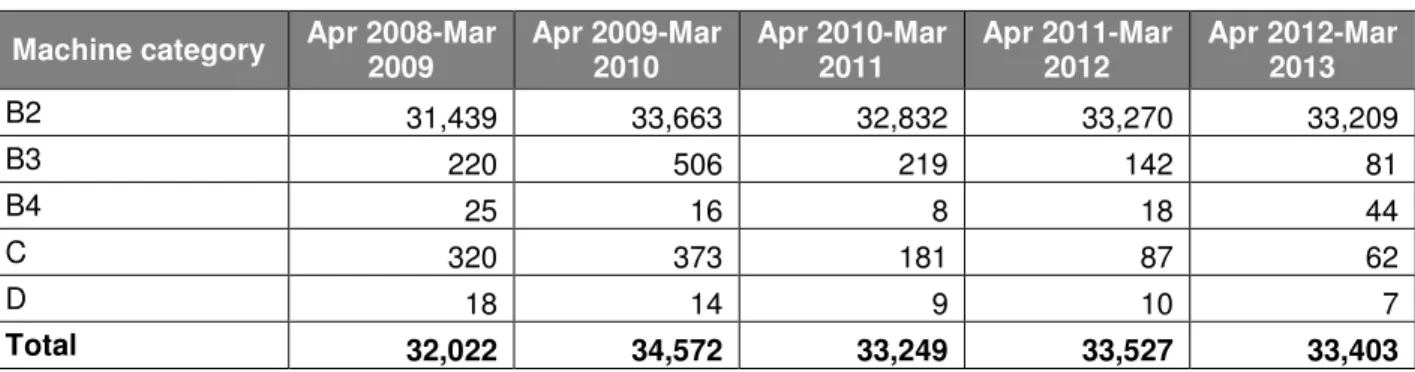
2013) estimate there are 33,209 category B2 gaming machines located in betting shops in Great Britain. These machines make up the overwhelming majority (over 99%) of gaming machines in the betting sector. Table 1 sets out average gaming machine numbers in the betting sector over a five year period.
Table 1: Gaming Machines in Betting Shops: Average Gaming Machine Numbers
Machine category Apr 2008-Mar
2009 Apr 2009-Mar 2010 Apr 2010-Mar 2011 Apr 2011-Mar 2012 Apr 2012-Mar 2013 B2 31,439 33,663 32,832 33,270 33,209 B3 220 506 219 142 81 B4 25 16 8 18 44 C 320 373 181 87 62 D 18 14 9 10 7 Total 32,022 34,572 33,249 33,527 33,403
4. Gross Gambling Yield (GGY) from gaming machines in betting shops has increased since 2008-09. Category B2 gaming machines contributed over £1.5bn in revenue to the betting industry in 2012/13. Gross Gambling Yield represents the amount
retained by the operator after prizes are paid. Table 2 shows gaming machine GGY in the betting sector over a five year period.
Table 2: Gaming Machines in Betting Shops: Gaming Machine GGY (Gross Gambling Yield)
Machine category Apr 2008-Mar 2009 £m Apr 2009-Mar 2010 £m Apr 2010-Mar 2011 £m Apr 2011-Mar 2012 £m Apr 2012-Mar 2013 £m B2 1,050.71 1,166.50 1,302.38 1,450.35 1,547.12 B3 2.46 7.69 2.07 1.75 1.71 B4 0.70 0.07 0.02 0 0.02 C 1.64 1.08 0.61 0.23 0.23 D 0.05 0.12 0.02 0.01 0.01 Aggregated categories1 15.43 7.48 2.24 0.77 2.41 Total 1,070.99 1,182.94 1,307.34 1,453.11 1,551.50
Rationale for Intervention
5. Category B2 gaming machines offer the highest maximum stake of any gaming machine in Great Britain. The betting shops in which they are predominantly found are often located on high streets and other relatively accessible locations. Some people have experienced considerable problems from gambling on these machines. The recent publication “Gambling behaviour in England and Scotland – Findings from the Health Surveys for England 2012 and the Scottish Health Survey 2012” showed an estimated 7.2% problem gambling prevalence rate among people who use gaming machines in bookmakers, which is higher than some other forms of machine
gambling and many other products available in terrestrial gambling premises regulated by the Gambling Commission. It is also higher than the overall problem gambling prevalence rate for the adult population, which is estimated to be around 0.6%.
6. In addition, category B2 gaming machines present a combination of high stakes and natural game volatility that can generate significant losses in a short space of time. The Gambling Commission has advised the Government that it is quite possible for individuals to lose several thousand pounds in an hour within the normal range of behaviour of the B2 machine. The Commission has further advised that a small but significant proportion of sessions on B2 machines result in high losses, with
approximately 6% of sessions resulting in a loss of more than £100. Government intervention is necessary to create the appropriate regulatory environment in which these machines are provided.
Background and Options Considered
7. In January 2013, the Government consulted on proposals to amend the maximum stake and prize limits for certain categories of gaming machine. In respect of category B2 gaming machines, the Government sought evidence on the extent of the impact that a reduction in B2 stake and/or prize might have both socially and economically. During the course of that review, both the Gambling Commission and the
Responsible Gambling Strategy Board (RGSB) advised that a precautionary
reduction in stakes was unsupported by the available evidence. However, both were equally clear that the Government could quite reasonably act on a precautionary basis should the lack of transparency around the impact of B2 machines persist. 8. In its response to the consultation issued in October 2013, the Government decided
not to amend stake or prize limits for B2 machines but concluded that the future of the machine was unresolved pending further work to explore “what precautionary measures might be needed and when”. This is dealt with substantively in the Impact Assessment for the Triennial Review of Gaming Machine Stake and Prize Limits, published in October 2013.
9. In March 2014, the Association of British Bookmakers implemented new player protection measures on B2 machines as part of its voluntary industry code for social responsibility. These self-regulatory measures include mandatory warning messages after every £250 spent and at thirty minute intervals. The Government considers that, while a step in the right direction, player protection measures such as these should be toughened and made mandatory. The Gambling Commission is undertaking a review of its licence conditions and codes of practice with a view to requiring all players to be presented with a choice to set limits before play, and ensuring regular messaging and pauses in play to prompt players to consider their behaviour and remain in control. The Gambling Commission expect the outcome of this review to be published in the coming months, with any changes being effective from April 2015.
10. In April 2014, the Government announced that it would adopt a precautionary
approach to category B2 gaming machines. The Government proposes to introduce a new requirement that those accessing higher stakes (over £50) load cash via staff interaction or use account-based play. The intended effect of the policy is that customers will benefit from improved interaction and more conscious decision making. In addition, account based play provides greater opportunities for the provision of information, which is beneficial in helping customers make informed decisions.
11. More specifically, account based play allows players access to up-to-date and
accurate information in the form of activity statements and real time information about their session of play which can reduce biased or irrational gambling-related decisions and help people maintain control. The Government considers that tailored player information such as account summaries or activity statements may be a particularly effective way of giving clear and accurate information regarding game play and patterns of net expenditure.
12. Finally, making staff interaction a compulsory component of high staking machine play ensures greater opportunities for intervention where patterns of behaviour indicate that someone may be at risk of harm from their gambling, or for other reasons, such as preventing crime. There is evidence2 which indicates that regular
interaction can give players a reality check. This approach emphasises consumer control which is particularly important given that some experts believe that a lack of control may be a determinant of problem gambling.
Scope
13. A small number (approximately 112) of category B2 gaming machines are situated in casinos. Aside from betting shops, casinos are the only premises in which category B2 gaming machines are permitted. The Government does not propose to extend the new regulation to category B2 gaming machines situated in casinos. This is on the basis that opportunities for staff supervision and customer interaction are generally more readily available in casinos than in betting shops. The Government is mindful of the Statutory Principles of Regulation which requires regulation to be targeted and proportionate.
2 Cashless and card-based technologies in gambling: A review of the literature, Gambling
Benefit / Cost Analysis Methodology
14. This section of the impact assessment assesses the likely benefits and costs that will accrue to different groups as a result of implementing the government’s policy
proposal. Before proceeding to present an analysis of the benefits and costs, it is important to be clear about the methodological basis for appraisal. This needs to take account of structure of analysis, proportionality, and technical parameters.
Key areas of impact and the structure of analysis
15. The intended effect of the policy is that players will make better informed decisions about their gambling behaviour as a result of the new regulations. It is anticipated that as players are assisted to establish greater control over their gambling, there is likely to be a reduction in overall GGY on B2 machines and a corresponding impact on industry revenue. For the purpose of impact assessment, this change must be considered from both economic and social perspectives.
Proportionality
16. These impacts should be assessed to a level of analytical detail that is proportionate to the intervention being made. There are different factors to take into account when considering proportionality. Firstly, the policy is not irreversible because stake and prize limits for all categories of gaming machine are subject to regular review. Secondly, the regulatory intervention and associated distribution of impacts seeks to strike a balance between allowing normal leisure gamblers use of a product while protecting those who may be at risk. The impact assessment uses existing evidence in combination with contributions from industry and sector specialists.
Presentation of “do nothing” and other technical issues
17. There are a number of presentational and technical points that apply across different policy options. The do nothing option represents the status quo and therefore for the purposes of appraisal does not introduce any new benefits or costs that might affect the existing baseline. All monetised impacts are presented in present value terms unless otherwise stated, discounted at the Green Book determined rate of 3.50% per annum. All prices and monetised impacts are presented at 2009 prices unless
otherwise stated.
Framework for analysis
18. To be able to appraise the policy proposals accurately there needs to be a
mechanism for relating the proposed regulatory intervention to changes in industry revenue. The mechanism through which it operates is as follows:
a. Percentage of High Staking Players Reducing Stakes to £50: This is the primary mechanism through which the impacts on industry revenues will be realised. The model assumes that there will be some players who prefer to play anonymously and will therefore be limited to maximum stakes of £50. This assumption follows advice from industry, who have indicated that a proportion of their customers have a general preference for anonymity. On this basis, it follows that reduced spend per session is likely to lead to a corresponding decrease in machine GGY. However, where players choose to make payments via staff interaction or take up account based play in order to maintain access to higher staking levels the impact on industry revenues will be less. The extent to which people adapt their gambling behaviour as they establish
greater control is uncertain, but it is recognised that this is likely to have an additional negative impact on gaming machine revenue.
b. Level of Session Adjustment:Revenue losses might be dampened if some of these players choose to gamble at a £50 limit for a longer period of time than at a £100 staking limit. In line with advice provided by the Gambling Commission, we expect a proportion of players to act in this way. However, those who do not adjust their sessions in this way will on average spend less per session than they were before leading to a negative impact on industry revenues.
19. The framework for analysis gives the basis for quantitatively assessing the impact of the policy proposal. The way in which this is achieved is described in the following sections.
Establishing the baseline
20. The Gambling Commission collects annual gaming machine revenue (GGY) statistics dating back to 2008/2009 for gaming machines located in the sectors regulated by the Gambling Commission. Statistics from the Gambling Commission’s Industry Statistics 2008 – 2013 document, published in November 2013, are used as the basis for the industry revenue impact calculations.
21. Although it is intuitive to use the B2 GGY figures as set out in the industry statistics publication, it would be unwise to do so because these figures also include revenues from other categories of gaming machine (typically B3) which are available on the same terminal. This is because data is categorised under the highest category of game available on that machine. For example, if a terminal offers category B2 and B3 games (and it’s not possible for the operator to account for GGY by the component parts) operators attribute all revenue to the B2 machine category. For this reason, using the stated B2 figures will overestimate machine revenues. To overcome this, advice submitted by the Gambling Commission to DCMS in August 20133 has been
used to more accurately estimate B2 revenues. According to this advice, 76% of total gaming machine revenues in betting shops were accounted for by B2 play during 2012. Therefore, the baselines used in this analysis are derived from the figure for total machine revenues for 2012/13 multiplied by 76%.
22. In order to project the impact of the proposed regulatory intervention on industry revenues, it is necessary to do so from a representative baseline which accounts for changes in market conditions over the appraisal period. In recent years there has been a structural tendency for B2 revenues to expand. This can be represented through the compound annual growth rate (CAGR) which was 6% between 2010/11 and 2012/13. This is graphically illustrated in Graph 1, overleaf. Although it is common to use the CAGR to form the baseline, in this case, advice from the Gambling Commission in addition to evidence from the industry and investment consultancies suggests that the rate of B2 revenue growth is likely to be lower in the foreseeable future, with B3 content predicted to grow at a faster rate.
23. In a 2014 equity report, Morgan Stanley assume in their central estimate that
machine revenues will grow at 3% until 2017 (after 2017 is not modelled). According to Gambling Commission data, 49% of the growth in gaming machine revenues in betting shops between the years 2010/11 and 2011/12 was from B2 content. Applying this figure to the 3% Morgan Stanley figure would therefore suggest a B2 growth rate of 1.5% until 2017. Although significantly smaller than the CAGR of 6%,
3 http://www.gamblingcommission.gov.uk/pdf/Letter%20to%20Alison%20Pritchard%20re%20B2-B3%20gaming%20machine%20analysis.pdf
anecdotal evidence from Ladbrokes suggests that for the financial year 2012/13, B2 growth was almost flat, unlike B3 content4. In addition, changes to machine game
duty – which will rise from 20% to 25% from March 2015 – will also provide downward pressure on B2 revenue growth. Combined, these factors suggest that future B2 growth will not be as high as that experienced recently.
24. Notwithstanding the points made above, one must also take into account the UK’s strengthening economic recovery which could boost discretionary spending on B2 machines. The fact that operators continue to roll out new, more user friendly gaming machine cabinets across their betting shop estates suggests that the recent slide in B2 growth rates might be dampened. Whether these two factors will be enough to return the growth rates to levels seen in recent years remains to be seen. Given the uncertainty surrounding the B2 growth trajectory, low, central and high estimates have been used for the baseline in the analysis. In order to provide a sensible range of estimates, the low estimate assumes that B2 revenue will not grow over the
appraisal period, whilst the high estimate utilises the CAGR of 6% measured between 2010/11 and 2012/13. For the central estimate, we assume a growth rate of 3%. This seems reasonable in light of the recent slowdown in B2 growth but also the potential for recovery given the economic upturn and the anticipated introduction of new machine cabinets.
Graph 1 – B2 GGY (£m) 2010/11-2012/13:
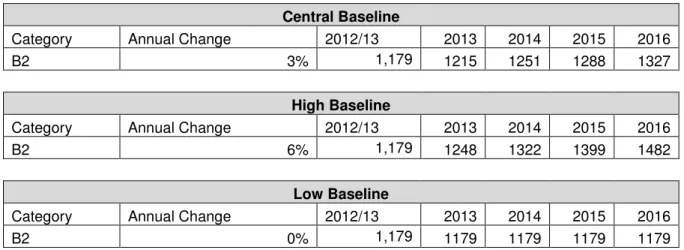
25. Table 3 sets out the low, central and high estimate baselines used in the analysis:
4http://www.ladbrokesplc.com/~/media/Files/L/Ladbrokes/Reports/annual-report-and-accounts-2013.pdf? 950.00 1,000.00 1,050.00 1,100.00 1,150.00 1,200.00 2010/11 2011/12 2012/13 G G Y ( £ m ) Financial Years B2 GGY
Table 3 – Baselines used as the basis for appraisal:
Central Baseline
Category Annual Change 2012/13 2013 2014 2015 2016
B2 3% 1,179 1215 1251 1288 1327
High Baseline
Category Annual Change 2012/13 2013 2014 2015 2016
B2 6% 1,179 1248 1322 1399 1482
Low Baseline
Category Annual Change 2012/13 2013 2014 2015 2016
B2 0% 1,179 1179 1179 1179 1179
Calculating the impact on revenues
26. Before the technical details of the model are set out, it is worth explaining the mechanism and assumptions through which the proposed regulatory intervention translates into lower industry revenues.
27. Under the government proposal, players who wish to stake at a level greater than £50 will have to interact with staff either at the counter or machine terminal, or use account based play in order to access stakes up to £100. Where higher staking access has been unlocked and a player wishes to continue staking above £50 per single action they will need to load cash via staff interaction each time they wish to add to their balance, or use a customer account. Alternatively, they can adjust their staking behaviour to £50 or below and play anonymously.
28. We assume in the central estimate that 85% of players gambling at stakes above £50 will accept interaction with staff at the counter or the machine terminal, or take up account based play, thereby maintaining their access to high staking play. However, we assume that the remaining 15% of players currently gambling at stakes over £50 would continue to play, but at a maximum stake of £50, thereby reducing machine revenues.
Table 4: Summary of assumptions underpinning model
Assumptions of Model
Central High Low
% of players shifting stakes to £50 15% 45% 5%
Level of session adjustment 50% 25% 75%
29. In 2005, a Canadian research paper on card based technology for machine gaming revealed that only 13% of machine gamblers opposed the mandatory usage of cards. Given that the paper used actual player data, player surveys and focus groups collated across 10 sites from 70 machines in Nova Scotia, this paper is arguably the most reliable available. Indeed, the methodology is considered to be strong,
particularly the broad cross-section of non-problem, low-risk, moderate-risk, and problem gamblers used in the study across locations. A survey in the same report suggests that between 70% and 90% of gamblers find cards easy-to-use and useful, something which might explain the low level of opposition to cards. This paper arguably lends support to our central assumption. Indeed, given that the
the option to interact with staff at the counter or gaming terminal as a means to stake above £50, the 15% figure used in the central estimate seems reasonable.
30. In order to consider a range of estimates for this assumption, other papers have also been assessed. One such paper is that by Australian consultancy firm McDonnell-Phillips, which in 2006 conducted a randomly selected telephone survey of machine gamers which suggested that only 30% of players would be prepared to use a pre-paid card. Although this figure is the lowest we have encountered, the result must be put into context. The question did not ask whether players would use a card if it were required to stake at the desired level, it was simply whether they would try using a pre-paid card under normal circumstances where the incentives to do so are much lower. Therefore, it is understandable that the figure in question stands at only 30%. Moreover, a literature review by the Gambling Commission which assessed the paper, pointed to the fact that the percentage of completed surveys relative to phone calls was around 1%, raising concerns about sampling bias.
31. Given that all large betting chains would be required to offer account based play under the proposed regulatory intervention, it is likely that they would quickly be considered a norm of machine gaming, thereby reducing the reluctance of some customers to use them. The Government expects larger gambling operators to encourage take up among their customers. As a result, it is quite possible that the proportion of customers who choose not to use account based play could be lower than the 15% figure used in the central estimate. However, the possibility that a higher proportion of high staking players might wish to maintain anonymity compared to lower staking players (in order to maintain privacy about their gambling behaviour) a figure of less than 15% would arguably be too low for the central estimate.
32. In response to the government’s proposals, industry submitted through the Association of British Bookmakers (ABB) analysis providing estimates of the projected impact. The ABB submitted research which included papers from investment bank Credit Suisse and stock brokers, Goodbody. As a whole, these papers tend to point to an impact on industry revenues which is higher than that projected in our analysis. Their figures are summarised in Table 5 below:
Table 5: Summary of revenue change projections submitted by industry
Firm % revenue change
Goodbody Stockbrokers 6%
Credit Suisse 3%
33. One of the main reasons for the projections being higher is because there are differences in the specification of assumptions relative to this analysis. For instance, Credit Suisse and Goodbody assume 50% of customers will refuse to use account based play or pay via staff interaction to stake above £50. Moreover, in the case of Goodbody, they assume as much as 25% of plays above £50 on B2 machines will be lost altogether. Given that the fundamental nature of B2 gaming will not have
changed because the maximum stake limit would still allow for viable roulette play, it is highly unlikely gamblers will stop playing it altogether as Goodbody have
suggested. Indeed, as with this analysis, Credit Suisse assumes that all customers will continue playing B2 machines after the proposed changes. However, we feel the assumption that 50% of players will refuse to use a customer account is
unrealistically high given the empirical evidence suggesting that only 13% of players would refuse to use them. Added to this the fact that players can pay for their
gambling via staff interaction we feel that our assumption of 15% is more realistic. 34. Revenue losses will be dampened by players who choose to stake at the £50 limit and play for longer than they did at a £100 limit. Previous advice from the Gambling Commission, as well as information from industry sources, suggests that around 50% of revenue lost as a result of the regulatory intervention will be recouped by players adjusting their behaviour in this way. However, due to the uncertainties in accurately predicting this, it was decided that a 50% range between the high and low estimates is appropriate for analytical purposes, as shown in Table 4.
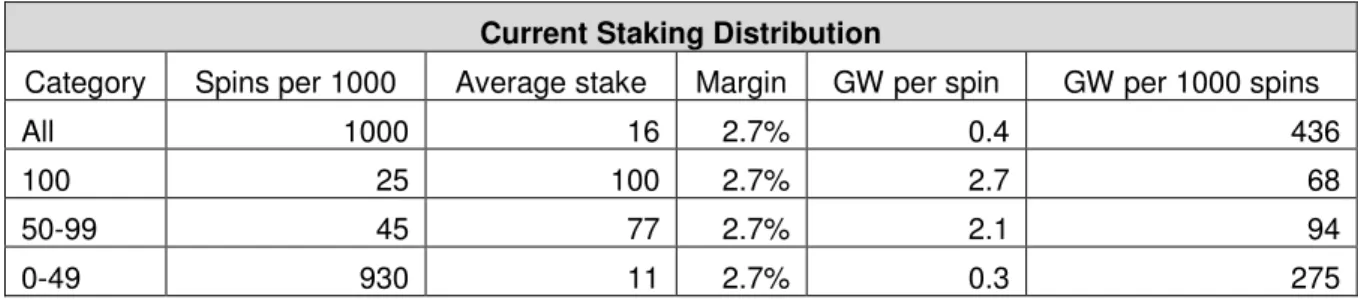
35. The model used to produce the revenue change estimate is built upon an established method previously used by DCMS, the Gambling Commission and Credit Suisse. 36. The method is underpinned by a staking distribution – based on data from the
Gambling Commission - for B2 play per 1000 spins. It includes the number of spins and the gross win expected for each staking category. For example, as set out in Table 6, it is evident that under current stake limits there are 70 spins per 1000 for stakes above £50, corresponding to a gross win (or revenues) of £162 per 1000 spins – based on a gross win margin of 2.7%. The return to player ratio at which B2 gaming machines operate is 97.3%, hence a gross win margin of 2.7% for the operator. Table 6 is based on data submitted to the Gambling Commission by industry and is
considered to be reliable.
Table 6: Current staking distribution for cash stake limit of £100
Current Staking Distribution
Category Spins per 1000 Average stake Margin GW per spin GW per 1000 spins
All 1000 16 2.7% 0.4 436
100 25 100 2.7% 2.7 68
50-99 45 77 2.7% 2.1 94
0-49 930 11 2.7% 0.3 275
37. When it comes to estimating the percentage revenue change figures which one would then apply to the baseline to calculate the total revenue costs over the appraisal period, one has to apply the assumptions set out in Table 4 and alter the staking distribution accordingly. Given that 15% of players previously staking above £50 are expected to stake at a maximum of £50 in order to remain anonymous, one has to correspondingly redistribute 15% of the spins in the staking categories above £50 to the £0-49 category. The model assumes that the additional spins now in the latter category are staked at the maximum cash stake limit of £50 rather than the average stake of £11 for that category.
38. The other 85% of players previously betting above £50 who are prepared to pay via staff interaction or take up account based play are represented on the staking distribution as they were previously. However, in order to account for session adjustment in which some of the players now staking at £50 play for longer, an ex-post adjustment to the new total gross win level is done by recouping, in the case of the central estimate, 50% of the revenue lost from players choosing to stake at the £50 cash stake limit.
39. The next stage of the model is to apply a Monte Carlo analysis which provides a range of possible values across a probability distribution for the percentage revenue
change figure based on the specification of the assumptions set out in Table 4. The analysis runs the model a large number of times (10,000) taking into account the assumptions for the central, high and low estimates, resulting in values at the median, 95th and 5th percentiles which correspond to the central, high and low estimates required for the model. The results of the Monte Carlo analysis are set out in Tables 7 and 8, below:
Table 7: Percentage revenue change figures resulting from Monte Carlo analysis
Change in Gross Win (%)
Median (Central) 95th Percentile (High) 5th Percentile (Low)
-1.4% -2.3% -0.7%
Table 8: Probability distribution for percentage revenue change resulting from Monte Carlo analysis (the red lines are the 5th and 95th percentiles, respectively)
40. The percentage revenue change figures for the central, high and low estimates, allow us to calculate the revenue cost figures across the appraisal period, allowing for NPV and EANCB figures to be calculated. This stage of the model requires, in the case of the central estimate, applying the -1.4% revenue change figure to the projected B2 machine revenues across all years of the appraisal period. Inflation is taken into account by using the Treasury deflator, as is the conversion to present values using the discount rate of 3.5% as stipulated in the Green Book. The results of these calculations are presented in Tables 9 and 10 respectively.
Table 9: Total change in industry revenues at constant prices over three year appraisal period
Central Estimate
Category % Revenue Change Total
B2 -1.4% -£52m
High Estimate (£m)
Category % Revenue Change Total
B2 -2.3% -£98m 0% 1% 2% 3% 4% 5% 6% 7% 8% 9% 10% 0% -1% -2% -3% -4% -5% P ro b a b il it y
Low Estimate (£m)
Category % Revenue Change Total
B2 -0.7% -£25m
Table 10: Total change in industry revenues in present value and constant price terms over three year appraisal period
Central Estimate (£m)
Category % Revenue Change Total
B2 -1.4% -£50m
High Estimate (£m)
Category % Revenue Change Total
B2 -2.3% -£95m
Low Estimate (£m)
Category % Revenue Change Total
B2 -0.7% -£24m
41. Although the calculations made above consider the revenue impact derived from customers who choose not to interact with staff or use account-based play, they do not take into account the revenue impact of behavioural changes from customers using account-based play or staff interaction to play at stake levels above £50. While the intention of the policy is that customers will make better informed decisions about their gambling as a result of increased interaction and access to better information, it is not possible to accurately predict what impact this will have due to uncertainties in predicting customer behaviour. We therefore decided not to attempt to quantify these impacts in the analysis. Despite this, it is widely accepted in independent analysis by investment banks that the primary impact will occur as a result of the migration of players to a lower stake limit of £50, something that has been explicitly modelled in this section.
Betting shop profitability and employment impacts
42. The impact of this regulatory intervention is assessed primarily through changes to industry revenues, which could potentially translate into shop closures and job losses. Although it is difficult to calculate a firm number of shop closures or job losses which might result from the proposed regulatory intervention, it is possible to provide an indication of the number of shops and jobs that may be at risk. Table 10 shows an adapted profitability distribution - sourced from a 2014 Morgan Stanley equity report – which has been altered to assess the potential change in profitability (EBIT) based on the percentage change in industry revenues as a result of the Government’s
proposed regulatory intervention.
43. The analysis works by splitting all 9031 LBOs into deciles, each with a corresponding EBIT and machine revenue share based on the Morgan Stanley distribution. Although it is quite likely that different betting operators will have different profitability
distributions, we assume there is not likely to be significant variation given the level of competition and commonalities in the strategies pursued by the UK’s largest betting operators which account for 87% of all betting shops. To calculate the number of shops at risk of closure, one splits the total EBIT and machine revenue into each decile and then divides this figure by the number of shops in that decile to get profit per shop - which for the sake of simplicity we have equated to EBIT per shop - and
machine revenue per shop. Then, the percentage revenue change figure is multiplied by the machine revenue figure, the result of which is then subtracted from the original profit per shop figure to get the new profit per shop figure under the proposed
regulatory intervention.
44. The result of this analysis for the central estimate is set out in Table 11 which shows that after the implementation of the proposed regulatory intervention, nine out of the ten deciles are still profitable, with changes in profitability ranging between 3% and -8%. Therefore, we expect at least 90% of all betting shops to remain profitable. Impact may be greatest in the 10% of betting shops which are currently unprofitable. Following the regulatory intervention, we expect these shops to be on average approximately £1500 less profitable per year. Thus, although these shops were already at risk of closure based on profitability, one could make the argument that they are now at greater risk of closure.
45. It is important to note that the current level of profitability per shop is an average figure and therefore it is quite possible a sizeable proportion of the 903 shops in the 10th decile will still be profitable after implementation of the proposed regulatory intervention. Moreover, even among the shops which do become unprofitable or more unprofitable, there can be little certainty around how many would actually close because there are reasons related to market share, brand exposure and the
placement of shops in growth areas to explain why betting operators may be willing to keep loss making shops open.
46. Dynamic impacts resulting from the proposed regulatory intervention are also not considered. For instance, the negative impact of profitability across the distribution could be mitigated to some extent by product innovation or another business response which historically has often followed regulatory change in a range of industries. Given the uncertainties in forecasting any potential industry response, we have not attempted to quantify this as part of the analysis. Another context in which to consider the results in Table 11 is the normal business cycle and natural churn of shop closures. As is evident from betting shop annual reports, shops are opened, closed and re-sited every year in response to market conditions. Therefore it would be unwise to assume that a slight increase in shop unprofitability in the 10th decile would automatically translate into significant shop closures.
47. Without greater data granularity, knowledge of the strategies of betting operators and the impact of dynamic effects, it is difficult to predict with any certainty the number of shops which may close as result of the proposed regulatory intervention. However, given that the average change in profitability is only likely to be -£1500 per shop per year in the central estimate for the at risk decile and that they are already
Table 11: Average change in shop profit by decile per year in 2012 prices Central Estimate Decile Shops % EBIT share Current retail PBT per shop (£k) £50 Cash limit retail PBT - central case (£k) Change in Profitability (£k) % Change in Profitability 1st (Most Profitable) 903 26% 174 169 5.5 -3% 2nd 903 17% 113 109 4.3 -4% 3rd 903 14% 95 91 3.7 -4% 4th 903 12% 80 76 3.4 -4% 5th 903 10% 67 64 3.1 -5% 6th 903 8% 55 52 2.8 -5% 7th 903 6% 40 37 2.4 -6% 8th 903 5% 34 32 2.1 -6% 9th 903 3% 21 20 1.8 -8% 10th (Least Profitable) 903 -1% -6 -8 -1.5 -25% Total 9031
Table 12: Average change in shop profit by decile per year across estimates in 2012 prices
Decile Shops % EBIT share Current retail PBT per shop (£k) £50 Cash Limit Profit per Shop (£k) Change in Profit (£k) % Change in Profit Central - 10th Decile 903 -1% -6 -8 -1.5 -25% High - 10th Decile 903 -1% -6 -9 -2.6 -42% Low - 10th Decile 903 -1% -6 -7 -0.8 -13%
Industry adjustment costs, on-going costs and supply chain impacts
48. It is expected that adjustment costs required to ensure compliance with the new regulations will be relatively small. As B2 gaming machine content is server based, it is possible for software updates to be made on a large scale at once. In addition, all large betting operators either already offer, or are preparing to offer, customer account schemes which will result in low adjustment costs for this aspect of the regulatory measure. Small and micro sized independent betting operators who do not already have customer account schemes will not be required to implement them if they do not wish to. Given the small size of these costs in all likelihood, it is reasonable to assume they are negligible.
49. However, given that some players are likely to choose to access higher stakes via staff interaction, there will be a corresponding burden placed on staff in shops who will have to devote time to such customers in addition to their existing responsibilities. It is necessary to consider what the additional labour cost to gambling operators of complying with the proposed regulatory intervention will be.
50. To calculate this we firstly establish B2 gaming machine turnover per year generated from stakes above £50 (cash through machine as opposed to GGY), and average stake per spin for all stakes over £50. Both of these statistics were calculated using Gambling Commission industry statistics and a submission to DCMS5. Dividing the
5 http://www.gamblingcommission.gov.uk/pdf/Letter%20to%20Alison%20Pritchard%20re%20B2-B3%20gaming%20machine%20analysis.pdf
former by the latter, produces an estimate of the total number of spins per year at stakes above £50. This equates to 170.35m spins:
51. It is also possible to estimate the total number of sessions played on B2 machines per year. Research by Barclays6 reveals that the average number of spins per
session across all staking categories is likely to be 16.7. This is calculated from operator data which shows gamblers on average spin every 27 seconds and that the average session lasts 7.5 minutes. Therefore the average number of spins per session is as follows:
52. From Gambling Commission data, we are able to establish there are a total of 2381 spins per year across all staking categories. By dividing the total number of spins per year by the number of spins per average session we reach the following figure; 2381m/16.7 = 142.9m. However, data limitations mean it is not possible to establish how high staking spins are distributed across player sessions. It is possible that a small number of high staking spins are each distributed across a large number of sessions, but equally it is possible that high staking spins are preferred by a relatively small number of players and therefore confined to a small number of sessions. The figure of 142.9m sessions represents the maximum number of sessions into which the 170.35 million spins could be distributed into. However, we consider it highly unlikely that all players will stake above £50 in every session they play given the average stake is estimated to be only £16.157.
53. We can also estimate the lowest number of sessions into which the spins above £50 can be distributed into: If we know there are 170.35m spins and the average session consists of 16.7 spins, we can estimate there are 10.22m sessions with £50 spins if all the spins in these sessions are above £50 (170.35/16.7=10.22). This is a highly unrealistic scenario but gives us the lower bound of the continuum between 10.22m and 142.9m sessions. In reality, the number of sessions with spins above £50 probably sits somewhere between these points. However, in order to calculate the increased labour costs, we need to estimate the number of sessions in scope of this policy proposal.
54. Since no data exists in this area, we have to use intuition. Gambling Commission data indicates that only 7% of spins are above £508. Given that the average stake is
estimated to be £16.15, it is reasonable to assume that fewer than 50% of sessions will contain stakes above £50. Therefore we feel that the 50% figure should constitute the High estimate. Given that the lowest number of sessions that may contain £50 spins is 10.22m (for reasons stated in paragraph 51) which equates to approximately 7% of sessions, it is reasonable to assume a figure of 10% in the Low estimate. More important is the Central estimate which we will use to input into the EANCB
calculation. It is reasonable to estimate that this figure lies somewhere between the
6 Barclays (2014), Is flawless Online execution likely?, February 2014 7 Credit Suisse (2013), UK Bookmakers, December 2013
8 http://www.gamblingcommission.gov.uk/pdf/Letter%20to%20Alison%20Pritchard%20re%20B2-B3%20gaming%20machine%20analysis.pdf
Spins > £50 = (Machine GGY £) > £50) / (Average stake per spins >£50)
170.35m = 14.54b/85.36
Spins per session = (60/27=spins per minute) * (Average session length=7.5)
High and Low estimates. In this instance we have decided to use a figure of 25%. This suggests that 1 in 4 sessions played on B2 machines will include at least one spin above £50. While it may be that fewer than 25% of sessions contain spins at over £50, in order to avoid underestimating the additional labour cost, we have assumed a 25% figure in the Central estimate. These assumptions are set out in Table 13:
Table 13 – Summary of estimates in terms of proportion of sessions with £50 spins and the number of £50 spins in these sessions:
Estimate % sessions with £50 spins Sessions with £50 spins (m) £50 spins per session
High 50% 71 2
Central 25% 36 5
Low 10% 14 12
55. To translate the assumptions in Table 13 into labour costs, we first need to estimate how many times a player will load cash during a particular session. Once again, there is no data to guide us on this. However, given that an average session lasts only 7.5 minutes, the average stake on a B2 is estimated to be £16.15 and that the return to player ratio on a B2 machine is 97.3%, it seems reasonable to assume that players will load twice in the Central estimate, with one and three loads for the Low and High estimates respectively.
56. As stated elsewhere, our analysis assumes that under the proposed regulatory intervention 85% of players continue betting above the limit and of those, only 15% would choose not to use a customer account and instead load cash through staff interaction at the counter or machine. Taking into account these assumptions, it is possible to estimate the number of actual staff interactions per year. We estimate this to be 9.1 m (36m*0.85*0.15*2 = sessions with £50 spins*% of players who continue betting above £50*% of players who then do not use a customer account but instead load through staff interaction*the number of cash loads per session). Assuming that i) each customer interaction where a payment of money is made will take around one minute and that the average cost per hour of labour is £7.34 (based on industry data), the additional labour cost per year will be approximately £1.11m in the Central
estimate. The results for all estimates is set out in Table 14, below:
Table 14 – Summary of labour costs across all estimates:
Estimate % sessions with £50 spins
Interactions per LBO per year (m)
Labour costs per year (£m)
High 50% 58.2 3.34
Central 25% 19.4 1.11
Low 10% 3.9 0.22
57. As is evident, the calculations in Table 14 depend on assumptions regarding the average number of spins per session, how many times the customer goes to the counter per session and the proportion of players deciding not to use customer accounts or stake in cash at the £50 limit. However, the opportunity for customers to take up account based play rather than pay for higher stake gambling via staff interaction is likely to mitigate the impact on staff labour costs. It is conceivable that labour costs could be absorbed by staff in betting shops where there are fewer customers, which would arguably mean that there are little or no labour costs
associated with the proposal. However, in order to avoid underestimating additional labour costs, we assume that there will be an additional impact on labour costs. Relative to the revenue impact from changes to gambling behaviour, we do not expect on-going or adjustment costs to be significant.
Assessment of impact on competition
58. The changes to industry revenues need to be assessed in terms of their impact upon competition. This can be considered through the prism of substitution.
59. The maximum stake for B2 gaming machines makes this category of machine relatively unique in comparison to other forms of gaming machines available on the high street or other accessible locations. Therefore, in terms of substitution, the most readily available alternative for machine players are B2 machines in casinos, where the new regulations will not apply. However, there are fewer casinos in Great Britain relative to betting shops. According to the Gambling Commission’s Industry Statistics 2013, there were 9,031 betting shops versus 143 casinos in Great Britain in 2013, with 33,209 B2 machines in betting shops and only 112 in casinos. Therefore,
because casinos are in very small numbers and are in a very different segment of the market, it is unlikely that casinos will benefit significantly from any competitive
advantage resulting from the government proposal. Moreover, given that players will still be able to stake up to £100 if they take up account based play or pay via staff interaction, we assume that the cost of travelling to a casino - and the extra
supervision that players are subjected to in such premises relative to betting shops - will outweigh the additional utility that could be derived from staking above £50 in cash.
60. However, regardless of the possible substitutions which exist for B2 gaming in betting shops, it is important to note that the fundamental nature of B2 gaming will not be altered by the proposed regulatory intervention. Indeed, as stated earlier in the analysis, we have assumed that all customers previously staking above £50 will continue to play albeit at either stakes up to £50, via staff interaction, or with a customer account. As a result, the proposed regulatory intervention is unlikely to result in significant substitution to other gambling products inside or outside betting shops. Without the scope for significant amounts of substitution, it is unlikely that this regulatory change would alter the competitive landscape.
Impact on the Exchequer
61. Changes in industry revenues will have an impact on Exchequer revenues. However, estimates of Exchequer revenues are a matter for HM Treasury and HM Revenue and Customs and are not estimated as part of this Impact Assessment.
Small and micro business assessment
62. In order to minimise the impact of the proposed regulatory intervention on smaller businesses, shops which are not owned by any of the large betting shop chains will be exempt from providing customer account schemes if they wish, thereby excluding them from the associated adjustment costs. Small and micro business will not, however, be exempted from the requirement to interact with customers who wish to access stakes above £50. Should small and micro businesses choose not to offer customer account schemes, interaction with staff will be the mechanism by which customers in these premises can access stakes in excess of £50.
63. Out of 9031 betting shops in Great Britain as of 2013, 8111 were owned by the five largest betting chains (William Hill, Ladbrokes, Gala Coral Group, Betfred and Paddy
Power), accounting for 90% of all betting shops. The remaining 920 are made up of a variety of small, micro and medium sized betting chains and individual shops.
64. To establish what proportion of the shops not owned by the five largest four chains are small or micro businesses, it was necessary to manually go through Gambling Commissioning licensing data of registered betting shops, deleting from the list all shops/chains which cannot be classified as being small or micro businesses. The EU definition of small and micro businesses – less than 50 employees - was used in this exercise. Although the licensing data does not indicate the number of employees each betting shop has, it is assumed that each shop employs four staff. Therefore, assuming that there are two management staff for each business, in this context this leads to the following definition of a small and micro business; a business which has 12 shops or less. There are 573 shops that fit this categorisation.
65. It is necessary for this assessment to distinguish the small and micro businesses from operators of a larger size. Although the Gambling Commission does not have data of this type available, it is possible to estimate it. From the Gambling
Commission Industry Statistics, it is evident that there are 33 209 B2 machines located in betting shops. Assuming that the density of B2 machines in the shops of the largest five betting chains are identical at four per shop (the statutory maximum), it can then be calculated that there are 31,236 B2 machines located in such shops. This leaves 1,973 B2 machines to be accounted for amongst the 920 betting shops which are not owned by the five largest operators. Assuming that the density of B2 machines among these shops is 3, it can be calculated that 72% of these shops have machines. The assumption of the shop density of these shops being 3 is based on data from the Gambling Commission which suggests the density of B2 machines in single site operators is 2.83. Given that that the 573 shops in question are not all single site operators, we felt using a density assumption of 3 was likely to be more accurate in light of the bigger customer base of larger operators which would warrant a greater density of machines in their shops.
66. By applying the 72% figure from the last paragraph to the number of small and micro businesses, 573, it becomes apparent that 413 shops are in scope. However, as stated above, these shops will not be required to offer customer accounts (although they may choose to do so if they wish to) thereby ensuring that they are not
disproportionately affected by adjustment costs.
67. A further reason for not exempting small and micro businesses from the fundamental requirement for high staking access to be enabled via staff interaction is that it would be detrimental to the aim of the policy proposal. The Government considers it
important that all B2 gaming machine players who wish to access high stakes should benefit from the opportunity of greater staff interaction. Moreover, such an exemption would also give an unfair competitive advantage to small and micro businesses who would have an opportunity to exploit their ability to offer high stake B2 gaming in cash without the need for account-based play or staff interaction.
Impact on reducing regulation - One-in, Two-Out
68. The method of assessing whether new legislative proposals add to, or subtract from, the current stock of business regulation is known as “One-in-Two-out” (OITO). Proposals that impose direct costs are described as “IN”, while proposals that lead directly to benefits are described as “OUT”. Proposals that lead to indirect costs and benefits only are classified as “Zero net cost”.
69. The “One-In-Two-Out” (OITO) status of this policy proposal is defined as “IN” because the proposals are regulatory. Given that the proposed regulatory intervention is likely to directly affect player behaviour and therefore industry
revenues, the impacts will be classified as direct, included within the OITO framework and scored accordingly as a net cost to businesses. Adjustment and on-going costs can also be classified as direct impacts, however for the reasons given previously they have not been included in the analysis.
Table 15: Business impact in 2009 prices
Business Impact 2009 Prices
IA Metrics Central Low High
NPV -£50m -£24m -£95m
EANCB -£17m -£8m -£33m
Macroeconomic impacts
70. The framework for analysis only looks at gambling markets through the impact on B2 machine revenues. It does not take into account wider economic effects in other gambling markets or the rest of the economy (general equilibrium) because doing so would be disproportionate relative to the size of the policy impacts expected.
Impacts on individuals and society
71. The Health Survey for England 2012 and the Scottish Health Survey 2012 provide information about gambling behaviour in England and Scotland. Further analysis of this data undertaken by NatCen provides in-depth analysis of gambling and problem gambling levels and examines the associations with problem and at-risk gambling. 72. The survey measures at-risk gambling using the Problem Gambling Severity Index
(PGSI). This identifies people who have experienced some difficulty with their gambling behaviour but who are not classified as problem gamblers. The surveys identify two groups: gamblers at ‘low risk’ of harm (a PGSI score of 1-2) and gamblers at ‘moderate risk’ of harm (a PGSI score of 3-7). Overall, the surveys estimate that in 2012, 3.2% of adults were low risk gamblers and a further 1.0% were moderate risk gamblers, meaning that overall 4.2% of adults had a PGSI score which categorised them as ‘at-risk’ gamblers. Rates of low risk and moderate risk gambling were higher among men than women and were higher among younger age groups. 73. The Health Surveys define problem gambling as gambling to a degree that
compromises, disrupts or damages family, personal or recreational pursuits. Estimates of problem and at-risk gambling are provided according to two different measurement instruments, the Diagnostic and Statistic Manual of Mental Disorders IV (DSM-IV) and the PGSI. According to the DSM-IV, problem gambling prevalence among adults living in private households in England and Scotland was 0.5%. Men were more likely than women to be classified as a problem gambler according to the DSM-IV (0.8% and 0.1% respectively). According to the PGSI, problem gambling prevalence among adults in England and Scotland was 0.4%, with men again being more likely than women to be classified as a problem gambler (0.7% and 0.1% respectively).
74. It is also possible to produce a problem gambling estimate based on whether
participants were categorised as problem gamblers according to either the DSM-IV or the PGSI. According to either the DSM-IV or the PGSI, problem gambling prevalence among adults in England and Scotland was 0.6%, with men again being more likely than women to be classified as a problem gambler (1.0% and 0.2% respectively).
75. With respect to B2 gaming machines specifically, the recent publication “Gambling behaviour in England and Scotland – Findings from the Health Surveys for England 2012 and the Scottish Health Survey 2012” showed an estimated 7.2% problem gambling prevalence rate among people who use gaming machines in bookmakers, which is higher than some other forms of machine gambling and many other products available in terrestrial gambling premises regulated by the Gambling Commission. 76. Further analysis of the Health Survey findings by NatCen examines the prevalence of
at-risk gambling behaviour by gambling activity. This analysis indicates that the overall prevalence of at-risk gambling among those who gamble on machines in bookmakers was 38%. The prevalence of moderate risk gambling was observed to be 14%, while the prevalence of low risk gambling behaviour among those who had played a gaming machine in bookmakers was 23%. The prevalence of at risk
gambling among users of gaming machines in bookmakers was high relative to other gambling activities.
77. Whilst drawing conclusions on causality between certain gambling products and problem or at risk gambling is problematic, the Government considers that these figures support the introduction of greater protections and controls for those people who play gaming machines in bookmakers. The proposed intervention achieves this by introducing regulations on a targeted and proportionate basis.
78. In addition some people have raised concerns about the high losses that can be experienced by users of B2 gaming machines, including those who may not be problem gamblers or at risk gamblers. A combination of high stakes and natural game volatility (where the player might be encouraged by the odd small win to put at risk high stakes) can generate significant losses in a short space of time. The regulatory intervention is designed to increase player interaction with betting shop staff, especially for those engaged in high stake machine play, to ensure players of gaming machines are assisted to remain in control of their gambling behaviour.
Conclusions: benefits, and costs of the policy proposal
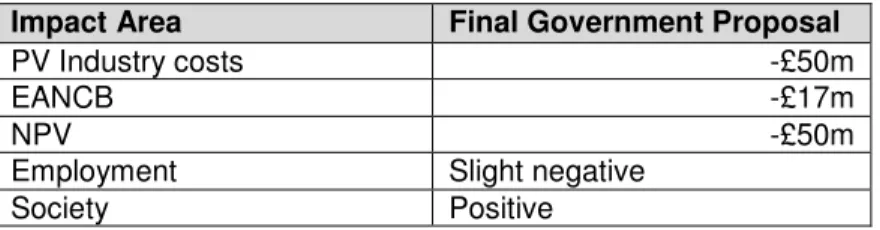
79. The impact assessment has considered a number of impacts including business revenues, adjustment and on-going costs, supply chain, employment, and societal impacts. The impact of the proposed regulatory intervention is summarised for the central estimate only in Table 16 below. It is recognised that additional negative impact on industry revenues is likely to occur as a result of players benefitting from improved decision making (e.g. choosing not to gamble where previously they might have). Given the significant uncertainty associated with estimating the proportion of people among those who do take up account based play or interact with staff subsequently changing their staking behaviour, we have not attempted to model for this impact as part of this analysis. Notwithstanding the impact on business, we consider the introduction of regulations for B2 machines to be justified.
Table 16: Summary of impacts of final government proposal with central assumption in present value and constant price terms
Impact Area Final Government Proposal
PV Industry costs -£50m
EANCB -£17m
NPV -£50m
Employment Slight negative