LD2SD: Linked Data Driven Software Development
Aftab Iqbal, Oana Ureche, Michael Hausenblas, Giovanni Tummarello
Digital Enterprise Research Institute (DERI), National University of Ireland, Galway
IDA Business Park, Galway, Ireland
[email protected]
ABSTRACT
In this paper we introduceLinked Data Driven Software
De-velopment (LD2SD), a light-weight Semantic Web
method-ology to turn software artefacts such as data from version control systems, bug tracking tools and source code into linked data. Once available as linked data, the related infor-mation from different sources is made explicit, allowing for a uniform query and integration. We show the application of LD2SD using a real-world software project as the reference dataset and discuss the added value of LD2SD compared to existing technologies.
1.
MOTIVATION
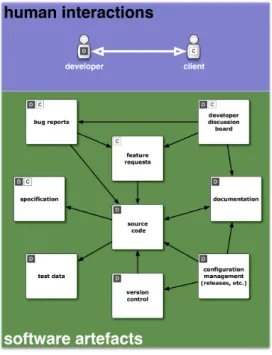
In the software development process, both humans and so called software artefacts are involved (Fig. 1). Human beings such as developers and clients (customers, project managers, etc.) typically interact not only face-to-face or telephone, but also by means of discussion forums, emails, etc.. The software artefacts shown in the lower half of Fig. 1 can be understood asheterogeneous, interconnected datasets, conveying information about the software project and the humans involved.
It is worth mentioning that very often these interconnec-tions are not explicit, hence machine-accessible but rather of an implicit nature (a mentioning of a certain Java class in a blog post, for example). Further, some of these datasets, such as the program source code or versioning data are mainly under the control of adeveloper, whilst other datasets are widely “filled” byclients. Then, there are datasets that are shared between developer and clients (e.g., a discussion board). In any case, the datasets are closely related and interdependent. A bug report, for example, may lead to a change in the program code and additionally the documen-tation needs to be updated. This may be reflected in the configuration management system. Further, a feature re-quest may indirectly arise from a discussion on a discussion board, for example.
Nowadays, development takes place mainly in two envi-ronments, (i) the developers Integrated Development Envi-ronment (IDE), such as Eclipse1, and (ii) the Web, such as
for finding examples and documentation, discussions, etc. as a large. We need hence not only make the links between the software artefacts within a project explicit but also
al-1
http://www.eclipse.org/
Figure 1: LD2SD Overview.
low connecting to data on the Web. Having such an explicit representation of the connection between the datasets avail-able we will be avail-able to support certain scenarios often found in the software development process:
1. Synthesis Scenarios—support the development of
new source code:
• A developer could effectively query colleagues for support (expert finding) and/or being suggested contextualised code fragment(s);
• A project manager could learn from previous projects and/or metrics.
2. Analysis Scenarios—support the project
manage-ment and maintenance of existing source code: • One could perform opinion mining on SIOC [8]
based representations of the discussion forums [19] in order to generate reports on a component or ex-tract features requests and/or bug reports. SIOC (Semantically Interlinked Online Communities) is
a vocabulary to describe the content and struc-ture of online community sites. It allows to create new connections between discussion channels and posts;
• Given that the documentation is interlinked with the source code, a dynamic FAQs could be pro-vided;
• Developer profiles, based on their commitments to versioning control systems and the source code could be provided.
The contribution of this work is twofold: first, we
intro-duceLinked Data Driven Software Development (LD2SD),
a light-weight Semantic Web methodology to turn software artefacts such as data from version control systems, bug tracking tools or Java source code into linked data. Further, we show the application of LD2SD on a reference software project.
The paper is structured as follows: in section 2 we present use cases for LD2SD. Then, we introduce the overall LD2SD methodology in section 3 and discuss its characteristics in section 4. We report on exemplary implementation of LD2SD in section 5. In section 6 we review related work and com-pare it to our approach. Finally, we conclude in section 7 and outline future steps.
2.
USE CASES
As motivated above, there are plenty of real-world scenar-ios one could think of where explicit interlinks between data sources would be desirable. We have detailed out a couple of use cases in the following which we realise in the realm of the software development. The use cases described below have in common that at least two data sets are involved. Note, that in case onlyone data set (such as bug tracking) is targeted, various solutions (cf. section 6) already exist, potentially not justifying the effort to apply LD2SD .
Finding an expert Jim has a long career in software project
management. He knows that a task will be solved fast and bug-free only by a developer who is an expert in the required field. Jim now wants to assign a new task which involves Web pages scrapping. He needs to find a member of his team who is an expert in the HTML-Parser Java library.
Issues not fixed in due time Bug tracking systems
con-tain a lot of issue entries. These issues need to be
fixed on assigned dates. Harry, a project leader, is
very busy, having to travel most of his time. He just came back from a project review and wants to know if all the issues due yesterday have been fixed. Harry additionally wants to know about the breakdown in terms of lines-of-code committed and which packages have been effected.
Find developer replacement Mary, a developer for a
soft-ware company, has to relocate with her husband in an-other city. Julie, her supervisor, needs to hire a devel-oper who can replace Mary. Therefore, Julie wants an analysis of her expertise and latest activities: assigned bugs, committed code, mailing list and blog posts, sub-sequently finding CVs that match Mary’s expertise.
Assigning a bug to a developer Bug tracking
environ-ments structurebugsassignment by projects. John, a user of projectX finds a bug and reports it on ablog
post. Sarah, a developer of projectY, reads theblog
post. However, she does not know the projectX de-velopers and their experience. She needs to find the most active developer in projectX and assign thebug
to him/her.
3.
LD2SD FOUNDATIONS
We first introduce linked data, the foundation ofLinked
Data Driven Software Development(LD2SD), and then give
an account of the LDSD methodology.
3.1
Linked Data
The basic idea of linked data [6] has first been outlined by Tim Berners-Lee in 20062, where he described the linked data principles as follows: (i) all items should be identified usingURIs [18] and these URIs should bedereferenceable, that is, using HTTP URIs allows looking up the an item identified through the URI, further (ii) when looking up an URI (an RDF [13] property is interpreted as a hyper-link), it leads to more data, and (iii) links to URIs in other datasets should be included in order to enable the discovery of more data. In contrast to the full-fledged Semantic Web vision, linked data is mainly about publishing structured data in RDF using URIs rather than focusing on the onto-logical level or inferencing. This simplification—comparable to what the World Wide Web did for hypertext—fosters a wide-spread adoption [4].
3.2
Methodology
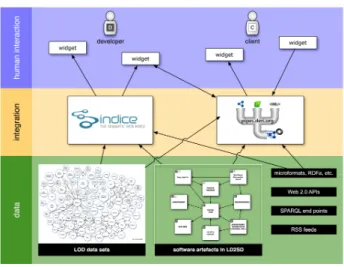
In order to provide auniform and central access to the different datasets, one needs to interlink, integrate and align them. Various techniques could potentially be utilised (see also section 6), however, given the arguments regarding linked data above, we decided to realise a linked-data driven ap-proach. In Fig. 2 the overall LD2SD methodology is picted. This methodology basically covers the layers as de-scribed in the following:
1. Assign URIs to all entities in software artefacts and convert to RDF representations based on the linked data principles, yielding LD2SD datasets;
2. Use semantic indexer, such as Sindice [15] to index the LD2SD datasets;
3. Use semantic pipes, such as the DERI Pipes (cf. sec-tion 5.2) allowing to integrate, align and filter the LD2SD datasets;
4. Deliver the information to end-users integrated in their preferred environment, such as discussed in section 5.3.
4.
LD2SD CHARACTERISTICS
4.1
Scale to the Web
In 2007, the Linking Open Data (LOD) project3, an open, collaborative effort aiming at bootstrapping the Web of Data
2
http://www.w3.org/DesignIssues/LinkedData.html
3http://esw.w3.org/topic/SweoIG/TaskForces/
Figure 2: LD2SD Methodology.
by publishing datasets in RDF on the Web and creating interlinks between these datasets, has been launched. With over 50 interlinked dataset offering billions of RDF triples and millions of interlinks, the so called “LOD cloud” enables entire new application areas [11].
We highlight the fact, that by utilising LD2SD, a Web-scale data integration of software development-related infor-mation is hence made possible. One can imagine that—as both LD2SD and LOD follow the linked data principles—we are able to connect software artefacts to the LOD datasets, such as DBpedia [3], hence enabling the reuse of existing information in the software development process.
4.2
Read-only?
To this end, LD2SD allows us to integrate, view and filter the data. However, one problem remains unresolved: updat-ing the original software artefact. With a recently launched community project called pushback4—aiming at turning the current “read-only” Semantic Web into a read/write Seman-tic Web—we are confident to adequately address this issue in the near future.
5.
IMPLEMENTATION
The methodology described in the previous section will be demonstrated herein. We have divided this section ac-cording to Fig. 2: in section 5.1, we describe the reference data set and the interlinking, in section 5.2, we show the querying of the interconnected datasets using DERI Pipes5, and in section 5.3 we present some earlier work on Semantic Widgets.
5.1
Data Layer
We first present a list of candidate software artefacts to be converted to RDF and then we present a concrete example to realise some use case described in section 2.
To practice what we preach, we have chosen the Sindice software project6 as the reference software project. In Ta-ble 1 the details regarding the respective LD2SD datasets
4
http://esw.w3.org/topic/PushBackDataToLegacySources
5http://pipes.deri.org/
6
http://sindice.com/
are listed, yielding more than 43,000 (43k) RDF triples in total.
In order to apply the interlinking approach to our soft-ware artefacts as listed in the previous section we examine the RDF datasets in the following. An excerpt of an ex-emplary RDF representation of some Sindice Java source code is shown in listing 1. Further, an example of some
1 @ p r e f i x b : < h t t p : / / b a e t l e . g o o g l e c o d e . c o m / s v n / ns /# > . 2 @ p r e f i x : < u r n : j a v a : o r g . s i n d i c e . p r o j e c t s . wp . > . 3 : W P L i n k E x t r a c t o r a b : C l a s s ; 4 b : c o n t a i n e d < > ; 5 b : u s e s < u r n : j a v a : j a v a . a w t . C o m p o n e n t > , 6 < u r n : j a v a : j a v a . io . I O E x c e p t i o n > .
Listing 1: An exemplary Java RDFication.
RDFised Subversion logs is shown in listing 2. From the
1 @ p r e f i x b : < h t t p : / / b a e t l e . g o o g l e c o d e . c o m / s v n / ns /# > .
2 @ p r e f i x : < s v n : / / s i n d i c e . c o m / s v n / > .
3 : b c 2 7 5 a b : C o m m i t t i n g ;
4 b : a d d e d < s v n : / / s i n d i c e / wp / W P L i n k E x t r a c t o r . j a v a > .
5 b : a u t h o r : o a n u r e .
Listing 2: An exemplary Subversion RDFication.
listings 1 and 2, we are able to conclude that both RDF fragments are describing the same entity, “WPLinkExtrac-tor.java”. We can interlink7 these two RDF fragments as shown in listing 3 using anowl:sameAsproperty indicating that these URIs actually refer to the same entity.
1 : W P L i n k E x t r a c t o r owl : s a m e A s
2 < s v n : / / s i n d i c e / wp / W P L i n k E x t r a c t o r . j a v a > .
Listing 3: An Interlinking Example.
5.2
Integration Layer
After RDFising and interlinking the software artefacts, the next step is integrating the artefacts and query them.
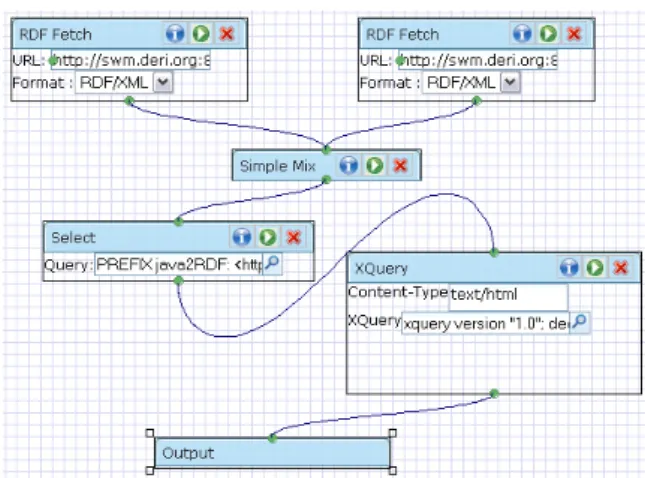
DERI Pipes [16] are an open source project used to build RDF-based mashups. They allow to fetch RDF documents from different sources (referenced via URIs), merge them and operate on them. In our case at hand, this involves four major steps:
1. Fetch the RDF representation of the Subversion log, JIRA8 issue tracker, Java source code, etc. using the
RDF Fetch operator9;
2. Merge the datasets using aSimple Mix operator10;
3. Query the resulting, integrated dataset with SPARQL11;
4. Apply XQuery12in order to sort and format the data from the previous step.
7 http://www4.wiwiss.fu-berlin.de/bizer/pub/ LinkedDataTutorial/#RDFlinks/ 8 http://www.atlassian.com/software/jira/ 9 http://pipes.deri.org:8080/pipes/doc/#FETCH 10 http://pipes.deri.org:8080/pipes/doc/#MIX 11http://www.w3.org/TR/rdf-sparql-query/ 12 http://www.w3.org/TR/xquery/
Software Artefact Data Format RDFizer Vocabulary Triples
JIRA Bug Tracker relational data D2RQ [7] BAETLEa 12k
Java Source Code structured data SIMILE RDFizerb SIMILE Java2RDF 22k
Subversion relational data BAETLE RDFizerc BAETLE 7k
Developer’s calendar RFC2445 [10] iCalendar to RDFd iCalendare 1k
Developer’s profile FOAF/RDF system specific FOAFf 1k
Developer blog relational data SIOC exporterg SIOC [8]h not yet implemented
Project Mailing Lists RFC2822 [17] SIMILE RDFizeri SIMILE Email2RDF not yet implemented
Table 1: The Sindice Reference Software Project. a http://baetle.googlecode.com/svn/ns/ b http://simile.mit.edu/repository/RDFizers/java2rdf/ c http://code.google.com/p/baetle/ d http://www.kanzaki.com/courier/ical2rdf e http://www.w3.org/TR/rdfcal/ f http://xmlns.com/foaf/spec/ g http://sioc-project.org/wordpress/ h http://rdfs.org/sioc/spec/ ihttp://simile.mit.edu/repository/RDFizers/email2rdf/
The output of the implemented pipe is then accessible via an URI.
Let’s consider the situation described in the Issues not
fixed in due time use case (cf. section 2). The information
we need to process is contained in a JIRA RDF dump13 describing the issues assigned to a developer, and in the the developers FOAF14 files. The state of an issue can be
Open,Closed or Resolved. We are interested in issues that
are Open and that were due yesterday. Further, we want to display the issue summary and the author full name. In order to retrieve the information we are interested in, we apply a SPARQL SELECT query (listing 4) .
1 P R E F I X b : < h t t p :// b a e t l e . g o o g l e c o d e . com / svn / ns /# > . 2 P R E F I X w3s : < h t t p :// www . w3 . org / 2 0 0 5 / 0 1 / wf / f l o w# > . 3 S E L E C T ? i s s u e ? a u t h o r ? s u m m a r y ? d u e _ d a t e 4 W H E R E { 5 ? i s s u e b : a s s i g n e d _ t o ? a u t h o r ; 6 b : d u e _ d a t e ? d u e _ d a t e ; 7 b : s u m m a r y ? s u m m a r y ; 8 w3s : s t a t e < h t t p :// l d 2 s d . d e r i . org / d a t a / B u g s 2 R D F / Open > . 9 }
Listing 4: SPARQL Query to Select Overdue Issues.
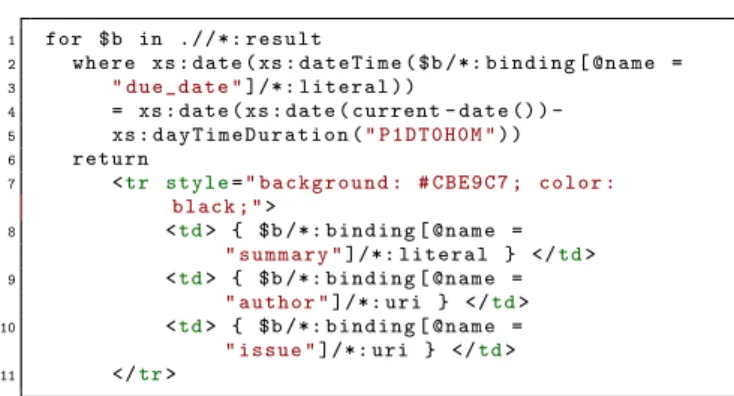
As a matter of fact, SPARQL is currently limited to fil-ter only specific dates. However, XQuery allows some basic calculations on top of the resulting SPARQL XML file, as shown in listing 5. In the XQuery box (see Fig. 4) we can specify theContent-type:xml/html, allowing us to format the output using HTML and directly display the result in a Web browser. The code snippet from listing 5 calculates the yesterday’s date by subtracting one day from the cur-rent date (lines 4-5) and renders thesummary,author and
issue elements as rows in an HTML table (Fig. 3). In a
second step, the developer’s profiles exposed as FOAF can be integrated. This would for example mean that the URIs in the Author-column in Fig. 3 would be replaced by the
13http://ld2sd.deri.org/data/Bugs2RDF/RDFDump.rdf 14 http://www.foaf-project.org/ 1 for $b in . / / * : r e s u l t 2 w h e r e xs : d a t e ( xs : d a t e T i m e ( $b /*: b i n d i n g [ @ n a m e = 3 " d u e _ d a t e "] / * : l i t e r a l ) ) 4 = xs : d a t e ( xs : d a t e ( current d a t e () ) -5 xs : d a y T i m e D u r a t i o n (" P 1 D T 0 H 0 M ") ) 6 r e t u r n 7 <tr s t y l e=" b a c k g r o u n d : # C B E 9 C 7 ; c o l o r : b l a c k ; "> 8 <td> { $b /*: b i n d i n g [ @ n a m e = " s u m m a r y "] / * : l i t e r a l } < /td> 9 <td> { $b /*: b i n d i n g [ @ n a m e = " a u t h o r "] / * : uri } < /td> 10 <td> { $b /*: b i n d i n g [ @ n a m e = " i s s u e "] / * : uri } < /td> 11 < /tr>
Listing 5: XQuery Filtering by Yesterday’s Date.
Figure 3: Pipe Result in a Web Browser.
respective developer’s full name. Further, by integrating the developer’s profile data, one can be group developer by team-membership (for example “core”, “API”, etc.) or ren-der dependencies on other developers.
In the same manner the data from Subversion can be in-tegrated in a further step in order to enable the breakdown in terms of lines-of-code committed or the highlight which packages have been effected by a certain bug-fix. Conclud-ing, the more data sets are integrated, the richer the queries may be.
A screen-shot of a pipe implementing the above example is depicted in Fig. 4.
5.3
Interaction Layer
The interaction layer handles the interaction between the integrated data as described above and the end-users, such as developers. We have shown elsewhere [21] how to utilise
Figure 4: DERI Pipes.
the datasets using Semantic Widgets. With Semantic Wid-gets, we provide a methodology to enhance existing Web applications and deliver aggregated views of information to end-users. These views are accessed by clicking buttons
Figure 5: Examples of Semantic Widgets.
which are injected into the DOM of a Web page. For ex-ample, next to a bug, related information regarding bugs or dependent bugs is displayed as shown in Fig. 5.
6.
RELATED WORK
There are certain technologies in the open source com-munity available to combine software artefacts. Existing work related to combining software artefacts has been de-scribed in Dhruv by Ankolekar et.al. [1], a Semantic Web system for open source software (OSS) communities. It pro-vides a semantic interface allowing users to see a detailed de-scription of highlighted terms in the message posted during bug resolution in cross-links pages. Their approach extracts information about software artefacts using information ex-traction techniques based on noun phrases, code terms and references to other artefacts. Dhruv is specifically designed for OSS bug resolution processes.
Another interesting, closely related work has been de-scribed in [2]. There, a relational database is used to store information related to version control and bug tracking data. The source code meta model has been represented using the Rigi Standard Format (RSF) [20], which is a triple based specification language that can be easily customised [2]. The integration of these three artefacts has been done by (i)
querying the relational database, and (ii) merging the re-sult with the source model RSF files. In contrast to their approach, we have provided a methodology to integrate the candidate software artefacts by RDFizing and interlinking them using linked-data driven approach.
In [12], Kiefer et.al. have presented EvoOnt15, a software repository data exchange format based on OWL16. EvoOnt
includes software code, code repository and bug informa-tion. They have used the iSPARQL 17 engine which is an extension of SPARQL, to query for similar software entities. iSPARQL is based onvirtual tripleswhich are used to con-figuresimilarity joins [9]. Their approach differs from our approach in that we have used DERI pipes to integrate and query different software artefacts.
Existing work related to our use cases discussed in sec-tion 2 has been described in [14]. Their approach uses data from change management systems and heuristics are based on but are limited to only two software artefacts, i.e., for software bugs and source code commits. Contrary to their approach, we have added developer’s information from blogs, mailing lists and developer’s profile to realize our use cases.
In [5], Basili et.al. have presented Experience Factory con-cept for software development. Experience Factory supports the evolution of processes and other forms of knowledge, based on experiences within the organization [5]. Experi-ences are captured from FAQs, chat logs, emails and project presentations. In contrast to their approach, we have pro-vided a methodology to capture knowledge from candidate software artefacts and interlink them to find a certain ex-pertise.
Mylyn18is a sub-system for the Eclipse IDE allowing mul-titasking for developer and task management. It provides the means render bug-related data in the Eclipse IDE for developers to work efficiently in their development environ-ment without having to log in to the Web based application to update or create new bugs. The limitation of Mylyn is that it works only with task repositories such as JIRA, Bugzilla19.
Further, there are plug-ins20 which integrates Subversion
with bug trackers, for example Bugzilla or JIRA. The plug-in displays all Subversion commit messages related to a specific issue. To the best of our knowledge such Subversion plug-ins are available for a few bug trackers.
Existing work described above somehow try to address the integration or interlinking of different software artefacts but some of them are desktop applications and some are Web based applications and none of the above described approaches address all the candidate software artefacts we described in this paper (see Table 1). Still what is missing is the existence of a generic framework where all software arte-facts can be collected and queried that would allow project managers to get an overall view of the software development projects. 15 http://www.ifi.uzh.ch/ddis/evo/ 16 http://www.w3.org/TR/2004/REC-owl-guide-20040210/ 17 http://www.ifi.uzh.ch/ddis/isparql.html 18http://www.eclipse.org/mylyn/ 19 http://www.bugzilla.org/ 20http://subversion.tigris.org/links.html# misc-utils
7.
CONCLUSION & OUTLOOK
We have motivated and introduced Linked Data Driven Software Development (LD2SD) as well as demonstrated its value in a concrete setup in this paper. The basic idea un-derlying LD2SD is to make the implicit links between
software artefacts found in software development—such
as version control systems, issue trackers, discussion forums, etc.—explicitand expose them using RDF. By using LD2SD, one enables a Web-scale integration of data, connecting to the LOD cloud and enabling the vast reuse of information.
We plan to implement further LD2SD use cases to show how one can benefit from it, especially when more than two data sources are involved. We aim to overcome a shortcom-ing of the current implementation, as it is not 100% linked data conforming; in certain places we use URNs rather than HTTP URIs. Additionally we will improve the interlink-ing, yielding higher-quality and also more links between the LD2SD datasets.
Acknowledgements
Our work has partly been supported by the European Com-mission under Grant No. 217031, FP7/ICT-2007.1.2, project Romulus—“Domain Driven Design and Mashup Oriented Development based on Open Source Java Metaframework for Pragmatic, Reliable and Secure Web Development”21.
8.
REFERENCES
[1] A. Ankolekar, K. Sycara, , J. Herbsleb, R. Kraut, and C. Welty. Supporting online problem-solving
communities with the Semantic Web. InProceedings of the 15th International Conference on World Wide Web, Edinburgh, Scotland, 2006.
[2] G. Antonio, M. D. Penta, H. Gall, and M. Pinzger. Towards the Integration of Versioning Systems, Bug Reports and Source Code Meta-Models. InElectronic
Notes in Theoretical Computer Science, pages 87–99,
2005.
[3] S. Auer, C. Bizer, G. Kobilarov, J. Lehmann, R. Cyganiak, and Z. G. Ives. DBpedia: A Nucleus for a Web of Open Data. InThe Semantic Web, 6th International Semantic Web Conference, 2nd Asian Semantic Web Conference, ISWC 2007 + ASWC 2007, pages 722–735, 2007.
[4] D. Ayers. Evolving the Link.IEEE Internet
Computing, 11(3):94–96, 2007.
[5] V. R. Basili, M. Lindvall, and P. Costa. Implementing the Experience Factory concepts as a set of
Experience Bases. InProceeedings of the 13th
International Conference on Software Engineering and
Knowledge Engineering, pages 102–109, 2001.
[6] C. Bizer, T. Heath, K. Idehen, and T. Berners-Lee. Linked Data on the Web (LDOW2008). InLinked
Data on the Web Workshop (WWW2008), 2008.
[7] C. Bizer and A. Seaborne. D2RQ - Treating Non-RDF Databases as Virtual RDF Graphs. In3rd
International Semantic Web Conference, Hiroshima,
Japan, 2004.
[8] U. Bojars, J. Breslin, V. Peristeras, G. Tummarello, and S. Decker. Interlinking the Social Web with
21
http://www.ict-romulus.eu/
Semantics. In IEEE Intelligent Systems, 23(3):
29-40,, 2008.
[9] W. W. Cohen. Data Integration Using Similarity Joins and a Word-Based Information Representation Language. InACM TOIS, pages 288–321, 2000. [10] F. Dawson and D. Stenerson. Internet Calendaring
and Scheduling Core Object Specification (iCalendar), RFC2445. IETF Network Working Group, 1998.
http://www.ietf.org/rfc/rfc2445.txt.
[11] M. Hausenblas. Exploiting Linked Data For Building Web Applications.IEEE Internet Computing, N(N):to appear, 2009.
[12] C. Kiefer, A. Bernstein, and J. Tappolet. Mining Software Repositories with iSPARQL and a Software Evolution Ontology. InProceedings of the ICSE International Workshop on Mining Software
Repositories (MSR), Minneapolis, MA, 2007.
[13] G. Klyne, J. J. Carroll, and B. McBride. Resource Description Framework (RDF): Concepts and
Abstract Syntax). W3C Recommendation 10 February 2004, RDF Core Working Group, 2004.
[14] A. Mockus and J. Herbsleb. Expertise browser: a quantitative approach to identifying expertise. In
Proceedings of the 24th International Conference on
Software Engineering, Orlando, 2002.
[15] E. Oren, R. Delbru, M. Catasta, R. Cyganiak, H. Stenzhorn, and G. Tummarello. Sindice.com: a document-oriented lookup index for open linked data.
International Journal of Metadata, Semantics and
Ontologies, 3(1):37–52, 2008.
[16] D. L. Phouc, A. Polleres, C. Morbidoni, M. Hauswirth, and G. Tummarello. Rapid
Prototyping of Semantic Mash-Ups through Semantic Web Pipes. InProceeedings of the 18th International
World Wide Web Conference (WWW2009), ACM,
Madrid, Spain, 2009.
[17] P. Resnick. Internet Message Format, RFC2822. IETF Network Working Group, 2001.
http://www.ietf.org/rfc/rfc2822.txt.
[18] L. Sauermann and R. Cyganiak. Cool URIs for the Semantic Web. W3C Interest Group Note 31 March 2008, W3C Semantic Web Education and Outreach Interest Group, 2008.
[19] S. Softic and M. Hausenblas. Towards Opinion Mining Through Tracing Discussions on the Web. InSocial
Data on the Web (SDoW 2008) Workshop at the 7th
International Semantic Web Conference, Karlsruhe,
Germany, 2008.
[20] S. R. Tilley, K. Wong, M. A. D. Storey, and H. A. Muller. Programmable Reverse Engineering. In
International Journal of Software Engineering and
Knowledge Engineering., pages 501–520, 1994.
[21] A. Westerski, A. Iqbal, G. Tummarello, and S. Decker. Sindice Widgets: Lightweight embedding of Semantic Web capabilities into existing user applications. In
Proceedings of the 4th International Workshop on Semantic Web Enabled Software Engineering,