KIRKPATRICK FOUR LEVELS
Audio Recordings Study Guide
it to people who did not buy the CD, create your own seminar or webinar using the contents, use these ideas as a means to obtain consulting and contract business for yourself, or represent these ideas as your own. Your only indication that you may legally use these materials for anything other than personal use within
your own company is written permission from :
Kirkpatrick Partners, LLC (443) 856-4500
68 West Shore Drive [email protected]
TABLE OF CONTENTS
Module 1 Introduction to the Kirkpatrick Model
Module 2 Kirkpatrick Principles and Methods
Module 3 The New World Kirkpatrick Model
Module 4 Implementing the New World Kirkpatrick Model
Page 5 Page 9 Page 15 Page 21
• Overview of the four levels • Three purposes of evaluation • Getting managers on board • Evaluating Level 1 - Reaction
Module 2
• Evaluating Level 2 - Learning • Evaluating Level 3 - Behavior • Evaluating Level 4 - Results • Evidence versus proof Dr. Jim Kirkpatrick
Module 3
• Creating evaluation success • Conducting purposeful evaluation
• The Kirkpatrick Business Partnership Model
Module 4
1
MODULE 1
OVERVIEW OF THE FOUR LEVELS
To what degree participants react favorably to the learning event
To what degree participants acquire the intended knowledge, skills and attitudes based on their participation in the learning event
To what degree participants apply what they learned during training when they are back on the job
To what degree targeted outcomes occur, as a result of Level 1: Reaction Level 3: Behavior Level 2: Learning
1
INTRODUCTION TO THE KIRKPATRICK MODELTen requirements for effective programs
1. Determining needs 2. Setting objectives
3. Determining subject content 4. Selecting participants
5. Determining the best schedule 6. Selecting appropriate facilities 7. Selecting appropriate instructors
8. Selecting and preparing audiovisual aids 9. Coordinating the program
10. Evaluating the program
THREE PURPOSES OF EVALUATION
1. Should we continue the program? 2. How can the program be improved? 3. Justify our existence
EVALUATING LEVEL 1 - REACTION
• Smile sheet - keep it simple
• Measure reaction in all of your programs LEVEL 1: REACTION
2
MODULE 2
EVALUATING LEVEL 2 - LEARNING
• Before and after
• Paper and pencil test
• Unwanted visitors should be treated ‘coolly’ so they won’t stay
• Delegation should always include the results to be achieved as well as the activities to be performed
• Performance test for skill
LEVEL 2: LEARNING
To what degree participants acquire the intended knowledge, skills and attitudes based on their participation in the learning event
2
KIRKPATRICK PRINCIPLES AND METHODSEVALUATING LEVEL 3 – BEHAVIOR
Change in Behavior Requirements:
• Desire to change
• Necessary knowledge and skills • The “right” job climate
• Encouragement and help • Rewards for change
Job Climate • Preventative • Discouraging • Neutral • Encouraging • Requiring LEVEL 3: BEHAVIOR
To what degree participants apply what they learned during training when they are back on the job
Transferring Learning to Behavior
Balancing two major factors: • Support
• Accountability
Guidelines for Evaluating Behavior
• Measure on a before / after basis
• Allow time for behavior change to take place
• Survey and / or interview at least two of the following: • The learners
• The bosses of the trainees
• The subordinates of the trainees (use caution) • Others who know the behavior of the trainees
2
KIRKPATRICK PRINCIPLES AND METHODSEVALUATING LEVEL 4 – RESULTS
• Measure on a before / after basis
• Allow time for behavior change to take place
• Repeat at appropriate times
• Consider cost verses benefit
• Consider “evidence” if “proof” is not possible
• Chain of evidence LEVEL 4: RESULTS
To what degree targeted outcomes occur as a result of learning event(s) and subsequent reinforcement
3
MODULE 3
CREATING EVALUATION SUCCESS
Avoid “reaction sheet, pretest and post-test and hope for the best” approach that currently prevails.
CONDUCTING PURPOSEFUL EVALUATION
Evaluation needs to be purposeful and deliberate
• Decide in advance what data and information is needed, and how you will get it
• More evaluation / data is not better
3
THE NEW WORLD KIRKPATRICK MODEL
Purposes of evaluation
1. Continue program 2. Improve program
3. Justify existence of training 4. Ensure compliance
5. Maximizing training effectiveness
6. Ensure learning and training are aligned with business strategy
Evaluations is about data and numbers, but also about information that may or may not be quantifiable.
Training needs partnership from business managers and leaders to execute levels 3 and 4.
The ADDIE model is poorly executed
A
- Analyze - this is largely ignoredD
- DesignD
- DevelopI
-
ImplementE
- Evaluate - training professionals are weak here
80% of our time is spent here. This is too much, because activity after the event is required.
3
THE NEW WORLD KIRKPATRICK MODEL
THE KIRKPATRICK BUSINESS PARTNERSHIP MODEL
Begin with the end in mind - use the four levels in reverse
Share data and information with business partnership and remain in contact along the way
Return on Expectations (ROE)
What a successful training initiative delivers to key business stakeholders, demonstrating the degree to which their expectations have been satisfied
Level 4:
Results Find out business needs and opportunities Level 3:
Behavior Define non-negotiable required behaviors Level 2:
Learning Identify required knowledge, skills and attitude to perform the required behaviors Level 1:
Training on Trial
• Demonstrating the value of training is like a lawyer presenting a legal case to a jury
• We have “corporate juries” - senior stakeholders interested in whether learning is proving organizational impact
• Prepare a compelling argument including credible data and anecdotal evidence
1 + 2 ≠ 4
• Training professionals must have evidence of Level 3 Behavior, in addition to evidence of Level 2 Learning, to show connection to Level 4 Results
4
MODULE 4
DATA - GATHERING METHODS
LEVEL 1: REACTION
• Reaction sheets are the most common
• For onboarding or new information, conduct a focus group after some time has passed
Key question: What have you found in your position for which you could have been better equipped?
• For executive level programs, get interview or focus group data; reaction sheet alone is not sufficient
LEVEL 2: LEARNING
• In delayed focus group, you can also ask what information participants recall from training
• Get more creative than pretest and post-tests!
• Measure learning throughout the program Skills observation
4
IMPLEMENTING THE NEW WORLD KIRKPATRICK MODELLEVEL 3: BEHAVIOR
• In delayed measurement (focus group or interview), you can ask “If you are not applying what you learned, why not?” to find out what isn’t working
• Questionnaires, surveys and patterned interviews are acceptable
• Behavioral observation is one of the best techniques, especially for skills-based learning
• Make sure you prepare training participants for Level 3 follow up and evaluation
• Action learning - giving training participants an actual project or task to complete on the job, in which they apply their learning, such that there is actual benefit to the organization
LEVEL 4: RESULTS
• Borrow data and information on level 4 metrics (i.e. sales volume, turnover, waste)
• Gather your own data and information
• Level 4 does not have to be so difficult, because often the data is already being tracked
EVALUATION BEST PRACTICES
Criteria for determining which levels to measure, and how robust of an evaluation plan is needed
• Is the program high impact? • Is there executive interest?
• How much has been invested in this program? • How many people will go through the program? • Is it a pilot?
The more yeses you have, the more robust of a chain of evidence required.
4
IMPLEMENTING THE NEW WORLD KIRKPATRICK MODELSIX PURPOSES OF EVALUATION
Instructions: When an initiative is identified for implementation, this tool guides the robustness and type of evaluation methods that should be used.
Each purpose should be discussed, and a rating of high, medium or low importance assigned. Once the mix has been analyzed, a comprehensive, targeted evaluation plan can be developed.
Program Name:
Purpose Rating What to do for a high rating
Should the program be continued? Query managers and participants in regards to on-the-job relevance and potential business impact.
Has the program become obsolete? Should it be discontinued, scaled back or incorporated into another program?
How can the program be improved? Conduct robust L1/L2 and predictive L3/4 evaluation, especially for pilots or when reaction sheets show weaknesses. Focus on qualitative information; it is more useful than data. Has the program been properly designed
to deliver the right content to the right people?
How can we ensure regulatory
compliance? Ensure there is good documentation. If L2 is the highest requirement, stop there. Focus on quantitative data. Will all boxes be “checked” to meet
requirements?
How can we maximize training
effectiveness? Conduct robust quantitative and qualitative evaluation for each level, and connecting them.
Will stakeholder expectations for strategic impact be met?
How can we be sure training is
aligned with strategy? Conduct a performance/business needs assessment of the course with a brief but targeted look at both quantitative and qualitative data. Is training connected to the purpose of the
organization?
How can we demonstrate the value
26 © 2013 Kirkpatrick Partners, LLC. All rights reserved. HARNESSING THE POWER OF LEVEL 3
The below case study is excerpted from Evaluating Training Programs: The Four Levels (3rd ed) by D. Kirkpatrick & J. Kirkpatrick, 2006, pages 144-167.
Evaluating a Leadership
Training Program
144
This case illustrates an organized approach to evaluating a leadership training program at all four levels. Forms and procedures are included as well as the results of the evaluation.The approach can be adapted to any type of organization.
Gap Inc.
Don Kraft, Manager, Corporate Training Gap Inc., San Bruno, California Introduction: Why Leadership Training?
In 1994 the need for leadership training was identified for the store-manager level for the Gap, GapKids, Banana Republic, and Interna-tional divisions of Gap Inc. The focus was on supervisory and leadership skills—how to influence and interact with store employees. The program selected to meet this need was Leadership Training for Supervisors (LTS). By providing store managers the opportunity to attend LTS, managers would not only improve their performance with supervisory and leadership skills, but job satisfaction would also increase. As one manager shared after attending LTS, “This was the most rewarding experience I’ve had with the company in my four years as Evaluating a Leadership Training Program 145
a manager.” Equally important, LTS would also provide managers with the necessary tools for developing people, so the business could remain competitive and continue to grow.
Getting to Level 4 Evaluation
Program
The LTS program was developed through a partnership between Blanchard Training and Development (BTD) and Gap Inc. Corporate Training Department. The content and delivery were customized to be applicable to the needs of the company. The three-day program focuses on the Situational Leadership® II model, as well as
communi-cation skills, goal setting, action planning, monitoring performance, giving feedback, and providing recognition.
The program continues, and training occurs throughout all divi-sions of the organization. The widespread use of one program con-nects employees at Gap Inc. by providing a shared philosophy and common language.
Audience
In 1994, the program rollout began and included general managers, area managers, district managers, and regional managers for Gap, Gap-Kids, Banana Republic, and International divisions. In 1995 and 1996, LTS was rolled out to store managers.The program continues today,
4
IMPLEMENTING THE NEW WORLD KIRKPATRICK MODELEvaluating a Leadership Training Program 145a manager.” Equally important, LTS would also provide managers with the necessary tools for developing people, so the business could remain competitive and continue to grow.
Getting to Level 4 Evaluation
Program
The LTS program was developed through a partnership between Blanchard Training and Development (BTD) and Gap Inc. Corporate Training Department. The content and delivery were customized to be applicable to the needs of the company. The three-day program focuses on the Situational Leadership®II model, as well as
communi-cation skills, goal setting, action planning, monitoring performance, giving feedback, and providing recognition.
The program continues, and training occurs throughout all divi-sions of the organization. The widespread use of one program con-nects employees at Gap Inc. by providing a shared philosophy and common language.
Audience
In 1994, the program rollout began and included general managers, area managers, district managers, and regional managers for Gap, Gap-Kids, Banana Republic, and International divisions. In 1995 and 1996, LTS was rolled out to store managers.The program continues today, focusing on new store managers and the additional participation of general managers from Gap Inc.’s division, Old Navy.
Evaluation Strategy
From the onset of planning the 1995 rollout to store managers, Gap Inc. Corporate Training Department was committed to evaluating the effectiveness of the LTS program. The evaluation strategy included measuring the program’s effectiveness on four levels:
1. Level 1: Evaluating Reaction. Determining participants’ initial
reactions to the LTS program: Were they satisfied with the program?
2. Level 2: Evaluating Learning. Determining if participants
learnedthe fundamental concepts of Situational Leadership®
II during the program:What new knowledge was acquired as a result of attending the program?
3. Level 3: Evaluating Behavior. Determining participants’change in behavior since attending the LTS program: How has the program affected on-the-job performance?
4. Level 4: Evaluating Organizational Results. Determining the
impact of the LTS program on the company: How has the program contributed to accomplishing company goals?
Evaluation Methods
Level 1: Evaluating Reaction
Participant reaction was evaluated both qualitatively and quantita-tively using the LTS Program Evaluation form. Each participant com-pleted an LTS program evaluation at the end of the program. See Exhibit 15.1 for the LTS Program Evaluation questionnaire, grouped with the other exhibits at the end of the chapter.
Level 2: Evaluating Learning
Participant learning was evaluated using the LTS Questionnaire.The LTS Questionnaire is a “fill-in-the-blank” test with fifty-five possible answers (see Exhibit 15.2). A sample of 17 percent of total partici-pants completed the questionnaire at the end of the LTS program. The questionnaire was completed anonymously. While completing the questionnaire, participants were not permitted to use any notes or
4
IMPLEMENTING THE NEW WORLD KIRKPATRICK MODELEvaluating a Leadership Training Program 147
4
IMPLEMENTING THE NEW WORLD KIRKPATRICK MODELEvaluating a Leadership Training Program 149
4
IMPLEMENTING THE NEW WORLD KIRKPATRICK MODELEvaluating a Leadership Training Program 151
Exhibit 15.2. LTS Questionnaire (continued)
The LTS Questionnaire was scored on a percentage basis by the number of correct answers. Each blank was equal to one point.All ques-tionnaires were scored by Gap Inc. Corporate Training Department.
Level 3: Evaluating Behavior
Short-Term Behavior Change. Behavior change was measured quantitatively by interviewing participants and their direct reports using the LTS Post-Program Survey.A random sample of 17 percent of total participants from each division was selected for this evalu-ation method. See Exhibits 15.3 and 15.4 for LTS Post-Program Surveys.
The LTS Post-Program Survey is an absolute rating scale survey of twelve questions.There are two versions of the survey. A store man-ager version was completed by interviewing the manman-agers who
4
IMPLEMENTING THE NEW WORLD KIRKPATRICK MODELEvaluating a Leadership Training Program 153
Exhibit 15.3. LTS Post-Program Survey: Store Manager Version (continued)
reports.The results of the survey determined managers’ perception of changes in behavior since attending LTS as well as perceptions of their direct reports.
4
IMPLEMENTING THE NEW WORLD KIRKPATRICK MODELEvaluating a Leadership Training Program 155
Exhibit 15.4. LTS Post-Program Survey:Associate/Assistant Manager Version (continued)
store numbers were used in the results. All completed interview sur-veys were mailed to Gap Inc. Corporate Training Department.
Long-Term Behavior Change. Leadership skills assessments were administered to store managers’ direct reports prior to the train-ing as well as six to nine months after attendance. Quantitative results were determined by comparing the preleadership skills assessment
4
IMPLEMENTING THE NEW WORLD KIRKPATRICK MODELEvaluating a Leadership Training Program 157
4
IMPLEMENTING THE NEW WORLD KIRKPATRICK MODELEvaluating a Leadership Training Program 159
pre- and postassessment, specifically for eight skill areas—directing, coaching, supporting, delegating, goal setting, observing performance, providing feedback, and communication.
Level 4: Evaluating Organizational Results
To investigate the impact LTS had on organizational results, Gap Inc. Corporate Training Department, in partnership with Blanchard Train-ing and Development, conducted an impact study to determine if improvement in leadership and supervisory skills had a positive impact on areas such as store sales, employee turnover rates, and shrinkage.
Sales. It was assumed that if the leadership skills of store managers improved, employee performance would improve, customers would be served better, and sales would increase.
Employee Turnover Rates. Studies indicate that recruitment, hir-ing, and on-the-job training costs are about 1.5 times the first-year salary for a job. Therefore, any training intervention that reduces turnover contributes directly to the bottom line.
Shrinkage. It was also assumed that by improving store managers’ effectiveness, shrinkage as a percent of sales should go down.
Interpreting LTS Results
Interpreting Level 1: Reaction
When reviewing the averages from the LTS program evaluation (Exhibit 15.1), use the following ranges as guidelines for responses to
expectations, relevance, facilitator’s presentation,andoverall program.
Range Interpretation
1–2 Participants had serious concerns about the training. Low–mid 3 Training provided some value, but could have been
better.
160 Case Studies of Implementation
Use the following ranges as guidelines for responses to appropriate for skill level.
Range Interpretation
1–2 Participants’ reactions indicated the material of the program was entirely too elementary.
2–3 Participants’ reactions indicated the material of the program was somewhat elementary.
3 Participants found the material “just right” for their skill level.
3–4 Participants’ reactions indicated the material was some-what advanced.
4–5 Participants’ reactions indicated the material was entirely too advanced.
Use the following ranges as guidelines for responses to pace of program.
Range Interpretation
1–2 Participants’ reactions indicated the pace of the pro-gram was entirely too quick.
2–3 Participants’ reactions indicated some sections were covered too quickly.
3 Participants’ reactions indicated the pace was “just right.” 3–4 Participants’ reactions indicated certain sections were
covered too slowly.
4–5 Participants’ reactions indicated the pace of the pro-gram was entirely too slow.
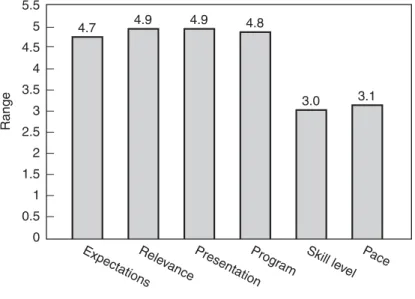
Figure 15.1 shows the results of LTS Program Evaluation.Table 15.1 shows a breakdown of these results. Store managers attending the LTS program responded to the training with incredible enthusiasm. They reacted favorably; their expectations were met and the training was
rel-4
IMPLEMENTING THE NEW WORLD KIRKPATRICK MODELEvaluating a Leadership Training Program 161
5.5 5 4.5 4 3.5 3 2.5 2 1.5 1 0.5 0 Expectations 4.7 Rele vance 4.9 Presentation 4.9 Prog ram 4.8 Skill le vel 3.0 Pace 3.1 Range
Figure 15.1. LTS Program Evaluation Results (all sessions)
Table 15.1. LTS Program Evaluation Results, by Division
Interpreting Level 2: Learning
Although store manager reaction was extremely positive, the question to ask was, Did they learn while attending the session? The following
Range Interpretation
Less than 50% More than half of the participants did not increase their knowledge.
50–60% Little over half the participants improved their knowledge.
60–80% The majority of participants gained new knowl-edge as a result of the training.
80–100% Outstanding! Almost all participants gained new knowledge.
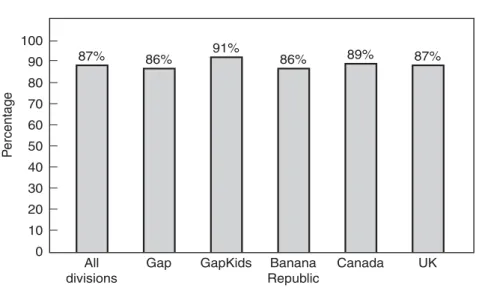
The results from the LTS Questionnaire shown in Figure 15.2 indicate that significant learning did occur during the program.The average score for all divisions from the LTS Questionnaire was 87 percent. Store managers were unfamiliar with LTS concepts before attending the session.The score of 87 percent indicates that new learnings were used to successfully complete the LTS Questionnaire.
Interpreting Level 3: Change in Behavior (Short Term)
Store managers’ reactions were positive, and significant learning occurred during the training. Now the question to ask was, Did the managers change their behavior on the job as a result of the training?
100 90 80 70 60 50 87% 86% 91% 86% 89% 87% P ercentage
4
IMPLEMENTING THE NEW WORLD KIRKPATRICK MODELEvaluating a Leadership Training Program 163
The LTS Post-Program Survey measured the degree to which managers’ behaviors changed in twelve skill areas, according to their own perceptions as well as their direct reports’ perceptions. Each of the survey questions focuses on a skill from the LTS program. Follow-ing are the skills surveyed:
Skill Interpretation
1. Diagnosing The ability to look at a situation and assess the developmental needs of the employee involved. 2. Leadership The patterns of behavior a leader uses as
per-styles ceived by others.
3. Flexibility The ability to use a variety of leadership styles comfortably.
4. Direction What supervisors use to build an employee’s knowledge and skills with accomplishing a task.
5. Support What supervisors use to build an employee’s commitment, both confidence and motivation. 6. Contracting The ability to communicate with employees
and reach agreement about which leadership style to use to help them develop competence and commitment to achieve a goal or com-plete a task.
7. Receiver Supervisors in this role can make communica-skills tion effective by encouraging dialogue,
con-centrating, clarifying, and confirming a sender’s message.
8. Sender Supervisors in this role can make communica-skills tion effective by analyzing their audience,
being specific, and using appropriate body language and tone.
9. Goal A function of leadership for ensuring standards setting are clarified.A clear goal creates a picture of
what good performance looks like.
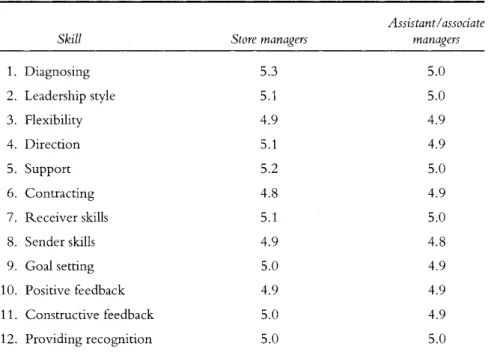
Table 15.2. LTS Post-Program Survey Results (all interviews)
12. Providing Reinforcing desired performance by acknowl-recognition edging progress and celebrating
accomplish-ments.
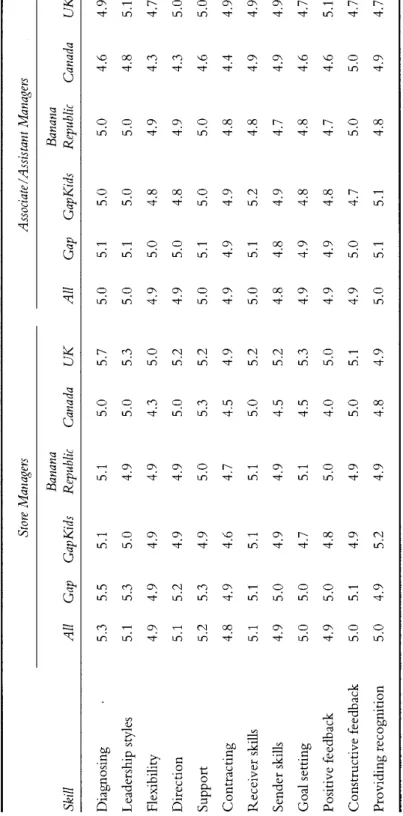
When looking over the results of the Post-Program Survey shown in Tables 15.2 and 15.3, the following ranges can be used as guide-lines:
Range Interpretation
4
IMPLEMENTING THE NEW WORLD KIRKPATRICK MODELTab le 15.3. LTS P ost-Pr og ram Sur ve y
Results (all inter
vie
ws),
by Di
Greater than 5 Any rating in this range is very positive and indi-cates the store managers improved dramatically in using the skill they learned since attending LTS. As seen in Table 15.3, store managers believe they have become “somewhat better” to “much better” in using all of the leadership skills included in the program. Specifically, store managers believe they have significantly improved their leadership skills in four areas:
1. Diagnosingthe development level of their employees
2. Using the correct leadership stylewith each development level 3. Providing directionto employees when needed
4. Providing supportto employees when needed
Table 15.3 also illustrates associate and assistant managers’ percep-tions of their store manager. All responses indicate a dramatic improvement in leadership skills since the managers attended LTS. In fact, five out of the twelve questions asked have an average score of five.
Interpreting Level 3: Change in Behavior (Long Term)
As store managers continued to focus on developing their supervisory and leadership skills, measurement of their ongoing success contin-ued. In 1996, store managers participated in the post-leadership skills assessment.
A comparison of all pre- and posttraining leadership skills assess-ment (LSA) results indicated that according to store employees, store managers had improved in all skill areas measured by the LSA— namely, directing, coaching, supporting, delegating, goal setting, observing and monitoring performance, feedback, and communica-tion. In fact, seven of the eight skill areas included in the assessment
4
IMPLEMENTING THE NEW WORLD KIRKPATRICK MODELEvaluating a Leadership Training Program 167
Interpreting Level 4: Evaluating Organizational Results
Store managers’ reactions were positive, new learnings occurred dur-ing the traindur-ing, and behaviors changed on the job since attenddur-ing LTS. The next question was, How has the training contributed to organizational results?
Recent statistical analyses have revealed positive correlation between improved LSA scores and increased sales, decreased turnover, and increased loss prevention in stores from which managers attended the training.The study examined stores with increased sales, reduced turnover, and reduced shrinkage that had the same managers in place one year prior to the training and one to one and a half years after attending LTS.
For each month, quarter, or year of store performance data exam-ined, the number of managers with increased sales, reduced turnover, and reduced shrinkage was compared with the number of managers with increased LSA scores and increased performance on these three measures. Of the stores with increased sales, reduced turnover, and reduced shrinkage, 50 to 80 percent of the time managers had also increased their LSA scores. In other words, store managers increased their leadership effectiveness and had a positive impact on store per-formance.
Over time (one to two years after training), the trend in the data is also very positive; the percentage of store managers with improved LSA scores and positive business results steadily increases.
Summary
On four levels of evaluation, LTS was a success. Store managers 1. Had a positive reaction to the LTS program
2. Learned new skills and knowledge while attending the pro-gram
3. Used those learnings to improve their performance as leaders on the job
CALL TO ACTION
SAMPLE HYBRID COURSE EVALUATION FORM
On the following pages is a sample hybrid course evaluation form. You may adapt and use it for your own programs.
Make your form as brief as possible, while gathering the data and information you need to build a strong chain of evidence for the value of your training to the organization.
4
IMPLEMENTING THE NEW WORLD KIRKPATRICK MODELParticipant Survey
Instructions: Thinking about the course you just completed, please indicate to what degree you agree with each statement using this rating scale:
1 = Strongly Disagree 2 = Disagree 3 = Agree 4 = Strongly Agree Please provide comments along with your rating to help us to improve this course in the future.
Learning Environment
The class environment helped me to learn. 1 2 3 4 There were no major distractions that interfered with my learning. 1 2 3 4 Comments:
Relevance
The program material will be helpful for my success in the future. 1 2 3 4 I will be able to immediately use what I learned. 1 2 3 4 Comments:
Delivery
I was well engaged with what was going on during the program. 1 2 3 4 The activities and exercises aided in my learning. 1 2 3 4 I was given adequate opportunity to demonstrate what I was learning. 1 2 3 4 Comments:
Overall
The program met my expectations. 1 2 3 4 I am clear on how to apply what I learned on the job. 1 2 3 4 I would recommend this program to my co-workers. 1 2 3 4
Comments:
From what you learned, what will you be able to apply on your job?
Energy for Change
How confident are you that you will be able to apply what you have learned back on the job? (Circle one rating)
0…..1…..2…..3…..4…..5…..6…..7…..8…..9…..10
Not at all confident Extremely confident
If you circled 6 or lower, please answer the following question. Circle all that apply.
My confidence is not high because:
a. I do not have the necessary knowledge and skills b. I do not have a clear picture of what is expected of me c. I have other higher priorities
d. I do not have the necessary resources to do it e. I do not have the human support to do it
4
IMPLEMENTING THE NEW WORLD KIRKPATRICK MODELHow committed are you to applying what you learned to your work? (Circle one rating) 0…..1…..2…..3…..4…..5…..6…..7…..8…..9…..10
Not at all committed Extremely committed
If you circled 6 or lower, please answer the following question. Circle all that apply.
My commitment isn’t high because:
a. I do not have the necessary knowledge and skills b. I do not have a clear picture of what is expected of me c. I have other higher priorities
d. I do not have the necessary resources to do it e. I do not have the human support to do it f. I am not required to do this
g. I am not rewarded or recognized for doing this h. Other (please explain):
What barriers do you anticipate that might prevent you from applying what you learned?
What might help to overcome those barriers?
REFERENCES
Kirkpatrick, D.L., & Kirkpatrick, J.D. (2005). Transferring Learning to Behavior. San Francisco, CA: Berrett-Koehler Publishers.
Kirkpatrick, D.L., & Kirkpatrick, J.D. (2006). Evaluating Training Programs: The Four Levels (3rd ed). San Francisco, CA: Berrett-Koehler Publishers.
Kirkpatrick, D.L., & Kirkpatrick, J.D. (2007). Implementing the Four Levels. San Francisco, CA: Berrett-Koehler Publishers.
Kirkpatrick, J.D., & Kirkpatrick, W.K. (2009). Kirkpatrick Then and Now. St. Louis, MO: Kirkpatrick Publishing.
Kirkpatrick, J.D., & Kirkpatrick, W.K. (2010). Training on Trial. New York, NY: AMACOM.
ADDITIONAL RESOURCES
American Society for Training and Development. (2009). The Value of Evaluation: Making Training Evaluations More Effective. Alexandria, VA: Author.
Brinkerhoff, R.O. (2003).The Success Case Method: Find Out Quickly What’s Working and What’s Not. San Francisco, CA: Berrett-Koehler Publishers.
Brinkerhoff, R.O. (2006). Telling Training’s Story: Evaluation Made Simple, Credible, and Effective. San Francisco, CA: Berrett-Koehler Publishers.
Church, A.H., Waclawski, J., & Kraut, A.I. (2001). Designing and Using Organizational Surveys: A Seven-Step Process. San Francisco, CA: Jossey Bass Publishing.
DeVillis, R.F. (2003). Scale Development, Theory and Applications (2nd ed). Thousand Oaks, CA: Sage Publications, Inc.
Dillman, D.A., Smyth, J.D., & Christian, L.M. (2008). Internet, Mail, and Mixed-Mode Surveys: The Tailored Design Method. Hoboken, NJ: John Wiley and Sons.
Hodges, T. K. (2002). Linking Learning and Performance: A Practical Guide to Measuring Learning and On-the-Job Application (Improving Human Performance). Boston, MA: Butterworth-Heinemann. Thalheimer, W. (2007, April). Measuring Learning Results: Creating Fair and Valid Assessments. Retrieved from http://www.work-learning.com/catalog.html
KIRKPATRICK FOUR LEVELS EVALUATION CERTIFICATION PROGRAM Program Description
The Kirkpatrick Model comprises the foremost evaluation methodology in the world. In this course, you will learn the true and correct methodology directly from the Kirkpatricks. You will apply it to a program of your own to maximize business results. This interactive course is limited to 30 or fewer attendees to ensure that you receive personalized attention and the opportunity to participate.
During this course, you will learn the Kirkpatrick Model, receive a participant manual filled with examples and templates that you may borrow and adapt to build your own tools, and gain a complete understanding of what each level measures. You will also explore the reasons why evaluation is critical to training success. Case studies and success stories from companies that have used the model effectively will be highlighted. You will also learn the Kirkpatrick Decision-Making Model for effective training resource allocation.
A unique feature of this course is the exploration of how to ensure that what is learned transfers to on-the-job behaviors. You will learn why training alone is not enough, and you will receive guidance to make sure that what you teach actually gets used on the job.
To complete the course, you will create an evaluation plan based on one of your own programs and submit it for grading and personalized comments. With a passing grade, you will become Kirkpatrick Certified. After this session, you will be able to:
• Objectively determine where to allocate training resources to create the most business impact • Create an effective program evaluation plan that maximizes business results and minimizes
resources employed
• Define the critical difference between effective training and training effectiveness • Evaluate programs using appropriate Kirkpatrick tools
“Kirkpatrick’s four levels is the best I’ve ever seen in evaluating training effectiveness. It is sequentially integrated and comprehensive. It goes far beyond ‘smile sheets’ into actual learning, behavior changes and actual results, including long-term evaluation. An outstanding model!”
Stephen R. Covey
Author, The 7 Habits of Highly Effective People and The Leader in Me
KIRKPATRICK® BUSINESS PARTNERSHIPCERTIFICATION PROGRAM
Program Description
The Kirkpatrick Model represents more than just training evaluation. It forms the framework for the Kirkpatrick Business Partnership Model, a holistic process that creates, delivers and demonstrates training value. In this course, you will learn how to leverage the model
to maximize business impact through all phases of the instructional design process.
In this workshop, you will study worldwide best practices and share your own experiences in an interactive, conversational environment. You will use your own programs for application activities, so actual work gets completed during the session. Attendance is limited to 30 to ensure you receive personalized attention.
Particular attention is given to business acumen and speaking the language of the business when you make your case for training resources and support. You will receive a workbook containing templates, samples, and tools, so you will be able to apply what you learned to all future programs within your company. Your certification is complete when you receive a passing score on the real life case you submit for grading and critique at the end of class.
After this session, you will be able to:
• Use the Kirkpatrick Business Partnership Model to design, develop, deliver and evaluate training programs that provide true business value
• Maximize training and business results with limited time, money and resources
• Build and effectively present a chain of evidence to provide a compelling argument for the value of learning to your organization
“Since the Program we have changed our entire way of thinking about results and begun to ask Senior Leadership to articulate their expectations before we begin our training intervention.”
Don Kirkpatrick, Ph.D. Jim Kirkpatrick, Ph.D. Wendy Kirkpatrick kirkpatrickpartners.com
ABOUT KIRKPATRICK PARTNERS
Kirkpatrick Partners is proud to be The One and Only Kirkpatrick® company and the only provider of authentic
Kirkpatrick products and programs. The company carries on the work of Don Kirkpatrick, Ph.D., and the four levels. Kirkpatrick Partners offers seminars, consulting, impact studies, books and other written resources on the Kirkpatrick Model and related concepts.
Kirkpatrick Partners is firmly grounded in the principles that Don Kirkpatrick created over 50 years ago. It was established in 2008 to respond to a growing need for companies to rationalize the resources dedicated to training. It was originally called Kirkpatrick Consulting. The company was renamed to better represent the full line of products and services it provides to the training and business community.
Don is the company’s Honorary Chairman. Jim, Don’s son, is a Senior Consultant with the company. Don’s daughter-in-law, Wendy, is the Founder and Managing Director of Kirkpatrick Partners. Kirkpatrick affiliates also facilitate Kirkpatrick® programs and provide additional thought leadership in the areas of evaluation
and business partnership.
Kirkpatrick Partners proudly continues to reinforce the importance of the Kirkpatrick Model around the world. In addition, the newer Kirkpatrick Business Partnership Model and Kirkpatrick Foundational Principles underpin all products and programs the company provides.