READING INSTRUCTION AND ASIAN LANGUAGE-MINORITY LEARNERS’ AND NATIVE-ENGLISH-SPEAKING STUDENTS’ ENGLISH READING ABILITY GROWTH
Melody Kung
A dissertation submitted to the faculty of the University of North Carolina at Chapel Hill in partial fulfillment of the requirements for the degree of Doctor of Philosophy in the School of
Education.
Chapel Hill 2016
iii ABSTRACT
MELODY KUNG: Reading Instruction and Asian Language-Minority Learners’ and Native-English-Speaking Students’ English Reading Ability Growth
(Under the direction of Jill Fitzgerald)
There is a lack of knowledge regarding reading development and predictors of reading development for Language Minority students (LMs) such as Asians. In particular, the research base is limited regarding the effectiveness of different reading instructional emphases for Asian LMs. The purpose of the present study was to examine whether language status (Asian LMs versus Native-English-speakers [NE-speakers]) moderated the relationship between early reading instructional emphasis/amount and reading growth from kindergarten through eighth grade. The sample consisted of 6,715 NE-speakers and 242 Asian LMs from the Early Childhood
Longitudinal Study-Kindergarten Class of 1998-1999. Hierarchical Linear Modeling growth curve analyses were conducted.
The main conclusions were that (1) Students' language status did not moderate the relationship between two aspects of instructional emphasis, the degree to which meaning was emphasized or the overall amount of reading instruction, with reading ability growth—neither in kindergarten nor in first grade. (2) However, by first grade, students’ language status did
moderate to some extent the relationship between the degree to which teachers emphasized
sounds/letters during the first grade year with reading ability growth. The most salient
iv
emphasis on sounds/letters, the most salient differences in the two growth patterns were at initial reading ability at the end of first grade and in the pattern of deceleration through the middle grades. (4) Lastly, only in first grade (that is, not in kindergarten), on the whole, regardless of language status, students who were exposed to sounds/letters to a lesser degree than their peers in first grade displayed slightly higher reading ability by the spring of first grade. Practical
v
ACKNOWLEDGEMENTS
By no stretch of the imagination, this dissertation has taken me on quite the journey. As I finish up this chapter of my life, I look back and am filled with so much gratitude, for the people around me who supported me and cheered me on, for the resources available to me, and most importantly, for God’s hand on my life as He guided me through the process.
I am forever thankful for my advisor and mentor, Dr. Jill Fitzgerald, who took me under her wing these last few years. Not only did she model academic excellence through quality and thorough work and critical thinking skills, but she also pushed me to do the same. Her unending patience and willingness to bend over backwards to support me have not gone unnoticed. Dr. Jill, thank you infinitely for all your time and effort, for your insight and advocacy, for the
opportunities you have provided that allowed me to grow as a person, as a writer, and as a researcher. I will take what I learned and apply them to all facets of my life, and I will remember to take on every ensuing challenge bird by bird.
To my committee members Drs. Able, Amendum, Baker, and Palsha: Thank you for your expertise, time, insight, and contributions.
To my family: I sincerely appreciate how you instilled the work ethic mentality and strife for excellence in me and supported me from afar.
Jackie Relyea: Thank you so much for paving the way for me and for carving out so much time to answer all my questions.
vi
Many thanks goes to Rosemary Russo as well as Chris Wiesen, Patrick Curran, and Natasha Bowen for fielding all my statistics questions.
vii
TABLE OF CONTENTS
LIST OF TABLES ………...…xiv
LIST OF FIGURES………...xvi
CHAPTER 1: INTRODUCTION ……….………...1
Rationale………..1
LM Difficulties in Reading……….…….1
Research Gaps………..2
Prior Research and Theory: The Importance of Early Word Reading for Later Reading Development, Growth Trajectories, and the Impact of Early Reading Instructional Emphases on Reading Growth...3
Why is Early Success in Reading Ability Important for Students in General and Asian Students in Particular?...3
For NE-speaking students....………...3
Asian LMs………4
What is Known About Reading Trajectories for NE-Students and LMs………….5
For NE-speaking students………5
For LM students compared to NE-speaking speakers……….6
Asians………...7
Early Grades Reading Instructional Emphasis May Impact Reading Growth in General and Asian LMs’ Reading Growth in Particular………..7
For NE-speakers………..……….8
LMs as a heterogeneous group………9
viii
Summary………...………...9
Summary………..9
Significance of the Study………...10
Research Question and Hypotheses………...11
Hypothesis………..11
Definitions of Terms………..12
CHAPTER 2: REVIEW OF THE LITERATURE………..……...13
Selection of Material for the Research Review……….……….13
Theoretically, Why is Early Word Reading Important for NE-Speakers’ and LMs’ Reading Growth?...14
Native-English Speakers in General……….………..14
Asian LMs………..16
Empirical Research Supports the Theoretical Position that Early Word Reading Matters for Longer-Term Reading Growth for Both NE-Speakers and LMs………..…...18
What is Known About Reading Trajectories for NE-Speakers and LMs………..19
For NE-Speaking Speakers………19
For LM Students (with Many Language Groups Combined) as Compared to NE- Speakers……….20
For Homogeneous Subgroups of LM Students……….…….22
Latinos………22
Asians……….26
Reading Instructional Emphases and Amount of Reading Instruction for Beginning Readers May Matter for NE-Speakers, LMs in General, and Asian LMs……….26
Description of Type of Early Grades Reading Instructional Emphasis………….27
ix
Early instructional emphasis and overall amount of reading instruction:
NE-speakers………...……...31
Beginning NE-speaking readers: Studies that only examined meaning construction emphasis……….31
Beginning NE-speaking readers: Studies that only examined meaning construction emphasis………...…..32
Beginning NE-speaking readers: Study that directly compared sounds and letter-sounds and meaning construction emphases….32 Importance of Overall Amount of Reading Instruction for NE-Speakers……….33
Early instructional emphasis for heterogeneous LM Speakers…………..34
Summary for Early Reading Instructional Emphases………34
Overall Chapter Summary……….35
CHAPTER 3: METHODOLOGY………..…38
Design………38
Data Source: The ECLS-K……….………39
ECLS-K Data Collection Procedures……….40
Present Study Instruments and their ECLS-K Sources………..41
Reading Assessment………..41
Background and content………41
Oral English screener……….42
Procedure………...43
Scaling and Theta score……….44
Parent or Guardian Interview……….…44
Teacher Questionnaire………...45
x
ECLS-K Sample……….46
Analytic Sample……….48
Variables in the Present Study………...51
Reading Ability………..…51
Validity and reliability………..…….51
Reading Instructional Emphasis/Amount Variables………..52
Extent to Which Sounds and Letter-Sound Relationships are Emphasized………52
Extent to Which Meaning Construction is Emphasized………....53
Overall Amount of Reading Instruction………..…..54
Control Variable………...……..54
SES……….…54
Language Status……….54
Data Analytic Approach……….……...55
Justification for Using HLM………...56
Data Preparation……….56
Multicollinearity………57
Missing data……….…………..57
Correcting for biased estimates………..58
Standardized and centered variables………..58
Preliminary Analyses……….58
The Present Study Analytical Models………58
Fitting the models………..59
xi
Unconditional means model………..60
Unconditional linear growth model………...61
Unconditional quadratic growth model……….61
Full conditional model………...62
Model evaluation………...63
CHAPTER 4: RESULTS………..…65
Preliminary Analyses……….65
Descriptive Statistics……….65
Reading Ability………..65
Reading instructional emphases/amount………66
Kindergarten reading instructional emphases/amount, full sample...……….67
First grade reading instructional emphases/amount, full sample………67
Kindergarten versus first grade reading instructional emphases/amount, full sample………...68
Asian LMs versus NE-speakers’ reading kindergarten instructional emphases/amount………...69
Asian LMs versus NE-speakers’ reading first grade instructional emphases/amount……….………..70
Correlations………71
Multicollinearity………73
Outliers………...73
Choosing the Quadratic Model to Capture Reading Ability Growth………73
xii
Unconditional means model (Model 1)……….74
Unconditional linear growth model (Model 2)………..75
Unconditional quadratic growth model (Model 3)………75
Choosing the Quadratic model to Capture Reading Ability Growth: First Grade Model……….76
Unconditional means model (Model 1)……….76
Unconditional linear growth model (Model 2)………..77
Unconditional quadratic growth model (Model 3)………77
Final Model Results………...78
Is the Relationship Between Kindergarten Early Reading Instructional Emphasis/Amount and Reading Growth Different for Asian LMs as Compared to Their NE-Speaking Peers?...79
The three interactions……….79
Main effects………...79
Control variable……….81
Is the Relationship Between First Grade Early Reading Instructional Emphasis/Amount and Reading Growth Different for Asian LMs as Compared to Their NE-Speaking Peers?...81
The three interactions……….81
Main effects………...83
Language Status……….84
Extent to Which Sounds and Letter-Sound Relationships were Emphasized………85
What was learned from the analysis of first grade interactions and main Effects?...86
Control variable……….87
xiii
CHAPTER 5: CONCLUSION AND DISCUSSION………....89
Conclusions………....89
Limitations……….90
Discussion………..92
Language Status Does Not Moderate the Relationship Between Two Aspects of Reading Instructional Emphasis/Amount and Reading Ability Growth…………93
Language Status Does matter for the Relationship Between Sounds Instruction and Reading Ability Growth………..96
The Importance of Language Status for Reading Ability Growth, Regardless of Reading Instructional Emphases/Amount………100
The Importance of Sounds/Letter Emphasis on Reading Growth Regardless of Language Status………...103
Instructional Implications………103
Implications/Directions for Future Research………...105
xiv
LIST OF TABLES Table
2.1. Studies that Only Examined Meaning Construction Instruction for NE-Speakers……108 2.2. Study that Directly Compared Sounds and Letter-Sounds Instruction and Meaning
Construction Instruction for NE-Speakers……….109
2.3. Studies that Examined Degree to Which Sounds and Letter-Sounds Instruction and Meaning Construction for NE-Speakers and LM Speakers………...110 3.1. Proficiency Levels for Reading Assessment………..111
3.2. Number (Percentage) of Children, by Language-Status Groups, Who Met and Did Not Meet Each Inclusion Criterion………...112
3.3. Descriptive Statistics for the Present Study Full Sample and Subsamples by Age, Gender, Race, SES, Language Proficiency and School Sector………113 3.4. Oral-English Proficiency and Spring of Kindergarten Reading Ability Scores for NE-
Speakers and LM Subgroups who attained the Minimum Proficiency Level at Different Time Points………...114 3.5. Extent to Which Sounds and Letter-Sound Relationships Were Emphasized………...117 3.6. Extent to Which Meaning Construction Was Emphasized………118 3.7. Multilevel Model Equations………..119 3.8. Symbols and Explanation………..120 4.1. Ranges (n) and Means (SD) for Reading Ability Scores (with Sampling Weights
Applied) by Full Sample, Asian LMs, and Native-English-Speaking Student Groupsand Testing Time Point………...………..125
4.2. Ranges (n) and Means (SD) for Reading Instructional Emphases/Amount and SES (with Sampling Weights Applied) by Full Sample, Asian LMs, and English Language
Proficiency Groups………...……….126
4.3. Correlations Among Reading Ability, Control Variables, and Instructional Emphasis/ Amount Variables, Estimated with Longitudinal Sampling Weights………127
xv
xvi
LIST OF FIGURES
Figure
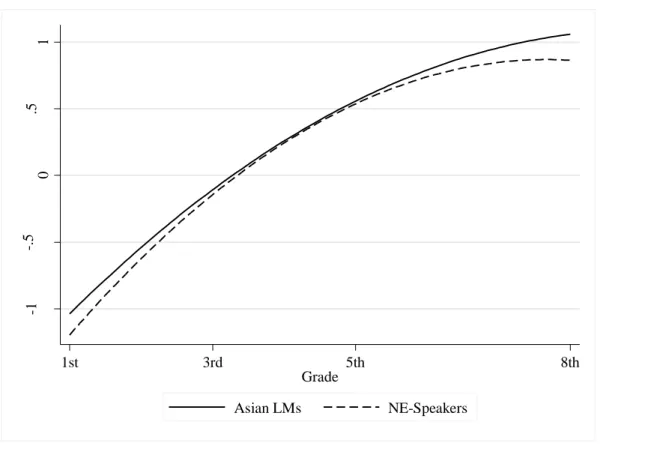
4.1. Kindergarten Reading Instructional Emphases/Amount for Full Sample, Asian LMs, and Native-English-Speaking Student Groups………..132 4.2. First Grade Reading Instructional Emphases/Amount for Full Sample, Asian LMs, and Native-English-Speaking Student Groups………...………...…133 4.3. Predicted Reading Ability Growth From Kindergarten to Eighth Grade for the Kindergarten Model, with Sampling Weights Applied………....134 4.4. Predicted Reading Ability Growth From First Grade to Eighth Grade for the First Grade Model, with Sampling Weights Applied……….135 4.5. Predicted Reading Ability Growth Across Grades for Kindergarten Asian LMs and NE-speakers, with Sampling Weights Applied………..136 4.6. Predicted Reading Ability Across Grade for First Grade Asian LMs and Native-English- Speakers with Lesser Amount of Sounds and Letter-Sound Relationships Instructional Emphasis and High Amount of Sounds and Letter-Sound Relationships Instructional Emphasis, Sampling Weights Applied………..………137
1 CHAPTER 1 INTRODUCTION
For the present study, the research question was: What is the relationship between
kindergarten and first grade reading instructional emphases/amount and Asian language-minority (LM) students’ reading ability growth from kindergarten through eighth grade, as compared to that of native English-(NE)-speakers? Reading instructional emphases/amount (in both
kindergarten and first grade, but measured separately by grade) were defined (and measured) three separate ways as (1) degree of emphasis on sounds and letter-sound relationships, (2) degree of emphasis on meaning construction, and (3) overall amount of reading instruction. Socioeconomic status was controlled. The study sample was drawn from the United States nationally-representative data from the Early Childhood Longitudinal Study–Kindergarten Class of 1998-1999 (ECLS-K).
Rationale
Academic performance of LM learners has become an important topic in the last few decades since an increasing number of students in the United States primarily speak a non-English language in their homes. According to the Department of Education (2011), from 1980 to 2009, the number of school-aged children who speak a language other than English at home increased from 4.7 to 11.2 million. Within the population of LMs, there are growing numbers of LMs of different language backgrounds, with those from Asian backgrounds, including Chinese and Korean, comprising almost 20% of the LM population (Goldenberg, 2008).
2
With the rise in the number of LMs, it becomes increasingly important to examine topics related to these students’ literacy development, particularly because on the whole, in the United States, LMs are experiencing difficulties in reading, in comparison to their NE-speaking peers. For instance, on the National Assessment of Educational Progress (NAEP) in 2013, while there were no breakout percentages for Asian LMs or other subgroups of LMs, only 7% of LMs attained a proficient or advanced reading level in fourth grade, leaving 93% reading at a basic or below basic level. There is a clear gap in reading achievement between the majority of fourth-grade LMs and their NE-speaking peers, and the gap does not close by eighth fourth-grade (NAEP, 2013). There is some evidence that the LM-White achievement gap may widen with grade levels through eighth grade (Fry, 2007). The statistics are concerning, since they depict a trajectory that does not favor the LMs.
The gap in reading scores for LMs may not be surprising, since texts read at higher grades become increasingly demanding, by requiring more integrated comprehension, involving more abstract topics, and including more difficult vocabulary (Gamson, Lu, & Eckert, 2013). In addition to the increased text difficulty at higher grade levels, reading comprehension may be especially challenging for LMs as they approach middle and high school due to the potential for underdeveloped oral language and prior knowledge (Lesaux, Rupp, & Siegel, 2007). While there is some evidence that LMs’ reading performance lags behind that of their
native-English-speaking peers, little is known about Asian LM students’ performance in particular. Research Gaps
3
Studying early predictors of growth trajectories for students from specific LM ethnicities may help to further the research base by allowing researchers and educators to identify areas where LM subgroups are lagging behind their native-English-speaking peers, with associated
implications for how to more effectively address LMs’ needs. In addition, the research base is limited regarding the effectiveness of different reading instructional emphases for LMs (Sonnenschein, Stapleton, & Benson, 2010; Xue & Meisels, 2004). The study is a first step toward addressing one of the research gaps.
Prior Research and Theory: The Importance of Early Word Reading for Later Reading Development, Growth Trajectories, and the Impact of Early Reading Instructional
Emphases on Reading Growth
The next sections briefly summarize the importance of early word reading on later reading development for Asian LMs and speaking students and the general patterns of NE-student and Asian LM reading growth. Also, what is known about the impact of early reading instructional emphases on NE-speaking student and Asian LM reading growth will be briefly presented.
Why is Early Success in Reading Ability Important for Students in General and Asian Students in Particular?
For NE-speaking students. Theoretically, early word reading ability is related to long-term reading development. Ehri’s (1999) phases of word development, automaticity theory (LaBerge & Samuels, 1974), and the Simple View of Reading support the importance of early word reading development. First, Ehri’s phases delineate the general process for learning to read, with phonological awareness and letter sounds being acquired initially, followed by word
4
implication is that the acquisition of word reading development provides a foundation for later reading growth. Second, automaticity theory focuses on the automatic word reading and reading comprehension relationship, where students who are able to read words automatically do not expend much attention in deciphering words but rather, are able to devote their attention to comprehension. In contrast, those who cannot quickly recognize and read words are unable to pay attention to comprehension. Third, the Simple View of Reading posits that both decoding and language comprehension predict reading comprehension.
Empirically, for monolingual NE-speakers, early reading ability or achievement is highly correlated with later reading performance (Catts, Bridges, Little, & Tomblin, 2008; Cutuli et al., 2013; Fien, Park, Baker, Smith, Stoolmiller, & Kame’enui, 2010; Foster & Miller, 2007; Francis, Shaywitz, Stuebing, Shaywitz, & Fletcher, 1996; Herbers, Cutuli, Supkoff, Heistad, Chan, Hinz, & Masten, 2012; Kieffer, 2011; Roberts, Mohammed, & Vaughn, 2010; Sparks, Patton, & Murdoch, 2014), supporting the notion that later reading development builds on acquisition of earlier skills (Foster & Miller, 2007).
In particular, a body of research supports the contention that NE-students who are skilled at word reading early on are more able to progress to reading more difficult texts than students who are less skilled early on (RAND Reading Study Group, 2002; Fien, Park, Baker, Smith, Stoolmiller, & Kame’enui, 2010; Roberts, Mohammed, & Vaughn, 2010).
5
Word reading ability (also called decoding, word recognition, or word analysis) involves internalized knowledge of sound-symbol relationships (Koda, 2007; Lesaux, Koda, Siegel, Shanahan, 2006). Fluent word reading skills allow efficient retrieval of previously stored linguistic knowledge. Languages, however, differ in the manners in which information is visually encoded (Koda, 2007). Whereas for English and other alphabetic languages such as Spanish, letters are the symbols that represent sounds in systematic ways, for Asian languages such as Chinese, glyphs are used to represent words or morphemes.
Virtually no studies have been conducted on the relationship between early word reading and reading growth for Asian LMs, so no conclusive statement can be derived from empirical research about whether an alphabetic home language may facilitate the development of English word recognition skills or on the contrary, whether a non-alphabetic home language may hinder the development of English word recognition skills.
What is Known About Reading Trajectories for NE-Students and LMs
In the following sections, what is known about reading trajectories for NE-speaking students, LM students, and subgroups of LM students will be briefly summarized.
6
Houts, & Morrison, 2008; Roberts, Mohammed, & Vaughn, 2010) as well as those with reading disabilities (Francis, Shaywitz, Stuebing, Shaywitz, & Fletcher, 1996) and those from low SES or highly mobile family backgrounds (Cutuli et al., 2013; Pianta, Belsky, Vandergrift, Houts, & Morrison, 2008; Voight, Shinn, & Nation, 2012).
For LM students compared to NE-speaking students. Few researchers to date have compared the growth trajectory patterns of LMs with those of NE-speakers. Thus, it is difficult to state any firm conclusions. From the existing studies, some researchers reported similar growth (Mancilla-Martinez & Lesaux, 2010; Manis, Lindsey, & Bailey, 2004; Nakamoto, Lindsey, & Manis, 2007; Roberts, Mohammed, & Vaughn, 2010) while others reported different patterns (Fitzgerald, Amendum, & Guthrie, 2008; Kieffer, 2008, 2010, 2012; Kieffer & Vukovic, 2013). The difference could be due to different measures used and different control variables examined.
However, three tentative statements can be asserted. First, socioeconomic status (SES) may be a factor that impacts LMs’ reading growth. In a few studies, low SES was associated with a lag between LMs’ and NEs’ reading growth (Kieffer, 2008, 2010, 2012; Kieffer & Vukovic, 2013, Roberts, Mohammed, & Vaughn, 2010). But when SES was taken into account or controlled in statistical analyses, reading growth between LMs and NE-speakers were similar (Kieffer, 2008, 2010, 2012; Kieffer & Vukovic, 2012; Roberts, Mohammed, & Vaughn, 2010). Second, oral English ability may be another factor that impacts LMs’ reading growth. In one study, LMs who were not initially fluent in oral English in kindergarten demonstrated a reading lag as compared to NE-speakers through eighth grade (Kieffer, 2011). But LMs who
7
Third, in a few studies, LMs displayed similar lower level (e.g., word recognition) English reading growth from kindergarten to second grade when compared to NE-speakers (Mancilla-Martinez & Lesaux, 2010; Manis, Lindsey, & Bailey, 2004; Nakamoto, Lindsey, & Manis, 2007; Roberts, Mohammed, & Vaughn, 2010).
Asians. More research is needed to draw an overall conclusion about the reading growth patterns for Asian LMs since only one study investigated Asian LM reading growth (Roberts, Mohammed, & Vaughn, 2010). From the one study, kindergarten to fifth grade Asian LM reading growth was similar to that of native-English-speakers but Asian LMs started out slightly higher on initial reading. It is important to note that all the Asian LMs had passed an oral-English proficiency test by the end of kindergarten. While the study is indicative, more studies are
needed to determine the replicability of the finding across different samples with extension into the middle grades (and high school).
Early Grades Reading Instructional Emphasis May Impact Reading Growth in General and Asian LMs’ Reading Growth in Particular
There has been a history of disagreement about the most effective reading instructional emphases in general for teaching students to read (Fitzgerald, Elmore, Relyea-Kim, Hiebert, & Stenner, 2016; Sonnenschein, Stapleton, & Benson, 2010; Xue & Meisels, 2004). The debates revolve around two instructional emphases: instruction that focuses on sounds and letter-sound relationships and instruction that focuses on meaning construction (Xue & Meisels, 2004).
The sounds and letter-sound relationships reading instructional emphasis focuses on lower-level reading skills such as learning the names of letters, writing the letters, phonics, and matching letters to sounds (cf. Sonnenschein, Stapleton, & Benson, 2010). The meaning
8
through authentic reading and writing activities. Exemplative activities include retelling stories, identifying the main idea and parts of a story, making predictions based on text, using context cues for comprehension, and learning vocabulary (cf. Sonnenschein, Stapleton, & Benson, 2010).
It is important to note that though reading instruction may focus on a particular aspect of reading, it is generally not to the exclusion of other aspects. For instance, instruction that
emphasizes meaning may incorporate letter-sound relationship instruction as well but in an implicit manner, using whole words and words-in-context to teach phonics. In a similar way, instruction that emphasizes letter-sounds relationships may be characterized by a more direct approach for teaching letter-sounds but still include meaning construction.
For NE-speakers. It is difficult to make a blanket statement about whether a greater amount of early grades sounds and letter-sound relationships instructional emphasis or a greater amount of early grades meaning construction instructional emphasis is more effective for NE-speakers’ reading growth. The difficulty may be due to an insufficient number of studies and contradictory findings in the existing research. While in one study (Connor, Morrison, &
Petrella, 2004), greater amounts of third-grade meaning construction instruction was effective for reading growth, in another study (Sonnenschein, Stapleton, & Benson, 2010), greater amounts of third-grade meaning construction instruction was not effective. Reasons for the differences in results were not apparent.
9
Second, a greater overall amount of kindergarten and first grade reading instruction may positively impact reading growth for kindergarten (Sonnenschein, Stapleton, & Benson, 2010; Xue & Meisels, 2004) through third graders (Sonnenschein, Stapleton, & Benson, 2010).
LMs as a heterogeneous group. To date, only one study (Vadasy & Sanders, 2012) has been conducted on the impact of early instructional emphases on reading growth for LMs as a heterogeneous (by native language) group. The researchers concluded that the benefits of an increased amount of a particular emphasis depended on students’ grade level. While a greater amount of first grade sounds and letter-sounds instruction was beneficial for reading growth, a greater amount of second grade meaning instruction was beneficial for reading growth.
Asian LMs. To my knowledge, no studies have specifically investigated the impact of different early grades reading instructional emphasis on Asian LMs’ reading growth.
Summary. In sum, for NE-speakers, from empirical findings, it is unclear whether teaching early-grades readers using frequent systematic, sounds and letter-sounds
correspondences or meaning-based instruction is more effective for reading growth. From a very limited number of studies, on the whole, the impact of an increased amount of a sounds and letter sounds emphasis was moderated by students’ initial reading ability. Also, perhaps an increase in overall amount of reading instruction may benefit students’ reading ability.
Only one study examined early reading instructional emphasis on general LM reading growth, so it is not feasible to provide a summary statement about the impact of instructional emphases.
For Asian LMs, the influence of early reading instructional emphasis for Asian LMs’ reading development has not been studied.
10
The number of LMs in the U.S. is growing, and on the whole, they are not performing well in reading.
A focus on “cracking the code” is not only theoretically important during the early phases of learning to read, but it has also been empirically supported. From prior theory for
NE-speakers, early reading ability sets the stage for later reading development. But there are no parallel theories that have been specifically applied to Asian LM English reading development.
Native English-speakers experience a curvilinear reading growth trend, where rapid growth occurs in the early elementary grades but decelerates in the late elementary grades. But more research is needed to draw an overall conclusion about the reading growth patterns for Asian LMs.
No firm statement can be made regarding whether teaching early-grades readers using frequent sounds and letter-sound relationships or teaching that is focused on meaning
construction is more effective for NE-speakers. Two very tentative statements are that (1) students’ initial reading ability may moderate the benefit of early reading instructional emphasis and (2) an increase in overall amount of reading instruction may benefit students’ reading ability.
No summary statement can be made about the impact of early instructional emphases on reading growth for LMs in general due to the lack of research.
Also, no summary statement can be made about the influence of early reading instructional emphasis on Asian LMs’ reading growth.
Significance of the Study
11
are still gaps in the knowledge base regarding the development of reading for LMs, specifically for Asian LMs. The study is one of the first studies to examine Asian LM reading growth, one of the first large-scale studies, and the first to examine that growth beyond fifth grade. Moreover, little is known about the impact of different early reading instructional emphases on Asian LM students’ reading ability growth. To my knowledge, the present research is the first to examine different reading instructional emphases impact on Asian LM students’ versus native-English-speaking students’ reading growth.
Research Question and Hypotheses
For the present study, the research question was: What is the relationship between kindergarten and first grade reading instructional emphases/amount and Asian LMs’ reading ability growth from kindergarten through eighth grade, as compared to that of NE-speakers? Reading instructional emphasis/amount (in both kindergarten and first grade but measured separately by grade) was defined (and measured) three separate ways as (1) degree of emphasis on sounds and letter-sound relationships, (2) degree of emphasis on meaning construction, and (3) overall amount of reading instruction. Socioeconomic status was controlled.
Hypothesis
12
was similar to NEs through fifth grade. However, it is difficult to resolve the theoretical position with the single finding from a single study.
Definition of Terms
In the present study, Language-Minority (LM) learners referred to students who primarily spoke a language other than English in the home setting (Kieffer, 2008). Native-English,
monolingual students referred to students who only spoke English in the home.
The Sounds and Letter-Sound Relationships reading instructional emphasis focused on learning the names of letters, writing the letters, phonics, conventions of print, alphabet and letter recognition, matching letters to sounds, writing one’s own name, and rhyming words and word families (cf. Sonnenschein, Stapleton, & Benson, 2010).
The Meaning Construction reading instructional emphasis focused on the construction of meaning from the text through authentic reading and writing activities. Activities were retelling stories, identifying the main idea and parts of a story, making predictions based on text, using context cues for comprehension, and learning vocabulary (cf. Sonnenschein, Stapleton, & Benson, 2010).
13 CHAPTER 2
REVIEW OF THE LITERATURE
The present study examined the relationship between early reading instruction and reading growth for Asian LM students and NE-speaking students. The research question was: What is the relationship between kindergarten and first grade reading instructional
emphases/amount and Asian LMs’ reading ability growth from kindergarten through eighth grade, as compared to that of NE-speakers? Reading instructional emphasis/amount (in both kindergarten and first grade but measured separately by grade) was defined (and measured) three separate ways as (1) degree of emphasis on sounds and letter-sound relationships, (2) degree of emphasis on meaning construction, and (3) overall amount of reading instruction.
Socioeconomic status was controlled.
In the present chapter, theoretical perspectives supporting the importance of early word reading for NE-speaking students’ later reading growth and the implications of the theoretical perspectives for Asian LMs will be presented first. Next, a summary is provided of extant empirical findings that support the theoretical positions. Finally, research support will be
presented for why particular early grades reading instructional emphases matter for NE-speakers and Asian LMs.
Selection of Material for the Research Review
14
development,” “reading ability,” “early reading ability,” “early word reading,” “reading
instruction,” “language minority,” “English language learners,” “English-as-a-second-language,” “native-English-speakers,” “Asian,” “alphabetic languages,” and “non-alphabetic languages.” Additionally, reference lists of the selected articles were examined to locate other pieces.
The research review included published, peer-reviewed, empirical research conducted in the US. No date restriction was imposed. Studies were included if participants were followed from preschool to elementary school or from elementary school into the secondary grades. Studies that were focused exclusively on preschoolers or on college or adult students were excluded. Studies on reading growth were further limited to quantitative studies that used statistical growth modeling.
Theoretically, Why is Early Word Reading Important for NE-Speakers’ and LMs’ Reading Growth?
Currently, there are no comprehensive theoretical models of LMs’ early reading
developmental phases or of the relationship between LMs’ early English reading ability and later English reading growth. However, several theories derived generally for NE-speaking students may be applicable for Asian LMs’ English reading growth.
Native-English Speakers in General
Word reading automaticity is at the heart of the early phases of learning to read (e.g. Ehri, 1999). Automaticity theory (LaBerge & Samuels, 1974), the Simple View of Reading (Gough & Tunmer, 1986), and Ehri’s (1999) phases of word development all provide support for the notion that early word reading is the foundation for later reading growth.
15
and recognize words quickly, they are unlikely to be able to pay attention to comprehension. On the contrary, as students become more proficient at decoding and learn more sight words, they become more fluent in word reading and do not need to spend as much attention to figure out the words. The accumulation of words that students can look at and quickly pronounce leads to interconnection formation in the brain. Automaticity enables quicker access to networks of word meanings and text engagement (Stahl & Nagy, 2006). In short, automatic word recognition allows students to pay more attention to higher-order processes such as comprehension, which in turn can impact later reading achievement (LaBerge & Samuels, 1974).
Additionally, Gough and Tunmer’s (1986) Simple View of Reading is another theoretical position developed for monolingual learners supporting the importance of an early instructional emphasis on word reading skills for later reading comprehension for NE-speakers. According to the Simple View of Reading, decoding and language comprehension predict reading
comprehension. Difficulties in either decoding or language comprehension will lead to
difficulties in reading comprehension. Strengths in one skill will not compensate for weaknesses in the other. Even if students are able to make sense of a string of words, if they are unable to decipher words in a text, they will not be able to comprehend the complete text.
16
patterns. They use graphic and syntax cues in the context to decipher unfamiliar words. And in the third stage, children build on what they have learned in the previous stages, becoming fluent in reading words and being able to internalize strategies for reading unfamiliar words. The heavy focus on word reading in the first phases of learning to read points to its importance for later reading growth. Overall, the implication of the theoretical positions is that students should receive an emphasis on word reading early on.
Asian LMs
Although no formal theoretical position exists for LM reading development in general or Asian LM reading development specifically, theoretically, English word reading may be
17
phonological awareness may lead to a lag in English reading ability growth, as compared to their NE-speaking peers.
There is a large linguistic distance between English and Asian oral and written languages. Asian languages and English differ greatly (1) in the actual sounds that comprise the languages and (2) in their linguistic structure – the way that meaning and sound are linked and how they are encoded in the writing system (Koda, 2007). Firstly, the ability to understand written language is tied to the ability to understand the sounds in spoken language, but the actual sounds and
intonation patterns in Asian languages differ from those in English. Specifically, some English phonemes do not exist in Asian languages, making it hard to distinguish between certain sounds (Wang & Geva, 1999). For instance, the /v/ and /f/ consonant sounds do not exist in Korean. Another characteristic of some Asian languages is that they are tonal, signifying that pitches of sounds differentiate meanings. Whereas, in English, varying tones only signifies emotion and not change in meaning. The differences in sounds within each language system imply that it may take more time for Asian LMs to learn the English sound system.
18
character, is mapped onto a morpheme, and each morpheme conveys distinctive meanings (Wong, 2013). Words are usually comprised of two characters, each of which has both a meaning and a sound component (Wong, 2013).
Given the language differences in oral and written word representation, phonemic manipulation may weigh less heavily when learning to read Asian languages such as Chinese. Instead, Asian language reading proficiency may be more dependent on the ability to read
holistic visual cues (Yamashita, 2013). The large differences between English and Asian oral and written languages suggest that Asian children could require additional time to develop English phonological skills that would support word recognition and later reading growth.
Empirical Research Supports the Theoretical Position that Early Word Reading Matters for Longer-Term Reading Growth for Both NE-Speakers and LMs
19
All the studies included early-grades word reading and reading comprehension measures for examining growth.
Regardless of whether students were NE-speakers, LMs, were from homeless or mobile family backgrounds, or had language impairments, reading achievement trajectories reflected students’ initial word reading ability in the early elementary grades. More specifically, students who scored higher on initial word reading skills demonstrated greater reading growth than students who initially scored lower on reading skills. The findings support the notion that later reading development hinges upon earlier acquired word reading skills.
To date, only one US study (Roberts, Mohammed, & Vaughn, 2010) has been
accomplished on the importance of early-grades word reading ability for longer-term reading growth for Asian LMs. Students were followed from kindergarten through fifth grade using a nationally representative sample. Asian LMs, as compared to NE-speakers, started out higher in reading ability, accelerated similarly, and performed higher than their NE-speaking peers through fifth grade. The finding supports the notion that early word reading ability is important for later reading development.
What is Known About Reading Trajectories for NE-Speakers and LMs
Knowledge of the general patterns of NE-speaking students’, heterogeneous LMs’, and homogeneous LMs’ reading growth would provide contextual information for the expected patterns of reading growth. Further, language minority students come from various language backgrounds, and examining homogeneous LM groups may be fruitful in disentangling language effects. The following sections summarize what is known about the reading growth patterns of NE-speakers, heterogeneous groups of LMs, Latino LMs, and Asian LMs.
20
Examination of quantitative, multi-time-point studies revealed that in general, reading growth trends for NE-speaking students from elementary through middle school can be
characterized by a quadratic curvilinear trend, where rapid growth occurs in the early elementary grades but decelerates in the late elementary grades into middle school (Catts, Bridges, Little, & Tomblin, 2008; Cutuli et al., 2013; Francis, Shaywitz, Stuebing, Shaywitz, & Fletcher, 1996; Herbers, Cutuli, Supkoff, Heistad, Chan, Hinz, & Masten, 2012; Kieffer, 2008, 2011; Roberts, Mohammed, Vaughn, 2010; Nese et al., 2013; Pianta, Belsky, Vandergrift, Houts, & Morrison, 2008; Voight, Shinn, & Nation, 2012; Williamson, Fitzgerald, & Stenner, 2014). The curvilinear trend has held for students from highly varied backgrounds and abilities: typically-developing preschool, elementary, and middle school students (Catts, Bridges, Little, & Tomblin, 2008; Francis, Shaywitz, Stuebing, Shaywitz, & Fletcher, 1996; Herbers, Cutuli, Supkoff, Heistad, Chan, Hinz, & Masten, 2012; Kieffer, 2008, 2011; Nese et al., 2013; Pianta, Belsky, Vandergrift, Houts, & Morrison, 2008; Roberts, Mohammed, & Vaughn, 2010) as well as those with
language impairments (Catts, Bridges, Little, & Tomblin, 2008), those with reading disabilities (Francis, Shaywitz, Stuebing, Shaywitz, & Fletcher, 1996), and those from low SES or highly mobile family backgrounds (Cutuli et al., 2013; Pianta, Belsky, Vandergrift, Houts, & Morrison, 2008; Voight, Shinn, & Nation, 2012). Over the course of the growth periods investigated, measured reading subskills included word reading, reading comprehension, and reading achievement.
21
2011; Kieffer & Vukovic, 2013). Two of the four studies followed students from kindergarten through eighth grade, while the other two followed students in the elementary grades. However, two tentative conclusions can be stated.
First, SES may be as important as language status for explaining similarities and/or differences in the comparison of LM and NE-student reading growth. Low SES was associated with a lag in reading growth, and the impact of SES increased as students moved into higher grades. In one study, a heterogeneous LM group and their NE-speaking peers from similarly low SES backgrounds were compared from first to fourth grade (Kieffer & Vukovic, 2013). The two groups were similar to each other as well as near national norms for letter-word identification and phonological awareness skills in first grade. By fourth grade, LMs lagged behind the NE-speakers in several areas, namely, vocabulary and oral comprehension skills, but even so, both groups were below national norms, indicating that language status may also play a role in LM reading growth.
Another researcher first followed a group of LM and NE-speaking students from
kindergarten through fifth grade, and then in two later studies, followed a subset of students from the same dataset through eighth grade (Kieffer, 2008, 2011, 2012). Low SES was again
associated with lower initial reading ability. In these studies, low SES was also associated with slower growth rates as compared to high SES. But when SES was taken into account statistically, LMs showed a higher rate of reading growth and reading performance as compared to
22
Second, differences in initial oral English proficiency impacted LM students’ (from many language backgrounds) reading development. First-grade LM students who were initially fluent in English in kindergarten caught up with NE-speakers by first grade and maintained similar levels at the national average, while those who were not initially fluent were unable to catch up (Kieffer, 2011). Even though the students with initially lower English fluency demonstrated slightly faster growth rates, they remained below the national average at all time points. For Homogeneous Subgroups of LM Students
Collectively, LMs speak several hundred different languages and vary widely in their ethnic and racial backgrounds (Wolf, Guzman-Orth, & Hauck, 2014). On average, English-proficient students of different races and ethnicities exhibit different reading trajectories (Fryer & Levitt, 2004), and in the same vein, different subgroups of LMs may take on different reading trajectories. Thus, reading development for subgroups of LMs could be different.
Nearly all of the studies that included homogeneous subgroups of LMs focused on native-Spanish-speaking LMs (Fitzgerald, Amendum, & Guthrie, 2008; Lesaux, Crosson, Kieffer, & Pierce, 2010; Mancilla-Martinez & Lesaux, 2010; Manis, Lindsey, & Bailey, 2004; Nakamoto, Lindsey, & Manis, 2007; Roberts, Mohammed, & Vaughn, 2010) while only one study to date exists of Asian language-speaking LMs’ growth (Roberts, Mohammed, & Vaughn, 2010). The following sections synthesize research that specifically examined Latino and Asian LM reading development.
Latinos. On the whole, growth for lower-level (e.g., letter identification and word
23
were mixed. As well, where SES and initial oral English ability were also studied, the results were inconclusive about their impact on Latino English reading growth.
First, in five studies, a large amount of lower-level reading skill growth (reading words in isolation, phonological awareness, and decoding pseudowords) occurred during kindergarten through second grades (Fitzgerald, Amendum, & Guthrie, 2008; Mancilla-Martinez & Lesaux, 2010; Manis, Lindsey, & Bailey, 2004; Nakamoto, Lindsey, & Manis, 2007; Roberts,
Mohammed, & Vaughn, 2010). In four of the studies, native-Spanish-speaking LMs began kindergarten or first grade with average level sound-and-word-level skills and remained in the average range (Mancilla-Martinez & Lesaux, 2010; Manis, Lindsey, & Bailey, 2004; Nakamoto, Lindsey, & Manis, 2007; Roberts, Mohammed, & Vaughn, 2010). In the fifth study, native-Spanish-speaking LMs began first or second grade with lower reading levels than their NE-speaking peers but performed at similar levels to NE-speakers on sound-and-word-level skills by the end of second grade or third grade (Fitzgerald, Amendum, & Guthrie, 2008). One study started in preschool (Mancilla-Martinez & Lesaux, 2010), two started in kindergarten (Manis, Lindsey, & Bailey, 2004; Roberts, Mohammed, & Vaughn, 2010), one (Nakamoto, Lindsey, & Manis, 2007) started in first grade, and one (Fitzgerald, Amendum, & Guthrie, 2008) followed two cohorts of students, from first into second grade and from second into third grade. Three of the studies (Mancilla-Martinez & Lesaux, 2010; Nakamoto, Lindsey, & Manis, 2007; Roberts, Mohammed, & Vaughn, 2010) followed students through the end of elementary school.
24
(Fitzgerald, Amendum, & Guthrie, 2008; Mancilla-Martinez & Lesaux, 2010; Manis, Lindsey, & Bailey, 2004; Nakamoto, Lindsey, & Manis, 2007; Roberts, Mohammed, & Vaughn, 2010).
Moreover, the patterns of sound and word-level skills development were consistent even when measured using several different measures of reading skills (phonological awareness, letter and word reading, word automaticity, pseudoword reading) or whether measures came from standardized and normed assessments or researcher-created curriculum-based measures.
Second, findings in six studies (Fitzgerald, Amendum, & Guthrie, 2008; Lesaux, Crosson, Kieffer, & Pierce, 2010; Mancilla-Martinez & Lesaux, 2010; Manis, Lindsey, &
Bailey, 2004; Nakamoto, Lindsey, & Manis, 2007; Roberts, Mohammed, & Vaughn, 2010) were mixed regarding Latino LMs’ higher-level reading skill growth. Whereas in three studies, early elementary (Mancilla-Martinez & Lesaux, 2010; Nakamoto, Lindsey, & Manis, 2007) and late elementary Latino LMs (Lesaux, Crosson, Kieffer, & Pierce, 2010) demonstrated higher-level reading skills consistently below grade level, Latino LMs in two other studies (Manis, Lindsey, & Bailey, 2004; Roberts, Mohammed, & Vaughn, 2010) demonstrated higher level reading skills at grade-level. In the sixth study, Latino LMs started out with skills below grade level but experienced rapid growth over one school year, to end with skills above grade level (Fitzgerald, Amendum, & Guthrie, 2008). Perhaps the type of measure used could be attributed to the difference. Whereas Fitzgerald, Amendum, and Guthrie (2008) examined instructional reading level growth, the other studies examined passage comprehension, reading ability, or reading comprehension.
25
national norms) that was persistent in the upper elementary grades (Lesaux, Crosson, Kieffer, Pierce, 2010; Mancilla-Martinez & Lesaux, 2010; Nakamoto, Lindsey, & Manis, 2007; Roberts, Mohammed, & Vaughn, 2010).
Third, there was very little evidence about the impact of SES on Latino LMs’ reading growth. One reason for the lack of ability to make a confident conclusion is that the prevalence of native-Spanish-speaking students comes from low SES households (Roberts, Mohammed, & Vaughn, 2010), and in five of the six studies reviewed, students came from low-SES
backgrounds (Fitzgerald, Amendum, & Guthrie, 2008; Lesaux, Crosson, Kieffer, & Pierce, 2010; Mancilla-Martinez & Lesaux, 2010; Manis, Lindsey, & Bailey, 2004; Nakamoto, Lindsey, & Manis, 2007). With little or no variation in SES, the question of its impact on reading growth cannot be addressed.
In one study, the impact of SES on reading achievement was examined (Roberts,
Mohammed, & Vaughn, 2010). The result was that SES moderated English reading growth such that SES may have mattered as much as language status. Prior to controlling for SES, reading achievement trajectories of NE-speakers were dissimilar to speaking LMs. Spanish-speaking LMs started school less ready to read and made less progress over time. However, in the same study when SES was controlled, the differences in achievement patterns were
26
English screener at the start of the study (Roberts, Mohammed, & Vaughn, 2010). In these four studies, the lack of variation in oral English proficiency precluded the ability to study its impact on reading ability growth. In the two other studies (Fitzgerald, Amendum, & Guthrie, 2008; Lesaux, Crosson, Kieffer, & Pierce, 2010), there was a mixed SES sample. However, oral
English was not included as a moderator, so its impact on reading growth could not be evaluated. Asians. More research is needed to draw a conclusion about the English reading growth pattern for Asian LMs in comparison to that of NE speakers and also to draw a conclusion about the potential impact of SES. To my knowledge, only one study involved Asian LM English reading growth (Roberts, Mohammed, & Vaughn, 2010). Students were followed from kindergarten through fifth grade using a nationally representative sample. The Asian LMs
attained a pre-established cutscore for oral English proficiency by the spring of kindergarten. For the Asian LMs, the slope and deceleration reading growth pattern but not the intercept appeared to be similar to those for NE-speakers. Asian LMs actually started out statistically higher in reading but progressed at a similar rate as NE-speakers throughout the study. In the same study, when SES was accounted for, the intercept difference between the two groups was no longer significantly different. The conclusion was that Asian LMs, as compared to NE-speakers, started out higher in reading ability, accelerated similarly, and performed higher than their NE-speaking peers through fifth grade. While the study results were indicative, more research is needed to determine the replicability of the study for other samples.
Reading Instructional Emphases and Amount of Reading Instruction for Beginning Readers May Matter for NE-Speakers, LMs in General, and Asian LMs
27
finally present the findings from existing US studies that examined reading instructional emphasis and reading growth. The research findings will be broken out by language group. Description of Type of Early-Grades Reading Instructional Emphasis
As early as the 1960s, researchers have identified ways to characterize emphases in reading instruction. Several characterizations are: learning letter-sound correspondences, learning correspondences between spelling patterns and oral word patterns, learning whole words, and learning words in meaningful context (Chall, 1967; Popp, 1975). The four characterizations can be broadly represented by: (1) a sounds and letter-sound relationships instructional emphasis and (2) a meaning construction instructional emphasis (Chall, 1967).
In general, a sounds and letter-sounds reading instructional emphasis focuses on teaching sounds and letter-sound relationships in the beginning stages of learning to read. Proponents believe that code-breaking and word-recognition should be taught systematically and explicitly (Xue & Meisels, 2004). Activities that follow a sounds and letter-sound instructional emphasis include learning the names of letters, writing the letters, phonics, conventions of print, alphabet and letter recognition, matching letters to sounds, writing one’s own name, and rhyming words and word families (cf. Sonnenschein, Stapleton, & Benson, 2010).
28
using context cues for comprehension, and learning vocabulary (cf. Sonnenschein, Stapleton, & Benson, 2010).
There has been a history of disagreement about whether one of the two broad characterizations is a more effective approach in general for teaching students to read
(Fitzgerald, Elmore, Relyea-Kim, Hiebert, & Stenner, 2016; Sonnenschein, Stapleton, & Benson, 2010; Xue & Meisels, 2004). Since the 1960s, each decade has generally been characterized by changing emphases of beginning reading instruction, reflecting changing beliefs of educators and researchers (Anderson, Hiebert, Scott, Wilkinson, 1985; Fitzgerald, Elmore, Relyea-Kim,
Hiebert, & Stenner, 2016; Hiebert, 2014). Instruction in the 60s had an emphasis on meanings in texts and less of a focus on sound and symbol relationships while instruction in the 70s generally had a focus on phonics and use of phonics to teach new words (Chall, 1996). In the 80s,
instruction shifted back towards a meaning-focus. While the 90s started out with an emphasis on whole language and meaning and development of reading skills through authentic texts, with attention on integration and application of reading strategies in the context of authentic texts. The 2000s could be characterized by balanced reading but with more of a focus on decoding, and since the 2010s, the Common Core State Standards Initiative has been a driving force, emphasizing many aspects of reading, including decoding and meaning construction.
In sum, two characterizations of early grades reading instructional emphases are sounds and sound-letter emphasis and meaning emphasis. While different emphases have been
29
Research on Early Reading Instructional Emphasis and Overall Amount of Reading Instruction on Longer-Term Reading Growth
The next sections summarize empirical findings about the effectiveness of the two instructional emphases on reading growth, separated by language status, first for NE-speakers and second for LMs. Additionally, results of research on the amount of reading instruction are presented. The research in the following sections almost exclusively focused on NE-speakers, with only one study including a heterogeneous LM group (Vadasy & Sanders, 2012). No researchers have specifically investigated the impact of different early grades reading instructional emphasis on Asian LMs’ reading growth.
The following sections draw from six recent US studies (the only studies accomplished to date) examining the relationship between early elementary reading instructional emphasis and students’ reading growth (Connor, Morrison, & Katch, 2004; Connor, Morrison, & Petrella, 2004; Foorman, Francis, Fletcher, & Schatchneider, 1998; Sonnenschein, Stapleton, & Benson, 2010; Vadasy & Sanders, 2012; Xue & Meisels, 2004). All the studies included NE-speakers, and one study also included a heterogeneous (by native language) group of LMs (Vadasy & Sanders, 2012). Tables 2.1 to 2.3 show all of the studies broken out by which instructional emphasis was examined and provide a summary of key characteristics of the studies. Three of the studies followed students for one school year (kindergarten, first, second, or third grade) (Connor, Morrison, & Katch, 2004; Connor, Morrison, & Petrella, 2004; Foorman, Francis, Fletcher, & Schatchneider, 1998; Xue & Meisels, 2004), one followed students from first grade through second grade (Vadasy & Sanders, 2012), and one followed students throughout
30
primary grades only. The studies assessed at least one of the following to measure reading growth: word recognition, letter and sound identification, vocabulary, and comprehension.
In the following subsections, studies will be ordered according to the instructional emphasis/es that was/were included in the study. In two studies (Connor, Morrison, & Petrella, 2004; Sonnenschein, Stapleton, & Benson, 2010), only meaning construction instruction was examined. In another study (Foorman, Francis, Fletcher, & Schatschneider, 1998), sounds and letter-sounds instruction was directly compared to meaning construction instruction. And in four other studies (Connor, Morrison, & Katch, 2004; Sonnenschein, Stapleton, & Benson, 2010; Vadasy & Sanders, 2012; Xue & Meisels, 2004), the effectiveness of the extent of sounds and letter-sounds instruction and the extent of meaning construction instruction on reading growth was examined. Also, two of the studies examined the relationship between overall amount of reading instruction and students’ reading growth (the only studies accomplished to date) (Sonnenschein, Stapleton, & Benson, 2010; Xue & Meisels, 2004).
The studies varied in design—whether they were intervention studies or investigations of naturally occurring situations. In one study (Foorman, Francis, Fletcher, & Schatschneider, 1998), students were assigned to sounds and letter-sounds or meaning construction instructional groups. In the other studies (Connor, Morrison, & Katch, 2004; Connor, Morrison, & Petrella, 2004; Sonnenschein, Stapleton, & Benson, 2010; Vadasy & Sanders, 2012; Xue & Meisels, 2004), the researchers studied the extent of reading instructional emphases that occurred naturally in the classrooms.
31
meaning are presented (for NE-speakers). Third, results from four studies that examined the effectiveness of the extent of sounds and letter-sound emphasis and meaning construction emphasis, without direct comparison of the two, are presented (separated by studies of NE-speakers and LMs). Finally, results of two studies are discussed, where the amount of reading instruction was related to students’ reading growth (for NE-speakers).
Early instructional emphasis and overall amount of reading instruction:
NE-speakers. Overall, there is an insufficient amount of research for NE-speakers and contradictory findings in the limited existing research to support the superiority of either sounds and letter-sounds instructional emphasis or meaning construction emphasis. Part of the difficulty in
determining the more effective instructional emphasis stems from different researchers studying students with different initial reading ability. However, three very tentative statements can be made about early instructional emphasis for NE-speakers’ reading growth and will be expanded in selected sections below. The tentative statements are: (1) An increase in sounds and letter-sounds instructional emphasis may be more effective for reading growth than an increase in meaning instructional emphasis for NE-speaking readers in kindergarten through second grade with initially low reading ability, (2) an increase in meaning instruction instructional emphasis may be more effective for reading growth than an increase in sounds and letter-sounds
instructional emphasis for NE-speaking readers in kindergarten through second grade with initially higher reading ability, and (3) a greater amount of overall reading instruction may be effective for reading growth for NE-speakers from kindergarten through second grade.
Beginning NE-speaking readers: Studies that only examined meaning construction
emphasis. As shown in Table 2.1, the two studies that examined the effectiveness of meaning
32
Stapleton, & Benson, 2010) indicated contrasting results. While meaning construction instruction was effective for third graders’ reading growth in one study (Connor, Morrison, & Petrella, 2004), it was ineffective for a group of third graders in another study (Sonnenschein, Stapleton, & Benson, 2010). Reasons for the difference were not apparent.
Beginning NE-speaking readers: Study that directly compared sounds and
letter-sounds instruction to meaning construction instruction. As shown in Table 2.2, only one study
(Foorman, Francis, Fletcher, & Schatschneider, 1998) directly compared the effectiveness of the instructional emphases. The result was that on average, a sounds and letter-sounds instruction was more effective than meaning construction, especially for lower ability primary grade students.
Beginning NE-speaking readers: Studies that examined the extent of sounds and
letter-sounds and meaning construction emphases. Studies produced inconclusive results about
whether an increase in a particular instructional emphasis as compared to a second emphasis was associated with more reading growth for NE-speakers. As shown in Table 2.3, from the four sets of studies that compared the extent to which the two instructional emphases were provided, different conclusions were drawn. These studies are different from the Foorman, Francis, Fletcher, and Schatschneider (1998) study discussed in the immediately preceding section because in the present studies the researchers examined the amounts of instructional emphasis (as reported by teachers) whereas in the preceding section, the two emphases were studied in the “absolute” sense—variability in amount of emphasis wasn’t studied.
33
NE-speaking readers, namely, initially low-scorers on reading ability. So the first tentative statement that can be made is that an increase in sounds and letter-sounds instructional emphasis may be more effective than an increase in meaning instructional emphasis for reading growth for kindergarten through second grade NE-speaking students with lower initial reading ability.
However, two sets of researchers concluded that an increased emphasis on meaning construction was more effective than an increased emphasis on sounds and letter-sounds, on average, for beginning NE-speakers who initially scored high on reading ability. So the second tentative statement that can be made is that an increase in meaning construction instructional emphasis may be more effective than an increase in sounds and letter-sounds instruction for reading growth for kindergarten through second grade NE-speaking students with higher initial reading ability.
Importance of Overall Amount of Reading Instruction for NE-speakers. Of the six
studies, only two studies examined the relationship between overall amount of reading
instruction and NE-speakers’ reading growth (Sonnenschein, Stapleton, & Benson, 2010; Xue & Meisels, 2004). No other studies were found on the amount of early reading instruction in
relation to reading growth. The overall amount of kindergarten and first grade reading instruction positively impacted reading growth for kindergarten (Sonnenschein, Stapleton, & Benson, 2010; Xue & Meisels, 2004) through third graders(Sonnenschein, Stapleton, & Benson, 2010). While the studies are indicative, more studies are needed to determine the replicability of the findings across different samples. The third tentative statement that can be made is that a greater amount of overall reading instruction may be effective for reading growth for NE-speakers from
34
Early instructional emphasis for heterogeneous LM speakers. With only one study on the early reading instructional emphasis involving heterogeneous LM speakers from which to draw, no firm conclusion can be made about which reading instructional emphasis would be more effective for heterogeneous LMs’ reading growth.
As shown in Table 2.2, the effectiveness of the particular reading instructional emphasis depended on the LM students’ grade level. On average, an increased amount of first grade
sounds and letter-sound instruction was more effective than an increased amount of meaning construction instruction for first-grade LM reading growth at the end of first grade (Vadasy & Sanders, 2012). However, an increased amount of second grade meaning instruction was more effective than an increased amount of sounds and letter-sounds instruction for end of second grade reading growth (Vadasy & Sanders, 2012). Taken together, it appeared that the
effectiveness of the type of early reading instructional emphasis varied according to grade level. Though the findings may be indicative, to date only one study on LMs has been
conducted and only for a heterogeneous group. Thus, no conclusive statement can be made for LMs in general, and more pointedly, for the present study, for Asian LMs in particular.
Summary for Early Reading Instructional Emphases
In sum, two ways to characterize emphases in early reading instruction are instruction that emphasizes sounds and letter-sound relationships and instruction that emphasizes meaning construction. There has been a history of disagreement about the most effective approach for teaching beginning students to read, whether NE-speakers or LMs.
35
letter-sounds instructional emphasis may be more effective for reading growth than an increase in meaning instructional emphasis for NE-speaking readers in kindergarten through second grade with initially low reading ability. (2) An increase in meaning instruction instructional emphasis may be more effective for reading growth than an increase in sounds and letter-sounds
instructional emphasis for NE-speaking readers in kindergarten through second grade with initially higher reading ability. (3) A greater amount of sounds instruction and meaning
instruction may be better for reading growth for NE-speakers from kindergarten through second grade. No statements can be made for the effectiveness of reading instructional emphasis on long-term reading growth or reading growth beyond elementary school. Additionally, no statements can be made for heterogeneous groups of LMs or specifically for Asian LMs.
Overall Chapter Summary
Automaticity theory, the Simple View of Reading, and Ehri’s phases of word
development for NE-speakers point to the importance of early word reading for later reading growth. There are no formal theories on the importance of early word reading that specifically pertain to LMs in general or Asian LMs in particular, but early word reading may be important for Asian LMs as well. Given the potential lack of exposure to English prior to formal schooling and linguistic distance between Asian languages and English, English word reading may be more challenging for Asian LMs than for NE-speakers.