ANALYSIS OF TWITTER
USAGE BY GOVERNMENTAL
ACTORS IN NORTH
CAROLINA FLORENCE
RECOVERY
Master’s Project – April 2019
Table of Contents
Abstract...2
Introduction...3
Literature Review...5
Governmental Use of Social Media...5
Social Media in Disaster Response and Recovery...7
Twitter for Disaster Research...9
Methodology...10
Determining Study Criteria...10
Topic...10
Time Period...10
Stakeholders...10
Obtaining Twitter Data...11
Coding Twitter Data...12
Results...13
Discussion...17
Limitations...18
Recommendations...20
Conclusion...22
References...23
Abstract
Introduction
In recent years, increasingly destructive natural disasters have caused billions of dollars in damages to property and disrupted countless lives. Notable events, such as Superstorm Sandy and Hurricane Harvey saw people turning to social media to communicate and obtain
assistance (King 2018). Citizens offered help to their neighbors, coordinating rescues and sharing information about where to find emergency supplies (Cheshire 2015). Government agencies shared information with the public about available resources, and tracked on-the-ground conditions from citizen feeds (Liu, Lai, and Xu 2018). Social media platforms, such as Twitter and Facebook, have grown in popularity as outlets for government communications before, during, and after disaster events. Social media has the potential to allow governments to be more connected with their communities and reach larger audiences (Mergel 2012). Many stakeholder groups have social media presence, to contribute their opinions to the collective conversation in the post-disaster realm (Ragini, Anand, and Bhaskar 2018). Examining the social media conversation may provide agencies with a unique lens of the post-disaster situation, though data unobtainable via traditional stakeholder engagement methods. This information can inform decision-making specific to local conditions during the disaster recovery phase.
Disaster recovery may be defined as a return to pre-event conditions, though it also has potential to create space for more sustainable solutions and resilience to future disasters (G. Smith 2014). Recovery takes many forms, including the repair of buildings, the revitalization of local economies, the restoring of community networks and the healing of mental and emotional wellbeing (Jamali et al. 2018). There are many factors that contribute to this recovery, including organizational support and cooperation among various stakeholder networks. This “disaster recovery assistance network” includes actors from governmental, governmental, non-profit, corporate, and individual backgrounds (G. Smith 2008). These groups act independently, with unique roles in post-disaster recovery. The federal government may be expected to supply disaster relief funding and set overarching policy. Individual homeowners are responsible for making decisions whether to stay or leave an area, and how to approach the rebuilding of their homes (Comerio 1998). Resiliency refers to a community’s ability to lead itself towards
overcoming crises (Leykin et al. 2016). There are opportunities in the recovery phase to instill change, by identifying underlying vulnerabilities, learning from the past, and incorporating resilience towards future disasters (G. Smith 2008).
they communicate relief information and connect citizens to recovery resources. Agencies develop disaster recovery plans, or “comprehensive statements of consistent actions to be taken before, during and after a disaster”(Wold 2019). Planning efforts before a disaster occurs are the most effective in facilitating recovery after the event (Berke, Kartez, and Wenger 1993). However, in practice plans made before a disaster may not be adequate to inform decision-making. Plans may be adjusted to incorporate new information obtained after a disaster event, which can inform recovery and future incidents the community may face (C. Topping et al. 1998). Additionally, appropriate solutions depend on the characteristics of a community. In designing a post-disaster recovery plan, officials must consider community demographics, individual priorities and circumstances faced by each locality (Jamali et al. 2018). Developing social networks before a disaster occurs can improve a community’s resilience (Godschalk 2003). Social media can play a role in establishing and strengthening these social networks, whether between neighbors, citizens and their governments, or organizations with shared interests. Social networks can utilize available resources, prior knowledge and up-to-date information to rebuild their communities (Berke and Smith 2010).
Effective communication is essential to understand the true needs of a community, and to enact policies that meet these needs. Recovery efforts after a storm may reveal pre-existing weaknesses in the community, such as poor communication between different groups(G. P. Smith and Wenger 2007). Communities must be engaged in the planning process, so that resources are not wasted on ineffective solutions (Cohen et al. 2017). Individuals and local organizations can contribute their local knowledge and opinions towards recovery efforts. More stakeholders involved in the process generates more flexible and focused solutions, as there is greater accessibility to resources, and a broader network to draw experience from (G. Smith 2008). Information sharing by governments is crucial in supporting resilient communities. Additionally, communication needs to be personalized for the local population, especially targeting vulnerable groups with messages tailored to their needs (Cohen et al. 2017).
There are many tools available to help planners and policy-makers facilitate communication with the public. Social media has gained increasing popularity in recent years, especially in developing post-disaster recovery plans (Kim and Hastak 2018). Social media as a planning tool assists in obtaining situational awareness of environmental conditions, communicating
information effectively and coordinating resources among stakeholders (Luna and J. Pennock 2018). Publicly shared content creates a temporal and geographic record of events during a disaster, which can be analyzed in the post-disaster phase to mitigate future events (Jamali et al. 2018). This platform may promote opportunities for transparency and interaction, allowing governments to update citizens on recovery efforts and individuals to provide feedback
technology, agencies can increase their ability to coordinate recovery efforts following disaster events.
Social media portrays the recovery narrative in a unique way that may allow planners to better understand the role of government organizations. This paper aims to learn how government entities utilize social media in the post-disaster context. In particular, this paper examines a case study of post-disaster recovery in North Carolina following Hurricane Florence. This event gained national attention and resulted in massive damages for communities across the state. Hurricane Florence made landfall in North Carolina on September 14th, 2018, with an estimated $17 billion in damage to property (Stradling and Bennett 2018). In the months following the event, recovery efforts are ongoing in North Carolina. Many local stakeholders and government agencies utilized the Twitter platform to communicate with stakeholders about different
Literature Review
Governmental Use of Social Media
Over the past few decades, internet technology has changed the way governments
communicate with the public (Kapoor et al. 2018). Social media has revolutionized the way organizations and individuals interact on the internet. Social media can be broadly defined as internet-based applications that “allow for the creation and exchange of user-generated content” (Kaplan and Haenlein 2010). There have been many studies seeking to understand how different groups use social media, including how governance changes in the digital context. Governments utilize social media to fulfill critical needs of organization: to communicate and share information with the public. Governments can use the social media platform to the advance the democratic goals of transparency, citizen participation and collaboration (Mergel 2013a). Interaction with the public can take the form of representation (a one-way push of governmental information), engagement (a two-way dialogue where citizens pull information), and networking (a multi-sided conversation between governments and individuals) (Mergel 2013a). Recently, DePaula et al. proposed an additional category for governmental
communication, the concept of “symbolic and presentational communication” (DePaula, Dincelli, and Harrison 2017). They and others recognize that social media interactions are often intended for the self-promotion and marketing of ideas to the public (Bellström et al. 2016).
Governments tend to rely on representation, seeking to inform and educate the public in one-way communication streams (Waters and M. Williams 2011). Governments are able to push information out to the public, which can be crucial in disaster situations. This has the potential to increase the transparency of agency activities, given that information is accurate and timely (Bauhr and Grimes 2012; Fairbanks, Plowman, and Rawlins 2007). In practice, agencies have seen that the content of their posts holds greater importance than the social media strategies they employ (Mergel 2013b). Popular or unique content may “go viral” and spread quickly among major communication channels. In order to promote greater citizen involvement, agencies can provide the public with useful and appealing information. For example, research has shown that citizens engage more, through “likes”, “retweets” and “replies”, with twitter messages that contain graphics and photos (Zavattaro, Edward French, and D. Mohanty 2015).
There is an opportunity to increase public value through online interactions, engaging in dialogue to build relationships between government and other stakeholders (Chun and Luna-Reyes 2012; Mergel 2012). Social media creates the potential for interacting with and obtaining feedback from the public. However, research shows that in reality, the most common
citizen conversations, and gain information about events as they unfold (Kavanaugh et al. 2011). Recent empirical studies show that listening and interacting with ongoing conversations may be of greater importance than the creation of new messages by governmental actors (Picazo-Vela, Fernandez, and Luna-Reyes 2016). Certain key leaders may have the ability to influence change within their communities. For example, in the local government context, the mayor’s twitter account may serve as a bridge facilitating conversation between citizens and public officials (Eom, Hwang, and Houng Kim 2018).
As a form of “networking”, there is potential to collaborate with social media users to create novel solutions. (Mergel 2013a) This “citizen co-production of public services” allows the public more opportunity to shape the workings of the government, creating more efficient processes (Linders 2012). It may be advantageous for governments to network with community groups to co-create content that accomplishes shared goals (Picazo-Vela, Fernandez, and Luna-Reyes 2016). The unique landscape of internet communication requires a more adaptive approach than governments may be comfortable with. This idea of “adaptive governance” is being adopted in more settings, and refers to governance that supports “decentralized bottom-up decision-making, efforts to mobilize internal and external capabilities, wider participation to spot and internalize developments, and continuous adjustments to deal with uncertainty” (Janssen and van der Voort 2016) In a recent study on adaptive governance in the digital context, Wang et al. find that decision-making power and accountability can be distributed between governmental and non-governmental actors, to enable a more flexible and adaptive approach, that can change over time as necessary. (Wang, Medaglia, and Zheng 2018) This approach also enables learning from past actions, and building trust among stakeholders, which is crucial in disaster recovery. (G. Smith and Birkland 2012) Governments can use this new type of approach to make the most of their social media interactions with various actors in the natural disaster context.
Additionally, social media may not reach all citizens, and communication should be coordinated with traditional media platforms, such as radio, television, and newspapers. (Picazo-Vela, Fernandez, and Luna-Reyes 2016) Some socio-cultural demographic groups, such as the elderly, disabled, low-income and other minority groups may lack access to this technology (Pew Research Center 2018). Multiplying the number of channels increases the probability that crucial information will be received by as many people as possible (Mackinnon, Heldsinger, and Peddle 2018).
Social Media in Disaster Response and Recovery
Historically emergency communications were conducted through television and radio
broadcasts, as well as telephone alerts (Wendling, Radisch, and Jacobzone 2013). This one-way communication allows authorities to inform the public but does not provide a space for
dialogue and feedback from the public. Social Media technology has the potential to allow officials to better respond to public needs in the disaster context. Today, multiple social media platforms allow citizens to pull information through queries and interactions with the shared content. This is apparent in disaster situations, as the public tries to fill information gaps by reaching out to the government. Social media platforms are seen as more approachable for citizens and create personal interactions with governmental agencies (Mergel 2013b). Research shows that increased social media communication is beneficial in the ability of local
governments to manage crisis situations (Graham, Avery, and Park 2015). Governments can use social media to build relationships with stakeholders during disasters and afterwards (Chan, Vasardani, and Winter 2014). However, agencies must be able to utilize these tools effectively and establish standards and policies before a disaster to streamline recovery activities (Houston et al. 2015).
During disaster events, citizens are more likely to reach out to assist their neighbors (Cheshire 2015). Government agencies can facilitate these connections, and other volunteering efforts through social media (Wendling, Radisch, and Jacobzone 2013). As seen following the Haitian Earthquakes, vulnerable individuals are more likely to be displaced after a disaster, and recovery efforts can target these populations with relevant policies (Sapat and Esnard 2012). These disaster-response studies often focus on very short time periods, when there is
concentrated activity around an event.
In general, there is less research available about the disaster recovery process as a whole, compared to other phases of the disaster cycle (preparedness, response and mitigation) (G. P. Smith and Wenger 2007). However, government use of social media in disaster recovery has improved significantly in recent years. A 2011 policy report explored the idea of the Federal Emergency Management Agency (FEMA) utilizing social media to connect the public with disaster relief resources and obtain information about damage estimates (Lindsay 2011). Today, these social media strategies are used by FEMA, as well as incorporated in the tactics of other government agencies. Guan and Chen examined Twitter usage during hurricane Sandy, and show how Twitter can be used for rapid damage assessment during disasters by looking at where tweets were posted and the content of user messages (Guan and Chen 2014). This type of information can greatly assist governments in post-disaster damage inventories. Jamali et al. focused their efforts on how social media can track individual recovery post-disaster. This research looked at the content of user posts on Twitter following Sandy, and organized the topics by demographic groups based on the location of the tweet. They noted trends among user posts, showing that “faith-based, community , assets, and financial” related topics were the most prevalent among disaster victims (Jamali et al. 2018). Social media can also help agencies understand and increase resilience of communities and individuals in post-disaster recovery (Carley et al. 2016).
In disaster situations, government stakeholders must respond to rapidly changing environments and greater complexity of information based on public sentiment (Djalante, Holley, and
This touches on another concern, that disaster victims may have unrealistic expectations of the help available to them via social media. Some may believe that emergency officials are legally responsible for assisting them if they request help online. When emergency helplines were overwhelmed during Hurricane Harvey in 2017, Houston residents posted their addresses on Twitter, expecting to be rescued from rooftops (King 2018). This was potentially dangerous, as EMS agencies may not have been monitoring these channels. Agencies need to clearly explain to the public what is possible during a disaster event, and redirect them towards official rescue channels, such as 911 for assistance (Simon, Goldberg, and Adini 2015). Additionally, agencies must inform citizens of how to communicate their needs on social media securely. It may be dangerous to share sensitive and personal information on public forums. It is essential for EM agencies to decide internally what they wish to use social media for, and to clarify to the public their capabilities in response and recovery assistance (Wendling, Radisch, and Jacobzone 2013). The government’s approach to disaster situations has an effect on levels of public trust in the institution (Han, Hu, and Nigg 2011). Government communication must be consistent and proven reliable over time, to attempt to gain the trust of social media users (Cheng, Fu, and de Vreede 2017).
The nature of social media may make it difficult to maintain engagement with the long-term recovery process. Social media users receive constant news updates and entertainment online, so more mundane activities such as grant administration may not be seen as important or shareable. Recovery to pre-existing conditions may take years, and staying in communication with the public will require consistent effort (Reilly et al. 2016). Local governments, who are more involved in community recovery, can utilize the momentum gained from national media attention to attract resources and long-term assistance, such as technical expertise needed to move forward post-disaster (Djalante, Holley, and Thomalla 2011; Han, Hu, and Nigg 2011).
Twitter for Disaster Research
provide more detailed information. They are also able to include hyperlinks, directing followers to more resources on agency websites.
The majority of social media research on disasters uses the Twitter platform, due to its global popularity and the ease of extracting large public datasets (Simon, Goldberg, and Adini 2015). The fact that Twitter data is relatively more accessible through the site’s Application
Programming Interface (API) leads to a “selection bias” in research studies (Kapoor et al. 2018). However, this may not be representative of the public’s true online presence and social media use (Simon, Goldberg, and Adini 2015). Twitter specifically has the potential to provide insights on government interactions with the public. The use of Twitter by government agencies has grown in popularity over time. Federal agencies, such as FEMA have a long-standing presence on the platform. In 2012, FEMA had 48,000 followers on Twitter, which was seen as a significant amount at that time (U.S. Department of Homeland Security 2013). As of April 2019, the agency has 745,000 followers (Twitter 2019a). FEMA’s growth in popularity shows that more users are interested in receiving emergency information from the agency, possibly due to their online presence in recent disasters.
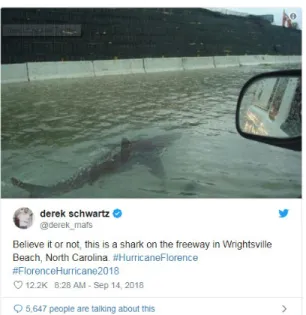
There are also inherent challenges to using Twitter data. Because of the character limit, users tend to write in shorthand, and use local names in referencing places and events (Chan, Vasardani, and Winter 2014). This may create difficulties in data analysis, when filtering posts by word or topic. The technology itself may also limit user access to data, based on algorithms which give less weight to posts from governmental sources (Waters and M. Williams 2011). Because Twitter messages are so simple to post, they may also contribute to the spread of misinformation and rumors, especially in the disaster context (Stephens and Malone 2009). For example, during Hurricane Florence a fabricated Twitter post (Figure 5) about sharks in
Methodology
In order to study social media use by government agencies, a three steps process is used, starting with the “capture” of data, then utilizing techniques to “understand” the data, and finally “presenting” results (Fan and Gordon 2014). First, the study criteria are determined and used to obtain the data, then the data is coded to allow analysis, and finally the results are visualized in the form of figures.
Determining Study Criteria
Before collecting the twitter dataset, criteria were determined to limit the dataset based on the research question. The research required Twitter posts related to Hurricane Florence recovery that were posted by governmental actors in areas affected by Florence in the post disaster timeframe. Therefore, the chosen criteria filtered data based on the topic, time period, and stakeholders.
Topic
The tweet topic was used to obtain data related to Hurricane Florence recovery. The key word utilized was “Florence”. This word could appear in the body of the tweet, as well as in a
hashtag. This term was chosen to be as specific as possible in obtaining data about references to Hurricane Florence in the recovery phase. Using this specific keyword would also exclude posts related to the recovery that do not reference Florence. This would filter out data related to other hurricanes, such as Matthew or Michael. This would also show the prevalence of governmental use of standard hashtags, and referencing events specifically.
Time Period
Additional criteria used to constrain the dataset was the time period over which tweets were posted. FEMA identifies the disaster incident period as September 7th, 2018 through
September 29th, 2018 (FEMA 2018c). Hurricane Florence made landfall in North Carolina on September 14th, 2018. The time period chosen for the study was between September 20th, 2018 and April 2nd, 2019. The start date of September 20th was chosen because it occurred
approximately one week after the event. April 2nd was the end date that represented the “present”, as this is when the dataset was collected. This provided 195 days, or about 6 months’ worth of data. This allowed for the comparison of short vs. long term phases of post-disaster recovery efforts in North Carolina, specifically in terms of when agencies were involved in the post-disaster arena.
Stakeholders
the event, including the Environmental Protection Agency (EPA) and Small Business
Administration (SBA). A total of 14 federal agencies that partnered with FEMA on Florence recovery were identified through this method (FEMA 2018a). To determine state level actors, a list was made of relevant governmental departments (NC.gov 2019). This included all
departments with active Twitter accounts that may play a role in state level disaster recovery. To determine county and municipal level actors, the FEMA Disaster Declaration in North
Carolina was consulted. This method identified 32 counties designated for Individual Assistance located mostly within southeastern North Carolina, and these were chosen for the study area (). The municipalities considered for the study were larger cities and towns within these
designated counties, with populations greater than 20,000.
A manual search of Twitter was used to identify the Twitter accounts associated with each agency. All of the federal and state agencies identified had active Twitter accounts. At the local level, both the official county or municipal account was included, as well as the local Emergency Management agency, if applicable. Figure 9 in the appendix displays all governmental entities considered in the study. Fifteen of the county and local governments considered did not have official twitter accounts, as seen in Figure 7. Many agencies identified were not actively posting Florence-related tweets in the post disaster timeframe, which are identified in Figure 8.
Obtaining Twitter Data
To obtain the dataset of tweets from Hurricane Florence, a Twitter scraping tool was used. Web scraping tools are used to extract information from websites. It is difficult to define the exact size of the Twitter dataset that focuses on Hurricane Florence recovery. Although not utilized in this study, there is a database of Hurricane Florence tweets in the tweet catalog of the
Documenting the Now Project. This dataset represents the time period from 9-05-18 through 10-03-18, and holds approximately 5 million tweets (Phillips 2018). The DocNow catalog holds tweet IDs, which must be rehydrated to read the content of the tweets and perform data analysis (DocNow 2019). This database method was not chosen to obtain tweets for this study, as a larger timescale covering post-disaster recovery was desired.
with all posts of each governmental user that contained the term “Florence” since September 20th, 2018.
The subsequent .csv file contained information about the post content as well as Twitter metadata. The content of the post refers to the message written by the user, which may contain words, multimedia, hyperlinks, and hashtags. These posts may refer to other users, places and events through mentions and hashtags. Metadata refers to information about the tweet that can be used to identify the data. In this case, the metadata held the unique tweet ID, the user ID, username, timestamp, and number of likes, replies, and retweets.
The data was filtered to contain all unique tweet IDs for each username. The total number of tweets in the dataset were 405. The tweets were sorted by governmental level: Federal, State, County and Municipal. At this point, tweet messages were read through and all posts unrelated to Hurricane Florence were removed from the dataset. This removed 5 tweets, so the final dataset contained 400 tweets.
Coding Twitter Data
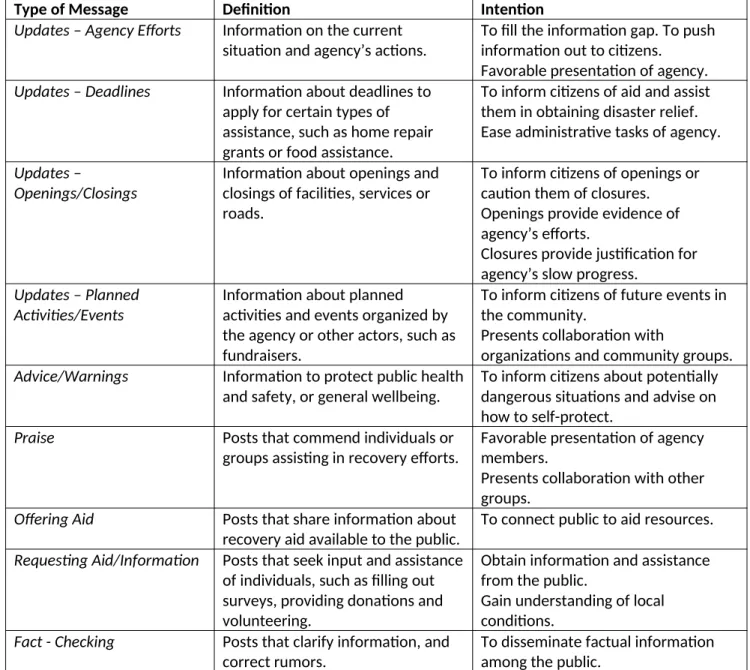
After the dataset was finalized, the tweets were then coded to determine the content of each post. There were three types of coding for each tweet: the disaster phase, the type of message, and the subject of the post. The disaster phase refers to which phase of the disaster cycle the content of the tweet falls within. There were four options within this category: response, recovery, mitigation or preparation. The type of message related to the intention of the
governmental post. This includes providing updates or advice, asking for or offering assistance, praising certain parties, and fact-checking information. There were many types of updates provided, and these were delineated further into updates related to agency efforts, deadlines, opening/closing dates, and planned activities and events. These categories were inspired by other classification schemes created to categorize governmental communication on social media (DePaula, Dincelli, and Harrison 2017; Mergel 2013a; Alexander 2013). The table in Figure 10 defines the categories for each type of message in greater detail.
Results
From the tweet data, patterns emerged on how governmental organizations use Twitter to share information and resources. The tweet data collected can be summarized in the following figures. The first bar graph details how tweets were communicated over time. Then the
following pie charts show the percentage of tweets designated in each type of message and subject categories. Additionally, a bar graph describing the number of likes, comments and retweets on posts. This shows what types of communications were most popular and most shared.
Sep Oct Nov Dec Jan Feb Mar Apr
2018 2019
0 20 40 60 80 100 120 140
Frequency of Governmental Tweets over Time by Level
State Municipal Federal County
Month/Year Tweet Posted
N
u
m
b
er
o
f
Tw
ee
ts
Figure 1. Graph showing the frequency of governmental tweets over the study time period for each level of government.
study time period. This graph characterizes how frequently each level of government dispatched messages in the post-recovery timeframe, both in the short-term and long-term recovery phase.
Advice/Warning; 13%
Fact-Checking; 1%
Offering Aid; 18%
Praise; 14%
Requesting Aid/ Info; 8%
Update - Agency Efforts; 20% Updates - Open-ings/Closings; 6%
Updates - Planned Ac-tivites/Events; 9%
Updates -Dead-lines; 13%
Percentage of Tweets by Type of Message
Figure 2. Pie chart showing percentage of total tweets for each message type.
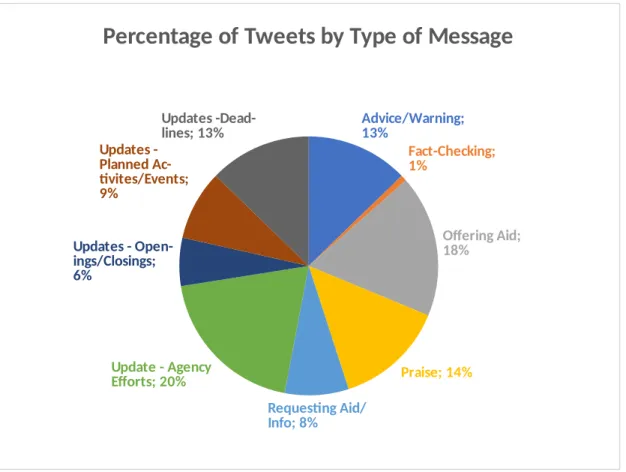
Figure 2 organizes the tweet dataset by type of message. This shows the intention of each governmental tweet, whether it was updating readers, offering advice or aid, fact-checking, requesting aid, or praising certain parties. About half of all tweets consisted of updates, with 20% of those being updates about the governmental agency’s efforts towards recovery. The other types of updates include deadlines (13%), openings and closings of agencies or roadways (6%), and planned activities and events (9%). There were also a large proportion of messages (18%) meant for offering assistance to citizens. These tweets informed citizens about recovery assistance such as food, water, and shelter, as well as grants and loan programs available for home owners. About 14% of tweets offered praise to various groups, including government agency employees, community groups, or citizens that were valuable to recovery efforts. Many posts sent out by federal and state agencies focused on delivering advice and warnings to readers. This 13% of posts included information about health and safety warnings, such as mold and mosquito reduction, as well as flood protection. A small percentage (8%) of tweets,
the public. These tweets linked to online surveys, where property owners could input damage information, volunteer information or donation pages where readers could contribute funds towards recovery efforts. Only 1% of original tweets were related to fact-checking information. These tweets contained clarifying information to stop the spread of rumors. Sorting information by the type of message shows how the government focused communication efforts in the post-disaster context.
Community 17%
Debris 6%
Economic/ Financial
19%
Energy/ Power
1% Environment
4% Gov Services
7% Property
18% Public Health/
Safety 11%
Resources 8%
Shelter/Temp Housing
4%
Trans-portation
5%
Percentage of tweets by Subject
Figure 3. Pie chart showing percentage of total tweets by message subject.
but also included praise of transportation officers. Following the immediate concerns, there were tweets focused on government services (7%) which included many rescheduled services and information about openings and closings of local offices. There were also 6% of tweets concerning debris collection, which consisted of advice on how to sort home waste and information about debris pick-up in local areas. About 4% of tweets concerned the physical environment, such as how flooding impacted local ecosystems. The majority of tweets (19%) were related to economic and financial concerns, such as updates on how local governments were paying for recovery efforts, and financial assistance programs for disaster victims,
including specific groups such as farmers and fishermen. The property category made up 18% of all tweets, and included tweets related to home repairs, flood insurance, home buyout
programs, and historic preservation efforts. The majority of the buyout programs and historic preservation tweets were initiated at the local government level. The final category,
community, made up 17% of tweets and consisted of messages relating how governmental agencies were involved in community recovery and praise for public involvement in recovery efforts. Organizing information by subject allows for greater understanding of the substance of governmental communications.
County Federal Municipal State 0
500 1000 1500 2000 2500 3000 3500 4000
Tweet Interactions to Posts by each Level of
Government
Total Likes Total Retweets Total Replies
Level of Government
To
ta
l C
o
u
n
t
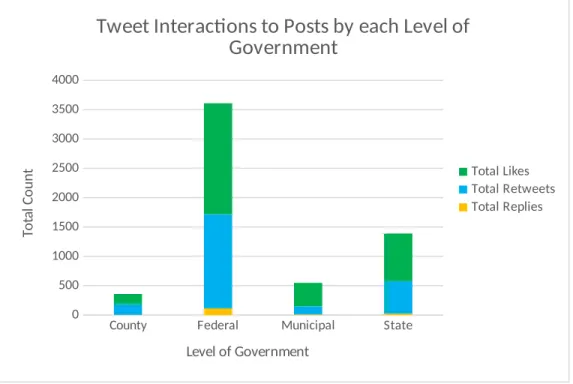
Figure 4. Graph depicting tweet interactions (Likes, Retweets, Replies) to governmental tweets by level.
Discussion
This study reveals trends regarding governmental usage of Twitter in the post-disaster context. From the results, it is clear that the highest number of posts occurred immediately following the event, in September and October, then decreased significantly in the subsequent months. Certain agency levels, such as the federal and state government tend to be more involved in the beginning of the recovery process. Later in recovery, county and municipal governments were still posting about Hurricane Florence. These groups are more responsible for the local
rebuilding process. County and local governments posted about assistance programs available to survivors, such as the STEP program for temporary home repairs post-Florence, that enabled victims to return to their homes. The beginning of recovery, just after the event, is when federal and state agencies are most involved. This would be a good time to inject long-term planning that includes mitigation efforts. The higher-level involvement is more oriented towards sending out warnings and broader updates, but they can use their reach to let the public know about available resources. The federal level has more exposure on this platform, but local levels are responsible for the practical work, such as asking for assistance and administering aid.
Social media is fulfilling a crucial need of governments, to communicate and share information with the public (Mergel 2013b). The majority of governmental posts were intended to update users on agency activities, as well as inform them of aid opportunities. Sharing this type of information online helps increase transparency and inform citizens of agency efforts (Mergel 2012). Many of these updates were deadlines to apply for certain types of relief programs or funding opportunities. Though they set deadlines, government agencies ended up extending many of the deadlines, allow citizens more time to file. Generally, they were more lenient and understanding of the issues people faced, such as losing their homes or losing power. Updates about openings and closings also allowed agencies to show progress and justify their actions. For instance, these updates informed of emergency aid centers opening in certain cities, or that the local license office was closed because of flooding. This keeps citizens informed about what is occurring in their area, which is important when people are not able to move around easily or are deciding whether to return home after the storm.
Twitter to engage in dialogue with the public and shape recovery efforts. However, the data shows that in this case, it was mostly one-sided information sharing. Governments primarily used the platform to push out updates of agency operations in a top-down approach.
One of the main goals of social media use is to pull information and engage in dialogue with the public on disaster recovery. This was seen in governmental tweets asking residents for
assistance or information. Many counties asked residents to fill out surveys of hurricane damage, in order to help with damage estimates to qualify for state and federal disaster assistance. This was in line with other research, that found most of the input-seeking activities of governments involved asking people to fill out surveys or polls (Waters and M. Williams 2011). Obtaining feedback from residents on how the town or county handled the event would be very helpful in a planning context. This could be used to improve processes for future events, enhancing preparedness. Asking for donations and volunteers was another way government engaged citizens in the recovery process. For example, the NC Department of Health and Human Services posted about the North Carolina Disaster Relief Fund and linked a website where citizens could donate money towards state-wide recovery efforts.
Overall, tweets containing property and financial information were the most common subject in this study. This is practical information that would concern many readers as well as planners. Deciding how to rebuild after a storm is often the task of the local government. They might have to make the decision of whether to rebuild a damaged area or not. If the municipal government decides not to invest in rebuilding homes and infrastructure, residents may be forced to move. The local level is responsible for administering aid programs created by higher federal and state levels, such as FEMA’s disaster assistance program or the state’s STEP
program. The use of social media to alert people to resources available and deadlines for applying to these programs is a helpful tool in disaster recovery. For longer-term planning efforts, residents must know about aid programs available, so they can be self-sufficient in rebuilding their lives. Though there were posts mentioning local organizations, there was not much online interaction with other agencies or community organizations.
content analysis shows planners the best ways of reaching the public. What content is re-tweeted and shared the most.
Limitations
The Florence dataset was collected by scraping the data using the “Twint” Twitter intelligence tool. This works around Twitter API limitations and produced a larger dataset for the recovery time period. However, this may not be a complete dataset due to limitations created by the keywords used, time of extraction, and users identified. Searching by keywords and hashtags does not always produce the full collection of tweets. Some users had no tweets that
referenced Florence, but that does not necessarily mean they were not posting about hurricane recovery. Users may not use consistent terminology or have local terms for events (Chan, Vasardani, and Winter 2014). It is more difficult to find tweets if users do not use standardized hashtags, such as #Florence. In fact, “#Florance” and “#HurricaneFlorerence” were common misspellings referring to the disaster, that were “trending” (Fagan 2018). Twitter exacerbates this issue, by automatically filling in trending hashtags when users begin typing the word. The word Florence may also carry emotional weight for survivors, so more general terms may have been used by governments in recovery efforts. The dataset could have been expanded by including more general terms, such as “hurricane” “recovery” and “relief”.
More broadly there are limitations observed by utilizing Twitter to analyze governmental use of social media versus other social platforms, namely Facebook. Twitter is more frequently used by social media researchers, but may not paint a true picture of how governmental actors utilize social media, and how the public interacts with these entities. The time length of the dataset covered about 6 months, which was a significant portion of the recovery. However, tweets or Twitter accounts may have been deleted between the disaster in September and the collection date in April. Tweets that were deleted by the user are not included in the scraped dataset. This makes it more difficult to find tweets that are negative or controversial in nature, because they are more likely to be deleted as time goes on. A better method would be to collect tweets continuously as they are posted, to procure a complete dataset.
A limitation of the Twint tool is that it only contains communications initiated by the
government agency. The data contained all original posts by the governmental users, but did not contain retweets. Retweets would include posts that originated with other users that are then shared by the government entity. This information would show how the governmental actor shares information of other stakeholders. For example, the Wilmington government may retweet a post by a local business sharing their re-opening after the storm. There was also quantitative information about the number of comments and retweets, but not the actual content of these communications. The content of the replies would reveal how the agency engages in dialogue with other users. Information about who is retweeting governmental posts would also show how stakeholders interact with government created information.
Governmental Twitter accounts are not representative of all recovery activity in the post-disaster field. There are many other stakeholders in play, such as non-profit groups, individuals, and businesses. Some of these actors were mentioned in governmental posts, including local faith organizations and musicians hosting benefit concerts. Non-profit groups may be more involved in specialized recovery efforts, towards housing, resource provision, and emotional support. Additionally, social media users may not be representative of the larger population, and their perception of reality may be biased when related to disaster situations. Individuals may also have more emotional responses to recovery. Businesses may choose to spread messages of their recovery. This information would characterize recovery in different ways, as these groups experience different outcomes. Many of these groups are prominent in the recovery efforts, but their contributions are not acknowledged greatly in governmental Twitter posts.
Recommendations
There are many opportunities for government agencies to make the most of this social media platform. Throughout Hurricane Florence recovery, governments used Twitter to update citizens on agency activities, planned events, facility openings/closings, and deadlines. They shared information on opportunities to provide and receive assistance post-disaster. Twitter can be used to encourage productive communication and constructive public participation. There is an opportunity here to obtain citizen feedback in terms of replies to messages and mentions of the agency. They can gauge how the public interacts with their posts and create more engaging content. They can use citizen feedback to shape the recovery process. They can share information about the actions of other local organizations to better enable volunteering and promote recovery efforts locally. There are many stakeholders involved in the process, though there was less evidence of coordinated efforts with governmental agencies.
There were different amounts of involvement for each governmental agency. The county and municipal levels with active Twitter accounts remained engaged in Florence recovery months after the event. However, there were many county and municipal governments that did not have a twitter presence. They may have been engaging with the public through other methods, but it may be helpful to adopt an online presence to communicate with the public and share information on recovery activities in the community. When adopting new forms of social media, it may be necessary to create new organizational roles for this purpose (Picazo-Vela, Fernandez, and Luna-Reyes 2016). This may be beyond the capabilities of many local governments in North Carolina, in terms of finances and personnel available for disaster recovery.
It can be challenging for understaffed agencies to adopt technological changes. They must respond to public demands for additional information and have a presence on the internet. These technologies create additional staffing and resource demands for agencies, who must maintain their websites and stay current in this evolving field. Agencies should work to establish a combination of social media tools that complement each other, are sustainable by available resources, and meet the needs of local audiences. Agencies can incorporate social media strategies as part of future local hazard mitigation plans. Social media can serve as a record keeping tool, tracking recovery progress and showing how communities engage in recovery efforts. This can help in future disasters, to remember how governments engaged with communities in the past. They can learn from their past posts, to see what content resonated most with the public. If they know praising and sharing community achievements is the best way to engage the public, they can tailor future posts.
There was a large proportion of tweets that conveyed content about property and financial recovery. These are important subjects, but there are other aspects of recovery that were barely mentioned, such as citizen’s mental and emotional recovery. Local governments could also share resources related to other types of aid, such as a trauma assistance hotline. Governments must also consider the psychological impacts of disaster on victims. When communicating, it is important to consider how individuals will process and react to
information presented after a disaster. They may be able to better support disaster victims by considering social and mental states. This is how they can build social capital and support resilient communities (Cox and Perry 2011).
There is an opportunity to coordinate response efforts across different levels of government, along with private and non-profit entities. This works well if there is a shared understanding of end goals. There are many organizations responsible for communication during disasters, who may be sharing similar messages with the public. Decisions must be made regarding the
local and county governments, as well as at the state and federal level. There are also opportunities to bring together expertise from different areas, including government, academia, non-profits, and the private sector. Further research could involve a more
Conclusion
Social media is relevant to planners and may become more widespread as a planning tool in the coming years. It would be unwise for planners to ignore the prevalence of the internet, its influence on people and its power to spread information and influence public opinion. Social media is continuously evolving, and in the future there may be easier ways to access data to inform decision making. More disaster research using social media dataset will help planners understand what data is needed to make decisions, so they can meet the needs of different organizations. Studying the post-disaster context allows planners to have a better
References
Alexander, David. 2013. “Social Media in Disaster Risk Reduction and Crisis Management.” Science and Engineering Ethics 20. https://doi.org/10.1007/s11948-013-9502-z.
Bauhr, M., and M. Grimes. 2012. “What Is Government Transparency?” 16.
Bellström, Peter, Monika Magnusson, John Sören Pettersson, and Claes Thoren. 2016. “Facebook Usage in a Local Government: A Content Analysis of Page Owner Posts and User Posts.” Transforming Government: People, Process and Policy 10: 548–67. https://doi.org/10.1108/TG-12-2015-0061.
Berke, Philip, Jack Kartez, and Dennis Wenger. 1993. “Recovery after Disaster: Achieving Sustainable Development, Mitigation and Equity.” Disasters 17: 93–109. https://doi.org/10.1111/j.1467-7717.1993.tb01137.x.
Berke, Philip, and Gavin Smith. 2010. “Hazard Mitigation, Planning, and Disaster Resiliency: Challenges and Strategic Choices for the 21st Century.” In , 1–23.
Bonsón, Enrique, Lourdes Torres, Sonia Royo, and Francisco Flores. 2012. “Local E-Government 2.0: Social Media and Corporate Transparency in Municipalities.” Government Information Quarterly 29: 123–32. https://doi.org/10.1016/j.giq.2011.10.001.
C. Topping, Kenneth, Charles C. Eadie, Robert E. Deyle, and Richard A. Smith. 1998. “Planning for Post-Disaster Recovery and Reconstruction.”
Carley, Kathleen M., Momin Malik, Peter M. Landwehr, Jürgen Pfeffer, and Michael Kowalchuck. 2016. “Crowd Sourcing Disaster Management: The Complex Nature of Twitter Usage in Padang
Indonesia.” Safety Science 90. https://doi.org/10.1016/j.ssci.2016.04.002.
Chan, C K, M Vasardani, and S Winter. 2014. “Leveraging Twitter to Detect Event Names Associated with a Place.” Journal of Spatial Science 59 (1). Taylor & Francis: 137–55.
https://doi.org/10.1080/14498596.2014.852073.
Chatfield, Akemi Takeoka, and Christopher G Reddick. 2018. “All Hands on Deck to Tweet #sandy: Networked Governance of Citizen Coproduction in Turbulent Times.” Government Information Quarterly 35 (2): 259–72. https://doi.org/https://doi.org/10.1016/j.giq.2017.09.004.
Cheng, Xusen, Shixuan Fu, and Gert-Jan de Vreede. 2017. “Understanding Trust Influencing Factors in Social Media Communication: A Qualitative Study.” International Journal of Information
Management 37 (2): 25–35. https://doi.org/https://doi.org/10.1016/j.ijinfomgt.2016.11.009.
Cheshire, Lynda. 2015. “‘Know Your Neighbours’: Disaster Resilience and the Normative Practices of Neighbouring in an Urban Context.” Environment and Planning A: Economy and Space 47 (5): 1081–99. https://doi.org/10.1177/0308518X15592310.
Chun, Soon, and Luis Luna-Reyes. 2012. “Social Media in Government.” Government Information Quarterly 29: 441–445. https://doi.org/10.1016/j.giq.2012.07.003.
Comerio, M.C. 1998. Disaster Hits Home: New Policy for Urban Housing Recovery. Univ of California Press.
Cox, Robin S, and Karen-Marie Elah Perry. 2011. “Like a Fish Out of Water: Reconsidering Disaster Recovery and the Role of Place and Social Capital in Community Disaster Resilience.” American Journal of Community Psychology 48 (3–4): 395–411. https://doi.org/10.1007/s10464-011-9427-0.
DePaula, Nic. 2018. “#Supporting the Cause: An Analysis of How Government Agencies Use Twitter Hashtags.” Proceedings of the Association for Information Science and Technology 55: 788–89. https://doi.org/10.1002/pra2.2018.14505501117.
DePaula, Nic, Ersin Dincelli, and Teresa Harrison. 2017. “Toward a Typology of Government Social Media Communication: Democratic Goals, Symbolic Acts and Self-Presentation.” Government Information Quarterly. https://doi.org/10.1016/j.giq.2017.10.003.
Djalante, Riyanti, Cameron Holley, and Frank Thomalla. 2011. “Adaptive Governance and Managing Resilience to Natural Hazards.” International Journal of Disaster Risk Science 2 (4): 1–14. https://doi.org/10.1007/s13753-011-0015-6.
DocNow. 2019. “Tweet ID Datasets.” Documenting the Now Project. 2019. https://www.docnow.io/catalog/.
Eom, Seok-Jin, Hanchan Hwang, and Jun Houng Kim. 2018. “Can Social Media Increase Government Responsiveness? A Case Study of Seoul, Korea.” Government Information Quarterly.
https://doi.org/10.1016/j.giq.2017.10.002.
Fagan, Kaylee. 2018. “DOUBLE EDGED TWEET: HASHTAGS CAN SAVE LIVES, SPREAD DISINFO DURING DISASTERS LIKE HURRICANE FLORENCE.” YR Media. 2018. https://yr.media/tech/double-edged-tweet-hashtags-can-save-lives-spread-disinfo-during-disasters-like-hurricane-florence/.
Fairbanks, Jenille, Kenneth Plowman, and Brad Rawlins. 2007. “Transparency in Government Communication.” Journal of Public Affairs 7: 23–37. https://doi.org/10.1002/pa.245.
Fan, Weiguo, and Michael Gordon. 2014. “The Power of Social Media Analytics.” Communications of the ACM 57: 74–81. https://doi.org/10.1145/2602574.
FEMA. 2018a. “FEMA and Partners Respond to Hurricane Florence.” 2018. https://www.fema.gov/news-release/2018/09/14/fema-and-partners-respond-hurricane-florence.
———. 2018b. “Hurricane Florence Rumor Control.” Department of Homeland Security. 2018. https://www.fema.gov/florence-rumors.
———. 2018c. “North Carolina Hurricane Florence (DR-4393).” Department of Homeland Security. 2018. https://www.fema.gov/disaster/4393.
G. Reddick, Christopher, and Donald F. Norris. 2013. “Social Media Adoption at the American Grass Roots: Web 2.0 or 1.5.” Government Information Quarterly 30.
https://doi.org/10.1016/j.giq.2013.05.011.
Godschalk, David. 2003. “Urban Hazard Mitigation: Creating Resilient Cities.” Natural Hazards Review 4. https://doi.org/10.1061/(ASCE)1527-6988(2003)4:3(136).
https://doi.org/https://doi.org/10.1016/j.pubrev.2015.02.001.
Guan, Xiangyang, and Cynthia Chen. 2014. “Using Social Media Data to Understand and Assess Disasters.” Natural Hazards 74 (2): 837–50. https://doi.org/10.1007/s11069-014-1217-1.
Han, Ziqiang, Xiaojiang Hu, and Joanne Nigg. 2011. “How Does Disaster Relief Works Affect the Trust in Local Government? A Study of the Wenchuan Earthquake.” Risk, Hazards & Crisis in Public Policy 2 (4): 1–20. https://doi.org/10.2202/1944-4079.1092.
Houston, J Brian, Joshua Hawthorne, Mildred F Perreault, Eun Hae Park, Marlo Goldstein Hode, Michael R Halliwell, Sarah E Turner McGowen, et al. 2015. “Social Media and Disasters: A Functional
Framework for Social Media Use in Disaster Planning, Response, and Research.” Disasters 39 (1): 1– 22. https://doi.org/10.1111/disa.12092.
Jamali, Mehdi, Ali Nejat, Souparno Ghosh, and Guofeng Cao. 2018. “Social Media Data and Post-Disaster Recovery.” International Journal of Information Management 44: 25–37.
https://doi.org/10.1016/j.ijinfomgt.2018.09.005.
Janssen, Marijn, and Haiko van der Voort. 2016. “Adaptive Governance: Towards a Stable, Accountable and Responsive Government.” Government Information Quarterly 33 (1): 1–5.
https://doi.org/https://doi.org/10.1016/j.giq.2016.02.003.
Java, Akshay, Xiaodan Song, Tim Finin, and Belle Tseng. 2009. “Why We Twitter: An Analysis of a Microblogging Community.” In Advances in Web Mining and Web Usage Analysis, edited by Haizheng Zhang, Myra Spiliopoulou, Bamshad Mobasher, C Lee Giles, Andrew McCallum, Olfa Nasraoui, Jaideep Srivastava, and John Yen, 118–38. Berlin, Heidelberg: Springer Berlin Heidelberg.
Kaplan, Andreas, and Michael Haenlein. 2010. “Users of the World, Unite! The Challenges and Opportunities of Social Media.” Business Horizons 53: 59–68.
https://doi.org/10.1016/j.bushor.2009.09.003.
Kapoor, Kawaljeet Kaur, Kuttimani Tamilmani, Nripendra P Rana, Pushp Patil, Yogesh K Dwivedi, and Sridhar Nerur. 2018. “Advances in Social Media Research: Past, Present and Future.” Information Systems Frontiers 20 (3): 531–58. https://doi.org/10.1007/s10796-017-9810-y.
Kavanaugh, Andrea, Edward Fox, Steven Sheetz, Seungwon Yang, Lin Li, Travis Whalen, Donald Shoemaker, Paul Natsev, and Lexing Xie. 2011. “Social Media Use by Government: From the Routine to the Critical.” In , 121–30.
Kim, Jooho, and Makarand Hastak. 2018. “Social Network Analysis: Characteristics of Online Social Networks after a Disaster.” International Journal of Information Management 38 (1): 86–96. https://doi.org/https://doi.org/10.1016/j.ijinfomgt.2017.08.003.
King, Larry J. 2018. “Social Media Use During Natural Disasters : An Analysis of Social Media Usage During Hurricanes Harvey.” Proceedings of the International Crisis and Risk Communication Conference, 6–9. https://doi.org/10.30658/icrcc.2018.6.
Leykin, Dmitry, Mooli Lahad, Ran Cohen, Avishay Goldberg, and Limor Aharonson-Daniel. 2016. “The Dynamics of Community Resilience between Routine and Emergency Situations.” International Journal of Disaster Risk Reduction 15. https://doi.org/10.1016/j.ijdrr.2016.01.008.
Linders, Dennis. 2012. “From E-Government to We-Government: Defining a Typology for Citizen
doi.org/10.1016/j.giq.2012.06.003.
Lindsay, Bruce R. 2011. “Social Media and Disasters: Current Uses, Future Options, and Policy
Considerations.” Washington D.C. https://mirror.explodie.org/CRS-Report-SocialMediaDisasters-Lindsay-SEP2011.pdf.
Liu, Wenlin, Chih-Hui Lai, and Weiai (Wayne) Xu. 2018. “Tweeting about Emergency: A Semantic
Network Analysis of Government Organizations’ Social Media Messaging during Hurricane Harvey.” Public Relations Review 44 (5): 807–19.
https://doi.org/https://doi.org/10.1016/j.pubrev.2018.10.009.
Luna, Sergio, and Michael J. Pennock. 2018. “Social Media Applications and Emergency Management: A Literature Review and Research Agenda.” International Journal of Disaster Risk Reduction 28. https://doi.org/10.1016/j.ijdrr.2018.01.006.
Mackinnon, Jessica, Natalie Heldsinger, and Shawna Peddle. 2018. “A Community Guide to Effective Flood Risk Communication: Promoting Personal Preparedness.”
Mergel, Ines. 2012. “The Social Media Innovation Challenge in the Public Sector.” Information Polity 17: 281–92. https://doi.org/10.3233/IP-2012-000281.
———. 2013a. “A Framework for Interpreting Social Media Interactions in the Public Sector.” Government Information Quarterly 30: 327–34. https://doi.org/10.1016/j.giq.2013.05.015.
———. 2013b. “Social Media Adoption and Resulting Tactics in the U.S. Federal Government.” Government Information Quarterly 30. https://doi.org/10.1016/j.giq.2012.12.004.
Mergel, Ines, and Stuart Bretschneider. 2013. “A Three-Stage Adoption Process For Social Media Use in Government.” Public Administration Review 73: 1–11. https://doi.org/10.1111/puar.12021.
Mossberger, Karen, Yonghong Wu, and Jared Crawford. 2013. “Connecting Citizens and Local Governments? Social Media and Interactivity in Major U.S. Cities.” Government Information Quarterly 30. https://doi.org/10.1016/j.giq.2013.05.016.
Murphy, Brian. 2018. “A Shark Swimming alongside Cars on a Flooded Street in NC? Just Another Florence Fake.” News and Observer, September 12, 2018.
https://www.newsobserver.com/news/state/north-carolina/article218265210.html.
NC.gov. 2019. “Agencies.” 2019. https://www.nc.gov/agencies.
Neppalli, Venkata K, Cornelia Caragea, Anna Squicciarini, Andrea Tapia, and Sam Stehle. 2017. “Sentiment Analysis during Hurricane Sandy in Emergency Response.” International Journal of Disaster Risk Reduction 21: 213–22. https://doi.org/https://doi.org/10.1016/j.ijdrr.2016.12.011.
Pew Research Center. 2018. “Demographics of Social Media Users and Adoption in the United States.” 2018. http://www.pewinternet.org/fact-sheet/social-media/.
Phillips, Mark Edward. 2018. “Hurricane Florence Twitter Dataset.” University of North Texas Digital Library. 2018. https://digital.library.unt.edu/ark:/67531/metadc1259406/.
Picazo-Vela, Sergio, Marilu Fernandez, and Luis Luna-Reyes. 2016. “Opening the Black Box: Developing Strategies to Use Social Media in Government.” Government Information Quarterly.
Poldi, Francesco. 2019. “Twint - Twitter Intelligence Tool.” Github. 2019. https://github.com/twintproject/twint/blob/master/README.md.
Ragini, J Rexiline, P M Rubesh Anand, and Vidhyacharan Bhaskar. 2018. “Big Data Analytics for Disaster Response and Recovery through Sentiment Analysis.” International Journal of Information Management 42: 13–24. https://doi.org/https://doi.org/10.1016/j.ijinfomgt.2018.05.004.
Reilly, Paul, Dima Atanasova, Jem Stone, and C C By. 2016. “A Report on the Role of the Media in the Information Flows That Emerge during Crisis Situations,” 1–41.
Sapat, Alka, and Ann-Margaret Esnard. 2012. “Displacement and Disaster Recovery: Transnational Governance and Socio-Legal Issues Following the 2010 Haiti Earthquake.” Risk, Hazards & Crisis in Public Policy 3 (1): 1–24. https://doi.org/10.1515/1944-4079.1095.
Simon, Tomer, Avishay Goldberg, and Bruria Adini. 2015. “Socializing in Emergencies—A Review of the Use of Social Media in Emergency Situations.” International Journal of Information Management 35 (5): 609–19. https://doi.org/https://doi.org/10.1016/j.ijinfomgt.2015.07.001.
Smith, Gavin. 2008. “Planning for Post-Disaster Recovery: A Review of the United States Disaster Assistance Framework.” In Solutions to Coastal Disasters Congress 2008 - Proceedings of the Solutions to Coastal Disasters Congress 2008, 312:773–84. https://doi.org/10.1061/40968(312)69.
———. 2014. “Planning for Sustainable and Disaster-Resilient Communities.” Natural Hazards Analysis: Reducing the Impact of Disasters, 221–47. https://doi.org/10.1201/b17463-10.
Smith, Gavin, and Thomas Birkland. 2012. “Building a Theory of Recovery: Institutional Dimensions.” International Journal of Mass Emergencies and Disasters 30: 147–70.
Smith, Gavin, Amanda Martin, and Dennis Wenger. 2017. “Disaster Recovery in an Era of Climate Change: The Unrealized Promise of Institutional Resilience.” In , 595–619.
https://doi.org/10.1007/978-3-319-63254-4_28.
Smith, Gavin P, and Dennis Wenger. 2007. “Sustainable Disaster Recovery: Operationalizing An Existing Agenda.” In Handbook of Disaster Research, 234–57. New York, NY: Springer New York.
https://doi.org/10.1007/978-0-387-32353-4_14.
Stephens, Keri K, and Patty C Malone. 2009. “If the Organizations Won’t Give Us Information…: The Use of Multiple New Media for Crisis Technical Translation and Dialogue.” Journal of Public Relations Research 21 (2). Routledge: 229–39. https://doi.org/10.1080/10627260802557605.
Stradling, Richard, and Abbie Bennett. 2018. “‘Historic’ Hurricane Florence Caused More Damage than Matthew and Floyd Combined, Governor Says.” News and Observer. 2018.
https://www.newsobserver.com/news/local/article220890905.html.
Twitter. 2019a. “FEMA Twitter.” 2019. https://twitter.com/fema.
———. 2019b. “Search Tweets.” Developer Tools. 2019. https://developer.twitter.com/en/docs/tweets/ search/overview.
U.S. Department of Homeland Security. 2013. “Innovative Uses of Social Media in Emergency Management,” no. September.
the SIGCHI Conference on Human Factors in Computing Systems, 1079–88. CHI ’10. New York, NY, USA: ACM. https://doi.org/10.1145/1753326.1753486.
Wang, Cancan, Rony Medaglia, and Lei Zheng. 2018. “Towards a Typology of Adaptive Governance in the Digital Government Context: The Role of Decision-Making and Accountability.” Government Information Quarterly 35 (2): 306–22. https://doi.org/https://doi.org/10.1016/j.giq.2017.08.003.
Waters, Richard, and Jensen M. Williams. 2011. “Squawking, Tweeting, Cooing, and Hooting: Analyzing the Communication Patterns of Government Agencies on Twitter.” Journal of Public Affairs 11: 353–63. https://doi.org/10.1002/pa.385.
Wendling, Cécile, Jack Radisch, and Stephane Jacobzone. 2013. “The Use of Social Media in Risk and Crisis Communication.” OECD Working Papers on Public Governance, no. 25: 1–42. https://doi.org/ http://dx.doi.org/10.1787/5k3v01fskp9s-en.
Wold, Geoffrey H. 2019. “Disaster Recovery Planning Process.”
Appendix
Figure 6. Map of North Carolina counties designated for FEMA Disaster Assistance. (FEMA 2018c)
Row Labels
Count of Name
County 10
Beaufort 1
Greene 1
Hoke 1
Johnston 1
Jones 1
Moore 1
Pamlico 1
Richmond 1
Robeson 1
Anson 1
Municipal 5
Kinston 1
Lumberton 1
Raeford 1
Whiteville 1
Grand Total 15
Government Agencies with No Florence Tweets County Bladen Columbus Duplin Durham Guilford Lenoir New Hanover Onslow Sampson Scotland Wilson Craven Cumberland Pitt Federal
FEMA Ready Gov
Small Business Administration Southeast EPA
SouthEast FEMA Southeast SBA
US Army Corps of Engineers US Coast Guard
US Dept of Defense US Dept of Justice
US Dept of State US Dept of the Interior US Fish and Wildlife Survey US National Guard
US Nuclear Regulatory Commission
Municipal Burgaw Clinton Elizabethtown Greenville Jacksonville Lillington Pittsboro Rocky Mount State
NC Dept of Administration NC Dept of Commerce NC Dept of Labor
NC Dept of Natural and Cultural Resources NC Dept of Revenue
NC Dept of Transportation NC Division of Public Health NC Forest Service
NC Governor's Office NC Govt Info
Rebuild NC
Agency Name (Twitter Username)
Total Florence Tweets
County 166
Beaufort
NA
Bladen 0
@BladenOnline 0
Brunswick 43
@BrunswickGovt 23
@BrunscoES 20
Carteret 6
@CarteretCoGov 6
Chatham 13
@ChathamCountyNC 13
Columbus 0
@ColCoES 0
Duplin 0
@DuplinCountyNC 0
Durham 0
@DurhamCounty 0
@EMSDurham 0
Greene
NA
Guilford 1
@GuilfordCounty 1
@GuilfordEMS 0
Harnett 11
@HarnettCounty 11
Hoke
NA
Hyde 7
@HydeNC 7
Johnston
NA
Jones
NA
Lee 8
@leecountync 8
Lenoir 0
@LenoirCountyES 0
Moore
NA
@NewHanoverCo 0
@NewHanoverEM 0
Onslow 0
@OnslowES 0
@OnslowPIO 0
Orange 16
@OCNCGOV 16
Pamlico
NA
Richmond
NA
Robeson
NA
Sampson 0
@CountyofSampson 0
Scotland 0
@Scotland_Co_911 0
@Scotland_County 0
Union 9
@UnionCountyNC 9
Wayne 3
@waynecountygov 3
Wilson 3
@wilsoncountygov 3
@wilsonema 0
Anson
NA
Craven 0
@cravencountyem 0
@cravencountync 0
Cumberland 6
@Cumberland911 0
@CumberlandNC 6
Pender 40
@PenderCounty_NC 20
@PenderCountyEM 20
Pitt 0
@PittCountyNC 0
Federal 46
FEMA Ready Gov 0
@Readygov 0
National Oceanic and
@NOAA 1
Small Business Administration 0
@SBAgov 0
Southeast EPA 0
@USEPASoutheast 0
SouthEast FEMA 0
@femaregion4 0
SouthEast HUD 4
@HUDSoutheast 4
Southeast SBA 0
@SBAsoutheast 0
US Army Corps of Engineers 0
@USACEHQ 0
US Coast Guard 0
@USCG 0
US Dept of Defense 0
@DeptofDefense 0
US Dept of Energy 2
@ENERGY 2
US Dept of Justice 0
@TheJusticeDept 0
US Dept of Labor 3
@USDOL 3
US Dept of State 0
@StateDept 0
US Dept of the Interior 0
@Interior 0
US Dept of Transportation 2
@USDOT 2
US Environmental Protection
Agency 8
@EPA 8
US Federal Emergency Mgmt
Agency 12
@fema 12
US Fish and Wildlife Survey 0
@USFWS 0
US Geological Survey 8
@USGS 8
US Health and Human Services 6
@HHSGov 6
US National Guard 0
US Nuclear Regulatory
Commission 0
@NRCgov 0
Municipal 72
Beaufort 4
@TownofBeaufort 4
Bolivia
NA
Burgaw 0
@ncburgaw 0
Chapel Hill 10
@chapelhillgov 10
Clinton 0
@ClintonNCMgr 0
Durham 3
@CityofDurhamNC 3
Elizabethtown 0
@ElizabethtownNC 0
Fayetteville 6
@CityOfFayNC 6
Goldsboro 3
@cityofgoldsboro 3
Greensboro 2
@greensborocity 2
Greenville 0
@GreenvilleGov 0
Jacksonville 0
@NC_Jacksonville 0
Kinston
NA
Lillington 0
@LillingtonNC 0
Lumberton
NA
New Bern 20
@CityofNewBern 20
Pittsboro 0
@pittsboroncgov 0
Raeford
NA
Rocky Mount 0
@cityofrockymtnc 0
@CityofSanfordNC 1
Smithfield 1
@SmithfieldNews 1
Whiteville
NA
Wilmington 20
@CityofWilm 20
Wilson 2
@WilsonNC 2
State 116
NC Dept of Administration 0
@NCDOA 0
NC Dept of Commerce 0
@NCCommerce 0
NC Dept of Environmental
Quality 20
@NCDEQ 20
NC Dept of Health and Human
Services 20
@ncdhhs 20
NC Dept of Human Resources 20
@Work4NC 20
NC Dept of Information
Technology 2
@NCDIT 2
NC Dept of Labor 0
@NCDOL 0
NC Dept of Natural and Cultural
Resources 0
@ncculture 0
NC Dept of Public Safety 17
@NCPublicSafety 17
NC Dept of Revenue 0
@NCDOR 0
NC Dept of Transportation 0
@NCDOT 0
NC Division of Public Health 0
@NCPublicHealth 0
NC Emergency Mgmt 20
@NCEmergency 20
NC Forest Service 0
@ncforestservice 0
NC Govt Info 0
@NCdotGov 0
NC State Highway Patrol 17
@NCSHP 17
Rebuild NC 0
@ReBuildNC_gov 0
Grand Total 400