THE INFLUENCE OF TECHNIQUE ON THROWING PERFORMANCE AND INJURY RISK IN JAVELIN THROWERS
Steven Leigh
A dissertation submitted to the faculty of the University of North Carolina at Chapel Hill in partial fulfillment of the requirements for the degree of Doctor of Philosophy in the
Curriculum of Human Movement Science.
Chapel Hill 2012
Approved by: Bing Yu, PhD Jesus Dapena, PhD Michael Gross, PT, PhD Li Li, PhD
ABSTRACT
STEVEN LEIGH: The Influence of Technique on Throwing Performance and Injury Risk in Javelin Throwers
(Under the direction of Bing Yu)
The overall objective of this dissertation was to understand the effects of elite javelin throwers’ techniques on their athletic performance and their risk for injury. Javelin throwing is a complex, multi-joint task that requires great coordination, muscular strength, and control to generate the forces necessary to propel implements at high velocities. A javelin thrower’s technique has crucial effects on the release variables that determine their performance. The need to generate high release speeds means that javelin throwing techniques exert significant musculoskeletal stress to multiple joints, which may cause acute and overuse injuries. Since an athlete’s technique affects both their performance and their injury risk, it is necessary to understand the inter-relationships between technique, performance, and injury in throwing events, such as the javelin.
Three-dimensional kinematic and kinetic data were reduced from the video images of elite javelin throwers competing in the USA Track and Field National Outdoor
Championships. Cross-sectional and longitudinal, subject-specific statistical analyses were performed to investigate the relationships between javelin throwing technique and
Technique variables that were associated with differences in performance and injury were identified. Differences were found between males and females, and for specific
ACKNOWLEDGEMENTS
TABLE OF CONTENTS
LIST OF TABLES...……...………...…………...…... vii
LIST OF FIGURES……..………... ix
LIST OF ABBREVIATIONS AND SYMBOLS...………...………...……...…. xi
Chapter I. INTRODUCTION... 1
Background and Significance…...………...……...…...……. 1
Statement of the Problem…..………...…...…...…… 7
Specific Aims of the Dissertation.…..………...…...…....……...… 8
Definitions of Key Terms..………....……...………...………...……. 10
II. REVIEW OF LITERATURE…………...………...……. 15
Javelin Throwing Technique... 15
Javelin Throwing Performance... 22
Biomechanical Factors that Affect Performance in Javelin Throwing... 24
The Influence of Technique on Javelin Throwing Performance... 41
Injuries in Over-arm Throwing... 44
III. METHODS………...………...…………... 55
Subjects... 55
Data Collection... 57
Data Reduction... 62
Data Analysis... 75
IV. RESULTS..………...………... 82
Injury Survey... 82
Kinematic Data Screening... 83
Technique and Performance….…... 84
Technique and Injury……... 93
V. DISCUSSION……….………... 98
Technique and Performance...………... 98
Technique and Injury... 122
Limitations & Future Studies...…... 144
Summary... 147
Tables………... 149
Figures……... 178
LIST OF TABLES
Table
3.1 Subject Demographics... 149
4.1 Injury Survey... 150
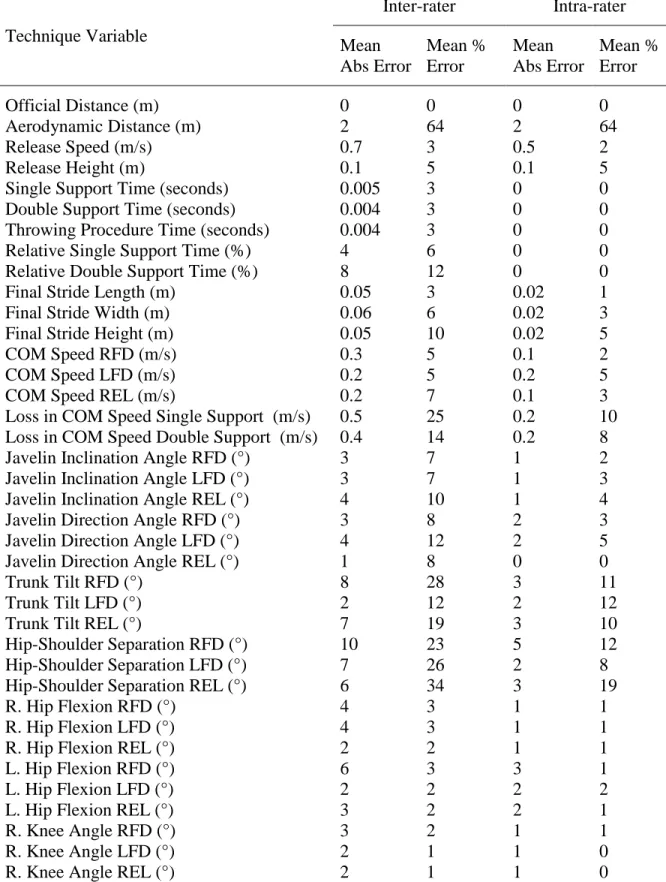
4.2 Inter- and Intra-Rater Reliability... 151
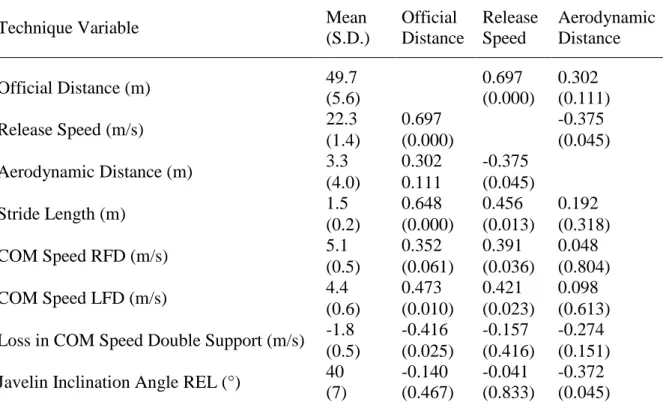
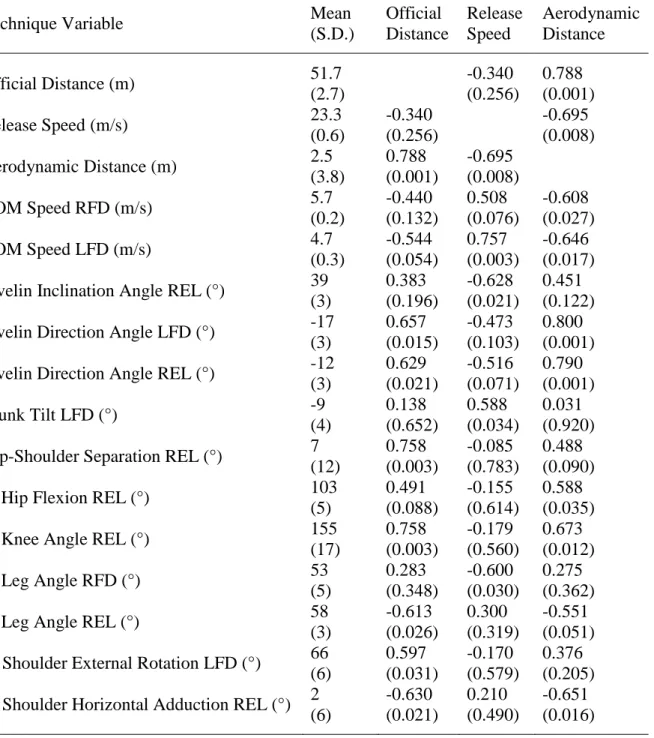
4.3 Female Performance Correlations... 153
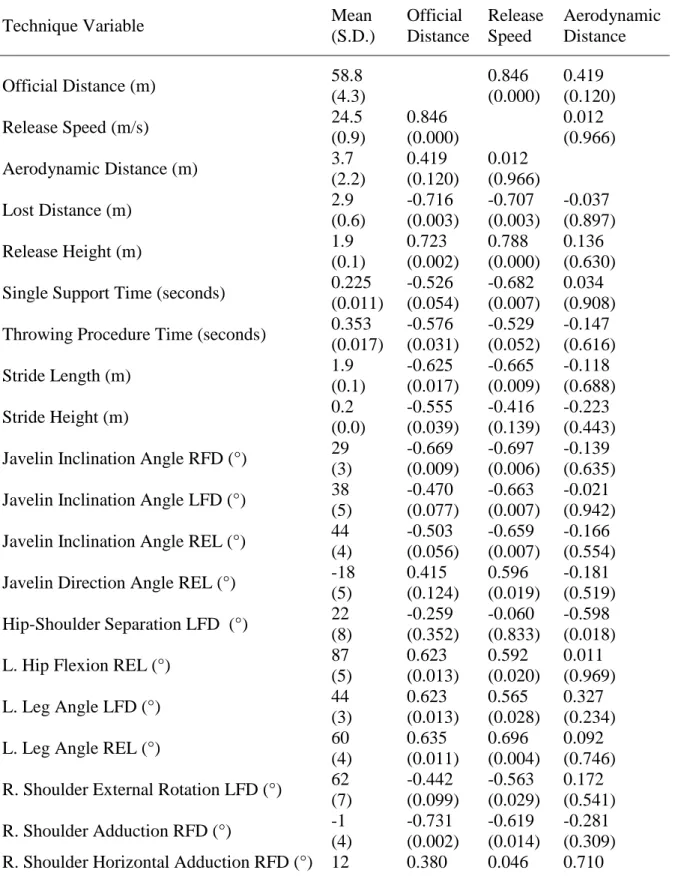
4.4 Male Performance Correlations…... 154
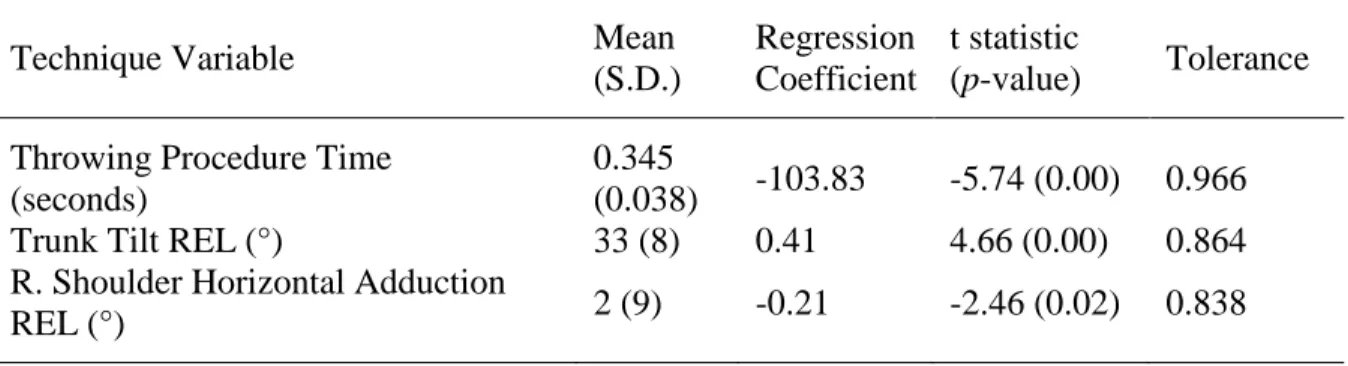
4.5 Female Official Distance Multiple Regression... 155
4.6 Male Official Distance Multiple Regression... 156
4.7 Female Release Speed Multiple Regression... 157
4.8 Male Release Speed Multiple Regression... 158
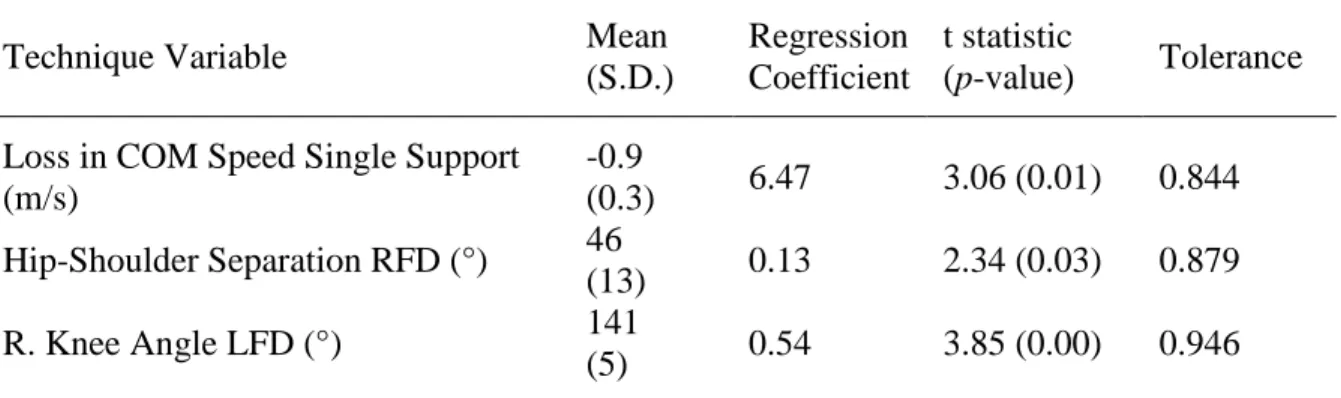
4.9 Female Aerodynamic Distance Multiple Regression... 159
4.10 Male Aerodynamic Distance Multiple Regression... 160
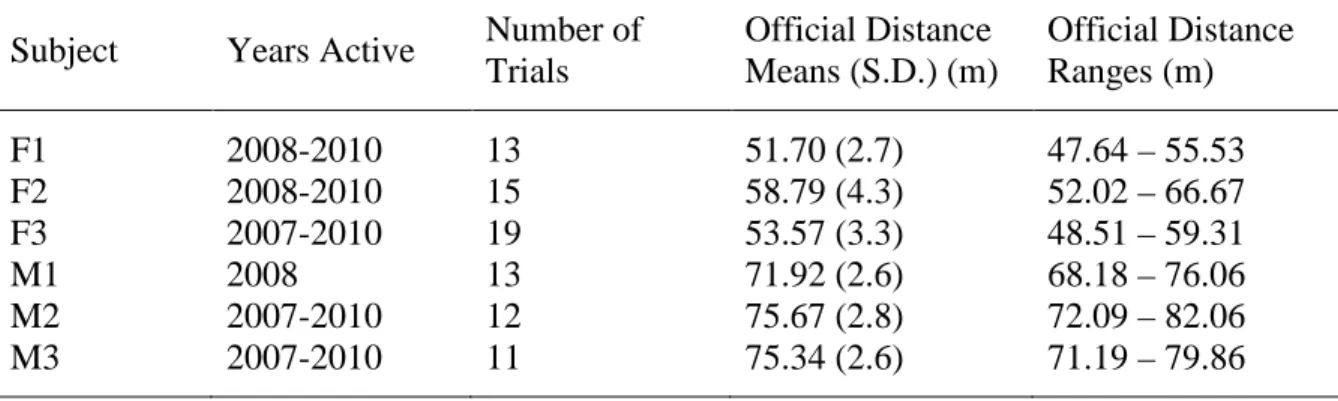
4.11 Longitudinal Subject’s Descriptive Statistics………... 161
4.12 Subject F1 Performance Correlations... 162
4.13 Subject F2 Performance Correlations... 163
4.14 Subject F3 Performance Correlations... 165
4.15 Subject M1 Performance Correlations... 167
4.16 Subject M2 Performance Correlations... 168
4.17 Subject M3 Performance Correlations... 169
4.18 Shoulder and Elbow Forces and Torques... 170
4.20 Injured Females Technique Differences………... 172
4.21 Injured Males Technique Differences………... 173
4.22 Female Technique Groupings for Performance or Injury……... 174
LIST OF FIGURES
Figure
1.1 Javelin Throwing Technique, Side View………...…………....……. 178
1.2 Javelin Throwing Technique, Rear View……….…...……. 179
1.3 Javelin Measured Distances…...………....…...……. 180
1.4 Official and Partial Distances…...……...……….. 181
1.5 Release Variables, Side View………...…...……. 182
1.6 Release Variables, Top View………...…...……. 183
2.1 The Javelin………...………....……….. 184
2.2 Javelin Arena…...………...……… 185
2.3 Javelin and Baseball, Single Support……….…....……… 186
2.4 Javelin and Baseball, Delivery…...……...……… 187
2.5 Javelin Aerodynamics…...…….………...………188
2.6 Magnus Force………...……… 189
3.1 Camera Location…...………...………..……. 190
3.2 Calibration Frame…...…...………..……. 191
3.3 Calibration Volume…...………..……. 192
3.4 Body Landmarks…...………..……. 193
3.5 Javelin Reference Frame…...…...……..……. 194
3.6 Angle of Attack…...……...………..……. 195
3.7 Angle of Sideslip…...………..……. 196
3.9 Shoulder Joint Angles and Torques…...…………..……. 198
3.10 Upper Arm Reference Frame…...……. 199
3.11 Hip Joint Angles…...…………...………..……. 200
3.12 Thigh Reference Frame…...……. 201
3.13 Trunk Angles…...………...……..……. 202
3.14 Trunk Reference Frames…...……. 203
3.15 Hip-Shoulder Separation…...………...……. 204
3.16 Right Upper Extremity Angles and Torques…...……. 205
3.17 Lower Extremity Angles…...…………....………..……. 206
4.1 Official Distance and Release Speed…...…...…………..……. 207
4.2 Official and Aerodynamic Distance…...……....………..……. 208
LIST OF ABBREVIATIONS AND SYMBOLS
θ Angle of release
ϕ Yaw angle
α Angle of attack β Angle of sideslip ψ Inclination angle χ Direction angle
° Degrees
ρ Air density 2-D Two-dimensional 3-D Three-dimensional
A Projection area of the javelin
ACL Anterior Cruciate Ligament of the knee joint CD Drag coefficient
CL Lift coefficient
CMC The Coefficient of Multiple Correlation COM Center of Mass
dO Official distance
dF Vacuum flight distance
dA Aerodynamic distance
dL Lost distance
F F-statistic for ANOVA statistical tests
F Force
FD Drag force
FL Lift force
g Gravitational acceleration i i unit vector
j j unit vector k k unit vector
IAAF The International Association of Athletics Federations
Kg Kilograms
m Meters
mph Miles per hour m/s Meters per second
N Newtons
Nm Newton meters
p p-value or probability value for statistical tests
r Pearson product-moment correlation coefficient
t t-statistic for regression statistical tests UCL Ulnar Collateral Ligament of the elbow joint v Release velocity
CHAPTER I INTRODUCTION
Background and Significance
Javelin throwing technique is complicated and demanding (Ariel, Pettito, Penny, & Terauds, 1980; Best, Bartlett, & Morris, 1996; Morriss & Bartlett, 1996; Terauds, 1985). A javelin thrower makes complex, multi-joint movements that require great muscular strength, sophisticated coordination, and accurate control (Limpisvasti, ElAttrache, & Jobe, 2007; Wilk, Meister, Fleisig, & Andrews, 2000). These movements must develop the great forces that are necessary to accelerate the javelin to great release speeds (Bartionetz, 2006; Bartlett, 1988; Wilk, et al., 2000), while carefully controlling the direction of the release (Bartlett, 1988; Best & Bartlett, 1986, 1987; Ganslen, 1967; Hubbard, 1984; Hubbard & Alaways, 1987; Rich, Whiting, McCoy, & Gregor, 1985; Terauds, 1974a, 1974b). The generation of great forces exerts significant musculoskeletal stress on multiple joints (Andrews & Fleisig, 1998; Boden, Griffin, & Garrett, 2000; Fleisig, Andrews, Dillman, & Escamilla, 1995; Limpisvasti, et al., 2007; Werner, Jones, Guido, & Brunet, 2006; Wilk, et al., 2000).
Current javelin throwing technique consists of: (1) an approach run where the thrower runs forwards towards the throwing direction to build up momentum, (2) a series of
runway momentum to javelin speed, and releases the javelin in an over-arm throwing motion, and (5) a follow through where the thrower decelerates their throwing motion and regains their balance (Figures 1.1 and 1.2) (Babbitt, 2001; Bartlett, 1988; Gorski, 2003; Morriss & Bartlett, 1996). The single support phase was defined as the time between the right foot touching down and the left foot touching down (single support phase). The delivery phase was defined as the time between the left foot touching down and the release of the javelin (delivery phase). The throwing procedure was defined as the single support phase and the delivery phase together (Bartlett, 1988; Hay & Yu, 1995; Morriss & Bartlett, 1996).
& Rust, 1984). The lost distance was defined as the distance thrown for which the javelin thrower was not credited, and had relatively minor effects on official distance (Hay & Yu, 1995). The performance measures for javelin throwing, therefore, were the official distance, the release speed, and the aerodynamic distance.
To achieve maximum official distance, a javelin at release must have the optimal release characteristics for maximum theoretical vacuum projectile motion, as well as for beneficial aerodynamic effects (Best & Bartlett, 1986, 1987; Best, et al., 1996; Hubbard, 1984; Hubbard & Alaways, 1987; Rich, et al., 1985; Terauds, 1974b; Vitasalo, Mononen, & Norvapalo, 2007). Vacuum projectile motion was measured by the vacuum flight distance, which is the primary partial distance of the official distance. It was defined as the distance travelled by the javelin as if it were a point mass in a vacuum as calculated by the range equation from release speed, release angle, and release height (Hay & Yu, 1995; Hubbard, 1984) (Figures 1.3 and 1.4). The release speed was defined as the magnitude of the release velocity, which is the velocity of the center of mass of the javelin at the instant of release (Bartlett, 1988; Best, et al., 1993; Hay & Yu, 1995; Morriss & Bartlett, 1996) (Figures 1.5 and 1.6). The release height was defined as the vertical distance above the runway of the center of mass of the javelin at the instant of release (Hay & Yu, 1995; Morriss & Bartlett, 1996) (Figure 1.5). The release angle was defined as the orientation of the release velocity relative to the forward throwing direction in a vertical plane defined by the true vertical axis and the axis pointing along the longitudinal axis of the javelin (Bartlett, 1988; Best, et al., 1993; Hay & Yu, 1995; Morriss & Bartlett, 1996) (Figure 1.5). The optimal release
1984; Hubbard & Alaways, 1987; Morriss & Bartlett, 1996; Rich, et al., 1985; Terauds, 1974a; Vitasalo, et al., 2007).
The aerodynamic effect was measured by the aerodynamic distance, which is the secondary partial distance of the official distance. It was defined as the difference between the official distance, the vacuum flight distance, and the lost distance (Hay & Yu, 1995) (Figures 1.3 and 1.4). The aerodynamic distance was primarily determined by the direction of the javelin relative to the velocity of the javelin (Hubbard, 1984; Morriss & Bartlett, 1996), which depended on the angle of attack and the angle of sideslip. The angle of attack was defined as the angle between the release angle and the orientation of the javelin relative to the forward throwing direction in a vertical plane defined by the true vertical axis and the axis pointing along the longitudinal axis of the javelin (Bartlett, 1988; Hubbard, 1984; Morriss & Bartlett, 1996) (Figure 1.5). The angle of sideslip was defined as the angle between the yaw angle and the orientation of the javelin relative to the forward throwing direction in a
Hubbard & Alaways, 1987; Morriss & Bartlett, 1996; Rich, et al., 1985; Terauds, 1974a, 1974b).
The lost distance was the third partial distance of the official distance. It was defined as the distance for which the athlete did not get credit, because they released behind the foul line or the javelin travelled along a path longer than was measured by the meet officials (Hay & Yu, 1995) (Figures 1.3 and 1.4). It had relatively minor effects on official distance, and was minimized by releasing as close to the foul line as possible (Hay & Yu, 1995).
The optimal release characteristics for javelin throwing were determined to be a release at a suitable angle with a great release velocity, and a precise direction of the velocity relative to the ground and to the javelin (Best & Bartlett, 1986; Hubbard & Alaways, 1987; Morriss & Bartlett, 1996; Terauds, 1974a). This approach was found to maximize the performance measures of javelin throwing, which were the release speed, the aerodynamic distance, and the official distance.
throwing performance (Kunz & Kaufman, 1980). There was a need, therefore, to explore the factors that may have underlain javelin throwing performance, and to identify specific movement patterns that may have influenced performance. This information would be of direct use for practitioners – primarily coaches and athletes.
Javelin throwers were found to have a high incidence of injury. Personal
Javelin throwing injuries were determined to have severe effects. Acute and overuse injuries could lead to a loss of practice and competition time, may have placed a financial and quality of life burden on the javelin thrower, and may have put the javelin thrower at an increased risk for secondary and degenerative injuries (Andrews, Broussard, et al., 1985; Andrews & Fleisig, 1998; Gerbino, 2003; Limpisvasti, et al., 2007; Lyman & Fleisig, 2005; Meister, 2000b; Petty, Andrews, Fleisig, & Cain, 2004b). Injuries sustained through javelin throwing were mainly non-contact injuries, so they may have been prevented through training programs that modified technique to decrease musculoskeletal stress. Researchers and clinicians need to understand relationships between movement and injury before they can design and evaluate injury prevention training programs (Luckstead, Satran, & Patel, 2002; Rowland, 2001; van Beijsterveldt et al., 2011).
No studies were performed that related javelin throwing technique to injuries sustained by javelin throwers, or that identified possible mechanisms of injury. There was a lack of basic information on the mechanisms of javelin throwing injuries. There was a need, therefore, to investigate the relationships between javelin throwing technique and injuries sustained by javelin throwers.
Statement of the Problem
performance, and a high injury rate, scientific studies that critically evaluate javelin throwing technique with three-dimensional, biomechanical methods are limited. The overall purpose of this study, therefore, was to determine the inter-relationships among javelin throwing
technique, javelin throwing performance, and injuries sustained by javelin throwers.
Specific Aims of the Dissertation
To achieve the overall objective of this study, three specific aims were addressed. Specific Aim 1: To explore the relationships between (1) biomechanical variables describing javelin throwing technique and (2) javelin throwing performance. This specific aim would address the gap in the current coaching and scientific literature by providing objective information that explained how detailed techniques affect performance. Two research hypotheses were tested for this specific aim.
Hypothesis 1: The timing of the shoulder, elbow, wrist, hip, knee, and ankle joint motions and trunk rotations would be significantly correlated with the release speed, the aerodynamic distance, and the official distance in javelin throwing.
Hypothesis 2: The motions of the shoulder, elbow, wrist, hip, knee, and ankle joints, and the trunk are significantly correlated with the release speed, the aerodynamic distance, and the official distance in javelin throwing.
Specific Aim 2: To investigate the type of injuries sustained by javelin throwers and potential mechanisms for those injuries. This specific aim would provide information on the nature of the injuries sustained by javelin throwers. This would entail
variables that have been identified as potential mechanisms of injury in over-arm throwing motions. Two research hypotheses were tested for this specific aim.
Hypothesis 3: Javelin throwers' would achieve a right elbow flexion angle of 50 degrees or less at left foot down, a negative hip-shoulder separation before the release, a forward trunk tilt before the release, and a left knee flexion angle of 160 degrees or greater at left foot down.
Hypothesis 4: The average maximum elbow varus and flexion torques, the average maximum shoulder internal rotation and horizontal adduction torques, the average maximum elbow and shoulder joint resultant joint forces, and the average maximum shoulder joint anterior shear force experienced by javelin throwers during the throwing procedure would be greater than zero.
Specific Aim 3: To investigate the relationships between biomechanical variables describing javelin throwing technique, musculoskeletal torques and forces, and injuries sustained by javelin throwers. This specific aim would address the gap in the coaching and scientific literature by relating technique to injuries sustained. This would entail
comprehensively surveying javelin throwers to understand what injuries they sustained, and relating technique to injury. Four research hypotheses were tested to address this specific aim.
forces, and the average maximum right shoulder joint anterior shear force experienced by javelin throwers.
Hypothesis 6: The timings of the shoulder, elbow, wrist, hip, knee, and ankle joint motions and trunk rotations would be significantly different between athletes who sustained an injury to their shoulder, elbow, trunk, hip, knee, or ankle and athletes who did not sustain an injury to that body part.
Hypothesis 7: The motions of the shoulder, elbow, wrist, hip, knee, and ankle joints, and the trunk would be significantly correlated with the average maximum elbow varus and flexion torques, the average maximum shoulder external rotation and horizontal abduction torques, the maximum elbow and shoulder joint resultant joint forces, and the maximum shoulder joint anterior shear force experienced by javelin throwers.
Hypothesis 8: The motions of the shoulder, elbow, wrist, hip, knee, and ankle joints, and the trunk would be significantly different between athletes who sustained an injury to their shoulder, elbow, trunk, hip, knee, or ankle and athletes who did not sustain an injury to that body part.
This dissertation would provide significant information to athletes and coaches for javelin throwing training aimed at drug-free performance improvement, and for injury prevention.
Definitions of Key Terms
Aerodynamic Distance: The aerodynamic distance is the distance gained or lost by the implement as part of its official distance that can be attributed to the aerodynamic force’s lift and drag components.
Body Landmark: A body landmark is a key, conspicuous, and very specific location or anatomical feature that can be observed or located by a researcher during digitizing. Body Segment: A body segment is a discrete structure of the human body, such as a limb. Double Support or Delivery Phase: The double support phase or delivery phase is the time period between the instant when a right handed javelin thrower's left foot contacts the ground and the instant they release the javelin.
Foul Line: The foul line is the curved arched line at the end of the javelin runway, behind which the javelin must be released for the throw to be determined legal and measured. No part of the competing athlete must land on or over this line.
Injury: An injury is damage to a bone or soft tissue, such as a ligament, muscle, or tendon. Javelin: A javelin is the spear-like implement that is thrown by the athlete taking part in a javelin throwing competition.
Joint: A joint is the location between two distinct segments of the human body around which those segments rotate.
Left Foot Down: Left foot down is the first instant any part of the javelin thrower's left foot makes contact with the ground.
Left Leg Angle: This is the angle between an assumed straight left leg and the global horizontal plane.
Line of Shoulders: This is an imaginary straight line joining the center of the right shoulder joint to the center of the left shoulder joint at any given instant.
Lost Distance: The lost distance is the distance the implement travels for which the athlete does not get credit, either because it was released before the foul line, or did not travel along the line measured by the meet officials.
Official Distance: The official distance is the distance measured by meet officials from the point of landing of the implement to the inside edge of the foul line in a track and field throwing event. In javelin throwing this distance is measured from the first mark on the ground made by the landing javelin; the mark closest to the foul line.
Over-arm Throwing: Over-arm throwing will be used to describe any throwing activity where the motion is such that the motion of the hand holding the implement to be thrown occurs above the height of the shoulder of the throwing arm. Examples are javelin throwing, baseball pitching, and football passing.
Performance: In javelin throwing, performance refers to the longest official distance a javelin thrower manages to achieve throughout the competition.
Release: The release is the instant in time that the implement and the hand of the thrower completely break contact.
Release Angle: The release angle is the angle between the release velocity and the longitudinal axis of the javelin.
Release Height: The release height is the vertical position of the center of mass above the origin of the global reference frame.
Release Speed: The release speed is the rate of change of position of the center of mass of the javelin at the instant of release, and is mathematically defined as the absolute magnitude of the velocity vector of the implement at the release.
Right Foot Down: Right foot down is the first instant any part of the javelin thrower's right foot makes contact with the ground.
Sector: The sector is the marked area of the stadium in which athletes are competing that the implement must land in for the throw to be deemed legal and measured.
Single Support Phase: The single support phase is the time period between the instant when a right handed javelin thrower's right foot contacts the ground and the instant when their left foot contacts the ground.
Technique: Technique refers specifically to the combination of actions that make up the javelin throwing procedure. This includes any carrying, backswing or cocking motion made to move the implement away from the throwing direction, as well as any motion made to propel the implement towards the throwing direction.
Throwing Procedure: The throwing procedure is the sum of an athlete’s actions that make up their attempt to complete the predefined throwing activity. In javelin throwing, this
encompasses all of the motions made by the athlete as they attempt to propel the implement from rest up to the release. The throwing procedure time refers to the time from right foot down to release.
CHAPTER II
REVIEW OF LITERATURE
Javelin Throwing Technique
The Javelin: The javelin is a type of light spear designed for throwing in an athletic competition. The javelin consists of a metal head, a shaft made of a homogeneous material, such as steel, aluminum, or carbon fiber, and a cord grip which is wound round the shaft at the center of mass (Figure 2.1). The javelin is circular along its length and tapers to a point at the front and rear from the grip. For male javelin throwers, the javelin weighs 800 grams and is 2.6 meters to 2.7 meters long. For female javelin throwers, the javelin weighs 600 grams and is 2.2 meters to 2.3 meters long (IAAF, 2009).
The Arena: The javelin throw is performed by throwing from a runway into a throwing sector. The throwing sector is often located within a track and field arena, inside a running track. The runway is 30 meters to 36.5 meters in length and 4 meters wide. The runway ends with a foul line, and the throw must be performed behind the foul line. The foul line is not straight, but is an arc that has a radius of 8 meters. The javelin is thrown into the throwing sector from behind the foul line arc, and the sector extends outwards from the arc with a central angle of 26 degrees (IAAF, 2009) (Figure 2.2).
1. The Carry: The javelin must be held at the cord grip, which is wound around the shaft of the javelin at the center of mass (Figure 2.1). The throw begins with the javelin thrower facing the throwing direction and carrying the javelin above their right shoulder with their palm up, their elbow flexed approximately 90 degrees, and their shoulder abducted approximately 90 degrees (Figure 1.1 frame 1 and Figure 1.2 frame 1).
2. The Run-Up: To reach the maximum controllable speed at the release, a javelin thrower will include a run-up before transitioning into a throwing motion. This serves to increase momentum of the thrower plus javelin system, which can be transferred to the javelin only at release. The javelin thrower will face forwards and run in a relatively upright position towards the throwing sector with the line of their shoulders and the line of their hips approximately perpendicular to the throwing direction, and their feet facing the throwing direction. The javelin thrower will run towards the throwing direction at a speed suitable for their ability for around 10-15 strides. They will accelerate to increase their running speed throughout this phase to a speed that can be controlled during the transition from run to throw (Figure 1.1 frames 1-7 and Figure 1.2 frames 1-5).
4. The Crossovers: Around the time the javelin is moved into the withdrawn position, the javelin thrower will transition from running while their hips are facing towards the throwing direction into crossovers. Crossovers are a type of sideways run, where the line of the javelin thrower’s hips is turned to be between 45 degrees and 90 degrees to the throwing direction. For a right handed thrower, their left hip will lead their right hip. The line of the javelin thrower’s shoulders and the javelin are maintained at roughly parallel to the throwing direction (Figure 1.1 frames 8-20 and Figure 1.2 frames 6-26).
The athlete will attempt to have their feet contact the ground underneath their center of mass, which produces a characteristic backwards lean. Usually three to seven crossovers are performed to transition from running to throwing. The athlete will attempt to accelerate through the crossovers to achieve the maximum runway speed at the start of the delivery stride. The final stride of the crossovers, known as the impulse stride, ends with a forceful horizontal drive from their left leg, and fast action from both legs during the flight phase between the impulse stride and the delivery stride. This fast leg action brings their left leg level with, or forward of, their right leg at the instant their right leg contacts the ground to begin the delivery stride (Figure 1.1 frames 15-20 and Figure 1.2 frames 19-26).
their hips and their shoulders will start to rotate towards the throwing direction during this phase, with the line of the hips leading the line of the shoulders. The javelin thrower’s right hip, knee and ankle joints flex during single support to facilitate rotation of their body over their right foot. This allows greater runway speed and momentum to be maintained up to the release by minimizing braking (Figure 1.1 frames 20-22 and Figure 1.2 frames 26-29).
6. The Delivery Phase: The delivery phase starts from the left foot touchdown of the delivery stride and ends at the release of the javelin from the hand. The objective of the delivery is to give the javelin a final acceleration to release the javelin with the maximum velocity in the optimal direction. The javelin thrower braces their left knee at the left foot touchdown in a process known as blocking. This decelerates the javelin thrower and allows momentum of the javelin thrower plus javelin system to be transferred into the javelin only. The javelin thrower will fully rotate their right hip towards the throwing direction to bring the line of their hips perpendicular to the throwing direction. This hip rotation is followed by forward rotation of the upper trunk, moving their right shoulder towards the throwing
direction, and bringing the line of their shoulders perpendicular to the throwing direction. Following this hip and shoulder rotation, the joints of the upper arm move in sequence to increase linear velocity. The joint actions are firstly shoulder joint horizontal adduction and internal rotation, this is followed by elbow joint extension, and then wrist joint flexion, and finally the release of the javelin. For a legal throw the javelin must be released over the shoulder and upper arm of the right arm (Figure 1.1 frames 22-25 and Figure 1.2 frames 29-32).
also slow the motion of their throwing arm from maximum velocity at the release to rest over a long displacement. The javelin thrower must complete the throw behind the foul line, and the javelin must land point first for a legal throw (Figure 1.1 frames 26-31 and Figure 1.2 frames 33-39).
For a left handed javelin thrower, the same basic sequence is followed; however the left and right side roles are reversed. A left handed javelin thrower will carry the javelin in their left hand. They will have a lead of their right shoulder over their left shoulder from the withdrawal and a lead of their right hip over their left hip during the crossovers. The impulse stride will begin with a drive from their right leg. The single support leg will be the left leg, and they will block with their right leg.
Javelin throwing is an over-arm throwing motion. Meister (2000) suggested that movements such as the baseball pitch, football pass, handball pass, and the tennis serve could all be modeled as variations of a general over-arm throwing motion, with baseball pitching as the base model. The schema theory proposed by Schmidt (1975) suggested this may be a reasonable assumption as long as the movement patterns among specific skills were similar. Schema theory suggested that specific movements were not learned; instead a “generalized motor program” was developed by the brain. This generalized motor program contains invariant features, which makes it general, and variant features, which allows for application to many similar skills (Schmidt, 1975). This allows for the brain to link generally similar movements into a movement class, i.e. to group movements into a generalized motor
program with the same invariant features. A specific movement from a class can be produced by varying the parameters used to construct the movement, i.e. by altering the variant
generalized motor program would be: the musculature of the body used in the movement and their firing sequence, the relative durations of muscle activity, and the relative force
produced by the musculature. The variant features of the generalized motor program would be the absolute timing and force of the musculature involved (Schmidt ,1975). This scaling of the variant features allows for different movements to be produced from one generalized motor program as the different absolute forces and times result in altered kinematics of movements. For example, greater angular velocity of limb segments can be achieved through greater muscle contraction force, while the pattern of angular velocities remains similar (Schmidt ,1975). A generalized over-arm throwing motion as proposed by Meister fit within this Schema theory. Javelin throwing may be part of a general over-arm throwing motion, along with baseball pitching, handball passing, and tennis serving.
Javelin throwing is similar to baseball pitching. Atwater (1970), Bunn (1972), and Wickstrom (1977) made comparisons between javelin throwing and baseball pitching. These researchers determined that following the running approach and the crossovers, the javelin throwing motion is similar to the baseball pitching motion. That is, the single support phase and delivery phase of javelin throwing is similar to the acceleration phase motion of baseball pitching. Atwater (1970) noted that the shoulder and arm motion of baseball pitching,
Fleisig et al (2011) compared baseball pitching from a mound to throws for distance. They found that baseball pitching was significantly different from throwing for distance in measures of joint angle, joint angular velocity, and joint torque. However, the variables they chose to compare for different throwing goals were absolute values of joint angle, joint angular velocity, and joint torque. These are variant features of a general over-arm throwing motion, because they are absolute not relative, and would be likely to vary. Relative timing, coordination and force are invariant features of a motor program, but these were not
compared among pitching and throwing for distance. Twelve of the 25 variables that were compared were not significantly different among throws, suggesting strong similarity among throws. There was no research that compared the invariant features of over-arm throwing for distance with the invariant features of baseball pitching. This study did not provide sufficient evidence against the theory of a generalized motor program for over-arm throwing.
tilts it forwards, horizontally adducts and internally rotates their shoulder, extends their elbow, and flexes their wrist (Hay, 1993; Morriss & Bartlett, 1996) (Figure 2.4). From the cocked position to ball release in baseball pitching, the pitcher tilts their trunk forwards and rotates it leftwards, internally rotates their shoulder, and extends their elbow (Fleisig, 2010) (Figure 2.4).
These results and visual comparisons suggested that javelin throwing motion was similar to baseball pitching and other over-arm throwing skills. Javelin throwing could be considered as part of a generalized over-arm throwing motion. Results from and methods used in studies on the throwing motion of over-arm skills could be applicable to javelin throwing. Results from and methods used in this dissertation could be applicable to other studies of over-arm throwing motion. The similarity of the baseball pitching and javelin throwing techniques set the basis for comparing the joint loadings between these two techniques and injury mechanisms.
Javelin Throwing Performance
Javelin performance was determined by the official distance measured by meet officials, and practice improvements were measured by increases in distance thrown.
Aki Parviainen in 1999 (Larsson, 2011). The difference between these two throws was 5.39 meters, which was 5.5% of the world record. The next greatest difference occured in the women’s discus throw event where 2.24 meters separated the top two competitors, which was 3% of the world record (Larsson, 2011). For the women’s javelin throw the world record was 72.28 meters, which was set by Barbora Spotakova in 2009. The next longest throw by a different competitor was 71.99 meters, which was achieved by Mariya Abakumova in 2011 (Larsson, 2011). The difference between these two throws was 29 centimeters, which is 0.5% of the world record. The other throwing events had differences of one percent or less than the world record between the top two competitors. For comparison, one percent was the
difference between the world record in the 100 meter dash and the next fastest time for both the men’s and women’s events.
Jan Zelezny had thrown 40 of the 100 longest men’s javelin throws in history. In the throwing events this proportion was bettered only by women’s shot putter Ilona Slupianek, who had 45 of the 100 longest throws. In the women’s javelin throw, Christina Obergfoll had thrown 26 of the longest 100 throws in history, and Barbora Spotokova had thrown 17. All other throwing events had lower proportions of the 100 longest throws, ranging from 15 to 25 (Larsson, 2011).
Jan Zelezny was the dominant men’s javelin thrower in the modern era, and was the coach of Barbora Spotokova, who was the world record holder for the women’s javelin throw. There appeared to be something about their style of javelin throwing that was
far, and highlight where technique changes needed to be made for other throwers to optimize their performance.
Biomechanical Factors That Affect Performance in Javelin Throwing Official Distance and Partial Distances
The performance measure of javelin throwing was official distance, which was the distance measured by meet officials from the point of landing to the inside of the painted foul line co-linear with the point of landing and the radius of the arc of the foul line (IAAF, 2009) (Figure 1.3). This was a measured distance, which was related to, but not the same as the total distance thrown by a javelin thrower. Similar to the official distance in discus throwing, the official distance in javelin throwing was divided into three partial distances: (1) the vacuum flight distance, (2) the aerodynamic distance, and (3) the lost distance (Hay and Yu, 1995) (Figures 1.3 and 1.4). The vacuum flight distance was the distance between the landing point and the release point if the javelin was a point mass travelling in an airless
The official distance (dO) was expressed as a function of the vacuum flight distance (dF), the
aerodynamic distance (dA), and the lost distance (dL) as:
dO = dF + dA - dL (1)
Among the three partial distances, the vacuum flight distance and the aerodynamic distance were the major components of the official distance, and the lost distance had relatively small effects on official distance (Hay and Yu, 1995). The release speed was the principal determinant of vacuum flight distance (Hay and Yu, 1995), and the release speed was the primary variable that differentiated between performances and performers in throwing events. The aerodynamic distance was more important in javelin throwing than other events, due to the greater aerodynamic properties of the javelin (Hubbard, 1984;
Hubbard & Alaways, 1987; Hubbard & Rust, 1984b). The three major performance measures of javelin throwing technique, therefore, were the official distance, the release speed, and the aerodynamic distance.
Factors That Affect Vacuum Flight Distance
The culmination of the javelin throwing technique is the release. After the release the athlete can exert no further control on the javelin to increase the distance thrown. The
𝑑𝐹 = 𝑣𝑟cos𝜃×
𝑣𝑟sin 𝜃+�𝑣𝑟2𝑠𝑖𝑛2𝜃−2𝑔𝑧𝑖
𝑔 (2)
Where dF = vacuum flight distance, vr= release speed, θ = angle of release, g =
constant acceleration due to gravity, and zi = the vertical coordinate of the front of the grip of
the javelin at the point of release.
The release speed was defined as the absolute magnitude of the velocity vector of the center of mass of the javelin at release (Figures 1.5 and 1.6). The release angle was defined as the angle between the direction of the velocity vector of the center of mass of the javelin at release and the horizontal plane (Figure 1.5). The release height was defined as the vertical position of the javelin’s center of mass at release (Figure 1.5).
makes the javelin throw a predominantly linear event. There is, however, a substantial rotational component to javelin throwing (true rotational techniques have been banned by the IAAF due to safety concerns). Competitors run sideways towards the throwing direction for the final few strides of the run-up, and rotate their body before releasing the javelin while facing the throwing direction. A considerable amount of speed of the javelin at release is added during the delivery phase (Best & Bartlett, 1986), where the majority of the angular motion occurs. Thus, javelin throwing contains both three-dimensional linear and rotational components that must be performed at high speeds to gain the maximum release speed.
on an inter- and an intra-athlete basis (Best & Bartlett, 1986; Miller & Munro, 1983; Rich, Whiting, McCoy, & Gregor, 1985).
There are two contrasting running styles that may affect the speed gained from the run-up and the release speed. A javelin thrower may attempt to maintain as much of their run-up speed up to the release, the European style, or allow their speed to decrease during the transition and up to the release, the Finnish style (Komi & Mero, 1985). A study including two throwers who used these contrasting techniques found that the athlete who allowed their speed to decrease up to the release (58% of their runway speed remained at the release) threw further than the athlete who maintained their speed up to the release (77% of their runway speed remained at the release) (Komi & Mero, 1985). The authors suggested that the Finnish style offers a distinct advantage by decreasing the distance lost at release, and that in this case the smaller distance lost at release was the difference in official distance between the two throwers. The authors also mentioned, however, that the athlete with 58% of their speed remaining at the release had a runway speed 1 m/s higher than the athlete who had 77% of their runway speed remaining at release. When this difference was accounted for, the runway speed differences were negligible. Furthermore, considering the runway speed in isolation, did not account for differences in either athletes’ ability to generate additional release speed during the delivery, which may have accounted for the difference in official distance between these two athletes. Since the same study reported no significant correlation between runway speed and official distance. All this together suggests that the importance of runway speed on technique has not yet been determined.
(Bartlett, 1983). By applying a greater force over a given distance, or applying a given force over a greater distance, or by combining these two, the javelin’s release speed will be
increased. One technique method that has been suggested is increasing the acceleration path, the distance over which a given force is applied, by increasing backwards trunk tilt (Kunz & Kaufman, 1980). Increasing the backwards trunk tilt may increase the horizontal and vertical distance travelled by the javelin during the delivery as there is a tendency for forwards lean late in the throwing procedure. Increased backwards trunk tilt was correlated with increased official distance (Kunz & Kaufman, 1980). The timing of the accelerations of body segments is another proposed method to increase the release speed. By sequentially adding the
maximum angular velocity of each body segment onto the maximum angular velocity of the segment preceding it in an order from the midline of the body out to the right hand, a greater angular momentum will be generated at the last link in the chain – the javelin. This method may increase the force applied to the javelin by increasing the angular momentum available to transfer speed to the javelin. This kinetic linking sequence has been reported in
competitive javelin throwers (Ariel, 1973; Terauds, 1978a, 1978b; Morriss & Bartlett, 1996). Considerable individual variations in the kinetic linking sequence were reported, and no direct link has been found with release speed or official distance.
2007). The relationship is predominantly linear and negative, although positive relationships have been noted (Vitasalo, Mononen, & Norvapalo, 2007). This means that the release angle is a variable that can be optimized, and is athlete-specific. The optimal release angle for javelin throwing has been reported as approximately 36.5 degrees (Best & Bartlett, 1987), and is likely to be as inclined as possible with minimal loss in release speed. Hubbard (1984) found that a three degree increase in release angle, from 30 degrees to 33 degrees, resulted in a decrease in official distance of less than one meter. The release angle has considerably less influence on vacuum flight distance than release speed.
An increase in the release height will result in an increase in official distance, however, increasing the release height may change technique. Therefore, this variable may also need to be optimized rather than maximized, so that release height is as high as possible without altering technique. The javelin is usually released directly overhead with an extended elbow (Bartlett, 1983; Miller & Munro, 1983; Rich, Whiting, McCoy, & Gregor, 1985); however trunk flexion and lateral flexion decrease the overall release height so it is positively correlated with standing height (Rich, Whiting, McCoy, & Gregor, 1985; Terauds, 1978b, 1985). Miller and Munro (1983) found an increase in official distance of 0.35 meters for a maximal change in release height, suggesting the release height is the least important release variable affecting the vacuum flight distance.
Factors That Affect Aerodynamic Distance
shaft made of metal, usually aluminum or steel, or carbon fiber, with a metal head that must have a sharp point, and a cord grip wound around the center of mass. In 1984 a men’s javelin throw world record of 104.8 was achieved, and in 1986 the javelin specifications were changed to reduce the distances thrown and increase the likelihood of a point first landing. These changes primarily affected the aerodynamic distance (Hubbard, 1984). Similar changes were made for the women’s implement in 1999. The center of mass of the javelin was moved forwards in an attempt to cause the javelin to pitch forward in flight, and the minimum radius of the tail of the javelin was increased, thereby increasing drag forces (Hubbard, 1984). These new rules javelins must be a minimum of 260 cm long with a
minimum mass of 800 grams for men, and a minimum of 220 cm long with a minimum mass of 600 grams for women. The center of mass of the men’s javelin must be between 0.9 meters and 1.06 meters from the tip. The center of mass of the women’s javelin must be between 0.8 meters and 0.92 meters from the tip. Strict rules govern the construction and dimensions of the javelins (IAAF, 2009).
Athletes’ throwing techniques result in the release variables that principally determine the aerodynamic distance. The aerodynamic distance is calculated from the difference
between the official distance and the vacuum flight distance and the lost distance (Hay & Yu, 1995). The release variables that are used to calculate vacuum flight distance are the release speed, release angle, release height, and acceleration due to gravity. The release speed and the release angle are also determinants of aerodynamic distance (Hay & Yu, 1995).
javelin at release have a great influence on the lift and drag forces that act on the javelin, and the aerodynamic distance, but are not used in the calculation of vacuum flight distance (Hubbard, 1984). The aerodynamic characteristics of the javelin, such as its mass, shape, surface area, principal moments of inertia, lift and drag coefficients, and projection area also influence the lift and drag forces and the aerodynamic distance (Hubbard, 1984).
Environmental conditions, such as the atmospheric pressure, wind speed and wind direction, have no effect on the vacuum flight distance, but have a great influence on the drag and lift forces during flight, and therefore the aerodynamic distance (Hubbard, 1984). The
aerodynamic flight of the javelin is a complicated concept. Considering the aerodynamic distance as representing all the complicated factors simplifies analysis and interpretation.
have a great influence. Release velocities of 28 meters/second are common, which would be the equivalent of a storm force wind with a hurricane warning on the Beaufort scale.
The orientation of the javelin at the release can be described with the inclination angle, and the angle of attack. The release angle is the angle between the direction of the velocity vector of the center of mass of the javelin at release and the horizontal plane (Best & Bartlett, 1987) (Figure 1.5). The release angle is a measure of the orientation of the velocity of the javelin (Best & Bartlett, 1987). The inclination angle, is the angle between the plane of the javelin formed by its longitudinal axis and the horizontal plane (Best, Bartlett, & Morriss, 1993) (Figure 1.5). It represents the orientation of the javelin relative to the horizontal plane at release. The angle of attack is the angle between the vertical orientation of the javelin and the release angle (Best, et al., 1993), and represents deviation between the vertical orientation of the javelin and the movement direction of the javelin at release (Figure 1.5).
The orientation of the javelin at the release can also be described with the yaw angle, the direction angle, and the angle of sideslip. The yaw angle is the angle between the
Hubbard (1984) suggested that for javelin throwing performance, the release angles may be less important than the rates of revolution associated with those angles. The release angle describes the static orientation of the javelin in the vertical plane. The pitch rate describes how the javelin tumbles forwards during flight (Best & Bartlett, 1987). The pitch rate is the angular velocity of the javelin that causes it to rotate around the horizontal perpendicular axis, which is an axis that is perpendicular to the longitudinal axis of the javelin and parallel to the horizontal plane (Best, et al., 1993). The yaw angle describes the static orientation of the javelin in the horizontal plane. The yaw rate describes how the javelin twists to the left or the right during flight (Best & Bartlett, 1987). The yaw rate is the angular velocity of the javelin that causes it to rotate around an axis that is orthogonal to the plane defined by the longitudinal axis of the javelin and an axis that is perpendicular to the longitudinal axis of the javelin and parallel to the horizontal plane (Best, et al., 1993). The spin of the javelin is the rate at which the javelin rotates around its longitudinal axis (Best, et al., 1993). Hubbard found that a three degree increase in release angle resulted in a decrease in official distance of less than one meter, but a decrease of five meters occurred with a change of two degrees/second in pitch rate. He concluded that pitch rate was more important than release angle for maximizing the official distance. This is most likely due to the effect of pitch rate on aerodynamic distance, since it is not a component of the range equation used to calculate vacuum flight distance. The pitch rate probably affects the lift and drag forces that act on the javelin during flight.
surface force is an aerodynamic force and has two components. The lift force is the
component of the aerodynamic force that acts perpendicular to the surface of the javelin and tends to act generally upwards, countering the gravitational effects (Figure 2.5). The drag force is the component of the aerodynamic force that acts parallel to the surface of the javelin and tends to cause the javelin to decelerate (Figure 2.5) (Best & Bartlett, 1987; Hubbard, 1984). Properties of the javelin that affect the lift and drag forces include the drag coefficient and the lift coefficient.
The drag coefficient is a measure of how much an object disrupts fluid flow around it (Hubbard, 1984). A value close to zero represents strong laminar flow, which means the object travels easily through fluid, whereas a high value means the object disrupts fluid flow and causes turbulent flow (Hubbard, 1984). For a javelin a lower drag coefficient means the javelin is more streamlined (Bertin, 2001). The drag coefficient is dependent on the material properties of the javelin and the angle of attack. The lift coefficient is a measure of how much lift an object gets from fluid flow past it relative to how much drag affects the same object. A greater value represents more lift force than drag force is acting on the object (Bertin, 2001). The lift force is dependent on the material properties of the javelin and the angle of attack. A greater angle of attack, up to the point where fluid flow is greatly disturbed and the object stalls, will produce more lift (Hubbard, 1984). An angle of attack greater than zero was found to be a necessity for lift (Hubbard, 1984). This is true only for the actual angle of attack, however. The apparent angle of attack may be observed to be negative, but the actual angle of attack may be positive if the wind vector were included in the calculation.
area, the atmospheric pressure, and the square of the relative velocity of the center of mass of the javelin referenced to the wind vector (Bertin, 2001) (Figure 2.5). The angle of attack affects the projection area, which is the surface area of an object orthogonally projected onto the plane of fluid it is contacting (Bertin, 2001) (Figure 2.5). For a javelin, this represents how much of the javelin initially contacts the air, and is heavily influenced by the angle of attack (Bertin, 2001). For a javelin thrown at a release angle of zero degrees and an angle of attack of zero degrees, the projection area will be the cross sectional area of the javelin measured perpendicular to the longitudinal axis of the javelin (Figure 2.5). For a javelin thrown at a release angle of zero degrees and an angle of attack of 90 degrees, the projection area will be the cross sectional area of the javelin measured parallel to the longitudinal axis of the javelin (Figure 2.5). Low angles of attack are associated with small projection areas.
The aerodynamic force acting perpendicular to the relative wind vector is the lift force, and is proportional to the lift coefficient, the projection area, the atmospheric pressure, and the square of the relative velocity of the center of mass of the javelin referenced to the wind vector (Bertin, 2001) (Figure 2.5). The same variables that influence lift force also influence drag force.
The aerodynamic force acting on the javelin can be considered to act at a center of pressure at a distance from the tip of the javelin. The center of pressure’s location depends on the angle of attack and flow of the air along the javelin (Bertin, 2001). The distance from the center of pressure to the javelin’s center of mass is the moment arm with which pitch and yaw moments can be calculated (Figure 2.5).
that the time of flight of a javelin was two and a half times greater in air than it would be in a vacuum, which is a considerable advantage when throwing for distance. The aerodynamic distance may be more important for throwers with high release speeds; those release speeds greater than the minimums necessary to throw over 80 meters and 60 meters for men and women, respectively (Bartlett, 1988). When these high release speeds can be achieved, the aerodynamic distance may become more important, because it is the most likely candidate for taking the athlete from the 80 meter or 60 meter threshold to world or Olympic medal level.
The aerodynamic component of the flight of a javelin depends upon the magnitude and direction of the aerodynamic force, the center of pressure of this force, and the center of mass of the javelin (Hubbard, 1984). The aerodynamic force is determined in part by the release speed, the release angle, and the angle of attack (Hubbard, 1984). Researchers have shown that the lift force, the drag force, and the pitching moment are directly related to the square of the release speed, and to the angles of attack and release, through the projection area and the lift and drag coefficients (Best & Bartlett, 1988; Hubbard, 1984; Hubbard & Cheng, 2007; Hubbard & Rust, 1984a, 1984b).
Optimal release parameters for throwing maximum distance were estimated from these studies. Many of these studies took place before the 1986 rule changes, however, and so the optimal release parameters and associated techniques with which to achieve them are no longer valid. The accuracy of the release variables reported in kinematic evaluations of javelin throwing technique is questionable. The errors arise from the data collection and reduction methodology, as well as from treating javelin throwing as a two-dimensional motion. The use of these reported release variables in subsequent computer simulations of the javelin throw, along with the assumptions made about unreported or immeasurable release conditions, mean any results must be interpreted with great care.
The positive lift gained by a javelin has decreased slightly following the rule changes, where the center of mass was moved closer to the tip, mainly due to a decrease in the lift coefficient (Best & Bartlett, 1988). The hypothesis of Terauds (1985), that new rules javelins would have greater lift forces at a given angle of attack, therefore, was rejected. The
implication of this is that it is not necessary for athletes to release the javelin with great positive angles of attack to gain lift.
The new rules javelins consistently displayed forward pitching moments for positive angles of attack, while negative angles of attack reduced the magnitude of this pitching moment (Best & Bartlett, 1987, 1988). This was due to the aerodynamic force acting at a center of pressure behind the center of mass, and so both the lift force and the weight acted to point the nose downwards with a positive angle of attack (Hubbard, 1984). Since a positive angle of attack is require for positive lift, a minimal positive angle of attack should be strived for in order to minimize this downwards pitching moment. The center of pressure is
This suggests that athletes should select the implements that have the best match to their release speed, release angle, and angle of attack, so that lift is maximized, and drag and the forward pitching moment are minimized. This requires the athlete to balance their release variables to achieve maximum release speed at optimal angles of release and attack, and selecting the correct javelin accordingly.
The aerodynamics of the javelin have been considered mainly in the vertical plane, however, the horizontal and longitudinal motions may also affect flight distance (Duncan, Thom, & Young, 1985; Terauds, 1974b, 1985). The spin of the javelin about its longitudinal axis gives it gyroscopic stability, and may prevent excessive yaw moments (Bertin, 2001; Duncan, et al., 1985; Hay, 1993; Terauds, 1974b). The spin also interacts with the angle of sideslip and any side wind to generate Magnus force during flight (Hubbard, 1984). For a right handed thrower the javelin will tend to spin clockwise when viewed from behind along the longitudinal axis (Figure 2.6). This may be due partly to the pronation of the forearm athletes employ to throw over the midline of their body and partly to the fingers on the right hand edge of the javelin breaking contact last. A clockwise rotation coupled with air moving past the javelin from left to right, when viewed from behind, has the effect of increasing the relative speed of the air over the top of the javelin and decreasing the relative speed of the air under the bottom of the javelin. This creates a pressure differential from bottom to top, and hence an upwardly directed Magnus force (Figure 2.6). An opposite wind direction of right to left with a clockwise spin will generate a downwardly directed Magnus force. A wind
horizontal plane. It may be beneficial, or at least not detrimental, for athletes to throw more towards the right hand sector line than towards the center of the sector.
The mass of the javelin may make a small contribution to the official distance. A decrease in mass should allow the athlete to generate a greater release speed (Kunz, 1974; Toyoshima, Hoshikawa, Miyashita, & Oguri, 1974), which is the most important factor in throwing for distance. A decreased mass of the javelin has also been shown to increase the official distance by decreasing the drag to weight ratio (Best & Bartlett, 1988; Hubbard & Alaways, 1987). The potential increases in distance are small, less than one meter, however minimizing the mass of the javelin is optimal.
The wind speed, direction, density, and humidity were all influential for aerodynamic flight (Best & Bartlett, 1988; Hubbard & Alaways, 1987; Townend, 1984; Ward-Smith, 1986), however, these variables are not easy to measure and vary with flight time and height. The wind speed and direction, as noted earlier, is necessary to calculate the actual angle of attack, and the lift and drag coefficients. The wind direction is also influential on the Magnus force that affects the javelin during flight. Converse to events where aerodynamics is less influential, a decrease in air density through increased altitude or humidity, will decrease the aerodynamic distance of the javelin. Hubbard (1984) related a 20% air density reduction to a 2% range reduction due to the decrease in lift during flight. However, no kinematic study of javelin throwing has included estimates of the wind velocity and direction, let alone other environmental factors.
Factors That Affect the Lost Distance
(Figures 1.3 and 1.4). As such, any distance the javelin travelled while behind the foul line will not be credited to the official distance. This distance is related to the distance travelled by the tip of the javelin while behind the foul line, since the official distance is measured from the landing mark made by the tip to the inside of the foul line, and flat or tail first landings are classed as fouls (IAAF, 2011). Furthermore, any distance travelled by the javelin that is not along the line joining the point of landing and the focal point of the fan of the foul line will not be credited to the official distance (IAAF, 2011). For example, if the javelin is released at the extreme right hand edge of the runway, and lands at the extreme left hand edge of the sector, the javelin will have travelled further than will be given credit for, since the measurement will be made to a point further to the left of the foul line than the release point.
The lost distance is the minor component of the official distance (Hay & Yu, 1995). It can be minimized by releasing as close to the foul line as possible without fouling, and by releasing closer to the middle of the runway. There are diminishing returns when attempting to decrease this distance, however, and an athlete is better served optimizing the release variables that affect both the vacuum flight distance and the aerodynamic distance. Both of the other partial distances are greater contributors to the official distance.
The Influence of Technique on Javelin Throwing Performance
distance are the main performance measures of javelin throwing. Relating technique to performance, and suggesting technical changes that may improve performance are particularly important to coaches and athletes. This line of research provides coaches and athletes with objective insights into techniques that may directly assist them. Research into the technical aspects of javelin throwing can scientifically evaluate the techniques suggested in coaching literature, which have been designed to improve performance. Scientific studies on the technical aspects of javelin throwing are limited, though.
Javelin throwing technique has been studied qualitatively and quantitatively. Qualitative studies, such as those by Babbitt (2001), Gorski (1981 & 2003), Salmenkyla (1984), Terauds (1983), and Witchey (1973), presented a coaches perspective on javelin throwing, but did not scientifically evaluate technique. Conclusions were drawn from personal interpretations of observations, but not from objective analysis. This practitioner written literature emphasized general body positions and estimated release variables, which were anecdotally linked to performance. Suggestions were made on where athletes should focus their training in order to achieve better results in competition. The usefulness of these studies is limited, therefore, because the methods and results are subjective and the
conclusions may not be relevant.
The kinematic variables included temporal descriptions for different phases of the throw, mass center velocities of the javelin and limbs, momentum changes during the throwing procedure, joint angles recorded at critical events, and movement sequence time differences (Ariel, Pettito, Penny, & Terauds, 1980; Bartlett, 1983; Best, et al., 1993; Gregor & Pink, 1985; Ikegami, et al., 1981; Komi & Mero, 1985; Kunz & Kaufman, 1980; Maximov, 1979; Morriss & Bartlett, 1996; Plagenhoef, 1971; Terauds, 1978b, 1983; Witchey, 1973). These studies have described movements made by javelin throwers in terms of two-dimensional (Ariel, et al., 1980; Kunz & Kaufman, 1980; Rich, et al., 1985; Salmenkyla, 1984; Terauds, 1983; Witchey, 1973) and three-dimensional (Bartlett, 1983, 1988; Best, et al., 1996; Best, et al., 1993; Komi & Mero, 1985; Morriss & Bartlett, 1996; Red & Zogaib, 1977) kinematic variables. The relevance of using two-dimensional kinematic variables to describe a three-dimensional skill is limited, because the calculations of those kinematic variables require assumptions that may not be valid. The primary assumption that was often violated was that the movement occurs parallel to the optical axis of the camera (Abdel-Aziz & Karara, 1971; Dapena, 1978; Shapiro, 1978).
Kinetic analyses of javelin throwing are problematical because instrumentation of the runway is not often allowed or even possible, and it is difficult to obtain complete data sets. Deporte & van Gheluwe (1987) measured ground reaction forces for a group of Belgian throwers. They reported the maximum impact loads of the front and rear legs, but failed to reference these to performance. They did note, however, that the magnitude of the impact forces may be related to common lower extremity injuries suffered by javelin throwers.
with correlation analyses, or from matching techniques which have been successful for highly skilled throwers (Gregor & Pink, 1985; Komi & Mero, 1985; Kunz & Kaufman, 1980; Morriss & Bartlett, 1996; Terauds, 1978b, 1983). These studies were not hypothesis driven, however, so they described rather than evaluated technique. For example, the study by
(Morriss & Bartlett, 1996) purported to review biomechanical factors critical for performance in the javelin throw. While the paper laid out theoretical relationships between the
biomechanical factors and performance, no empirical evidence was supplied, so it is still unclear whether those biomechanical factors really are critical for performance or not.
The results of previous javelin throwing studies contain limited usable information for practitioners. There is a lack of studies that scientifically and accurately investigate javelin throwing technique, and interpret results so that the findings are relevant and applicable to javelin throwers and their coaches. Three dimensional cross sectional and longitudinal studies are necessary to identify important elements of technique, those which most influence performance and injury risk.
Injuries in Over-arm Throwing
therefore, that javelin throwing may share mechanisms of injury with other over-arm
throwing sports (Atwater, 1979; Bunn, 1972; Wickstrom, 1975), and that they have common injury risk factors. Many male American javelin throwers have a baseball background, which supports the theory of a common generalized throwing motion pattern, and shared injury risk factors. This review of literature pertaining to javelin related injuries, therefore, will include discussion of injuries observed in similar over-arm throwing events, particularly baseball.
Over-arm throwing technique has been show to exert significant musculoskeletal stress on multiple joints, particularly the shoulder and elbow used for throwing (Aguinaldo & Chambers, 2009; Andrews, Carson, & McLeod, 1985; Andrews & Fleisig, 1998; Dillman, Smutz, & Werner, 1991; Fleisig, et al., 1995; Hagberg, 1984; Werner, Gill, Murray, Cook, & Hawkins, 2001; Wilk, et al., 2000). These musculoskeletal stresses lead to acute and overuse shoulder and elbow injuries (Aguinaldo & Chambers, 2009; Andrews, Broussard, & Carson, 1985; Andrews, Carson, et al., 1985; Andrews & Fleisig, 1998; Andrews, Kupferman, & Dillman, 1991; Bechler & Jobe, 1994; Boden, et al., 2000; Gerbino, 2003; Lyman & Fleisig, 2005; Marshall, 2009; Portus, Mason, Elliott, Pfitzner, & Done, 2004; Safran & Graham, 2002; Waris, 1946; Werner et al., 2007). These injuries included tears or ruptures of the ulnar collateral ligament (Dillman, et al., 1991; Escamilla et al., 2007; Fleisig, et al., 1995;