Stereoselective Synthesis of Quaternary Carbons via the
Dianionic Ireland-Claisen Rearrangement: An Approach to the
Synthesis of Briarane Diterpenes
Philip S. Williams
A dissertation submitted to the faculty of the University of North Carolina at Chapel Hill in partial fulfillment of the requirements for the degree of Doctor of
Philosophy in the Department of Chemistry.
Chapel Hill 2012
Approved by:
Prof. Michael T. Crimmins
Prof. Jeffrey S. Johnson
ii
iii
Abstract
PHILIP S. WILLIAMS: Stereoselective Synthesis of Quaternary Carbons via the Dianionic Ireland-Claisen Rearrangement: An Approach to the Synthesis of
Briarane Diterpenes
(Under the direction of Michael T. Crimmins)
Investigation of the dianionic Ireland-Claisen rearrangement has led to the
development of a simple method to enantioselectively access quaternary carbon
stereocenters via a chelated transition state. This methodology was taken and
applied to the synthesis of the core structure of Brianthein A. Peripheral
modification of the core structure to complete the total synthesis proved quite
challenging and ultimately was unsuccessful in forming the fused butenolide.
iv
Acknowledgements
“From his neck down a man is worth a couple of dollars a day, from his neck up he is worth
anything that his brain can produce.” – Thomas Edison
This is the quote that I was exposed to as I began my graduate chemistry
education here at UNC. Filled to the brim with hope and expectations in addition
to excitement and uncertainty, Professor Crimmins accepted me into his
research group. The journey that began then could never have been predicted,
but I am grateful to you Mike for your acceptance, guidance, and soft touch to
help make me the scientist I am today – from the “neck up.”
A big thank you must go to my committee, Professors Brookhart, Johnson,
Gagne, and Templeton. An extra special thank you goes to Professors
Brookhart and Johnson for being official readers of my dissertation. Thank you
all for your support and guidance through the past five years.
I have also enjoyed the company of intelligent, determined and dedicated
colleagues. First, many thanks must go to Dr. Yan Zhang, who helped me
transition into the lab and gave a wonderful foundation to pursue the brianthein A
project. To Mark, Tim, Lizzie, Colin, Anne-Marie, Dee, Yan, Adam, Jay, big Matt,
v
Christie, Dave, Greg, Joe - thanks for making the atmosphere intelligent yet
light-hearted.
The atmosphere and professional relationships at work only takes a
person so far. I would not be where I am today without the support of my family
through the past five years. When reactions didn’t go the way I wanted or when I
was thought to live in lab, I always was able to share the stresses and struggles
of work, even if you didn’t really know what I was talking about. There are many
who have supported me through the years, thanks to my brother Eric, Aunt
Helene, Tom, Michael and Katie, Kristine, Captain Bur, Adam, the Tree of Life
family, and many others. To Doug and Kathy, thanks for listening, supporting,
and enabling so many opportunities the past 5 years. To Mom, thanks for the
unconditional love, even when it meant sacrificing sleep for the late night phone
conversations when life was stressful in lab (and when things went right!).
Finally, I must thank my beautiful and loving wife, Dawn, for being my solid
support on which I have been able to reach for the stars - thank you for being
there, sacrificing, and unconditionally loving me all the while.
"If you knew what you were doing it wouldn't be called research!"
vi
Table of Contents
List of Tables ... viii
List of Figures... ix
List of Schemes ... x
List of Abbreviations ... xiii
Chapter 1 - Development of the Dianionic Ireland-Claisen Rearrangement ... 1
Introduction: ... 1
[3,3] Sigmatropic Rearrangements ... 3
The Ireland-Claisen Rearrangement ... 5
Stereocontrolled Ireland-Claisen Rearrangements ... 7
Dianionic Ireland-Claisen Rearrangement ... 9
Enantioselective synthesis of a quaternary carbon via the Dianionic Ireland Claisen Rearrangement ... 11
Synthesis of the dianionic Ireland-Claisen starting material ... 11
Optimization of the dianionic Ireland-Claisen rearrangement ... 13
Stereochemistry of the Dianionic Ireland-Claisen Rearrangement ... 20
Degradation Pathways: ... 23
Challenges and Summary ... 26
Chapter 2 - Efforts toward the Total Synthesis of Brianthein A ... 27
Cyclized Cembranoid-Based Natural Products ... 27
vii
Previous Synthetic Efforts ... 31
Nantz’ Work toward C1 Quaternary Carbon ... 31
Iguchi’s efforts toward Pachyclavulide B... 36
Bates’ Synthesis of the C1 Quaternary Carbon of the Briarane Skeleton ... 39
Previous Syntheses of Ten Membered Rings ... 44
Procter NHK Coupling toward Solenolide F ... 45
Ring Closing Metathesis to form 10 Membered Rings ... 46
Crimmins’ Efforts toward Brianthein A ... 50
1st Generation Synthesis ... 50
Second Generation Synthesis ... 53
Endgame Strategy 1 ... 61
Endgame Strategy 2 ... 75
Summary 86 Chapter 3 - Experimental ... 90
Materials and Methods ... 90
Experimental ... 91
viii
List of Tables
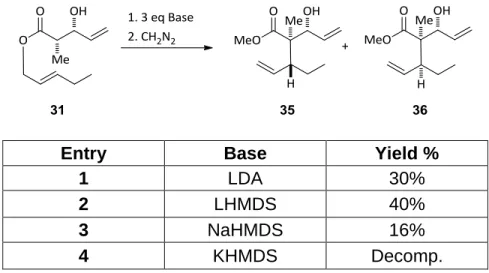
Table 1: Examination of different bases ... 14
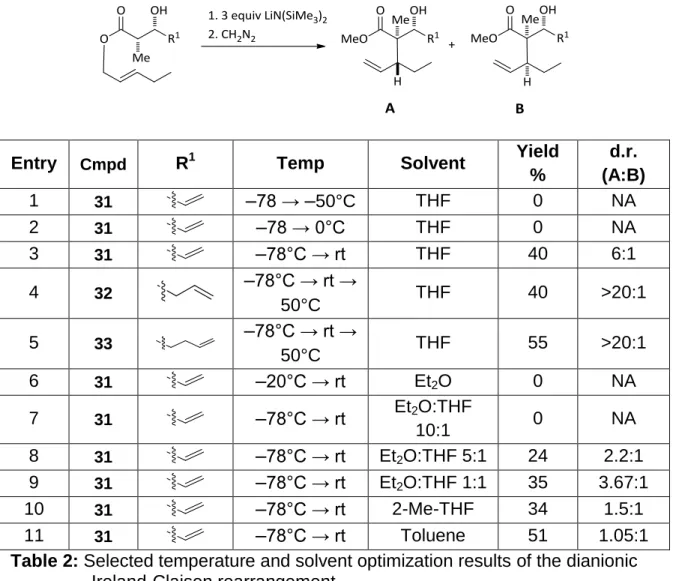
Table 2: Selected temperature and solvent optimization results of the dianionic Ireland-Claisen rearrangement ... 16
Table 3: Selected results of the dianionic Ireland-Claisen rearrangement ... 19
Table 4: RCM optimization by Gennari ... 48
Table 5: Synthesis of silyl enol ether for the Rubottom oxidation ... 65
Table 6: Counterion study in formation of the silyl enol ether ... 66
Table 7: Sampled conditions for synthesis of butenolide 166 by Ueda ... 71
Table 8: Attempts to synthesize butenolide 172 ... 73
Table 9 Attempts to remove the acetonide protecting group ... 74
Table 10: Attempt at removing the acetonide protecting group ... 76
ix
List of Figures
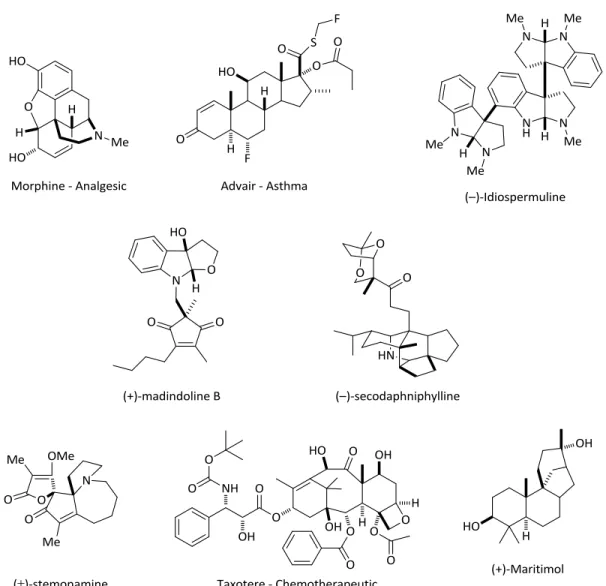
Figure 1: Examples of compounds with quaternary carbon centers ... 2
Figure 2: X-Ray crystallography of 37 confirmed the predicted absolute stereochemistry ... 23
Figure 3: Briarane natural product brianthein A ... 26
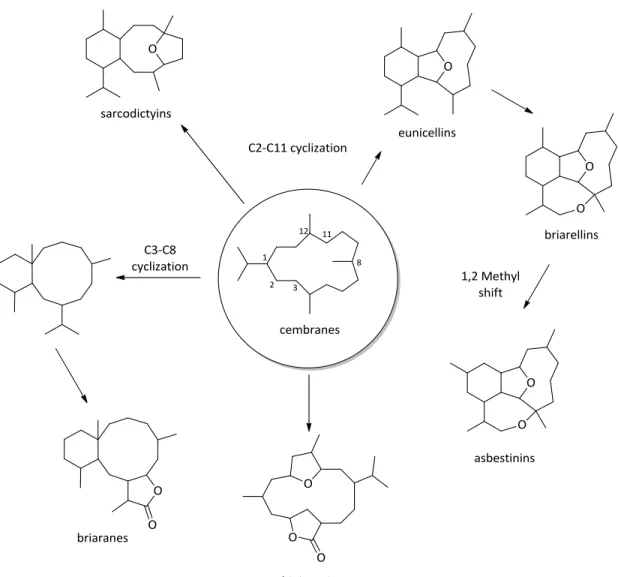
Figure 4: Proposed biosynthetic pathway for cembranoid based natural products ... 28
Figure 5: Isolated natural product examples of briarane type diterpenes ... 29
Figure 6: Brianthein A, a briarane diterpene with MDR reversal activity ... 30
Figure 7: Briarane natural product brianthein W ... 40
Figure 8: Hydroxyl protecting group variations to effect the tandem ring closing metathesis of the brianthein core ... 52
Figure 9: Proposed conformational restraints to effect a the 10-membered ring closing metathesis ... 53
x
List of Schemes
Scheme 1: The Claisen rearrangement ... 3
Scheme 2: Claisen rearrangement of propargyl vinyl ether 1 ... 4
Scheme 3: Major Claisen rearrangement variations ... 5
Scheme 4: Ireland-Claisen rearrangement ... 6
Scheme 5: Corey and co-workers utilize the Ireland-Claisen rearrangement to form the quaternary carbon of (–)-aspidophytine ... 6
Scheme 7: Devine and co-workers utilize soft enolization and chelation ... 7
Scheme 8: Kazmaier achieves excellent selectivity with metal salt chelation ... 8
Scheme 6: Chiral boron catalyst controlled Ireland-Claisen rearrangement ... 9
Scheme 9: Claisen rearrangement of N,O-acetals ... 9
Scheme 10: The dianionic Ireland-Claisen rearrangement ... 10
Scheme 11: Proposed quaternary carbon formation via dianionic Ireland-Claisen rearrangement ... 11
Scheme 12: Crimmins thiazolidinethione mediated aldol methodology ... 12
Scheme 13: Synthesis of the dianionic Ireland-Claisen model substrate ... 13
Scheme 14: New substrates for the DIC ... 18
Scheme 15: Depiction of stereochemical outcome of the dianionic Ireland-Claisen rearrangement ... 21
Scheme 16: Proposed degradation pathways of the dianionic Ireland-Claisen rearrangement ... 25
xi
Scheme 18 Synthesis of mono-protected alcohol fragments ... 33
Scheme 19: Synthesis of epoxide fragment containing quaternary carbon 63 ... 34
Scheme 20: Proposed mechanism of methyl addition and side reactions ... 35
Scheme 21: Synthesis of 66 containing quaternary carbon 8 ... 36
Scheme 22: Retrosynthetic strategy to access the briarane core ... 37
Scheme 23 Synthesis and optimization of chiral epoxidation ... 37
Scheme 24: Synthesis of cyclohexane portion of briarane skeleton ... 38
Scheme 25: Bates synthesis of the northern fragment of the briarane core ... 42
Scheme 26: Nantz' proposed formation of ten membered ring ... 44
Scheme 27: Proposed Retrosynthesis of solenolide F core ... 45
Scheme 28: Nozaki-Hiyama-Kishi conditions to form 10 membered ring ... 46
Scheme 29: Koskinen ring closing metathesis of 10 membered ring ... 47
Scheme 30: Barrett's synthesis of ent-clavilactone B ... 48
Scheme 31: 1st Generation Retrosynthesis of Brianthein A ... 50
Scheme 32: 1st generation dianionic Ireland-Claisen rearrangement ... 51
Scheme 33: Second generation retrosynthesis of brianthein A ... 54
Scheme 34: Synthesis of the allylic alcohol fragment 133 ... 55
Scheme 35: Synthesis of the aldol fragment 96 ... 56
Scheme 36: Coupling to form the dianionic Ireland-Claisen substrate ... 57
Scheme 37: Synthesis of the C14 stereocenter via Grignard addition ... 58
Scheme 38: Attempts to improve yield of desired alcohol diastereomer 131 ... 58
Scheme 39: Attempts to improve ratio of the R diastereomer at C14 ... 59
xii
Scheme 41: Completion of the bicyclic core of brianthein A ... 61
Scheme 42: Initial endgame strategy to complete brianthein A ... 62
Scheme 43: Synthesis of ketone 159 ... 62
Scheme 44: Rubottom oxidation attempts to form hydroxyketone 157 ... 64
Scheme 45: Deuterium quenching study ... 67
Scheme 46: Synthesis of the hydroxyketone 157 ... 68
Scheme 48: Carson and Kerr synthesize butenolide 164 ... 70
Scheme 49: Tanyeli synthesis of mintlactone ... 71
Scheme 50: Acid chloride acylation of hydroxyketone 157 ... 72
Scheme 51: Improved phosphonate formation via carbodiimide coupling ... 72
Scheme 52: Revised endgame strategy to complete brianthein A ... 75
Scheme 53: Synthesis of cyclopentylidine acetal 184 ... 77
Scheme 54: Synthesis of the correct stereoisomer at C14 ... 79
Scheme 55: Synthesis of phosphonate 189 ... 80
Scheme 56: Investigation of sp2 carbon-carbon bond formation at C8 ... 82
Scheme 57: Attempts to form lactone via aldol chemistry ... 83
Scheme 58: Reformatsky conditions to form lactone 197 ... 84
Scheme 59: Investigation of Shindo’s conditions to form butenolides... 85
xiii
List of Abbreviations
Ac acetyl
AIBN 2,2’-azo bis(isobutyronitrile)
BINAP 2,2’-bis(diphenylphosphino)-1,1’-binaphthyl
Bn benzyl
bp boiling point
Bu butyl
Bz benzoyl
CM Cross Metathesis
CSA camphorsulfonic acid
Cy cyclohexyl
DCC dicyclohexyl carbodiimide
DDQ 2,3-dichloro-5,6-dicyano-1,4-benzoquinone
DHP dihydropyran
DIAD diisobutyl azodicarboxylate
DIBAL diisobutylaluminum hydride
DMAP 4-dimethylaminopyridine
DME 1,2-dimethoxyethane
DMF dimethylformamide
DMS dimethyl sulfide
DMSO dimethyl sulfoxide
dr diastereomeric ratio
xiv
EDC ethyldimethylaminopropyl carbodiimide
ee enantiomeric excess
Et ethyl
Ipc isopinocampheyl
lut. 2,6-lutidine
LHMDS Lithium bis(trimethylsilyl)amide
LTMP Lithium tetramethylpiperidine
m-CPBA meta-chloroperoxybenzoic acid
Me methyl
MOM methoxymethyl
MOP methoxypropyl
MS Molecular Sieves
NIS N-iodo succinimide
NMO N-methylmorpholine-N-oxide
NMP N-methylpyrrolidinone
NR no reaction
Ph phenyl
Piv pivaolyl
PMB p-methoxybenzyl
PMP p-methoxyphenyl
PPTS pyridinium p-toluenesulfonate
Pr propyl
xv
RCM Ring-closing Metathesis
TBAF tetrabutylammonium fluoride
TBDPS tert-butyldiphenylsilyl
TBS tert-butyldimethylsilyl
TES triethylsilyl
Tf trifluoromethanesulfonyl
THF tetrahydrofuran
THP tetrahydropyran
TIPS triisopropylsilyl
TLC Thin layer chromatography
TMEDA N,N,N’,N’-tetramethylethylenediamine
TMP 2,2,6,6-tetramethylpiperidine
TMS trimethylsilyl
TPAP tetrapropylammonium perruthenate
TS transition state
1
Chapter 1
Development of the Dianionic Ireland-Claisen Rearrangement
Introduction:
Organic synthesis has long been challenged by the construction of
complex molecules from simple chemical starting materials. One challenge in
particular is the stereoselective construction of quaternary carbon stereocenters.
The last thirty years has seen a wealth of impressive methodologies
developed,1,2 however the stereoselective synthesis of quaternary carbons remains a significant challenge for organic chemists. These stereocenters pose
a challenge due to their inherent steric strain and that they must be made
selectively when the bond is formed as they are typically unable to be inverted.
Nonetheless, in the context of natural product synthesis, the
stereoselective construction of quaternary carbon centers is a crucial tool for the
synthetic chemist’s toolbox. In figure 1, a sampling of pharmaceutical agents and
natural products containing quaternary carbons is shown. It is the goal of
numerous research groups, to develop new methods to synthesize quaternary
carbons. Sigmatropic rearrangements are well known and a popular reaction
class in the synthesis of complex carbon centers. A key feature of these
2
context of the research presented, a brief review of the common [3,3] sigmatropic
rearrangements will be presented.
3 [3,3] Sigmatropic Rearrangements
The Claisen rearrangement was discovered in 1912 by Ranier Ludwig
Claisen3,4,5 (scheme 1). The classical Claisen rearrangement is the [3,3] sigmatropic rearrangement of an allyl vinyl ether to afford a γ-δ-unsaturated
carbonyl.
Scheme 1: The Claisen rearrangement
One of the most powerful features of the [3,3] sigmatropic rearrangement
is the 1,3 stereogenic transfer due to the chair-like transition state. This can be
observed in scheme 1. The ordered transition state defines the stereochemistry
of the newly formed bond between carbons 6 and 1.
A significant amount of research has been expended on the Claisen
rearrangement. The functional group tolerance remains limited by thermal
stability; however, the reaction has been utilized in a number of complex
syntheses to achieve the stereoselective synthesis of quaternary carbons. Ley
utilized the Claisen rearrangement of propargyl vinyl ether 1 as part of a synthetic sequence leading to the total synthesis of azadirachtin (scheme 2).6 The
4
Scheme 2: Claisen rearrangement of propargyl vinyl ether 1
The greatest limitations to the Claisen rearrangement are the synthesis of
the allyl vinyl ether moiety and the harsh temperatures often required to achieve
the rearrangement. To this end, a number of research groups have proposed
modifications to the reaction to achieve the reaction under milder conditions. The
5
Scheme 3: Major Claisen rearrangement variations
The Ireland-Claisen Rearrangement
The Ireland-Claisen variation of the Claisen rearrangement is by far one of
the most popularly utilized [3,3] sigmatropic rearrangements.10,11,12 There are three distinct advantages. First, the starting allylic ester functionality is relatively
easy to access via standard condensation coupling chemistry. Second, the
stereochemistry of the reaction can be influenced by the deprotonation conditions
6
the temperature necessary for the rearrangement to proceed is significantly lower
and typically occurs as the reaction is warmed from –78 °C.
Scheme 4: Ireland-Claisen rearrangement
Corey utilized the Ireland-Claisen rearrangement in the total synthesis of
(-)-aspidophytine (scheme 5).13 Beginning with chiral allyl acetate 3,
deprotonation with LDA and silyl ketene acetal formation with TBSCl proceeded
at –78 °C. The reaction mixture was then warmed at reflux to facilitate the
rearrangement to provide acid 4, which was esterified and carried forward.
7
Stereocontrolled Ireland-Claisen Rearrangements
The benefits of the Ireland-Claisen rearrangement are definite
improvements on the Claisen rearrangement. However, without a strong
substrate conformational bias, the stereochemical outcome of the reaction is only
able to be controlled by the geometry of the ester enolate and the alkene moiety
participating in the reaction. A synthetic handle to be able to control the absolute
stereochemistry of the Ireland-Claisen rearrangement would prove extremely
useful.
Devine and co-workers demonstrated that soft enolization of 5 with dibutylboron triflate and diisopropylethylamine (DIEA) promoted chelation
between the ester enolate and an α-methoxy group.14 This chelation helped to rigidify the transition state conformation and reinforce a single diastereomer.
Moderate yields were achieved (17-64%) with diastereoselectivities up to 99:1.
Scheme 6: Devine and co-workers utilize soft enolization and chelation
Similarly, Kazmaier and co-workers demonstrated the use of transition
metal chelation in the synthesis of amino acids.15 Strong hindered base was necessary to form the dianionic intermediate, and transition metal chelation
occurred between the ester enolate and deprotonated alpha-amine. Once again,
this proved to reinforce the conformation of a single diastereomer in the
8
excellent diastereoselectivities (up to 95:5) were observed, affording an
extremely useful method for the synthesis of aliphatic amino acids.
Scheme 7: Kazmaier achieves excellent selectivity with metal salt chelation
While the chelation work significantly improved the diastereocontrol of the
reaction by controlling the formation of the Z enolate, the enantiocontrol of the
reaction was not achieved. Stated differently, the facial selectivity of the E
alkene was not controlled. Corey and co-workers disclosed a catalyst controlled
Ireland-Claisen rearrangement utilizing chiral boron catalyst 11 (scheme 6).16 In this reaction, not only was the enolate geometry controlled, but the catalyst
created a steric bias for a single face of the enolate. Excellent yields (52-99%)
and enantioselectivities (up to 99:1) were observed. However, the reaction times
were quite long and impractical.
9
Dianionic Ireland-Claisen Rearrangement
Utilizing chelation for the stereocontrol of the Ireland-Claisen
rearrangement has had positive results (vide supra). Unfortunately, the
diasterofacial selectivity of the reaction was not controlled in the work by
Kazmaier or Devine, thus the enantioselectivity of the reaction was not fully
controlled via the chelated intermediates. Additionally, the presence of the
chelating functional group at the alpha position to the ester carbonyl limits the
opportunity to fully functionalize the newly formed stereocenters as all carbon
quaternary centers.
Kurth and co-workers initially observed the effect of intramolecular remote
stereocontrol in their investigation of the Claisen rearrangement of N-allylketene
N,O-acetals. (Scheme 9) The reaction required the use of the high boiling
solvent decalin. Through the utilization of a chiral auxiliary, Kurth demonstrated
the ability to direct the diastereoselectivity of the Claisen rearrangement of N
-allylketenes.
Scheme 9: Claisen rearrangement of N,O-acetals
By expanding this strategy of utilizing a remote functional group (i.e.
beyond the alpha position) to influence the stereochemical outcome of the
10
rearrangement of beta-hydroxy esters was highly selective for some substrates
(Scheme 10). A dianionic, chair-like transition state was proposed, and the
proposed transition state was rigidified by the chelation of the ester enolate to the
deprotonated hydroxyl group by the lithium counter ion. Additionally, this
chelated intermediate was able to provide enantiocontrol of the reaction through
the stereodefined beta-hydroxyl group influencing the facial selectivity of the
alkene for the [3,3] sigmatropic rearrangement.
Scheme 10: The dianionic Ireland-Claisen rearrangement
Moderate yields (up to 48%) and moderate to excellent selectivities (up to 98:2)
were reported. An obvious trend showed higher selectivities for compounds that
were more sterically demanding at the distal carbon of the allyl ether. The poor
to moderate yields were somewhat of a surprise because there are many
examples of the Ireland-Claisen rearrangement in the literature that show
11
Enantioselective synthesis of a quaternary carbon via the Dianionic Ireland Claisen Rearrangement
We were inspired by the work of Kurth and co-workers and the ability of a
remote stereocenter, beyond the alpha position, to significantly influence the
stereochemical outcome of the Ireland-Claisen rearrangement. This was not
common in the literature with the exception of substrates utilizing remote chiral
auxiliaries. It was proposed that a chelated transition state predominated to
control the conformation of the 6-membered chair transition state of the
Ireland-Claisen rearrangement.
Kurth’s work inspired the investigation of this diastereo- and
enantiocontrolled Ireland-Claisen rearrangement being utilized to form
quaternary carbon centers. The essential modification to Kurth’s precedent is to
add an alkyl substituent at the alpha position of the beta-hydroxy allylic ester
(scheme 11). It was predicted that this would aid in stabilizing the transition state
while also affording a quaternary carbon stereocenter in the product.
Scheme 11: Proposed quaternary carbon formation via dianionic Ireland-Claisen rearrangement
Synthesis of the dianionic Ireland-Claisen starting material
A significant challenge in all asymmetric synthesis is the achievement of
12
proposed to control the diastereoselectivity of the reaction, its stereochemistry
must be defined by both a highly selective and high yielding reaction. The
Crimmins lab has developed the thiazolidinethione-mediated aldol reaction which
affords aldol adducts in both very high yields and selectivities. Utilizing soft
enolization, titanium tetrachloride coordinates to the amide carbonyl and the
auxiliary thionyl allowing a weak, hindered base to deprotonate the alpha-carbon
and form a metallated enolate. Upon the addition of N-methylpyrrolidinone
(NMP), the coordination to the chiral auxiliary is modified allowing for the dipole
minimized transition state resulting in the Evans syn product upon addition of the
aldehyde (scheme 12).
Scheme 12: Crimmins thiazolidinethione mediated aldol methodology
With a stereodefined beta-hydroxyl stereocenter in place, we planned to
exploit the versatility inherent in the removal of the thiazolidinethione auxiliary
compound compared to the more traditional oxazolidinone auxiliary. Under mild
13
an allylic alcohol. This quick access to the dianionic Ireland-Claisen
rearrangement substrate makes it amenable to variations in functional groups to
investigate the scope of the dianionic Ireland-Claisen rearrangement to form
quaternary carbon stereocenters.
Optimization of the dianionic Ireland-Claisen rearrangement
Optimization of the reaction conditions began with the synthesis of ester
31. Beginning with propionyl thiazolidinethione 24, titanium tetrachloride (TiCl4)
mediated enolization with diisopropylethyl amine (DIEA) and addition of acrolein
afforded the desired aldol adduct 28 in 92% yield and 99:1 dr (scheme 13). Displacement of the chiral auxiliary with pentenol 34 afforded the desired dianionic Ireland-Claisen substrate 31 in 95% yield.
Scheme 13: Synthesis of the dianionic Ireland-Claisen model substrate
Investigation of the appropriate base for the dianionic Ireland-Claisen
14
and enolize the ester under Kurth’s conditions resulted in poor yields. Treatment
with a variety of amide bases showed that lithium hexamethyldisilazide (LHMDS)
was the base of choice (table 1).
Entry Base Yield %
1 LDA 30%
2 LHMDS 40%
3 NaHMDS 16%
4 KHMDS Decomp.
Table 1: Examination of different bases
The yields of the reaction were all poor, though LHMDS proved reliable
and the highest yielding while also being easily prepared for immediate use. The
important variable to improved yields turned out to be the regulation of the
reaction temperature. As one would expect, enolization occurs well at –78 °C
over 2 hours. To attain the energy required for the Ireland-Claisen
rearrangement to proceed, the reaction must be warmed. However, the
temperature required for a productive reaction was dependent on the specific
substrate.
The substrate 31 has fewer degrees of freedom than 32 or 33 and thus is able to undergo the sigmatropic rearrangement at room temperature. However,
15
required to proceed with the [3,3] rearrangement. When 32 was enolized at –78 °C and warmed to room temperature, no product was observed. Interestingly,
when the same substrate was warmed immediately to reflux after enolization, a
very low yield also resulted. This raised some question of the stability of the
ester enolate intermediate which will be discussed later. Heating to reflux over a
longer period of time was attempted and a slightly higher isolated yield was
observed. The optimized dianionic Ireland-Claisen (DIC) procedure resulting in
the best yields for the majority of substrates required the enolization at –78 °C
over 2 hours with three equivalents of LHMDS followed by warming over 1-2
hours from –78 °C to room temperature after enolization, then stirring for 4-6
hours at room temperature was essential and finally, heating at reflux overnight
for 12-16 hours. These conditions proved compatible with most compounds
16
Entry Cmpd R1 Temp Solvent Yield
%
d.r. (A:B)
1 31 –78 → –50°C THF 0 NA
2 31 –78 → 0°C THF 0 NA
3 31 –78°C → rt THF 40 6:1
4 32 –78°C → rt →
50°C THF 40 >20:1
5 33 –78°C → rt →
50°C THF 55 >20:1
6 31 –20°C → rt Et2O 0 NA
7 31 –78°C → rt Et2O:THF
10:1 0 NA
8 31 –78°C → rt Et2O:THF 5:1 24 2.2:1
9 31 –78°C → rt Et2O:THF 1:1 35 3.67:1
10 31 –78°C → rt 2-Me-THF 34 1.5:1
11 31 –78°C → rt Toluene 51 1.05:1
Table 2: Selected temperature and solvent optimization results of the dianionic Ireland-Claisen rearrangement
The nature of the reaction was also heavily dependent on the solvent
employed. A cursory evaluation of the yields and selectivities of table 2 shows
that the inclusion of THF is essential, not only for the reaction to proceed, but
also to obtain any useful diastereoselectivity. It is presumed that THF is the best
coordinating solvent to support lithium aggregation of the enolate. The utility of
2-methyltetrahydrofuran (table 2, entry 10) was able to achieve a similar overall
yield, though the stereoselectivity of the reaction was diminished, presumably
17
To support this theory, less coordinating solvents were examined. When
a non-coordinating solvent such as toluene was used, the yield of the DIC
improved, yet an unselective reaction was observed, demonstrating that the
coordination of solvent was important to achieving a useful stereoselectivity. We
also looked to diminish the amount of coordinating solvent by employing solvent
mixtures of THF and diethyl ether. In these experiments, the yield of the reaction
appeared to be proportional to the ratio of THF to diethyl ether. As the ratio of
THF was increased, the yield increased (Table 2, entries 7-9).
It is rather unclear as to why the reaction yields are higher only after
warming to room temperature and stirring for several hours before heating to
reflux. It is believed that a key aspect here is the aggregation of the lithium ester
enolates. Collum has disclosed examples where the most thermodynamically
stable lithium aggregate is formed only after warming from -110 °C to 0 °C; in
these mixed lithium aggregates, higher enantioselectivities were observed with
the more stable aggregate.18 In the case of the dianionic Ireland-Claisen rearrangement, as the reaction warms, it is presumed the lithium chelated
dianionic intermediate forms a more stable aggregate, which stabilizes the
enolate intermediate and reinforces the desired stereochemistry. It is believed
that the aggregate not only reinforces the stereochemistry, but also stabilizes the
ester enolate intermediate from the potential degradation pathways which will be
addressed later.
The external variables of base, temperature, and solvent had still not
18
this end, substrates were designed to probe the [3,3] sigmatropic rearrangement.
The focus of this design was the alteration of the allylic alcohol employed to
examine both steric and electronic variations in the DIC substrate.
Scheme 14: New substrates for the DIC
We first synthesized the isopropyl variants 49, 50 and 51. Unfortunately, the yields were quite low, and did not compare well to the original optimized
substrate where ethyl was utilized in place of the isopropyl group. The cause for
this result is not clear. However, although the yields suffered, the
stereoselectivity did improve where observable (table 3 entry 4 vs 1) due to
increased steric demand in the transition state. The cinnamyl alcohol variant
allowed us the opportunity to modify the electronic nature of the substrate. Much
to our delight, the phenyl substituent (table 3 entries 7-9) did not hinder the
19
The phenyl ring was then substituted with p-chloro, -methoxy, and –nitro
functional groups.
Entry Cmpd. n R1 Total
Time (h) Yield % Selectivity A:B
1 31 0 Et 8 40 6:1
2 32 1 Et 13 40 >20:1
3 33 2 Et 15 55 >20:1
4 49 0 i-Pr 22 16 >20:1
5 50 1 i-Pr 20 18 >20:1
6 51 2 i-Pr 23 21 >20:1
7 37 0 Ph 20 44 >20:1
8 38 1 Ph 16 55 >20:1
9 39 2 Ph 16 60 >20:1
10 44 1 p-ClPh 6.5 46 >20:1
11 41 1 p-OMePh 48 8 >20:1
12 47 1 p-NO2Ph -- Decomp. NA
Table 3: Selected results of the dianionic Ireland-Claisen rearrangement
Treatment of the 4-methoxy dianionic Ireland-Claisen substrate 41 with the optimized conditions afforded a lower yield and generally sluggish reaction
that did not progress significantly even after 2 days (table 3, entry 11). This was
in stark contrast to the 4-chlorophenyl substrate 44 that proceeded in higher yield and significantly shorter total time of 6.5 hours. The total time measures the time
beginning with addition of the allylic ester and ending with the consumption of the
20
resonance stabilizing electronic conjugation effects of the aryl ring on the
dianionic intermediate were the cause of the improved yields for electron poor
aromatic rings. This is in contrast to solely inductive effects of the aryl ring
improving the relative rate of the reaction. As shown by Burrow and
Carpenter,19 electron withdrawing groups at the bond forming position of the [3,3] rearrangement actually decreased the rate of reaction. However, we observed
an improvement in overall reaction time and yield, which is attributed to
conjugative stabilization of the allylic alcohol moiety of the DIC substrate.
Stereochemistry of the Dianionic Ireland-Claisen Rearrangement
The stereochemistry of the β-hydroxy carbon stereocenter is presumed to
direct the facial selectivity. A larger interaction between R1 and R2 (Scheme 15)
should dictate a higher selectivity for the bond forming event to occur from the
less hindered face of the chelated intermediate. Kurth showed that with sterically
undemanding substrates (R1 = R2 = methyl), the diastereotopic facial selectivity
was good but not exclusive, as evidenced by his isolation of three stereoisomeric
products (d.r. = 7.3:1.7:1, Scheme 6). In light of all these factors, the lack of
stereospecificity observed in this preliminary research is assumed to largely be a
21
22
There are four factors compounding the number of possible transition
states from which the product diastereomers can arise: ester enolate geometry,
the geometry of the allylic olefin, the diastereotopic facial selectivity (which face
of the enolate the olefin approaches) and finally the transition state
conformational geometry (boat vs. chair). These variables provide for 16
potential transition states in all (scheme 15). By fixing the geometry of the allylic
olefin as the E olefin, the number of possible transition states was reduced by
half. Moreover, the kinetic enolization of the ester should provide the
energetically favorable E-ester enolate, further limiting the possible transition
states to four. The facial selectivity is predicted to sterically controlled by the
steric interaction between the R1 and R2 side-chains. The two possible
stereoisomeric products remaining are expected to be determined by the chair
versus boat energy conformations.
The stereochemical analysis afforded us an excellent prediction of
the expected absolute stereochemistry of the dianionic Ireland-Claisen
rearrangement products. Fortunately, throughout the course of optimizing and
exploring the reactivity of the DIC, it was discovered that 37 crystallizes when purified. X-Ray crystallography proved that the predicted stereochemistry of the
23
Figure 2: X-Ray crystallography of the product from 37 confirmed the predicted absolute stereochemistry
Degradation Pathways:
Improvement of the reaction yields was welcomed, however
developing the DIC into a broadly useful synthetic tool was challenged by the
decomposition of the allylic ester. In addition, although yields hovered around
50%, none of the starting allylic ester for any substrate was ever recovered.
Thin-layer chromatography (TLC) observation of the reaction showed the
complete consumption of the starting allylic ester with all substrate variations.
Annoyingly, the analysis of the reaction by-products was not able to identify the
major degradation pathway until the phenyl substrate 37 was investigated. With
24
This crucial observation allowed the proposal of more accurate
degradation pathways, in addition to elucidating why the yields were unable to be
improved much higher than 50%. It was found that the major decomposition of
the dianionic Ireland-Claisen substrate occurs after enolization but before the
[3,3]-sigmatropic rearrangement. The ester enolate can degrade in a β
-elimination pathway where the hydroxyl group is eliminated affording an enone
(scheme 16). This expected by-product has been isolated and confirmed by 1H NMR; however, it is a very small yield and typically less than 10%. As with any
aldol adduct, treatment with base can induce a retro-aldol reaction. The most
applicable degradation pathway is the elimination of the allylic alcohol forming a
ketene that then could undergo any number of other degradation reactions.
Ketene formation from enolates of esters with bulky alcohols is well-known.20,21 Although direct evidence for the formation of a ketene is unavailable, the
expunged allylic alcohol has been isolated when stable to vacuum and
chromatography and the yields typically correspond to the remainder of the mass
25
Scheme 16: Proposed degradation pathways of the dianionic Ireland-Claisen rearrangement
This degradation pathway was interesting as it hasn’t been reported in the
Ireland-Claisen literature. Typically, the Ireland—Claisen ester enolate is trapped
as the silyl enol ether increasing its stability and mitigating allylic alcohol
elimination. Often, the enol ether intermediate is stable enough to be isolated.
This increased stability was unfortunately unable to be exploited as chelation was
critical to the stereoselectivity of the DIC.
Enolate stabilization
In an attempt to better stabilize the ester enolate intermediate to reduce
the propensity of thermal degradation, an investigation into chelating lewis acids
was performed. Lithium chloride, magnesium chloride, magnesium bromide, and
titanium tetrachloride were examined. Unfortunately, addition of these chelating
26
and lithium halide salts, the reaction proceeded, although the yields suffered.
Utilization of more oxophilic lewis acids such as titanium tetrachloride promoted
decomposition of the reaction.
Challenges and Summary
The dianionic Ireland-Claisen rearrangement has been shown to be an
excellent vehicle for the creation of quaternary carbons with a high level of
stereocontrol. Unfortunately, the stability of the ester enolate intermediate is a
significant challenge in promoting the broad utility of the reaction. As will be
shown in the next chapter, the high diastereoselectivity of the reaction makes the
reaction ideal for applications toward the total synthesis of natural products,
specifically the formation of the bridgehead angular quaternary stereocenter of
brianthein A.
27
Chapter 2
Efforts toward the Total Synthesis of Brianthein A
Cyclized Cembranoid-Based Natural Products
Cyclized cembranoid based natural products are complex, often
biologically active, and synthetically interesting diterpene secondary metabolites.
The Crimmins laboratory has pursued the total synthesis of numerous C2-C11
cyclized cembranoid classes including the eunicellins,22 briarellins,23 and asbestinins (Figure 4).24
Another related group is the C3-C8 cyclized cembranoids termed the
briarane class. Since the discovery of the first briarane-type natural product by
Burks25 in 1977, more than three hundred of these secondary metabolites have been isolated. Many of the briaranes have been assayed for relevant biological
activity.26,27,28 This understudied class of natural products contains a number of synthetic challenges related to their total synthesis. Varying levels of oxidation
surround a complex trans-fused 6,10 bicyclic core ring structure containing
numerous stereocenters and a bridgehead, angular quaternary carbon (figure 5).
The synthetic challenges, lack of interest from the synthetic community, and
interesting biological activities led to the pursuit of the total synthesis of a
28
29
30
Isolation and biological profile of Brianthein A
Brianthein A was originally isolated off the coast of Japan in 2001 by
Kobayashi and co-workers.29 The initial methanol extract of the dried gorgonian
Briareum excavatum demonstrated multi-drug resistance (MDR) reversal activity
at 10 μg/mL when assayed against the human carcinoma KB-C2 cell line.30
After
further extractions and HPLC purifications, the novel briarane diterpene 52 was isolated as the major component.
Figure 6: Brianthein A, a briarane diterpene with MDR reversal activity
Brianthein A was isolated as a colorless powder and extensively analyzed
by one and two dimensional nuclear magnetic resonance (1H, 13C, COSY, NOESY, and HMBC), high-resolution mass spectroscopy and degradation
studies with sodium methoxide. Through the Mosher ester31 NMR analysis, the stereochemistry of the acetyl protected alcohol moieties at carbons 2, 3 and 14
were able to be identified as R, R and S respectively.
Treatment of human cancer is plagued by the development of multi-drug
resistant tumor cells. A major mechanism found to be responsible for this activity
(P-31
gp).32 P-glycoprotein functions from the cell cytoplasm signaling pathway to control an ATP-dependent efflux pump of unwanted toxins including anti-cancer
drugs such as doxorubicin and vincristine. The biological profile of the isolated
brianthein A was found to be quite impressive. In a 96-well plate, the colchicine
resistant human carcinoma KB-C2 cell30 line was added both colchicines and brianthein A. After incubation for 48 hours the samples were measured by
means of an (MTT) colorimetric assay.33 It was found that in the samples where only the anti-cancer drug colchicine or brianthein A was added, the cells survived
unscathed. However, where brianthein A was added in concert with colchicine,
the complete reversal of multi-drug resistance was observed and the cells were
destroyed. Of the numerous briarane-type diterpenes that have been isolated,
only brianthein A has shown the efficacy to inhibit MDR activity making it a
desirable target for total synthesis and subsequent in vitro biological studies.
Previous Synthetic Efforts
Currently, a number of publications have been reported which focus on
methodology to approach the synthesis of briarane class molecules. However,
significant issues remain in accomplishing the total synthesis of the complex
briarane core, specifically the formation of the 6,10-fused bicyclic core structure.
A brief synopsis of the relevant previous synthetic efforts will be presented.
Nantz’ Work toward C1 Quaternary Carbon
In 1997, Nantz and co-workers disclosed new methodology focused on
32
toward their use in the total synthesis of briarane-type natural products. Their
investigation into the regioselective methylation of functionalized
3,3-disubstituted-2,3-epoxy alcohols led to the successful synthesis of the quaternary
carbon C1 and C8 of the briarane skeleton.
Scheme 17: Retrosynthetic strategy and briarane target molecules
Nantz was initially interested in the briaranes shown in scheme 17, yet
efficient access to the core carbon skeleton could enable access to the entire
family. Retrosynthetically, he had envisioned accessing the challenging
ten-membered ring via a McMurry coupling35 and the remaining carbon skeleton could be elaborated from diol 53 utilizing the newly developed methodology.
33
prolonged time period afforded the butenolide, which was subsequently protected
as the benzyl ether 56 with the acidic protocol developed by Bundle and co-workers36 in a 68% yield over two steps. Butenolide reduction with an excess of diisobutyl aluminum hydride in ether proceeded smoothly in 95% yield. The
mono-protection was successful only when the diol was deprotonated with n
-butyllithium (n-BuLi) followed by treatment with dimethylthexysilyl chloride
(DTS-Cl) resulting in an 83% yield and a 1:1 mixture of 57 and 58. This was
acceptable because both mono-protected compounds were to be further utilized.
Scheme 18 Synthesis of mono-protected alcohol fragments
To complete the first of two fragments, 57 was treated under Sharpless’
asymmetric epoxidation conditions to afford the epoxide 58 in 92% yield (scheme 19). Oxidation of the primary alcohol and subsequent treatment with methylene
34
Scheme 19: Synthesis of epoxide fragment containing quaternary carbon 63
Deprotection with tetra(n-butyl)ammonium fluoride produced 59 in a 44% yield over the three steps. Under the newly developed methylation protocol, the
allylepoxy alcohol was treated with trimethyl aluminum to afford the desired
quaternary carbon product 60 along with two minor products 61 and 62 resulting from SN2’ addition and competitive migration of the C2 hydroxymethyl group
35
Scheme 20: Proposed mechanism of methyl addition and side reactions
The synthesis of the second fragment required for the proposed
retrosynthesis begins with the monosilyl protected 58 (scheme 21). Again, Sharpless asymmetric epoxidation conditions afforded 64 in 86% yield and a 92% diastereomeric excess. Exposure to an excess of lithium dimethylcuprate in
diethyl ether afforded methyl addition to the less substituted epoxide carbon
according to the method by Kishi.37 Subsequent protection of the diol as its acetonide proceeded smoothly utilizing pyridinium p-toluenesulfonic acid (PPTS)
to give 65 in a 54% yield over three steps. To complete the fragment synthesis, benzyl ether cleavage under lithium and ammonia reducing conditions followed
36
Scheme 21: Synthesis of 66 containing quaternary carbon 8
By controlling the carbon-carbon bond forming events with epoxides 59 and 64 to proceed at either the more or less substituted epoxide carbon, Nantz has
demonstrated the ability to synthesize the quaternary carbons of such briarane
natural products as brianthein Y, solenolide F, and tubiporein. To date, no report
of successful ten-membered ring synthesis has been reported.
Iguchi’s efforts toward Pachyclavulide B
In his synthetic study of the briarane-type diterpene pachyclavulide B
(scheme 22), Iguchi and co-workers developed a synthetic strategy aimed at the
angular quaternary carbon C1 of the bridgehead stereocenter.38 As shown by the proposed retrosynthetic analysis, an enantioselective epoxidation would
37
Scheme 22: Retrosynthetic strategy to access the briarane core
To prepare the epoxidation material, Iguchi began with the commercially
available 2,6-dimethylbenzoic acid (67) and reduced the aromatic ring under Birch conditions.39 Exposure of the carboxylic acid to tert-butyldiphenylsilyl chloride (TBDPS-Cl) afforded the TBDPS ester 68 in 96% over 2 steps. Oxidation conditions were optimized utilizing the chiral D-fructose derived
catalyst40 developed by Shi to form the epoxide 69. Higher catalyst loadings were required for improved selectivities (scheme 23).
Scheme 23 Synthesis and optimization of chiral epoxidation
38
subsequent protection of the primary alcohol as the TBDPS ether 72 in 93% over 2 steps proceeded smoothly. The hindered Lewis acid diethylaluminum
tetramethylpiperidine (Et2AlTMP) induced the opening of epoxide 72 to allylic
alcohol 73 in 97% yield.41 Exposure of alcohol 73 to ethyl vinyl ether in the presence of N-iodosuccinimide afforded the primary iodide 74.42
Scheme 24: Synthesis of cyclohexane portion of briarane skeleton
Treatment of 74 with tributyltin hydride and azobisisobutyronitrile (AIBN) at 100 ºC initiated the intramolecular radical cyclization43 constructing the
quaternary carbon stereocenter in a disappointing 32% yield. Oxidation of the
39
the silyl ether followed by alpha oxidation of the lactone utilizing lithium
diisopropylamine and 2-(phenylsulfonyl)-3-phenyloxaziridine (Davis reagent)44 produced the alpha hydroxyl group on diol 76. This alpha oxidation was found to be sluggish with the steric repulsion of the TBDPS ether, and thus the TBDPS
ether was cleaved prior to oxidation. Once the alpha hydroxyl group was
installed, the primary hydroxyl group of diol 76 was protected again as the TBDPS ether. Reduction of the lactone and subsequent oxidation of the
resulting vicinal diol afforded the aldehyde 77 in 66% over three steps. Finally, a diastereoselective vinylmagnesium chloride addition was achieved to produce 78
as a single diastereomer in quantitative yield.
Iguchi has demonstrated the ability to synthesize the cyclohexane ring of
the briarane skeleton. The elaboration of substrate 78 to the fused 6,10 bicycle remains a significant challenge that has not yet been addressed. Additionally,
the key quaternary bond forming step only results in low yields which would
make scaling the synthesis challenging.
Bates’ Synthesis of the C1 Quaternary Carbon of the Briarane Skeleton
Published in 2010, Bates and co-workers defined an approach to the C1
quaternary carbon stereocenter and northern hemisphere of the briarane carbon
40 Figure 7: Briarane natural product brianthein W
To construct the desired cyclohexane ring of the briarane skeleton, a
chiral sulfoxide auxiliary was installed on diene 80 and utilized in a Diels-Alder reaction with methyl crotonate (scheme 25). While it is known that the
Diels-Alder reaction of diene 80 and methyl acrylate is quite rapid with aluminum trichloride as the catalyst,47 the same reaction with methyl crotonate as the dienophile is far more sluggish and required seven days in refluxing
dichloromethane to afford a 62% isolated yield of cyclohexene 81. This stereocontrolled Diels-Alder reaction succeeded in creating the desired C10
stereocenter of the briarane skeleton.
Treatment of the resulting Diels-Alder adduct 81 with diisobutylaluminum hydride reduced the methyl ester to a primary alcohol. Sodium hydroxide in
methanol was utilized to isomerize the double bond within the cyclohexene ring
which produced a γ,δ-unsaturated sulfone. Silyl protection of the free alcohol
with tert-butyldimethylsilyl chloride (TBS-Cl) followed by oxidative desulfurization
via lithium diisopropylamine and
41
excellent yield (96%) and selectivity (15:1). Conversion of the allylic alcohol 83
to form the quaternary carbon stereocenter at C1 of the briarane core proved
quite challenging. Numerous [3,3] sigmatropic conditions were tested and found
unsuccessful including the Johnson-Claisen49 rearrangement (triethylorthoacetate and propionic acid at reflux), Ireland-Claisen10
rearrangement (acetate alcohol and treated with base), Claisen50 rearrangement (treated with mercuric acetate and ethyl vinyl ether and heated) and the method
developed by Mandai51(oxa-michael addition of alcohol 83 to aryl vinyl sulfoxide). Fortunately, the Eschenmoser variation8 was found to produce amide 84 with the desired quaternary C1 carbon in a modest yield.
Amide 84 was subjected to cycloiodination conditions to afford the
iodolactone 85 in 94% yield. Base promoted elimination of H-I followed by alpha oxidation of the lactone resulted in alkene 87 in 82% over 2 steps. Bates
required the opposite stereoconfiguration of the alpha hydroxyl group of 87, and thus effected an epimerization via oxidation with 2-iodoxybenzoic acid (IBX)
followed by sodium borohydride (NaBH4) reduction to afford intermediate 89.
Reduction of the lactone with lithium aluminum hydride (LAH) and conversion of
42
43
Summary of previous efforts
Bates and co-workers disclosed an advanced substrate toward the total
synthesis of the briarane skeleton. They were able to achieve all but three
carbons of the ultimate 6,10-bicyclic carbon skeleton with 4 of 5 stereocenters of
brianthein W (79) installed (Figure 7); however, the cyclodecene synthesis remained a daunting challenge. In all of the synthetic efforts to date, the
synthesis of the angular quaternary carbon stereocenter at C1 of the briarane
skeleton has been clearly defined as the most challenging feature to address.
While Nantz, Iguchi, and Bates have all disclosed syntheses of the C1
stereocenter, the synthesis of the ten membered carbocylic ring has yet to be
disclosed leaving a significant challenge in completing the synthesis of the
44 Previous Syntheses of Ten Membered Rings
Synthesis of the C1 quaternary carbon of the briarane skeleton is certainly
a challenging feature of the structure. Additionally, the synthesis of ten
membered carbocycles is a significant challenge. There are many examples of
larger macrolides synthesized via the formation of an ester linkage, although the
formation of ten membered carbocycles calls for the creation of a carbon-carbon
bond in their synthesis.
In the previous example by Nantz (scheme 18), the formation of his
quaternary carbon methodology was described. To complete the proposed
synthesis of solenolide F, the ten membered ring of the briarane skeleton was to
be formed via a McMurry coupling.35 This synthetic route has not yet been achieved, though remains a viable option to utilize the fragments synthesized in
the previous work.
45
Procter NHK Coupling toward Solenolide F
Solenolide F was also a molecule of interest for the Proctor group.54 The proposed formation of the carbon skeleton focused on the formation of the ten
membered ring via a Nozaki-Hiyama-Kishi (NHK) coupling reaction.
Scheme 27: Proposed Retrosynthesis of solenolide F core
Attempts at closing the ten membered ring were found to be highly
dependent on the bridgehead stereochemistry being cis. As shown in scheme
28, the NHK coupling formed a 1:1 mixture of diastereomers at the newly formed
carbinol position only in the reactants in the cis position. With a trans bridgehead
orientation, the metallated vinyl center and the carbonyl were presumably not
46
Scheme 28: Nozaki-Hiyama-Kishi conditions to form 10 membered ring
Ring Closing Metathesis to form 10 Membered Rings
The synthesis of larger carbocycles via ring closing metathesis is not well
known due to the entropic challenge of bringing two distant alkenes into proximity
with one another. Koskinen and co-workers demonstrated the ability to form
these larger carbocycles when the correct steric constraints were employed on
47
Scheme 29: Koskinen ring closing metathesis of 10 membered ring
By the addition of the bulky silyl protecting group on the alcohol, the
acyclic conformation was modified so that the two alkenes were more able to
react. Interestingly, this resulted in an additional challenge. Now, because of the
larger ring size, the conformational flexibility allows for the formation of both the E
and the Z alkene geometries.
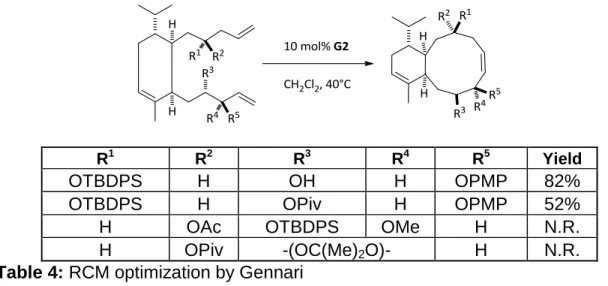
Gennari showed the ability to form a ten membered ring via ring closing
metathesis as well (table 4).56 His formation of a 6,10 fused bicycle is very similar to that of the briarane skeleton, with the exception of the stereochemistry
of the bridgehead, which in this case is cis and lacks a quaternary carbon
stereocenter at C1. Molding the results of both Procter and Koskinen by utilizing
the cis bridgehead stereochemical relationship and selectively modifying the
protecting groups around the diene, Gennari was able to form the 10 membered
48
R1 R2 R3 R4 R5 Yield
OTBDPS H OH H OPMP 82%
OTBDPS H OPiv H OPMP 52%
H OAc OTBDPS OMe H N.R.
H OPiv -(OC(Me)2O)- H N.R.
Table 4: RCM optimization by Gennari
A final example of ring closing metathesis being utilized in the formation of
10 membered rings is the work by Barrett in the synthesis of ent-clavilactone B
(scheme 30).57 After extensive experimentation and optimization, the ten-membered ring was achieved through the addition of 40 mol% Grubbs’ 2nd
generation catalyst in the presence of 80 mol% tetrafluorobenzoquinone while
heated in toluene to 80 C. The removal of the ethylene formed by reaction with
the terminal alkene was found to be crucial in driving the reaction toward the
desired macrocycle. In this example, the stereochemistry of the bridgehead
position was more restricted due to the presence of sp2 carbons.
49
Summary of the synthesis of 10 membered rings
The formation of large carbocycles presents a number of challenges not
found with the synthesis of smaller rings. Entropic effects of the acyclic reactants
often outweigh the thermodynamic ability of the two intramolecular reactants to
react with each other. The conformation of the molecule can ultimately control
the capability of the molecule to undergo the necessary carbon-carbon bond
forming step, whether with a RCM reaction, NHK coupling reaction, or other
carbon-carbon bond forming reaction. Additionally, in the cases where ring
closing metathesis is used, the formation of both alkene geometries is possible
50 Crimmins’ Efforts toward Brianthein A
1st Generation Synthesis
The Crimmins laboratory, having consistently looked to synthesize
complex, biologically active natural products, viewed the briarane class as a
formidable challenge. The opportunity to apply the dianionic Ireland-Claisen
methodology as a synthetic handle toward the briarane bicyclic core was
appealing. Scheme 31 defines the first generation retrosynthesis explored by Dr.
Yan Zhang.58
Scheme 31: 1st Generation Retrosynthesis of Brianthein A
The butenolide was to be appended at a late stage from hydroxyketone
115. One of the two key reactions was the tandem ring closing metathesis of tetraene 116 to form the 6,10 fused bicycle. The tetraene substrate containing the C1 quaternary carbon stereocenter in place would be prepared via the
51
This strategy was extremely appealing due to the short number of
synthetic steps required to access the complex 6,10 carbon skeleton of the entire
briarane family. In addition, upon successful tandem ring closing metathesis, the
general strategy could be applied to many of the over three hundred briaranes
currently known.28
Scheme 32: 1st generation dianionic Ireland-Claisen rearrangement
The dianionic Ireland-Claisen substrate 117 was prepared over an 8 longest linear step sequence and 34% overall yield (scheme 32). Optimization of
the substrate by removing the triethylsilyl ether protecting group allowed for a
57% yield from the dianionic Ireland-Claisen rearrangement. Elaboration to
tetraene 116 proceeded smoothly in 3 steps (not shown). Unfortunately,
treatment with a variety of ring closing metathesis catalysts did not produce the
desired 6,10 fused bicycle. The synthesis of 10-membered rings in the literature
is very dependent on the conformational restraints of the individual substrate.
52
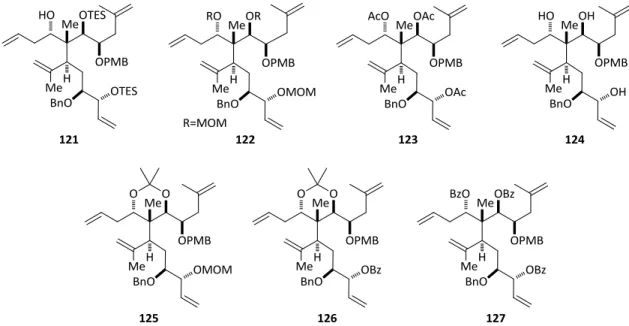
form.55,59,57 Thus, the focus was shifted to protecting group manipulation of the hydroxyl groups in order to manipulate the conformation of the substrate.
Figure 8: Hydroxyl protecting group variations to effect the tandem ring closing metathesis of the brianthein core
Not only did the synthetic strategy of the tandem ring closing metathesis
prove unsuccessful, none of the substrates tested ever formed the ten
membered ring. To probe solely the formation of the ten membered carbocycle,
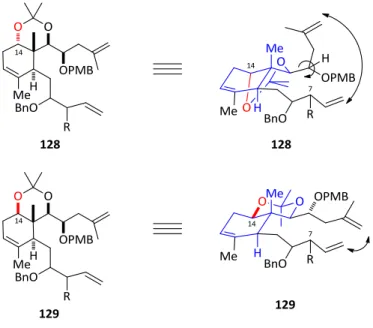
the cyclohexene ring was closed efficiently. The resulting triene (figure 9) was
also probed to form the desired briarane bicycle to no avail. Closer analysis of
the conformation of the triene 128 showed that the two acyclic alkenes required for the formation of the ten membered ring were oriented in opposite directions.
Through this same conformational analysis, Zhang developed a method to utilize
the 1,3 acetonide as a conformational constraint to reinforce the necessary
53
Figure 9: Proposed conformational restraints to effect a the 10-membered ring closing metathesis
By inverting the hydroxyl stereocenter at C14 of the briarane skeleton and
forming an acetonide between two hydroxyls, a very rigid, planar, trans-decalin
type conformation was rationalized. This structure of 129 oriented the two reactive alkenes in better proximity to each other. With this conformation, the
desired RCM reaction was successful, but only with substrates with no
functionality at C7 of the brianthein A core (R=H in figure 9).58
Second Generation Synthesis
The development of the ten membered ring closing metathesis reaction
toward the synthesis of the briarane skeleton led to a revised, second generation
retrosynthesis depicted in scheme 33. Performing the RCM reactions to form the
54
however also potentially allowed for maximum flexibility in future synthetic
modifications toward other briarane natural product targets.
Scheme 33: Second generation retrosynthesis of brianthein A
The revised retrosynthetic analysis required additional late-stage
protecting group manipulations to epimerize C14 to the desired stereochemistry
of brianthein A. The butenolide would be constructed from hydroxyketone 115
which would be accessed by an alpha-oxidation as opposed to carrying the
masked hydroxyketone from an early stage in the synthesis as in the first
generation route. Ring closing metathesis would be utilized to form both the ten
and six membered rings. The bridgehead carbon-carbon bond including the
Ireland-55
Claisen methodology. The DIC substrate 132 is formed by coupling the aldol adduct 118 with the revised allylic alcohol 133.
Synthesis of Quaternary Carbon C1
The synthesis of the allylic alcohol began with 1,3-propane diol (135) (scheme 34). Initially disclosed by Zhang,58 the current publication reports an optimized synthetic route to improve scalability. Mono tert-butyldimethylsilyl
protection after sodium hydride deprotonation proceeded well with a minor
amount of di-protected side-product. Swern oxidation of the resulting primary
alcohol 136 was taken forward without purification to the Wittig olefination with stabilized phosphorane 138. The crude reaction mixture from the olefination could again be carried forward without chromatographic purification. After
filtration of the phosphine oxide by-product, the crude material was reduced with
excess DIBAL to afford the allylic alcohol 133 in good yield after flash column silica gel purification.
56
Synthesis of the aldol adduct 118 began with glycolate 139 (scheme 35). Treatment with alkylation conditions of sodium hexamethyldisilazane and excess
freshly prepared methallyliodide afforded the desired product 140 in 80% yield as a single detectable diastereomer by 1H NMR spectroscopy. Reduction of the oxazolidinone chiral auxiliary with sodium borohydride followed by Swern
oxidation afforded aldehyde 141. The chiral thiazolidinethione-mediated aldol could be employed with the unpurified aldehyde, however optimal yields were
achieved after flash chromatography purification of the aldehyde before addition
to the aldol reaction.
Scheme 35: Synthesis of the aldol fragment 118
The coupling of the allylic alcohol 133 and the aldol adduct 118 was performed in the same manner as with the model systems described in chapter
one (scheme 13). By combining both the allylic alcohol and aldol product with
imidazole and DMAP, up to an 88% yield of 132 could be achieved if allowed to react for 96 hours (scheme 36). A 75% yield was achieved after stirring for a
57
optimized to proceed in a maximum 65% yield by Zhang.58 This moderate yield was tolerated because of the synthetic complexity added to the substrate in
single operation.
Scheme 36: Coupling to form the dianionic Ireland-Claisen substrate
Methyl ester 142 was elaborated to the homoallylic alcohol after protecting the free hydroxyl group as the TBS ether (scheme 37). Reduction with excess
DIBAL afforded the primary alcohol 143 which was oxidized under Swern conditions to aldehyde 144. Allylmagnesium bromide addition to 144 formed a 3:1 mixture favoring the undesired (S) diastereomer at C14 when cooled below 0
58
Scheme 37: Synthesis of the C14 stereocenter via Grignard addition
In attempts to improve on the isolated yield of the desired R diastereomer
(131), a range of reducing conditions was investigated. When ketone 145
(acyclic) was reduced with DIBAL, LAH, NaBH4, or L-selectride (s-Bu3BHLi) no
improvement above a 1:1 diastereomeric ratio was observed.
Scheme 38: Attempts to improve yield of desired alcohol diastereomer 131
Belief that perhaps the cyclic ketone 147 would allow for some improved selectivity, examination again with DIBAL and NaBH4 demonstrated no