ESTIMATION OF GRAPHICAL MODELS WITH BIOLOGICAL APPLICATIONS
Yuying Xie
A dissertation submitted to the faculty of the University of North Carolina at Chapel Hill
in partial fulfillment of the requirements for the degree of Doctor of Philosophy in the
Department of Statistics and Operations Research.
Chapel Hill
2015
c
2015
Yuying Xie
ABSTRACT
Yuying Xie: ESTIMATION OF GRAPHICAL MODELS WITH BIOLOGICAL
APPLICATIONS
(Under the direction of Yufeng Liu and William Valdar)
Graphical models are widely used to represent the dependency relationship among
ran-dom variables. In this dissertation, we have developed three statistical methodologies for
estimating graphical models using high dimensional genomic data. In the first two, we
estimate undirected Gaussian graphical models (GGMs) which capture the conditional
de-pendence among variables, and in the third, we describe a novel method to estimate a
Gaussian Directed Acyclic Graph (DAG).
In the first project, we focus on estimating GGMs from a group of dependent data.
A motivating example is that of modeling gene expression collected on multiple tissues
from the same individual. Existing methods that assume independence among graphs are
not applicable in this setting. To estimate multiple dependent graphs, we decompose the
problem into two graphical layers: the systemic layer, which is the network affecting all
outcomes and therefore describing cross-graph dependency, and the category-specific layer,
which represents the graph-specific variation. We propose a new graphical EM technique
that estimates the two layers jointly; and also establish the estimation consistency and
selection sparsistency of the proposed estimator. We confirm by simulation and real data
analysis that our EM method is superior to a naive one-step method
study suggests that our method have substantially higher sensitivity and specificity to
esti-mate the underlying graph than existing methods.
ACKNOWLEDGEMENTS
A great many people have helped me throughout my graduate research. I finally finished
the journey to my second and also potentially last Ph.D degree. I owe my gratitude to all
those who gave me direction, instruction, and courage. Thank you very much!
First, I would like to sincerely thank my co-mentor Dr. Yufeng Liu. I am extremely
fortunate to have an advisor who gave me the freedom to explore, and at the same time,
the guidance to recover when I lost confidence in my research. I still remember how excited
and nervous I was when I first talked to Yufeng about the possibility of working with him
for my second Ph.D in Statistics. He taught me, encouraged me, and led me into the area
of statistical machine learning. Without his constant encouragement and support, I would
not have accomplished as much. I value Yufeng’s creativity in developing novel machine
learning methodologies to analyze biological data with complicated structure, and admire
his passion for both work and life. He has been a role model for me as a researcher and a
teacher.
I also would like to thank my other mentor, Dr. William Valdar, for his support, advice,
criticism, and encouragement for the past five years. It was Will who dragged me into a dry
lab. He taught me not only about how to program efficiently, but also about how express
ideas clearly. Most importantly, he taught me how to question thoughts and progress a
topic beyond its current understanding. It has been a pleasure and great honor to be your
student.
professor who to sit on the committees of both my Ph.D.s. He greatly cares for his students,
even letting me borrow his office for my phone interviews. He gave me great suggestions
for my project and was always willing to shared his code.
Amazing lab members and classmates were another treasure I got during my study. We
went through all the up and down together. I greatly value their friendship and I deeply
appreciate their belief in me. I have to give a special mention for the support given by Dr.
Allen Larnacic, Dr. Zhaojun Zhang, Dr. Jeremy Sabourin, Dr. Wonyul Lee, Dr. Qiang
Sun, Dr. Chang Zhang, Dr. Guanhua Chen, Dr. Sunyoung Shin, Dr. Patrick Kimes, Guan
Yu, Daniel Oreper, Greg Keele, Dr Jeff Roach, Paul Maurizio, and Robert Corty.
TABLE OF CONTENTS
LIST OF TABLES . . . .
x
LIST OF FIGURES . . . .
xi
1
Introduction . . . .
1
1.1
Gaussian Graphical Models . . . .
2
1.2
Extensions of Gaussian Graphical Models . . . .
3
1.3
Bayesian Networks and Directed Acyclic Graphs . . . .
4
1.4
Estimation of Directed Acyclic Graphs and Skeleton . . . .
5
2
Joint Estimation of Multiple Dependent Gaussian Graphical Models with
Applications to Mouse Genomics . . . .
7
2.1
Introduction
. . . .
7
2.2
Methodology . . . .
11
2.2.1
Problem formulation . . . .
12
2.2.2
One-step method . . . .
13
2.2.3
Graphical EM method . . . .
14
2.2.4
Model selection . . . .
17
2.3
Asymptotic properties . . . .
18
2.4
Simulation . . . .
20
2.4.1
Simulating category-specific and systemic networks . . . .
21
2.4.2
Criteria for evaluating performance . . . .
22
2.4.3
Estimation of category-specific Ω
kand systemic networks Ω
0. . . .
22
2.4.4
Estimation of aggregate networks ΩY
k. . . .
25
2.5
Application to gene expression data in mouse . . . .
25
2.7
Appendix . . . .
35
2.7.1
Derivation of likelihood for y . . . .
35
2.7.2
Proof of Identifiability . . . .
37
2.7.3
Proof of Proposition 2.1 . . . .
39
2.7.4
Proof of Theorem 2.1 . . . .
49
2.7.5
Proof of Corollary 2.1 . . . .
53
2.7.6
Proof of Theorem 2.2 . . . .
54
2.7.7
Proof of Theorem 2.3 . . . .
59
2.7.8
Proof of Theorem 2.4 . . . .
61
2.7.9
Extension with Similarity Parameter
α
k. . . .
61
3
Estimation of Gaussian Graphical Model from Data with Dependent
Noise Structure . . . .
67
3.1
Introduction . . . .
67
3.2
Methodology . . . .
71
3.2.1
Problem formulation . . . .
71
3.2.2
One-step method . . . .
72
3.2.3
Graphical EM method . . . .
74
3.3
Asymptotic properties . . . .
76
3.4
Numerical Example . . . .
78
3.4.1
Simulating
X
and
networks . . . .
79
3.5
Discussion . . . .
83
3.6
Appendix . . . .
83
3.6.1
Derivation of likelihood for y . . . .
83
3.6.2
Proof of Identifiability . . . .
84
3.6.3
Proof of Corollary 3.1 . . . .
85
4
Estimation of the Skeletons in High Dimensional Directed Acyclic Graphs
using Adaptive Group Lasso . . . .
86
4.2
Preliminaries . . . .
89
4.2.1
Definition and Terminology for DAG . . . .
89
4.2.2
Gaussian Graphical Model and Correlation Graph . . . .
90
4.3
Methodology . . . .
92
4.3.1
Problem Formulation . . . .
92
4.3.2
The AdaPC Algorithm . . . .
93
4.4
Simulation Examples . . . .
95
4.4.1
Simulating set-up . . . .
96
4.4.2
Relationship between
M
and skeleton . . . .
97
4.4.3
Estimation of
M
. . . .
98
4.4.4
Estimation of the Skeleton . . . .
99
4.5
Application . . . .
99
4.6
Discussion . . . 102
LIST OF TABLES
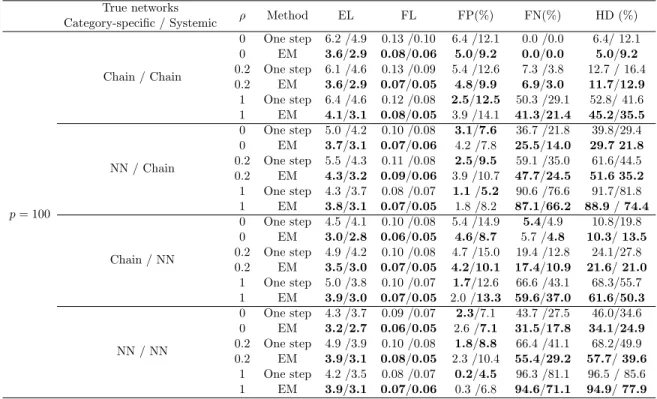
2.1
Summary statistics reporting performance of the EM and one-step
methods inferring graph structure for different networks. In each
cell, the number before and after the slash correspond to the results
using extended BIC and cross-validation, respectively. . . .
31
2.2
Summary statistics reporting performance of the EM and one-step
methods inferring graph structure for different networks. In each
cell, the number before and after the slash correspond to the results
using extended BIC and cross-validation, respectively. . . .
32
2.3
Summary statistics reporting performance of HL, JGL, one-step and
the EM methods estimating aggregate network ,ΩY
, under different
simulation settings with dimension
p
= 30 and 100. . . .
33
3.1
Summary statistics reporting performance of the EM and one-step
methods inferring graph structure for different networks. In each
cell, the number before and after the slash correspond to the results
using extended BIC and cross-validation, respectively. . . .
81
3.2
Summary statistics reporting performance of the EM and one-step
methods inferring graph structure for different networks. In each
cell, the number before and after the slash correspond to the results
LIST OF FIGURES
2.1
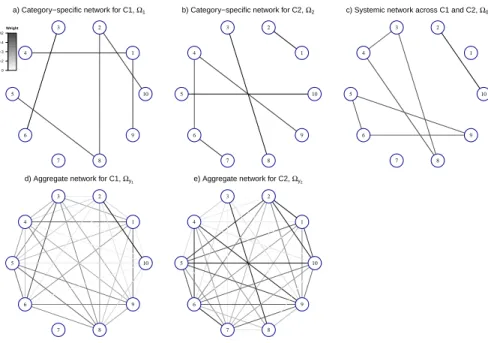
Illustration of systemic and category-specific networks using a toy
example with two categories (C1 and
C2) and
p
= 10 variables.
a) Category-specific network for
C1. b) Category-specific network
for
C2. c) Systemic network affecting variables in both
C
1and
C
2.
d)Aggregate network, Ω
Y1= (Ω
−1
1
+ Ω
−1 0
)
−1
, for category
C
1. e)
Aggregate network, Ω
Y2= (Ω
−1 2
+ Ω
−1
0
)
−1, for
C
2. . . .
11
2.2
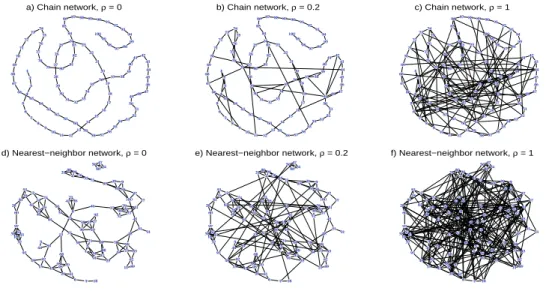
Network topologies generated in the simulations. Top row (a-c)
shows chain networks with noise ratios
ρ
= 0, 0.2, and 1. Bottom
row (d-e) shows nearest-neighbor (NN) networks with
ρ
= 0, 0.2,
and 1. . . .
20
2.3
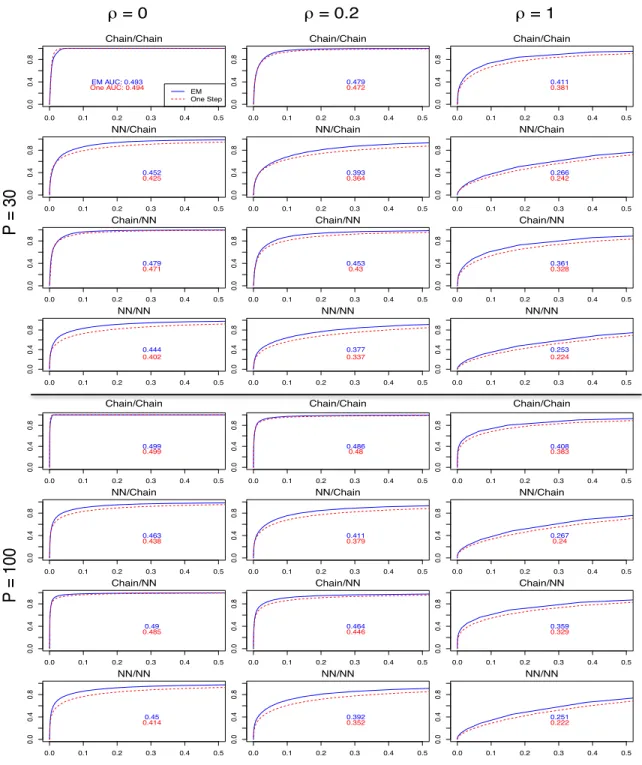
Receiver operating characteristic (ROC) curves assessing power and
discrimination of graphical inference under different simulation
set-tings. Each panel reports performance of the EM method (blue
line) and the one-step method (dashed line), plotting true positive
rate (y-axis) against false positive rate (x-axis) for a given noise ratio
ρ. . . .
24
2.4
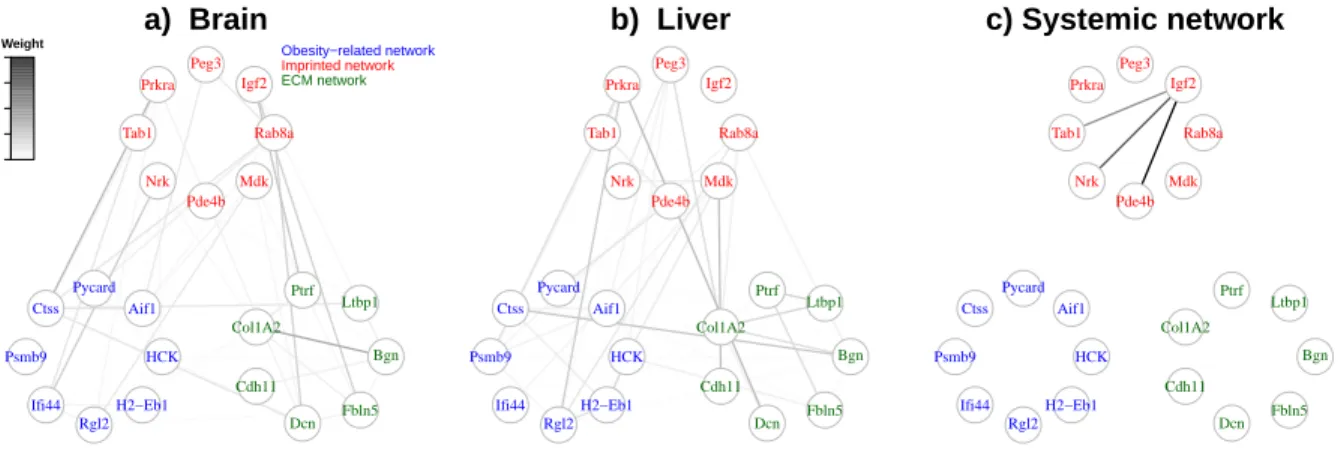
Topology of gene co-expression networks inferred by the
EM-method for the data from a population of F
2mice with randomly
allocated high-fat vs normal gene variants. Panels a) and b) display
the estimated brain-specific and liver-specific dependency structures
respectively. Panel c) shows the estimated systemic structure
de-scribing whole body interaction that simultaneously affect variables
in both tissues. . . .
28
2.5
Topology of gene co-expression networks inferred by the
EM-method for the data from a population of reciprocal F
1mice.
Pan-els a) and b) display the estimated brain-specific and liver-specific
dependency structures respectively. Panel c) shows the estimated
systemic structure describing whole body interaction that
simulta-neously affect variables in both tissues. . . .
29
2.6
Topology of co-expression networks inferred by the EM method
ap-plied to measurements of the 1000 genes with highest within-tissue
variance in a population of F
2mice. Panels a), b), c) and d) display
the category-specific networks estimated for adipose, hypothalamus,
liver and muscle tissues respectively. Panel e) shows the structure
of the estimated systemic network, describing across-tissue
depen-dencies, with panel f) showing a zoomed-in view of the connected
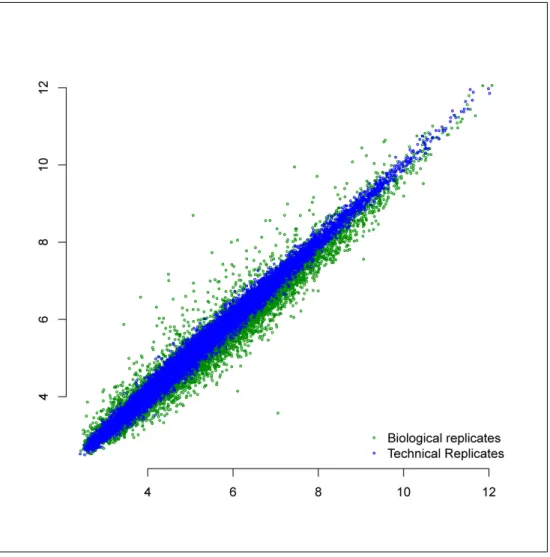
3.1
Effect of measurement error is illustrated through a scatter plot.
Each point represents a gene, X and Y axes are gene expression
levels measured by microarray. Blue dots are technical replicates
that are the same sample measured twice using two different
mi-croarrays. Green dots are biological replicates. A large proportion
of the total variance is due to measurement error. . . .
69
3.2
Effect of measurement error on Ω
Ywith
p
= 10 variables. The left
figures is the true Ω
X, and the right figure is Ω
Y= (Ω
−X1+ Ω
−1)
−1. . . .
70
3.3
Network topologies generated in the simulations. . . .
78
3.4
Receiver operating characteristic (ROC) curves assessing power and
discrimination of graphical inference for
p
= 100 and
n
= 500. Each
panel reports performance of the EM method (blue line) and the
Glasso method (red line), plotting true positive rate (y-axis)against
false positive rate (x-axis) for a given noise ratio. . . .
80
3.5
Receiver operating characteristic (ROC) curves assessing power and
discrimination of graphical inference for
p
∈ {30,
100}
and
n
= 500.
Each panel reports performance of the EM method (blue line) and
the one-step method (green line), plotting true positive rate
(y-axis)against false positive rate (x-axis) for a given noise ratio. . . .
82
4.1
Illustration of the relationship among DAG, skeleton, GGN, CG,
and GGN
∩
CG. . . .
92
4.2
DAG topologies used in the simulations. (a) and (b) shows the
DAG with
E
= 2 and 5 respectively. . . .
96
4.3
Illustration of the relationship between graph
M
and skeleton. Each
panel plots the Ω value (x-axis) against the Σ value (y-axis) with
red dots representing those entries with edges in the skeleton, while
blue dots representing entries without edges. . . .
97
4.4
Receiver operating characteristic (ROC) curve for estimating
M.
Each panel reports the performance of the AdaPC method (blue
line) and the separate method (orange, grey, yellow and brown lines
represent the fixed
λ
3for a given sparsity parameter
E. . . .
98
4.5
ROC curve assessing power and discrimination of estimating the
skeleton of a DAG. The blue solid line represents the AdaPC
algo-rithm and dash red line is result from PC-stable algoalgo-rithm. . . .
99
4.6
Topology of the skeleton networks inferred by the EM method
applied to measurements of the 394 genes with highest
within-tissue variance in Mesenchymal subclass. Panels a) and b) display
the skeleton networks estimated by AdaPC method and PC-stable
CHAPTER 1
Introduction
With the advance of technology in recent years, we have witnessed a data explosion
in many fields including biological science, social network and engineering. As a result, in
order to better explore and understand the information behind large and maybe noisy data
sets, there is a great need for the development of new statistical methodologies. A graphical
model is a probabilistic model which uses a graph to denote the conditional dependence
structure among random variables. Since graphs are conveniently used to provide insight
and capture complex dependencies among random variables, graphical models have become
an important focus of research in recent years. For example, in biological research, genes
can be represented by the nodes of a graph, and the correlations between genes can be
represented by the edges. In the area of finance, nodes of a graph can represent different
stocks in Nasdaq and edges can represent the partial correlation between stocks.
1.1
Gaussian Graphical Models
Gaussian Graphical models (GGMs) are widely used to represent conditional
depen-dencies among sets of normally distributed outcome variables that are observed together.
For example, observed, and potentially dense, correlations between measurements of
ex-pression for multiple genes, stock market prices of different asset classes, or blood flow for
multiple voxels in functional Magnetic Resonance Imaging (fMRI)-measured brain activity
can often be more parsimoniously explained by an underlying graph corresponding to the
partial correlation. The partial correlation matrix is normally assumed to be sparse, since
most of the time two variables interact with each other through other variables, hence the
partial correlation between these two variables given all other variables is zero. As methods
for estimating these underlying graphs have matured, a number of elaborations to the basic
GGM have been proposed; these include elaborations that seek either to model more closely
the sampling distribution of the data, or to model prior expectations of the analyst about
structural similarities among graphs representing data sets that are related.
Introduced more formally, the conditional dependence relationships among a set of
p
outcome variables,
y
= (y
1, ..., yp), can be represented by a graph
G
= (X, E) where each
variable corresponds to a node in the set
V
and conditional dependencies are represented
by the edges in the set
E. If we further assume that the joint distribution of the outcome
variables is multivariate Gaussian,
y
∼ N
(0,
Σ), then conditional dependencies are reflected
in the non-zero entries of the precision matrix Ω = Σ
−1. Specifically, variables
i
and
j
are
conditionally independent given the other variables if and only if the (i, j)-th element of
Ω is zero. Inferring the dependence structure of such a Gaussian graphical model is thus
equivalent to estimating which elements of its precision matrix are non-zero.
to determine iteratively the edges of each node in
G
by regressing the corresponding variable
yj
on the remaining variables
y
−junder an
`
1penalty, an approach which can be viewed
as optimizing a pseudo-likelihood (Rocha et al., 2008; Ambroise et al., 2009; Peng et al.,
2009). Several groups have proposed sparse penalized maximum likelihood to estimate
GGMs(see for example Yuan and Lin, 2007; Banerjee et al., 2008; d’Aspremont et al., 2008;
Rothman et al., 2008). Several efficient implementations solving this problem have also been
published including the graphical-LASSO (GLASSO) algorithm (Friedman et al., 2008) and
the QUadratic Inverse Covariance (QUIC) algorithm (Hsieh et al., 2011). The asymptotic
properties of such penalized estimation schemes have also been described in theoretical
studies (for example, Rothman et al., 2008; Lam and Fan, 2009).
1.2
Extensions of Gaussian Graphical Models
lasso (Friedman et al., 2008) to estimate multiple graphs from independent data sets using
penalties based on the generalized fused lasso or, alternatively, the sparse group lasso.
However, in some applications, data from different categories are naturally dependent,
hence the methods mentioned above are not valid. In Chapter 2, we develop a new graphical
EM method to estimate the GGMs from dependent data sets.
1.3
Bayesian Networks and Directed Acyclic Graphs
Causality is an important topic in scientific research. Bayesian networks have become
popular in recent years for their application in causal inference (Glymour, 1987; Koller
and Friedman, 2009; Pearl, 1995, 2000, 2009). Though estimating causal effect requires
experimental data, when the causal structure, the DAG of the Bayesian network, is given,
the post-intervention distributions and causal effects can be estimated from observational
data using various existing methods (Pearl, 2000).
A Bayesian network is a probabilistic graphical model that uses a directed acyclic graph
(DAG) to represent the conditional dependencies of a set of random variables. More
for-mally, a DAG is a mathematical object consisting of a pair (V, E), where
V
is the set of
vertices indicating random variables and
E
contains all the directed edges representing
di-rect causal relationship among the variables. A didi-rected edge is an ordered pair of nodes:
For example, the edge from node
X
→
node
Y
can be represented as (X, Y
). Implicit in
the notation (X, Y
) are several additional constraints on the relationship between
X
and
Y
:
X
is said to be a parent of
Y
,
Y
is a child of
X, and the two node are adjacent with one
another. A directed path in
G
is a sequence of distinct vertices with directed edge pointing
from each vetex to its successor.
X
is called the an ancestor of
Y
, and
Y
a descendant of
X, if there is a directed path from
X
to
Y
. There are no directed cycles in a DAG, namely,
there are no two distinct vertices that are ancestors of each other. This requirement is a
necessary condition for causal inference (Spirtes et al., 2000).
we could only identify an class of DAGs called the Markov equivalence class given the data.
The DAGs in a Markov equivalence class share the same skeleton structure and v-structures
(Pearl, 2009). Here, skeleton of a DAG is the undirected version of DAG, and a v-structure
(Xi, Xj, Xk) is a triple structure in a DAG with the edges oriented as (Xi
→
Xj
←
Xk).
Using the shared skeleton structure and v-structures in a Markov equivalence class, we
define a completed partially directed acyclic graph (CPDAG) which uniquely represents
the corresponding Markov equivalence class (Andersson et al., 1997). A CPDAG has the
following properties: 1) The skeleton of a CPDAG is the same for each DAG in the Markov
equivalence class; 2) If an edge in such a CPDAG is directed, all the DAGs in the equivalence
class have the same directed edge; 3) For every undirected edge (X
i−X
j) in such a CPDAG,
there exists at least a DAG with
Xi
→
Xj
and a DAG with
Xi
←
Xj.
1.4
Estimation of Directed Acyclic Graphs and Skeleton
Estimating DAG can be challenging, since the size of the space of DAGs is
super-exponential in the number of nodes (Kalisch and B¨
uhlmann, 2007). However, when the
dimension is small or moderate, there are several quite successful methods using greedy or
structurally restricted approaches (See for example, Chickering and Boutilier, 2002; Chow
et al., 1968; Heckerman and Chickering, 1995; Spiegelhalter et al., 1993).
the results of PC-algorithm are order-dependent, in the sense that different initial nodes
would lead to different outputs. To overcome this drawback, Colombo and Maathuis (2013)
proposed a modified PC-algorithm called PC-stable algorithm, which is order-invariant.
Another drawback of the PC-algorithm is the large number of tests for high dimensional
data, since it starts from a fully connected graph. To address this problem, one can start
with the so called moral graph (also known as the independence graph) instead of the
fully connected graph. A moral graph is a undirected graph generated from a DAG by
connecting two parents of the same node corresponding to the v-strucure, and then removing
the direction from all edges. Therefore, the moral graph of a DAG contains or equals
to its skeleton. Namely, the skeleton could be obtained by removing extra edges in the
corresponding moral graph. Based on this fact, Spirtes et al. (2000) proposed the the
Independence Graph (IG) algorithm, which first estimates the independence graph, i.e. the
moral graph, and then removes extra edges using conditional independence tests. Under
the multivariate Gaussian assumption, the moral graph becomes the partial correlation
graph which can be uniquely determined by Ω as described in Section 1.1. Under Gaussian
assumption, Ha et al. (2014) proposed the PenPC algorithm which is similar to the IG
algorithm. The concept behind PenPC is that they first estimate the precision matrix Ω via
penalized regression, and then use a modified PC-stable algorithm to delete the extra edges
due to v-structures. The advantage of the PenPC algorithm relies on the fact that it screens
out most of the extra edges in the first step leaving much few conditional independence tests
to be performed in the following step. Thus the PenPC algorithm enjoys better accuracy
and faster computational speed.
CHAPTER 2
Joint Estimation of Multiple Dependent Gaussian Graphical Models with
Ap-plications to Mouse Genomics
2.1
Introduction
Introduced more formally, the conditional dependence relationships among a set of
p
outcome variables,
Y
= (Y
1, . . . , Yp), can be represented by a graph
G
= (Γ, E) where each
variable corresponds to a node in the set Γ and conditional dependencies are represented
by the edges in the set
E. If we further assume that the joint distribution of the outcome
variables is multivariate Gaussian,
Y
∼ N
(0,
Σ), then conditional dependencies are reflected
in the non-zero entries of the precision matrix Ω = Σ
−1. Specifically, variables
i
and
j
are
conditionally independent given the other variables if and only if the (i, j)-th element of
Ω is zero. Inferring the dependence structure of such a Gaussian graphical model is thus
equivalent to estimating which elements of its precision matrix are non-zero.
When the underlying graph is sparse, as is often assumed, the ordinary maximum
likelihood estimate (MLE) is dominated by shrinkage methods: The MLE of Ω typically
implies graph that is fully connected, and so gives a result that is unhelpful for estimating
graph topology. To impose sparsity, and thereby provide a more informative inference about
network structure, a number of methods have been introduced that estimate the precision
matrix under
`
1regularization. For example, Meinshausen and B¨
uhlmann (2006) proposed
to determine iteratively the edges of each node in
G
by regressing the corresponding variable
Y
jon the remaining variables
Y
−junder an
`
1penalty, an approach which can be viewed
as optimizing a pseudo-likelihood (Rocha et al., 2008; Ambroise et al., 2009; Peng et al.,
2009). More recently, a large number of papers have proposed for estimation of GGMs
using sparse penalized maximum likelihood (see for example Yuan and Lin, 2007; Banerjee
et al., 2008; d’Aspremont et al., 2008; Rothman et al., 2008; Ravikumar et al., 2011).
Efficient implementations to address this problem include the graphical-LASSO (GLASSO)
algorithm (Friedman et al., 2008) and the QUadratic Inverse Covariance (QUIC) algorithm
(Hsieh et al., 2011).
The convergence rate and selection consistency of such penalized
estimation schemes have also been described in theoretical studies (for example, Rothman
et al., 2008; Lam and Fan, 2009).
is the simultaneous estimation of multiple graphs that may share some common structure.
For example, when inferring how brain regions interact using fMRI data, each subject’s
brain corresponds to a different graph, but we would nonetheless, expect some interaction
patterns to be common across subjects, as well as patterns specific to an individual. In
such cases, joint estimation of multiple related graphs can be more efficient than
estimat-ing graphs separately. For joint estimation of Gaussian graphs, Varoquaux et al. (2010)
and Honorio and Samaras (2010) proposed methods using group-LASSO (Yuan and Lin,
2006), and multitask-LASSO respectively. Both methods assume that all graphs share
the same pattern, namely that the precision matrices have the same pattern of zeros. To
provide greater flexibility, Guo et al. (2011) proposed a joint penalized method using a
hierarchical penalty, and derived the convergence rate and sparsistency properties for the
resulting estimators. Under the same setting, Danaher et al. (2014) extended the graphical
lasso (Friedman et al., 2008) to estimate multiple graphs from independent data sets using
penalties based on the generalized fused lasso or, alternatively, the sparse group lasso.
The methods discussed above for estimating multiple Gaussian graphs focus on
set-tings in which data collected from different categories are stochastically independent. In
some applications, however, data from different categories are more naturally considered
stochastically dependent. In a study considered here, gene expression data have been
col-lected on multiple tissues in multiple mice. Specifically, for each mouse, we have expression
measurements for
p
genes in each of
K
different tissues (or categories, in our terminology),
represented by the
p-vector
Yk
(k
= 1, . . . , K
). Gene expression profiles between mice may
be from a similar network structure, but are otherwise stochastically independent. Gene
expression profiles for different tissues within the same mouse, however, are stochastically
dependent. For this type of data, increasingly common in biomedical research, the above
methods are not applicable.
To explore the gene network structure across different tissues, and to characterize the
dependence among tissues, we consider a decomposition of the observed gene expression
Y
kinto two latent vectors
where
Z, X
1, . . . , X
Kare mutually independent.
Because cov(Y
k, Y
l) = var(Z) for any
k
6=
l,
Z
represents the sample dependence across different tissues. Letting Ωj
denote the
precision matrix of
Xj
for tissue
j, and defining var(Z) = Ω
−01, we aim to estimate Ω
kfor
all
k
= 0,
1, . . . , K
from the observed outcome data
{Y
1=
y
1, . . . , YK
=
yK
}. To accomplish
joint estimation of multiple dependent networks, two new methods are proposed: a one-step
method and an expectation-maximization (EM) method. To our knowledge, this is the first
work proposing joint estimation of such systemic and category-specific networks.
In the above decomposition,
z
can be viewed as representing “systemic” variation in
gene expression, that is, variation manifesting simultaneously in all measured tissues of the
same mouse, whereas
x
krepresents “category-specific” variation, that is, variation unique
to tissue
k. An important property of this two-layer model is that sparsity in the systemic
and category-specific networks can produce graphs for the outcome variable
y
that are
highly connected (i.e., not sparse). Conversely, highly connected graphs for the outcome
y
can easily arise from relatively sparse underlying dependencies acting at two levels. This
phenomenon is illustrated in Figure 2.1. Category-specific networks Ω
1and Ω
2are depicted
for the two categories C1 and C2 (Figure 2.1a,b); these might correspond to, for example,
liver and brain tissue-types.
The systemic network Ω
0is depicted in Figure 2.1c; this
reflects relationships affecting all tissues at once, for example, gene interactions that are
responsive to hormone levels or other globally-acting processes. Despite the fact that all
three underlying networks, Ω
0, Ω
1and Ω
2, are sparse, the precision matrix of observed
1 2 3 4
5
6
7 8 9
10
a) Category−specific network for C1, Ω1
1 2 3 4
5
6
7 8 9
10
b) Category−specific network for C2, Ω2
1 2 3 4
5
6
7 8 9
10
c) Systemic network across C1 and C2, Ω0
1 2 3 4
5
6
7 8 9
10
d) Aggregate network for C1, Ωy1
1 2 3 4
5
6
7 8 9
10
e) Aggregate network for C2, Ωy2
Weight
0 0.2 0.3 0.4 0.42
Figure 2.1: Illustration of systemic and category-specific networks using a toy example with two
categories (C1 and C2) and p= 10 variables. a) Category-specific network for C1. b)
Category-specific network for C2. c) Systemic network affecting variables in bothC1 and C2. d)Aggregate
network, ΩY1= (Ω−11+ Ω
−1
0 )−1, for categoryC1. e) Aggregate network, ΩY2 = (Ω−21+ Ω
−1
0 )−1, for
C2.
The remainder of the article is organized as follows.
In Section 2.2, we introduce
our dependent Gaussian graphical model, its implementation, and the one-step and EM
methods. In Section 2.3, we study the asymptotic properties of the proposed methods.
In Section 2.4, we illustrate the performance of our methods through simulations and real
mouse study.
2.2
Methodology
For convenience the following notations are used throughout the paper. We denote
the true precision and covariance matrices respectively as Ω
∗and Σ
∗. For any matrix
W
= (ω
ij), we denote the determinant as det(W
), the trace as tr(W
) and
W
−as the
off-diagonal entries of
W
. We further denote the
jth eigenvalue of
W
as
φ
j(W
), and the
minimum and maximum eigenvalues of
W
as
φ
min(W
) and
φ
max(W
). The Frobenius norm
kW
k
Fis defined as
P
i,jω
ij2; the operator/spectral norm
kW
k
2is defined as
φ
max(W W
T);
2.2.1
Problem formulation
In the problem we address, measurements are available on the same
p
outcome variables
in each of
K
distinct categories on each of
n
subjects. Some dependency is anticipated
among outcomes both at the level of the category and at the level of the subject. We
describe dependency at the level of the category as “category-specific”. Drawing an analogy
with physiology, we describe dependency at the level of the subject (i.e., the individual, the
mouse, etc) as “systemic”; that is, modelled as if affecting outcomes in all categories of the
same subject simultaneously. Our primary example is the measurement of gene expression
giving rise to transcript abundance readings on
p
genes on
K
tissues (e.g., liver, kidney,
brain) in
n
laboratory mice. Letting
Yk,i
be the
i-th data vector for the
k-th category, we
model
Y
k,i=
X
k,i+
Z
i(i
= 1, . . . , n;
k
= 1, . . . , K
),
(2.2)
where
Zi
is the random vector corresponding to the shared systemic random effect, and
X
k,iis the random effect corresponding to the
k-th category. We assume that
X
k,iand
Zi
are independent and identically distributed
p−dimensional random vectors with mean 0,
and covariance matrices Σk
and Σ
0respectively, for
i
= 1, . . . , n
and
k
= 1, . . . , K. For
simplicity, we further assume that
Xk,i, and
Zi
are independent of each other and each
follows a multivariate Gaussian distribution.
For the
i-th sample in the
k-th category, we observe the
p-dimensional realization of
Y
k,i,
vector
y
k,i= (y
k,i1, . . . , y
k,ip)
T. Without loss of generality, we assume these observations
are centered, i.e.,
P
ni=1
y
k,ij= 0 (j
= 1, . . . , p;
k
= 1, . . . , K). Let
y
·,ibe the combined
data vector with
y
·,i= (y
T1,i, . . . , y
K,iT)
T, such that
y
·,ifollows a Gaussian distribution with
covariance ΣY
=
{
dΣ
k}+J
⊗Σ
0=
{Σ
Y(l,m)}
1≤l,m≤K, where
{
d·}
is a block diagonal matrix,
J
is a square matrix with all 1
0s as the entries,
⊗
is the Kronecker product and Σ
Y(l,m)Section 2.6. For simplicity, we write Ω and Σ for
{Ω
k}
Kk=0
and
{Σ
k}
Kk=0respectively in the
following derivation.
The log-likelihood of the data can be written as
L(Ω
|
y) =
−
npK
2
log(2π) +
n
2
h
log{det(Ω
Y)} −
tr( ˆ
Σ
YΩ
Y)
i
,
where
ˆ
ΣY
=
n
−1 nX
i=1
yiy
iT=
{
Σ
ˆ
Y(l,m)}
1≤l,m≤K(2.3)
is the
Kp
×
Kp
sample covariance matrix. Under our setting, the log-likelihood can also be
expressed as
L(Ω
|
y)
∝
KX
k=1
h
log{det(Ω
k)} −
tr( ˆ
Σ
Y(k,k)Ω
k)
i
+ log{det(Ω
0)}
−
log{det(A)}
+
KX
l,m=1
tr
Ω
lΣ
ˆ
Y(l,m)Ω
mA
−1,
(2.4)
where
A
=
P
Kk=0
Ω
k. The detailed derivation can be found in the Supplementary material.
A natural way to achieve a sparse estimate of Ω is to maximize the penalized
log-likelihood
ˆ
Ω = argmax
Ω0
P(Ω) = argmax
Ω0
L(Ω
|
y)
−
λ
1K
X
k=1
|Ω
−k|
1−
λ
2|Ω
−0|
1.
(2.5)
Because the likelihood is complicated in its full form, direct estimation of the precision
matrices in (2.5) is difficult. Estimation can proceed directly, however, given the values
z
of the latent outcome vector
Z. Using this observation and recalling that
Z
∼ N
(0,
Σ
0),
we can first estimate Σ
0and then the other parameters subsequently. In Sections 2.2.2 and
2.2.3, we consider estimation of these multiple dependent graphs using a one-step procedure
and a method based on the EM algorithm.
2.2.2
One-step method
cov(Y
l, Y
m), for any
m
6=
l, it is natural to use the covariance matrix Σ
Y(l,m)between all
pairs of
Y
land
Ym
to estimate Σ
0as
ˆ
Σ
0=
1
K(K
−
1)
X
m6=l
ˆ
Σ
Y(m,l)=
1
K(K
−
1)n
X
m6=l n
X
i=1
y
m,iy
Tl,i.
(2.6)
Using the fact that var(X
k) = var(X
k)
−
var(Z), we can then obtain an estimate for Σ
kas
ˆ
Σ
k= ˆ
Σ
Y(k,k)−
Σ
ˆ
0=
1
n
n
X
i=1
y
k,iy
Tk,i−
Σ
ˆ
0.
(2.7)
Note that although ˆ
Σk
is symmetric, it is not necessarily positive semidefinite. Positive
definiteness can be ensured, however, using the projection approach of Xu and Shao (2012):
for any possible non-positive definite matrix ˆ
Σ
k, we obtain the projection ˆ
Σ
0kby solving
ˆ
Σ
0k= argmin
Σ0
kΣ
−
Σk
ˆ
k
∞.
(2.8)
Lastly, we estimate Ω by minimizing
K
+ 1 separate functions,
W
k, defined as follows:
W
k(Ω
k) = tr( ˆ
Σ
0kΩ
k)
−
log{det(Ω
k)}
+
λ
X
i6=j
ω
k(i,j),
(2.9)
where
k
= 0,
1, . . . , K
, and
λ
=
λ
2when
k
= 0 and
λ
=
λ
1otherwise. The minimization
problem of (2.9) can be solved efficiently by various algorithms such as GLASSO as proposed
by Friedman et al. (2008) or by QUIC as proposed by Hsieh et al. (2011). We refer to this
approach as the “one-step” method and compare its performance with the EM method
defined next.
2.2.3
Graphical EM method
First, we rewrite the sampling model as
Z
Y
1−
Z
..
.
YK
−
Z
∼ N
0
0
..
.
0
,
Σ
00
. . .
0
0
Σ
1. . .
0
..
.
..
.
..
.
..
.
0
0
. . .
ΣK
,
and the log-likelihood on the observed data
Y
=
y
as
L(Ω
|
y, z)
∝
log
det(Ω
0)
−
tr Ω
0zz
T/n
+
KX
k=1h
log
det(Ω
k)
−
tr Ω
k nX
i=1
(y
k,i−
z
i)(y
k,i−
z
i)
T/n
i
.
The above log likelihood cannot be calculated directly because the values of
z
iand
z
iz
iTare unobserved. But we can calculate a function
Q(Ω
|
Ω
(t), y) in which
z
iand
z
iz
iTare
substituted by their expected values conditional on Ω and
y. This implies the following EM
steps.
E step:
Q(Ω
|
y,
Ω
(t))
∝
KX
k=1
log{det(Ωk)} −
tr
"
ΩkE
(
nX
i=1
(yk,i
−
zi)(yk,i
−
zi)
T/n
|
y,
Ω
(t))#!
+ log{det(Ω
0)} −
tr
(
Ω
0E
n
X
i=1
ziz
iT/n
|
y,
Ω
(t)!)
=
KX
k=0n
log{det(Ω
k)} −
tr
Ω
kΣ
˙
(kt)o
.
M step:
Ω
(t+1)= argmin
Ω
−Q(Ω
|
y,
Ω
(t)) +
λ
1X
i6=j K
X
k=1
ω
k(i,j)+
λ
2X
i6=j
ω
0(i,j),
(2.10)
where Ω
(t)and
ω
(t)k(i,j)
denote the estimates from the
t-th iteration, and ˙
Σ
(t)k
is defined as
˙
Σ
(kt)=E
(
nX
i=1
(y
k,i−
z
i)(y
k,i−
z
i)
T/n
|
y,
Ω
(t))
= ¨
Σ
Y(k,k)−
K
X
l=1
¨
Σ
Y(k,l)Ω
(t)
l
(A
(t))
−1−
(A
(t))
−1 KX
l=1
+ (A
(t))
−1 KX
l,k=1
Ω
(lt)Σ
¨
Y(l,k)Ω
(t)k
(A
(t))
−1+ (A
(t))
−1,
(k
= 1, . . . , K
).
(2.11a)
˙
Σ
(0t)=
n
X
i=1
E z
iz
Ti/n
|
y,
Ω
(t)= (A
(t))
−1+ (A
(t))
−1 KX
l,k=1
Ω
(lt)Σ
¨
Y(l,k)Ω
(kt)(A
(t))
−1,
(2.11b)
where ¨
Σy
is an estimator for Σ
∗y, here ¨
Σy
= ˆ
Σy
. Thus, at the
t
+ 1 iteration, problem (2.74)
is decomposed into
K
+ 1 separate optimization problems:
Ω
(kt+1)= argmin
Ωk
tr
Ω
kΣ
˙
(kt)−
log{det(Ω
k)}
+
λ
X
i6=jω
k(i,j)
,
(2.12)
where
λ
=
λ
2when
k
= 0, otherwise
λ
=
λ
1for
k
= 0, . . . , K. We then can use GLASSO
(Friedman et al., 2008) to solve (2.12).
We summarize the proposed EM method in the following steps:
Step 1
(Initial value). Initialize ˆ
Σ
0and ˆ
Σ
kfor all
k
= 1, . . . , K
using (2.3), (2.6), (2.7)
and (2.8).
Step 2
(Updating rule: the M step). Update Ω
kusing (2.12) for all
k
= 0, . . . , K
using
GLASSO.
Step 3
(Updating rule: the E step). Update ˙
Σ
kusing (2.76a) and (2.76a).
Step 4
(Iteration). Iterate Steps 2 and 3 until convergence is achieved.
The next proposition demonstrates the convergence property of our graphical EM
al-gorithm.
Proposition 2.1.
With
λ
1>
0
and
λ
2>
0
, the graphical EM algorithm solving
(2.5)
has
the following properties:
1. The penalized log-likelihood in
(2.5)
is bounded above;
2. For each iteration, the penalized log-likelihood is non-decreasing;
3. For a prespecified threshold
δ
, after finite steps, the objective function in
(2.5)
con-verges in the sense that
The detail of proof could be found in the Proof section.
2.2.4
Model selection
We consider two options for selecting the tuning parameter
λ
= (λ
1, λ
2), minimization
of the extended BIC (Chen and Chen, 2008), and cross-validation. Extended BIC is quick to
compute and explicitly takes into account both goodness of fit and model complexity.
Cross-validation, by contrast, is more computationally demanding and focuses on the predictive
power of the model.
In our model we define extended BIC as
BIC
γ(λ) =
−2L({
Ω
ˆ
k}
Kk=0) +
ν(λ) log
n
+ 2γ
log
Kp(p
−
1)/2
ν(λ)
,
0
≤
γ
≤
1,
where
{
Ω
ˆ
k}
Kk=0are the estimates with the tuning parameter set at
λ,
L(·) is the likelihood
function described in (2.4), the degrees of freedom,
ν
(λ), is the sum of the number of
non-zero off-diagonal elements on
{
Ω
ˆ
k}
Kk=0. The criterion is indexed by a parameter
γ
∈
[0,
1].
The tuning parameter
λ
is selected by
ˆ
λ
= argmin{BIC
γ(λ) :
λ
1, λ
2∈
(0,
∞)}.
In describing the cross-validation procedure, we define the predictive negative
log-likelihood function as follows:
F
(Σ,
Ω) = tr(ΣΩ)
−
log{det(Ω)}.
To select
λ
using cross-validation, we first randomly split the dataset equally into
J
groups, and denote the sample covariance matrix from the
j-th group as Σ
(j,λ)and the
precision matrix estimated from the remaining groups as ˆ
Ω
(−j,λ). Then we choose
λ
as
argmin
λ
J
X
j=1
F(Σ
(j,λ),
Ω
ˆ
(−j,λ)) :
λ
1, λ
2∈
(0,
∞)
.
2.3
Asymptotic properties
In this section we study the asymptotic properties of our proposed methods. First, we
introduce the notation and the regularity conditions on the true precision matrices
{Ω
∗k
}
Kk=0,
where Ω
∗k= (ω
k∗(j,j0))p
×p. LetT
k=
n
(j, j
0) :
j
6=
j
0, ω
k∗(j,j0)6= 0
o
be the set of indices of all
nonzero off-diagonal elements in Ω
∗k,
q
k=
|T
k|
be the cardinality of
T
k, and
q
=
P
Kk=0
q
k.
Let
{Σ
∗k}
Kk=0
be the true covariance ma
trices for
z
and
{x
k}
Kk=1
, and Σ
∗Y=
{Σ
∗Y(l,m)}
1≤l,m≤Kbe the true covariance matrices for
y. We assume that the following regularity conditions hold.
Condition
1. There exist constants
τ
1,
τ
2such that for all
k
= 0,
1, . . . , K, 0
< τ
1<
φ
min(Ω
∗k)
≤
φ
max(Ω
∗k)
< τ
2<
∞.
Condition
2. There exists a constant
τ
3>
0, such that min
k=0,...,Kmin
(j,j0)∈Tk
ω
∗ k(j,j0)
≥
τ
3.
Condition 1 bounds the eigenvalues of Ω
∗k, thereby guaranteeing the existence of its
inverse and facilitating the proof of consistency. Condition 2 is needed to bound the nonzero
elements away from zero.
The following theorems discuss estimation consistency and selection sparsistency of our
methods.
Theorem 2.1
(Consistency of the one-step method)
.
Under Conditions 1-2,
(p
+
q) log
p/n
=
o(1)
, and
a
1(log
p/n)
1/2≤
λ
1, λ
2≤
b
1{(1 +
p/q) log
p/n}
1/2for some
con-stants
a
1and
b
1. Let
{
Ω
ˆ
k}
Kk=0be the minimizer defined by
(2.9)
using the one-step method,
then
K
X
k=0
ˆ
Ω
k−
Ω
∗k F=
O
p"
(p
+
q) log
p
n
1/2#
.
Before we introduce the main theorem of the EM algorithm, we first present a corollary
of Theorem 2.1 which gives a good estimator of Σ
∗Y.
Corollary 2.1.
Suppose that Conditions 1-2 hold, and
Ω
ˆ
kis the one-step solution on
Σ
ˇ
k−
Σ
∗kF
=
O
p"
(p
+
q) log
p
n
1/2#
.
To study our EM estimator, we need a good estimator for Σ
∗Ywhich specifies in the
following condition.
Condition
3. We assume there exists an estimator ˜
Σ
Ysuch that
k
ΣY
˜
−
Σ
∗Yk
F=
Op
"
(p
+
q) log
p
n
1/2#
.
The rate in Condition 3 is required to control the convergence rate of the E-step estimate
˙
Σ
kand thus the consistency of the estimate from the EM method. Under the conditions in
Theorem 2.1, we can use the one-step estimator ˆ
Ω
0, . . . ,
ΩK
ˆ
to obtain ˜
ΣY
=
J
⊗
( ˆ
Ω
0)
−1+
{
d( ˆΩk)
−1}, which satisfies Condition 3 by Corollary 2.1.
Theorem 2.2
(Consistency of the EM method)
.
Suppose Conditions 1-3 hold, and
(p
+
q) log
p/n
=
o(1)
, and
a
2(log
p/n)
1/2≤
λ
1, λ
2≤
b
2{(1 +
p/q) log
p/n}
1/2for some constants
a
2and
b
2. Then the solution,
{
Ωk
ˆ
}
Kk=0, of the EM method satisfies
K
X
k=0
Ω
ˆ
k−
Ω
∗ k
F
=
Op
"
(p
+
q) log
p
n
1/2#
.
Theorem 2.3
(Sparsistency of the one-step method)
.
Under the assumptions of Theorem
2.1.
If we further assume that
P
Kk=0
Ωk
ˆ
−
Ω
∗ k
=
Op(ηn)
for a sequence of
ηn
→
0
,
and
(log
p/n
+
η
2n)
1/2=
O(λ
1) =
O(λ
2)
, then with probability tending to 1, the minimizer
{
Ω
ˆ
k}
Kk=0satisfies
ω
ˆ
k(j,j0)= 0
for all
(j, j
0)
∈
T
ck
,
k
= 0, . . . , K
.
To obtain sparsistency we require a lower bound on the rate of the regularization
pa-rameters
λ
1and
λ
2. For consistency, we need an upper bounds for
λ
1and
λ
2to control
the biases. In order to have both consistency and sparsistency to hold simultaneously,
we need the bounds to be compatible, that is, we need (log
p/n
+
η
2n
)
1/2=
O(λ
1, λ
2) =
{(1 +
p/q) log
p/n}
1/2. Using the inequalities
kW
k
2F
/p
≤ kW
k
2≤ kW
k
2F, there are two
scenarios describing the rate of
η
n, as in Lam and Fan (2009). In the worst case, where
P
Kk=0
k
Ω
ˆ
k−Ω
∗kk
has the same rate as
P
Kk=0
k
Ω
ˆ
k−Ω
∗kk
F, the two bounds are compatible only
when
q
=
O(1). In the most optimistic case, where
P
Kk=0
k
Ω
ˆ
k−Ω
∗kk
2=
P
KTheorem 2.4
(Sparsistency of EM method)
.
Under the assumptions of Theorem 2.2, and
if we further assume that
P
Kk=0
Ω
ˆ
k−
Ω
∗ k
=
Op(ηn)
and
P
Kk=0
Σ
˜
k−
Σ
∗ k
=
Op(ζn)
for
sequences of
ηn
→
0
and
ζn
→
0
. Moreover let
ζn
+
ηn
=
O(λ
1) =
O(λ
2)
, then with
probability tending to 1, the minimizer
{
Ωk
ˆ
}
Kk=0
in Theorem 2.2 satisfies
ω
ˆ
k(j,j0)= 0
for all
(j, j
0)
∈
T
kc,
k
= 0, . . . , K
.
Similar to the discussion above, for the EM algorithm, we have both consistency and
sparsistency when
q
=
O(p) for the best scenario, and
q
=
O(1) for the worst case. Details
of the proof can be found in the Supplementary material.
2.4
Simulation
We assessed the performance of the one-step and EM methods by applying them to
simulated data generated by two types of synthetic network: a chain network and a
nearest-neighbor (NN) network (Figure 2.2).
Twenty-four simulation settings were considered.
These varied the base architecture of the category-specific network, the degree to which
the actual structure could deviate from this basic architecture, and the number of outcome
variables (nodes).
● ● ● ● ● ● ● ● ● ● ●● ● ● ● ● ● ● ● ● ● ● ● ● ● ● ● ● ● ● ● ●● ● ● ● ●● ● ● ●● ● ● ● ● ● ● ● ● ● ● ● ● ● ● ● ● ● ● ● ● ● ● ● ● ● ● ● ● ● ● ●● ● ● ● ● ● ●● ● ● ● ● ●●●●● ● ● ● ● ● ● ● ● ● ● 1 2 3 4 5 6 7 8 9 10 1112 13 14 15 16 17 18 19 20 21 22 23 24 25 26 27 28 29 30 31 3233 34 3536 3738 39 40 4142 43 44 45 46 47 48 49 50 51 52 53 54 55 56 57 58 59 60 61 62 63 64 65 66 67 68 69 70 71 72 7374 75 76 77 78 79 8081
82 83 84 85 868788899091
92 93 94 95 96 97 98 99 100 a) Chain network, ρ = 0
● ● ● ● ● ● ● ● ● ● ●● ● ● ● ● ● ● ● ● ● ● ● ● ● ● ● ● ● ● ● ●● ● ● ● ● ● ● ● ●● ● ● ● ● ● ● ● ● ● ● ● ● ● ● ● ● ● ● ● ● ● ● ● ● ● ● ● ● ● ● ●● ● ● ● ● ● ● ● ● ● ● ● ●●●●● ● ● ● ● ● ● ● ● ● ● 1 2 3 4 5 6 7 8 9 10 1112 13 14 15 16 17 18 19 20 21 22 23 24 25 26 27 28 29 30 31 3233 34 35
36 3738 39 40 4142 43 44 45 46 47 48 49 50 51 52 53 54 55 56 57 58 59 60 61 62 63 64 65 66 67 68 69 70 71 72 7374 75 76 77 78 79 8081
82 83 84 85 868788899091
92 93 94 95 96 97 98 99 100 b) Chain network, ρ = 0.2
● ● ● ● ● ● ● ● ● ● ● ● ● ● ● ● ● ● ● ● ● ● ● ● ● ● ● ● ● ● ● ●● ● ● ● ●● ● ● ●● ● ● ● ● ● ● ● ● ● ● ● ● ● ● ● ● ● ● ● ● ● ● ● ● ● ● ● ● ● ● ●● ● ● ● ● ● ● ● ● ● ● ● ●●●●● ● ● ● ● ● ● ● ● ● ● 1 2 3 4 5 6 7 8 9 10 1112 13 14 15 16 17 18 19 20 21 22 23 24 25 26 27 28 29 30 31 3233 34 35
36 3738 39 40 4142 43 44 45 46 47 48 49 50 51 52 53 54 55 56 57 58 59 60 61 62 63 64 65 66 67 68 69 70 71 72 7374 75 76 77 78 79 8081
82 83 84 85 868788899091
92 93 94 95 96 97 98 99 100 c) Chain network, ρ = 1
● ● ● ● ● ● ● ● ● ● ● ● ● ● ● ● ● ● ● ● ● ● ● ● ● ● ● ● ● ● ● ● ● ● ● ● ● ● ● ● ● ● ● ● ● ● ● ● ● ● ● ● ● ● ● ● ● ● ● ● ● ● ● ● ● ● ● ● ● ● ● ● ● ● ● ● ● ● ● ● ● ● ● ● ● ● ● ● ● ● ● ● ● ● ● ● ● ● ● ● 1 2 3 4 5 6 7 8 9 10 11 12 13 14 15 16 17 18 19 20 21 22 23 24 25 26 27 28 29 30 31 32 33 34 35 36 37 38 39 40 41 42 43 44 45 46 47 48 49 50 51 52 53 54 55 56 57 58 59 60 61 62 63 64 65 66 67 68 69 70 71 72 73 74 75 76 77 78 79 80 81 82 83 84 85 86 87 88 89 90 91 92 93 94 95 96 97 98 99 100 d) Nearest−neighbor network, ρ = 0
● ● ● ● ● ● ● ● ● ● ● ● ● ● ● ● ● ● ● ● ● ● ● ● ● ● ● ● ● ● ● ● ● ● ● ● ● ● ● ● ● ● ● ● ● ● ● ● ● ● ● ● ● ● ● ● ● ● ● ● ● ● ● ● ● ● ● ● ● ● ● ● ● ● ● ● ● ● ● ● ● ● ● ● ● ● ● ● ● ● ● ● ● ● ● ● ● ● ● ● 1 2 3 4 5 6 7 8 9 10 11 12 13 14 15 16 17 18 19 20 21 22 23 24 25 26 27 28 29 30 31 32 33 34 35 36 37 38 39 40 41 42 43 44 45 46 47 48 49 50 51 52 53 54 55 56 57 58 59 60 61 62 63 64 65 66 67 68 69 70 71 72 73 74 75 76 77 78 79 80 81 82 83 84 85 86 87 88 89 90 91 92 93 94 95 96 97 98 99 100 e) Nearest−neighbor network, ρ = 0.2
● ● ● ● ● ● ● ● ● ● ● ● ● ● ● ● ● ● ● ● ● ● ● ● ● ● ● ● ● ● ● ● ● ● ● ● ● ● ● ● ● ● ● ● ● ● ● ● ● ● ● ● ● ● ● ● ● ● ● ● ● ● ● ● ● ● ● ● ● ● ● ● ● ● ● ● ● ● ● ● ● ● ● ● ● ● ● ● ● ● ● ● ● ● ● ● ● ● ● ● 1 2 3 4 5 6 7 8 9 10 11 12 13 14 15 16 17 18 19 20 21 22 23 24 25 26 27 28 29 30 31 32 33 34 35 36 37 38 39 40 41 42 43 44 45 46 47 48 49 50 51 52 53 54 55 56 57 58 59 60 61 62 63 64 65 66 67 68 69 70 71 72 73 74 75 76 77 78 79 80 81 82 83 84 85 86 87 88 89 90 91 92 93 94 95 96 97 98 99 100 f) Nearest−neighbor network, ρ = 1
Figure 2.2: Network topologies generated in the simulations. Top row (a-c) shows chain networks
with noise ratiosρ= 0, 0.2, and 1. Bottom row (d-e) shows nearest-neighbor (NN) networks with