Causes and consequences of flat-slab subduction in southern Peru
Brandon T. Bishop
1, Susan L. Beck
1, George Zandt
1, Lara Wagner
2, Maureen Long
3, Sanja Knezevic Antonijevic
4, Abhash Kumar
5, and
Hernando Tavera
61Department of Geosciences, University of Arizona, 1040 East 4th Street, Tucson, Arizona 85721, USA
2Department of Terrestrial Magnetism, Carnegie Institution for Science, 5241 Broad Branch Road NW, Washington, D.C. 20015, USA
3Department of Geology and Geophysics, Yale University, 210 Whitney Avenue, New Haven, Connecticut 06511, USA
4University of North Carolina at Chapel Hill, CB #3312, Chapel Hill, North Carolina 27599, USA
5National Energy Technology Laboratory, 626 Cochrans Mill Road, Pittsburgh, Pennsylvania 15236, USA
6Instituto Geofísico del Perú, Calle Badajoz 169, Lima 15012, Peru
ABSTRACT
Flat or near-horizontal subduction of oceanic lithosphere has been an im-portant tectonic process both currently and in the geologic past. Subduction of the aseismic Nazca Ridge beneath South America has been associated with the onset of flat subduction and the termination of arc volcanism in Peru, making it an ideal place to study flat-slab subduction. Recently acquired seis-mic recordings for 144 broadband seisseis-mic stations in Peru permit us to image the Mohorovičić discontinuity (Moho) of the subducted oceanic Nazca plate, Nazca Ridge, and the overlying continental Moho of the South American crust in detail through the calculation of receiver functions. We find that the sub-ducted over-thickened ridge crust is likely significantly eclogitized ~350 km from the trench, requiring that the inboard continuation of the flat slab be supported by mechanisms other than low-density crustal material. This contin-uation coincides with a low-velocity anomaly identified in prior tomography studies of the region immediately below the flat slab, and this anomaly may provide some support for the flat slab. The subduction of the Nazca Ridge has displaced most, if not the entire South American lithospheric mantle beneath the high Andes as well as up to 10 km of the lowermost continental crust. The lack of deep upper-plate seismicity suggests that the Andean crust has remained warm during flat subduction and is deforming ductilely around the subducted ridge. This deformation shows significant coupling between the subducting Nazca oceanic plate and overriding South American conti-nental plate up to ~500 km from the trench. These results provide important modern constraints for interpreting the geological consequences of past and present flat-slab subduction locations globally.
INTRODUCTION
Near-horizontal subduction or flat-slab subduction of oceanic lithosphere occurs along ~10% of all subduction zones today and has been postulated to have occurred in many subduction zones in the past to explain patterns of overriding plate magmatism and deformation (Gutscher et al., 2000; Kay and Mpodozis, 2002). In this mode of subduction, the descending slab initially
dips at a normal angle (~30°) down to a depth of ~80–100 km, then becomes horizontal for several hundred km, before descending more steeply into the mantle. Studying present-day flat-slab subduction, including the Peruvian flat slab, may provide important insights into this process. How strongly coupled the downgoing and overriding plates may be in a flat-slab system has long been debated, and our study suggests that the South American and Nazca plates are strongly coupled in the segment of the Peruvian flat slab associated with the subduction of the Nazca Ridge. The causes of flat subduction and the effects on the upper plate also remain topics of vigorous debate. Numerous studies suggest several factors are important, including the age of the sub-ducting slab, the absolute motion of the plates, and the presence of buoyant features, such as aseismic ridges on the descending plate (e.g., Gutscher et al., 2000; van Hunen et al., 2002a). Other studies suggest these features are not sufficient and that dynamic effects and the structure of the upper plate play an important role (e.g., Gerya et al., 2009; Manea et al., 2012; O’Driscoll et al., 2012). Additional parameters potentially influencing flat subduction include changes in the viscosity and geometry of the mantle wedge separating the two plates, with relatively shallow low-viscosity regions in the mantle wedge acting to enhance slab flattening by reducing viscous resistance (Manea and Gurnis, 2007). Prior studies of the proposed Cretaceous to mid-Cenozoic Lara-mide flat slab beneath the western United States and the present-day Sierras Pampeanas flat slab beneath Chile and Argentina have argued that flat-slab subduction leads to both the termination of arc volcanism (e.g., Dickinson and Snyder, 1978, for Laramide; Barazangi and Isacks, 1976, for Sierras Pampeanas) and compressional thick-skinned crustal deformation in the upper plate (see Erslev, 2005, for a review of the Laramide; Jordan and Allmendinger, 1986, for the Sierras Pampeanas). However, not all instances of present-day flat subduc-tion are associated with these features. The Mexico flat slab occurs in associa-tion with an inboard active arc and a neutral to extensional state of stress in the upper plate (Suter et al., 2001; Gérault et al., 2015), while the Peruvian flat slab is associated with a cessation of arc volcanism (e.g., Rosenbaum et al., 2005) and long spatial wavelength foreland uplift (Espurt et al., 2007). This diverse range of behavior indicates that no single set of upper-plate responses can be linked to all flat subduction occurrences (see Manea et al., 2017, for a detailed review of present-day flat-slab systems).
GEOSPHERE
GEOSPHERE; v. 13, no. 5
doi:10.1130/GES01440.1
7 figures; 3 supplemental files
CORRESPONDENCE: brandontbishop@email .arizona .edu
CITATION: Bishop, B.T.,Beck, S.L., Zandt, G., Wag-ner, L., Long, M., Knezevic Antonijevic, S., Kumar, A., and Tavera, H., 2017, Causes and consequences of flat-slab subduction in southern Peru: Geosphere, v. 13, no. 5, p. 1392–1407, doi:10.1130/GES01440.1.
Received 6 October 2016 Revision received 18 April 2017 Accepted 9 June 2017 Published online 27 July 2017
tions. We identify both the South American continental Moho and subducted Nazca oceanic Moho, map the depths to both discontinuities, and calculate an isopach map of the thickness separating the two. The results show up to 20 km of continental crustal thickness variation and delineate the flat slab’s depth and areal extent. The new information on the geometry of the flat slab and the structure of the overlying continental crust, in conjunction with recent tomo-graphic results, reveal new clues on the causes of flat subduction and provide details on the tectonic effects in the overlying plate.
SOUTHERN PERUVIAN FLAT SLAB
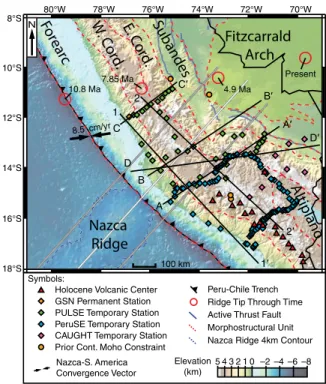
The Nazca and South American plates have a present convergence rate in our study region of ~7 cm/yr oriented at an azimuth of 71° (DeMets et al., 2010), a significant departure from the calculated 0 Ma to 5 Ma average con-vergence value of 8.5 cm/yr oriented along an azimuth of 82° (Somoza and Ghidella, 2012). The oceanic Nazca plate first subducts at an angle of ~30°, then flattens near a depth of 100 km to become nearly horizontal in the upper-most mantle beneath South America between 2°S and 15°S and subducts at a continuous angle of ~30° south of ~15°S (Gutscher et al., 2000). The mod-ern gap in active arc volcanism characterizing northmod-ern and central Peru was established between 2 and 3 Ma (Noble and McKee, 1982; Rosenbaum et al., 2005) following a significant pulse of magmatism between 16 Ma and 4 Ma (Rosenbaum et al., 2005). Approximately perpendicular to the Peruvian Trench lies the Nazca Ridge, an aseismic ridge with ~17–20-km-thick oceanic crust (Hampel et al., 2004; Tassara et al., 2006) formed from the interaction of the Easter-Salas Hotspot and the East Pacific Rise (Coffin and Eldholm, 1994; Ray et al., 2012). Subduction of the Nazca Ridge has been linked to the cessation of volcanism and ongoing flat-slab subduction between ~9°S and 15°S (Fig. 1) (e.g., Gutscher et al., 1999; Gutscher et al., 2000; Hampel, 2002; Rosenbaum et al., 2005; Antonijevic et al., 2015). Slab seismicity relocated by Kumar et al. (2016) for a 2.5 year period shows earthquakes at depths of <~100 km in the re-gion where the Nazca Ridge subducts and a gap in deeper seismicity >~100 km along the projection of the subducting Nazca Ridge (Fig. 2).
The western margin of South America between 9°S and 17°S can be di-vided into seven major morphostructural units (Fig. 1, modified from Espurt et al., 2010; Carlotto, 2013). From west to east, the forearc, Western Cordillera (WC), Eastern Cordillera (EC), Subandes, and Amazonian foreland basin ex-tend along a northwest-southeast trend throughout the study region. The Alti-plano Plateau is localized in the southeastern corner of our study region, and the Fitzcarrald Arch is a broad foreland uplift aligned with the inland projection of the oceanic Nazca Ridge (Fig. 1). While uplift of the forearc (e.g., Macharé and Ortlieb, 1992; Saillard et al., 2011) and the formation of the Fitzcarrald Arch (e.g., Espurt et al., 2007; Espurt et al., 2010) have been proposed to correspond to the ongoing subduction of the Nazca Ridge, no ridge-related deformation
inboard of the 500 m elevation contour of the WC has been documented within the cordillera (Wipf et al., 2008).
Crustal seismicity in the WC is limited to <10 km depth, while that in the EC is limited to <20 km depth (Dorbath et al., 1990; Dorbath et al., 1991; Devlin et al., 2012) in contrast to seismicity observed at >30 km depth in the Subandes (Dorbath et al., 1991; Devlin et al., 2012). This suggests a comparatively shallow brittle to ductile transition depth in the WC and EC relative to the Subandes. East of the forearc, little to no seismicity is observed between this seismo genic
16°S
18°S 14°S 12°S 10°S
8.5 cm/yr
Nazca
Ridge
10.8 Ma7.85 Ma 4.9 Ma
Present
A
A′
B D
B′
D′
C 2
C′
2′
1
1′
Fitzcarrald
Arch
Altiplano
rea
rc
. C
ord
.
E. C
ord
.
s
Holocene Volcanic Center Symbols:
Prior Cont. Moho Constraint GSN Permanent Station PULSE Temporary Station PeruSE Temporary Station CAUGHT Temporary Station
Peru-Chile Trench Ridge Tip Through Time Active Thrust Fault
Nazca-S. America Convergence Vector
Morphostructural Unit Nazca Ridge 4km Contour 100 km
–8 –6 –4 –2 0 1 2 3 4 5 Elevation
(km)
zone in the upper 20–30 km of the continental crust and the normal to strike-slip mechanism seismicity that begins at ~70 km depth and locally extends to >100 km (Suárez et al., 1990; Kumar et al., 2016), interpreted as earthquakes occurring within the downgoing Nazca slab (see also slab-related seismicity in Fig. 2).
DATA AND METHODS
We utilized data from a total of 144 broadband seismic stations to investi-gate the structure of central and southern Peru. Thirty-eight of these seismic stations (Fig. 1, green diamonds) were deployed (October 2010 to June 2013) for the PULSE temporary network (Wagner et al., 2010; Eakin et al., 2014). We
also used data from eight seismometers (Fig. 1, purple diamonds) deployed (October 2010 to July 2012) for the Central Andes Uplift and Geodynamics of High Topography temporary network (Beck et al., 2010; Ryan et al., 2016). Ninety- seven broadband seismic stations (Fig. 1, blue diamonds) are part of the Peru Subduction Experiment temporary network deployed between June 2008 and February 2013 (PeruSE, 2013). Finally, we used data recorded at the permanent broadband Global Seismic Network station NNA (Scripps Institu-tion of Oceanography, 1986) located near Lima, Peru (Fig. 1, orange diamond). We first calculated receiver functions (RFs) from the three-component broadband seismic data using an iterative time domain method (Ligorría and Ammon, 1999) and then used common conversion point (CCP) stacking (Dueker and Sheehan, 1997; Sheehan et al., 2000) to make lithospheric-scale depth cross sections (Fig. 3). To migrate the 2752 RFs that we calculated to depth, we used a simplified 1-D layer over half-space velocity model using an average crustal velocity for the region of 6.0 km/s Vp (Dorbath, 1996) to 75 km depth with a Vp/Vs of 1.75 determined from a modified Wadati plot (see Methods in Supplemental Material and Figure S11) and consistent with
adja-cent regions (e.g., Phillips et al., 2012; Ryan et al., 2016). The half-space from 75 to 200 km depth was assigned a Vp of 8.1 km/s and a Vp/Vs of 1.8, equivalent to the IASP91 mantle model averaged to 200 km depth. We used bootstrapping with 400 iterations to calculate each CCP stack and required that each plotted CCP stack bin contained a minimum of four RFs to reduce the effects of noise and ensure that no single RF dominated any portion of our stack. Uncertainty in our depth calculation for features observed in the CCP stacks is strongly de-pendent on the uncertainty in the velocity model used to migrate the RFs from time to depth. Because detailed seismic-velocity models for the entirety of our study region are not yet available, we estimate our depth uncertainty based on departures from the simple regional starting model. Forward modeling shows that a feature at 60 km depth in our CCP stacks can be moved ~±0.8 km by Vp/Vs variations of 0.01 or ~±2.6 km by a 5% change in average P-wave velocity of the entire crustal column. The largest errors are associated with the forearc, where the seismic velocities and crustal thickness as well as the shallow slab structure are significantly more complex than our simple model. More detailed estimates of uncertainty require a better knowledge of the regional seismic- velocity structure than is presently available.
We used a variety of bin spacings to accommodate the variable inter-station distances in our data set. The CCP stack cross section in A–A′ (Fig. 3) uses rectangu lar bins of 15 km × 25 km; B–B′ uses square bins of 25 km × 25 km (Fig. 3); C–C′ uses square bins of 15 km × 15 km (Fig. 3); D–D′ (Fig. 3) uses square bins of 30 km × 30 km; and 1–1′ and 2–2′ both use square bins of 25 km × 25 km. All cross sections use a bin sharing (spatial overlap) with di-mensions of 1.5× bin size. Further details of these methods are described in the Methods section in our Supplemental Material (see footnote 1). The CCP stacks show a complex continental crustal structure in the region, and this complexity is likely to create a number of multiple arrivals. We have examined the possi-ble effects of multiple arrivals from the mid-crustal discontinuities on our inter-preted primary Moho arrivals. Evaluation of the influence of multiple arrivals
80°W 78°W 76°W 74°W 72°W 70°W
16°S
18°S 14°S 12°S 10°S 8°S
Nazca
Ridge
NSymbols:
Hypocenter Location from Kumar et al., 2016 Hypocenter Location from
Langer and Spence, 1995 Peru-Chile Trench Nazca Ridge 4km Contour 100 km
–8 –6 –4 –2 0 1 2 3 4 5
Elevation (km)
0 20 40 60 80 100 150 200 250
Hypocenter Depth (km)
Figure 2. Map of regional slab seismicity relocated using local seismic array data by Langer and Spence (1995) (colored diamonds) and Kumar et al. (2016) (colored circles). Kumar et al. (2016) used the PULSE and CAUGHT arrays to relocate regional slab seismicity between 2010 and 2013. Langer and Spence (1995) used a local seismic array to relocate the aftershock se-quence to an October 3, 1974 8.1 Mw earthquake along the Peruvian Trench, providing locations we use to better constrain the slab in the forearc. Note that the overall patterns in seismicity are similar to those in the 43-year Inter-national Seismological Centre (2011) hypocenter record plotted in Figure 6.
Supplemental Material
Causes and consequences of flat slab subduction in southern Peru
Brandon T. Bishop1, Susan L. Beck1, George Zandt1, Lara Wagner2, Maureen Long3, Sanja
Knezevic Antonijevic4, Abhash Kumar5, Hernando Tavera6
1Department of Geosciences, University of Arizona, 1040 East 4thStreet, Tucson, Arizona 85721, USA
2Department of Terrestrial Magnetism, Carnegie Institution for Science, 5241 Broad Branch Road NW, Washington DC 20015, USA
3Department of Geology and Geophysics, Yale University, 210 Whitney Avenue, New Haven, Connecticut 06511, USA
4University of North Carolina at Chapel Hill, CB #3312, Chapel Hill, North Carolina, 27599, USA
5National Energy Technology Laboratory, 626 Cochrans Mill Road, Pittsburgh, PA 15236, USA 6Instituto Geofísico del Perú, Calle Badajoz 169, Lima 15012, Peru
RECEIVER FUNCTION METHOD DETAILS
We obtained records of teleseismic direct P-phases (≥5.0 Mw, 30° and 90° distance, 1431
usable event pairs), PP-phases (≥6.0 Mw, 90° and 150° distance, 1202 usable station-event pairs), and PKP-phases (≥6.0 Mw, 110° and 160° distance, 119 usable station-station-event pairs,
PKP- phase was not used for PeruSE stations as overlapping station coverage provided sufficient P-, PP-phase arrivals) arrivals from each seismometer for the calculation of teleseismic receiver functions (Langston, 1979) via the iterative time domain deconvolution technique (Ligorría and
Ammon, 1999) using a Gaussian pulse width of 2.5 (equivalent to a low-pass filter with a corner frequency of 1.2 Hz). This gave us a total of 2752 receiver functions. In addition we obtained
1Supplemental Material. Additional details on
6 4 2 0
50
100
150
200
Ele
v.
(km)
Depth (km
)
14.15°S 76.79°W
13.89°S 74.86°W
13.62°S 72.94°W
13.37°S 71.01°W
13.10°S 69.09°W D
2 A
B 1
D′
D
42 0
50
100
150
200
Ele
v.
(km)
Depth (km)
15.45°S 75.47°W
14.70°S 74.32°W
13.95°S 73.16°W
13.19°S 72.01°W
12.36°S 70.74°W
A
6 4 2 0
50
100
150
200
Ele
v.
(km)
Depth (km)
14.34°S 76.08°W
13.58°S 74.93°W
12.83°S 73.77°W
12.08°S 72.62°W
11.32°S 71.46°W B
2
D 1
B′
B
642 0
50
100
150
200
Ele
v.
(km)
Depth (km)
12.29°S 77.20°W
11.88°S 76.65°W
11.39°S 75.99°W
10.90°S 75.33°W
10.58°S 74.89°W C
2 1
C′
C
100 km Figure 3. Receiver-function common con-version point (CCP) stack profiles. A–A′,
B–B′, and C–C′ are trench-perpendicular
cross sections from south (A–A′) to north
(C–C′). Cross section D–D′ follows a strike
parallel to the 5 Ma to 0 Ma average South America plate–Nazca plate convergence vector. Receiver- function CCP stack bin
size varies between profiles; line A–A′
uses rectangular bins of 15 km × 25 km;
B–B′ uses square 25 km × 25 km bins; C–C′
uses square 15 km × 15 km bins; and line
D–D′ uses square 30 km × 30 km bins. All
profiles use 1.5× bin sharing. Light-blue lines mark interpreted continental Moho; purple lines mark interpreted subducted oceanic Moho; dashed dark-blue line at
western edge of D–D′ marks inferred top
from these crustal interfaces on the continental Moho and subducted oceanic Moho is presented in our Supplemental Material (see footnote 1) along with examples of intersecting CCP-stack cross sections that have allowed us to bet-ter constrain the continental and subducted oceanic Moho (Figs. S2 and S3). An examination of the potential effects of bin size and sharing is presented in Figure S4. Here we focus on the depth to the continental Moho, the depth to the subducting plate’s Moho, and on the interpretation of these two features combined with previous studies in the region.
INTERPRETATIONS OF CROSS SECTIONS
We first picked the continental Moho and the subducted oceanic Moho on individual CCP stacks by identifying relatively high amplitude, laterally con-tinuous positive arrivals at or near depths predicted by previous work. The continental Moho Ps phase is generally a positive high-amplitude, continuous feature except under the forearc, where mantle hydration weakens and may even locally invert the amplitude (Bostock, 2013). The oceanic Moho Ps phase is more variable in amplitude and becomes difficult to trace inland, but re-cently published slab seismicity locations obtained from analysis of a subset of the seismic stations used in this study (Kumar et al., 2016) have aided us in identifying the top of the slab. We required that the RF arrivals identified as these features match constraints from prior geophysical studies and that these arrivals be laterally continuous between intersecting trench-perpendicular and trench-parallel cross sections (see Figs. S2 and S3 in the Supplemental Mate-rial [footnote 1] for examples of intersecting cross sections). The CCP cross sections in Figures 3 and 4 show our interpreted continental Moho (light-blue lines) and subducted oceanic slab Moho (purple lines) based on our receiver- function results (solid lines) and prior seismic (Hampel et al., 2004; Antonijevic et al., 2015; Kumar et al., 2016; Scire et al., 2016) and gravity (Fukao et al., 1989; Tassara and Echaurren, 2012) studies of the region (dashed lines).
Profile A–A′ (Fig. 3) is a trench-perpendicular cross section located slightly south of the inboard projection of the Nazca Ridge. We observe the continental Moho’s depth (given in depth below sea level) increasing from ~20 km depth at the coastline (where it may coincide with the top of the subduction channel) to more than 60 km depth beneath the WC and undulating between 55 km and 60 km depth beneath the EC and Subandes before gradually reaching less than 50 km depth in the Amazonian foreland. The subducted oceanic Moho of the Nazca plate appears at less than 50 km depth at the coast and dips at a relatively steep angle beneath the forearc to ~80 km beneath the WC before following the variations in the South American continental Moho. This undu-lating structure is consistent both with slab earthquake hypocenter locations (Kumar et al., 2016) and RF-constrained surface-wave results sampling this lo-cation (Ma and Clayton, 2015). The amplitude of the oceanic Moho Ps phase is very high beneath the western portion of the WC and then diminishes abruptly into a low-amplitude phase farther inboard, a characteristic observed on other trench-perpendicular cross sections. We utilize slab earthquake locations and
seismic tomography results to constrain the inboard locations and show the feature with dashed lines where it is poorly constrained (see Supplemental Material [footnote 1] for a discussion of crustal interface multiples that may po-tentially influence the low-amplitude oceanic Moho Ps phase and an example in Fig. S2 [see footnote 1]).
Profile B–B′ (Fig. 3) is a trench-perpendicular cross section located slightly askew to the inboard projection of the Nazca Ridge axis; the vertical red line marks the intersection of the profile and the projection of this axis. The conti-nental Moho signal is very weak or perhaps inverted beneath the forearc and much of the WC, and we show an interpretation consistent with our other cross lines and with offshore data (Hampel et al., 2004). The continental Moho signal increases in strength and depth toward the east, reaching ~50 km depth be-neath the EC and the Subandes. The depth to the continental Moho along this profile is significantly shallower than the continental Moho observed to the south (see profile A–A′) and north (see profile C–C′), where it reaches >60 km depths. Over the ~375 km separating the forearc and western Subandes, the subducted oceanic Moho lies at ~80 km depth, making it the shallowest part of the flat slab. This upwarp of both the continental and oceanic Mohos across the subducted Nazca Ridge is observed most clearly in the along-strike and oblique cross sections described below.
Trench-perpendicular profile C–C′ (Fig. 3) crosses the Andes north of the subducted Nazca Ridge. The continental Moho in the forearc lies at ~45 km depth before increasing to more than 60 km depth beneath both the WC and EC. The gradational character of the forearc Moho arrival may indicate a struc-tural complication or gradual rather than abrupt transition between mantle and crustal velocity materials in this location. Along this profile, the Nazca plate’s subducted oceanic Moho lies at ~60 km depth near the Peruvian coast to ~80 km depth near the edge of the WC. The slab Moho appears discontin-uous under the WC and is offset rapidly from ~80 km to ~110 km depth near the central portion of the WC (see Supplemental Material and Fig. S3 [foot-note 1] for additional details), before flattening for ~225 km inland and then re-steepening beneath the Subandes (Scire et al., 2016). This separation be-tween the South American crust and Nazca plate is several tens of kilometers greater than the separation we observe elsewhere in the region and is located where Antonijevic et al. (2015) hypothesized a trench-parallel slab tear from surface-wave tomography results.
2013), suggesting this variation may relate to the underthrusting of the Nazca Ridge. The slab Moho signal is strong under most of the WC and weakens abruptly under the dense line of stations in the central part of the high cor di-llera. Based on a few slab earthquakes and tomography results, we interpret the slab to remain flat ~180 km beyond the projection of the Nazca Ridge’s southeastern edge, suggesting the subducted ridge may be wider or less linear than the non-subducted portion. Alternately, this may indicate that additional factors are promoting flat-slab subduction in this area. Under the forearc, a large negative arrival near 50 km depth appears to correspond to mega thrust-related earthquakes (gray dots in Fig. 3, Langer and Spence, 1995) and the
down-dip projection of the top of the subducting slab (dashed dark-blue line, Hampel et al., 2004), suggesting this feature marks the top of the slab. If so, the subducted ridge has a crustal thickness of ~20 km, indistinguishable from the non-subducted portion of the oceanic ridge crust within the limits of our resolution and uncertainty.
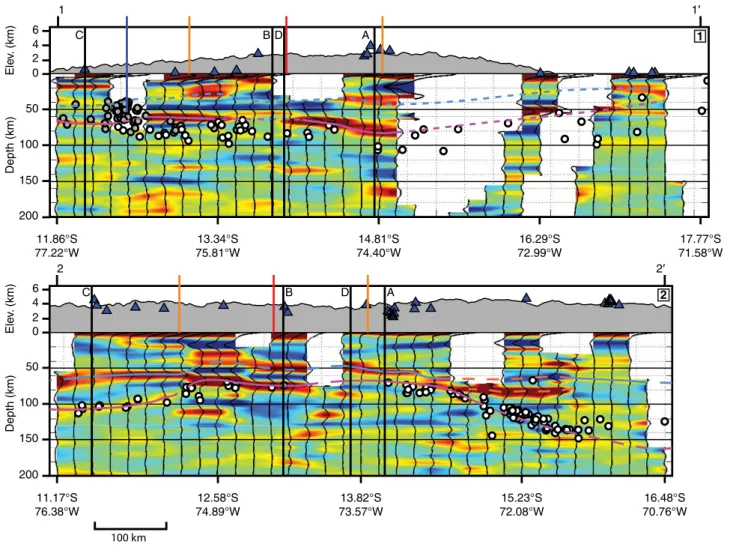
Profile 1–1′ (Fig. 4) samples the forearc, highlighting the complicated nature of the continental forearc Moho structure in this region. Aside from the area near the intersection of this line with A–A′, the continental Moho ap-pears as a diffuse or low-amplitude arrival that is much weaker than the under-lying subducted slab oceanic Moho. This indicates that the velocity contrast 4
2 0
50
100
150
200
Ele
v.
(km)
Depth (km)
11.86°S 77.22°W
13.34°S 75.81°W
14.81°S 74.40°W
16.29°S 72.99°W
17.77°S 71.58°W
C B D A
11.17°S 76.38°W
12.58°S 74.89°W
13.82°S 73.57°W
15.23°S 72.08°W
16.48°S 70.76°W 2
B D A
C
2′ 6
4 2 0
50
100
150
200
Ele
v.
(km
)
Depth (km
)
100 km
1
2
Figure 4. Receiver-function common con-version point (CCP) stack profiles. Cross
sections 1–1′ and 2–2′ strike approximately
perpendicular to the inboard projection of the Nazca Ridge Axis and
trench-perpen-dicular cross sections A–A′, B–B′, and C–C′.
Both cross sections use square 25 km × 25 km bins and 1.5× bin sharing. Blue
vertical line in 1–1′ marks location where
Langer and Spence (1995) report strike-slip earthquakes within the subducting Nazca plate (see text). Dashed orange line
in 2–2′ marks possible inverted continental
between the forearc mantle material and overlying crust in this region may be significantly less than that farther inboard or that the forearc Moho represents a gradational rather than abrupt velocity structure. It is also possible that the high-amplitude negative arrival near 50 km depth along the inboard projection of the Nazca Ridge (area between the orange lines, Fig. 4) marks a location where the continental crust is in direct contact with the underlying subducted oceanic crust. However, this interpretation is difficult to reconcile with mega-thrust coseismic slip depths in this location (e.g., Motagh et al., 2008) and grav-ity-based estimates of forearc Moho depth (e.g., Fukao et al., 1989), which sug-gest separation between the overlying and subducting crust at these depths. This negative arrival approximately corresponds to the area where Dougherty and Clayton (2015) found evidence for a thin (≤3 km), slow-velocity layer lying on top of the slab, which was interpreted as localized hydration of the mantle wedge. The spatial coincidence of our RF negative arrival and Dougherty and Clayton’s (2015) slow layer suggests the RF arrival may mark the top of this layer. We also note that extensive subduction erosion in this region (Clift et al., 2003; Hampel et al., 2004) may have introduced a large amount of near-trench forearc crustal material into the subduction channel at this location, and this may be partly responsible for the complexity of the continental Moho. Finally, we note a set of intra-slab strike-slip earthquakes reported by Langer and Spence (1995) (gray circles surrounding blue line, Fig. 4) with fault strikes trending perpendicular to the trench and at depths within the slab that oc-curred as aftershocks to a mega thrust earthquake. These earthquakes corre-spond to an ~10 km offset in the slab Moho arrival, suggesting that this is a sharp monoclinal fold or zone of faulting that accommodates differential in-board postseismic motion between adjacent segments of the slab.
Profile 2–2′ (Fig. 4) approximately follows the strike of the WC and is nearly perpendicular to the inboard projection of the Nazca Ridge (region between the two orange lines, Fig. 4). The profile’s most prominent feature is a high-ampli tude positive arrival on the northwest side at 60 km depth that drops to 70 km at the projected edge of the Nazca Ridge and then dips down to ~80 km by the profile’s middle. The arrival’s apparent continuity suggests it is a single feature; however, our interpretations along the intersecting profiles C–C′ and B–B′ reveal that this arrival is the continental Moho to the NW of the edge of the Nazca Ridge but is the oceanic Moho under the Nazca Ridge itself. With this interpretation, the continental Moho makes a 10 km step down off the northwestern edge of the Nazca Ridge, and the oceanic Moho “sags” down from 80 km under the ridge to ~100 km under profile C–C′. This interpretation is supported by the relocated slab earthquakes (Kumar et al., 2016) and previous interpretations of a “sag” in the subducted flat slab to the north of the ridge based on long-term seismicity (Gutscher et al., 1999). On this profile, the depth of the South American Moho changes from ~60 km near 11°S to ~50 km depth above the inboard projection of the subducting Nazca Ridge before increasing to ~60 km near 14°S. The absence of a significant topographic change across this boundary suggests the average density structure across this significant change in lithospheric structure must be on average equivalent. In addition, the ~20 km separating the continental and oceanic “Mohos” suggest there is
little to no continental mantle remaining above the subducted Nazca Ridge, consistent with an observed lack of local S-wave splitting along the inboard projection of the ridge (Eakin et al., 2014). Assuming the subducted portion of the ridge’s crust is comparable to the unsubducted portion with 17–20-km-thick oceanic crust, less than ~3 km of continental mantle separates the subducted ridge’s crust and the overriding continental crust.
The rapid change in the subducted oceanic Moho depth from ~80 to ~60 km depth where profile 2–2′ crosses the northwest edge of the Nazca Ridge (left orange line in Fig. 4) suggests the presence of a trench-perpendic-ular lithosphere scale fold or fault in the Nazca plate. This feature is inboard and oriented approximately along the same strike as the intra-slab strike-slip fault Langer and Spence (1995) observed in seismicity patterns that we dis-cussed above in relation to profile 1–1′. This suggests that this feature may be a continuation of the fault system. It is also approximately in line with a possible slab tear or hole hypothesized in the deeper slab based on teleseis-mic tomography (Scire et al., 2016). This suggests that the fault system may control, at least in part, the rapid drop of the flat slab from ~80 km depth along the inboard projection of the Nazca Ridge to ~100 km depth to the northwest.
South of the flat-slab region, we follow slab seismicity (Dougherty and Clayton, 2015; Kumar et al., 2016) and prior tomography results (Scire et al., 2016) to infer the slab’s location. In this area (near 15.23°S), a prominent, paired negative-over-positive arrival appears in the uppermost mantle below the northernmost active arc volcanic center. We associate this with a significant mantle low-velocity zone imaged by surface-wave tomography (e.g., Ma and Clayton, 2014; Ward et al., 2016). We interpret the negative arrival as marking a location where mantle material is significantly slower than the overlying conti-nental crustal material, resulting in an inverted Moho, and the deeper positive arrival as marking the bottom of the low velocity zone. This feature is likely related to active arc processes at this location.
SUMMARY MOHO MAPS
In addition to calculating CCP stack profiles shown in Figures 3 and 4, we also picked the continental and subducted oceanic Moho from a second set of CCP stacks covering the study region in a 25 km × 25 km grid. We then created interpolated maps of the continental Moho (Fig. 5A) and the subducted oce-anic Moho (Fig. 5B) augmented by additional constraints from prior studies. Additional continental Moho constraints are from James and Snoke (1994), McGlashan et al. (2008), Tassara and Echaurren (2012), and Ryan et al. (2016). See Figure S5A in our Supplemental Material (footnote 1) for a map of the Moho constraints and locations used as well as Supplemental Table S12 for
latitudes, longitudes, and depths of each constraint. Additional oceanic Moho constraints are augmented by data from Hayes et al. (2012) and Scire et al. (2016). See Supplemental Material Figure S5B (footnote 1) for a map of the slab constraints and locations used as well as Supplemental Table S23 for latitudes,
longitudes, and depths of each constraint. We then subtracted the depths to
Lat Long Depth Comment
(°S) (°W) (km)
13.403300 76.603459 25.500000 RF Moho depth from sea level 13.577829 76.459284 35.200000 Theoretical CCP-stack resolution 13.752359 76.315108 34.400000 equal to 0.1 km 13.926889 76.170932 36.300000
14.101419 76.026756 38.200000 14.275948 75.882580 37.900000 14.450478 75.738404 41.400000 14.625008 75.594229 41.500000 14.799538 75.450053 41.000000 12.912909 76.713769 31.600000 13.087439 76.569593 29.900000 13.261968 76.425417 27.600000 13.436498 76.281241 26.800000 13.611028 76.137065 28.000000 13.785557 75.992890 28.100000 13.960087 75.848714 35.800000 14.134617 75.704538 36.300000 14.309147 75.560362 36.300000 14.483676 75.416186 38.600000 14.658206 75.272011 38.400000 11.898929 77.256605 44.900000 12.073459 77.112430 44.800000 12.247988 76.968254 44.100000 12.422518 76.824078 40.200000 12.771577 76.535726 31.200000 12.946107 76.391551 29.600000 13.120637 76.247375 29.800000 13.295167 76.103199 27.100000 13.469696 75.959023 27.200000 13.644226 75.814847 26.700000 13.818756 75.670672 36.900000 13.993286 75.526496 37.700000 14.167815 75.382320 36.300000 14.342345 75.238144 38.300000 14.516875 75.093968 38.100000 11.757597 77.078563 46.500000 11.932127 76.934387 47.600000 12.106657 76.790211 48.000000
SUPPLEMENTAL TABLE 1. SOUTH AMERICAN MOHO CONSTRAINTS
This Study
Lat Long Depth Comment
(°S) (°W) (km)
12.879711 77.035987 065.600000 RF subducted oceanic Moho depth
13.054240 76.891811 065.300000 from sea level
13.228770 76.747635 070.800000 Theoretical CCP-stack resolution
13.403300 76.603459 072.400000 equal to 0.1 km
13.577829 76.459284 073.000000
13.752359 76.315108 071.800000
13.926889 76.170932 070.400000
14.101419 76.026756 071.700000
14.275948 75.882580 071.300000
14.450478 75.738404 073.200000
14.625008 75.594229 071.600000
14.799538 75.450053 072.300000
12.912909 76.713769 059.800000
13.087439 76.569593 059.500000
13.261968 76.425417 060.600000
13.436498 76.281241 063.000000
13.611028 76.137065 063.000000
13.785557 75.992890 064.100000
13.960087 75.848714 068.000000
14.134617 75.704538 067.600000
14.309147 75.560362 067.200000
14.483676 75.416186 064.900000
14.658206 75.272011 065.200000
14.832736 75.127835 065.200000
11.898929 77.256605 067.600000
12.073459 77.112430 068.700000
12.247988 76.968254 068.900000
12.422518 76.824078 069.700000
12.771577 76.535726 060.000000
12.946107 76.391551 059.100000
13.120637 76.247375 060.600000
13.295167 76.103199 062.800000
13.469696 75.959023 063.100000
13.644226 75.814847 062.800000
13.818756 75.670672 067.200000
13.993286 75.526496 067.100000
14.167815 75.382320 066.800000
14.342345 75.238144 064.800000
14.516875 75.093968 065.100000
14.691404 74.949792 065.200000
11.757597 77.078563 070.700000
11.932127 76.934387 071.000000
12.106657 76.790211 071.000000
12.281187 76.646036 072.000000
12.455716 76.501860 074.800000
12.630246 76.357684 059.700000
12.804776 76.213508 059.000000
SUPPLEMENTAL TABLE 2. NAZCA SLAB CONSTRAINTS
This Study (RF Based)
2Supplemental Table S1. Latitude, longitude, and
depth constraints of South American Continental Moho. Please visit http:// doi .org /10 .1130 /GES01440 .S2 or the full-text article on www .gsapubs .org to view Table S1.
3Supplemental Table S2. Latitude, longitude, and
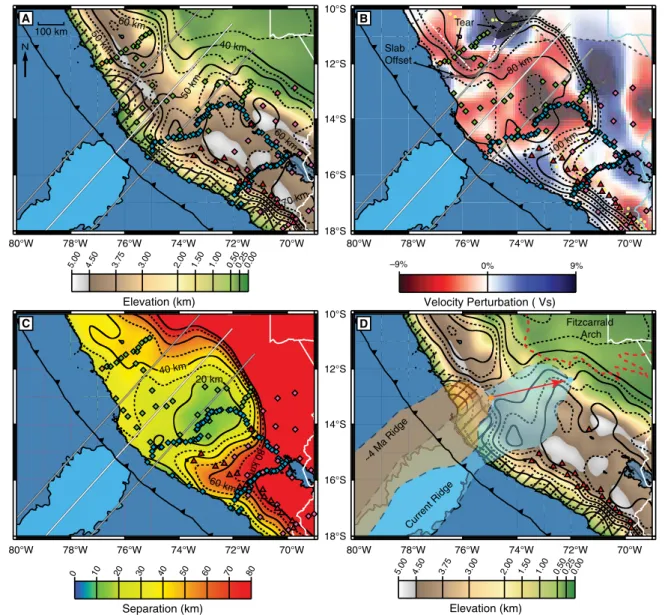
these surfaces to obtain a map showing the separation between the continen-tal and subducted oceanic Mohos (Fig. 5C). All maps have been filtered using a low-pass spatial filter passing spatial wavelengths greater than 650 km and re-jecting wavelengths less than 50 km, with a cosine taper over wavelengths be-tween these two values. We applied this filter to eliminate any features smaller than 50 km × 50 km, which are effectively below the lateral resolution of our
array. The South American continental Moho depth map (Fig. 5A) shows the close correspondence between the shallow Moho beneath the WC (see pro-files D–D′ and 2–2′ above) and the likely location of the subducted Nazca Ridge (region bound by gray lines in Fig. 5A). Here continental Moho depths ~60 km typically associated with the high Andes shallow to ~50 km, strongly suggest-ing that the thick crustal root of the cordillera has been partially displaced by
80°W 78°W 76°W 74°W 72°W 70°W
N
50 km 50 km
40 km
60 km
70 km
100 km
C
20 km
40 km
60 km 80 km
80°W 78°W 76°W 74°W 72°W 70°W
?
? ? ? ?
80°W 78°W 76°W 74°W 72°W 70°W
18°S 16°S 14°S 12°S
Slab Offset
80 km
100 km
Current Ridge ~4 Ma Ridge
Fitzcarrald Arch
18°S 16°S 14°S 12°S 10°S
D
80°W 78°W 76°W 74°W 72°W 70°W
0.00 0.25 0.50 1.00 1.50 2.00 3.00 3.75 4.50 5.00
Elevation (km)
80 70 60 50 40 30 20 10 0
Separation (km)
Velocity Perturbation ( Vs)
–9% 0% 9%
0.00 0.25 0.50 1.00 1.50 2.00 3.00 3.75 4.50 5.00
Elevation (km)
Figure 5. Maps showing our results. Map symbols in A, B, and C are the same as in Figure 1. (A) Moho depth map of the South American continental Moho incorporating receiver- function (RF) constraints (CAUGHT stations not in-cluded in Fig. 1) from this study and Ryan et al. (2016) along with additional seismic constraints (James and Snoke, 1994; McGlashan et al., 2008) and gravity constraints from Tassara and Echaurren (2012) (see Fig. S2A [footnote 1] for locations of constraint on these features). Solid contours mark 10-km-depth increments, dashed contours mark 5 km increments. (B) Slab depth contour map for subducted Nazca plate to 130 km depth overlain on S-wave teleseismic tomography results from Scire et al. (2016) (130-km-depth slice). Slab Moho contours between 50 and 110 km depth are from our RF study; contours <~50 km are based on slab seismicity (Hayes et al., 2012) and contours >~110 km are based on slab seismicity (Dougherty and Clayton, 2015; Kumar et al., 2016) and tomography (Scire et al., 2016).
Slab tear marked by white solid line seen in RF profile C–C′
(Fig. 3), slab offset seen in profile 1–1′ (Fig. 3); tear feature
the subducting ridge. This location also corresponds to the shallowest section of flat subduction and may relate to the subduction of the main body of the over-thickened Nazca Ridge. The southeastern edge of the ridge is likely to correspond to the increase in continental Moho depth to >60 km. This depth increase may partially reflect the eastward displacement of crustal material as ridge subduction progresses.
Compilation of our subducting slab depth map (Fig. 5B) is complicated by differing criteria used by different authors to determine slab depth. In the re-gion sampled by our array, we have used the subducted oceanic Moho from our RF results to constrain slab depth. In this region, the top of the slab itself is likely to be ~8 to ~20 km above the mapped slab Moho depth. In the areas outside our array coverage, we have used Slab1.0 (Hayes et al., 2012) to define the slab above 95 km and seismicity (Dougherty and Clayton, 2015; Kumar et al., 2016) along with tomography-based contours (Scire et al., 2016) to de-fine the slab below 95 km depth. Both Hayes et al. (2012) and Scire et al. (2016) use different criteria to define their slab locations (slab surface and center of high-velocity slab anomaly, respectively). To reduce potential artifacts result-ing from the incorporation of these disparate data sets, we maintained a gap of at least 25 km where the data sets gave differing values, allowing for a gradual shift between what are presumably nearly parallel surfaces in the subducting plate. We further avoid interpretation of the slab Moho surface near the edge of individual data sets (especially the rapid re-steepening of the surface to the east) and focus on only large-scale features. For the locations of the slab-depth constraints used in the calculations of Figure 5B, see Supplemental Figure S5B (footnote 1).
We also note the similarity of our slab contours at and below 90 km depth to those determined independently by Antonijevic et al. (2015) using surface-wave tomography and slab earthquake locations. Differences above 90 km depth likely reflect greater vertical resolution by receiver functions than that possible with surface-wave tomography. The southeastern corner to the flat slab, in a region well sampled by our array, extends well beyond the south-ern margin of the Nazca Ridge projection and directly above a prominent sub-slab low-velocity zone image at 130 km depth by teleseismic S-wave tomog-raphy (Fig. 5B) (Scire et al., 2016) and surface-wave tomogtomog-raphy (Antonijevic et al., 2016). These low velocities could be produced by increased temperature, the presence of partial melt, and/or the presence of hydrous phases, imply-ing that more buoyant material is present in this area than in the surroundimply-ing mantle (Antonijevic et al., 2016; Scire et al., 2016). The correspondence be-tween the 100- and 120-km contours and the edge of the low-velocity anomaly is consistent with the southern margin of the flat slab being partially supported by this material. We further note that this location corresponds to an area of complicated mantle anisotropy identified in shear-wave splitting results; this area contrasts with observations immediately to the north and south of the ridge (Eakin et al., 2015), further indicating the mantle beneath the subducted ridge is distinct from other parts of the upper mantle.
The slab, where it re-steepens to the southeast, appears to be continuous despite the rapid change in slab dip. This contrasts with the behavior we
ob-serve northwest of the Nazca Ridge where smaller changes in slab dip are associated with a clear down-drop of the slab from 70 km to 100 km depth. A trench-perpendicular fold or fault zone, imaged by our RFs at ~80 km depth, which may develop into a slab tear at 120 km to 300 km depth as imaged by teleseismic tomography (Scire et al., 2016), accommodates this down-drop. This feature intersects a second, trench-parallel apparent offset that we image on profile C–C′ at the same location as Antonijevic et al. (2015) inferred a tear from surface-wave tomography. This offset corresponds to the southern mar-gin of the “sag” in the flat slab proposed by Gutscher et al. (1999). These pro-posed tears and/or faults would allow the continuation of flat subduction NW of the subducted Nazca Ridge, but at a depth >20 km deeper than along the ridge itself. While our observations are consistent with the “sag” feature of Gutscher et al. (1999), we lack the coverage to test for the hypothesized “Lost Inca Plateau,” which Gutscher et al. (1999) proposed as a second, buoyant subducted oceanic feature to explain the northern segment of the Peruvian flat slab.
Figure 5C shows a map of the separation between the South American continental Moho and the slab Moho based on the previous maps. The sub-ducted ridge requires a minimum of ~17 km of separation between these two surfaces to accommodate the over-thickened oceanic crust. This suggests that the southern edge of the ridge is in contact with the overriding continental crust, consistent with a comparison of the continental Moho contours and the 70 km and 80 km slab Moho contours (Fig. 5D). These slab contours closely follow the complex geometry of the continental Moho, suggesting coupling between the two features. Figure 5D also shows the present position of the Nazca Ridge in blue and the simplified outline of the <80 km depth segment of the flat slab (transparent blue) and the position of the ridge and this <80 km depth segment at ca. 4 Ma (transparent orange). Assuming that the shallowest part of the observed flat slab, characterized by a subducted oceanic Moho lying at <80 km depth, has remained at this depth or shallower over the past 4 m.y., we find an interesting relationship between the shallow slab and the overrid-ing continental crust. Figure 5D indicates that this shallow segment passed directly beneath the region of the WC and EC with anomalously thin crust. We return to this possibility later in the following discussion.
DISCUSSION
Numerical and analogue modeling of flat-slab subduction (e.g., van Hunen et al., 2002a; Martinod et al., 2005; Espurt et al., 2008; Currie and Beaumont, 2011; Manea et al., 2012) has repeatedly shown that over-thickened oceanic crust is insufficient to account for flat-slab subduction extending for >300 km from the trench without the contribution of factors related to the overriding plate. Exceptions to this (e.g., van Hunen et al., 2004; Arrial and Billen, 2013) require a significantly delayed basalt-to-eclogite conversion of the subducting crust—a proposition that is readily testable through the relative amplitude of Ps conver-sions from the subducted oceanic Moho recorded in RFs and directly analogous to the interpretation of changing subducted oceanic Moho seismic character discussed by Rondenay et al. (2008) in Cascadia and Alaska. The strong velocity contrast between basaltic crust and the underlying mantle lithosphere of the oceanic plate should produce a high-amplitude Ps conversion. This contrast would be increased if the crust is hydrated and the mantle was relatively dry, as proposed for the lithosphere under the thick crust of the Nazca Ridge where the ridge remains seismically active (Kumar et al., 2016). A crust with a significant eclogitized component should have a much weaker velocity contrast with the underlying mantle lithosphere, yielding a lower amplitude Ps conversion.
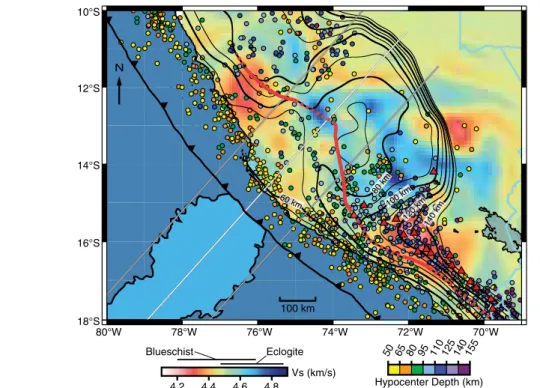
significant fraction of the subducting Nazca Ridge has been eclogitized well trenchward of the point where the Nazca slab resumes steep subduction in tomographic results (Antonijevic et al., 2015; Scire et al., 2016). This decrease in Ps amplitude corresponds to a transition in S-wave velocity structure at 75 km depth from relatively slow velocities typical of sub–eclogite-facies material to high velocities typical of eclogite-facies material (Fig. 6). We further note that the slab seismicity from Kumar et al. (2016) appears to correspond primarily to areas where a strong subducted oceanic Moho Ps conversion is present (see Figs. 3 and 4). This region with a strong subducted oceanic Moho Ps conver-sion also has an inboard extent that approximately matches that of a supra- slab ultra-low velocity layer likely related to slab dehydration identified by Dougherty and Clayton (2015). The depth of this transition from a strong sub-ducted oceanic Moho Ps conversion to a weak conversion and its relationship to slab dehydration is consistent with recent studies of instances of subducted oceanic material exhumed from pressures equivalent to 70–100 km (Beinlich et al., 2010; Dragovic et al., 2012; Klemd et al., 2015) and with petrologic mod-els that indicate that dehydration of subducted oceanic crust predominately occurs rapidly at the blueschist/eclogite transition (Hacker, 1996; John et al.,
80°W 78°W 76°W 74°W 72°W 70°W
18°S 16°S 14°S 12°S 10°S
Vs (km/s) 4.2 4.4 4.6 4.8
Blueschist Eclogite 50 65 80 95 110125 140155
Hypocenter Depth (km) N
100 km
80 km
60 km 100 km
120 km 140
km
Figure 6. Comparison of subducted oce-anic Moho slab contours and replotted surface-wave tomography at 75 km depth from Antonijevic et al. (2015) model. Earth-quakes from International Seismological
Centre (2011) catalogue (≥4.5 magnitude,
2012; Baxter and Caddick, 2013). This interpretation is also consistent with the inference by Kumar et al. (2016) that the rapid decrease in slab seismicity in the Peruvian flat slab in the vicinity of the subducted Nazca Ridge is a re-sult of the ridge’s subducted oceanic crust largely being dehydrated by 80 km depth. Our results suggest that numerical models of flat slabs that model a rapid eclogite transition occurring 300 km to 350 km from the trench (e.g., van Hunen et al., 2002a; Currie and Beaumont, 2011) are an accurate representation of the processes occurring within the Peruvian flat slab.
In Figure 6, we summarize the relationship between this “eclogitization front,” the slab Moho contours, long-term (>40 year) patterns of slab seismicity from the International Seismological Centre (2011) catalogue (note similarity to patterns shown in Fig. 2 from short-term (~2.5 years) seismicity relocated using local arrays), and the S-wave velocity structure at 75 km depth from surface-wave tomography (Antonijevic et al., 2015). Two important relation-ships are revealed in Figure 6. First, the shallowest part (<80 km depth) of the flat slab resides roughly between the projected locations of the edges of the subducted Nazca Ridge and extends ~500 km inboard of the trench. While the precise shape and size of the subducted portion of the Nazca Ridge cannot be known with certainty, reconstructions (e.g., Hampel, 2002; Rosenbaum et al., 2005) indicate that as the ridge formed at the intersection of the Easter-Salas Hotspot and the East Pacific Rise, the Tuamotu Plateau is likely the Nazca Ridge’s conjugate and of comparable size. Given the size and position of the Tuamotu Plateau relative to the East Pacific Rise and given plate motion recon-structions, the present-day location of the end of the subducted Nazca Ridge is likely located ~400–500 km farther down-dip in the slab (Hampel, 2002) than the present inboard limit of flat subduction. This suggests that much of the ridge has been subducted and is presently located within the section of the slab that descends nearly vertically into the mantle (Scire et al., 2016). Second, the flat segment extends several hundred kilometers beyond the eclogitization front, indicating that additional forces (in addition to the positive buoyancy of the subducted oceanic crust) must be acting to maintain the flat geometry. Both our observations and those of Ma and Clayton (2015) using a similar data set show that some of the shallowest segments of the flat slab occur along the projection of the Nazca Ridge beyond 350 km from the trench in the area with at least partially eclogitized oceanic crust. Additionally, the southern edge of the flat slab appears to extend farther south than the projected southern edge of the ridge. While numerical models of flat subduction incorporating ac-tive over-thrusting of the overriding plate (van Hunen et al., 2002a; Currie and Beaumont, 2011) suggest that over-thrusting can promote flat-slab subduction, the correspondence of the shallowest inboard part of the flat slab to the Nazca Ridge and a region of slow S-wave velocities in the mantle immediately be-neath the shallow flat slab (Fig. 5B) suggest that a second source of buoyancy may also be acting on the slab, in addition to any dynamic effects, in agree-ment with findings by Antonijevic et al. (2016). The origin of this low-velocity feature remains unclear (Antonijevic et al., 2016; Scire et al., 2016).
While this sub-slab, low-velocity feature’s origin is unknown, our observa-tions and those of prior studies allow us to better understand its present-day
relationship with the flat slab. Comparison of our subducted oceanic Moho depth over this region (~80 km) and the most intense negative velocity anom-aly in tomographic results (concentrated between ~100 and 200 km though po-tentially extending to ~400 km depth; Antonijevic et al., 2016; Scire et al., 2016) indicates that it is separated from the oceanic crust by at least 20–30 km of high-velocity slab lithosphere. This indicates the anomaly is unlikely to be due to hydration-related serpentinization of the slab’s lithosphere, a mechanism invoked for other flat-slab occurrences (e.g., Kopp et al., 2004). Our observa-tions support the interpretation of this feature as a region of anomalously hot mantle material (Antonijevic et al., 2016; Scire et al. 2016) or a portion of the mantle containing melt (Antonijevic et al., 2016). Calculations by Antonijevic et al. (2016) indicate the low-velocity material can be explained by a mantle temperature anomaly of 200 °C or the presence of at least 1% partial melt. We emphasize that either possibility would decrease the density of mantle beneath this segment of the flat slab, helping to promote continued flat subduction.
The existence of complicated shear-wave splitting anisotropy in the mantle along the projection of the ridge (Eakin et al., 2015) further indicates that man-tle beneath the ridge differs significantly from that to the north or south. Based on this correlation, we suggest that low-velocity, low-density upper mantle be-neath the ridge may be a contributing factor to its continued buoyancy, some-what analogous to other low-density mantle anomalies observed along the Juan Fernandez Ridge and associated Sierra Pampeanas flat slab (e.g., Kopp et al., 2004; Porter et al., 2012), though affecting the base of the oceanic litho-spheric mantle rather than its top.
The shallow depth of the subducted Nazca Ridge and the corresponding deep continental Moho, especially to the southeast of the ridge (see Fig. 5), suggest that strong mechanical coupling occurs between the Nazca and South American plates. The WC and EC southeast of the ridge are characterized by a number of short-wavelength changes of >5 km in Moho depth (see Fig. 5A). Variations on this scale over such short lateral distances are difficult to attribute to variations in crustal thickening due to variations in structural shortening amounts, which occur over a much larger spatial wavelength in this region (Oncken et al., 2006; Pfiffner and Gonzalez, 2013), or to variations in mag-matic addition, as these features include areas free of Cenozoic arc volcanism (Rosenbaum et al., 2005; Mamani et al., 2010). These changes in Moho depth appear to interlock with changes in the depth to the subducted slab oceanic Moho (see Fig. 5B). The correspondence of these slab and continental features leads to the remarkably uniform, <20 km separation between the continental and oceanic Mohos in this area (see Fig. 5C), suggesting the overriding conti-nental crust and subducting slab have deformed one another. When combined with the arch-like structure apparent in the continental Moho directly above the shallowest part of the flat slab (discussed in detail in the subsequent two sections), we take this as evidence for significant displacement of upper-plate material, and by extension, we infer strong mechanical coupling of the plates in response to the subduction of the Nazca Ridge.
The shallow depth and potential mechanical coupling in this portion of the Peruvian flat slab contrast with some other modern flat-slab occurrences where the subducting plate lies well below the continental Moho, as in Chile (e.g., Porter et al., 2012), or a weak layer separates the plates, preventing sig-nificant coupling, as in Mexico (e.g., Kim et al., 2012). In central Peru, however, a number of observations suggest that strong coupling occurs between the two plates along the southern edge of the subducted Nazca Ridge. These ob-servations include coseismic slip to 75 km depth associated with a 1996–1997 earthquake sequence (Spence et al., 1999), increased subduction erosion along the trench removing on the order of 100 km of the forearc (e.g., Clift et al., 2003; Hampel et al., 2004), and vertical uplift of the Peruvian forearc both near the trench (Hagen and Moberly, 1994) and inland of the present shoreline (e.g., Macharé and Ortlieb, 1992; le Roux et al., 2000; Wipf et al., 2008; Saillard et al., 2011). To further understand this coupling, we examine its effects on the litho-spheric mantle and lower crust of the upper plate in more detail.
Effects of Flat-Slab Subduction on the Upper Plate
Displacement of the Continental Lithospheric Mantle
The thick (>50 to ~60 km) continental crust beneath the WC and EC that overlies the subducted oceanic Moho of the Nazca Ridge observed at 70–80 km depth leaves little room for continental mantle lithosphere. Assuming the
less than 3 km of continental mantle lithosphere may separate these features. Crustal shortening estimates for the WC and EC of ~30% for the Cretaceous through Cenozoic (Pfiffner and Gonzalez, 2013) would require proportional thickening of the mantle lithosphere. The present configuration of the sub-ducted slab and overriding continental crust requires that much of the South American mantle lithosphere has been thinned prior to, or as a consequence of, ridge subduction. Thinning as a consequence of ridge subduction is consis-tent with shear-wave splitting for local S events and indicates that the subduct-ing ridge actively deforms the mantle lithosphere as it moves with respect to South America (Eakin et al., 2014). These lines of evidence suggest the removal of a significant part of the mantle lithosphere is a response to ridge subduction in central Peru. The inboard extent of this removal is difficult to constrain; how-ever, given both the thinning of the South American crust near the Shira Uplift in the Subandes (James and Snoke, 1994) and the re-steepening of the Nazca slab near 71°W (Scire et al., 2016), it is possible that the lithospheric mantle remains thicker beneath the Subandes and Fitzcarrald Arch.
Displacement of WC and EC Crust along the Subducted Nazca Ridge
With the exception of the region along the projected axis of the subducting Nazca Ridge, we find that the South American Moho beneath the WC and EC extends to depths greater than 55 km and locally to depths greater than 65 km. These Moho depths are similar to those reported for the central to northern Altiplano immediately to the south (e.g., Dorbath et al., 1993; Tassara et al., 2006; McGlashan et al., 2008; Phillips et al., 2012; Ryan et al., 2016) and some-what surprising given the differences in tectonic shortening between the two regions (~120 km to ~150 km for central Peru [Gotberg et al., 2010; Pfiffner and Gonzalez, 2013] versus up to ~250 km for the central Altiplano [e.g., Oncken et al., 2006]). The similarity in Moho depth despite differing shortening histo-ries may support models in which crustal flow moves material from the Alti-plano to the regions to the north (e.g., Kley and Monaldi, 1998; Gotberg et al., 2010) or those that reflect the effects of regional variations in magmatic addi-tion (e.g., Mamani et al., 2010; Chapman et al., 2015).
the high elevations of the WC and EC. We suggest that the unexpectedly shal-low slab combined with the unusually thick oceanic crust of the subducting ridge may have complicated interpretation of the gravity data at this location.
The migration history of the tip of the Nazca Ridge over the past 10 m.y., based on the plate reconstruction of the mirror image of the Tuamoto Pla-teau (Fig. 1) (Hampel, 2002; Rosenbaum et al., 2005), suggests an apparent kinematic problem with the formation of this crustal arch: if the Nazca Ridge produced flat subduction immediately upon entering the subduction zone, it should have passed at an equally shallow depth to the north, where crust >60 km thick remains (Fig. 5). We have already discussed the possibility that this apparent conflict is due to a delay in the start of flat subduction following initial subduction of the ridge. Alternately, progressive development of fault-ing and tearfault-ing along the northern edge of the ridge may have reduced the downward force exerted on the ridge by the rest of the slab and allowed this segment to shallow. This alternative is somewhat less likely given the continu-ity of the slab observed to the east and southeast (Schneider and Sacks, 1987; Phillips and Clayton, 2014; Dougherty and Clayton, 2015; Scire et al., 2016), in the overall plate subduction direction, that would be the dominant sources of downward slab pull.
While we prefer the scenario presented above to explain the relationship between the overriding continental crustal structure and the subducting ridge, we are unable to conclusively rule out two other possibilities that could also account for thicker crust north of the subducting ridge: (1) re-thickening of crust north of the ridge via crustal flow or (2) crustal underplating of material tec-tonically eroded from the near-trench forearc. High temperatures in the lower continental crust (~1000 °C at 40 km depth) have been reported immediately south of the subducting ridge (Chapman et al., 2015). These temperatures are sufficiently high to induce the formation of partial melt in the middle to lower crust (Clark et al., 2011) and above temperatures necessary to induce ductile flow (Jamieson and Beaumont, 2013). This raises the possibility that ductile flow at mid-crustal levels may have supplied a path for material to pass over the shallowly subducting slab and fill in the region to the north as the ridge migrates. This requires that the crust of the overriding plate remained at a high temperature following the onset of flat subduction. This requirement may be fulfilled; numerical models incorporating temporal transitions from normal to flat subduction (van Hunen et al., 2002a, 2002b; Arrial and Billen, 2013) indi-cate the crust of the upper plate above a flat slab may cool only slightly even >10 m.y. after the onset of flat subduction. Alternately, material may have been available to re-thicken the continental crust north of the ridge through under-plating of tectonically eroded forearc materials. Significant forearc subduction erosion has been documented to the north of the Nazca Ridge (Clift et al., 2003; Hampel et al., 2004) and dated to a period following subduction of the ridge. This tectonically eroded material may have allowed extensive underplating to occur north of the ridge.
Although both of these mechanisms may be possible explanations for the presence of thick continental crust north of the subducting Nazca Ridge, they require processes that are not yet documented in central Peru and are more
complicated than our preferred model, in which the ridge only begins to affect the continental crust at ca. 4 Ma when the mantle wedge is finally closed and volcanism ceases in this region (Rosenbaum et al., 2005). We also note that all four mechanisms discussed above require the modification of the conti-nental crust by the subducting Nazca Ridge and strong coupling between the two plates.
CONCLUSIONS
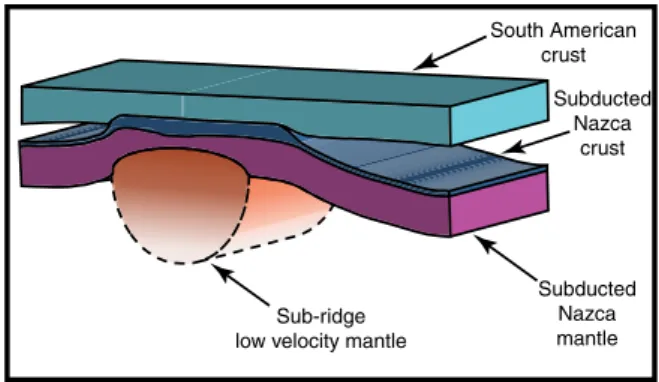
We have used CCP receiver function analysis and prior geophysical studies to constrain the depth to both the South American plate’s continental Moho and the Nazca plate’s subducted oceanic Moho in the southern segment of the Peruvian flat slab. The schematic plate-scale 3D model for the region in Figure 7 shows what we find to be the key features of the southern segment of the Peruvian flat slab. In this trench-parallel view, the subducted oceanic Moho of the Nazca slab is very close to the base of the continental crust, leaving very little room for continental mantle lithosphere between the two. Specifically, the oceanic Moho is separated from the overriding continental crust by less than 40 km, and locally less than 20 km. Given the 17–20 km thickness of the Nazca Ridge’s crust, less than 3 km of mantle lithosphere may locally separate the subducted Nazca Ridge and the base of the overriding continental crust. The thickness of the continental crust varies significantly over the subducted
South American crust
Sub-ridge low velocity mantle
Subducted Nazca
crust
Subducted Nazca mantle
Figure 7. Schematic 3D model of the Nazca Ridge’s subduction in central
Peru. This is a trench-parallel view based primarily on cross section 2–2′ in