
COMPETING IDENTITIES THE CONSTRUCTION OF NATIONAL IDENTITY IN THE REPUBLIC OF MOLDOVA
Valentin Florin Ion
“A dissertation submitted to the faculty of the University of North Carolina at Chapel Hill in partial fulfillment of the requirements for the degree of Master of Arts in the Department of Russian and East European Studies.”
Chapel Hill 2013
Approved by:
Robert M. Jenkins
Graeme Robertson
iii Abstract
VALENTIN FLORIN ION: Competing Identities The Construction of National Identity in the Borderland Moldova
(Under the direction of Robert M. Jenkins)
This paper discusses the competing processes for national identity
construction in the Republic of Moldova between a Moldovan national identity and a
Romanian national identity. The paper follows three main theories of national identity
construction coined by Keith Darden, David Laitin and Rogers Brubaker and surveys
the implementation of mass schooling in interwar Romania, the shift in national
identity of Moldova during the Soviet Union and the process of national identity
building in independent Moldova. I argue that the group who controls institutions also
controls the future identity of the country. The education system is the main creator of
national identity and after the collapse of the Soviet Union the Moldovan education
system was controlled by the pro-Romanian identity groups. I conclude that the
number of Moldovans who self-identify with Romanian language has increased
significantly in the last two decades.
iv
Acknowledgement
I would like to thank my advisor Robert M. Jenkins for guidance and patience
in the process of writing this paper. He supported me throughout both academic years
of a growth process at the UNC Chapel Hill.
I would like to also thank Graeme Robertson for his encouragements and
challenging courses, and to Peter Sherwood, who helped me to be more aware of the
historical and linguistic sensitivities of the European continent. Also I would like to
thank Jacqueline Olich and Donald Raleigh for their invaluable feedback.
I am grateful for the support from my family and friends. The hospitability
and help of my Bessarabian friends made the process of researching and
v
TABLE OF CONTENTS
1. INTRODUCTION ... 1
2. TERMS AND DEFINITIONS ... 6
2.1IDENTITY ... 6
2.2ETHNICITY AND NATIONALITY ... 7
2.3THE STATE ... 8
2.4ETHNIC IDENTITY IN THE REPUBLIC OF MOLDOVA ... 12
3. THEORIES OF IDENTITY FORMATION. APPLICATIONS TO MOLDOVA ... 20
3.1MASS SCHOOLING ... 23
3.2IDENTITY SHIFT ... 28
3.3INSTITUTIONALIZED NATIONALISM ... 33
4. “NATIONAL” REVIVALS ... 36
4.1IMPLEMENTING IDENTITY IN THE NEWLY ESTABLISHED SOVIET MOLDOVA ... 38
4.2POST-STALIN REFORMS AND THE RISE OF NATIONALISM ... 42
4.3NATIONALISM AND THE STRUGGLE FOR POLITICAL POWER DURING PERESTROIKA . 43 5. THE PROCESS OF NATIONAL IDENTITY BUILDING ... 47
5.1POLITICAL PARTIES AND NATIONAL IDENTITY ... 48
5.2EDUCATION SYSTEM ... 56
5.3STREET PRESSURE ... 60
6. CONCLUSION ... 65
ii List of Tables:
Table 1: Examples of Moldovan neologisms in 1929 17
Table 2: Changes in the definition of Moldovan language 18
Table 3: The percentage of enrolled students in Bessarabia 25
Table 4: Classification of political parties based on national identity 52
Table 5: Elections results based on identity type 54
Table 6: Ministers of Education 62
iii
List of Illustrations
1. Introduction
“Lord! Paralyze the hand that wrote these Journals! Only, have mercy, forgive me,
maybe this hand will redeem something.”1 So Andrei Lupan confessed in 1992
during his last public appearance referring to his own personal journals from the
1950s and 1960s. He was born in 1912, in Orhei, at that time part of the Tsarist
province of Bessarabia in a family of Moldovan peasants. Lupan was schooled under
the Romanian education system and published his first poem in 1932. Although he
was taught that he was Romanian and spoke Romanian, he enrolled in the Romanian
Communist Party, choosing to adopt an internationalist and class self-identification
and not a national one. Even more, during the Second World War he worked for
Radio Moscow’s Romanian language department and supported the Soviet war efforts
against Romania. After the war, Lupan returned to Chisinau, the capital of the
Socialist Soviet Republic of Moldova, where he became the President of the Writers’
Union. He was still a self-identified communist, but the Soviet Union’s internal
structure named him a Moldovan who spoke Moldovan langauge. Lupan continued to
speak Moldovan until 1989 when he, as one of the deputies of the Moldovan Supreme
Soviet, asked for Moldovan with Latin scrypt and, in 1992, during his 80th
anniversary he openly named his people and their language “Romanian.”
1 In original “Usucă, Doamne, mâna care le-a scris! Numai, mai îndură-te, mai iartă-mă, poate cu
această mână voi mai putea îndrepta ceva.” http://www.andreilupan.com/loaditem.do?id=399500010
2
Who was Andrei Lupan and what was his first language?2 Was he Moldovan,
Romanian, Soviet, Communist? Did he speak Romanian or Moldovan? Maybe, was
he all at the same time? During his lifetime Lupan experienced several national ideas.
In interwar Romania he was first Romanian, speaking Romanian and then he became
communist, identifying himself in terms of class and not nationality. After the war he
became Soviet but he kept speaking the same language even though he named it
Moldovan. In 1990s, he renamed his first language Romanian and considered himself
as being part of the Romanian people. Not every Moldovan shifted from a Romanian
identity to a Communist, a Soviet, a Moldovan and then back to a Romanian identity.
But Moldova3 went through at least three processes of national identity construction.
In this paper I discuss the processes of national identity construction in Moldova.
I study the territory of today’s Moldova, situated between the rivers Prut and Dniester.
Still, the paper addresses the case of interwar Transnistria but only to offer a
comprehensive image of Moldova. I am interested in how national identity was
constructed in the last century but especially since late 1980s. I argue that the group
which controls the institutions that create national identity also controls the future
identity of the country. I consider the education system the main institution that
creates national identity. I argue that a small pro-Romanian identity group emerged
during the Soviet Union. In the early 1990s, the same group managed to control the
2 I use the term “first language” to describe what conventionally it is called “native language” or
“mother tongue.” I do not use the term “mother tongue” because I am interested in the standardized language used by the centralized system of education and not in the variants of language taught orally in each family. Therefore, I think “native language” is a more appropriate term.
3
3
political institutions and the education system. The consequences of their policies
resulted in the creation of new generations of Moldovans with a Romanian identity.
After the pro-Romanian identity political parties lost the 1994 parliamentary
elections, any change of the curriculum in the education system was blocked through
street protests. The name of the language and the popularity of the political parties are
the two indicators of national identity on which I will focus. It can be noticed that
after two decades of independence it can be noticed an increased in the percentage of
Moldovans who name their language Romanian and a significant increase in the votes
received by the pro-Romanian identity political parties.
I argue that mass schooling was implemented during interwar Romania when the
name of the official language, Romanian, was institutionally unchallenged. During the
same period of time a different national identity was created in Transnistria, then a
part of the Ukrainian Socialist Soviet Republic under the name of Autonomous
Moldavian Soviet Socialist Republic. In Transnistria was institutionalized for the first
time the glottonym Moldovan language and Moldovan national identity. After the
WWII the glottonym Moldovan was extended to most of the territory the Soviet
Union incorporated from Romania.
Starting with 1944 Moldova experienced a shift from a Romanian national
identity to a Soviet identity based on class. Even though the main indicator of the
Soviet identity was class origin, language and national identity existed as secondary
indicators of the Soviet identity. The main language of the Soviet identity was
Russian and, as a consequence, there were implemented policies of Russification. For
Moldovans, Soviet identity meant also a shift in the form and name of their language.
4
from Romanian to Moldovan and promoted as similar but distinct languages. Russian
language and the terms Moldovan language and Moldovan nationality were
institutionalized in administration and the education system at the same time and
remained closely connected to the Soviet identity.
As I show in this paper, from late 1940s the Soviet power did not trust the
Moldovans born on the right side of Dniester and the political power and the
economic resources were controlled by the Moldovans from the left side of Dniester
(Transnistria) or by Russians.4 The main institutions controlled by the Moldovans
from the right side of Dniester were the Writers’ Union and the Polytechnic Institute.
Members of these institutions would continuously show opposition to political power
and challenge the Soviet identity.
Finally, I discuss the competition between the main political parties in post-Soviet
Moldova and the role played by national identity in their leaders’ rhetoric. I argue that
it is not an ethnic distinction between the Moldovan and the Romanian identities but it
is more a political competition for the glottonyms and ethnonyms “Moldovan” –
“Romanian.” In the late 1980s, Gorbachev created the institutional framework which
allowed competition for the Soviet Union’s political establishment and the intellectual
elites offered an alternative to the Communist Party, which was the representative of
the central power in Moldova. Organized under the umbrella of the Popular Front, the
intellectuals questioned the legitimacy of the Soviet identity and proposed in
exchange a Romanian national identity. Initially, the Popular Front gained political
control of the country and, therefore, control over the education system. The members
4 I use the term Russians to refer to the Soviet citizens who settled in the territory of the Soviet
5
of the Popular Front introduced in Moldovan schools the courses “Romanian
language and literature” and “History of Romanians,” allowed local Moldovans to
control the schools and cultural institutions, and tightened cultural relations with
Romania. As a consequence, the Popular Front managed to lay foundations to
generate Romanian identity instead of Moldovan. The Popular Front lost political
control over the education system in 1994 after the first post-Soviet elections but the
supporters of the Popular Front and especially high school and college students
continued to challenge major changes to the education system through street protest.
At the end of the paper I show that even though the majority of Moldovans name
their language Moldovan the percentage is smaller in the case of the young
generations educated after the collapse of the Soviet Union and especially among
Moldovans with high levels of education. The percentage of the Moldovans who
name their native language Romanian in the case of these two social groups is higher
than the national average. I interpret these numbers as a result of the Popular Front’s
reforms in the field of education.
In conclusion, I argue that national identity is a continuous process based on
political preferences and generated mostly by the education system. In the case of
Moldova the Romanian national identity created in the interwar period shifted to a
Soviet class identity with a regional institutionalized Moldovan identity. Political
opportunities created at the end of the Soviet era allowed the opposition groups to
legitimize themselves and to challenge the central government using Romanian
identity. The self-identified Romanian part of the Moldovan society managed to
institutionalize Romanian identity in the education system and, as a source of their
6
increase percentage of the Moldovans who have a self-identified Romanian national
identity.
2. Terms and definitions 2.1 Identity
The national-state is the latest political entity political communities have
created. A national-state is a modern construction. It is first imagined by intellectuals
and then assumed and adapted by political elites and imposed over a controlled
territory for a stronger cohesion and a deeper loyalty to the political center.
Intellectuals are the initiators of the national idea and they imagine the nation based
on a preexisting identity of an ethnic group.
Just like a national-state, individuals’ identities are also a construction based
on “race, gender, class, job, religious affiliation, national origin” (Tilly 1996: 7).
Charles Tilly defines identity as “an actor’s experience of a category, tie, role,
network, group or organization, coupled with a public representation of that
experience; the public representation often takes the form of a shared story, a
narrative” (Tilly 1996: 7).
In this paper, the term identity should be “understood as a specifically
collective phenomenon” and “as a ground or basis of social or political action”
(Brubaker and Cooper 2000: 7). In Identity in Formation, David Laitin talks about
“personal identities” as opposed to “constructed social identities.” He sees personal
identities as inalienable identities and “a person who is x today will surely be x
tomorrow” (Laitin 1998: 14). Therefore, in the following paragraphs, identity does not
have a broad meaning but a narrower one. I am not referring to any kind of collective
7
people, who share one or more common characteristics or interests, but more to those
social movements that are connected to nationalism or ethnicity as explained below.
2.2 Ethnicity and Nationality
In spite of the fact that the terms ethnicity and nationality are used
interchangeably outside the academic world, many scholars differentiate them.
Anthony D. Smith considers ethnicity as “a precursor and foundation of the nation”
(Sutherland 2012: 28). Others, such as Craig Calhoun, think that “while it is
impossible to dissociate nationalism entirely from ethnicity, it is equally impossible to
explain it simply as a continuation of ethnicity or a simple reflection of common
history or language” (Calhoun 1993: 211). He adds that nationalism “remains the
pre-eminent rhetoric for attempts to demarcate political communities, claim rights of
self-determination and legitimate rule by reference to the people of a country” (Calhoun
1993: 211). He also thinks that “ethnic solidarities and identities are claimed most
often where groups do not seek national autonomy but rather a recognition internal to
or cross-cutting national or state boundaries” (Calhoun 1993: 211).
I think that ethnicity and nationality share the same characteristics. Both
terms define a group of people, who most of the time have the same or similar
language, religion, historical background, myths and symbols. But while ethnicity is
based on what Herder described as folklore, nationality is the politically
institutionalized form of ethnicity. Nationality is uniformly spread throughout the
entire territory controlled by political institutions. The language is standardized,
myths and symbols are rethought and the role of volk (the people) in creating new
8
I look at national identity as a constructed phenomenon with some elements
that survive throughout time but an identity that changes based on political
opportunities. Keith A. Darden believes that national identity is a durable construction
(Darden 2013). Darden argues that nation is a modern concept and that nation-states
initially used the centralized education system to build the nation and then to
perpetuate its loyalty to the central government. He adds that after being literate, a
community will keep its loyalty for generations despite change of the political
authority. A similar approach is held by Mark Beissinger, who considers that
individuals build strong identities and only what seems durable national attachment
changes (Beissinger 2002). Other scholars such as Rogers Brubaker and David Laitin
think that national identity is changing when social opportunities change (Brubaker
1996; Laitin 1998). They argue that individuals do not have a deep national identity
and one’s identity can be easily constructed and experiences alteration.
2.3 The state
Any modern state utilizes principles which legitimize its existence. Many
modern European countries use the right of national self-determination in order to
build the identity of their main ethnic group. Other nations such as the United States
legitimize their existence based on civic rights. Another type of legitimization has
been used by communist countries that considered themselves representatives of the
working class.
Initially, the term nation represented “a group of men belonging together by
similarity of birth” (Kedourie 1961: 13), which in modern terms means a social group
9
or personal skills. In the early modern age, the children of barons, prelates, and nobles
were expected to become barons, prelates, and nobles with little possibilities to
change their social group. From the French Revolution, E. J. Sieyes defines a nation
as “a body of associates living under one common law and represented by the same
legislature” (Kedourie 1961: 15). He and most of the French revolutionaries did not
see nation in terms of language and culture but more on principles of citizenship. One
of the French revolutionaries’ demands was equality among all nationalities, which
did not imply equal rights following ethnic criteria but civic ones.
According to Lipset, the United States was the first country promoting civil
and political general rights for its citizens.5 America “was not only a new nation, it
was a new society, much less bound to the customs and values of the past than any
nation of Europe” (Lipset 1963: 94). Because the new Americans did not have strong
roots on American soil and because of the lack of common religion, culture and
myths, they legitimized their political entity by different principles. The USA could
not build national unity based on ethnicity and instead relied mainly on civic rights.
Lipset argues that American “national identity was formed under the aegis, first of a
charismatic authority figure, and later under the leadership of a dominant “left wing”
or revolutionary party led successively by three Founding Fathers” (Lipset 1963: 90).
The national idea was later developed by the German Enlightenment
philosophy. The state was not expected to serve only a few social groups but all those
who shared the same language, traditions, and myths. The German type of
nationalism prevailed in Europe and a nation went from defining a social group to
5
10
representing an ethnic group. Eric Hobsbawn pointed out that “nations do not make
states and nationalism but the other way around” (Hobsbawn 1990: 10). National
ideology was adopted by intellectuals to make political demands and by political
elites to create national unity.
Scholars like Kohn divided Europe between a civic West and an ethnic East
(Kohn 1955) or between a nationalizing East and a civic West as Brubaker argued
later (Brubaker 1996). Tilly underlines that “almost all European governments
eventually took steps which homogenized their populations” (Tilly 1975: 43). Kuzio
argues that “all civic states are composed of both civic and ethnic factors and the
proportional relationship between them depends upon how much progress there has
been in democratization” (Kuzio 2001: 135). Following Tilly and Kuzio’s ideas, I
also think that both East and West are applying civic policies by offering individual
or collective rights to ethnic minorities, and, at the same time, have nationalizing
tendencies by promoting characteristics, like language and religious holidays, of the
dominant ethnic identity at a national level.
Another modern type of state building was influenced by Marxist theories.
Countries, which embraced communist ideology, promoted a state based on class
rights. In theory, communist ideology considers national states as the last stage of
human development before communism. Initially a communist state was supposed to
appeal to workers’ class consciousness regardless of their ethnic identity. Taking into
consideration that Soviet Union was overwhelmingly a rural country, peasants were
the second category represented by the state. The first article of the 1936 USSR
11
of workers and peasants.” Therefore, intellectuals and other social groups who were
considered an “enemy of the people” did not officially constitute the Soviet state.
Later, the 1977 Soviet constitution declared that the Soviet Union was “the expression
of the will and interests of the workers, peasants, and intelligentsia” the later accepted
to represent a third social group. The Soviet Union tied its legitimacy to representing
workers, peasants and intelligentsia. Even though the origins of the Soviet state were
not connected to the ethnic groups of the union, the national question played an
important role for the entire existence of the state.
Expanding on Tilly and Kuzo’s theories, one can observe that Soviet Union
was not only a class-state but also a nationalizing-state. Officially, in its 15 republics
the Union promoted the cultural traits of the titular ethnic group but unofficially the
republics were exposed to a continuous process of Russification. Andropov
mentioned in January 1983, “the party’s goal was in Lenin’s words, not only the
drawing together of nations but their merger” (Solchanyk 1985: 315). The merging
process was obvious from both cultural and politico-administrative perspectives.
Russian was the inter-ethnic communication language as well as the language used in
bureaucratic activities. Plus, ethnic Russians were over-represented in state and party
structures in most of the republics. Therefore, the Soviet Union was a state based on
12 2.4 Ethnic identity in the Republic of Moldova
This section addresses the question of ethnic identity in Moldova. What
makes someone Moldovan or Romanian6 or what if anything is the difference
between a Moldovan speaker and a Romanian speaker is the question that I will try to
answer in this chapter. I argue that the national identity indicators such as the
historical background, cultural traditions, myths and symbols, religion and language
of both groups living in Moldova are identical.
In the paper Ethnic Identification in a Complex Civilization: Who are the
Lue?, Michael Moerman tried to identify the criteria by which the Lue (the Northern
Thai whose capital was Chiengrung) portray themselves as a distinct group in the
region. He argues that “language, culture, political organization, etc., do not correlate
completely, the units delimited by one criterion do not coincide with the units
delimited by another” (Moerman 1965: 1215) and, therefore, “someone is a Lue by
virtue of believing and calling himself Lue and of acting in ways that validate his
Lueness” (Moerman 1965: 1222). I have encountered the same problem trying to
distinguish between those of Moldova’s citizens who identify themselves as being
Moldovans and those as being Romanians. I argue that objectively Moldovans and
Romanians have the same historical background, cultural traditions, myths and
symbols, religion and language. Following Moerman I think that someone is
Moldovan or Romanian only by virtue of believing and calling himself
Moldovan/Romanian and of acting in ways that validates his
Moldovanness/Romanianness.
Both groups share the same historical background and identical cultural
6
13
traditions in Moldova. Moldovans or Romanians do not inhabit their present-day areas
as a result of group migration since they are not homogeneous geographically
compact groups7 nor as a consequence of individual migration. Moldova does not
have regions ethnically compact with Romanians or Moldovans. Also, in the last two
centuries the territory on which I am focusing has never been divided between two or
more political centers. From North to South and West to East people celebrate the
same holidays, eat the same type of food and have the same rituals. At the same time
geography of the country and country’s natural resources are spread uniformly across
the country and, therefore, the country’s regions are not characterized by different
economies. Even nowadays, except for Chisinau, there is no difference between the
level of industrialization in the country. Thus, historical background and cultural
traditions do not play any significant role in the ethnic self-identification of the
Moldovans and Romanians of Moldova.
Another indicator of the similarities between Moldovan and Romanian
identities to be discussed here is related to their national myths and symbols to which
both communities show strong attachment. Stephen the Great (Ştefan cel Mare, 1457
– 1504), the most emblematic historical figure in Moldova, is accepted by both
communities in Moldova. Moldova’s national flag is a vertical tricolor of blue, yellow
and red and with a coat of arms on the yellow bar.8 The same colors and format are
used by the Romanian flag excluding the coat of arms. Even though the Romanian
flag does not have the same, the Moldovan coat of arms is also part of the official
7
Based on political preference one can observe that the pro-Romanian identity parties gain most of their support from the center of the country while pro Moldovan identity parties find their support predominantly from the North and the South of the country.
14
iconography of Romania alongside the coat of arms of other historical provinces of
Romania. A last shared symbol by Moldova and Romania is the word leu (lion) which
is used to name the currency.
The national anthem is another symbol that is shared by Moldova and
Romania. When Moldova proclaimed its independence from the Soviet Union the
first national anthem adopted was “Wake up, Romanian!” (Deştapte-te, române!)
which was replaced in 1994 with „Our Language” (Limba noastră). Both songs have
roots in the collective memory of Romanians and Moldovans. The song “Wake up,
Romanian!” was used for the first time as a national anthem by the Democratic
Republic of Moldova between December 1917 and March 1918 and has been
Romania’s official anthem since 1990. “Our language” was written by Alexei
Mateevici, an early twentieth century Moldovan poet from the Tsarist province of
Bessarabia. He was a promoter of Romanian identity in Bessarabia in the early
twentieth century. Thus, the national anthem is also a symbol accepted by both
identities, Moldovan and Romanian.
Religion is a criterion that often divides societies. In Moldova, Moldovans
and Romanians are overwhelmingly Christian Eastern Orthodox.9 In principle
Moldovan and Romanian groups are represented by their own religious institution.
The Orthodox community is divided between the Metropolitanate of Chisinau and all
Moldova, which is subordinate to the Russian Patriarchate, and the Metropolitanate of
Bessarabia, which is subordinate to the Romanian Patriarchate. In practice, people do
not follow these criteria mostly due to the lack of differentiation between the two
9
According to the 2004 census 93.3 percent of the population of Moldova is Christian Orthodox.
15
denominations. In Moldova, both churches celebrate religious ceremonies and rituals
at the same times and in the same ways, and church and religious symbols look
identical.
Still, there is a difference between Romanian Orthodox Church (RoC) and
Russian Orthodox Church (RuC). RoC celebrates Christmas following the New Style
(December 25th), while RuC follows the Old Style (January 7th). But the
Metropolitanate of Bessarabia was reactivate by the RoC as an Old Style Church
which allows the Metropolitanate of Bessarabia to celebrate Christmas and other
religious holidays following the old style. Therefore, there is no difference in
religious practices between the Metropolitanate of Chisinau and all Moldova and the
Metropolitanate of Bessarabia. Similarities between the two institutions are so close
that a church can switch from a religious authority to another without changing
anything in its religious practices.10 Hence, religion plays a very small role in ethnic
self-identification.
The most important differentiation between Moldovans and Romanians is
made by the word they choose to name their native language. From a linguistic point
of view there is no difference between Moldovan language and Romanian language
(Gutu 2011). Charles King argues that the difference between Moldovan language and
Romanian language consists on the alphabet in which the language is written. If the
Latin alphabet is used then the language is Romanian but if the Cyrillic alphabet is
used then the language is Moldovan (King 2000: XIX).King gives another example
10
In early 2005 an important group of priests left Metropolis of Chisinau and all Moldova (MCM) and joined Metropolis of Bessarabia (MB) as a disapproval of the MCM decision to name Priest Petru Bishop of the newly established Bishoprics of Ungheni and Nisporeni. Eventually they returned back to MCM. For more details visit
16
about how Moldovan differs from Romanian. He argues that Moldovans use the letter
“î” to write the vowel sound of [ə] while the Romanians use “â.” For example,
Moldovans write the word dog “cîine” while Romanians write it ”câine.” But the
letter “î” is widely used also in Romania. During Communist Romania only the letter
“î” was used in all situations with an exception: the words Romania and Romanian
language were written with the letter “â.” In 1993, Romanian Academy considered the
letter “î” as being too Slavic and, therefore, Communist and replaced it with “â.” This
change could not be done in the Republic of Moldova because the pro-Romanian
majority of the parliament was replaced after the February 1994 elections. In Romania,
people who graduated before or immediately after 1993 still write using “î” instead of
“â” and even the new generations who went to school after 1993 consistently use both
letters. The changes made in 1993 affected only the cases when “î” is inside the word
and not when it is the first or the last letter of the word or the proper nouns. Thus,
“cîine” was replaced with “câine” but other words as “înger”, “împărat”, “a coborî”,
etc., are still correctly written using the letter “î” and not “â”. In 2010 the Philology
Institute of the Moldovan Academy of Science accepted the same type of linguistic
reform as the Romanian Academy did in 1993 (Podoleanu 2012). In order to became
compulsory this reform has to be approved by the Moldovan Government. Up to this
moment, the Government did not express its opinion on this issue.
In Constantin Tănase’s view, Romanian is the written language while
Moldovan is the language spoken by illiterate or semi-illiterate people (Tănase 2012).
Even though both theories make a very good point there is little evidence of two
distinct languages. A language called Moldovan and distinct from Romanian was for
17
1932 in the Autonomous Socialist Soviet Republic of Moldova (RASSM) which at
that time was part of Soviet Ukraine. The language was created by the
Moldovenization and Ukrainization Commission beginning in 1925 and was part of
an extended Soviet policy of indigenization of Soviet peoples. The purpose of the
Commission was to create a language distinct from Romanian but based on the dialect
of the peasants from central Moldova (King 2000: 64-70). Linguists such as Leonid
Madan tried to create the language using words that resonate more with the Slavic
languages, combining two or more existing words to create new meanings or just
borrowing from Russian and Ukrainian. In 1927, 12 study groups existed on the
territory of the RASSM trying to teach the Moldovan peasants the newly standardized
language (Gribincea, Gribincea and Siscanu 2004: 7). That language is not the same
as what is today called the Moldovan language.
Table 1: Examples of Moldovan neologisms in 1929
English Standard Romanian Russian Moldovan
self-determination autoadministrare samoupravlenie sîngurcîrmuiri contemporary contemporan sovremennyi amuvremnic
necktie cravată galstuk galstuh
chronicle cronică letopis’ anoscriiri
dictionary dicţionar slovar’ slovari
English englezesc angliiskii anglicesc
February februarie fevral’ făurari
January ianuarie ianvar’ jerariul
monotonous monoton odnoobraznyi unofelnic
custom obicei obikhod zîlnictreburi
like-mindedness unitate de idei edinomyslie unogîndiri Source: King 2000: 69
In 1932, the process of Moldovanization was stopped and reversed towards a
18
which made Moldovan “wholly Romanian” (King 2000: 84). The Latinization lasted
until 1938 when all the cultural elites were purged and a young linguist Ivan
Dmitrievici Ciobanu “served as the chief exponent of the return to the Cyrillic
alphabet” (King 2000: 85). After the Second World War, the main difference between
Romanian literary language and Moldovan literary language was the script and after
the 1989 Language Law, which reintroduced the Latin script, Moldovan became de
facto Romanian. Because there is no written difference between the two languages,
quite often the expressions “our language” (limba noastră) or “state language” (limba
de stat) are used to refer to the language spoken by Moldovans to please both sides.
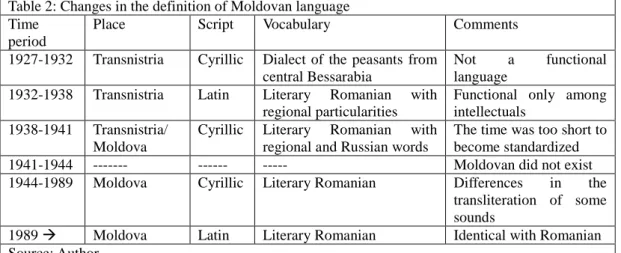
The definition of Moldovan identity/language changed throughout time but always
implied distinctiveness of Romanian identity/language. Table 2 shows the main time
periods when Moldovan language was recreated.
Table 2: Changes in the definition of Moldovan language Time
period
Place Script Vocabulary Comments
1927-1932 Transnistria Cyrillic Dialect of the peasants from central Bessarabia
Not a functional language
1932-1938 Transnistria Latin Literary Romanian with regional particularities
Functional only among intellectuals
1938-1941 Transnistria/ Moldova
Cyrillic Literary Romanian with regional and Russian words
The time was too short to become standardized
1941-1944 --- --- --- Moldovan did not exist
1944-1989 Moldova Cyrillic Literary Romanian Differences in the transliteration of some sounds
1989 Moldova Latin Literary Romanian Identical with Romanian Source: Author
Romanians in Moldova do not reject Moldovan identity but they consider it
regional, while Moldovans reject Romanian identity and consider the Moldovan
identity as a national identity and Moldovan as a distinct ethnicity. What makes
19
Moldovan speaker and a Romanian speaker is a matter of self-identification. At a
rhetorical level there is a Moldovan identity distinct from a Romanian one.
Therefore, someone is a Moldovan or Romanian by virtue of believing and calling
himself Moldovan or Romanian.
In this chapter I have tried to discuss the main indicators of Moldovan
national identity. I argued that the institutionalized indicators of identity such as the
historical background, myths, symbols, religion and language are the same between
Moldovan and Romanian groups. Throughout the paper I argue that Moldovan and
Romanian are not a matter of objectiveness but a subjective self-identification.
Someone can have a Moldovan regional identity and a Romanian national identity.
From a generational approach, in a family the parents might think they speak
Moldovan while their children can call it Romanian. There is no major
distinctiveness between Romanian and Moldovan which allows me to approach the
following chapters looking at the competition between cultural and political elites
and the institutions they control. The process of national identity building in Moldova
20
3. Theories of identity formation. Applications to Moldova
As I mentioned in the previous chapter, in Moldova a Moldovan/Romanian
ethnic identity can be found but a contested national identity divided between the
Moldovan and Romanian identities. In this chapter I argue that the first generation of
Moldovans that experienced mass schooling was in interwar Romania. I think that the
identity of the region shifted after the WWII from Romanian to Moldovan identity but
parts of the generation educated in the interwar period kept a Romanian consciousness.
Finally, I consider the state’s institutions the main creator of national identity.
I see the centralized education system as the main creator of national identity
and I think that someone’s chances to build deep national loyalties increases based on
the number of received years of schooling. Even though the first generation that
experienced mass schooling in Moldova was educated in a pro Romanian identity
environment, in the first decade after the Second World War Moldova shifted to a
Moldovan national identity. The loss of Romanian consciousness of the region was
due to the retreat of most of the civil servants, teachers and priests to Romania,
because of deportations to Siberia and Central Asia, and because of self-imposed
censorship, which stopped the transmission of national identity through oral history.
I argue that in the 1960s the generation educated in interwar Romania, which
at that time represented the age segment between 30 and 40 years old, managed to
influence some institutions like the Writer’s Union and the Polytechnic Institute. The
same generation challenged the political power in the 1980s and created the basis of
modern Moldova. But not every individual self-identifies in national terms. Some of
the intellectuals who remained in Chisinau after 1944 did not have a national identity
21
Moldovan and replacing the Latin script with Cyrillic script.
The shift in Moldova’s identity was possible because of the institutional
structure of the Soviet Union and due to the changes these institutions encountered.
The administrative structure of the Soviet Union in 15 national republics, the
Russification of the educational system and Gorbachev’s reforms which allowed the
creation of opposition groups and the challenge to political power are just a few of the
changes in the institutional structure that influenced the process of national identity
building in Moldova. Also the territorial structure of Moldova led to a division
between Moldovans and Transnistrians. Transnistrians and Russians11 controlled the
political and economic life of Moldova while the Moldovans influenced the cultural
life.
To understand better how Moldovan and Romanian identities emerged and
who supports them I will try to analyze three theories of national identity offered by
Keith A. Darden, David D. Laitin and Rogers Brubaker. Darden talks about the
origins of national identity and how national loyalties were initially formed. He
considers that national identity is created through mass schooling of the first literate
generation (Darden 2013: 10). He adds that once the literacy level of a generation
passes a 50 percent threshold then the entire community will have durable national
loyalties (Darden 2013: 56). Laitin argues that national identity is temporary and can
be changed through “nationalist policies” based on “national revival” and
“assimilation.” He thinks that national identity can be reversed during the same
generation if the economic opportunities and political trends change (Laitin 1998: 14).
Following the same line, Brubaker thinks that national identity is temporary and can
22
be changed depending on the political and institutional structure of a territory
(Brubaker 1996: 23).
I consider the above theories very helpful in my initiative to interpret the
national identity of Moldova and all three of them should be taken into consideration
to explain the entire picture of the Moldovan national identity process. Darden talks
about how national identity was formed but he thinks that once formed, the fidelity
towards a certain identity does not change. This theory is very helpful in
understanding the origins of national identity in Moldova and especially the national
revival of the late 1980s.
Laitin’s theory is a very good tool in explaining the shift of national identity
among individuals and understanding the reasons which lead to the replacement of
Romanian identity with Moldovan identity. But Laitin is not interested in who or what
makes these changes. He looks for patterns that show changing trends in national
identity and he is interested “to understand the dynamics of identity shift and the
implications for the kinds of states they will be living in, and for the degree of conflict
they are likely to experience in their relations with the titular population” (Laitin 1998:
32). Based on statistical data Laitin shows how a generation creates an extra layer to
its identity because of economic opportunities and political coercion. At the same time,
Laitin focuses on the post-Soviet era and the dynamics of identity created by the
collapse of the Soviet Union.
On the other hand, Brubaker has a general approach looking at the role of
institutions in the legacy of the Soviet Union. He argues that national identity was
“institutionalized in the Soviet Union – territorial and political on the one hand,
23
explains the relationship between Moldovan and Romanian identities before and after
the independence of Moldova. Just like during the Soviet Union era, Moldova’s
institution played a major role in the creation of national identity in the independent
Moldova.
3.1 Mass schooling
In late 19th century mass schooling was extending rapidly throughout Europe.
School played an important role in creating trained citizens for the modern state.
Through school the state also found an opportunity to form citizens devoted to the
idea of national state. Darden argues that “the national loyalties instilled in a
population during the introduction of mass schooling – when a community shifts from
an oral to a literate mass culture” (Darden 2013: 10) - are durable and last for long
periods of time. He adds that these loyalties are passed from generation to generation
through oral stories. National loyalty “is passed primarily in the family” (Darden 2013:
41) and can be kept in the community regardless of the official school curriculum. In
his study, the author also sets a 50 percent literacy threshold that a community has to
pass in order to develop deep national loyalties (Darden 2013: 56).
Darden thinks that mass schooling plays a fundamental role in building
national identity and that the process is influenced by the country which controls the
education system. But it was not an easy task to pass the national identity from
generation to generation in Soviet society. During the Soviet time the older generation
could not express freely their national belief to the younger ones. Soviet citizens had
doubled their speech having one version in public spaces and a different one at home
24
interpretation of the society. To avoid being accused of “nationalist views” and
deported or, in earlier times, executed, the Soviet citizens rather internalized their
national identity and missed the opportunity to pass further what they were initially
taught about their national identity.
Even though Darden focuses on two regions from Ukraine, he also mentions
the school system in Bessarabia and concludes that the literacy rate merely reached 38
percent of the entire population when the territory was incorporated into the Soviet
Union (Darden 2013: 228-229). Therefore, he thinks that Bessarabia “experienced
mass schooling for the first time under USSR after the Second World War” (Darden
2013: 228-229). I think that mass schooling was implemented in Bessarabia in
interwar Romania and the generation educated between 1920 and 1940 reached a
level of literacy of 80 percent.
The 38 percent literacy level is the number recorded by the 1930 Romanian
census for all age groups and not for only one generation. By the beginning of the
Second World War the level of literacy for the entire population of Bessarabia reached
55 percent and had increased during the war (Scurtu 2012). Darden argues that only
50 percent of a generation should be literate in order to influence the entire
community but in the case of Moldova he uses the percentage that applies to the entire
number of population which covers several generations and not only one.
I define a generation as a group of people who were born in the same period
of time between one age range in a family or society and the next one. For the first
half of the 20th century in what was known at that time Bessarabia a generation
covered a period of 20 years. In a rural community from Bessarabia a typical woman
25
(Scurtu 2003) and, on average, gave birth to 5.5 – 6.1 children (Ghetau 1997: 11).
Even though the fertility rate was high a woman stopped delivering babies before she
was 35 years old. Therefore, 22 years plus the war period, when nationalist
indoctrination reached its height, covered a little more than a generation and the
Romanian government had enough time to build a Romanian national identity in
Bessarabia.
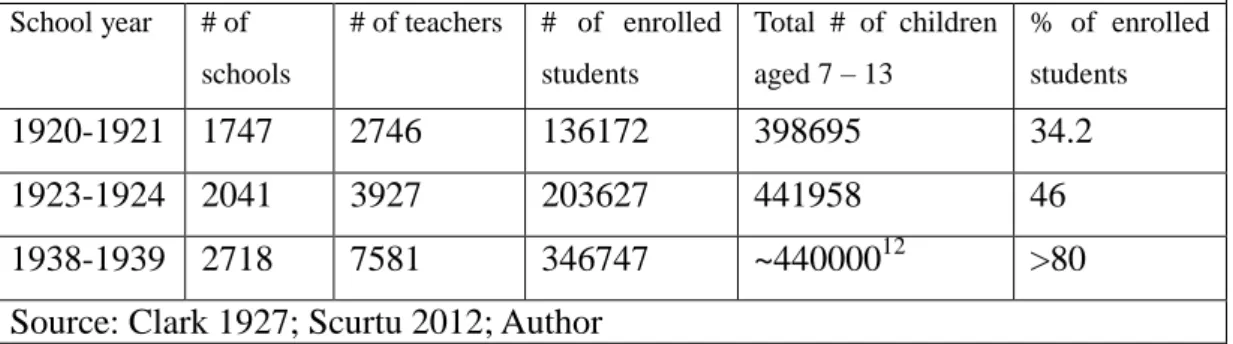
The 1924 Romanian education law mandated seven years of free education
(Scurtu 2001). In 1921, after the first school census, in Bessarabia there were 1,747
schools and 136,172 elementary school students, which represented 34.2 percent of
the entire number of children between the ages 7 and 13. In 1923 the percentage
increased to 46 (Clark 1927; Scurtu 2012) and by the beginning of Second World
War the enrolled students reached around 80 percent of the total number of children.
Table 3: The percentage of enrolled students in the province of Bessarabia
School year # of
schools
# of teachers # of enrolled
students
Total # of children
aged 7 – 13
% of enrolled
students
1920-1921 1747 2746 136172 398695 34.2
1923-1924 2041 3927 203627 441958 46
1938-1939 2718 7581 346747 ~44000012 >80
Source: Clark 1927; Scurtu 2012; Author
I estimate the literacy level of the 1920 – 1940 generation somewhere above
80 percent for several reasons. The percentage of enrolled students reflects how many
children were in school at a certain moment but not all of the enrolled students who
12 Even though the number of births decreased constantly in interwar Bessarabia the number of
26
had finished the seven year elementary school. I think that the number of enrolled
students was higher in the first years of school compared to the last years. Hence, I
consider that the percent of children who reached at least a semi-literate level is
higher than the percentage of enrolled students at a certain moment.
Another reason to consider the generation of 1920 – 1940 having a high level
of literacy is the World Bank data which mentions that the level of literacy in
Moldova in 1989 for people ages 15 and above was 96 percent.13 In 1989, the
population of Moldova was 4,366,000 out of which 3,147,886 were 15 or older.14 The
level of illiteracy is 4 percent which means 125,915 people. The 1920 – 1940
generation represented 881,932 people. Even if we assume that the entire number of
illiterate people was from the 1920 – 1940 generation there is at least a number of
756,017 literate people which represents a level of literacy of 85 percent of their
generation.
A final reason to consider a high level of literacy is that the modernization of
educational system took place in 1920s under the mandate of Constantin Angelescu
who built more than 7000 schools all over Romania.15 Most of the schools were built
between 1922 and 1928 under Angelescu’s second mandate. Therefore, throughout the
1930s Bessarabia already had a comprehensive school infrastructure.
According to the Romanian census of 1930 the population of Bessarabia was
2,864,402 (Scurtu 2012). The difference between the literacy level of 1930 (38
13
http://data.worldbank.org/indicator/SE.ADT.LITR.ZS?order=wbapi_data_value_1989+wbapi_data_val ue&sort=asc&page=4 01.23.2013.
14
http://populationpyramid.net/Republic+of+Moldova/1990/ 03.15.2013
15 Constantin Angelescu was Minister of Education between 1918 – 1919, 1922 – 1928 and 1933 –
27
percent) and the one from 1940 (55 percent) is 17 percent. This percentage means
approximately 487,000 new literate people. On average 48,700 seven grade students
graduated per year for a 10 year period. To verify this number, we can take the
number of students enrolled in 1937 (346,747) and divided by seven (the number of
schooling years) and we will see that the average number of students who graduated
yearly in 1930s is 49,500 students. Therefore, around 495,000 students experienced
school between 1930 and 1940 which increased the percentage of literate people of
the 1920 – 1940 generation to more than 80 percent.
Following Darden’s theory Moldova experienced mass schooling in interwar
Romania, which means that the region should have had by the end of the WWII a
Romanian identity. As I argued above, around 80 percent of the interwar generation
was schooled between 1920 and 1940. In the next subchapter I discuss how starting
with 1949 the Soviet authorities build a different identity in Moldova. I argue that the
Moldovan cultural leaders educated in Romania accepted to change aspects of their
national identity because they were self-identifying in class terms and to join the
advantages offered by the Soviet administration. But this shift in identity mostly
impacted the new generations schooled under the Soviet education system and not the
cohorts educated prior to 1949. An important role in the identity shift was due to the
establishment of Moldova from two territories with different historical background. I
28 3.2 Identity shift
Just like Darden, David Laitin also argues that national identities are
constructed. But while Darden thinks that they are created in early childhood, Laitin
believes they are adopted “according to how well they serve individual purposes and
reconstructed to take advantage of new opportunities” (Laitin 1998: 20). He thinks
that identity changes based on what Thomas Schelling called a “tip” or “cascade.” If
an important number of the members of a society believe that a significant number of
their fellows are going to behave in a certain way, then they are going to change their
behavior in that particular way because they are afraid of losing the new opportunities.
Laitin considers that language plays the most important role in the demands of
nationalist groups. He adds that nationalist projects have two directions in creating a
more homogeneous country. One is the national revival and the second is the process
of assimilation.
The newly created Socialist Soviet Republic of Moldova (SSRM) emerged as
a result of the unification of the territories from both banks of river Dniester. The
territory from the left bank was already incorporated into the Soviet Union and
represented the West part of the Autonomous Socialist Soviet Republic of Moldavia
(ASSRM/Transnistria), while the territory from the right bank of river Dniester
represented most of the former Tsarist gubernia of Bessarabia. The process of shifting
the national identity in Moldova meant the transformation of Romanian identity into a
Moldovan identity. From a linguistic perspective Moldovans kept using Romanian
language adapted to Cyrillic script and renamed Moldovan. At an ideological level
Moldovan language was the successor of the Moldovan language created in late 1920s.
29
on building a certain level of Russification by making Moldovans learn Russian and,
at the same time, creating a Moldovan national identity in opposition to the Romanian
identity. But Moldovan identity was seen differently by the Transnistrians than by
Moldovans.16 Both groups accepted that Romanian identity had been a result of the
bourgeoisie interwar Romania but the Moldovans though that Romanian language
was different than Moldovan due to the alphabets used by the two languages, while
the Transnistrians argued that Moldovan language is a Slavic language and had
nothing in common with Romanian (Meurs 1994: 131).
Since late 1940s, Soviet authorities supported the elites who had a positive
attitude towards the Soviet Union in interwar Romania and during WWII. Laitin calls
it “The Elite – Incorporation Model of State Expansion” (Laitin 1998: 60). Bruchis
argues that “writers, linguists, and literary critics who, in the interwar period, had
written in unadulterated Romanian ... undertook efforts to save their language from
being transformed into a Russian jargon” (Bruchis 1996: 24), which was the language
spoken by the Transnistrians. Further, Bruchis considers that Moscow supported
Moldovan writers in spite of their promotion of Romanian language. He adds that
most of them were in favor of the 1940 incorporation of Bessarabia into the Soviet
Union and, during the war, “their broadcasting on Soviet radio and writing in the
Soviet press” was considered by Moscow as “a contribution to the defeat of Germany”
(Bruchis 1996: 24).
In Moldova, political and military elites retreated with the Romanian army
and only some parts of the intelligentsia remained behind. Most of these writers and
16
30
linguists “received their primary, secondary and higher education (…) in the
Rumanian literary language and up to 1940 composed their works in this language.”17
The intellectuals who remained behind did not necessarily identify themselves in
terms of national identity but more on class terms. Writers such as Andrei Lupan and
Emilian Bucov were communist during interwar Romania and in 1941 fled into Soviet
Union. They did not support Romanian national identity but defended their linguistic
identity and professional belief. These intellectuals supported the Soviet regime
during the war and after and accepted to call the language Moldovan and use Cyrillic
script. Still, they were not willing to alter the language in which they published their
work.
Moldovan intellectuals managed to control the Writer’s Union and to pass
Romanian language from generation to generation even though it was called
Moldovan. Their success was due to several reasons. The first reason was that they
were accepted in the educational system because the Soviet Power wanted to quickly
integrate the new territory. Another reason is suggested by Van Meurs. He thinks that
“Stalin’s interference in the field of linguistics [forced] linguists to rethink the Soviet
theory on the Moldavian language.”18 Third, the Moldovans had a higher level of
education with university degrees, while the left bank Moldovans who survived
Stalin’s purges and the war “had only attended a communist crash course in Tiraspol”
(Meurs 1994: 131). Last, the good relations between Romania and the Soviet Union
after the outbreak of the conflict between Tito and Stalin played an important role in
the success of the right bank intellectuals. These good relations lasted until 1964 when
17 Some writers were natives of other regions of Romania (Bruchis 1982: 79).
18
31
Romania rejected Khrushchev’s plan to divide labor inside the Communist camp.
Until the collapse of the Soviet Union Moscow polices on Chisinau were influenced
by the relations between Romania and the Soviet Union.
Laitin’s theory of “elite – incorporation” explains the apparent shift in
national identity of the Moldovan intellectual elites. The only reason which kept them
from moving even closer to a Transnistrian-Moldovan identity was their incapability
to change what Laitin calls “personal identity.” “A person who is x today will surely
be x tomorrow” (Laitin 1998: 14). But they transmitted to new young generations a
Moldovan identity.
From a cultural point of view the elites from the right bank managed to
overcome those from the left bank, but the political life and the administration was
controlled from the beginning by Transnistrians. Transnistria was already part of the
Soviet Union for almost three decades when Moldova was incorporated into the
Soviet Union. Transnistria already had strong ties with Moscow and reliable and
well-trained political activists and bureaucrats in Soviet political and administrative affairs.
In political life and the administration, Transnistrians controlled the Republic for its
entire existence. Until November 1989 when Petru Lucinschi became the First
Secretary of the Communist Party of SSRM, there had never been a First Secretary
originally from the right bank of Dnister.19 Soviet cadres from Transnistria played a
key role in transforming both SSR Moldova and Romania into communist territories.
In Romania, the top three intelligence officers Gheorghe Pintilie (Pantelei
Bodnarenko), Alexandru Nicolschi (Boris Grünberg) and Vladimir Mazuru (Vladimir
19
32
Mazurov), who reformed and led Romanian internal intelligence agency from its
creation in 1948 until 1963, came to Romania after the war from the Soviet Union.
Mazuru was born in Chisinau in an ethnic Ukrainian family and was educated in
Romania but Pintilie and Nicolschi were both born in Tiraspol and were part of the
Soviet cadres cohort designated to implement communism in SSRM and Socialist
Romania.
While for most of the right bank intellectuals the shift of identity was
superficial, for the rest of Moldovans the shift of identity was much deeper and it
went along with the process of Russification. Learning Russian represented an
opportunity for Moldovans to have access to positions in administration and economy.
Laitin calls it “different recruitments practices” and adds that “one motivation for
titulars to learn Russian was to become Soviet officials” (Laitin 1998: 70).
By learning in schools which used Russian as the instruction of language,
Moldovans moved further away from the Romanian language and therefore from
Romanian identity. In a matter of a generation, most of the Moldovans became
diglossics and alongside with Russian language and culture they accepted the
Moldovan identity. The shift was possible due to economic opportunities but also
because of political coercion. Soviet society was not based on plurality and the
Moldovans, who showed affiliation to the Romanian identity, were accused of
nationalism and excluded from the society. Another important role in the shift of
33 3.3 Institutionalized nationalism
The Soviet Union was a state based primarily on class, not ethnicity. Party
membership was more important than ethnic origins. But nationalism played an
important role in Soviet internal affairs. The administrative borders incorporated
ethnicity and nationality was an important criterion in the selection and promotion in
administration and party affairs. The Soviet Union was what Brubaker calls a
“nationalizing state.” Multilinguism was not part of the Soviet central government and
Russification was encouraged in school and throughout the society. In this subchapter
I argue that the Soviet Union’s institutional organization encouraged a Soviet identity
based on Russian language but allowed to some social groups to perpetuate the
identity of the constituent nationality. Most of the Moldovan society encountered a
process of Russification and only some institutions such as the Writer’s Union were
allowed to have a Moldovan identity. In late 1980s the writers and linguists would
challenge the political institutions based on a nationalistic agenda.
Brubaker’s research focuses on the role of the state in institutionalizing
national identity. In his book Nationalism Reframed, he is interested in how
“nationhood as a political and cultural form [is] institutionalized within and among
states” (Brubaker 1996: 16). He considers that the Soviet Union created national
boundaries drawing more than 50 territorial divisions based on ethnic criteria.
Alongside the territorial nationalism of big national communities, the Soviet Union
imposed on each of its citizens a permanent national identity at an individual level. In
1932 the Soviet government recorded nationality in all internal passports. This
categorization represented a form of discrimination for the non-titular inhabitants
non-34
Russians from the territories incorporated after WWII.
Moldovans had fewer chances for a successful career outside their national
Republic. Even in Moldova, those who originated from the right bank of Dniester did
not have the same opportunities as Transnistrians and Russians had in being promoted
in management positions. Moldovan was not an interethnic liaison and the
administration language was Russian. Moreover, after WWII Moldova did not have
well prepared cadres for the administration and the ones that existed were formed in
Transnistria. Transnistrians were more trusted by the Soviet central government. This
institutionalized lack of opportunities was one of the main reasons of the movement
from late 1980s in asking for more national rights.
Article 36 of the Soviet Constitution of 1977 states that the “citizens of the
USSR of different races and nationalities have equal rights. Exercise of these rights is
ensured (...) by the possibility to use their native language and the languages of other
people in the USSR.” The Moldovans were entitled to administer and control their
republic only at a theoretical level. In reality, Russian language was the main
language used in administration, school, and daily conversation (Anderson and Silver
1984: 1022). The influence of Russian language increased in the Soviet Union starting
with 1938 when Russian “was made compulsory in all non-Russian schools across the
Soviet Union” (Dietrich 2005: 2).
The Moldovans from the right side of Dniester could use their language and
get promoted only in the fields they controlled after the late 1940s such as technical
education, fine arts, and writing. Their professional outlet was reduced to the small
world of the Moldovan intellectuals. The distribution of management positions did not



![Twenty-seventh annual management report 1995 [Office for Official Publications]](data:image/gif;base64,R0lGODlhAQABAIAAAP///wAAACH5BAEAAAAALAAAAAABAAEAAAICRAEAOw==)