An updated systematic review of epidemiological
evidence on hormonal contraceptive methods and
HIV acquisition in women
Chelsea B. Polis
a,b, Kathryn M. Curtis
c, Philip C. Hannaford
d,
Sharon J. Phillips
e, Tsungai Chipato
f, James N. Kiarie
g,
Daniel J. Westreich
hand Petrus S. Steyn
gObjective and design: Some studies suggest that specific hormonal contraceptive methods [particularly depot medroxyprogesterone acetate (DMPA)] may increase women’s HIV acquisition risk. We updated a systematic review to incorporate recent epidemiological data.
Methods: We searched for articles published between 15 January 2014 and 15 January 2016 and hand-searched reference lists. We identified longitudinal studies comparing users of a specific hormonal contraceptive method against either nonusers of hormonal contraception or users of another specific hormonal contraceptive method. We added newly identified studies to those in the previous review, assessed study quality, created forest plots to display results, and conducted a meta-analysis for data on DMPA versus non-use of hormonal contraception.
Results: We identified 10 new reports of which five were considered ‘unlikely to inform the primary question’. We focus on the other five reports, along with nine from the previous review, which were considered ‘informative but with important limitations’. The preponderance of data for oral contraceptive pills, injectable norethisterone enanthate, and levonorgestrel implants do not suggest an association with HIV acqui-sition, though data for implants are limited. The new, higher quality studies on DMPA (or nondisaggregated injectables), which had mixed results in terms of statistical significance, had hazard ratios between 1.2 and 1.7, consistent with our meta-analytic estimate for all higher quality studies of hazard ratio 1.4.
Conclusion: Although confounding in these observational data cannot be excluded, new information increases concerns about DMPA and HIV acquisition risk in women. If the association is causal, the magnitude of effect is likely hazard ratio 1.5 or less. Data for other hormonal contraceptive methods, including norethisterone enanthate, are largely reassuring. Copyrightß2016 Wolters Kluwer Health, Inc. All rights reserved.
AIDS2016,30:2665–2683
Keywords: contraceptive implants, depot medroxyprogesterone acetate, HIV acquisition, hormonal contraception, injectable contraception, norethisterone
enanthate, oral contraception, systematic review
a
Guttmacher Institute, New York, New York,bDepartment of Epidemiology, Johns Hopkins Bloomberg School of Public Health, Baltimore, Maryland,cDivision of Reproductive Health, Centers for Disease Control and Prevention (CDC), Atlanta, Georgia, USA,dCentre of Primary Academic Care, University of Aberdeen, United Kingdom,eDepartment of Family Medicine, Boston University School of Medicine/Boston Medical Center, Boston, Massachusetts, USA,fDepartment of Obstetrics and Gynecology, University of Zimbabwe College of Health Sciences, Harare, Zimbabwe,gDepartment of Reproductive Health and Research, World Health Organization (WHO), Geneva, Switzerland, andhDepartment of Epidemiology, University of North Carolina, Chapel Hill, North Carolina, USA.
Correspondence to Chelsea B. Polis, PhD, Guttmacher Institute, 125 Maiden Lane, 7th Floor, New York, NY 10038, USA. E-mail: [email protected]
Received: 1 June 2016; revised: 26 July 2016; accepted: 3 August 2016.
See related paper on page 2571
DOI:10.1097/QAD.0000000000001228
ISSN 0269-9370 CopyrightQ2016 Wolters Kluwer Health, Inc. All rights reserved. This is an open-access article distributed under the terms of the Creative Commons Attribution Licence 3.0 IGO, which permits unrestricted use, distribution, and reproduction in any medium, provided
Introduction
Empowering women and couples with the tools necessary to prevent unintended pregnancy and avoid sexually transmitted infections including HIV is critically important for individual and public health. Hormonal contraceptive methods are highly effective for prevention of unintended pregnancy and associated sequelae. However, some epidemiological studies suggest an association between use of specific hormonal contra-ceptive methods [particularly depot medroxyprogester-one acetate (DMPA)] and an increased risk of HIV acquisition in women; other studies have not reported this association [1]. This question is critically important for women’s health, particularly in sub-Saharan Africa, where high rates of HIV coincide with high use of injectable contraception [2]. Many regions with high HIV prevalence also have high rates of unmet need for contraception, unintended pregnancy, and maternal mortality and morbidity, underlying the imperative for access to effective contraception [3,4].
Several biologically plausible mechanisms have been postulated to explain how various hormonal contra-ceptive methods could increase women’s risk of HIV acquisition, including possible disruption of epithelial barriers, alterations in immune cell populations, or soluble inflammatory responses [5–8]. The effect of hormonal contraception on cervical immunity is influenced by the genital tract microenvironment and presence of infections [9]. Interpretation of current data on biologic and immunologic impacts from hormonal contraceptive use is hampered by studies that fail to account for different hormones, diverse dosages, and hormonal contraceptive delivery routes [7]. Women using particular hormonal contraceptive methods may also have other characteristics (e.g. different patterns of condom use), which could impact HIV acquisition risk.
A previous systematic review of epidemiological evidence assessed all relevant evidence published prior to 15 January 2014 [1]. The review was conducted indepen-dently of the WHO guidance development process and served as an input into WHO deliberations related to updating the medical eligibility criteria for contraceptive use (refer to Appendix A, http://links.lww.com/QAD/ A969 for current WHO guidance for hormonal contra-ceptive use among women at high risk of HIV) [10]. Given the public health importance of this topic, we updated our previous systematic review to incorporate newly published, pertinent epidemiological evidence.
Methods
We conducted this systematic review according to Preferred Reporting Items for Systematic Reviews and Meta-Analyses guidelines [11].
Inclusion/exclusion criteria
We included published primary research reports on women who were HIV-negative at baseline in longitudinal studies (observational studies or randomized trials, or meta-analyses containing data not otherwise captured in our search strategy) that measured incident, laboratory-confirmed HIV infection among women who used a specific method of hormonal contraception [injectables, oral contraceptives, implants, patches, rings, or levonor-gestrel intrauterine devices (LNG-IUDs)] compared with incident HIV infections among women using a non-hormonal contraceptive method (e.g. condoms, nonhor-monal IUD, sterilization, withdrawal, etc.) or no contraceptive method (henceforth, ‘hormonal contra-ceptive versus non-use of hormonal contraception’ comparisons). Some studies compared hormonal contra-ceptive users against a heterogeneous group including other hormonal contraceptive users, nonhormonal method users, and nonusers of contraception. We identified and included such studies, but considered the composition of the comparison group when assessing study quality.
We also included studies comparing incident HIV infection among HIV-negative women using a specific method of hormonal contraception against HIV-negative women using another specific method of hormonal contraception (henceforth, ‘head-to-head’ analyses) in which the comparison group did not contain non-hormonal method users or nonusers of contraception.
We excluded studies that did not report a risk estimate for the relationship between hormonal contraceptive use and HIV acquisition, cross-sectional studies, studies assessing only emergency contraception, conference abstracts, or other unpublished reports.
Search strategy
We retained all articles included in the previous systematic review, unless superseded by a new published analysis based upon the same data. We searched PubMed and Embase (Appendix B, http://links.lww.com/QAD/ A969) for articles published in any language between 15 January 2014 and 15 January 2016, inclusive. We hand-searched reference lists of included studies. C.B.P. conducted the literature search and C.B.P., K.M.C., and P.C.H. screened titles, abstracts, and full-text manuscripts to determine inclusion using Covidence software [12].
Data extraction and quality assessment
criteria, regardless of quality. However, we focused on studies with neither of the two quality concerns noted above; we considered these studies ‘informative but with important limitations’ (IBWILs) to acknowledge that all studies to date are vulnerable to residual or uncontrolled confounding. All authors participated in confirming the study quality assessment framework and in rating the quality of each study. We adapted previously used abstraction forms that were pilot tested by all coauthors. All coauthors abstracted data from each newly included study that was considered as IBWIL. We contacted study investigators if clarifications were needed.
Graphical summaries
We created forest plots using Microsoft Excel 2013 (Microsoft, Redmond, Washington, USA) to summarize point estimates for a given contraceptive method [i.e. oral contraceptives, injectables (nonspecified, DMPA, and nore-thisterone enanthate (NET-EN)), or implants]. We focus on graphics summarizing only studies considered IBWIL, but graphs depicting all studies regardless of quality are provided in Appendix D, http://links.lww. com/QAD/A969.
Most studies estimated hazards ratios using Cox proportional hazards models; some also included esti-mates from a marginal structural model (MSM) (for additional discussion, refer to [1,13]). A few estimated only incidence rate ratios (IRRs) (Tables 1 and 2). For clarity of presentation, we display the IRR or Cox hazards ratio, unless the MSM model generated qualitatively different estimates, in which case both Cox and MSM estimates are shown.
As in 2014, we requested disaggregated estimates from authors of new studies classified as IBWIL and which included women from South Africa (where use of both DMPA and NET-EN is common) but which didnot
report separate estimates for each. Disaggregated estimates have reduced statistical power but greater epidemiological and clinical value, given the potential for different biological effects by contraceptive type or formulation.
Meta-analysis
Given concerns specific to DMPA, we performed a statistical meta-analysis for the effect of DMPA versus non-use of hormonal contraception on HIV acquisition (studies that did not disaggregate injectables were not included). For maximum comparability, we included the most fully adjusted Cox hazards ratio estimates from each study, except one that reported an adjusted IRR (IRRs can be interpreted similarly to hazards ratios under certain conditions [14]). We log-transformed reported adjusted point estimates and 95% confidence intervals (95% CIs) to calculate standard errors using a random effects model [15]. We assessed statistical heterogeneity using the I2
statistic [16]. Analyses were performed using Stata (Version 13.1, College Station, Texas, USA).
Tabl
e
1
(
continued
)
First
aut
hor,
public
a-tion
year,
locat
ion
De
sign,
pu
rpose,
period
of
dat
a
collect
ion
Numb
er
enroll
ed,
descr
iption
of
popu
lation
Resu
lts
(point
estima
te
[a
djusted,
where
avai
lable]
and
95%
CIs)
Met
criter
ia
for
being
consi
dere
d
‘inf
or-mative
but
with
imp
ortant
li
mitatio
ns’?
Morri
son
2015
[26]
IP
D
meta
-ana
lysis
IPD
meta
-analys
is
of
prospe
ctive
studies
Autho
rs
perf
ormed
a
sub
analysis
asses
sing
dir
ect
compari
sons
betw
een
HC
m
ethods
amo
ng
studies
with
pert
inent
data;
num
ber
of
in
cluded
wom
en
not
provided
DM
PA
versu
s
NET-EN
adjHR:
1.32
(1.0
8
–
1.61)
(b
ased
on
IPD
meta
-ana
lysis
of
data
from
the
followi
ng
stu
dies:
[17,21,
34,35,3
7,47,51
,55,56
]);
DM
PA
versus
COC
adjH
R:
1.43
(1.23
–
1.67
)
(based
on
IPD
meta
-analys
is
of
data
from
the
followi
ng
studies:
[17,21,2
4,32
–
37,39,4
2,48,5
1,53,55
,56,60]
);
NET-EN
versus
COC
adjH
R:
1.30
(0.99
–
1.71
)
(based
on
IPD
meta
-analys
is
of
data
from
the
followi
ng
studies:
[17,21,
34,35,3
7,51,55
,56])
Yes
Note:
Please
refer
to
2014
syst
ematic
revie
w
for
detail
on
prev
iously
in
cluded
studies
[1].
adjH
R,
adju
sted
haz
ard
ra
tio;
adjIR
R,
adju
sted
inciden
ce
rate
ratio;
CI,
confi
dence
interv
als;
COCs,
combi
ned
oral
cont
raceptive
pills;
DMPA
,
depot
m
edroxypr
ogeste
one
acetat
e;
FSW
,
female
sex
wo
rker;
HC,
hor
monal
cont
raceptio
n;
HIV,
hu
man
immun
odefi
cienc
y
virus;
HR
,
hazard
ra
tio;
IP
D,
indivi
dual
partic
ipan
t
data;
IPW,
inverse
pro
bability
weigh
ted;
NE
T-EN,
norethi
steron
e
enant
hate;
OCs
,
oral
cont
racepti
ve
pills;
POPs,
progest
in-only
pil
ls;
RCT,
random
ized
cont
rolled
tria
Tabl
e
2
(
continu
ed
)
Study,
study
population
Number
seroconverted/
number
analyzed,
number
of
seroconverters
by
exposure
group,
overall
HIV
incidence
Interval
between
visits,
length
of
f/u,
loss
to
f/
u,
and
whether
f/u
was
differential
by
HC
status
Referent
group
(including
overall
pro-portion
of
condom
use
in
population)
Handling
of
condom
use
Results
Summary
of
strengths
Summary
of
weaknesses
Morrison
2015
IPD
meta-analysis [26,38]
(and
subanalysis
of
seven
databases);
East
and
Southern
Africa
1830
incident
seroconversions
in
d
ata
from
full
IPD
meta-analysis;
DMPA:
5.1/100
woman-years;
NET-EN:
4.8/100
woman-years;
COCs
3.4/100
woman-years;
No
HC
3.9/100
woman-years
Ranged
from
monthly
to
every
6
months
in
full
IPD
m
eta-analysis
No
HC
(condoms,
sterilization, nonhormonal
IUD,
diaphragm,
no
modern
method)
Controlled
for
condom
use, (parameterization unspecified)
Full
IPD
meta-analysis
[26]:
COC
adjHR:
1.07
(0.91
–
1.25);
DMPA
adjHR:
1.52
(1.27
–
1.82);
N
ET-EN
adjHR:
1.27
(0.99
–
1.61);
Subanalysis
of
seven
previously
unpublished
studies
(two-stage
random
effects
model)
[38];
COC
adjHR:
0.79
(0.38
–
1.64);
DMPA
adjHR:
1.69
(1.02
–
2.78);
N
ET-EN
adjHR:
1.58
(0.66
–
3.79)
IPD
meta-analysis
included
both
published
and
previously
unpublished
data.
R
epresents
the
largest
analysis
to
date
o
f
this
subject,
and
o
ffered
a
consistent
approach
to
coding
and
multivariable
analysis
across
datasets.
Multisite
(by
n
ature
of
inclusion
of
studies
from
various
settings).
Extremely
h
igh
statistical
power
permitted
ability
to
conduct
several
key
subgroup
analyses.
Numerous
sensitivity
analyses
which
generally
supported
overall
findings
(except
study
quality
and
region)
For
most
studies,
no
information
on
partner
HIV
status;
variable
length
of
intersurvey
interval.
Quality
ranking
of
studies
(for
h
igher
versus
lower
risk
of
bias)
is
necessarily
subjective
(and
d
iscrepant
w
ith
our
study
quality
criteria).
Potential
for
unmeasured/residual confounding
Indirect
evidence
from
head-to-head
studies
Noguchi
2015
[30],
South
A
frica
207
seroconversions
in
2733.7
person-years,
for
an
incidence
of
7.57/
100
woman-years.
152/1763
person-years
of
DMPA
(incidence:
8.62/
100
woman-years)
and
55/
970.8
woman-years
of
NET-EN
(incidence:
5.67/
100
woman-years)
Monthly
NET-EN
users
Condom
use
at
last
sex,
assessed
monthly
DMPA
versus
NET-EN
adjHR
¼
1.41
(1.06
–
1.89)
Large
p
rospective
study,
careful
documentation
of
exposure
to
injectables,
use
of
ACASI,
adjustment
for
variety
of
time-varying
covariates,
monthly
intersurvey
intervals,
head-to-head
comparison
may
be
less
likely
confounded
b
y
behavioral
differences,
multiple
sensitivity
analyses
generally
supported
overall
findings.
Low
loss
to
f/u
No
information
o
n
partners’
HIV
status.
Loss
to
f/u
differential
by
comparison
arm.
Head-to-head
comparisons
cannot
assess
whether
DMPA
increases
risk
of
HIV
acquisition
relevant
to
no
hormonal
contraception; underlying
risk
of
comparison
group
is
uncertain.
Potential
for
Table
2
(
conti
nued
)
Study,
study
population
Number
seroconverted/
number
analyzed,
number
of
seroconverters
by
exposure
group,
overall
HIV
incidence
Interval
between
visits,
length
of
f/u,
loss
to
f/
u,
and
whether
f/u
was
differential
b
y
HC
status
Referent
group
(including
overall
pro-portion
of
condom
use
in
population)
Handling
of
condom
use
R
esults
Summary
of
strengths
Summary
of
weaknesses
Morrison
2
015
[26]
IPD
1830
incident
seroconversions
in
d
ata
from
full
IPD
meta-analysis;
DMPA:
5.1/100
woman-years;
NET-EN:
4.8/100
woman-years;
COCs
3.4/100
woman-years;
No
HC
3.9/100
woman-years
Ranged
from
monthly
to
every
6
months
in
full
IPD
meta-analysis
Head-to-head
comparisons included:
DMPA
versus
COC;
DMPA
versus
N
ET-EN;
N
ET-EN
versus
COC
Controlled
for
condom
use, (parameterization unspecified)
DMPA
versus
COC
adjHR:
1.43
(1.23
–
1.67)
(17
studies
included);
DMPA
versus
N
ET-EN
adjHR:
1.32
(1.08
–
1.61)
(8
studies
included);
NET-EN
versus
COC
adjHR:
1.30
(0.99
–
1.71)
(8
studies
included)
IPD
meta-analysis
included
both
published
and
previously
unpublished
data.
R
epresents
the
largest
analysis
to
date
of
this
subject,
and
o
ffered
a
consistent
approach
to
coding
and
multivariable
analysis
across
datasets.
Multisite
(by
n
ature
of
inclusion
o
f
studies
from
various
settings).
Extremely
high
statistical
power
permitted
ability
to
conduct
several
key
subgroup
analyses.
Numerous
sensitivity
analyses
which
generally
supported
overall
findings
(except
study
quality
and
region).
Head-to-head comparisons
may
be
less
likely
confounded
by
behavioral
differences
For
most
studies,
no
information
o
n
p
artner
HIV
status;
variable
length
of
intersurvey
interval.
Quality
ranking
of
studies
(for
h
igher
versus
lower
risk
of
bias)
is
necessarily
subjective
(and
discrepant
with
our
study
quality
criteria).
Head-to-head comparisons
cannot
assess
whether
various
HC
methods
increase
risk
of
HIV
acquisition
relevant
to
no
hormonal
contraception; underlying
risk
of
various
comparison
groups
is
uncertain.
Potential
for
unmeasured/residual confounding
Note:
Please
refer
to
2014
syst
ematic
review
for
detail
on
prev
iously
includ
ed
stu
dies
[1].
adjH
R,
adju
sted
hazar
d
ratio;
COCs,
com
bine
d
oral
contracep
ti
ve
pills;
DMPA,
depot
med
roxypro
gesteo
ne
acetate;
f/u,
fo
llow
up;
f/u,
follow-u
p;
HC,
horm
onal
contracep
tion;
HIV
,hu
man
immu
node
ficiency
viru
s;
IP
D,
indivi
dual
part
icipant
data;
IPW,
inv
er
se
probabi
lity
weight
ed;
IUD,
intrau
terine
devic
e;
NET-EN,
noreth
isterone
ena
nthate;
O
Cs,
oral
con
traceptiv
e
pills;
POPs,
progest
in-only
Results
Description of included studies
Twenty-two studies were included in our previous review [1]. For this review, we screened 312 new references, assessed 14 full-text reports, and excluded four: two did not report on the association of interest [17,18] and two meta-analyses contained published data already captured by our search strategy (including them would have resulted in double-counting of data, instead they are mentioned in our discussion) (Fig. 1) [19,20].
We included 10 new reports [21–30]; one [21] super-seded a previously included study [31]. A large, individual participant data (IPD) meta-analysis [26] used raw data from 18 datasets, including seven not previously utilized to investigate the association of interest [17,32–37]. To incorporate the previously unpublished information (while avoiding double-counting from previously pub-lished studies), we requested a subanalysis restricted to data from these seven studies in a hormonal contraceptive versus non-use of hormonal contraception comparison [38]. The IPD meta-analysis also included a head-to-head comparison that none of our included component studies had assessed; here we used results from the original article [26].
Table 1 describes 10 newly included studies; information on previously included studies is available elsewhere [1]. A total of 31 studies (comprising 34 reports) were included [21–30,39–62]. Thirty assessed hormonal contraceptive versus non-use of hormonal contraception comparisons [21–29,39–62] and two assessed head-to-head comparisons [26,30].
Among 30 studies with hormonal contraceptive versus non-use of hormonal contraception comparisons, 24 included estimates specific to (or largely composed of) oral contraceptives [21–24,26,27,29,39,41–46,49– 53,55–59,61,62]. Twenty-four included estimates specific to (or largely composed of) injectables [21,24– 29,39–48,50–53,55,56,58,60,62] and three included implant-specific estimates [27,39,50,54]. All studies assessing DMPA assessed intramuscular DMPA, rather than the lower dose, subcutaneous formulation. No study assessed contraceptive patches, rings, combined inject-ables, or LNG-IUDs. Among two head-to-head studies, two compared DMPA versus NET-EN [26,30] and one compared DMPA versus combined oral contraceptives (COCs) and NET-EN versus COCs [26].
Hormonal contraceptive versus non-use of hormonal contraception studies considered informative but with important limitations Of 30 hormonal contraceptive versus non-use of hormonal contraception, we rated 12 as IBWIL [21,26,27,29,39,42,43,47,51–53,55,56,58], including four newly identified studies [21,26,27,29]. Table 2 provides details on new IBWIL studies; information on previously included IBWIL studies is available elsewhere [1]. The four new studies included a large IPD meta-analysis that assessed oral contraceptives, DMPA, and NET-EN across a range of datasets [26], an analysis from an 18-year cohort study of Zambian serodiscordant couples to assess oral contraceptives, DMPA, and implants [27], and two analyses from large microbicide trials, one assessing unspecified injectables [29] and the other assessing oral contraceptives, DMPA, and NET-EN [21]. Below, we summarize results from all 12 hormonal Original references retrieved (published between 15 January 2014 and 15 January 2016 (n = 312)
Reports excluded based on title/abstract review (n = 298)
Full-text reports assessed for eligibility (n = 14)
Reports excluded based on full text review (n = 4)
Did not report on association between hormonal contraceptives and HIV acquisition (n = 2) •
• Meta-analysis, did not provide previously unpublished data (n = 2)
New reports included (n = 10)
One new study (Crook 2014) replaces a study (Wand 2012) included in previous systematic review due to being based on fuller dataset of same trial • 8 HC versus no-HC studies
• 1 head-to-head study (DMPA versus NET-EN)
• 1 meta-analysis; included previously unpublished data
Fig. 1. Identification of newly included studies.We relied upon the search from a previous systematic review [1] to identify all
contraceptive versus non-use of hormonal contraception studies considered IBWIL. Readers should consult the relevant tables and figures for additional detail (such as 95% CIs); descriptions below provide a succinct synthesis of the overall evidence base. We discuss studies according to whether results were significant atPless than 0.05, but acknowledge that, considered alone, P values are an imperfect indicator of significance [63].
Implants
Neither of two IBWIL studies assessing levonorgestrel-based implants (Norplant or Jadelle) [27,39,54] suggested a statistically significant increased risk of HIV. Point estimates ranged from adjusted hazards ratio (adjHR) 0.96 to 1.60; 95% CIs were wide.
Oral contraceptives
Of 11 IBWIL studies assessing oral contraceptives [21,26,27,29,38,39,42,51–53,55,56,58], one reported a marginally significant increase in risk (adjHR: 1.46,
P¼0.05); 10 reported nonsignificant estimates ranging from adjusted incidence rate ratios (adjIRR) 0.66 to adjHR 1.80 (Fig. 2). One study disaggregated COCs and progestin-only pills (POPs); point estimates were similar and nonsignificant (adjHR: 0.86 and 0.98, respectively) [51].
Injectables
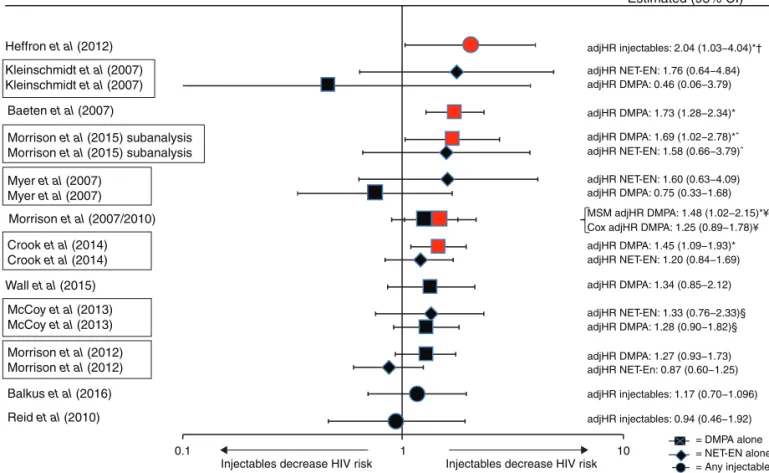
Of 12 IBWIL studies assessing injectables (DMPA, NET-EN, or a mix of both) [21,26,27,29,38,39,42,47,51– 53,55,56,58], nine provided DMPA-specific estimates and three provided estimates for unspecified injectables. Five studies reported a statistically significant increase in risk with either unspecified injectables [42] or DMPA [21,26,38,39,52,53], although the point estimate in one was not statistically significant in a Cox proportional hazards model [53] (Figs. 3 and 4). Point estimates from Cox models from these five studies ranged from adjHR 1.45 to 2.04 (Figs. 3 and 4) [21,26,38,39,42,52,53]; the largest estimate under an MSM model was 2.19 [42].
0.1 1 10
adjIRR: 0.66 (0.66) (0.09–4.78) Myer et al (2007)
Balkus et al (2016) Morrison et al (2015)
Oral contraceptives decrease HIV risk Oral contraceptives increase HIV risk
= Any OCs
= POPs = COCs Morrison et al (2007)
Wall et al (2015) Baeten et al (2007) Heffron et al (2012)
Morrison et al (2012) Crook et al (2014) Reid et al (2010) McCoy et al (2013) McCoy et al (2013)
adjHR: 0.76 (0.37–1.55) adjHR: 0.79 (0.38–1.64)^ adjHR: 0.88 (0.49–1.30) adjHR: 0.90 (0.63–1.26) adjHR: 0.91 (0.45–1.83) adjHR COC: 0.86 (0.58–1.28) adjHR POP: 0.98 (0.56–1.73) adjHR: 0.99 (0.69–1.72)¥ adjHR: 1.39 (0.90–2.15) adjHR: 1.46 (1.00–2.13)* adjHR: 1.80 (0.55–5.82) Estimated risk (95% Cl)
Fig. 2. Use of oral contraceptives (versus non-use of hormonal contraception) and HIV acquisition, among 11 studies considered
informative but with important limitations.Error bars show 95% confidence intervals. Studies are arranged in order of decreasing
magnitude of risk estimate, except if a single study disaggregated progestin-only pills and combined oral contraceptives, in which the case both estimates are adjacent (as indicated by a box around the study identifiers). Graph does not display estimates from marginal structural models. adjIRR, adjusted incidence risk ratio; adjHR, adjusted hazard ratio.Analysis showed significant
Among seven studies reporting nonstatistically significant results, point estimates ranged from adjIRR 0.46 to adjHR 1.34 (both DMPA-specific) [27,29,47,51, 55,56,58]. None of six studies assessing NET-EN reported statistically significant increases in HIV risk: point estimates ranged from adjHR 0.87 to adjIRR 1.76 (Fig. 5) [21,26,38,47,51,55,56].
Head-to-head studies considered informative but with important limitations
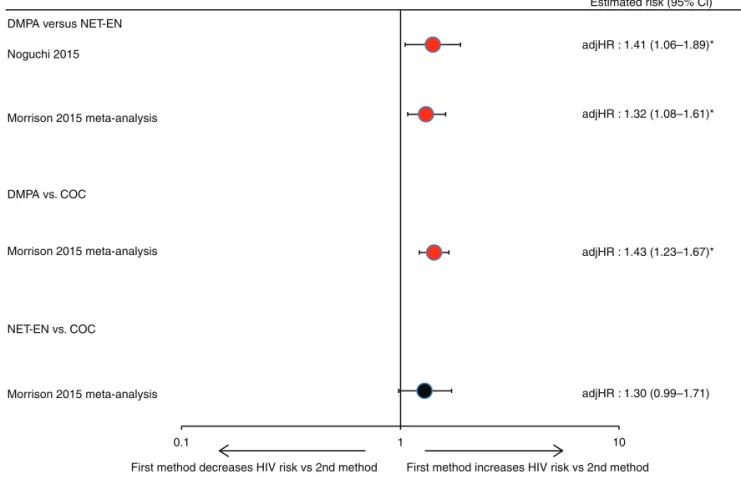
No head-to-head comparison studies were available in the previous review [1]. Both newly included head-to-head studies were considered IBWIL (Tables 1 and 2) [26,30]. Both reported a statistically significant increased risk of HIV for DMPA use (adjHR: 1.32 and 1.41) versus NET-EN use [26,30]. The IPD meta-analysis also compared each injectable against COCs, reporting significantly increased risk for DMPA versus COCs
(adjHR: 1.43, 95% CI: 1.23–1.67) and a borderline nonsignificant increased risk for NET-EN versus COCs: adjHR 1.30 (0.99–1.71) (Fig. 6) [26].
Meta-analysis
Ten estimates, from nine published studies with DMPA-specific estimates versus non-use of hormonal contra-ception [21,27,39,42,47,51,53,55,56] and a subanalysis of previously unpublished information from an IPD meta-analysis [26], were included in our meta-meta-analysis of the effect of DMPA on HIV acquisition (Appendix D, Fig. 5, http://links.lww.com/QAD/A969). The overall effect estimate was 1.40 (95% CI: 1.23–1.59) with anI2of 0%, indicating minimal quantitative heterogeneity.
Effect modification
One study reported increased HIV risk with DMPA and oral contraceptives in younger (18–24 years) but not
Heffron et al (2012) adjHR injectables: 2.04 (1.03−4.04)*†
Estimated (95% CI)
adjHR NET-EN: 1.76 (0.64−4.84) adjHR DMPA: 0.46 (0.06−3.79)
adjHR DMPA: 1.73 (1.28−2.34)*
adjHR DMPA: 1.69 (1.02−2.78)*ˆ adjHR NET-EN: 1.58 (0.66−3.79)ˆ
adjHR NET-EN: 1.60 (0.63−4.09) adjHR DMPA: 0.75 (0.33−1.68)
MSM adjHR DMPA: 1.48 (1.02−2.15)*¥ Cox adjHR DMPA: 1.25 (0.89−1.78)¥
adjHR DMPA: 1.45 (1.09−1.93)* adjHR NET-EN: 1.20 (0.84−1.69)
adjHR DMPA: 1.34 (0.85−2.12)
adjHR NET-EN: 1.33 (0.76−2.33)§ adjHR DMPA: 1.28 (0.90−1.82)§
adjHR DMPA: 1.27 (0.93−1.73) adjHR NET-En: 0.87 (0.60−1.25)
adjHR injectables: 1.17 (0.70−1.096)
adjHR injectables: 0.94 (0.46−1.92)
= DMPA alone = NET-EN alone = Any injectable
Kleinschmidt et al (2007) Kleinschmidt et al (2007)
Morrison et al (2007/2010)
Wall et al (2015)
Balkus et al (2016)
Reid et al (2010) Baeten et al (2007)
Morrison et al (2015) subanalysis Morrison et al (2015) subanalysis
Myer et al (2007) Myer et al (2007)
Crook et al (2014) Crook et al (2014)
McCoy et al (2013) McCoy et al (2013)
Morrison et al (2012) Morrison et al (2012)
0.1 1 10
Injectables decrease HIV risk Injectables decrease HIV risk
Fig. 3. Use of injectables (depot medroxyprogesterone acetate, norethisterone enanthate, or unspecified injectable) versus non-use of hormonal contraception and HIV acquisition, among 12 studies considered informative but with important limitations.
Error bars show 95% confidence intervals. Studies arranged in order of decreasing magnitude of risk estimate, except if a single study disaggregated depot medroxyprogesterone acetate and norethisterone enanthate, in which the case both estimates are adjacent (as indicated by a box around the study identifiers). Graph does not display estimates from marginal structural models, except where use of such models resulted in different conclusion regarding statistical significance; in such cases, estimates from both models are displayed on a single line (also identified by bracket signs). Note: displays all data on injectables (depot medroxyprogesterone acetate, norethisterone enanthate, or unspecified). adjIRR, adjusted incidence risk ratio; adjHR, adjusted hazard ratio.Analysis showed significant findings atP¼0.05 (marker also displayed in red).y
older women [52]; eight studies reported no effect modification by age [21,27,29,39,42,47,51,56]; most studies reported no effect modification by herpes simplex virus type 2 (HSV-2) status [21,29,39,42,51], whereas two reported effect modification in opposite directions [One observed higher HIV risk with DMPA in HSV-2 seronegative women (Morrisonet al.[52]) and the other observed higher HIV risk with DMPA (versus NET-EN) in HSV-2 seropositive women (Noguchi et al. [30]).]. Two studies reported no effect of modification by study site [21,30], one reported greater risk for oral contra-ceptives and DMPA in a Ugandan site versus a Zimbabwean site [53]. A study in serodiscordant couples reported no effect modification for genital ulceration, inflammation, viral load of HIV-positive partner at baseline, or fertility intentions [27]. Another study reported no effect modification by reported condom use at baseline, participant behavioral risk, or prevalent chlamydia or gonorrhea [53].
Within the IPD meta-analysis, assessment for effect modification was conducted with information from all 18 studies (some of which were also included in our review). No evidence of interaction was reported with any method for age (15–24 versus >25 years), HSV-2 status at baseline, or HIV incidence in population (low versus high) [26]. Increased HIV risk was observed for COC use in East Africa (adjHR: 1.58, 95% CI: 1.19–2.09) but not South Africa or Southern Africa, and for DMPA use in east and South Africa (adjHR: 2.09, 95% CI: 1.68–2.80; adjHR: 1.30, 95% CI: 1.11–1.53), but not Southern Africa. Populations that reported engaging in transactional sex work had an increased HIV risk with COCs (adjHR: 1.51, 95% CI: 1.09–2.10) unlike populations without transactional sex work. Finally, smaller point estimates were observed among studies deemed by the investigators as at lower risk of methodological bias: adjHR for DMPA: 1.22 (95% CI: 0.99–1.50) and adjHR for NET-EN: 0.67 (95% CI:
Heffron et al (2012)
Baeten et al (2007)
Morrison et al (2015) subanalysis
Morrison et al (2007/2010)
Crook et al (2014)
Wall et al (2015)
McCoy et al (2013)
Morrison et al (2012)
Balkus et al (2016)
Reid et al (2010)
Myer et al (2007)
Kleinschmidt et al (2007)
adjHR injectables: 2.04 (1.03−4.04)*†
Estimated risk (95% CI)
adjHR DMPA: 1.69 (1.02−2.78)*ˆ
MSM adjHR DMPA: 1.48 (1.02−2.15)*¥ Cox adjHR DMPA: 1.25 (0.89−1.78)¥
adjHR DMPA: 1.45 (1.09−1.93)*
adjHR DMPA: 1.34 (0.85−2.12) adjHR DMPA: 1.73 (1.26−2.34)*
adjIRR DMPA: 0.46 (0.06−3.79)
= DMPA alone = Any injectable
DMPA (or any injectable) decrease HIV risk DMPA (or any injectable) increases HIV risk
adjHR DMPA: 1.27 (0.93−1.73) adjHR DMPA: 1.28 (0.90−1.82)§
adjHR DMPA: 0.75 (0.33−1.68) adjHR injectables: 0.94 (0.46−1.92) adjHR injectables: 1.17 (0.70−1.96)
0.1 1 10
Fig. 4. Use of depot medroxyprogesterone acetate (or unspecified injectable) versus non-use of hormonal contraception and
HIV acquisition, among 12 studies considered informative but with important limitations.Error bars show 95% confidence
intervals. Studies arranged in order of decreasing magnitude of risk estimate. Graph does not display estimates from marginal structural models, except where use of such models resulted in different conclusion regarding statistical significance; in such cases, estimates from both models are displayed on a single line (also identified by bracket signs). adjIRR, adjusted incidence risk ratio.
Note:restricts to all data on depot medroxyprogesterone acetate or unspecified injectables, as estimates of unspecified injectables are likely comprised largely of DMPA. adjHR, adjusted hazard ratio.Analysis showed significant findings atP¼0.05 (marker also
0.47–0.96). Table 3 details how the IPD meta-analysis investigators defined lower risk of bias in comparison with our quality criteria.
Discussion
Interpretation of overall results
As in our 2014 review, current data do not suggest an increased risk of HIV acquisition among women using oral contraceptives [1]. Extremely limited data do not suggest a statistically significant increased risk of HIV acquisition among users of levonorgestrel implants; no data are available regarding etonogestrel implants. In 2014, one of five studies that was considered IBWIL suggested an increased risk of HIV acquisition with NET-EN injectables [31]. In this updated review, that study was replaced by a larger, more sophisticated analysis of the same dataset [21], and increased HIV risk was no longer observed. Thus, currently available data for injectable NET-EN use do not suggest an association with HIV acquisition in women.
Although concerns around confounding in observational data remain relevant, newly available evidence regarding
injectable DMPA use increases concern about a potential causal association with HIV acquisition. Twelve studies considered IBWIL assessed DMPA or nondisaggregated injectables compared with non-use of hormonal contra-ception; four or five (depending on the statistical model considered) reported statistically significant increased risks of HIVacquisition, ranging from adjHR 1.45 to 2.04 in Cox models (or 2.19 in MSM models). Among four newly included studies, two reported statistically signifi-cant increased risk (adjHR: 1.45 and 1.69), including one very large study [21] and a subanalysis of a large IPD meta-analysis [26]. A smaller study among serodiscordant couples [27] reported a nonsignificant estimate of adjHR 1.34, and data from a microbicide trial also had a nonsignificant estimate of adjHR 1.17 but did not disaggregate between injectables [29]. Head-to-head comparisons were newly available and may be less confounded by unmeasured or residual behavioral differences than comparisons from hormonal contra-ceptive versus non-use of hormonal contraception studies, particularly if groups compared in head-to-head studies use different types of the same delivery method (i.e., injectable DMPA versus injectable NET-EN) [30]. A head-to-head analysis of VOICE data reported a 41%
0.1 1 10
adjHR: 0.87 (0.60–1.25) adjHR: 1.20 (0.84–1.69)
Morrison et al (2012)
NET-EN decreases HIV risk NET-EN increases HIV risk Crook et al (2014)
McCoy et al (2013)
Morrison et al (2015) subanalysis Myer et al (2007)
Kleinschmidt et al (2007)
adjHR: 1.33 (0.76–2.33) § adjHR: 1.58 (0.66–3.79)^ adjIRR: 1.60 (0.63–4.09) adjIRR: 1.76 (0.64–4.84)
Estimated risk (95% Cl)
Fig. 5. Use of norethisterone enanthate versus non-use of hormonal contraception and HIV acquisition, among six studies
considered informative but with important limitations.Error bars show 95% confidence intervals. Studies arranged in order of
increased risk of HIV acquisition in DMPA versus NET-EN users [30]. In the IPD meta-analysis [26], DMPA use was associated with a significantly increased risk of HIV acquisition of 30–40% when compared with either NET-EN or COC use. Comparing NET-NET-EN against COC users suggested higher risk with NET-EN, though this was not statistically significant at P less than 0.05 (P¼0.055). Although residual confounding cannot be ruled out in any observational study, several recently published studies suggesting an increased risk of HIV acquisition among DMPA users had few limitations apart from being observational (Table 2).
Recent analyses contradict the hypothesis that differential over-reporting of condom use by hormonal contra-ceptive users explains observed associations between hormonal contraceptive use and HIV infection in some studies [64]. However, the possibility remains that certain confounders are specific to DMPA users. In South Africa (where both DMPA and NET-EN injectables are used), studies suggest that women perceive DMPA and NET-EN differently, and providers may preferentially prescribe different injectable types to specific subpopulations, which could result in confounding specific to injectable type [30,65,66]. Although beyond the scope of this review, emerging evidence related to DMPA and HSV-2 acquisition must also be considered [67,68].
Taken together, the new evidence points toward heightened concerns that the association between DMPA use and HIV acquisition may not be fully explained by confounding or other methodological problems. In contrast, additional reassuring evidence of no significant association for other hormonal contraceptive methods (oral contraceptives, NET-EN, and implants) is newly available. If the association between DMPA and HIV acquisition risk is causal, meta-analyses, including our own, suggest a likely increase in risk of hazards ratio 1.5 or less.
The quality of epidemiological evidence on this issue has improved over time. Several newly published studies used recent analytic recommendations [13] or other innovative analytic techniques. For example, Crook et al. [21] conducted a particularly thorough exploration of statistical methodology and incorporated multiple sensi-tivity analyses to assess the robustness of their findings, Morrisonet al.[26] contributed substantial new data in a carefully conducted IPD meta-analysis, and Noguchi
et al. [30] examined an alternative comparison group (NET-EN users).
The methodological contribution of three newly published meta-analyses varied. In addition to the IPD analysis included in our review [26], two
meta-Estimated risk (95% Cl)
adjHR : 1.41 (1.06–1.89)*
adjHR : 1.32 (1.08–1.61)* DMPA versus NET-EN
Noguchi 2015
Morrison 2015 meta-analysis
DMPA vs. COC
NET-EN vs. COC
Morrison 2015 meta-analysis
0.1
First method decreases HIV risk vs 2nd method First method increases HIV risk vs 2nd method
1 10
Morrison 2015 meta-analysis adjHR : 1.43 (1.23–1.67)*
adjHR : 1.30 (0.99–1.71)
Fig. 6. Hormonal contraceptive methods and HIV acquisition in head-to-head studies, among two studies considered
informative but with important limitations.Error bars show 95% confidence intervals. Within each comparison group, studies
are arranged in order of decreasing magnitude of risk estimate. adjHR, adjusted hazard ratio.Analysis showed significant findings
Table
3.
Inclus
ion
and
qual
ity
rating
of
public
ations
and
data
bases
acro
ss
system
atic
reviews
and
meta-an
alyses
asses
sing
the
associ
ation
of
injec
tables
(versu
s
nonu
se
of
ho
rmonal
contrac
epti
on)
with
risk
of
HIV
acquisi
tion
in
women.
Current
systemat
ic
review
and
meta-analy
sis
Ralph
et
al.
[19]
meta-analy
sis
Brind
et
al.
[20
]
meta
-analys
is
(longi
-tudina
l
data)
Mo
rrison
et
al.
[26
]
IPD
meta
-analys
is
Refer
ences
Inclusion
,qu
ality
ra
t-ing
Inclusi
on
Inclusi
on
Inclu
sion/ex
clusion
rati
onale,
qual
ity
rat-ing
and
rational
e
Publis
hed
man
uscrip
ts
with
risk
est
imates
for
injec
tables
and
HIV
acqui
sition
Bult
erys
et
al.
(1994)
[40]
**
*
Did
not
meet
inclusi
on
criteria
;
follow-u
p
vis
its
>
6
months
apa
rt
Ungc
husak
et
al.
(199
6)
[62
]
**
*
Did
not
meet
inclusi
on
criteria
;
not
sub-Sah
aran
Africa
Kilmarx
et
al.
(1998)
[46
]
***
Did
not
meet
inclusi
on
criteria
;
not
sub-Sah
aran
Africa
Kapig
a
et
al.
(199
8)
[44]
***
Did
not
meet
inclusi
on
criteria
;
follow-u
p
vis
its
>
6
months
apa
rt
Kidd
ugavu
et
al.
(2003)
[45]
*
**
Did
not
meet
inclusi
on
criteria
;
follow-u
p
vis
its
>
6
months
apa
rt
Baeten
et
al.
(2007)
[39
]
(u
pdate
of
[77],
[54
])
***
*
A
Mye
r
et
al.
(2
007)
[56
]
*
(6
mo
estima
tes)
**
*
A,
B,
C
Klein
schmidt
et
al.
(2
007)
[47
]
***
*
A,
B
Kum
wenda
et
al.
(2008)
[48
]
**
*
*
B
Watso
n-Jon
es
et
al.
(2009)
[60
]
**
*
*
B
Mo
rrison
et
al.
(201
0)
[52]
(rean
alysis
of
[53
])
****
Feldb
lum
et
al.
(2
010)
[41
]
**
*
Did
not
meet
inclusi
on
criteria
;
no
long
itudinal
data
on
contra
ception
Reid
et
al.
(2
010)
[58
]
***
Did
not
meet
inclusi
on
criteria
;
>
5%
miss
ing
data
for
exp
osure
Heff
ron
et
al.
(2
012)
[42
,43]
****
Mo
rrison
et
al.
(201
2)
[55]
****
Wand
and
Ramj
ee
(2012)
[31]
Replaced
by
[21]
*
Dup
licates
[21
]
*
Dup
licates
[21
]
Rep
laced
by
[21
]
McCo
y
et
al.
(201
3)
[51]
Tabl e 3 ( continu ed ) Curr ent syst ematic revie w and meta -analy sis Ral ph et al. [19 ] meta -ana lysis Br ind et al. [20] m eta-ana lysis (longi -tu dinal data) Morriso n et al. [26] IPD meta-an alysis Ref erences Inclusi on, qual ity rat-ing Inclu sion In clusion Inclusi on/excl usion rational e, qu ality ra t-ing and rati onale Lut alo et al. (2013) [50] ** d Did not m eet inclusi on cr iteria; follow -up visits > 6 mon ths apar t; publ ished after meta -analys is datase t closed Kap iga et al. (2013) [24 ] a * dd * Cro ok et al. (2014) [21 ] a *** * B Wal l et al. (2015) [27 ] a * yy y McK innon et al. (2 015) [25 ] a * yy y Byrn e et al. (2 016) [28 ] a * yy y Bal kus et al. (2016) [29 ] a * yy y Da ta in Morriso n et al. [26] with no associ ated public ation specifica lly assessin g HC-HIV Kau l et al. (2004) [32 ] a Va llely et al. (2007) [33] a De lany-M oretlwe and Rees (2010) [34] a McG rath et al. (2 014) [35 ] a Va ndep itte et al. (2011)[36 ] a Ab dool Kari m et al. (2 010) [37 ] a Va n Da mme et al. (2012) [17 ] a * * * * * * * y y y y y y y y y y y y y y
analyses [19,20] utilized data already included as primary studies in our systematic reviews (thus, adding no information beyond that already included in this review). Although all three meta-analyses reported summary estimates for DMPA similar to our own (hazards ratio 1.4–1.5), one of the excluded meta-analyses contained no assessment of study quality and included several studies with serious methodological limitations [20], which raises particular concern in the context of meta-analysis of observational data (Table 3) [69]. Both excluded meta-analyses [19,20] double-counted [70] data by inclusion of both Wand and Ramjee [31] and Crooket al. [21]. We generated a meta-analytic estimate for DMPA, but recommend that such results be interpreted with caution, given the potential for spurious precision in meta-analyses of observational data [71]. The I2 value for our meta-analysis suggested minimal statistical heterogeneity, but qualitative differences between study populations and methods remain an important consideration [16]. That said, estimates from all four meta-analyses are similar, despite inclusion of slightly different component studies [26].
Limitations
Previous reviews have addressed key methodological considerations about this body of literature, including potential for confounding, frequency, and accuracy of variable measurement, considerations related to ‘direct’ and ‘total’ effects, potential for publication bias, and limitations of individual studies, such as failure of some studies to disaggregate by specific hormonal content or formulation (e.g., most studies assessing oral contra-ceptives failed to disaggregate estimates by COCs or POPs) [1,72]. Our study quality framework is necessarily subjective, and we encourage continued discussion on how best to evaluate study quality in this body of evidence.
Conclusion
There remain no data on use of contraceptive patches, rings, or hormonal IUDs and HIV acquisition in women. For implants, very limited data pertaining to levonorges-trel implants do not suggest increased risk, but more information is needed. In comparison, a larger amount of data are available for oral contraceptives and are generally reassuring. A growing number of studies have assessed injectable NET-EN, and although still limited, data are generally reassuring. For injectable DMPA, although some new, high-quality studies do not report a statistically significant increased risk of HIV acquisition, other new data, including studies directly comparing DMPA and NET-EN, tend to strengthen concerns about DMPA. If the association between DMPA and HIV acquisition risk is causal, data suggest a likely increase in risk of hazards ratio 1.5 or less. Several new studies have used recently proposed recommendations for analysis or other inno-vative methodological approaches [13], although as with all observational data, the possibility of uncontrolled or
residual confounding remains. The growing, generally reassuring evidence about other hormonal contraceptive methods, including other injectables like NET-EN, stands in contrast to the DMPA-specific findings. An important next step is for WHO to determine whether these concerns warrant a reconsideration of global guidance for DMPA. Modeling studies can be useful in understanding net health impacts of various policy responses in different epidemiological contexts, including the risk of HIV, maternal mortality and morbidity, and access to alternative contraception and HIV prevention methods [2,73–76].
Acknowledgements
We are grateful to Sharon Achilles for her thoughtful input related to describing potential biological mechan-isms, and to all study investigators who provided additional information about their analyses. WHO provided support for the writing of this systmatic review and for the writing group to attend a working meeting in Geneva, Switzerland in October 2015. D.J.W. was partially funded by NIH DP2-HD-08-4070. The review was conducted independently of the WHO guidance development process; and conclusions represent the independent opinions of the authors. The findings and conclusions in this article do not necessarily reflect the positions and policies of the donor.
Role of authors: The World Health Organization (J.N.K. and P.S.S.) initiated the idea to conduct this systematic review update. C.B.P. led the conduct of the systematic review, including conducting the systematic literature search and drafting the manuscript. C.B.P., K.M.C., and P.C.H. screened titles, abstracts, and full-text manuscripts to determine study inclusion. S.J.P. conducted the statistical meta-analysis. All coauthors (C.B.P., K.M.C., P.C.H., S.J.P., T.C., J.N.K., D.J.W., and P.S.S.) partici-pated in framing the study question, developing the quality criteria, abstracting study information and assessing study quality, interpreting the data, and contributing to the writing and editing of the manuscript.
Disclaimer: The findings and conclusions in this report are those of the authors and do not necessarily represent the official positions of the Guttmacher Institute, the Centers for Disease Control and Prevention, the World Health Organization, the National Institutes of Health, or other institutions with which the authors are affiliated.
Conflicts of interest
J.N.K., and P.S.S. are current members of the ECHO trial consortium. We do not feel that participation in these activities influenced our work on this systematic review. K.M.C. and D.J.W. have nothing to declare.
References
1. Polis CB, Phillips SJ, Curtis KM, Westreich DJ, Steyn PS, Ray-mond E,et al.Hormonal contraceptive methods and risk of HIV acquisition in women: a systematic review of epidemiological evidence.Contraception2014;90:360–390.
2. Butler AR, Smith JA, Polis CB, Gregson S, Stanton D, Hallett TB.
Modelling the global competing risks of a potential interaction between injectable hormonal contraception and HIV risk. AIDS2013;27:105–113.
3. Alkema L, Chou D, Hogan D, Zhang S, Moller AB, Gemmill A,
et al.Global, regional, and national levels and trends in
ma-ternal mortality between 1990 and 2015, with scenario-based projections to 2030: a systematic analysis by the UN Maternal Mortality Estimation Inter-Agency Group. Lancet 2016;
387:462–474.
4. Schelar E, Polis CB, Essam T, Looker KJ, Bruni L, Chrisman CJ,
et al. Multipurpose prevention technologies for sexual and
reproductive health: mapping global needs for introduction of new preventive products.Contraception2016;93:32–43.
5. Blish CA, Baeten JM. Hormonal contraception and HIV-1 transmission.Am J Reprod Immunol2011;65:302–307.
6. Hel Z, Stringer E, Mestecky J.Sex steroid hormones, hormonal contraception, and the immunobiology of human immunode-ficiency virus-1 infection.Endocr Rev2010;31:79–97.
7. Achilles SL, Hillier SL.The complexity of contraceptives: un-derstanding their impact on genital immune cells and vaginal microbiota.AIDS2013;27 (Suppl 1):S5–S15.
8. Hickey M, Marino JL, Tachedjian G.Critical review: mechan-isms of HIV transmission in Depo-Provera users: the likely role of hypoestrogenism.J Acquir Immune Defic Syndr2016;71: 1–7.
9. Fichorova RN, Chen PL, Morrison CS, Doncel GF, Mendonca K, Kwok C,et al.The contribution of cervicovaginal infections to the immunomodulatory effects of hormonal contraception. MBio2015;6:e00221-15.
10. World Health Organization.Medical eligibility criteria for
con-traceptive use. 5th ed. Geneva, Switzerland: World Health
Organization; 2015.
11. Moher D, Liberati A, Tetzlaff J, Altman DG, Group P.Preferred reporting items for systematic reviews and meta-analyses: the PRISMA statement.PLoS Med2009;6:e1000097.
12. Veritas Health Innovation.Covidence Systematic Review
Soft-ware.Melbourne, Australia: Veritas Health Innovation; 2015.
13. Polis CB, Westreich D, Balkus JE, Heffron R.Assessing the effect of hormonal contraception on HIV acquisition in observational data: challenges and recommended analytic approaches.AIDS
2013;27 (Suppl 1):S35–S43.
14. Hernan MA.The hazards of hazard ratios.Epidemiology2010;
21:13–15.
15. DerSimonian R, Laird N.Meta-analysis in clinical trials.Control
Clin Trials1986;7:177–188.
16. Higgins JP, Thompson SG, Deeks JJ, Altman DG. Measuring inconsistency in meta-analyses.BMJ2003;327:557–560.
17. Van Damme L, Corneli A, Ahmed K, Agot K, Lombaard J, Kapiga
S, et al. Preexposure prophylaxis for HIV infection among
African women.N Engl J Med2012;367:411–422.
18. Masese L, Baeten JM, Richardson BA, Bukusi E, John-Stewart G, Graham SM,et al.Changes in the contribution of genital tract infections to HIV acquisition among Kenyan high-risk women from 1993 to 2012.AIDS2015;29:1077–1085.
19. Ralph LJ, McCoy SI, Shiu K, Padian NS. Hormonal contra-ceptive use and women’s risk of HIV acquisition: a meta-analysis of observational studies. Lancet Infect Dis 2015;
15:181–189.
20. Brind J, Condly SJ, Mosher SW, Morse AR, Kimball J.Risk of HIV infection in depot-medroxyprogesterone acetate (DMPA) users: a systematic review and meta-analysis. Issues Law Med2015;30:129–139.
21. Crook AM, Ford D, Gafos M, Hayes R, Kamali A, Kapiga S,et al.
Injectable and oral contraceptives and risk of HIV acquisition in women: an analysis of data from the MDP301 trial.Hum
Reprod2014;29:1810–1817.
22. Dube K, Zango A, van de Wijgert J, Meque I, Ferro JJ, Cumbe F,
et al.HIV incidence in a cohort of women at higher risk in
Beira, Mozambique: prospective study 2009–2012.PLoS One
2014;9:e84979.
23. Feldblum PJ, Enosse S, Dube K, Arnaldo P, Muluana C, Banze R,
et al.HIV prevalence and incidence in a cohort of women at
higher risk for HIV acquisition in Chokwe, southern Mozam-bique.PLoS One2014;9:e97547.
24. Kapiga SH, Ewings FM, Ao T, Chilongani J, Mongi A, Baisley K,
et al.The epidemiology of HIV and HSV-2 infections among
women participating in microbicide and vaccine feasibility studies in Northern Tanzania.PLoS One2013;8:e68825.
25. McKinnon LR, Izulla P, Nagelkerke N, Munyao J, Wanjiru T, Shaw SY,et al.Risk factors for HIV acquisition in a prospective Nairobi-based female sex worker cohort.AIDS Behav2015;
19:2204–2213.
26. Morrison CS, Chen PL, Kwok C, Baeten JM, Brown J, Crook AM,
et al.Hormonal contraception and the risk of HIV acquisition:
an individual participant data meta-analysis.PLoS Med2015;
12:1–26.
27. Wall KM, Kilembe W, Vwalika B, Htee KN, Brill I, Chomba E,
et al.Hormonal contraception does not increase women’s HIV
acquisition risk in Zambian discordant couples, 1994–2012.
Contraception2015;91:480–487.
28. Byrne EH, Anahtar MN, Cohen KE, Moodley A, Padavattan N, Ismail N,et al.Association between injectable progestin-only contraceptives and HIV acquisition and HIV target cell fre-quency in the female genital tract in South African women: a prospective cohort study.Lancet Infect Dis2016;16:441–448.
29. Balkus JE, Brown ER, Hillier SL, Coletti A, Ramjee G, Mgodi N,
et al.Oral and injectable contraceptive use and HIV acquisition
risk among women in four African countries: a secondary analysis of data from a microbicide trial. Contraception
2016;93:25–31.
30. Noguchi LM, Richardson BA, Baeten JM, Hillier SL, Balkus JE, Chirenje ZM,et al.Risk of HIV-1 acquisition among women who use different types of injectable progestin contraception in South Africa: a prospective cohort study. Lancet HIV2015;
2:e279–287.
31. Wand H, Ramjee G.The effects of injectable hormonal contra-ceptives on HIV seroconversion and on sexually transmitted infections.AIDS2012;26:375–380.
32. Kaul R, Kimani J, Nagelkerke NJ, Fonck K, Ngugi EN, Keli F,
et al.Monthly antibiotic chemoprophylaxis and incidence of
sexually transmitted infections and HIV-1 infection in Kenyan sex workers: a randomized controlled trial. JAMA 2004;
291:2555–2562.
33. Vallely A, Kasindi S, Hambleton IR, Knight L, Chirwa T, Balira R,
et al.Microbicides development program, Tanzania-baseline
characteristics of an occupational cohort and reattendance at 3 months.Sex Transm Dis2007;34:638–643.
34. Delany-Moretlwe S, Rees H. Tshireletso study for women’s
health. Microbicide feasibility study. Protocol.Hillbrow, South
Africa: Reproductive Health Research Unit, University of Wit-watersrand; 2010.
35. McGrath N, Chimbwete C, Bennish M, Cassol S, Nunn A. A feasibility study in preparation for phase III microbicide trials in the Hlabisa sub-district, South Africa. 2014, http://www.africa centre.ac.za/Portals/0/Researchers/microbicide_proto-col_5.0.pdf. [Accessed (by Morrison 2015) 16 April 2014].
36. Vandepitte J, Bukenya J, Weiss HA, Nakubulwa S, Francis SC, Hughes P,et al.HIV and other sexually transmitted infections in a cohort of women involved in high-risk sexual behavior in Kampala, Uganda.Sex Transm Dis2011;38:316–323.
37. Abdool Karim Q, Abdool Karim SS, Frohlich JA, Grobler AC, Baxter C, Mansoor LE,et al.Effectiveness and safety of tenofovir gel, an antiretroviral microbicide, for the prevention of HIV infection in women.Science2010;329:1168–1174.
38. Morrison CS. Personal communication: subanalysis of
pre-viously unpublished data in IPD meta-analysis.2015.
![Table 1 describes 10 newly included studies; information on previously included studies is available elsewhere [1].](https://thumb-us.123doks.com/thumbv2/123dok_us/8323867.2206825/9.982.205.754.106.452/describes-included-studies-information-previously-included-studies-available.webp)