ASSOCIATION ANALYSIS OF RARE VARIANTS IN SEQUENCING STUDIES
Zhengzheng Tang
A dissertation submitted to the faculty of the University of North Carolina at Chapel Hill in partial fulfillment of the requirements for the degree of Doctor of Philosophy in
the Department of Biostatistics in the Gillings School of Global Public Health.
Chapel Hill 2014
Approved by:
Dr. Danyu Lin
Dr. Donglin Zeng
Dr. Wei Sun
Dr. Yun Li
ABSTRACT
ZHENGZHENG TANG: Association Analysis of Rare Variants in Sequencing Studies
(Under the direction of Dr. Danyu Lin)
Recent advances in sequencing technologies have made it possible to explore the
influence of rare variants on complex diseases and traits. Large-scale sequencing studies
provide the opportunity to examine the proportion of the missing heritability that is
attributable to rare variants. They also pose a range of analytical and computational
challenges that cannot be adequately addressed with existing methods.
For the association analysis of the rare variants, it is customary to aggregate rare
mutations within a gene to perform gene-level association analysis. In the first part
of the dissertation, we develop asymptotic and resampling gene-level association tests
for a variety of traits and study designs. We employ score statistics under appropriate
statistical models to achieve numerical stability and computational efficiency. The
resulting software SCORE-Seq features a large collection of utilities devoted to perform
gene-level association analysis in different scenarios.
Trait-dependent sampling has been adopted in many sequencing projects to reduce
cost. In the second part, we provide a valid and efficient maximum likelihood framework
for analyzing binary secondary traits under such sampling strategy. We produce the
commonly used gene-level association tests and compare our methods with the na¨ıve
methods ignoring the trait-dependent sampling.
A single sequencing study is often underpowered to detect modest genetic effect of
rare variants. Several methods are available to conduct meta-analysis for rare variants
studies. In practice, genetic associations are likely to be heterogeneous among studies
because of differences in population composition, environmental factors, phenotype and
genotype measurements, or analysis method. In the third part, we propose a general
framework for meta-analysis of sequencing studies that allows the genetic effects to
vary among studies. We produce the fixed-effects and random-effects versions of all
commonly used gene-level association tests. Our methods take score statistics, rather
than individual participant data, as input and thus can accommodate any study designs
and any phenotypes. We demonstrate through extensive simulation studies that our
I dedicate this dissertation work to my parents,
Jianhua Tang and Ziping Luo,
who have loved and supported me throughout my life,
and to my beloved husband and son,
Guanhua Chen and Patrick L. Chen
ACKNOWLEDGMENTS
My graduate experience at University of North Carolina at Chapel Hill has been an
amazing journey. I am grateful to a number of people who have guided and supported
me throughout the research process, and cheered me during my venture.
My deepest gratitude is to my advisor, Dr. Danyu Lin, for his guidance, support
and patience. I have been very fortunate to have an advisor like him. And I would not
have been able to achieve this accomplishment without him.
I would also like to thank my committee members Dr. Donglin Zeng, Dr. Wei Sun,
Dr. Yun Li and Dr. Matthew R. Nelson for their insightful comments and constructive
criticisms at different stages of my research. These comments motivated many of my
thinking.
I am also thankful to Dr. Lloyd E. Chambless who supported me in my early years
TABLE OF CONTENTS
LIST OF TABLES . . . ix
LIST OF FIGURES . . . xi
1 Literature review . . . 1
1.1 Introduction . . . 1
1.2 Gene-level association tests . . . 3
1.2.1 Burden tests: CAST, GRANVIL, CMC . . . 5
1.2.2 Weighted approach: WSS, KBAC . . . 6
1.2.3 Maximization approach: VT . . . 6
1.2.4 Signed approach: Han and Pan . . . 7
1.2.5 Variance-Component (VC) tests: Simi-larity regression, C-alpha, SKAT . . . 7
1.3 Trait-dependent sampling . . . 8
1.3.1 Estimating parameters for the primary trait . . . 10
1.3.2 Estimating parameters for the secondary trait . . . 12
1.3.3 Performing association tests . . . 12
1.4 Meta-analysis . . . 14
1.4.1 Meta-analysis of GWAS . . . 14
1.4.2 Meta-analysis of sequencing studies . . . 17
2 A general framework for detecting disease asso-ciations with rare variants in sequencing studies . . . 21
2.1 Introduction . . . 21
2.2.1 Binary phenotypes . . . 23
2.2.2 Quantitative phenotypes . . . 29
2.2.3 Survival outcomes . . . 30
2.2.4 Family-based data . . . 32
2.3 Simulation studies . . . 34
2.4 Data analysis . . . 47
2.5 Discussion . . . 58
3 Binary secondary trait analysis under trait-dependent sampling . . . 61
3.1 Introduction . . . 61
3.2 Methods . . . 61
3.3 Simulation studies . . . 64
3.3.1 Type I error under random sampling . . . 64
3.3.2 Type I error and power under trait-dependent sampling . . . 67
3.3.3 Meta-analysis . . . 68
3.4 Data analysis . . . 72
4 Meta-analysis in sequencing studies . . . 77
4.1 Introduction . . . 77
4.2 Methods . . . 78
4.3 Simulation studies . . . 83
4.4 Data analysis . . . 90
4.5 Discussion . . . 92
Appendix : Test statistics in Chapter 4 . . . 99
LIST OF TABLES
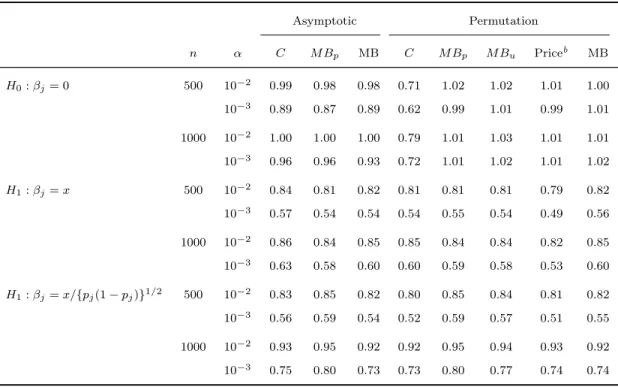
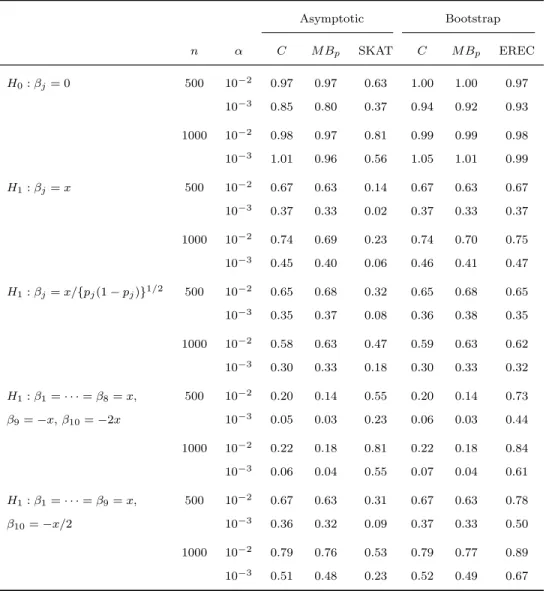
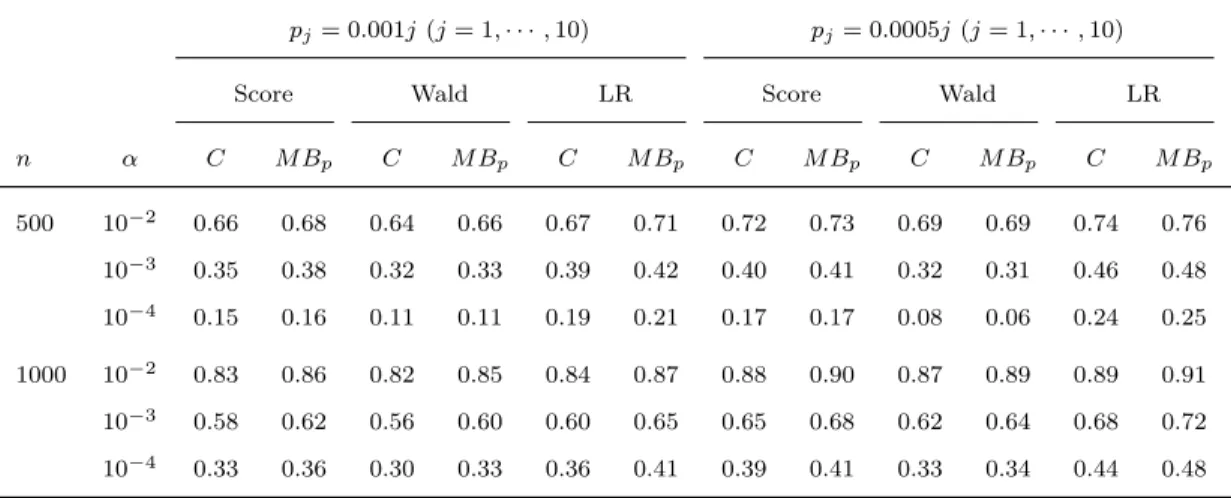
2.1 Type I erroraand power of asymptotic methods
with different weight functions . . . 38
2.2 Type I erroraand power of asymptotic and
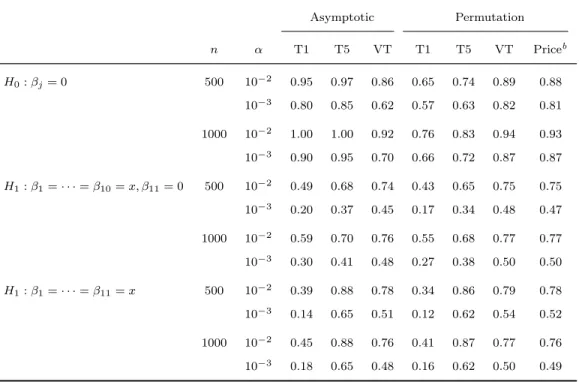
per-mutation methods . . . 38
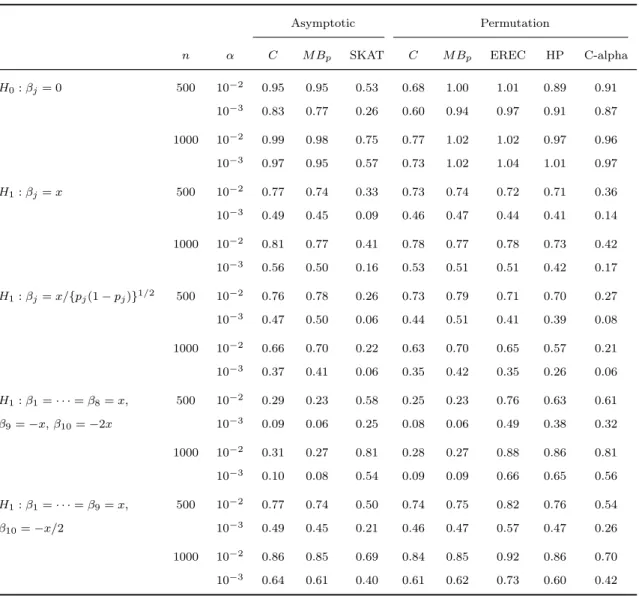
2.3 Type I erroraand power of fixed and variable
threshold methods . . . 39
2.4 Type I erroraand power of asymptotic and per-mutation tests for detecting potentially opposite
effects . . . 40
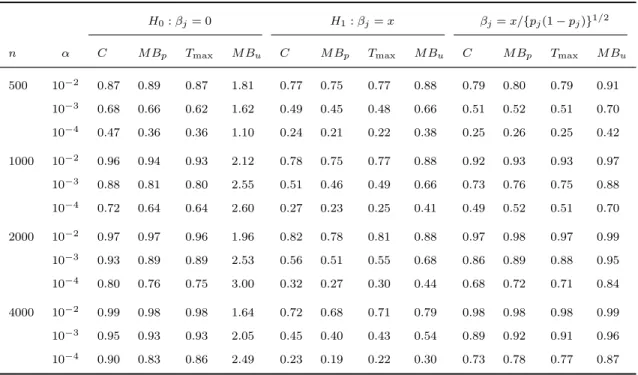
2.5 Type I erroraand power of fixed and variable
threshold methods with covariates . . . 41
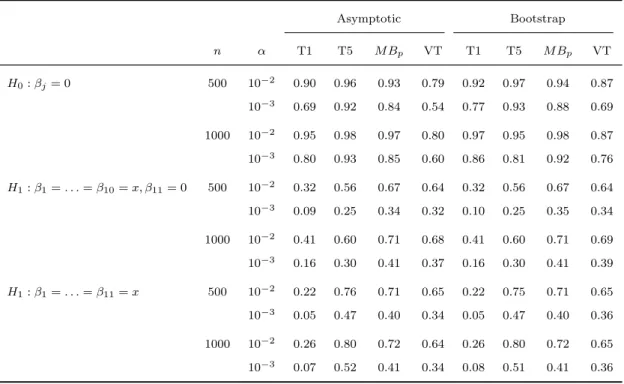
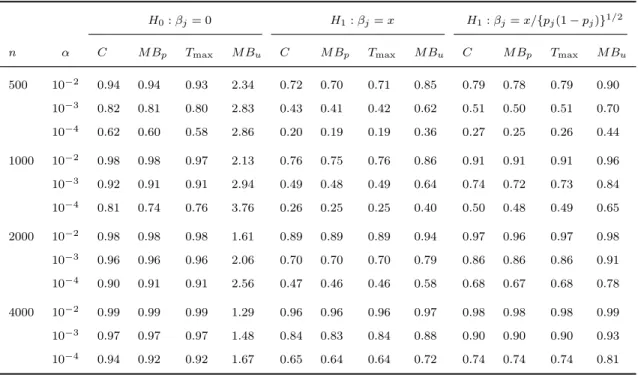
2.6 Type I erroraand power of asymptotic and boot-strap tests for detecting potentially opposite
ef-fects in the presence of covariates . . . 42
2.7 Type I erroraand power of asymptotic meth-ods with different weight functions under pj =
0.0005j (j = 1,· · · ,10) . . . 43 2.8 Type I erroraand power of asymptotic
meth-ods with different weight functions under pj =
0.00025j (j = 1· · · ,20) . . . 43 2.9 Type I erroraand power of asymptotic methods
with different weight functions under pj = 0.005
(j = 1,· · · ,10) . . . 44 2.10 Type I erroraand power of asymptotic
meth-ods with different weight functions under pj =
0.0025 (j = 1,· · · ,10) . . . 44 2.11 Type I erroraand power of asymptotic
meth-ods with different weight functions under pj =
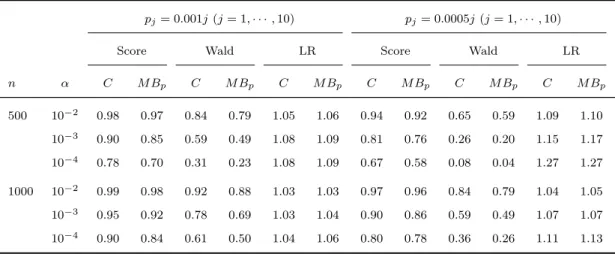
2.13 Power of score, Wald and LR tests with
covari-ates under H1 :βj =x (j = 1, . . . ,10) . . . 46
2.14 Power of score, Wald and LR tests with
covari-ates under H1 :βj =x/{pj(1−pj)}1/2 (j = 1, . . . ,10) . . . 46
3.1 Type I erroraat different nominal levels for rare-variant tests based on probit and logistic regres-sions under pj = 0.001j (j = 1,· · · ,10). Bina-ry data are simulated using a logistic regression
model. . . 65
3.2 Type I erroraat different nominal levels for rare-variant tests based on probit and logistic regres-sions under pj = 0.01j (j = 1,· · · ,10). Bina-ry data are simulated using a logistic regression
model. . . 66
4.1 Type I error divided by the nominal significance
LIST OF FIGURES
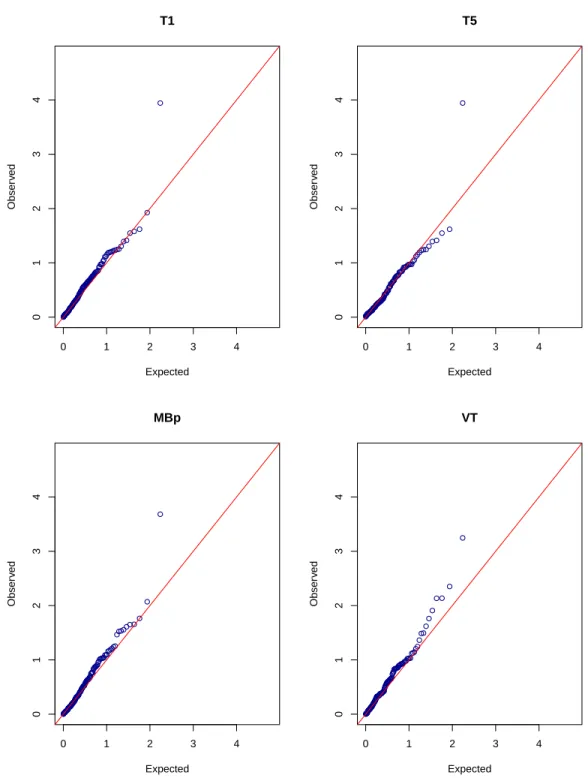
2.1 Quantile-quantile plots of −log10(p-values) for the asymptotic T1, T5, M Bp and VT tests in
the quantitative trait analysis of total cholesterol. . . 50
2.2 Quantile-quantile plots of −log10(p-values) for the permutation EREC, T5, M Bp and VT tests
in the quantitative trait analysis of total cholesterol. . . 51
2.3 Quantile-quantile plots of −log10(p-values) for the asymptotic T1, T5, M Bp and VT tests in
the binary trait analysis of total cholesterol. . . 52
2.4 Quantile-quantile plots of −log10(p-values) for the bootstrap EREC, T5, M Bp and VT tests in
the binary trait analysis of total cholesterol. . . 53
2.5 Quantile-quantile plots of −log10(p-values) for the SKAT in the quantitative and binary trait analyses of total cholesterol (with covariates) and for the SKAT and C-alpha in the binary trait
analysis of total cholesterol without covariates. . . 54
2.6 Quantile-quantile plots of −log10(p-values) for the asymptotic T1, T5,M Bpand VT tests in the
binary trait analysis of total cholesterol without covariates. . . 55
2.7 Quantile-quantile plots of −log10(p-values) for the permutation EREC, T5, M Bp and VT tests in the binary trait analysis of total cholesterol
without covariates. . . 56
2.8 Quantile-quantile plots of −log10(p-values) for the Han-Pan test, Price et al.’s VT test, and the asymptotic and permutation versions of the MB test in the binary trait analysis of total
3.1 Type I error rates for the ML and na¨ıve methods for detecting genetic associations when the ge-netic effects are positive. The results for the bur-den, VT, and VC tests are shown in the upper, middle, and lower rows, respectively. The left panel shows the power as a function of the ge-netic effect on the primary trait when the corre-lation between the primary and secondary trait-s itrait-s 0.4. The right panel trait-showtrait-s the power atrait-s a function of the correlation between the primary and secondary traits when the genetic effect on
the primary trait is 0.4. . . 69
3.2 Power of the ML and na¨ıve methods for detect-ing genetic associations when the genetic effects are positive. The results for burden, VT, and VC tests are shown in the upper, middle, and lower rows, respectively. The left panel shows the power as a function of the genetic effect on the primary trait when the correlation between the primary and secondary traits is 0.4. The right panel shows the power as a function of the correlation between the primary and secondary traits when the genetic effect on the primary
trait is 0.4. . . 70
3.3 Power of the ML and na¨ıve methods for detect-ing genetic associations when the genetic effects are negative. The results for burden, VT, and VC tests are shown in the upper, middle, and lower rows, respectively. The left panel shows the power as a function of the genetic effect on the primary trait when the correlation between the primary and secondary traits is 0.4. The right panel shows the power as a function of the correlation between the primary and secondary traits when the genetic effect on the primary
3.4 Power of the meta-analysis using the ML and na¨ıve methods for detecting genetic association-s. The results for the burden, VT, and VC tests are shown in the upper, middle, and lower rows, respectively. For the left panel, we set the ge-netic effect on the primary trait in both studies to 0.4 and the correlations between the prima-ry trait and the secondaprima-ry trait in Study I and Study II to 0.6 and -0.6, respectively. For the right panel, we set the correlations between the primary trait and the secondary trait in both studies to 0.4 and the genetic effect on the pri-mary trait in Study I and Study II to 0.6 and
-0.6, respectively. . . 73
3.5 Quantile-quantile plots for the ML, na¨ıve-M’,
and na¨ıve-C’ meta-analysis results. . . 75
3.6 Pair plots between the p-values for the ML method
and the na¨ıve methods. . . 76
4.1 Power as a function of the between-study het-erogeneity for the quantitative trait. The left, middle and right panels correspond to three dif-ferent genetic structures: (a) genetic effects ex-hibit at the burden score level for variants with MAFs< 5%, (b) genetic effects exhibit at the burden score level for variants with MAFs<1%, and (c) genetic effects exhibit at the individual variant level. For each structure, 80%, 50% or 20% of the variants in ten 300 base-pair regions
were randomly selected to be potentially causal. . . 87
4.2 Power as a function of the between-study hetero-geneity for the binary trait. The left, middle and right panels correspond to three different genetic structures: (a) genetic effects exhibit at the bur-den score level for variants with MAFs<5%, (b) genetic effects exhibit at the burden score level for variants with MAFs<1%, and (c) genetic ef-fects exhibit at the individual variant level. For each structure, 80%, 50% or 20% of the vari-ants in ten 300 base-pair regions were randomly
4.3 Power as a function of the number of studies with genetic effects on the quantitative trait. The upper, middle and lower panels correspond to three different genetic structures: (a) genet-ic effects exhibit at the burden score level for variants with MAFs<5%, (b) genetic effects ex-hibit at the burden score level for variants with MAFs< 1%, and (c) genetic effects exhibit at the individual variant level. For each structure, 50% of the variants in ten 300 base-pair regions
were randomly selected to be potentially causal. . . 89
4.4 Meta-analysis of the eleven studies in the NHLBI ESP: the left and middle panels are the quantile-quantile plots for the FE and RE tests, and the right panel compares the RE and FE results.
The red dot indicates the gene LDLR. . . 93
4.5 Forest plots for the burden tests with two MAF thresholds for the gene LDLR in the NHLBI E-SP. For each study, the estimate of the genet-ic effect is shown by the square and the corre-sponding 95% confidence interval is shown by the line. The meta-estimate of the genetic effect and the corresponding 95% confidence interval
are shown by the diamond. . . 94
4.6 Standardized LDL values for the carriers of the LDLR mutations in the NHLBI ESP. Each point represents an individual who carries a mutation. There are 54 polymorphic sites with the chr:position IDs and MAFs labeled on the x-axis. The vari-ants are ordered by the MAFs. The vertical line pertains to the MAF threshold at which the test statistics of FE-VT and RE-VT are maximized. The five phenotype groups are indicated by d-ifferent colors. AA and EA subjects are shown in circles and triangles, respectively. The hor-izontal line pertains to the average LDL value
CHAPTER1: LITERATURE REVIEW
1.1 Introduction
Complex diseases, such as cancer, hypertension, and diabetes, are determined by
a variety of genetic and environmental factors, as well as their interactions. Genetic
dissection of complex human disease is typically accomplished using data from
large-scale genetic association studies, which explore relationship between genetic variants
and disease phenotypes. Biological and empirical evidence suggests that rare variants
account for a significant proportion of the genetic contribution to complex human
diseases. Recent technological advances in next-generation sequencing (NGS) platforms
have made it possible to generate comprehensive information on rare variants in large
samples. Indeed, the number of sequencing studies has been increasing dramatically
due to the widespread availability of NGS technologies and decrease in costs.
Gene-level testing is widely used in rare-variant association studies; however, the
analytical methods must be tailored for different outcomes and study designs. In
ad-dition, the use of asymptotic approximations to assess the statistical significance has
notable limitations in the setting of rare-variant testing. For instance, due to the low
frequency of rare variants, asymptotic approximation may be violated, which can lead
to inflated type I error and loss of power. Furthermore, the analytical distribution
of the test statistic may not be known, and so, the statistical significance has to be
evaluated empirically. Valid resampling methods for gene-level tests would therefore
Although next-generation sequencing is much more cost-effective than Sanger
se-quencing, it is not economically feasible to sequence all study subjects in a very large
cohort. A cost-effective strategy is to sequence only those subjects with extreme
val-ues of a quantitative trait. In the National Heart, Lung, and Blood Institute Exome
Sequencing Project (NHLBI ESP), subjects with the highest or lowest values for body
mass index (BMI), low-density lipoprotein (LDL), or blood pressure (BP) were
select-ed for whole-exome sequencing. Failure to account for such trait-dependent sampling
can cause severe inflation of type I error and substantial loss of power in quantitative
trait analysis, especially when combining results from multiple studies that used
differ-ent selection criteria. Thus, the valid and efficidiffer-ent statistical methods are needed for
rare-variant association testing under such sampling design.
Due to the limited carriers of the rare mutations and high background rates of
neutral variation even in causal genes, a single study is often underpowered to identify
rare variants. Thus, meta-analysis becomes an important tool to increase statistical
power by combining summary statistics over multiple studies. Fixed-effects models
have been adopted almost exclusively for meta-analysis in genetic research. However,
fixed-effects methods lose power if gene-level associations are heterogeneous among
studies.
In this proposal, we first conduct a literature review in Chapter 1. In Chapter
2, we introduce a general framework for gene-level association analysis and develop
asymptotic and resampling methods for different traits and study designs. In Chapter
3, we investigate a maximum likelihood framework to analyze binary secondary traits
under trait-dependent sampling. Finally, in Chapter 4, we propose methods for
1.2 Gene-level association tests
Genome-wide association studies (GWAS) using tagSNPs (representative single
nu-cleotide polymorphism in a region of the genome) have successfully identified common
SNPs with small to modest effects for virtually every complex human disease. The
standard approach for analyzing GWAS data is to apply a univariate test at each
vari-ant and then assess significance by using an appropriate p-value threshold, taking into
account multiple testing. For dichotomous disease traits, commonly used association
tests include χ2 test, Fisher’s exact test, alleles test, Armitage trend test, and tests
based on logistic regression. The χ2 test and Fisher’s exact test can be employed for
testing recessive, dominant, or codominant modes of inheritance. The alleles test and
the Armitage trend test are tests of the additive mode of inheritance, in which the
geno-types 0/1/2 are viewed as ordered categories. The regression approach is more flexible
because it allows for covariate adjustment (e.g., principle components, environmental
factors, and interactions) and different types of phenotypes (e.g., dichotomous disease
indicator, count, or continuous measurement).
Genetic association studies may test hundreds of thousands of genetic variants for
association with disease. Failure to account for the effects of multiple comparisons may
result in an abundance of false positive results. Several approaches have been developed
to correct for multiple testing. The simplest approach is to use a Bonferroni correction.
In a typical GWAS study, thep-value cutoff for declaring significance is 5×10⁻⁸. This figure is based on the approximate number of independent common variants across the
genome. However, the Bonferroni correction is highly conservative, especially when the
variants are in strong linkage disequilibrium. Permutation and Monte-Carlo methods
(Lin 2005) are common alternative approaches to control false positive rates.
for disease association with multiple variants simultaneously. Such tests not only
cap-ture the linkage disequilibrium patterns, but also decrease the number of required tests
and thus reduce the penalty for multiple testing. The multivariate approach may be
more powerful than the single-variant test if the variants have moderate effect sizes.
Commonly used multivariate tests include Hotelling’s T2 test and multivariate tests
based on regression. However, the large degrees of freedom compromise the power of
these tests. In addition, simulation shows that Hotelling’sT2 test is highly sensitive to
allele frequencies and power reduces drastically when the number of variants increase
(Li and Leal 2008).
Technological advances in NGS platforms have made it possible to extend
associa-tion studies to rare variants in targeted exons and eventually, the entire genome. Rare
variants are believed to be enriched for functional alleles and have stronger effects on
complex diseases than common variants (Pritchard 2001, Gorlov et al. 2008). Indeed,
deep-resequencing studies of candidate genes have already demonstrated the influence
of rare variants on several complex traits (Cohen et al. 2004, Ahituv et al. 2007,
Nejent-sev et al. 2009). Single-variant analysis has limited power in rare-variant association
studies because only a small percentage of study subjects carry a rare mutation and
ad-justments need to be made for multiple testing. Other methods have been developed for
detecting rare-variant associations (Tzeng and Zhang 2007, Li and Leal 2008, Madsen
and Browning 2009, Han and Pan 2010, Liu and Leal 2010, Price et al. 2010, Wu et al.
2011, Sun et al. 2013). These methods are usually called “gene-level” methods because
they combine information across multiple variant sites within a gene and the tests are
performed for individual genes instead of individual variants. The gene-level methods
can enrich association signals and reduce the penalty for multiple testing. In addition,
prior biological knowledge (e.g., variant function, deleterious prediction) can be used to
of different gene-level methods.
1.2.1 Burden tests: CAST, GRANVIL, CMC
The burden tests generate genetic variable(s) by collapsing variants on the basis of
specific criteria and applying univariate or multivariate tests for analysis of the genetic
variable(s). The commonly-used criterion is to aggregate variants with minor allele
frequencies (MAFs) less than a certain frequency threshold, and most burden tests are
based on one genetic variable. For example, the Cohort Allelic Sums Test (CAST)
collapses all variants below some frequency threshold and contrasts the number of
individuals with one or more mutations between cases and controls (Morgenthaler and
Thilly 2007). The Gene- or Region-based ANanlysis of Variants of Intermediate and
Low frequency test (GRANVIL) is another burden test similar to CAST, in which
the likelihood ratio test is performed under a linear regression framework (Morris and
Zeggini 2010).
The CAST and GRANVIL tests enrich the association signals and reduce the
num-ber of degrees of freedom for testing. However, the inclusion of non-causal variants or
the exclusion of causal variants during collapsing dilutes the association signal and
ad-versely affects the power. The Combined Multivariate and Collapsing (CMC) test was
developed to harness the advantages of both the collapsing and multivariate tests (Li
and Leal 2008). For the CMC test, variants are divided into rare and common groups
based on an allele frequency cutoff. In particular, rare variants (e.g., those with MAFs
<0.01) are collapsed together, whereas each common variant forms a separate group.
Within each group, the individuals are coded as 1 if they carry one or more mutations
and coded as 0 otherwise. A multivariate test (e.g., Hotelling’sT2 test) is then applied
for detecting diseases associated with those genetic variables. The CMC test is more
collapsing methods. In addition, the CMC test has the advantage of allowing both rare
and common variants to contribute to the overall test for the effect of a gene, although
a large number of degrees of freedom are required when testing many common variants.
1.2.2 Weighted approach: WSS, KBAC
The CMC test depends on the ad hoc choice of a frequency cutoff to distinguish
rare and common variants. The weighted approach, on the other hand, aggregates rare
and common variants and assigns different weights to each group. In the weighted
approach, the genetic variable for an individual is calculated as a weighted sum of the
mutation counts. This approach accentuates signals from rare mutations such that the
test is not completely dominated by common mutations. The Madsen and Browning
method weights each mutation according to its frequency in the unaffected subjects and
permutes the disease status to assess the significance of a Wilcoxon-type test statistic
(Madsen and Browning 2009). In the Kernel-Based Adaptive Cluster (KBAC) method,
the weight is based on the kernel functions, depending on the estimated sample risk,
and the permutation procedure is applied to evaluate the significance of the score test
statistics under a logistic regression model (Liu and Leal 2010).
1.2.3 Maximization approach: VT
The optimal choice of the MAF cutoff depends on the true disease model, which
is unknown. In addition, a variant with frequency 0.01 is rare in a small data set of
500 individuals but is quite common in a much larger data set of 100,000 individuals.
Therefore, a fixed-threshold may not be appropriate for all diseases and data sets. The
variable threshold (VT) test developed by Price et al. (2010) uses the maximum of
the test statistics over all unique allele-frequency thresholds and assesses statistical
allele-frequency thresholds and different weight functions.
1.2.4 Signed approach: Han and Pan
The foregoing tests do not have good power if the variants being combined have
opposite effects on the phenotype. Several other tests aim to detect variants with
opposite effects. The methods proposed by Han and Pan incorporate the signs of the
observed effects into the calculation of the genetic variables and apply a permutation
procedure to assess the significance (Han and Pan 2010). This test was motivated by
the data-adaptive modifications to an aggregation test originally proposed for common
variant analysis, which aims to strike a balance between utilizing information from
multiple markers in linkage disequilibrium and reducing the cost of large degrees of
freedom or adjustments for multiple testing.
1.2.5 Variance-Component (VC) tests: Similarity regression, C-alpha, SKAT
VC tests are aimed at detecting variants with opposite effects within a gene. VC
tests can be motivated from the similarity regression or kernel-machine regression.
In these regression frameworks, the genetic effects are incorporated into the model
through a nonparametric function h(Gi1, . . . , GiK), where Gik is the genotype of the
kth variant for the ith subject. Supposed Gi = (Gi1, . . . , GiK), then the form of the
nonparametric function is determined by a user-specified, positive, semi-definite kernel
matrix K(Gi, Gj), which measures the genomic similarity between the genotypes of
the ith and jth subjects. Some commonly used kernels include (weighted) linear,
identity-by-descent, and quadratic kernels. By the representation theory, h(Gi) can
be written as Pn
j=1αjK(Gi, Gj) with parameters α1, . . . , αn. It can be shown that this nonparametric regression framework is equivalent to the random-effects model
τ K. Therefore, testing h = 0 is equivalent to testing τ = 0. Based on the working
random-effects model, the score test statistic can be constructed, and the asymptotic
distribution can be derived. A related test is SKAT-O, which is a weighted sum of the
burden and VC statistics (Lee et al. 2012).
1.3 Trait-dependent sampling
The rare variants that are involved in complex trait etiologies usually only have
moderate effect sizes, and even their aggregated frequencies across a genetic region can
be limited. Therefore, a large number of samples must be sequenced and analyzed in
order to have adequate power to detect associations. Although NGS is much more
cost-effective than Sanger sequencing, it is still expensive to generate high read depth
data for a large number of samples. To reduce expenses and increase statistical power
of association tests, many sequencing projects select samples based on the value of
a trait of primary interest (i.e., the primary trait). Indeed, previous research shows
that trait-dependent sampling can substantially increase power comparing to random
sampling with equal sample sizes. In the NHLBI ESP, multiple studies were included,
each of which was focused on one primary trait. Subjects with extreme high or low
values of the quantitative primary traits BMI, LDL and BP were selected for
whole-exome sequencing. For the binary primary traits myocardial infarction (MI) and stroke,
case-control (MI) and case-only (stroke) samples were generated for sequencing. In
addition, a large random sample was created and referred to as the deeply phenotype
reference (DPR). In addition to the primary trait, there were many quantitative and
binary secondary traits across the six studies (e.g, high-density lipoprotein, triglyceride,
diabetes). A mega- or meta-analysis that includes these secondary traits would boost
However, the trait-dependent sampling study design produces challenges for
ana-lyzing secondary traits. If the secondary trait is correlated with the primary trait, and
the primary trait is associated with a genetic variable, then spurious secondary trait
association will be created among the subjects with extreme values of the primary trait.
Thus, standard methods that ignore the sample ascertainment yield biased effect
esti-mates and inflated type I error in association tests. For quantitative secondary traits,
the properties of the na¨ıve methods have been investigated theoretically and empirically
(Lin et al. 2013). In the subsequent materials, we show the likelihood-based methods
and the three types of gene-level tests that have been developed.
Suppose that we have a cohort of n subjects, among whomn1 subjects are selected
for sequencing. We assume that the primary trait Y1 is available on all n cohort
members. (If there are missing values onY1, we define n as the total number of subjects
with available Y1.) The selection of subjects for sequencing may depend on the values
of Y1 in the entire cohort. By definition, the genotype G is available only on the n1
sequenced subjects. We assume that the covariate Z and the secondary trait Y2 are
available only on the n1 sequenced subjects. The values of Y2 may be missing among
the sequenced subjects.
We allowGandZto differ between the primary and secondary traits. The
observed-data likelihood can be expressed as
n1
Y
i=1
P(Y1i|G1i, Z1i)P(G1i, Z1i)
n
Y
i=n1+1
X
g,z
P(Y1i|g, z)P(g, z)
n2
Y
i=1
P(Y2i|Y1i, G2i, Z2i). (1.1)
It is natural to formulate the joint distribution of Y1 and Y2 through the bivariate
linear regression model:
whereG1 andG2 may pertain to individual variants or (weighted) burden scores.
Con-ditioned onY1,Y2 satisfies the following linear regression model:
Y2 =δYe1+β2TG2+γ2TZ2 +
e
2,
whereYe1 =Y1−β1TG1−γ1TZ1.
1.3.1 Estimating parameters for the primary trait
We maximize the first two terms in expression 1.1 to obtain the maximum likelihood
estimates (MLEs) of (β1, γ1, σ11) and P(·,·). We adopt the nonparametric maximum likelihood estimation (NPMLE) approach to estimate P(·,·) by the discrete proba-bilities at (g1, z1),· · · ,(gm, zm), which are the distinct observed values of (G1i, Z1i)
(i = 1, . . . , n1). We denote the point mass at (gj, zj) as qj. Then, we maximize the
following objective function
n1
X
i=1
"
logP(Y1i|G1i, Z1i) + log m
X
j=1
I{(G1i, Z1i) = (gj, zj)}qj
#
+ n
X
i=n1+1
log m
X
j=1
P(Y1i|gj, zj)qj,
whereI{·}is the indicator function.
The maximization is carried out through an expectation-maximization (EM)
al-gorithm, in which the missing values of (G1, Z1) for the non-sequenced subjects are
inferred from the discrete probability distribution with point mass qj at (gj, zj) (j =
1,· · · , m). Start with the initial values:
β1 = 0, γ1 = 0, σ11 = sample variance of Y1 based on (Y11, . . . , Y1n),
and qj = 1/m, j = 1, . . . , m.
E-step. For i = 1, . . . , n1, we set ψij = I{(G1i, Z1i) = (gj, zj)}. For i = n1 + 1, . . . , n, we set
ψij =
P(Y1i|gj, zj)qj
Pm
k=1P(Y1i|gk, zk)qk
,
whereP(y1|g, z) = (2πσ11)−1/2exp{−(y1−β1Tg−γ1Tz)2/(2σ11)}.
M-step. We update the parameter values as follows:
η= n X i=1 m X j=1
ψijWjWjT
!−1 n
X i=1 Y1i m X j=1
ψijWj
!
and
σ11=n−1
n X i=1 m X j=1
ψij(Y1i−ηTWj)2,
where η= β1 γ1
and Wj = gj zj . In addition,
qj =n−1
n
X
i=1
ψij, j = 1,· · · , m.
At convergence, we obtain the estimator (βb1, b
γ1,bσ11,qb1, . . . ,qbm). It follows from
Theorem 1 of Lin and Zeng (2006) that the estimator is consistent, asymptotically
normal ,and asymptotically efficient. We estimate the asymptotic covariance matrix
according to the Louis formula. For i = 1, . . . , n and j = 1, . . . , m, let l1ij and l2ij be
the first and second derivatives, respectively, of logP(Y1i|gj, zj) + logqj with respect to
(β1, γ1, σ11, q1, . . . , qm). We then calculate the information matrix as
Q1 =−
n X i=1 m X j=1
ψijl2ij −
n X i=1 m X j=1
ψijl1ijl1ijT −
m
X
j=1
ψijl1ij
! m X
j=1
ψijl1ij
!T
.
To account for the constraint that Pm
matrix of (β1, γ1, σ11, q1,· · · , qm) with respect to (β1, γ1, σ11, q1,· · · , qm−1). Then, the asymptotic covariance matrix of the estimator (βb1,bγ1,σb11,bq1,· · · ,qbm−1) is estimated by
Ω1 =F−1, whereF =DTQ1D.
1.3.2 Estimating parameters for the secondary trait
To estimate (δ, β2, γ2,σe22), we maximize the last term in (2.1) or equivalently apply
the standard least-squares method to the observations (Y2i,Yb1i, G2i, Z2i) (i= 1, . . . , n2),
whereYb1i =Y1i−βb1TG1i−bγ
T
1Z1i. That is,
b δ b β2 b γ2 = n2 X i=1 b Y1i G2i Z2i
⊗2
−1
n2 X i=1 Y2i b Y1i G2i Z2i and b e
σ22=n−21
n2
X
i=1
(Y2i−bδYb1i−βb2TG2i− b
γ2TZ2i)2,
wherea⊗2 =aaT. We estimate the covariance matrix of (
b
δ,βb2,
b
γ2) by
Ω2 =b e σ22 n2 X i=1 b Y1i G2i Z2i
⊗2
−1
+JΩe1JT,
whereJ is the Jacobian matrix of (δ,b βb2, b
γ2) with respect to (βb1, b
γ1), andΩe1 is the block
of Ω1 corresponding to (β1, γ1).
1.3.3 Performing association tests
To calculate the score statistic for testing the null hypothesisH0(1) :β1 = 0, we
calcu-late the restricted MLE of (γ1, σ11, q1,· · · , qm) underH (1)
the aforementioned EM algorithm, in which β1 is set to 0 and only (γ1, σ11, q1,· · · , qm) is estimated. The score statistic for testingH0(1) :β1 = 0 is
U1 =
n
X
i=1 m
X
j=1
ψijl
(1) 1ij,
where l1ij(1) is the component of l1ij corresponding to β1. It can be shown that U1 is
approximately multivariate normal with mean 0 and covariance matrix
V1 =F11−F12F22−1F21,
where
F11 F12
F21 F22
is the partition of F forβ1 versus the other parameters.
We test H0(1) using the quadratic form
U1TV1−1U1,
which is referred to theχ2
ddistribution, wheredis the dimension ofβ1. We also consider the maximum test statistic
Tmax = max j=1,...,d|Tj|, where Tj = U1j/V
1/2
1j , U1j is the jth component of U1, and V1j is the jth diagnonal element ofV1. Thep-value ofTmaxis determined by the multivariate normal distribution
of U1. Finally, we consider the weighted quadratic form
Q=UTW U,
whereW is a diagonal matrix of weights that depend on the MAFs through a beta
func-tion. The null distribution ofQis approximated byPd
j=1λjχ 2
the eigenvalues ofV11/2W V11/2, and (χ2
1,1, . . . , χ21,d) are independentχ21 random variables.
To test the null hypothesis H0(2):β2 = 0, we estimate δ, γ2 and σe22 under β2 = 0:
b δ b γ2 = n2 X i=1 b Y1i Z2i
⊗2
−1
n2 X i=1 Y2i b Y1i Z2i and b e
σ22=n−21
n2
X
i=1
(Y2i−bδYb1i− b
γ2TZ2i)2.
We calculate
U2 =b
e
σ−221
n2
X
i=1
(Y2i−bδYb1i− b
γ2TZ2i)G2i,
which is approximately multivariate normal with mean 0 and covariance matrix
V2 =b
e
σ−221
n2 X i=1
G⊗2i2−
n2 X i=1 G2i b Y1i Z2i T n2 X i=1 b Y1i Z2i
⊗2
−1
n2 X i=1 b Y1i Z2i G T 2i
+BΩe1BT,
where B is the Jacobian matrix of U2 with respect to (βb1,bγ1). We test H
(2)
0 by using the aforementioned three types of test statistics.
1.4 Meta-analysis
1.4.1 Meta-analysis of GWAS
GWAS have successfully identified common SNPs with small to modest effects for
virtually every complex human disease (Hardy and Singleton 2009). For variants with
small sample size. Meta-analysis is an important tool to combine evidence from
mul-tiple studies and explain part of the missing heritability that was not easy to capture
in individual studies. Many new findings have been made through meta-analysis of
GWAS (Saxena et al. 2007, Scott et al. 2009, Franke et al. 2010). Fixed-effects models
have been adopted almost exclusively; these models assume a common genetic effect
across studies. Multiple meta-analysis methods for GWAS have been developed and
are described below.
1. p-value-based methods
Let pk denote the p-value from the kth study among a total of K studies. Assuming
that theK studies are independent, the simplest meta-analysis approach is to combine
the p-values using Fisher’s method
T =−2
K
X
k=1
log(pk)
or Stouffer’s method
Z =
PK
k=1Zkwk
q PK
k=1w2k
,
wherewk is the square root of the sample size of the kth study, and
Zk = (sign for effect direction)∗Φ−1
1−pk
2
,
where Φ(·) is the cumulative density function for the standard normal distribution. The major disadvantage of the p-value-based meta-analysis method is that it can not
provide an overall estimate of the effect size.
Let X1,· · · , XK denote the estimate of the effect sizes for the K studies. Inverse-variance weighting is usually applied to estimate overall genetic effect under fixed-effects
models. The overall effect size estimate takes the form
X =
PK
k=1wkXk
PK
k=1wk
,
wherewk is the inverse of the variance forXk. The variance of the estimate is
var(X) = 1
PK
k=1wk
.
3. Bayesian methods
Some consortia have applied Bayesian approaches for meta-analysis. For example, the
Wellcome Trust Case Control Consortium has used the Bayes factor that represents the
ratio of the probability of the data under the null hypothesis to the probability of the
data under the alternative hypothesis. Bayesian models are intuitive, but the result
may depend on the assumptions about the prior distribution, and the genome-wide
im-plementation can be computationally intensive. It has been shown that Bayes factors
and p-values often yield similar rankings for common variants. However, differences
can be observed for rare or low-frequency variants (Wakefield 2009).
4. Methods that account for between-study heterogeneity
An alternative approach is the random-effects model in which the genetic effect is
allowed to be heterogenous among studies. There are multiple sources of heterogeneity
across genetic studies: populations with different demographic features (Waters et al.
et al. 2009, Tobacco and Consortium 2010); and inconsistencies in data collection and
manipulation (Ioannidis et al. 2007) (e.g., genotyping platforms, quality control criteria,
or imputation methods). Nevertheless, the random-effects model is seldom used in
genetic association studies for two reasons: (1) The random-effects model requires a
large number of studies to make valid asymptotic inference, but the number of available
genetic association studies is usually small. (2) The conventional test under the
random-effects model gives less significantp-values than the corresponding test under the
fixed-effects model. In a recent paper by Han and Eskin (2011), this phenomenon was
described, and the cause was discovered to be the implicit assumption of heterogeneity
under the null hypothesis that the variant is not associated with the trait of interest.
A new test was proposed in their paper that relaxes this assumption and thus, is more
powerful than the test under the fixed-effects model when heterogeneity exists. To
account for the fact that the number of studies is small, the Monte-Carlo method is
used to obtain thep-value.
1.4.2 Meta-analysis of sequencing studies
We reviewed various level tests in Section 1.1. Three major types of
gene-level tests are the burden, VT, and VC tests. None of these tests is universally most
powerful. The burden and VT tests can outperform the VC test when a large proportion
of the variants are causal and harboring unidirectional effects, whereas the VC tests
tend to be more powerful when a small proportion of the variants are causal and
harboring bidirectional effects. Therefore, it is necessary to develop different
meta-analysis methods for each of these tests. Of course, one can always combine p-values
through the Fisher and Stouffer methods; software that implements this approach has
been developed (e.g., RAREMETAL). However, it has been shown that meta-analysis
address the heterogeneity issue usingp-values. Tang and Lin (2013) and Liu et al. (2014)
have developed meta-analysis methods that combine score statistics across studies for
gene-level tests under fixed-effects models. We review the fixed-effects methods in the
subsequent materials.
Suppose that we are interested indgenetic variables, which may be the genotypes of
individual variants or the burden scores for a gene. For each ofK studies, we calculate
the (multivariate) score statistic for testing the null hypothesis that none of thedgenetic
variables has any effect on the trait of interest, and we also calculate the corresponding
information matrix. We sum the score statistics and information matrices over the K
studies to obtain the overall score statistic Uand overall information matrix V. Note that U is a d×1 vector and V is a d×d matrix. Under the null hypothesis, U is (asymptotically) multivariate zero-mean normal with covariance matrix V. It can be shown thatUis the score statistic for the common genetic effects in the joint likelihood based on the original data of theK studies, allowing nuisance parameters to be different
among the studies (Lin and Zeng, 2010). Thus, association testing based onU and V
is equivalent to the joint analysis of the original data.
Given Uand V, we perform three types of multivariate tests, which encompass all commonly used rare-variant tests.
1. Quadratic statistic:
Q=UTV−1U.
Under the null hypothesis, Q is distributed as χ2
d. If U pertains to a specific burden score, then Q is a burden test. If U pertains to the genotype values of common SNPs and the burden score of rare variants, then Q is the CMC test (Li and Leal, 2008).
2. Maximum statistic:
Tmax= max j=1,...,dUj
where Uj is the jth component of U, and Vj is the jth diagonal element of V. The
p-value of Tmax is determined by the multivariate normal distribution of U (Lin and Tang, 2011). If the genetic variables consist of the burden scores at different MAF
thresholds, then Tmax is the VT test. If the genetic variables pertain to different types
of burden scores, thenTmaxcan be used to adjust for multiple testing with those burden
scores.
3. Weighted quadratic statistic:
Qw =UTWU,
whereWis a weight matrix. The null distribution ofQw is determined byPdj=1λjχ21,j, where λj is the jth eigenvalue of V1/2WV1/2, and χ21,1, . . . , χ21,d are independent χ21 random variables. If the genetic variables are the genotypes of individual SNPs, then
Qw becomes the SKAT or C-alpha test. For the SKAT test, W is a diagonal matrix that depends on the MAFs through a beta function; for the C-alpha test, W is an identity matrix.
These fixed-effects meta-analysis methods lose power if the genetic effects are
het-erogeneous among studies. Recently, Lee et al. (2013) proposed two test statistics to
allow for heterogeneous effects:
Het-SKAT = d
X
j=1 K
X
k=1
wkj2 Skj2 and
Het-SKAT-O =%
d X
j=1 K
X
k=1
wkjSkj
2
+ (1−%) d
X
j=1 K
X
k=1
wkj2 Skj2 ,
whereSkjis the score statistic for testing thejth variant in thekth study,wkj is a weight
for the jth variant, and % is chosen to minimize the p-value. Het-SKAT is essentially
average effect size is large or the heterogeneity exhibits at the burden score instead of
the variant level. Het-SKAT-O is a weighted sum of fixed-effects burden test (under the
additive mode of inheritance) and Het-SKAT and thus is a joint test of the mean effect
at the burden score level and the heterogeneity at the variant level. Het-SKAT-O will
lose power if both the mean effects and heterogeneity exhibit at the burden score level
or if both the mean effects and heterogeneity exhibit at the individual variant level.
The p-values of Het-SKAT and Het-SKAT-O are based on asymptotic distributions.
Consequently, the type I error may not be well-controlled, the burden scores can only
be calculated under the additive mode of inheritance, and the same set of weights has
to be used for the two components of Het-SKAT-O.
In Chapter 4, we investigate the performance of the aforementioned meta-analysis
CHAPTER2: A GENERAL FRAMEWORK FOR DETECTING DISEASE ASSOCIATIONS WITH RARE VARIANTS IN
SEQUENCING STUDIES
2.1 Introduction
In this chapter, we provide a general framework for association testing with rare
variants that reflects the spirits of the existing methods but is statistically more
power-ful and computationally more efficient. Our framework covers all major study designs
(i.e., case-control, cross-sectional, cohort and family studies) and all common
pheno-types (e.g., binary and quantitative traits, and potentially censored ages at onset of
disease) and allows any covariates (e.g., environmental factors and ancestry variables).
The ability to accommodate covariates is critically important because population
strat-ification is expected to be a more severe issue with rare variants than with common
variants but may be corrected by including suitable ancestry variables (e.g., percentage
of African ancestry or principal components for ancestry) in the association analysis.
We combine information across multiple variant sites within a gene by taking a weighted
sum of the mutation counts for each study subject and relate the combined
informa-tion and covariates to disease phenotypes through appropriate regression models. We
derive theoretically optimal weights that would produce the most powerful tests among
all valid tests and develop the corresponding testing procedures. We employ score-type
statistics, which are numerically stable even in the case of extremely rare variants and
computationally fast even in the presence of covariates. We provide asymptotic normal
and other resampling tests that can accommodate covariates. We investigate
theoreti-cally and numeritheoreti-cally when normal approximation is appropriate and when resampling
is required. We modify the popular methods of Madsen and Browning and Price et
al. to enhance statistical power, avoid permutation and accommodate covariates. We
construct data-adaptive test statistics that are powerful even when the combined rare
mutations have opposite effects on the phenotype. The advantages of the new methods
over the existing ones are demonstrated both analytically and empirically.
2.2 Methods
Suppose that a total of n subjects are genotyped on a total of m SNPs in a gene
and that there are d covariates. Here, the word “gene” refers to the group of variants
that will be collectively analyzed and may pertain to a subset of SNPs within a gene
or to a region/pathway involving multiple genes; “covariates” may include non-genetic
variables, such as age and smoking status, as well as ancestry variables, such as
per-centage of African ancestry and principal components for ancestry. For i = 1, . . . , n,
letYi be the phenotype value of the ith subject; for i = 1, . . . , n and j = 1, . . . , m, let
Xji denote the number of the rare mutation theith subject carries at the jth SNP; for
i = 1, . . . , n and j = 1, . . . , d, let Zji denote the value of the jth covariate on the ith
subject. We can write
Xi =
X1i .. . Xmi
, Zi =
1 Z1i .. . Zdi .
2.2.1 Binary phenotypes
It is natural to relateYi toXi and Zi through the logistic regression model:
Pr(Yi = 1) =
eβTXi+γTZi
1 +eβTX
i+γTZi,
whereβandγ arem×1 and (d+1)×1 vectors of unknown regression parameters. Since the first component of Zi is 1, the first component of γ corresponds to the intercept.
Writeβ =τ ξ, whereτ is a scalar constant, andξ=β/τ. Then equation above becomes
Pr(Yi = 1) =
eτ Si+γTZi
1 +eτ Si+γTZi,
whereSi =ξTXi. Note that ξ= (ξ1, . . . , ξm)T is a m×1 vector of weights and that Si is a weighted linear combination of X1i, . . . , Xmi with Xji receiving the weight ξj. We
will refer to ξ as the weight function.
The score statistic for testing the null hypothesis H0 :τ = 0 takes the form
U =
n
X
i=1
Yi−
eγb
TZ
i
1 +ebγ
TZ
i !
Si,
wherebγ is the restricted maximum likelihood estimator of γ, which solves the equation
n
X
i=1
Yi−
eγTZ
i
1 +eγTZ
i !
Zi = 0.
The variance of U is estimated by
V =
n
X
i=1
viSi2−
n
X
i=1
viSiZi
!T n X
i=1
viZiZiT
!−1 n
X
i=1
viSiZi
!
where
vi =
ebγ
TZ
i
(1 +eγb
TZ
i)2.
Under H0, the test statistic T = U/V1/2 is asymptotically standard normal. In the
absence of covariates,
U =
n
X
i=1
(Yi−Y)Si,
and
V =Y(1−Y)
n
X
i=1
Si2−n−1
n
X
i=1
Si
!2
,
whereY =n−1Pn
i=1Yi.
The true value of the weight function ξ = (ξ1, . . . , ξm)T is unknown and must be
determined biologically or empirically. If we set ξj = 1 (j = 1, . . . , m), then T is a
burden test, which counts the total number of rare mutations each subject carries over
themSNPs. If we believe that common variants are not associated with the phenotype,
then we set ξj = 0 if pj > c, where pj is the minor allele frequency (MAF) of the jth
SNP, and c is a given threshold. If we set ξj = {pj(1−pj)}−1/2 (j = 1, . . . , m), then the weight function is in the same vein as that of Madsen and Browning.
If the choice of the weight functionξ is not proportional to β orξ is estimated from
the data, then U is no longer the score statistic. However, it is simple to verify that
the test statistic T is asymptotically standard normal under H0 regardless of how ξ is
determined. The only condition is that, if ξ is estimated from the data, the estimate
converges to a constant vector as the sample sizenincreases. This condition is satisfied
by all sensible estimates, including those based on estimated allele frequencies. If the
choice ofξ or the limit of the estimate ofξ is proportional toβ, then the corresponding
test statistic T is the most powerful among all valid tests.
The weight function ξ is similar to that of Price et al. The latter authors showed
the choice ofξj ={pj(1−pj)}−1/2(j = 1, . . . , m) corresponds to the implicit assumption that log(ORj) ∝ {pj(1−pj)}−1/2 (j = 1, . . . , m), where ORj is the odds ratio in the 2×2 table for thejth SNP. Our theory is much more general in that it assumes unknown allele frequencies and accommodates covariates. Indeed, the proposed test statistic is
optimal ifξis proportional to the set of regression parameters (in the limit); this result
holds for all phenotypes, including binary and continuous traits, as well as potentially
censored ages at onset of disease.
Madsen and Browning suggested to setξj ={pbj(1−pbj)}
−1/2 (j = 1, . . . , m), where
b
pj is the estimate of the MAF of the jth SNP in the unaffected subjects. Because the
weights depends on the phenotype values, the authors suggested a permutation-based
test. Our testing framework allows such data-dependent weights since the
frequen-cy estimates converge to the true values as n increases. To improve the accuracy of
asymptotic approximation, we suggest to estimate the frequencies from all study
sub-jects rather than the unaffected subsub-jects. Because the variants can be very rare, we
recommend to add pseudo counts when estimating the frequencies, as was done by
Madsen and Browning. The weight functions based on the frequency estimates in the
pooled sample and the unaffected subjects will be denoted by “M Bp” and “M Bu”,
respectively; the constant weight function will be denoted by “C”. The corresponding
tests will be referred to as “M Bp-test”, “M Bu-test” and “C-test”.
Although M Bu is the weight function used by Madsen and Browning, our M Bu
-test is fundamentally different from the Madsen and Browning (MB) -test. The latter is
based on the sum of the ranks of theSi’s with weight function M Bu over the affected
subjects. Madsen and Browning proposed to assess the statistical significance of their
rank-sum statistic by permutation. They also suggested an asymptotic normal
Because the mean and standard derivation are estimated by permutation, the
asymp-totic version of the MB test is many orders of magnitudes slower than our asympasymp-totic
tests. The rank-sum statistic is confined to case-control analysis without covariates.
Price et al. developed a VT method by taking the maximum of the test statistics
(i.e., z-scores) over all allele-frequency thresholds and assessing statistical significance
by permutation. We describe below a more general approach that allows not only
multiple allele-frequency thresholds but also different types of weight function; it also
accommodates covariates and does not require permutation.
We considerK choices ofξ, which may correspond to different thresholds or different
types of weight function, or both. For the kth choice of ξ, the corresponding Si is
denoted bySki. Then the “score” statistic is
Uk =
n
X
i=1
Yi−
ebγ
TZ
i
1 +ebγ
TZ
i !
Ski,
and the test statistic is Tk =Uk/V 1/2
k , where
Vk=
n
X
i=1
viSki2 −
n
X
i=1
viSkiZi
!T n X
i=1
viZiZiT
!−1 n
X
i=1
viSkiZi
!
.
We can show that, under H0, the random vector (U1, . . . , UK)T is approximately K
-variate normal with mean 0 and covariance matrix {Vkl;k, l= 1, . . . , K}, where
Vkl =
n
X
i=1
viSkiSli−
n
X
i=1
viSkiZi
!T n X
i=1
viZiZiT
!−1 n
X
i=1
viSliZi
!
.
For the two-sided test, we consider the maximum of the absolute test statistics
Lettmax be the observed value of Tmax. The p-value is given by
Pr(Tmax≥tmax) = 1−Pr(|T1|< tmax, . . . ,|TK|< tmax),
which is evaluated by treating (T1, . . . , TK)T as aK-variate normal random vector with
mean 0 and covariance matrix {rkl;k, l = 1, . . . , K}, where rkl =Vkl/(VkkVll)1/2. (The one-sided p-value can be calculated in a similar manner.) We reject H0 if the p-value
is smaller than the nominal significance levelα.
The tests based on positive weight functions, such as C, M Bu and M Bp, will have
low power if the mutations being combined have opposite effects on the phenotype. The
optimal choice ofξjisβj, which is unknown. We can estimateβjfrom the data. It would
be tempting to set ξj to βbj, where βbj is an appropriate estimate of βj. There are two
major problems with this strategy. First, the test statisticT will not be asymptotically
normal. Second, theβbj’s are highly variable (since the individual variants are very rare)
and can be quite different from the true values of the βj’s. As a compromise, we set
ξj =βbj+δ, where δ is a given constant. We refer to this weight function as “EREC”,
an abbreviation of estimated regression coefficients. The corresponding test statistic
T will be asymptotically standard normal as long as δ is non-zero. Indeed, the EREC
test is asymptotically optimal in that ξj will converge to βj if we let δ decrease to 0
as the sample size n increases to∞. The asymptotic normality and optimality require large samples. For small samples, we recommend to use a relatively large value ofδ so
that the weights are not unduly driven by the highly variableβbj’s.
The Han and Pan (HP) statistic is a special case of our score statisticU (for binary
traits without covariates) in which ξj = −1 if βbj < 0 and the corresponding p-value
<0.1 and ξj = 1 otherwise. The SKAT statistic of Wu et al. is a weighted sum of the
squared score statistics for individual variants, and the C-alpha statistic of Neale et al.
HP, C-alpha and SKAT tests are not asymptotically optimal.
Because the asymptotic approximation may not be accurate in small samples,
es-pecially when the weight functionξ involves the phenotype valuesYi’s, we also provide
permutation-type tests. In the absence of covariates, we simply permute the phenotype
values Yi’s and calculate the test statistic T for each permutation. Note that it is
nec-essary to re-calculate theSi’s after permuting theYi’s if the weight functionξ depends
on theYi’s.
Our permutation differs from that of Price et al. in that we permute T whereas
they permuted Pn
i=1YiSi. The former is a pivotal statistic whereas the latter is not. (It is desirable to permute a pivotal statistic.) If the test is one-sided and the weight
function does not depend on the phenotype values, then our permutation is equivalent
to Price et al.’s; otherwise, the two are different. For VT methods, the numerators in
the z-scores of Price et al. are the same as ours, but the denominators are not the
same as or proportional to ours. Thus, the permutationp-values are generally different
between the two methods. The permutation version of the MB test requires ranking
the Si’s for each permutation and is thus substantially slower than our permutation
tests.
In the presence of covariates, it is not appropriate to permute the Yi’s because Yi is
generally correlated withZi. Instead, we generate Yi∗ from the fitted null model:
Pr(Yi∗ = 1) = e
b γTZ
i
1 +ebγ
TZ
i,
and replace theYi’s with theYi∗’s to calculate the test statistic. This process is repeated
and is called (parametric) bootstrap. Both permutation and bootstrap are resampling
methods. In the absence of covariates, Pr(Yi∗ = 1) is the sample proportion of cases.
A large number of resamples (i.e., permutations or bootstrap samples) are required
large and can be estimated accurately with a small number of resamples. Thus, we
employ a multi-stage procedure which filters out large p-values with small numbers of
resamples and uses large numbers of resamples only for the most extreme p-values.
2.2.2 Quantitative phenotypes
For quantitative traits, we consider the linear regression model:
Yi =τ Si+γTZi+i,
where i is normal with mean 0 and variance σ2. Then the score statistic and its
variance are
U =
n
X
i=1
Yi−bγ
T
Zi
Si,
and
V =bσ2
n X i=1
Si2−
n
X
i=1
SiZi
!T n X
i=1
ZiZiT
!−1 n
X
i=1
SiZi
! , where b γ = n X i=1
ZiZiT
!−1 n X
i=1
YiZi,
and
b
σ2 =n−1
n
X
i=1
(Yi−bγ
TZ i)2.
For multiple weight functions,
Uk=
n
X
i=1
Yi−bγ
T
Zi
and
Vkl =σb
2 n X i=1
SkiSli−
n
X
i=1
SkiZi
!T n X
i=1
ZiZiT
!−1 n
X
i=1
SliZi
!
.
To perform permutation tests without covariates, we simply permute the Yi’s. In the
presence of covariates, we permute the residuals Ri =Yi−bγ
TZ
i (i= 1, . . . , n) to yield
the R∗i’s, and replace Yi by Yi∗ = bγ
TZ
i +R∗i (i = 1, . . . , n) in calculating the test
statistic.
2.2.3 Survival outcomes
For potentially censored age-at-onset traits, we specify that the hazard function for
the age at onset conditional on Si and Zi satisfies the proportional hazards model
λ(t|Si, Zi) = λ0(t)eτ Si+γ
TZ
i,
where λ0 is an arbitrary baseline hazard function, and Zi is redefined to exclude the
unit component. Let Yi denote the duration of follow-up for the ith subject, and let
∆i indicate, by the values 1 vs 0, whetherTi is the actual age at onset or the censoring
time. Then the score statistic and its variance are
U =
n
X
i=1
∆i Si−
P
j∈Rie
b γTZ
jS
j
P
j∈Riebγ TZ j ! , and V = n X i=1 ∆i P
j∈Riebγ TZ
jS2
j
P
j∈Rie
b γTZ
j − P
j∈Riebγ TZ
jS
j
P
j∈Rie
b γTZ
j !2
where Ri denotes the set of subjects whose durations of follow-up are no shorter than
Yi, and bγ is the solution to the partial likelihood score equation
n
X
i=1
∆i Zi−
P
j∈Rie
γTZ jZ
j
P
j∈Rieγ TZ
j !
= 0.
We observed through simulation studies that the asymptotic score test was
anti-conservative for the low-frequency variant. To tackle this problem, we adopt the
para-metric bootstrap to assess the statistical significance. The detailed steps are described
below.
Let ST(t |z) and SC(t |z) denote the survival function for the event time and the censoring time respectively. Fori= 1, . . . , n,
1. generate event time Ti∗ from the estimated survival function ST(t | zi) and in-dependently generate censoring time Ci∗ from the estimated survival function
SC(t|zi);
2. set Yi∗ = min(Ti∗, Ci∗), with ∆i∗ = 1 ifYi∗ =Ti∗ and ∆∗i = 0 otherwise.
The Breslow estimator of the cumulative hazard function can be written as
ˆ Λ0(t) =
X
i:Yi≤t
∆i
P
j∈Ri
eZjγ
Survival function of the event time for the individual with covariate value z takes the
form
ˆ
ST(t |z) =
e−Λˆ0(t)
ezγˆ
.
If the censoring time is independent of the covariate, the survival function of the
Yi)
ˆ
SC(t) =
Y
i:Yi≤t
n−i
n+ 1−i
1−∆i
If the censoring time is dependent on the covariate, the survival function of the censoring
time can be estimated similarly based on the proportional hazards model.
2.2.4 Family-based data
Suppose that the study contains n families with ni members in the ith family. For
i = 1, . . . , n and j = 1, . . . , ni, let yij, sij and zij denote the values of Y, S and Z for
the jth member of the ith family.
We consider using generalized estimation equations (GEE) models to capture the
dependence of the trait values. Suppose that the marginal density ofyij belongs to the
exponential family with the form
P(yij) = exp{(yijθij−b(θij))φ+c(yij, φ)},
where θij = τ sij +γTzij, and b(.) and c(.) are specific functions. The mean and the
variance of yij are given by
E(yij) = b 0
(θij) =µij, and Var(yij) =φ−1b 00
(θij),
whereb0 and b00 are the first and second derivatives of the function b(.).
Then we assume a working covariance matrix for Yi = (yi1, . . . , yini)
T
φ−1Vi =φ−1B
1/2
i Ri(α)B 1/2
i ,
where Bi = diag(b 00
(θi1), . . . , b
00
(θini)), and Ri(α) is a working correlation matrix for