NDM-5 and OXA-181 Beta-Lactamases, a
Significant Threat Continues To Spread
in the Americas
Laura J. Rojas,b,dAndrea M. Hujer,b,cSusan D. Rudin,b,cMeredith S. Wright,h T. Nicholas Domitrovic,b,cSteven H. Marshall,bKristine M. Hujer,b,c
Sandra S. Richter,iEric Cober,jFederico Perez,a,cMark D. Adams,h*
David van Duin,kRobert A. Bonomo,a,b,c,d,e,f,gfor the Antibacterial Resistance Leadership Group (ARLG)
Medicalaand ResearchbServices, Louis Stokes Cleveland Department of Veterans Affairs Medical Center,
Cleveland, Ohio, USA; Departments of Medicine,cMolecular Biology and Microbiology,dBiochemistry,e
Pharmacology,fand Proteomics and Bioinformatics,gCase Western Reserve University School of Medicine,
Cleveland, Ohio, USA; J. Craig Venter Institute, La Jolla, California, USAh; Department of Laboratory Medicine,
Cleveland Clinic, Cleveland, Ohio, USAi; Department of Infectious Diseases, Cleveland Clinic, Cleveland, Ohio,
USAj; Division of Infectious Diseases, University of North Carolina, Chapel Hill, North Carolina, USAk
ABSTRACT Among Gram-negative bacteria, carbapenem-resistant infections pose a serious and life-threatening challenge. Here, the CRACKLE network reports a sentinel detection and characterization of a carbapenem-resistant Klebsiella pneumoniae ST147 isolate harboring blaNDM-5 and blaOXA-181 from a young man who underwent ab-dominal surgery in India. blaNDM-5 was located on an IncFII plasmid of ⬇90 kb, whereas blaOXA-181 was chromosomally encoded. Resistome and genome analysis demonstrated multiple copies of the transposable element IS26 and a “hot-spot re-gion” in the IncFII plasmid.
KEYWORDS NDM-5, OXA-181,Klebsiella pneumoniae
C
arbapenem-resistantKlebsiella pneumoniae(CRKp) infections are among the most problematic clinical challenges worldwide, since few antimicrobials retain activity against them, and they are associated with high morbidity and mortality (1, 2). The New Delhi metallo-beta-lactamase (NDM-1) was first identified in 2008 (3). blaNDM has emerged as a major global health challenge not only because of its ability to confer resistance to nearly all beta-lactam antibiotics but also because of its rapid spread worldwide. At present, 16 blaNDM-5variants are reported in ⬎40 countries, and it is endemic in several areas (Southeast Asia, the Balkans, and the Middle East) (4). The NDM-5 variant differs from NDM-1 at amino acid positions Val88Leu and Met154Leu, and this metallo-beta-lactamase was first identified in a multidrug-resistantEscherichia coliST648 isolate from a patient in the United Kingdom who had a recent history of hospitalization in India (5). NDM-5 has since been detected in Algeria Spain, Japan, Australia, China, and Egypt (6–10).The OXA-48 beta-lactamase was initially identified in aK. pneumoniaeisolate from a patient residing in Istanbul, Turkey, in 2001 (11). Soon after, the gene encoding this carbapenemase (the “phantom menace”) rapidly disseminated through Turkish hospi-tals, with outbreaks in the main cities of the country reaching endemic levels (12, 13). Since then, 11 variants ofblaOXA-48-likehave been designated and have spread to the Middle East, North Africa, and Europe. In addition, several nosocomial outbreaks were reported in Mediterranean countries, including France, Spain, Lebanon, Israel, Tunisia, Morocco, and Malta, and have reached an endemic situation (14). OXA-181, a variant of OXA-48 that differs by four amino acid substitutions (Thr104Ala, Asn110Asp, Glu175Gln, and Ser179Ala), was initially identified in Enterobacter cloacae and K. pneumoniae
Received2 March 2017Returned for modification3 April 2017Accepted23 April 2017
Accepted manuscript posted online1 May 2017
CitationRojas LJ, Hujer AM, Rudin SD, Wright MS, Domitrovic TN, Marshall SH, Hujer KM, Richter SS, Cober E, Perez F, Adams MD, van Duin D, Bonomo RA, for the Antibacterial Resistance Leadership Group (ARLG). 2017. NDM-5 and OXA-181 beta-lactamases, a significant threat continues to spread in the Americas. Antimicrob Agents Chemother 61:e00454-17.https://doi.org/10.1128/AAC .00454-17.
Copyright© 2017 American Society for Microbiology.All Rights Reserved. Address correspondence to David van Duin, [email protected], or Robert A. Bonomo, [email protected].
*Present address: Mark D. Adams, The Jackson Laboratory for Genomic Medicine, Farmington, Connecticut, USA.
isolates that were recovered in 2007 in India (15). Since then, OXA-181-producing
Enterobacteriaceaewere reported in several other countries on the Indian subcontinent, including Bangladesh, Sri Lanka, and Nepal (16, 17), followed by Canada, France, the Netherlands, New Zealand (in a K. pneumoniae isolate from a patient from Nepal), Norway (in a patient from Romania), Oman, Romania, Singapore, South Africa, and the United Kingdom (in a patient from India) (18).
Herein, we report aK. pneumoniaeisolate harboringblaNDM-5andblaOXA-181and a paired isolate from the same patient exhibiting highly plastic genomic regions associ-ated with the IS26insertion element involved in the loss ofblaNDM-5and several other resistance determinants. These isolates were detected as part of a surveillance network dedicated to characterizing theK. pneumoniaecarbapenemase (KPC) epidemic in the United States and elsewhere.
A young man underwent sleeve gastrectomy for management of obesity in India in 2014. The surgery was complicated by a postoperative anastomotic leak, and the patient was transferred to a U.S. hospital a month after surgery. An abdominal washout was required, and the patient was placed on bowel rest and started on total parenteral nutrition. However, he developed an enterocutaneous fistula and was transferred to one of the hospitals participating in CRACKLE (The Consortium on Resistance against Carbapenems inKlebsiella pneumoniae), a prospective, multicenter, observational study in the Great Lakes Region of the United States (2), for a Roux-en-Y gastric bypass procedure and resection of the fistula. This surgery was performed 4 months after his initial operation. Cultures sent from abdominal fluid revealed a carbapenem-resistantK. pneumoniaestrain (CR Kp-1) (Table 1) andCandida albicans. The patient was initially treated with ciprofloxacin, metronidazole, and micafungin. After CR Kp-1 was con-firmed, ciprofloxacin was switched to tigecycline. He remained febrile, and a repeat abdominal computed tomography scan revealed persistent fluid collections, which were drained percutaneously. Cultures from this procedure again revealed a carbapenem-resistant K. pneumoniaestrain (CRKp-2) (Table 1). He was treated for a total of 16 days with tigecycline. His symptoms resolved, and he was discharged in stable condition and off of antibiotics after a 28-day admission.
The Check MDR CT103 XL assay (Check-Points, Wageningen, Netherlands) was used to detect beta-lactamase genes, including extended-spectrum beta-lactamases (blaSHV andblaTEMESBLs), plasmid-mediated AmpCs, and carbapenemases, including blaKPC,
blaNDM,blaVIM,blaIMP,blaOXA-48-like,blaGES,blaGIM,blaSPM,blaOXA-23-like,blaOXA-24/40-like,
blaOXA-48-like. CR Kp-1 contained blaNDM, blaOXA-48-like, blaCTX-M-15-like, blaSHV-WT, and
blaTEM-WT. CRKp-2 containedblaOXA-48-like,blaCTX-M-15-like, andblaSHV-WT. PCR amplifi-cation and sequencing performed to identifyblaNDM andblaOXA-48-like variants
con-TABLE 1MICs for CRKp-1 and CRKp-2, evaluated by Etest
Antibiotic
MIC (mg/liter) for:
CRKp-1 CRKp-2
Tigecycline 0.5 0.5
Amikacin ⬎256 2
Gentamicin ⬎256 2
Ampicillin-sulbactam ⬎256 ⬎256
Piperacillin/tazobactam 256 ⬎256
Ceftazidime/avibactam ⬎256 0.5
Ceftazidime ⬎256 48
Cefepime ⬎256 96
Ceftriaxone ⬎32 ⬎32
Cefotaxime ⬎32 ⬎32
Ertapenem ⬎32 ⬎32
Imipenem ⬎32 4
Meropenem ⬎32 24
Doripenem ⬎32 8
Polymyxin Ba ⱕ0.5 1
firmed that CR Kp-1 carried blaNDM-5 and blaOXA-181, whereas CR Kp-2 carried only
blaOXA-181.
Conjugation experiments were performed using K. pneumoniaeclinical strains as donors and the azide-resistantE. coliJ53 as a recipient; however, transconjugants were not obtained. Therefore, plasmid DNA was extracted and electroporated into E. coli
DH10B (19). Transformants were selected on ampicillin-containing lysogeny broth agar, and the presence of blaNDM-5 and blaOXA-181 was confirmed by PCR amplification. Plasmid characterization on CRKp-1 and CRKp-2 isolates, as well as on transformants, was performed by PCR-based replicon typing using the PCR-based replicon typing kit (Diatheva, Fano, PU, Italy) following the manufacturer’s instructions. Only an IncFII amplicon was obtained for both strains and transformants. S1 nuclease pulsed-field gel electrophoresis (PFGE) followed by Southern hybridization with blaNDM-5, blaOXA-181, and IncFII replicon probes for clinical strains and transformants (see Fig. S1 in the supplemental material) and I-CeuI PFGE followed by Southern hybridization with
blaOXA-181and 16S probes for clinical strains (see Fig. S2 in the supplemental material) suggested thatblaNDM-5was located on an IncFII plasmid of⬇90 kb, whileblaOXA-181 was encoded chromosomally (20, 21).
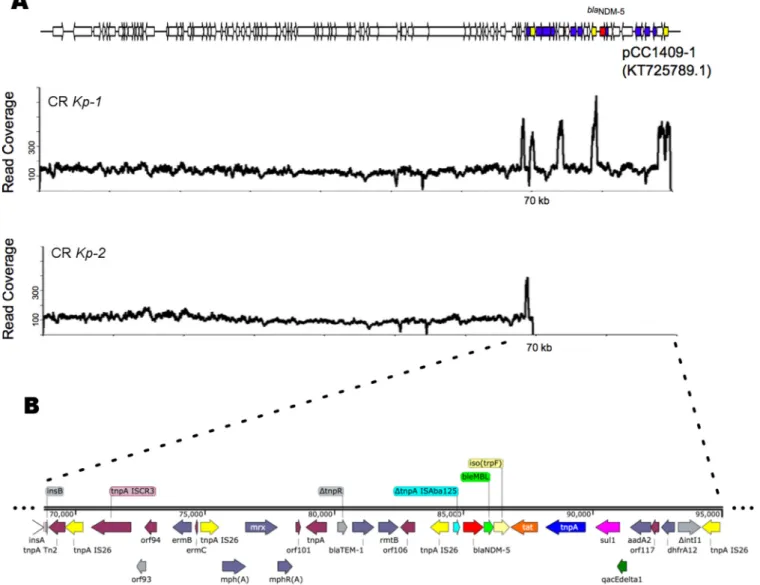
Draft whole-genome sequences were obtained from Illumina paired-end reads. Use of ResFinder (https://cge.cbs.dtu.dk/services/ResFinder/) with assemblies as input con-firmed that CRKp-2 possesses a resistome smaller than that of CRKp-1 (Table 2) (22). Likewise, BLAST revealed that for CRKp-1,blaNDM-5was localized on an IncFII plasmid of⬇90 kb (99% similarity with pCC1409, ablaNDM-5-harboring IncFII plasmid from aK.
pneumoniae ST147 isolated in Poland;KT725789.1) (Fig. 1A). Interestingly, this same plasmid was present in CRKp-2; however, it was slightly smaller due to the loss of an ⬇25-kb region, including not onlyblaNDM-5but also several other resistance determi-nants (e.g.,blaTEM-1,mphA,ermB,dfrA12,aadA2, andrmtB) (Fig. 1A). ISFinder (https:// www-is.biotoul.fr) showed the presence of multiple transposable elements, including IS26, distributed along the above-mentioned region (Fig. 1B) (23). Of note, the finding ofrmtBis manifested by the difference in susceptibility to aminoglycosides (256 versus 2 mg/liter) (Table 1). In addition, the presence of numerous resistance determinants may indicate that this is a “hot-spot region.” Given the replicative transposition mech-anism of IS26and its previously shown critical role in the mobilization and reorgani-zation of antibiotic resistance genes in Gram-negative bacteria, we hypothesize that the excision of this region might have been aided by IS26(24, 25).
ISEcp1 was identified upstream of blaOXA-181, as previously described (18); I-CeuI PFGE and probe hybridization suggested that this carbapenemase was chromosomally located in both clinical strains. Interestingly, transformation experiments revealed that
blaOXA-181 was also carried by a plasmid on the CRKp-2 E. colitransformant, which, based on size and IncFII probe hybridization, is the same plasmid that lost the above-mentioned⬇25-kbblaNDM-5-harboring region. This might indicate a transposi-tion event aided by the flanking ISEcp1 accompanying this gene, highlighting the plasticity of this plasmid to incorporate or lose genes (Fig. S1 and S2 in the supple-mental material).
In the United States,blaNDMhas been circulating since 2010 (26), whereasblaOXA-48 was imported in 2012 by patients who were initially hospitalized in Saudi Arabia and India (27). The rapid and widespread dissemination ofblaOXA-181throughout Southeast Asia, the recent finding of blaOXA-181 (associated with the ISEcp1 mobile genetic element) in the chromosome of a wastewater Shewanella xiamenensisisolate (28), and
TABLE 2Resistome of CRKp-1 and CRKp-2
Strain
Genome size (bp)
No. of
contigs Resistance determinants
CRKp-1 5,608,317 87 oqxA,oqxB,blaSHV-11,fosA,rmtF,aacA4,aac(6=)Ib-cr,qnrB12,dfrA14,blaOXA-181,ARR-2,blaCTX-M-15,mph(A),sul1,
erm(B),dfrA12,aadA2,rmtB,blaTEM-1,blaNDM-5
the recognition that most cases outside of this area of the world are from patients that had a recent travel history to Southeast Asia and the Asian Pacific region suggest that this is the likely place of origin for blaOXA-181 and an important reservoir of this carbapenemase gene. Multilocus sequence typing (MLST) (http:// www.pasteur.fr/recherche/genopole/PF8/mlst/Kpneumoniae.html) revealed that CR
Kp-1 and CRKp-2 both belong to ST147. AK. pneumoniaeisolate belonging to the same ST type (ST147) and carrying an IncFII plasmid with blaOXA-181 and blaNDM-5 was previously reported in South Korea from a patient transferred from a tertiary care hospital in Abu Dhabi, United Arab Emirates (29). However, the first report of a K. pneumoniaeisolate harboringblaOXA-181andblaNDM-5occurred in Singapore in 2013 and was isolated from the urine of a patient that was transferred from Bangladesh (16). Another isolate harboring both carbapenemase genes was described in Egypt; how-ever, it was anE. colithat carried each gene on a different plasmid (30). In the United States, aK. pneumoniaeisolate carryingblaNDM-1andblaOXA-232was reported in another patient transferred from India (31). However, blaNDM-5 and blaOXA-181 have been reported only once before in the same patient but in differentE. coliisolates (32).
In summary we describe the occurrence of two clinically important carbapenemases (the “evil twins”),blaOXA-181(chromosomally encoded) andblaNDM-5(plasmid encoded),
FIG 1(A) Coverage of Illumina reads fromK. pneumoniaeisolates CRKp-1 and CRKp-2 mapped using Bowtie2 (33) across the reference IncFII plasmid pCC1409 (KT725789.1). (B) Organization of the 25-kbblaNDM-5-containing region of the IncFII plasmid present only in CRKp-1. This entire region was excised out of the
in a carbapenem-resistantK. pneumoniaeclinical isolate in the United States. Our results also underscore the ability of ceftazidime/avibactam to indicate the presence of metallo-beta-lactamases when carbapenem-resistant isolates show resistance to this combination. These findings underscore the importance of molecular surveillance programs such as CRACKLE that characterize resistant strains and highlight the emer-gence of novel genotypes in the United States.
Accession number(s).The nucleotide sequence of the draft genomes for CRKp-1
(1699_2676) and CR Kp-2 (1699_2677) were deposited in GenBank under accession numbersNZ_MPYK00000000.1andNZ_MPYL00000000.1, respectively.
SUPPLEMENTAL MATERIAL
Supplemental material for this article may be found athttps://doi.org/10.1128/AAC .00454-17.
SUPPLEMENTAL FILE 1,PDF file, 0.1 MB.
ACKNOWLEDGMENTS
Research reported in this publication was supported in whole or in part by the National Institute of Allergy and Infectious Diseases of the National Institutes of Health (award numbers R01AI100560, R01AI063517, and R01AI072219 to R.A.B.; UM1AI104681 and R21AI114508 to R.A.B. and D.V.D.; and U19AI110819 to J.C.V.I.). This study was supported in part by funds and/or facilities provided by the Cleveland Department of Veterans Affairs (award number 1I01BX001974 to R.A.B.) from the Biomedical Laboratory Research & Development Service of the VA Office of Research and Development and the Geriatric Research Education and Clinical Center VISN 10 (to R.A.B). F.P. is supported by the Clinical and Translational Science Collaborative of Cleveland (award number UL1TR000439).
REFERENCES
1. Munoz-Price LS, Poirel L, Bonomo RA, Schwaber MJ, Daikos GL, Cormican M, Cornaglia G, Garau J, Gniadkowski M, Hayden MK, Kumarasamy K, Livermore DM, Maya JJ, Nordmann P, Patel JB, Pat-erson DL, Pitout J, Villegas MV, Wang H, Woodford N, Quinn JP. 2013. Clinical epidemiology of the global expansion of Klebsiella pneu-moniaecarbapenemases. Lancet Infect Dis 13:785–796.https://doi .org/10.1016/S1473-3099(13)70190-7.
2. van Duin D, Perez F, Rudin SD, Cober E, Hanrahan J, Ziegler J, Webber R, Fox J, Mason P, Richter SS. 2014. Surveillance of carbapenem-resistant
Klebsiella pneumoniae: tracking molecular epidemiology and outcomes through a regional network. Antimicrob Agents Chemother 58: 4035– 4041.https://doi.org/10.1128/AAC.02636-14.
3. Yong D, Toleman MA, Giske CG, Cho HS, Sundman K, Lee K, Walsh TR. 2009. Characterization of a new metallo--lactamase gene,blaNDM-1,
and a novel erythromycin esterase gene carried on a unique genetic structure in Klebsiella pneumoniae sequence type 14 from India. Antimicrob Agents Chemother 53:5046 –5054. https://doi.org/10 .1128/AAC.00774-09.
4. Mojica MF, Bonomo RA, Fast W. 2016. B1-Metallo--lactamases: where do we stand? Curr Drug Targets 17:1029 –1050.https://doi.org/10.2174/ 1389450116666151001105622.
5. Hornsey M, Phee L, Wareham DW. 2011. A novel variant, NDM-5, of the New Delhi metallo--lactamase in a multidrug-resistantEscherichia coli
ST648 isolate recovered from a patient in the United Kingdom. Antimi-crob Agents Chemother 55:5952–5954. https://doi.org/10.1128/AAC .05108-11.
6. Pitart C, Solé M, Roca I, Román A, Moreno A, Vila J, Marco F. 2015. Molecular characterization ofblaNDM-5carried on an IncFII plasmid in an Escherichia coliisolate from a nontraveler patient in Spain. Antimicrob Agents Chemother 59:659 – 662.https://doi.org/10.1128/AAC.04040-14. 7. Sassi A, Loucif L, Gupta SK, Dekhil M, Chettibi H, Rolain J-M. 2014. NDM-5 carbapenemase-encoding gene in multidrug-resistant clinical isolates of
Escherichia coli from Algeria. Antimicrob Agents Chemother 58: 5606 –5608.https://doi.org/10.1128/AAC.02818-13.
8. Soliman AM, Khalifa HO, Ahmed AM, Shimamoto T, Shimamoto T. 2016. Emergence of an NDM-5-producing clinicalEscherichia coliisolate in
Egypt. Int J Infect Dis 48:46 – 48.https://doi.org/10.1016/j.ijid.2016.05 .003.
9. Wailan AM, Paterson DL, Caffery M, Sowden D, Sidjabat HE. 2015. Draft genome sequence of NDM-5-producingEscherichia colisequence type 648 and genetic context of blaNDM-5 in Australia. Genome Announc
3:e00194-15.https://doi.org/10.1128/genomeA.00194-15.
10. Zhu YQ, Zhao JY, Xu C, Zhao H, Jia N, Li YN. 2016. Identification of an NDM-5-producing Escherichia colisequence type 167 in a neonatal patient in China. Sci Rep 6:29934.https://doi.org/10.1038/srep29934. 11. Poirel L, Héritier C, Tolün V, Nordmann P. 2004. Emergence of
oxacillinase-mediated resistance to imipenem inKlebsiella pneumoniae. Antimicrob Agents Chemother 48:15–22.https://doi.org/10.1128/AAC .48.1.15-22.2004.
12. Albiger B, Glasner C, Struelens MJ, Grundmann H, Monnet DL. 2015. Carbapenemase-producing Enterobacteriaceae in Europe: assessment by national experts from 38 countries, May 2015. Euro Surveill 20(45). http://www.eurosurveillance.org/ViewArticle.aspx?ArticleId⫽21300. 13. Carrër A, Poirel L, Eraksoy H, Cagatay AA, Badur S, Nordmann P. 2008.
Spread of OXA-48-positive carbapenem-resistantKlebsiella pneumoniae iso-lates in Istanbul, Turkey. Antimicrob Agents Chemother 52:2950 –2954. https://doi.org/10.1128/AAC.01672-07.
14. Girmenia C, Serrao A, Canichella M. 2016. Epidemiology of carbapenem resistantKlebsiella pneumoniaeinfections in Mediterranean countries. Medi-terr J Hematol Infect Dis 8:e2016032.https://doi.org/10.4084/MJHID.2016 .032.
15. Castanheira M, Deshpande LM, Mathai D, Bell JM, Jones RN, Mendes RE. 2011. Early dissemination of NDM-1-and OXA-181-producing Enterobac-teriaceae in Indian hospitals: report from the SENTRY Antimicrobial Surveillance Program, 2006-2007. Antimicrob Agents Chemother 55: 1274 –1278.https://doi.org/10.1128/AAC.01497-10.
16. Balm MND, La MV, Krishnan P, Jureen R, Lin RTP, Teo JWP. 2013. Emergence of co-producing NDM-type and OXA-181 carbapenemases. Clin Microbiol Infect 19:E421–E423.https://doi.org/10.1111/1469-0691 .12247.
pneumoniaefrom Sri Lanka. J Med Microbiol 63:1087–1092.https://doi .org/10.1099/jmm.0.076760-0.
18. Poirel L, Potron A, Nordmann P. 2012. OXA-48-like carbapenemases: the phantom menace. J Antimicrob Chemother 67:1597–1606.https://doi .org/10.1093/jac/dks121.
19. Heringa SD, Monroe JD, Herrick JB. 24 October 2007. A simple, rapid method for extracting large plasmid DNA from bacteria. Nature Preced-ings.http://precedings.nature.com/documents/1249/version/1. 20. Barton BM, Harding GP, Zuccarelli AJ. 1995. A general method for
detecting and sizing large plasmids. Anal Biochem 226:235–240.https:// doi.org/10.1006/abio.1995.1220.
21. Liu S-L, Hessel A, Sanderson KE. 1993. Genomic mapping withI-Ceu I, an intron-encoded endonuclease specific for genes for ribosomal RNA, in
Salmonella spp.,Escherichia coli, and other bacteria. Proc Natl Acad Sci U S A 90:6874 – 6878.https://doi.org/10.1073/pnas.90.14.6874. 22. Zankari E, Hasman H, Cosentino S, Vestergaard M, Rasmussen S, Lund O,
Aarestrup FM, Larsen MV. 2012. Identification of acquired antimicrobial resistance genes. J Antimicrob Chemother 67:2640 –2644. https://doi .org/10.1093/jac/dks261.
23. Siguier P, Pérochon J, Lestrade L, Mahillon J, Chandler M. 2006. ISfinder: the reference centre for bacterial insertion sequences. Nucleic Acids Res 34:D32–D36.https://doi.org/10.1093/nar/gkj014.
24. Harmer CJ, Moran RA, Hall RM. 2014. Movement of IS26-associated antibiotic resistance genes occurs via a translocatable unit that includes a single IS26and preferentially inserts adjacent to another IS26. mBio 5:e01801-14.https://doi.org/10.1128/mBio.01801-14.
25. He S, Hickman AB, Varani AM, Siguier P, Chandler M, Dekker JP, Dyda F. 2015. Insertion sequence IS26reorganizes plasmids in clinically isolated multidrug-resistant bacteria by replicative transposition. mBio 6:e00762 -15.https://doi.org/10.1128/mBio.00762-15.
26. Centers for Disease Control and Prevention. 2010. Detection of Entero-bacteriaceae isolates carrying metallo-beta-lactamase—United States, 2010. MMWR Morbid Mortal Weekly Rep 59:750.
27. Mathers AJ, Hazen KC, Carroll J, Yeh AJ, Cox HL, Bonomo RA, Sifri CD. 2013. First clinical cases of OXA-48-producing carbapenem-resistant
Klebsiella pneumoniaein the United States: the “menace” arrives in the New World. J Clin Microbiol 51:680 – 683.https://doi.org/10.1128/JCM .02580-12.
28. Potron A, Poirel L, Nordmann P. 2011. Origin of OXA-181, an emerging carbapenem-hydrolyzing oxacillinase, as a chromosomal gene in She-wanella xiamenensis. Antimicrob Agents Chemother 55:4405– 4407. https://doi.org/10.1128/AAC.00681-11.
29. Cho SY, Huh HJ, Baek JY, Chung NY, Ryu JG, Ki C-S, Chung DR, Lee NY, Song J-H. 2015.Klebsiella pneumoniaeco-producing NDM-5 and OXA-181 carbapenemases, South Korea. Emerg Infect Dis 21:1088 –1089. https://doi.org/10.3201/eid2106.150048.
30. Gamal D, Fernandez-Martinez M, El-Defrawy I, Ocampo-Sosa AA, Martinez-Martinez L. 2016. First identification of NDM-5 associated with OXA-181 inEscherichia coli from Egypt. Emerg Microb Infect 5:e30. https://doi.org/10.1038/emi.2016.24.
31. Doi Y. 2014. Co-production of NDM-1 and OXA-232 byKlebsiella pneu-moniae. Emerg Infect Dis 20:163–165.https://doi.org/10.3201/eid2001 .130904.
32. Hasassri ME, Boyce TG, Norgan A, Cunningham SA, Jeraldo PR, Weissman S, Patel R, Banerjee R, Pogue JM, Kaye KS. 2016. An immunocompro-mised child with bloodstream infection caused by twoEscherichia coli
strains, one harboring NDM-5 and the other harboring OXA-48-like carbapenemase. Antimicrob Agents Chemother 60:3270 –3275.https:// doi.org/10.1128/AAC.03118-15.