RELATIONSHIPS BETWEEN SUB-CLINICAL AUTISTIC TRAITS, COGNITIVE SUBSTRATES, AND SOCIAL FUNCTIONING IN A TYPICALLY DEVELOPING
COLLEGE SAMPLE
Timothy D. Perry
A dissertation submitted to the faculty at the University of North Carolina at Chapel Hill in partial fulfillment of the Doctor of Philosophy degree in Clinical Psychology.
Chapel Hill 2013
Approved by: David L. Penn
Gary B. Mesibov Mitchell J. Prinstein J. Steven Reznick
iii
ABSTRACT
Timothy D. Perry: Relationships between sub-clinical autistic traits, cognitive substrates, and social functioning in a typically developing college sample
(Under the direction of David L. Penn, Ph.D)
The continuum theory of autism argues that the behavioral traits associated with the disorder are normally distributed throughout the population. Studies suggest that these traits can be reliably measured in first-degree relatives of individuals with autism and, more recently, in individuals in the general population. What remains unclear, however, is whether these traits in the general population are associated with similar cognitive and social profiles as those observed in autism. The current study examined associations between autistic traits, cognitive substrates, and social functioning in a group of typically developing college students. Sixty-seven undergraduate participants were recruited to complete self-report measures of autistic traits and social
iv
TABLE OF CONTENTS
LIST OF TABLES………..…vi
LIST OF FIGURES………...…....vii
CHAPTER 1: INTRODUCTION……….……….……1
A General Overview………1
Background and Significance………..……3
The Autistic Triad of Deficits……….7
Cognitive Theories of Autism………12
Theory of Mind………..…13
Executive Dysfunction………...…18
Weak Central Coherence………...22
Autistic Cognitive Substrates in Typically Developing Samples………..28
Goals of the Current Study………30
Aims and Hypotheses………30
CHAPTER 2: METHODS……….…33
Participants and Procedure……….33
Measures………34
CHAPTER 3: RESULTS………...40
Preliminary Analyses……….40
v
CHAPTER 4: DISCUSSION……….……46
Study Limitations and Directions for Future Research………..49
APPENDIX 1: DATA TABLES AND FIGURES………...…52
APPENDIX 2: DATA TABLES AND FIGURES………...58
vi
LIST OF TABLES
vii
LIST OF FIGURES
1. Figure 1: Predicted model………..………56
1
CHAPTER 1: INTRODUCTION A General Overview
The primary aim of this dissertation is to investigate relationships among
subclinical autistic traits, cognitive substrates related to autism, and social outcomes in a group of typically developing young adults. Autism Spectrum Disorders (ASDs) are increasingly conceptualized as part of a spectrum of severity with the disorder on one end and normal functioning on the other (Constantino & Todd, 2003; Posserud, 2006). Additionally, sub-clinical autistic traits have been ascribed to individuals who do not meet diagnostic criteria for the disorder in relatives of individuals with autism (Bolton et al., 1994; Piven et al., 1997) and, more recently, among individuals in the general
population (Austin, 2005; Hoekstra, Bartels, Verweij, & Boomsa, 2007; Hurst et al., 2007).
2
and communication domains are closely related in individuals with autism, the RRBI domain is fairly independent of these domains (Mandy & Skuse, 2008). Similar findings in typically developing samples would support the idea of the autism continuum.
Another important unanswered question involves the extent to which autistic traits in non-autistic individuals are associated with the same underlying cognitive substrates and social deficits as those seen in autism. Theory of mind (ToM), executive dysfunction (EF), and weak central coherence (WCC) have each been proposed as cognitive
substrates which underlie autistic symptoms (Rajendran & Mitchell, 2007). Studies examining these factors in typically developing samples have produced conflicting results (Best, Moffat, Power, Owens, Johnstone, 2008; Kunihira, Senju, Dairoku, Wakabayashi, & Hasegawa, 2006). This inconsistency may be due, in part, to sample characteristics (disability status) and measurement issues (insufficient sensitivity). Similarly,
impairments of social functioning are a hallmark feature of ASDs at both high and low functioning levels. But these impairments have not been consistently found among non-autistic individuals with non-autistic traits. The continuum theory of autism would predict that these deficits will also be apparent, in milder forms, in typically developing
individuals with autistic traits. Further, it would predict that the relationship between the cognitive substrates and social functioning will be partially mediated by autistic
symptoms. Findings suggesting similar, but attenuated, underlying cognitive substrates and social impairments among those with sub-clinical autistic traits are supportive of the continuum hypothesis of autism. Those suggesting differing patterns support the
3
In the following literature review, I will first discuss autism as a diagnostic
category and the continuum theory of autism. Next, I will examine the symptom domains of autism and evidence of autistic traits among typically developing individuals.
Following this discussion, I will outline the three dominant cognitive theories of autism (ToM, EF, and WCC) and discuss their relationship to autistic symptoms and social functioning. This dissertation aims to extend previous research by employing a path analytic model to investigate the pattern of relationships between autistic symptom domains, cognitive substrates, and social functioning in a college sample, examining autistic symptom domains, and by using multiple measures with sufficient sensitivity to detect subtle individual differences.
Background and Significance
Autism is a neuro-developmental disorder characterized by impairment in the domains of social interaction and communication as well as restricted interests and repetitive behaviors (APA, 2000). These impairments were first noted by Kanner (1943) when he described children with pronounced difficulties in social interaction and
problems with emotional expression and recognition. Since that time, numerous studies have sought to characterize autistic traits and their relationships to social outcomes. These traits have been linked to difficulties in independent living (Tantam, 1991), psychiatric dysfunction (Green, Gilchrist, Burton, & Cox, 2000), social isolation, and peer rejection (Orsmond, Krauss, & Seltzer, 2004).
Since Kanner’s initial description, recognition of the diverse clinical
4
relations, narrow interests, irregular eye gaze). These children also differed in important ways from those in Kanner’s group. The children Asperger described had average to above average cognitive abilities and were less impaired in terms of adaptive and social functioning than those described by Kanner. Also, notably, Asperger described the children he observed as “little professors” due to their pedantic style and precocious use of speech. This characterization is in stark contrast to Kanner’s observations of language deficits (Mesibov, Shea, & Adams, 2001). Asperger’s writings were not translated into English, however, until 1991 by Frith. With their publication and other work by Wing (1986) explicating the disorder, came increased interest in the concept of the autistic spectrum. Asperger’s Disorder was subsequently added to the Diagnostic and Statistical Manual, Fourth Edition (DSM-IV) in 1994 alongside the previously identified Autistic Disorder (APA, 2000). Though these conditions appear dissimilar in many ways, they are understood as part of a spectrum of autistic disturbance ranging from near normal
functioning to severe impairment. Upcoming changes to diagnostic criteria with the introduction of the DSM-V appear to reflect recognition of the broad spectrum of severity of autistic symptoms. These changes include removal of Asperger’s disorder as a
separate diagnosis in favor of the umbrella diagnosis of Autism Spectrum Disorder along with ratings of impairment severity (APA, 2013). This shift from categorical
conceptualization to dimensional understanding is consistent with the continuum theory of autism.
5
personality characteristics and subclinical symptoms often found in first degree relatives of individuals with ASD which represent a genetic liability for the disorder (Piven, Palmer, Jacobi, Childress, & Arndt, 1997). The original work on the BAP found that up to 20% of siblings of individuals with autism exhibited a deficit in one or more core areas associated with ASD (social interaction, communication, and restricted and repetitive behaviors) (Bolton et al. 1994). Subsequent studies of family members have suggested that the BAP is associated with specific personality features, such as rigidity, aloofness, and anxiety (Murphy et al. 2000), interpersonal difficulties, such as deficits in the number and quality of friendships (Grinter, et al., 2001), pragmatic language deficits (Landa et al. 1992), and cognitive deficits, such as impaired executive functioning (Hughes, Leboyer, & Bouvard, 1997; Ozonoff , Rogers, Farnham, & Pennington, 1993) and systemizing strength (Grinter, et al., 2001).
Recent studies have proposed that the BAP is not restricted to family members of individuals with autism, and that autistic behavioral traits are normally distributed in the general population (Hoekstra et al., 2007; Hurst et al., 2007). Constantino and Todd (2003) administered the Social Responsiveness Scale (SRS) to the parents of 788 typically developing pairs of twins between the ages of 7 and 15. This study concluded that autistic traits were continuously distributed in this group. Levels of severity ranged from zero traits to levels comparable to clinical cutoffs. Similarly, Posserud (2006) administered teacher and parent report forms of the Autism Spectrum Screening
Questionnaire (ASSQ) in a population study of 7 to 9 year-old children. They found that these scores were “almost continuous” and classified 2.7% of the children as
6
Evidence of autistic traits in the general population has also come from studies using self-report measures. Austin (2005) examined personality correlates among a group of undergraduate college students using the Big Five Personality Inventory and the Autism Spectrum Quotient (AQ) (Baron-Cohen et al., 2001). This study found that people who endorsed a high level of autistic traits also scored highly on Neuroticism and Introversion, and tended to receive low scores on the Agreeableness scale. Austin (2005) suggests that these personality traits map on to the autistic characteristics of anxiety, rigidity, and social withdrawal. Ingersoll (2010) administered the AQ to 106
undergraduate students and found an association between autistic traits and the ability to interpret non-verbal behavior as measured by the Diagnostic Analysis of Nonverbal Accuracy (DANVA2) and the Test of Nonverbal Cue Knowledge (TONCK). This study found AQ scores ranging from 7-30 (out of 50) which is consistent with previous studies in college populations (Baron-Cohen, et al. 2001).
The recent focus on autistic traits in the general population has produced intriguing findings regarding the nature of autistic impairment, but has not done so without controversy. The concept of the BAP in relatives of individuals with autism proceeds from the assumption that these individuals share autistic traits with relatives due to a common genetic origin and has stimulated research into the genetic causes of autism. Many studies of the BAP also categorize individuals into groups “with” and “without” the BAP based on cut-off scores on measures of autistic traits. This characterization is at odds with the continuum theory and, rather, implies that autism is a condition
7
individuals provides an opportunity to gain insight into the nature of the disorder as well as normal development.
The Autistic Triad of Deficits
Although autism is considered to be one of the most heritable of the psychological
disorders, the lack of a viable single gene explanation suggests that separate genes may
be responsible for different autistic symptoms (Happe & Ronald, 2007). These social,
communication, and behavioral symptoms may, in turn, have different neural and
cognitive causes. Researchers have studied the extent of interrelation among these
domains in samples with and without autism.
The idea that autistic symptom domains may have unique and independent
determinants has existed in autism research for some time. Wing (1971) discussed the
difficulty of attributing these disparate symptoms to a single abnormality. Rather, she
advocated explaining autism as the result of multiple impairments and suggested some
individuals might only meet criteria for the disorder in one symptom domain. Similarly,
Goodman (1989) and Bishop (1989) reported observations that children without an
autism diagnosis frequently showed one or more symptom of autism. These examples
notwithstanding, the predominant view has supported the idea that one of the most
important goals of autism research is the search for genes responsible for susceptibility in
all three domains.
A number of factor analytic studies have attempted to characterize the
dimensional structure of ASD symptoms using samples with autism. Although the
majority of studies have found strong relationships between social and communication
8
Ronald, 2007). Many studies have combined the social and communication domains to
form one “social factor” and termed the behavioral domain a “non-social factor.”
Mundy and Skuse (2008) reviewed seven studies and found that all but one observed
evidence for multiple factors underlying autistic behaviors, and all produced a social
impairment factor and a nonsocial factor. Tanguay, Robertson, and Derrick (1998)
examined the triad in a group of children with Pervasive Developmental Disorder, Not
Otherwise Specified (PDD-NOS) and found that nearly all displayed social and
communication impairments, but few demonstrated non-social symptoms (RRBIs).
Silverman et al. (2002) also found that RRBIs do not cluster with social and
communication impairments and this finding has been replicated by a number of other
studies using both informant rated and self-report measures (Austin, 2005; Constantino et al., 2004; Georgiades et al., 2007; Lecavalier, 2005; Miranda-Linne & Melin, 2002 Tadevosyan-Leyfer et al., 2003; van Lang et al., 2006).
Although using samples comprised of individuals with autism to investigate these
domains is beneficial in some regards, it also has disadvantages. An advantage of using
clinical ASD samples to study the structure of autistic symptom domains is that their face
validity is not questioned. In contrast, when studying general population samples, even
with a reliable and valid measure of autistic behaviors, one question often raised is how
the data actually relate to clinical ASD. Nevertheless, the restricted variance in narrowly
defined clinical samples, and the circularity of investigating the relationship between the
triad of impairments in a sample of individuals who, by definition, show all three
difficulties, suggests that non-clinical samples should be employed to study the autistic
9
One of the earliest and most influential studies suggesting the independence or
“fractionability” of the autism symptom domains with a non-autistic sample was
conducted by Wing and Gould (1979). This study, with a sample collected from a
psychiatric and mental retardation registry, investigated the prevalence of the triad of
impairments and the extent to which they co-occur. Participants were a clinical sample
of children chosen from an epidemiological study. Of 914 children, 132 were selected
because they showed impairment in at least one domain or were severely intellectually
impaired. The authors assessed the children using observations and interviews with
teachers, care staff, and parents and categorized children based on the presence or
absence of specific social, communication, and RRBI features. Comparisons were made
between those with and without any type of social impairment, and between those with
and without a social abnormality meeting autism criteria. The authors reported evidence
of a tendency for these problems to occur together. For example, of 74 children with any
social impairment, 55% also had no symbolic activities, 55% had no speech, and 72%
had only repetitive interest patterns; the results indicated a clustering of the triad. By
comparison, the percentages for the sociable children with intellectual disability were
10%, 33%, and 7%, respectively.
Comparisons across groups formed on the basis of type of social impairment
found social aloofness was most commonly associated with language impairments and
RRBIs; 89% of the socially aloof had no speech and all (N=37) had no symbolic play and
only repetitive interest patterns. Some children with passive interaction and active but
odd interaction also showed language problems and RRBIs, but the overlap was not
10
children were not limited to repetitive interest patterns, and had constructive and
repetitive interest patterns, and most (82–85%) did not show elaborate repetitive routines,
that is, they had social impairments but fewer RRBIs. Also, 29–50% of the socially
passive and socially odd children had no echolalia and a majority (65– 94%) had speech,
(i.e., social impairments but fewer language problems). Four children showed repetitive
interest patterns and had severe intellectual disability, but had appropriate social
interaction (i.e., RRBIs but no social impairments). In short, some children showed social
impairments (passive or odd interaction) but not RRBIs, and vice-versa. This study’s
goal was to investigate the extent to which the behaviors described by Kanner clustered
together in a clinical, but non-autistic sample, using a systematic approach. There was
evidence for substantial clustering of social impairments, communication impairments,
and RRBIs, particularly when social aloofness was the social impairment. However, the
study also clearly documented that some children had only certain aspects of the autism
phenotype, and not others.
Another important consideration related to the findings from this study involves
the broadening understanding of autism. Interpretation of these findings nearly 30 years
after this study is limited by changes in definition and criteria for ASDs. The working
definition for autism at the time of this study was quite narrow by current standards, and
Wing has since suggested that there are no clear divisions between Kanner’s autism and
the other subgroups, and that these should all be considered within the concept of the
triad of impairments (Wing, 1981). The study was also limited by relatively small
numbers of children, especially when divided into subgroups. In addition, and perhaps
11
(Caron & Rutter, 1991). It is possible that some of the participants would, today, be
diagnosed with High-Functioning Autism, PDD-NOS, or Asperger’s Disorder as those
classifications were used less frequently or nonexistent at the time of the study.
Furthermore, almost one fourth of the 900 children originally screened had at least one of
the problems assessed by the interview schedule (Wing et al., 1976). In most cases, the
authors decided that the problem was atypical for autism and the child was excluded.
Although some of these children would now be diagnosed with an ASD, at that time
impairments had to be more severe to reach the diagnostic threshold. These limitations
suggest that it would be useful to explore this research question again with heterogeneous
ASD and non-ASD samples.
Recent studies have also investigated the fractionability of the autistic triad in
12
provide compelling evidence of the independence of social and non-social autistic traits, they have been criticized on the basis of the poor psychometric properties of the measures (LeCavalier, et al, 2009; Mandy & Skuse, 2008). More research is needed with
community samples employing more established and psychometrically sound measures of autistic traits.
The studies outlined above point to the need to continue investigating the
clustering of autism symptom domains. Additionally, homogenous non-clinical samples
may provide useful insight in the nature of autism as well as typical development. A
commonly cited shortcoming of treatments developed for individuals with autism is that
they fail to address the varied needs of individuals with ASD diagnoses (Bauminger,
2002). Gaining a better understanding of autistic subtypes based on symptom domains,
may allow for more targeted and effective treatments. Also, these treatments may also
benefit individuals without an ASD diagnosis who have impairments in one of the
symptom domains. To design these treatments, though, will also require an improved
understanding of what underlies these difficulties. Thus, determining the cognitive
substrates related to social and communication impairment and RRBI’s is also a worthy
research goal.
Cognitive Theories of Autism
13
years: The theory of mind hypothesis, the theory of executive dysfunction, and the theory of weak central coherence. These theories and research findings with samples with autism and first-degree relatives of individuals with autism are described below. Limitations of the theories with regard to explaining social and non-social autistic symptoms are also discussed. Following this discussion, research findings with non-clinical samples is presented.
Theory of Mind
ToM has been defined as the ability to attribute mental states (thoughts, feelings, beliefs, etc.) to oneself and others (Premack & Woodruff, 1978). It also involves an understanding that the mental states of others can be different from one’s own and the ability to use this understanding to predict behavior (Leslie, 1991). Research
14
functioning. They proposed ToM as such a cognitive mechanism due to the demonstrated relationship between ToM in children and imaginative play.
The capacity for imaginative or pretend play depends, in part, on the ability to form second order meta-representations. Research suggests that this ability begins to develop for typically developing children in the second year of life. This time period corresponds with the development of interest in imaginative play and also corresponds with early reports of atypical behavior in cases of autism (Begeer, Rieffe, Terwogt, & Stockman, 2003). To provide support for a ToM hypothesis of autism, Baron-Cohen and colleagues administered a false belief task assessing ToM skills to children divided into three groups. The first group was composed of 20 children with autism and average to above IQ scores. The second group was composed of 14 children with Down’s
15
with autism strategies to correctly respond to the prompts given in these tasks. They observed that the children were able to learn the strategies, but were unable to employ them to predict mental states of characters in the stories. Aside from the lack of
generalization often seen in studies with individuals with autism, this study demonstrates the automatic nature of ToM reasoning and the extent to which this automaticity is impaired in autism. Results also suggest that this ability is difficult to teach, in part, because of its fundamental nature.
Another study used several false belief tasks to compare children with pervasive development disorder-not otherwise specified (PDD-NOS) to typically developing
children. Based on the results of this study, the authors concluded that ToM development in children with milder symptoms of autism was both delayed and abnormal in character (Serra et al., 2002). Similarly, studies have generally indicated impairment in ToM ability using indirect communication and implied meaning tasks with individuals with autism (Brent, Rios, Happe, and Charman, 2008). Kaland, Callesen, Moller-Nielsen, Mortensen, and Smith (2008) compared performance on the Strange Stories task in a group of children and adolescents with Asperger’s disorder and high-functioning autism (HFA) and a group of typically developing age matched peers. They found that the children with autism gave significantly more incorrect responses than their peers.
16
study found that the parents of children with autism were less accurate than age and IQ matched control participants. Similarly, Losh and colleagues (2009) reported ToM impairment among first-degree relatives of individuals with autism using the Eyes Task and other emotion decoding measures. Gocken, Bora, Eremis, Kesiki, and Aydin (2007) also found that parents of individuals with autism performed more poorly than controls on ToM tasks involving indirect speech. They administered the Hinting Task (Corcoran et al., 1995) to 76 parents of children with autism and 41 parents with typically
developing children. This task consists of stories in which one character hints about his or her intention rather than explicitly stating it. Participants are asked to identify the character’s intention based on the hint. Gocken et al. (2007) found that parents of children with autism were less accurate at guessing the intention than control parents. These studies point to the potential usefulness of ToM as a genetic marker for autism. They also indicate that the boundaries of the autism phenotype extend beyond clinical diagnosis.
17
employ these skills in real life social situations (e.g. Klin, Jones, Schultz, and Volkmar, 2003).
Another criticism of the ToM explanation of autism is that it does not explain some of the key features of the disorder. ToM impairment does not, for example account for the hallmark feature of autism of RRBIs (Happe, 2001: Tager-Flusberg, 2007). Researchers once suggested that RRBIs served to reduce anxiety which resulted from a lack of social understanding characterized by poor ToM abilities; but this theory appears insufficient to explain the variation among autistic the symptom profiles (Happe & Ronald, 2007). Nor does such a deficit explain the particular strengths related to autism such as superior visual-attention skills or enhanced memory abilities (Tager-Flusberg, 2001). Consequently, future research should focus more closely on sub-groups of
individuals with autism (i.e. general autism, HFA, Asperger’s Disorder) as well as groups without autism who have autistic traits, and the unique challenges and strengths
associated with these groups.
18
Tager-Flusberg, 2000), other studies have questioned the connection between ToM and social functioning. A number of studies suggest that individuals with autism who pass false belief tasks are unable to apply this understanding in real world settings (e.g., Bauminger & Kasari, 1999; Dahlen & Trillingsgaard, 1996; Howlin, 1998). Ozonoff and Miller (1995) examined the effectiveness of a social skills training group for high-functioning adolescents with autism. At post-test, they found improvements in performance on false belief tasks, but did not find improvements in parent ratings of social functioning. This result was interpreted as possible evidence that social
functioning is not related to ToM ability. Another potential interpretation, however, is that false belief tasks are not appropriate measures for high-functioning individuals. These individuals likely compensate for poor emotional understanding with intellectual ability in controlled settings, but having trouble doing so in naturalistic social interactions (Bauminger, 2002). It also suggests that these measures are inappropriate for use in BAP studies with family members or in general population samples. Consequently, additional research should be conducted using ToM tasks which mimic real world social encounters more closely than false belief tasks. Advanced ToM tasks which include indirect
language and gestures may allow for the detection of the subtle difference that exist in a typically developing sample.
Executive Dysfunction
19
symptoms of autism were similar to those associated with specific brain injury. For example, a need for sameness, a difficulty switching attention, a tendency to perseverate and a lack of impulse control are symptoms similar to those shown by individuals with what is now known as Dysexecutive Syndrome (Baddeley & Wilson, 1988). Such individuals have problems with executive function usually, but not exclusively, due to frontal lobe damage. This led some researchers (e.g., Ozonoff et al., 1991) to suggest that autism could be explained as deficit in EF.
Historically, the notion of EF comes from the analysis of the resultant damage to the Prefrontal Cortex (PFC). Recently, however, EF studies have been carried out by researchers of typical and atypical cognitive development (Zelazo & Müller, 2002). Despite EF being traditionally related to the PFC, EF is not the same as PFC function. For example, Shallice and Burgess (1991) found that some individuals with PFC damage did not show impairments in EF, while some people with damage outside the PFC do show impairments (e.g., Anderson, Damasio, Jones, & Tranel, 1991; Levisohn, Cronin-Golomb, & Schmahmann, 2000). Interestingly, the PFC is also thought by some to be a site of theory of mind abilities (Shallice, 2001; Stone, Baron-Cohen, & Knight, 1998; Stuss, Gallup, & Alexander, 2001) and, thus, may hint at a shared brain site for these functions.
20
maintenance, organized search, and coordination of thought and action. Tranel, Anderson, and Benton (1994) suggested that EF involves planning, decision-making, judgment and self-perception. In contrast, Gillberg and Coleman (2000) describe EF as all those faculties needed to work in a motivated fashion, towards a goal that may not be reached instantly.
In reviewing the EF autism literature, Hill (2004a, 2004b) divided studies into categories of EF: planning, mental/cognitive flexibility (set shifting), inhibition, generativity and self-monitoring. Hill’s review suggests that evidence for a unique deficit in autism in one of these functions seems unlikely. However, it may still be that a distinct EF profile distinguishes autism from other neurodevelopmental disorders. The search for such a profile will be a key aim in the coming years. Differentiating between disorders on the basis of EF is not made any easier because of the difficulty in isolating the specific form of EF impairment; probably because EF tests have been designed to investigate only one aspect of EF while in fact they often measure multiple executive abilities (Burgess, 1998). Hence, a key challenge facing EF research lies is in designing tests and studies that measure one aspect of EF in isolation. For example, the frequently used Wisconsin Card Sort Task is interpreted as examining cognitive flexibility through set shifting; this task has been thought to tap into just one executive process, but in fact it may draw upon several (see Zelazo, Burack, Boseovski, Jacques, & Frye, 2001).
21
administered to a group of children with autism and age and IQ matched controls. This task uses a simple grasp and place mechanism which involves planning with regard to which hand the participant uses. This task was completed more quickly by control participants than individuals with autism. Rumsey and Hamburger (1988) also reported evidence of problems with cognitive flexibility after administering the Trail Making Test (TMT) to groups of individuals with and without autism. The group with autism
completed this task requiring them to join letters and numbers in a proscribed sequence more slowly than the control group.
Impaired executive functioning has also been associated with the broader autism phenotype in studies of parents (Hughes, Leboyer, & Bouvard, 1997) and siblings (Hughes, Leboyer, & Plumet 1999) of children with autism. In one study, parents showed deficits in cognitive flexibility and fluency, and siblings only had mild reduction in non-fluency and weakness in verbal fluency (Wong, Maybery, Bishop, Maley,
&Hallmarker, 2006). Similarly, Nyden, Hagberg, Gousse, and Rastam (2011)
administered the Tower of London planning task and the TMT to 18 mothers, 18 fathers, and 50 siblings of individuals with autism and 35 matched controls. This study found evidence of executive dysfunction in planning among family members of individuals with autism relative to the control group but did not see differences in cognitive flexibility between the groups.
22
Inventory of Executive Functioning (BRIEF) to groups of typically developing individuals endorsing high and low autistic traits (groups of 66 and 28, respectively). This study found that autistic traits accounted for a significant proportion of variance in global executive functioning scores.
One obvious criticism of EF as an explanation for autistic symptoms is that it does not adequately address the social symptoms of the disorder, which are often the most debilitating. It may be that problems shifting attention and problems with cognitive flexibility underlie problems in social interactions, but these problems appear to be better accounted for by ToM abnormalities (Happe & Ronald, 2007). Because executive functioning does not appear to explicitly related to social symptoms, it has also been less thoroughly investigated with regard to social functioning than ToM in autism. In other populations, however, poor social functioning does appear to be related to impaired executive functioning (i.e., Hanks, Rapport, Millis, & Deshpande, 1999). Overall, because these two theories have been unable to account for the full autism triad,
researchers have searched for a cognitive construct, which might explain both the social and non-social aspects of the disorder.
Weak Central Coherence
23
According to this theory, individuals with autism process things in a detail-focused or piecemeal way, processing the constituent parts, rather than the global whole. The WCC theory has reinvigorated research into the perceptual abilities of individuals with autism and has the additional strength of explaining both key weaknesses and key strengths of the disorder.
The initial work on central coherence focused on perceptual processes (Mitchell & Ropar, 2004). Evidence came from studies showing that children with autism scored above average on the Children’s Embedded Figures Test (CEFT, Witkin, Oltman, Raskin, & Karp, 1971) and performed better than chronologically and mental age matched typically developing children. In the CEFT, participants are asked to locate a small target shape in a drawing of a larger everyday shape composed of potentially confusing lines. When looking at the figures, it seems as if the larger shapes are so captivating that the smaller embedded shape is hard to detect. Shah and Frith (1993) also found that participants with autism were faster at reproducing 40 different block designs than learning disabled and typically developing controls. The Block Design is a subtest of the Wechsler Intelligence Scales (e.g., WASI, WISC; Wechsler, 1999) in which the participant is asked to assemble an identical image of a 2-D picture, as fast as possible, using red and white blocks. When the pictures were pre-segmented, the controls’ performance improved to a point where the group with autism was no longer superior. Shah and Frith suggested that participants with autism perceptually segmented the
24
central coherence in the typically developing population, the salience of these smaller components is not as great as the global figure. Frith (1989, 2003) argues that individuals with autism show better performance on these tasks because they lack a cognitive drive to attend to global form; that is, they have weak central coherence.
Additional support for WCC in autism has come from their superior performance on visuospatial and perceptual tasks relative to controls. In this context, Happe (1996) made a prediction about the lack of susceptibility to visual illusions, arguing that the reason people succumb to visual illusions is that they try to integrate all parts of the illusion as they process it. In the example of the Titchener illusion, where two
comparison circles are physically identical in size, the presence of surrounding larger or smaller circles induces the misperception that the comparison circles are different in size. Happe (1996) found that participants with autism were less likely to succumb to visual illusions than other groups, arguing that individuals with autism processed parts of illusions in a piecemeal manner without integrating the comparison features with the inducing context.
Ropar and Mitchell (1999, 2001) discovered, in contrast to Happe (1996), that participants with autism were just as susceptible to visual illusions as controls. Ropar and Mitchell presented a variety of visual illusions to individuals with autism on a
25
like those of Ropar and Mitchell (1999, 2001) suggest global processing seems to be under attentional control in autism and that care needs to be taken before concluding that autistic individuals have a low-level perceptual deficit (Milne et al., 2002). Another explanation is that higher-order processing is merely optional in autism but mandatory in people without autism (Mottron, Dawson, Soulieres, Hubert, & Burack, 2006), raising the possibility that whether or not higher-order processing is triggered depends on the
wording of the question. In support of this explanation, Brosnan, Scott, Fox, and Pye (2004) reported that individuals with autism succumb to visual illusions (e.g., the Muller-Lyer illusion) when asked “which line looks longer”, but not when asked “which line is longer.”
As an alternative to WCC, Plaisted (2001) argues that perceptual processes in autism are better explained in terms of reduced generalization. Plaisted states that superior autistic performance on the Block Design and Embedded Figures Task can be explained as reduced processing of the similarities that are held between stimuli and situations. For example, in the Embedded Figures Task, the target contains some elements in common with the overall picture and features that define it. Hence, finding the target among the other patterns will be easier if the differences are more salient. The hypothesis that individuals with autism process unique features of stimuli relatively well and the common features poorly, gives rise to two complementary predictions. First, they should be better at difficult discrimination tasks in which the stimuli to be
26
difference between categories than shared category features. Support for the first prediction comes from a perceptual learning task (Plaisted, O’Riordan, & Baron-Cohen, 1998a) and a conjunctive visual search task (Plaisted, O’Riordan, & Baron-Cohen, 1998b). In the perceptual learning task, a typically developing adult group showed the perceptual learning effect: they were better at discriminating between familiar than novel stimuli. The group of adults with autism, however, did not show the perceptual learning effect and performed significantly better on the novel discrimination problem compared with the control adults. In the conjunctive search task, participants had to find a target stimulus (e.g., a red X) amongst two kinds of distracter stimuli which all shared one feature with the target (e.g., red Ts and Green Xs). Hence, the target stands out because of its combination of features; in order to find the target, participants have to be able to integrate the features. WCC theory predicts that participants with autism should be impaired on this task if they process the visual array in piecemeal and non-integrative ways, and hence should be slower at finding the target. However, the opposite was found: participants with autism were faster than typically developing individuals as predicted by Reduced Generalization theory. In support of the second prediction, that participants with autism should be poorer at a task that requires categorization of two sets of stimuli. Plaisted, O’Riordan, Aitken, and Killcross (2010) found that individuals with autism showed a deficit in initial category learning. Moreover, they found a reduced effect of categorizing according to the prototypes, that participants could induce from exposure to examples despite never having seen them before.
27
AS and fathers of children with ASD have shown a bias toward detail-focus in solving concerning visuo-spatial construction and problem solving (Baron-Cohen & Hammer, 1997; Happe et al., 2001), perceptual illusions (Happe et al., 2001), and verbal semantics (Happe et al., 2001). Parents of children with ASD performed significantly faster than parents of children with either intellectual impairment or early onset schizophrenia (Bolte & Poustka, 2006) in a test measuring local processing style, indicating weak central coherence. Briskman, Happe, and Frith (2001) administered social functioning
questionnaires to members of 22 families with a child with autism and 15 families with a child with dyslexia in a study examining central coherence. This study found that those with relatives with autism preferred non-social to social activities more often than those with children with dyslexia. This study demonstrates an association between the BAP and WCC. Further, it suggests that WCC is related to social symptoms, which
characterize autism in unaffected family members.
28
Autistic Cognitive Substrates in Typically Developing Samples
To date, only two studies have examined all three of these cognitive substrates in a typically developing sample. Kunihira, Senju, Dairoku, Wakabayashi, and Hasegawa (2006) administered the AQ to 1364 college students in Japan along with a battery of cognitive measures and personality inventories. Although the study found associations between autistic traits and obsessional personality, depression, and anxiety, there was no relationship between these traits and ToM, EF, or WCC. This finding may reflect a lack of sensitivity of the study’s measures rather than the absence of these cognitive
substrates. The study’s authors theorized that their null findings might have resulted from a combination of low variability of autistic traits in the sample and the failure of the measures they selected to detect subtle differences. For example, the study used the Eyes Test as the sole measure of ToM. This measure is reliably able to distinguish those with ASD from those not meeting diagnostic criteria; its ability to detect within group
29
Best et al. (2008) administered the Social Communication Questionnaire (SCQ) to parents of 60 individuals between the ages of 13-22. These individuals were recruited from a sample of participants at heightened risk for mental illness due to learning problems. Individuals in the study were also administered measures of ToM, EF, and WCC. Counter to findings of Kunihira et al (2006), results indicated significant associations between all three cognitive substrates and autistic traits. This study also used two measures for each of the cognitive substrates. The study used first and second-order false belief tests to measure ToM, the Block Design Test and visual illusions to assess WCC, and ambiguous figure reversal to measure cognitive flexibility (EF).
Although this battery is clearly more exhaustive than that used by Kunihira et al., it could be strengthened by the inclusion of ToM measures which approximate real world social demands and measures assessing more than one facet of each construct. Additionally, it can be argued that the sample used in this study should not be considered to be “typically developing” given their learning difficulties.
30 Goals of the Current Study
The goal of the present study is to examine the relationships between autistic symptom domains (social and non-social symptoms), cognitive substrates related to autism (ToM, EF, WCC), and social functioning in a college sample. The study aims and hypotheses are as follows:
Aims and Hypotheses
Aim 1: Examine the relationship between sample demographic characteristics and degree of autistic traits.
The first aim is to examine the relationship between specific demographic variables and autistic traits. Studies have consistently found autistic traits to be more common among males than females (Baron-Cohen et al., 2001). Additionally, among college students, those majoring in laboratory sciences and computer science have been found to endorse autistic traits at rates higher than those of humanities and social science majors. It is, therefore, hypothesized that group differences will be observed for gender and undergraduate major, with males and laboratory science and computer science majors endorsing autistic traits at higher rates than other groups. Group differences are not expected with respect to other demographic variables (race, age, and year in school) as these differences have not been detected in past research.
Aim 2: Evaluate the relationship between social and non-social autistic symptom domains.
The second aim is to evaluate the relationship between social and non-social symptoms in the college sample. Ample evidence suggests that social and
31
not to be related to non-social autistic symptoms (e.g., Happe and Ronald, 2007). The few studies that have examined this association in typically developing samples have produced similar findings, but these studies have been criticized due to the poor psychometric properties of measures used (Ronald et al, 2005, 2006). These findings point to a need for further evaluation of these relationships with psychometrically sound measures. It is hypothesized that social and communication autistic symptoms (social symptoms) will be positively associated with one another and that neither social nor communication autistic symptoms will be significantly associated with RRBI’s (non-social symptoms).
Aim 3: Evaluate associations between social and non-social autistic symptoms and cognitive substrates related to autism (ToM, EF, WCC) The third aim is to examine the associations between autistic symptom domains and cognitive substrates. Cognitive theories of autism were introduced in an attempt to explain the diverse symptoms seen in the disorder (Rajendran & Mitchell, 2007). These theories have been noted, however, for their inability to account for the full variety of autistic symptoms. The ToM hypothesis for example, appears to account for social and communication symptoms, but does not account for non-social symptoms among individuals with autism (Happe, 2001; Tager-Flusberg, 2007). Similarly, the EF
32
in typically developing individuals. Specifically, it is hypothesized that: ToM will predict social and communication symptoms; EF will predict non-social symptoms; and WCC will predict both social and non-social symptoms.
Aim 4: Evaluate relationships between autistic symptoms, cognitive substrates, and social functioning.
The fourth aim is to evaluate the relationships between social and non-social symptoms, cognitive substrates (ToM, EF, WCC), and social functioning in a typically developing sample. The cognitive substrates have each been linked with social
functioning among individuals with autism and first-degree relatives of individuals with autism (Bauminger & Kasari, 2000; Briskman, Happe, & Frith; Tager-Flusberg, 2000). If ToM, EF, and WCC are causally linked to social functioning and autistic symptoms, the symptoms should partially mediate the relationships between the cognitive substrates and social functioning. Specifically, it is hypothesized that the relationships between ToM and WCC and social functioning will be partially mediated by social autistic symptoms. Further, the relationships between WCC and EF and social functioning will be partially mediated by non-social autistic traits.
33
CHAPTER 2: METHODS Participants and Procedures
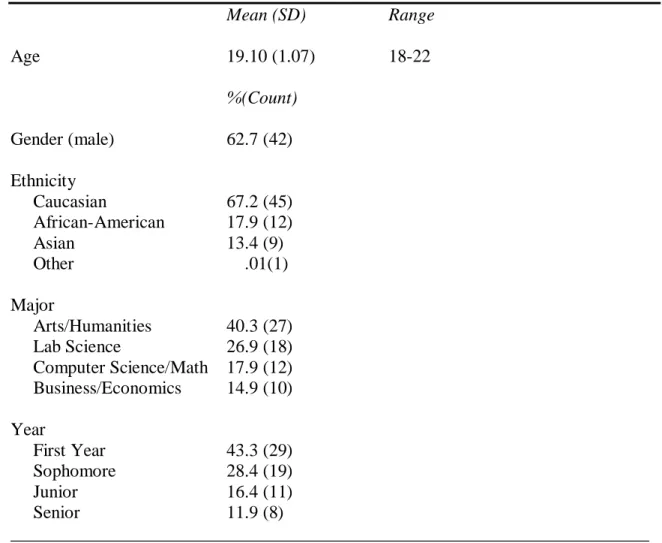
A sample of 70 undergraduate students at the University of North Carolina at Chapel Hill participated in the study. Table 1 provides sample demographic
characteristics. Participants volunteered for the study in exchange for 2 hours of research participation credit in order to fulfill course requirements for Introduction to Psychology. Targeted sampling strategies were employed to insure sufficient range of scores on measures of autistic traits given the relatively small sample size. First, participation was restricted to males during a portion of the recruitment period. Although oversampling male participants reduces the generalizability of the study, it also increases chances of recruiting participants with autistic traits, as males are approximately twice as likely to possess these traits as females (Baron-Cohen et al, 2001). Additionally, individuals majoring in mathematics, laboratory sciences (chemistry, physics, biology), and
34
Exclusion criteria for the study were: 1) history of autism spectrum disorders among participants or first-degree relatives; 2) history of schizophrenia spectrum disorders among participants or first-degree relatives; 3) Scores in the autistic range on measures of autistic traits. Two individuals were excused from further participation after positive response regarding first-degree relatives with autism. One additional
participant’s data was not included in analysis after he scored in the autistic range on the AQ. Thus, sixty seven participants were included in final analyses. Demographic data obtained from each participant included age, race, GPA, and prior mental health diagnoses of the participant and first-degree relatives.
Participants read a brief description of the study aims and exclusion criteria and were able to sign up for a time slot to participate in the study through an online research enrollment system. Upon arrival, participants completed consent forms and a
questionnaire for demographic information. A copy of the study consent forms is included in Appendix 2. Research assessments were conducted by the principal investigator and by trained undergraduate research assistants. After completing the assessments, participants were debriefed, apprised of study hypothesis, and thanked for their participation.
Measures
Autistic Traits
35
representing answers in the direction of autism. Higher scores indicate a greater
expression of the broader autism phenotype. Scores above 32 indicate likely diagnosis of ASD (Baron-Cohen, et al., 2001). The AQ has been found to have high
internal consistency and test–retest reliability in college populations (Kunihira et al., 2006) and has been found to be a sensitive and valid measure of broad autism phenotype (Bishop, et al. 2008). The AQ contains five subscales, which represent domains of autistic behavior. These subscales also map roughly onto the autistic triad of social impairments, communication deficits, and RRBIs and will be used in the current analyses. This measure is included in Appendix 2.
The Broad Autism Phenotype Questionnaire (BAPQ; Hurley, Losh, Parlier, Reznick, & Piven, 2007) is a 36-item self-report measure designed to measure characteristics associated with the BAP in adult relatives of individuals with autism. Each item is rated on a 6-point likert scale with high scores representing more autistic traits. It is unique in being designed specifically to measure the BAP based on clinical observation of BAP characteristics in parents of children with autism. The BAPQ contains three subscales, which correspond to autistic symptoms domains: aloof personality, rigid personality, and pragmatic language/mind reading. A copy of this measure is found in Appendix 2.
36 Cognitive Measures
The Hinting Task (Corcoran, 2001) is a self-report interview ToM assessment (although items are read to participants). This test contains ten short stories involving interactions between two people. Each story concludes with one of the characters
uttering at statement with implied rather than explicit meaning (a hint). The participant’s task is to determine the meaning of the hint. If not guessed correctly on the first trial, participants are given a second more direct hint about the meaning of the statement. Two points are awarded if the participant correctly deciphers the hint on the first trial. One point is awarded if the participant answers correctly after the second hint. No points are awarded if the participant is unable to determine the meaning of the hint after two trials. Performance is indexed as the total number of points with higher scores indicating better performance. The Hinting task has been found to reliably and validly index ToM abilities among typically developing young adults (Fernyhough, Jones, Whittle, Waterhouse, and Bentall, 2008). This measure is included in Appendix 2.
The Awareness of Social Inference Test (TASIT; McDonald, Flanagan, & Rollins, 2002) is a ToM assessment tool that comprises videoed vignettes of everyday situations enacted by professional actors. TASIT has three parts with alternate forms for re-testing. Part 2 will be used in this study due to its emphasis on discerning mental states of individuals during brief social interactions. This section is comprised of
15-videotaped vignettes designed to assess whether test participants are sensitive to
37
manner that implies the opposite. The total number of correct responses indexes
performance of the TASIT. Though the TASIT has not been used in samples with autism, its reliability and validity has been demonstrated with other clinical groups (McDonald, et al., 2002).
The Trail Making Test, part A and part B (TMT A, TMT B) (Reitan, 1958) was used to assess the EF domain of cognitive flexibility. In part A, the participant is asked to draw a line to connect consecutively numbered circles, and in part B to connect consecutively numbered and lettered circles alternating between the two sequences. Results are indexed by the amount of time needed for completion on each part of the measure with more time indicating poorer executive functioning skills. TMT B is one of the most widely used indices of executive functioning and excellent reliability as well as convergent validity with other measures of set shifting (Arbuthnott, 2000).
The EF domain of planning was measured using the Tower of London paradigm (Shallice, 1982). Specifically, participants are shown two pictures of rings on pegs and they have to denote how many moves of the rings will be needed in order for one picture to look like the other. Larger numbers of required moves selected denote poorer
executive (planning) functioning. Studies suggest that this task is a valid measure of planning ability and is related to constructs such as independent living among those with intellectual disability (Masson, Dagnan, & Evans, 2010).
38
indicating worse performance. This measure has demonstrated adequate internal consistency and split-half reliability and has been used in studies with individuals with autism and unaffected family members of those with autism (Panek, Funk, & Nelson, 1980).
Visuospatial WCC was measured using the Block Design Task in segmented and non-segmented conditions (Wechsler, 2008). This task asks participants to assemble an identical image of a 2-D picture, as fast as possible, using red and white blocks.
Individuals with autism have been shown to be faster than controls at constructing these patterns when presented with non-segmented stimuli. Time to completion, then, is taken as an index of piecemeal processing with shorter times suggestive of the autistic
phenotype. Although this measure has not been widely used to index visuospatial WCC, it has been used in few studies including Best and colleagues (2007). The authors of this study concluded that this measure holds promise for use in studies with typically
developing samples. Social Functioning
39
40
CHAPTER 3: RESULTS Preliminary Analyses
Power analyses were conducted to determine the sample size necessary to detect significant findings in the regression model. For regression model with two sets of predictors, these analyses indicated that, to have an 80% chance of detecting an effect size of .2 at p≤.05, a minimum sample size of 42 participants would be required (Cohen, Cohen, West, & Aiken, 2003). This effect size is comparable with those reported in similar studies such as those of Best and colleagues (2008). For the regression model with five sets of predictors, analyses indicated that, to have an 80% chance of detecting an effect size of .2 at p≤.05, a minimum sample size of 57 participants would be required. Due to relatively small sample size, the path analytic model will be considered
exploratory.
41 Primary Analyses
Aim 1
The first study hypothesis predicted that male participants would endorse autistic traits at rates higher than those reported by female participants and that participants majoring in laboratory and computer sciences would endorse autistic traits at rates higher than those of participants majoring in humanities and social sciences. Based on past research, significant group differences were not expected with regard to other
demographic variables (race, age, year in school). A series of One-Way ANOVAs were conducted to evaluate this hypothesis with demographic variables entered as independent variables with total AQ scores as independent variables.
Consistent with these predictions, significant group differences were found with regard to participant gender with male participants receiving higher scores on measures of autistic traits than women (F(2,66)=3.00; p<.05). Differences were also found with regard to major field of study (F(4,64)= 3.52; p<.05). Post hoc analysis revealed that those majoring in sciences and computer sciences endorsed higher levels of autistic traits than those majoring in the humanities (F(4, 64) =3.77; p <.05) and business (F(4,64)= 3.69; p<.05). No significant interactions were observed among these variables (See Table 3 for means by group).
Aim 2
42
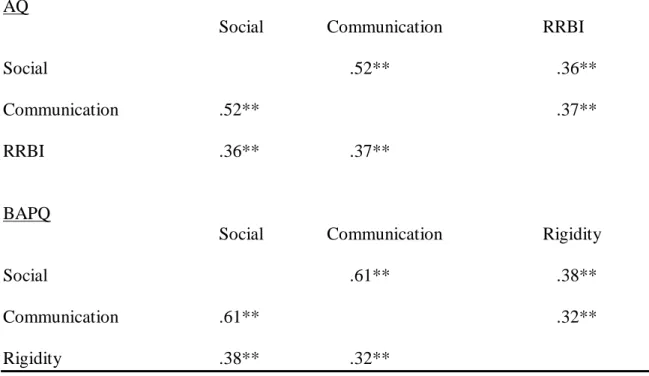
on the AQ and the BAPQ and bivariate correlations were calculated to assess association among the symptom domains. Resultant correlations are displayed in Table 4.
Consistent with expectations, significant correlations were observed between social and communication subscales on the AQ and BAPQ. Contrary to expectations, however, results also indicated significant correlations between these subscales and the non-social or RRBI scales. Specifically, on the AQ, Social and Communication subscales were significantly positively correlated with one another and were correlated with
composite RRBI subscale (Attention to Details and Attention Switching subscales). On the BAPQ, Social and Communication subscales were significantly positively correlated with one another as were the Social and Rigidity subscales, and the Communication and Rigidity subscales. This pattern of results does not support hypothesis 2 and the
fractionability of social and non-social traits.
43
another than the Social and composite RRBI subscales (t=1.36, p=.18) and Communication and RRBI subscales (t=1.28, p=.22).
Aims 3 and 4
To examine hypothesized relationships among autistic traits, cognitive substrates and social functioning while accounting for co-variation among predictors and outcomes, path analyses were conducted using full information maximum likelihood as
implemented in MPlus version 6.11 (Muthen & Muthen, 2007). Prior to testing specific study predictions, the explanatory power of the full-predicted model was tested. The chi sqaure (χ2) goodness-of-fit statistic is one of the most commonly used statistical tests within this framework, and indicates the degree of consistency between the pattern of fixed and free parameters, and the pattern of variances and covariances in the observed data. It tests the null hypothesis that the matrix estimated from the model parameters equals the observed data matrix. It should not be significant if there is good model fit. The Comparative Fit Index (CFI) and the Root Mean Squared Error of Approximation (RMSEA) will also be examined, given that they tend to be the least biased indices in small samples (Hu & Bentler, 1998). Both indices use conventional cut-offs to indicate good model fit.
Model fit statistics indicated an unsatisfactory fit of the data with the Social Competence Model (χ2= 264.37, p < .001, RMSEA=.17, CFI=.80). Following this result, an iterative process was used to identify which paths might be removed to achieve
44
Means, standard deviations, and ranges for measures of autistic traits, cognitive substrates, and measures of social functioning are also included in Table 2. After assessing overall model fit, individual paths were examined to determine their consistency with predictions of hypotheses 3 and 4.
The third study aim examined direct effects between cognitive measures and autistic traits. Our prediction of significant negative relationships between measures of theory of mind and social autistic traits was supported. The hinting task and TASIT were each observed to be negative predictors of social autistic traits. Additionally, and
consistent with our hypotheses, measures of executive functioning were found to be significant predictors of non-social autistic traits. TOL scores were negatively associated with these traits while TMTB scores were positively associated with non-social traits. Finally, we predicted significant relationships between measures of weak central coherence and both social and non-social autistic traits. These predictions were not supported by the data. GEFT scores did not predict social autistic traits (β=-.09; p=.42) or non-social autistic traits (β=-.13; p=.31). Similarly, Block Design scores did not predict social autistic traits (β=-.05; p=.49) or non-social autistic traits (β=.02; p=.56).
45
distribution can be empirically generated. Because the mean of the bootstrapped distribution will not exactly equal the indirect effect, a correction for bias is usually made. With the distribution, a confidence interval, a p value, or a standard error can be determined. A confidence interval is computed and it is checked to determine if zero is in the interval. If zero is not in the interval, then the direct or indirect effect can be said to be present. The p statistic is used to test the null hypothesis that the direct or indirect effect is not present (Bollen & Stine, 1990; Preacher & Hayes, 2004; Shrout & Bolger, 2002).
Study predictions involving indirect effects received partial support. Results indicated that the relationship between Hinting Task scores and ICQ scores was partially mediated by BAPQ Social Scores (β=.13 ; p=.05) and that the relationship between
46
CHAPTER 4: DISCUSSION
The primary aim of this study was to explore autistic traits and predictors of these traits among a group of typically developing college students and to test a model of casual relationships between autistic symptoms, cognitive substrates, and social
functioning. Consistent with expectations and with past research, demographic variables of gender and college major were related to autistic traits. Overall, men tended to score higher than women on the AQ and BAPQ, consistent with the findings of Baron-Cohen et al. (2001) and Wakabayashi (2003). This finding likely reflects the overrepresentation of autism and Asperger’s syndrome in men (Happe & Frith, 1996; Wing, 1981), and is consistent with the extreme male brain hypothesis of autism (Baron-Cohen & Hammer, 1997; Baron-Cohen, 2002). Also consistent with previous work, participants majoring in laboratory sciences scored higher on measures of autistic traits than individuals majoring in the arts and humanities. This finding replicates previous work, which suggests a link between autism spectrum conditions and occupations/skills in math, physics, and engineering (Baron-Cohen et al., 1998).
47
fractionability of the autistic triad in typically developing samples. One reason for this pattern of findings may be the broad manner in which the RRBI domain was assessed. This broadness is especially notable on the AQ which may account for the lack of significant differences between correlations among subscales on this measure. This domain, in general, is the most heterogeneous in the autistic triad and includes features such as insistence on sameness and repetitive sensory and motor behaviors. It is possible that this domain is further fractionable and that certain aspects of this domain correlate with social and communication symptoms while others do not. Although it is not
possible to meaningfully further parse this domain with available measures, future factor analytic studies with larger sample sizes may shed light on this hypothesis.
Although significant associations between social and non-social symptoms were contrary to our hypotheses, this finding is consistent with those observed in samples of individuals with autism (Happe & Frith, 2000). These individuals, by definition, experience symptoms in all three-symptom domains. An important implication of hypothesized fractionability of the ASD triad in typically developing samples is that putative cognitive underpinnings (symptom domains) need not be specific to ASD. Rather, it is the combination of deficits that is unique to the disorder (Mandy & Skuse, 2008). Further explication of this finding may open the way to more research comparing different clinical groups, not only highlighting differences but also similarities in core deficits.
48
statistics. Satisfactory fit statistics were achieved for the final model, however, by removing non-significant WCC pathways. It is unclear what accounted for the lack of association between WCC measures and measures of autistic traits and social
functioning. One possibility, however, relates to restriction of range on these measures. The simplicity of these measures may have resulted in ceiling effects, which prevent significant associations with other variables. For example, most participants were able to complete all items on the GEFT and Block Design Task in the allotted time period. Different results may have been obtained if shorter time intervals had been used. Although such modifications alter the nature of these tasks, they may have allowed for detection of significant differences in typically developing samples where ceiling effects are likely. Similar problems have been noted in other studies using typically developing participants and measures designed for individuals with unique cognitive profiles (i.e., Kunihira et al., 2008). Another unexpected was the non-significant relationship between measures of executive functioning and social functioning. This finding may reflect the severity of executive functioning deficits necessary to produce social difficulties, which has been noted in past studies (e.g., Nyden, Hagberg, Gousse, & Rastam, 2010).
49
first and second degree false belief tasks (Peterson & Siegal, 2003; Peterson, Slaughter & Mackintosh, 2007; Shaked, Gamliel, & Yirmiya, 2006). These tasks are vulnerable to ceiling effects when used in non-affected samples. Thus, a logical solution to this
problem is the use of ToM measures that more closely mimic real world social demands. The Hinting Task and TASIT were selected based upon their ecological validity. Results suggest that these measures may be useful in future studies of typically developing samples.
Study Limitations and Directions for Future Research
The most significant limitations of the current study involve issues related to self-report measures of autistic traits and social functioning. These measures are susceptible to bias and issues related to impression management as individuals may be reluctant to endorse shortcomings or social failings. The study would have been bolstered by the inclusion of informant rated measures of cognitive substrates and autistic traits and by more objective measures of social functioning. The inclusion of such measures in future studies will help in clarifying associations between autistic traits and social functioning and the causal role of cognitive substrates associated with autism. Such studies hold important implications with regards to the manner in which autism is currently studied and conceptualized.
An additional limitation of the current study is that it did not include measures to insure participants’ understanding of self-report questionnaires. Given that the study included individuals from a variety of cultural backgrounds, it is possible that some participants had difficulty understanding test items assessing nuances of social