THE ROLE OF SLEEP IN LINKS BETWEEN SOCIAL THREAT AND CARDIOVASCULAR RISK IN ADOLESCENCE
Melissa Grimes
A thesis submitted to the faculty at the University of North Carolina at Chapel Hill in partial fulfillment of the requirements for the degree of Master of Arts in the Department of Psychology
and Neuroscience (Developmental).
Chapel Hill 2017
Approved by:
Lilly Shanahan
Martha Cox
Peter Ornstein
ABSTRACT
Melissa Grimes: The role of sleep in links between social threat and cardiovascular risk in adolescence
(Under the direction of Lilly Shanahan)
Experiences of social threat in adolescence are common. During adulthood, such
experiences are associated with both sleep problems and cardiovascular risk factors such as
obesity and hypertension. Less is known about these associations during adolescence. The
current study (N=152) tested whether social threat predicts cardiovascular risk during
adolescence, and whether these linkages are mediated by sleep problems. Social threat was
assessed via measures of peer victimization/bullying and loneliness. Sleep problems were
assessed via sleep duration and disturbance. Cardiovascular risk was assessed via BMI and
systolic blood pressure. Experiencing increased social threat at age 15 predicted
pre-/hypertension by age 16. Additionally, cumulative sleep problems predicted higher BMI. No
social threatàsleep problemsàcardiovascular risk meditational pathway emerged. The findings support select linkages among social threat, sleep problems, and cardiovascular risk in
mid-adolescence. Further research is needed to better understand the mechanisms by which earlier
ACKNOWLEDGEMENTS
The author thanks Dr. Lilly Shanahan for her guidance and support during the preparation
of this thesis, as well as Dr. Martha Cox, Dr. Cathi Propper, and Dr. Peter Ornstein for their
feedback. Additionally, the author extends gratitude to the research assistants and students who
aided in the collection of this data, as well as to the adolescents who participated in this study. It
TABLE OF CONTENTS
LIST OF TABLES……….……vii
LIST OF FIGURES………...…viii
INTRODUCTION………...…………1
Social Threat During Adolescence………..3
Links Between Social Threat and Cardiovascular Health………...6
Pathways from Social Threat to Cardiovascular Links via Sleep Problems………7
The Multiple Facets of Sleep………...7
Social Threat à Sleep Problems Link……….8
Sleep Problems à Cardiovascular Risk Link………...10
Sex Differences………..……12
Current Study……….13
Hypotheses……….…14
METHODS………...…….15
Participants……….15
Analytic Strategy………....………...16
Procedures………..…17
Measures………17
Cardiovascular risk………17
Covariates………..21
Measures used in sensitivity analyses………21
RESULTS………..23
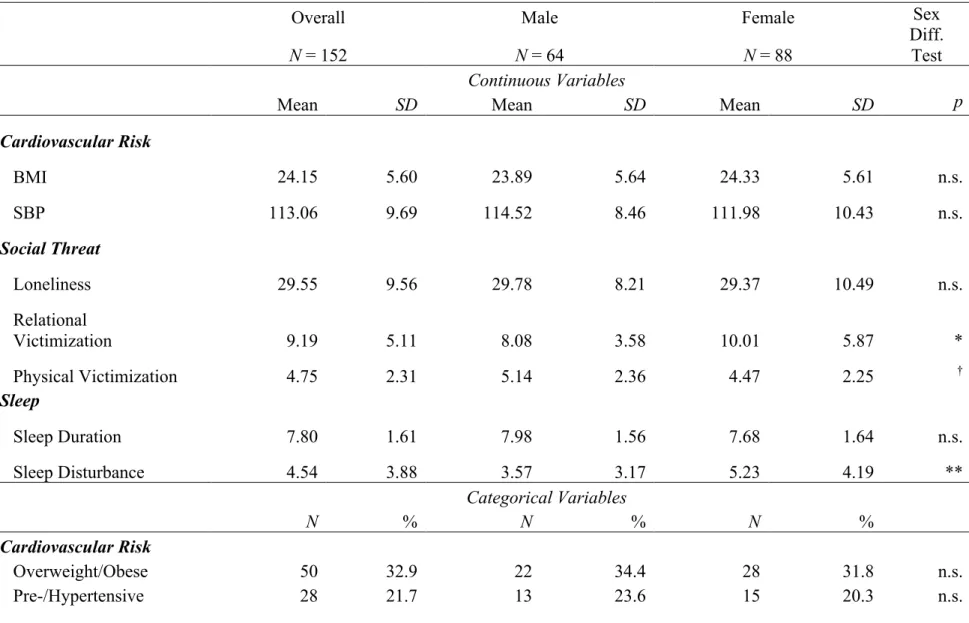
Descriptive Statistics………..23
Bivariate Associations Among Study Variables………24
Predicting continuous CVR outcomes………...25
Predicting categorical CVR outcomes………...26
Predicting continuous sleep variables………27
Sex differences in associations………..…27
Mediation Analyses………...27
Sensitivity Analyses………...…28
DISCUSSION………...….30
Strengths and Limitations………..35
Future Directions………...36
Conclusion……….37
APPENDIX………....47
LIST OF TABLES
Table 1 - Means and standard deviations of continuous study variables. N and % for categorical study variables…………...………...…38
Table 2 - Pearson correlations among continuous variables………...………...40
Table 3 - Summary of standardized (β) and unstandardized (B) regression coefficients for regression models predicting the continuous BMI
and systolic blood pressure variables ………..………...41
Table 4 - Odds ratios for social threat and sleep problems predicting
categorical CVR outcomes ………...……….………...43
Table 5 - Summary of standardized (β) and unstandardized (B) regression
coefficients for continuous measures of sleep problems ………...45
Table S1 - Standardized (β) and unstandardized (B) regression coefficients for regression models predicting the continuous BMI and systolic
blood pressure variables, adjusting for age 15 BMI and systolic blood pressure………..53
Table S2 - Odds ratios and 95% confidence intervals for logistic regression analyses predicting categorical age 16 CVR outcomes with for social
LIST OF FIGURES
Figure 1 - Conceptual model of associations among social threat, sleep problems,
and cardiovascular risk during adolescence ………...………..3
Introduction
Cardiovascular disease (CVD) is the leading cause of death in the United States
(Mozaffarian et al., 2016). Clinical endpoints of CVD typically do not manifest themselves until
mid or late adulthood. However, many factors that initiate and maintain disease processes that
eventually lead to later cardiovascular disease—here also referred to as cardiovascular risk—
emerge earlier in the life course (Mozaffarian et al., 2016; Twig et al., 2016). For example,
national studies suggest that approximately one in five adolescents aged 12-19 in the United
States meet criteria for obesity status (BMI ≥ 95th percentile) and approximately one in three
meet criteria for overweight status (≥ 85th percentile) (Ogden, Carroll, Kit, & Flegal, 2014).
Furthermore, hypertension is increasingly common among young people in the United States
(Freedman, 2002; Gidding, Bao, Srinivasan, & Berenson, 1995; Kirk et al., 2005; Miller, Kaylor,
Johannsson, Bay, & Churilla, 2014; Nguyen et al., 2011; Skinner, Perrin, Moss, & Skelton,
2015).
Obesity and hypertension are cardiovascular risk factors that are involved in the initiation
and maintenance of chronic disease processes and predict later morbidity and mortality (Hartiala
et al., 2012; Janssen et al., 2005; Juonala et al., 2011; Llewellyn, Simmonds, Owen, &
Woolacott, 2016; Reilly et al., 2003; Reilly & Kelly, 2011). In the face of rising rates of
cardiovascular risk factors during the early life course, many adolescents begin to notice declines
in their health from this period onwards (Bauldry, Shanahan, Boardman, Miech, & Macmillan,
examined in studies that begin assessing participants before adulthood (for some exceptions, see
Doom, Gunnar, & Clark, 2016; Ruiz & Brondolo, 2016).
Work on adults suggests that influences on the development of cardiovascular risk are
manifold, ranging from psychosocial influences to health behaviors to family history and
molecular physiological factors. In the psychosocial domain, perceived threat in one’s social
environment (henceforth referred to as “social threat”) has recently emerged as an important
predictor of cardiovascular disease risk in adults. The role of social threat in cardiovascular risk
is less well-understood during adolescence, however. Yet, during mid to late adolescence—the
high school years—youth spend most of their time in frequent interactions with others across
multiple social contexts (Giordano, 2003). Adolescents spend long days at school with their
peers and teachers. They also spend much of their free time interacting with their peers (Larson
& Verma, 1999; Steinberg & Sheffield Morris, 2001). Indeed, during this developmental period,
youth typically spend more time with their peers than with their family, and many adolescents
are exposed to social threat in the forms of peer victimization/bullying and social isolation
(Copeland, Wolke, Angold, & Costello, 2013; Heinrich & Gullone, 2006).
Therefore, the current study examined whether social threat during adolescence—
especially in the peer context—predicts cardiovascular risk during this developmental period. In
addition, this study added to existing research by testing whether sleep problems—which are
associated with both social threat and cardiovascular risk among adults—partially mediate this
Figure 1. Conceptual model of associations among social threat, sleep problems, and
cardiovascular risk during adolescence
Social Threat During Adolescence
Human lives are intertwined, and a key characteristic of the human condition is that it is
inherently social. Supportive social connections have been imperative for survival for millions of
years. In turn, threats in one’s environment have endangered survival. In historical contexts, the
predominant environmental threats were physical in nature (e.g., exposure to dangerous
predatory animals). During modern times, however, many forms of environmental threat are
social in nature. Such social threats include victimization/bullying and also social isolation/the
lack of social connection (defined in more detail in the next section). These two forms of social
Research suggests that social threats can initiate and maintain the body’s “fight or flight”
response. This response involves the mobilization of the body’s resources to address imminent
threat. For example, epinephrine and norepinephrine are released, resulting in increased blood
flow and heart rate. These functions serve to keep an individual alert and to free up energetic
resources to be able to address a threat (Padgett & Glaser, 2003). However, they also result in
increased blood pressure. Thus, the physiological reactions involved in the fight or flight
response are typically highly adaptive in the short term until the threat is removed. However, if
activated repeatedly or continually—as is often the case among victimized or lonely
individuals—these responses can become maladaptive and result in a long-term dysregulation of
physiological systems associated with stress responses (Biebl, DiLalla, Davis, Lynch, & Shinn,
2011; Cohen et al., 1998). Ultimately, a progressive dysregulation of the body’s stress response
systems confers an increased risk of for chronic disease, including cardiovascular disease (Cohen
et al., 1998; McEwen & Stellar, 1993; Miller & Chen, 2010; Slavich & Irwin, 2014). I now
define and describe victimization/bullying and social isolation/loneliness, which are the two most
common—yet often unavoidable—types of social threat encountered by youth during mid to late
adolescence (Brown & Larson, 2009).
Victimization (or bullying) is a salient negative social threat experience that many adolescents face in their social networks (Brown & Larson, 2009). Peer victimization (and
bullying) is defined as intentional and repeated aggression against others that often involves an
imbalance of power (Olweus, 1994). Thus, victimization involves unwanted relational or
physical aggression by another youth or group of youth (Centers for Disease Control and
Prevention, 2016b). Relational victimization includes behaviors such as exclusion or spreading
and shoving another person (Wang, Iannotti, & Nansel, 2009). Victimization is common:
prevalence rates range from approximately 8% to 41%, depending on the type of victimization
(relational, physical, or verbal) and also the timeframe during which victimization was assessed
(Copeland et al., 2013; Nansel et al., 2001; Wang et al., 2009). Indeed, victimization is the most
common form of social threat that occurs within the school environment (Kubiszewski, Fontaine,
Potard, & Gimenes, 2014). Being victimized by one’s peers is perceived as a fundamental threat
to safety by many youth (Kubiszewski et al., 2014). By definition, victimization typically
involves repeated acts, and can readily lead to perceived or imagined threats even in the absence
of “actual” social threats. In addition to the direct social threat encompassed by victimization
behaviors, many adolescents suffer from social isolation—a different albeit also important type
of social threat that has been found to be relevant to health (Laursen & Hartl, 2013).
Social Isolation/Loneliness is defined by the perceived absence of intimate relationships or social connections—negative or positive (Bunker et al., 2003; Cacioppo et al., 2002; Laursen
& Hartl, 2013; Tennant, 1999). From an evolutionary perspective, social isolation posed an
extreme threat to safety: survival was difficult without a strong social network to help protect
and defend against harm (Hawkley & Cacioppo, 2010). Although individuals can thrive on their
own in many areas in today’s world, feelings of loneliness and perceived social isolation
continue to act as a threat to health. Like bullying, loneliness is a common experience during
adolescence, and, in fact, its prevalence peaks during this developmental period. Previous studies
have found that anywhere from 50-79% of adolescents experience loneliness, depending on the
timeframe of assessment (Brennan, 1982; Culp, Clyman, & Culp, 1995; Heinrich & Gullone,
Links Between Social Threat and Cardiovascular Health
The presence of social threat in an adolescent’s life can have significant implications for
their health across the lifespan. Research on mostly adults and also animal models (Cruz et al.,
2016) suggests that social threat is as important a risk factor for cardiovascular disease as is
smoking or obesity (Bunker et al., 2003; Hemingway & Marmot, 1999; Holt-Lunstad, Smith, &
Layton, 2010; Rozanski, Blumenthal, & Kaplan, 1999; Yang et al., 2016). Indeed, victimization
and social isolation have been identified as particularly harmful social stressors with respect to
adults’ cardiovascular health (Powell et al., 2013; Slavich & Irwin, 2014).
Less is known about these associations in adolescence. One of the few extant studies on
this topic found that positive social relationships during adolescence were protective against
obesity in adolescence and also predicted lower risk of cardiovascular disease into young
adulthood (Yang et al., 2016). In turn, social isolation during adolescence was associated with
higher levels of systemic low-grade inflammation—a risk factor for cardiovascular disease in
addition to obesity and hypertension—in young adulthood. In fact, the effect size of the
association between social isolation on cardiovascular risk in the form of systemic inflammation
was approximately similar in size to that of the association between physical inactivity and
cardiovascular risk (Yang et al., 2016). Another recent study examined linkages between
bullying and systemic inflammation and also found that child and adolescent victims of bullying
had higher levels of inflammation in young adulthood (Copeland et al., 2014).
Despite their strengths, these two recent studies focused either on social isolation or on
victimization, but not on both of these forms of social threat simultaneously. In addition, the
assessment of social threat constructs was somewhat limited (e.g., via few items only). Yet,
of analyzing risk cumulatively, noting that multiple risk factors in one’s environment typically
have greater influence on various outcomes than individual factors alone (Evans, Li, & Whipple,
2013). Additionally, previous studies of adolescents were not informative about potential
mechanism by which social threat predicts cardiovascular risk. The current study focuses on
sleep problems as a potential mediator of this association. Before describing preliminary
evidence for separate social threat–sleep problems and sleep problems–cardiovascular risk
associations, I next describe two dimensions of sleep problems that may each play a role in our
conceptual model.
Pathways from Social Threat to Cardiovascular Links Via Sleep Problems
Little is known about the pathways that link social threat with cardiovascular risk before
adulthood. The current study focuses on sleep problems as a potential mediator in this link.
There is some support for separate social threat-sleep problems and also sleep
problems-cardiovascular risk associations; thus providing preliminary support for our conceptual model.
However, no study during adolescence has comprehensively tested this overall mediational
model, with several indicators of each, social threat, sleep problems, and cardiovascular risk. I
now review the literature on each of these separate links.
The Multiple Facets of Sleep
Sleep is a multifaceted construct, and an individual’s sleep problems can be characterized
along both quantitative and qualitative dimensions. In the current study, I focus on sleep duration
as an index of quantity and sleep disturbance as an index of quality (Buysse et al., 2008). Sleep
duration is a quantitative index of the amount of time that a person spends asleep each night. It is commonly assessed via self-report of the minutes or hours spent asleep. It can also be assessed
Sleep disturbances are occurrences during the night that make it difficult for a person to fall or stay asleep (Bruni et al., 1996). Examples include emotional disturbances such as worrisome
thoughts, or physical disturbances such as having to use the restroom, and trouble breathing.
Sleep disturbances are more common in adolescents than in adults, possibly due to hormonal
changes and increased social stressors, and can negatively influence daytime functioning (Pagel,
Forister, & Kwiatkowki, 2007).
Social Threat à Sleep Problems Link
Social threat endangers a fundamental prerequisite for sleep: feeling safe and secure
(Dahl & Lewin, 2002). Previous research on adults has demonstrated that perceiving one’s
physical environment as safe is a necessity for attaining high-quality sleep (Hawkley, Preacher,
& Cacioppo, 2010; Troxel, Cyranowski, Hall, Frank, & Buysse, 2007). The ability to fall and
stay asleep requires a person to cease responding to her/his external environment. Thus, the
person must feel safe enough to stop responding to any potential dangers. This safety
prerequisite also extends to the social environment: when safety/security in social relationships is
amiss, optimal sleep patterns are threatened (Sladek & Doane, 2015).
Some evidence for the link between social threat and poor sleep comes from work on
parent-child relationships—in younger children. For example, research on elementary school
children shows that emotional insecurity in the parent-child relationship predicts later sleep
problems, including shorter sleep duration, greater disturbances, and poorer sleep quality (Keller
& El-Sheikh, 2011). In addition, a family context characterized by anger and hostility—either in
the parent-child or in the marital relationship—is also associated with sleep problems in children
Diamond, 2011). However, much of this research was based on younger children and is not
informative about social threat in the peer domain during adolescence.
A new body of literature on social threat and sleep is beginning to emerge; the current
study will contribute to this work. Beginning with peer victimization, one study of adolescents
aged 12-17 years old found that adolescents who had been bullied by classmates had poorer
sleep than their peers (Smaldone, Honig, & Byrne, 2007). This study assessed sleep via parent
reports, however, which is not an ideal method for assessing sleep in adolescents. In addition,
only one dimension of sleep was assessed—whether children got “enough sleep”—which was
subject to parental interpretation. Additional studies have also revealed that being the victim of
bullying is associated with poor sleep quality and also with sleep disturbances, in particular with
difficulties falling asleep and waking up/staying awake (Sansone & Sansone, 2008; Tu, Erath, &
El-Sheikh, 2015). In fact, the authors of one recent meta-analysis suggested that the presence of
sleep problems could be viewed as a potential marker of bullying exposure (van Geel, Goemans,
& Vedder, 2016). However, all of the studies that this meta-analysis was based on were
cross-sectional. Most of these studies also did not differentiate between the two main types of
victimization (relational and physical). Studying associations between victimization and sleep
problems longitudinally and differentiating between the different types of social threat (relational
and physical victimization/bullying and social isolation/loneliness) and sleep problems in one
study would provide us with a more comprehensive understanding of this association.
With respect to the links between social isolation and sleep problems, work on adults
supports this association. A common finding among prior studies is that lonely adults report an
of these studies were limited by their cross-sectional designs. Furthermore, much less is known
about loneliness-sleep problems associations during adolescence.
One study with adolescents aged 12-17 years, however, revealed that loneliness was
significantly correlated with more sleep disturbances (Mahon, 1994). While social connectedness
fosters feelings of safety and security that can aid in sleeping, a lack of social support (i.e.
loneliness) can increase risk of an array of sleep problems (Sladek & Doane, 2015). The current
study extends upon the findings of the current literature by examining the association between
social threat at one time point and sleep problems one year later. Testing these associations
longitudinally will enable us to analyze whether social threat is a marker for sleep problems one
year later in addition to understanding the role of sleep problems in our conceptual mediational
model.
Sleep Problemsà Cardiovascular Risk Link
Sleep behaviors during adolescence constitute an important foundation for subsequent
sleep behaviors (Dahl & Lewin, 2002), and can have both short- and long-term effects on health.
In one study, adults who reported a sleep duration of 5 hours or less had a 500% increase in risk
for hypertension compared to those who slept 6 or more hours each night (Vgontzas, Liao,
Bixler, Chrousos, & Vela-Bueno, 2009). In addition, in a study of adult women, researchers
found that sleeping less than the recommended 8 hours each night put participants at increased
risk for coronary heart disease 10 years later (Ayas et al., 2003).
Although the majority of the work on sleep problems and cardiovascular risk has been
conducted on adult samples, the number of studies examining this linkage during earlier
developmental periods is rising, and is primarily focused on inadequate sleep duration. For
time each night, and/or who have late bedtimes are at increased risk for becoming overweight or
obese and developing hypertension during adolescence and into young adulthood (Hart, Cairns,
& Jelalian, 2011; Meldrum & Restivo, 2014; Peach, Gaultney, & Reeve, 2015). Reversely,
adolescents sleeping an adequate amount each night appear to be protected against becoming
obese (Chen, Wang, & Jeng, 2006). However, this study defined “adequate sleep” as attaining
6-8 hours of sleep on four or more weekdays during the week, which does not match the Center for
Disease Control’s recommendation for 8-10 hours of sleep for this age group.
Only few studies have examined sleep disturbance and cardiovascular risk in
adolescence. In one of the few studies, healthy adolescents who experienced a high number of
sleep disturbances were at greater risk for higher blood pressure and hypertension and also for
higher BMI than their peers (Narang et al., 2012). This study was also one of the few to use the
sleep disturbances scale on the Pittsburgh Sleep Quality Index (PSQI), which is also used in the
current study. It is clear from the extant literature that suffering from sleep problems puts
individuals at increased risk for cardiovascular disease. However, it is necessary to examine this
link using multiple dimensions of sleep problems to fully assess how these variables are related.
Taken together, research on mostly adults has suggested that social threat (i.e.
victimization and loneliness) is a key psychological construct associated with cardiovascular
risk, and that sleep problems could play an important role in these pathways (Cacioppo et al.,
2002; Harris, Qualter, & Robinson, 2013; Miller & Chen, 2010; Segrin & Domschke, 2011).
Although there is preliminary evidence for several of these separate associations during
adolescence, comprehensive tests of mediational pathways in our conceptual model during this
developmental period are scant. To my knowledge, the current study is the first to test such a
assessments of a) multiple aspects of social threat, b) multiple aspects of sleep problems, and c)
multiple aspects of cardiovascular risk. Finally, the current study examines sex differences in all
of the conceptual model’s associations, which may be important for the reasons outlined below.
Sex Differences
The associations predicted by our conceptual model may differ by sex for several
reasons. First, the prevalence of the study’s key constructs is sex-differentiated. With respect to
type of victimization, females are more likely than males to be victims of relational aggression.
In turn, males are more likely than females to be victims of physical aggression (Wang et al.,
2009). Sex differences in loneliness are not consistently found, but select studies have reported
that male adolescents report feelings of loneliness more often than female adolescents (Koenig &
Abrams, 1999). The prevalence of sleep problems is also typically sex-differentiated. Sleep
duration has been found to be shorter for females than for males during adolescence, but this sex
difference reverses during adulthood (Burgard & Ailshire, 2013; Maslowsky & Ozer, 2014).
Female adolescents are also more likely to present with sleep disturbances than their male
counterparts (Buboltz, Brown, & Soper, 2001; Maume, 2013). Finally, several cardiovascular
risk factors including obesity and elevated systolic blood pressure are more common in
adolescent males than females (Dasgupta et al., 2006; Ogden et al., 2014; Shanahan, Schorpp,
Volpe, Linthicum, & Freeman, 2016).
Second, the pathways in our conceptual model may differ by sex. For example,
associations between social threat and sleep problems may be stronger in females than in males
considering that adolescent females tend to ruminate more about social threat than males (van
Geel et al., 2016). Studies that test sex differences in select links of our conceptual model are
short sleep duration was associated with higher BMI in both sexes (Hitze et al., 2009). In
contrast, a study of Australian adolescents reported that this association was found in male but
not in female participants (Eisenmann, Ekkekakis, & Holmes, 2006). Given evidence of
sex-differentiated prevalence of key construct in our model and select evidence for sex-sex-differentiated
associations, the current study aims to further explore sex differences in our conceptual model.
Current Study
The current study examined associations among social threat, sleep problems, and
cardiovascular risk in adolescence in a community sample of adolescents at approximately ages
15.5 and 16.5 years old. The primary outcome of the current study was cardiovascular risk—that
is factors that could initiate and maintain disease processes that eventually lead to later
cardiovascular disease. I specifically examined two cardiovascular risk indices—both of which
can be assessed continually and also with clinically meaningful cutoffs that result in categorical
variables. First, I examined body mass index (BMI), which is calculated using an individual’s
height and weight. In turn, BMI can then be used to place the person into a weight category,
ranging from underweight to obese (Centers for Disease Control and Prevention [CDC], 2015).
Previous research has shown that elevated BMI in childhood and adolescence predicts lifelong
cardiovascular morbidity (Skinner et al., 2015). Second, I focused on blood pressure, which is a
measure of the strength with which the blood pushes against the artery walls (National Library of
Medicine [NLM], 2015). Systolic blood pressure indicates the pressure when the heart is active
(NLM, 2015). Blood pressure that is between a normal and high threshold is indicative of
pre-hypertension, a condition that, if not treated, can result in hypertension. Obesity and
hypertension are both thought of as indices of the overall underlying construct of cardiovascular
are only moderately correlated (Hahn, Heath, & Chang, 1994). Therefore, it will be important to
examine them as separate outcomes.
Taken together, I propose to test a model that examines whether social threat manifests
itself in cardiovascular risk (e.g., overweight/obesity and pre-/hypertension) during adolescence
via sleep problems, and whether these associations differ by sex.
Hypotheses
1) The presence of social threat (victimization/loneliness) will be associated with
increased cardiovascular risk, as characterized by higher BMI / a classification
as overweight/obesity, and higher systolic blood pressure / a classification as
pre-/hypertensive status.
2) The presence of social threat (victimization/loneliness) will be associated with
increased sleep problems in the form of shorter duration and more
disturbances.
3) Participants who present with sleep problems will be at increased risk for
higher BMI / a classification as overweight/obesity, and higher systolic blood
pressure / a classification as pre-/hypertensive status.
4) Sleep problems will mediate the association between presence of social threat
and cardiovascular risk outcomes.
5) Sex differences in all associations will be tested. Given limited evidence from
Methods Participants
Participants came from the RIGHT (Research Investigating Growth and Health
Trajectories) Track project, an ongoing prospective-longitudinal community study spanning 12+
years, which was approved by the governing Institutional Review Board. Four hundred and forty
seven participants were initially recruited at 2 years of age through childcare centers, the County
Health Department, and the local Women, Infants, and Children program. Additional details about
sample recruitment may be found elsewhere (Smith, Calkins, Keane, Anastopoulos, & Shelton,
2004). The recruitment sample was diverse, with 67% of the children classified as European
American, 27% African American, 4% biracial, and 2% Hispanic. Families were also economically
diverse: Hollingshead scores that take into account parental educational level and occupation
(Hollingshead, 1975) ranged from 14 to 66 (M = 39.56). Hollingshead scores from 40 to 54 are
typically representative of the middle class.
When participants were approximately 16 years old, a new study component was added
for a subset of participants. This “health component” focused on adolescents’ health behaviors
and cardiometabolic health. The current study draws on data from this health component and
examines N = 152 participants (females = 58%) with complete data on adolescent social threat,
sleep problems, and cardiovascular risk. Attrition analyses revealed that participation at the
Analytic Strategy
I began by testing each separate link in the model. Models predicting continuous
outcomes such as BMI and systolic blood pressure were estimated using separate ordinary least
squares linear regression models. Models predicting dichotomous outcomes such as
overweight/obesity and pre-/hypertension were estimated using separate logistic regression
models. The outcome variables were 1) first regressed on the covariates, 2) then on the
cumulative index adjusted for the covariates, 3) then on each predictor one at a time, adjusted for
the covariates, and 4) finally on all individual predictors in each domain and covariates
simultaneously. In a final step, mediation was tested using Baron and Kenny’s (1986) method for
examining mediation through regression. I tested three separate pathways: 1) social threat à cardiovascular risk 2) social threat à sleep 3) sleep à cardiovascular risk. I then regressed cardiovascular risk on social threat, controlling for the role of sleep. Full mediation would be
supported if the social threat variable was no longer significant in the fourth regression step.
With respect to missing data, the analytic techniques used here employed listwise
deletion. A more ideal method, primarily available with more advanced techniques such as
structural equation modeling, would have been the use of a full information maximum likelihood
estimator—which uses all available data values (Enders & Bandalos, 2001). Previous analyses
with the current sample showed, however, that results generally did not differ when using
listwise deletion versus full information maximum likelihood estimators (Janssen et al., 2017).
Thus, at least in past analyses with this sample, the use of the listwise deletion method for
Procedures
At approximately ages 15.5 and 16.5, adolescents were invited for laboratory visits.
During the age 15 assessment, adolescents visited the RIGHT Track laboratory at the University
of North Carolina at Greensboro and reported on social threat. During the age 15 assessment,
adolescents visited the Exercise Physiology Laboratory at the University of North Carolina at
Greensboro and reported on their sleep problems. In addition, trained interviewers assessed
adolescents’ weight and height and measured adolescents’ blood pressure. Adolescents provided
assent and were given $50 gift cards for their participation. At least one parent attended the visit
to the research laboratory with their child and provided consent. All study protocols were
approved by the governing Institutional Review Boards.
Measures
Cardiovascular risk. Body mass index (BMI) was computed using the formula weight/(height2). Height (kg) and weight (m) were measured by trained interviewers during
participants’ visits to the laboratory at ages 4, 5, 7, 10, 15, and 16, and by participants’
self-reports when a laboratory visit was not possible. Height was measured to the nearest 0.1 cm with
a wall mounted, calibrated stadiometer (SECA, Chino CA). Weight was measured to the nearest
0.1 kg with a balance-beam scale (Detecto-medic, Brooklyn NY). Age- and sex-adjusted BMI
percentiles were assigned according to the Center for Disease Control (CDC) growth charts
(Centers for Disease Control and Prevention, 2009). CDC guidelines were also used for
computing dichotomous overweight/obesity variables. Specifically, adolescents at BMI ≥ 85th
percentile for their sex and age were coded as being overweight/obese (Centers for Disease
Control and Prevention, 2009). Among participants with both laboratory-measured and
Systolic blood pressure (SBP). Upon arrival at the Exercise Physiology Laboratory and after obtaining consent/assent, participants rested quietly for 5 minutes with their arm supported
at heart level and feet on the floor, as outlined by the Seventh Report of the Joint National
Committee on Prevention, Detection, Evaluation and Treatment of High Blood Pressure
(National High Blood Pressure Education Program, 2004). Manual cuff blood pressure
measurements were repeated two times with at least 5 minutes between measures. The mean of
two readings was taken; such averaging has been shown to have high validity (Bauldry, Bollen,
& Adair, 2015). Dichotomous pre-/hypertension variables were computed using the age- and
sex-adjusted height percentiles provided by the U.S. Department of Health & Human Services
guidelines (National High Blood Pressure Education Program Working Group on High Blood
Pressure in Children and Adolescents, 2004). According to these guidelines, values of SBP ≥ 120
mmHg or ≥ 90th percentile for age, sex, and height indicate pre-/hypertension.
Social threat. Victimization was measured using a self-report measure of aggression and social behavior during the past year adapted from Linder, Crick, and Collins (2002). This
24-item questionnaire (full measure shown in Appendix) yielded two subscales of interest for the
current study: relational victimization and physical victimization. Participants were asked to rate
each statement on a 7-point Likert scale ranging from 1 (“Not at all true”) to 7 (“Very true”).
Example items in the relational victimization subscale include “I have a friend who ignores me
or gives me the “cold shoulder” when they are angry with me” and “A friend of mine has gone
“behind my back” and shared private information about me with other people.” Example items in
the physical victimization subscale include “I have been pushed or shoved by people when they
the current study, the reliability coefficient for the 4-item relational victimization subscale is
α=.80 and α=.57 for the 3-item physical victimization subscale.
In addition, the Youth Risk Behavior Survey (YRBS) was administered to participants.
The YRBS is a self-report questionnaire that includes 2 items (full items shown in Appendix)
assessing victimization behaviors (Centers for Disease Control and Prevention, 2016a). The first
item asks participants if they have been bullied on school property in the past 12 months. The
second item asks if they have been bullied electronically in the past 12 months. A substantial
number of items on the YRBS have kappas ranging from 61-100%, indicating sufficient
reliability (Brener, Collins, Kann, Warren, & Williams, 1995).
Social isolation/loneliness was assessed using a 24-item self-report measure of loneliness and social dissatisfaction that was adapted from Asher, Shelley, and Henshaw (1984). The full
measure is shown in the Appendix. There are 16 target items and 8 filler items that are rated on a
5-point Likert scale ranging from 1 (“Not at all true”) to 5 (“Always true”). Example target items
include “I have nobody to talk to” and “It's hard to get other teens to like me.” Scores from the
16 target items are summed, resulting in a total loneliness score ranging from 16 (low loneliness)
to 80 (high loneliness). In the current study, reliability for this measure is high, with α=.92.
In addition to the individual social threat variables, I created a cumulative social threat
index. I dichotomized the continuous social threat variables (loneliness, relational victimization,
and physical victimization), assigning scores of 1 to those scoring in the top 25% for each
variable, and 0 for all others. This approach to dichotomizing variables is consistent with
previous cumulative risk research (Burchinal, Roberts, Hooper, & Zeisel, 2000; Evans et al.,
indicating “yes”. These five dichotomous variables were summed to create a cumulative social
threat score ranging from 0-5.
Sleep problems. The Pittsburgh Sleep Quality Index (PSQI) was used to measure adolescents’ sleep duration and disturbance. The PSQI is a self-report measure that assesses
sleep behaviors over the past 1-month period. Here, I focused on two of the seven subscales of
the measure: duration and disturbance. The PSQI has been found to be internally consistent,
reliable, and valid (α= .83, test-retest reliability of .87) (Backaus, Junganns, Broocks, Riemann,
& Hohagen, 2002; Carpenter & Andrykowskia, 1998; Pilcher et al., 1997). The sleep duration
subscale assesses participants’ average amount of sleep each night over the past month (in
hours). The sleep disturbance subscale is comprised of 10 items asking participants how often
during the past month have they had trouble sleeping because of issues including having to use
the bathroom, feeling too hot or cold, and having bad dreams. Participants’ responses were
scored 0 for “Not during the past month”, 1 for “Less than once a week”, 2 for “Once of twice a
week”, and 3 for “Three or more times a week.” For ease of analysis and interpretation, the
scores on this subscale were then split into tertiles representing no sleep disturbance (score of
0-1), moderate sleep disturbance (score of 2-8), or severe sleep disturbance (score of 9+).
Although the PSQI was designed for adults, it is commonly used with adolescents (Harris et al.,
2013).
In addition to the individual sleep variables, I created a cumulative sleep problems index.
First, the sleep duration variable was dichotomized into less or greater than 8 hours (1 = sleeping
less than 8 hours). Next, for the sleep disturbance variable, those scoring in the highest—most
severe—tertile were assigned 1; all others were assigned 0. Furthermore, I used one more item
item asked: “During the past month, how would you rate your overall sleep quality?” with scores
ranging from Very Good (0) to Very Bad (3). For inclusion into the cumulative risk index, this
score was dichotomized into 0 = “good quality” (score of 0-1) and 1 = “poor quality” (score of
2-3). These three dichotomous variables were summed to create a cumulative sleep problems score
ranging from 0-3.
Notably, sleep can be measured in a variety of ways, and objective instruments—such as
polysomnography—are often considered “gold standard.” However, due to high participant
burden when using polysomnography or actigraphy (Gradisar, Gardner, & Dohnt, 2011), only
self-reports of sleep were assessed during adolescence in this study. Self-report scales, such as
the Pittsburgh Sleep Quality Index (PSQI), are commonly used and allow one to understand how
individuals perceive their own sleep (Lockley, Skene, & Arendt, 1999).
Covariates. Three potential covariates were assessed in the sample: sex, race, and
socioeconomic status (SES). Children’s sex and race were reported by parents. SES was assessed
using the Hollingshead Index, a weighted average of parental education and employment
(Hollingshead, 1975). Scores ranging from 40 to 54 represent middle class professional and
technical occupations. Families from a range of socio-economic strata typically captured by this
scale are represented in this analysis.
Measures used in sensitivity analyses. Two measures were included to account for potential within-family sources of social threat in follow-up analyses. Parent-child conflict was
measured through the hostility scale of the Getting Along with My Parent (Mom) questionnaire
(Conger & Ge, 1999). This scale includes 8 questions that assess the frequency with which the
mother displays both verbal and nonverbal behaviors, such as criticizing the child’s ideas and
to be α=.79 (Conger et al., 2002). Adolescent perception of interparental conflict was assessed
through five questions regarding the extent to which they have witnessed behaviors in the past
year. Items included statements such as “My parents are often angry at each other” and “My
parents disagree and argue about my behavior more than once a week”. While this subscale
comes from an unpublished measure (Shanahan, 2007), the scale had a high reliability in this
Results Descriptive Statistics
Table 1 displays descriptive statistics [means and standard deviations for continuous
variables and N (%) for categorical variables] for all social threat, sleep, and cardiovascular risk
variables used in the current study. Consistent with recent work on nationally representative
cohorts (e.g., Nguyen et al., 2011; Reither, Olshansky, & Yang, 2011), youth in the analytic
sample showed evidence of relatively high BMI and systolic blood pressure. For example, the
average BMI was at 24.15, which is close to the BMI = 25 CDC cutoff used to define overweight
status (Janssen et al., 2005). Indeed, 32.9% of adolescents in our sample met criteria for
overweight and obesity status combined (≥ 85th percentile), which is consistent with a rate of
32.2% for adolescents that has recently been reported at the U.S. national level (Skinner &
Skelton, 2014). The average systolic blood pressure (SBP) for adolescents in our sample was 113
mmHg, which is close to the adult cut-off of 120 mmHg used to define pre-hypertension. Indeed,
21.7 % of our participants met criteria for the combined pre-/hypertension status category. Taken
together, a substantial proportion of adolescents in our sample met criteria for cardiovascular risk
factors, which is consistent with recent nationally-representative data from young people
growing up in the United States.
Social threat was also prevalent in this sample: the cumulative social threat variable
indicated that the majority of adolescents in our sample (56.4%) had encountered some form of
social threat in the past year. Almost 15% of adolescents reported having been bullied at school
for the relational and physical victimization measures ranged from 4-28 and 3-21, respectively,
and the mean values on these scales in our sample indicate that participants experienced some
form of victimization in the past year (M = 9.19 and M = 4.75 for relational and physical
victimization, respectively). With respect to the sleep variables, only 43.2% of adolescents
reported not having had a sleep problem in the past month, and 14.8% of adolescents in our
sample reported poor sleep quality. The mean sleep duration for adolescents in our sample was
below 8 hours, and, thus, fell below the recommended minimum number of hours of nightly
sleep for adolescents (Centers for Disease Control and Prevention, 2015).
We also tested sex differences in the mean and prevalence of each study variable. There
was a significant difference for relational victimization, t(142.78) = -2.49, p = .014, with females
experiencing more relational victimization than males. In contrast, males reported more physical
victimization at the statistical trend level, t(147) = 1.78, p = .077. In addition, there was a
significant sex difference for sleep disturbance, t(144.38) = -2.73, p = .007, with females
suffering from more sleep disturbances than males (Figure 2). Figure 2 indicates that this the sex
difference emerged particularly at the level of severe sleep disturbances [X2 (1) = 6.01, p=.01].
Bivariate Associations Among Study Variables
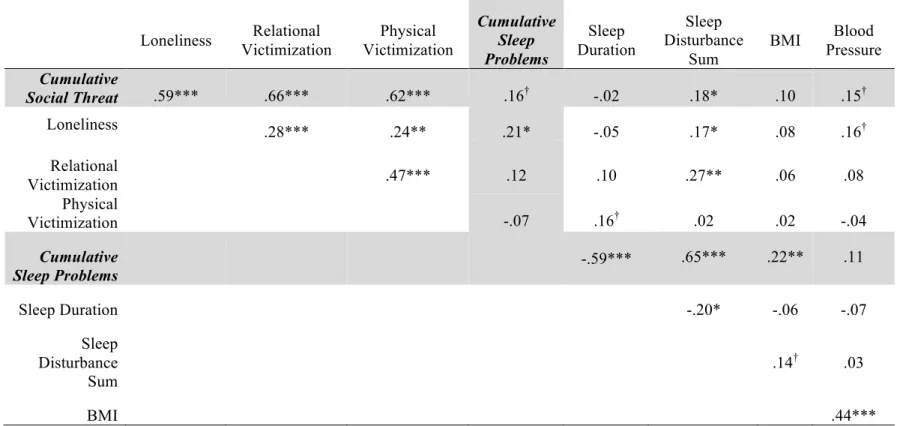
Table 2 shows Pearson correlations among all continuous study variables. Correlations
within study constructs. Correlations among the individual social threat variables indicated that loneliness was positively correlated with both relational victimization and physical victimization,
meaning that higher levels of loneliness were associated with more relational and physical
victimization. Correlations among the sleep variables indicated that adolescents who slept more
hours also reported a lower number of sleep disturbances. Correlations between the
those with high BMI also had higher blood pressure. The size of significant correlations within
each construct ranged from r = -.20 to r = .47, supporting low to moderate associations among
study variables. Overall, these low to moderate associations did not support the use of factor
analyses and factor score models to create overarching summary variables for each of the risk
and outcome domains (Burchinal et al., 2000).
Correlations across study constructs indicated that some indicators of social threat were associated with greater sleep disturbance. Specifically, higher levels of loneliness and relational
victimization were associated with greater sleep disturbance. Surprisingly, however, there was
only one marginal correlation between the cardiovascular risk variables and each, the individual
social threat and sleep variables. Specifically, greater levels of loneliness were associated with
systolic higher blood pressure at the statistical trend level. In addition, higher numbers of sleep
disturbances were associated with higher BMI at the statistical trend level. With respect to the
cumulative variables, increased cumulative social threat were marginally correlated with greater
cumulative sleep problems and blood pressure, and significantly correlated with increased sleep
disturbance. Increased cumulative sleep problems were associated with higher BMI and greater
loneliness.
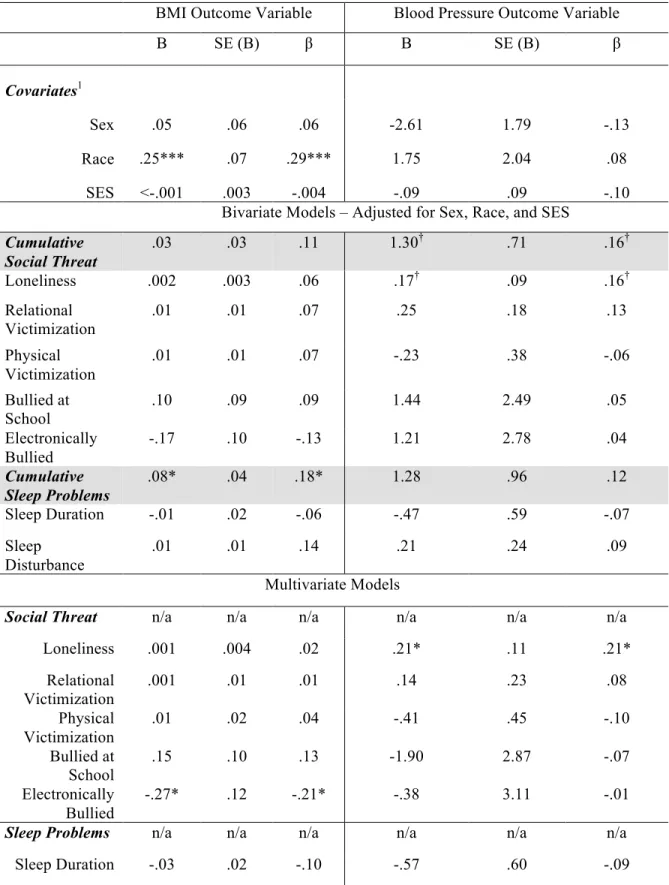
Predicting continuous CVR outcomes. Table 3 displays results from ordinary least squares regression models predicting the continuous BMI and systolic blood pressure outcome
variables. The outcome variables were 1) first regressed on the covariates, 2) then on the
cumulative index adjusted for the covariates, 3) then on each predictor one at a time, adjusted for
the covariates, and 4) finally on all individual predictors in each domain and covariates
cumulative variables, and use caution when interpreting results with individual indicators from
each domain given multiple testing.
Race was significantly associated with BMI: being non-White was associated with higher
BMI (β = .29, p < .001). From the domain of social threat, the cumulative social threat variable
predicted higher blood pressure at the statistical trend level (β = .16, p < .10). With respect to the
individual social threat variables, only loneliness predicted higher blood pressure at the statistical
trend level (β = .16, p < .10); this association became significant in the multivariate model (β =
.21, p < .05). From the domain of sleep problems, the cumulative sleep problems score was
associated with greater BMI (β = .18, p < .05). In the multivariate model, being electronically
bullied was associated with lower BMI (β = -.20, p < .05). Taken together, cumulative social
threat predicted SBP at the statistical trend level and with each additional sleep problem, BMI
one year later increased. Next, findings from the continuous outcomes were followed up with
clinically meaningful dichotomous CVR variables, using logistic regression models.
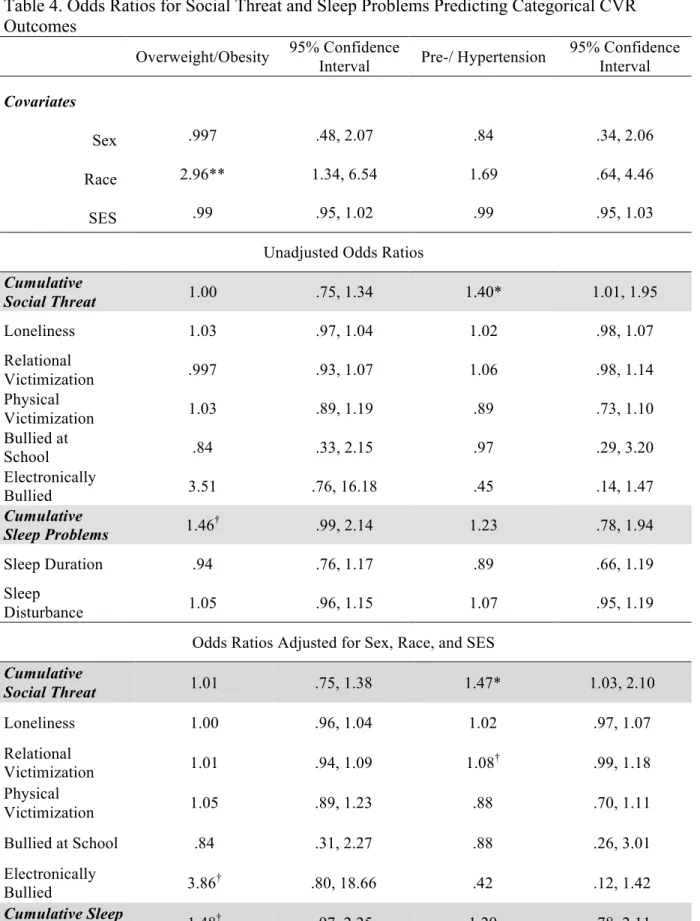
Predicting categorical CVR outcomes. Table 4 displays results from logistic regression models predicting the categorical overweight/obesity and pre-/hypertension variables. From the
domain of social threat, the cumulative social threat variable predicted pre-/hypertension status.
Specifically, with each additional social threat encountered by the adolescent, the odds for
meeting criteria for pre-/hypertensive status increased by a factor of 1.40 (p < .05). None of the
individual social threat variables predicted the categorical cardiovascular risk outcomes. From
the domain of sleep problems, the cumulative sleep variable was associated with the
overweight/obesity outcome at the statistical trend level. Specifically, with each additional sleep
(p < .10). None of the individual sleep variables predicted the categorical cardiovascular risk
outcomes.
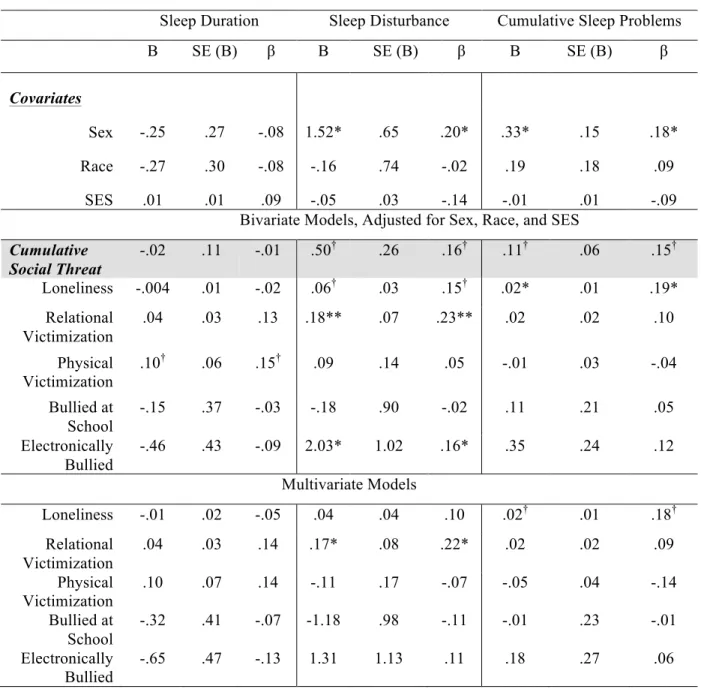
Predicting continuous sleep variables. Table 5 displays results from ordinary least squares regression models predicting the continuous sleep duration and sleep disturbance
variables, as well as the cumulative sleep problems variable. Similar to the tables above, the
outcome variables were first regressed on the covariates, then on each predictor adjusted for the
covariates, and finally on all predictors and covariates combined. In terms of the demographic
variables, sex was significantly associated with both sleep disturbance (β = .20, p < .05) and
cumulative sleep problems (β = .18, p < .05), with females reporting greater sleep problems.
The cumulative social threat variable predicted sleep disturbance and cumulative sleep
problems at the statistical trend level (β= .16 and β = .15, p < .10, respectively). In terms of the
individual social threat variables, results from the adjusted bivariate models showed that,
relational victimization significantly predicted sleep disturbance (β = .23, p < .01), while
loneliness significantly predicted cumulative sleep problems (β = .19, p < .05). Relational
victimization continued to significantly predict sleep disturbance (β = .22, p < .05) when all other
social threats were adjusted for.
Sex differences in associations. Sex differences were tested in all regression models via moderation analyses. Only one significant interaction emerged, indicating that higher levels of
loneliness predicted increased sleep disturbance only in males (β = -.76, p < .05). However,
given the number of interactions tested, this finding could be due to chance.
Mediation Analyses
BMI via cumulative sleep problems, cumulative social threat predicting BMI via sleep
disturbance, loneliness predicting BMI via cumulative sleep, and relational victimization
predicting BMI via sleep disturbance. While some of the individual pathways in these models
were significant, as previously described, the overall mediational pathways were non-significant.
Thus, evidence for social threat predicting cardiovascular risk via sleep problems did not emerge.
Sensitivity Analyses
In a first set of sensitivity analyses, all models were rerun, adjusting for within-family
sources of social threat (i.e., parent-child hostility and child perception of interparental conflict).
These analyses did not result in any meaningful changes in effect size of the results reported
here.
In a second set of sensitivity analyses, I attempted to control for cardiovascular risk at age
15. A first finding was that age 15 and 16 BMI were correlated at r = .90, p < .001. When age 15
BMI was included in the analyses, the standardized coefficient of cumulative social threat to
later BMI was reduced from β =.18 to β =.03. A second finding was that age 15 and 16 systolic
blood pressure were correlated at r = .46, p < .001. When age 15 systolic blood pressure was
included in the regression models, the standardized regression coefficient of cumulative social
threat predicting later blood pressure was reduced from β = .16 to β = .14. When age 15 BMI and
systolic blood pressure were included in the analyses predicting age 16 categorical
overweight/obesity and pre-/hypertension outcomes, findings did not change, however. Thus,
only 1 out of 4 findings changed with the inclusion of the age 15 CVRs. Tables S1 and S2 in the
The recommended minimum number of hours of nightly sleep for adolescents is 8 hours,
and in a number of previous studies, the < 8 hours cut-off had been used to define short sleep
duration (e.g. Eisenmann et al., 2006; Seicean et al., 2007). Therefore, my main analyses had
focused on whether or not adolescents typically slept 8 hours per night (Centers for Disease
Control and Prevention, 2015). In a third set of sensitivity analyses, I tested whether using a
different cut-off for “short sleep duration” would change the findings. Descriptive analyses
showed that 23% of adolescents typically slept < 7 hours/night, whereas only 6% of adolescents
typically slept < 6 hours/night; therefore I used the < 7 hours/night variable for these sensitivity
analyses. Results revealed that sleeping less than 7 hours was associated with higher BMI (β =
.17, p < .05) and greater risk of being overweight/obesity (OR= 2.38, p < .05). Changing the
cumulative sleep problems index to include sleep duration less than 7 hours also changed results.
Specifically, the cumulative score including less than 7 hours of sleep/night was associated with
both higher BMI (β = .26, p < .01) and higher blood pressure (β = .20, p < .05), and also
associated with greater risk of being overweight/obese (OR= 1.68, p < .05), and of being
pre-/hypertensive (OR= 1.71, p < .05).
Mediation analyses using this lower threshold for sleep duration yielded non-significant
findings, as neither the individual nor the cumulative social threat variables predicted the new
Discussion
Cardiovascular risk—such as elevated BMI and pre-/hypertension—among young people
in the United States is at historically high levels and contributes to disease processes that predict
subsequent all-cause morbidity and mortality (Mozaffarian et al., 2016). Nevertheless, the
origins of cardiovascular risk factors during the early life course remain to be fully understood.
The current study was among the first to examine social threat—a putative risk factor from the
domain of psychosocial risk—and sleep problems—a putative risk factor from the domain of
health behaviors—in the prediction of adolescent cardiovascular risk. Results supported separate
direct links from cumulative social threat to later pre-/hypertension and associations between
cumulative sleep problems and higher BMI. Support for a full mediational chain from earlier
social threat to later sleep problems and cardiovascular risk did not, however, emerge.
Descriptive findings from the current community study were consistent with work from
nationally representative studies in that rates of cardiovascular risk among adolescents were high
(Ogden et al., 2014; Skinner & Skelton, 2014). Specifically, about one in three adolescents in our
sample met criteria for being overweight/obese, and approximately one in five for
pre-/hypertension. In addition, our sensitivity analyses showed that adolescent BMI is highly stable
over the course of one year and that systolic blood pressure displays moderate stability over this
time span. These prevalence rates and stabilities are alarming given the harmful consequences of
increased cardiovascular risk, including chronic illness and disability beginning at a young age
adolescence.
Social threat and sleep problems have been established as important correlates of
cardiovascular risk among adults, but less is known about the role of these two factors in the
emergence of cardiovascular risk during adolescence. Both, social threat and sleep problems
were common in our sample: more than half of the adolescents in our sample experienced at least
one social threat in the past year and more than half of adolescents also exhibited at least one
sleep problem in the past month. The high prevalence of social threat is concerning given that
previous research indicates that social threat—such as exposure to bullying in adolescence—
predicts serious mental and physical health problems into adulthood (Copeland et al., 2013).
Thus, social threat experiences in the peer domains cannot simply be viewed as a “normative
rites of passage” during adolescence, but give rise to concern. Similarly, sleep problems have
also been shown to have both short- and long-term consequences for cognitive, emotional, and
behavioral development (Dahl & Lewin, 2002; Shanahan, Copeland, Angold, Bondy, &
Costello, 2014), and, once established during adolescence, sleep problems may be stable into
adulthood or recur.
In terms of the predictive models, a number of associations deserve attention. First,
cumulative social threat was predictive of later pre-/hypertension. One proposed mechanism,
supported mainly by extant literature on adult samples, refers to a link from social threat to
continued activation of the autonomic nervous system, resulting in increased blood pressure and
heart rate (Rozanski et al., 1999). In turn, continued elevation of blood pressure can lead to
increased risk of pre-/hypertension at a later time point.
Second, cumulative social threat predicted sleep problems (i.e., sleep disturbance and a
exposure to social threat may be that the individual consciously or unconsciously perceives
his/her physical environment as unsafe. This perception is detrimental to attaining high-quality
sleep (Hawkley, Preacher, & Cacioppo, 2010; Troxel, Cyranowski, Hall, Frank, & Buysse,
2007). Indeed, during evolutionary time, during which frequent imminent threats to survival
were the norm, prolonged sleep without awakening was rare (Nunn, Samson, & Krystal, 2016).
Third, cumulative sleep problems were related to increased BMI at the same time point.
This is consistent with studies showing links between sleep disturbances, short sleep duration,
and higher BMI in adolescents (Hart et al., 2011; Meldrum & Restivo, 2014; Narang et al., 2012;
Peach et al., 2015). While the exact mechanism by which these associations occur is not
perfectly understood, research in adult samples suggests that poor sleep leads to increased
hypothalamic activity, which results in increased appetite (Knutson, 2010) and also in increased
impulsivity with respect to eating. If increased appetite and impulsive eating are not
supplemented by an increase in physical activity, weight gain and increased BMI can occur.
While prior work found similar associations using an individual sleep duration variable, the lack
of such findings in the current study is likely due to different defintions of inadequate sleep
duration. For example, the associations reported in Meldrum & Restivo (2014) were using less
than 5 hours as their cutoff for poor sleep duration.
Finally, although I found support for each link of the mediational model, no single one
full mediational chain emerged. Thus, the current study did not identify sleep problems as a
mechanism by which social threat is translated into increased cardiovascular risk during
adolescence. Sleep may not be the only health behavior via which social threat could have an
effect on cardiovascular risk. It is likely, for example, that adolescents who experience social
in less physical and more sedentary activities—which ultimately may contribute to an increase in
cardiovascular risk.
Notably, it was primarily the cumulative variables, but not the individual social threat or
sleep indicators, that were predictive. From a methodological perspective, the use of cumulative
measures is encouraged for samples of smaller size (Burchinal et al., 2000). Substantively,
cumulative scores may also better capture the co-occurrence of risk commonly found in the real
world. Cumulative scores do not parse out small effects of individual variables one-by-one.
Rather, they are representative of the overall (social threat or sleep) experience. Indeed, the use
of cumulative scores also allows for the possibility that the effects of multiple, individual threats
are compounded by one another.
The totality of social threats and sleep problems likely create physiological circumstances
conducive to the development of cardiovascular risk. Although the current work focused
specifically on social threats from the peer domain, the fact that our main significant findings
center around the cumulative scores is consistent with research on other domains of social stress
(Suglia, Duarte, Chambers, & Boynton-Jarrett, 2012). With respect to individual indicators, the
sole consistent “signal” to both cardiovascular risk and sleep problems was from loneliness. The
perceived absence of intimate relationships or social connections is a powerful predictor of
health behaviors and health among adults (Hawkley & Cacioppo, 2010). Given the number of
statistical tests conducted, this finding should not be over-interpreted, but it may be worthwhile
to generate a better understanding of the role of loneliness in adolescents’ health.
Indeed, despite the significant findings discussed above, it should be noted that fewer
significant associations emerged than expected, which could be due to several reasons. First, as
impact outcomes. Second, BMI is not the best measure of cardiovascular risk. Indeed, high BMI
in adolescence could indicate body fat or high levels of lean muscle mass, and waist
circumference could be a more accurate measure of adiposity, and thus, cardiovascular risk
(Dobbelsteyn, Joffres, MacLean, & Flowerdew, 2001; Shanahan et al., 2016). Third, statistical
power may be another reason for fewer-than-expected significant findings. However, given that
the identified effect sizes when using individual risk indicators were generally small, greater
power would, at best, have resulted in small effect sizes becoming significant. Finally, from the
perspective of study design, it is possible, that social threat à sleep problems à cardiovascular risk mediational chains could take more time to unfold and thus could only be observed with
longer timeframes. Our study covered the period of one year only, but more time may be needed
to see these processes unfold. Alternatively, and especially with respect to the social threat à sleep link, it is possible that this association fades over time, and that this link is more easily
captured in the moment; indeed, the previous studies that had reported associations between
select social threat indicators and sleep problems were primarily cross-sectional in nature (e.g.
Cacioppo et al., 2002; van Geel et al., 2016).
Previous research had been inconclusive with respect to sex differences in associations.
Therefore, a final goal of our study was to examine sex differences. Several sex differences
emerged in the prevalence of social threat and sleep variables. Consistent with previous work
(Wang et al., 2009), females were more likely to suffer from relational victimization, whereas
males were marginally more likely to experience physical victimization. With respect to sleep,
sleep disturbances were far more likely among females than males. The animal literature
suggests that reproductive hormones lead females to wake up more frequently throughout the
Fishbein, 1996). In addition, adolescent females are more likely than males to suffer from mental
health conditions that also be associated with sleep problems (Buboltz et al., 2001; Maume,
2013; Shanahan et al., 2014). Despite these sex differences in prevalence, our predictive models
revealed only one sex difference in prediction: loneliness significantly predicted greater sleep
disturbance in males but not in females. However, given the number of sex differences tests
conducted, this finding should be interpreted with caution.
Strengths and Limitations
The current study is not without its limitations. First, the sample is not nationally
representative, as participants came from one region in North Carolina, and findings cannot be
generalized to the larger U.S. population. Nevertheless, some of the prevalence estimates (e.g., of
cardiovascular risk factors) were consistent with those from nationally representative samples.
Second, although the overall model assessed is longitudinal in nature, sleep problems and
cardiovascular risk were measured at the same time point. Thus, we cannot draw conclusions
regarding the direction of effects between these two variables. However, future data from the
overarching study will allow for longitudinal tests of these associations. Third, the sample size
was not large; however, even if a larger sample had yielded more significant findings, they
would not necessarily have had a larger effect size. Finally, in order to understand potential
nuances in the social threat à sleep problems à cardiovascular risk, I conducted a good number of statistical tests with individual indicators. Such a high number of statistical tests could result
in chance findings; therefore results from our models with individual indicators should not be
over-interpreted.