INFLUENCES OF SERENDIPITY ON CONSUMER MEDICAL INFORMATION PERSONALIZATION
Xiangyu Fan
A dissertation submitted to the faculty of the University of North Carolina at Chapel Hill in partial fulfillment of the requirements for the Doctor of Philosophy degree in the School of
Information and Library Science.
Chapel Hill 2015
Approved by: Javed Mostafa
Bradley M. Hemminger Robert Capra
©2015 Xiangyu Fan
ABSTRACT
XIANGYU FAN: Influences of Serendipity on Consumer Medical Information Personalization
(Under the direction of Javed Mostafa)
Serendipity is an important concept in the field of information science. It has the potential of enhancing information retrieval by promoting unexpected discovery. Serendipitous recommendation has been incorporated into the design of personalized systems to minimize blind spots in information delivery. Little evidence has been found to identify how serendipity influences personalization of consumer medical information delivery. This dissertation attempts to examine what roles serendipity plays in filtering consumer medical information and to understand how to incorporate serendipity in an effective manner. In addition, the study seeks to clarify users’ attitudes associated with unexpected discovery of medical content during filtering as well as users’ interest changes during this process.
To empirically analyze the influence of serendipity, a medical news filtering system named MedSDFilter was developed. The system personalizes the delivery of news articles based on users’ interest profiles. In MedSDFilter, serendipitous recommendation was integrated into personalized filtering using three serendipity models, namely, a randomness-based, a knowledge-randomness-based, and an adaptive knowledge-based model. Using Medical News Today1 site as information source, the three different system modalities were compared based
on a series of experimental sessions conducted with users. Thirty staff members were recruited to read and rate medical news delivered by one of the three system modalities.
The results of the user study indicated that serendipity has an important role in medical news content delivery. Regarding the question of how to incorporate serendipity, it was demonstrated that physicians’ knowledge of medical topic association effectively enhanced serendipitous recommendation. In addition, the results suggested that the performance of recommendations were further improved after combing physicians’ knowledge with a learning algorithm for more refined filtering. This study provided evidence of user-satisfaction associated with serendipitous recommendation. Finally, the study revealed several types of individual differences in seeking consumer medical information.
ACKNOWLEDGEMENTS
It is highly challenging for me to pursue a Ph.D. degree in a field of which I knew little before. Without the support of family, mentors, and friends, I could not have achieved this goal.
My advisor Dr. Javed Mostafa introduced me to information science after I got MS degree in a different major. Under his directions, I had a chance to access a fantastic field - consumer medical information personalization. Dr. Mostafa is an excellent mentor to me. Though he was busy with multiple projects, he still spent a great deal of time discussing with me the details of the user study design. When I encountered various problems in my research work and personal life, he always encouraged me to keep an optimistic attitude. From him, I have learnt not only how to become a good researcher in my chosen academic field but also how to link the knowledge I have learnt in my research to business development.
another University, she was still able to find time to advise me and serve on my committee. Dr. Luz Quiroga advised me to read some important papers in the information filtering field and also gave me good advice on the development of filtering system.
I would like to thank my parents. When I was pursing this degree, they always encouraged me to move forward. During the times when I felt exhausted with my research work and wanted to give up, I just went to see them and enjoyed delicious food they cooked for me. Despite staying far away from them, my parents tried their best to provide me with emotional and financial support. Without their continued support and love, I could not have accomplished this degree.
TABLE OF CONTENTS
1. INTRODUCTION ... 1
1.1 Problem Statement ... 2
1.2 Research Questions ... 7
1.3 Significance of the Study ... 12
2. LITERATURE REVIEW ... 15
2.1 Information Overload and Filtering ... 16
2.1.1 Information Overload ... 16
2.1.2 Types of Information Filtering ... 20
2.1.3 Approaches of Information Filtering ... 22
2.2 Personalization and Serendipity in Information Filtering ... 26
2.2.1 User Model in Personalized Information Filtering ... 26
2.2.2 Blind Spots in Personalized Information Filtering ... 30
2.2.3 Serendipitous Recommendation ... 31
2.2.4 Role of Serendipity in Personalized Information Filtering ... 34
2.3 Medical Information Seeking ... 38
2.3.1 Introduction of Medical Information ... 39
2.3.2 Characteristics of Medical Information Seeking ... 40
3.1 Setup of Experimental Environment ... 45
3.1.1 Personalized Filtering Environment... 45
3.1.2 Methods of Incorporating Serendipity ... 48
3.1.3 Example of Implementing Serendipitous Recommendation ... 52
3.2 Setup of User Study ... 56
3.2.1 Design of User Experiments ... 56
3.2.2 Procedure of User Experiments ... 58
3.3 Data Collection and Analysis... 59
3.3.1 Collection of Experimental Data ... 59
3.3.2 Analysis of Quantitative Data ... 64
3.3.3 Analysis of Qualitative Data ... 66
4. RESULTS ... 70
4.1 Characteristics of the Subjects ... 70
4.1.1 Age and Gender ... 70
4.1.2 Information Seeking Experience ... 73
4.1.3 Summary ... 77
4.2 Topic Association Judged by Physicians ... 78
4.2.1 Difference between Physicians’ Judgments ... 78
4.2.2 Average Topic Association ... 80
4.3 Serendipitous Recommendation ... 81
4.3.1 Users’ NSP Clicks ... 82
4.3.2 Users’ NSP Clicks with Strong Interest ... 86
4.4 Difference between RA, KA, and KAA Methods ... 88
4.4.1 Users’ NSP Clicks ... 88
4.4.2 Users’ NSP Clicks with Strong Interest ... 91
4.4.3 Relationship between Subjects’ Characteristics and NSP Clicks ... 93
4.4.4 Summary ... 94
4.5 Users’ Response to Unexpected Discovery ... 95
4.5.1 Users’ Interest in Clicked NSP Articles ... 95
4.5.2 Users’ Opinions on Unexpected Discovery ... 97
4.5.3 Users’ Satisfaction on Unexpected Discovery ... 100
4.5.4 Summary ... 103
4.6 Impact of Unexpected Discovery on Users’ Interest ... 104
4.6.1 Quantitative Analysis of Newly-Added Topics ... 104
4.6.2 Qualitative Analysis of Users’ Interest Change ... 106
4.6.3 Summary ... 108
5. CONCLUSIONS AND DISCUSSION ... 109
5.1 Conclusions ... 109
5.2 Implications... 111
5.3 Comparison with Previous Studies ... 113
5.4 Individual Difference ... 114
5.5 Limitations ... 116
5.6 Suggestions for Future Work ... 117
APPENDIX A. MEDICAL TOPICS ... 119
APPENDIX C. CONSENT FORM ... 122
APPENDIX D. QUESTIONNAIRES ... 126
APPENDIX E. RECRUITING EMAIL ... 129
APPENDIX F. RECEIPTS ... 130
LIST OF TABLES
Table 3.1: The Strength of Topic Associations Judged by Two Physicians ... 53
Table 3.2: The Normalized Association of Medical Topics ... 53
Table 3.3: Process Flow for User Experiment ... 59
Table 3.4: The Screenshot of Survey on Users’ Information Seeking Experiences... 60
Table 3.5: Screenshot of Online Survey to Capture Users’ Interests ... 61
Table 3.6: The Screenshot of Survey Table to Capture Users’ Interest Strength ... 61
Table 4.1: Average and Standard Deviation of Subjects’ Ages in Three Groups ... 70
Table 4.2: The Frequency with Which the Subjects Looked for News ... 73
Table 4.3: The Frequency with Which the Subjects Looked for Medical News ... 73
Table 4.4: Factors that Influenced Seeking Medical News ... 74
Table 4.5: Levels of Understanding Medical News Content ... 76
Table 4.6: Topics with Distinct Difference in Physicians’ Judgments ... 79
Table 4.7: Overall Association between Topic-X and All Other Topics ... 81
Table 4.8: Pair-wise Comparisons on Proportion of NSP Clicks for Three Groups ... 89
Table 4.9: Pair-wise Comparisons on Proportion of NSP-SI Clicks for Three Groups ... 92
LIST OF FIGURES
Figure 1.1: The Scope of This Study ... 4
Figure 1.2: Distance between Serendipity Models and Users’ Actual Interest Profile ... 10
Figure 2.1: Decision Accuracy Change with Information Load (Eppler, 2004) ... 17
Figure 2.2: A General Model of Information Filtering (Belkin & Croft, 1992) ... 20
Figure 2.3: Top Articles Presented to Users in MedSIFTER System ... 36
Figure 2.4: The Proportion of Off-topic Clicks Per Session (Fan et al., 2012) ... 37
Figure 2.5: The Satisfaction on Off-topic Clicks (Fan et al., 2012) ... 37
Figure 2.6: The Symptom Checker Available in WebMD Site ... 42
Figure 2.7: The Symptom Checker Available in Symcat Site ... 43
Figure 3.1: An Example of an Article List Shown in MedSDFilter... 46
Figure 3.2: News Categories in the MNT Site ... 47
Figure 3.3: Article List Presented to Users in MedSDFilter System ... 49
Figure 3.4: Article List Generated Using the RA Method ... 54
Figure 3.5: Article List Generated Using the KA Method ... 54
Figure 3.6: Article List Generated Using the KAA Method ... 55
Figure 3.7: An Example of a Full Article Window ... 63
Figure 4.1: The Number of Subjects in Different Age Ranges ... 71
Figure 4.2: The Distribution of Subject’s Gender in the MNT Site ... 72
Figure 4.3: The Number of Male and Female Subjects in Different Groups ... 72
Figure 4.4: Preference of Medical News Seeking Factors in Different Groups ... 75
Figure 4.7: The Number of NSP Clicks in Each Session ... 83
Figure 4.8: The Number of SP Clicks in Each Session... 85
Figure 4.9: The Number of NSP-SI Clicks in Each Session ... 86
Figure 4.10: The Proportion of NSP Clicks for Different Groups ... 89
Figure 4.11: The Proportion of NSP-SI Clicks for Different Groups ... 91
Figure 4.12: Distribution of Interest Strength in Clicked NSP Articles ... 95
Figure 4.13: Distribution of Interest Strength in Clicked SP Articles ... 97
1.INTRODUCTION
we define serendipity as the occurrence and development of unexpected discovery of information which is relevant to users’ interest. This is different as compared to the traditional concept of serendipity which focuses on the exposure to diverse content in casual information seeking situation. In personalized filtering, serendipity is concerned with finding a way to actively assist users’ unexpected discovery instead of relying on discoveries simply based on luck.
1.1 Problem Statement
To address the possibility of blind spot occurring and also to reduce blind spots, explicit incorporation of serendipity has been proved useful. Serendipitous recommendation has been incorporated into the design of many personalized systems in practice. LyricTime music system (Loeb, 1992) is one of the early information recommendation systems that accommodate serendipitous access to information by augmenting the information. The system occasionally adds randomly picked songs to the user’s playlist. Similar techniques are now being used extensively by Amazon, Netflix, and other e-commerce systems. Despite successful applications in some commercial sites, little attention has been paid to developing information filtering systems that facilitate serendipitous discovery in medical domain.
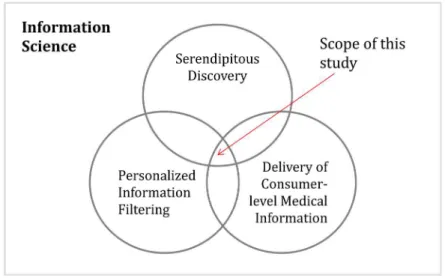
To be more specific regarding serendipitous recommendation, little research has been conducted to investigate how to effectively implement it into filtering settings that focus on consumer-level medical information. This study focuses on the role of serendipity as well as the methods of incorporating serendipity, with its scope shown in Figure 1.1.
Figure 1.1 indicates this study is closely related to three areas in information science: delivery of consumer-level medical information, personalized information filtering and serendipitous discovery. Based on previous research work in these areas, the study attempts to examine important factors associated with serendipitous discovery of consumer-level medical information in personalized filtering environment.
In order to make our problem statement clear, elaboration and explanation is necessary on the initialization phase of filtering systems. When users access a filtering system for the first time, they are often asked to select topics of interest from a list. These selected topics constitute the user’s profile used in the whole filtering process by the system. Therefore, the topics are defined as system-profile (SP) topics. In contrast, the topics that are not selected by users are defined as non-system-profile (NSP) topics. In this study, incorporating serendipity is implemented in the system as presenting articles from NSP topics to users.
conditions. Therefore, user-related factors need to be carefully examined through empirical experiments before declaring the effectiveness of incorporating topic associations in enhancing serendipitous discovery in medical area.
In addition, the drawbacks of incorporating and presenting topic associations cannot be neglected. In serendipitous recommendation based on topic associations, NSP topics are presented around the SP topics with which they are associated. It is possible that one NSP topic is related to many SP topics and thus has a priority of presentation in multiple locations. If this NSP topic is not attractive to users, repeated presentation of the topic will make a negative impression on users in terms of information delivery performance. In order to resolve this problem, the method of adopting topic associations in serendipitous recommendation can be optimized by effectively integrating users’ preferences for potentially relevant NSP topics. Based on users’ interests, the frequency of presentation for each NSP topic is modified. For NSP topics presented to users over multiple times, the improved methods will exclude these topics in the subsequent sessions if users have low or no interest in old (or current) sessions. The methods also make sure that these NSP topics will continue to be presented in the subsequent sessions if users have strong interest in current sessions. By integrating the adaptive learning mechanism, this method incorporates serendipity which is closer to users’ interest profile as compared with the method which only utilizes topic association.
serendipitous discovery of medical content in filtering settings and if their interests are influenced by this type of discovery.
A previous study conducted by the researcher revealed that serendipity can play a positive role in medical information retrieval and should be given careful consideration in the design of personalized information retrieval systems (Fan et al., 2012). On the basis of findings in the study, this work further examines many important aspects of serendipity in the field of medical content delivery. Different from the previous study, this dissertation research puts an emphasis on how to effectively enhance serendipitous discovery. The incorporation of serendipity has the possibility of reducing blind spots through enhancing unexpected discovery in personalized information filtering. However, it remains an empirical research question as to how to make the serendipitous feature more effective in helping the occurrence of unexpected and useful discoveries in the medical domain.
1.2 Research Questions
medical news; 2) to introduce three serendipity models and determine their efficacy; 3) to investigate users’ attitude related to unexpected discoveries; 4) to study the change of users’ interests after incorporating serendipity. Based on these goals, four research questions are proposed and introduced in sequence in the following paragraphs. Questions 1 and 2 are proposed from the system’s perspective, with the focus on serendipitous recommendation. Questions 3 and 4 are proposed from users’ perspective, with the focus on unexpected discovery of relevant content. The four research questions (RQ) are described below:
RQ 1: Does incorporating serendipity help people find unexpected but relevant news? The first research question focuses on the feasibility of incorporating serendipity to achieve unexpected but useful discoveries. The previous study (Fan et al, 2012) examined information seeking behaviors of users in a personalized information delivery system that ranks medical news articles based on the weight of users’ interests. Experimental results demonstrated that serendipity can play a positive role in personalized medical content delivery. Based on the findings in previous work, this dissertation study attempts to examine whether incorporating serendipity influences unexpected discovery of relevant news content in a personalized filtering environment. The unexpected discovery is identified through comprehensively analyzing user interface actions (clicks and rating) and a survey of user interests. It is hoped that by comparing the results of this study with the results obtained in the previous experiments, we will clarify how serendipitous recommendation can affect personalization and effectiveness of medical content delivery.
This particular research question is the most important one in this study and concerns how to enhance unexpected discovery of relevant content in medical domain. Serendipity is typically incorporated into information filtering by inclusion of randomly selected documents into presentation. Beyond the random method (named as the RA method for serendipity Model 1 here), this study attempts to examine the feasibility of leveraging medical knowledge to strengthen unexpected discovery. In this updated method, the documents that help with unexpected discovery are not randomly chosen. Instead, they are chosen through analyzing the associations of medical topics (called KA methods for serendipity Model 2 here). For each SP topic, all NSP topics are sorted by their association with it. Based on this rank, these NSP topics are sequentially presented around the associated SP topic over many sessions. In the process of implementation, the NSP topic of the highest rank is shown first, followed by that of the second highest rank. Theoretically in both RA and KA methods, users have a chance to view the articles on all the NSP topics if the number of sessions is large enough. Since there exist hundreds of common medical topics in medical domain, it may take a long time to show all NSP topics in sessions. In addition, the interests of users may change over time. In order to improve user experience, it is significant to present NSP topics with a high possibility of being relevant to user’s interests at the initial stage of serendipitous recommendation. KA method may perform better than RA in this aspect, based on additional data about medical topics. The associations among medical topics are determined based on the judgment of physicians.
Adaptive KA methods (called KAA methods for serendipity Model 3 here) are developed to resolve the problem. In the implementation of KAA methods, all NSP topics are given a limited number of presentations. If users show interest in them in these presentations, the NSP topics continue to be shown to users. If users have low or no interest in them, the NSP topics are moved to the lowest position in the ranked list, implying no continuous presentations on them. More details of KAA method are given in the chapter of research methods. To clarify, KAA methods involve not only professional knowledge from physicians, but also the feedback from users.
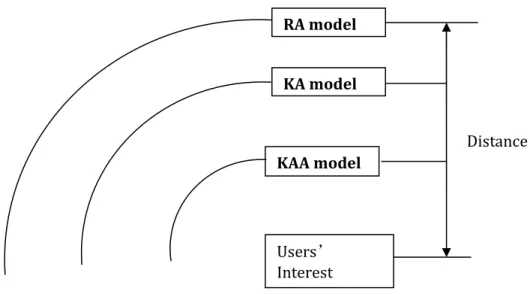
The main difference between the three types of methods above is how to predict what NSP topics users would prefer to see. Figure 1.2 shows the distance of predicted NSP topics and users’ interest profile.
Figure 1.2: Distance between Serendipity Models and Users’ Actual Interest Profile
Compared with RA methods, the serendipity topics are selected from NSP topics with
Users’
Interest KAA model
RA model
KA model
further shortened when KAA methods are adopted. To clarify the difference, KA/KAA methods are developed to test “closely related” serendipity whereas RA methods are based on “random” serendipity. RQ2 is proposed to examine how “closely related” and “random” serendipity models perform.
The first two research questions cover the main aspects of incorporating serendipity from the perspective of system performance. In order to evaluate the serendipitous discovery comprehensively, another two research questions are proposed to analyze the role of serendipity from the perspective of user reactions.
RQ 3: Do users have a positive response to unexpected discovery of medical news? This question is concerned with users’ attitude related to unexpected discoveries of medical news in filtering settings. It is addressed through analyzing user’s interests on clicked articles. This process involves two types of data associated with the articles on NSP topics. The first one is user rating of interest levels on article content over all sessions. The second one is the data from a post-study survey in which users directly describe what they think about the discovery of these unexpected articles and whether they would like to continue to use this feature. These data are comprehensively analyzed to clarify whether people like unexpected discoveries of medical news in filtering settings.
RQ 4: Does unexpected discovery causes a change in users’ interest profile?
before and after filtering sessions, we can see whether users are interested in extra medical topics after accessing a wider range of medical content. If extra interest dimensions in post-study profiles exist, users will be asked to describe the factors associated with their interest changes. By qualitatively analyzing the comments of users, the connections between unexpected discovery and users’ interest changes can be identified. This type of information from questionnaires provides direct evidence for answering RQ 4.
The ultimate objective is to develop reliable medical information filtering settings, which deliver more relevant information to users in an efficient manner, by reducing blind spots associated with personalization. The diversity and complexity of users and their interests make simulation study difficult to implement. As a result, this study adopts empirical research methods based on real users, and further details of the user study are introduced in the methods chapter.
1.3 Significance of the Study
designers of personalization systems with implications that can be utilized to reduce negative effects of over-personalization in information filtering.
By generating new evidence, this study seeks to further develop the concepts and theories of serendipity in the information seeking process. Despite the existence of successful applications in some commercial websites, the role of serendipity in IR is still somewhat controversial. Many scholars have noted the “threat” (Foster & Ford, 2003) to serendipity by particular electronic IR systems (Gup, 1997, 1998; Cooper & Prager 2000; Huwe, 1999). Although some scholars have described how serendipity can happen in IR systems, particularly in relation to browsing (Bruijn and Spence, 2008), IR systems have traditionally been created with the intention of enhancing the ability to conduct item” or “known-problem” searches. Information filtering is similar to information retrieval in this respect since IF systems map known users’ profiles to information stream. Experiments conducted in this study help demonstrate the role of incorporating serendipity in personalized information delivery in the medical domain. The clarification of fundamental concepts and theories often results in technological innovations and revolutions. From the perspective of developing new serendipity-related concepts and applications, this study contributes to the field of information science. In addition, the serendipity-related features in assisting medical information seeking have not been carefully investigated. Specifically, there is little literature about serendipitous discovery in the field of consumer-level medical information. This study can make an important contribution to the research about serendipitous discovery of medical content.
often results in variation of ways in which medical information is consumed, increasing the difficulty of designing robust filtering systems. It is important to see how users perform when seeking relevant information in filtering settings and how users’ interface actions are related to their interest properties. This study generates some evidence to identify these internal connections. Additionally, users’ intrinsic motivation for health information seeking can be identified from their comments, which helps health information provider better understand users’ information needs and generate more appropriate information at consumer level.
2. LITERATURE REVIEW
The area of focus for this dissertation is consumer medical information delivery, and the research examines how serendipity affects the delivery of consumer medical information in a personalized filtering system. Highlighting the problems associated with information delivery efficiency and coverage, this review aims to survey the literature in information overload and filtering technology, personalization in information delivery, and the role of serendipity in personalized information filtering.
2.1 Information Overload and Filtering 2.1.1 Information Overload
The rapid advances in computer and communication technologies have led to a generation where a deluge of data and information overload people every day. This overload has been apparent for a long time but has been exacerbated with broad adoption and use of the Internet. The term “information overload” conveys the simple notion of receiving too much information. The term and concept of information overload is a psychological phenomenon where information overload relates to sensory organs with an excess of incoming information. Toffler (1970) noted that individuals can have difficulty in understanding an issue and making decisions when they encounter too much information, and this difficulty can be considered information overload. Hanka (2000) explained the cause of information overload from the perspective of human interaction with knowledge expansion. He claimed that information overload results from the mismatch between the neural capacity of the human brain and the rate of expansion of human knowledge. In medical domain, overload on any given topic comes from the availability of hundreds of journals and guidelines, as well as large amounts of patient data and consumer medical information (e.g., news articles). Fuat et al. (2003) found that most clinicians were not familiar with existing guidelines, and ‘guideline fatigue’ is a common cause of stress when ascertaining a patient’s diagnosis. This result is consistent with an older study conducted by Hibble et al. in 1998.
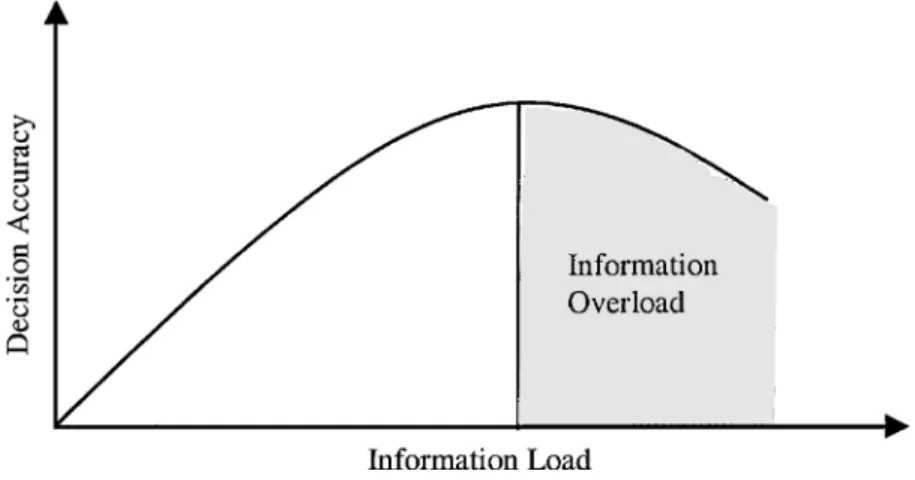
1987). The findings are consistent in different disciplines: the performance of an individual in decision-making can be improved with the amount of information he or she receives. If more information is provided beyond a certain point, however, the performance of the individual may decline (Chewning & Harrell, 1990). The authors further explained that the information provided beyond this point causes the occurrence of information overload, which confuses the users and makes them fail to recall prior information they have received (O’Reilly, 1980, Schick et al., 1990). This curve of decision accuracy with information load is shown in Figure 2.1 (Eppler, 2004). It is consistent with the results of many studies on decision-making (Iselin, 1989; Hwang et al., 1999).
Figure 2.1: Decision Accuracy Change with Information Load (Eppler, 2004)
performance for general information, the statements were still applicable to the medical domain.
and due to its importance, this study selects information filtering as the main method for delivering consumer medical content to users.
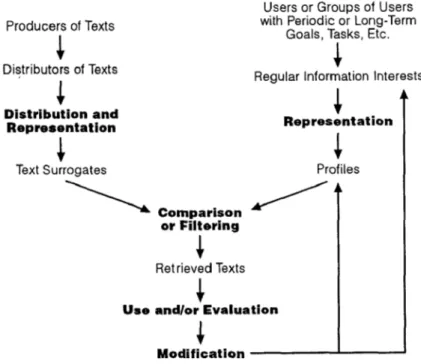
Figure 2.2: A General Model of Information Filtering (Belkin & Croft, 1992)
2.1.2 Types of Information Filtering
methods. In this section, the characteristics of different filtering types are discussed in an attempt to establish one likely to be most suitable for consumer medical information delivery.
1) Initiative of Operation
2) Presentation Methods
Filtering systems may adopt different methods to present the information. Some filtering systems present part of the data after removing irrelevant information from the information stream, while others show all the data items ranked by relevancy. Each approach has advantages and shortcomings, and the selection of a particular approach is actually a trade-off situation. Less information presented to users can minimize the overload of information but may exclude some important information. Therefore, the selection of presentation method is dependent on whether the risk is affordable. For instance, a study by Oard (1997) indicated that Email users tend to use a filtering method that lists all messages because they are afraid of missing some messages of importance. Even if important messages are given a low rank position, most users consider this case acceptable because they can still scroll down to browse the messages. Compared to Emails, news can be more suitable for filtering systems that exclude irrelevant information from presentation, as the information in daily news is not as important to users as that in Email messages. Based on the analysis above, exclusion of irrelevant information is a good way of presenting the filtering results in a consumer medical information system.
2.1.3 Approaches of Information Filtering
of their scope. According to the definition of Malone et al. (1987), cognitive filtering characterizes “the contents of a message and the information needs of potential message recipients, and then us[es] these representations to intelligently match messages to receivers,” while sociological filtering “works by supporting the personal and organizational interrelationships of individuals in a community.” In much of the literature (Morita & Shinoda, 1994; Sheth, 1994; Shapira et al., 1997), cognitive and sociological filtering are interpreted as content-based and collaborative approaches, respectively. This dissertation is limited to the information seeking process of the individual user, and no collaborative approach is applied in the study. Therefore, this literature review focuses on content-based filtering techniques.
Content-based filtering techniques were used in the early recommendation systems (Basu et al., 1998; Mooney & Roy, 1999; Claypool et al., 1999). In addition, some filtering systems handling consumer medical documents also adopted content-based approaches (Mostafa et al., 1999; Mostafa & Lam, 2000). Content-based recommendation systems work by mapping a description of the item to a profile of the user’s interests. The success of the content-based approach requires a good representation of target items, and it is important for the system to build representations of the items based on the features of the items. These items can be automatically extracted features (such as word frequency for text items) or human-edited features (such as genre of movies). Then, the similarity between the user’s interest profile and the items in the database could be analyzed quantitatively, with a threshold established to determine whether the specific item should be presented to the user.
working with free text is to convert it to a structured representation. One basic method is to treat every word as an attribute. This method uses a Boolean value (0 or 1) to indicate whether the word exists in the text or an integer value to indicate how frequently the words occur in the text. During this process, words are stemmed, which is a process that counts the root forms of words rather than words in analysis. Some words are not related to the task or the domain and need to be filtered out prior to applying NLP or statistical analysis. The words that are removed are called stop words.
A key issue in the representation of content is termed weighting. A variety of methods have been developed to reflect the significance of a word to a document in a collection or corpus. One of the popular weighting methods of words is term frequency— inverse document frequency, often called tf–idf (Salton and McGill, 1983). In tf–idf methods, the weight of a word is calculated by this formula:
= ∗ = ∗ log ( / ) (2.1) where tfij is the frequency of term i over document j; where idfi is the inverse
document frequency of term i over a collection of N documents; and where ni is the number
of documents containing term i.
experiment rated Netnews articles as either relevant or not relevant, based on the subjects’ interests. The ratings from the initial 80% of the articles read were used to predict the relevance of the remaining 20% of the articles. The results indicated an average of 13% improvement in prediction after adopting LSI, compared with the keyword matching method. The research also showed a 26% improvement in retrieval precision based on ranking. The positive effects of LSI were verified in another study (Foltz & Dumais, 1992). After using LSI, an improvement was observed for the mean ratings of users. This improvement was attributed to the fact that users were allowed to access relevant documents without words in their interest profiles.
Despite many successful applications, content-based recommendation systems may fail if the content does not contain enough information to distinguish items the user likes from items the user does not like. This can occur for the content where separated words cannot represent the content well. Poems and jokes are representative examples for this type of content. In order to resolve this problem, more content-specific information needs to be integrated. For instance, the introduction of poems (i.e., one of metadata of the poem) may be added into the representation of content in the recommendation. A representative commercial application is exemplified in the recommendation of movies. The movie recommendation systems not only use movie content to make recommendations but also the genres of movies, actors, and directors.
description) instead of classifying the articles through NLP techniques. This method greatly reduces the impact of text analysis on filtering, whereby inferring filtering performance is mainly determined based on user model (profile) and mapping methods. In the next section, the literature related to user model and mapping process is reviewed, with a focus on the role of personalization and serendipity in information filtering.
2.2 Personalization and Serendipity in Information Filtering
Information filtering not only involves information retrieval and representation but also the acquisition and representation of users’ interests, which is challenging because user profiles are dynamic and sensitive in both time and context. If the system fails to keep up with the shift in user interests, the system would eventually fail which points out the importance of learning component in the information filtering process. In this section, the literature on user profiles and learning methods will be reviewed along with the challenges associated with personalizing based on user models.
2.2.1 User Model in Personalized Information Filtering
interests. Some early researchers employed the term “query” to refer to user models (Belkin & Croft, 1992). In this view, a user model is actually a saved query (or a set of saved queries). LyricTime (Loeb, 1992), a music recommendation system, adopted the mood specified by users as a user model. After users were logged in, the system would deliver a playlist based on the selected mood from users. Widyantoro et al. (2000) proposed a more complex user model with a two-fragment user profile, which contained the following components: a long-term interest profile that captures user’s general interests and a short-term interest profile, which kept track of a user’s more recent, faster changing interests. Traditional user models are utilized in commercial sites as well. Amazon employs “favorites” to represent user models and the data of “favorites” are generated from the preferred categories set by users (Brusilovsky et al., 2007).
The methods of acquiring users’ interests can be explicit or implicit, depending on the source of the data. If the data are generated from user interrogation, the methods are considered explicit. In contrast, implicit approaches often refer to handling the data on observed user behaviors. Modern information filtering (or recommendation) always involves the explicit and implicit approaches simultaneously and sets different weights on the signals of these approaches in the learning module.
User Models Built on Explicit Methods
User interrogation has been widely used and is always considered the more reliable approach in acquiring user knowledge compared to other means. The basis for this method is that conceptually users know themselves better than others who may know them. In the process of interrogation, users are required to provide information on their interest directly to the filtering system. Previous researchers have examined different types of interrogation with variable levels of flexibility granted to users. Some filtering systems present a predefined set of profiles, granting users the ability to choose one from these profiles (McCleary, 1994). This method makes users capable of creating profiles very quickly. To increase the freedom of choice, some systems provide users with a set of terms and ask users to construct their profiles based on these terms. Some systems allow users not only to pick terms but also set the importance of terms in building the profiles (McCleary, 1994). These aforementioned approaches generate user profiles, which are represented by a vector.
User Models Built on Implicit Methods
emotional status, this process is deemed highly challenging. For instance, users’ browsing actions can be interrupted by some uncontrollable issues, such as phone calls. Despite these difficulties, researchers have achieved positive advances in understanding implicit user behavior. Previous studies indicated that the time users spend reading data items relates to users’ interest in the data (Morita & Shinoda, 1994; Konstan et al., 1997). The work conducted by Morita and Shinoda examined the correlation between the usefulness scores of articles and the time users spent reading them. The study demonstrated that there is a relatively strong correlation between these two factors (correlation coefficient is 0.49), suggesting that users spend more time reading documents that they find relevant than they do reading documents that are irrelevant. Some other types of user behavior can be leveraged to acquire interest information implicitly. Goecks and Shavlik (2000) presented an approach that learned users’ preferences through observing the hyperlinks clicked on and the users’ activity, as tracked by their mouse and scrolling movements. The results were consistent with the surrogate measurements of user interests, indicating the well-designed implicit approach was capable of predicting a user interest profile. Calvi and De Bra (1997) conducted a similar study in which they developed an adaptive learning approach that analyzes users’ past navigation history. This study performed well in the filtering module of educational hypermedia systems.
relationship exists between the length of time that a user spends viewing a document and the user’s subsequent judgment on document relevance. This suggests that the theory concerning the relationship between reading time and relevance is scope-specific. In order to explain this clearly, Kelly and Belkin (2004) investigated the effects of tasks on the effectiveness of display time as implicit feedback. They analyzed online information-seeking behaviors of seven subjects during a fourteen-week period. In the study, subjects were asked to identify their tasks, classify the documents that they viewed according to these tasks, and evaluate the usefulness of the documents. The experimental results showed that tasks and the time spent on tasks vary with the settings of the individual studies, resulting in no general, direct relationship between viewing time and usefulness. The effects of tasks on viewing time partially explain the inconsistency in the conclusions of the previous studies.
2.2.2 Blind Spots in Personalized Information Filtering
interest to the user, then the new documents from those topical areas would not be presented to users. In this specific case, the relevant document representation approach would never successfully acquire all of a user’s interests through the learning algorithms. This problem of “blind spots” not only occurs for the relevant document-representation approach but also in the filtering techniques based on other types of user models.
Mostafa et al. (1997, 2003) attempted to resolve the problem of “blind spots” in the simulation study on information filtering. They developed the SIFTER system, which can filter information based on content and a user’s specific interests. Beyond user interest profiles, which consist of many interest topics, the learning algorithm adopted another vector that represents the probability of the topic in the profile being selected as the most relevant topic. By modifying the module of generating the probability vector, all the topics in the incoming documents were given dynamic chances to be presented to users. This method reduced the probable occurrences of blind spots in the filtering process, which was verified in an experimental study (Mostafa, et al., 1997).
2.2.3 Serendipitous Recommendation
enhancing the ability to conduct “known-item” or “known-problem” searches. However, in some situations search systems involve the limitations in relation to natural human information seeking. Miksa (1992) gave a detailed description of these situations in his book:
“Intellectual knowledge appears to be characterized by a relatively unfocused sense of inquiry where the initial goal is not to find some particular informational answer or to fill some sort of reasonably anticipated informational gap, but rather to bring order to (or to re-order) an ill-formed mass of ideas or to map some vaguely arranged area of knowledge. Information retrieval in such situations takes on the character, then, of helping an inquirer think about what he or she appears to be interested in, and might be better conceived as an exploratory and game-like mechanism rather than a precise response mechanism.” (Miksa, 1992).
sensitive to both time and context, Loeb and Panagos (2011) presented a generalized model for the production of augmented and context sensitive profiles. With this model, users can be exposed to a potentially broader set of relevant information. The serendipitous discovery in search was examined in a previous study (André et al., 2009a). The paper showed how to measure serendipity by analyzing user ratings. For measuring serendipity, participants were asked to rate search results on two dimensions: relevance and interestingness. It hypothesized that search results that are interesting but not highly relevant indicate a potential for serendipity. The new method of evaluating serendipity provided some guidelines for the experimental design in this dissertation study.
always related to browsing. Marchionini and Shneiderman (1988) defined Internet browsing as “an exploratory, information seeking strategy that depends upon serendipity.”
Some general ideas can also be obtained from previous studies in terms of how to incorporate serendipity in content delivery. Mostafa et al. (1997) integrated the serendipitous mechanism into personalized recommendation system by randomizing the articles presented on the top of the presentation window. They considered this as an efficient solution to the problem of blind spots. Beale (2007) proposed a serendipitous environment for offering supplemental information to support users in making new discoveries while keeping them at the center of an interaction with data mining systems. Some researches show how serendipity can be incorporated through ontological information in filtering settings (Sieg et al., 2010). In these experiments, researchers examined the effect of ontological information on the ability of filtering to increase the coverage of the information filter. The experimental results showed that the semantic context broadened the set of recommended items, thus improving the diversity of recommendations.
2.2.4 Role of Serendipity in Personalized Information Filtering
excluded from the user interest profile which was generated and stabilized by the system. This scenario most often occurs in over-personalized systems. For instance, in a typical information recommendation environment, systems are increasingly trained to provide users with only the information that they explicitly requested or the information similar to what they received before. There is major concern rising from these over-personalized systems because previous studies demonstrated the fact that information seekers were often unaware or unable to articulate their actual information needs (Taylor, 1968; Belkin, 1980). Therefore, it is important to study how the serendipity plays a role in the personalized filtering process.
Fan et al. (2012) conducted a user study to examine serendipity-related issues in the medical domain. Fan’s study was an important empirical research conducted to investigate the role of serendipity in personalized delivery of consumer medical information. Since relevant research literature in the specific research area (i.e., serendipitous recommendation of consumer medical information) is very limited, it is of significance to review this previous study comprehensively. There are two general aims for discussing the past study: First, to demonstrate the role of serendipity in the medical information seeking process; Second, to clarify how people use a personalized system to seek information and how the serendipity feature can be implemented into personalization systems. Both types of findings in the past study contributed to this study in terms of formulating research questions and designing the user study.
recommendation in the article list shown in Figure 2.3. A higher value of r indicates a higher level of personalization, whereas a lower value of r means a lower level of serendipity. Medical news articles from MedLinePlus (a public website maintained by the National Institute of Health) was utilized as presented medical information in MedSIFTER system.
Figure 2.3: Top Articles Presented to Users in MedSIFTER System
Thirty participants from the School of Library and Information Science (SLIS) program at Indiana University Bloomington were recruited to participate in a four-week user study. Study participants were randomly assigned into one of three groups (ten participants per group). Each group was assigned to an instance of MedSIFTER with a different personalization level. At the beginning of this study, each user was presented with twenty-six topics and asked to identify the strength of their interests in the topics. Then, the classes with the high interest strength were selected as the scope of the user profile. The clicks on the articles from the topics that were not included in the profile were off-topic clicks.
Figure 2.4 indicates the proportion of off-topic clicks (POC) per session for every group. No significant difference existed in users’ off-topic clicks between the three groups (p>0.5). Each user implemented approximately three off-topic clicks per session for all three
1. Article on topic-X (serendipitous recommendation)
2. Article on the topic of the highest interest strength
groups on average. The POC for all sessions was fairly high in Group 3 (r=0.8), which indicates that the participants showed interests in off-topic classes even in a highly personalized environment.
Figure 2.4: The Proportion of Off-topic Clicks Per Session (Fan et al., 2012)
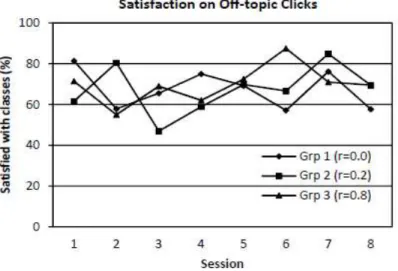
For off-topic clicks, users’ feedback on their satisfaction level was examined, with the results shown in Figure 2.5.
Statistical analysis indicated no significant difference existed in satisfaction between the three groups (p > 0.5). The proportion of satisfaction with clicked news items per session (PSCS) remained fairly high across the study although there was fluctuation with each session. The off-topic clicks with satisfaction were aggregated across all participants and compared with total off-topic clicks. The results showed that users were satisfied with 67.5% of news items related to off-topic clicks.
In summary, the results of Fan’s study demonstrated that serendipity can play a positive role in information retrieval. The study investigated the interaction between serendipity and personalization in an information retrieval setting. There were two main findings in the study. First, users had fairly high off-topic clicks, regardless of the personalization level to which they were assigned. Second, users showed uniform satisfaction with the outcome of serendipitous behavior across the three groups. The results from the usability analysis indicated that user responses were likely rooted in information-seeking characteristics that were dynamic or evolving in nature. In addition to the findings mentioned above, experimental system utilized in Fan’s study is another concern for us and the experience learnt in the implementation of MedSIFTER system is useful to the design of our experiment system in this dissertation research.
2.3 Medical Information Seeking
information consumption before they adopt appropriate medical information seeking strategies. This chapter first discusses the important properties of medical information and then introduces a variety of techniques and popular tools that have been recently developed for processing medical information.
2.3.1 Introduction of Medical Information
Information is a delicate commodity. One definition describes information as the data and knowledge that intelligent systems (human and artificial) use to support their decisions. Medical information systems assist doctors with their decisions and actions and also improve patient outcomes by making better use of information—creating more efficient means for patient data and medical knowledge to be captured, processed, communicated, and applied. Medical information mainly resides in electronic medical records systems deployed in inpatient hospitals, outpatient clinics, public health institutions, etc. Health information is different from the traditional format of information representation, which poses many challenges for intelligent analysis.
professionals). This study is conducted from the angle of enhancing the delivery of relevant consumer-level medical content to deal with information overload in medical domain.
2.3.2 Characteristics of Medical Information Seeking
Health information seeking is important for both members of the general public and healthcare professionals, such as physicians. The general public also desires to obtain information related to healthcare, especially after they have developed certain illnesses. Physicians strive for the newest medical information in order to update their own medical knowledge. An increasing emphasis on the use of evidence-based medicine, which focuses on the use of best evidence from the scientific literature in clinical decision making, also increases the importance of medical information seeking at the point of care. Due to the vast and ever increasing amount of medical information being made available on a daily basis, information seeking in the medical domain, in the absence of domain-specific tools, becomes unmanageable. Therefore, useful information delivery tools are becoming increasingly important in the medical domain, due to the explosion of clinically relevant evidence in published literature in particular.
Regarding the behavior of information seekers, most medical information searchers share two important sets of characteristics:
First, medical information searchers generally have limited abilities to express themselves when performing information seeking tasks. This is primarily due to a lack of medical knowledge. Such users would expect to read and learn all the information and knowledge related to their disease of interest. However, most search engines, even domain-specific ones, focus primarily on the accuracy of the retrieved documents, and this lack-of-diversity problem could be further aggravated by the nature of medical web pages. When discussing medical topics, medical web pages tend to use similar, but not exactly identical, descriptions by paraphrasing the contents of medical textbooks and research papers. Therefore, there is plenty of semantic redundancy in the pool of retrieved documents, many of which offer little use to information seekers. To appropriately address this problem while balancing the accuracy of search results, user queries would need to be refined or expanded to broaden the search scope horizontally.
Healthline (http://www.healthline.com/) is a domain-specific search engine dedicated to health information. It has a database containing descriptions of over 1,000 diseases and conditions, as well as over 4,500 symptom choices. However, the controlled vocabulary of symptoms limits the users’ ability to describe medical situations appropriately. Such limitations may not provide the best match for the patients’ current ailments during a one-time input of text (i.e. the description of symptoms). Realizing the special characteristics of medical information seekers and the complexity of medical information itself, researchers and engineers have since developed several medical domain specific information delivery systems in an effort to accommodate the needs of information seekers. These systems have symptom checker which utilizes filtering features.
After users select one body area from a body map, a list of related symptoms are presented to them. Based on each user’s choices of symptoms, the possible conditions are retrieved through matching the symptoms to different conditions.
By reviewing current consumer medical information systems, we can see that search is an important solution when people have information needs in the medical area. Despite this, search systems may still pose barriers as query length is limited and domain knowledge may be required for formulating a good query. In IF systems, some of the challenges associated with search systems can be addressed or their negative impact can be minimized.
3.RESEARCH METHODS
The goal of this study is to understand whether and how incorporating serendipity can help people find unexpected but relevant news in the medical domain. For this purpose, the study adopted an empirical user evaluation to investigate the role of serendipity as well as different methods of incorporating serendipity in enhancing medical content delivery. This study falls under the broad research area of information seeking behaviors of users and the research methods were developed based on it. We start with an introduction of experimental system and user study procedures. After that, the critical categories of data and the methods for data collection are described. Finally, the chapter offers detailed discussion on the analytical methods of experimental results and approaches used for interpreting the potential findings. For this study, three filtering system modalities with different serendipitous features were developed to conduct user experiments. Based on these system modalities, three sets of experiments were carried out to answer the research questions, with each user group assigned to a specific modality. The details associated with experimental systems and the user study are presented respectively in the next several sections.
3.1 Setup of Experimental Environment 3.1.1 Personalized Filtering Environment
each title to give a short description of the article content. All the articles are shown in the screen of browser. Users can see all the articles, without using a scroll bar. At the top-right corner of screen, there exists a “Go to Next Session” link. After reading the medical news in the current session, users can enter the next session to read more news by simply clicking the button. Users are not allowed to return to old sessions once they enter into a new session.
Figure 3.1: An Example of an Article List Shown in MedSDFilter
of interest. They include diabetes, anxiety, women’s/men’s health, and heart disease, etc. (see Appendix A for the full set).
Figure 3.2: News Categories in the MNT Site
date and content were extracted. These data were sorted by publication date and stored into one table in the database. All 30 tables (each table for each class) were treated as the complete document set in the study. When filtering sessions start, the articles on each class are retrieved from the corresponding table in the order of ascending publication date. In order to avoid duplicate presentation of articles to one user, all articles in the database are labeled as “unused” before the first session starts. When one session completes, retrieved articles are re-labeled as “used” in the database and excluded from being retrieved in the following sessions.
3.1.2 Methods of Incorporating Serendipity
The section above introduces the setup process for the filtering environment. The next important issue in this study is how to incorporate serendipity in the filtering environment. In order to reduce the impact of ranking on serendipitous recommendation, we adopt a fixed position in the presented list to introduce serendipity. This means that our study does not test placement location. Placement is not an independent variable in this study.
experimental dataset. In the presentation stage, only the top 5 articles are listed according to the rank of their topics due to the limitation in total number of presented articles. Then, one article from a NSP topic is added below each article on SP topics, generating a total of 10 articles shown to the user in each session (see Figure 3.3).
Figure 3.3: Article List Presented to Users in MedSDFilter System
From the description above, topic-X in Figure 3.3 is selected from all NSP topics. Presenting the articles on the NSP topics represents this study’s strategy for incorporating serendipity. In this context, how to pick topic-X from all NSP topics in each session becomes
especially important. Based on the article list described in Figure 3.3, three methods for
picking topic-X are introduced respectively. In order to double check users’ interests, topic-X is presented repeatedly for 2 times in consecutive sessions. In other words, users view 2 different articles on each topic-X. Below, we describe the three methods that introduced serendipity in this study.
1. Article on SP topic-1
2. Article on NSP topic-X (serendipity incorporated)
3. Article on SP topic-2
4. Article on NSP topic-X (serendipity incorporated)
5. Article on SP topic-3
6. Article on NSP topic-X (serendipity incorporated)
7. Article on SP topic-4
8. Article on NSP topic-X (serendipity incorporated)
9. Article on SP topic-5
1) RA Method (Based on Randomness)
RA method is the simplest solution of incorporating serendipity since it relies on randomness. It works as a baseline for comparing the other methods of incorporating serendipity. When RA method was implemented in this study, topic-X in every location was randomly selected from all NSP topics across all the sessions.
2) KA Method (Based on Knowledge of Topic Association)
In KA method, the topic-X is not randomly selected from all NSP topics. Instead, the topic-X is selected through analyzing its association (to be described later) with the SP topic above it in the presentation. For instance, as for the topic-X in the second article in Figure 3.3, all NSP topics are sorted by their association with topic-1. Based on this rank, these sorted topics are sequentially presented below topic-1 over all the 10 sessions. When KA method was implemented in this study, the NSP topic of the highest rank was selected as topic-X first, followed by that of the second highest rank.
across topics, the physicians were requested to adopt the same rating standards for all of these topic pairs when they conducted the evaluation. It is highly challenging to achieve this goal, considering the fact that a large number of judgments have to be made by each physician. As a result, a short range of topic associations (0-3, not 0-5 or more) was adopted to compress the range of selectable options for a judgment, making the workload of evaluation manageable. After the survey, the data obtained from the physicians were compared and analyzed through statistical methods. Based on average value of their judgments on topic association, the KA method was implemented for topic-X selection.
3) KAA Method (Adaptive KA method)
If NSP topics are not relevant to users’ interests but presented repeatedly, users may be distracted by noise introduced. Based on the KA method, the KAA method is developed to resolve the problem of over-presentation of irrelevant NSP topics. The KAA method is similar to KA but it incorporates user feedback representing their level of interest. In order to display more relevant NSP topics to users in a limited number of sessions, a NSP topic is excluded if it has been presented to users multiple times and users have low or no interest. In this study, two articles on topic-X (one NSP topic picked for presenting) were shown to users in consecutive sessions. If users were not interested in these articles, the topic-X was not shown to users again until all other NSP topics were presented.
these methods, the influence of serendipity was analyzed in the study. Additional details of system implementation are discussed in the next section.
3.1.3 Example of Implementing Serendipitous Recommendation
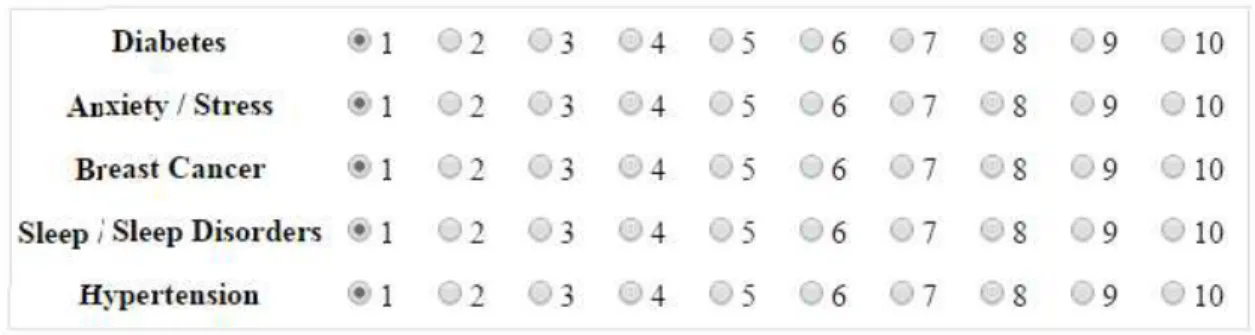
In order to easily visualize the article list and explain how the list is generated, an example is given. This example assumes that one user chooses two topics from five available medical topics (not 30 in the real user experiments) to build the system’s profile. These available topics include “anxiety,” “diabetes,” “sleep disorder,” “breast cancer,” and “hypertension.” Let us assume the user is strongly interested in the topic “breast cancer” and also has a weaker interest in the topic “diabetes.” From this selection, SP topics include “diabetes” and “breast cancer.” In contrast, NSP topics include “sleep disorder,” “breast cancer,” and “hypertension.” In filtering settings, the articles on “breast cancer” are retrieved from the dataset and shown at the top, followed by the articles on “diabetes” because the strength of user’s interest on “breast cancer” is higher than that on “diabetes.”
The next step involves obtaining the association of these five topics. In this study, the associations of these five topics were judged by the two physicians. Table 3.1 shows the results of physician judgments where ‘0’ indicates no association and ‘3’ means the strongest association. The normalized associations (r) of the five topics (see Table 3.2) are calculated from physician’s judgment by this formula:
=
(3.1)Table 3.1: The Strength of Topic Associations Judged by Two Physicians
Top-A Top-B R1 R2
Anxiety Diabetes 1 1
Anxiety Sleep disorder 3 1
Anxiety Breast cancer 2 1
Anxiety Hypertension 2 3
Diabetes Sleep disorder 0 2
Diabetes Breast cancer 0 1
Diabetes Hypertension 2 3
Sleep disorder Breast cancer 0 0
Sleep disorder Hypertension 1 3
Breast Cancer Hypertension 0 1
Table 3.2: The Normalized Association of Medical Topics
Anxiety Diabetes Sleep Disorder
Breast Cancer
Hypertension
Anxiety 1.00 0.33 0.67 0.50 0.83
Diabetes 0.33 1.00 0.33 0.17 0.83
Sleep Disorder 0.67 0.33 1.00 0.0 0.67
Breast Cancer 0.50 0.17 0.0 1.00 0.17
Hypertension 0.83 0.83 0.67 0.17 1.00
From the results shown in Table 3.2, all the NSP topics are ranked based on their associations to the SP topics. If multiple NSP topics have the same association with one SP topic, they are ordered based on their rank in the complete topic list.
As for SP topic “breast cancer”, NSP topics are ranked in the following way: Anxiety (r=0.50) > Hypertension (r=0.17) > Sleep Disorder (r=0.0) As for SP topic “diabetes,” NSP topics are ranked based on: