Reactive
nitrogen/oxygen
species
production
by
nitro/nitrosyl
supramolecular
ruthenium
porphyrin
complexes
M.I.F.
Barbosa
a,i,1,
G.G.
Parra
b,1,
R.S.
Correa
c,
R.N.
Sampaio
d,
L.N.
Magno
e,
R.C.
Silva
f,
A.C.
Doriguetto
a,
J.
Ellena
g,
N.M.
Barbosa
Neto
h,
A.A.
Batista
i,
P.J.
Gonçalves
e,f,*
aInstitutodeQuímica,UniversidadeFederaldeAlfenas,37130-000,Alfenas,MG,Brazil b
DepartamentodeFísica,FFCLRP,UniversidadedeSãoPaulo,14040-901,RibeirãoPreto,SP,Brazil c
DepartamentodeQuímica,ICEB,UniversidadeFederaldeOuroPreto,35400-000,OuroPreto-MG,Brazil d
DepartmentofChemistry,UniversityofNorthCarolina,ChapelHill,NC,USA e
InstitutodeFísica,UniversidadeFederaldeGoiás,74001-970Goiânia,GO,Brazil f
InstitutodeQuímica,UniversidadeFederaldeGoiás,74001-970Goiânia,GO,Brazil
gInstitutodeFísicadeSãoCarlos,UniversidadedeSãoPaulo,CP369,13560-970,SãoCarlos,SP,Brazil hInstitutodeCiênciasExataseNaturais,UniversidadeFederaldoPará,66075-110,Belém,PA,Brazil i
DepartamentodeQuímica,UniversidadeFederaldeSãoCarlos,CP676,13565-905,SãoCarlos,SP,Brazil
ARTICLE INFO
Articlehistory:
Received20October2016
Receivedinrevisedform29January2017 Accepted30January2017
Availableonline11February2017
Keywords: NO Photorelease ROS Tripletstates
Photophysicalproperties PDT
ABSTRACT
Thismanuscriptreportsonnewnitro/nitrosylRu-basedcomplexes,whichweresynthesizedwiththe
purposeofusingthemasprecursorstoobtainsupramolecularrutheniumporphyrinspecies({TPyP[Ru
(NO2)(5,50-Mebipy)2]4}(PF6)4) and ({TPyP[Ru(NO)(5,50-Mebipy)2]4}(PF6)12). The photochemical and
photophysicalpropertiesoftheseporphyrinspecieswereinvestigated.Resultsshowthatthecomplex
containingnitriteisabletoproduceNObyhomolyticO—NOcleavage(FPPhNO=0.05)whilethe{TPyP[Ru
(NO)(5,50-Mebipy)2]4}(PF6)12 does it by direct labilization (FPPh
NO=0.53) of the RuNO bond.
Furthermore,atripletquantumyieldof0.09and0.27wasobservedforcomplexescontainingnitrite
andnitricoxide,respectively.Thereactiveoxygenspeciesquantumyieldforthecomplex{TPyP[Ru(NO)
(5,50-Mebipy)2]4}(PF6)12(0.78)isconsistentwiththesumofquantumyieldsNOrelease(0.53)andtriplet
state(0.27),whichsuggeststhatbothprocessesparticipateintheformationofthereactivespecies.Our
resultsshowthatcombiningthesecharacteristics,NOproductionandtripletstates,onthesameplatform
couldinduceasynergiceffect,leadingtoaconsiderableimprovementinthephotodynamicactionof
thesecomplexes.
©2017ElsevierB.V.Allrightsreserved.
1.Introduction
Photochemotherapyis aclinicaltreatmentmethod,whereby cancercellscanbedestroyedcombininglightanda photosensi-tizerdrug(PS).Photodynamic Therapy(PDT)isoneofthemost knowntechniquesthatcombinevisibleornear-infraredlight,aPS and a suitable amount of molecular oxygen [1–3]. Nowadays, photodynamicactionisacceptedasoneofthevariousmethods
available to treat different kinds of cancer and other clinical applications[4–9].
Currently,manystudiesarebeingcarriedoutaimingtodevelop moreefficientPSmolecules[10–13],aswellastodiscovermore efficientphotodynamicmechanisms[13–16].Amongthevarious strategiesreportedin theliterature,rutheniumcomplexeshave receivedagreatdealofattentionaspotentialPDTagents[17–22]. Typically,photodynamicactioncanbedescribedastwodistinct mechanisms:TypeImechanism,whichisbasedontheproduction of freeradicals,suchasOH,HO2,O2and typeIImechanism, involvingenergytransfertothemolecularoxygen.Bothprocesses caninducedamagetomembranes,DNAandotherbiomolecules, whichcanleadtocellulardeathbynecrosisorapoptosis[23,24].A thirdmechanismhasbeenreportedforruthenium-NOcomplexes [25,26],whichinvolvesthephotoreleaseoftheNOradical,which *Correspondingauthorat:InstitutodeFísica,UniversidadeFederaldeGoiás,
74001-970,Goiânia,GO,Brazil.
E-mailaddress:[email protected](P.J. Gonçalves). 1
Theseauthorscontributedequallytothismanuscript.
http://dx.doi.org/10.1016/j.jphotochem.2017.01.028
1010-6030/©2017ElsevierB.V.Allrightsreserved.
JournalofPhotochemistryandPhotobiologyA:Chemistry338(2017)152–160
ContentslistsavailableatScienceDirect
Journal
of
Photochemistry
and
Photobiology
A:
Chemistry
can also be important for hypoxic regions. Combining these mechanismsonthesameplatform,whichcouldbeabletoinducea synergic effect resulting in a considerable improvement of photodynamicaction,isstronglydesirable.
Furthermore,nitricoxide(NO)hasbeendescribedasan anti-tumor agent [27,28], which, combined with reactive oxygen species, (ROS) produces a synergistic photodynamic action between ROS and reactive nitrogen species (RNOS) [25,26,29,30]. It was shown that using UV–vis irradiationon a NO-compoundleadstotumordestruction[29].Considering the roleofNOincancertherapyandthehightripletquantumyieldof porphyrinsandphthalocyanines,wedecided,rationally,todesign supramolecularrutheniumporphyrincomplexesthatcouldhave thesedesirable properties.Considering this, nitrosyl ruthenium complexesweresynthesized,whichwereabletophoto-releaseNO andalsoproducetripletstates[25,26,29,30].Thus,inthiswork,the synthesis and characterization of two new supramolecular rutheniumporphyrin complexes,{TPyP[Ru(NO)(5,50-Mebipy)2]4} (PF6)12and{TPyP[Ru(NO2)(5,50-Mebipy)2]4}(PF6)4,arepresented, andthepurposeistostudytheirphotodynamicproperties.
2.Materialsandmethods
2.1.Chemicalsforthesynthesis
Solventswerepurifiedusingstandardmethods.Allchemicals usedwereofreagentgradeorcomparablepurity.RuCl3
3H2O,5,50 -dimethyl-2,20-bipyridine (5,50-Mebipy), 5,10,15,20-Tetra(4-pyr-idyl)porphyrin (TPyP), sodium nitrite and hexafluorphosphoric acidwereusedasreceivedfromAldrich.2.2.Synthesis
cis-[RuCl2(5,50-Mebipy)2](1),cis-[Ru(NO2)2(5,50-Mebipy)2](2), andcis-[Ru(NO)(NO2)(5,50-Mebipy)2](PF6)2(3)weredevelopedas precursorstocoordinatetheporphyrinbytheperipheralpyridine rings, leading to the formation of TPyP{[Ru(NO2)(5,50 -Mebi-py)]}4(PF6)4 (4) and TPyP{[Ru(NO)(5,50-Mebipy)]}4(PF6)12 (5) species.Complexes(1—3)areanaloguesdescribedintheliterature for2,2-bipiridine[31,32].Thesyntheticrouteforthesesynthesesis illustratedinScheme1.
[RuCl2(5,50-Mebipy)2]
2H2O (1)InaSchlenkflaskwith10mLofdegasseddimethylformamide, 1.0g(3.8mmol)ofRuCl33H2O,1.2g(6.5mmol)of5,50-Mebipyand 1.1g(25.9mmol)oflithiumchloridewereadded,asdescribedin theliterature[31].Thereactionwasstirredandheatedfor8hat 130C.Attheendofthereactiontime, itwascooleddownand 50mLofcoldacetonewereadded.Theflaskwasleftinthefridge for1h.Thesolutionwasfilteredandthedarksolidwaswashedin icewaterandether.Yield91.4%.Elementalanalysis(%)calc.for C24H28Cl2N4O2Ru:C50.60,H4.90,N9.72.Found:C50.86,H4.70 and N 10.07. Conductivity (dichloromethane): 1.44ohm1cm2 mol1,T=298K(neutralelectrolyte).
[Ru(NO2)2(5,50-Mebipy)2] (2)
InaSchlenkflask,0.30g(0.5mmol)ofcis-[RuCl2(5,50-Mebipy)2 wassuspendedin50mLofwater,boiledfor15minandstirred.The deep red solution was cooleddown to room temperature and filteredand 0.90g(7.8mmol) of sodiumnitritewasadded. The solutionwasthenrefluxedfor90min.Theflaskwascooledfor1h, then filteredand washedwithwaterand ether (35mL) [32].
Yield94.0%.Elementalanalysis(%)calc.forC24H24N6O4Ru:C51.33, H4.31,N14.97.Found:C50.95,H4.49andN15.39.Conductivity (dichloromethane):1.80ohm1cm2mol1,T=298K(neutral elec-trolyte).
Ru(NO)(NO2)(5,50-Mebipy)2](PF6)2 (3)
Asampleof0.20g(0.4mmol)ofcis-[Ru(NO2)2(5,50-Mebipy)2] was suspended in 10mL ofdegased methanoland was stirred. Then 2mL of concentrated HPF6 were added dropwise. After 15min,theorangesolidwasconvertedintoayellowsolid,which wasfilteredoffandwashedinmethanolandether(35mL)[32]. Yield94.0%.Elementalanalysis(%)calc.forC24H24F12N6O3P2Ru:C 34.50, H 2.90, N 10.06. Found: C 34.38, H 2.87 and N 9.95. Conductivity(methanol):165.7ohm1cm2mol1,T=298K (elec-trolyte2:1).
{TPyP[Ru(NO2)(5,50-Mebipy)2]4}(PF6)4 (4)
InaSchlenkflask,0.30g(0.3mmol)ofcis-[Ru(NO)(NO2)(5,50 -Mebipy)2](PF6)2weresuspendedin20mLofacetoneandstirred vigorously.Anequimolaramountofsodiumazide(NaN3)(0.023g, 0.36mmol)wasdissolvedin5.0mLofmethanolandwasadded slowly, dropwise to the above solution. After 10min, 0.05g, (0.08mmol)ofTPyP,previouslydissolvedin20mLofchloroform, wasaddedandtheflaskwaswrappedinaluminumfoilandheated (60C). After 24h of reaction, its volume was reduced to approximately1mLandNH4PF6(0.5g,3.0mmol), solubilizedin 1mL of methanol, was added. Then ethyl ether was added to precipitateabrownsolid.Theflaskremainedintherefrigeratorfor about1h.Theformedsolid wasfilteredoffandwashedseveral times in water to remove remaining NH4PF6 and with ether (35mL). Yield: 90.0%. Elemental analysis (%) calc. for C136H122F24N28O8P4Ru4: C 49.99, H 3.98and N 12.00. Found: C 49.08,H3.65,N12.12.
{TPyP[Ru(NO)(5,50-Mebipy)
2]4}(PF6)12 (5)
A mass of {TPyP[Ru(NO2)(5,50-Mebipy)2]4}(PF6)4 (0.2g, 0.06mmol)wasdissolved in20mLofacetonitrile.1mLofHPF6, dilutedin5mLofmethanolwasaddedtothissolutionandstirred for2h.Afterthat,thevolumeofthesolutionwasreducedtoabout 2mLand20mLofcoldwaterwasadded,leadingtoaformationofa lightbrownprecipitatethatwascollectedbyfiltrationandwashed severaltimesincoldwaterandethylether.Yield:90.0%.Elemental analysis(%)calc.forC136H122F72N28O4P12Ru4:C37.10,H2.82andN 9.00.Found:C36.87,H2.67,N9.12.
2.3.Instrumentation
ElementalanalyseswereperformedinaFisonsEA1108model (ThermoScientific,Waltham,Massachusetts).TheFTIRspectraof the complexes were recorded using CsI pellets in the 4000– 200cm1regioninaFTMB-102instrument(Bomen–Michelson). TheUV–vis spectraof thecomplexwas recorded in CH2Cl2 for complex(1),inacetonitrileforcomplexes(2)-(3)andDMSOfor complexes(4)and(5)inaHewlettPackarddiodearray8452A. Cyclic voltammetry(CV)measurements of thecomplexes were performed in an electrochemical analyzer BAS model 100B (Bioanalytical Systems, West Lafayette, Indiana). These experi-ments were carried out at room temperature in previously degassedCH2Cl2forcomplex(1),acetonitrileforcomplexes(2) -(3) and DMF for complex (4)-(5), containing 0.1molL1 Bu4N+ClO4(PTBA)(FlukaPurum,St.Louis,MO)asasupporting electrolyte.Aone-compartmentcellwasusedwithbothworking andauxiliaryelectrodes,whichwerestationaryPtfoils,whilethe referenceelectrode was Ag/AgCl, 0.1molL1 PTBA.Under such conditions,theferroceneisoxidizedat0.43V(Fc+/Fc).AlltheNMR
spectrawererecordedat298Kandmeasuredusinga9.4TBruker AvanceIII spectrometer.The molarconductivity measurements (
L
m) weretakenin acetone,dichloromethaneand methanolat 298Kusingconcentrationsof1.0103Mofthecomplexes.2.4.X-raycrystallography
Orangecrystalsofcis-[Ru(NO2)2(5,50-Mebipy)2](2)andcis-[Ru (NO)(NO2)(5,50-Mebipy)2] (PF6)2 (3) were obtained by slow evaporation of a methanol/hexane solution (2:1) at 298K. The data collection was performed using Mo-K
a
radiation (l
=0.71073Å)onanEnraf–NoniusKappa-CCDdiffractometer at 293K.Thefinalunitcellparameterswerebasedonallreflections. DatacollectionswereperformedusingtheCOLLECTprogram[33]. Data reduction was carried out using the Denzo-SMN and Scalepacksoftware[34].Thestructuresweresolvedbythedirect methodusingSHELXS-97andrefinedusingthesoftware SHELXL-97[35].The hydrogen atoms were calculated at idealized positions usingtheriding modelofSHELXL97[35].TheGaussianmethod wasusedfortheabsorptioncorrections[36].Theprojectionviews ofthestructureswerepreparedusingORTEP-3forWindows[37]. Hydrogen atoms werestereochemically positionedand refined withtheridingmodel.
2.5.Photophysicalcharacterization
The UV–vis spectra were acquiredusing a Beckman DU640 spectrophotometer and thefluorescence spectrawereobtained withaFluorolog-3spectrofluorometerHoriba/Jobin-YvonInc. Theconcentrations weremonitored spectrophotometricallyand allphotophysicalmeasurementswereperformedatroom temper-ature. The flluorescence quantum yield (
F
f) was obtained bycomparingitwithanemissionstandardofaknowncompound,as describedinreference[22],whichwasmeso -tetrakis(4-N-methyl-pyridiniumyl)porphyrin(TMPyP)inanaqueoussolutionatpH6.8 (
F
f0=0.05)[38].TheF
fvalueswerecalculatedaccordingtoEq.(1).f
f¼f
f 0 Ff Ff 0A0 A
n2 n2 0
ð1Þ
where
F
f andF
f0 are the quantum yields of the investigatedcompoundandreference,respectively.AandA0aretheabsorbance
valuesattheexcitationwavelengthofthecompoundandreference solutionsandFfandFf0aretheintegratedfluorescenceintensities
of the compound and reference samples. The sample and the standardwerebothexcitedatthesamerelevantwavelength.n's aretherefractiveindexesofthesolventscontainingthecompound (n)andthereference(n0).
The triplet quantum yields and transient absorptions were obtained through transient absorption experiments. Briefly, samples were excited by a Q-switched, pulsed Nd:YAG laser (Quantel U.S.A. (BigSky) Brilliant B; 5–6ns full width at half-maximum(fwhm),1Hz,10mmindiameter)tunedto532nmby usingtheappropriatesecondharmonicgenerator.A150Wxenon arclampservedasaprobebeamandwasalignedorthogonallyto the laser excitation light. Detection was achieved using a monochromator (Spex 1702/04) optically coupled to a photo-multipliertube(R928,Hamamatsu).Moredetailscanbefoundin [11].The quantumyieldsof theformation ofthetripletexcited state,
F
isc,werecalculatedusingthepartialsaturationmethod,Eq.(2),[39,40].
D
Aðl
;IÞ¼a1ebI ð2Þwherea¼
e
Tðl
Þe
gðl
Þ
C0Landb¼2:3
Fisc
e
gðl
excÞ.The param-eterse
Tande
garethetripletexcitedstateandthegroundstateextinctioncoefficients(M1cm1)atthewavelengthofanalysis while
e
gðl
excÞ is the ground state extinction coefficient at the excitationwavelength(532nm),C0 is the sample concentration(molL1),L is theopticalpath of thesample (cm)and Iis the intensityofexcitation (einsteincm2).The absorbancechanges,
D
Aðl
;IÞ,wereacquiredat420nmand470nmfordifferentlaser intensities from transient absorption experiments. The probed wavelengths correspond to the ground state bleaching of the singletandthetripletexcitedstates,respectively.2.6.NOphotoreleasedetection
Chemiluminescent NO detection was used to confirm the releaseoffreeNOduringthephotolysisof(4)and(5)porphyrinsin dimethylsulfoxidesolutions(DMSO, HPLCgradeSigma-Aldrich). Measurements were carried out in a GE Sievers NOA 280i apparatus,asdescribedintheliterature[41].AxenonlampXBO 75W/2 OFR OSRAM irradiation induced NO photorelease of porphyrinsolutions(3.0mL).Theirradianceat320–850nmwas measuredbySpectra-Physics407Aradiometerat0ofincidence angleandthevalueusedwas87070mWcm2.Optical absorp-tion spectra, beforeand after irradiation,weremonitored bya spectrophotometer. All experiments were performed in a dark roomatatemperatureof295.01.0K.
NO release during porphyrin photolysis was measured at t=1,000sforeachsample.TheyieldreactionofNOreleasewas calculatedbyEq.(3),whereMNOandMPPharethemassesofthe formedNOandconsumedporphyrin,respectively.
F
PPhNO ¼ MNOMPPh ð
3Þ
2.7.Photochemicalreaction
ThedisplacementofNOfromcomplex(5)wascarriedoutby irradiation,at395nm,ofasolutioncontaining{TPyP[Ru(NO)(5,50 -Mebipy)]4}(PF6)12(0.02g/2mLofDMSO)and[RuCl3(dppb)(H2O)] (0.015g/2mLCH2Cl2),whichwasusedasatraptocapturetheNO releasedfromtheporphyrin.Thesameexperimentwasperformed in the absence of light. The photoreaction experiment was followedbythe31P{1H}NMRtechnique.
2.8.Determinationofquantumyieldsforreactiveoxygenspecies (RNOS)
Quantum yields for reactive oxygen species (
F
D) were determinedusingtherelativemethodofachemicalquencherof RNOS1,3-diphenylisobenzofuran(DPBF)withzincphthalocyanine asareference[11,42].TheDPBFwasusedasanefficientquencher for oxygensinglet [11] and theradicalion astheanion radical superoxide[42].Porphyrinsolutionscontainingthequencherwerepreparedin thedarkandirradiatedintheQ-bandregionusinga661nmlaser. The absorbance value of solution was adjusted to0.2 at the irradiationwavelength.ThedisappearanceofDPBFwasmonitored usingaUV–visspectrophotometerbyabsorptiondecaysofDPBFat 417nm.ThequantumyieldsofROS(
F
D)weredeterminedusing:F
D¼F
0DRI 0 abs R0Iabsð4Þ
whereRandR0aretheratesofconsumptionoftheDPBFinthe
presenceofthecompoundunderinvestigationandthereference, respectively.IabsandI0absaretheratesoflightabsorptionbythe
sensitizerunderinvestigationandthereference,respectively.
F
D
0isthequantumyieldofthereferenceforROSformation.InDMSO, the
F
D
0valueforzincphthalocyanineis0.67[11].3.Resultsanddiscussion
Complexes(1–5)wereobtainedingoodyieldsutilizingmild conditions.Elementalanalysisandmolarconductivitysuggestthe structures and purity of the complexes. The 1H NMR data for complexes(1)to(5)aresummarizedtosupporttheinformation (see Figs. S1-S4 and Table S1). All compounds exhibited well-resolvedcharacteristic1HNMRpeaks.Aromatichydrogensof 5,5-MebipyandpyrrolicandpyridylprotonsofTPyPwerefoundinthe rangeof7.0–10.0ppm,givinganintegratedsignalcorrespondingto 78hydrogensandsingletsrelativetomethylgroups,rangingfrom 2.0to2.9ppm,makingatotalof48hydrogensthatareconsistent withtheexpectedstructuresforcomplexes(4) and(5).Singlets observedfor themethylgroupwereconfirmedbytheCOSY1H NMRexperiment.Asingletat2.9ppm(2H)wasassignedtothe innerringprotonsfromtheTPyP.Thepresenceofthecounter-ion PF6withachemicalshiftat
d
144ppmwasconfirmedby31P{1H} NMRspectra.ThemainIRbandsforcomplexes(1)to(5)aresummarizedin Figs.S5-S9.IRmeasurementsshowthatnitrosylcomplexes(3)and (5)presentedstrongbandsrangingfrom1940to1945cm1,which areattributedtothe
n
NO+stretching[43].Complexes(2)and(4) presentedaNO2groupcoordinatedtothemetalcenterbythe oxygen,agreeingwithanitrocomplexwithn
asandn
sat820cm1 and824cm1,respectively.Atapproximately1331/1290cm1and 1328/1281cm1,stretchingofn
asNO2and
n
sNO2forcomplexes (2) and (4) was also observed, which is consistent with nitro complexes[44].Ontheotherhand,complex(3)presentedaband at1945cm1assignedton
NO+stretchingandn
asand
n
s,fromNO2 wereobservedat1453cm1 and1061cm1, respectively.These resultsareconsistentwithnitritecomplexesandinbothcases,the coordination mode was confirmed by crystallographic data (TableS2).In theIRspectraofcomplex(5),
n
sandn
as(CH)aromatic stretchingwasobservedintheregionof3500cm1.Bothbands, C¼NandC¼C,ofthepyridineringsandCH3of5,50-groupwere observedrangingfrom1630to1400cm1[45].At827cm1and 547cm1,anintensebandfromn
asand
n
s(P-F)wasobservedand attributedtothecounter-ion.Thelowintensitybandat547cm1 wasassignedtothen
Ru-Nstretching[45].Theelectrochemicalbehaviorforthecompoundswasevaluated bycyclicvoltammetryanddifferentialpulsevoltammetry experi-ments (Fig. S10). Complex (1) showed a reversible process attributed tothe oxidation of RuII/RuIII where ipa/ipc=1.0 and E1/2 of 291mV, reinforced by differential pulse voltammetry. Complexes(2),(4)and(5)havethepresenceofaRu-NO+fragment in common.Thus, theelectrochemistry of these compounds is basedonthenitrosylgroup(1A:NO+!NO0,1B:NO0!NO,2A: NO!NO0and2B:NO0!NO+).
Cyclicvoltammogramofcomplex(3)showedaquasi-reversible process(ipa/ipc=1.11)withEpaandEpcvaluesof821and736mV, respectively.ThiscanbeattributedtotheredoxpairofRuII-NO
2to RuIII-NO
2 [46].Afteroxidationthe[RuIII-(NO2)2(5,50-Mebipy)2]2+ species has a limited stability due to the easy intermolecular disproportionationreaction,whichisresponsiblefortheformation ofthenitriteandnitrosylcomplex,aspreviouslyreportedforthe cis-[Ru(NO2)2(bipy)2]compound[46].
3.1.Xraydiffraction
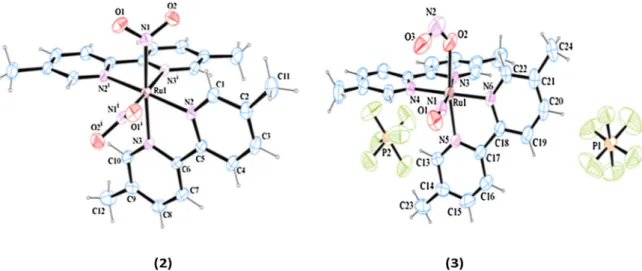
SinglecrystalssuitableforX-raydiffractionofcomplexes(2) and(3)wereobtainedbyslowevaporationof methanol/hexane (4:1) solutions at room temperature. Complexes (2) and (3) crystallizedintoamonocliniccrystallinesystemandspacegroup C2/candP21/n,respectively(TableS2).Inthestructureofcomplex (2)(Fig.1),H2Omoleculeswereomittedforthesakeofclarity.
Complexes (2) and (3) exhibit the expected octahedral coordinationgeometries:thetwobidentate5,50-Mebibyligands aresituatedinpositioncistoeachotherandtheligandNO2in complex(2)isinthecispositiontoNO2,andincomplex(3),NO2is alsosituatedcistoNO.Thenitriteioniscoordinatedbytheoxygen atom(O2) withO2-N2-O3bondangleof 116.7(8)Å. Thebond distancesO1-N1,N2-O2,andN2-O3(1.130(5)1.244(8)and1.147 (8)Å)arewithintherangereportedforothernitritecomplexes [44](TableS3).
TheRu-N3distanceincomplex(3),whichistranstoRu-N1(NO) is2.087(4)Å,whileRu-N5(5,50-Mebipy)transtoONOispractically thesame,2.090(4)Å.ThebonddistancesRu-N1(NO)andRu-O2 (ONO) are 1.758 (4) and 2.067 (4), respectively. The nitrosyl structure is practically in a linear coordination mode and the structuralparameters,typicalfor Ru-NOcomplexes[43,44],are consistentwiththeIRdata.
Complex(2)presentsasymmetricalstructurewithspacegroup C2/candconsequentlythedistancesoftheatomsareidentical,as
canbeobservedinRu(1)-N(1)andRu(1)-N(1)i2.033(2)ÅandRu (1)-N(2)and Ru(1)-N(2)i2.078(2)Å. Thebonddistances,O1-N1 and N2-O2,1.231 (3) and 1.268 (3) Å respectively, and O1-N1-O2angle117.2(2),areinagreementwiththeliteratureonnitro complexes[45,46].
3.2.UV–visabsorbanceandfluorescenceemission
Theelectronicspectraforcomplex(1–3)aresummarizedinthe supplementarymaterial(TableS4). Theelectronic(blackcurve) andfluorescenceemission(graycurve)spectraforTPyP{[Ru(NO2) (5,50-Mebipy)]
4}(PF6)4 (4) and TPyP{[Ru(NO)(5,50-Mebipy)]4} (PF6)12(5),inDMSOarepresentedinFig.2aandb,respectively. The band around 300nm can be attributed to the
p1p
* intraligand transition of unsaturation in 5,50-Mebipy ligands, while the band at 420nm can be assigned as the B-band of porphyrinsandthebandsrangingfrom515to647nmarethe Q-bands. The molar absorption coefficients were obtained in differentconcentrationsfrom1to100m
Mfor themaximumof themainpeaks,inTable1.The fluorescence spectra of these samples show the well-knowndualemission of freebaseporphyrins.The fluorescence quantumyieldwasobtainedandtheresultsshowthatforcomplex (4)itis0.002,whileforcomplex(5)itis0.003.
3.3.Tripletstateformation
Nanosecond transient absorption experiments for a great variety of porphyrins have been extensively reported in the
literatureregardingtheformationanddynamicsoftripletstates [47–52]. The transient absorption spectrum of a free base tetrapyridylporphyrinshowscharacteristicgroundstatebleaching between400nmand430nmandagrowthfrom430nmto500nm [52]. In transient absorption, a positive signal represents an increase in absorption, and generally for porphyrins, this is assignedtothetripletexcitedstateabsorption,T1!Tn.
Transient absorption of porphyrin complexes (4) and (5) depictedverydistincttripletexcitedstatebehavioralthoughthey differ slightly in their molecular structure (see Fig. 3). Both compoundsexhibittri-exponentialkineticsforthetripletexcited state relaxation, as shown in Table 2. The origin of each time constantwillnotbefurtherdiscussedsinceitisnotthemainaimof thecurrentresearch.Themostrelevantaspecthereistoshowthat bothcompoundshavealonglivedtripletexcitedstateandtheir calculatedtripletquantumyieldis0.09and0.27forcomplexes(4) and(5),respectively.
3.4.NOphotoreleasefromnitrosylrutheniumporphyrinscomplexes
Thenitrosylrutheniumporphyrincomplexes,whendissolved inDMSOarestableinthedark,butuponirradiationwithvisible light, the solution of (4) and (5) release nitric oxide (NO) as demonstratedbyspectralmodifications(Fig.4)andNO chemi-luminescentsignal(Fig.5).
Thedecreaseintheabsorptionofthebandat420nm(Fig.4) canbeattributedtotheconsumptionoftheinitialcomplex,while the band centered at 300nm is associated to the intraligand
p
!p
* transitions in 5,50-Mebipy ligands [48]. The porphyrin transitionbandsintheregion330–550nmintheUV–visspectra aresufficientlyintensetomaskthemetalligandchargetransfer(MLCT) involving dp(RuII)!
p
*(5,50-Mebipy) and dp
(RuII)!p
* (NO+)inthecaseofcomplex(5)ordp(RuIII)!
p
*(5,50-Mebipy)and dp
(RuIII)!p
*(ONO)forcomplex(4)(Figs.S11-S13).Thus,thespectralchangesareassociatedwithnitrosylligand reduction (NO+
!NO00) in the case of complex (5) and {TPyP [RuIII(solvent)(5,50-Mebipy)]
4}(PF6)12 formation, as suggested by controlledreductionpotential(electrolysis),performedinCH3CN, Table1
UV/Visabsorptionpropertiesobtainedatroomtemperatureforsamplescontainingporphyrincomplexes(4)and(5).Thevaluesoftheextinctioncoefficient(e)areinunitsof 105
M1 cm1
,standarddeviation.Thewavelengths,innm,forthecenteroftheobservedbandsarepresentedbetweenparentheses.
Complex IntraligandBand B-Band Qy(1,0) Qy(0,0) Qx(1,0) Qx(0,0)
(4) 2.380.05(300) 2.960.09(419) 0.470.02 (514)
0.230.01(545) 0.160.04(590) 0.070.01(647)
(5) 2.150.03(300) 2.170.05(420) 0.210.05(515) 0.110.01(555) 0.310.01(590) 0.030.01(647)
Fig.3.Absorption changesmonitored at460nm after pulsed lightexcitation (lexc=532nmand1mJ/pulse)ofcomplex(4),graycurveandcomplex(5),black curve,inDMSOsolution.Theyellowlinecorrespondstoatri-exponentialfunction. (Forinterpretationofthereferencestocolourinthisfigurelegend,thereaderis referredtothewebversionofthisarticle.).
Table2
Depopulationtimeconstantsandformationquantumyieldoftripletstatefor{TPyP [Ru(NO2)(5,50-Mebipy)]4}(PF6)4(4) and (b){TPyP[Ru(NO)(5,50-Mebipy)]4}(PF6)12 (5)inDMSO.
Compound t1a t2a t3a FT
(4) 2.8108(94%) 3.2106(3%) 9.5105(3%) 0.09 (5) 5.8107(50%) 8.9106(24%) 6.4105(26%) 0.27
aThenumbersbetweenparenthesisrepresentthecontribution ofthe time constanttotheoverallkinetics.
0.1MPTBA(Fig.S10e).Thechangesinthecomplex(4)spectrum wereassociatedwithnitriteligandoxidation(ONO!NO0)and subsequentformation ofmetaloxo species.In thiscase, there was no metal-solvent coordination since the ruthenium of complex (4) has an octahedral structure (TPyP[RuIV=O]) (Fig.S10d).NOphotolabilizationfromthecoordinatedruthenium complexhas beendemonstrated by a direct labilization of the RuNObond,inourcasecomplex(5),andbyhomolyticONO cleavageresultinginametaloxospecies,inthisstudyascomplex (4)[53–55].
ThedetectionofNOwasdirectlyregisteredbythe chemilumi-nescenceemittedfromtheNO2excitedstate(NO2*).Theamountof NOreleased(MNO,inmoles)fromtheporphyrincomplexesduring photolysiswascalculatedtakingtheratioof theareaunderthe decaycurve(Fig.5)bytheproportionalityconstantB=7.90.2 1012mVsmol1.ConstantBwasobtainedfromthecalibration curve as previously reported [41] (Fig. S14). Additionally, the amount of porphyrin consumed (MPPh, in moles) is directly determinedfromtheopticalabsorptionspectraattheSoretband, acquired immediately before and after photolysis (see Fig. 5), accordingtoEq.(5).
MPPh¼
AinitialAf inal
volume
e
Soretband ð5Þ
Comparedtotheinitialamountofporphyrinsinthereaction flask, theamountofNO releasedrepresents areactionyield of 0.530.03molofNOpermolof(5)and0.050.01molofNOper molof(4).TheseresultsaresummarizedinTable3.
TheNOquantumyieldishighlydependentonthestructureof nitrosyl porphyrin ruthenium complexes, TPyP[RuIIN O] or TPyP[RuIIION¼O]. The lower reactionphotorelease yield of free NO for complex (4) could be explained in terms of the recombination reaction between NO+ and TPyP[RuIV=O], as
suggested in Ref. [53]. It is supported by a predominantly (>50%) short triplet lifetime and lower triplet quantum yield,
t
1=2.8108sandF
T=0.09,respectively(Table2).Thesedata indicatethatNOreleaseis oneoftheprocessesinvolvedinthe dissipation of the triplet state energy, since the intersystem crossingprocesstothecomplex(4)groundstateislower.NO photorelease from complex (5) was monitored by the photoreactivityofnitrosyl(NO0)with[RuIIICl
3(dppb)(H2O)],which inturnwasreducedto[RuII(NO)Cl
3(dppb)]andisconfirmedby31P {1H} NMR data.The[RuII(NO)Cl
3(dppb)]31P{1H} NMRspectrum shows a chemical shift at 14.6ppm and 11.1ppm, whose phosphorusatoms of dppb aretrans-dppb-NO and trans -dppb-Cl,respectively(Fig.S15)[56].Ontheotherhand,intheabsenceof light, no chemical shift and consequently no reduction of RuIII complex was detected, indicating an absence of NO00 photo-releasing.
Additionally,anothermechanismshouldalsobeinvolvedinthe NOproductionfromsimilarnitrosylrutheniumcomplexes.Ithas been reportedthat under air atmosphere and upon ultraviolet irradiation,photoinducedelectrontransfercouldbepresentinthe photoredoxtransformationsofanitrosylphthalocyanine rutheni-umcomplex,resultinginsuperoxideanion O2 formation[57]. Thishypothesisiscorroboratedbythefactthattheestimated Q-bandenergyfor {TPyP[Ru(NO)}is2.17eV,and thegroundstate {TPyP[Ru(NO)}+/{TPyP[Ru(NO)}0 reduction potential is +1.17V. Thus, the estimated
D
E0,0 gives the {TPyP[Ru(NO)}+/{TPyP[Ru (NO)}*potential as1.00eVforthesinglet state,whichimplies that {TPyP[Ru(NO)}* can easily reduce molecular oxygen to superoxide anion, since molecular oxygen has a one-electron reductionpotentialof0.33eV[57,58].Thismechanismcouldalso bepresentforcomplex(4),{TPyP[Ru(NO2)(5,50-Mebipy)]4}(PF6)4,D
E0,0=1.55eV.Moreover,itiswell knownthatsuperoxidecan reactquicklywithnitricoxideproducingperoxynitrite(ONOO) andcouldalsobeinthephotochemicalreaction[59].3.5.Determinationofquantumyieldsforreactivenitrogenandoxygen species(RNOS)
RNOSquantumyield (
F
D)valueswerecalculatedbyEq. (4) accordingtoFig.S16.TheF
Dvaluesobtainedfor(4)and(5)were 0.07and0.78,respectively.ThegenerationoftheRNOSdependson theformation of the tripletstate fromthe PS. Thus, theRNOS quantumyieldislimitedbyatripletquantumyield(F
DF
T).However,the
F
Dforcompound (5) was0.78 andF
Twas 0.27,indicatingthatasecondmechanismisinvolvedinROSformation. Asthe
F
Dforcomplex(5)(0.78)isconsistentwiththesumof quantum yields NO release (0.53) and triplet state (0.27), we believethatanothermechanisminvolvedisthephotoreleaseofthe NOradical.Therefore, both photodynamic processes participate in the formationofreactiveoxygenspeciesandreactivenitrogenspecies, contributing to the increase in photodynamicefficiencyof the studied compounds. This result is in agreement with other photosensitizer-NO compounds [60]. Thus, Schemes 2 and 3 summarizethephotochemicalpathwayforthephotolysisofthe investigatednitrosylporphyrinrutheniumcomplexes.
4.Conclusions
Inthispaper,wereportthesynthesisandcharacterizationof threenewnitro/nitrosylRu-basedcomplexes,whichwereusedas precursors to obtain two new porphyrin ruthenium species containing nitricoxide (NO) or nitrogen dioxide(NO2), able to generate NO. The NO photorelease, triplet state and reactive oxygen species formationby theseruthenium porphyrinswere Fig. 5.Chemiluminescent signal from photolysis of (4) and (5) compounds
irradiatedwithvisiblelightduringDt=1000s.Theinsetshowstherescaled(4) curve.
Table3
Amountsof NO released (MNO) and porphyrin consumed (MPPh) during the photolysis of {TPyP[Ru(NO2)(5,50-Mebipy)]4}(PF6)4 (4) and {TPyP[Ru(NO)(5,50 -Mebipy)]4}(PF6)12(5)porphyrins.ThereactionyieldofNOrelease(FPPhNOÞ was determinedfor an irradiation time of Dt=1,000s.
Complexes MPPh(1012
moles) MNO(1012
moles) FPPh NO
(4) 73010 4010 0.050.03
(5) 57010 30010 0.530.03
evaluated and followed by photochemical and photophysical characterization.Theresultssuggestthatthe{TPyP[Ru(NO2)(5,50 -Mebipy)]4}(PF6)4 (complex 4) and the {TPyP[Ru(NO)(5,50 -Mebipy)]4}(PF6)12 (complex 5) porphyrins are able to produce reactivenitrogenspeciesandreactiveoxygenspeciesonthesame platformandthehighestproductionwasobservedforcomplex(5). These results couldimprove the photodynamicaction of these compounds,whichcouldbepotentialdrugsforcancertreatment andotherdiseases.
Acknowledgements
TheauthorswouldliketoacknowledgetheFundaçãodeAmparo àPesquisadoEstadodeGoiás(FAPEG),theFundaçãodeAmparoà PesquisadoEstado de MinasGerais (FAPEMIG), theFundaçãode AmparoàPesquisadoEstadodeSãoPaulo(FAPESP),theCoordenação deAperfeiçoamentodePessoal deNívelSuperior(CAPES) and the Conselho Nacional de Desenvolvimento Científico e Tecnológico (CNPq) for the financial support for this research. The authors areverygratefultoProf. GeraldJ.MeyerfromtheUniversityof NorthCarolinafortheuseofthetransientabsorptionexperimental setup. We would also like to thank the Grupo de Física dos Materiais(IF/UFG)forallowingusaccesstotheirspectrofl uorom-eter(FluorologFL3-221;HoribaJobinYvonInc.).
AppendixA.Supplementarydata
Supplementarydataassociatedwiththisarticlecanbefound,in the online version, at http://dx.doi.org/10.1016/j. jphotochem.2017.01.028.
References
[1]K.Plaetzer,B.Krammer,J.Berlanda,F.Berr,T.Kiesslich,Photophysicsand photochemistryofphotodynamictherapy:fundamentalaspects,LasersMed. Sci.24(2009)259–268.
[2]A.E. O’Connor, W.M. Gallagher, A.T. Byrne, Porphyrin and nonporphyrin photosensitizersinoncology:preclinicalandclinicaladvancesin
photodynamictherapy,Photochem.Photobiol.85(2009)1053–1074. [3]J.M.Dabrowski,L.G.Arnaut,Photodynamictherapy(PDT)ofcancer:fromlocal
tosystemictreatment,Photochem.Photobiol.Sci.14(2015)1765–1780. [4]M.Kim,H.Y.Jung,H.J.Park,TopicalPDTinthetreatmentofbenignskin
diseases:principlesandnewapplications,Int.J.Mol.Sci.16(2015)23259–
23278.
[5]D.A. Caminos,M.B. Spesia, E.N.Durantini, Photodynamic inactivation of Escherichiacolibynovelmeso-substitutedporphyrinsby 4-(3-N,N,N-trimethylammoniumpropoxy)phenyland4-(trifluoromethyl)phenylgroups, Photochem,Photobiol.Sci.5(2006)56–65.
[6]M.R. Detty, S.L. Gibson, S.J. Wagner, Current clinical and preclinical photosensitizersforuseinphotodynamictherapy,J.Med.Chem.47(2004) 3897–3915.
[7]P. Braham,C. Herron,C. Street, R.Darveau, Antimicrobial photodynamic therapymaypromoteperiodontalhealingthroughmultiplemechanisms,J. Periodontol.80(2009)1790–1798.
[8]L.M.Almeida,F.F.Zanoelo,K.P.Castro,I.E. Borissevitch,C.M.A.Soares,P.J. Gonçalves,Cellsurvivalandalteredgeneexpressionfollowingphotodynamic inactivationofparacoccidioidesbrasiliensis,Photochem.Photobiol.88(2012) 992–1000.
[9]G.B.Kharkwal,S.K.Sharma,Y.Y.Huang,T.Dai,M.R.Hamblin,Photodynamic therapyforinfections:clinicalapplications,LasersSurg.Med.43(2011)755–
767.
[10]X.Zhou,D.Liu,T.Wang,X.Hu,J.Guo,K.C.Weerasinghe,L.Wang,W.Li, Synthesisandphotophysicalstudiesoftriazine-linkedporphyrin-perylene bisimidedyadwithlong-livedperylenetripletstate,J.Photochem.Photobiol. A274(2014)57–63.
[11]L.Alonso,R.N.Sampaio,T.F.M.Souza, R.C.Silva,N.M. BarbosaNeto,A.O. Ribeiro,A.Alonso,P.J.Gonçalves,Photodynamicevaluationof tetracarboxy-phthalocyaninesinmodelsystems,J.Photochem.Photobiol.B161(2016)100–
107.
Scheme2.Photochemicalpathwayforthephotolysisof{TPyP[Ru(NO2)(5,50-Mebipy)]4}(PF6)4(4)porphyrin.Thedirectphotolysisof(4)producesNOandinvolvesa reducingprocesswithsuperoxide(O2)anionformationandperoxynitrite(ONOO).ThedirectphotolysiscanbereversibleduetorecombinationreactionbetweenNO+and TPyP[RuIV=O].
Scheme3.Photochemicalpathwayforthephotolysisof{TPyP[Ru(NO)(5,50-Mebipy)]4}(PF6)12(5)porphyrin.Thedirectphotolysisof(5)isassociatedwithnitrosylligand
reduction(NO+ !NO0
)and{TPyP[RuIII
(solvent)(5,50-Mebipy)]4}(PF6)12formation.Thedirectphotolysisof(5)alsoinvolvesareducingprocesswithsuperoxide(O2)anion
[12]M.P.Romero,N.R.S.Gobo,K.T.deOliveira,Y.Iamamoto,O.A.Serra,S.R.W. Louro,Photophysicalpropertiesandphotodynamicactivityofanovel menthol-zincphthalocyanineconjugateincorporatedinmicelles,J. Photochem.Photobiol.A253(2013)22–29.
[13]B.Pucelik,I.Gürol,V.Ahsen,F.Dumoulin,J.M.Dabrowski,Fluorinationof phthalocyaninesubstituents:improvedphotopropertiesandenhanced photodynamicefficacyafteroptimalmicellarformulations,Eur.J.Med.Chem. 124(2016)284–298.
[14]K.Ogawa,Y.Kobuke,Recentadvancesintwo-photonphotodynamictherapy, AnticancerAgentsMed.Chem.8(2008)269–279.
[15]L.De Boni,D.S.Correa,D.L.Silva,P.J.Gonçalves,S.C.Zílio,G.G.Parra,I.E. Borissevitch,S.Canuto,C.R.Mendonça,Experimentalandtheoreticalstudyof two-photonabsorptioninnitrofuranderivatives:promisingcompoundsfor photochemotherapy,J.Chem.Phys.134(2011)014509.
[16]G.C.Bolfarini,M.P.Siqueira-Moura,G.J.F.Demets,P.C.Morais,A.C.Tedesco,In vitroevaluationofcombinedhyperthermiaandphotodynamiceffectsusing magnetoliposomesloadedwithcucurbit[7]urilzincphthalocyaninecomplex onmelanoma,J.Photochem.Photobiol.B115(2012)1–4.
[17]T.Gianferrara,I.Bratsos,E.Iengo,B.Milani,A.Ostric,C.Spagnul,E.Zangrando, EnzoAlessio,Syntheticstrategiestowardsruthenium?porphyrinconjugates foranticanceractivity,DaltonTrans.48(2009)10742–10756.
[18]T.Gianferrara,A.Bergamo,I.Bratsos,B.Milani,C.Spagnul,G.Sava,E.Alessio, Ruthenium-porphyrinconjugateswithcytotoxicandphototoxicantitumor activity,J.Med.Chem.53(2010)4678–4690.
[19]S.Rani-Beeram,K.Meyer,A. McCrate,Y.Hong,M.Nielsen,S.Swavey, A
fluorinatedrutheniumporphyrinasapotentialphotodynamictherapyagent: synthesis,characterization,DNAbinding,andmelanomacellstudies,Inorg. Chem.47(2008)11278–11283.
[20]M.Pernot,T.Bastogne,N.P.E.Barry,B.Therrien,G.Koellensperger,S.Hann,V. Reshetov,M.Barberi-Heyob,Systemsbiologyapproachforinvivo photodynamictherapyoptimizationofruthenium-porphyrincompounds,J. Photochem.Photobiol.B117(2012)80–89.
[21]A.Frei,R.Rubbiani,S.Tubafard,O.Blacque,P.Anstaett,A.Felgenträger,T. Maisch,L.Spiccia,G.Gasser,Synthesis,characterization,andbiological evaluationofnewRu(II)polypyridylphotosensitizersforphotodynamic therapy,J.Med.Chem.57(2014)7280–7292.
[22]R.N. Sampaio,W.R. Gomes,D.M.S.Araujo, A.E.H.Machado, R.A.Silva,A. Marletta,I.E.Borissevitch,A.S.Ito,L.R.Dinelli,A.A.Batista,S.C.Zílio,P.J. Gonçalves,N.M.BarbosaNeto,Investigationofground-andexcited-State photophysicalpropertiesof5,10,15,20-Tetra(4-pyridyl)-21H,23H-porphyrin withrutheniumoutlyingcomplexes,J.Phys.Chem.A116(2012)18–26. [23]L.Huang,Y.Xuan,Y.Koide,T.Zhiyentayev,M.Tanaka,M.R.Hamblin,TypeIand
TypeIImechanismsofantimicrobialphotodynamictherapy:aninvitrostudy onGram-negativeandGram-positivebacteria,LasersSurg.Med.44(2012) 490–499.
[24]D.E.J.G.J.Dolmans,D.Fukumura,R.K.Jain,Photodynamictherapyforcancer, Nat.Rev.Cancer3(2003)380–387.
[25]M.G.Sauaia,R.G.deLima,A.C.Tedesco,R.S.daSilva,NitricOxideProcuctionby visbleligthirradiationofaqueoussolutionofNitrosylRetheniumComplexes, Inorg.Chem.44(2005)9946–9951.
[26]S.A.Cicillini,A.C.L.Prazias,A.C.Tedesco,O.A.Serra,R.S.daSilva,Nitricoxide andsingletoxygenphoto-generationbylightirradiationinthe
phototherapeuticwindowofanitrosylrutheniumconjugatedwitha phthalocyaninerareearthcomplex,Polyhedron28(2009)2766–2770. [27]W.Xu,L.Z.Liu,M.Loizidou,M.Ahmed,I.G.Charles,Theroleofnitricoxidein
cancer,CellRes.12(2002)311–320.
[28]S.Mocellin,V.Bronte,D.Nitti,Nitricoxide,adoubleedgedswordincancer biology:searchingfortherapeuticopportunities,Med.Res.Rev.27(2007)317–
352.
[29]J.C.G. Rotta, C.N. Lunardi, A.C. Tedesco,Nitric oxiderelease from the S-nitrosothiolzincphthalocyaninecomplexbyflashphotolysis,Braz.J.Med. Biol.Res.36(2003)587–594.
[30]T.A.Heinrich,A.C.Tedesco,J.M.Fukuto,R.S.daSilva,Productionofreactive oxygenandnitrogenspeciesbylightirradiationofanitrosylphthalocyanine rutheniumcomplexasastrategyforcancertreatment,DaltonTrans.43(2014) 4021–4025.
[31]J.B. Godwin, T.J. Meyer, Preparation of ruthenium nitrosyl complexes containing2,2'-bipyridineand1,10-phenanthroline,Inorg.Chem.10(1971) 471–474.
[32]J.B. Godwin, T.J. Meyer, Nitrosyl-nitrite interconversion in ruthenium complexes,Inorg.Chem10(1971)2150–2153.
[33]Enraf-Nonius,Collect,NoniusBV,Delft,TheNetherlands,1997–2000. [34]Z.Otwinowski,W.Minor,ProcessingofX-raydiffractiondatacollectedin
oscillationmode,MethodsEnzymol.276(1997)307–326.
[35]G.M.Sheldrick,ShelXS-97ProgramforCrystalStructureResolution,University ofGöttingen,Göttingen,Germany,1997.
[36]R.H. Blessing, An empirical correction for absorption anisotropy, Acta Crystallogr.A51(1995)33–38.
[37]L.J.Farrugia,ORTEP-3forwindowsaversionofORTEP-IIIwithagraphical userinterface(GUI),J.Appl.Crystallogr.30(1997)565–565.
[38]P.J.Gonçalves,P.L.Franzen,D.S.Correa,L.M.Almeida,M.Takara,A.S.Ito,S.C. Zílio,I.E.Borissevitch,Effectsofenvironmentonthephotophysical characteristicsofmesotetrakismethylpyridiniumylporphyrin(TMPyP), Spectrochim.ActaA79(2011)1532–1539.
[39]C.A.Strassert,G.M.Bilmes,J.Awruch,L.E.Dicelio,Comparativephotophysical investigationofoxygenandsulfurascovalentlinkersonoctaalkylamino substitutedzinc(II)phthalocyanines,Photochem.Photobiol.Sci.7(2008)738–
747.
[40]C.Ian,G.L.Hug,Triplet-tripletabsorptionspectraoforganicmoleculesin condensedphases,J.Phys.Chem.Ref.Data15(1986)1–250.
[41]N.A.Daghastanli,I.A.Degterev,G.B.Olivera,A.B.Seabra,M.G.deOliveira,I.E. Borissevitch,Formationofcytotoxicintermediatesinthecourseof photodecompositionofanitroheterocyclicantisepticquinifuryl,J.Photochem. Photobiol.A184(2006)98–104.
[42]T.Ohyashiki,M.Nunomura,T.Katoh,Detectionofsuperoxideanionradicalin phospholipidliposomalmembranebyfluorescencequenchingmethodusing 1,3-diphenylisobenzofuran,BiochimBiophys.Acta1421(1999)131–139. [43]M.G.Sauaia,F.S.Oliveira,A.C.Tedesco,R.S.daSilva,ControlofNOreleaseby
lightirradiationfromnitrosyl–rutheniumcomplexescontainingpolypyridyl ligands,Inorg.Chim.Acta355(2003)191–196.
[44]N.Nagao,D.Ooyama,K.Oomura,Y.Miura,S.Howell,M.Mukaida,Ligand natureofcoordinatedNO2-intheoxidationreactionofRu(II)complexes,[Ru (NO2)(OH2)(py)4-2n(bpy)n]+(n=0,1,2),andtheirrelatedcomplexes,Inorg. Chim.Acta225(1994)111–121.
[45]S.L.Queiroz,A.A.Batista, G.Oliva,M.T.P.Gambardella,R.H.A.Santos,K.S. MacFarlane,S.J.Retting,B.R.James,Thereactivityoffive-coordinateRu(II) (1,4-bis(diphenylphosphino)butane)complexeswiththeN-donorligands: ammonia,pyridine,4-substitutedpyridines,2,20-bipyridine,bis(o-pyridyl) amine,1,10-phenanthroline,4,7-diphenylphenanthrolineand
ethylenediamine,Inorg.Chim.Acta267(1998)209–221.
[46]A.Y. Ershov, P.V. Kucheryavyi, A. B.Nikol’skii, Chemistry of ruthenium polypyridinecomplexes:IX.Nitro-Nitrosylequilibriumincis-[Ru(2,2'-bpy) 2(L)NO2]+complexes,Russ.J.Gen.Chem.74(2004)651–654.
[47]M.Ghirotti,C.Chiorboli,M.T.Indelli,F.Scandola,M.Casanova,E.Iengo,E. Alessio,EnergytransferpathwaysinpyridylporphyrinRe(I)adducts,Inorg. Chim.Act.360(2007)1121–1130.
[48]M.G.Sauaia,R.G.deLima,A.C.Tedesco,R.S.daSilva,PhotoinducedNOrelease byvisiblelightirradiationfrompyrazi-bridgednitrosylrutheniumcomplexes, J.Am.Chem.Soc.125(2003)14718–14719.
[49]T.A.Heinrich,A.C.Tedesco,J.M.Fukuto,R.S.daSilva,PhotoinducedNOrelease byvisiblelightirradiationfrompyrazi-bridgednitrosylrutheniumcomplexes, DaltonTrans.43(2014)4021–4025.
[50]R.V.Maximiano,E.Piovesan,S.C.Zílio,A.E.H.Machado,R.dePaula,J.A.S. Cavaleiro,I.E.Borissevitch,A.S.Ito,P.J.Gonçalves,N.M.BarbosaNeto, Excited-stateabsorptioninvestigationofacationicporphyrinderivative,J.Photochem. Photobiol.A214(2010)115–120.
[51]N.M. Barbosa Neto,D.S. Correa, L. De Boni,G.G. Parra, L.Misoguti, C.R. Mendonça,I.E.Borissevitch,S.C.Zílio,P.J.Gonçalves,Excitedstatesabsorption spectraofporphyrins—Solventeffects,Chem.Phys.Lett.587(2013)118–123. [52]R.N.Sampaio,M.M.Silva,A.A.Batista,N.M.BarbosaNeto,Investigationofthe
photophysicalandeletrochemicalpropertiesofafreebasetetrapyridyl porphyrinwithmesocarbonlinkedruthenium(II)groups,J.Photochem. Photobiol.315(2016)98–106.
[53]I.M.Lorkovic,K.M.Miranda,B.Lee,S.Bernhard,J.R.Schoonover,P.C.Ford,Flash photolysisstudiesoftheRuthenium(II)porphyrinsRu(P)(NO)(ONO).multiple pathwaysinvolvingreactionsofintermediateswithnitricoxide,J.Am.Chem. Soc.120(1998)11674–11683.
[54]K.S.Suslick,R.A.Watson,Photochemicalreductionofnitrateandnitriteby manganeseandironporphyrins,Inorg.Chem.30(1991)912–919.as [55]M.Yamaji,Y.Hama,Y.Miyazaki,M.Hoshino,Photochemicalformationof
oxochromium(IV)tetraphenylporphyrinfromnitritochromium(III) tetraphenylporphyrininbenzene,Inorg.Chem.31(1992)932–934. [56]R.S.Corrêa,J.P.Barolli,M.I.F.Barbosa,J.Ellena,A.A.Batista,Theeffectofguest
moleculesontheconformationandmolecularassemblyofthefac-[RuCl3(NO) (dppb)]complex,J.Mol.Struct.1048(2013)11–17.
[57]Z.N.daRocha,R.G.deLima,F.G.Doro,E.Tfouni,R.S.daSilva,Photochemical productionofnitricoxidefromanitrosylphthalocyaninerutheniumcomplex byirradiationwithlightinthephototherapeuticwindow,Inorg.Chem. Commun.11(2008)737–740.
[58]Z.A.Carneiro,J.C.B.DeMoraes,F.P.Rodrigues,R.G.DeLima,C.Curti,Z.N.Da Rocha,M.Paulo,L.M.Bendhack,A.C.Tedesco,A.L.B.Formiga,R.S.daSilva, PhotocytotoxicactivityofanitrosylphthalocyaninerutheniumcomplexA systemcapableofproducingnitricoxideandsingletoxygen,J.Inorg.Biochem. 105(2011)1035–1043.
[59]G.L.Squadrito,W.A.Pryor,Oxidativechemistryofnitricoxide:therolesof superoxide,peroxynitrite,andcarbondioxide,FreeRadic.Biol.Med.25(1998) 392–403.
[60]A.Fraix, A.R. Gonçalves,V. Cardile,A.C.E. Graziano,T.A. Theodossiou, K. Yannakopoulou,S.Sortino,Amultifunctionalbichromophoricnanoaggregate forfluorescenceimagingandsimultaneousphotogenerationofRNOSandROS, Chem.AsianJ.8(2013)2634–2641.