TITLE: Surface Decontamination of Navy Dye Marker by DeconGelTM 1101
ABSTRACT
Surface decontamination efficacy determination of DeconGelTM 1101 on aluminum, stainless steel, and concrete surfaces contaminated with Navy Dye Marker was performed with LC/MS (Liquid Chromatography/Mass Spectrometry) according to Environmental Protection Agency (EPA) SW-846 Methods: 3500C (sampling) and 8321B (analysis).
HAZARDOUS MATERIALS RELEVANCE
Navy Dye Marker is a water-soluble dye used as an ocean marker for a variety of applications and uses. Navy Dye Marker resists short-term environment-mediated degradation and possesses a strong chromophore, and as such even small amounts of dye are plainly visible on both porous and non-porous surfaces, complicating the complete and facile removal of Navy Dye Marker from commonly utilized surfaces.
SUMMARY RESULTS
As seen in Table 1, excellent surface decontamination was achieved by applying DeconGel 1101 onto contaminated surfaces, resulting in encapsulation of Navy Dye Marker contaminant by DeconGel’s active components. Decontamination efficacies of poured DeconGel 1101 ranged from 99.1% (on concrete) to 99.3% (on aluminum) to 99.4% (on stainless steel) as determined by residual swipe/solvent extraction analysis. Additionally, for concrete substrate, no residual dye was detected visually when adding droplets of water to the concrete panels after DeconGel administration and film peel.
Optimized experimental and analytical methods were successfully developed following standardized EPA sampling and analysis methods as guidelines for determination of organics in polar solvent solvated samples. When necessary, the digestion methods were customized to result in the complete dissolution of the organic contaminants and to ensure accurate decontamination efficacy determination of DeconGel.
RESULTS
Table 1 shows the decontamination efficacies of DeconGel 1101 on stainless steel, aluminum, and concrete surfaces contaminated with Navy Dye Marker as determined by residual swipe/solvent extraction testing.
Table 1. Decontamination efficacies of DeconGel 1101 on Dye Marker on stainless steel, aluminum, and concrete surfaces as determined by residual swipe testing/solvent extraction.
Swipe/Extraction/Visual Testing (ppm) Formulation
DeconGel1101 Stainless Steel* Control 198.63 + 0.12 Residual 1.28 + 0.10 Decon. Efficacy (%) 99.4 + 0.10 Aluminum* Control 198.71 + 0.14 Residual 1.34 + 0.10 Decon. Efficacy (%) 99.3 + 0.10 Concrete** Control 199.38 + 0.58 Residual 1.87 + 0.14 Visual inspection ND*** Decon. Efficacy (%) 99.1 + 0.10
10000x dilution factor for samples and controls
* Decontamination efficacy determined using residual swipe testing ** Decontamination efficacy determined using solvent extraction
*** ND: not detected (residual dye not detected visually after 5, 24 hours after adding droplets of water to decontaminated concrete panel)
NOTES
Application of a homogenous, thin layer of Navy Dye Marker contaminant on the respective substrate facilitated an optimized interaction between contaminant and DeconGel, and an accurate measure of DeconGel’sdecontamination efficacy in a scaled-down yet real-world setting. No less than 6.0 g of DeconGel was used for each experiment to allow an optimized interaction between contaminant and DeconGel.
ASTM method E1728-03, a standardized swipe testing method used for sampling of contaminants, was the integral method used to accurately evaluate DeconGel’s decontamination efficacy. Pre-wetted (with water) GhostWipe™ (Environmental Express; Mt. Pleasant, SC) swipes were utilized in this swipe testing method.
For concrete testing surface, both control and sample coupons contaminated with Navy Dye Marker were extracted with deionized water in a suitably-sized closed plastic bottle, such that concrete coupons were completely submerged in water (50 mL) for 24 hours to afford the complete dissolution of analyte in such a porous substrate such as concrete.
To evaluate leaching dynamics of the Dye in porous substrates such as concrete, after decontamination using DeconGel, water droplets were added to the decontaminated concrete panels to determine if any residual Dye remained on or within the substrate surfaces. Applied water droplets were inspected after 5 and 24 hours of administration, and gratifyingly, no residual dye/coloration was noted for any of the water droplets/concrete surfaces tested.
Standardized EPA SW-846 Sampling Method 3500C “Organic Extraction and Sample Preparation” was followed as a guideline to prepare all samples and controls. All samples, controls, and standards were prepared using the same solvent and appropriate experimental conditions to ensure accurate and LC/MS instrumental analysis.
LC/MS instrumentation is a sensitive and accurate analytical tool for qualitative and quantitative determination of a large number of organic compounds. Standardized EPA SW-846 Analytical Method 8321B “Solvent-Extractable Nonvolatile Compounds by High-Performance Liquid Chromatography/Thermospray/Mass Spectrometry (HPLC/TS/MS) or Ultraviolet (UV) Detection” was followed as a guideline to prepare all samples and controls.
To ensure accurate determination of DeconGeldecontamination efficacy, a standard curve of the analyte of interest was prepared using sufficiently pure analyte; the respective standards were diluted to a known concentration (ppm) using the same solvent as used for samples and controls.
CALCULATIONS
Decontamination Efficacy (Swipe Testing) =
[(Contaminant (ppm) of Swipe Control) – (Contaminant (ppm) of Residual Swipe)/Contaminant (ppm) of Swipe Control] x 100%
Decontamination Efficacy (Solvent Extraction Testing) =
[(Contaminant (ppm) of Solvent Extraction Control) – (Contaminant (ppm) of Residual Solvent Extraction)/Contaminant (ppm) of Solvent Extraction Control] x 100%
MATERIALS AND METHODS Sample Method
In a typical procedure, 0.005 g (0.50 mL of 0.5 g/50 mL deoinized water) Navy Dye Marker contaminant was evenly applied via brushing on 1) aluminum (surface area: 56.3 cm2), 2) stainless steel (surface area: 56.3 cm2), or 3) concrete (industrial grade, surface area: 56.3 cm2) coupons. Approximately 6.0 g of DeconGel 1101 was poured onto the contaminated surface and let to dry for 24 hours. Dried DeconGel samples were peeled off the contaminated surface, and the surface was either 1) swipe tested (ASTM method E1728-03) using pre-wetted (with water) GhostWipe™ (Environmental Express; Mt. Pleasant, SC) swipes (for aluminum and stainless steel coupons); or 2) extracted with deionized water (50 mL) in a suitably-sized closed plastic bottle as to completely submerge contaminated coupon surfaces with solvent, and let to stand for 24 hours to afford the complete dissolution of analyte (for concrete coupons). Swipe and dried film samples were suspended in 50 mL deionized water for 24 hours. All samples were then analyzed via LC/MS (see below). To evaluate leaching dynamics of the Dye in concrete (porous substrate), after decontamination using DeconGel, small water droplets (deionized water, 2 mL) were added throughout the area of the decontaminated concrete panels. Applied water droplets were inspected visually after 5 and 24 hours of administration for any notable coloration on the surface or within water droplets.
Control Methods
For swipe control samples, a respective amount of contaminant was evenly applied via brushing on 1) aluminum (surface area: 56.3 cm2) or 2) stainless steel (surface area: 56.3 cm2) coupons, and the surface was swipe tested (ASTM method 1728-03) using pre-wetted (with water) GhostWipe™ (Environmental Express; Mt. Pleasant, SC) swipes. Swipe samples were suspended in 50 mL deionized water for 24 hours, and then analyzed via LC/MS (see below). For Solvent Extraction Control samples, a respective amount of contaminant was evenly applied via brushing on concrete (industrial grade, surface area: 56.3 cm2) coupons, and the coupons were extracted with deionized water (50 mL) in a suitably-sized closed plastic bottle as to completely submerge contaminated coupon surfaces with solvent, and let to stand for 24 hours to afford the complete dissolution of analyte, and then analyzed via LC/MS (see below).
Reagents and Standards
Navy Dye Marker powder (sourced in Oahu, Hawaii) was dissolved in water and used to generate standard curves.
Analytical Instrumentation
A Thermo LCQ LC/MS with autosampler in positive mode was used to determine Navy Dye Marker concentration (ppm, wt/wt) of all samples and controls, using a Grace Davison (Deerfield, IL) C18-Select analytical column (150 x 4.6 mm, 5 um).
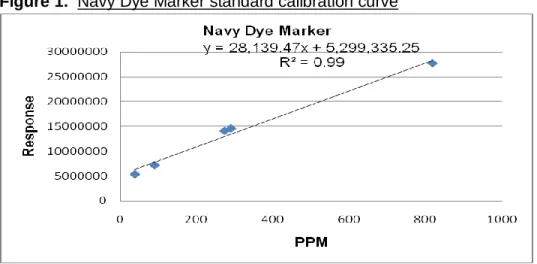
A 5-point standard curve derived from three independently prepared stock solutions was prepared using deionized water as the working solvent. The calibration curve exhibits a curve fitting as approximated by the coefficient of determination of linear regression R2, where R2 = 0.99 (see Figure 1).
LC method using A= water (0.1% formic acid), B=acetonitrile (0.1% formic acid); start at 90%A to 2 min at 70%A, to 3 min at 50%A, to 5 min at 30%A, to 6 min at 100%B, hold until 16 min at 90% A hold until 17 min.
Navy Dye Marker LC/MS data: 7.58 min; lambda max = 266, 293 nm; M+ = 333.
APPLICATION INSTRUCTIONS FOR END-USERS
Use product directly as is from container. DO NOT DILUTE. Masking or painters tape can be applied along one edge of the area that is to be decontaminated to aid creating a peeled edge to grip for peeling the dried film. Apply DeconGel using a paint brush, a trowel, a handheld sprayer, or an industrial grade sprayer (use DeconGel 1120 or 1121 for spray application).
The thickness of the gel and the number of coats is dictated by the surface to be decontaminated. Coating thickness required for good peel characteristics varies with substrate and generally increases with substrate porosity. It is recommended that first time customers test DeconGel on a small sample area to confirm the required film thickness and dry time for their specific application. If the film is difficult to peel, please apply an additional coat. A razor blade is useful to start the peel. Lay the blade nearly flat and fillet the edge of the film to create a tab that can be pulled. For surfaces that the gel adheres to well, such as concrete, 12” – 24” strips can be cut in the film resulting in less force being required to peel the film.
Let DeconGel dry for 24 hours
Dry time will vary depending on humidity, temperature, air flow and thickness of the DeconGel. This can take from as little time as an hour for thin coats in a dry environment with plenty of airflow, to overnight or longer if thicker coats are applied in humid environments. Dry times exceeding 24 hours may sometimes be required for good peel performance on bare concrete, wood and other highly porous substrates and substrates with deep cracks or grooves. However, 18-24 hours is often sufficient dry time on good quality concrete. It is recommended that users test a small area to determine drying time prior to applying DeconGel for an entire job. Supplemental heat or air circulation will accelerate DeconGel’s drying time for any job.
When dry, the product locks the contaminants into a polymer matrix. The film containing the encapsulated contamination can then be peeled. DeconGel peels from most non-porous and porous hard surfaces if the dried film is thick enough. If the film is difficult to peel, add another coat, let dry, and peel. In most cases the DeconGel will come off in a single sheet but for odd shaped surfaces you may be required to score DeconGel in order to peel it off.
Dispose of the dried DeconGel in accordance with the local, state and Federal disposal regulations of the contaminant/substance you are removing. DeconGelitself has no special disposal restrictions.
For questions about DeconGel or to place an order, visit our website at www.decongel.com or contact us at:
CBI Polymers Inc.
1946 Young Street, Suite 480 Honolulu, Hawaii 96826 (808) 949-2215 ext. 146 [email protected]