The Analysis, Design and Implementation of Optimized Web Structures
ZDENKA PROKOPOVA, RADEK SILHAVY, AND PETR SILHAVY
Department of Computer and Communication Systems, Faculty of Applied Informatics,
Tomas Bata University in Zlin,
nam. T. G. Masaryka 5555, 760 01 Zlin,
CZECH REPUBLIC
[email protected], [email protected], [email protected]
Abstract: - The goal of this work was to develop an optimized web structure combined with the preparation of a web-based e-commerce platform for a small manufacturing company. The aim of the optimization of the web structure was to increase the number of website-visits, reduce the bounce rate, and increase the percentage representation of approaches from search engines. Evaluation and testing of the website after optimization has shown that the number of website visits increased by 55%, the bounce rate went down by nearly 40%; and the percentage representation of approaches from search engines went up by 15%. An analysis and comparison of the possibilities for the utilization of an e-commerce platform was undertaken.
Key-Words: - Analysis, Evaluation, Implementation, Optimization, Search engines, Website
1 Introduction
Nowadays, it is a very popular view that every company or organization has its own website(s). This has been an ongoing trend for several years and therefore, it is important to pay attention to this issue. With the increase in the number of websites and competition - and the battle for first rung in the search results; it was thus necessary to begin to focus on the theme of “how to optimize web structures”. The main goal being to affect the placement of websites in search engines results. [1]
Generally, most visitors just come to the websites through search engines. The reason being that if/when search engines find our site, we have to inform them. One of the relatively easy and fast ways is to register our sites with the catalog link - which most inland portals operate with. Why register websites in some catalogs when they are separated from search engines? A number of search robots´ first tasks being, to hunt on the internet for links relating to just such catalogs. We cannot however generalize that the fact is that most people come to sites through search engines. More complex phrases are, however, less popular. Users prefer to search pages by scrolling through categories in the catalog. [2]
In contrast to full-text search engines, we can buy a display position in most catalogs. Search engines also offer the opportunity to increase visibility and display a link to your site, but - for now, there is a generally accepted custom that such
paid sites are visually distinguished from the standard search results. Search engines try to present relevant results especially to queries to its visitors. On the contrary, a catalog does not care about the content of the site and, de-facto, often does not even know it. Catalog editors may sometimes go through individual registrations, but often include references to its database automatically - without human control. [3]
The goal of each website operator is to bring their own site to as many people as possible. Each visitor generates income. This is - for example, income from advertising or from sales of other services. Google (or Yahoo!) are trying to bring as many users as possible on a daily basis to their web-sites. And how this is accomplished? Just give users what they want - relevant search results. It is clear that they are working “day and night” on the problem of giving the most relevant answers. [4]
E-commerce has transformed how clients shop over the past few years. An online store can reach customers anywhere in the world. The Internet as a global and free media provides a fast and easy way for people to purchase things without having to visit an actual store [5]. One of the simplest ways to create an e-commerce platform is the utilization of e-commerce website builders.
2 How Search Engines Work
Let us focus - for example, on the very popular Google search-engine. You can find some of the
many reasons, why Google is so popular in the following overview. In addition, the general facts about what Google offers with a brief list of the best known and most widely used services include: • Very fast and comprehensive full-text search
engines – these are primarily sites that mediate responses to what we are looking for on the internet - divided into catalogs and search-engines. There are two basic categories of search engines. Search engines from the first category search for titles and descriptions of sites and the content of the site is not taken into account. The second category is represented by full-text search engines. They search websites´ contents; and one of them - is Google.
• Accuracy of results – despite the huge number of pages scanned; Google always returns accurate results. The results that contain the information one searched for. Google can be considered as one of the most successful search-engines in terms of quality of results.
• No “annoying insect” (advertising) – in contrast to some of the other search engines, Google does not offer paid links as a search result.
The Google background consists of a server containing a list of URLs. Downloaded pages are sent to the storage server (warehouse). In the warehouse sites, these are compressed and stored in the depository. Each site receives a unique identification number, which is known as a docId. The indexer and sorter take care about its inclusion in the register (indexing). We could say that the indexer is the heart of search engines. A detailed description of its functions can be found, e.g. in [6].
2.1 Aspects affecting the location of websites
in search results
Search engines determine the placement of our website on the SERP (i.e. Search Engine Result Page), according to several criteria:
• The mutual positions of words found (searched for multiword phrases)
• The location of words found (position in the document)
• The location of a word or phrase in the page title, meta descriptions and titles
• The page weight in the eyes of search engines (PageRank)
• The number of links on the sites, and the quality of those links
2.1.1 Evaluation – PageRank (PR)
The PageRank algorithm shows the authenticity of websites on a scale from 0-10. The display position in search results depends on the amount of PR. The authors of the original algorithm are former students at Stanford University - Lawrence Page and Sergey Brin, the founders of Google. The algorithm is based on the Kandall-Wei Evaluation Theory from the nineteen-fifties. The main idea of this theory is based on a/the comparison of the importance of people and things based on their mutual influence. PageRank is thus, the value of the credibility, i.e. how many pages simultaneously evaluated (using the same formula) references to that page. PageRank is an important factor in determining the location of the site on the Search Engine Result Page (SERP). [1], [6]
2.1.2 SERP – Search Engine Result Page
SERP is an acronym, which we can sometimes encounter on pages dedicated to searching and to search engine optimization. The main task of SEO is to achieve the best position in the SERP. The aim is to get the maximum number of relevant visitors - visitors who are interested in the information, products, or services offered on our websites. [7]
3 SEO Methods
SEO methods can be divided into two basic groups according to ways of doing SEO. On-page SEO includes providing good content, good keyword selection, etc. (i.e. on-page factors). Off-page SEO includes link-building, link-exchange, etc. (off-page factors).
3.1
On-page SEOs
The On-page factors are those factors that occur on one unique site. This means - titles, headers, keywords, pure texts, etc. The general rule in optimization is that every page on the optimized site must be unique. It is always important to keep in mind that search engines evaluate each page separately. So it is necessary to focus not only on the home page - this would be almost useless, but on all of the site´s pages. [8]
3.1.1 Keywords
Keywords selection is the most important part of an on-page SEO. If the site does not contain a specific keyword; search engines cannot find it (except for the anchor text). If you are creating a site from the
beginning, just select the appropriate keywords and distribute them well - all over the site. Each page can be optimized for about 5-6 keywords. In the case of a more competitive area, the number of keywords is usually smaller (1-2). More detailed information can be found in [9].
3.1.2 Simplification of site navigation
The creation of a file sitemap.xml is one of the ways to improve the position of a site in the “eyes” of search engines. Using the sitemap, we tell the browser robot which pages are on our site, and under what address they are.
The problem for a number of the authors is how to create a site map. A sitemap contains a list of pages in the form of an XML structure. In addition, sitemaps contain their weight, date-of-last-change and frequency of page changes. The manual creation of such a list could be very frustrating - or even impossible for very large sites. Curiously enough, a number of large sites do not have a sitemap for search engines. [10]
3.2
Off-page SEO
An Off-page SEO is as important as an On-page one. We have to do both if we want our SEO´s performance to be successful. An Off-page SEO refers to activities outside the boundaries of the page e.g. social media (Facebook, twitter…), social bookmarking etc. This gives us a good indication on how other sites and users perceive our site.
Now, we shall present several off-page SEO strategies to market our website, get ranked in search engines, and to build an online reputation for our website. [11]
3.2.1 Link-building
One of the most popular off-page SEO methods is link-building. Links are like the streets between pages. With link-building, it’s not only a matter of how many links pinpoint your site but, it is more important from where these links come from. Link-building could include Link-exchange, Link-baiting or Cross-linking, too.
3.2.2 Community creation in social networks Community creation in social networks is the first and foremost step that we have to initiate for our process to work. It is good become a member of the most popular social networks e.g. Facebook, Tweeter, Linked-In, etc. By doing this, you can promote your website to build an online reputation.
3.2.3 Search engine submission
We should submit our website to the most popular search engines - like Google, Yahoo, Search, Bing, etc., to get listed for free.
3.2.4 Blogging
This is one of the most powerful ways of promoting your website online. Write a blog of your own for your website. Enter and promote your blog in blog directories and blog search engines.
3.2.5 Social bookmarking
Social bookmarking is another powerful way to promote our own website. We can do some social bookmarking in popular bookmarking sites like: Digg, Propeller, Delicious, and others). Social bookmarking may increase our website traffic - but we have to be very careful while doing this.
3.2.6 Document, photo and video sharing We should share our website documents, pictures, videos and make them public. The best way to do this is in major photo or video sharing websites like: Google Docs, Picasa, Photo Bucket, YouTube, etc.
3.2.7 Local listings
Instead of competition through going global, we should also make our website local. In that case, search engines can easily view our website and retrieve the content. This will help us to reach a targeted audience. We can submit our website to: Google Local, Yahoo Local, Yellow Pages, etc. 3.2.8 Social shopping networks
If we own an e-commerce website, this is a good strategy for advertising our products for free. We could submit our products to: Google Product Search, Yahoo Online Shopping, etc.
3.2.9 Answers
We can participate in Answers by asking and answering relevant questions and placing a link to our website - this could be another good way to increase our link´s popularity and we can also participate in: Yahoo Answers, Cha-Cha, etc. 3.2.10 Discussion forums
After the creation of an online discussion board, we can start a discussion - or share topics with our clients.
4 Analysis of an Existing Website
The first step to good search engine optimization is analysis of the initial website. It may be a current
web presentation - which the company already has, but is not satisfied with [12]. We were asked for an initial analysis of existing websites and their subsequent optimization by an unnamed small manufacturing company. The initial analysis had to be taken very seriously; i.e. we could not forget anything important. The following sections briefly describe the shortcomings of existing web server pages from the perspective of SEO optimization. [13], [14]
4.1
An analysis of index.html
When we look at a home-page from the SEO optimization point-of-view, we can find serious weaknesses in the very first - and most important step. It can be found in the source-code listing that is missing basic meta-tags like “descriptions” or “keywords”. When we continue, we find the most important tag <title>. The title tag in the original source code of the index page is completely wrong. The main problem is its vague description - which will not describe the necessary information about the content of the website to a search robot.
4.2
An analysis of on-page factors
The next step will focus on the analysis of several on-page factors. We used the Seo Servis [15] application, which offers very useful SEO tools like source-code analysis, keyword analysis, etc. The steps are divided into some subcategories.
4.2.1 Descriptive information and document header
The first point of any analysis is descriptive information. This function lists all the important information like title, description, keywords, robots, info etc. We found that some items of the document header are filled-in, but the page-label (description) is not filled-in. As written above, some search engines use the afore-mentioned label in their search results, but this is not true for all of them.
4.2.2 Source code
Clear and high-quality source code is also very important for good SEO optimization. Any text that appears on a page should be marked in the appropriate style – i.e. paragraphs, headings and subheadings. Images used must include an alternative description, called "alt". If we write source-code, we should avoid mixing semantic highlighting with physical formatting. All should be defined using CSS styles (i.e. avoid using labels like
<font>). It is also very important to debug source code, for it to be free of errors and valid.
4.2.3 Content part
The last point in the analysis of on-page factors is the content part. It is necessary to use keywords in the headings and paragraphs of the text. Some search engines use tag <strong> - which is also good to use for each keyword.
4.3
An analysis using Google Analytics
Another very important step towards any good optimization is an analysis of the existing visitors of the websites. Google Analytics [16] is a very powerful and useful tool, which helped us to determine for instance - how many visitors come to sites. After registration, Google Analytics generates a source code that must be inserted into each page that you want to monitor. In our case, the following source code was generated:<script type="text/javascript"> var gaJsHost = (("https:" == document.location.protocol) ? "https://ssl." : "http://www."); document.write(unescape("%3Cscript src='" + gaJsHost + "googleanalytics.com/ga.js' type='text/javascript'%3E%3C/script% 3E")); </script><script type="text/javascript">
try {var pageTracker = _gat._getTracker("UA-10756895-2");
pageTracker._trackPageview();} catch(err) {}
</script>
Analysis using Google Analytics started on 8th, September, 2013 and ended on 8th, October, 2013. During the analysis, we found some very interesting information about existing websites which we used in the preparation of new sites.
4.3.1 An analysis of access to web-sites
Analytics offers plenty of options to monitor a web-site. The most important factors are the total number of visitors and the traffic sources overview. In Table 1, (Column “Before”), you can find information received from the web server during the measured time interval (30 days). The total number of web-sites visits for the test sample is 621 visitors. On average, there are about 15 visitors per day - which is not a very promising number. The bounce rate is about 57% - which is, on the other hand, a very high
value. This number indicates that the visitor leaves the site from the main page. The average time on site (1:15 min) is sufficient, but the value should be higher. According to these indicators, we can determine the poor quality of the website.
5 Practical Website Optimization
In the first step, we have focused mainly on on-page factors in practical optimization. As has already been said, the most important things are quality content and good keywords. Since it is necessary to optimize all the pages, we will need to describe each
page separately. One of the most important is the landing page, index.php. We can include content, tags, codes, architectures or sitemaps to on-page factors.
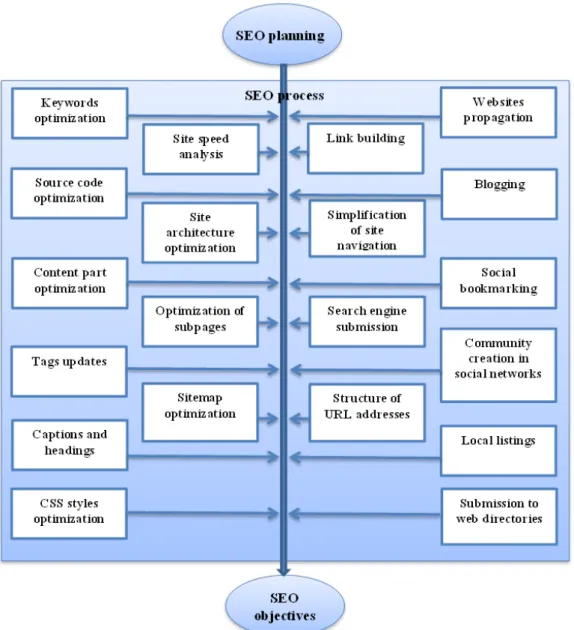
After the completion of an on-page SEO, we can continue with the implementation of off-page factors - viz Chapter 3.2. In addition to the basic SEO optimization processes, we performed further steps to improve the number of site visits in the form of improvements in the content quality, link building, offered services, website promotion etc. The illustrative search engine optimization scheme is shown in Fig. 1.
Fig. 1 Search engine optimization scheme
5.1 Keywords and tags
It is always better to use different descriptions and keywords on different pages. We used
KeywordPlanner [17] to search for tips for new keywords. This is a tool which could help us with creating the best-positioned websites.
5.2 Index coverage
The landing page is usually considered to be the most important page, because the user mostly enters it directly from search engines. Therefore, it is important to pay close attention to the landing page.
5.3 Captions and headings
The title to be inserted into a website is very important. It should contain keywords which should not be overly long and mainly, must be listed.
5.4 Optimization of subpages
It is important to stick to the strict rules for other pages and check for their SEO on-page factors. The most important factor is compliance with quality content and strict rules for optimization.
5.5 URL address structures
We assumed that a well-structured and understandable address easily guides users to the page content. For users who want to refer to our website, it is a good idea to create a simpler URL address. The best way to create a sitemap file is to download a specialized program (e.g. Sitemap Generator).
5.6 Quality content and useful services
The most important factors in terms of both users and search engines are high-quality content and the services provided. The use of new useful services which no other comparable web offers is appealing to users. For users, we created a service to compare indicators of price / performance ratio for the selected item, for instance.
5.7 Website propagation
An important way to inform visitors about new websites is to promote them on the appropriate fora. We decided to promote our new websites on social networks (e.g. Facebook, Twitter…) and user blogs. Another important step is finding quality link partners. The results of this promotion appeared after a relatively long time (several months).
6 An analysis of e-commerce platform
possibilities
E-commerce website builders are programs that let us create, customize, and run online stores. These
programs are designed to help a provider build an online store regardless of programming or web design experience. A complete e-commerce solution will come with the tools to walk us through the entire process: hosting, design, pricing and payment options, marketing tools and reports [18], [19] . 6.1 Main conditions
During the process of choosing the most suitable e-commerce website builder, we should deal with the following issues:
• Storage space - the inventory space and bandwidth to fit our needs
• Safety protocols – Secure Socket Layer (SSL) technology
• Website design – a user-friendly interface
We recommend using the following criteria to evaluate e-commerce website builders:
• The choice and quality of the design templates, customization and professional assistance
• Attract more shoppers and sell more products – through social media integration, coupon codes, Google Analytics, reporting tools, and more • E-shop (webstore) design - IT support that make
uploading products quick and easy
• Starting prices, set-up costs transaction fees, free trial period and other costs involved
• User-feedback, ratings and reviews
• Product support, response time and expert knowledge resources [20], [21]
6.2 E-commerce website builders
Here is a comparison of some selected e-commerce website builders:
• Volusion – A good starting price, no transaction fees, 14-day free trial, high security, integration of mobile commerce, social media tools, etc. • wix.com – A good starting price, no transaction
fees, 14-day free trial, high security, lead generator payment application, social integration reporting tool, etc.
• Bigcommerce- A higher starting price, 1.5% transaction fee, 15-day free trial, high security, coupon codes, social integration, built-in SEO Google Analytics etc.
• pinnaclecart – A higher starting price, no transaction fees, 14-day free trial, high security, reporting analytics, QR codes marketing, social integration etc.
• web.com – A low price, 2.5% transaction fee, 14-day free trial, high security, social integration, product management, etc.
• RIA (Rich Internet Application) e.g. new kinds of internet applications and Flex technology [22]. For the conditions of our company the most suitable e-commerce website builders appeared to be: Volusion or wix.com.
7 Optimized Website Testing and
Evaluation
To evaluate pages´ optimization, we used the Google Analytics application again (i.e. from 15th, November, 2013 to 15th, December, 2013). In addition, Google offers another tool called Website Optimizer [23], where you can experiment with your site and find what works and what doesn´t.
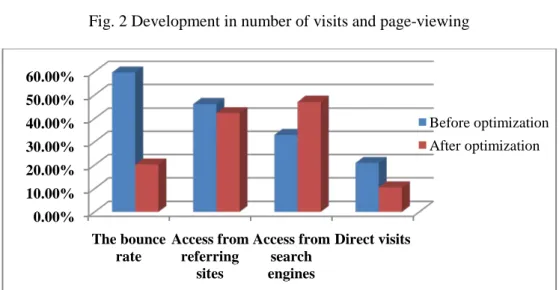
In Table 1, we can see the positive development of websites after optimization. The increase in number of visits is noticeable as is the greatly reduced bounce rate - which is very important. We must also note the increased average time on site. Percentages of access from the search engines have increased, but direct visits and access from referring sites have decreased.
Table 1 Comparison of website development before and after optimization
Before After
Number of visits 621 964
Pages viewing 1,548 5,976
The bounce rate 59.63% 20.22% Average time on site 1:15 2:39 Access from referring sites 46.17% 42.33% Access from search engines 32.95% 47.12%
Direct visits 20.88% 10.55%
Graphical representation of the development of number of visits and page-viewing before and after optimization is depicted in Fig.2. The development of the bounce rate, access from referring sites, search engines and directs visits before and after optimization is illustrated in Fig.3.
Since it takes several days or weeks until all search engines “reindex” their site-content, it is clear that the keywords will still have small representation - in the first case, landing page indexes, index.php. The landing page is dominant and search engines take it as the highest authority.
Fig. 2 Development in number of visits and page-viewing
Fig. 3 Development of the bounce rate, access from referring sites, search engines and directs visits 0 1000 2000 3000 4000 5000 6000
Number of visits Pages viewing
Before optimization After optimization 0.00% 10.00% 20.00% 30.00% 40.00% 50.00% 60.00% The bounce rate Access from referring sites Access from search engines Direct visits Before optimization After optimization
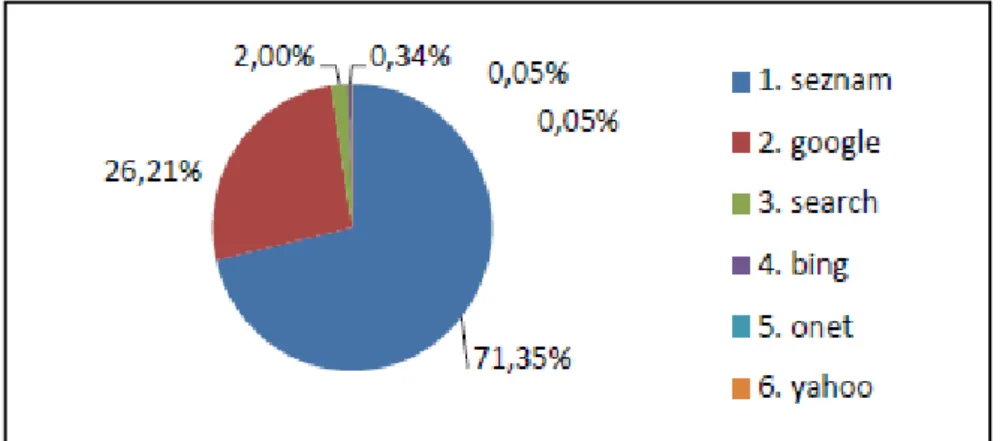
In Fig. 4, we can see that the largest share of search engines belongs to Seznam.cz (a local Czech search engine) – 71.35%. Right behind it is the Google search engine (the localized google.cz version was
used) with 26.21%. Several other full-text search engines like Search, Bing, Onet and Yahoo were also recognized.
Fig. 4 Percentage distribution of various search engines Individual sites were optimized by the most
appropriate keywords (originally in Czech) and then tested in the search engines. In Table 2, we can see
site placement in several search engines. Most of the results ranged from 1st to 10th places, which is the first page in the resulting search.
Table 2 Placement in search engines after optimization
Key words seznam.cz google.cz search.com bing.cz parking systems 1st place 3rd place 6th place 4th place car security 8th place 7th place 9th place 6th.place hands free montage 2nd place 8th.place 12th place 9th place navigation montage 3rd place 2nd place 8th place 2nd place car hi-fi montage 3rd place 9th place 9th place 3rd place music to the car 7th place 17th place 10th place 7th place installation of ceiling monitors 1st place 1st place 7th place 1st place installation of mechanical security 4th place 7th place 5. place 3rd place
8 Conclusion
The goal of the research presented herein was to propose a new structure for existing, non-optimized websites and to implement an e-commerce platform for a small manufacturing company. The major benefit of this work is its description of the analysis of an existing non-optimized website, a demonstration of practical website optimization and the testing and evaluation of optimized web structures. The work is focused on SEO search engine optimization. This is a method that helps online presentations and websites succeed in today's competitive world. First, all the websites factors that play a role in optimization were analyzed. It was found that most websites do not satisfy the basic
conditions for a good search. The design of a new web site structure was based on the previous analysis. The individual parts were optimized separately with the help of Website Optimizer. The aim was to reduce the bounce rate as much as possible - which was successful. It was also necessary to increase the percentage representation of approaches from search engines, where the value increased from 32.95% to 47.12%. From the test results, it is apparent for instance that optimization helped to reduce the bounce rate from 59.63% to 20-22%. When we look at the work from a global perspective, it is clear that the optimization of existing websites was successful and that newly designed websites are thus more easily searchable.
Implementation of the selected website builder will depend on the decision of the company management.
An analysis and comparison of the possibilities for utilization of e-commerce platform was done and is presented here. Currently, for the conditions facing our company, the most suitable traditional e-commerce website builder appeared to be Volusion. The next logical step of our future research leads to experimenting with RIA and Flax technology. References:
[1] B. Croft, D. Metzler, T. Strohman, Search Engines: Information Retrieval in Practice, Addison-Wesley, 2009, ISBN: 978-0136072249.
[2] J. Grappone, G. Couzin, Search Engine Optimization: An Hour a Day, Sybex, 2011, ISBN: 978-0470902592.
[3] D. Dover, E. Dafforn, Search Engine Optimization Secrets, Wiley, 2011, ISBN: 978-0470554180.
[4] A. Gandour, A, Regolini, Web site search engine optimization: A case study of Fragfornet, Library Hi Tech News,Volume 28, Issue 6, 2011, pp. 6-13.
[5] Beatrice Zuell, The Vision of Global Internet Freedom, International Journal of Computers and Communications, Vol.8, 2014, pp. 120-127.
[6] P. Kent, Search Engine Optimization for Dummies, Wiley, 2012, ISBN: 978-1118336854.
[7] M. H. Fleischner, SEO Made Simple: Strategies for Dominating the World's Largest Search Engine, CreateSpace Independent Publishing Platform, 2013, ISBN: 978-1481838061.
[8] R. L. Adams, SEO Simplified: Learn Search Engine Optimization Strategies and Principles for Beginners, CreateSpace Independent Publishing Platform, 2013, ISBN: 978-1484831007.
[9] R. L. Adams, SEO White Book: The Organic Guide to Google Search Engine Optimization, CreateSpace Independent Publishing Platform, 2013, ISBN: 978-1484815083.
[10]R. L. Adams, SEO Black Book: A Guide to the Search Engine Optimization Industry's Secrets, CreateSpace Independent Publishing Platform, 2013, ISBN: 978-1482665161.
[11]Vaidhya, 21 Off-Page SEO Strategies to Build Your Online Reputation, Retrieved on 28 June 2013 from http://moz.com/ugc/21offpage-seo-strategies-to-build-your-online-reputation.
[12]A.F. Al-Juboori, D. J. Su, F. Ko, Web site evaluation: Trends and existing approaches, Journal of Next Generation Technology, Volume 3, Issue 2, 2012, pp. 57-64.
[13]P. Silhavy, R. Silhavy, Z. Prokopova, Web-based service portal in healthcare, Advanced Techniques in Computing Sciences and Software Engineering, International Conference on Systems, Computing Sciences and Software Engineering, 2010, pp. 269-272. [14]R. Silhavy, P. Silhavy, Z. Prokopova,
Systematic modeling process of system behavior, International Journal of Mathematical Models and Methods in Applied Sciences, Volume 5, Issue 6, 2011, pp. 1044-1051.
[15]Seo Servis. Retrieved on 21 September 2013 from http://seo-servis.cz.
[16]Google Analytics. Retrieved on 23 July 2013 from https://www.google.com/analytics/web. [17]Keyword Planner Google AdWords. Available:
https://adwords.google.com/ko/KeywordPlanner. [18]Jaecheol Lee, Sundong Kwon, Tae-Sung Kim,
Online Privacy Concerns and Service Use (A comparison of social network service, cloud service, and mobile banking service), International Journal of Communications, Vol.8, 2014, pp. 8-15.
[19]Yeh-Cheng Chen, C. N. Chu, H. M. Sun, Ruey-Shun Chen, Y. H. Yang, Design and Implement of a Web-based E-Procurement System Platform for Shipping Line, WSEAS Transactions on Computers, Vol.13, 2014, pp. 381-393.
[20]L. F. A. Aristizabal, N. Dario Duque Mendez, SEO (Search Engine Optimization) schema application for websites with an emphasis on optimizing pages developed in flash, 7th Colombian Computing Congress, 2012.
[21]D. Tan, P. Chen, X. Liu, H. Liu, B. Sun. Using PSO algorithm to optimize linking structure of e-commerce sites, Proceedings of the 2nd International Conference on Electronic and Mechanical Engineering and Information Technology, EMEIT 2012, pp. 204-209.
[22]J. Hu, B. Li, Design and research of e-commerce web site based on RIA, Proceedings - 2013 International Conference on Computational and Information Sciences, 2013, pp. 501-503.
[23]Google Website Optimizer. Retrieved on 17 July 2013 from https://services.google.com/-websiteoptimizer.