VALUE CREATION - AS A VALUATION METHOD OF A
LISTED COMPANY
Silvia - Melania PETRESCU1 1
„A. I. Cuza” University of Iaşi
e-mail: [email protected]
The financial analysis of the companies listed on the stock market involves specialized research concerning the performance of economic and financial activity in order to diagnose the value created or destroyed for stakeholders (shareholders, creanciers, owners, employees).
The paper presents some theoretical concepts concerning the basic tools utilised in value-based management. It is focussed on performance by the value creation for the stakeholders of a company. For this reason, the fundamental analysis of the company's performance utilizes more metric tools based on added value, as Economic Value Added - trade-marked by Stern Stewart & Co, and several of its derivatives: Market Value Added (MVA) and Cash Value Added (CVA). All these indicators prove the management performance in the value creation for investors and depend on the net operating income and the cost of invested capital.
Accordingly to financial theory, EVA and its derivatives are considered as a management tools because the goal of the company is to add value as much as possible over the cost of invested capital. It must demonstrate how sensitive these tools are to the influence of various factors.
For this reason, analysis based on accounting uses more methods for listed companies valuation. Some such methods are the problems that our paper addresses.
Key words: value based management, value creation, economic value added, market value added.
The paper presents some aspects of listed company valuation in a competitive economy, confronted with fluid and versatile stock exchange demands. The real value of the listsed company is confirmed by the stock price which can attract potential investors in a favorable conjuncture of the stock market.
This is the motivation for valuing a listed company by specific indicators, which determine if the company creates or destroys value of invested capital by the own performances.
The paper emphasizes some theoretical aspects of the listed company valuation through the financial performance indicators calculated in order to determine how value is created or destroyed. We accept the main role of the Economic Value Added and its derivatives: Market Value Added and Cash Value Added.
the stakeholders value creation mechanism necesitates the utilization of financial statements, such as the Balance Sheet, the Income Statement and stock exchange data.
MATERIAL AND METHOD
The theoretical concepts from literature concerning financial management based on value performance metrics in the market economy are utilised in the paper, because sometimes apparently deep changes are superficial compared to the real principles of wealth creation.
This requested the change of the valuation principles based on accounting methods and on the traditional management practices; it imposed that financial-accounting management be based on economic value added, as the most relevant tool in the performance assessment.
The paper evaluates the economic and financial performances of a company listed on the stock market through the value creation mechanism for the stakeholders (especially for the shareholders) based on the information offered by the most significant accounting statements, the Balance Sheet and Income Statement, developed according to the E. U. directives and international accounting standards.
The research method imposed an interdisciplinary approach, specific to theoretical–applied investigations, where the accounting for management, financial management, stock analysis, statistics and financial valuation knowledge are involved.
After an explanation of the economic value added and of several related concepts, a case study of a listed company is presented to illustrate their utilization in practice. The analysis offers the opportunity to evaluate the value of the concepts in practice.
RESULTS AND DISCUSSIONS
1. The performance evaluated through value creationThe market places significant competiveness demands on companies, which must devise innovative management methods and models to survive and thrive. Among these methods we can mention value based management methods, which require the development of a new accounting for management and new tools for decision making based on the new financial or non-financial concepts, such as Activity Based Management, Balanced Scorecard, Benchmarking, or Total Quality Management.
All these concepts operate with performance valuation indicators on value creation basis.
Value creation has become central topic for management, as it is extensively used by shareholders and financial analysts; it is one of the basic concepts governing the interest of the current and potential investors for efficient investments on the stock market. The reason for this is that creating value for the company originates in a higher efficiency of the invested capital compared to the costs of its financing. The surplus thus created is a margin (named shareholder value if distributed to shareholders), which can accurately reflect the basic tenets of financial theory of capital investment.
The concept of value creation challenges traditional thought regarding performance measured only through net accounting benefit, in which only the cost of debt is considered an expense, and own capitals are not classified as a resource bearing a cost for the organization. Currently, demands from the financial markets have turned shareholders into a constraint for the publicly-traded company, which now has to provide a return on its capitals: shareholders also expect to receive this category of revenue, along with dividends.
The relationship between the management of the company and the company’s shareholders has been interpreted in several ways: some consider that shareholders are the business owners and elected management must represent their interests through stocks value maximization; others consider that management is an agent of the shareholders and must assure the long term continuity of the business.
In this respect, the financial management of the organization has evolved to include new concepts regarding the performance concept, its valuation criteria, the key factors and the models of value creation which have as a goal the value maximization for shareholders. Value creation cannot be spotty; it has to be constant and it must contribute to subordinating performance management to the objective of increasing the share value of the company.
A company is thus seen as creating value for investors (shareholders) as long as it obtains a profitability greater than the cost of the invested capital; on the contrary, the absence of performance destroys the capital value. In this way value creation for stakeholders becomes an indicator for the practical evaluation of the company.
2. The Added Value – mainstay of performance for shareholders
The Added Value offers multiple features for measuring and evaluating economic and financial performance of listed or non-listed companies; it is a basic element for determining major performance indicators. The ability to create value is the main strategic criterion for performance determination used by shareholders, whose long term goal is to maximize present and future gains.
The value created for shareholders is estimated with a set of indicators which must reflect the „true” value of the company for investors, unaffected by fluctuating market prices of shares outstanding under some independent factors of the management performance.
By extending the added value concept to the capital market performance, this concept is presented in three variants: economic value added, market value added and cash-value added [4].
2.1. The Economic Value Added - EVA
For a company which has multiple stakeholders, sometimes at odds (owners, management, employees, customers, suppliers, creditors), managers are deemed the champions of shareholders’ worth maximization. Among managerial instruments, EVA is considered to represent the owners’ interest.
residual income, was trade marked in 1990 by U. S. Consulting Company Stern Stewart, as a tool to measure the financial performance. Commercially, it is considered the best performing indicator, and it is deemed by current financial theory to be in concordance with those value principles which are important to a company's investors. EVA develops three basic ideas: cash is king, any dollars spent are really a masked investment, and own capital is expensive [1].
Because is a trademarked term, with accounting adjustements, the notion of economic profit can be used in its stead [5]. According to financial theory, residual revenue (the equivalent of economic profit and EVA) is considered a managerial tool because the goal of the company is to add value to the owners' worth. In other words, owners expect a maximal compensation over the cost of their invested capital in the company.
As a measure of additional value created by an investment or portfolio of investments on top of invested capital, EVA is a measure of financial performance of a company, calculated by deducing the cost of capital from the net operating profit:
EVA = Net Operating Profit After Tax (NOPAT)-(Invested Capital x Capital Cost)
where:
NOPAT = Operating Profit – Taxes
The cost of invested capital is an opportunity cost, namely an weighted average cost of the debt and equity (WACC), which depends on the financial structure (proportion of debt and stock used in financing):
WACC = SCP x Rf + SD x d (1 – i) (%)
where:
Rf = Return On Equity (ROE); SCP = Weight of the equity;
SD = Weight of the long term financial debts (>1 year);
d = Interest rate; i = Tax rate.
By introducing the invested capital (Ci), the Economic Value Added becomes: Ci x ] WACC -Ci NOPAT [ EVA =
A positive economic value added shows the company has created value for investors if its profitability ratio is greater than the weighted average cost of all invested capital; a negative one shows the company has destroyed the capital.
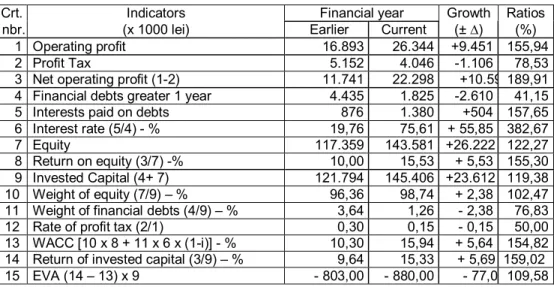
For example, using financial statement data of a listed entity [3] in Table 1, we present the Eva Value Added evolution:
Table 1 Economic Value Added
Crt. Indicators Financial year Growth Ratios
nbr. (x 1000 lei) Earlier Current (± ∆) (%)
1 Operating profit 16.893 26.344 +9.451 155,94
2 Profit Tax 5.152 4.046 -1.106 78,53
3 Net operating profit (1-2) 11.741 22.298 +10.597189,91 4 Financial debts greater 1 year 4.435 1.825 -2.610 41,15
5 Interests paid on debts 876 1.380 +504 157,65
6 Interest rate (5/4) - % 19,76 75,61 + 55,85 382,67
7 Equity 117.359 143.581 +26.222 122,27
8 Return on equity (3/7) -% 10,00 15,53 + 5,53 155,30 9 Invested Capital (4+ 7) 121.794 145.406 +23.612 119,38 10 Weight of equity (7/9) – % 96,36 98,74 + 2,38 102,47 11 Weight of financial debts (4/9) – % 3,64 1,26 - 2,38 76,83 12 Rate of profit tax (2/1) 0,30 0,15 - 0,15 50,00 13 WACC [10 x 8 + 11 x 6 x (1-i)] - % 10,30 15,94 + 5,64 154,82 14 Return of invested capital (3/9) – % 9,64 15,33 + 5,69 159,02 15 EVA (14 – 13) x 9 - 803,00 - 880,00 - 77,00 109,58
The increasing negative EVA is a consequence of the fact that the average profitability of the invested capital was smaller than the weighted average cost of capital; on the other hand, the apparent destroyed value is a result of a historical cost of the financial statements data; in spite of the fact that the historical cost is the credible one, it stands in contradiction with the market value of all the capital in current price, more relevant but less credible.
For the listed company, the cost of capital represents the possible shareholders' rate of return if their capital were invested in another business with the same risk. If we consider that the company has to pay all the invested capital sources, that is equity (Cp) of the shareholders, measured through return on stock market (Rcp) and financial debts through interest rate, finally the EVA becomes:
p) R -Cp Rnet ( Cp EVA= C = Cp (ROE – Rcp), where:
Rnet = Net profit; ROE = Return on equity; Rcp = Return on stock market.
Return on stock market (Rcp) is a function of profitability rate without risk (R0) - as the governmental bonds, the average capital market profitability (Rp) and
the β coefficient of stock volatility [2]: Rcp = R0 + β (Rp– R0) where: β =
%
%
rp
increase
ratio
price
Market
ra
increase
ity
profitabil
Stock
2.2. The Market Value Added - MVA
The MVA is the difference between the current market value of a company and the capital contributed by investors (owners, shareholders). It is the sum of all capital of the firm plus the market value of debt and equity [1]:
MVA = Market Value of Capital – Invested Capital
Invested capital is the sum of present value of initial capital contributed by shareholders and the present value of reinvested profits.
A high positive MVA shows that the company has created a substantial worth for investors, while a negative one indicates the destruction of their wealth due to underperforming management.
The MVA is the equivalent of the expected present value of future economic added values and its maximization is favored by investors even more than the maximization of the company's value through capital growth or new investments.
CONCLUSIONS
EVA is a performance metric of the actual economic profit created by the company; as it allows to estimate the company’s success or failure, it interests the investors. This indicator shows how well the company created value for shareholders and it can be utilised for capital allocation. In the mean time it indicates the destruction of value for the shareholders'capital if the company doesn't obtain a profitability at least equal to the average rate of the stock market; then the investors can switch the funds to another company.
BIBLIOGRAPHY
1. Harper, D., 2005 - Understanding economic value added,Invetsopedia.com. (2007). 2. Levinson, M., 2009 - Guide to financial markets, The Economist(Profile Books), London,
p. 145, După http//en.wikipedia.org/wiki/Beta (finance).
3. Petrescu, S., 2008 – Analiză şi diagnostic financiar-contabil. Ghid teoretico-aplicativ. Editura CECCAR, Bucureşti, p. 272.
4. Salmi, T., Virtanen, I., 2004 – Economic value added. A simulation analysis of the trendy, owner-/oriented management tool, Acta Wasaensia, No. 90, Business Administration. 5. Stewart III, G. B., 2000 – Using EVA for performance measurement and financiall