http://www.jscdss.com Vol.7 No.1 February 2020: 1-6 Article history:
Accepted 29 November 2019 Published online 29 November 2019
Journal of Soft Computing and Decision
Support Systems
Noise-Resistant Feature Extraction from Measured Data of a Passive
Sonar
Vahid Bagheri a,*, Vahid Izadi b, Kamran Davoodi c
a
Electrical and Computer Engineering Department, Persian Gulf University, Bushehr, Iran
b
Mechanical Engineering Department, UNC Charlotte, Charlotte, NC, USA, 28262
c
Electrical and Computer Engineering Department, Iran University of Science and Technology, Tehran, Iran
* Corresponding author email address: [email protected]
Abstract
In this paper, two different methods for the classification of passive sonar data based on time-frequency methods are studied. In the first step, two passive sonar signal classifier systems are implemented using the Short-Time Fourier Transformation (STFT) approach and Short-Time Fractional Fourier Transformation (STFrFT). The performance of the proposed classifier for passive sonars in the presence of an increased amount of noise is investigated in this study. The results showed that the classification system based on STFT has better efficiency in classifying the original signals. The method based on STFT showed more resistance to noisy signal classification so that the accuracy of the classification system was reduced by a smoother slope than the STFT classification system. The loss of accuracy in the STFrFT-based method for increasing the noise level is -0.15, while for STFT-based method is equal to -0.37.
Keywords: Feature extraction, Short-Time Fourier Transformation (STFT), Short-Time Fractional Fourier Transformation (STFrFT), Sonar Data Classification.
1. Introduction
Passive sonar in underwater environments is commonly used for tracking and detection of marine vessels. To classify sonar signals, related staffs are trained to take appropriate decisions by observing the visual information obtained from the spectrograph and accurately receiving the sound obtained from the target. This task places a heavy burden on these users. Therefore, designing an automated system to classify passive sonar targets to reduce the workload of sonar users is essential. There are ongoing researches to extract useful and accurate information from measured data in passive sonars. The main challenge from the practical aspect is the noisy environment and its effect on the measurement from sonar equipment (Liu et al., 2010).
Four categories of maritime vehicles for the purpose of classification are considered by researchers. These categories are defined based on the amount of noise radiated from surface ships and submarines (Zeng et al., 2013). The dominant noise sources are Propeller Cavitation Noise (PCN), Blade-Rate Tonal (BRT), Piston-Slap Tonal (PST), Gear Noise (GN), injector noise including low-frequency radiations of the hull, drift speed, impeller blade
speed, and the location of machine components. Maritime vehicles are identified and classified based on the injector noise or apparatus noise, including base frequency radiation from the vehicle body (Rajagopal et al., 1990). The classification and exposure of a practical passive sonar signal based on STFT is a conventional method for the active sonars. The application of the Finite Impulse Response Neural Networks (FIRNN) in the passive sonars concerning the feature extraction in continuous mode and different classification approaches for the received transient signals by passive sonar, is shown in (Ward et al., 2000; Farrokhrooz, 2005; Liu et al., 2010). The features of the scattered acoustic noise of ships are extracted by the probabilistic neural network (PNN) as a classifier from a model based on the regression method with appropriate order and coefficients (Farrokhrooz et al., 2011; De Seixas et al., 2011). The benefits and weaknesses of the extracted features from the energy spectrum density and higher-order characteristics are examined in (Zeng et al., 2013) and then combined the estimation of the acquired characteristics and calculated spectrum to extract the discernible features.
In data transition, the compressive sensing has been proposed to store the information in the optimum memory space with the fewer number of samples required by the
Nyquist theorem. Researchers have tried to deploy identification methods that work based on compressive sensing. However, the quality of the sampled signal in those approaches is not comparable with that of the state-of-the-art system identification approaches. Nonetheless, some signal processing technique for CS recoveries has been proposed to accelerate the improvement in the recovery phase, and also for accelerating the recovery phase (Zanddizariet et al., 2018; Mitra et al., 2019).
Not only the long-range propagated sound detection can be improved by spatial beam-forming, but also the spectrogram analysis is practical for increasing the clarity in the processed sound signal. In this way, the useful frequency components will have remained, and the noise-related parts which are outside the useful band and beam of the radiated sound will have eliminated.
The acquired signal from the hydrophone array with high sampling rates is the primary principal point in the detection process. By increasing the distance, the received signal contains a high amount of noise, and the accuracy of the detection procedure will decrease because of the high amount of SNR (Bagheri et al., 2014). There are notable differences between the wholly theoretical array gain and the actual one. The dependency on the wavelength of the acquired signal and cohered noise with the array aperture length, are two main factors to create a massive difference between abstract design and implemented one. The horizontal received sound-signal in the steering integrates with the beam-pattern by the effective beam-forming routine. The nulls in the beam pattern in the plane-wave approaches, which are away from the direction of the steering, are in the nonconstructive or even destructive modes in the beam pattern (Ozaktas et al., 1993).
This paper studies the methods presented in (Bagheri et al., 2014; De Seixas, 2011) with the recorded data from a marine vessel and then examine the effects of noise types on the performance of these two methods. The next section details the available data.
2. Data set and measurement sources
The applied analysis in the paper is based on a subset of data acquired in the Persian Golf 2016 Experiment (PerG16) from 18 March to 27 July in 2015, which was conducted by a collaborative team from the Marine research center in Tarbiat Moderres University. In the field experiment and the data acquisition phase, a large aperture for coherent sampling purposes received the dense sound-signals by hydrophone array in the x-axis with average speed 2 m/sec (roughly four knots). The data acquisition period for the different experiments is varying from 8 to 24 hours in an underwater situation. The distance from the starting point for the sampling to the end of the procedure of the one-shot experiment is about 280m to 330m. By the increased distance, the tow ship noise will appear in the recorded signal in an obvious way, which is representative of working conditions on acoustic data. The location of the arrays is from 45m to 70m below the water surface, and the water depth is varying between 100m to 300m in the
sampled area. The detail related to the used subset in this paper is presented in Table 1.
3. Study methods
There are various methods used to extract and process passive sonar signals, but the important part is to use them according the specified goal. The data used in this study consisted of five different marine vessels. As stated in (De Seixas et al., 2011), the useful information for classifying these types of passive sonar signals is at frequencies below
, so frequency changes will not be drastic. Therefore, the short-time Fourier transform method is the best method for classifying these types of targets. In the light of the above, the two methods mentioned in this article have been studied.
Table 1
Used subset detail
Type Record number
Time period/record
Total time
Percent
Motor-boat 6 130 780 22.6
Passenger
Ship 6 129 774 22.5
Cargo Ship 6 127 762 22.1
Bearing pad 6 125 750 21.7
Tow ship 3 129 384 11.1
Total 27 - 3450 100
3.1 Passive sonar signal classification system based on STFT
When the signal contains abnormal characteristics, its Fourier analysis is inappropriate. To solve this problem, a simple and innovative method involves pre-populating the
( ) signal at the particular time , computing its Fourier Transform, and repeating it for every instant . The resulting transform is called the short time Fourier transform, which is defined as follows:
( ) ∫ ( ) ( )
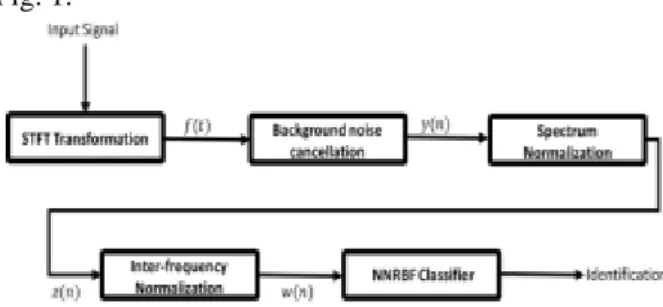
(1) Here, ( ) is the short time analysis window. Time resolution of Fourier transform of short time is proportional to effective length of analysis window ( ). In 2011, (De Seixas, 2011) the STFT method is comprehensively reviewed. In this study, the classification of passive sonar data by STFT method using neural network classifier is presented. The block diagram of this method is shown in Fig. 1.
In this way, it considers different states for extracting attributes at the output of each block, and these attributes are eventually sent to a multi-layer NN classifier to implement the classification operations. The state's number considered in (Zeng et al., 2013) are states, with
being introduced as the best case. In this study,
introduced cases were implemented on existing data. The classification results of these methods are shown in Table 2.
Table 2
Different modes of passive sonar data classification based on STFT
Classification accuracy
Mode Classification accuracy
Mode
% 90.38 W1Z1Y5F2 % 90.11 W2Z2Y1F3
% 88.02 W1Z2Y2F1 % 89.3 W2Z4Y1F3
% 89.07 W1Z2Y3F2 % 89.9 W3Z1Y4F2
% 88.9 W1Z3Y3F1 % 89.5 W4Z1Y3F2
% 90.02 W1Z3Y4F2 % 87.9 W4Z2Y6F2
3.2 Passive sonar signal classification system based on STFrFT
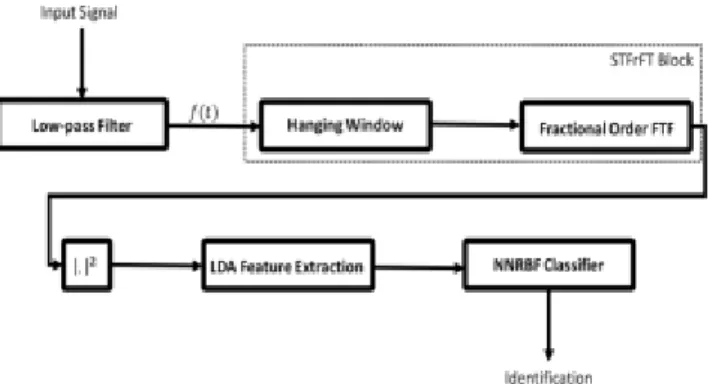
The fractional Fourier transform has been applied in different fields and the results show that this method is superior to the conventional Fourier transform method (Moavenian et al., 2012). This section presents a method for implementing a system for classification of passive sonar targets based on the Fourier transform of the short-time fractional fracture, which is shown in the processing step to the signal classification in Fig. 2.
Fig. 2. Passive sonar signal classification system based on STFrFT
Details of how to process and describe the parameters in detail are given in (Bagheri et al., 2014), introduced in the fractional Fourier transform block of parameter which provides a greater degree of freedom than ordinary Fourier transform. Proper determination of has a great impact on classification accuracy, the fractional Fourier transform is a linear operator as defined below (Ozaktas et al., 1993).
( ) ( ( )) ∫ ( ) ( ) (2)
So that ( ) represents the kernel function as follow:
( )
{
√
( )
( )
( ) ( ) ( )
(3)
Which ( ) indicates the Dirac function. is used to display the STFrFT operator. It should be noted that the angle of rotation is indicated by . Mathematicians often represent the angle of rotation with and the fractional or conversion degree with such that . It should be noted that different values of , provides conversion with distinct features. In this study, in order to find the optimal value for , this parameter was changed to a precision of in the interval and the accuracy of
classification corresponding to each change was
calculated. After the signal is passed through the pre-processing block and the signal is windowed, the number of samples per window is . Here, in terms of attributes, used for samples in each window, having many attributes, will cause problems for the classifier, such as learning delays or even training saturation. Therefore, extraction techniques are used to solve this problem. Feature extraction can be used to reduce the size or enhance the class resolution, which can ultimately increase the performance of a classifier. One of the most popular methods of feature extraction is linear discriminant analysis (LDA). It is worth noting that the classification accuracy is increased at frequencies close to one (frequency domain) and also at STFrFTLDA the maximum classification accuracy is at a fractional order . This increase in classification efficiency in a particular can be attributed to the specific display of the signal on the time-frequency plate in such a way that high resolution features can be extracted. Given that the best efficiency obtained in the STFrFTLDA method is for the range of values in the range , Table 3 shows these results.
Table 3
Accuracy of passive sonar signal classification system based on STFrFTLDA method for .
Classification accuracy
Classification accuracy
% 95.19 0.95 % 92.05 0.9
% 96.94 0.96 % 92.31 0.91
% 95.11 0.97 % 91.83 0.92
% 95.29 0.98 % 94.07 0.93
% 95.2 0.99 % 95.49 0.94
A comparison between the results of the current
classification method (STFT) and the proposed
overall performance of the classification system. As can be seen, the LDA attribute extraction method performs better despite the fewer extracted attributes, and these lower attributes increase the speed of the learning algorithm and ultimately decrease the classification operation time.
4. Investigation of noise effects on classification system
In this section, the effect of noise on sonar signal classification systems was studied. The passive sonar
signals are considered cumulative with Gaussian
distribution. The received ( ) signal by a hydrophone is expressed as follows:
( ) ( ) ( ) (4)
where ( ) is emitted wave sound by the source ( )
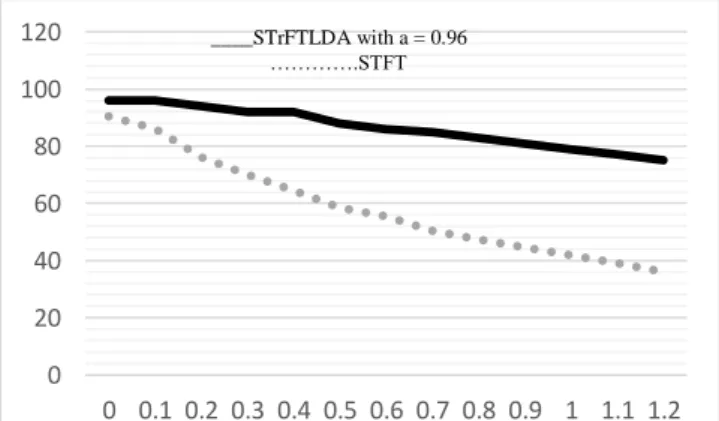
after propagation in the aqueous medium and ( ) is background noise. In this study, the Gaussian background noise distribution was investigated. The purpose of this experiment is to investigate the effect of signal reduction ratio on classification system performance, hence the Gaussian noise variance is increased in several stages and corresponding to each noise variance variation, the classification accuracy of the system was calculated. The experiment was validated on a short-time Fourier transform and classification system based on STFrFTLDA. Since the best results of the STFrFTLDA classification system were obtained, the effect of increasing noise on these orders of fractional Fourier transform was investigated and the effect of Gaussian noise enhancement was evaluated for the best accuracy of classification system. The results of the effect of noise on the performance and the accuracy of the classification system based on STFT are shown in Table 4 and the effect of Gaussian noise was compared between the classification system based on STFT and STFrFTLDA (see Fig. 3).
Table 4
Accuracy of passive sonar signal classification system based on STFrFTLDA method for the noise variance variations.
Classification accuracy
Classification accuracy
% 58.59 0.5 % 90.38 0
% 55.44 0.6 % 86.09 0.1
% 50.32 0.7 % 76.17 0.2
% 36.16 1.2 % 70.18 0.3
% 64.60 0.4
The results show that noise has more effect on the STFT-based classification system. On the other hand, the slope of variation in classification accuracy is slower in the STFrFTLDA-based system. The signal may be displayed complexly in a particular frequency range, for example,
in the time domain or in frequency domain but altering the fractional-order with the concept of signal rotation may provide a better representation of the signal in a way that filtering the signal becomes easier than noise (see Fig. 4).
Fig. 3. Noise effect on STFrFTLDA and STFT methods for α=[0.9,0.99]
Fig. 4. Signal rotation to improve noise elimination.
As it can be seen from Fig. 3, in the STFrFTLDA-based classification system, the signal-to-noise reduction reduces the accuracy of the classification, but it has a slower reduction compared to the STFT-based classification system. On the other hand, by altering the noise variance, the best classification accuracy in the STFrFTLDA-based system does not occur at constant fractional order. The best classification accuracy can be found in different categories as it is illustrated in Fig. 5.
Fig. 5. Effect of Gaussian noise in STFT and STFrFTLDA methods with
.
0 20 40 60 80 100 120
0 0.1 0.2 0.3 0.4 0.5 0.6 0.7 0.8 0.9 1 1.1 1.2 ____STrFTLDA with a = 0.96
The effect of Gaussian noise on the classification system was investigated in this study, although the assumption of Gaussian noise in the underwater environment may be different than reality however this type of noise can be a suitable criterion to evaluate the resistance of the classification system against the noise. Rain noise is one of the noises that affect the background noise of the underwater environment.
Midsize raindrops generate a sound level
of to decibels near the surface, and large raindrops produce decibels which frequency efficiency of rain noise is to . This relatively wide frequency efficiency overlaps with the desired frequency range. Therefore, it is advantageous to study the performance of the classification system during rainfall. For this purpose, the heavy rain noise signal obtained from (Rana et al., 2013) was added to the passive sonar target signal in two forms. In the first case, the rain noise signal in form of cumulative added to the passive sonar signal and in the second case, the rain noise was combined with passive sonar signals by an audio file compiler software (mixpad). The reason for this type of sound combination is that the synthesized sound becomes distinguishable to the sonar operator. The results of the classified passive noisy sonar signals with rain noise by using the STFrFTLDA-based classification system are shown in Table 5 which shows the appropriate resistance of this classification system to the rain noise.
Table 5
The effect of the heavy rainfall noise on the accuracy of STFrFTLDA classification system.
Fractional order
Classification accuracy
Original Signal
Original Signal + Noise (rain)
Original Signal + Noise (heavy rain)
0.96 % 86.09 % 86.09 % 86.09
0.98 % 76.17 % 76.17 % 76.17
0.99 % 70.18 % 70.18 % 70.18
% 64.60 0.4
5. Conclusion
Passive sonar systems are typically used to classify targets along with the detection and tracking tasks and with the help of emitted noise by these targets. Passive sonar signal detection and classification systems are designed according to the type of target (vessels, torpedoes, submarines, marine animals, etc.). In this paper, two passive sonar signal classification systems are studied concerning the available data and the characteristics of the targets. The first classification system studied was the Short-Time Fourier transform (STFT) and the second one was based on the Short-Time Fractional Fourier Transform and feature extraction technique (STFrFTLDA). Implementation of the STFrFTLDA-based classification system on existing passive sonar data showed a better performance than the STFT-based system in which the best performance of the STFrFTLDA-based classification system with fractional-order of was percent of the classification
accuracy and in the STFT based method, this accuracy was obtained percent. This better performance can be due to the presence of a fractional order in the STFrFTLDA, which provides a higher degree of freedom and flexibility by rotating the signal on the time-frequency plane, or different fractional orders which can display the signal in an optimal fractional order so that the features can be extracted with higher resolution.
In this paper, Gaussian noise and rain noise were used to evaluate the effect of increasing noise and the resistance of two classification systems. Commonly, the background noise in the sea environment is considered a Gaussian noise. The results depict that increasing Gaussian noise variance has less effect on the performance of the STFrFTLDA-based approach, somewhat concerning the STFT-based. Accordingly, the slope of the reduction in classification accuracy variation in the classification system based on the STFrFTLDA method is for increasing the noise variance to whereas the same scale for the STFT classification system is equal to which demonstrates the better resistance of the STFrFTLDA method against Gaussian noise. In the next step, the rain noise was added to the signal according to the fact that it is one of the most effective noises on the background noise, reduces the signal to noise rate and has the same frequency efficiency with the aims of this study. The negative effect of the classification accuracy was studied in which it shows variation in classification accuracy in the STFrFTLDA method and in STFFT. These results show better performance and higher resistance for the STFrFTLDA classification systems compared to the STFFT method.
References
Bagheri, V., Jahromi, M. S., Keshavarz, A., & Rostami, H. (2014). Time-Frequency Signal Processing Based on Fractional Fourier Transform in Passive Sonar Classification. Int. J. Electron. Commun. Comput. Eng, 5(6), 1366-1370. De Seixas, J. M., & De Moura, N. N. (2011). Preprocessing
passive sonar signals for neural classification. IET radar, sonar & navigation, 5(6), 605-612.
Farrokhrooz, M., & Karimi, M. (2011). Marine vessels acoustic radiated noise classification in passive sonar using probabilistic neural network and spectral features. Intelligent Automation & Soft Computing, 17(3), 369-383.
Farrokhrooz, M., & Karimi, M. (2005, June). Ship noise classification using probabilistic neural network and AR model coefficients. In Europe Oceans 2005 (Vol. 2, pp. 1107-1110). IEEE.
Izadi, V., & Ghasemi, A. (2019). Determination of roles and interaction modes in a haptic shared control framework. In Proceedings of the ASMA Dynamic Systems and Control Conference in Park City, Utah (pp. 1-8).
Izadi, V., Abedi, M., Bolandi, H., & Vaghei, G. (2014). Reaction wheel functional modeling based on internal component. In 17th Iranian Conference on Electrical and Electronics Engineering in (pp. 123-127).
Izadi, V., Abedi, M., & Bolandi, H. (2016, January). Verification of reaction wheel functional model in HIL test-bed. In 2016 4th International Conference on Control, Instrumentation, and Automation (ICCIA) (pp. 155-160). IEEE.
Izadi, V., Shahri, P. K., & Ahani, H. (2019). A compressed-sensing-based compressor for ECG. Biomedical engineering letters.
Liu, Z., Meng, L., Zhao, W., & Yu, F. (2010, May). Application of ANN in food safety early warning. In 2010 2nd International Conference on Future Computer and Communication (Vol. 3, pp. V3-677). IEEE.
Mitra, D., Zanddizari, H., & Rajan, S. (2019). Investigation of kronecker-based recovery of compressed ecg signal. IEEE Transactions on Instrumentation and Measurement.
Moavenian M., Ashtiani B., Ahani H., Nazari F. (2012) Applying Neural Network for the Identification of Multiple Cracks in Beams Using Genetic Algorithm. ICMEAT2012
Ozaktas, H. M., & Mendlovic, D. (1993). Fractional Fourier transforms and their optical implementation. II. JOSA A, 10(12), 2522-2531.
Rajagopal, R., Sankaranarayanan, B., & Rao, P. R. (1990, April). Target classification in a passive sonar-an expert system approach. In International Conference on Acoustics, Speech, and Signal Processing (pp. 2911-2914). IEEE.
Rana, P., Mishra, V., & Pachauri, R. (2013). Filtering in time-frequency domain using STFrFT. International Journal of Computer Applications, 69(26), 5-9.
Shahri, P. K., Shindgikar, S. C., HomChaudhuri, B., & Ghasemi, A. (2019). Optimal Lane Management in Heterogeneous Traffic Network. In Proceedings of the ASMA Dynamic Systems and Control Conference in Park City, Utah.
Taremi, R. S., Shahri, P. K., & Kalareh, A. Y. (2019). Design a Tracking Control Law for the Nonlinear Continuous Time Fuzzy Polynomial Systems. Journal of Soft Computing and Decision Support Systems, 6(6), 21-27.
Ward, M. K., & Stevenson, M. (2000, May). Sonar signal detection and classification using artificial neural networks. In 2000 Canadian Conference on Electrical and Computer Engineering. Conference Proceedings. Navigating to a New Era (Cat. No. 00TH8492) (Vol. 2, pp. 717-721). IEEE. Zanddizari, H., S. Rajan, and Houman Zarrabi. "Increasing the
quality of reconstructed signal in compressive sensing utilizing Kronecker technique." Biomedical engineering letters 8.2 (2018): 239-247.